EP1108824A1 - Baumaterial - Google Patents
Baumaterial Download PDFInfo
- Publication number
- EP1108824A1 EP1108824A1 EP99947951A EP99947951A EP1108824A1 EP 1108824 A1 EP1108824 A1 EP 1108824A1 EP 99947951 A EP99947951 A EP 99947951A EP 99947951 A EP99947951 A EP 99947951A EP 1108824 A1 EP1108824 A1 EP 1108824A1
- Authority
- EP
- European Patent Office
- Prior art keywords
- microcapsules
- construction
- hinokitiol
- concrete
- base material
- Prior art date
- Legal status (The legal status is an assumption and is not a legal conclusion. Google has not performed a legal analysis and makes no representation as to the accuracy of the status listed.)
- Withdrawn
Links
- 239000004566 building material Substances 0.000 title 1
- FUWUEFKEXZQKKA-UHFFFAOYSA-N beta-thujaplicin Chemical compound CC(C)C=1C=CC=C(O)C(=O)C=1 FUWUEFKEXZQKKA-UHFFFAOYSA-N 0.000 claims abstract description 72
- 239000003094 microcapsule Substances 0.000 claims abstract description 50
- TUFYVOCKVJOUIR-UHFFFAOYSA-N alpha-Thujaplicin Natural products CC(C)C=1C=CC=CC(=O)C=1O TUFYVOCKVJOUIR-UHFFFAOYSA-N 0.000 claims abstract description 36
- 229930007845 β-thujaplicin Natural products 0.000 claims abstract description 36
- 239000000463 material Substances 0.000 claims abstract description 34
- 238000010276 construction Methods 0.000 claims abstract description 30
- 239000007788 liquid Substances 0.000 claims abstract description 27
- 239000004035 construction material Substances 0.000 claims abstract description 21
- 230000008859 change Effects 0.000 claims abstract description 7
- 239000004567 concrete Substances 0.000 claims description 34
- 230000000694 effects Effects 0.000 description 10
- 241000894006 Bacteria Species 0.000 description 9
- 239000007864 aqueous solution Substances 0.000 description 7
- 230000007774 longterm Effects 0.000 description 6
- 239000003242 anti bacterial agent Substances 0.000 description 5
- 230000000844 anti-bacterial effect Effects 0.000 description 5
- 241000256602 Isoptera Species 0.000 description 4
- NBIIXXVUZAFLBC-UHFFFAOYSA-N Phosphoric acid Chemical compound OP(O)(O)=O NBIIXXVUZAFLBC-UHFFFAOYSA-N 0.000 description 4
- 239000002781 deodorant agent Substances 0.000 description 4
- 239000002994 raw material Substances 0.000 description 4
- 239000000243 solution Substances 0.000 description 4
- 239000000853 adhesive Substances 0.000 description 3
- 230000001070 adhesive effect Effects 0.000 description 3
- 230000007423 decrease Effects 0.000 description 3
- 239000000284 extract Substances 0.000 description 3
- 238000000605 extraction Methods 0.000 description 3
- 238000002156 mixing Methods 0.000 description 3
- 230000001846 repelling effect Effects 0.000 description 3
- 229920003002 synthetic resin Polymers 0.000 description 3
- 239000000057 synthetic resin Substances 0.000 description 3
- 241000588724 Escherichia coli Species 0.000 description 2
- 241000589242 Legionella pneumophila Species 0.000 description 2
- 241000191967 Staphylococcus aureus Species 0.000 description 2
- 229910000147 aluminium phosphate Inorganic materials 0.000 description 2
- 239000007853 buffer solution Substances 0.000 description 2
- 238000004332 deodorization Methods 0.000 description 2
- 230000008030 elimination Effects 0.000 description 2
- 238000003379 elimination reaction Methods 0.000 description 2
- 238000002474 experimental method Methods 0.000 description 2
- 229940115932 legionella pneumophila Drugs 0.000 description 2
- 238000004519 manufacturing process Methods 0.000 description 2
- 239000000203 mixture Substances 0.000 description 2
- 241000218691 Cupressaceae Species 0.000 description 1
- 108010073771 Soybean Proteins Proteins 0.000 description 1
- 238000004378 air conditioning Methods 0.000 description 1
- 244000052616 bacterial pathogen Species 0.000 description 1
- 230000009286 beneficial effect Effects 0.000 description 1
- 239000004568 cement Substances 0.000 description 1
- 238000001816 cooling Methods 0.000 description 1
- 235000013365 dairy product Nutrition 0.000 description 1
- 230000006866 deterioration Effects 0.000 description 1
- 239000012634 fragment Substances 0.000 description 1
- 239000003205 fragrance Substances 0.000 description 1
- 230000006872 improvement Effects 0.000 description 1
- 238000004898 kneading Methods 0.000 description 1
- 238000000034 method Methods 0.000 description 1
- 238000012986 modification Methods 0.000 description 1
- 230000004048 modification Effects 0.000 description 1
- 239000003973 paint Substances 0.000 description 1
- 239000002245 particle Substances 0.000 description 1
- 239000011120 plywood Substances 0.000 description 1
- 230000008569 process Effects 0.000 description 1
- 239000011150 reinforced concrete Substances 0.000 description 1
- 238000002791 soaking Methods 0.000 description 1
- 239000002689 soil Substances 0.000 description 1
- 235000019710 soybean protein Nutrition 0.000 description 1
- 230000004936 stimulating effect Effects 0.000 description 1
- 239000005418 vegetable material Substances 0.000 description 1
- XLYOFNOQVPJJNP-UHFFFAOYSA-N water Substances O XLYOFNOQVPJJNP-UHFFFAOYSA-N 0.000 description 1
- 239000002023 wood Substances 0.000 description 1
Images
Classifications
-
- C—CHEMISTRY; METALLURGY
- C04—CEMENTS; CONCRETE; ARTIFICIAL STONE; CERAMICS; REFRACTORIES
- C04B—LIME, MAGNESIA; SLAG; CEMENTS; COMPOSITIONS THEREOF, e.g. MORTARS, CONCRETE OR LIKE BUILDING MATERIALS; ARTIFICIAL STONE; CERAMICS; REFRACTORIES; TREATMENT OF NATURAL STONE
- C04B40/00—Processes, in general, for influencing or modifying the properties of mortars, concrete or artificial stone compositions, e.g. their setting or hardening ability
- C04B40/06—Inhibiting the setting, e.g. mortars of the deferred action type containing water in breakable containers ; Inhibiting the action of active ingredients
- C04B40/0633—Chemical separation of ingredients, e.g. slowly soluble activator
-
- A—HUMAN NECESSITIES
- A01—AGRICULTURE; FORESTRY; ANIMAL HUSBANDRY; HUNTING; TRAPPING; FISHING
- A01M—CATCHING, TRAPPING OR SCARING OF ANIMALS; APPARATUS FOR THE DESTRUCTION OF NOXIOUS ANIMALS OR NOXIOUS PLANTS
- A01M1/00—Stationary means for catching or killing insects
- A01M1/24—Arrangements connected with buildings, doors, windows, or the like
- A01M1/245—Arrangements connected with buildings, doors, windows, or the like for pesticide application or distribution, e.g. using a network of pipes
-
- C—CHEMISTRY; METALLURGY
- C04—CEMENTS; CONCRETE; ARTIFICIAL STONE; CERAMICS; REFRACTORIES
- C04B—LIME, MAGNESIA; SLAG; CEMENTS; COMPOSITIONS THEREOF, e.g. MORTARS, CONCRETE OR LIKE BUILDING MATERIALS; ARTIFICIAL STONE; CERAMICS; REFRACTORIES; TREATMENT OF NATURAL STONE
- C04B24/00—Use of organic materials as active ingredients for mortars, concrete or artificial stone, e.g. plasticisers
-
- C—CHEMISTRY; METALLURGY
- C04—CEMENTS; CONCRETE; ARTIFICIAL STONE; CERAMICS; REFRACTORIES
- C04B—LIME, MAGNESIA; SLAG; CEMENTS; COMPOSITIONS THEREOF, e.g. MORTARS, CONCRETE OR LIKE BUILDING MATERIALS; ARTIFICIAL STONE; CERAMICS; REFRACTORIES; TREATMENT OF NATURAL STONE
- C04B40/00—Processes, in general, for influencing or modifying the properties of mortars, concrete or artificial stone compositions, e.g. their setting or hardening ability
- C04B40/06—Inhibiting the setting, e.g. mortars of the deferred action type containing water in breakable containers ; Inhibiting the action of active ingredients
- C04B40/0641—Mechanical separation of ingredients, e.g. accelerator in breakable microcapsules
-
- E—FIXED CONSTRUCTIONS
- E04—BUILDING
- E04B—GENERAL BUILDING CONSTRUCTIONS; WALLS, e.g. PARTITIONS; ROOFS; FLOORS; CEILINGS; INSULATION OR OTHER PROTECTION OF BUILDINGS
- E04B1/00—Constructions in general; Structures which are not restricted either to walls, e.g. partitions, or floors or ceilings or roofs
- E04B1/62—Insulation or other protection; Elements or use of specified material therefor
- E04B1/72—Pest control
-
- A—HUMAN NECESSITIES
- A01—AGRICULTURE; FORESTRY; ANIMAL HUSBANDRY; HUNTING; TRAPPING; FISHING
- A01M—CATCHING, TRAPPING OR SCARING OF ANIMALS; APPARATUS FOR THE DESTRUCTION OF NOXIOUS ANIMALS OR NOXIOUS PLANTS
- A01M2200/00—Kind of animal
- A01M2200/01—Insects
- A01M2200/011—Crawling insects
-
- Y—GENERAL TAGGING OF NEW TECHNOLOGICAL DEVELOPMENTS; GENERAL TAGGING OF CROSS-SECTIONAL TECHNOLOGIES SPANNING OVER SEVERAL SECTIONS OF THE IPC; TECHNICAL SUBJECTS COVERED BY FORMER USPC CROSS-REFERENCE ART COLLECTIONS [XRACs] AND DIGESTS
- Y10—TECHNICAL SUBJECTS COVERED BY FORMER USPC
- Y10T—TECHNICAL SUBJECTS COVERED BY FORMER US CLASSIFICATION
- Y10T428/00—Stock material or miscellaneous articles
- Y10T428/29—Coated or structually defined flake, particle, cell, strand, strand portion, rod, filament, macroscopic fiber or mass thereof
- Y10T428/2982—Particulate matter [e.g., sphere, flake, etc.]
- Y10T428/2984—Microcapsule with fluid core [includes liposome]
Definitions
- This invention relates to a construction material, more specifically to a construction material which constitutes walls or floors of a construction.
- concrete is sometimes used as a construction material in high-rise buildings or residential housings, etc.
- the concrete is used, for example, for a base in a single residential house or for floors or walls in high-rise buildings or apartment houses such as condominium. Then, in case of the apartment houses made of reinforced concrete interior materials made of wood-base such as plywood are used for walls or floors in order to improve comfortability.
- the interior material uses a large amount of synthetic resin adhesive in a process of manufacturing the interior material as well as in applying the interior material.
- synthetic resin adhesives it is known that some kind of the synthetic resin adhesive diffuses a peculiar smell in indoors as well as diffuses some material which may affect human body in indoors.
- an opening portion such as a window employs a window sash, which improves airtightness of the room, and an opening in windows or doorways decreases.
- the object of the invention is to solve all of the above-mentioned problems.
- the construction material in accordance with the invention is so made that a construction base material such as concrete or stucco is mixed with microcapsules inside of which liquid containing hinokitiol is incorporated and has such an arrangement that the microcapsules collapse due to at least change with time and the incorporated liquid transudes into the construction material base.
- the invention is a construction material characterized by that comprising a construction base material and microcapsules inside of which liquid containing hinokitiol is incorporated and a plurality of which are to be mixed into the construction base material and that the liquid in the microcapsules transudes into the construction base material because the microcapsules collapse due to at least change with time.
- the microcapsules in the construction base material gradually collapse one by one as time goes by and the liquid containing the hinokitiol and incorporated in the collapsed microcapsule transudes into the construction base material.
- the liquid gradually spreads in whole of the construction base material according to collapse of the microcapsules.
- construction base material concrete or stucco is represented.
- the construction base material is used, for example, in a residential house, the construction base material is used for a part which remains for a long time even if walls or floors are reconstructed.
- the effect of the hinokitiol can last throughout a long term.
- the microcapsules are mixed with the construction base material at a volume of about 0.5 through 1 per cent of a volume of the construction base material. With this mixing ratio, it is possible to secure enough volume which can produce an effect of the hinokitiol continuously for one construction material and to suppress a rise in the manufacturing cost, resulting in producing an effect of the hinokitiol with an improved cost performance. In the meantime, even though the microcapsules are mixed into the construction base material with a mixing ratio over the above ratio, the improvement in the effect according to the increase in the amount of the liquid containing the hinokitiol which is to transude into the construction base material can not be expected.
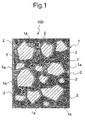
- Fig. 1 is a cross-sectional view of a principle part showing one embodiment of the invention.
- a construction material shown in Fig. 1 comprises concrete 1 as a construction base material and microcapsules 2 inside of which liquid containing hinokitiol is incorporated.
- the concrete 1 may be made of cement, rough aggregates la, fine aggregates and water with a variety of different mixing rates. Since each of the microcapsules 2 is extremely small in size compared with the rough aggregates la or the fine aggregates, the microcapsule 2 is shown in a magnified size in Fig. 1 to clarify the microcapsule 2.
- Fig. 1 shows a cross-sectional view of the construction material of the embodiment which is used for a wall.
- the microcapsule 2 has a cover manufactured by a vegetable material of, for example, soybean protein, and liquid containing the hinokitiol which will be described hereinafter in detail is incorporated inside thereof.
- the size of the microcapsule 2 is preferably, for example, about 2 ⁇ m.
- a solution containing the hinokitiol may be used as the liquid containing the hinokitiol of an aqueous solution extracted from the hinoki (Japanese cypress).
- the aqueous solution containing the hinokitiol is extracted by separating it from a solution containing a mix of oil and aqueous solution, obtained by directing high-pressure, high-temperature flow of steam at raw material comprised of hinoki chips, bark, branches or leaves, to fumigate the raw material, followed by rapid cooling and liquefaction of the steam containing the hinokitiol.
- the raw material comprised of wood fragments of hinoki is thus reduced to approximately sawdust-sized particles, which enhances extraction efficiency as by increasing the surface area of the overall supply of the raw material, namely, the area available for contact with the steam.
- the solution extracted namely, the undiluted extract, contains a mixture of oil and aqueous solution containing the hinokitiol.
- This undiluted extract is accumulated in a container used for extraction, the oil is separated, and the aqueous solution is separated from the oil and placed in a separate vessel to obtain an aqueous solution containing at least the hinokitiol.
- This aqueous solution may of course also contain other beneficial extracts apart from the hinokitiol.
- microcapsules 2 are mixed with the concrete 1 with a ratio of the microcapsule 2 to the concrete 1 approximate 0.5 through 1 per cent by volume while kneading the concrete 1.
- the microcapsules 2 are mixed into the concrete 1 at generally the same time when the rough aggregates la or the fine aggregates are mixed so as to knead the concrete 1.
- the microcapsules 2 are placed into a mixer where the concrete 1 is mixed, the microcapsules 2 are in a state of a lump which is formed by several decade pieces to several hundred pieces of the microcapsules 2 being attracted each other.
- the microcapsules 2 which have been mixed with the concrete 1 are distributed generally even over the whole concrete 1 in a state of the lump inside of the hardened concrete 1.
- the construction material 100 is made, which comprises the concrete 1 and the microcapsules 2.
- the above-described construction material 100 shows a bactericidal action whose test results are shown as follows.
- the trial of the antibacterial effect is conducted by hardening the concrete 1 into which the microcapsules 2 are mixed, smashing the concrete 1 after cured for about 1 month, soaking the smashed construction material 100 into phosphoric acid buffer solution at a proportion of 10 g of the construction material 100 to 50 ml of phosphoric acid buffer solution maintained at 35 °C and measuring populations of each bacteria adhered to the construction material 100 in every 24 hours.
- Table 1 shows a result of a trial conducted to evaluate the bactericidal ability and table 2 shows a results of a control experiment for comparison.
- concrete 1 into which the microcapsules 2 are mixed is, for example, used for an apartment house such as condominium.
- the microcapsules 2 are distributed into floors, walls and ceilings constituting a room of the apartment house, aroma of the hinokitiol always exists in the air.
- it can prevent a carpet laid on the floor from being infested with sticks due to the antibacterial effect. As a result, it can save a trouble of applying antibacterial agents.
- the microcapsules 2 in the concrete 1 might get broken or damaged a little while the concrete 1 is kneaded, which makes liquid containing the hinokitiol infiltrate into tissue of the hardened concrete 1 from an initial stage so as to diffuse the aroma of the hinokitiol.
- the diffused aroma is quite a little compared with an amount of the liquid in the microcapsules existing in the concrete 1.
- the damaged microcapsules 2 break one by one in the early time and the liquid containing the hinokitiol transudes into the concrete 1.
- the microcapsules 2 which has not got damaged break due to change with time and the liquid containing the hinokitiol infiltrates into the concrete 1.
- the aroma of the hinokitiol is constantly diffused from inside of the concrete 1.
- the liquid containing the hinokitiol and incorporated into the microcapsule 2 infiltrates gradually one by one due to collapse of the microcapsule 2, the aroma and the antibacterial action of the hinokitiol can be enjoyed constantly throughout a long term.
- a base of a wooden house is made of the construction material 100, wooden parts such as the base can be prevented from harm of termites due to a characteristic of termite repelling.
- the amount of the liquid containing the hinokitiol which transudes into the concrete 1 is very small because the liquid is contained in the microcapsule 2. Therefore, it is as a whole micro-perfumed because of a small amount and it is possible to sufficiently demonstrate an effect which the hinokitiol possesses without stimulating residents.
- the microcapsules 2 are mixed with the concrete 1 at a volume of about 0.5 through 1 per cent of a volume of the concrete 1, the strength of the concrete 1 is not influenced. As a result, the effect of the hinokitiol can be demonstrated to the maximum without causing deterioration of the concrete 1. In addition, there is no an extreme difference in the effect of the hinokitiol even if the microcapsules 2 are mixed over such volume ratio, resulting in high cost performance.
- the construction base material is the concrete 1, however, it may be stucco or soil of a paint wall in a Japanesque house.
- oil liquid separated from extraction undiluted solution may be used as the liquid containing the hinokitiol.
- the construction material in accordance with the invention is good for antimicrobe, bacteria elimination, termite repelling, deodorization and suitable for walls or floors of residential houses or apartment houses, and for a base of wooden architectures.
Landscapes
- Chemical & Material Sciences (AREA)
- Engineering & Computer Science (AREA)
- Ceramic Engineering (AREA)
- Life Sciences & Earth Sciences (AREA)
- Structural Engineering (AREA)
- Pest Control & Pesticides (AREA)
- Materials Engineering (AREA)
- Organic Chemistry (AREA)
- Analytical Chemistry (AREA)
- Architecture (AREA)
- Electromagnetism (AREA)
- Civil Engineering (AREA)
- Physics & Mathematics (AREA)
- Insects & Arthropods (AREA)
- Wood Science & Technology (AREA)
- Zoology (AREA)
- Environmental Sciences (AREA)
- Building Environments (AREA)
- Agricultural Chemicals And Associated Chemicals (AREA)
- Panels For Use In Building Construction (AREA)
Applications Claiming Priority (3)
| Application Number | Priority Date | Filing Date | Title |
|---|---|---|---|
| JP1999004383U JP3064963U (ja) | 1999-06-17 | 1999-06-17 | 建築資材 |
| JP438399U | 1999-06-17 | ||
| PCT/JP1999/005741 WO2000079065A1 (en) | 1999-06-17 | 1999-10-18 | Building material |
Publications (1)
| Publication Number | Publication Date |
|---|---|
| EP1108824A1 true EP1108824A1 (de) | 2001-06-20 |
Family
ID=11582849
Family Applications (1)
| Application Number | Title | Priority Date | Filing Date |
|---|---|---|---|
| EP99947951A Withdrawn EP1108824A1 (de) | 1999-06-17 | 1999-10-18 | Baumaterial |
Country Status (4)
| Country | Link |
|---|---|
| US (1) | US6350304B1 (de) |
| EP (1) | EP1108824A1 (de) |
| JP (1) | JP3064963U (de) |
| WO (1) | WO2000079065A1 (de) |
Cited By (3)
| Publication number | Priority date | Publication date | Assignee | Title |
|---|---|---|---|---|
| EP1698672A2 (de) | 2002-06-19 | 2006-09-06 | THOR GmbH | Beschichtungsmasse mit Biozidmikrokapseln |
| WO2010121606A2 (de) | 2009-04-24 | 2010-10-28 | Chemische Werke Kluthe Gmbh | Verfahren, formulierungen und erzeugnis für die biozide behandlung eines kühlschmierstoffs |
| US11577212B2 (en) | 2018-07-16 | 2023-02-14 | SAS Nanotechnologies Inc. | Stimuli-responsive micro-reservoirs for release of encapsulants |
Families Citing this family (7)
| Publication number | Priority date | Publication date | Assignee | Title |
|---|---|---|---|---|
| JP3781405B2 (ja) * | 2000-09-04 | 2006-05-31 | 株式会社トピックス | ヒノキチオール含有マイクロカプセルの使用方法 |
| JP3522672B2 (ja) | 2000-09-04 | 2004-04-26 | 株式会社トピックス | 防湿シート及び防湿シートの使用方法 |
| US6565644B2 (en) * | 2001-06-27 | 2003-05-20 | The United States Of America As Represented By The Secretary Of The Interior | Micro-encapsulated crack resistant cement |
| MXPA02012236A (es) * | 2002-12-10 | 2004-07-16 | Cemex Trademarks Worldwide Ltd | Pisos y recubrimientos prefabricados con actividad antimicrobiana. |
| US8974594B2 (en) | 2011-03-29 | 2015-03-10 | Empire Technology Development Llc | Microcapsule corrosion control in reinforced concrete |
| CN104295002B (zh) * | 2014-09-17 | 2016-06-29 | 华南理工大学 | 内设局部约束的高强化再生混合钢管砼轴压柱及施工工艺 |
| CN110204260B (zh) * | 2019-05-24 | 2021-01-01 | 武汉大学 | 一种抗蚁混凝土及其制备方法 |
Family Cites Families (12)
| Publication number | Priority date | Publication date | Assignee | Title |
|---|---|---|---|---|
| US4772326A (en) * | 1986-02-28 | 1988-09-20 | Construction Products Research, Inc. | Cartridges of fast setting cement and gelled water |
| JPH0791100B2 (ja) * | 1986-12-10 | 1995-10-04 | タカタ株式会社 | コンクリ−トやモルタルの劣化防止方法 |
| JPS63205232A (ja) * | 1987-02-23 | 1988-08-24 | 松下電工株式会社 | 建材 |
| JPH0333043A (ja) * | 1989-06-29 | 1991-02-13 | Takashi Saigan | 防かびセメントの製造法 |
| US5164096A (en) * | 1991-11-01 | 1992-11-17 | Nalco Chemical Company | Biocide microencapsulation |
| JPH05132950A (ja) * | 1991-11-11 | 1993-05-28 | Ibiden Co Ltd | 建物のための直接基礎 |
| US5320851A (en) * | 1992-01-31 | 1994-06-14 | W. R. Grace & Co.-Conn. | Packaging and dispensing system for fluid and semi-fluid cement admixtures |
| JPH06184475A (ja) * | 1992-04-14 | 1994-07-05 | Takeyoshi Horinouchi | 抗菌剤からの気相を徐放する塗料の製造方法 |
| JPH0665018A (ja) * | 1992-08-21 | 1994-03-08 | New Line Package:Kk | 防虫性塗料ならびに防虫性インキおよびこれらを使用した建材ならびに包装材 |
| JPH07243172A (ja) * | 1994-03-07 | 1995-09-19 | Sakagami Taoru Kk | 抗菌・防ダニ性の布製品 |
| JP3547058B2 (ja) * | 1995-03-31 | 2004-07-28 | 株式会社パル | 抗菌性木質建材 |
| JPH1112017A (ja) * | 1998-05-08 | 1999-01-19 | Toto Ltd | 防菌防カビ性を有する建築用基材 |
-
1999
- 1999-06-17 JP JP1999004383U patent/JP3064963U/ja not_active Expired - Lifetime
- 1999-10-18 WO PCT/JP1999/005741 patent/WO2000079065A1/ja not_active Ceased
- 1999-10-18 EP EP99947951A patent/EP1108824A1/de not_active Withdrawn
- 1999-10-18 US US09/674,324 patent/US6350304B1/en not_active Expired - Fee Related
Non-Patent Citations (1)
| Title |
|---|
| See references of WO0079065A1 * |
Cited By (4)
| Publication number | Priority date | Publication date | Assignee | Title |
|---|---|---|---|---|
| EP1698672A2 (de) | 2002-06-19 | 2006-09-06 | THOR GmbH | Beschichtungsmasse mit Biozidmikrokapseln |
| WO2010121606A2 (de) | 2009-04-24 | 2010-10-28 | Chemische Werke Kluthe Gmbh | Verfahren, formulierungen und erzeugnis für die biozide behandlung eines kühlschmierstoffs |
| DE102010018312A1 (de) | 2009-04-24 | 2010-11-04 | Chemische Werke Kluthe Gmbh | Verfahren und Erzeugnis für die biozide Behandlung eines Kühlschmierstoffs |
| US11577212B2 (en) | 2018-07-16 | 2023-02-14 | SAS Nanotechnologies Inc. | Stimuli-responsive micro-reservoirs for release of encapsulants |
Also Published As
| Publication number | Publication date |
|---|---|
| JP3064963U (ja) | 2000-01-28 |
| WO2000079065A1 (en) | 2000-12-28 |
| US6350304B1 (en) | 2002-02-26 |
Similar Documents
| Publication | Publication Date | Title |
|---|---|---|
| US6350304B1 (en) | Building material | |
| CN106189864B (zh) | 一种具有抗菌防霉功能的植物纤维墙衣涂料 | |
| DE102004056362A1 (de) | Schimmel-beständige Baustoffe | |
| KR100906608B1 (ko) | 벽면부착용 액자형 황토 타일 및 그의 제조방법. | |
| KR100645097B1 (ko) | 피톤치드를 이용한 주택 유해 물질 차단 방법 | |
| KR100524625B1 (ko) | 지속적인 향기 발산 특성을 갖는 마이크로캡슐 함유황토페인트 | |
| JP3713264B2 (ja) | 防蟻セメント、防蟻モルタル、防蟻コンクリート、防蟻モルタル及び防蟻セメントの使用方法、並びに防蟻セメントの製造方法 | |
| JPH02117602A (ja) | シロアリ防除剤及び防除方法 | |
| JPS59199616A (ja) | 殺虫組成物 | |
| JPS62191571A (ja) | 内装用布材 | |
| CN104920516A (zh) | 一种蚂蚁诱杀剂及其制备方法、应用 | |
| JP6082291B2 (ja) | 害虫防除剤及び害虫防除材 | |
| KR960008826Y1 (ko) | 벽지 | |
| KR100519844B1 (ko) | 식물성 추출물을 이용한 건축물 바탕 마무리용 바이오바름재 | |
| EP1189505A1 (de) | Verfahren zur verbesserung der milbenentfernung durch staubsaugen | |
| JP2003089770A (ja) | 複合塗料及び複合塗料の製造方法並びに建築構造物の施工方法 | |
| JPH0665713B2 (ja) | 有効成分の解放制御のための組成物 | |
| JP2847633B2 (ja) | 遠赤外線放射特性を有すると共に、抗菌性、脱臭性、防カビ性および防虫性を有する木くず並びにその加工方法 | |
| DE19910356A1 (de) | Mittel, Verfahren, Vorrichtung sowie Verwendungen zum biologischen Entkeimen von Luft und Räumen mit Luft | |
| KR101024247B1 (ko) | 친환경 몰딩 제조방법 | |
| JP2004124036A (ja) | 建築用調湿防蟻塗料 | |
| JP2873215B2 (ja) | 遠赤外線放射特性を有すると共に、抗菌性、脱臭性、防カビ性および防虫性を有する発泡ポリウレタンの製造方法 | |
| JP2873196B2 (ja) | 遠赤外線放射特性を有すると共に、抗菌性、脱臭性および防カビ性、防虫性を有する木材ブロックおよびその加工方法 | |
| JP2002309688A (ja) | 壁パネル | |
| KR20040076264A (ko) | 히노키 티올 함유 주거환경 개선 재료의 제조 방법 |
Legal Events
| Date | Code | Title | Description |
|---|---|---|---|
| PUAI | Public reference made under article 153(3) epc to a published international application that has entered the european phase |
Free format text: ORIGINAL CODE: 0009012 |
|
| AK | Designated contracting states |
Kind code of ref document: A1 Designated state(s): AT BE CH CY DE DK ES FI FR GB GR IE IT LI LU MC NL PT SE |
|
| 17P | Request for examination filed |
Effective date: 20001108 |
|
| RBV | Designated contracting states (corrected) |
Designated state(s): DE FR GB IT |
|
| PUAJ | Public notification under rule 129 epc |
Free format text: ORIGINAL CODE: 0009425 |
|
| 32PN | Public notification | ||
| STAA | Information on the status of an ep patent application or granted ep patent |
Free format text: STATUS: THE APPLICATION IS DEEMED TO BE WITHDRAWN |
|
| 18D | Application deemed to be withdrawn |
Effective date: 20050503 |