EP1109620B1 - Gasartige hilfsmittel zur bildung einer wirbelschicht - Google Patents
Gasartige hilfsmittel zur bildung einer wirbelschicht Download PDFInfo
- Publication number
- EP1109620B1 EP1109620B1 EP99938090A EP99938090A EP1109620B1 EP 1109620 B1 EP1109620 B1 EP 1109620B1 EP 99938090 A EP99938090 A EP 99938090A EP 99938090 A EP99938090 A EP 99938090A EP 1109620 B1 EP1109620 B1 EP 1109620B1
- Authority
- EP
- European Patent Office
- Prior art keywords
- fluidization
- gas
- molecular
- low
- helium
- Prior art date
- Legal status (The legal status is an assumption and is not a legal conclusion. Google has not performed a legal analysis and makes no representation as to the accuracy of the status listed.)
- Expired - Lifetime
Links
- 238000005243 fluidization Methods 0.000 title claims abstract description 76
- 239000007789 gas Substances 0.000 claims abstract description 82
- 239000001307 helium Substances 0.000 claims abstract description 39
- 229910052734 helium Inorganic materials 0.000 claims abstract description 39
- SWQJXJOGLNCZEY-UHFFFAOYSA-N helium atom Chemical compound [He] SWQJXJOGLNCZEY-UHFFFAOYSA-N 0.000 claims abstract description 39
- 239000002245 particle Substances 0.000 claims abstract description 36
- 239000001257 hydrogen Substances 0.000 claims abstract description 33
- 229910052739 hydrogen Inorganic materials 0.000 claims abstract description 33
- UFHFLCQGNIYNRP-UHFFFAOYSA-N Hydrogen Chemical compound [H][H] UFHFLCQGNIYNRP-UHFFFAOYSA-N 0.000 claims abstract description 25
- 238000000034 method Methods 0.000 claims abstract description 18
- 239000000843 powder Substances 0.000 claims description 43
- 239000010419 fine particle Substances 0.000 claims description 14
- YZCKVEUIGOORGS-OUBTZVSYSA-N Deuterium Chemical compound [2H] YZCKVEUIGOORGS-OUBTZVSYSA-N 0.000 claims description 10
- YZCKVEUIGOORGS-NJFSPNSNSA-N Tritium Chemical compound [3H] YZCKVEUIGOORGS-NJFSPNSNSA-N 0.000 claims description 10
- 229910052805 deuterium Inorganic materials 0.000 claims description 10
- 229910052722 tritium Inorganic materials 0.000 claims description 10
- 150000002431 hydrogen Chemical class 0.000 claims description 8
- 230000000694 effects Effects 0.000 abstract description 4
- 239000000463 material Substances 0.000 abstract description 3
- 239000003795 chemical substances by application Substances 0.000 abstract 2
- 238000006467 substitution reaction Methods 0.000 abstract 1
- 238000006243 chemical reaction Methods 0.000 description 7
- 239000011324 bead Substances 0.000 description 6
- 239000011521 glass Substances 0.000 description 6
- 239000007787 solid Substances 0.000 description 6
- OAICVXFJPJFONN-UHFFFAOYSA-N Phosphorus Chemical compound [P] OAICVXFJPJFONN-UHFFFAOYSA-N 0.000 description 5
- XKRFYHLGVUSROY-UHFFFAOYSA-N Argon Chemical compound [Ar] XKRFYHLGVUSROY-UHFFFAOYSA-N 0.000 description 4
- GUBGYTABKSRVRQ-QKKXKWKRSA-N Lactose Natural products OC[C@H]1O[C@@H](O[C@H]2[C@H](O)[C@@H](O)C(O)O[C@@H]2CO)[C@H](O)[C@@H](O)[C@H]1O GUBGYTABKSRVRQ-QKKXKWKRSA-N 0.000 description 4
- VYPSYNLAJGMNEJ-UHFFFAOYSA-N Silicium dioxide Chemical compound O=[Si]=O VYPSYNLAJGMNEJ-UHFFFAOYSA-N 0.000 description 4
- 239000011261 inert gas Substances 0.000 description 4
- 239000008101 lactose Substances 0.000 description 4
- 239000000203 mixture Substances 0.000 description 3
- IJGRMHOSHXDMSA-UHFFFAOYSA-N Atomic nitrogen Chemical compound N#N IJGRMHOSHXDMSA-UHFFFAOYSA-N 0.000 description 2
- 238000013019 agitation Methods 0.000 description 2
- 229910052786 argon Inorganic materials 0.000 description 2
- 230000002209 hydrophobic effect Effects 0.000 description 2
- 238000004519 manufacturing process Methods 0.000 description 2
- 239000000377 silicon dioxide Substances 0.000 description 2
- 239000000725 suspension Substances 0.000 description 2
- RYGMFSIKBFXOCR-UHFFFAOYSA-N Copper Chemical compound [Cu] RYGMFSIKBFXOCR-UHFFFAOYSA-N 0.000 description 1
- XUIMIQQOPSSXEZ-UHFFFAOYSA-N Silicon Chemical compound [Si] XUIMIQQOPSSXEZ-UHFFFAOYSA-N 0.000 description 1
- 150000001350 alkyl halides Chemical class 0.000 description 1
- 230000009286 beneficial effect Effects 0.000 description 1
- 239000006229 carbon black Substances 0.000 description 1
- 239000003054 catalyst Substances 0.000 description 1
- 239000000919 ceramic Substances 0.000 description 1
- 239000011248 coating agent Substances 0.000 description 1
- 238000000576 coating method Methods 0.000 description 1
- 239000000470 constituent Substances 0.000 description 1
- 229910052802 copper Inorganic materials 0.000 description 1
- 239000010949 copper Substances 0.000 description 1
- 230000003247 decreasing effect Effects 0.000 description 1
- 238000009826 distribution Methods 0.000 description 1
- 239000003814 drug Substances 0.000 description 1
- 238000001035 drying Methods 0.000 description 1
- 238000005516 engineering process Methods 0.000 description 1
- 230000002349 favourable effect Effects 0.000 description 1
- 238000002347 injection Methods 0.000 description 1
- 239000007924 injection Substances 0.000 description 1
- 239000007788 liquid Substances 0.000 description 1
- 238000005259 measurement Methods 0.000 description 1
- 229910052757 nitrogen Inorganic materials 0.000 description 1
- 239000003973 paint Substances 0.000 description 1
- 239000011236 particulate material Substances 0.000 description 1
- 230000000737 periodic effect Effects 0.000 description 1
- 238000002360 preparation method Methods 0.000 description 1
- 239000011253 protective coating Substances 0.000 description 1
- 239000011863 silicon-based powder Substances 0.000 description 1
- 238000003756 stirring Methods 0.000 description 1
- 239000000126 substance Substances 0.000 description 1
Images
Classifications
-
- B—PERFORMING OPERATIONS; TRANSPORTING
- B01—PHYSICAL OR CHEMICAL PROCESSES OR APPARATUS IN GENERAL
- B01J—CHEMICAL OR PHYSICAL PROCESSES, e.g. CATALYSIS OR COLLOID CHEMISTRY; THEIR RELEVANT APPARATUS
- B01J8/00—Chemical or physical processes in general, conducted in the presence of fluids and solid particles; Apparatus for such processes
- B01J8/18—Chemical or physical processes in general, conducted in the presence of fluids and solid particles; Apparatus for such processes with fluidised particles
- B01J8/1818—Feeding of the fluidising gas
-
- B—PERFORMING OPERATIONS; TRANSPORTING
- B01—PHYSICAL OR CHEMICAL PROCESSES OR APPARATUS IN GENERAL
- B01J—CHEMICAL OR PHYSICAL PROCESSES, e.g. CATALYSIS OR COLLOID CHEMISTRY; THEIR RELEVANT APPARATUS
- B01J8/00—Chemical or physical processes in general, conducted in the presence of fluids and solid particles; Apparatus for such processes
- B01J8/18—Chemical or physical processes in general, conducted in the presence of fluids and solid particles; Apparatus for such processes with fluidised particles
- B01J8/1872—Details of the fluidised bed reactor
Definitions
- This invention relates to fluidization of particles, and particularly to fluidization aids.
- Gas-solids fluidization is a process where gas flows through a bed of solid particles at a sufficient velocity that the particles begin to move and form a gas-solids suspension with properties like a liquid (hence the term "fluidized").
- the advantages of these liquid-like properties are then employed to handle the particles and to carry out gas-solids chemical reactions, gas-phase solid-catalyzed chemical reactions or physical operations such as drying or coating.
- fluidizing gas is all that is required, although fluidization aids are sometimes useful or essential.
- fluidizing gas alone is not effective, particularly with powders having fine particles commonly referred to as Geldart Group C particles (mostly smaller than 30 ⁇ m), and to a lesser degree with powders having fine Geldart Group A particles (which are generally slightly larger than the Group C particles). These fine particles tend to be very cohesive, i.e. they clump together or agglomerate, and they are therefore very difficult to fluidize.
- fluidization aids in addition to the fluidizing gas.
- Such aids include the addition of other powders such as anti-static aids or hydrophobic silica, mechanical means such as stirring, agitation or vibration of the bed, acoustic (including ultrasonic) waves, electromagnetic forces, etc.. These aids help to overcome the inter-particle forces and produce better fluidization than is possible with the fluidizing gas alone.
- U.S. patent No. 5,277,245 uses a fluidizing gas comprising helium, hydrogen and mixtures thereof, optionally in combination with other fluidizing gases, to enhance the heat transfer characteristics of fluidized beds of Geldart type C powders.
- a fluidizing gas comprising helium, hydrogen and mixtures thereof, optionally in combination with other fluidizing gases, to enhance the heat transfer characteristics of fluidized beds of Geldart type C powders.
- Dutta et al. blends the powder with a fine particle size hydrophobic silica, which functions as a fluidization aid.
- United States patent No. 5,258,201 discloses a method for forming a protective coating on phosphor particles used in the manufacture of fluorescent lamps.
- One step in the process comprises the suspension of phosphor particles in a fluidized bed.
- An inert gas, helium being one example, is passed upwardly through the fluidized bed.
- a fluidization aid is mixed with the phosphor powder, or it is stated that "fluidization of fine phosphor powders can alternatively be accomplished by additional agitation of the phosphor powder particles.".
- United States patent no. 5,783,721 (Tsumura et al.) relates to a process for the preparation of alkylhalosilanes by reacting fluidized particles of metallic silicon powder with a gaseous alkyl halide in the presence of a copper catalyst (also in the form of fluidized particles) in a fluidized bed reactor. Difficulties in fluidizing Geldart type C powders are discussed. These difficulties are overcome by carefully controlling the size distribution of the particles to ensure that there are sufficient larger-sized particles to act as fluidization aids for the smaller particles.
- the fluidizing gas is an inert gas, preferably nitrogen, although it is stated that helium or argon could be used.
- the existing fluidization aids have several drawbacks. Firstly, the existing methods are not always effective. They tend to be more effective for certain fine powders than for others. In general, if the inter-particle forces are too strong, the aids are simply insufficient to overcome them. In addition, none of the existing methods work well for extremely fine and cohesive powders, e.g. for most particles smallerthan approximately 10 ⁇ m in diameter. Secondly, many require extra components, such as vibrators, acoustic field generators, motors, etc., to generate the external aids. Thirdly, many require additional energy to provide the external aids, or they require addition of foreign particles which may contaminate the product.
- a method of fluidizing powders characterized by using a fluidizing gas including one or more gases other than gasses selected from the group consisting of hydrogen, deuterium, tritium and helium, and adding a low-molecular-weight gas to the fluidizing gas as a fluidization aid, where said low-molecular-weight gas is selected from the group consisting of hydrogen, deuterium, tritium and helium.
- a low molecular-weight gas would act as a highly effective fluidization aid, by adding it to the fluidizing gas even in fairly low ratios, or in some cases by having it in much higher ratios, including up to 100%, where it in effect becomes the fluidizing gas as well as a fluidization aid.
- the low-molecular-weight gas could be, for example, hydrogen, deuterium, tritium or preferably, helium, or mixtures of these gases.
- the low-molecular-weight gas acts as a fluidization aid by breaking up the interparticle forces of fine powders.
- fluidizing gases In fluidized beds, the gas which is flowed through the bed of powder and is primarily intended to lift or expand the bed of powder, is the fluidizing gas.
- Helium in particular has been used as a fluidizing gas, selected for its inert nature or for its high thermal conductivity, but helium has not been previously recognized as a fluidization aid.
- a method of aiding fluidization in fluidizing powders comprising using a low-molecular-weight gas as a fluidizing gas, selected from the group consisting of hydrogen, deuterium, tritium and helium, wherein a low-molecular-weight gas selected from the same group is additionally added as and when required into regions where defluidization is occurring locally, to act as a fluidization aid in such regions.
- a low-molecular-weight gas selected from the group consisting of hydrogen, deuterium, tritium and helium
- the invention lies in the use of a low-molecular-weight gas such as helium or hydrogen (or deuterium or tritium) as a fluidization aid.
- a low-molecular-weight gas such as helium or hydrogen (or deuterium or tritium) as a fluidization aid.
- helium or hydrogen or deuterium or tritium
- deuterium and tritium are also contemplated.
- the inventors have discovered that when hydrogen or helium or a combination of same, alone, together, or in combination with other gases are used as the fluidizing gas or as an addition to the fluidizing gas, the fluidization quality is improved. In particular, the fluidization of very fine powders is significantly improved.
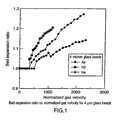
- Fig. 1 illustrates that the bed expansion ratio (a measurement of fluidization effectiveness) is much higher when helium is used as the fluidizing gas, as compared to air alone, with respect to 4 ⁇ m glass beads.
- a given bed expansion ratio is achieved at much lower normalized gas velocities. Hydrogen is even better in terms of bed expansion ratio for a given normalized gas velocity.
- the normalized gas velocity is the superficial gas velocity divided by the calculated minimum fluidization velocity.
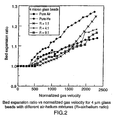
- Fig. 2 illustrates that fluidization of 4 ⁇ m glass beads can be improved with only a portion of helium in the fluidizing gas, particularly as normalized gas velocity increases.
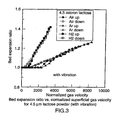
- Fig. 3 illustrates the dramatic effect of hydrogen on the fluidization quality with respect to 4.5 ⁇ m lactose powder (which is very cohesive), with a constant vibration level, by comparing to air and argon.
- the "up” and down” references refer to increasing flow of the gas and then decreasing flow of the gas. In this case, the bed expansion ratio tracks quite consistently up and down.
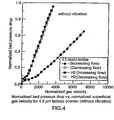
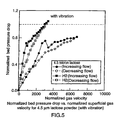
- Figs. 4 and 5 illustrate that the use of hydrogen as a fluidization aid causes an increase in the normalized pressure drop across the fluidized bed, compared to air.
- An increased pressure drop is another indication of improved fluidization quality. It suggests that the weight-minus-buoyancy force required to support or suspend the particles is more nearly or completely provided by the drag exerted by the gas.
- Fig. 4 shows the case without the additional aid of vibration
- Fig. 5 shows the case with vibration as an auxiliary fluidization aid.
- Figs. 4 and 5 also show that the combination of two fluidization aids, for certain cases, can further increase the fluidization quality.
- pure hydrogen or helium can be used to fluidize the fine particles, or one or both may be introduced as a constituent of the fluidizing gas.
- helium is an inert gas, and therefore its use will often be preferable.
- the application of using low-molecular-weight gas species as fluidization aids to fine powder fluidization can be applied to many existing chemical reaction and powder handling processes where fine and/or cohesive particles are used to improve the fluidization quality, and hence to improve the conversion and/or selectivity, as well as particle handling.
- the availability of this new technology may well also allow some other processes currently not employing a fluidized bed to be processed in a fluidized bed, thereby making use of the significant advantages of fluidized beds over other types of gas-solids contactors, e.g. rotating drums, pneumatic conveying, etc. fluidized bed, thereby making use of the significant advantages of fluidized beds over other types of gas-solids contactors, e.g. rotating drums, pneumatic conveying, etc.
- low-molecular-weight gas is useful in connection with fluidization of larger particles as well.
- ftuidization of regular powders does not require aids.
- fluidization aids are very helpful or even essential.
- low-molecular-weight gas will also enhance the fluidization quality of regular powders, especially those located near the Group C and Group A boundary, although the beneficial effect becomes less as the powders get larger. (Group A particles are generally larger than Group C particles.)
- This invention may be applied to many processes where the handling of fine particles are involved.
- hydrogen and/or helium may be added as a component of the total gas initially in order to assist in fluidizing a particulate material, and then the hydrogen or helium may be turned off once self-sustaining fluidization has been achieved.
- hydrogen or helium may be added into regions where defluidization is occurring locally to assist in effecting fluidization in those zones. That is, some local area in the fluidized bed may have bad fluidization quality. In that situation, the low-molecular-weight gas, or a gas containing low-molecular-weight gas, can be injected to those specific area to improve the local fluidization. After that, when the local fluidization improves, this "special" injection can be stopped.
- helium or hydrogen may be periodic or only carried out when some indicator of fluidization quality (e.g. pressure drop) indicates that defluidization is occurring or likely to occur, whether across the entire bed, or locally within the bed.
- some indicator of fluidization quality e.g. pressure drop
- the invention provides improved fluidization of powders, especially fine powders.
Landscapes
- Chemical & Material Sciences (AREA)
- Engineering & Computer Science (AREA)
- Combustion & Propulsion (AREA)
- Organic Chemistry (AREA)
- Chemical Kinetics & Catalysis (AREA)
- Devices And Processes Conducted In The Presence Of Fluids And Solid Particles (AREA)
- Treating Waste Gases (AREA)
Claims (15)
- Verfahren zum Fluidisieren von Pulvern, gekennzeichnet durch das Verwenden eines fluidisierenden Gases einschließlich eines Gases oder mehrerer Gase außer Gasen, die ausgewählt sind aus der Gruppe bestehend aus Wasserstoff, Deuterium, Tritium und Helium, und Zusetzen eines Gases mit einem geringen Molekulargewicht als Fluidisierungshilfe zu dem fluidisierenden Gas, wobei das Gas mit einem geringen Molekulargewicht ausgewählt ist aus der Gruppe bestehend aus Wasserstoff, Deuterium, Tritium und Helium.
- Erfindung nach Anspruch 1, wobei zu den Pulvern feine Teilchen zählen, wie Teilchen der Geldart-Gruppe C und/oder der Geldart-Gruppe A.
- Erfindung nach Anspruch 1, wobei die Pulver im wesentlichen aus feinen Teilchen bestehen, wie Teilchen der Geldart-Gruppe C und/oder der Geldart-Gruppe A.
- Erfindung nach einem der Ansprüche 1-3, wobei keine anderen Fluidisierungshilfen vorliegen außer dem Gas mit einem geringen Molekulargewicht.
- Erfindung nach einem der Ansprüche 1-4, wobei das Gas mit einem geringen Molekulargewicht Helium ist.
- Erfindung nach einem der Ansprüche 1-4, wobei das Gas mit einem geringen Molekulargewicht Wasserstoff ist.
- Erfindung nach einem der Anspüche 1-6, wobei das Gas mit einem geringen Molekulargewicht gegebenenfalls zusätzlich zu Gebieten zugesetzt wird, wo lokal eine Defluidisierung eintritt, um das Bewirken der Fluidisierung in derartigen Gebieten zu unterstützen.
- Erfindung nach einem der Ansprüche 1-7, mit einem Schritt des Beendens des Einleitens der Gasspezies mit einem geringen Molekulargewicht in das fluidisierende Gas, wenn eine sich selbst erhaltende Fluidisierung der Pulver erreicht wird.
- Erfindung nach Anspruch 8, wobei mit dem Zusatz des Gases mit einem geringen Molekulargewicht wieder begonnen wird, wenn die Fluidisierung schlecht wird oder sich nicht mehr selbst erhält.
- Verfahren zur Unterstützung der Fluidisierung von Pulvern, mit der Verwendung eines Gases mit einem geringen Molekulargewicht als fluidisierendes Gas, ausgewählt aus der Gruppe bestehend aus Wasserstoff, Deuterium, Tritium und Helium, wobei ein aus der gleichen Gruppe ausgewähltes Gas mit einem geringen Molekulargewicht gegebenenfalls zusätzlich zu Gebieten zugesetzt wird, wo lokal eine Defluidisierung eintritt, um als Fluidisierungshilfe in derartigen Gebieten zu wirken.
- Erfindung nach Anspruch 10, wobei zu den Pulvern feine Teilchen zählen, wie Teilchen der Geldart-Gruppe C und/oder der Geldart-Gruppe A.
- Erfindung nach Anspruch 10, wobei die Pulver im wesentlichen aus feinen Teilchen bestehen, wie Teilchen der Geldart-Gruppe C und/oder der Geldart-Gruppe A.
- Erfindung nach einem der Ansprüche 10-12, wobei keine anderen Fluidisierungshilfen vorliegen außer dem Gas mit einem geringen Molekulargewicht.
- Erfindung nach einem der Ansprüche 10-13, wobei das als eine Fluidisierungshilfe zugesetzte Gas mit einem geringen Molekulargewicht Helium ist.
- Erfindung nach einem der Ansprüche 10-13, wobei das als eine Fluidisierungshilfe zugesetzte Gas mit einem geringen Molekulargewicht Wasserstoff ist.
Applications Claiming Priority (3)
| Application Number | Priority Date | Filing Date | Title |
|---|---|---|---|
| US09/133,215 US6212794B1 (en) | 1998-08-13 | 1998-08-13 | Gaseous fluidization aids |
| US133215 | 1998-08-13 | ||
| PCT/CA1999/000742 WO2000009254A1 (en) | 1998-08-13 | 1999-08-13 | Gaseous fluidization aids |
Publications (2)
| Publication Number | Publication Date |
|---|---|
| EP1109620A1 EP1109620A1 (de) | 2001-06-27 |
| EP1109620B1 true EP1109620B1 (de) | 2003-03-19 |
Family
ID=22457516
Family Applications (1)
| Application Number | Title | Priority Date | Filing Date |
|---|---|---|---|
| EP99938090A Expired - Lifetime EP1109620B1 (de) | 1998-08-13 | 1999-08-13 | Gasartige hilfsmittel zur bildung einer wirbelschicht |
Country Status (8)
| Country | Link |
|---|---|
| US (1) | US6212794B1 (de) |
| EP (1) | EP1109620B1 (de) |
| CN (1) | CN1316918A (de) |
| AT (1) | ATE234673T1 (de) |
| AU (1) | AU5273699A (de) |
| CA (1) | CA2340378A1 (de) |
| DE (1) | DE69906092D1 (de) |
| WO (1) | WO2000009254A1 (de) |
Families Citing this family (11)
| Publication number | Priority date | Publication date | Assignee | Title |
|---|---|---|---|---|
| JP4039950B2 (ja) | 2001-04-20 | 2008-01-30 | グラクソ グループ リミテッド | 粒子状物質の計量供給方法 |
| US6630548B1 (en) | 2002-11-01 | 2003-10-07 | Equistar Chemicals, Lp | Static reduction |
| DE102005009321A1 (de) * | 2005-03-01 | 2006-09-07 | Degussa Ag | Suspension |
| DE102005037336A1 (de) * | 2005-08-04 | 2007-02-08 | Degussa Ag | Kohlenstoffmaterial |
| DE102006037079A1 (de) * | 2006-08-07 | 2008-02-14 | Evonik Degussa Gmbh | Ruß, Verfahren zur Herstellung von Ruß und Vorrichtung zur Durchführung des Verfahrens |
| DE102007060307A1 (de) * | 2007-12-12 | 2009-06-18 | Evonik Degussa Gmbh | Verfahren zur Nachbehandlung von Ruß |
| DE102008026894A1 (de) * | 2008-06-05 | 2009-12-10 | Evonik Degussa Gmbh | Ink Jet Tinte |
| DE102008044116A1 (de) * | 2008-11-27 | 2010-06-02 | Evonik Degussa Gmbh | Pigmentgranulat, Verfahren zu dessen Herstellung und Verwendung |
| ATE516330T1 (de) * | 2008-12-12 | 2011-07-15 | Evonik Carbon Black Gmbh | Ink jet tinte |
| DE102010002244A1 (de) * | 2010-02-23 | 2011-08-25 | Evonik Carbon Black GmbH, 63457 | Ruß, Verfahren zu seiner Herstellung und seine Verwendung |
| US10423736B2 (en) * | 2015-08-28 | 2019-09-24 | University Of British Columbia | Methods and systems for simulating hydrodynamics in gas-solid fluidized beds |
Family Cites Families (9)
| Publication number | Priority date | Publication date | Assignee | Title |
|---|---|---|---|---|
| US3639103A (en) * | 1970-04-21 | 1972-02-01 | Badger Co | Fluid bed reactors |
| US4585673A (en) | 1984-05-07 | 1986-04-29 | Gte Laboratories Incorporated | Method for coating phosphor particles |
| US4825124A (en) | 1984-05-07 | 1989-04-25 | Gte Laboratories Incorporated | Phosphor particle, fluorescent lamp, and manufacturing method |
| US4710674A (en) | 1984-05-07 | 1987-12-01 | Gte Laboratories Incorporated | Phosphor particle, fluorescent lamp, and manufacturing method |
| US5258201A (en) | 1990-09-17 | 1993-11-02 | Munn Robin W | Method of forming a partial coating on phosphor particles by coating the phosphors in a fluidize bed for a limited time and subsequently annealing to promote ionic diffusion |
| EP0476207A3 (de) * | 1990-09-17 | 1992-04-08 | Gte Products Corporation | Verbesserter mit Blei aktivierter Bariumsilikat-Phosphor und Verfahren zur seiner Herstellung |
| US5277245A (en) | 1992-10-29 | 1994-01-11 | Gte Products Corp. | Heat transfer in fluidized bed of cohesive powder |
| US5439867A (en) * | 1994-03-04 | 1995-08-08 | Phillips Petroleum Company | Fluidizable sulfur sorbent and fluidized sorption process |
| JP3159029B2 (ja) | 1996-01-12 | 2001-04-23 | 信越化学工業株式会社 | シラン類の製造方法 |
-
1998
- 1998-08-13 US US09/133,215 patent/US6212794B1/en not_active Expired - Fee Related
-
1999
- 1999-08-13 CN CN99810715.8A patent/CN1316918A/zh active Pending
- 1999-08-13 WO PCT/CA1999/000742 patent/WO2000009254A1/en not_active Ceased
- 1999-08-13 AT AT99938090T patent/ATE234673T1/de not_active IP Right Cessation
- 1999-08-13 EP EP99938090A patent/EP1109620B1/de not_active Expired - Lifetime
- 1999-08-13 CA CA002340378A patent/CA2340378A1/en not_active Abandoned
- 1999-08-13 DE DE69906092T patent/DE69906092D1/de not_active Expired - Lifetime
- 1999-08-13 AU AU52736/99A patent/AU5273699A/en not_active Abandoned
Also Published As
| Publication number | Publication date |
|---|---|
| US6212794B1 (en) | 2001-04-10 |
| CA2340378A1 (en) | 2000-02-24 |
| DE69906092D1 (de) | 2003-04-24 |
| AU5273699A (en) | 2000-03-06 |
| CN1316918A (zh) | 2001-10-10 |
| EP1109620A1 (de) | 2001-06-27 |
| WO2000009254A1 (en) | 2000-02-24 |
| ATE234673T1 (de) | 2003-04-15 |
Similar Documents
| Publication | Publication Date | Title |
|---|---|---|
| EP1109620B1 (de) | Gasartige hilfsmittel zur bildung einer wirbelschicht | |
| EP2094382B1 (de) | Fliessbettsysteme und verfahren mit sekundärgasstrom | |
| EP1953184B1 (de) | Thermisch expandierte mikrokugel und herstellungsverfahren dafür | |
| Ma et al. | Effect of interparticle adhesion forces on elutriation of fine powders from a fluidized bed of a binary particle mixture | |
| EP0185548B1 (de) | Wirbelverfahren und zum Vorwirbeln geeignete Gemische | |
| Zhou et al. | Investigation on minimum fluidization velocity in a modified Geldart’s diagram | |
| CA2079202A1 (en) | A method and apparatus for treating gases and perticulate solide in a fluid bed | |
| Zhu et al. | Magnetized fluidized bed with binary admixture of magnetizable and nonmagnetizable particles | |
| US5348163A (en) | Method and apparatus for separating fine particles | |
| CN1059930C (zh) | 流化床法处理粒状材料的方法和实施该方法的设备 | |
| JP4564658B2 (ja) | 流動もしくは撹拌容器への固体触媒の導入方法 | |
| CN106824023A (zh) | 一种声场喷动流化床装置 | |
| Ma et al. | Elutriation of fine powders from a fluidized bed of a binary particle-mixture | |
| Zhu | Fluidization of fine powders | |
| Matsumoto et al. | Axial segregation of multicomponent solid particles suspended in bubble columns | |
| Matsuda et al. | Fluidization of ultrafine particles with high G | |
| US7718138B2 (en) | Device for introducing gas into a fluidised bed and a process therefor | |
| EP0700866A1 (de) | Verfahren zur Herstellung von Synthesegas in einem Fliessbett | |
| CN223159212U (zh) | 一种流化床反应器的下料管 | |
| Liang et al. | Modified model for estimation of agglomerate sizes of binary mixed nanoparticles in a vibro-fluidized bed | |
| Pfeffer et al. | NANO HIGHLIGHT | |
| Shin et al. | Entrainment characteristics of fine particles in cylindrical and conical inert-medium fluidized beds | |
| GB2256866A (en) | Improvements in or relating to ceramic welding process | |
| JPH09268013A (ja) | 流動層を利用した微粉末生石灰の製造方法 | |
| Breault et al. | Processing Cohesive Fine Particles in a Spouted Bed via Mixing with Spoutable Media |
Legal Events
| Date | Code | Title | Description |
|---|---|---|---|
| PUAI | Public reference made under article 153(3) epc to a published international application that has entered the european phase |
Free format text: ORIGINAL CODE: 0009012 |
|
| 17P | Request for examination filed |
Effective date: 20010308 |
|
| AK | Designated contracting states |
Kind code of ref document: A1 Designated state(s): AT BE CH CY DE DK ES FI FR GB GR IE IT LI LU MC NL PT SE |
|
| 17Q | First examination report despatched |
Effective date: 20010629 |
|
| GRAG | Despatch of communication of intention to grant |
Free format text: ORIGINAL CODE: EPIDOS AGRA |
|
| GRAG | Despatch of communication of intention to grant |
Free format text: ORIGINAL CODE: EPIDOS AGRA |
|
| GRAH | Despatch of communication of intention to grant a patent |
Free format text: ORIGINAL CODE: EPIDOS IGRA |
|
| GRAH | Despatch of communication of intention to grant a patent |
Free format text: ORIGINAL CODE: EPIDOS IGRA |
|
| GRAA | (expected) grant |
Free format text: ORIGINAL CODE: 0009210 |
|
| AK | Designated contracting states |
Designated state(s): AT BE CH CY DE DK ES FI FR GB GR IE IT LI LU MC NL PT SE |
|
| PG25 | Lapsed in a contracting state [announced via postgrant information from national office to epo] |
Ref country code: NL Free format text: LAPSE BECAUSE OF FAILURE TO SUBMIT A TRANSLATION OF THE DESCRIPTION OR TO PAY THE FEE WITHIN THE PRESCRIBED TIME-LIMIT Effective date: 20030319 Ref country code: LI Free format text: LAPSE BECAUSE OF FAILURE TO SUBMIT A TRANSLATION OF THE DESCRIPTION OR TO PAY THE FEE WITHIN THE PRESCRIBED TIME-LIMIT Effective date: 20030319 Ref country code: IT Free format text: LAPSE BECAUSE OF FAILURE TO SUBMIT A TRANSLATION OF THE DESCRIPTION OR TO PAY THE FEE WITHIN THE PRESCRIBED TIME-LIMIT;WARNING: LAPSES OF ITALIAN PATENTS WITH EFFECTIVE DATE BEFORE 2007 MAY HAVE OCCURRED AT ANY TIME BEFORE 2007. THE CORRECT EFFECTIVE DATE MAY BE DIFFERENT FROM THE ONE RECORDED. Effective date: 20030319 Ref country code: GR Free format text: LAPSE BECAUSE OF FAILURE TO SUBMIT A TRANSLATION OF THE DESCRIPTION OR TO PAY THE FEE WITHIN THE PRESCRIBED TIME-LIMIT Effective date: 20030319 Ref country code: FR Free format text: LAPSE BECAUSE OF FAILURE TO SUBMIT A TRANSLATION OF THE DESCRIPTION OR TO PAY THE FEE WITHIN THE PRESCRIBED TIME-LIMIT Effective date: 20030319 Ref country code: FI Free format text: LAPSE BECAUSE OF FAILURE TO SUBMIT A TRANSLATION OF THE DESCRIPTION OR TO PAY THE FEE WITHIN THE PRESCRIBED TIME-LIMIT Effective date: 20030319 Ref country code: CH Free format text: LAPSE BECAUSE OF FAILURE TO SUBMIT A TRANSLATION OF THE DESCRIPTION OR TO PAY THE FEE WITHIN THE PRESCRIBED TIME-LIMIT Effective date: 20030319 Ref country code: BE Free format text: LAPSE BECAUSE OF FAILURE TO SUBMIT A TRANSLATION OF THE DESCRIPTION OR TO PAY THE FEE WITHIN THE PRESCRIBED TIME-LIMIT Effective date: 20030319 Ref country code: AT Free format text: LAPSE BECAUSE OF FAILURE TO SUBMIT A TRANSLATION OF THE DESCRIPTION OR TO PAY THE FEE WITHIN THE PRESCRIBED TIME-LIMIT Effective date: 20030319 |
|
| REG | Reference to a national code |
Ref country code: GB Ref legal event code: FG4D |
|
| REG | Reference to a national code |
Ref country code: CH Ref legal event code: EP |
|
| REG | Reference to a national code |
Ref country code: IE Ref legal event code: FG4D |
|
| REF | Corresponds to: |
Ref document number: 69906092 Country of ref document: DE Date of ref document: 20030424 Kind code of ref document: P |
|
| PG25 | Lapsed in a contracting state [announced via postgrant information from national office to epo] |
Ref country code: SE Free format text: LAPSE BECAUSE OF FAILURE TO SUBMIT A TRANSLATION OF THE DESCRIPTION OR TO PAY THE FEE WITHIN THE PRESCRIBED TIME-LIMIT Effective date: 20030619 Ref country code: DK Free format text: LAPSE BECAUSE OF FAILURE TO SUBMIT A TRANSLATION OF THE DESCRIPTION OR TO PAY THE FEE WITHIN THE PRESCRIBED TIME-LIMIT Effective date: 20030619 |
|
| PG25 | Lapsed in a contracting state [announced via postgrant information from national office to epo] |
Ref country code: PT Free format text: LAPSE BECAUSE OF FAILURE TO SUBMIT A TRANSLATION OF THE DESCRIPTION OR TO PAY THE FEE WITHIN THE PRESCRIBED TIME-LIMIT Effective date: 20030620 |
|
| PG25 | Lapsed in a contracting state [announced via postgrant information from national office to epo] |
Ref country code: DE Free format text: LAPSE BECAUSE OF FAILURE TO SUBMIT A TRANSLATION OF THE DESCRIPTION OR TO PAY THE FEE WITHIN THE PRESCRIBED TIME-LIMIT Effective date: 20030621 |
|
| PG25 | Lapsed in a contracting state [announced via postgrant information from national office to epo] |
Ref country code: LU Free format text: LAPSE BECAUSE OF NON-PAYMENT OF DUE FEES Effective date: 20030813 Ref country code: IE Free format text: LAPSE BECAUSE OF NON-PAYMENT OF DUE FEES Effective date: 20030813 Ref country code: GB Free format text: LAPSE BECAUSE OF NON-PAYMENT OF DUE FEES Effective date: 20030813 Ref country code: CY Free format text: LAPSE BECAUSE OF FAILURE TO SUBMIT A TRANSLATION OF THE DESCRIPTION OR TO PAY THE FEE WITHIN THE PRESCRIBED TIME-LIMIT Effective date: 20030813 |
|
| PG25 | Lapsed in a contracting state [announced via postgrant information from national office to epo] |
Ref country code: MC Free format text: LAPSE BECAUSE OF NON-PAYMENT OF DUE FEES Effective date: 20030831 |
|
| NLV1 | Nl: lapsed or annulled due to failure to fulfill the requirements of art. 29p and 29m of the patents act | ||
| PG25 | Lapsed in a contracting state [announced via postgrant information from national office to epo] |
Ref country code: ES Free format text: LAPSE BECAUSE OF FAILURE TO SUBMIT A TRANSLATION OF THE DESCRIPTION OR TO PAY THE FEE WITHIN THE PRESCRIBED TIME-LIMIT Effective date: 20030930 |
|
| REG | Reference to a national code |
Ref country code: CH Ref legal event code: PL |
|
| PLBE | No opposition filed within time limit |
Free format text: ORIGINAL CODE: 0009261 |
|
| STAA | Information on the status of an ep patent application or granted ep patent |
Free format text: STATUS: NO OPPOSITION FILED WITHIN TIME LIMIT |
|
| EN | Fr: translation not filed | ||
| 26N | No opposition filed |
Effective date: 20031222 |
|
| GBPC | Gb: european patent ceased through non-payment of renewal fee |
Effective date: 20030813 |
|
| REG | Reference to a national code |
Ref country code: IE Ref legal event code: MM4A |