EP1110527B1 - Absorbierender Artikel mit äusserer Schicht, und Herstellungsverfahren für die äussere Schicht - Google Patents
Absorbierender Artikel mit äusserer Schicht, und Herstellungsverfahren für die äussere Schicht Download PDFInfo
- Publication number
- EP1110527B1 EP1110527B1 EP00311348A EP00311348A EP1110527B1 EP 1110527 B1 EP1110527 B1 EP 1110527B1 EP 00311348 A EP00311348 A EP 00311348A EP 00311348 A EP00311348 A EP 00311348A EP 1110527 B1 EP1110527 B1 EP 1110527B1
- Authority
- EP
- European Patent Office
- Prior art keywords
- region
- moisture
- back sheet
- permeable
- optical transmittance
- Prior art date
- Legal status (The legal status is an assumption and is not a legal conclusion. Google has not performed a legal analysis and makes no representation as to the accuracy of the status listed.)
- Expired - Lifetime
Links
- 239000002250 absorbent Substances 0.000 title claims abstract description 96
- 230000002745 absorbent Effects 0.000 title claims abstract description 96
- 238000004519 manufacturing process Methods 0.000 title claims description 13
- 238000000034 method Methods 0.000 title claims description 11
- 230000003287 optical effect Effects 0.000 claims abstract description 67
- 238000002834 transmittance Methods 0.000 claims abstract description 67
- 229920005989 resin Polymers 0.000 claims abstract description 53
- 239000011347 resin Substances 0.000 claims abstract description 53
- 239000000463 material Substances 0.000 claims abstract description 22
- 239000011256 inorganic filler Substances 0.000 claims abstract description 19
- 229910003475 inorganic filler Inorganic materials 0.000 claims abstract description 19
- 238000004049 embossing Methods 0.000 claims description 11
- 229920005672 polyolefin resin Polymers 0.000 claims description 6
- 238000002156 mixing Methods 0.000 claims description 3
- 239000004745 nonwoven fabric Substances 0.000 description 8
- 239000000853 adhesive Substances 0.000 description 6
- 230000001070 adhesive effect Effects 0.000 description 6
- VTYYLEPIZMXCLO-UHFFFAOYSA-L Calcium carbonate Chemical compound [Ca+2].[O-]C([O-])=O VTYYLEPIZMXCLO-UHFFFAOYSA-L 0.000 description 4
- TZCXTZWJZNENPQ-UHFFFAOYSA-L barium sulfate Chemical compound [Ba+2].[O-]S([O-])(=O)=O TZCXTZWJZNENPQ-UHFFFAOYSA-L 0.000 description 4
- 229920001684 low density polyethylene Polymers 0.000 description 3
- 239000004702 low-density polyethylene Substances 0.000 description 3
- 239000011148 porous material Substances 0.000 description 3
- 230000000717 retained effect Effects 0.000 description 3
- 210000002700 urine Anatomy 0.000 description 3
- VYPSYNLAJGMNEJ-UHFFFAOYSA-N Silicium dioxide Chemical compound O=[Si]=O VYPSYNLAJGMNEJ-UHFFFAOYSA-N 0.000 description 2
- XLOMVQKBTHCTTD-UHFFFAOYSA-N Zinc monoxide Chemical compound [Zn]=O XLOMVQKBTHCTTD-UHFFFAOYSA-N 0.000 description 2
- 230000015572 biosynthetic process Effects 0.000 description 2
- 229910000019 calcium carbonate Inorganic materials 0.000 description 2
- OSGAYBCDTDRGGQ-UHFFFAOYSA-L calcium sulfate Chemical compound [Ca+2].[O-]S([O-])(=O)=O OSGAYBCDTDRGGQ-UHFFFAOYSA-L 0.000 description 2
- 229920001577 copolymer Polymers 0.000 description 2
- 239000000835 fiber Substances 0.000 description 2
- 239000012943 hotmelt Substances 0.000 description 2
- VTHJTEIRLNZDEV-UHFFFAOYSA-L magnesium dihydroxide Chemical compound [OH-].[OH-].[Mg+2] VTHJTEIRLNZDEV-UHFFFAOYSA-L 0.000 description 2
- 239000000347 magnesium hydroxide Substances 0.000 description 2
- 229910001862 magnesium hydroxide Inorganic materials 0.000 description 2
- 238000002844 melting Methods 0.000 description 2
- 230000008018 melting Effects 0.000 description 2
- 239000000203 mixture Substances 0.000 description 2
- 238000000465 moulding Methods 0.000 description 2
- 239000008188 pellet Substances 0.000 description 2
- 239000001993 wax Substances 0.000 description 2
- 208000010201 Exanthema Diseases 0.000 description 1
- 229920010126 Linear Low Density Polyethylene (LLDPE) Polymers 0.000 description 1
- 239000004743 Polypropylene Substances 0.000 description 1
- GWEVSGVZZGPLCZ-UHFFFAOYSA-N Titan oxide Chemical compound O=[Ti]=O GWEVSGVZZGPLCZ-UHFFFAOYSA-N 0.000 description 1
- 239000000654 additive Substances 0.000 description 1
- WNROFYMDJYEPJX-UHFFFAOYSA-K aluminium hydroxide Chemical compound [OH-].[OH-].[OH-].[Al+3] WNROFYMDJYEPJX-UHFFFAOYSA-K 0.000 description 1
- AYJRCSIUFZENHW-DEQYMQKBSA-L barium(2+);oxomethanediolate Chemical compound [Ba+2].[O-][14C]([O-])=O AYJRCSIUFZENHW-DEQYMQKBSA-L 0.000 description 1
- 235000013871 bee wax Nutrition 0.000 description 1
- 239000012166 beeswax Substances 0.000 description 1
- 239000008280 blood Substances 0.000 description 1
- 210000004369 blood Anatomy 0.000 description 1
- 210000001124 body fluid Anatomy 0.000 description 1
- 239000010839 body fluid Substances 0.000 description 1
- 239000003086 colorant Substances 0.000 description 1
- 238000000354 decomposition reaction Methods 0.000 description 1
- 238000001035 drying Methods 0.000 description 1
- 230000000694 effects Effects 0.000 description 1
- 230000002708 enhancing effect Effects 0.000 description 1
- 239000005038 ethylene vinyl acetate Substances 0.000 description 1
- 201000005884 exanthem Diseases 0.000 description 1
- 239000011521 glass Substances 0.000 description 1
- 229920001903 high density polyethylene Polymers 0.000 description 1
- 239000004700 high-density polyethylene Substances 0.000 description 1
- 230000002209 hydrophobic effect Effects 0.000 description 1
- 239000003112 inhibitor Substances 0.000 description 1
- 238000010030 laminating Methods 0.000 description 1
- 229920000092 linear low density polyethylene Polymers 0.000 description 1
- 239000004707 linear low-density polyethylene Substances 0.000 description 1
- 239000007788 liquid Substances 0.000 description 1
- 239000000314 lubricant Substances 0.000 description 1
- 239000000395 magnesium oxide Substances 0.000 description 1
- CPLXHLVBOLITMK-UHFFFAOYSA-N magnesium oxide Inorganic materials [Mg]=O CPLXHLVBOLITMK-UHFFFAOYSA-N 0.000 description 1
- AXZKOIWUVFPNLO-UHFFFAOYSA-N magnesium;oxygen(2-) Chemical compound [O-2].[Mg+2] AXZKOIWUVFPNLO-UHFFFAOYSA-N 0.000 description 1
- 230000004048 modification Effects 0.000 description 1
- 238000012986 modification Methods 0.000 description 1
- 230000003647 oxidation Effects 0.000 description 1
- 238000007254 oxidation reaction Methods 0.000 description 1
- 239000012188 paraffin wax Substances 0.000 description 1
- 239000002245 particle Substances 0.000 description 1
- 239000002985 plastic film Substances 0.000 description 1
- 229920001200 poly(ethylene-vinyl acetate) Polymers 0.000 description 1
- 229920001083 polybutene Polymers 0.000 description 1
- 229920000642 polymer Polymers 0.000 description 1
- 229920000098 polyolefin Polymers 0.000 description 1
- -1 polypropylene Polymers 0.000 description 1
- 229920001155 polypropylene Polymers 0.000 description 1
- 206010037844 rash Diseases 0.000 description 1
- 238000005096 rolling process Methods 0.000 description 1
- 239000000377 silicon dioxide Substances 0.000 description 1
- 239000003381 stabilizer Substances 0.000 description 1
- 239000000454 talc Substances 0.000 description 1
- 229910052623 talc Inorganic materials 0.000 description 1
- OGIDPMRJRNCKJF-UHFFFAOYSA-N titanium oxide Inorganic materials [Ti]=O OGIDPMRJRNCKJF-UHFFFAOYSA-N 0.000 description 1
- 239000012801 ultraviolet ray absorbent Substances 0.000 description 1
- 239000002966 varnish Substances 0.000 description 1
- XLYOFNOQVPJJNP-UHFFFAOYSA-N water Substances O XLYOFNOQVPJJNP-UHFFFAOYSA-N 0.000 description 1
- 239000011787 zinc oxide Substances 0.000 description 1
Images




Classifications
-
- A—HUMAN NECESSITIES
- A61—MEDICAL OR VETERINARY SCIENCE; HYGIENE
- A61F—FILTERS IMPLANTABLE INTO BLOOD VESSELS; PROSTHESES; DEVICES PROVIDING PATENCY TO, OR PREVENTING COLLAPSING OF, TUBULAR STRUCTURES OF THE BODY, e.g. STENTS; ORTHOPAEDIC, NURSING OR CONTRACEPTIVE DEVICES; FOMENTATION; TREATMENT OR PROTECTION OF EYES OR EARS; BANDAGES, DRESSINGS OR ABSORBENT PADS; FIRST-AID KITS
- A61F13/00—Bandages or dressings; Absorbent pads
- A61F13/15—Absorbent pads, e.g. sanitary towels, swabs or tampons for external or internal application to the body; Supporting or fastening means therefor; Tampon applicators
-
- A—HUMAN NECESSITIES
- A61—MEDICAL OR VETERINARY SCIENCE; HYGIENE
- A61F—FILTERS IMPLANTABLE INTO BLOOD VESSELS; PROSTHESES; DEVICES PROVIDING PATENCY TO, OR PREVENTING COLLAPSING OF, TUBULAR STRUCTURES OF THE BODY, e.g. STENTS; ORTHOPAEDIC, NURSING OR CONTRACEPTIVE DEVICES; FOMENTATION; TREATMENT OR PROTECTION OF EYES OR EARS; BANDAGES, DRESSINGS OR ABSORBENT PADS; FIRST-AID KITS
- A61F13/00—Bandages or dressings; Absorbent pads
- A61F13/15—Absorbent pads, e.g. sanitary towels, swabs or tampons for external or internal application to the body; Supporting or fastening means therefor; Tampon applicators
- A61F13/15203—Properties of the article, e.g. stiffness or absorbency
-
- A—HUMAN NECESSITIES
- A61—MEDICAL OR VETERINARY SCIENCE; HYGIENE
- A61F—FILTERS IMPLANTABLE INTO BLOOD VESSELS; PROSTHESES; DEVICES PROVIDING PATENCY TO, OR PREVENTING COLLAPSING OF, TUBULAR STRUCTURES OF THE BODY, e.g. STENTS; ORTHOPAEDIC, NURSING OR CONTRACEPTIVE DEVICES; FOMENTATION; TREATMENT OR PROTECTION OF EYES OR EARS; BANDAGES, DRESSINGS OR ABSORBENT PADS; FIRST-AID KITS
- A61F13/00—Bandages or dressings; Absorbent pads
- A61F13/15—Absorbent pads, e.g. sanitary towels, swabs or tampons for external or internal application to the body; Supporting or fastening means therefor; Tampon applicators
- A61F13/42—Absorbent pads, e.g. sanitary towels, swabs or tampons for external or internal application to the body; Supporting or fastening means therefor; Tampon applicators with wetness indicator or alarm
-
- A—HUMAN NECESSITIES
- A61—MEDICAL OR VETERINARY SCIENCE; HYGIENE
- A61F—FILTERS IMPLANTABLE INTO BLOOD VESSELS; PROSTHESES; DEVICES PROVIDING PATENCY TO, OR PREVENTING COLLAPSING OF, TUBULAR STRUCTURES OF THE BODY, e.g. STENTS; ORTHOPAEDIC, NURSING OR CONTRACEPTIVE DEVICES; FOMENTATION; TREATMENT OR PROTECTION OF EYES OR EARS; BANDAGES, DRESSINGS OR ABSORBENT PADS; FIRST-AID KITS
- A61F13/00—Bandages or dressings; Absorbent pads
- A61F13/15—Absorbent pads, e.g. sanitary towels, swabs or tampons for external or internal application to the body; Supporting or fastening means therefor; Tampon applicators
- A61F13/51—Absorbent pads, e.g. sanitary towels, swabs or tampons for external or internal application to the body; Supporting or fastening means therefor; Tampon applicators characterised by the outer layers of the pads
- A61F13/514—Backsheet, i.e. the impermeable cover or layer furthest from the skin
- A61F13/51474—Backsheet, i.e. the impermeable cover or layer furthest from the skin characterised by its structure
-
- A—HUMAN NECESSITIES
- A61—MEDICAL OR VETERINARY SCIENCE; HYGIENE
- A61F—FILTERS IMPLANTABLE INTO BLOOD VESSELS; PROSTHESES; DEVICES PROVIDING PATENCY TO, OR PREVENTING COLLAPSING OF, TUBULAR STRUCTURES OF THE BODY, e.g. STENTS; ORTHOPAEDIC, NURSING OR CONTRACEPTIVE DEVICES; FOMENTATION; TREATMENT OR PROTECTION OF EYES OR EARS; BANDAGES, DRESSINGS OR ABSORBENT PADS; FIRST-AID KITS
- A61F13/00—Bandages or dressings; Absorbent pads
- A61F13/15—Absorbent pads, e.g. sanitary towels, swabs or tampons for external or internal application to the body; Supporting or fastening means therefor; Tampon applicators
- A61F13/51—Absorbent pads, e.g. sanitary towels, swabs or tampons for external or internal application to the body; Supporting or fastening means therefor; Tampon applicators characterised by the outer layers of the pads
- A61F13/514—Backsheet, i.e. the impermeable cover or layer furthest from the skin
- A61F13/51496—Backsheet, i.e. the impermeable cover or layer furthest from the skin having visual effects
-
- Y—GENERAL TAGGING OF NEW TECHNOLOGICAL DEVELOPMENTS; GENERAL TAGGING OF CROSS-SECTIONAL TECHNOLOGIES SPANNING OVER SEVERAL SECTIONS OF THE IPC; TECHNICAL SUBJECTS COVERED BY FORMER USPC CROSS-REFERENCE ART COLLECTIONS [XRACs] AND DIGESTS
- Y10—TECHNICAL SUBJECTS COVERED BY FORMER USPC
- Y10T—TECHNICAL SUBJECTS COVERED BY FORMER US CLASSIFICATION
- Y10T428/00—Stock material or miscellaneous articles
- Y10T428/24—Structurally defined web or sheet [e.g., overall dimension, etc.]
- Y10T428/24355—Continuous and nonuniform or irregular surface on layer or component [e.g., roofing, etc.]
-
- Y—GENERAL TAGGING OF NEW TECHNOLOGICAL DEVELOPMENTS; GENERAL TAGGING OF CROSS-SECTIONAL TECHNOLOGIES SPANNING OVER SEVERAL SECTIONS OF THE IPC; TECHNICAL SUBJECTS COVERED BY FORMER USPC CROSS-REFERENCE ART COLLECTIONS [XRACs] AND DIGESTS
- Y10—TECHNICAL SUBJECTS COVERED BY FORMER USPC
- Y10T—TECHNICAL SUBJECTS COVERED BY FORMER US CLASSIFICATION
- Y10T428/00—Stock material or miscellaneous articles
- Y10T428/24—Structurally defined web or sheet [e.g., overall dimension, etc.]
- Y10T428/24355—Continuous and nonuniform or irregular surface on layer or component [e.g., roofing, etc.]
- Y10T428/24372—Particulate matter
-
- Y—GENERAL TAGGING OF NEW TECHNOLOGICAL DEVELOPMENTS; GENERAL TAGGING OF CROSS-SECTIONAL TECHNOLOGIES SPANNING OVER SEVERAL SECTIONS OF THE IPC; TECHNICAL SUBJECTS COVERED BY FORMER USPC CROSS-REFERENCE ART COLLECTIONS [XRACs] AND DIGESTS
- Y10—TECHNICAL SUBJECTS COVERED BY FORMER USPC
- Y10T—TECHNICAL SUBJECTS COVERED BY FORMER US CLASSIFICATION
- Y10T428/00—Stock material or miscellaneous articles
- Y10T428/24—Structurally defined web or sheet [e.g., overall dimension, etc.]
- Y10T428/24479—Structurally defined web or sheet [e.g., overall dimension, etc.] including variation in thickness
-
- Y—GENERAL TAGGING OF NEW TECHNOLOGICAL DEVELOPMENTS; GENERAL TAGGING OF CROSS-SECTIONAL TECHNOLOGIES SPANNING OVER SEVERAL SECTIONS OF THE IPC; TECHNICAL SUBJECTS COVERED BY FORMER USPC CROSS-REFERENCE ART COLLECTIONS [XRACs] AND DIGESTS
- Y10—TECHNICAL SUBJECTS COVERED BY FORMER USPC
- Y10T—TECHNICAL SUBJECTS COVERED BY FORMER US CLASSIFICATION
- Y10T428/00—Stock material or miscellaneous articles
- Y10T428/24—Structurally defined web or sheet [e.g., overall dimension, etc.]
- Y10T428/24479—Structurally defined web or sheet [e.g., overall dimension, etc.] including variation in thickness
- Y10T428/24612—Composite web or sheet
-
- Y—GENERAL TAGGING OF NEW TECHNOLOGICAL DEVELOPMENTS; GENERAL TAGGING OF CROSS-SECTIONAL TECHNOLOGIES SPANNING OVER SEVERAL SECTIONS OF THE IPC; TECHNICAL SUBJECTS COVERED BY FORMER USPC CROSS-REFERENCE ART COLLECTIONS [XRACs] AND DIGESTS
- Y10—TECHNICAL SUBJECTS COVERED BY FORMER USPC
- Y10T—TECHNICAL SUBJECTS COVERED BY FORMER US CLASSIFICATION
- Y10T442/00—Fabric [woven, knitted, or nonwoven textile or cloth, etc.]
- Y10T442/60—Nonwoven fabric [i.e., nonwoven strand or fiber material]
- Y10T442/674—Nonwoven fabric with a preformed polymeric film or sheet
-
- Y—GENERAL TAGGING OF NEW TECHNOLOGICAL DEVELOPMENTS; GENERAL TAGGING OF CROSS-SECTIONAL TECHNOLOGIES SPANNING OVER SEVERAL SECTIONS OF THE IPC; TECHNICAL SUBJECTS COVERED BY FORMER USPC CROSS-REFERENCE ART COLLECTIONS [XRACs] AND DIGESTS
- Y10—TECHNICAL SUBJECTS COVERED BY FORMER USPC
- Y10T—TECHNICAL SUBJECTS COVERED BY FORMER US CLASSIFICATION
- Y10T442/00—Fabric [woven, knitted, or nonwoven textile or cloth, etc.]
- Y10T442/60—Nonwoven fabric [i.e., nonwoven strand or fiber material]
- Y10T442/674—Nonwoven fabric with a preformed polymeric film or sheet
- Y10T442/678—Olefin polymer or copolymer sheet or film [e.g., polypropylene, polyethylene, ethylene-butylene copolymer, etc.]
Definitions
- the present invention relates to an absorbent article such as a disposable diaper, a sanitary napkin, a pantie liner or a urine absorbing pad and, more particularly, to an absorbent article using a back sheet having regions, which are different in the degree of orientation, and a method for manufacturing the back sheet.
- the back sheet to be ordinarily employed in the absorbent article is exemplified by a liquid-impermeable resin sheet.
- the back sheet is formed by stretching a resin film containing an inorganic filler so as to enhance the air-permeability and the moisture-permeability so that the back sheet is made opaque.
- the care taker in order to confirm whether or not the wearer has made a discharge, the care taker has to remove the diaper from the wearer to confirm the inside of the diaper. This is a seriously troublesome work for the care taker.
- a back sheet of a developing type disposable diaper In this back sheet, a see-through portion is formed in at least a central portion in the longitudinal direction.
- This back sheet is formed like before of a porous sheet, which is prepared by stretching the resin film containing the inorganic filler, for enhancing the moisture-permeability.
- a transparent portion is formed by crushing the pores of the porous sheet by an embossing treatment thereby to eliminate the scattering of light. If the porous sheet is further embossed, however, pin holes will be easily formed, because the embossed portion is lowered in its strength.
- the transparent portion could be formed by applying wax, varnish or hot melt in place of the embossing treatment.
- the applied material will ooze or stick on the film surface and requires a drying treatment after being applied, so that the cost for the material and for the treatment rises.
- EP 0 553 808 A1 discloses an air-permeable and liquid-impermeable back sheet for use in body fluid absorbent articles.
- the back sheet is made from polyolefin plastic sheet containing inorganic filler particles and is made by stretching followed by thermo-embossing.
- This sanitary napkin may be provided on the two longitudinally extending sides with wings which extend in the width direction.
- the wings are folded back to the lower side of the crotch portion of the underwear such as panties so that the edge portions of the panties can be prevented from being blotted with the discharge.
- the napkin can be prevented from going out of position by adhesion means disposed on the wings for attaching the napkin to the panties.
- These wings are formed by protruding the member constructing the body of the napkin, such as the adhered back sheet and top sheet, in the width direction from the two side portions of the body of the napkin.
- the back sheet of the sanitary napkin is formed as in the diaper by stretching the film so as to enhance the air-permeability so that the optical transmittance is extremely lowered.
- the presence of the wing portions i.e., the wearing of the napkin is apparent from the outside.
- Only the wings could be made of a material different from that of the back sheet, such as a high optical transmittance sheet so that the wearing of the napkin could not be confirmed in the appearance.
- the absorbent article has been desired to have a partially high optical transmittance.
- the portion desired to have a high optical transmittance is different among the kinds of absorbent articles.
- An object of the invention is to provide an absorbent article using a back sheet which has a high optical transmittance portion and an air- and moisture-permeable portion.
- Another object of the invention is to provide a method for manufacturing the back sheet.
- an absorbent article comprising: a liquid-permeable top sheet; a back sheet; and an absorbent core sandwiched between the top sheet and back sheet, wherein the back sheet is formed of a resin film containing an inorganic filler in a resin base material, wherein the back sheet includes: (a) a stretched moisture-permeable region; and (b) a high optical transmittance region having a lower degree of orientation than that of the moisture-permeable region and/or left unstretched, and wherein the high optical transmittance region (b) is thicker than the moisture-permeable region (a).
- the high optical transmittance region can be formed in a portion of the absorbent article while the air-permeability and the moisture-permeability being retained in the entire absorbent article.
- the diaper for example, whether or not the discharge has been made can be confirmed from the outside of the diaper being worn.
- the presence of the wings cannot be seen from the outside of the panties.
- this strength of the back sheet is hard to degrade.
- the resin base material is preferably a polyolefin resin.
- the mixing ratio between the resin base material and the inorganic filler is preferably 20 to 70 % by mass : 80 to 30 by mass.
- the high optical transmittance region (b) is preferably positioned to cover the entirety or a portion of the back of the absorbent core.
- the high optical transmittance region (b) is preferably provided in the generally widthwise central portion of the region having the absorbent core and in the region containing the widthwise center of the absorbent core and having one quarter of the width size of the diaper, and/or in the generally longitudinal central portion of the region having the absorbent core and in the region containing the longitudinal center of the absorbent core and having one quarter of the longitudinal size of the diaper.
- the term “longitudinal central portion/region” as used herein means the intermediate portion/region located between two end regions lying opposite one another in the longitudinal direction; the term “widthwise central portion/region” as used herein means the intermediate portion/region located between two side regions lying opposite one another in the widthwise direction.
- the term “longitudinal center” as used herein means the midpoint located between two end edges lying opposite one another in the longitudinal direction; the term “widthwise center” as used herein means the midpoint located between two side edges lying opposite one another in the widthwise direction.
- the absorbent article is a sanitary napkin including a pair of wing portions disposed on the two sides of the region of the absorbent core and extending outwardly in the widthwise direction
- the moisture-permeable region (a) is preferably positioned to cover the entirety or a portion of the back of the absorbent core whereas the high optical transmittance region (b) is preferably positioned in at least the wing portions.
- the moisture-permeable region (a) is preferably positioned in the generally widthwise central portion of the region having the absorbent core and over one half or more of the width size of the absorbent core, and/or in the generally longitudinal central portion of the region having the absorbent core and over one half or more of the longitudinal size of the absorbent core.
- the moisture-permeable region (a) is preferred to have a moisture-permeability of 1,000 g/m 2 ⁇ 24hrs or more.
- the moisture-permeable region (a) is preferred to have a total optical transmittance of 50 % or less according to JIS-K-7105.
- the high optical transmittance region (b) is preferred to have a total optical transmittance of 60 % or more according to JIS-K-7105.
- the back sheet in the moisture-permeable regions (a) has a thickness T1 and if the back sheet in the high optical transmittance region (b) has a thickness T2, it is preferred that the values T1 and T2 satisfy the following Formulas: 20 ⁇ ⁇ (T2 - T1)/T1 ⁇ x 100 ⁇ 30.
- the back sheet may have a multi-layered structure in at least the high optical transmittance region (b).
- the back sheet to be used in the absorbent article of the invention can be formed simply at a low cost.
- a method for manufacturing a back sheet for an absorbent article including: a liquid-permeable top sheet; the back sheet; and an absorbent core sandwiched between the top sheet and back sheet.
- a film containing an inorganic filler in a resin base material is partially stretched to form: (a) a stretched moisture-permeable region; and (b) a high optical transmittance region having a lower degree of orientation than that of the moisture-permeable region and/or left unstretched, wherein the high optical transmittance region (b) is thicker than the moisture-permeable region (a).
- a film being continuously fed may be stretched exclusively at a central portion in a width direction (or in CD) thereof to form the moisture-permeable region (a) at the central portion.
- a film being continuously fed may be stretched exclusively on two side portions in a width direction (or in CD) thereof to form the moisture-permeable regions (a) on the two side portions.
- a film being continuously fed may be partially stretched at a predetermined interval in a longitudinal direction (or in MD) thereof to form the moisture-permeable regions (a) at a spacing in the longitudinal direction.
- a film being continuously fed may be partially stretched at a predetermined interval in a width direction (or in CD) thereof to form the moisture-permeable regions (a) at a spacing in the width direction.
- the film may be stretched by an embossing treatment to form the moisture-permeable region (a).
- a film having partially different thicknesses is formed of a material containing the inorganic filler in the resin base material and is stretched to form the moisture-permeable region (a) in the thinner portion and the high optical transmittance region (b) in the thicker portion.
- an unstretched film is partially coated with a transparent film and is then stretched to form the moisture-permeable region (a) in the portion, which is not coated with the transparent film, and the high optical transmittance region (b) in the portion which is coated with the transparent film.
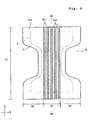
- Fig. 1 is a top plan view, as taken from the back side, of a diaper as an absorbent article according to one embodiment of the invention
- Fig. 2 is a section taken along line II - II of the diaper shown in Fig. 1.
- the longitudinal direction of the diaper is taken in a Y-direction
- the widthwise direction generally perpendicular to the Y-direction is taken in an X-direction.
- a disposable diaper 1A is the so-called "open type" diaper and is constructed, as shown in Fig. 2, to include: a liquid-permeable top sheet 4 to confront the wearer; a liquid-impermeable back sheet 3; and an absorbent core 2 sandwiched between the top sheet 4 and the back sheet 3.
- These top sheet 4, back sheet 3 and absorbent core 2 are individually formed into the hour glass shape.
- the absorbent core 2 may have a rectangular shape.
- the top sheet 4 and the back sheet 3 are adhered and jointed to each other at the outer sides of the absorbent core 2 in the X-direction and in the Y-direction by means of a hot-melt type adhesive, for example.
- the top sheet 4 is made of nonwoven fabric comprising hydrophobic fibers subjected to a hydrophilic treatment or hydrophilic fibers, such as point bond, air-through, spun bond or spun lace nonwoven fabric.
- the top sheet 4 has a basis weight (this may be referred to as "METSUKE") of 10 to 40 g/m 2 .
- the top sheet 4 may be formed by laying a cushion layer of bulky nonwoven fabric over the former nonwoven fabric.
- the absorbent core 2 is formed of an absorbent material, for example, pulverized pulp or a mixture of pulverized pulp and a highly water-absorbing polymer, which is enveloped with an absorbent sheet of tissues.
- the diaper 1A may be provided with leg cuffs for ensuring the close contact around the legs, although not shown, and leakage preventing cuffs 8 for preventing sideway leakage, as shown in Fig. 2.
- the liquid-impermeable back sheet 3 is made of a resin sheet which is prepared by orientating a resin film containing an inorganic filler to have regions different in the degree of orientation.
- the diaper 1A may be provided with a nonwoven fabric layer on the outer side (i.e., on the lower side of the back sheet 3, as seen in Fig. 2) of the back sheet 3 (of the resin sheet).
- the nonwoven fabric to be employed has a high moisture-permeability and a high optical transmittance so as not to impair the functions of regions (a) and (b), which will be described hereinbelow, of the back sheet 3 (of the resin sheet).
- This back sheet 3 is different in properties between its widthwise central region 31 containing the center line 30 of the diaper 1A and its two adjoining side regions 32 and 32. Specifically, these two side regions 32 and 32 are moisture-permeable regions (a) having a relatively high moisture-permeability, whereas the central region 31 is a region (b) (as hatched in Fig. 1) having a higher optical transmittance than the moisture-permeable regions (a).
- this discharge is absorbed mainly at the widthwise central region 31 of the absorbent core 2 of the diaper 1A. Since this central region 31 has the high optical transmittance, the discharge can be discriminated in its color, when absorbed by the absorbent core 2, from the outside of the diaper 1A through the back sheet 3. Thus, it can be easily confirmed whether or not the wearer has discharged.
- the resin sheet constituting the back sheet 3 is formed by either not orientating the film or orientating the film at a low degree of orientation. In the region (b), therefore, the optical transmittance is kept so high or not degraded as can confirm the color of the discharge which was absorbed by the absorbent core 2.
- the region (b) is preferred to have a total optical transmittance of 60 % or more according to JIS-K-7105. This standard is preferably satisfied even when the nonwoven fabric layer is laminated on the outer side of the resin sheet.
- the region (b) has a low moisture-permeability because it has few pores.
- the resin sheet is formed by orientating the film at a higher degree of orientation than that of the region (b) so that the optical transmittance is lower than that of the region (b) whereas the moisture-permeability is made higher in the presence of the pores.
- the region (b) of the low moisture-permeability being present in the central region 31, therefore, the inside of the diaper 1A does not become stuffy so that the wearer does not have a rash.
- the moisture-permeable regions (a) are preferred to have a moisture-permeability of 1,000 g/m 2 ⁇ 24hrs or more. This standard is preferably satisfied even when the nonwoven fabric layer is laminated on the outer side of the resin sheet.
- the moisture-permeability is measured by the following method (according to JIS Z-0208).
- the width size of the region (b) (or the central region 31) in the X-direction is preferred to be within about 30 to 70 % of the entire width of the film. With the region (b) being formed over such range, the discharge can be reliably recognized. In addition, the diaper 1A hardly becomes stuffy in its inside.
- Any resin base material for the resin sheet can be employed, but a polyolefin resin is preferably used for the aspects of cost and safety.
- polystyrene resin there can be enumerated polypropylene, low-density polyethylene (LDPE), high-density polyethylene, linear low-density polyethylene (LLDPE), polybutene, ethylene-propylene copolymer, ethylene-butene copolymer and ethylene-vinylacetate copolymer. At least one kind of these can be employed. Of these, the preferable one is the LDPE, and the more preferable one is the LLDPE.
- LDPE low-density polyethylene
- LLDPE linear low-density polyethylene
- the inorganic filler there can be enumerated barium sulfate, barium carbonate, calcium sulfate, calcium carbonate, magnesium hydroxide, magnesium oxide, aluminum hydroxide, zinc oxide, titanium oxide, silica and talc. Of these, barium sulfate, calcium carbonate and magnesium hydroxide are preferable.
- an ultraviolet ray absorbent an oxidation inhibitor, an stabilizer, a coloring agent, a lubricant and so on.
- the mixing ratio between the resin base material and the inorganic filler is preferably 20 to 70 % by mass : 80 to 30 % by mass. If the inorganic filler is more than the upper limit, the resin film becomes clouded in white before it is oriented so that it cannot form the region (b) having the high optical transmittance. If the inorganic filler is less than the lower limit, on the other hand, pin holes are formed when the resin film is oriented. More preferably, the ratio of the inorganic filler is 60 to 30 % by mass.
- the polyolefin resin and inorganic filler thus far specified and, optionally, other additives are mixed by using a Henschel mixer, a super mixer, a tumbler type mixer or the like and is kneaded into pellets by the ordinary single- or double-screw extruder.
- a Henschel mixer a super mixer, a tumbler type mixer or the like
- those pellets are melted at a melting point or higher of the base resin, preferably at a temperature higher than the melting point + 20°C and lower than the decomposition temperature, and filmed into a resin film by using a inflation molding machine or a T-die molding machine.
- the material may be directly filmed by the extruder without being pelletized.
- This resin film preferably has a thickness of 10 to 90 ⁇ m (microns). Under the above-specified lower limit, the film is liable to break in the subsequent orientation. Over the upper limit, no special problem arises, but the productivity is slightly lowered.
- the resin film thus prepared is oriented in at least one direction by the well-known method such as the roll method or the tender method to produce a resin sheet having the moisture-permeable regions (a) of the high moisture-permeability and the region (b) of the high optical transmittance.
- the orientation is preferably uniaxial orientation in the X-direction (CD: Cross Direction) of 1.1 to 2.5 times.
- a film 50a having a uniform thickness is partially stretched to form a resin sheet 60b, as shown in Fig. 3B.
- this resin sheet 60b there are formed: the moisture-permeable regions (a) of the high moisture-permeability which were stretched to a smaller thickness; and the high optical transmittance region (b) which substantially retains the thickness of the resin sheet 50a before stretched.
- the film 50a before stretched is preferable to have a basis weight of 20 to 40 g/m 2 .
- a film 50c having a thicker portion 51c and thinner portions 52c as shown in Fig. 3C, which is formed by a corrugated die in the formation of the film.
- This film 50c may be stretched in its entirety to form the resin sheet 60b, as shown in Fig. 3B. Even if the film 50c is stretched in its entirety, the thicker portion 51c is not changed in its substantial thickness, so that its optical transmittance is not lowered.
- the thinner portions 52c are sufficiently stretched to form the moisture-permeable regions (a) of the high moisture-permeability.
- the film 50c before stretched is preferred to have a basis weight of 40 to 50 g/m 2 in its entirety.
- the resin sheet may be formed such that: a film (or resin) 53d is laid over a portion of a film 54d having a uniform thickness, as shown in Fig. 3D; and the film 54d is then stretched like that shown in Fig. 3C to form a resin sheet 60e, as shown in Fig. 3E. At this time, the portion laminated with the film 53d provides the high optical transmittance region (b) in the resin sheet 60e. It is preferable to employ a transparent film having a high optical transmittance as the film 53d.
- the orientation is preferably performed such that the values T1 and T2 satisfy the following Formulas, if the resin sheet in the high moisture-permeable regions (a) has a thickness T1 and if the resin sheet in the high optical transmittance region (b) has a thickness T2: 20 ⁇ ⁇ (T2 - T1)/T1 ⁇ x 100 ⁇ 30.
- the aforementioned orientation may be performed separately at multiple stages or in two or more directions including the X-direction and the Y-direction.
- the biaxial orientations are preferred to be simultaneously made. These biaxial orientations enhance the strength of the resin sheet.
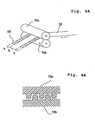
- embossing treatment can be additionally enumerated as the means for forming the regions (a) and the region (b) by making the degree of orientation partially different in the resin film.
- a similar film 58 is pinched by embossing rolls 70a and 70b so that it is pressed and stretched to form a resin sheet 68 having the regions (a) and the region (b).
- the embossing rolls 70a and 70b are corrugated, in Fig. 4B, in the surfaces of their two side regions.
- the film 58 is pinched and pressed by those corrugations so that it is stretched to form the regions (a).
- the back sheet having the high moisture-permeable regions (a) and the high optical transmittance region (b) in the invention can be manufactured simply and at a low cost from one material (i.e., one film).
- one material i.e., one film.
- a series of works from the formation of the back sheet to the completion of the absorbent article can be performed by carrying the film orienting step on the assembly line of the absorbent article.
- Fig. 5 is a top plan view, as taken from the back side, of a diaper of another embodiment of the invention
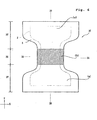
- Fig. 6 is a top plan view, as taken from the back side, of a diaper of still another embodiment of the invention.
- a diaper 1B shown in Fig. 5 there are formed in the widthwise central region 31 of the diaper a plurality of high optical transmittance regions (b) which are continuously extended in the Y-direction at a predetermined spacing in the X-direction from each other.
- the regions (a) are formed between the regions (b) extending in the Y-direction. Therefore, the diaper 1B not only can reliably recognize whether or not the discharge has been made, like the diaper 1A shown in Fig. 1, but also has a higher moisture-permeability in its entirety than that of the diaper 1A.
- the regions (a) are thus formed in the stripe shape, they may be arranged alternately with the regions (b) all over the surface of the back sheet 3.
- the high optical transmittance region (b) is formed all over the width size in the X-direction of the diaper in the longitudinal central region 36 containing the center line 35 of the diaper.
- This resin sheet can be obtained by stretching the film, as fed in the MD, at a predetermined spacing in the MD.
- the diaper 1C may be manufactured by laminating the resin sheet, as can be prepared to have the high optical transmittance region (b) at the center region in the CD by the methods shown in Figs. 3 to 4, over the absorbent core and the top sheet such that the MD may be in the X-direction.
- the high optical transmittance region (b) is provided in the generally widthwise central portion of the region having the absorbent core 2 and in the region containing the widthwise center of the absorbent core and having one quarter of the width size of the diaper, and/or in the generally longitudinal central portion of the region having the absorbent core and in the region containing the longitudinal center of the absorbent core and having one quarter of the longitudinal size of the diaper.
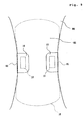
- Fig. 7 is a top plan view, as taken from the back side, of a sanitary napkin as an absorbent article according to still another embodiment of the invention
- Fig. 8 is a section taken along line VIII - VIII of the sanitary napkin shown in Fig. 7
- Fig. 9 is a top plan view of a portion showing a state in which the sanitary napkin shown in Fig. 7 is attached to panties.
- the longitudinal direction of the sanitary napkin or the absorbent article is taken like before in the Y-direction, and the widthwise direction generally perpendicular to the Y-direction is taken in the X-direction.
- a sanitary napkin 1E is generally symmetric with respect to the center line Ly extending in the Y-direction.
- This sanitary napkin 1E is provided, as seen from the section shown in Fig. 8, with: a liquid-permeable top sheet 4 on the liquid receiving side; a liquid-impermeable back sheet 3 on the outer side; and an absorbent core 2 sandwiched between the top sheet 4 and the back sheet 3.
- These individual members are similar to those of the foregoing diapers.
- the top sheet 4 and the back sheet 3 are individually extended in the X-direction to form wings 10 and 10.
- the sanitary napkin 1E is provided with an adhesive portion 12 on the back side of its body and adhesive portions 13 on the back sides of the wings 10.
- the sanitary napkin 1E is attached, when worn, to the crotch portion 82 on the inner side of panties 80, as shown in Fig. 9.
- the adhesive portion 12 on the back of the body is retained on the inner face of the crotch portion 82 of the panties 80.
- the wings 10 as extending outward of the body in the X-direction, are folded along the edge portions 81 of the panties 80 so that they are hooked on the panties 80 by the adhesive portions 13. With these wings 10 thus provided, it is possible to prevent the edge portions of the panties from being blotted or the sanitary napkin 1E from going out of position.
- the two side regions 32 provide the high optical transmittance regions (b), and the central region 31 provides the high moisture-permeable region (a).
- the wings 10 are so hardly prominent that the color of the panties 80 can be seen through the wings 10. This makes the sanitary napkin 1E unclear from the appearance.
- the top sheet 4 used at this time has to be high in the optical transmittance.
- the regions (b) are preferred to have a total optical transmittance of 60 % or more according to JIS-K-7105.
- the moisture-permeable region (a) is preferred to have a moisture-permeability of 1,000 g/m 2 ⁇ 24hrs or more so as to prevent the panties from becoming stuffy in its inside while wearing the sanitary napkin 1E.
- the total optical transmittance is preferred to be 50 % or less according to JIS-K-7105 so that the absorbed mensual blood may not be seen at the back side through the body of the sanitary napkin. It is, therefore, preferable that the moisture-permeable region (a), i.e., the low optical transmittance region is positioned at least in the generally widthwise central portion of the region having the absorbent core 2 and over one half or more of the width size of the absorbent core 2, and/or in the generally longitudinal central portion of the region having the absorbent core 2 and over one half or more of the longitudinal size of the absorbent core 2.
- the back sheet 3 is preferred to have a tearing strength of 20 g or more so that it may be prevented from being broken by the adhesion of the adhesive portion 12 when the sanitary napkin 1E is removed after use from the panties 80.
- the back sheet 3 is preferred to have a tearing strength of 200 g or more so that the wings 10 may be prevented from being torn from the body.
- the wings 10 are preferred to have a rigidity at some level so that they may be easily attached to the crotch portion 82 of the panties 80. Therefore, the rigidity (as measured by the cantilever method according to JIS L1096) of the regions (b) in the back sheet 3 is preferably at 30 mm or higher.
- the region (a) and the regions (b) are given different thicknesses so that the wings 10 are easily folded at their boundaries between the regions (a) and (b). Therefore, the sanitary napkin 1E can be easily attached because the wings 10 are easily folded along the edge portions 81 of the panties 80.
- the regions (b) need not be formed all over the two side regions 32 but may be provided exclusively at the portions forming the wings 10.
- the back sheet 3 of the sanitary napkin 1E can be prepared in a manner similar to that used in the aforementioned diaper.
- the central region in the widthwise direction (or the CD) of the film being fed may be exclusively embossed by using the embossing rolls 70a and 70b shown in Fig. 4Abut having the corrugations of Fig. 4B at their central portions.
- the back sheet of the absorbent article of the invention it is possible to form the high optical transmittance region in a necessary extension at a target portion.
- This back sheet should not be limited to the open type diaper or the sanitary napkin thus far described but could be applied to another absorbent article such as a diaper, as formed in advance into an underwear shape, a urine absorbing pad or a liner sheet.
- the high optical transmittance portion (or the region (b)) and the high air- and moisture-permeable portion (or the region (a)).
- the region (b) is formed at the center so that whether or not the discharge has been made can be confirmed from the outside of the diaper being worn.
- the regions (b) are formed in the wings so that the presence of the wings cannot be seen from the outside of the panties.
- the high optical transmittance region can be formed in a portion of the absorbent article while the air-permeability and the moisture-permeability being retained in the entire absorbent article.
- the strength of the back sheet is hard to degrade.
- the back sheet having an optical transmittance changed partially can be manufactured at a low cost and with ease.
Landscapes
- Health & Medical Sciences (AREA)
- General Health & Medical Sciences (AREA)
- Epidemiology (AREA)
- Biomedical Technology (AREA)
- Heart & Thoracic Surgery (AREA)
- Vascular Medicine (AREA)
- Life Sciences & Earth Sciences (AREA)
- Engineering & Computer Science (AREA)
- Public Health (AREA)
- Animal Behavior & Ethology (AREA)
- Veterinary Medicine (AREA)
- Dermatology (AREA)
- Absorbent Articles And Supports Therefor (AREA)
- Laminated Bodies (AREA)
- Orthopedics, Nursing, And Contraception (AREA)
- Solid-Sorbent Or Filter-Aiding Compositions (AREA)
Claims (20)
- Absorbierender Gegenstand umfassend
eine flüssigkeitsdurchlässige obere Lage (4), eine untere Lage (3) und einen zwischen der oberen und der unteren Lage sandwichartig angeordneten absorbierenden Kern (2),
wobei die untere Lage aus einem Harzfilm gebildet ist, der einen anorganischen Füllstoff in einem Harzbasismaterial enthält,
wobei die untere Lage enthält:wobei der Bereich (b) von hohem optischen Transmissionsgrad dicker ist als der flüssigkeitsdurchlässige Bereich (a).(a) einen gedehnten feuchtigkeitsdurchlässigen Bereich (a), und(b) einen Bereich (b) von hohem optischen Transmissionsgrad, der einen geringeren Grad an Orientierung als der feuchtigkeitsdurchlässige Bereich aufweist und/oder ungedehnt gelassen ist, und - Absorbierender Gegenstand nach Anspruch 1, wobei das Harzbasismaterial ein Polyolefinharz ist.
- Absorbierender Gegenstand nach Anspruch 1 oder 2, wobei das Mischverhältnis zwischen dem Harzbasismaterial und dem anorganischen Füllstoff 20 zu 70 Masse-% oder 80 zu 30 Masse-% beträgt.
- Absorbierender Gegenstand nach einem der vorhergehenden Ansprüche, wobei der absorbierende Gegenstand eine Wegwerfwindel ist, und wobei der Bereich (b) von hohem optischen Transmissionsgrad so angeordnet ist, daß er das ganze Hinterteil des absorbierenden Kerns oder einen Teil davon bedeckt.
- Absorbierender Gegenstand nach Anspruch 4, wobei der Bereich (b) von hohem optischen Transmissionsgrad vorgesehen ist: im bezüglich der Breite im wesentlichen mittleren Abschnitt des Bereichs mit dem absorbierenden Kern und in dem Bereich, der den Mittelpunkt bezüglich der Breite des absorbierenden Kerns enthält und der einem Viertel der Breite der Windel entspricht, und/oder in dem bezüglich der Länge im wesentlichen mittleren Abschnitt des Bereichs mit dem absorbierenden Kern und in dem Bereich, der den Mittelpunkt bezüglich der Länge des absorbiernden Kerns enthält und der einem Viertel der Länge der Windel entspricht.
- Absorbierender Gegenstand nach einem der Ansprüche 1 bis 3, wobei der absorbierende Gegenstand eine Damenbinde (1B) mit einem Paar von Flügelabschnitten (10), die auf den zwei Seiten des Bereichs des absorbierenden Kerns angeordnet sind und nach außen in der Richtung der Breite verlaufen, und wobei der feuchtigkeitsdurchlässige Bereich (a) so angeordnet ist, daß er das ganze Hinterteil des absorbierenden Kerns oder einen Teil davon bedeckt, wobei der Bereich (b) von hohem optischen Transmissionsgrad zumindest in den Flügelabschnitten angeordnet ist.
- Absorbierender Gegenstand nach Anspruch 6, wobei der feuchtigkeitsdurchlässige Bereich (a) angeordnet ist:in dem bezüglich der Breite im wesentlichen mittleren Abschnitt des Bereichs mit dem absorbierenden Kern und über eine halbe Breite des absorbierenden Kerns oder mehr, und/oder in dem bezüglich der Länge im wesentlichen mittleren Abschnitt des Bereichs mit dem absorbierenden Kern und über eine halbe Länge des absorbierenden Kerns oder mehr.
- Absorbierender Gegenstand nach einem der vorhergehenden Ansprüche, wobei der feuchtigkeitsdurchlässige Bereich (a) eine Feuchtigkeitsdurchlässigkeit von 1.000 g/m2·24h oder mehr aufweist.
- Absorbierender Gegenstand nach einem der vorhergehenden Ansprüche, wobei der feuchtigkeitsdurchlässige Bereich (a) einen totalen optischen Transmissionsgrad von 50 % oder weniger entsprechend JIS-K-7105 aufweist.
- Absorbierender Gegenstand nach einem der vorhergehenden Ansprüche, wobei der Bereich b von hohem optischen Transmissionsgrad einen totalen optischen Transmissionsgrad von 60 % oder mehr entsprechend JIS-K-7105 aufweist.
- Absorbierender Gegenstand nach einem der vorhergehenden Ansprüche, wobei, wenn die untere Lage in den feuchtigkeitsdurchlässigen Bereichen (a) eine Dicke T1 und in den Bereichen (b) von hohem optischen Transmissionsgrad eine Dicke T2 aufweisen, die Werte T1 und T2 die folgende Formel erfüllen:
- Absorbierender Gegenstand nach einem der vorhergehenden Ansprüche, wobei die untere Lage eine Mehrschichtstruktur zumindest im Bereich (b) von hohem optischen Transmissionsgrad aufweist.
- Verfahren zum Herstellen einer unteren Lage für einen absorbierenden Gegenstand, umfassend
eine flüssigkeitsdurchlässige obere Lage (4), die untere Lage (3) und einen zwischen der oberen und der unteren Lage sandwichartig angeordneten absorbierenden Kern (2),
wobei ein Film mit einem anorganischen Füllstoff in einem Harzbasismaterial teilweise gedehnt wird, um zu formen:wobei der Bereich (b) von hohem optischen Transmissionsgrad dicker ist als der feuchtigkeitsdurchlässige Bereich (a).(a) einen gedehnten feuchtigkeitsdurchlässigen Bereich, und(b) einen Bereich von hohem optischen Transmissionsgrad, der einen geringeren Grad an Orientierung hat als der feuchtigkeitsdurchlässige Bereich aufweist und/oder ungedehnt gelassen wird, und - Herstellungsverfahren für eine untere Lage nach Anspruch 13,
wobei ein stetig zugeführter Film ausschließlich in einem mittleren Abschnitt in einer Breitenrichtung (oder in CD) gedehnt wird, um den feuchtigkeitsdurchlässigen Bereich (a) im zentralen Abschnitt zu bilden. - Herstellungsverfahren für eine untere Lage nach Anspruch 13,
wobei ein stetig zugeführter Film ausschließlich in zwei Seitenabschnitten in einer Breitenrichtung (oder in CD) gedehnt wird, um die feuchtigkeitsdurchlässigen Bereiche (a) auf den zwei Seitenabschnitten zu bilden. - Herstellungsverfahren für eine untere Lage nach Anspruch 13,
wobei ein stetig zugeführter Film in einem vorgegebenen Intervall in einer Längsrichtung (oder in MD) teilweise gedehnt wird, um die feuchtigkeitsdurchlässigen Bereiche (a) in einem Zwischenraum in der Längsrichtung zu bilden. - Herstellungsverfahren für eine untere Lage nach Anspruch 13,
wobei ein stetig zugeführter Film in einem vorgegebenen Intervall in einer Breitenrichtung (oder in CD) teilweise gedehnt wird, um die feuchtigkeitsdurchlässigen Bereiche (a) in einen Zwischenraum in der Breitenrichtung zu bilden. - Herstellungsverfahren für eine untere Lage nach Anspruch 13,
wobei der Film durch eine Prägebehandlung gedehnt wird, um den feuchtigkeitsdurchlässigen Bereich (a) zu bilden. - Herstellungsverfahren für eine untere Lage nach einem der Ansprüche 13 bis 18,
wobei ein Film mit teilweise unterschiedlichen Dicken aus einem dem anorganischen Füllstoff in Harzbasismaterial enthaltenden Material geformt wird und gedehnt wird, um den feuchtigkeitsdurchlässigen Bereich (a) im dünneren Abschnitt und den Bereich (b) von hohem optischen Transmissionsgrad im dickeren Abschnitt zu bilden. - Herstellungsverfahren für eine untere Lage nach einem der Ansprüche 13 bis 19,
wobei ein ungedehnter Film teilweise mit einem transparenten Film beschichtet wird und dann gedehnt wird, um den feuchtigkeitsdurchlässigen Bereich (a) in dem Abschnitt, der nicht mit dem transparenten Film beschichtet ist, und dem Bereich (b) von hohem optischen Transmissionsgrad in dem Abschnitt, der mit dem transparenten Film beschichtet ist, zu bilden.
Priority Applications (1)
| Application Number | Priority Date | Filing Date | Title |
|---|---|---|---|
| DE60022849T DE60022849T3 (de) | 1999-12-22 | 2000-12-19 | Absorbierender Artikel mit äusserer Schicht, und Herstellungsverfahren für die äussere Schicht |
Applications Claiming Priority (2)
| Application Number | Priority Date | Filing Date | Title |
|---|---|---|---|
| JP36443099A JP3819657B2 (ja) | 1999-12-22 | 1999-12-22 | バックシートを備えた生理用ナプキン及び前記バックシートの製造方法 |
| JP36443099 | 1999-12-22 |
Publications (4)
| Publication Number | Publication Date |
|---|---|
| EP1110527A2 EP1110527A2 (de) | 2001-06-27 |
| EP1110527A3 EP1110527A3 (de) | 2004-06-23 |
| EP1110527B1 true EP1110527B1 (de) | 2005-09-28 |
| EP1110527B2 EP1110527B2 (de) | 2011-11-23 |
Family
ID=18481793
Family Applications (1)
| Application Number | Title | Priority Date | Filing Date |
|---|---|---|---|
| EP00311348A Expired - Lifetime EP1110527B2 (de) | 1999-12-22 | 2000-12-19 | Absorbierender Artikel mit äusserer Schicht, und Herstellungsverfahren für die äussere Schicht |
Country Status (14)
| Country | Link |
|---|---|
| US (3) | US6531204B2 (de) |
| EP (1) | EP1110527B2 (de) |
| JP (1) | JP3819657B2 (de) |
| KR (1) | KR100778719B1 (de) |
| CN (1) | CN1212821C (de) |
| AT (1) | ATE305285T1 (de) |
| AU (1) | AU777398B2 (de) |
| BR (1) | BR0006282B1 (de) |
| CA (1) | CA2329467C (de) |
| DE (1) | DE60022849T3 (de) |
| ID (1) | ID28687A (de) |
| MY (1) | MY126969A (de) |
| SG (1) | SG91318A1 (de) |
| TW (1) | TW471962B (de) |
Families Citing this family (31)
| Publication number | Priority date | Publication date | Assignee | Title |
|---|---|---|---|---|
| EP1138293B1 (de) * | 2000-03-25 | 2012-07-18 | The Procter & Gamble Company | Durchsichtiger absorbierender Artikel |
| US6749594B2 (en) | 2001-04-11 | 2004-06-15 | Sca Hygiene Products Ab | Absorbent product with enhanced inconspicuousness |
| EP1295711B1 (de) | 2001-09-19 | 2006-04-12 | The Procter & Gamble Company | Farbbedruckte Mehrschichtstruktur, ein damit hergestellter absorbierender Artikel und Verfahren zu deren Herstellung |
| US7205259B2 (en) * | 2002-07-26 | 2007-04-17 | Kimberly-Clark Worldwide, Inc. | Absorbent binder desiccant composition and articles incorporating it |
| US7115321B2 (en) | 2002-07-26 | 2006-10-03 | Kimberly-Clark Worldwide, Inc. | Absorbent binder coating |
| JP4336539B2 (ja) * | 2002-08-30 | 2009-09-30 | ユニ・チャーム株式会社 | 装飾要素を有する吸収性物品 |
| JP4426754B2 (ja) * | 2002-12-27 | 2010-03-03 | ユニ・チャーム株式会社 | 体液吸収性物品のインジケータ |
| JP4558356B2 (ja) * | 2004-03-16 | 2010-10-06 | 大王製紙株式会社 | 吸収性物品 |
| DE102004036102A1 (de) * | 2004-07-24 | 2006-02-16 | Hygiene Oederan Vertriebsgesellschaft Mbh | Absorbierender Hygieneartikel |
| US8158848B2 (en) * | 2005-06-03 | 2012-04-17 | Paul Hartmann Ag | Absorbent single use article |
| US20070083175A1 (en) * | 2005-10-11 | 2007-04-12 | Kimberly-Clark Worldwide, Inc. | Transparent/translucent absorbent composites and articles |
| JP5170951B2 (ja) * | 2005-10-31 | 2013-03-27 | ユニ・チャーム株式会社 | 吸収性物品 |
| US20070101648A1 (en) * | 2005-11-10 | 2007-05-10 | Robert Iverson | Method and apparatus for endothermic fuel reformation |
| US20070129697A1 (en) * | 2005-12-02 | 2007-06-07 | Soerens Dave A | Articles comprising flexible superabsorbent binder polymer composition |
| US7619131B2 (en) * | 2005-12-02 | 2009-11-17 | Kimberly-Clark Worldwide, Inc. | Articles comprising transparent/translucent polymer composition |
| AU2006347731B2 (en) * | 2006-08-31 | 2012-09-13 | Kimberly-Clark Worldwide, Inc. | Highly breathable biodegradable films |
| USD564236S1 (en) | 2006-11-29 | 2008-03-18 | The Procter & Gamble Company | Substrate with printed pattern |
| CN103705344B (zh) * | 2007-09-05 | 2016-05-25 | 尤妮佳股份有限公司 | 吸收性物品 |
| US8710291B2 (en) | 2007-12-28 | 2014-04-29 | Kimberly-Clark Worldwide, Inc. | Translucent internal graphics enhancement |
| CA2715993A1 (en) * | 2008-02-19 | 2009-08-27 | Unicharm Corporation | Absorptive article |
| JP5130075B2 (ja) * | 2008-02-19 | 2013-01-30 | ユニ・チャーム株式会社 | 吸収性物品 |
| WO2009104673A1 (ja) * | 2008-02-19 | 2009-08-27 | ユニ・チャーム株式会社 | 吸収性物品 |
| JP5379991B2 (ja) * | 2008-03-31 | 2013-12-25 | ユニ・チャーム株式会社 | 吸収性物品 |
| JP4722151B2 (ja) * | 2008-04-07 | 2011-07-13 | 大王製紙株式会社 | 包装生理用ナプキン |
| JP4869279B2 (ja) * | 2008-04-07 | 2012-02-08 | 大王製紙株式会社 | 包装生理用ナプキン |
| US8691041B2 (en) * | 2008-08-08 | 2014-04-08 | The Procter And Gamble Company | Method of producing a composite multi-layered printed absorbent article |
| JP5465906B2 (ja) * | 2009-03-26 | 2014-04-09 | ユニ・チャーム株式会社 | 吸収性物品 |
| USD639071S1 (en) | 2010-01-22 | 2011-06-07 | The Procter & Gamble Company | Substrate with printed pattern |
| US20110264067A1 (en) * | 2010-04-23 | 2011-10-27 | Ilse Rubio | Feminine hygiene pads |
| JP2011229663A (ja) * | 2010-04-27 | 2011-11-17 | Unicharm Corp | 吸収性物品積層体 |
| US9573729B2 (en) | 2015-03-12 | 2017-02-21 | Poly-America, L.P. | Polymeric films and bags |
Family Cites Families (19)
| Publication number | Priority date | Publication date | Assignee | Title |
|---|---|---|---|---|
| US4902553A (en) * | 1987-12-04 | 1990-02-20 | Minnesota Mining And Manufacturing Company | Disposable products |
| JPH0745174B2 (ja) | 1990-02-12 | 1995-05-17 | クロペイ コーポレイション | 超柔軟性の布様エンボス加工プラスチックフィルム |
| JPH05168660A (ja) * | 1991-12-25 | 1993-07-02 | Mitsui Toatsu Chem Inc | 使い捨ておむつ |
| JPH05168860A (ja) | 1991-12-26 | 1993-07-02 | Toyota Motor Corp | 排気ガス浄化方法 |
| JPH05200063A (ja) * | 1992-01-28 | 1993-08-10 | Uni Charm Corp | 体液処理用品の通気不透液性裏面シート、およびその製造方法 |
| US5649917A (en) * | 1992-03-31 | 1997-07-22 | The Procter & Gamble Company | Sanitary napkin having barrier means |
| US5518801A (en) * | 1993-08-03 | 1996-05-21 | The Procter & Gamble Company | Web materials exhibiting elastic-like behavior |
| JP3540050B2 (ja) | 1995-04-14 | 2004-07-07 | 花王株式会社 | 多孔性シート及びその製造方法並びに該多孔性シートを用いた吸収性物品 |
| JP3310842B2 (ja) * | 1995-11-29 | 2002-08-05 | ユニ・チャーム株式会社 | 使い捨ておむつ |
| CA2262538A1 (en) * | 1996-07-30 | 1998-02-05 | Kimberley Ann Dreier | Disposable garment with inspection porthole |
| US6258308B1 (en) * | 1996-07-31 | 2001-07-10 | Exxon Chemical Patents Inc. | Process for adjusting WVTR and other properties of a polyolefin film |
| JP3688403B2 (ja) * | 1996-09-17 | 2005-08-31 | 花王株式会社 | 使い捨ておむつ |
| USH2042H1 (en) † | 1997-05-09 | 2002-08-06 | The Procter & Gamble Company | Method for forming a breathable film |
| US6179939B1 (en) * | 1997-05-12 | 2001-01-30 | Kimberly-Clark Worldwide, Inc. | Methods of making stretched filled microporous films |
| EP0890350A1 (de) † | 1997-07-08 | 1999-01-13 | The Procter & Gamble Company | Absorbierender Wegwerfartikel mit kleidungsähnlicher, äusserer Schicht, welche unterschiedliche Atmungsfähigkeit besitzt und die Methode, solche Schichten herzustellen |
| US6140551A (en) * | 1997-09-29 | 2000-10-31 | Kimberly-Clark Worldwide, Inc. | Absorbent article with visually and tactilely distinctive outer cover |
| JP3510093B2 (ja) * | 1997-12-16 | 2004-03-22 | ユニ・チャーム株式会社 | 使い捨ておむつ |
| JP4017283B2 (ja) * | 1998-04-06 | 2007-12-05 | 花王株式会社 | 多孔性シート及び吸収性物品 |
| JP2001233982A (ja) * | 1999-12-14 | 2001-08-28 | Tokuyama Corp | 多孔質ポリオレフィンフィルム及びその製造方法 |
-
1999
- 1999-12-22 JP JP36443099A patent/JP3819657B2/ja not_active Expired - Fee Related
-
2000
- 2000-12-18 MY MYPI20005934A patent/MY126969A/en unknown
- 2000-12-19 AT AT00311348T patent/ATE305285T1/de not_active IP Right Cessation
- 2000-12-19 US US09/740,640 patent/US6531204B2/en not_active Expired - Lifetime
- 2000-12-19 EP EP00311348A patent/EP1110527B2/de not_active Expired - Lifetime
- 2000-12-19 DE DE60022849T patent/DE60022849T3/de not_active Expired - Lifetime
- 2000-12-20 CA CA002329467A patent/CA2329467C/en not_active Expired - Fee Related
- 2000-12-20 AU AU72400/00A patent/AU777398B2/en not_active Ceased
- 2000-12-21 TW TW089127572A patent/TW471962B/zh not_active IP Right Cessation
- 2000-12-21 SG SG200007590A patent/SG91318A1/en unknown
- 2000-12-22 CN CNB001376403A patent/CN1212821C/zh not_active Expired - Fee Related
- 2000-12-22 KR KR1020000080430A patent/KR100778719B1/ko not_active Expired - Fee Related
- 2000-12-22 BR BRPI0006282-0A patent/BR0006282B1/pt not_active IP Right Cessation
- 2000-12-22 ID IDP20001130A patent/ID28687A/id unknown
-
2002
- 2002-12-31 US US10/334,335 patent/US7034199B2/en not_active Expired - Fee Related
- 2002-12-31 US US10/334,390 patent/US20030091796A1/en not_active Abandoned
Also Published As
| Publication number | Publication date |
|---|---|
| EP1110527A3 (de) | 2004-06-23 |
| US20030091796A1 (en) | 2003-05-15 |
| CA2329467C (en) | 2007-09-25 |
| EP1110527B2 (de) | 2011-11-23 |
| US7034199B2 (en) | 2006-04-25 |
| BR0006282B1 (pt) | 2009-01-13 |
| US20030100875A1 (en) | 2003-05-29 |
| BR0006282A (pt) | 2001-07-31 |
| KR100778719B1 (ko) | 2007-11-27 |
| JP2001170106A (ja) | 2001-06-26 |
| CN1306808A (zh) | 2001-08-08 |
| JP3819657B2 (ja) | 2006-09-13 |
| AU777398B2 (en) | 2004-10-14 |
| US6531204B2 (en) | 2003-03-11 |
| KR20010062637A (ko) | 2001-07-07 |
| DE60022849T2 (de) | 2006-07-06 |
| AU7240000A (en) | 2001-06-28 |
| DE60022849D1 (de) | 2006-02-09 |
| ATE305285T1 (de) | 2005-10-15 |
| US20010006867A1 (en) | 2001-07-05 |
| EP1110527A2 (de) | 2001-06-27 |
| MY126969A (en) | 2006-11-30 |
| TW471962B (en) | 2002-01-11 |
| CA2329467A1 (en) | 2001-06-22 |
| SG91318A1 (en) | 2002-09-17 |
| ID28687A (id) | 2001-06-28 |
| CN1212821C (zh) | 2005-08-03 |
| DE60022849T3 (de) | 2012-05-03 |
Similar Documents
| Publication | Publication Date | Title |
|---|---|---|
| CA2329467C (en) | Absorbent article with back sheet, and method for manufacturing the back sheet | |
| EP1078619B1 (de) | Absorbierender Artikel mit Seitenflügel, und Verfahren zu dessen Herstellung | |
| JP4070804B2 (ja) | 毛管積層材料 | |
| KR100266496B1 (ko) | 재습윤화차단부를갖는흡수제품 | |
| EP1290995B1 (de) | Absorbierender Artikel | |
| KR100263231B1 (ko) | 개선된 계면활성제-처리된 친수성 상면 시이트를 갖는 흡수제품 | |
| JPH09502635A (ja) | 複数のトップシートを有する吸収物品 | |
| JP4732497B2 (ja) | 吸収性物品 | |
| CN104066410B (zh) | 吸收性物品 | |
| EP2223670A1 (de) | Saugfähiger artikel und verfahren zu seiner herstellung | |
| CA2398745C (en) | Pants-type disposable diaper | |
| JP3812812B2 (ja) | 吸収性物品 | |
| AU776700B2 (en) | Absorbent article with perforated top sheet | |
| JP4124314B2 (ja) | 吸収性物品 | |
| CZ287033B6 (en) | Fluid-pervious structure, exhibiting surface energy gradient | |
| JP4536613B2 (ja) | バックシートを備えた使い捨ておむつ及び前記バックシートの製造方法 | |
| KR101227815B1 (ko) | 엠보 부직포가 적용된 일회용 흡수제품 |
Legal Events
| Date | Code | Title | Description |
|---|---|---|---|
| PUAI | Public reference made under article 153(3) epc to a published international application that has entered the european phase |
Free format text: ORIGINAL CODE: 0009012 |
|
| AK | Designated contracting states |
Kind code of ref document: A2 Designated state(s): AT BE CH CY DE DK ES FI FR GB GR IE IT LI LU MC NL PT SE TR |
|
| AX | Request for extension of the european patent |
Free format text: AL;LT;LV;MK;RO;SI |
|
| PUAL | Search report despatched |
Free format text: ORIGINAL CODE: 0009013 |
|
| RAP1 | Party data changed (applicant data changed or rights of an application transferred) |
Owner name: UNI-CHARM CORPORATION |
|
| AK | Designated contracting states |
Kind code of ref document: A3 Designated state(s): AT BE CH CY DE DK ES FI FR GB GR IE IT LI LU MC NL PT SE TR |
|
| AX | Request for extension of the european patent |
Extension state: AL LT LV MK RO SI |
|
| RIC1 | Information provided on ipc code assigned before grant |
Ipc: 7A 61F 13/514 A Ipc: 7A 61F 13/15 B Ipc: 7A 61F 13/42 B |
|
| 17P | Request for examination filed |
Effective date: 20041019 |
|
| 17Q | First examination report despatched |
Effective date: 20041116 |
|
| AKX | Designation fees paid |
Designated state(s): AT BE CH CY DE DK ES FI FR GB GR IE IT LI LU MC NL PT SE TR |
|
| GRAP | Despatch of communication of intention to grant a patent |
Free format text: ORIGINAL CODE: EPIDOSNIGR1 |
|
| GRAS | Grant fee paid |
Free format text: ORIGINAL CODE: EPIDOSNIGR3 |
|
| GRAA | (expected) grant |
Free format text: ORIGINAL CODE: 0009210 |
|
| AK | Designated contracting states |
Kind code of ref document: B1 Designated state(s): AT BE CH CY DE DK ES FI FR GB GR IE IT LI LU MC NL PT SE TR |
|
| PG25 | Lapsed in a contracting state [announced via postgrant information from national office to epo] |
Ref country code: FI Free format text: LAPSE BECAUSE OF FAILURE TO SUBMIT A TRANSLATION OF THE DESCRIPTION OR TO PAY THE FEE WITHIN THE PRESCRIBED TIME-LIMIT Effective date: 20050928 Ref country code: TR Free format text: LAPSE BECAUSE OF FAILURE TO SUBMIT A TRANSLATION OF THE DESCRIPTION OR TO PAY THE FEE WITHIN THE PRESCRIBED TIME-LIMIT Effective date: 20050928 Ref country code: AT Free format text: LAPSE BECAUSE OF FAILURE TO SUBMIT A TRANSLATION OF THE DESCRIPTION OR TO PAY THE FEE WITHIN THE PRESCRIBED TIME-LIMIT Effective date: 20050928 Ref country code: CH Free format text: LAPSE BECAUSE OF FAILURE TO SUBMIT A TRANSLATION OF THE DESCRIPTION OR TO PAY THE FEE WITHIN THE PRESCRIBED TIME-LIMIT Effective date: 20050928 Ref country code: BE Free format text: LAPSE BECAUSE OF FAILURE TO SUBMIT A TRANSLATION OF THE DESCRIPTION OR TO PAY THE FEE WITHIN THE PRESCRIBED TIME-LIMIT Effective date: 20050928 Ref country code: LI Free format text: LAPSE BECAUSE OF FAILURE TO SUBMIT A TRANSLATION OF THE DESCRIPTION OR TO PAY THE FEE WITHIN THE PRESCRIBED TIME-LIMIT Effective date: 20050928 |
|
| REG | Reference to a national code |
Ref country code: GB Ref legal event code: FG4D |
|
| RIN1 | Information on inventor provided before grant (corrected) |
Inventor name: INOUE, TOSHIO, C/O TECHNICAL CENTER Inventor name: IMAI, SHIGEO, C/O TECHNICAL CENTER Inventor name: SUEKANE, MAKOTO, C/OTECHNICAL CENTER |
|
| REG | Reference to a national code |
Ref country code: CH Ref legal event code: EP |
|
| REG | Reference to a national code |
Ref country code: IE Ref legal event code: FG4D |
|
| PG25 | Lapsed in a contracting state [announced via postgrant information from national office to epo] |
Ref country code: CY Free format text: LAPSE BECAUSE OF FAILURE TO SUBMIT A TRANSLATION OF THE DESCRIPTION OR TO PAY THE FEE WITHIN THE PRESCRIBED TIME-LIMIT Effective date: 20051219 Ref country code: IE Free format text: LAPSE BECAUSE OF NON-PAYMENT OF DUE FEES Effective date: 20051219 |
|
| PG25 | Lapsed in a contracting state [announced via postgrant information from national office to epo] |
Ref country code: GR Free format text: LAPSE BECAUSE OF FAILURE TO SUBMIT A TRANSLATION OF THE DESCRIPTION OR TO PAY THE FEE WITHIN THE PRESCRIBED TIME-LIMIT Effective date: 20051228 Ref country code: DK Free format text: LAPSE BECAUSE OF FAILURE TO SUBMIT A TRANSLATION OF THE DESCRIPTION OR TO PAY THE FEE WITHIN THE PRESCRIBED TIME-LIMIT Effective date: 20051228 |
|
| PG25 | Lapsed in a contracting state [announced via postgrant information from national office to epo] |
Ref country code: LU Free format text: LAPSE BECAUSE OF NON-PAYMENT OF DUE FEES Effective date: 20051231 Ref country code: MC Free format text: LAPSE BECAUSE OF NON-PAYMENT OF DUE FEES Effective date: 20051231 |
|
| PG25 | Lapsed in a contracting state [announced via postgrant information from national office to epo] |
Ref country code: ES Free format text: LAPSE BECAUSE OF FAILURE TO SUBMIT A TRANSLATION OF THE DESCRIPTION OR TO PAY THE FEE WITHIN THE PRESCRIBED TIME-LIMIT Effective date: 20060108 |
|
| REG | Reference to a national code |
Ref country code: SE Ref legal event code: TRGR |
|
| REF | Corresponds to: |
Ref document number: 60022849 Country of ref document: DE Date of ref document: 20060209 Kind code of ref document: P |
|
| PG25 | Lapsed in a contracting state [announced via postgrant information from national office to epo] |
Ref country code: PT Free format text: LAPSE BECAUSE OF FAILURE TO SUBMIT A TRANSLATION OF THE DESCRIPTION OR TO PAY THE FEE WITHIN THE PRESCRIBED TIME-LIMIT Effective date: 20060228 |
|
| REG | Reference to a national code |
Ref country code: CH Ref legal event code: PL |
|
| ET | Fr: translation filed | ||
| PLBI | Opposition filed |
Free format text: ORIGINAL CODE: 0009260 |
|
| PLAX | Notice of opposition and request to file observation + time limit sent |
Free format text: ORIGINAL CODE: EPIDOSNOBS2 |
|
| 26 | Opposition filed |
Opponent name: PAUL HARTMANN AG Effective date: 20060628 |
|
| NLR1 | Nl: opposition has been filed with the epo |
Opponent name: PAUL HARTMANN AG |
|
| REG | Reference to a national code |
Ref country code: IE Ref legal event code: MM4A |
|
| PLAF | Information modified related to communication of a notice of opposition and request to file observations + time limit |
Free format text: ORIGINAL CODE: EPIDOSCOBS2 |
|
| PLBB | Reply of patent proprietor to notice(s) of opposition received |
Free format text: ORIGINAL CODE: EPIDOSNOBS3 |
|
| RDAF | Communication despatched that patent is revoked |
Free format text: ORIGINAL CODE: EPIDOSNREV1 |
|
| APAH | Appeal reference modified |
Free format text: ORIGINAL CODE: EPIDOSCREFNO |
|
| APBM | Appeal reference recorded |
Free format text: ORIGINAL CODE: EPIDOSNREFNO |
|
| APBP | Date of receipt of notice of appeal recorded |
Free format text: ORIGINAL CODE: EPIDOSNNOA2O |
|
| APBQ | Date of receipt of statement of grounds of appeal recorded |
Free format text: ORIGINAL CODE: EPIDOSNNOA3O |
|
| APBU | Appeal procedure closed |
Free format text: ORIGINAL CODE: EPIDOSNNOA9O |
|
| PUAH | Patent maintained in amended form |
Free format text: ORIGINAL CODE: 0009272 |
|
| STAA | Information on the status of an ep patent application or granted ep patent |
Free format text: STATUS: PATENT MAINTAINED AS AMENDED |
|
| 27A | Patent maintained in amended form |
Effective date: 20111123 |
|
| AK | Designated contracting states |
Kind code of ref document: B2 Designated state(s): AT BE CH CY DE DK ES FI FR GB GR IE IT LI LU MC NL PT SE TR |
|
| REG | Reference to a national code |
Ref country code: DE Ref legal event code: R102 Ref document number: 60022849 Country of ref document: DE |
|
| REG | Reference to a national code |
Ref country code: DE Ref legal event code: R102 Ref document number: 60022849 Country of ref document: DE Effective date: 20111123 |
|
| REG | Reference to a national code |
Ref country code: SE Ref legal event code: RPEO |
|
| REG | Reference to a national code |
Ref country code: NL Ref legal event code: T3 |
|
| PGFP | Annual fee paid to national office [announced via postgrant information from national office to epo] |
Ref country code: DE Payment date: 20121213 Year of fee payment: 13 |
|
| PGFP | Annual fee paid to national office [announced via postgrant information from national office to epo] |
Ref country code: SE Payment date: 20121217 Year of fee payment: 13 Ref country code: GB Payment date: 20121219 Year of fee payment: 13 Ref country code: IT Payment date: 20121218 Year of fee payment: 13 |
|
| PGFP | Annual fee paid to national office [announced via postgrant information from national office to epo] |
Ref country code: FR Payment date: 20130107 Year of fee payment: 13 Ref country code: NL Payment date: 20121215 Year of fee payment: 13 |
|
| REG | Reference to a national code |
Ref country code: DE Ref legal event code: R119 Ref document number: 60022849 Country of ref document: DE |
|
| REG | Reference to a national code |
Ref country code: NL Ref legal event code: V1 Effective date: 20140701 |
|
| REG | Reference to a national code |
Ref country code: SE Ref legal event code: EUG |
|
| GBPC | Gb: european patent ceased through non-payment of renewal fee |
Effective date: 20131219 |
|
| PG25 | Lapsed in a contracting state [announced via postgrant information from national office to epo] |
Ref country code: SE Free format text: LAPSE BECAUSE OF NON-PAYMENT OF DUE FEES Effective date: 20131220 |
|
| REG | Reference to a national code |
Ref country code: DE Ref legal event code: R119 Ref document number: 60022849 Country of ref document: DE Effective date: 20140701 |
|
| REG | Reference to a national code |
Ref country code: FR Ref legal event code: ST Effective date: 20140829 |
|
| PG25 | Lapsed in a contracting state [announced via postgrant information from national office to epo] |
Ref country code: DE Free format text: LAPSE BECAUSE OF NON-PAYMENT OF DUE FEES Effective date: 20140701 Ref country code: NL Free format text: LAPSE BECAUSE OF NON-PAYMENT OF DUE FEES Effective date: 20140701 |
|
| PG25 | Lapsed in a contracting state [announced via postgrant information from national office to epo] |
Ref country code: GB Free format text: LAPSE BECAUSE OF NON-PAYMENT OF DUE FEES Effective date: 20131219 Ref country code: FR Free format text: LAPSE BECAUSE OF NON-PAYMENT OF DUE FEES Effective date: 20131231 |
|
| PG25 | Lapsed in a contracting state [announced via postgrant information from national office to epo] |
Ref country code: IT Free format text: LAPSE BECAUSE OF NON-PAYMENT OF DUE FEES Effective date: 20131231 |
|
| PG25 | Lapsed in a contracting state [announced via postgrant information from national office to epo] |
Ref country code: IT Free format text: LAPSE BECAUSE OF NON-PAYMENT OF DUE FEES Effective date: 20131219 |