EP1111068A1 - Verzweigte Substanz zur Verwendung in Reaktionen zur Detektion und Analyse von Nukleinsäuren - Google Patents
Verzweigte Substanz zur Verwendung in Reaktionen zur Detektion und Analyse von Nukleinsäuren Download PDFInfo
- Publication number
- EP1111068A1 EP1111068A1 EP99125484A EP99125484A EP1111068A1 EP 1111068 A1 EP1111068 A1 EP 1111068A1 EP 99125484 A EP99125484 A EP 99125484A EP 99125484 A EP99125484 A EP 99125484A EP 1111068 A1 EP1111068 A1 EP 1111068A1
- Authority
- EP
- European Patent Office
- Prior art keywords
- nucleic acid
- compound according
- group
- branched compound
- moiety
- Prior art date
- Legal status (The legal status is an assumption and is not a legal conclusion. Google has not performed a legal analysis and makes no representation as to the accuracy of the status listed.)
- Withdrawn
Links
- 150000001875 compounds Chemical class 0.000 title claims abstract description 91
- 150000007523 nucleic acids Chemical class 0.000 title claims abstract description 80
- 238000006243 chemical reaction Methods 0.000 title claims abstract description 68
- 102000039446 nucleic acids Human genes 0.000 title claims abstract description 28
- 108020004707 nucleic acids Proteins 0.000 title claims abstract description 28
- 238000004458 analytical method Methods 0.000 title claims abstract description 11
- 238000001514 detection method Methods 0.000 title claims abstract description 8
- 238000000034 method Methods 0.000 claims abstract description 46
- 230000008569 process Effects 0.000 claims abstract description 33
- 238000001668 nucleic acid synthesis Methods 0.000 claims abstract description 20
- 238000003786 synthesis reaction Methods 0.000 claims abstract description 16
- 230000015572 biosynthetic process Effects 0.000 claims abstract description 8
- 108091034117 Oligonucleotide Proteins 0.000 claims description 62
- 108020004414 DNA Proteins 0.000 claims description 42
- 125000003729 nucleotide group Chemical group 0.000 claims description 41
- 239000002773 nucleotide Substances 0.000 claims description 34
- 239000011521 glass Substances 0.000 claims description 27
- 239000007790 solid phase Substances 0.000 claims description 24
- 125000005647 linker group Chemical group 0.000 claims description 21
- 150000001282 organosilanes Chemical group 0.000 claims description 18
- 239000007787 solid Substances 0.000 claims description 16
- 125000006850 spacer group Chemical group 0.000 claims description 15
- 239000000872 buffer Substances 0.000 claims description 9
- -1 propyltrimethoxysilyl group Chemical group 0.000 claims description 7
- OKTJSMMVPCPJKN-UHFFFAOYSA-N Carbon Chemical group [C] OKTJSMMVPCPJKN-UHFFFAOYSA-N 0.000 claims description 6
- 125000002887 hydroxy group Chemical group [H]O* 0.000 claims description 6
- 239000000178 monomer Substances 0.000 claims description 6
- 238000007899 nucleic acid hybridization Methods 0.000 claims description 6
- 238000010839 reverse transcription Methods 0.000 claims description 6
- 125000000548 ribosyl group Chemical group C1([C@H](O)[C@H](O)[C@H](O1)CO)* 0.000 claims description 6
- 208000035657 Abasia Diseases 0.000 claims description 5
- KKZFLSZAWCYPOC-VPENINKCSA-N Deoxyribose 5-phosphate Chemical group O[C@H]1C[C@H](O)[C@@H](COP(O)(O)=O)O1 KKZFLSZAWCYPOC-VPENINKCSA-N 0.000 claims description 5
- 125000003277 amino group Chemical group 0.000 claims description 5
- 238000002474 experimental method Methods 0.000 claims description 5
- 108090000623 proteins and genes Proteins 0.000 claims description 5
- 239000004793 Polystyrene Substances 0.000 claims description 4
- 125000003545 alkoxy group Chemical group 0.000 claims description 4
- 125000003178 carboxy group Chemical group [H]OC(*)=O 0.000 claims description 4
- 239000012071 phase Substances 0.000 claims description 4
- 125000002467 phosphate group Chemical group [H]OP(=O)(O[H])O[*] 0.000 claims description 4
- 229920000151 polyglycol Polymers 0.000 claims description 4
- 229920002223 polystyrene Polymers 0.000 claims description 4
- 108091028043 Nucleic acid sequence Proteins 0.000 claims description 3
- 230000000692 anti-sense effect Effects 0.000 claims description 3
- 239000011324 bead Substances 0.000 claims description 3
- 239000012888 bovine serum Substances 0.000 claims description 3
- 239000003153 chemical reaction reagent Substances 0.000 claims description 3
- 230000002441 reversible effect Effects 0.000 claims description 3
- 239000001226 triphosphate Substances 0.000 claims description 3
- 235000011178 triphosphate Nutrition 0.000 claims description 3
- 239000000020 Nitrocellulose Substances 0.000 claims description 2
- 239000004677 Nylon Substances 0.000 claims description 2
- 239000004952 Polyamide Substances 0.000 claims description 2
- 125000003172 aldehyde group Chemical group 0.000 claims description 2
- 239000001913 cellulose Substances 0.000 claims description 2
- 229920002678 cellulose Polymers 0.000 claims description 2
- 239000005289 controlled pore glass Substances 0.000 claims description 2
- 229920001577 copolymer Polymers 0.000 claims description 2
- 238000004925 denaturation Methods 0.000 claims description 2
- 230000036425 denaturation Effects 0.000 claims description 2
- 229920001220 nitrocellulos Polymers 0.000 claims description 2
- 229920001778 nylon Polymers 0.000 claims description 2
- 229920002647 polyamide Polymers 0.000 claims description 2
- 239000004417 polycarbonate Substances 0.000 claims description 2
- 229920000515 polycarbonate Polymers 0.000 claims description 2
- 239000011541 reaction mixture Substances 0.000 claims description 2
- 125000003396 thiol group Chemical group [H]S* 0.000 claims description 2
- UNXRWKVEANCORM-UHFFFAOYSA-N triphosphoric acid Chemical compound OP(O)(=O)OP(O)(=O)OP(O)(O)=O UNXRWKVEANCORM-UHFFFAOYSA-N 0.000 claims description 2
- 125000005524 levulinyl group Chemical group 0.000 claims 5
- 125000006239 protecting group Chemical group 0.000 claims 5
- 125000002221 trityl group Chemical group [H]C1=C([H])C([H])=C([H])C([H])=C1C([*])(C1=C(C(=C(C(=C1[H])[H])[H])[H])[H])C1=C([H])C([H])=C([H])C([H])=C1[H] 0.000 claims 2
- KMEMIMRPZGDOMG-UHFFFAOYSA-N 2-cyanoethoxyphosphonamidous acid Chemical compound NP(O)OCCC#N KMEMIMRPZGDOMG-UHFFFAOYSA-N 0.000 claims 1
- 102000053602 DNA Human genes 0.000 description 41
- JLCPHMBAVCMARE-UHFFFAOYSA-N [3-[[3-[[3-[[3-[[3-[[3-[[3-[[3-[[3-[[3-[[3-[[5-(2-amino-6-oxo-1H-purin-9-yl)-3-[[3-[[3-[[3-[[3-[[3-[[5-(2-amino-6-oxo-1H-purin-9-yl)-3-[[5-(2-amino-6-oxo-1H-purin-9-yl)-3-hydroxyoxolan-2-yl]methoxy-hydroxyphosphoryl]oxyoxolan-2-yl]methoxy-hydroxyphosphoryl]oxy-5-(5-methyl-2,4-dioxopyrimidin-1-yl)oxolan-2-yl]methoxy-hydroxyphosphoryl]oxy-5-(6-aminopurin-9-yl)oxolan-2-yl]methoxy-hydroxyphosphoryl]oxy-5-(6-aminopurin-9-yl)oxolan-2-yl]methoxy-hydroxyphosphoryl]oxy-5-(6-aminopurin-9-yl)oxolan-2-yl]methoxy-hydroxyphosphoryl]oxy-5-(6-aminopurin-9-yl)oxolan-2-yl]methoxy-hydroxyphosphoryl]oxyoxolan-2-yl]methoxy-hydroxyphosphoryl]oxy-5-(5-methyl-2,4-dioxopyrimidin-1-yl)oxolan-2-yl]methoxy-hydroxyphosphoryl]oxy-5-(4-amino-2-oxopyrimidin-1-yl)oxolan-2-yl]methoxy-hydroxyphosphoryl]oxy-5-(5-methyl-2,4-dioxopyrimidin-1-yl)oxolan-2-yl]methoxy-hydroxyphosphoryl]oxy-5-(5-methyl-2,4-dioxopyrimidin-1-yl)oxolan-2-yl]methoxy-hydroxyphosphoryl]oxy-5-(6-aminopurin-9-yl)oxolan-2-yl]methoxy-hydroxyphosphoryl]oxy-5-(6-aminopurin-9-yl)oxolan-2-yl]methoxy-hydroxyphosphoryl]oxy-5-(4-amino-2-oxopyrimidin-1-yl)oxolan-2-yl]methoxy-hydroxyphosphoryl]oxy-5-(4-amino-2-oxopyrimidin-1-yl)oxolan-2-yl]methoxy-hydroxyphosphoryl]oxy-5-(4-amino-2-oxopyrimidin-1-yl)oxolan-2-yl]methoxy-hydroxyphosphoryl]oxy-5-(6-aminopurin-9-yl)oxolan-2-yl]methoxy-hydroxyphosphoryl]oxy-5-(4-amino-2-oxopyrimidin-1-yl)oxolan-2-yl]methyl [5-(6-aminopurin-9-yl)-2-(hydroxymethyl)oxolan-3-yl] hydrogen phosphate Polymers Cc1cn(C2CC(OP(O)(=O)OCC3OC(CC3OP(O)(=O)OCC3OC(CC3O)n3cnc4c3nc(N)[nH]c4=O)n3cnc4c3nc(N)[nH]c4=O)C(COP(O)(=O)OC3CC(OC3COP(O)(=O)OC3CC(OC3COP(O)(=O)OC3CC(OC3COP(O)(=O)OC3CC(OC3COP(O)(=O)OC3CC(OC3COP(O)(=O)OC3CC(OC3COP(O)(=O)OC3CC(OC3COP(O)(=O)OC3CC(OC3COP(O)(=O)OC3CC(OC3COP(O)(=O)OC3CC(OC3COP(O)(=O)OC3CC(OC3COP(O)(=O)OC3CC(OC3COP(O)(=O)OC3CC(OC3COP(O)(=O)OC3CC(OC3COP(O)(=O)OC3CC(OC3COP(O)(=O)OC3CC(OC3COP(O)(=O)OC3CC(OC3CO)n3cnc4c(N)ncnc34)n3ccc(N)nc3=O)n3cnc4c(N)ncnc34)n3ccc(N)nc3=O)n3ccc(N)nc3=O)n3ccc(N)nc3=O)n3cnc4c(N)ncnc34)n3cnc4c(N)ncnc34)n3cc(C)c(=O)[nH]c3=O)n3cc(C)c(=O)[nH]c3=O)n3ccc(N)nc3=O)n3cc(C)c(=O)[nH]c3=O)n3cnc4c3nc(N)[nH]c4=O)n3cnc4c(N)ncnc34)n3cnc4c(N)ncnc34)n3cnc4c(N)ncnc34)n3cnc4c(N)ncnc34)O2)c(=O)[nH]c1=O JLCPHMBAVCMARE-UHFFFAOYSA-N 0.000 description 27
- 229920002477 rna polymer Polymers 0.000 description 19
- 238000000338 in vitro Methods 0.000 description 18
- 230000003321 amplification Effects 0.000 description 16
- 238000003199 nucleic acid amplification method Methods 0.000 description 16
- 239000000047 product Substances 0.000 description 12
- 108010006785 Taq Polymerase Proteins 0.000 description 11
- 239000000203 mixture Substances 0.000 description 11
- 108010014303 DNA-directed DNA polymerase Proteins 0.000 description 10
- 102000016928 DNA-directed DNA polymerase Human genes 0.000 description 10
- 102000004190 Enzymes Human genes 0.000 description 8
- 108090000790 Enzymes Proteins 0.000 description 8
- 239000000523 sample Substances 0.000 description 7
- CSCPPACGZOOCGX-UHFFFAOYSA-N Acetone Chemical compound CC(C)=O CSCPPACGZOOCGX-UHFFFAOYSA-N 0.000 description 6
- LFQSCWFLJHTTHZ-UHFFFAOYSA-N Ethanol Chemical compound CCO LFQSCWFLJHTTHZ-UHFFFAOYSA-N 0.000 description 6
- ZMXDDKWLCZADIW-UHFFFAOYSA-N N,N-Dimethylformamide Chemical compound CN(C)C=O ZMXDDKWLCZADIW-UHFFFAOYSA-N 0.000 description 6
- 238000013459 approach Methods 0.000 description 6
- 125000002924 primary amino group Chemical group [H]N([H])* 0.000 description 6
- BLRPTPMANUNPDV-UHFFFAOYSA-N Silane Chemical group [SiH4] BLRPTPMANUNPDV-UHFFFAOYSA-N 0.000 description 5
- 238000009792 diffusion process Methods 0.000 description 5
- XLYOFNOQVPJJNP-UHFFFAOYSA-N water Substances O XLYOFNOQVPJJNP-UHFFFAOYSA-N 0.000 description 5
- LMDZBCPBFSXMTL-UHFFFAOYSA-N 1-ethyl-3-(3-dimethylaminopropyl)carbodiimide Chemical compound CCN=C=NCCCN(C)C LMDZBCPBFSXMTL-UHFFFAOYSA-N 0.000 description 4
- TWRXJAOTZQYOKJ-UHFFFAOYSA-L Magnesium chloride Chemical compound [Mg+2].[Cl-].[Cl-] TWRXJAOTZQYOKJ-UHFFFAOYSA-L 0.000 description 4
- XSQUKJJJFZCRTK-UHFFFAOYSA-N Urea Chemical compound NC(N)=O XSQUKJJJFZCRTK-UHFFFAOYSA-N 0.000 description 4
- 238000000137 annealing Methods 0.000 description 4
- 229910052799 carbon Inorganic materials 0.000 description 4
- 238000012986 modification Methods 0.000 description 4
- 230000004048 modification Effects 0.000 description 4
- 238000001556 precipitation Methods 0.000 description 4
- 238000003746 solid phase reaction Methods 0.000 description 4
- 239000000243 solution Substances 0.000 description 4
- 238000012360 testing method Methods 0.000 description 4
- RWQNBRDOKXIBIV-UHFFFAOYSA-N thymine Chemical compound CC1=CNC(=O)NC1=O RWQNBRDOKXIBIV-UHFFFAOYSA-N 0.000 description 4
- 125000001731 2-cyanoethyl group Chemical group [H]C([H])(*)C([H])([H])C#N 0.000 description 3
- YBANXOPIYSVPMH-UHFFFAOYSA-N 3-[[di(propan-2-yl)amino]-[6-[[(4-methoxyphenyl)-diphenylmethyl]amino]hexoxy]phosphanyl]oxypropanenitrile Chemical compound C1=CC(OC)=CC=C1C(NCCCCCCOP(OCCC#N)N(C(C)C)C(C)C)(C=1C=CC=CC=1)C1=CC=CC=C1 YBANXOPIYSVPMH-UHFFFAOYSA-N 0.000 description 3
- 230000006820 DNA synthesis Effects 0.000 description 3
- 108020004682 Single-Stranded DNA Proteins 0.000 description 3
- VMHLLURERBWHNL-UHFFFAOYSA-M Sodium acetate Chemical compound [Na+].CC([O-])=O VMHLLURERBWHNL-UHFFFAOYSA-M 0.000 description 3
- OMWQUXGVXQELIX-UHFFFAOYSA-N bitoscanate Chemical compound S=C=NC1=CC=C(N=C=S)C=C1 OMWQUXGVXQELIX-UHFFFAOYSA-N 0.000 description 3
- 238000007796 conventional method Methods 0.000 description 3
- SUYVUBYJARFZHO-RRKCRQDMSA-N dATP Chemical compound C1=NC=2C(N)=NC=NC=2N1[C@H]1C[C@H](O)[C@@H](COP(O)(=O)OP(O)(=O)OP(O)(O)=O)O1 SUYVUBYJARFZHO-RRKCRQDMSA-N 0.000 description 3
- SUYVUBYJARFZHO-UHFFFAOYSA-N dATP Natural products C1=NC=2C(N)=NC=NC=2N1C1CC(O)C(COP(O)(=O)OP(O)(=O)OP(O)(O)=O)O1 SUYVUBYJARFZHO-UHFFFAOYSA-N 0.000 description 3
- RGWHQCVHVJXOKC-SHYZEUOFSA-J dCTP(4-) Chemical compound O=C1N=C(N)C=CN1[C@@H]1O[C@H](COP([O-])(=O)OP([O-])(=O)OP([O-])([O-])=O)[C@@H](O)C1 RGWHQCVHVJXOKC-SHYZEUOFSA-J 0.000 description 3
- HAAZLUGHYHWQIW-KVQBGUIXSA-N dGTP Chemical compound C1=NC=2C(=O)NC(N)=NC=2N1[C@H]1C[C@H](O)[C@@H](COP(O)(=O)OP(O)(=O)OP(O)(O)=O)O1 HAAZLUGHYHWQIW-KVQBGUIXSA-N 0.000 description 3
- NHVNXKFIZYSCEB-XLPZGREQSA-N dTTP Chemical compound O=C1NC(=O)C(C)=CN1[C@@H]1O[C@H](COP(O)(=O)OP(O)(=O)OP(O)(O)=O)[C@@H](O)C1 NHVNXKFIZYSCEB-XLPZGREQSA-N 0.000 description 3
- 230000003247 decreasing effect Effects 0.000 description 3
- 230000000694 effects Effects 0.000 description 3
- 230000009088 enzymatic function Effects 0.000 description 3
- 238000006911 enzymatic reaction Methods 0.000 description 3
- 239000012634 fragment Substances 0.000 description 3
- 238000009396 hybridization Methods 0.000 description 3
- 239000002777 nucleoside Substances 0.000 description 3
- 150000002972 pentoses Chemical class 0.000 description 3
- 150000008300 phosphoramidites Chemical class 0.000 description 3
- 239000013612 plasmid Substances 0.000 description 3
- 239000001632 sodium acetate Substances 0.000 description 3
- 235000017281 sodium acetate Nutrition 0.000 description 3
- 239000000126 substance Substances 0.000 description 3
- YBJHBAHKTGYVGT-ZKWXMUAHSA-N (+)-Biotin Chemical compound N1C(=O)N[C@@H]2[C@H](CCCCC(=O)O)SC[C@@H]21 YBJHBAHKTGYVGT-ZKWXMUAHSA-N 0.000 description 2
- SJECZPVISLOESU-UHFFFAOYSA-N 3-trimethoxysilylpropan-1-amine Chemical compound CO[Si](OC)(OC)CCCN SJECZPVISLOESU-UHFFFAOYSA-N 0.000 description 2
- 108050006400 Cyclin Proteins 0.000 description 2
- 238000000018 DNA microarray Methods 0.000 description 2
- 102000009339 Proliferating Cell Nuclear Antigen Human genes 0.000 description 2
- 108091028664 Ribonucleotide Proteins 0.000 description 2
- CDBYLPFSWZWCQE-UHFFFAOYSA-L Sodium Carbonate Chemical compound [Na+].[Na+].[O-]C([O-])=O CDBYLPFSWZWCQE-UHFFFAOYSA-L 0.000 description 2
- IQFYYKKMVGJFEH-XLPZGREQSA-N Thymidine Chemical compound O=C1NC(=O)C(C)=CN1[C@@H]1O[C@H](CO)[C@@H](O)C1 IQFYYKKMVGJFEH-XLPZGREQSA-N 0.000 description 2
- ISAKRJDGNUQOIC-UHFFFAOYSA-N Uracil Chemical compound O=C1C=CNC(=O)N1 ISAKRJDGNUQOIC-UHFFFAOYSA-N 0.000 description 2
- OIRDTQYFTABQOQ-KQYNXXCUSA-N adenosine Chemical compound C1=NC=2C(N)=NC=NC=2N1[C@@H]1O[C@H](CO)[C@@H](O)[C@H]1O OIRDTQYFTABQOQ-KQYNXXCUSA-N 0.000 description 2
- 125000001931 aliphatic group Chemical group 0.000 description 2
- 238000003491 array Methods 0.000 description 2
- 125000003118 aryl group Chemical group 0.000 description 2
- 239000004202 carbamide Substances 0.000 description 2
- 239000007795 chemical reaction product Substances 0.000 description 2
- 239000012501 chromatography medium Substances 0.000 description 2
- OPTASPLRGRRNAP-UHFFFAOYSA-N cytosine Chemical compound NC=1C=CNC(=O)N=1 OPTASPLRGRRNAP-UHFFFAOYSA-N 0.000 description 2
- 238000006642 detritylation reaction Methods 0.000 description 2
- 238000005516 engineering process Methods 0.000 description 2
- 238000005194 fractionation Methods 0.000 description 2
- 125000000524 functional group Chemical group 0.000 description 2
- 230000002068 genetic effect Effects 0.000 description 2
- UYTPUPDQBNUYGX-UHFFFAOYSA-N guanine Chemical compound O=C1NC(N)=NC2=C1N=CN2 UYTPUPDQBNUYGX-UHFFFAOYSA-N 0.000 description 2
- 125000001245 hexylamino group Chemical group [H]N([*])C([H])([H])C([H])([H])C([H])([H])C([H])([H])C(C([H])([H])[H])([H])[H] 0.000 description 2
- 238000004128 high performance liquid chromatography Methods 0.000 description 2
- 238000011534 incubation Methods 0.000 description 2
- 229910001629 magnesium chloride Inorganic materials 0.000 description 2
- 108020004999 messenger RNA Proteins 0.000 description 2
- 125000000956 methoxy group Chemical group [H]C([H])([H])O* 0.000 description 2
- 238000002493 microarray Methods 0.000 description 2
- 150000003833 nucleoside derivatives Chemical class 0.000 description 2
- 229920002401 polyacrylamide Polymers 0.000 description 2
- 238000000746 purification Methods 0.000 description 2
- 230000009467 reduction Effects 0.000 description 2
- 238000004366 reverse phase liquid chromatography Methods 0.000 description 2
- 239000002336 ribonucleotide Substances 0.000 description 2
- 125000002652 ribonucleotide group Chemical group 0.000 description 2
- 238000000926 separation method Methods 0.000 description 2
- 229910000077 silane Inorganic materials 0.000 description 2
- 238000005382 thermal cycling Methods 0.000 description 2
- 229940113082 thymine Drugs 0.000 description 2
- 238000005406 washing Methods 0.000 description 2
- WKKCYLSCLQVWFD-UHFFFAOYSA-N 1,2-dihydropyrimidin-4-amine Chemical compound N=C1NCNC=C1 WKKCYLSCLQVWFD-UHFFFAOYSA-N 0.000 description 1
- YKBGVTZYEHREMT-KVQBGUIXSA-N 2'-deoxyguanosine Chemical compound C1=NC=2C(=O)NC(N)=NC=2N1[C@H]1C[C@H](O)[C@@H](CO)O1 YKBGVTZYEHREMT-KVQBGUIXSA-N 0.000 description 1
- ASJSAQIRZKANQN-CRCLSJGQSA-N 2-deoxy-D-ribose Chemical group OC[C@@H](O)[C@@H](O)CC=O ASJSAQIRZKANQN-CRCLSJGQSA-N 0.000 description 1
- 229930024421 Adenine Natural products 0.000 description 1
- GFFGJBXGBJISGV-UHFFFAOYSA-N Adenine Chemical compound NC1=NC=NC2=C1N=CN2 GFFGJBXGBJISGV-UHFFFAOYSA-N 0.000 description 1
- 102000002260 Alkaline Phosphatase Human genes 0.000 description 1
- 108020004774 Alkaline Phosphatase Proteins 0.000 description 1
- 108700028369 Alleles Proteins 0.000 description 1
- 108091093088 Amplicon Proteins 0.000 description 1
- 108060002716 Exonuclease Proteins 0.000 description 1
- 102100034343 Integrase Human genes 0.000 description 1
- 108020004711 Nucleic Acid Probes Proteins 0.000 description 1
- 238000009004 PCR Kit Methods 0.000 description 1
- 102000003992 Peroxidases Human genes 0.000 description 1
- OAICVXFJPJFONN-UHFFFAOYSA-N Phosphorus Chemical compound [P] OAICVXFJPJFONN-UHFFFAOYSA-N 0.000 description 1
- 102000009609 Pyrophosphatases Human genes 0.000 description 1
- 108010009413 Pyrophosphatases Proteins 0.000 description 1
- 108010092799 RNA-directed DNA polymerase Proteins 0.000 description 1
- PYMYPHUHKUWMLA-LMVFSUKVSA-N Ribose Natural products OC[C@@H](O)[C@@H](O)[C@@H](O)C=O PYMYPHUHKUWMLA-LMVFSUKVSA-N 0.000 description 1
- DLLXAZJTLIUPAI-XLPZGREQSA-N [[(2r,3s,5r)-5-(2-amino-4-oxo-1h-pyrrolo[2,3-d]pyrimidin-7-yl)-3-hydroxyoxolan-2-yl]methoxy-hydroxyphosphoryl] phosphono hydrogen phosphate Chemical compound C1=2NC(N)=NC(=O)C=2C=CN1[C@H]1C[C@H](O)[C@@H](COP(O)(=O)OP(O)(=O)OP(O)(O)=O)O1 DLLXAZJTLIUPAI-XLPZGREQSA-N 0.000 description 1
- 239000002253 acid Substances 0.000 description 1
- 150000007513 acids Chemical class 0.000 description 1
- 229960000643 adenine Drugs 0.000 description 1
- HMFHBZSHGGEWLO-UHFFFAOYSA-N alpha-D-Furanose-Ribose Natural products OCC1OC(O)C(O)C1O HMFHBZSHGGEWLO-UHFFFAOYSA-N 0.000 description 1
- BFNBIHQBYMNNAN-UHFFFAOYSA-N ammonium sulfate Chemical compound N.N.OS(O)(=O)=O BFNBIHQBYMNNAN-UHFFFAOYSA-N 0.000 description 1
- 229910052921 ammonium sulfate Inorganic materials 0.000 description 1
- 235000011130 ammonium sulphate Nutrition 0.000 description 1
- 239000007864 aqueous solution Substances 0.000 description 1
- 108010005774 beta-Galactosidase Proteins 0.000 description 1
- 102000005936 beta-Galactosidase Human genes 0.000 description 1
- 230000001588 bifunctional effect Effects 0.000 description 1
- 229960002685 biotin Drugs 0.000 description 1
- 235000020958 biotin Nutrition 0.000 description 1
- 239000011616 biotin Substances 0.000 description 1
- 108010064866 biozym Proteins 0.000 description 1
- 230000000903 blocking effect Effects 0.000 description 1
- 238000006664 bond formation reaction Methods 0.000 description 1
- 239000003795 chemical substances by application Substances 0.000 description 1
- 239000005515 coenzyme Substances 0.000 description 1
- 230000001351 cycling effect Effects 0.000 description 1
- 229940104302 cytosine Drugs 0.000 description 1
- UFJPAQSLHAGEBL-RRKCRQDMSA-N dITP Chemical compound O1[C@H](COP(O)(=O)OP(O)(=O)OP(O)(O)=O)[C@@H](O)C[C@@H]1N1C(N=CNC2=O)=C2N=C1 UFJPAQSLHAGEBL-RRKCRQDMSA-N 0.000 description 1
- 238000001212 derivatisation Methods 0.000 description 1
- 239000005546 dideoxynucleotide Substances 0.000 description 1
- LOKCTEFSRHRXRJ-UHFFFAOYSA-I dipotassium trisodium dihydrogen phosphate hydrogen phosphate dichloride Chemical compound P(=O)(O)(O)[O-].[K+].P(=O)(O)([O-])[O-].[Na+].[Na+].[Cl-].[K+].[Cl-].[Na+] LOKCTEFSRHRXRJ-UHFFFAOYSA-I 0.000 description 1
- 238000001035 drying Methods 0.000 description 1
- 239000000975 dye Substances 0.000 description 1
- 238000001962 electrophoresis Methods 0.000 description 1
- 230000002708 enhancing effect Effects 0.000 description 1
- 230000002255 enzymatic effect Effects 0.000 description 1
- 125000001301 ethoxy group Chemical group [H]C([H])([H])C([H])([H])O* 0.000 description 1
- DNJIEGIFACGWOD-UHFFFAOYSA-N ethyl mercaptane Natural products CCS DNJIEGIFACGWOD-UHFFFAOYSA-N 0.000 description 1
- 102000013165 exonuclease Human genes 0.000 description 1
- MHMNJMPURVTYEJ-UHFFFAOYSA-N fluorescein-5-isothiocyanate Chemical compound O1C(=O)C2=CC(N=C=S)=CC=C2C21C1=CC=C(O)C=C1OC1=CC(O)=CC=C21 MHMNJMPURVTYEJ-UHFFFAOYSA-N 0.000 description 1
- 238000012252 genetic analysis Methods 0.000 description 1
- 239000003365 glass fiber Substances 0.000 description 1
- 230000002779 inactivation Effects 0.000 description 1
- 239000003446 ligand Substances 0.000 description 1
- 239000007788 liquid Substances 0.000 description 1
- 230000007774 longterm Effects 0.000 description 1
- 229920002521 macromolecule Polymers 0.000 description 1
- 238000000386 microscopy Methods 0.000 description 1
- 230000035772 mutation Effects 0.000 description 1
- QJGQUHMNIGDVPM-UHFFFAOYSA-N nitrogen group Chemical group [N] QJGQUHMNIGDVPM-UHFFFAOYSA-N 0.000 description 1
- 239000002853 nucleic acid probe Substances 0.000 description 1
- 125000003835 nucleoside group Chemical group 0.000 description 1
- 244000052769 pathogen Species 0.000 description 1
- 108040007629 peroxidase activity proteins Proteins 0.000 description 1
- QKFJKGMPGYROCL-UHFFFAOYSA-N phenyl isothiocyanate Chemical compound S=C=NC1=CC=CC=C1 QKFJKGMPGYROCL-UHFFFAOYSA-N 0.000 description 1
- 239000002953 phosphate buffered saline Substances 0.000 description 1
- 238000003752 polymerase chain reaction Methods 0.000 description 1
- 229920000136 polysorbate Polymers 0.000 description 1
- 108090000765 processed proteins & peptides Proteins 0.000 description 1
- 102000004169 proteins and genes Human genes 0.000 description 1
- 238000011002 quantification Methods 0.000 description 1
- 230000002285 radioactive effect Effects 0.000 description 1
- 230000010076 replication Effects 0.000 description 1
- 238000011160 research Methods 0.000 description 1
- 238000007789 sealing Methods 0.000 description 1
- FZHAPNGMFPVSLP-UHFFFAOYSA-N silanamine Chemical compound [SiH3]N FZHAPNGMFPVSLP-UHFFFAOYSA-N 0.000 description 1
- 229910000033 sodium borohydride Inorganic materials 0.000 description 1
- 239000012279 sodium borohydride Substances 0.000 description 1
- 229910000029 sodium carbonate Inorganic materials 0.000 description 1
- 238000010532 solid phase synthesis reaction Methods 0.000 description 1
- 238000001179 sorption measurement Methods 0.000 description 1
- 239000000758 substrate Substances 0.000 description 1
- 230000002194 synthesizing effect Effects 0.000 description 1
- MPLHNVLQVRSVEE-UHFFFAOYSA-N texas red Chemical compound [O-]S(=O)(=O)C1=CC(S(Cl)(=O)=O)=CC=C1C(C1=CC=2CCCN3CCCC(C=23)=C1O1)=C2C1=C(CCC1)C3=[N+]1CCCC3=C2 MPLHNVLQVRSVEE-UHFFFAOYSA-N 0.000 description 1
- 239000005451 thionucleotide Substances 0.000 description 1
- 229940035893 uracil Drugs 0.000 description 1
- DGVVWUTYPXICAM-UHFFFAOYSA-N β‐Mercaptoethanol Chemical compound OCCS DGVVWUTYPXICAM-UHFFFAOYSA-N 0.000 description 1
Images


Classifications
-
- C—CHEMISTRY; METALLURGY
- C40—COMBINATORIAL TECHNOLOGY
- C40B—COMBINATORIAL CHEMISTRY; LIBRARIES, e.g. CHEMICAL LIBRARIES
- C40B80/00—Linkers or spacers specially adapted for combinatorial chemistry or libraries, e.g. traceless linkers or safety-catch linkers
-
- C—CHEMISTRY; METALLURGY
- C07—ORGANIC CHEMISTRY
- C07F—ACYCLIC, CARBOCYCLIC OR HETEROCYCLIC COMPOUNDS CONTAINING ELEMENTS OTHER THAN CARBON, HYDROGEN, HALOGEN, OXYGEN, NITROGEN, SULFUR, SELENIUM OR TELLURIUM
- C07F7/00—Compounds containing elements of Groups 4 or 14 of the Periodic Table
- C07F7/02—Silicon compounds
- C07F7/08—Compounds having one or more C—Si linkages
- C07F7/18—Compounds having one or more C—Si linkages as well as one or more C—O—Si linkages
- C07F7/1804—Compounds having Si-O-C linkages
-
- C—CHEMISTRY; METALLURGY
- C07—ORGANIC CHEMISTRY
- C07K—PEPTIDES
- C07K1/00—General methods for the preparation of peptides, i.e. processes for the organic chemical preparation of peptides or proteins of any length
- C07K1/107—General methods for the preparation of peptides, i.e. processes for the organic chemical preparation of peptides or proteins of any length by chemical modification of precursor peptides
- C07K1/1072—General methods for the preparation of peptides, i.e. processes for the organic chemical preparation of peptides or proteins of any length by chemical modification of precursor peptides by covalent attachment of residues or functional groups
- C07K1/1077—General methods for the preparation of peptides, i.e. processes for the organic chemical preparation of peptides or proteins of any length by chemical modification of precursor peptides by covalent attachment of residues or functional groups by covalent attachment of residues other than amino acids or peptide residues, e.g. sugars, polyols, fatty acids
-
- C—CHEMISTRY; METALLURGY
- C07—ORGANIC CHEMISTRY
- C07K—PEPTIDES
- C07K14/00—Peptides having more than 20 amino acids; Gastrins; Somatostatins; Melanotropins; Derivatives thereof
- C07K14/001—Peptides having more than 20 amino acids; Gastrins; Somatostatins; Melanotropins; Derivatives thereof by chemical synthesis
-
- C—CHEMISTRY; METALLURGY
- C07—ORGANIC CHEMISTRY
- C07K—PEPTIDES
- C07K17/00—Carrier-bound or immobilised peptides; Preparation thereof
-
- C—CHEMISTRY; METALLURGY
- C12—BIOCHEMISTRY; BEER; SPIRITS; WINE; VINEGAR; MICROBIOLOGY; ENZYMOLOGY; MUTATION OR GENETIC ENGINEERING
- C12N—MICROORGANISMS OR ENZYMES; COMPOSITIONS THEREOF; PROPAGATING, PRESERVING, OR MAINTAINING MICROORGANISMS; MUTATION OR GENETIC ENGINEERING; CULTURE MEDIA
- C12N15/00—Mutation or genetic engineering; DNA or RNA concerning genetic engineering, vectors, e.g. plasmids, or their isolation, preparation or purification; Use of hosts therefor
- C12N15/09—Recombinant DNA-technology
- C12N15/10—Processes for the isolation, preparation or purification of DNA or RNA
- C12N15/1096—Processes for the isolation, preparation or purification of DNA or RNA cDNA Synthesis; Subtracted cDNA library construction, e.g. RT, RT-PCR
-
- C—CHEMISTRY; METALLURGY
- C12—BIOCHEMISTRY; BEER; SPIRITS; WINE; VINEGAR; MICROBIOLOGY; ENZYMOLOGY; MUTATION OR GENETIC ENGINEERING
- C12Q—MEASURING OR TESTING PROCESSES INVOLVING ENZYMES, NUCLEIC ACIDS OR MICROORGANISMS; COMPOSITIONS OR TEST PAPERS THEREFOR; PROCESSES OF PREPARING SUCH COMPOSITIONS; CONDITION-RESPONSIVE CONTROL IN MICROBIOLOGICAL OR ENZYMOLOGICAL PROCESSES
- C12Q1/00—Measuring or testing processes involving enzymes, nucleic acids or microorganisms; Compositions therefor; Processes of preparing such compositions
- C12Q1/68—Measuring or testing processes involving enzymes, nucleic acids or microorganisms; Compositions therefor; Processes of preparing such compositions involving nucleic acids
- C12Q1/6813—Hybridisation assays
- C12Q1/6834—Enzymatic or biochemical coupling of nucleic acids to a solid phase
-
- C—CHEMISTRY; METALLURGY
- C12—BIOCHEMISTRY; BEER; SPIRITS; WINE; VINEGAR; MICROBIOLOGY; ENZYMOLOGY; MUTATION OR GENETIC ENGINEERING
- C12Q—MEASURING OR TESTING PROCESSES INVOLVING ENZYMES, NUCLEIC ACIDS OR MICROORGANISMS; COMPOSITIONS OR TEST PAPERS THEREFOR; PROCESSES OF PREPARING SUCH COMPOSITIONS; CONDITION-RESPONSIVE CONTROL IN MICROBIOLOGICAL OR ENZYMOLOGICAL PROCESSES
- C12Q1/00—Measuring or testing processes involving enzymes, nucleic acids or microorganisms; Compositions therefor; Processes of preparing such compositions
- C12Q1/68—Measuring or testing processes involving enzymes, nucleic acids or microorganisms; Compositions therefor; Processes of preparing such compositions involving nucleic acids
- C12Q1/6813—Hybridisation assays
- C12Q1/6834—Enzymatic or biochemical coupling of nucleic acids to a solid phase
- C12Q1/6837—Enzymatic or biochemical coupling of nucleic acids to a solid phase using probe arrays or probe chips
-
- C—CHEMISTRY; METALLURGY
- C12—BIOCHEMISTRY; BEER; SPIRITS; WINE; VINEGAR; MICROBIOLOGY; ENZYMOLOGY; MUTATION OR GENETIC ENGINEERING
- C12Q—MEASURING OR TESTING PROCESSES INVOLVING ENZYMES, NUCLEIC ACIDS OR MICROORGANISMS; COMPOSITIONS OR TEST PAPERS THEREFOR; PROCESSES OF PREPARING SUCH COMPOSITIONS; CONDITION-RESPONSIVE CONTROL IN MICROBIOLOGICAL OR ENZYMOLOGICAL PROCESSES
- C12Q1/00—Measuring or testing processes involving enzymes, nucleic acids or microorganisms; Compositions therefor; Processes of preparing such compositions
- C12Q1/68—Measuring or testing processes involving enzymes, nucleic acids or microorganisms; Compositions therefor; Processes of preparing such compositions involving nucleic acids
- C12Q1/6844—Nucleic acid amplification reactions
- C12Q1/6853—Nucleic acid amplification reactions using modified primers or templates
-
- C—CHEMISTRY; METALLURGY
- C40—COMBINATORIAL TECHNOLOGY
- C40B—COMBINATORIAL CHEMISTRY; LIBRARIES, e.g. CHEMICAL LIBRARIES
- C40B50/00—Methods of creating libraries, e.g. combinatorial synthesis
- C40B50/14—Solid phase synthesis, i.e. wherein one or more library building blocks are bound to a solid support during library creation; Particular methods of cleavage from the solid support
- C40B50/18—Solid phase synthesis, i.e. wherein one or more library building blocks are bound to a solid support during library creation; Particular methods of cleavage from the solid support using a particular method of attachment to the solid support
-
- C—CHEMISTRY; METALLURGY
- C07—ORGANIC CHEMISTRY
- C07B—GENERAL METHODS OF ORGANIC CHEMISTRY; APPARATUS THEREFOR
- C07B2200/00—Indexing scheme relating to specific properties of organic compounds
- C07B2200/11—Compounds covalently bound to a solid support
Definitions
- nucleic acid sequence often involves analysis of the nucleic acid sequence, structure or composition of a given organism or sample. frequently such analysis incorporates the step of, or requires nucleic acid amplification.
- One of the well known methods for nucleic acid amplification is the PCR, or polymerase chain reaction method also disclosed in US 4,683,195 and US 4,683,202.
- a nucleic acid sample serves as a template for a polymerase dependant in-vitro replication starting from for two separate primers.
- Polymerases are enzymes capable of synthesizing RNA or DNA making use of RNA or DNA as a template.
- RNA ribonucleic acid
- amplification additionally requires an enzymatic reverse transcription into DNA (deoxyribonucleic acid), but equally often on DNA.
- PCR is becoming powerful tool in diagnostics. PCR kits are becoming available for the detection and analysis of various pathogenic organisms as well e.g . mutant alleles of human genes.
- PCR is mostly performed in-vitro, i.e. in a tube whereby the components are mostly supplied in liquid format.
- the components usually being, a polymerase, a buffer, a template, two or more oligonucleotides, may be bound to some form of a solid-phase.
- EP0787205 discloses the use of linker between the oligonucleotide and the solid-support.
- the primers on a solid-support are not freely available in the reaction. Thus primers remain a limiting factor.
- Such reactive groups have been e.g. amino groups. It is known in the art that such groups are very unstable, consequently when a given primer pair is arrayed on a support wherein the terminal group of the primers are e.g . amino groups it is to be expected, based on the instability of the groups, that after arraying the primers in each pair will not be present equimolar manner.
- the objects of the present invention were accomplished by providing for novel molecules with advantageous characteristics, processes for making these molecules, novel processes for in vitro nucleic acid synthesis for use with and without the novel molecules as well as kits containing molecules according to the invention for use in processes according to the invention.
- L 1 represents a linker moiety of variable length for attachment to a solid support
- B 1 represents at least one branching moiety
- X 1 is one of at least two nucleic acid moieties
- Y 1 represents the second of at least two nucleic acid moieties and the nucleic acid moieties may be extended by a polymerase.
- a solid-support may be any support used to perform solid phase reactions.
- solid phase reactions and solid-support reactions are used with equal meaning and shall be understood as such reactions in which one or more compounds is attached to a solid matter of any given shape or chemical structure.
- a solid-phase reaction is a reaction in which at least one compound may not move freely through diffusion in the reaction.
- the inventors observe a large enhancement in reaction efficiency when applying the compound according to the invention to e.g. in-vitro nucleic acid detection and analysis reactions.
- the inventors attribute this unexpected behavior to the fact that two or more two nucleic acid moieties are in close spatial proximity.
- the molecule according to the invention thus solves one of the problems in the prior art namely the availability of oligonucleotides for extension.
- the reaction product of e.g. X 1 may, in a subsequent cycle of a number of cycles of an in an in-vitro nucleic acid synthesis reaction, serve as a template for a reaction with Y 1 and since these are in close molecular vicinity, this reaction will run very efficiently.
- the variable linker moiety L 1 makes it possible to overcome the drawbacks of known solid-phase reactions where the nucleic acids were in close vicinity to the solid-phase and thus cross-react with it to remain refrained from taking part in the actual reaction.
- the compound according to the invention thus combines for the very first time a number of characteristics in itself which the inventors have found to be important for success in e.g. in-vitro nucleic acid detection and analysis reactios.
- the compound according to the invention provides for the possibility to define the distance from a given solid-support. This is accomplished through the linker moiety L 1 which also serves to couple the compound to the solid-support.
- the compound according to the invention provides for the possibility to bring in close vicinity two or more nucleic acids (e.g. X 1 and Y 1 ) involved in one reaction, thus solving the problem of a lack of diffusion of e.g. nucleic acids in in-vitro nucleic acid synthesis reactions.
- the compound according to the invention provides for nucleic acids Xi and Y 1 which are not sterically hindered as the branching moiety B 1 permits them to become available in the reaction.
- Figure 9B shall illustrate schematically some of the advantageous the branched compound according to the invention provides for.
- an efficient in-vitro nucleic acid synthesis reaction is dependant on either one of two events occurring, (i) a template molecule, whereby this stems from the sample with which the reaction was started, to reach a primer X 1 , through diffusion or, (ii) a reaction product from a previous extension e.g. from X 1 to be in spatial vicinity and thus serve as a template for an extension by Y 1 (See also Fig. 9A and 9B).
- a branching molecule is defined as a molecule capable of binding 2 or more nucleic acids as well as a linker L 1 .
- nucleic acid molecules For a better understanding we shall define the components of nucleic acid molecules as follows:
- Deoxyribonucleic acid and ribonucleic acid are thread-like macromolecules, DNA comprising a chain of deoxyribnucleotides, and RNA comprising a chain of ribonucleotides.
- a "nucleotide” consists of a nucleoside and one or more phosphate groups; a “nucleoside” consists of a nitrogenous base linked to a pentose sugar.
- the phosphate group is attached to the fifth carbon (“5") hydroxyl group (“OH”) of the pentose sugar; however, it can also be attached to the third-carbon hydroxy group (“3'-OH").
- the pentose sugar is deoxy-ribose
- the pentose-sugar is ribose.
- the DNA bases are adenine ("A"), cytosine ("C”), guanine ("G”), and thymine (“T”). These base are the same for RNA except that uracil (“U”) replaces thymine in natural RNA, i.e. RNA isolated from a living organism.
- deoxynucleosides are as follows: deoxyadenosine ("dA”), deoxycytosine (“dC”), deoxyguanosine (“dG”), and deoxythymidine (“dT”).
- abbreviations A, C, G and T shall refer to the DNA as well as RNA bases unless specified otherwise.
- nucleic acid moieties X 1 and Y 1 may be selected from the group comprising deoxynucleotides, dideoxynucleotides, ribonucleotides or modified nucleotides as specified above. If the term nucleotides is used, any of the above may be meant unless specified otherwise.
- the inventors have found that it may, in some cases be advantageous to extend the distance between the branching molecule B and the oligonucleotides or oligonucleotide analogs by additionally adding one or more spacers to the molecule according to the invention.
- the molecule additionally comprises spacers SP 1 and SP 2 with which the molecular distance between the free 3' OH ends of oligonucleotides or oligonucleotide analogs and the branch B 1 may be defined.
- a possible structure is shown below in formula 2.
- the branched compound additionally comprises two or more spacers SP 1 and SP 2 according to the following formula 2:
- L 1 represents a linker moiety of variable length for attachment to a solid support
- B 1 represents at least one branching moiety
- X 1 is one of at least two nucleic acid moieties
- Y 1 represent the second of at least two nucleic acid moieties
- the nucleic acid moieties may be extended by a polymerase
- SP 1 and SP 2 respectively represent spacer moieties which serve to define the distance between the branch moiety B 1 and the nucleic acid moieties X 1 and Y 1 .
- spacers are optional and one may envision molecules where only one of the two oligonucleotides or oligonucleotide analogs are separated by a spacer from the branching molecule B 1 .
- this is one of the essential features of the present invention as the variation of spacer length allows for adjustment to different template lengths and types.
- spacers SP 1 and SP 2 are polymeric units comprising monomers. Although they may be chosen from the group comprising nucleotides, nucleotide analogs, abasic deoxyribose moieties, abasic ribose moieties, carbon chains which in turn may aliphatic or aromatic or even polyglycoles, they are not limited to these.
- oligonucleotides or oligonucleotide analog may be used as a spacer as long as they fulfill the functional requirement of defining a distance between the branch and the free 3'-OH and do not hinder the polymerase from extending oligonucleotides or oligonucleotide analog.
- the inventors have empirically found that a suitable distance between the 3'-OH group and the branch molecule lies between 3 and 350 angstrom, preferably between 30 and 120 angstrom. These values were established by testing different spacer types and calculating the resulting lengths from the molecule type.
- SP 1 and SP 2 are polymeric units comprising monomers chosen from the group comprising nucleotides, nucleotide analogs, abasic deoxyribose moieties, abasic ribose moieties, carbon chains.
- the SP 1 and SP 2 are polymeric units comprising monomers of nucleotides or nucleotide analogs.
- nucleotides are to be understood as stretches of the same nucleotide or any given mixture of different nucleotides. The inventors have found between one and a hundred, more preferably between 10 and 30 to be suited, according to the distances described in more detail below.
- a suitable distance between the 3'-OH group and the branch molecule lies between 3 and 350 angstrom, preferably between 30 and 120 angstrom. These values were established by testing different spacer types and calculating the resulting lengths from the molecule type.
- the branched compound further comprising a reactive group (R 1 ) as represented by formula 3.
- L 1 represents a linker moiety of variable length for attachment to a solid support
- B 1 represents at least one branching moiety
- X 1 is one of at least two nucleic moieties
- Y 1 represent the second of at least two nucleic acid moieties
- the nucleic acid moieties may be extended by a Polymerase
- SP 1 and SP 2 respectively represent spacer moieties which serve to define the distance between the branch moiety B 1 and the nucleic acid moieties X 1 and Y 1
- Such a reactive group may be selected from a group comprising amino group, hydroxyl group, carboxyl group, aldehyde group, thiol group, organo-silane group and phosphate group.
- the linker moiety (L 1 ) of variable length consists of polymeric units selected from the group comprising, nucleotides, nucleotide analogs, abasic deoxyribose moieties, abasic ribose moieties, carbon chains between about 3 carbons and 22 carbons, preferably between 3 carbons and 18 carbons in length, such chains may be aliphatic or aromatic, and polyglycoles.
- linker moiety (L 1 ) of variable length as long as they fulfill the functional requirement of defining a distance between the solid-support and the branch moiety.
- the inventors have empirically found that a suitable distance between the branch moiety and the solid-support lies between 3 and 350 angstrom, preferably between 30 and 120 angstrom. These values were established by testing different linker moieties and calculating the resulting lengths from the molecule type.
- the linker moiety (L 1 ) of variable length consists of polymeric units comprising monomers of nucleotides or nucleotide analogs.
- nucleotides are to be understood as stretches of the same nucleotide or any given mixture of different nucleotides. The inventors have found between one and a hundred, more preferably between 10 and 30 to be suited, according to the distances described in more detail above.
- nucleic acid moieties As described above, two or more nucleic acid moieties ( X 1 , Y 1 , Z 1 , etc.) are coupled to the branch moiety B 1 . It is an essential feature of the invention that at least to of these nucleic acid moieties carry a free 3' hydroxyl group and may thus be extended by a polymerase.
- X 1 and Y 1 consist of between 2 and 100 nucleotides in a more preferred embodiment of the invention between 10 and 30 nucleotides.
- oligonucleotide moiety will be used when the nucleic acid moieties consist of between 2 and 100 nucleotides.
- oligonucleotide moieties X 1 and Y 1 have the same sequence it is preferred if consist of different nucleotide sequences.
- the oligonucleotide moiety is characterized in that X 1 and Y 1 stem from the sense and anti-sense strand of a nucleic acid molecule. That means, if the were to anneal to a mixture of e.g. DNA, they would anneal to the plus and the minus strand respectively of a given DNA double helix.
- the oligonucleotide moieties thus point towards each other with their free 3'-OH groups.
- their positioning upon hybridization to a DNA double helix is so, that, a stretch of target DNA is located between the two positions of the respective oligonucleotide moieties X and Y.
- the oligonucleotide moieties may (i) have the same sequence, (ii) have different sequences, (iii) have different sequences that hybridize to different targets, (iv) have different sequences that hybridize to the same target at different locations on the target, (v) have different sequences that hybridize to the plus and minus strand of one DNA double helix and many so on.
- the oligonucleotide moieties may (i) have the same sequence, (ii) have different sequences, (iii) have different sequences that hybridize to different targets, (iv) have different sequences that hybridize to the same target at different locations on the target, (v) have different sequences that hybridize to the plus and minus strand of one DNA double helix and many so on.
- One skilled in the art will readily recognize that there are numerous ways of designing the oligonucleotide moieties for numerous different purposes, all of which shall be covered by the scope of the invention.
- the reactive group R 1 serves to couple the branched compound to a solid-support.
- the reactive group is an organo-silane group.
- Formula four below depicts the entire molecule according to this preferred embodiment.
- R 1 , R 2 , and R 3 are identical or different alkoxy groups and "branched compound” refers to the entire compound according to the invention excluding the reactive group R1 and n is an integer from 0 to 18.
- This novel compound has surprisingly shown unexpected results when compared to similar molecules previously used in solid-phase enzymatic reactions with respect to but not limited to the following effects, its adsorption capacity to a solid-support, it's availability in enzymatic reactions, thus its contribution to the efficiency of e.g. solid-phase nucleic acid synthesis reactions.
- the alkoxy groups R 1 , R 2 , and R 3 may, e.g. by methoxy, ethoxy or the like.
- organo-silane moieties comprising mixtures of different alkoxy groups.
- R 1 may be a methoxy
- R 2 an ethoxy
- R 3 a methoxy
- (R 1 ) is a propyltrimethoxysilyl group according to the following formula 5,
- the branched compound according to the invention is attached to a solid-phase.
- the branched compound is connected to a support via the linking moiety L 1 of which the reactive group R 1 has undergone a reaction with a group on the surface of the solid-support to form a covalent or non-covalent bond.
- Such solid-phase may be chosen from the group comprising nitrocellulose, nylon, controlled-pore glass beads (CPG), polystyrene, activated dextran, modified polystyrene, styrene-acrylnitril-copolymers, polycarbonate, cellulose, polyamide and glass.
- CPG controlled-pore glass beads
- the solid-phase is glass.
- Such glass may be a glass slide, as used e.g . for microscopy, glass vessels or containers, glass fibers, glass beads or other Si comprising glass entities.
- the compound according to the invention may be spotted onto, pipetted onto, sprayed onto or otherwise brought onto such a glass support.
- Possible methods are, application by means of a needle, capillary, dispenser and piezo pipette is preferable, e.g . an apparatus similar to the kind known for ink jet printers.
- the compound according to the invention may be used in various ways some of which shall be mentioned here.
- the compound is particularly suited and may thus be used in preferred embodiments of the invention for nucleic acid synthesis reactions, primer extension reactions, reverse transcription reactions of RNA into DNA or nucleic acid hybridization experiments (see also Figures 1 to 3).
- the compound is used in in-vitro nucleic acid synthesis reactions and hybridization experiments.
- the compound may be bound to a solid support such as glass.
- the compound represents one or more nucleic acid probes to which a target, i.e. the sample is bound.
- nucleic acid hybridization or synthesis reactions for identifying the sequence of a nucleic acid.
- the branched compound may be used in nucleic acid hybridization or synthesis reactions for analyzing the expression pattern of genes.
- oligonucleotides or nucleic acid fragments e.g . PCR products represent the nucleic acid moieties according to the invention which are attached via the rest of the branched compound to a suited solid-support to form an array of various probes, labeled RNA or pre-amplified RNA is hybridized to the array and the positive hybridizations scored as expressed genes.
- oligonucleotides or nucleic acid fragments e.g . PCR products represent the nucleic acid moieties according to the invention which are attached via the rest of the branched compound to a suited solid-support to form an array of various probes, labeled RNA or pre-amplified RNA is hybridized to the array and the positive hybridizations scored as expressed genes.
- the compound according to the invention may be used to distinguish single base mismatches.
- the general principle of such an approach is disclosed in U.S. Pat. 5,700,638 where, such experiments are described in Example 2.
- US Pat. 5,552,270 also describes such an approach.
- the compound according to the invention comprises an oligonucleotide of defined sequence.
- An array is generated comprising numerous different sequences each suited to test a defined sequence.
- the branched compound according to the invention may be used to map genomes of organisms.
- oligonucleotides or nucleic acid fragments e.g. PCR products represent the nucleic acid moieties according to the invention which are attached via the rest of the branched compound to a suited solid-support to form an array of various probes, labeled genomic fragments are sequentially hybridized in numerous steps in such a way that the relationship between individual fragments becomes apparent.
- the invention shall also cover a process for a nucleic acid synthesis reaction of one or more selected regions of one or more target nucleic acids comprising the steps of a) combining the sample containing the target region with at least on nucleotide triphosphate, a thermally stable polymerase, a buffer and at least one branched compound according to the invention, b) exposing the reaction mixture to at least one temperature cycle including at least a high temperature denaturation phase and a lower temperature extension phase, and thereby producing at least a partially amplified product.
- At least one branched compound according to the invention is bound to a solid-support.
- the branched compound according to the invention comprises preferably between 3 and 100 nucleotides more preferably between 10 and 50 nucleotide most preferably between 12 and 25 nucleotides for each nucleic acid moiety. It is essential in this context that the nucleic acid moiety is of sufficient length to bind the desired target nucleic acid molecule with sufficient stringency.
- PNA-DNA hybrid oligonucleotides see Finn, P. J. et al., N.A.R. 24, 3357-3363 (1996), Koch, T. et al., Tetrahedron Letters 36, 6933-6936 (1995), Stetsenko, D. A.
- a DNA polymerase may be selected from the group comprising Taq DNA polymerase, Tth DNA polymerase or Klentaq (Taq DNA polymerase (-exo5'-3'), Korolev et al., (1995) Proc. Natl. Acad. Sci. USA 92, 9246-9268.
- Taq DNA polymerase -exo5'-3'
- Korolev et al. (1995) Proc. Natl. Acad. Sci. USA 92, 9246-9268.
- the use of Taq DNA polymerase in the method of the present invention is especially preferred.
- numerous different thermally stable polymerases may be used.
- a DNA polymerase which has a decreased discrimination against the four ddNTPs with respect to wild-type Taq DNA polymerase in the buffer or under the conditions used for thermal cycling is preferred. More preferably, a DNA polymerase Taq polymerase carrying a "Tabor-Richardson" mutation or a functional derivative thereof which also lacks 5'-3' exonuclease activity such as, for example, AmplitaqFS TM (Taq DNA polymerase (-exo5'-3')(F667Y), Tabor and Richardson (1995), loc.
- Taquenase TM Taq DNA polymerase ⁇ 235(-exo5'-3')(F667Y), Tabor and Richardson (1995), loc. cit.
- Thermosequenase TM Taq DNA polymerase (-exo5'-3')(F667Y), Tabor and Richardson (1995), loc. cit.) as well as mixtures thereof or other DNA polymerases and mixtures thereof which are thermally stable can be used in the process of the present invention.
- Thermo Sequenase TM or any other DNA polymerase having a high ability to incorperate ddNTPs in the method of the present invention is especially preferred.
- a DNA polymerase which has a decreased discrimination against labeled nucleotides may be used.
- the present invention i.e. the process also provides for the use of two or more polymerases in the process or additional enzymes such as amplification enhancing reagents such as thermally stable pyrophosphatase or enzymes which enhance the processivity of the polymerase such as PCNA (proliferating cell nuclear antigen) homologues. Enzyme mixtures may be equally applied.
- the number of thermal cycles may range from about 1 to about 50 depending on the amount of template DNA and its purity. Generally, the inventors have found that very surprisingly extremely short cycles give good results. As the availability of the compound according to the invention is high in the process according to the invention the cycle period may be short, thus disadvantageous denaturing of proteins, e.g. the polymerase when in contact with glass occurs at a lower rate and the reaction may run efficiently without loss of function of enzyme.
- cycling consists of (i) a denaturing cycle, (ii) an annealing cycle and (iii) an extension cycle. Alternatively, only two cycles may be applied, (i) a denaturing cycle and (ii) an annealing and extension cycle.
- the denaturing cycle is performed at between 100°C and 85°C, more preferably at between 98°C and 90°C, most preferably at between 96°C and 92°C.
- the annealing cycle is performed at between 80°C and 45°C, more preferably at between 70°C and 50°C, most preferably at between 60°C and 55°C.
- the extension cycle is performed at between 80°C and 50°C, more preferably at between 75°C and 60°C, most preferably at between 73°C and 68°C.
- the denaturing cycle is performed for 3 minutes, more preferably for 30 seconds, most preferably for under 10 seconds.
- the annealing cycle is performed for 3 minutes, more preferably for 30 seconds, most preferably for under 10 seconds.
- the extension cycle is performed for 3 minutes, more preferably for 30 seconds, most preferably for under 10 seconds, however the extension time vary depending on the length of the template, in particular the extension time may be raised if the template length increases.
- Buffers components which can be used can include, but are not limited to, Tris-HCI at a pH of about 7.0 to 10 and concentration of about 2 to 60 mM, ammonium sulfate at a concentration of about 10-20 mM, preferably 15 mM, MgCl 2 at a concentration of about 1 to 10 mM, and optionally, about 0.05 mM mercaptoethanol, about 0.28% Tween® 20 and/or about 0.02% Nonidet® 40.
- Nucleotide triphosphates are preferably deoxynucleotides and can be selected from, but are not limited to, dGTP, dATP, dTTP and dCTP.
- derivatives of deoxynucleotides which are defined as those deoxynucleotides which are capable of being incorperated by a thermally stable DNA polymerase into nascent DNA molecules synthesized in the thermal cycling reaction, can also be used according to the invention.
- Such derivatives include, but are not limited to thionucleotides, 7-deaza-2'-dGTP, 7-deaza-2'-dATP as well as deoxyinosine triphosphate which may also be used as a replacement deoxynucleotide for dATP, dGTP, dTTP or dCTP.
- deoxynucleotides and derivatives thereof are preferably used at a concentration of about 50 ⁇ M to about 4 mM.
- the nucleotides are mixes of all four nucleotides A, C, G, and T and at 200 ⁇ M each.
- one or more of the nucleotides incorporated are labeled.
- single and differential labels may consist of the group comprising enzymes such as ⁇ -galactosidase, alkaline phosphatase and peroxidase, enzyme substrates, coenzymes, dyes, chromophores, fluorescent, chemiluminescent and bioluminescent labels such as FITC, Cy5, Cy5.5, Cy7, Texas-Red and IRD40(Chen et al. (1993), J. Chromatog. A 652: 355-360 and Kambara et al. (1992), Electrophoresis 13: 542-546), ligands or haptens such as biotin, and radioactive isotopes such as 3 H, 35 S, 32 P 125 l and 14 C.
- the nucleic acid molecule to be amplified can be present in the form of total genomic DNA, which is preferably in an uncloned or unpurified form.
- the genomic DNA has a length greater than or equal to 2 kb.
- all forms of template may be used, e.g . purified nucleic acids, i.e. nucleic acids where one fraction may be enriched or not, one example being plasmid DNA the other purified genomic DNA.
- the process may be suited for use with complex mixtures of DNA such being purified but not substantially fractionated genomic DNA or non-complex mixtures such being purified and substantially fractionated DNA e.g. plasmid DNA.
- the nucleic acid molecule to be amplified can be present in the form of RNA.
- One polymerase or a mixture of two polymerases maybe utilized: a first DNA polymerase for example, Taq polymerase, and a second DNA polymerase with the capability to reverse transcribe RNA into DNA preferably Taq DNA polymerase (Jones et al., Nucl. Acids Res. 17: 8387-8388 (1989)) or Tth DNA polymerase (Myers et al., Biochemistry 30: 7666-7672 (1991)).
- the invention also covers a kit for use in molecular biology or chemistry comprising at least the compound according to the invention.
- the kit may also comprise other reagents or enzymes such as buffers, nucleotides or the like.
- DNA Oligonucleotides were synthesized using standard cyanoethyl posphoramidite chemistry on an ABI 392 DNA/RNA Synthesizer (Caruthers MH, Barone AD, Beaucage SL, Dodds DR, Fisher EF, McBride LJ, Matteucci M, Stabinsky Z, Tang JY Chemical synthesis of deoxyoligonucleotides by the phosphoramidite method, Methods Enzymol 154, 287-313 (1987)). Primary amino groups with an hexyl carbon atom spacer were introduced using the N-MMT-C6-aminomodifier (Cruachem Cat. No. 22-8401-17).
- Oligonucleotides were synthesized using the trityl-on mode and purified via HPLC (BioCad, PE Biosystems) using Oligo R3 reversed phase chromatography media (PE Biosystems Cat. No. 1-1339-06) and an on-column detritylation standard protocol.
- the oligonucleotides contained specific 20 or 19 nucleotides together with a T 9 or T 15 spacer and were designed for the amplification of a 223 bp fragment of the polylinker sequence of pBlueScript KS + (Stratagene Cat. No. 212207).
- the single branched amplification molecule was synthesized using cyanoethyl posphoramidite chemistry on an ABI 392 DNA/RNA Synthesizer.
- the 3'terminal amino group was introduced by starting synthesis with an aminolinker column (Cruachem Cat. No. 19-7850-80).
- the 5'-branch was introduced using either symmetric or assymmetric branching CE phosphoramidites (Cruachem Cat. No. 22-8424-17 or 22-8425-17).
- Reactive carboxyl groups at the 5'-ends were introduced using Carboxy-dT CE phosphoramidite (Glen Research Cat.No. 10-1035-02), while primary amino groups were introduced using the N-MMT-C6-aminomodifier (Cruachem Cat. No. 22-8401-17).
- the carboxymodified branch (2 nmol) was incubated with the aminomodified oligonucleotides in molar excess.
- the reaction was accomplished by incubation of the carboxy and amino components in 100 ⁇ l aqueous solution containing 9 mg of the peptide condensing agent 1-ethyl-3-(3-dimethylaminopropyl)-carbodiimide (EDC) 6 hours at 4 °C.
- arrays After spotting slides were incubated for 4 hours in a humid chamber to allow rehydration of the DNA, washed once in 0.2% SDS, twice in water, and incubated for 5 minutes in 0.25 % sodium borohydride in phosphate buffered saline for blocking free aminoreactive groups of the glass slide. Arrays are then submerged in water 2 minutes at 95 °C, transferred to 0.2% SDS for 1 minute and rinsed twice in water. After drying, arrays can be stored in the dark at ambient temperature.
- Amplification reactions were performed in a 25 ⁇ l volume containing 50 mM Tris-HCI at pH 8.5, 30 mM KCI, 3 mM magnesium chloride, 12.5 ⁇ g bovine serum albumine, 200 ⁇ M each dGTP, dATP and dTTP, 100 ⁇ M dCTP, 4 ⁇ M Cy5-dCTP (Amersham Pharmacia Biotech, Cat. No. PA 55021), 0.1 unit Taq DNA Polymerase and 3 fmole of template DNA (pBlueScript KS + plasmid DNA).
- the reaction chamber was formed by sealing the reaction droplet on the slide with FrameSeal Slide Chambers (Biozym Diagnostik, Cat. No. 621741).
- the silde is then attached to a modified frame (originally designed for holding glass capillaries) which fits to the reaction chamber of the thermal-cycler device (Idaho Technology, Thermo-Cycler 1605). Reactions are cycled with the following profile one initial cycle at 94°C for 30 seconds, thirty cycles for 10 seconds at 94 °C, for 15 seconds at 60°C, for 25 seconds at 74 °C and one final cycle for 30 seconds at 74°C.
- Oligonucleotides were synthesized using standard cyanoethyl posphoramidite chemistry on an ABI 392 DNA/RNA Synthesizer. Primary amino groups with an hexyl carbon atom spacer were introduced using the N-MMT-C6-aminomodifier (Cruachem Cat. No. 22-8401-17). Oligonucleotides were synthesized using the trityl-on mode and purified via HPLC (BioCad, PE Biosystems) using Oligo R3 reversed phase chromatography media (PE Biosystems Cat. No. 1-1339-06) and an on-column detritylation standard protocol.
- the purified oligonucleotide or single branched amplification molecule containing the 5' hexylamino modification (100 pmoles) was incubated in 100 ⁇ l of a 100 mM 1,4-phenylene diisothiocyanate (DITC) containing solution of pyrridine : dimethylformamide (ratio 1 : 9) for 2 hours at ambient temperature
- DITC 1,4-phenylene diisothiocyanate
- the oligonucleotide was dissolved in 100 ⁇ l of a 1 % 3-aminopropyltrimethoxysilane solution in 95 % acetone/water and incubated for 2 hours at ambient temperature (Reaction B). After standard precipitation the oligonucleotide bearing the glass-reactive silane group was re-dissolved in 95 % aqueous acetone and stored at 4 °C. Attachment to various supports, such as glass was accomplished by spotting (Reaction C).
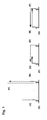
- Fig. 1 shows a schematic representation of a solid-phase in-vitro nucleic acid synthesis reaction.
- the figure shows a oligonucleotide wherein, the oligonucleotide as an arrow and an organo-silane moiety as zig-zag line, both coupled via the organo-silane moiety to a solid support (G).
- G a solid support
- an in-vitro nucleic acid synthesis reaction is schematically shown.
- a target molecule (H) anneals to the oligonucleotide (B) where it is used as a template and oligonucleotide is extended by a polymerase.
- the extended oligonucleotide may serve as a template for a further oligonucleotide (C) which must be in sufficiently close vicinity.
- the oligonucleotide (C) now uses the template (D) and is extended to the full-length product (E).
- efficient synthesis relies on equimolarity and close vicinity of two or more different oligonucleotide required in one reaction.
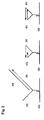
- Fig. 2 shows a schematic representation of a solid-phase in-vitro nucleic acid synthesis reaction.
- the figure shows a branched compound according to the invention wherein, the branched compound comprises two free 3'-OH groups and an organo-silane moiety as zig-zag line, both coupled via the organo-silane moiety to a solid support (G).
- G a solid support
- an in-vitro nucleic acid synthesis reaction is schematically shown.
- a target molecule (H) anneals to the nucleic acid moiety of the branched compound (B) where it is used as a template and the nucleic acid moiety is extended by a polymerase.
- the extended nucleic acid moiety may serve as a template for a further nucleic acid moiety (C) which is by definition in sufficiently close vicinity.
- the nucleic acid moiety (C) now uses the template (D) and is extended to the full-length product (E).
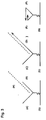
- Fig. 3 shows a schematic representation of a solid-phase in-vitro nucleic acid synthesis reaction starting from mRNA including the step of prior reverse transcription coupled to an amplification step.
- the figure shows a branched compound according to the invention wherein, the branched compound comprises two free 3'-OH groups and an organo-silane moiety as zig-zag line, both coupled via the organo-silane moiety to a solid support (G).
- G solid support
- a to F an in-vitro nucleic acid reverse transcription with coupled amplification reaction is schematically shown.
- a target mRNA molecule (H) anneals to the nucleic acid moiety (B) where it is used as a template and the nucleic acid moiety is extended by a polymerase with reverse transcriptase activity. Thereafter, the extended nucleic acid moiety may serve as a template for a further nucleic acid moiety (C) which is by definition in sufficiently close vicinity.
- the nucleic acid moiety (C) now uses the template (D) and is extend to the full-length product (E).
- efficient synthesis relies on equimolarity and close vicinity of two or more different nucleic acid moiety required in one reaction.
- the compound according to the invention takes place in reverse transcription as well as subsequent amplification.
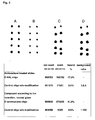
- Fig. 4 shows a comparison between binding amino-modified oligonucleotides to silane-treated glass (panels A, B) and binding oligonucleotides carrying a terminal silane group to normal glass (panels C, D).
- the compound according to the invention carries such a organo-silane group as shown here in combination with a standard oligonucleotide.
- the reactive group R 1 is an organo-silane group and thus the compound according to the invention will spot as in this example.
- the 3' 32 P-labeled oligonucleotides (10.000 cpm) were spotted onto the respective glass slides and scanned (panels A, C).
- the branched compound according to the invention carries such a organo-silane group as shown here in combination with a standard oligonucleotide.
- the reactive group R 1 is an organo-silane group and thus the compound according to the invention will spot as in this example.
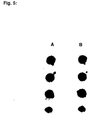
- Fig. 5 shows an experiment for the determination of the binding capacity of an organo-silane modified oligonucleotide to normal untreated glass.
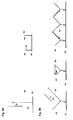
- Fig. 7 shows schematically the reactions leading to the derivatization of an oligonucleotide with an organo-silane moiety according to a preferred embodiment of the invention.
- An oligonucleotide containing a 5' hexylamino modification is first reacted with 1,4-phenylene diisothiocyanate (reaction A) and further reacted with 1, 3-aminopropyltrimethoxy-silane (reaction B).
- reaction B 1, 3-aminopropyltrimethoxy-silane
- the compound bearing the glass-reactive silane group can then be attached to e.g. glass supports (reaction C).
- Fig. 7 shows a preferred embodiment of the compound according to the invention.
- the nucleic acid moieties were attached separately.
- Fig. 8 shows a preferred embodiment of the compound according to the invention.
- the nucleic acid moieties were attached separately using two identical bifunctional groups.
- Fig. 9 A shows a prior-art nucleic acid synthesis on solid-phase (E) .
- template (A) is supplied through diffusion only.
- the oligonucleotides of sense (C) and antisense (D) are not in sufficient vicinity or are sterically hindered (not shown here) they may not serve as template upon elongation.
- the oligonucleotide (B) is elongated factors such as concentration, steric hindrance etc. will decide whether it may serve as a template in a subsequent cycle.
- Fig. 9 B shows a nucleic acid synthesis process on solid-phase (G) according to the invention.
- diffusion template (H) reaches any of the nucleic acid moieties, the may serve themselves as a template (C and D) or neighboring branched compounds (E and F) may serve as templates.
- the process according to the invention overcomes fundamental problems connected to the prior-art.
Landscapes
- Chemical & Material Sciences (AREA)
- Organic Chemistry (AREA)
- Life Sciences & Earth Sciences (AREA)
- Health & Medical Sciences (AREA)
- Engineering & Computer Science (AREA)
- Genetics & Genomics (AREA)
- Biochemistry (AREA)
- Molecular Biology (AREA)
- Proteomics, Peptides & Aminoacids (AREA)
- Zoology (AREA)
- Wood Science & Technology (AREA)
- General Health & Medical Sciences (AREA)
- Biophysics (AREA)
- Medicinal Chemistry (AREA)
- Bioinformatics & Cheminformatics (AREA)
- Biotechnology (AREA)
- Chemical Kinetics & Catalysis (AREA)
- General Engineering & Computer Science (AREA)
- General Chemical & Material Sciences (AREA)
- Physics & Mathematics (AREA)
- Microbiology (AREA)
- Analytical Chemistry (AREA)
- Immunology (AREA)
- Biomedical Technology (AREA)
- Structural Engineering (AREA)
- Bioinformatics & Computational Biology (AREA)
- Crystallography & Structural Chemistry (AREA)
- Plant Pathology (AREA)
- Gastroenterology & Hepatology (AREA)
- Measuring Or Testing Involving Enzymes Or Micro-Organisms (AREA)
Priority Applications (10)
| Application Number | Priority Date | Filing Date | Title |
|---|---|---|---|
| EP99125484A EP1111068A1 (de) | 1999-12-21 | 1999-12-21 | Verzweigte Substanz zur Verwendung in Reaktionen zur Detektion und Analyse von Nukleinsäuren |
| EP00993511A EP1252172A2 (de) | 1999-12-21 | 2000-12-21 | Verbindung mit einem peptidrest und einem organosilanrest |
| AU21709/01A AU2170901A (en) | 1999-12-21 | 2000-12-21 | Branched compound for use in nucleic acid detection and analysis reactions |
| EP00985230A EP1244812A1 (de) | 1999-12-21 | 2000-12-21 | Verzweigte verbindungen zur verwendung in reaktionen zum nachweis und zur analyse von nukleinsäuren |
| AU31631/01A AU3163101A (en) | 1999-12-21 | 2000-12-21 | Compound comprising a nucleic acid moiety and an organo-silane moiety |
| PCT/EP2000/013098 WO2001046464A1 (en) | 1999-12-21 | 2000-12-21 | Branched compound for use in nucleic acid detection and analysis reactions |
| PCT/EP2000/013099 WO2001046213A2 (en) | 1999-12-21 | 2000-12-21 | Compound comprising a peptide moiety and an organo-silane moiety. |
| AU28432/01A AU2843201A (en) | 1999-12-21 | 2000-12-21 | Compound comprising a peptide moiety and an organo-silane moiety. |
| EP00991249A EP1250344A2 (de) | 1999-12-21 | 2000-12-21 | Organosilanreste enthaltende nukleinsäuren |
| PCT/EP2000/013100 WO2001046214A2 (en) | 1999-12-21 | 2000-12-21 | Compound comprising a nucleic acid moiety and an organo-silane moiety |
Applications Claiming Priority (1)
| Application Number | Priority Date | Filing Date | Title |
|---|---|---|---|
| EP99125484A EP1111068A1 (de) | 1999-12-21 | 1999-12-21 | Verzweigte Substanz zur Verwendung in Reaktionen zur Detektion und Analyse von Nukleinsäuren |
Publications (1)
| Publication Number | Publication Date |
|---|---|
| EP1111068A1 true EP1111068A1 (de) | 2001-06-27 |
Family
ID=8239675
Family Applications (1)
| Application Number | Title | Priority Date | Filing Date |
|---|---|---|---|
| EP99125484A Withdrawn EP1111068A1 (de) | 1999-12-21 | 1999-12-21 | Verzweigte Substanz zur Verwendung in Reaktionen zur Detektion und Analyse von Nukleinsäuren |
Country Status (1)
| Country | Link |
|---|---|
| EP (1) | EP1111068A1 (de) |
Cited By (1)
| Publication number | Priority date | Publication date | Assignee | Title |
|---|---|---|---|---|
| WO2023234837A1 (en) * | 2022-05-31 | 2023-12-07 | Polypeptide Laboratories Holding (Ppl) Ab | Insoluble support for solid phase synthesis |
Citations (5)
| Publication number | Priority date | Publication date | Assignee | Title |
|---|---|---|---|---|
| FR2726286A1 (fr) * | 1994-10-28 | 1996-05-03 | Genset Sa | Procede d'amplification d'acides nucleiques en phase solide et trousse de reactifs utile pour la mise en oeuvre de ce procede |
| WO1996039413A1 (en) * | 1995-05-23 | 1996-12-12 | Hybridon, Inc. | Methods and compounds for the synthesis of oligonucleotides and the oligonucleotides thereby produced |
| US5641658A (en) * | 1994-08-03 | 1997-06-24 | Mosaic Technologies, Inc. | Method for performing amplification of nucleic acid with two primers bound to a single solid support |
| US5912332A (en) * | 1996-07-26 | 1999-06-15 | Hybridon, Inc. | Affinity-based purification of oligonucleotides using soluble multimeric oligonucleotides |
| US5916750A (en) * | 1997-01-08 | 1999-06-29 | Biogenex Laboratories | Multifunctional linking reagents for synthesis of branched oligomers |
-
1999
- 1999-12-21 EP EP99125484A patent/EP1111068A1/de not_active Withdrawn
Patent Citations (5)
| Publication number | Priority date | Publication date | Assignee | Title |
|---|---|---|---|---|
| US5641658A (en) * | 1994-08-03 | 1997-06-24 | Mosaic Technologies, Inc. | Method for performing amplification of nucleic acid with two primers bound to a single solid support |
| FR2726286A1 (fr) * | 1994-10-28 | 1996-05-03 | Genset Sa | Procede d'amplification d'acides nucleiques en phase solide et trousse de reactifs utile pour la mise en oeuvre de ce procede |
| WO1996039413A1 (en) * | 1995-05-23 | 1996-12-12 | Hybridon, Inc. | Methods and compounds for the synthesis of oligonucleotides and the oligonucleotides thereby produced |
| US5912332A (en) * | 1996-07-26 | 1999-06-15 | Hybridon, Inc. | Affinity-based purification of oligonucleotides using soluble multimeric oligonucleotides |
| US5916750A (en) * | 1997-01-08 | 1999-06-29 | Biogenex Laboratories | Multifunctional linking reagents for synthesis of branched oligomers |
Non-Patent Citations (4)
| Title |
|---|
| BRAICH R S ET AL: "Regiospecific solid -phase synthesis of branched oligonucleotides. Effect of vicinal 2',5'- (or 2',3'-) and 3',5'-phosphodiester linkages on the formation of hairpin DNA.", BIOCONJUGATE CHEMISTRY, (1997 MAY-JUN) 8 (3) 370-7., XP002140602 * |
| GROTLI, MORTEN (1) ET AL: "Solid -phase synthesis of branched RNA and branched DNA/RNA chimeras.", TETRAHEDRON, (1997) VOL. 53, NO. 33, PP. 11317-11346., XP002140600 * |
| MASKOS U ET AL: "OLIGNUCLEOTIDE HYBRIDISATIONS ON GLASS SUPPORTS: A NOVEL LINKER FOR OLIGONUCLEOTIDE SYNTHESIS AND HYBRIDISATION PROPERTIES OF OLIGNUCLEOTIDES SYNTHESISED IN SITU", NUCLEIC ACIDS RESEARCH,GB,OXFORD UNIVERSITY PRESS, SURREY, vol. 20, no. 7, 1 January 1992 (1992-01-01), pages 1679 - 1684, XP000651031, ISSN: 0305-1048 * |
| SPROAT ET AL.: "Novel solid-phase synthesis of branched oligoribonucleotides, including a substrate for the DNA debranching enzyme", JOURNAL OF THE CHEMICAL SOCIETY. PERKIN TRANSACTIONS I, 1994, pages 419 - 431, XP002140601 * |
Cited By (1)
| Publication number | Priority date | Publication date | Assignee | Title |
|---|---|---|---|---|
| WO2023234837A1 (en) * | 2022-05-31 | 2023-12-07 | Polypeptide Laboratories Holding (Ppl) Ab | Insoluble support for solid phase synthesis |
Similar Documents
| Publication | Publication Date | Title |
|---|---|---|
| EP1244812A1 (de) | Verzweigte verbindungen zur verwendung in reaktionen zum nachweis und zur analyse von nukleinsäuren | |
| EP3797170B1 (de) | Polynukleotidsyntheseverfahren, system und kit | |
| AU770217B2 (en) | Ligation assembly and detection of polynucleotides on solid-support | |
| JP3165431B2 (ja) | 増幅方法 | |
| JP4791043B2 (ja) | 同一固体支持体上で、2以上のオリゴヌクレオチドをタンデムに合成するための方法および組成物 | |
| US6361940B1 (en) | Compositions and methods for enhancing hybridization and priming specificity | |
| EP0742287B1 (de) | Modifizierte Nukleinsäuresonden | |
| US7074569B2 (en) | Mobility-modified nucleobase polymers and methods of using same | |
| US7794943B2 (en) | Modified nucleic acid probes | |
| EP3950115A1 (de) | Verfahren und reagenzien zur synthese von polynukleotidmolekülen | |
| US20050112636A1 (en) | Polymeric nucleic acid hybridization probes | |
| JPH07505529A (ja) | プローブ構成物および方法 | |
| WO1995006752A1 (en) | A method of nucleic acid sequencing | |
| EP3824100B1 (de) | Polynukleotidsyntheseverfahren | |
| GB2153356A (en) | Nucleoside phosphoramidites and oliglonucleotides produced therefrom | |
| WO2005021786A1 (en) | A method of sequencing nucleic acids by ligation of labelled oligonucleotides | |
| EP0502180A1 (de) | Enzymatische synthese von oligonukleotiden. | |
| JP2002531106A (ja) | 不連続プライマ−伸長による核酸反復配列の長さ決定 | |
| WO1998013527A2 (en) | Compositions and methods for enhancing hybridization specificity | |
| EP1111068A1 (de) | Verzweigte Substanz zur Verwendung in Reaktionen zur Detektion und Analyse von Nukleinsäuren | |
| EP1110967A1 (de) | Ein Biomolekül und ein Organosilan enthaltende Verbindung | |
| US20020031776A1 (en) | Enzymatic labeling and detection of DNA hybridization probes | |
| JP2000512843A (ja) | 安定性が2個のハイブリッドされた核酸分子の塩基組成に僅かしか依存しないハイブリッド複合体の形成方法 | |
| JP5128031B2 (ja) | RecAタンパク質を用いて標識が導入された核酸を製造する方法 |
Legal Events
| Date | Code | Title | Description |
|---|---|---|---|
| PUAI | Public reference made under article 153(3) epc to a published international application that has entered the european phase |
Free format text: ORIGINAL CODE: 0009012 |
|
| AK | Designated contracting states |
Kind code of ref document: A1 Designated state(s): AT BE CH CY DE DK ES FI FR GB GR IE IT LI LU MC NL PT SE |
|
| AX | Request for extension of the european patent |
Free format text: AL;LT;LV;MK;RO;SI |
|
| AKX | Designation fees paid | ||
| REG | Reference to a national code |
Ref country code: DE Ref legal event code: 8566 |
|
| STAA | Information on the status of an ep patent application or granted ep patent |
Free format text: STATUS: THE APPLICATION IS DEEMED TO BE WITHDRAWN |
|
| 18D | Application deemed to be withdrawn |
Effective date: 20011228 |