EP1114308B1 - Verfahren und gerät zur messung flüchtiger bestandteile - Google Patents
Verfahren und gerät zur messung flüchtiger bestandteile Download PDFInfo
- Publication number
- EP1114308B1 EP1114308B1 EP99951485.4A EP99951485A EP1114308B1 EP 1114308 B1 EP1114308 B1 EP 1114308B1 EP 99951485 A EP99951485 A EP 99951485A EP 1114308 B1 EP1114308 B1 EP 1114308B1
- Authority
- EP
- European Patent Office
- Prior art keywords
- sample
- measuring
- microwave
- moisture content
- temperature
- Prior art date
- Legal status (The legal status is an assumption and is not a legal conclusion. Google has not performed a legal analysis and makes no representation as to the accuracy of the status listed.)
- Expired - Lifetime
Links
Images

Classifications
-
- G—PHYSICS
- G01—MEASURING; TESTING
- G01N—INVESTIGATING OR ANALYSING MATERIALS BY DETERMINING THEIR CHEMICAL OR PHYSICAL PROPERTIES
- G01N22/00—Investigating or analysing materials by the use of microwaves or radio waves, i.e. electromagnetic waves with a wavelength of one millimetre or more
- G01N22/04—Investigating moisture content
-
- G—PHYSICS
- G01—MEASURING; TESTING
- G01N—INVESTIGATING OR ANALYSING MATERIALS BY DETERMINING THEIR CHEMICAL OR PHYSICAL PROPERTIES
- G01N5/00—Analysing materials by weighing, e.g. weighing small particles separated from a gas or liquid
- G01N5/04—Analysing materials by weighing, e.g. weighing small particles separated from a gas or liquid by removing a component, e.g. by evaporation, and weighing the remainder
- G01N5/045—Analysing materials by weighing, e.g. weighing small particles separated from a gas or liquid by removing a component, e.g. by evaporation, and weighing the remainder for determining moisture content
-
- G—PHYSICS
- G01—MEASURING; TESTING
- G01N—INVESTIGATING OR ANALYSING MATERIALS BY DETERMINING THEIR CHEMICAL OR PHYSICAL PROPERTIES
- G01N1/00—Sampling; Preparing specimens for investigation
- G01N1/28—Preparing specimens for investigation including physical details of (bio-)chemical methods covered elsewhere, e.g. G01N33/50, C12Q
- G01N1/44—Sample treatment involving radiation, e.g. heat
Definitions
- the invention relates to methods and apparatuses for measuring volatile content of a sample using microwave radiation. More particularly, the invention pertains to a method and an apparatus that helps to control sample temperatures during volatile content analyses.
- determining volatile or moisture content consists of weighing a representative sample of material, drying the material, then re-weighing the material to ascertain the losses on drying and, consequently, the initial volatile content of the sample.
- Convective, hot-air ovens which are typically used for this task, can be relatively slow to bring the sample to "oven-dry" equilibrium. Such devices can also be expensive to operate as they inefficiently consume energy. These problems lessen the utility of hot-air devices for volatile analysis.
- microwave drying to measure moisture content is usually faster than equivalent hot-air methods.
- hot-air techniques certain substances tend to bum, rather than merely become dry, when microwave power is applied to them.
- the rapid manner in which microwaves tend to interact with certain materials- which is an obvious advantage in some circumstances-can cause secondary heating of other materials that is disadvantageous (at least for volatile or moisture measurement purposes).
- Certain food products such as cheese are exemplary (although certainly not limiting) of materials that tend to bum rather than dry.
- microwaves interact with materials in a fashion known as "coupling," i.e ., the response of the materials ("the load") to the microwave radiation.
- Some materials do not couple well with microwave energy, making drying or other volatile removal techniques difficult or imprecise.
- Other materials couple well when their moisture content or content of other microwave-responsive materials (e.g., alcohols and other polar solvents) is high. As they dry under the influence of microwaves, however, they couple less and less effectively; i.e ., the load changes. As a result, the effect of the microwaves on the sample becomes less satisfactory and more difficult to control. In turn, the sample can tend to burn rather than dry, or degrade in some other undesired fashion. Both circumstances, of course, tend to produce unsatisfactory results.
- Maintaining the sample's temperature below that which will cause pyrolysis helps prevent burning.
- moisture analysis is based upon weight measurements, however, measuring the sample's temperature cannot be permitted to hinder measuring the sample's weight.
- conventional direct probe temperature measurement is often unsatisfactory for this purpose.
- the temperature sensor's contact with the sample can lead to erroneous weight measurements when using sensitive weighing devices.
- the type, location, and function of a temperature probe must be compatible with the proper propagation of energy to, and absorption of energy by, the sample.
- Some indirect methods have been developed to measure temperature in a way that avoids contacting the sample in an effort to avoid interfering with measuring sample weight. Many such indirect techniques, however, determine the temperature of something besides the sample itself. Thus, such techniques can lack accuracy, and can give a relatively slow response, particularly when heat conduction from the sample to the sensor is required. Other methods may utilize non-contact temperature sensing but fail to properly consider the weight of simple. Other methods fail to properly utilize non-contact temperature measurement and weight analysis. See EP 0 344 465 and U.S. 4,304,289 .
- the invention is an apparatus and method for quickly determining sample volatile content, and usually moisture content, through losses on drying while controlling the sample's temperature.
- this invention provides quick and accurate moisture analysis while helping to prevent sample burning.
- the method includes initially measuring sample weight and sample temperature. Then, microwave radiation is introduced to the sample to drive off moisture or other volatiles. Meanwhile, the changes to the sample weight and sample temperature are monitored. The introduction of microwave radiation is varied to maintain sample temperature at a set point or within a set range chosen to prevent sample pyrolysis. Once the incremental change to the weight of the sample reaches or approached equilibrium, the introduction of microwave radiation is stopped. Thereafter, the moisture content of the sample is calculated.
- the apparatus includes a structure forming an enclosed cavity to hold a sample and to contain microwave radiation, a microwave power source, a means to measure sample weight, a means to measure sample temperature, and a controller that moderates the introduction of microwave radiation to the sample based upon the sample temperature.
- the controller is programmed to moderate the applied microwave power (the manipulated variable) to maintain the sample's temperature at a set point or within a set range.
- the invention is an apparatus and associated method for measuring the moisture (or other volatile) content of a sample that is particularly suitable for samples that tend to bum when heated.
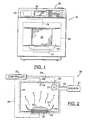
- the apparatus is broadly designated at 10 in Figure 1 and in schematic fashion at 20 in Figures 2 and 3 .
- the apparatus 10 includes a cavity 11 defined by the interior walls of the apparatus 10 or 20 for holding a sample 12 for which the moisture content is to be determined.
- the term "cavity” is used in its broadest sense to refer to any defined location to which the microwaves are directed.
- microwave analytical techniques are generally carried out within appropriate barriers that prevent the microwaves from propagating into the ambient surroundings. Metal walls or screens are most typically used for these purposes. It will be understood, however, that other cavity designs, shapes and equipment can be used consistently with the present invention.
- the apparatus includes an infrared photosensor 13 positioned to measure the temperature of the sample 12 placed within the cavity 11.
- the infrared photosensor 13 is positioned within the cavity 11, but it will be understood, particularly in conjunction with the method aspects of the invention, that the location of the photosensor 13 is limited only by the requirement that it be able to detect infrared radiation from the sample.
- the detector 13 could be placed outside of the cavity, or behind an infrared transparent material provided that the photosensor 13 is in a position to detect the infrared radiation from the sample.
- the invention's infrared-photosensor which determines sample temperature, does not interfere with the measurement of the sample's weight. This is so even though the photosensor measures the actual, average temperature of the sample and not merely the air temperature surrounding the sample.
- Such infrared analysis leads to a more accurate and precise temperature measurement as compared to u probe or the like, which measures only at a discrete, localized part of the sample.
- the infrared- photosensor provides accurate, non-contact temperature measurements. This facilitates control of the applied microwave energy, resulting in improved drying and moisture analysis.
- an infrared photosensor is a preferred device for measuring the sample temperature
- the invention is not limited to infrared photosensors.
- the invention can incorporate other sensing devices and techniques provided thai they accurately measure the sample temperature (rather than the ambient temperature) and do not interfere with the accurate and precise function of the balance.
- the apparatus includes an analytical balance of broadly designated at 14 for measuring the weight of the sample 12 while the sample is in the cavity.
- an analytical balance typically includes a pan IS or equivalent sample holder, with the appropriate mechanical or electrical components 16 and 17 associated therewith. Portions of the balance 14 are typically positioned both inside the cavity as well as outside of the cavity 11.
- the use of analytical balances within microwave devices is generally well understood in this art and will not be repeated herein in any particular detail other than as necessary to describe the invention. Exemplary descriptions of such analytical balances within microwave devices are given for example in commonly assigned U.S. Patents Nos. 3,909,598 ; 4,438,500 ; and 4,457,632 .
- a power source introduces microwave energy into the cavity 11.
- the power source comprises a magnetron 21 for generating microwaves and a waveguide 22 in wave communication with the magnetron 21 and the cavity 11 for directing microwaves from the magnetron 21 to the cavity 11 and thus to the sample 12.
- the generation and propagation of microwaves from , magnetrons through waveguides into cavities is generally well understood in this art and will not be described in further detail herein. It will be recognized, however, that there are additional sources other than magnetrons 21 including klystrons, and a continuously variable power supply which is described and set forth in co-pending and commonly assigned International Application No. PCT/US99/08729, filed April 20, 1999 . It is likewise expected that solid state microwave devices, which presently have wide application in communications devices, will eventually be suitable as power sources for microwave assisted chemical analysis including the moisture content analysis described herein.
- a processing unit illustrated as the controller 23 is in communication with the infrared sensor 13 and the power source 21 for controlling the introduction of microwave energy to the cavity 11 in response to the infrared photosensor 13 to prevent the sample 12 in reaching temperatures at which the sample would bum. Stated somewhat differently, the controller controls or moderates the microwave power or microwave propagation that reaches the sample when the sample temperature begins to approach a temperature at which the sample would bum.
- control devices and circuits are set forth in a variety of sources including by way of example and not limitation, Dorf, The Electrical Engineering Handbook, 2nd Edition (1997) by CRC Press , for example in Chapters 79-85 and 100.
- FIG 2 also schematically illustrates the appropriate circuitry 24 that connects the controller 23 to the source 21 and circuitry 25 that connects the controller 23 to the infrared photosensor 13.
- the controller 23 is in communication with the balance 14 through the appropriate circuitry 26 for controlling the introduction of microwave energy to the sample 12 in response to the measured weight of the sample. Stated differently, the controller stops the device from operating further when the sample is dry.
- the controlled relationship among the power source, the temperature snesor,and the balance also permits the apparatus of the invention to perform various other tasks, such as thermogravimetric analysis, for which previous microwave devices have been less satisfactory.
- the endpoint can be defined when the weight of the sample remains constant for a defined period of time, or for a defined number of consecutive measurements.
- the mathematical relationship between drying time and moisture content can be used to predict when the endpoint will be reached even if the sample is not dried out completely.
- FIG. 2 further illustrates preferred embodiments of the invention that include an exhaust fan 27 for removing volatiles from the cavity 11 as the sample 12 is being heated therein.
- the exhaust fan 27 is a variable speed fan and is communication with the processing unit 23 through the appropriate circuitry 30 to control the speed of the fan 27 in response to the infrared photosensor 13 and the analytical balance 14.
- the fan 27 can help prevent the flow of exhausted volatile materials from affecting the measurements of the analytical balance and can likewise provide a moderating effect on the temperature within the cavity 11 as may be desired.
- Those familiar with the operation and characteristics of such analytical balances, and particularly when they are used with small samples and small weight changes, will understand that air movement within the cavity 11 can aerodynamically affect the balance pan 15 and thus reduce the accuracy and precision of the balance 14.
- Figure 3 illustrates anther embodiment of the invention in which the elements are commonly numbered with those of Figure 2 for the sake of clarity, but which further illustrates a microwave absorbing material shown as the susceptor 31 in the cavity for absorbing microwaves and converting the absorbed microwaves into thermal energy that heat the sample.
- susceptor is used herein in its broadest sense; i.e ., an object or material that absorbs microwave radiation and converts the energy to heat.
- the susceptor can be formed of any material that absorbs microwaves and converts the energy to heat, provided that the susceptor material avoids otherwise interfering with the overall process.
- Certain ceramic materials such as silicon carbide (SiC) are typically used to form microwave susceptors, but it will be understood that the use of a susceptor is not limited to ceramics or silicon carbide.
- the term “susceptor” often refers to a thin film material with the desired characteristics, and as used herein, the term “susceptor” includes this meaning as well.
- the microwave absorbing material is usually either in close proximity or direct contact with the sample 12 to most efficiently enable the heat transfer desired.
- the use of the susceptor when combined with the temperature measurement and control of the present invention, provides an apparatus and method that takes full advantage of microwave techniques, and extends the use of microwaves to the temperature-controlled treatment of materials that would normally be unresponsive to, or would suffer degradation under, the application of microwave radiation.
- Figure 1 illustrates the appearance of a typical commercial version of the apparatus 10 and illustrates a viewing area 32, normally comprising a combination of a shatterproof glass and a metal screen, a door defined by the dotted line 33 for providing easy access to the cavity 11, a control panel broadly designated at 34 for providing the appropriate starting or operational instructions to the device, and a display 35 that typically incorporates light emitting diodes (LEDs) or liquid crystal displays (LCDs) to provide information to the operator.
- the apparatus 10 can also provide its output in digital form as may be desired or necessary; e.g., Dorf, supra, Section VIII "Digital Devices.”
- the invention is a method for measuring moisture content of a sample that is particularly suitable for samples that tend to burn when heated.
- the invention comprises the steps of applying microwave radiation at a predetermined power level to a moisture containing sample to drive moisture from the sample while continuously weighing the sample.
- the predetermined power level is low enough to be expected to prevent burning and the continuous weighing of the sample preferably comprising monitoring both the weight and the weight change of the sample.
- the microwave power is typically (but not exclusively) applied by generating the microwaves in a source, propagating the microwaves from the source through a waveguide, and thereafter launching the microwaves into a cavity in which the sample is located. It will be understood, of course, by those of ordinary skill in this art, that the use of the waveguide and the launcher are typically considerations of space and geometry and are not necessarily required provided that microwaves are otherwise appropriately introduced to the sample.
- the method further comprises monitoring the temperature of the continuously weighed sample during the application of microwaves without contacting either the sample or anything in contact with the sample.
- the step of monitoring the sample temperature comprises monitoring the infrared radiation emitted by the heated sample, as this provides a preferred method of obtaining an accurate temperature of the sample without contacting it.
- the microwave power applied to the sample is moderated based upon the monitored temperature to maintain the temperature of the sample at or below a predetermined set point temperature below which the sample will not bum.
- Microwave power can be moderated using several different techniques which generally fall into the categories of moderating the microwave power produced by the source, or moderating the passage of microwaves between the source and the sample.
- commonly assigned and co-pending application International Application No. PCT/US99/08729 filed April 20, 1999 , discloses a method for moderating the power at the source
- U.S. Patent No. 5,796,080 discloses an apparatus and technique for moderating the passage of microwaves between a source and sample, and the contents of this are incorporated entirely herein by reference.
- the method comprises applying microwave radiation at a predetermined power lever low enough to be expected to prevent burning to a moisture containing sample to drive moisture from the sample while continuously weighing the sample; monitoring the infrared radiation emitted by the continuously weighed sample and its surroundings during the application of microwave power without contacting either the sample or anything in contact with the sample; converting the value of the emitted infrared radiation into a temperature measurement; moderating the microwave power being applied to the sample based upon the measured temperature to maintain the temperature of the sample at or below a predetermined set point temperature below which the sample will not bum as moisture leaves the continuously weighed sample; and ending the application of microwave power when the weight loss of the sample indicates that the sample is dry.
- suitable techniques for determining the end point of a drying technique that can be suitably used in conjunction with the method of the invention.
- the method comprises measuring the temperature of a sample using an infrared photosensor, and measuring both the initial temperature and the continuous temperature of the sample as the drying process proceeds.
- the method further comprises measuring an initial weight and then continuously measuring the weight and weight change of the sample using an analytical balance while applying microwave energy to the sample at a predetermined power level that heats the sample without burning the sample.
- the microwave energy is moderated, usually decreased but possibly increased, in response to the temperature measured by the infrared photosensor in a manner that maintains the temperature of the sample below the temperature at which the sample would bum, while continuing to measure the weight and weight change of the sample with the analytical balance as the sample dries.
- the application of microwave power to the sample is ended when the measured weight or weight change indicates that the sample is dry.
- the method can further comprise the step of removing volatiles generated by the drying sample to thereby enhance the drying process or otherwise control the technique.
Landscapes
- Physics & Mathematics (AREA)
- Health & Medical Sciences (AREA)
- Life Sciences & Earth Sciences (AREA)
- Chemical & Material Sciences (AREA)
- Analytical Chemistry (AREA)
- Biochemistry (AREA)
- General Health & Medical Sciences (AREA)
- General Physics & Mathematics (AREA)
- Immunology (AREA)
- Pathology (AREA)
- Electromagnetism (AREA)
- Investigating Or Analysing Materials By Optical Means (AREA)
- Investigating Or Analyzing Materials Using Thermal Means (AREA)
- Sampling And Sample Adjustment (AREA)
Claims (23)
- Vorrichtung zum Bestimmen der flüchtigen Bestandteile von Proben, die dazu neigen zu brennen, wenn sie während der Überwachung oder der Steuerung der Probentemperatur erwärmt werden, wobei die Vorrichtung umfasst:einen Hohlraum (11), in dem eine Probe (12), für die die flüchtigen Bestandteile bestimmt werden sollen, aufgestellt werden kann;einen Infrarottemperatursensor (13), der messen kann und so positioniert ist, dass er die Temperatur der Probe, die innerhalb des Hohlraums aufgestellt ist, durch die von der Probe emittierte Infrarotstrahlung misst, ohne dabei die Probe zu berühren;eine Analysenwaage (14), um das Gewicht der Probe zu messen, während die Probe in dem Hohlraum ist;eine Leistungsquelle (21), um Mikrowellen in den Hohlraum einzuführen, um die Probe zu erwärmen; undeine Verarbeitungseinheit (23) in Verbindung mit dem Temperatursensor, mit der Analysenwaage und mit der Leistungsquelle, um als Reaktion auf die von dem Temperatursensor gemessenen Temperaturen die Einführung von Mikrowellenenergie in den Hohlraum zu steuern und um die flüchtigen Bestandteile der Probe auf der Grundlage der Gewichtsveränderung der Probe auf der Analysenwaage zu bestimmen.
- Vorrichtung zum Messen flüchtiger Bestandteile nach Anspruch 1, wobei die Verarbeitungseinheit in Verbindung mit der Analysenwaage steht, um als Reaktion auf das gemessene Gewicht die Einführung von Mikrowellenenergie in die Probe zu steuern.
- Vorrichtung zum Messen flüchtiger Bestandteile nach Anspruch 1, wobei die Leistungsquelle ausgewählt ist aus der Gruppe, die aus einem Magnettron, aus Klystronen und aus Festkörpervorrichtungen zum Erzeugen von Mikrowellen besteht.
- Vorrichtung zum Messen eines Feuchtigkeitsgehalts nach Anspruch 1 oder 2, die einen Wellenleiter (22) umfasst, um Mikrowellen von der Quelle zu dem Hohlraum zu lenken.
- Vorrichtung zum Messen eines Feuchtigkeitsgehalts nach Anspruch 1, die ferner in dem Hohlraum ein Material (31), das Mikrowellen absorbiert, umfasst, um Mikrowellen zu absorbieren und um die absorbierten Mikrowellen in thermische Energie umzuwandeln, die die Probe erwärmt.
- Vorrichtung zum Messen eines Feuchtigkeitsgehalts nach Anspruch 5, wobei das Material, das Mikrowellen absorbiert, positioniert ist, um in einem thermisch leitenden Kontakt mit der Probe zu sein.
- Vorrichtung zum Messen eines Feuchtigkeitsgehalts nach Anspruch 1, die ferner ein Absauggebläse (27) umfasst, um die flüchtigen Stoffe aus dem Hohlraum zu entfernen, wenn darin eine Probe erwärmt wird.
- Vorrichtung zum Messen eines Feuchtigkeitsgehalts nach Anspruch 7, wobei:das Absauggebläse ein Absauggebläse mit einer variablen Geschwindigkeit ist; unddie Verarbeitungseinheit in Verbindung mit dem Gebläse steht, um als Reaktion auf den Infrarottemperatursensor und auf die Analysenwaage die Geschwindigkeit des Gebläses zu steuern.
- Vorrichtung nach Anspruch 7, wobei die Verarbeitungseinheit in Verbindung mit der Leistungsquelle, mit dem Temperatursensor und mit dem Absauggebläse steht, um als Reaktion auf den Temperatursensor, auf die Analysenwaage und auf das Absauggebläse die Einführung von Mikrowellen in den Hohlraum zu steuern, um zu verhindern, dass die Probe Temperaturen erreicht, bei denen die Probe brennen würde.
- Verfahren zum Bestimmen der flüchtigen Bestandteile von Proben, die dazu neigen zu brennen, wenn sie erwärmt werden, wobei das Verfahren umfasst:Messen der von einer Probe emittierten Infrarotstrahlung unter Verwendung eines Infrarotfotosensors während des Anlegens von Mikrowellen, um die Temperatur der Probe zu bestimmen, ohne dabei die Probe oder irgendetwas anderes im Kontakt mit der Probe zu berühren;Messen des Gewichts der Probe unter Verwendung einer Analysenwaage;Anlegen von Mikrowellenergie an die Probe bei einem vorgegebenen Leistungspegel, der die Probe erwärmt, ohne dass dabei die Probe brennt; undMildern der Mikrowellenergie, die an die Probe angelegt ist, als Reaktion auf die von dem Infrarotfotosensor bestimmte Temperatur in einer Weise,die die Temperatur der Probe an oder unter einem Sollpunkt oderinnerhalb eines Sollbereichs unterhalb der Temperatur aufrechterhält, bei der die Probe brennen würde;Überwachen des Gewichts der Probe mit der Analysenwaage, wenn die Mikrowellenergie die Probe trocknet; undBeenden des Anlegens von Mikrowellenleistung an die Probe, wenn ausreichend flüchtige Stoffe aus der Probe ausgetrieben worden sind,um die flüchtigen Bestandteile der Probe zu berechnen.
- Verfahren zum Messen eines Feuchtigkeitsgehalts nach Anspruch 10, wobei der Schritt des Überwachens des Gewichts der Probe während des Anlegens von Mikrowellenleistung ein kontinuierliches Überwachen des Gewichts der Probe während des Anlegens von Mikrowellenleistung umfasst.
- Verfahren zum Messen eines Feuchtigkeitsgehalts nach Anspruch 10, das ein kontinuierliches Überwachen der Temperatur der Probe während des Anlegens von Mikrowellenleistung umfasst.
- Verfahren zum Messen eines Feuchtigkeitsgehalts nach Anspruch 10, das ein Beenden des Anlegens von Mikrowellenleistung an die Probe umfasst, wenn die Probe eine vorgegebene Temperatur erreicht.
- Verfahren zum Messen eines Feuchtigkeitsgehalts nach Anspruch 12, wobei der Schritt des Überwachens der Temperatur der Probe ein Überwachen der von der erwärmten Probe emittierten Infrarotstrahlung und ein Umwandeln des Werts der emittierten Infrarotstrahlung in eine Temperaturmessung umfasst.
- Verfahren zum Messen eines Feuchtigkeitsgehalts nach Anspruch 10, das ferner ein Entfernen der flüchtigen Stoffe, die durch das Trocknen der Probe erzeugt worden sind, umfasst.
- Verfahren zum Messen eines Feuchtigkeitsgehalts nach Anspruch 10, wobei der Schritt des Anlegens von Mikrowellenstrahlung an die Probe umfasst:Erzeugen der Mikrowellen in einer Quelle;Ausbreiten der Mikrowellen von der Quelle durch einen Wellenleiter; undEinführen der Mikrowellen in einen Hohlraum, in dem die Probe angeordnet ist.
- Verfahren zum Messen eines Feuchtigkeitsgehalts nach Anspruch 16, wobei der Schritt des Milderns der Mikrowellenergie ein Mildern der Mikrowellenleistung, die von der Quelle erzeugt worden ist, umfasst.
- Verfahren zum Messen eines Feuchtigkeitsgehalts nach Anspruch 16, wobei der Schritt des Milderns der Mikrowellenergie ein Mildern des Durchlaufweges der Mikrowellen zwischen der Quelle und einem Hohlraum, in dem die Probe angeordnet ist, umfasst.
- Verfahren nach Anspruch 11, das umfasst:Beenden des Anlegens von Mikrowellenleistung an die Probe, wenn alle flüchtigen Stoffe aus der Probe ausgetrieben worden sind.
- Verfahren zum Messen eines Feuchtigkeitsgehalts nach Anspruch 19, das ferner ein Messen eines anfänglichen Gewichts der Probe vor dem Anlegen der Mikrowellenergie an die Probe umfasst.
- Verfahren zum Messen eines Feuchtigkeitsgehalts nach Anspruch 19, das ferner ein Messen einer Anfangstemperatur der Probe vor dem Anlegen der Mikrowellenergie an die Probe umfasst.
- Verfahren zum Messen eines Feuchtigkeitsgehalts nach Anspruch 19, wobei der Schritt des Beendens des Anlegens von Mikrowellenleistung ein Beenden des Anlegens von Mikrowellenleistung an die Probe umfasst, wenn das gemessene Gewicht anzeigt, dass die Probe trocken ist.
- Verfahren zum Messen eines Feuchtigkeitsgehalts nach Anspruch 10, wobei der Schritt des Anlegens von Mikrowellenstrahlung bei einem vorgegebenen Leistungspegel ein Anlegen von Mikrowellenstrahlung bei einem vorgegebenen Leistungspegel an die Probe und an einen Suszeptor umfasst.
Applications Claiming Priority (3)
| Application Number | Priority Date | Filing Date | Title |
|---|---|---|---|
| US156086 | 1993-11-22 | ||
| US09/156,086 US6227041B1 (en) | 1998-09-17 | 1998-09-17 | Method and apparatus for measuring volatile content |
| PCT/US1999/021490 WO2000016067A1 (en) | 1998-09-17 | 1999-09-17 | Method and apparatus for measuring volatile content |
Publications (2)
| Publication Number | Publication Date |
|---|---|
| EP1114308A1 EP1114308A1 (de) | 2001-07-11 |
| EP1114308B1 true EP1114308B1 (de) | 2014-08-20 |
Family
ID=22558034
Family Applications (1)
| Application Number | Title | Priority Date | Filing Date |
|---|---|---|---|
| EP99951485.4A Expired - Lifetime EP1114308B1 (de) | 1998-09-17 | 1999-09-17 | Verfahren und gerät zur messung flüchtiger bestandteile |
Country Status (6)
| Country | Link |
|---|---|
| US (1) | US6227041B1 (de) |
| EP (1) | EP1114308B1 (de) |
| JP (2) | JP4845265B2 (de) |
| AU (1) | AU6391799A (de) |
| CA (1) | CA2343195C (de) |
| WO (1) | WO2000016067A1 (de) |
Families Citing this family (48)
| Publication number | Priority date | Publication date | Assignee | Title |
|---|---|---|---|---|
| US6548303B2 (en) | 2000-06-23 | 2003-04-15 | Cem Corporation | Method and apparatus for rapid fat content determination |
| US6566637B1 (en) * | 2000-06-28 | 2003-05-20 | Cem Corporation | Microwave assisted content analyzer |
| US7282184B2 (en) * | 2002-04-19 | 2007-10-16 | Cem Corporation | Microwave assisted chemical synthesis instrument with controlled pressure release |
| US6772536B2 (en) * | 2002-06-28 | 2004-08-10 | Saudi Arabian Oil Company | Accelerated degradation evaluation method and apparatus |
| US6867400B2 (en) * | 2002-07-31 | 2005-03-15 | Cem Corporation | Method and apparatus for continuous flow microwave-assisted chemistry techniques |
| JP2004151038A (ja) * | 2002-10-31 | 2004-05-27 | Kett Electric Laboratory | 加熱乾燥式赤外線水分計 |
| US7144739B2 (en) * | 2002-11-26 | 2006-12-05 | Cem Corporation | Pressure measurement and relief for microwave-assisted chemical reactions |
| US20050048661A1 (en) * | 2003-08-25 | 2005-03-03 | Droit Jimmy L. | Methods and apparatus for analyzing materials |
| US7003404B2 (en) * | 2003-09-03 | 2006-02-21 | A&D Company Limited | Control method for moisture meter, control program for moisture meter, record medium recording control program for moisture meter and moisture meter |
| US7307248B2 (en) * | 2003-12-09 | 2007-12-11 | Cem Corporation | Method and apparatus for microwave assisted high throughput high pressure chemical synthesis |
| DE102004053734B4 (de) * | 2004-11-06 | 2007-01-18 | Sartorius Ag | Trocknungswaage |
| SI1853588T1 (sl) | 2005-02-16 | 2008-10-31 | Astrazeneca Ab | Kemične spojine |
| US7141769B2 (en) * | 2005-04-01 | 2006-11-28 | Cem Corporation | Spectroscopy-based real-time control for microwave-assisted chemistry |
| US20080287437A1 (en) | 2005-05-16 | 2008-11-20 | Astrazeneca Ab | Pyrazolylaminopyrimidine Derivatives Useful as Tyrosine Kinase Inhibitors |
| US7405381B2 (en) | 2005-08-23 | 2008-07-29 | Cem, Corporation | Real-time imaging and spectroscopy during microwave assisted chemistry |
| JP2009513615A (ja) | 2005-10-28 | 2009-04-02 | アストラゼネカ アクチボラグ | 癌の治療においてチロシンキナーゼ阻害剤として使用するための4−(3−アミノピラゾール)ピリミジン誘導体 |
| DE102006014065B4 (de) * | 2005-11-07 | 2007-10-04 | Mikrowellen-Systeme Mws Gmbh | Verfahren und Vorrichtung zum Erwärmen von Probenmaterial mit Mikrowellen |
| PL1850111T3 (pl) * | 2006-04-25 | 2015-02-27 | Mettler Toledo Ag | Urządzenie pomiarowe do grawimetrycznego wyznaczania wilgotności |
| US7581876B2 (en) * | 2006-07-15 | 2009-09-01 | Cem Corporation | Dual energy source loss-on-drying instrument |
| US8286464B2 (en) * | 2006-12-22 | 2012-10-16 | Societe Bic | Sensing device and methods related thereto |
| US8166833B2 (en) * | 2006-12-22 | 2012-05-01 | Socíété BIC | State of charge indicator and methods related thereto |
| US8656793B2 (en) | 2006-12-22 | 2014-02-25 | Societe Bic | State of charge indicator and methods related thereto |
| UA99459C2 (en) | 2007-05-04 | 2012-08-27 | Астразенека Аб | 9-(pyrazol-3-yl)- 9h-purine-2-amine and 3-(pyraz0l-3-yl)-3h-imidazo[4,5-b]pyridin-5-amine derivatives and their use for the treatment of cancer |
| DE102007058390B4 (de) * | 2007-12-03 | 2009-10-01 | Sartorius Ag | Vorrichtung zur thermogravimetrischen Materialfeuchtebestimmung |
| DE102007058391B4 (de) * | 2007-12-03 | 2009-10-01 | Sartorius Ag | Vorrichtung zur Materialfeuchtebestimmung |
| US8193474B2 (en) * | 2008-07-17 | 2012-06-05 | Harris Technology, Llc | Smart sensing oven |
| DE102009036089A1 (de) * | 2009-08-04 | 2011-02-17 | Wmf Württembergische Metallwarenfabrik Ag | Einrichtung zur Bevorratung von Milch |
| EP2550928B1 (de) * | 2011-07-25 | 2017-03-01 | Ivoclar Vivadent AG | Dentalofen mit einemTrocknungssensor |
| US9538880B2 (en) * | 2012-05-09 | 2017-01-10 | Convotherm Elektrogeraete Gmbh | Optical quality control system |
| JP6190123B2 (ja) | 2013-02-18 | 2017-08-30 | 川崎重工業株式会社 | 燃料油分析装置 |
| CN103308417A (zh) * | 2013-05-15 | 2013-09-18 | 许世伟 | 一种肉类水份测定仪 |
| JP6586274B2 (ja) * | 2014-01-24 | 2019-10-02 | パナソニック インテレクチュアル プロパティ コーポレーション オブ アメリカPanasonic Intellectual Property Corporation of America | 調理装置、調理方法、調理制御プログラム、および、調理情報提供方法 |
| CN104181073B (zh) * | 2014-08-22 | 2016-08-03 | 中国农业科学院农产品加工研究所 | 一种物料挥发性物质的动态分析装置 |
| US20170074766A1 (en) | 2015-09-11 | 2017-03-16 | Cem Corporation | Moisture and volatiles analyzer |
| CN106404590A (zh) * | 2016-11-04 | 2017-02-15 | 广西大学 | 一种微波热解微藻实验装置及监控系统 |
| CN106768211A (zh) * | 2016-11-23 | 2017-05-31 | 合肥贺博教育科技有限公司 | 一种防止托盘和砝码上锈的托盘天平 |
| CN106680050B (zh) * | 2016-11-25 | 2023-07-25 | 中国石油大学(北京) | 利用微波快速制备不同含水饱和度页岩样品的设备及方法 |
| CN108195713A (zh) * | 2018-03-07 | 2018-06-22 | 安徽亚美羽绒有限公司 | 一种羽绒含水率检测装置及检测方法 |
| CN108534489B (zh) * | 2018-03-29 | 2024-02-02 | 湖南三德科技股份有限公司 | 一种用于燃料分析的加热装置 |
| CN109849152B (zh) * | 2018-04-25 | 2019-12-17 | 水利部交通运输部国家能源局南京水利科学研究院 | 混凝土构件微裂纹的预制方法及装置 |
| CN110346237A (zh) * | 2019-08-12 | 2019-10-18 | 徐州宇帆机电科技有限公司 | 一种微波快速测量物料水分的装置及方法 |
| TW202336410A (zh) * | 2021-03-12 | 2023-09-16 | 美商加野麥克斯Fmt股份有限公司 | 化學系統裝置及方法 |
| CN113447500B (zh) * | 2021-06-10 | 2022-08-16 | 山东大学 | 一种基于微波诱导定向加热技术的高温测量装置及方法 |
| JP2024030308A (ja) * | 2022-08-24 | 2024-03-07 | 株式会社島津製作所 | 熱重量測定装置及びその設定方法 |
| CN115855890B (zh) * | 2022-12-06 | 2025-03-25 | 广东能源集团科学技术研究院有限公司 | 一种水分测定与激光诱导击穿光谱联用检测系统 |
| CN117571539B (zh) * | 2023-12-05 | 2025-07-15 | 浙江大学 | 多频段混光加热程序控温热重反应系统及测试方法 |
| DE102024120843A1 (de) * | 2024-07-23 | 2026-01-29 | M L S Mikrowellen - Labor - Systeme GmbH | Vorrichtung zur Herstellung eines trockenen Materialfilms und Verfahren |
| CN119438527A (zh) * | 2024-12-23 | 2025-02-14 | 长沙开元仪器有限公司 | 一种测定粉末样品中水分的装置、及检测方法 |
Family Cites Families (50)
| Publication number | Priority date | Publication date | Assignee | Title |
|---|---|---|---|---|
| US3292417A (en) * | 1964-01-23 | 1966-12-20 | Atlas Chem Ind | Thermogravimetric balance |
| US3534260A (en) | 1967-04-26 | 1970-10-13 | Charles W E Walker | Method and apparatus for measuring moisture content in sheet materials using a frequency modulation free microwave energy beam |
| US3902354A (en) * | 1969-11-20 | 1975-09-02 | Columbia Scient Ind | Thermogravimetric analysis apparatus |
| US3693079A (en) | 1970-04-14 | 1972-09-19 | Charles W E Walker | Apparatus for measuring percent moisture content of particulate material using microwaves and penetrating radiation |
| US3813918A (en) | 1971-12-23 | 1974-06-04 | Ramex Co | Methods and apparatus using microwaves for material characteristics measurements |
| US3909598A (en) * | 1973-07-20 | 1975-09-30 | Cem Corp | Automatic volatility computer |
| US4304289A (en) | 1978-04-24 | 1981-12-08 | Foundry Technology Inc. | Apparatus for controlling the moisture content of foundry sand |
| US4554132A (en) * | 1979-03-19 | 1985-11-19 | Cem Corporation | Analytical apparatus for determining volatiles, solids, and solvent extractables in a sample |
| US4447693A (en) | 1979-09-06 | 1984-05-08 | Litton Systems, Inc. | Power controlled microwave oven |
| US4291775A (en) * | 1979-11-01 | 1981-09-29 | Cem Corporation | Method and apparatus for improving weighing accuracy |
| US4484133A (en) | 1981-12-23 | 1984-11-20 | Sentrol Systems Ltd. | Microwave moisture sensor |
| US4485284A (en) | 1982-01-11 | 1984-11-27 | Advanced Moisture Technology, Inc. | Apparatus and process for microwave moisture analysis |
| US4566804A (en) * | 1982-12-16 | 1986-01-28 | Cem Corporation | Apparatuses, processes and articles for controllably heating and drying materials by microwave radiation |
| JPS60135752A (ja) | 1983-12-23 | 1985-07-19 | Yokogawa Hokushin Electric Corp | マイクロ波水分計 |
| US4600879A (en) | 1984-06-15 | 1986-07-15 | Scully John P | Water moisture measuring instrument and method |
| FI75671B (fi) | 1984-11-16 | 1988-03-31 | Robotest Oy | Anordning foer maetning av pappers fuktighet och grundvikt. |
| FR2573530B1 (fr) | 1984-11-21 | 1987-01-30 | Siderurgie Fse Inst Rech | Appareil pour la determination rapide du taux d'humidite d'un materiau. |
| US4606650A (en) | 1984-11-26 | 1986-08-19 | Domtar Inc. | Microwave, a closed vessel and methods of determining volatile material content |
| US4578998A (en) | 1985-03-08 | 1986-04-01 | Armstrong World Industries, Inc. | Microwave moisture measurement |
| JPS61253442A (ja) | 1985-05-02 | 1986-11-11 | Touyoko Erumesu:Kk | 含水物の水分測定方法および水分測定装置 |
| US4716360A (en) | 1985-08-16 | 1987-12-29 | Advanced Moisture Technology, Inc. | Moisture detector apparatus and method |
| US4709579A (en) | 1985-08-16 | 1987-12-01 | Westinghouse Electric Corp. | Measurement of moisture content |
| DE3706609C1 (de) * | 1987-02-28 | 1988-04-14 | Sartorius Gmbh, 3400 Goettingen, De | |
| DE3707561A1 (de) | 1987-03-10 | 1988-09-22 | Bergwerksverband Gmbh | Verfahren zur schnellen bestimmung des feuchtigkeitsgehaltes von zersetzlichem messgut und vorrichtung zur durchfuehrung des verfahrens |
| US4835354A (en) * | 1987-03-30 | 1989-05-30 | Cem Corporation | Microwave heating apparatus for laboratory analyses |
| US4767982A (en) | 1987-06-01 | 1988-08-30 | Master Chemical Corporation | Concentration detection system |
| JPH01282464A (ja) * | 1988-05-10 | 1989-11-14 | Chubu Electric Power Co Inc | 水分測定装置 |
| US4970374A (en) | 1988-09-02 | 1990-11-13 | Matsushita Electric Industrial Co., Ltd. | Automatic heating appliance with weight sensor |
| JPH0247553U (de) | 1988-09-28 | 1990-03-30 | ||
| JPH0328535U (de) * | 1989-02-01 | 1991-03-22 | ||
| DE3905658A1 (de) | 1989-02-24 | 1990-08-30 | Hauni Werke Koerber & Co Kg | Verfahren und vorrichtung zum messen der feuchte eines gutes |
| US5014010A (en) | 1989-04-10 | 1991-05-07 | Texaco Inc. | Dual frequency microwave water cut monitoring means and method |
| US5001434A (en) | 1989-04-10 | 1991-03-19 | Texaco Inc. | Variable mode microwave water cut monitor and method |
| US4977377A (en) | 1989-04-13 | 1990-12-11 | Texaco Inc. | Microwave water cut monitor with temperature controlled test cell |
| US4959120A (en) * | 1989-06-21 | 1990-09-25 | Golden Valley Microwave Foods, Inc. | Demetallization of metal films |
| JPH03100439A (ja) * | 1989-09-14 | 1991-04-25 | Chubu Electric Power Co Inc | マイクロ波加熱乾燥機制御方法 |
| IT1238453B (it) | 1990-02-01 | 1993-08-18 | Eurodomestici Ind Riunite | Metodo e dispositivo per il rilevamento del peso di un alimento posto in un forno a microonde al fine di comandare la potenza di funzionamento del magnetron e controllare il trattamento dell'alimento stesso |
| JPH04327783A (ja) * | 1991-04-26 | 1992-11-17 | Onoda Cement Co Ltd | 試験用乾燥機および試験用乾燥機の制御方法 |
| US5414248A (en) * | 1991-12-24 | 1995-05-09 | Eastman Chemical Company | Grease and moisture absorbing inserts for microwave cooking |
| US5256978A (en) | 1992-04-27 | 1993-10-26 | Mitchell Rose | Microwave moisture content analyzer |
| KR0133476B1 (ko) * | 1994-03-18 | 1998-04-23 | 구자홍 | 마이크로 웨이브 오븐 |
| CA2124093C (en) * | 1994-03-31 | 2001-04-17 | Prasad S. Apte | Microwave sintering process |
| JP3063545B2 (ja) * | 1994-11-09 | 2000-07-12 | 松下電器産業株式会社 | 高周波加熱装置 |
| JP2963854B2 (ja) * | 1994-12-21 | 1999-10-18 | 核燃料サイクル開発機構 | 核燃料用粉末製造のための加熱容器及び方法 |
| JP3030756B2 (ja) * | 1995-03-30 | 2000-04-10 | 松下電器産業株式会社 | 調理装置 |
| US5796080A (en) | 1995-10-03 | 1998-08-18 | Cem Corporation | Microwave apparatus for controlling power levels in individual multiple cells |
| JPH09133646A (ja) * | 1995-11-07 | 1997-05-20 | Yazaki Corp | アルコール濃度測定装置及びその制御方法 |
| JP3123919B2 (ja) * | 1996-02-29 | 2001-01-15 | 三洋電機株式会社 | 電子レンジ |
| CA2229951C (en) * | 1997-03-18 | 2002-05-07 | Sanyo Electric Co., Ltd. | Cooking apparatus including infrared ray sensor |
| US5983711A (en) * | 1997-12-29 | 1999-11-16 | Arizona Instrument Corporation | Temperature controlled gravimetric moisture analyzer and method therefor |
-
1998
- 1998-09-17 US US09/156,086 patent/US6227041B1/en not_active Expired - Lifetime
-
1999
- 1999-09-17 JP JP2000570554A patent/JP4845265B2/ja not_active Expired - Lifetime
- 1999-09-17 CA CA002343195A patent/CA2343195C/en not_active Expired - Lifetime
- 1999-09-17 AU AU63917/99A patent/AU6391799A/en not_active Abandoned
- 1999-09-17 WO PCT/US1999/021490 patent/WO2000016067A1/en not_active Ceased
- 1999-09-17 EP EP99951485.4A patent/EP1114308B1/de not_active Expired - Lifetime
-
2010
- 2010-09-07 JP JP2010200069A patent/JP4898947B2/ja not_active Expired - Lifetime
Also Published As
| Publication number | Publication date |
|---|---|
| JP2002525570A (ja) | 2002-08-13 |
| EP1114308A1 (de) | 2001-07-11 |
| WO2000016067A1 (en) | 2000-03-23 |
| JP2011007809A (ja) | 2011-01-13 |
| JP4898947B2 (ja) | 2012-03-21 |
| US6227041B1 (en) | 2001-05-08 |
| JP4845265B2 (ja) | 2011-12-28 |
| CA2343195C (en) | 2003-11-25 |
| CA2343195A1 (en) | 2000-03-23 |
| AU6391799A (en) | 2000-04-03 |
Similar Documents
| Publication | Publication Date | Title |
|---|---|---|
| EP1114308B1 (de) | Verfahren und gerät zur messung flüchtiger bestandteile | |
| EP1879014B1 (de) | Messgerät für den Gewichtsverlust bei Trocknung mit einer Mikrowellenquelle und einer Infrarotquelle | |
| EP3141883B1 (de) | Analysator für feuchtigkeit und flüchtige bestandteile | |
| US5983711A (en) | Temperature controlled gravimetric moisture analyzer and method therefor | |
| JPH03504774A (ja) | 反応温度制御 | |
| JPH02133712A (ja) | 電子レンジの食品解凍を判定する方法及び装置 | |
| JP4777566B2 (ja) | 高効率空洞を備えたマイクロ波揮発物分析器 | |
| US5988877A (en) | Method and apparatus for temperature calibration in microwave assisted chemistry | |
| US20050048661A1 (en) | Methods and apparatus for analyzing materials | |
| GB2083924A (en) | Microwave Oven | |
| WO1999032221A1 (en) | Gas agitation of microwave assisted chemical processes | |
| JP2847179B2 (ja) | 重量分析装置 | |
| JPH05264428A (ja) | 微小押込形材料試験装置 |
Legal Events
| Date | Code | Title | Description |
|---|---|---|---|
| PUAI | Public reference made under article 153(3) epc to a published international application that has entered the european phase |
Free format text: ORIGINAL CODE: 0009012 |
|
| 17P | Request for examination filed |
Effective date: 20010316 |
|
| AK | Designated contracting states |
Kind code of ref document: A1 Designated state(s): AT BE CH CY DE DK ES FI FR GB GR IE IT LI LU MC NL PT SE |
|
| AX | Request for extension of the european patent |
Free format text: AL;LT;LV;MK;RO;SI |
|
| 17Q | First examination report despatched |
Effective date: 20030122 |
|
| RAP1 | Party data changed (applicant data changed or rights of an application transferred) |
Owner name: CEM CORPORATION |
|
| APBK | Appeal reference recorded |
Free format text: ORIGINAL CODE: EPIDOSNREFNE |
|
| APBN | Date of receipt of notice of appeal recorded |
Free format text: ORIGINAL CODE: EPIDOSNNOA2E |
|
| APBR | Date of receipt of statement of grounds of appeal recorded |
Free format text: ORIGINAL CODE: EPIDOSNNOA3E |
|
| APAF | Appeal reference modified |
Free format text: ORIGINAL CODE: EPIDOSCREFNE |
|
| APBT | Appeal procedure closed |
Free format text: ORIGINAL CODE: EPIDOSNNOA9E |
|
| GRAP | Despatch of communication of intention to grant a patent |
Free format text: ORIGINAL CODE: EPIDOSNIGR1 |
|
| RIC1 | Information provided on ipc code assigned before grant |
Ipc: G01N 1/44 20060101ALN20140422BHEP Ipc: G01N 22/04 20060101ALI20140422BHEP Ipc: G01N 5/04 20060101AFI20140422BHEP |
|
| INTG | Intention to grant announced |
Effective date: 20140509 |
|
| GRAS | Grant fee paid |
Free format text: ORIGINAL CODE: EPIDOSNIGR3 |
|
| GRAA | (expected) grant |
Free format text: ORIGINAL CODE: 0009210 |
|
| AK | Designated contracting states |
Kind code of ref document: B1 Designated state(s): AT BE CH CY DE DK ES FI FR GB GR IE IT LI LU MC NL PT SE |
|
| REG | Reference to a national code |
Ref country code: GB Ref legal event code: FG4D |
|
| REG | Reference to a national code |
Ref country code: CH Ref legal event code: EP |
|
| REG | Reference to a national code |
Ref country code: AT Ref legal event code: REF Ref document number: 683716 Country of ref document: AT Kind code of ref document: T Effective date: 20140915 |
|
| REG | Reference to a national code |
Ref country code: IE Ref legal event code: FG4D |
|
| REG | Reference to a national code |
Ref country code: DE Ref legal event code: R096 Ref document number: 69945169 Country of ref document: DE Effective date: 20141002 |
|
| REG | Reference to a national code |
Ref country code: AT Ref legal event code: MK05 Ref document number: 683716 Country of ref document: AT Kind code of ref document: T Effective date: 20140820 |
|
| REG | Reference to a national code |
Ref country code: NL Ref legal event code: VDEP Effective date: 20140820 |
|
| PG25 | Lapsed in a contracting state [announced via postgrant information from national office to epo] |
Ref country code: ES Free format text: LAPSE BECAUSE OF FAILURE TO SUBMIT A TRANSLATION OF THE DESCRIPTION OR TO PAY THE FEE WITHIN THE PRESCRIBED TIME-LIMIT Effective date: 20140820 Ref country code: GR Free format text: LAPSE BECAUSE OF FAILURE TO SUBMIT A TRANSLATION OF THE DESCRIPTION OR TO PAY THE FEE WITHIN THE PRESCRIBED TIME-LIMIT Effective date: 20141121 Ref country code: SE Free format text: LAPSE BECAUSE OF FAILURE TO SUBMIT A TRANSLATION OF THE DESCRIPTION OR TO PAY THE FEE WITHIN THE PRESCRIBED TIME-LIMIT Effective date: 20140820 Ref country code: FI Free format text: LAPSE BECAUSE OF FAILURE TO SUBMIT A TRANSLATION OF THE DESCRIPTION OR TO PAY THE FEE WITHIN THE PRESCRIBED TIME-LIMIT Effective date: 20140820 Ref country code: PT Free format text: LAPSE BECAUSE OF FAILURE TO SUBMIT A TRANSLATION OF THE DESCRIPTION OR TO PAY THE FEE WITHIN THE PRESCRIBED TIME-LIMIT Effective date: 20141222 |
|
| PG25 | Lapsed in a contracting state [announced via postgrant information from national office to epo] |
Ref country code: AT Free format text: LAPSE BECAUSE OF FAILURE TO SUBMIT A TRANSLATION OF THE DESCRIPTION OR TO PAY THE FEE WITHIN THE PRESCRIBED TIME-LIMIT Effective date: 20140820 |
|
| PG25 | Lapsed in a contracting state [announced via postgrant information from national office to epo] |
Ref country code: NL Free format text: LAPSE BECAUSE OF FAILURE TO SUBMIT A TRANSLATION OF THE DESCRIPTION OR TO PAY THE FEE WITHIN THE PRESCRIBED TIME-LIMIT Effective date: 20140820 |
|
| PG25 | Lapsed in a contracting state [announced via postgrant information from national office to epo] |
Ref country code: DK Free format text: LAPSE BECAUSE OF FAILURE TO SUBMIT A TRANSLATION OF THE DESCRIPTION OR TO PAY THE FEE WITHIN THE PRESCRIBED TIME-LIMIT Effective date: 20140820 |
|
| REG | Reference to a national code |
Ref country code: CH Ref legal event code: PL |
|
| REG | Reference to a national code |
Ref country code: DE Ref legal event code: R097 Ref document number: 69945169 Country of ref document: DE |
|
| PG25 | Lapsed in a contracting state [announced via postgrant information from national office to epo] |
Ref country code: MC Free format text: LAPSE BECAUSE OF FAILURE TO SUBMIT A TRANSLATION OF THE DESCRIPTION OR TO PAY THE FEE WITHIN THE PRESCRIBED TIME-LIMIT Effective date: 20140820 |
|
| REG | Reference to a national code |
Ref country code: IE Ref legal event code: MM4A |
|
| PLBE | No opposition filed within time limit |
Free format text: ORIGINAL CODE: 0009261 |
|
| STAA | Information on the status of an ep patent application or granted ep patent |
Free format text: STATUS: NO OPPOSITION FILED WITHIN TIME LIMIT |
|
| REG | Reference to a national code |
Ref country code: FR Ref legal event code: PLFP Year of fee payment: 17 |
|
| PG25 | Lapsed in a contracting state [announced via postgrant information from national office to epo] |
Ref country code: BE Free format text: LAPSE BECAUSE OF NON-PAYMENT OF DUE FEES Effective date: 20140930 |
|
| 26N | No opposition filed |
Effective date: 20150521 |
|
| PG25 | Lapsed in a contracting state [announced via postgrant information from national office to epo] |
Ref country code: LI Free format text: LAPSE BECAUSE OF NON-PAYMENT OF DUE FEES Effective date: 20140930 Ref country code: CH Free format text: LAPSE BECAUSE OF NON-PAYMENT OF DUE FEES Effective date: 20140930 |
|
| PG25 | Lapsed in a contracting state [announced via postgrant information from national office to epo] |
Ref country code: IE Free format text: LAPSE BECAUSE OF NON-PAYMENT OF DUE FEES Effective date: 20140917 |
|
| PG25 | Lapsed in a contracting state [announced via postgrant information from national office to epo] |
Ref country code: CY Free format text: LAPSE BECAUSE OF FAILURE TO SUBMIT A TRANSLATION OF THE DESCRIPTION OR TO PAY THE FEE WITHIN THE PRESCRIBED TIME-LIMIT Effective date: 20140820 |
|
| PG25 | Lapsed in a contracting state [announced via postgrant information from national office to epo] |
Ref country code: BE Free format text: LAPSE BECAUSE OF FAILURE TO SUBMIT A TRANSLATION OF THE DESCRIPTION OR TO PAY THE FEE WITHIN THE PRESCRIBED TIME-LIMIT Effective date: 20140820 Ref country code: LU Free format text: LAPSE BECAUSE OF NON-PAYMENT OF DUE FEES Effective date: 20140917 |
|
| REG | Reference to a national code |
Ref country code: FR Ref legal event code: PLFP Year of fee payment: 18 |
|
| REG | Reference to a national code |
Ref country code: FR Ref legal event code: PLFP Year of fee payment: 19 |
|
| REG | Reference to a national code |
Ref country code: FR Ref legal event code: PLFP Year of fee payment: 20 |
|
| PGFP | Annual fee paid to national office [announced via postgrant information from national office to epo] |
Ref country code: IT Payment date: 20180919 Year of fee payment: 20 Ref country code: FR Payment date: 20180813 Year of fee payment: 20 Ref country code: DE Payment date: 20180904 Year of fee payment: 20 |
|
| PGFP | Annual fee paid to national office [announced via postgrant information from national office to epo] |
Ref country code: GB Payment date: 20180912 Year of fee payment: 20 |
|
| REG | Reference to a national code |
Ref country code: DE Ref legal event code: R071 Ref document number: 69945169 Country of ref document: DE |
|
| REG | Reference to a national code |
Ref country code: GB Ref legal event code: PE20 Expiry date: 20190916 |
|
| PG25 | Lapsed in a contracting state [announced via postgrant information from national office to epo] |
Ref country code: GB Free format text: LAPSE BECAUSE OF EXPIRATION OF PROTECTION Effective date: 20190916 |