EP1114771A1 - Verbundwerkstoff, insbesondere für Segel - Google Patents
Verbundwerkstoff, insbesondere für Segel Download PDFInfo
- Publication number
- EP1114771A1 EP1114771A1 EP99830750A EP99830750A EP1114771A1 EP 1114771 A1 EP1114771 A1 EP 1114771A1 EP 99830750 A EP99830750 A EP 99830750A EP 99830750 A EP99830750 A EP 99830750A EP 1114771 A1 EP1114771 A1 EP 1114771A1
- Authority
- EP
- European Patent Office
- Prior art keywords
- fibers
- layer
- sail
- material according
- sails
- Prior art date
- Legal status (The legal status is an assumption and is not a legal conclusion. Google has not performed a legal analysis and makes no representation as to the accuracy of the status listed.)
- Withdrawn
Links
- 239000002131 composite material Substances 0.000 title claims abstract description 24
- 239000000835 fiber Substances 0.000 claims abstract description 56
- 239000000463 material Substances 0.000 claims description 37
- 239000000853 adhesive Substances 0.000 claims description 8
- 230000001070 adhesive effect Effects 0.000 claims description 8
- 238000004519 manufacturing process Methods 0.000 claims description 6
- 230000002457 bidirectional effect Effects 0.000 claims description 3
- 238000000151 deposition Methods 0.000 claims description 2
- 239000010410 layer Substances 0.000 description 22
- 230000002787 reinforcement Effects 0.000 description 7
- 238000005516 engineering process Methods 0.000 description 2
- 230000006698 induction Effects 0.000 description 2
- 238000000034 method Methods 0.000 description 2
- 230000006641 stabilisation Effects 0.000 description 2
- 238000011105 stabilization Methods 0.000 description 2
- 229920004934 Dacron® Polymers 0.000 description 1
- 238000003490 calendering Methods 0.000 description 1
- 230000002860 competitive effect Effects 0.000 description 1
- 230000008021 deposition Effects 0.000 description 1
- 239000004744 fabric Substances 0.000 description 1
- 239000002648 laminated material Substances 0.000 description 1
- 239000002650 laminated plastic Substances 0.000 description 1
- 230000000670 limiting effect Effects 0.000 description 1
- 238000012986 modification Methods 0.000 description 1
- 230000004048 modification Effects 0.000 description 1
- 239000005020 polyethylene terephthalate Substances 0.000 description 1
- 239000013047 polymeric layer Substances 0.000 description 1
Images

Classifications
-
- B—PERFORMING OPERATIONS; TRANSPORTING
- B32—LAYERED PRODUCTS
- B32B—LAYERED PRODUCTS, i.e. PRODUCTS BUILT-UP OF STRATA OF FLAT OR NON-FLAT, e.g. CELLULAR OR HONEYCOMB, FORM
- B32B27/00—Layered products comprising a layer of synthetic resin
- B32B27/12—Layered products comprising a layer of synthetic resin next to a fibrous or filamentary layer
-
- B—PERFORMING OPERATIONS; TRANSPORTING
- B32—LAYERED PRODUCTS
- B32B—LAYERED PRODUCTS, i.e. PRODUCTS BUILT-UP OF STRATA OF FLAT OR NON-FLAT, e.g. CELLULAR OR HONEYCOMB, FORM
- B32B5/00—Layered products characterised by the non- homogeneity or physical structure, i.e. comprising a fibrous, filamentary, particulate or foam layer; Layered products characterised by having a layer differing constitutionally or physically in different parts
- B32B5/02—Layered products characterised by the non- homogeneity or physical structure, i.e. comprising a fibrous, filamentary, particulate or foam layer; Layered products characterised by having a layer differing constitutionally or physically in different parts characterised by structural features of a fibrous or filamentary layer
- B32B5/08—Layered products characterised by the non- homogeneity or physical structure, i.e. comprising a fibrous, filamentary, particulate or foam layer; Layered products characterised by having a layer differing constitutionally or physically in different parts characterised by structural features of a fibrous or filamentary layer the fibres or filaments of a layer being of different substances, e.g. conjugate fibres, mixture of different fibres
-
- B—PERFORMING OPERATIONS; TRANSPORTING
- B32—LAYERED PRODUCTS
- B32B—LAYERED PRODUCTS, i.e. PRODUCTS BUILT-UP OF STRATA OF FLAT OR NON-FLAT, e.g. CELLULAR OR HONEYCOMB, FORM
- B32B5/00—Layered products characterised by the non- homogeneity or physical structure, i.e. comprising a fibrous, filamentary, particulate or foam layer; Layered products characterised by having a layer differing constitutionally or physically in different parts
- B32B5/22—Layered products characterised by the non- homogeneity or physical structure, i.e. comprising a fibrous, filamentary, particulate or foam layer; Layered products characterised by having a layer differing constitutionally or physically in different parts characterised by the presence of two or more layers which are next to each other and are fibrous, filamentary, formed of particles or foamed
- B32B5/24—Layered products characterised by the non- homogeneity or physical structure, i.e. comprising a fibrous, filamentary, particulate or foam layer; Layered products characterised by having a layer differing constitutionally or physically in different parts characterised by the presence of two or more layers which are next to each other and are fibrous, filamentary, formed of particles or foamed one layer being a fibrous or filamentary layer
- B32B5/26—Layered products characterised by the non- homogeneity or physical structure, i.e. comprising a fibrous, filamentary, particulate or foam layer; Layered products characterised by having a layer differing constitutionally or physically in different parts characterised by the presence of two or more layers which are next to each other and are fibrous, filamentary, formed of particles or foamed one layer being a fibrous or filamentary layer another layer next to it also being fibrous or filamentary
-
- B—PERFORMING OPERATIONS; TRANSPORTING
- B32—LAYERED PRODUCTS
- B32B—LAYERED PRODUCTS, i.e. PRODUCTS BUILT-UP OF STRATA OF FLAT OR NON-FLAT, e.g. CELLULAR OR HONEYCOMB, FORM
- B32B7/00—Layered products characterised by the relation between layers; Layered products characterised by the relative orientation of features between layers, or by the relative values of a measurable parameter between layers, i.e. products comprising layers having different physical, chemical or physicochemical properties; Layered products characterised by the interconnection of layers
- B32B7/04—Interconnection of layers
- B32B7/12—Interconnection of layers using interposed adhesives or interposed materials with bonding properties
-
- B—PERFORMING OPERATIONS; TRANSPORTING
- B63—SHIPS OR OTHER WATERBORNE VESSELS; RELATED EQUIPMENT
- B63H—MARINE PROPULSION OR STEERING
- B63H9/00—Marine propulsion provided directly by wind power
- B63H9/04—Marine propulsion provided directly by wind power using sails or like wind-catching surfaces
- B63H9/06—Types of sail; Constructional features of sails; Arrangements thereof on vessels
- B63H9/067—Sails characterised by their construction or manufacturing process
-
- B—PERFORMING OPERATIONS; TRANSPORTING
- B63—SHIPS OR OTHER WATERBORNE VESSELS; RELATED EQUIPMENT
- B63H—MARINE PROPULSION OR STEERING
- B63H9/00—Marine propulsion provided directly by wind power
- B63H9/04—Marine propulsion provided directly by wind power using sails or like wind-catching surfaces
- B63H9/06—Types of sail; Constructional features of sails; Arrangements thereof on vessels
- B63H9/067—Sails characterised by their construction or manufacturing process
- B63H9/0678—Laminated sails
-
- B—PERFORMING OPERATIONS; TRANSPORTING
- B32—LAYERED PRODUCTS
- B32B—LAYERED PRODUCTS, i.e. PRODUCTS BUILT-UP OF STRATA OF FLAT OR NON-FLAT, e.g. CELLULAR OR HONEYCOMB, FORM
- B32B2605/00—Vehicles
- B32B2605/12—Ships
Definitions
- the present invention relates to a composite material, particularly for sails and the like. More particularly, the invention relates to a composite material and to a sail made of such composite material.
- the fibers are arranged substantially parallel to each other and in any case so that the fibers never mutually cross and overlap, and they are deposited without tension onto the polymeric films.
- the fibers that belong to one layer of fibers never cross each other.
- the material described above for manufacturing sails and the like is subject to a significant percentage of shrinkage or elongation after intense use, possibly leading to damage to the optimum shape of the sail and therefore requiring replacement.
- the arrangement of the fibers in a conventional composite material i.e., as mentioned, substantially parallel to each other, causes the material to have a substantially unidirectional fiber arrangement; accordingly, when said material is cut into panels which must subsequently be assembled to provide for example a sail, the following drawback occurs.
- the unidirectional arrangement of the fibers of the composite material causes the individual panels cut from said material, which must then be mutually assembled, to have a resulting fiber arrangement which does not perfectly follow the profile of the stresses of the sail, since the unidirectional arrangement of the fibers entails that there are points of great discontinuity between the fibers of one panel and the fibers of the panel that is adjacent to it.
- Sails are also known which are formed monolithically by means of a mold. In this case, since it is necessary to strengthen certain regions of the sail, it is necessary to increase the density of the fibers of the entire part that constitutes the sail, to the detriment of the lightness of the sail.
- the aim of the present invention is to provide a composite material, particularly for sails and the like, which has optimum shape permanence to stress.
- an object of the present invention is to provide a composite material, particularly for sails and the like, which has a negligible shrinkage percentage even following intense use.
- Another object of the present invention is to provide a composite material, particularly for sails and the like, in which the use of adhesive is reduced considerably with respect to conventional materials, with a consequent lighter weight.
- Another object of the present invention is to provide a sail made of composite material which does not require particular reinforcements at the clew, head and tack points.
- Another object of the present invention is to provide a sail made of composite material in which the number of panels that constitute the sail is significantly smaller than the number of panels required for sails manufactured with conventional materials.
- Another object of the present invention is to provide a composite material, particularly for sails and the like, which is highly reliable, very simple to manufacture and at competitive costs.
- a composite material particularly for sails and the like, comprising:
- the material according to the present invention comprises the pair of flexible polymeric films 2 and 3, which are suitable to constitute a sandwich inside which a layer composed of a bidirectional or three-directional mesh 4 is inserted.
- the particularity of the invention resides in that it provides at least one layer 5 of individual nonparallel and mutually crossed fibers, which is interposed between the polymeric film 2 and the mesh 4.
- there are two layers of mutually crossed nonparallel individual fibers 5 which are arranged at each face of the mesh 4, each directly in contact with the polymeric film 2 and 3, respectively.
- the layer 5 of nonparallel and mutually crossed fibers is assembled by bonding to the mesh.
- the layer 5 of nonparallel and mutually crossed fibers is deposited under tension onto the polymeric film 2 and 3.
- Bonding occurs by applying a layer of adhesive to both surfaces to be bonded, for example, in this case, on the sides meant to face each other of the polymeric layer 2 and 3 and of the layer of fibers 5.
- Bonding occurs by means of a double induction process and once the adhesive deposited onto the two mutually opposite sides has dried the material is passed through a calender in order to produce bonding.
- calender designates a sort of press which is adapted to facilitate the mutual bonding of the various layers that constitute the material.
- the head, clew and tack points of a sail can be manufactured by using the material according to the invention, without requiring additional reinforcements.
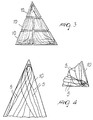
- Figure 4 illustrates in detail, for two different "corner” points of a sail made of the material according to the invention, how it is possible to use said fibers 5 to obtain, at the corner, a weave which gives natural rigidity and reinforcement to the sail.
- the layer 5 of fibers is actually constituted by a single thread of fiber which runs uninterruptedly from one end of the panel of composite material to the other.
- the composite material according to the invention therefore allows to provide, for example, sails with a smaller number of panels than normally required for conventional sails.
- the number of panels can be smaller because the arrangement of the fibers along each panel (layer of fibers 5) can be such as to avoid having to arrange a plurality of panels side by side.
- the orientation of the fibers 5 along the different panels in fact does not produce regions with points of great discontinuity between the orientation of the fibers of one panel and the orientation of the adjacent panel, and this allows to use a smaller number of panels to obtain a chosen stress distribution along the edges of the sail formed with said panels 10.
- the fiber density of the various panels that constitute the sail can be differentiated among the panels according to requirements, and this entails the provision of a sail with weight characteristics which differ in its various regions. It is therefore evident that it is possible to obtain a sail which is lighter than a sail formed monolithically (with a mold), since the reinforced areas can be chosen at will and there is no need to oversize, in terms of weight, the entire surface of the sail, i.e., including areas that are not subjected to particular stresses.
- the composite material according to the invention fully achieves the intended aim and objects, since it allows to have a considerably higher shape permanence to stress than conventional materials, indeed because of the particular nonparallel and crossed arrangement of the fibers that compose the one or more layers of fibers interposed in a sandwich-like configuration between the polymeric films and the stabilization mesh.
- nonparallel and crossed fibers allows, if the material is used to manufacture a sail, to avoid the need to resort to reinforcements in the critical points of the sail, i.e., at the clew, head and tack points.
- the particular bonding method used allows to reduce the amount of adhesive required and accordingly allows to obtain a composite material which is lighter than materials manufactured with known calendering technologies.
- Another advantage of the material according to the invention is the fact that if it is used as a material for manufacturing sails it is possible to assemble a sail by using a significantly smaller number of panels than sails made of conventional materials.
- the materials used may be any according to requirements and to the state of the art.
- the material that provides the flexible polymeric outer film, the material that provides the bidirectional or three-directional mesh layer and the material that provides the layer of fibers may be any without thereby having to modify the structure of the composite material described above.
Landscapes
- Engineering & Computer Science (AREA)
- Manufacturing & Machinery (AREA)
- Life Sciences & Earth Sciences (AREA)
- Sustainable Development (AREA)
- Sustainable Energy (AREA)
- Chemical & Material Sciences (AREA)
- Combustion & Propulsion (AREA)
- Mechanical Engineering (AREA)
- Ocean & Marine Engineering (AREA)
- Laminated Bodies (AREA)
Priority Applications (1)
| Application Number | Priority Date | Filing Date | Title |
|---|---|---|---|
| EP99830750A EP1114771A1 (de) | 1999-12-02 | 1999-12-02 | Verbundwerkstoff, insbesondere für Segel |
Applications Claiming Priority (1)
| Application Number | Priority Date | Filing Date | Title |
|---|---|---|---|
| EP99830750A EP1114771A1 (de) | 1999-12-02 | 1999-12-02 | Verbundwerkstoff, insbesondere für Segel |
Publications (1)
| Publication Number | Publication Date |
|---|---|
| EP1114771A1 true EP1114771A1 (de) | 2001-07-11 |
Family
ID=8243700
Family Applications (1)
| Application Number | Title | Priority Date | Filing Date |
|---|---|---|---|
| EP99830750A Withdrawn EP1114771A1 (de) | 1999-12-02 | 1999-12-02 | Verbundwerkstoff, insbesondere für Segel |
Country Status (1)
| Country | Link |
|---|---|
| EP (1) | EP1114771A1 (de) |
Cited By (5)
| Publication number | Priority date | Publication date | Assignee | Title |
|---|---|---|---|---|
| FR2868752A1 (fr) * | 2004-04-09 | 2005-10-14 | Pascal Francis Raymo Rossignol | Materiaux composites pour la confection de voiles et voiles realisees avec ce type de materiaux |
| WO2005123500A1 (en) * | 2004-06-18 | 2005-12-29 | Be 1 S.R.L. | A process for manufacturing tridimensional structures |
| FR2980136A1 (fr) * | 2011-09-21 | 2013-03-22 | Porcher Ind | Composites, leur procede de preparation et les voiles de vol les comprenant |
| ITUD20120190A1 (it) * | 2012-11-13 | 2014-05-14 | Cofib Compagnia Fiduciaria Di Beni S P A | Vela integrale e relativo procedimento di realizzazione |
| EP3049245B1 (de) * | 2013-09-23 | 2021-05-19 | Dimension-Polyant GmbH | Segeltuch aus faservliesstoff |
Citations (5)
| Publication number | Priority date | Publication date | Assignee | Title |
|---|---|---|---|---|
| EP0056657A2 (de) * | 1981-01-21 | 1982-07-28 | North Sails Surf Antilles N.V. | Segel für Segelschiffe und Verfahren zu dessen Herstellung |
| EP0249427A1 (de) * | 1986-06-11 | 1987-12-16 | Sobstad Sailmakers, Inc. | Verbundsegel, mit Fäden verkleidet |
| DE3718343A1 (de) * | 1987-06-01 | 1988-12-22 | Kirson Gmbh | Armierungsgitter, insbesondere fuer segel |
| DE3928312A1 (de) * | 1988-10-17 | 1990-04-19 | James C Linville | Segel und verfahren zu seiner herstellung |
| EP0475083A1 (de) * | 1990-08-21 | 1992-03-18 | North Sails Group, Inc | Segel aus einteiligem dreidimensionalem mehrschichtigem Stoff mit ununterbrochenen lasttragenden Garnen |
-
1999
- 1999-12-02 EP EP99830750A patent/EP1114771A1/de not_active Withdrawn
Patent Citations (5)
| Publication number | Priority date | Publication date | Assignee | Title |
|---|---|---|---|---|
| EP0056657A2 (de) * | 1981-01-21 | 1982-07-28 | North Sails Surf Antilles N.V. | Segel für Segelschiffe und Verfahren zu dessen Herstellung |
| EP0249427A1 (de) * | 1986-06-11 | 1987-12-16 | Sobstad Sailmakers, Inc. | Verbundsegel, mit Fäden verkleidet |
| DE3718343A1 (de) * | 1987-06-01 | 1988-12-22 | Kirson Gmbh | Armierungsgitter, insbesondere fuer segel |
| DE3928312A1 (de) * | 1988-10-17 | 1990-04-19 | James C Linville | Segel und verfahren zu seiner herstellung |
| EP0475083A1 (de) * | 1990-08-21 | 1992-03-18 | North Sails Group, Inc | Segel aus einteiligem dreidimensionalem mehrschichtigem Stoff mit ununterbrochenen lasttragenden Garnen |
Cited By (14)
| Publication number | Priority date | Publication date | Assignee | Title |
|---|---|---|---|---|
| FR2868752A1 (fr) * | 2004-04-09 | 2005-10-14 | Pascal Francis Raymo Rossignol | Materiaux composites pour la confection de voiles et voiles realisees avec ce type de materiaux |
| WO2005102690A1 (fr) | 2004-04-09 | 2005-11-03 | Custom-Laminates-Manufacturing C.L.M. | Toile de structure stratifiee pour voiles d'engins a propulsion velique |
| WO2005123500A1 (en) * | 2004-06-18 | 2005-12-29 | Be 1 S.R.L. | A process for manufacturing tridimensional structures |
| JP2013067169A (ja) * | 2011-09-21 | 2013-04-18 | Porcher Industries | 複合体及びその作製方法及びそれらを含有するフライングセイル |
| EP2572874A1 (de) * | 2011-09-21 | 2013-03-27 | Porcher Industries | Verbundstoffe, ihr Herstellungsverfahren und Flugsegel, die sie umfassen |
| KR20130032277A (ko) * | 2011-09-21 | 2013-04-01 | 포르쉐 엥뒤스트리 | 복합체, 이의 제조 방법, 및 이를 포함하는 비행 돛 |
| FR2980136A1 (fr) * | 2011-09-21 | 2013-03-22 | Porcher Ind | Composites, leur procede de preparation et les voiles de vol les comprenant |
| CN103112219A (zh) * | 2011-09-21 | 2013-05-22 | 博舍工业公司 | 复合物、其制备方法和包括该复合物的飞行帆 |
| TWI597171B (zh) * | 2011-09-21 | 2017-09-01 | 博舍工業有限公司 | 複合物、製備該複合物之方法,以及包含該複合物之飛行翼 |
| ITUD20120190A1 (it) * | 2012-11-13 | 2014-05-14 | Cofib Compagnia Fiduciaria Di Beni S P A | Vela integrale e relativo procedimento di realizzazione |
| WO2014076540A1 (en) | 2012-11-13 | 2014-05-22 | Cofib Compagnia Fiduciaria Di Beni Spa | Integral sail and corresponding method of production |
| AU2013346473B2 (en) * | 2012-11-13 | 2017-06-29 | G.B.L. Fiduciaria S.P.A. | Integral sail and corresponding method of production |
| US10329003B2 (en) | 2012-11-13 | 2019-06-25 | G.B.L. Fiduciaria S.P.A. | Integral sail and corresponding method of production |
| EP3049245B1 (de) * | 2013-09-23 | 2021-05-19 | Dimension-Polyant GmbH | Segeltuch aus faservliesstoff |
Similar Documents
| Publication | Publication Date | Title |
|---|---|---|
| EP0402099B1 (de) | Verstärkungsgewebe und vorgeformtes Halbzeug, faserverstärkter Verbundwerkstoff und daraus hergestellter Träger | |
| JP5650769B2 (ja) | 複合構造を適用するための混合三次元織/積層支柱 | |
| US4055697A (en) | Woven material with filling threads at angles other than right angles | |
| US4679519A (en) | Laminated cloth construction | |
| JP3941879B2 (ja) | 製帆用改良材料並びにその製造方法 | |
| RU2516802C2 (ru) | Способ тканья основ с цельными боковыми стенками | |
| EP2382082B1 (de) | Gewebter vorformling mit integralen ausserachsigen versteifern | |
| US5001003A (en) | Laminated sailcloth with scrim | |
| US4945848A (en) | Reinforced sailcloth | |
| CA2376997C (en) | Sail body and method for making | |
| US7658160B2 (en) | Asymmetrical sail fabric | |
| AU2009333185B2 (en) | Quasi-isotropic three-dimensional preform and method of making thereof | |
| EP1121289B1 (de) | Kompositprodukt sowie verfahren hierfür | |
| US5304414A (en) | Non-laminated woven sailcloth | |
| EP1216188B9 (de) | In segmente gebildetes segel und verfahren zu dessen herstellung | |
| CN216001519U (zh) | 一种增强织物及多轴向增强材料 | |
| EP1114771A1 (de) | Verbundwerkstoff, insbesondere für Segel | |
| US20070218793A1 (en) | Laminated Fabric for Sail of Wind-Driven Engines | |
| EP0885803A2 (de) | PBO-verstärktes Segel und Segeltuch | |
| JPH03119138A (ja) | 繊維補強複合材 | |
| EP0281322A1 (de) | Coextrudiertes Segeltuch, Verfahren und Verwendung | |
| JPH07113176B2 (ja) | 複合材の強化部材用又はその芯体用異形織物 | |
| US20060141216A1 (en) | Spliced fabric | |
| JPH0647022Y2 (ja) | 3軸補強織物 | |
| EP0826488B1 (de) | Verbundwerkstoffkonstruktion |
Legal Events
| Date | Code | Title | Description |
|---|---|---|---|
| PUAI | Public reference made under article 153(3) epc to a published international application that has entered the european phase |
Free format text: ORIGINAL CODE: 0009012 |
|
| 17P | Request for examination filed |
Effective date: 20001206 |
|
| AK | Designated contracting states |
Kind code of ref document: A1 Designated state(s): AT BE CH CY DE DK ES FI FR GB GR IE IT LI LU MC NL PT SE |
|
| AX | Request for extension of the european patent |
Free format text: SI PAYMENT 20001206 |
|
| AKX | Designation fees paid |
Free format text: AT BE CH CY DE DK ES FI FR GB GR IE IT LI LU MC NL PT SE |
|
| AXX | Extension fees paid |
Free format text: SI PAYMENT 20001206 |
|
| TPAD | Observations filed by third parties |
Free format text: ORIGINAL CODE: EPIDOS TIPA |
|
| STAA | Information on the status of an ep patent application or granted ep patent |
Free format text: STATUS: THE APPLICATION IS DEEMED TO BE WITHDRAWN |
|
| 18D | Application deemed to be withdrawn |
Effective date: 20050701 |