EP1117799B1 - Nouvelles souches du groupe du bacillus subtilis utilisees pour la fermentation alimentaire - Google Patents
Nouvelles souches du groupe du bacillus subtilis utilisees pour la fermentation alimentaire Download PDFInfo
- Publication number
- EP1117799B1 EP1117799B1 EP99946175A EP99946175A EP1117799B1 EP 1117799 B1 EP1117799 B1 EP 1117799B1 EP 99946175 A EP99946175 A EP 99946175A EP 99946175 A EP99946175 A EP 99946175A EP 1117799 B1 EP1117799 B1 EP 1117799B1
- Authority
- EP
- European Patent Office
- Prior art keywords
- natto
- gene
- ywfl
- subtilis
- fermentation
- Prior art date
- Legal status (The legal status is an assumption and is not a legal conclusion. Google has not performed a legal analysis and makes no representation as to the accuracy of the status listed.)
- Expired - Lifetime
Links
Images


Classifications
-
- C—CHEMISTRY; METALLURGY
- C12—BIOCHEMISTRY; BEER; SPIRITS; WINE; VINEGAR; MICROBIOLOGY; ENZYMOLOGY; MUTATION OR GENETIC ENGINEERING
- C12N—MICROORGANISMS OR ENZYMES; COMPOSITIONS THEREOF; PROPAGATING, PRESERVING, OR MAINTAINING MICROORGANISMS; MUTATION OR GENETIC ENGINEERING; CULTURE MEDIA
- C12N1/00—Microorganisms; Compositions thereof; Processes of propagating, maintaining or preserving microorganisms or compositions thereof; Processes of preparing or isolating a composition containing a microorganism; Culture media therefor
- C12N1/20—Bacteria; Culture media therefor
- C12N1/205—Bacterial isolates
-
- C—CHEMISTRY; METALLURGY
- C12—BIOCHEMISTRY; BEER; SPIRITS; WINE; VINEGAR; MICROBIOLOGY; ENZYMOLOGY; MUTATION OR GENETIC ENGINEERING
- C12N—MICROORGANISMS OR ENZYMES; COMPOSITIONS THEREOF; PROPAGATING, PRESERVING, OR MAINTAINING MICROORGANISMS; MUTATION OR GENETIC ENGINEERING; CULTURE MEDIA
- C12N1/00—Microorganisms; Compositions thereof; Processes of propagating, maintaining or preserving microorganisms or compositions thereof; Processes of preparing or isolating a composition containing a microorganism; Culture media therefor
- C12N1/20—Bacteria; Culture media therefor
-
- C—CHEMISTRY; METALLURGY
- C07—ORGANIC CHEMISTRY
- C07K—PEPTIDES
- C07K14/00—Peptides having more than 20 amino acids; Gastrins; Somatostatins; Melanotropins; Derivatives thereof
- C07K14/195—Peptides having more than 20 amino acids; Gastrins; Somatostatins; Melanotropins; Derivatives thereof from bacteria
- C07K14/32—Peptides having more than 20 amino acids; Gastrins; Somatostatins; Melanotropins; Derivatives thereof from bacteria from Bacillus (G)
-
- C—CHEMISTRY; METALLURGY
- C12—BIOCHEMISTRY; BEER; SPIRITS; WINE; VINEGAR; MICROBIOLOGY; ENZYMOLOGY; MUTATION OR GENETIC ENGINEERING
- C12R—INDEXING SCHEME ASSOCIATED WITH SUBCLASSES C12C - C12Q, RELATING TO MICROORGANISMS
- C12R2001/00—Microorganisms ; Processes using microorganisms
- C12R2001/01—Bacteria or Actinomycetales ; using bacteria or Actinomycetales
- C12R2001/07—Bacillus
- C12R2001/125—Bacillus subtilis ; Hay bacillus; Grass bacillus
Definitions
- the present invention pertains to novel strains of Bacillus subtilis capable of fermenting beans, which are essentially devoid of any iso-valeric acid production.
- the present invention especially relates to novel strains of Bacillus natto, in which one or more genes involved in the biosynthetic pathway for the production of iso-valeric acids are essentially non-functional.
- microorganisms such as yeasts, fungi or bacteria, so as to modify, prepare or change the nature/taste of foodstuff.
- microorganisms are the soil bacteria belonging to the Bacillus subtilis group that are used for the fermentation of different plants tissues, such as beans, e.g. soybeans and (African) locust beans, and seeds, e.g. the seeds of African oil bean, cotton seeds, melon seeds etc..
- beans e.g. soybeans and (African) locust beans
- seeds e.g. the seeds of African oil bean, cotton seeds, melon seeds etc.
- subtilis degrades cellulose or/and the protein material contained in the starting material resulting in a fermented product that may be further processed or is already ready for consumption.
- B. natto a food-grade, gram-positive microorganism mainly used for the fermentation of soybeans, which fermentation process eventually results in a cheap and nutritious food that is rich in amino acids.
- B. natto is derived from the Japanese soybean fermented product "Natto" that is commercially produced and often eaten at breakfast (see also K.H. Steinkraus et al., Handbook of Native Fermented Food, Vol. 9. (1983), 530-547).
- a drawback in the fermentation of biological starting materials with microorganisms for food production resides in that a variety of by-products are generated that are not desirable by the consumer, such as an off-flavor or an unwanted hardness of the product.
- JP-08275772 describes the use of a particular strain of B. subtilis for reducing the amount of ammonia in the end product "Natto”. This objective is achieved by keeping the protease activity during the early stage of fermentation at a high level, so that essentially all soybean proteins are degraded to a substantial degree, while in a later stage of fermentation the protease activity is remarkably reduced so as not to produce extensive amounts of ammonia which would eventually deteriorate the smell of the food product.
- JP-09009903 there is described another B. subtilis strain that has improved hemicellulose degrading properties such that the end product reveals an increased softness.
- EP 0 643 922 describes the preparation of an aromatizing agent.
- bacteria of the genus Bacillus Bacillus (Bacillus subtilis and Bacillus natto) are used to ferment plant material, providing unfavorable isovaleric acids (2- or 3-methylbutanoic acid).
- a carbon source like glucose or saccharose or a source harboring said components are to be added to the fermentation material. Providing such a supplemented material to micro-organisms results in a reduced amount of isovaleric acids in the fermentation material.
- the object of the present invention therefore resides in further improving the properties of food products obtainable by a fermentation with B. subtilis, especially improving the taste thereof.
- the above object has been solved by providing a novel strain of a microorganism of the B. subtilis group wherein a gene involved in the biosynthesis of isovaleric acids has been modified such that the bacterium cannot produce substantial amount of isovaleric acids, wherein the gene product that has a reduced activity, is essentially non-functional or is missing is derived from the ywfl -gene.
- flavour of products obtainable by fermentation with B. subtilis especially B. natto
- B. subtilis especially B. natto
- iso-valeric acids (2-methyl-butyric acid and 3-methyl-butyric acid)
- polypeptide derived from the gene ywfL may play a vital role in the production of iso-valeric acids and similar branched-chain fatty acids by the bacterium.
- a gene the ywfL gene (Nature, supra) has been modified in such a way that it reveals merely a reduced activity, preferably a strongly reduced activity or is non-functional.
- the ywfL gene may be deleted from the genome.
- the modified strain belonging to the B. subtilis group is of the species B. natto, most preferably B. natto BN10, that has been deposited with the Institute Pasteur under the Budapest Treaty having received the deposit number I-2077.
- novel strains may be obtained by known techniques, such as mutating common B. subtilis strains with known mutagens and selecting for the desired trait, that is a low or deficient synthesis of iso-valeric acids during fermentation.
- Mutagens and techniques for applying them are well known in the art and not limiting examples are e.g. DMSO (dimethylsulfoxide), MNNG (N-methyl-N'-nitro-N-nitrosoguanidine), methylamine or radiation treatment etc..
- B. subtilis strains may also be obtained by recominant gene technology, preferably without any exogeneous DNA incorporated therein, which will be described in detail hereunder.
- novel B. subtilis strains according to the invention may be used for the fermentation of plant material to eventually produce therefrom foodstuff, flavours or, more preferably, Natto.
- B. natto contains an isogenic deletion of the chromosomal ywfL gene.
- This deletion has been found to be stable and contains no undesired DNA sequences, such as vector sequences or antibiotic resistance markers used for its construction.
- the microorganisms obtained by deleting the ywfL gene have shown to perform equally well as compared to known B. natto strains indicating, that the fermentation behaviour of the novel strains are not deteriorated by the lack of the ywfL gene product.
- E. coli vector pBS SK+ (Stratagene, product number 212205) was carried out in E. coli strain BZ234 (Mollet, B. et al. "Directed genomic integration, gene replacement, and intgrative gene expression in Streptococcus thermophilus” Journal of Bacteriology 175 (14) (1993), 4315-4324) while selecting for recombinant strains by means of the antibiotic ampicillin (Boehringer Mannheim, product number 835 242).
- Recombinant plasmids were identified with X-gal (5-bromo-4-chloro-3-indolyl- ⁇ -D-galactopyranoside, Boehringer Mannheim, product number 1 680 293) and IPTG (isopropyl- ⁇ -D-thiogalactoside, Boehringer Mannheim, product number 1 411 446).
- the plasmid pG+host9 (Maguin, E. et al. "Efficient insertional mutagenesis in lactococci and other gram-positive bacteria” Journal of Bacteriology 178 (3) (1996), 931-935) is a gram-positive / gram-negative shuttle vector harbouring a gene for the resistance to the antibiotic erythromycin (Fluka, product number E6376) and a temperature sensitive plasmid replication protein.
- pG+host9 is propagated in E. coli EC101 (Law, J. et al.
- the B. natto strain (termed BN1) used in this work has been isolated from a fermented Natto product purchased on the market.
- the growth medium was LB at 37°C for E. coli and either 28°C or 37°C for B. natto with agitation. Erythromycin was added to 150 ⁇ g/ml for E. coli and 2-4 ⁇ g/ml for B. natto.
- the extraction of chromosomal DNA from B. natto for PCR and Southern blot analysis was performed on a 16 hr culture in LB medium with or without antibiotic selection as required. The culture was centrifuged at 6,000 rpm for 8 min to pellet the bacteria. The pellet was suspended in 500 ⁇ l of 50 mM glucose, 25 mM Tris-HCl pH 8.0, 10 mM EDTA plus 500 ⁇ g/ml lysozyme (Boehringer Mannheim, 1243004) and incubated at 37°C for 30 min. Mutanolysin (Fluka, M9901) was added to 1 ⁇ g/ml and the incubation was continued at 37°C for another 30 min.
- Mutanolysin Fluka, M9901
- Proteinase K was added (Fluka, P6556) to 20 ⁇ g/ml, EDTA to 2.5 mM and the cells were finally lysed by the addition of 0.1% SDS (Serva, 20763). This solution was incubated at 60°C for 1 hr and the lysate was extracted once with an equal volume of phenol-chloroform. The mixture was centrifuged at 14,000 rpm for 8 min to separate the phases. The aqueous phase was carefully removed and the chromosomal DNA was precipitated by the addition of 2 volumes of 95% ethanol (Fluka, 02860).
- the DNA precipitate was spooled with a sterile toothpick, transferred to 400 ⁇ l 10 mM Tris-HCl pH 8.0, 10 mM EDTA with 50 ⁇ g/ml RNAse (Boehringer, 109 169) and incubated at 60°C for 1 hr. The solution was phenol-chloroform extracted. The DNA was precipitated, spooled and finally suspended in 200 ⁇ l of TE buffer (10 mM Tris-HCl pH 8.0, 1 mM EDTA).
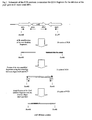
- DNA fragments flanking the ywfL gene were amplified from the B. natto strain BN1 and finally combined (Fusion Cycle PCR) by their primer incorporated homologies to create a DNA fragment for the disruption of the ywfL gene in this bacterium. This is schematically shown in Figure 1.
- the 5' flanking region was amplified using the oligonucleotides 6624 (SEQ. ID. NO.1) obtained from Microsynth, Balgach, Switzerland, which introduces a BamHI restriction site approximately 950 bp upstream of the start of the ywfL gene, and 6626 (SEQ. ID. NO.2), a composite oligonucleotide comprising 22 bp of the sequence of the region 50 bp away from the start of the ywfL gene and 22 bp of the region 100 bp away from the end of the ywfL gene.
- This oligonucleotide sequence defines the region that is to be deleted, namely the sequence that is omitted between the two segments of the composite primers.
- This second segment from the oligonucleotide 6626 was also designed to introduce two TGA stop codons to terminate translation of the truncated ywfL gene.
- the 3' flanking region was amplified using the oligonucleotides 6625 (SEQ. ID. NO. 3), which introduces a EcoRI restriction site approximately 1000 bp downstream of the end of the ywfL gene, and 6627 (SEQ ID. NO. 4) a second composite oligonucleotide that is essentially the reverse-complement of oligonucleotide 6626 (SEQ. ID. NO. 2).
- These complementary oligonucleotide sequences provide the homology between the the 5' and 3' fragments that is exploited in the primer-free, Pwo directed extension to complete the second strand.
- the two oligonucleotides 6626 and 6625 were finaly added and the correct deletion fragment was specifically amplified.
- PCR reactions were carried out as follows. 500 ng of chromosomal DNA were mixed in a 100 ⁇ l volume containing 80 ⁇ l sterile H 2 O, 6 ⁇ l 2 mM dNTPs, 10 ⁇ l Pwo polymerase reaction buffer, 2 ⁇ l each oligonucleotide at approximately 100 nM and 0.5 ⁇ l Pwo polymerase (Boehringer Mannheim, product number 1 644 947). The desired fragment was amplified using a Perkin Elmer DNA Thermal Cycler with 20 cycles of 1 min 95°C, 1 min 40°C, 2 min at 72°C and finally held at 4°C.
- a 1 ⁇ l sample from each PCR reaction was prepared in a 100 ⁇ l volume containing 80 ⁇ l sterile H 2 O, 6 ⁇ l 2 mM dNTPs, 10 ⁇ l Pwo polymerase reaction buffer and 0.5 ⁇ l Pwo polymerase (without any oligonucleotides). This control was processed for two cycles in the Thermal Cycler as described above to extend from the oligonucleotide induced homologies. Finally, 2 ⁇ l of each oligonucleotide 6624 and 6625 at approximately 100 nM were added and the PCR reaction was continued for another 20 cycles.
- the final PCR product was purified on a QIAquick PCR purification kit (Qiagen, product number 28104).
- a sample was digested with the restriction enzymes EcoRI and BamHI and electrophoresed on a 1 % agarose gel. The corresponding 2 kb fragment was cut out of the gel and the DNA was eluted using the QIAquick gel extraction kit (Qiagen, product number 28704).
- the DNA fragment obtained was digested with the restriction enzymes EcoRI and BamHI and ligated with the E. coli vector pBS SK+ that has been pretreated accordingly (digested with EcoRI/BamHI and dephosphorylated).
- the ligation mixture was electro-transformed in the E.
- coli strain BZ234 and transformants were selected on LB plates supplemented with 100 ⁇ g/ml ampicillin, Xgal and IPTG. Potential positive, white colonies were screened by restriction analysis of plasmids isolated therefrom (Sambrook, supra). The DNA sequence of the insert of a positive clone was determined so as to confirm the PCR construction. This plasmid was digested with the restriction enzymes EcoRI and SpeI and the fragments were separated on a 1% agarose gel. The corresponding 2 kb fragment was cut out of the gel and the DNA was eluted using the QIAquick gel extraction kit.
- the replication-temperature sensitive vector pG+Host 9 was digested with the restriction enzymes EcoRI and SpeI and the terminal phosphates were removed using shrimp alkaline phosphatase (USB, product number 70092). The ywfL, deletion fragment was mixed with the pG+Host 9 vector pretreated accordingly and ligated therwith. The ligation mixture was electro-transformed into the E. coli host EC101. Colonies were screened by means of restriction analysis of isolated plasmids. One of the positive plasmids was designated pMZ66 ( Figure 2).
- the deletion of the B. natto ywfL gene was performed in two separate steps.
- the first step the integration of pMZ66 by homologous recombination (directed by the flanking DNA homologies) was selected for.
- the second step use was made of plasmid replication facilitated excision from the genome and the desired bacterial clones were identified.
- the B. natto strain BN1 transformed with the plasmid pMZ66 was inoculated into fresh LB medium supplemented with 2 ⁇ g/ml erythromycin and was incubated at 42°C for 16 hr. This culture was diluted and plated onto on LB plates supplemented with 2 ⁇ g/ml erythromycin and incubated at 42°C. At this temperature the pG+Host 9 plasmid replication protein is no longer active. Consequently, those bacteria, that are selected, are the rare events of plasmid integration at the ywfL gene. This integration is directed by the DNA sequence homology of the ywfL deletion fragment and can occur in either the 5' or 3' homology region.
- a positive clone with pMZ66 integrated at the 5' end of the ywfL gene was inoculated at 1 % into LB medium with 2 ⁇ g/ml erythromycin and was incubated at 42°C for 16 hr. This culture was then used to inoculate at 1 % a fresh culture of LB medium and incubated at 28 °C for 16 hr. The culture was diluted, plated onto LB plates and then incubated at 42°C.
- the plasmid pMZ66 is considered to have two options for looping-out by two distinct routes:
- PCR amplification with primers designed to amplify across the deletion point were used to determine that all the large colonies carried the wild-type BN1 ywfL gene, while the small colonies all contained the designed deletion of the ywfL gene.
- PCR results were confirmed by sequencing the DNA at the deletion point of the ywfL gene, which showed the expected sequence from the constructs.
- the arrangement of the region around the ywfL gene was confirmed by Southern hybridization and finally it was determined by means of hybridization with that plasmid that no pG+Host 9 vector sequences remained.
- Five such ywfL deletion strains were identified from independent experiments and named BN10 (1-2077) to BN 14.
- B. natto strain BN1 and the 5 ywfL deletion strains obtained (BN10 to BN 14) were cultured in LB medium for 16 hr at 37°C.
- the bacteria were removed by filtration through a 0.2 micron filter (Schleicher & Schuell, FP 030/3) and the fatty acids composition was analysed by HPLC.
- HPLC was performed on a HPLC Hewlett Packard series 1100 machine using an Aminex Fast Acid 100 x 7.5 mm column (Bio-Rad, product number 125-0100) stabilized at 40°C and eluted with 10 mM H 2 SO 4 at a flow rate of 1 ml/min. Detection was achieved using a HP1047A Refractometer (Hewlett Packard) also stabilised at 40°C.
- soybeans were crushed, cooked, and inoculated with spores of the B. natto strain BN10 (1-2077), followed by solid state fermentation (Koji type fermentation) for 2 - 5 days at 30-50°C.
- a salt brine NaCl saturated solution
- the product was dried, pressed into cubes or was used as the powder for e.g. bouillon production. The final production did not have the taste common for products containing iso-valeric acids.
- novel B. subtilis strain therefore performed equally well in the fermentation of soybeans as compared to commonly used B. subtilis strains.
Landscapes
- Chemical & Material Sciences (AREA)
- Health & Medical Sciences (AREA)
- Life Sciences & Earth Sciences (AREA)
- Organic Chemistry (AREA)
- Engineering & Computer Science (AREA)
- Genetics & Genomics (AREA)
- Biotechnology (AREA)
- Zoology (AREA)
- Bioinformatics & Cheminformatics (AREA)
- Wood Science & Technology (AREA)
- Medicinal Chemistry (AREA)
- General Health & Medical Sciences (AREA)
- Biochemistry (AREA)
- Tropical Medicine & Parasitology (AREA)
- Microbiology (AREA)
- General Engineering & Computer Science (AREA)
- Biomedical Technology (AREA)
- Virology (AREA)
- Molecular Biology (AREA)
- Biophysics (AREA)
- Gastroenterology & Hepatology (AREA)
- Proteomics, Peptides & Aminoacids (AREA)
- Micro-Organisms Or Cultivation Processes Thereof (AREA)
- Preparation Of Compounds By Using Micro-Organisms (AREA)
- Beans For Foods Or Fodder (AREA)
- General Preparation And Processing Of Foods (AREA)
- Seasonings (AREA)
Abstract
Claims (11)
- Souche bactérienne du groupe Bacillus subtilis, dans laquelle un gène impliqué dans la biosynthèse d'acides isovalériques a été modifié de telle façon que la bactérie ne peut pas produire de quantités substantielles d'acides isovalériques, dans laquelle le produit de gène qui a une activité réduite, est essentiellement non fonctionnel ou est manquant est dérivé du gène ywfl.
- Souche de B. subtilis selon la revendication 1, qui est B. natto.
- Souche de B. subtilis selon la revendication 1 ou 2, dans laquelle le gène ywfL a une activité réduite, est essentiellement non fonctionnel ou est manquant.
- Souche de B. subtilis selon l'une quelconque des revendications précédentes, qui ne contient pas de séquences d'ADN exogènes.
- Souche de B. subtilis selon l'une quelconque des revendications précédentes, qui a été préparée par la technologie de recombinaison génétique.
- Souche de B. subtilis selon l'une quelconque des revendications 1 à 4, qui a été préparée par mutagénèse et sélection.
- Souche de B. subtilis selon la revendication 5, qui est B. natto I-2077.
- Utilisation d'une souche de B. subtilis selon l'une quelconque des revendications précédentes pour la fermentation d'une matière végétale.
- Utilisation selon la revendication 8 pour la préparation d'un produit alimentaire.
- Utilisation selon la revendication 8 pour la préparation de composés aromatisants.
- Utilisation selon la revendication 9 pour la préparation de Natto.
Priority Applications (1)
| Application Number | Priority Date | Filing Date | Title |
|---|---|---|---|
| EP99946175A EP1117799B1 (fr) | 1998-10-02 | 1999-09-15 | Nouvelles souches du groupe du bacillus subtilis utilisees pour la fermentation alimentaire |
Applications Claiming Priority (4)
| Application Number | Priority Date | Filing Date | Title |
|---|---|---|---|
| EP98118659A EP0999272A1 (fr) | 1998-10-02 | 1998-10-02 | Nouvelles souches de Bacillus subtilis pour fermentations d'aliments |
| EP98118659 | 1998-10-02 | ||
| EP99946175A EP1117799B1 (fr) | 1998-10-02 | 1999-09-15 | Nouvelles souches du groupe du bacillus subtilis utilisees pour la fermentation alimentaire |
| PCT/EP1999/006818 WO2000020597A1 (fr) | 1998-10-02 | 1999-09-15 | Nouvelles souches du groupe du bacillus subtilis utilisees pour la fermentation alimentaire |
Publications (2)
| Publication Number | Publication Date |
|---|---|
| EP1117799A1 EP1117799A1 (fr) | 2001-07-25 |
| EP1117799B1 true EP1117799B1 (fr) | 2006-05-03 |
Family
ID=8232739
Family Applications (2)
| Application Number | Title | Priority Date | Filing Date |
|---|---|---|---|
| EP98118659A Withdrawn EP0999272A1 (fr) | 1998-10-02 | 1998-10-02 | Nouvelles souches de Bacillus subtilis pour fermentations d'aliments |
| EP99946175A Expired - Lifetime EP1117799B1 (fr) | 1998-10-02 | 1999-09-15 | Nouvelles souches du groupe du bacillus subtilis utilisees pour la fermentation alimentaire |
Family Applications Before (1)
| Application Number | Title | Priority Date | Filing Date |
|---|---|---|---|
| EP98118659A Withdrawn EP0999272A1 (fr) | 1998-10-02 | 1998-10-02 | Nouvelles souches de Bacillus subtilis pour fermentations d'aliments |
Country Status (16)
| Country | Link |
|---|---|
| US (1) | US6852523B2 (fr) |
| EP (2) | EP0999272A1 (fr) |
| JP (1) | JP2002526113A (fr) |
| KR (1) | KR20010075562A (fr) |
| CN (1) | CN1159442C (fr) |
| AR (1) | AR021853A1 (fr) |
| AT (1) | ATE325195T1 (fr) |
| AU (1) | AU763912B2 (fr) |
| BR (1) | BR9915016B1 (fr) |
| DE (1) | DE69931176T2 (fr) |
| ES (1) | ES2263287T3 (fr) |
| HK (1) | HK1040416A1 (fr) |
| PL (1) | PL199811B1 (fr) |
| RU (1) | RU2001111821A (fr) |
| WO (1) | WO2000020597A1 (fr) |
| ZA (1) | ZA200102229B (fr) |
Families Citing this family (5)
| Publication number | Priority date | Publication date | Assignee | Title |
|---|---|---|---|---|
| JP4624278B2 (ja) * | 2006-02-13 | 2011-02-02 | タカノフーズ株式会社 | 納豆菌及び納豆の製造方法 |
| CN104522796A (zh) * | 2014-12-10 | 2015-04-22 | 杭州元佩特生物科技有限公司 | 一种食疗黄米汁的制备方法 |
| CN104381932A (zh) * | 2014-12-10 | 2015-03-04 | 杭州元佩特生物科技有限公司 | 一种富含纳豆激酶和吡咯喹啉醌的白菜泡菜的制作方法 |
| CN108004184B (zh) * | 2018-01-04 | 2021-01-29 | 云南中烟工业有限责任公司 | 一种芽孢杆菌及其用于生产异戊酸的方法 |
| CN114591857B (zh) * | 2022-03-10 | 2023-05-09 | 内蒙古工业大学 | 一株高纤维降解率的枯草芽孢杆菌及其应用 |
Family Cites Families (5)
| Publication number | Priority date | Publication date | Assignee | Title |
|---|---|---|---|---|
| JPS52108045A (en) * | 1976-03-06 | 1977-09-10 | Riyouji Sekiguchi | Method of making fermented soybeans |
| US4215229A (en) | 1978-06-15 | 1980-07-29 | Koppers Company, Inc. | Process for alkylating phenolic compounds to produce ortho- and para-monoalkylated phenols and 2,4- and 2,6-dialkylated phenols |
| SK281209B6 (sk) | 1993-09-21 | 2001-01-18 | Societe Des Produits Nestle S. A. | Spôsob výroby aromatizačného prostriedku |
| JP2851811B2 (ja) * | 1995-04-06 | 1999-01-27 | フジッコ株式会社 | 納豆菌およびそれを用いた納豆の製法並びに納豆 |
| JPH099903A (ja) * | 1995-06-30 | 1997-01-14 | Fujitsuko Kk | 納豆菌およびそれを用いた納豆の製法並びに納豆 |
-
1998
- 1998-10-02 EP EP98118659A patent/EP0999272A1/fr not_active Withdrawn
-
1999
- 1999-09-15 BR BRPI9915016-6A patent/BR9915016B1/pt not_active IP Right Cessation
- 1999-09-15 CN CNB998116874A patent/CN1159442C/zh not_active Expired - Fee Related
- 1999-09-15 AU AU58635/99A patent/AU763912B2/en not_active Ceased
- 1999-09-15 AT AT99946175T patent/ATE325195T1/de not_active IP Right Cessation
- 1999-09-15 HK HK02100614.4A patent/HK1040416A1/zh unknown
- 1999-09-15 EP EP99946175A patent/EP1117799B1/fr not_active Expired - Lifetime
- 1999-09-15 ES ES99946175T patent/ES2263287T3/es not_active Expired - Lifetime
- 1999-09-15 KR KR1020017004232A patent/KR20010075562A/ko not_active Abandoned
- 1999-09-15 RU RU2001111821/13A patent/RU2001111821A/ru not_active Application Discontinuation
- 1999-09-15 PL PL347101A patent/PL199811B1/pl not_active IP Right Cessation
- 1999-09-15 WO PCT/EP1999/006818 patent/WO2000020597A1/fr not_active Ceased
- 1999-09-15 JP JP2000574692A patent/JP2002526113A/ja not_active Ceased
- 1999-09-15 DE DE69931176T patent/DE69931176T2/de not_active Expired - Lifetime
- 1999-10-01 AR ARP990104998A patent/AR021853A1/es active IP Right Grant
-
2001
- 2001-03-16 ZA ZA200102229A patent/ZA200102229B/en unknown
- 2001-03-30 US US09/823,772 patent/US6852523B2/en not_active Expired - Fee Related
Also Published As
| Publication number | Publication date |
|---|---|
| CN1321192A (zh) | 2001-11-07 |
| PL199811B1 (pl) | 2008-11-28 |
| AU763912B2 (en) | 2003-08-07 |
| US6852523B2 (en) | 2005-02-08 |
| BR9915016A (pt) | 2001-08-14 |
| PL347101A1 (en) | 2002-03-25 |
| HK1040416A1 (zh) | 2002-06-07 |
| DE69931176T2 (de) | 2007-02-22 |
| EP0999272A1 (fr) | 2000-05-10 |
| JP2002526113A (ja) | 2002-08-20 |
| ES2263287T3 (es) | 2006-12-01 |
| EP1117799A1 (fr) | 2001-07-25 |
| ATE325195T1 (de) | 2006-06-15 |
| RU2001111821A (ru) | 2003-06-10 |
| US20020094329A1 (en) | 2002-07-18 |
| AU5863599A (en) | 2000-04-26 |
| CN1159442C (zh) | 2004-07-28 |
| ZA200102229B (en) | 2002-03-18 |
| KR20010075562A (ko) | 2001-08-09 |
| WO2000020597A1 (fr) | 2000-04-13 |
| AR021853A1 (es) | 2002-08-07 |
| BR9915016B1 (pt) | 2011-06-28 |
| DE69931176D1 (de) | 2006-06-08 |
Similar Documents
| Publication | Publication Date | Title |
|---|---|---|
| US6689750B1 (en) | Bactericide compositions prepared and obtained from microccus varians | |
| EP1117799B1 (fr) | Nouvelles souches du groupe du bacillus subtilis utilisees pour la fermentation alimentaire | |
| US5985668A (en) | Sucrose metabolism mutants | |
| CA1309674C (fr) | Peptide indiquant l'excretion de peptides dans les streptomycenes | |
| US7241610B2 (en) | Lactic acid bacteria overproducing exopolysaccharides | |
| CN109652436B (zh) | 一种重组乳酸乳球菌菌株及其制备方法和应用 | |
| JP3746556B2 (ja) | プラスミド及びプラスミドベクター | |
| US7053197B2 (en) | Ketogulonigenium endogenous plasmids | |
| JP4162383B2 (ja) | ホモグルタミン酸の生産に関与する遺伝子およびその使用 | |
| KR100953104B1 (ko) | 류코노스톡에서 유래된 신규 플라스미드 및 이를 포함하는셔틀 벡터 | |
| AU716408B2 (en) | Novel HS gene, expression plasmid in which HS gene is ligated downstream of structural gene encoding foreign gene PR product, and process for producing foreign gene product using transformant containing the expression of plasmid | |
| US7358083B1 (en) | Food-grade cloning vector and their use in lactic acid bacteria | |
| JP2005211068A (ja) | グルタミン酸ポリペプチド分解酵素高活性納豆菌、及び糸切れのよい納豆 | |
| JP7389640B2 (ja) | アルカリプロテアーゼ | |
| AU743215B2 (en) | Food-grade cloning vector and their use in lactic acid bacteria | |
| JP2006230329A (ja) | 酢酸発酵能が増強された酢酸菌、及び該酢酸菌を用いた食酢の製造方法 | |
| JPH10286091A (ja) | テトラサイクリン生合成に関与する遺伝子 | |
| HK1100850B (en) | Novel brevibacillus choshinensis and process for producing protein with use of the microbe as host | |
| HK1100850A1 (en) | Novel brevibacillus choshinensis and process for producing protein with use of the microbe as host | |
| JPH06225769A (ja) | マイシナマイシン耐性を付与する新規遺伝子myrB |
Legal Events
| Date | Code | Title | Description |
|---|---|---|---|
| PUAI | Public reference made under article 153(3) epc to a published international application that has entered the european phase |
Free format text: ORIGINAL CODE: 0009012 |
|
| 17P | Request for examination filed |
Effective date: 20010502 |
|
| AK | Designated contracting states |
Kind code of ref document: A1 Designated state(s): AT BE CH CY DE DK ES FI FR GB GR IE IT LI LU MC NL PT SE |
|
| 17Q | First examination report despatched |
Effective date: 20030703 |
|
| GRAP | Despatch of communication of intention to grant a patent |
Free format text: ORIGINAL CODE: EPIDOSNIGR1 |
|
| GRAS | Grant fee paid |
Free format text: ORIGINAL CODE: EPIDOSNIGR3 |
|
| GRAA | (expected) grant |
Free format text: ORIGINAL CODE: 0009210 |
|
| AK | Designated contracting states |
Kind code of ref document: B1 Designated state(s): AT BE CH CY DE DK ES FI FR GB GR IE IT LI LU MC NL PT SE |
|
| PG25 | Lapsed in a contracting state [announced via postgrant information from national office to epo] |
Ref country code: NL Free format text: LAPSE BECAUSE OF FAILURE TO SUBMIT A TRANSLATION OF THE DESCRIPTION OR TO PAY THE FEE WITHIN THE PRESCRIBED TIME-LIMIT Effective date: 20060503 Ref country code: LI Free format text: LAPSE BECAUSE OF FAILURE TO SUBMIT A TRANSLATION OF THE DESCRIPTION OR TO PAY THE FEE WITHIN THE PRESCRIBED TIME-LIMIT Effective date: 20060503 Ref country code: IT Free format text: LAPSE BECAUSE OF FAILURE TO SUBMIT A TRANSLATION OF THE DESCRIPTION OR TO PAY THE FEE WITHIN THE PRESCRIBED TIME-LIMIT;WARNING: LAPSES OF ITALIAN PATENTS WITH EFFECTIVE DATE BEFORE 2007 MAY HAVE OCCURRED AT ANY TIME BEFORE 2007. THE CORRECT EFFECTIVE DATE MAY BE DIFFERENT FROM THE ONE RECORDED. Effective date: 20060503 Ref country code: FI Free format text: LAPSE BECAUSE OF FAILURE TO SUBMIT A TRANSLATION OF THE DESCRIPTION OR TO PAY THE FEE WITHIN THE PRESCRIBED TIME-LIMIT Effective date: 20060503 Ref country code: CH Free format text: LAPSE BECAUSE OF FAILURE TO SUBMIT A TRANSLATION OF THE DESCRIPTION OR TO PAY THE FEE WITHIN THE PRESCRIBED TIME-LIMIT Effective date: 20060503 Ref country code: BE Free format text: LAPSE BECAUSE OF FAILURE TO SUBMIT A TRANSLATION OF THE DESCRIPTION OR TO PAY THE FEE WITHIN THE PRESCRIBED TIME-LIMIT Effective date: 20060503 Ref country code: AT Free format text: LAPSE BECAUSE OF FAILURE TO SUBMIT A TRANSLATION OF THE DESCRIPTION OR TO PAY THE FEE WITHIN THE PRESCRIBED TIME-LIMIT Effective date: 20060503 |
|
| REG | Reference to a national code |
Ref country code: GB Ref legal event code: FG4D |
|
| REG | Reference to a national code |
Ref country code: CH Ref legal event code: EP |
|
| REF | Corresponds to: |
Ref document number: 69931176 Country of ref document: DE Date of ref document: 20060608 Kind code of ref document: P |
|
| REG | Reference to a national code |
Ref country code: IE Ref legal event code: FG4D |
|
| PG25 | Lapsed in a contracting state [announced via postgrant information from national office to epo] |
Ref country code: SE Free format text: LAPSE BECAUSE OF FAILURE TO SUBMIT A TRANSLATION OF THE DESCRIPTION OR TO PAY THE FEE WITHIN THE PRESCRIBED TIME-LIMIT Effective date: 20060803 Ref country code: DK Free format text: LAPSE BECAUSE OF FAILURE TO SUBMIT A TRANSLATION OF THE DESCRIPTION OR TO PAY THE FEE WITHIN THE PRESCRIBED TIME-LIMIT Effective date: 20060803 |
|
| PG25 | Lapsed in a contracting state [announced via postgrant information from national office to epo] |
Ref country code: IE Free format text: LAPSE BECAUSE OF NON-PAYMENT OF DUE FEES Effective date: 20060915 |
|
| PG25 | Lapsed in a contracting state [announced via postgrant information from national office to epo] |
Ref country code: MC Free format text: LAPSE BECAUSE OF NON-PAYMENT OF DUE FEES Effective date: 20060930 |
|
| PG25 | Lapsed in a contracting state [announced via postgrant information from national office to epo] |
Ref country code: PT Free format text: LAPSE BECAUSE OF FAILURE TO SUBMIT A TRANSLATION OF THE DESCRIPTION OR TO PAY THE FEE WITHIN THE PRESCRIBED TIME-LIMIT Effective date: 20061003 |
|
| NLV1 | Nl: lapsed or annulled due to failure to fulfill the requirements of art. 29p and 29m of the patents act | ||
| REG | Reference to a national code |
Ref country code: CH Ref legal event code: PL |
|
| REG | Reference to a national code |
Ref country code: ES Ref legal event code: FG2A Ref document number: 2263287 Country of ref document: ES Kind code of ref document: T3 |
|
| ET | Fr: translation filed | ||
| PLBE | No opposition filed within time limit |
Free format text: ORIGINAL CODE: 0009261 |
|
| STAA | Information on the status of an ep patent application or granted ep patent |
Free format text: STATUS: NO OPPOSITION FILED WITHIN TIME LIMIT |
|
| 26N | No opposition filed |
Effective date: 20070206 |
|
| PG25 | Lapsed in a contracting state [announced via postgrant information from national office to epo] |
Ref country code: GR Free format text: LAPSE BECAUSE OF FAILURE TO SUBMIT A TRANSLATION OF THE DESCRIPTION OR TO PAY THE FEE WITHIN THE PRESCRIBED TIME-LIMIT Effective date: 20060804 |
|
| REG | Reference to a national code |
Ref country code: HK Ref legal event code: WD Ref document number: 1040416 Country of ref document: HK |
|
| PG25 | Lapsed in a contracting state [announced via postgrant information from national office to epo] |
Ref country code: LU Free format text: LAPSE BECAUSE OF NON-PAYMENT OF DUE FEES Effective date: 20060915 |
|
| PG25 | Lapsed in a contracting state [announced via postgrant information from national office to epo] |
Ref country code: CY Free format text: LAPSE BECAUSE OF FAILURE TO SUBMIT A TRANSLATION OF THE DESCRIPTION OR TO PAY THE FEE WITHIN THE PRESCRIBED TIME-LIMIT Effective date: 20060503 |
|
| PGFP | Annual fee paid to national office [announced via postgrant information from national office to epo] |
Ref country code: DE Payment date: 20110907 Year of fee payment: 13 Ref country code: FR Payment date: 20110922 Year of fee payment: 13 Ref country code: GB Payment date: 20110914 Year of fee payment: 13 |
|
| PGFP | Annual fee paid to national office [announced via postgrant information from national office to epo] |
Ref country code: ES Payment date: 20111017 Year of fee payment: 13 |
|
| GBPC | Gb: european patent ceased through non-payment of renewal fee |
Effective date: 20120915 |
|
| REG | Reference to a national code |
Ref country code: FR Ref legal event code: ST Effective date: 20130531 |
|
| REG | Reference to a national code |
Ref country code: DE Ref legal event code: R119 Ref document number: 69931176 Country of ref document: DE Effective date: 20130403 |
|
| PG25 | Lapsed in a contracting state [announced via postgrant information from national office to epo] |
Ref country code: DE Free format text: LAPSE BECAUSE OF NON-PAYMENT OF DUE FEES Effective date: 20130403 Ref country code: GB Free format text: LAPSE BECAUSE OF NON-PAYMENT OF DUE FEES Effective date: 20120915 |
|
| PG25 | Lapsed in a contracting state [announced via postgrant information from national office to epo] |
Ref country code: FR Free format text: LAPSE BECAUSE OF NON-PAYMENT OF DUE FEES Effective date: 20121001 |
|
| REG | Reference to a national code |
Ref country code: ES Ref legal event code: FD2A Effective date: 20131030 |
|
| PG25 | Lapsed in a contracting state [announced via postgrant information from national office to epo] |
Ref country code: ES Free format text: LAPSE BECAUSE OF NON-PAYMENT OF DUE FEES Effective date: 20120916 |