EP1118460A1 - Dispositif et méthode pour appliquer un revètement sur un substrat alternatif - Google Patents
Dispositif et méthode pour appliquer un revètement sur un substrat alternatif Download PDFInfo
- Publication number
- EP1118460A1 EP1118460A1 EP00100950A EP00100950A EP1118460A1 EP 1118460 A1 EP1118460 A1 EP 1118460A1 EP 00100950 A EP00100950 A EP 00100950A EP 00100950 A EP00100950 A EP 00100950A EP 1118460 A1 EP1118460 A1 EP 1118460A1
- Authority
- EP
- European Patent Office
- Prior art keywords
- adhesive
- piece
- substrate material
- laminate
- mating surface
- Prior art date
- Legal status (The legal status is an assumption and is not a legal conclusion. Google has not performed a legal analysis and makes no representation as to the accuracy of the status listed.)
- Withdrawn
Links
- 239000000463 material Substances 0.000 title claims abstract description 240
- 239000000758 substrate Substances 0.000 title claims abstract description 128
- 238000000034 method Methods 0.000 title claims abstract description 25
- 239000000853 adhesive Substances 0.000 claims abstract description 198
- 230000001070 adhesive effect Effects 0.000 claims abstract description 198
- 239000002313 adhesive film Substances 0.000 claims abstract description 15
- 239000003054 catalyst Substances 0.000 claims abstract description 12
- JOYRKODLDBILNP-UHFFFAOYSA-N Ethyl urethane Chemical compound CCOC(N)=O JOYRKODLDBILNP-UHFFFAOYSA-N 0.000 claims description 35
- 230000013011 mating Effects 0.000 claims description 31
- 239000011162 core material Substances 0.000 claims description 25
- 239000011248 coating agent Substances 0.000 claims description 24
- 238000000576 coating method Methods 0.000 claims description 24
- XLYOFNOQVPJJNP-UHFFFAOYSA-N water Substances O XLYOFNOQVPJJNP-UHFFFAOYSA-N 0.000 claims description 21
- 239000002648 laminated material Substances 0.000 claims description 13
- 239000007921 spray Substances 0.000 claims description 13
- 230000003068 static effect Effects 0.000 claims description 12
- 239000000203 mixture Substances 0.000 claims description 10
- 238000004140 cleaning Methods 0.000 claims description 9
- 230000005611 electricity Effects 0.000 claims description 9
- 238000000151 deposition Methods 0.000 claims description 5
- 239000007787 solid Substances 0.000 claims description 5
- 239000004372 Polyvinyl alcohol Substances 0.000 claims description 4
- 239000003795 chemical substances by application Substances 0.000 claims description 4
- 229920002451 polyvinyl alcohol Polymers 0.000 claims description 4
- 239000011324 bead Substances 0.000 claims description 3
- 239000006185 dispersion Substances 0.000 claims description 2
- 229910052751 metal Inorganic materials 0.000 claims description 2
- 239000002184 metal Substances 0.000 claims description 2
- 239000012790 adhesive layer Substances 0.000 claims 5
- 235000019422 polyvinyl alcohol Nutrition 0.000 claims 2
- 239000007789 gas Substances 0.000 claims 1
- 239000007769 metal material Substances 0.000 claims 1
- 239000004834 spray adhesive Substances 0.000 claims 1
- 238000005507 spraying Methods 0.000 claims 1
- 238000004026 adhesive bonding Methods 0.000 abstract 1
- 239000000047 product Substances 0.000 description 63
- 238000003475 lamination Methods 0.000 description 49
- 239000010410 layer Substances 0.000 description 20
- 230000008901 benefit Effects 0.000 description 13
- 238000009408 flooring Methods 0.000 description 13
- 230000007246 mechanism Effects 0.000 description 13
- 239000004676 acrylonitrile butadiene styrene Substances 0.000 description 9
- XECAHXYUAAWDEL-UHFFFAOYSA-N acrylonitrile butadiene styrene Chemical compound C=CC=C.C=CC#N.C=CC1=CC=CC=C1 XECAHXYUAAWDEL-UHFFFAOYSA-N 0.000 description 8
- 229920000122 acrylonitrile butadiene styrene Polymers 0.000 description 8
- 238000004519 manufacturing process Methods 0.000 description 8
- 238000001125 extrusion Methods 0.000 description 7
- 230000001681 protective effect Effects 0.000 description 7
- 229920000877 Melamine resin Polymers 0.000 description 6
- 239000002655 kraft paper Substances 0.000 description 5
- 239000002245 particle Substances 0.000 description 5
- 229920001568 phenolic resin Polymers 0.000 description 5
- KXGFMDJXCMQABM-UHFFFAOYSA-N 2-methoxy-6-methylphenol Chemical compound [CH]OC1=CC=CC([CH])=C1O KXGFMDJXCMQABM-UHFFFAOYSA-N 0.000 description 4
- 201000008217 Aggressive systemic mastocytosis Diseases 0.000 description 4
- VTYYLEPIZMXCLO-UHFFFAOYSA-L Calcium carbonate Chemical compound [Ca+2].[O-]C([O-])=O VTYYLEPIZMXCLO-UHFFFAOYSA-L 0.000 description 4
- 238000006243 chemical reaction Methods 0.000 description 4
- 239000007788 liquid Substances 0.000 description 4
- 239000000123 paper Substances 0.000 description 4
- 239000013618 particulate matter Substances 0.000 description 4
- 239000005011 phenolic resin Substances 0.000 description 4
- 230000008569 process Effects 0.000 description 4
- 239000011241 protective layer Substances 0.000 description 4
- 239000004640 Melamine resin Substances 0.000 description 3
- 238000005299 abrasion Methods 0.000 description 3
- 230000007613 environmental effect Effects 0.000 description 3
- 239000011094 fiberboard Substances 0.000 description 3
- 239000000945 filler Substances 0.000 description 3
- 239000011121 hardwood Substances 0.000 description 3
- 238000010438 heat treatment Methods 0.000 description 3
- 238000009434 installation Methods 0.000 description 3
- 239000003595 mist Substances 0.000 description 3
- CURLTUGMZLYLDI-UHFFFAOYSA-N Carbon dioxide Chemical compound O=C=O CURLTUGMZLYLDI-UHFFFAOYSA-N 0.000 description 2
- 239000004677 Nylon Substances 0.000 description 2
- 229910000019 calcium carbonate Inorganic materials 0.000 description 2
- 238000004891 communication Methods 0.000 description 2
- 239000004020 conductor Substances 0.000 description 2
- 238000005520 cutting process Methods 0.000 description 2
- 230000003247 decreasing effect Effects 0.000 description 2
- 238000004090 dissolution Methods 0.000 description 2
- 230000000694 effects Effects 0.000 description 2
- 239000006260 foam Substances 0.000 description 2
- 230000003993 interaction Effects 0.000 description 2
- 238000010030 laminating Methods 0.000 description 2
- 229920001778 nylon Polymers 0.000 description 2
- 229920003023 plastic Polymers 0.000 description 2
- 239000004033 plastic Substances 0.000 description 2
- 238000004381 surface treatment Methods 0.000 description 2
- 150000003673 urethanes Chemical class 0.000 description 2
- 229920006942 ABS/PC Polymers 0.000 description 1
- 238000003855 Adhesive Lamination Methods 0.000 description 1
- VEXZGXHMUGYJMC-UHFFFAOYSA-M Chloride anion Chemical compound [Cl-] VEXZGXHMUGYJMC-UHFFFAOYSA-M 0.000 description 1
- 239000004721 Polyphenylene oxide Substances 0.000 description 1
- 238000009825 accumulation Methods 0.000 description 1
- 230000009471 action Effects 0.000 description 1
- 230000006978 adaptation Effects 0.000 description 1
- 230000002411 adverse Effects 0.000 description 1
- 230000004075 alteration Effects 0.000 description 1
- PNEYBMLMFCGWSK-UHFFFAOYSA-N aluminium oxide Inorganic materials [O-2].[O-2].[O-2].[Al+3].[Al+3] PNEYBMLMFCGWSK-UHFFFAOYSA-N 0.000 description 1
- 150000001412 amines Chemical class 0.000 description 1
- 230000003466 anti-cipated effect Effects 0.000 description 1
- 239000012298 atmosphere Substances 0.000 description 1
- RQPZNWPYLFFXCP-UHFFFAOYSA-L barium dihydroxide Chemical compound [OH-].[OH-].[Ba+2] RQPZNWPYLFFXCP-UHFFFAOYSA-L 0.000 description 1
- 229910001863 barium hydroxide Inorganic materials 0.000 description 1
- BRPQOXSCLDDYGP-UHFFFAOYSA-N calcium oxide Chemical compound [O-2].[Ca+2] BRPQOXSCLDDYGP-UHFFFAOYSA-N 0.000 description 1
- 239000000292 calcium oxide Substances 0.000 description 1
- ODINCKMPIJJUCX-UHFFFAOYSA-N calcium oxide Inorganic materials [Ca]=O ODINCKMPIJJUCX-UHFFFAOYSA-N 0.000 description 1
- 239000001569 carbon dioxide Substances 0.000 description 1
- 229910002092 carbon dioxide Inorganic materials 0.000 description 1
- 239000001913 cellulose Substances 0.000 description 1
- 229920002678 cellulose Polymers 0.000 description 1
- 230000003749 cleanliness Effects 0.000 description 1
- 238000010276 construction Methods 0.000 description 1
- 238000011109 contamination Methods 0.000 description 1
- 238000010924 continuous production Methods 0.000 description 1
- 230000008602 contraction Effects 0.000 description 1
- 238000003851 corona treatment Methods 0.000 description 1
- 239000002537 cosmetic Substances 0.000 description 1
- 238000004132 cross linking Methods 0.000 description 1
- 230000001351 cycling effect Effects 0.000 description 1
- 230000007423 decrease Effects 0.000 description 1
- 229920006351 engineering plastic Polymers 0.000 description 1
- HDERJYVLTPVNRI-UHFFFAOYSA-N ethene;ethenyl acetate Chemical group C=C.CC(=O)OC=C HDERJYVLTPVNRI-UHFFFAOYSA-N 0.000 description 1
- 239000000835 fiber Substances 0.000 description 1
- 239000002657 fibrous material Substances 0.000 description 1
- 238000009501 film coating Methods 0.000 description 1
- 239000012467 final product Substances 0.000 description 1
- IVJISJACKSSFGE-UHFFFAOYSA-N formaldehyde;1,3,5-triazine-2,4,6-triamine Chemical compound O=C.NC1=NC(N)=NC(N)=N1 IVJISJACKSSFGE-UHFFFAOYSA-N 0.000 description 1
- 239000003365 glass fiber Substances 0.000 description 1
- 239000005337 ground glass Substances 0.000 description 1
- 231100001261 hazardous Toxicity 0.000 description 1
- 229920005669 high impact polystyrene Polymers 0.000 description 1
- 239000004797 high-impact polystyrene Substances 0.000 description 1
- -1 i.e. Substances 0.000 description 1
- 230000006872 improvement Effects 0.000 description 1
- 239000012535 impurity Substances 0.000 description 1
- 238000001764 infiltration Methods 0.000 description 1
- 230000008595 infiltration Effects 0.000 description 1
- 230000005012 migration Effects 0.000 description 1
- 238000013508 migration Methods 0.000 description 1
- 238000012544 monitoring process Methods 0.000 description 1
- 238000000465 moulding Methods 0.000 description 1
- 230000003472 neutralizing effect Effects 0.000 description 1
- 230000001473 noxious effect Effects 0.000 description 1
- 238000000399 optical microscopy Methods 0.000 description 1
- 230000003647 oxidation Effects 0.000 description 1
- 238000007254 oxidation reaction Methods 0.000 description 1
- TWNQGVIAIRXVLR-UHFFFAOYSA-N oxo(oxoalumanyloxy)alumane Chemical compound O=[Al]O[Al]=O TWNQGVIAIRXVLR-UHFFFAOYSA-N 0.000 description 1
- 239000004417 polycarbonate Substances 0.000 description 1
- 229920000515 polycarbonate Polymers 0.000 description 1
- 229920006380 polyphenylene oxide Polymers 0.000 description 1
- 239000011118 polyvinyl acetate Substances 0.000 description 1
- 229920000915 polyvinyl chloride Polymers 0.000 description 1
- 239000004800 polyvinyl chloride Substances 0.000 description 1
- 230000002035 prolonged effect Effects 0.000 description 1
- 229920005989 resin Polymers 0.000 description 1
- 239000011347 resin Substances 0.000 description 1
- 230000000717 retained effect Effects 0.000 description 1
- 239000002356 single layer Substances 0.000 description 1
- 239000012205 single-component adhesive Substances 0.000 description 1
- 239000002904 solvent Substances 0.000 description 1
- 239000000126 substance Substances 0.000 description 1
- 238000006467 substitution reaction Methods 0.000 description 1
- 229920002994 synthetic fiber Polymers 0.000 description 1
- 238000005496 tempering Methods 0.000 description 1
- 239000012974 tin catalyst Substances 0.000 description 1
- 239000010876 untreated wood Substances 0.000 description 1
- 229920002554 vinyl polymer Polymers 0.000 description 1
Images
Classifications
-
- B—PERFORMING OPERATIONS; TRANSPORTING
- B32—LAYERED PRODUCTS
- B32B—LAYERED PRODUCTS, i.e. PRODUCTS BUILT-UP OF STRATA OF FLAT OR NON-FLAT, e.g. CELLULAR OR HONEYCOMB, FORM
- B32B38/00—Ancillary operations in connection with laminating processes
- B32B38/16—Drying; Softening; Cleaning
- B32B38/162—Cleaning
-
- B—PERFORMING OPERATIONS; TRANSPORTING
- B32—LAYERED PRODUCTS
- B32B—LAYERED PRODUCTS, i.e. PRODUCTS BUILT-UP OF STRATA OF FLAT OR NON-FLAT, e.g. CELLULAR OR HONEYCOMB, FORM
- B32B37/00—Methods or apparatus for laminating, e.g. by curing or by ultrasonic bonding
- B32B37/0007—Methods or apparatus for laminating, e.g. by curing or by ultrasonic bonding involving treatment or provisions in order to avoid deformation or air inclusion, e.g. to improve surface quality
-
- B—PERFORMING OPERATIONS; TRANSPORTING
- B32—LAYERED PRODUCTS
- B32B—LAYERED PRODUCTS, i.e. PRODUCTS BUILT-UP OF STRATA OF FLAT OR NON-FLAT, e.g. CELLULAR OR HONEYCOMB, FORM
- B32B2310/00—Treatment by energy or chemical effects
- B32B2310/14—Corona, ionisation, electrical discharge, plasma treatment
-
- B—PERFORMING OPERATIONS; TRANSPORTING
- B32—LAYERED PRODUCTS
- B32B—LAYERED PRODUCTS, i.e. PRODUCTS BUILT-UP OF STRATA OF FLAT OR NON-FLAT, e.g. CELLULAR OR HONEYCOMB, FORM
- B32B38/00—Ancillary operations in connection with laminating processes
- B32B38/0008—Electrical discharge treatment, e.g. corona, plasma treatment; wave energy or particle radiation
Definitions
- the present invention relates in general to the manufacturing of laminated products such as may be used for decorative flooring, counter and table tops, and wall panels, and more particularly to the manufacturing of such laminated products utilizing a polymeric or other alternative substrate material.
- an anterior layer providing decorative or protective properties
- a substrate material such as fiberboard or particle board.
- the anterior layer will include one or more kraft paper layers which are themselves adhesively laminated together using various types of resins, such as melamine formaldehyde and phenolic resins.
- a high pressure decorative laminate may comprise a very thin overlay sheet impregnated with melamine resin and having aluminum oxide grit to provide for abrasion resistance, a decorative sheet disposed thereunder, and several sheets of kraft paper impregnated with phenolic resin disposed below the decorative sheet.
- the melamine resin and phenolic resin will cross link to provide a mechanical bond between these layers.
- anterior layers are inherently thin and somewhat flexible and, therefore, benefit from the application of a thicker and preferably more rigid substrate, such as the aforementioned fiberboard or particle board substrates, to add strength and/or thickness to the resulting product.
- a thicker and preferably more rigid substrate such as the aforementioned fiberboard or particle board substrates
- the above described high pressure laminate does not present a profile consistent with the hardwood flooring it may replace and, therefore, may be unacceptable.
- a thin profile militates against the use of techniques utilized in the installation of flooring which provide a consistent surface from component planking, such as tongue and groove edge treatment utilized to provide interlocking planks.
- such relatively thin materials may not exhibit other characteristics of a desired material, such as the resonance of hardwood flooring it is replacing. Accordingly, the aforementioned substrates such as fiberboard or particle board have been utilized to provide desired characteristics to laminated products.
- substrates such as fibreboard and particle board are relatively heavy materials causing a resulting laminate product including such a substrate to present an excessive total product weight.
- these fibrous prior art substrates are subject to dissolution, warpage, and other undesired characteristics when exposed to moisture. These characteristics are particularly undesirable for substrates utilized in decorative or protective laminates as these laminate products are typically installed expressly for the purpose of providing a decorative and protective surface in a wet environment, or other environment hostile to such materials.
- ASM alternative substrate material
- desired attributes such as a desired rigidity, density, weight, and load deflection value when presented in thicknesses suitable for use in a laminate product, while providing superior resistance to the environmental conditions such as moisture.
- desired attributes such as a desired rigidity, density, weight, and load deflection value when presented in thicknesses suitable for use in a laminate product, while providing superior resistance to the environmental conditions such as moisture.
- polymeric Foam Substrate and its Use as in Combination With Decorative Surfaces polymeric materials, such as foamed acrylonitrile-butadiene-styrene (ABS), extruded in sheets of a desired thickness provide properties of a desired substrate.
- ABS foamed acrylonitrile-butadiene-styrene
- sheets of polymeric materials suitable for use as a laminate material substrate i.e., a high pressure decorative laminate (HPDL) substrate
- HPDL high pressure decorative laminate
- materials suitable for use as ASMs often do not initially present a surface which is acceptable for providing for an anterior surface to be substantially permanently adhesively attached thereto under the conditions in which such laminate products might be utilized.
- adhesion problems are compounded in the circumstances in which such decorative and/or protective laminated products are generally deployed, including environments where large temperature and/or humidity variations are experienced or where heavy objects, such as furniture, are supported by and/or moved across the laminated product.
- a selected ASM such as the aforementioned foamed ABS material or other synthetic material
- a controlled amount of adhesive which, in combination with application of pressure according to a predetermined regime, is utilized to attach an anterior or first superstructure, i.e., a high pressure decorative laminate, and/or a posterior or second superstructure, i.e., a high pressure laminate backer, surface thereto.
- a laminate product having an anterior surface, such as the above mentioned decorative and/or protective layer, substantially permanently attached to a substrate or core comprised of an alternative substrate material providing advantages over the prior art substrate materials, such as the aforementioned advantages of resistance to environmental conditions, advantages in weight, and the like.
- a preferred embodiment of the present invention utilizes a corona treater in treating the surface of the alternative substrate material. Accordingly, an electrical charge imparted by the corona treater deposits a corona onto a surface of the ASM to which laminates are to be applied, i.e., a surface which is to accept the above mentioned anterior surface and/or a surface which is to accept the above mentioned posterior surface, in order to provide an increased surface tension of a surface to accept laminations. It shall be appreciated that the increased surface tension significantly increases the ability of the adhesives utilized according to the present invention to bond to the ASM surface and, thus, to substantially permanently prevent the resulting laminate product from delaminating.
- a urethane adhesive is deposited on the corona treated surface in a uniform coating of a controlled thickness.
- the urethane adhesive utilized is a two part urethane adhesive in order to provide a bond of sufficient strength and presenting desired aesthetic qualities in the finished product.
- an alternative embodiment of the present invention utilizes a one part urethane adhesive, such as where increased pot life is desired and where increased curing time, i.e., setup time, is desired or is not intolerable.
- Another alternative embodiment of the present invention utilizes water based adhesive, such as where prolonged or continuous exposure to moisture is not expected with respect to the edges of the laminate product, where such adhesive is exposed, and, therefore, may be susceptible to dissolution due to water infiltration and in cases where a long cure time (i.e., cure times greater than 48 hours) is allowed before the laminated material is subsequently stressed, such as by cutting, routing, fabricating, or rough movement.
- water based adhesive such as where prolonged or continuous exposure to moisture is not expected with respect to the edges of the laminate product, where such adhesive is exposed, and, therefore, may be susceptible to dissolution due to water infiltration and in cases where a long cure time (i.e., cure times greater than 48 hours) is allowed before the laminated material is subsequently stressed, such as by cutting, routing, fabricating, or rough movement.
- a laminate product setup regime includes the use of mechanical manipulation in order to ensure the interfacing of the applied adhesive with all points of the surface of the ASM and the surface of the anterior and/or posterior surface accepted thereon.
- the preferred setup regime includes exposure to a controlled pressure, such as by a cold press or, alternatively, a hot press or heated pressure rollers.
- a hot press with ASMs, such as the aforementioned preferred embodiment polymeric materials, must be carefully controlled in order to utilize a heat which is not inconsistent with the ASM's solid state.
- the present invention provides technical advantages in that an ASM is treated, coated with adhesive, and provided with desired laminate surfaces so as to result in a laminate product having desired mechanical integrity and appearance while providing superior characteristics with respect to weight and durability associated with the use of an alternative substrate material.
- treating, coating, and lamination according to the present invention are suitable for use in automated manufacturing lines allowing for the manufacture of an amount of ASM laminate product suitable for supplying demands associated with the product's use as counter/table top surfacing, floor surfacing, wall panels, and the like.
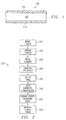
- laminated product 100 includes anterior or first superstructure surface material 101, substrate or core material 102, and posterior or second superstructure surface material 103.
- an anterior surface material and a posterior surface material be interfaced to a selected ASM according to the present invention.
- an alternative embodiment of a laminated product provided according to the present invention may include only an anterior surface material or only a posterior surface material interfaced with a selected ASM.
- a preferred embodiment of the present invention includes the use of posterior surface material 103 to balance the application of anterior surface material 101.
- posterior surface material 103 provides means by which warpage of the laminated product associated with environmental changes may be avoided through balancing the expansive/contractive forces of the anterior surface material.
- anterior and posterior surfaces the present invention is not limited to the application of a lamination material layer to any particular surface of a substrate material.
- material may be substantially permanently attached to any or all sides of a selected substrate material, if desired.
- anterior surface material 101 preferably provides a decorative and/or protective layer having properties of the desired lamination product.
- anterior surface material 101 may provide an exposed surface once interfaced with ASM 102 which provides a decorative print suitable for use as a wall panel, as a tub or shower enclosure, as a kitchen counter top, or as a flooring plank. Additionally or alternatively, this exposed surface of anterior surface material 101 may provide a protective surface suitable for use in wet environments or which is heat resistant and/or abrasion resistant.
- anterior surface material 101 may itself be a laminated product.
- anterior surface material 101 may be prepared using a decorative paper layer having a desired pattern printed thereon which is impregnated with melamine-formaldehyde resin and laminated to one or more sheets of kraft paper impregnated with phenol formaldehyde resin.
- the surface of the decorative layer that will be exposed in the final product may be prepared by bonding an overlay layer, such as a thin paper sheet impregnated with the same type of melamine formaldehyde resin.
- a filler may be included in the overlay in order to provide abrasion resistance and/or a non-slip surface.
- Such fillers may include alumina, calcium carbonate, milled glass fibers, ground glass fibers, or the like.
- Posterior surface material 103 may be utilized to provide an installation surface of the laminated product including the ASM which is more suitable for interfacing with a surface to be covered by the laminated product or to present a surface more consistent with the tools, adhesives, and techniques of a base of laminated product installers. Additionally, or alternatively, posterior surface material 103 may provide a protective layer having properties of the desired lamination product as described above with respect to anterior surface 101.
- posterior surface material 103 may be a laminated product.
- posterior surface material 103 may be prepared using layers of printed paper, overlay paper or kraft paper impregnated with melamine resin and layers of kraft paper impregnated with phenolic resin which are laminated to one another.
- posterior surface material 103 may be utilized as a HPDL backer well known in the art for providing an exposed surface adapted for installation on structure such as sub-flooring, untreated wood products of a counter top or cabinet, and the like.
- anterior and/or posterior surface material utilized according to the present invention may include non-laminated compositions, including solid surface material, i.e., solid surface counter top material, and metal. Accordingly, although reference herein may be made to laminated surface materials, it is not intended to limit such surface materials to materials which are themselves laminated, but rather to materials which may be laminated upon the substrate material.
- substrate material 102 is an alternative substrate material as shown and described in the above referenced patent application entitled “Polymeric Foam Substrate and its Use as in Combination With Decorative Surfaces," the disclosure of which has been previously incorporated herein by reference.
- a preferred embodiment of the present invention utilizes a co-mingled ABS foamed extruded sheet, such as might be predominately comprised of ABS but may also contain ABS/polycarbonate, high impact polystyrene, and possibly, in low levels, polyvinyl, chloride, nylon, polyphenylene oxide, or like engineering plastics, as well as fillers such as calcium carbonate, formed as shown in the above referenced patent application as a substrate material.
- the present invention may be utilized to provide a laminate product including any number of alternative substrate materials.
- alternative embodiment of the present invention may utilize such alternative substrate materials as ASB, ABS/PC, nylon, PVC, or like materials alone or in combination, if desired.
- the interface of anterior surface material 101 and substrate material 102 preferably includes a layer of adhesive material (not shown) to provide mechanical integrity of the anterior surface material and substrate material in the resulting laminated product.
- the interface of posterior surface material 103 and substrate material 102 preferably includes a layer of adhesive material (not shown) to provide mechanical integrity of the posterior surface material and substrate material in the resulting laminated product.
- FIGURE 2 wherein preferred embodiment lamination apparatus 200 adapted to produce laminate products including an ASM according to the present invention is shown.
- board feeder 201 is utilized to hold a supply of ASM boards to be utilized in providing laminated product according to the present invention.
- a stack or stacks of 4 foot by 8 foot sheets of substrate material may be held by, or in communication with, board feeder 201 in order that a desired number of ASM boards may be fed for surface treatment and lamination according to the present invention.
- ASM boards are serially fed by board feeder 201 to provide a substantially continuous stream of substrate material for forming into a desired laminated product.
- substrate material other than those typically thought of as boards may be provided with laminated coverings according to the present invention.
- substrate material provided in shapes commonly utilized in building structures, such as tiles, blocks, columns, mouldings, and the like, may be utilized if desired.
- the present invention is not limited to the use of any particular size of component or resulting product.
- boards having dimensions more consistent with flooring planks may be laminated according to the present invention.
- economics may be realized by utilizing larger dimensional components and cutting the resulting product to desired sizes.
- board feeder 201 feeds the ASM boards to components adapted to prepare the surface of the ASM boards for lamination.
- such components include corona treater 202 adapted to prepare surfaces of the ASM boards to receive lamination.
- Corona treater 202 is adapted to receive ASM boards, such as may be provided from board feeder 201 by automated conveyer mechanism, and is utilized to condition the surfaces of ASM boards in order to improve the adhesion or bonding of laminates by lamination apparatus 200.
- corona treater 202 imparts an electrical charge that deposits a corona, i.e., a discharge from a corona conductor when the potential difference between the conductor and the ASM board in near proximity exceeds a certain value but is not enough to cause a spark or an arc, onto the surface resulting in the oxidation of the ASM board surface and increases the surface tension thereof.
- a corona i.e., a discharge from a corona conductor when the potential difference between the conductor and the ASM board in near proximity exceeds a certain value but is not enough to cause a spark or an arc
- the plug strength provided in the table below is resultant from a 90° Instron tensile pull of the substrate material from the laminated surface material.
- Adhesive Thickness/Water Catalyst Adhesive Type Adhesive Water Sample Plug Strength One Component Urethane ASM Corona Treated Smooth side 3 mils/sqft. 0.55g 103.0 psi. Rough side 3 mils/sqft. 0.55g 86.25 psi
- the relative smoothness of the substrate material's surface to be laminated affects the mechanical integrity of the resulting laminated product.
- Optical microscopy reveals that such rough surfaces are often the product of the substrate material having a somewhat fibrous surface which appears under magnification as tangled spaghetti or tangled tree branches providing holes and tunnels that lead to the interior spaces of the substrate material.
- These voids may allow adhesive, such as under the pressure of expanding gasses associated with the curing of adhesives, to migrate inward from the surface and, therefore, provide less adhesive in the interface between the substrate and laminate for mechanical bonding.
- the rough surface characteristics allow the adhesive to bond to many areas that will break off of the main body of the substrate with very little pressure.
- the increased roughness associated with the fibrous material disposed in such a manner may also give a false indication as to the thickness of an adhesive coating applied thereon. Accordingly, it shall be appreciated that adjusting the amount of adhesive utilized as between relatively smooth and relatively rough substrate material surfaces may be utilized to further improve the resulting mechanical integrity.
- ASM boards are provided, such as through continued conveyance by the above mentioned automatic conveying mechanism, to brush cleaner 203.
- Brush cleaner 203 is adapted to accept ones of the ASM boards, such as through the use of an automatic conveying mechanism, and to remove unwanted particulate matter from surfaces of the ASM boards through brush interaction therewith.
- brush cleaner 203 and corona treater 202 may be reversed in order in lamination apparatus 200 if desired.
- the preferred embodiment disposes the brush cleaner subsequent to the corona treater in order to ensure cleaning of particulate matter attracted to the ASM boards resulting from a static electricity buildup associated with the corona treatment.
- brushes are provided to remove particulate matter, such as particles of the ASM material itself, and other contamination from all surfaces of the ASM boards passed there through.
- particulate matter such as particles of the ASM material itself
- brush cleaner 203 only selected surfaces of the ASM boards, such as the surface or surfaces of the ASM boards to receive lamination, are cleaned by brush cleaner 203. Accordingly, more complex handling of the ASM boards may be avoided, such as disposing brushes to clean an undersurface of the ASM boards or rotation of ASM boards to present surfaces to be cleaned in a proper orientation for cleaning.
- brush cleaner 203 may utilize brushes other than ones which dispose bristles in contact with a surface of the ASM board to be cleaned.
- nozzles may be disposed within brush cleaner 203 which direct a high pressure flow of gas, such as compressed air, and/or liquid, such as water or a cleaning solvent, at a surface of the ASM board to be cleaned, thus defining a pressure cleaning brush, such as an air brush.
- a liquid cleaning brush comprising a set of the aforementioned nozzles
- a gas cleaning brush comprising a second set of the aforementioned nozzles, in order to clean residual liquid from the ASM board.
- the traditional bristle bearing brushes and the pressure cleaning brushes may be used in combination or in the alternative as deemed advantageous.
- the material of the ASM boards is preferably comprised of plastics, such as the aforementioned ABS foamed sheet, the build up of static electricity upon the surface of the ASM boards and, accordingly, problems attendant therewith may be experienced.
- the rubbing of ASM boards together such as when being removed from a stack in board feeder 201, the ASM boards rubbing other surfaces, such as an automatic conveyance system, and the surface of the ASM boards being brushed by bristles of brushes, may result in static electricity causing undesired effects such as particulate matter clinging to the surfaces or the ASM boards clinging to one another or other componentry.
- lamination apparatus 200 preferably includes adaptation to minimize the introduction of static electricity charge to the ASM boards and/or to discharge any accumulated static electricity charge thereon.
- brush cleaner 203 may be adapted to include static discharge strips which are disposed to cause the discharge of ASM board surfaces. Additionally or alternatively the brushes of brush cleaner 203 may be adapted to reduce the amount of static electricity buildup associated with their use, such as by themselves providing a static discharge path or by providing ionized gas or liquid suitable for neutralizing any resulting static electricity charge.
- the ASM boards of the preferred embodiment of lamination apparatus 200 are provided to adhesive applicator 204, such as through further conveyance by the above mentioned automatic conveying mechanism.
- Adhesive application 204 prepares the surface of the ASM boards to adhesively engage laminates.
- adhesive applicator 204 provides a controlled coating of adhesive to the surfaces of the ASM board which are to receive lamination.
- adhesive applicator 204 prepares the surface of the ASM boards themselves, such as by applying a catalyst or other agent suitable for causing the material of the surface of the ASM board to adhesively engage a particular laminate, rather than applying a discrete adhesive material thereto.
- the adhesive applied may be any of a number of adhesives suitable for use in providing the desired bond between the ASM and the laminate material.
- one component urethane adhesives two component urethane adhesives, water based adhesives, including polyvinyl acetate (PVA), vinyl acetate ethylene (VAE) and/or polyvinyl alcohol (PVOH), water based adhesives modified with aqueous based urethane dispersions for cross linking, or the like may be used if desired.
- PVA polyvinyl acetate
- VAE vinyl acetate ethylene
- PVH polyvinyl alcohol
- one component adhesives such as the aforementioned one component urethanes
- an external catalyst such as water
- the addition of the external catalyst is difficult to apply quantitatively and consistently because of the minute amount required to initiate reaction.
- ASM is a polymeric plastic
- heat sufficient to cure such a one component adhesive in a desired amount of time may not be attainable without adversely affecting the shape or solidity of the substrate material.
- the chemical reaction of the one component adhesives expels carbon dioxide gas that can become trapped at the bond line due to the non-porous nature of both the laminate and the ASM material.
- the entrapped gas then produces gas pockets of various sizes, which bulge the product's surface yielding a panel with poor cosmetic appearance, as well as decreasing the mechanical integrity of the laminated product.
- Such gaseous discharge may be controlled through the utilization of a hot press during curing and/or its affects may be mitigated through techniques allowing for the escape of gasses, such as pin pricking the laminate and/or substrate material or the providing channels either in the application of the adhesive or the surfaces of the materials to be bonded, as well as the use of gas scavengers such as calcium oxide, barium hydroxide, or the like.
- the preferred embodiment of the present invention utilizes a two component urethane adhesive, such as MOR-AD 695-28 available from Morton International, Inc., Chicago, IL. Accordingly, the components of the urethane adhesive are mixed in order to create the desired bond.
- adhesive applicator 204 includes a Meter Mix system, such as is available from Graco, Inc. , Minneapolis, MN to introduce components of the urethane adhesive to each other in controlled amounts in order to assure the proper curing of the resulting adhesive material.
- the Meter Mix system feeds each component of the adhesive separately into a static mixer which is preferably located just prior to an adhesive spreader trough which is in communication with adhesive rollers.
- a preferred embodiment of adhesive applicator 204 includes adhesive rollers disposed such that a coating of two component urethane adhesive having a controlled thickness is deposited on a desired surface of an ASM board passed there through.
- spray nozzles may be utilized such that a multi component adhesive is mixed, such as by the aforementioned Meter Mix system, or where the components are intermixed just prior to delivery to a single nozzle for spray delivery by nozzles onto the surface of an ASM board to result in a coating of a controlled thickness.
- multiple sets of spray nozzles wherein each set of nozzles is associated with a different component of the adbesive may be utilized without the benefit of the meter mix system to result in a coating of a suitable mixture of the adhesive components relying on the spray mixing of the components.
- Another alternative embodiment of the present invention utilizes a bead delivery technique to deposit an adhesive coating of a controlled thickness on the surface of an ASM board.
- a linear extrusion head providing a delivery orifice substantially the width of an ASM board may be utilized to deposit adhesive by forming an adhesive bead between the extrusion head and the surface of the ASM board which, as the board is moved in relation to the extrusion head, causes an adhesive coating of uniform thickness to be deposited.
- the above described meter mixing system may be utilized to combine the components of a multiple component adhesive immediately prior to their introduction into the extrusion head which is just prior to the application of the adhesive material onto the substrate.
- the manifold of the extrusion head in which the adhesive material is accumulated prior to extrusion by the extrusion head is substantially protected from exposure to external or ambient atmosphere and, thus, may be utilized to provide a satisfactory pot life for dispensing the adhesive according to the present invention.
- the preferred embodiment of adhesive applicator 204 is adapted to provide a coating of adhesive material to all sides of an ASM board to be laminated.
- a preferred embodiment of adhesive applicator 204 includes adhesive rollers disposed both above and below an ASM board fed there through to provide the desired coating of adhesive on both the anterior and posterior sides of the ASM board.
- An alternative embodiment of adhesive applicator 204 may utilize adhesive applicator apparatus, such as the aforementioned adhesive roller, only on a single side of an ASM board and provide coating of multiple surfaces of the ASM board by handling of the ASM board itself, such as by flipping or rotating the ASM board.
- adhesive applicator apparatus such as the aforementioned adhesive roller
- lamination apparatus 200 is adapted to provide application of a number of lamination surfaces less than that ultimately desired, such as providing lamination of only a single side of the substrate material. Accordingly, a substrate material may be passed through lamination apparatus 200 a number of times in different orientations in order to result in the desired number of sides or surfaces receiving a laminated surface. Such an embodiment may be desirable, for example, where only a single surface is typically laminated and, thus, multiple laminations may be accommodated upon those instances where occasionally desired.
- the adhesive applicator of such an alternative embodiment may be simplified, i.e., a simple conveyer belt apparatus may be utilized in transporting a substrate material having an anterior surface coated with adhesive to a station for receiving the anterior surface material.
- a simple conveyer belt apparatus may be utilized in transporting a substrate material having an anterior surface coated with adhesive to a station for receiving the anterior surface material.
- the preferred embodiment operates to apply at least opposing lamination surface sides substantially contemporaneously and, therefore, provides for applying adhesive to at least the opposing sides of the substrate where such sides are to receive lamination.
- adhesive applicator 204 provides a coating or film of adhesive in a controlled, substantially uniform, thickness.
- adhesives such as those suitable for use in providing a laminated product able to withstand the rigors of flooring, counter top, or wall panel use are generally costly. Accordingly, it is desired to apply such adhesives sparingly.
- tempering the sparing application of such adhesives is the competing concern that a sufficient amount of adhesive to provide a substantially permanent bond be applied. In addressing these, as well as other, competing concerns, experimentation has revealed that application of adhesives in the range of approximately 3 to approximately 10 mils in thickness are generally suitable for applications as described above.
- the thickness of an applied film of urethane adhesive is in the range of from 3 mils to 5 mils with the most preferable adhesive film having a thickness of approximately 4 mils.
- the thickness of an applied film of water based adhesive is in the range of from 4 mils to 8 mils with the most preferable adhesive film having a thickness of approximately 6 mils.
- adhesive applicator 204 may be adapted to further catalyze the curing of an adhesive.
- adhesive applicator 204 may include nozzles to introduce a water mist to the adhesive film in order to catalyze the reaction.
- this water mist is delivered at a controlled rate selected from the range of approximately .2g/sqft. to .7g/sqft. to a one component urethane adhesive such as Mor-Ad 858-155, available from Morton International.
- the ASM boards of the preferred embodiment of lamination apparatus 200 are provided to lay-up table 205 to receive lamination surface materials thereon.
- conveyance of an ASM board from adhesive applicator 204 to lay-up table 205 may be by the above mentioned automatic conveying mechanism.
- particular conveyance mechanisms such as a conveyer belt mechanism commonly used in manufacturing facilities may not be preferred in the providing of a coated ASM board from adhesive applicator 204 to lay-up table 205.
- a conveyance mechanism adapted to provide the necessary manipulation of an ASM board between adhesive applicator 204 and lay-up table 205 without substantially disturbing an adhesive film coating thereon may be utilized.
- a conveyer mechanism adapted to engage substantially only uncoated edges of ASM boards is utilized between adhesive applicator 204 and lay-up table 205.
- human interaction may be utilized in removing coated ASM boards from adhesive applicator 204 and depositing the ASM boards in lay-up table 205.
- lay-up table 205 preferably positions a selected lamination surface material, preferably the posterior surface material, for interfacing of a coated surface of the substrate material therewith.
- the coated ASM board is moved into juxtaposition with a sheet of posterior substrate material having substantially the same dimensions as the ASM board by the aforementioned conveyance mechanism. Thereafter the substrate material and posterior surface material are interfaced, i.e., the substrate material and posterior material are placed in contact with the other material such that the edges of each substantially align.
- anterior surface material having substantially the same dimensions as the ASM board is placed in juxtaposition therewith and, thereafter, the substrate material and anterior surface material are interfaced as described above.
- the laminate surface material or substrate may have a substantially smaller dimension than the mated component and, therefore the material extending beyond the mated component may be trimmed, if desired.
- lay-up table 205 may retain both the anterior and posterior surface materials in juxtaposition wherein a gap is retained there between sufficient for the introduction of a coated ASM board.
- lay-up table 205 may provide relative motion, such as the lifting of a table surface, to result in the posterior surface material interfacing with a posterior surface of the substrate material and the anterior surface material interfacing with an anterior surface of the substrate material.
- lay-up table of the present invention may be adapted to suitably interface any number of lamination surface materials to a substrate material.
- lay-up table 205 of the present invention may retain this single surface material in position such that when a coated substrate material is moved into a corresponding position, the surface material is interfaced as described above.
- surfaces in addition to or in the alternative to the above described posterior and anterior surfaces may be provided with a laminate surface by lay-up table 205 by retaining such surface materials in a proper orientation and interfacing them with a corresponding surface of the substrate material.
- the preferred embodiment of the present invention Upon having lamination surface materials interfaced with a substrate, the preferred embodiment of the present invention provides the resulting combination of materials to layer interface homogenizer 206, such as through conveyance by the above mentioned automatic conveying mechanism.
- Layer interface homogenizer 206 is utilized to ensure that substantially all of a mating surface of the laminate surface material and a corresponding mating surface of the substrate material engages the adhesive and, therefore, engages the other material. Such an affirmative engaging of the mating surfaces ensures that there are no air or gas bubbles present in the interface which may degrade the mechanical integrity of the resulting laminated product.
- layer interface homogenizer 206 utilizes nip rollers disposed to accept the ASM board and interfaced lamination surfaces and to exert a controlled pressure, preferably 40 psi, on each such laminated surface such that trapped gasses are expelled and full engaging of mating surfaces is achieved. Accordingly, the aforementioned automatic conveying mechanism may pass the ASM board and interfaced lamination surfaces beneath or between nip rollers disposed to rotatably engage the exposed surfaces of the lamination surfaces.
- layer interface homogenizer 206 may include heated pinch rollers, such as might be utilized in order to accelerate curing of an adhesive, disposed to rotatably engage surfaces. Accordingly, in addition to providing homogeneity to the interface, layer interface homogenizer 206 may encourage curing of the bond between the surfaces. Moreover, through the application of a proper amount of pressure and a proper amount of heat, the heated pinch rollers of this embodiment may be utilized to provide a suitable bond without the further application of pressure as described herein below with respect to an adhesive curing press. Of course, it should be remembered that, as described above, the application of such heat should be carefully controlled in order to avoid undesired effects upon the particular alternative substrate material selected.
- a preferred embodiment of the aforementioned heated pinch rollers utilizes a heat at said pinch rollers sufficient to provide a desired heat to the adhesive without causing the temperature of the substrate material to exceed 70° C.
- an operating temperature of the pinch rollers may be selected which, when thermodynamically conducted through a surface such as the laminate surface at a speed at which the pinch rollers engage the material provides a heat to the substrate material within acceptable boundaries.
- heating of pinch rollers may be actively controlled, such as by a processor-based system operating under control of an instruction set, by monitoring a temperature of substrate material and adjusting the temperature of the pinch rollers to avoid excessive heating of the substrate material.
- lamination apparatus 200 of the preferred embodiment includes a staging area in which a suitable amount of substrate material and interfaced lamination surface material may be collected for introduction into a press to provide the desired pressure over an acceptable length of time.
- lamination apparatus 200 includes curing station receiving stack 207, wherein substrate material and interfaced lamination surface material is accumulated in a stack, such as may be formed through repeatedly depositing substrate material which is interfaced with lamination surface material one on top of another by the above mentioned automatic conveying mechanism. Accordingly, an amount of substrate material and interfaced lamination surface material may be accumulated over a period of time consistent with the cycling of a press, such as adhesive curing press 208, providing the above mentioned pressure over a desired amount of time with respect to a previously accumulated stack of substrate material and interfaced lamination surface material.
- a press such as adhesive curing press 208
- a desired bond may be formed through the application of a particular pressure to the substrate material and laminate surface material interfaced unit over a selected period of time.
- a pressure of approximately 20-35 psi, most preferably 30 psi over a time span of approximately 2 hours resulted in a bond suitable for use of the laminated product as a flooring material.
- the preferred embodiment of the present invention utilizes an adhesive having associated therewith a pot life, such as may be selected or adjusted by controlling the amount of a catalyst component of a multi-component adhesive or controlling the amount of additional catalyst introduced to the adhesive, sufficient for such staging of materials.
- staged material i.e., a first substrate material and laminate surface material unit are disposed on a staging table and thereafter each subsequent substrate material and laminate surface material unit are serially placed thereon
- the material units first placed in the staging stack benefit from pressure associated with the mass of additional material units stacked thereon.
- a sufficient number of presses may be implemented to allow the application of pressure for a desired amount of time without staging or without significant staging times.
- a preferred embodiment of the present invention utilizes a number of presses which when divided into the amount of time desired for pressure curing is consistent with an acceptable staging time. For example, in the above described preferred embodiment utilizing the application of pressure for 2 hours, if a staging time of 1 hour is acceptable for a particular adhesive utilized, 2 curing presses may be utilized.
- adhesive curing press 208 comprises a two station press.
- material is accumulated for one hour in a stack at curing station receiving stack 207 which is then accepted into a first stage of adhesive curing press 208 wherein a desired pressure is applied.
- material is again accumulated for one hour in a stack at curing station receiving stack 207.
- the material which was initially accepted into a first stage of adhesive curing press 208 is released from pressure and accepted into a second stage of adhesive curing press 208 wherein a desired pressure is again applied.
- the newly accumulated material is accepted into the first stage of adhesive curing press 208 wherein a desired pressure is applied.
- material is again accumulated for one hour in a stack at curing station receiving stack 207 and the above process repeated.
- adhesive curing press 208 provides for the simplified continuous production of laminated product as will typically be desired.
- the present invention is not limited to the use of a multiple stage press arrangement as described.
- a number of stages in addition to the two described may be utilized according to the present invention.
- the present invention may alternate providing an accumulated stack as between the available number of presses, such as to avoid the releasing of pressure as a material stack is moved from one press stage to another, if desired.
- the present invention may operate to provide varying amounts of pressure, such as at particular milestones in the curing of an adhesive.
- a first, preferably lesser, pressure may be utilized in a first stage of adhesive curing press 208 in order to encourage the curing of the adhesive without displacing a substantial portion thereof
- a second, preferably greater, pressure may be utilized in a second stage of adhesive curing press 208 in order to encourage the substantially complete curing of the adhesive at a point at which the adhesive is sufficiently cured that its undesired migration due to added pressure is not substantially a concern.
- a multiple stage curing press arrangement is not required in order to provide the variable application of pressure of the present invention, as a press used throughout the curing of the adhesive may have its applied pressure adjusted during the process.
- Curing press 208 may be adapted to provide heat or other conditions, such as an atmospheric pressure, air humidity, surrounding gas composition, or the like, conducive to the curing of the adhesive material.
- curing press 208 may provide for a flow of heated air across a compressed stack of material to maintain the material at a desired temperature during curing.
- the application of such conditions may be intelligently controlled, such as by a processor-based system operating under control of an instruction set.
- the aforementioned processor-based system may monitor a temperature of substrate material and adjust the temperature of the air flow to avoid excessive heating of the substrate material.
- the present invention may be utilized to provide any number of lamination strata to a surface.
- additional strati of lamination surface material may be added, such as where additional layers are required to provide a desired level of protection or a desired thickness of the resulting laminated product.
- additional componentry substantially as that shown in FIGURE 2, associated with the application of multiple layers of laminate surface material may be included within lamination apparatus 200, if desired.
Landscapes
- Engineering & Computer Science (AREA)
- Quality & Reliability (AREA)
- Laminated Bodies (AREA)
Priority Applications (1)
| Application Number | Priority Date | Filing Date | Title |
|---|---|---|---|
| EP00100950A EP1118460A1 (fr) | 2000-01-18 | 2000-01-18 | Dispositif et méthode pour appliquer un revètement sur un substrat alternatif |
Applications Claiming Priority (1)
| Application Number | Priority Date | Filing Date | Title |
|---|---|---|---|
| EP00100950A EP1118460A1 (fr) | 2000-01-18 | 2000-01-18 | Dispositif et méthode pour appliquer un revètement sur un substrat alternatif |
Publications (1)
| Publication Number | Publication Date |
|---|---|
| EP1118460A1 true EP1118460A1 (fr) | 2001-07-25 |
Family
ID=8167651
Family Applications (1)
| Application Number | Title | Priority Date | Filing Date |
|---|---|---|---|
| EP00100950A Withdrawn EP1118460A1 (fr) | 2000-01-18 | 2000-01-18 | Dispositif et méthode pour appliquer un revètement sur un substrat alternatif |
Country Status (1)
| Country | Link |
|---|---|
| EP (1) | EP1118460A1 (fr) |
Cited By (3)
| Publication number | Priority date | Publication date | Assignee | Title |
|---|---|---|---|---|
| CN102179990A (zh) * | 2011-01-26 | 2011-09-14 | 海信容声(广东)冰箱有限公司 | 一种粘贴真空绝热板的装置及方法 |
| CN104196205A (zh) * | 2014-08-27 | 2014-12-10 | 邓云鹏 | 一种多层实木地板及其制备方法 |
| CN115674695A (zh) * | 2022-11-16 | 2023-02-03 | 湖北著鑫智能科技有限公司 | 一种双工位合页热压机 |
Citations (8)
| Publication number | Priority date | Publication date | Assignee | Title |
|---|---|---|---|---|
| FR2185506A1 (en) * | 1972-05-24 | 1974-01-04 | Siempelkamp Gmbh & Co | Bonded paper laminates prodn - layout for rapid-cure materials |
| FR2307861A1 (fr) * | 1975-04-16 | 1976-11-12 | Nasa | Procede pour obtenir une finition lisse de surface d'avion et produits obtenus |
| EP0262973A2 (fr) * | 1986-10-01 | 1988-04-06 | Canon Kabushiki Kaisha | Appareil de revêtement utilisant un élément de protection pour support d'enregistrement optique et appareil d'enregistrement et de lecture d'information optique |
| JPH01249344A (ja) * | 1988-03-30 | 1989-10-04 | Nkk Corp | 縞鋼板を原板素材とする制振鋼板の製造方法 |
| GB2250229A (en) * | 1990-11-24 | 1992-06-03 | Ampteam Limited | Metal based laminate |
| DE4133634A1 (de) * | 1991-10-10 | 1993-04-15 | Wahl Bernd | Verfahren zur herstellung von kunststoffverbundplatten |
| US5849126A (en) * | 1997-02-20 | 1998-12-15 | Nichiha Corporation | System for manufacturing stack of which manufacture involves pressing/clamping and curing |
| EP0919367A2 (fr) * | 1997-11-25 | 1999-06-02 | Premark RWP Holdings, Inc. | Composition polymérique mousseuse et produits stratifiés obtenus à partir de celle-ci |
-
2000
- 2000-01-18 EP EP00100950A patent/EP1118460A1/fr not_active Withdrawn
Patent Citations (8)
| Publication number | Priority date | Publication date | Assignee | Title |
|---|---|---|---|---|
| FR2185506A1 (en) * | 1972-05-24 | 1974-01-04 | Siempelkamp Gmbh & Co | Bonded paper laminates prodn - layout for rapid-cure materials |
| FR2307861A1 (fr) * | 1975-04-16 | 1976-11-12 | Nasa | Procede pour obtenir une finition lisse de surface d'avion et produits obtenus |
| EP0262973A2 (fr) * | 1986-10-01 | 1988-04-06 | Canon Kabushiki Kaisha | Appareil de revêtement utilisant un élément de protection pour support d'enregistrement optique et appareil d'enregistrement et de lecture d'information optique |
| JPH01249344A (ja) * | 1988-03-30 | 1989-10-04 | Nkk Corp | 縞鋼板を原板素材とする制振鋼板の製造方法 |
| GB2250229A (en) * | 1990-11-24 | 1992-06-03 | Ampteam Limited | Metal based laminate |
| DE4133634A1 (de) * | 1991-10-10 | 1993-04-15 | Wahl Bernd | Verfahren zur herstellung von kunststoffverbundplatten |
| US5849126A (en) * | 1997-02-20 | 1998-12-15 | Nichiha Corporation | System for manufacturing stack of which manufacture involves pressing/clamping and curing |
| EP0919367A2 (fr) * | 1997-11-25 | 1999-06-02 | Premark RWP Holdings, Inc. | Composition polymérique mousseuse et produits stratifiés obtenus à partir de celle-ci |
Non-Patent Citations (1)
| Title |
|---|
| PATENT ABSTRACTS OF JAPAN vol. 013, no. 591 (M - 913) 26 December 1989 (1989-12-26) * |
Cited By (4)
| Publication number | Priority date | Publication date | Assignee | Title |
|---|---|---|---|---|
| CN102179990A (zh) * | 2011-01-26 | 2011-09-14 | 海信容声(广东)冰箱有限公司 | 一种粘贴真空绝热板的装置及方法 |
| CN102179990B (zh) * | 2011-01-26 | 2014-05-21 | 海信容声(广东)冰箱有限公司 | 一种粘贴真空绝热板的装置及方法 |
| CN104196205A (zh) * | 2014-08-27 | 2014-12-10 | 邓云鹏 | 一种多层实木地板及其制备方法 |
| CN115674695A (zh) * | 2022-11-16 | 2023-02-03 | 湖北著鑫智能科技有限公司 | 一种双工位合页热压机 |
Similar Documents
| Publication | Publication Date | Title |
|---|---|---|
| CN102171057B (zh) | 用于改良木质板的方法和装置 | |
| AU2015257887B2 (en) | Method for producing a decorated wall or floor panel | |
| EP2155485B1 (fr) | Procédé et appareil de fabrication de panneaux de plancher lamellés comportant une âme contenant un composite bois/matière plastique, et panneaux ainsi obtenus | |
| US6887584B2 (en) | System and method for two sided sheet treating | |
| EP2363299B1 (fr) | Procédé de fabrication d'une lame à parquet | |
| KR102237338B1 (ko) | 플로어 커버링을 형성하기 위한 패널 및 이 패널을 제조하기 위한 방법 | |
| JP5384748B2 (ja) | 両面コーティング装飾用ボードの製造方法および製造装置 | |
| EP2463116B1 (fr) | Procédé de production d'un panneau comprenant une couche résistant à l'usure | |
| EP1534511B1 (fr) | Conditionnement d'articles prefinis en fibrociment | |
| US20160136913A1 (en) | Method for producing a decorated wall or floor panel | |
| US20100068535A1 (en) | System and Method for Coating a Fire-Resistant Material on a Substrate | |
| EP3725482B1 (fr) | Dispersion monocouche de poudres de surface | |
| WO1998029265A1 (fr) | Procede et dispositif de transfert sur des surfaces courbes | |
| EP2829415A1 (fr) | Procédé de fabrication d'un panneau mural et de sol décoré | |
| CN107073742B (zh) | 用于生产装饰墙壁或地板的方法 | |
| JP2001519256A (ja) | 耐摩耗性積層体およびその製造方法 | |
| WO2019015916A1 (fr) | Panneau de particules de bois | |
| EP1035254A1 (fr) | Dispositif et méthode pour traiter les deux côtés d'une feuille | |
| AU6174899A (en) | System and method for adhering laminate to an alternate substrate material | |
| CN105451893A (zh) | 用于制造涂布建筑板、且尤其是涂漆建筑板的方法和装置以及相关涂漆建筑板 | |
| MXPA00000265A (en) | System and method for adhering laminate to an alternate substrate material | |
| JP2018119398A (ja) | 弾性フロアパネル | |
| EP2237936B1 (fr) | Procédé permettant de produire un panneau pressée multicouche et panneau pressée multicouche | |
| JP2001310311A (ja) | パーティクルボードの製造方法 | |
| JP2000006592A (ja) | 曲面転写方法及び曲面転写装置 |
Legal Events
| Date | Code | Title | Description |
|---|---|---|---|
| PUAI | Public reference made under article 153(3) epc to a published international application that has entered the european phase |
Free format text: ORIGINAL CODE: 0009012 |
|
| 17P | Request for examination filed |
Effective date: 20000119 |
|
| AK | Designated contracting states |
Kind code of ref document: A1 Designated state(s): AT BE CH CY DE DK ES FI FR GB GR IE IT LI LU MC NL PT SE |
|
| AX | Request for extension of the european patent |
Free format text: AL;LT;LV;MK;RO;SI |
|
| AKX | Designation fees paid |
Free format text: AT BE CH CY DE DK ES FI FR GB GR IE IT LI LU MC NL PT SE |
|
| STAA | Information on the status of an ep patent application or granted ep patent |
Free format text: STATUS: THE APPLICATION IS DEEMED TO BE WITHDRAWN |
|
| 18D | Application deemed to be withdrawn |
Effective date: 20020126 |