EP1119056A2 - Dispositif à semiconducteur et procédé de fabrication - Google Patents
Dispositif à semiconducteur et procédé de fabrication Download PDFInfo
- Publication number
- EP1119056A2 EP1119056A2 EP01300349A EP01300349A EP1119056A2 EP 1119056 A2 EP1119056 A2 EP 1119056A2 EP 01300349 A EP01300349 A EP 01300349A EP 01300349 A EP01300349 A EP 01300349A EP 1119056 A2 EP1119056 A2 EP 1119056A2
- Authority
- EP
- European Patent Office
- Prior art keywords
- insulating layer
- layer
- active region
- over
- bond pad
- Prior art date
- Legal status (The legal status is an assumption and is not a legal conclusion. Google has not performed a legal analysis and makes no representation as to the accuracy of the status listed.)
- Withdrawn
Links
Images



Classifications
-
- H—ELECTRICITY
- H10—SEMICONDUCTOR DEVICES; ELECTRIC SOLID-STATE DEVICES NOT OTHERWISE PROVIDED FOR
- H10F—INORGANIC SEMICONDUCTOR DEVICES SENSITIVE TO INFRARED RADIATION, LIGHT, ELECTROMAGNETIC RADIATION OF SHORTER WAVELENGTH OR CORPUSCULAR RADIATION
- H10F77/00—Constructional details of devices covered by this subclass
- H10F77/20—Electrodes
- H10F77/206—Electrodes for devices having potential barriers
Definitions
- This invention relates to semiconductor devices, for example, optical semiconductor devices such as photodetectors.
- Electrodetectors often include a wire bond for providing electrical connection to the active regions of the device. Since pressure and ultrasonic energy are applied to effect the bond, the wire bonding process can lead to damage to the device resulting in such undesired characteristics as increased leakage current. In order to avoid this problem, it has been proposed to provide the wire bond pad at some portion away from the active area.
- Such bond sites are desirably formed in a manner which keeps additional capacitance to a minimum. This is of particular significance for high speed devices. It is known that capacitance is a function of the area of the pad, the dielectric constant of the insulating layer over which the pad is formed, and the thickness of the insulating layer. Therefore, one of the design criteria is to use an insulating layer with as low a dielectric constant as possible (known in the art as low k dielectric material) which can be applied with an adequate thickness. Desirably, the dielectric constant is no greater than 3 and the thickness is at least 4 ⁇ m.
- low k dielectric materials however, presents additional problems in the fabrication of the devices.
- metals generally adhere poorly to the low k dielectrics and conventional wire bonding techniques utilizing ultrasonic energy leads to low yielding manufacturing processes.
- metal deposition can be effected by sputtering to alleviate the metal adhesion problem, the simple and convenient method of a lift-off process to define metal patterns is not compatible with common sputtering processes.
- conventional sputtering is employed to deposit metal, often a conductive interface is produced on the whole surface of the low k dielectric (through a chemical reaction of energetic metal particles) and hence making it virtually impossible to devise a suitable manufacturing process to define a confined metal bond pad.
- bond pads are thick (2-4 ⁇ m) and hence makes sputtering an unattractive method of manufacturing as compared to conventional electron beam evaporation which is known in the art as having much higher deposition rates.
- substrate temperature may use rise high enough to cause surface degradation of low k dielectrics and eventually lead to potential long term reliability problems.
- the invention in accordance with one aspect is a semiconductor device including a semiconductor substrate, an active region in the substrate, a first low dielectric constant insulating layer formed over at least a portion of the substrate, a second insulating layer formed over at least a portion of the first insulating layer, and a bond pad formed over the second insulating layer and electrically contacting the active region.
- the invention in accordance with another aspect is a method of fabricating a semiconductor device including the steps of forming an active region in a semiconductor substrate, forming a first low dielectric constant insulating layer over at least a portion of the substrate, forming a second insulating layer over at least a portion of the first layer by deposition at a temperature no greater then 200°C, and forming a bond pad over the second insulating layer.
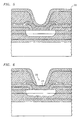
- Figs 1-7 illustrate the fabrication of a photodetector using principles of the invention. It will be appreciated that the invention is not limited to photodetectors, but can be applied to any semiconductor device where reduced capacitance is desirable.
- Fig 1 illustrates a typical starting material for the illustrative process.
- a semiconductor body, 10, preferably comprising n-type InP is provided, upon which are successively grown epitaxial layers, 11-13.
- the body, 10, and the layers, 11-13 are all considered as part of the semiconductor substrate.
- the layer, 11, was an undoped InP buffer layer with a thickness of approximately 1.5 microns.
- the layer, 12, was an undoped InGaAs absorber layer with a thickness of 2-5 microns.
- the layer, 13, was an undoped InP or InGaAsP contact layer with a thickness of approximately 0.5 microns.
- Such layers are standard for PIN photodiodes.
- a dielectric layer, 14, in this example SiN was deposited over the substrate and patterned by standard photolithographic techniques to form an opening, 30, therein.
- the active region is the region of the semiconductor device which includes a homo or hetero junction of opposite conductivity types.
- free carriers are produced in the active region by incident light and provide an electrical read-out.
- free carriers are produced by applying an electrical bin to the device and the carriers recombine to produce light in the active region.
- the preferred process continues with the deposition of an adhesion promoter, 18, over the dielectric layer, 16, and contact, 17, as shown in Fig 4.
- the adhesion promoter was vinyltriacetoxy silane dissolved in 1-methoxy-2-propanol (sold by Dow Chemical under the designation "AP3000") which was deposited by spinning.
- the low k dielectric was B-staged divinyl silane bisbenzocylobutane which is sold by Dow Chemical under the designation Cyclotene (TM). This material is advantageous since it can be spun-on the structure to a thickness of 5-10 microns.
- the dielectric constant of the material was approximately 2.56.
- any organic insulating layer with a dielectric constant less than 3 can be utilized.
- polyimide or polytetra fluroethylene (Teflon) could be employed.
- An opening, 31, was formed in the dielectric layer, 19, and adhesion promoter, 18, by exposure of the layer, 19, through a mask (not shown) and then developing with a suitable developer such as dipropylene glycol dimethyl ether to expose the underlying contact, 17.
- a suitable developer such as dipropylene glycol dimethyl ether
- this particular Cyclotene is a photosensitive material.
- other dielectrics which are not photosensitive can be employed, in which case, a separate patterned photoresist layer could be deposited over the dielectric followed by subtractive etching to define the opening, 31.
- an additional insulating layer, 20, was preferably deposited over the low k insulating layer, 19, and the exposed portion of the contact, 17.
- the layer is deposited at a temperature of less than 200 deg C so that the low k material does not degrade.
- ion beam assistance deposition which is described, for example in U.S. Patent No. 5,802,091. Briefly, such a deposition involved placing the structure in an evacuated chamber with a crucible containing oxide evaporatant which is impinged with an electron beam. The resulting vapor from the crucible was incident on the surface of the low k dielectric layer, 19, and contact, 17.
- the thickness of the layer, 20, was preferably within the range 1000 to 3000 ⁇ .
- the insulating layer, 20 was selectively etched to expose a portion of the underlying contact, 17.
- Standard photolithography was employed followed by etching.
- a convenient etchant comprises 1:10 HF and deionized water. It is understood that other methods of etching, e.g., dry etching are also possible.
- a metal stack, 21, was deposited over the insulating layer, 20, and the exposed portion of the contact, 17, so as to establish ohmic contact to the active region, 15, of the semiconductor.
- the metal stack can be, for example, Ti/Pt/Au, Cr/Pt/An, Ni/Pt/Au or Al/Pt/Au.
- the layer, 21 was deposited by electron beam evaporation to a total thickness within the range 3 ⁇ m to 4 ⁇ m.
- the presence of the insulating layer, 20, resulted in excellent adhesion of the metal stack, 21.
- the metal stack 21 was defined by a lift-off process which would not be used if the metal was deposited by sputtering.
- the metal layer, 21, comprises a contact portion, 22, overlying the active region, 15, and a bond pad portion, 23, which overlies the insulating layers, 19 and 20, and is laterally displaced from the area above the active region.
- This configuration permits a wire bond (not shown) to be made to the bond pad portion without the risk of damaging the active region.
Landscapes
- Light Receiving Elements (AREA)
- Internal Circuitry In Semiconductor Integrated Circuit Devices (AREA)
- Electrodes Of Semiconductors (AREA)
Applications Claiming Priority (2)
| Application Number | Priority Date | Filing Date | Title |
|---|---|---|---|
| US487400 | 2000-01-18 | ||
| US09/487,400 US6437425B1 (en) | 2000-01-18 | 2000-01-18 | Semiconductor devices which utilize low K dielectrics |
Publications (1)
| Publication Number | Publication Date |
|---|---|
| EP1119056A2 true EP1119056A2 (fr) | 2001-07-25 |
Family
ID=23935578
Family Applications (1)
| Application Number | Title | Priority Date | Filing Date |
|---|---|---|---|
| EP01300349A Withdrawn EP1119056A2 (fr) | 2000-01-18 | 2001-01-16 | Dispositif à semiconducteur et procédé de fabrication |
Country Status (3)
| Country | Link |
|---|---|
| US (2) | US6437425B1 (fr) |
| EP (1) | EP1119056A2 (fr) |
| JP (1) | JP2001267622A (fr) |
Cited By (3)
| Publication number | Priority date | Publication date | Assignee | Title |
|---|---|---|---|---|
| EP1291920A3 (fr) * | 2001-08-31 | 2005-02-02 | Matsushita Electric Industrial Co., Ltd. | Cellule solaire, procédé de fabrication et appareil pour sa fabrication |
| WO2005010988A1 (fr) * | 2003-07-22 | 2005-02-03 | Infineon Technologies Ag | Composant electronique avec puce de semi-conducteur et tranche de semi-conducteur presentant des points de contact, et leur procede de production |
| WO2012084186A3 (fr) * | 2010-12-22 | 2013-05-30 | MAX-PLANCK-Gesellschaft zur Förderung der Wissenschaften e.V. | Détecteur à semi-conducteur à contact de liaison décalé |
Families Citing this family (34)
| Publication number | Priority date | Publication date | Assignee | Title |
|---|---|---|---|---|
| US6852167B2 (en) * | 2001-03-01 | 2005-02-08 | Micron Technology, Inc. | Methods, systems, and apparatus for uniform chemical-vapor depositions |
| US6844203B2 (en) * | 2001-08-30 | 2005-01-18 | Micron Technology, Inc. | Gate oxides, and methods of forming |
| US8026161B2 (en) * | 2001-08-30 | 2011-09-27 | Micron Technology, Inc. | Highly reliable amorphous high-K gate oxide ZrO2 |
| US6638878B2 (en) * | 2001-10-02 | 2003-10-28 | International Business Machines Corporation | Film planarization for low-k polymers used in semiconductor structures |
| US6953730B2 (en) * | 2001-12-20 | 2005-10-11 | Micron Technology, Inc. | Low-temperature grown high quality ultra-thin CoTiO3 gate dielectrics |
| KR100464367B1 (ko) * | 2002-01-08 | 2005-01-03 | 삼성전자주식회사 | 포토다이오드 디텍터 및 그 제조방법 |
| US6767795B2 (en) | 2002-01-17 | 2004-07-27 | Micron Technology, Inc. | Highly reliable amorphous high-k gate dielectric ZrOXNY |
| KR100790268B1 (ko) * | 2002-03-05 | 2007-12-31 | 매그나칩 반도체 유한회사 | 금속 패드의 부식 방지를 위한 반도체 소자의 제조 방법 |
| US6812100B2 (en) * | 2002-03-13 | 2004-11-02 | Micron Technology, Inc. | Evaporation of Y-Si-O films for medium-k dielectrics |
| US6806182B2 (en) * | 2002-05-01 | 2004-10-19 | International Business Machines Corporation | Method for eliminating via resistance shift in organic ILD |
| US7160577B2 (en) * | 2002-05-02 | 2007-01-09 | Micron Technology, Inc. | Methods for atomic-layer deposition of aluminum oxides in integrated circuits |
| US7589029B2 (en) * | 2002-05-02 | 2009-09-15 | Micron Technology, Inc. | Atomic layer deposition and conversion |
| US7135421B2 (en) * | 2002-06-05 | 2006-11-14 | Micron Technology, Inc. | Atomic layer-deposited hafnium aluminum oxide |
| US7221586B2 (en) * | 2002-07-08 | 2007-05-22 | Micron Technology, Inc. | Memory utilizing oxide nanolaminates |
| US7084078B2 (en) * | 2002-08-29 | 2006-08-01 | Micron Technology, Inc. | Atomic layer deposited lanthanide doped TiOx dielectric films |
| US7192892B2 (en) | 2003-03-04 | 2007-03-20 | Micron Technology, Inc. | Atomic layer deposited dielectric layers |
| US7049192B2 (en) * | 2003-06-24 | 2006-05-23 | Micron Technology, Inc. | Lanthanide oxide / hafnium oxide dielectrics |
| US7601649B2 (en) * | 2004-08-02 | 2009-10-13 | Micron Technology, Inc. | Zirconium-doped tantalum oxide films |
| US7081421B2 (en) * | 2004-08-26 | 2006-07-25 | Micron Technology, Inc. | Lanthanide oxide dielectric layer |
| US7494939B2 (en) * | 2004-08-31 | 2009-02-24 | Micron Technology, Inc. | Methods for forming a lanthanum-metal oxide dielectric layer |
| US7588988B2 (en) * | 2004-08-31 | 2009-09-15 | Micron Technology, Inc. | Method of forming apparatus having oxide films formed using atomic layer deposition |
| US7235501B2 (en) * | 2004-12-13 | 2007-06-26 | Micron Technology, Inc. | Lanthanum hafnium oxide dielectrics |
| US7560395B2 (en) | 2005-01-05 | 2009-07-14 | Micron Technology, Inc. | Atomic layer deposited hafnium tantalum oxide dielectrics |
| US7687409B2 (en) | 2005-03-29 | 2010-03-30 | Micron Technology, Inc. | Atomic layer deposited titanium silicon oxide films |
| US7662729B2 (en) * | 2005-04-28 | 2010-02-16 | Micron Technology, Inc. | Atomic layer deposition of a ruthenium layer to a lanthanide oxide dielectric layer |
| US7927948B2 (en) | 2005-07-20 | 2011-04-19 | Micron Technology, Inc. | Devices with nanocrystals and methods of formation |
| US7605030B2 (en) | 2006-08-31 | 2009-10-20 | Micron Technology, Inc. | Hafnium tantalum oxynitride high-k dielectric and metal gates |
| JP4389962B2 (ja) * | 2007-04-26 | 2009-12-24 | ソニー株式会社 | 半導体装置、電子機器、および半導体装置の製造方法 |
| US7759237B2 (en) * | 2007-06-28 | 2010-07-20 | Micron Technology, Inc. | Method of forming lutetium and lanthanum dielectric structures |
| US8030778B2 (en) * | 2007-07-06 | 2011-10-04 | United Microelectronics Corp. | Integrated circuit structure and manufacturing method thereof |
| IT1400096B1 (it) | 2010-05-12 | 2013-05-17 | St Microelectronics Srl | Processo di fabbricazione di circuiti elettronici integrati e circuiti cosi' ottenuti |
| US10529135B2 (en) * | 2016-07-27 | 2020-01-07 | Google Llc | Low-power mode feature identification at a head mounted display |
| JP6814698B2 (ja) * | 2017-06-05 | 2021-01-20 | ルネサスエレクトロニクス株式会社 | 半導体装置の製造方法 |
| JP7437346B2 (ja) * | 2021-04-15 | 2024-02-22 | 株式会社東芝 | 半導体装置及びその製造方法 |
Family Cites Families (16)
| Publication number | Priority date | Publication date | Assignee | Title |
|---|---|---|---|---|
| DE3009533C2 (de) * | 1980-03-12 | 1986-11-06 | D. Swarovski & Co., Wattens, Tirol | Belag mit mittlerem Brechwert, Verfahren zu dessen Herstellung und Verwendung des Belages |
| US5449950A (en) * | 1984-04-16 | 1995-09-12 | Canon Kabushiki Kaisha | Photosensor with organic and inorganic insulation layers |
| US4723197A (en) * | 1985-12-16 | 1988-02-02 | National Semiconductor Corporation | Bonding pad interconnection structure |
| JPH07118548B2 (ja) * | 1986-04-28 | 1995-12-18 | 住友電気工業株式会社 | ▲iii▼−v族多元化合物半導体pinフオトダイオ−ド |
| JPH0773111B2 (ja) * | 1986-08-11 | 1995-08-02 | ソニー株式会社 | 半導体装置 |
| JPH01241832A (ja) * | 1988-03-23 | 1989-09-26 | Rohm Co Ltd | 電子部品におけるワイヤボンディング構造 |
| US5719448A (en) * | 1989-03-07 | 1998-02-17 | Seiko Epson Corporation | Bonding pad structures for semiconductor integrated circuits |
| JPH0316176A (ja) * | 1989-03-10 | 1991-01-24 | Sumitomo Electric Ind Ltd | 3―v族化合物半導体素子電極構造及びその形成方法 |
| JPH04179278A (ja) * | 1990-11-13 | 1992-06-25 | Sumitomo Electric Ind Ltd | 受光素子 |
| JP3531688B2 (ja) * | 1994-11-04 | 2004-05-31 | 宇部興産株式会社 | 誘電体結晶膜 |
| US5841178A (en) * | 1996-10-04 | 1998-11-24 | Lucent Technologies Inc. | Optical component package |
| US5802091A (en) * | 1996-11-27 | 1998-09-01 | Lucent Technologies Inc. | Tantalum-aluminum oxide coatings for semiconductor devices |
| KR100249047B1 (ko) * | 1997-12-12 | 2000-03-15 | 윤종용 | 반도체 소자 및 그 제조 방법 |
| JP2000183104A (ja) * | 1998-12-15 | 2000-06-30 | Texas Instr Inc <Ti> | 集積回路上でボンディングするためのシステム及び方法 |
| US6236061B1 (en) * | 1999-01-08 | 2001-05-22 | Lakshaman Mahinda Walpita | Semiconductor crystallization on composite polymer substrates |
| JP2000223527A (ja) * | 1999-01-28 | 2000-08-11 | Mitsubishi Electric Corp | 半導体装置 |
-
2000
- 2000-01-18 US US09/487,400 patent/US6437425B1/en not_active Expired - Lifetime
-
2001
- 2001-01-16 EP EP01300349A patent/EP1119056A2/fr not_active Withdrawn
- 2001-01-18 JP JP2001009925A patent/JP2001267622A/ja active Pending
-
2002
- 2002-05-28 US US10/156,429 patent/US6734036B2/en not_active Expired - Fee Related
Cited By (3)
| Publication number | Priority date | Publication date | Assignee | Title |
|---|---|---|---|---|
| EP1291920A3 (fr) * | 2001-08-31 | 2005-02-02 | Matsushita Electric Industrial Co., Ltd. | Cellule solaire, procédé de fabrication et appareil pour sa fabrication |
| WO2005010988A1 (fr) * | 2003-07-22 | 2005-02-03 | Infineon Technologies Ag | Composant electronique avec puce de semi-conducteur et tranche de semi-conducteur presentant des points de contact, et leur procede de production |
| WO2012084186A3 (fr) * | 2010-12-22 | 2013-05-30 | MAX-PLANCK-Gesellschaft zur Förderung der Wissenschaften e.V. | Détecteur à semi-conducteur à contact de liaison décalé |
Also Published As
| Publication number | Publication date |
|---|---|
| US6437425B1 (en) | 2002-08-20 |
| US20030001241A1 (en) | 2003-01-02 |
| US6734036B2 (en) | 2004-05-11 |
| JP2001267622A (ja) | 2001-09-28 |
Similar Documents
| Publication | Publication Date | Title |
|---|---|---|
| US6734036B2 (en) | Semiconductor device and method of fabrication | |
| EP0100735B1 (fr) | Procédé de "lift-off" pour la fabrication de contacts autoalignés | |
| US5468656A (en) | Method of making a VCSEL | |
| US6097748A (en) | Vertical cavity surface emitting laser semiconductor chip with integrated drivers and photodetectors and method of fabrication | |
| JP2706030B2 (ja) | 光検出器及びその製造方法 | |
| EP0156185B1 (fr) | Electrode d'un dispositif semi-conducteur et son procédé de fabrication | |
| HK1249661A1 (zh) | 高性能辐射检测器和其制造方法 | |
| US3994758A (en) | Method of manufacturing a semiconductor device having closely spaced electrodes by perpendicular projection | |
| US5448099A (en) | Pin-type light receiving device, manufacture of the pin-type light receiving device and optoelectronic integrated circuit | |
| JP2599131B2 (ja) | 集積光検出器−増幅器装置 | |
| JP2558016B2 (ja) | 集積半導体装置の製造方法 | |
| EP0810645B1 (fr) | Méthode de fabrication d'un transistor bipolaire à hétérojonction auto-aligné à l'aide d'une couche photorésistance double | |
| EP1148559A2 (fr) | Photodétecteur à sémi-conducteur de grande vitesse et procédé de fabrication | |
| KR100203307B1 (ko) | 레이저 다이오드의 제조방법 | |
| JPH07118524B2 (ja) | 光受信集積回路およびその製造方法 | |
| US6645819B2 (en) | Self-aligned fabrication method for a semiconductor device | |
| JP2002083993A (ja) | 光半導体受光素子およびその製造方法 | |
| JPH05502760A (ja) | 半導体デバイスのメサ構造体に電気的接触片を製造するための処理方法 | |
| CN114203860A (zh) | 半导体器件的制造方法和pin光电二极管 | |
| CN117154533A (zh) | 一种InP基半导体激光器芯片与制备方法 | |
| CN120500122B (zh) | 一种高速探测器芯片及其制作方法 | |
| US20030077849A1 (en) | Method for fabricating ohmic contact layer in semiconductor devices | |
| JPH0575092A (ja) | 光電子集積回路装置の製造方法 | |
| JP4072248B2 (ja) | 半導体装置の製造方法 | |
| JPH0982990A (ja) | フォトコンダクタおよびその製造方法、ならびに光スイッチ |
Legal Events
| Date | Code | Title | Description |
|---|---|---|---|
| PUAI | Public reference made under article 153(3) epc to a published international application that has entered the european phase |
Free format text: ORIGINAL CODE: 0009012 |
|
| AK | Designated contracting states |
Kind code of ref document: A2 Designated state(s): AT BE CH CY DE DK ES FI FR GB GR IE IT LI LU MC NL PT SE TR |
|
| AX | Request for extension of the european patent |
Free format text: AL;LT;LV;MK;RO;SI |
|
| RTI1 | Title (correction) |
Free format text: SEMICONDUCTOR DEVICE AND METHOD OF FABRICATION |
|
| STAA | Information on the status of an ep patent application or granted ep patent |
Free format text: STATUS: THE APPLICATION IS DEEMED TO BE WITHDRAWN |
|
| 18D | Application deemed to be withdrawn |
Effective date: 20030801 |