EP1120950A1 - Système de communication de mise à disposition d' informations dépendants du genre de communication. - Google Patents
Système de communication de mise à disposition d' informations dépendants du genre de communication. Download PDFInfo
- Publication number
- EP1120950A1 EP1120950A1 EP00101380A EP00101380A EP1120950A1 EP 1120950 A1 EP1120950 A1 EP 1120950A1 EP 00101380 A EP00101380 A EP 00101380A EP 00101380 A EP00101380 A EP 00101380A EP 1120950 A1 EP1120950 A1 EP 1120950A1
- Authority
- EP
- European Patent Office
- Prior art keywords
- information
- task
- data
- communication system
- user
- Prior art date
- Legal status (The legal status is an assumption and is not a legal conclusion. Google has not performed a legal analysis and makes no representation as to the accuracy of the status listed.)
- Withdrawn
Links
- 238000004891 communication Methods 0.000 title claims abstract description 102
- 230000001419 dependent effect Effects 0.000 title claims description 31
- 238000012545 processing Methods 0.000 claims abstract description 21
- 230000005540 biological transmission Effects 0.000 claims description 60
- 238000006243 chemical reaction Methods 0.000 claims description 10
- 238000013461 design Methods 0.000 claims description 10
- 238000012790 confirmation Methods 0.000 claims description 6
- 238000000034 method Methods 0.000 description 21
- 230000015654 memory Effects 0.000 description 16
- 230000008569 process Effects 0.000 description 16
- 230000006870 function Effects 0.000 description 9
- 238000012795 verification Methods 0.000 description 9
- 230000008859 change Effects 0.000 description 8
- 238000012546 transfer Methods 0.000 description 8
- 238000013475 authorization Methods 0.000 description 5
- 230000001934 delay Effects 0.000 description 4
- RYGMFSIKBFXOCR-UHFFFAOYSA-N Copper Chemical compound [Cu] RYGMFSIKBFXOCR-UHFFFAOYSA-N 0.000 description 3
- 230000001413 cellular effect Effects 0.000 description 3
- 238000012015 optical character recognition Methods 0.000 description 3
- 230000003287 optical effect Effects 0.000 description 3
- 239000010453 quartz Substances 0.000 description 3
- 238000012552 review Methods 0.000 description 3
- VYPSYNLAJGMNEJ-UHFFFAOYSA-N silicon dioxide Inorganic materials O=[Si]=O VYPSYNLAJGMNEJ-UHFFFAOYSA-N 0.000 description 3
- 230000002457 bidirectional effect Effects 0.000 description 2
- 230000001404 mediated effect Effects 0.000 description 2
- 230000001960 triggered effect Effects 0.000 description 2
- 230000004913 activation Effects 0.000 description 1
- 238000013459 approach Methods 0.000 description 1
- 230000008901 benefit Effects 0.000 description 1
- 230000015572 biosynthetic process Effects 0.000 description 1
- 239000003795 chemical substances by application Substances 0.000 description 1
- 229910052802 copper Inorganic materials 0.000 description 1
- 239000010949 copper Substances 0.000 description 1
- 238000010586 diagram Methods 0.000 description 1
- 230000000694 effects Effects 0.000 description 1
- 238000005265 energy consumption Methods 0.000 description 1
- 230000003203 everyday effect Effects 0.000 description 1
- 239000000835 fiber Substances 0.000 description 1
- 230000010006 flight Effects 0.000 description 1
- 239000003365 glass fiber Substances 0.000 description 1
- 230000010365 information processing Effects 0.000 description 1
- 230000003993 interaction Effects 0.000 description 1
- 239000000203 mixture Substances 0.000 description 1
- 238000012544 monitoring process Methods 0.000 description 1
- 238000003825 pressing Methods 0.000 description 1
- 230000005855 radiation Effects 0.000 description 1
- 230000010076 replication Effects 0.000 description 1
- 230000008672 reprogramming Effects 0.000 description 1
- 238000009420 retrofitting Methods 0.000 description 1
- 239000004065 semiconductor Substances 0.000 description 1
- 238000003786 synthesis reaction Methods 0.000 description 1
- 230000002123 temporal effect Effects 0.000 description 1
- 238000012360 testing method Methods 0.000 description 1
- 238000013024 troubleshooting Methods 0.000 description 1
Images

Classifications
-
- H—ELECTRICITY
- H04—ELECTRIC COMMUNICATION TECHNIQUE
- H04M—TELEPHONIC COMMUNICATION
- H04M3/00—Automatic or semi-automatic exchanges
- H04M3/42—Systems providing special services or facilities to subscribers
- H04M3/487—Arrangements for providing information services, e.g. recorded voice services or time announcements
- H04M3/493—Interactive information services, e.g. directory enquiries ; Arrangements therefor, e.g. interactive voice response [IVR] systems or voice portals
-
- H—ELECTRICITY
- H04—ELECTRIC COMMUNICATION TECHNIQUE
- H04M—TELEPHONIC COMMUNICATION
- H04M2201/00—Electronic components, circuits, software, systems or apparatus used in telephone systems
- H04M2201/60—Medium conversion
Definitions
- the present invention relates to a communication system for task-dependent Providing information and a portable transmitter for generating and sending identification information.
- the identification information identify a respective task, which is achieved by an inventive Communication system is assigned to be provided information.
- the present invention relates in particular to voice communication, i.e. the provision of information in the form of acoustic speech signals.
- the goal of distribution communication is to provide the same information to a variety of people To distribute communication partners.
- the recipient procures general, not targeted information for him.
- a transmitter sends information uncontrolled in a transmission channel that one or more receivers for Can choose to receive the information.
- the channels have addresses in the form of Channel numbers.
- the recipient must use the corresponding sequence of digits as the address of his Enter the connection request on his end device to get information from the to be able to receive the addressed remote station.
- the connection is unidirectional and has a very short delay time, which only depends on the runtime of the signals.
- the transmission path can be provided by various transmission media such as Copper wire, coaxial cable, fiber optic or radio links.
- a line-switched is usually used for voice communication Telecommunication network, e.g. a landline telephone network or a cellular network or a combination thereof.
- voice communication Telecommunication network e.g. a landline telephone network or a cellular network or a combination thereof.
- dialog communication Individual information is exchanged between two or more participants. Such telephone calls are in the known public telephone network, for example, PSTN in Germany, essentially still mediated individually and broadcast. This creates a direct connection between the two or more End devices manufactured.
- the connection is bidirectional, full duplex and has a very high short delay time, which only depends on the runtime of the signals.
- This Connection used to be a physical electrical connection (copper wire line), which was switched by a manual operator. The manual operator was in the course of time through electromechanical switching centers, e.g.
- Rotary dials etc. replaced.
- connection media such as copper cable, glass fiber, coaxial cable, Radio links etc.
- the users use the connection exclusively from the time of the Establishing a connection until the connection is cleared down.
- the connection is established from the calling party to the addressed party.
- the terminal of the addressed subscriber is given an address by the telecommunications network operator Form of a number sequence (number) or the like assigned. This sequence of digits the calling subscriber must use the address of his connection request on his Enter the terminal to start a conversation with the partner at the addressed remote station to be able to lead.
- the location is the one addressed Participant.
- Such an architecture of a circuit-switched telephone network makes it difficult to get new services such as Single number services, lifelong to integrate location-independent numbers, service numbers, etc. into the network.
- Packet switching was originally a technique for data transmission, where the data is packaged in individual, independent packets become. Each packet receives the address of the end device to which it is to be transmitted Information will be sent.
- the data packet from Device to device, e.g. through routers (a router connects two or more networks with each other), hubs (divides a network cable into a number of separate lines, which are each connected to a computer), switches (the data packets on connect different transmission paths), etc., passed on until the data packet achieved its goal.
- No permanently reserved connection e.g. a line or a channel, but uses the data packets sent by a transmitter can take different ways to get to the same destination. The chosen one The route depends, among other things, on the load on the various sections of the route and not predictable for the broadcaster.
- This type of transmission is unidirectional and half duplex, causing delays between sending and receiving the data packets. This Delays can be relatively long, i.e. up to several 100ms.
- the usual transmission protocols have, for example, in Internet the Internet protocols TCP / IP (transmission control protocol / internet protocol) enforced.
- the Internet protocol IP provides a connectionless, unsecured Transmission service for the data packets, i.e. routes the data packets from device to device.
- the structure of the data packets and the troubleshooting during the transfer is the higher-level protocols such as TCP or RTP (real time transport protocol) left.
- the IP only provides the addressing method to the routers etc. the forwarding of data packets in one or more networks, e.g. Internet, wide area network (WAN) etc., to the destination.
- the IP Addresses consist of two parts, namely the network identifier and the Host identifier.
- the network identifier is assigned by a central body and denotes the address area of a unique in the entire worldwide Internet Subnet.
- the host identifier is assigned by the local network administrator and denotes the individual terminal in a subnet.
- Such a simulated connection is set up by the calling subscriber to the addressed subscriber.
- the terminal of the addressed subscriber has the central and local network administration an address in the form of a string four numbers from 0 to 255 (IP address) assigned.
- IP address thus contains the global network address consisting of four numbers and the four number Existing local address in the local subnet.
- the corresponding string must the calling subscriber as the address of his connection request on his terminal Enter to have a conversation with the partner at the addressed remote station can.
- the location of the remote station of the addressed subscriber is local Subnet variable, i.e. the routers in the local network can address the end device of the Control participants everywhere. Simulated connections between direct end devices connected to the IP network, e.g. Computers.
- the Distribution communication can be used by a large number of customers simultaneously or in parallel inform, but cannot deliver individually tailored content.
- the Dialogue communication can deliver individual content, but it does do not distribute to the many customers with reasonable effort.
- an airline wants both its 500,000 customers to be individual Offer information as well as general information.
- Generally applicable Information is possible flight connections, special prices or special flights etc.
- Individual information is ticket ordering and cancellation, Booking confirmations and current information about delays or Flight schedule changes that are only relevant for the customers concerned.
- the Customers have different requirements depending on whether they are Occasional flyers, regular travelers or participants in a frequent flyer program are.
- the current offer of the Airline and the situation of the environment, such as Weather situation, Delays, strikes, etc. many individual customers must each special adequate information is provided.
- an information provider can only offer customers a mixture of Distribution communication and dialog communication using different Deliver addresses (phone numbers or channel numbers).
- Deliver addresses phone numbers or channel numbers
- the Information providers Telephone connections and phone numbers for calls to one certain person, e.g. a clerk, account manager etc. or for calls for a group of people, e.g. Provide call center agents etc.
- Automation will be partially Telephone connections and phone numbers for fax polling, email polling, or for that Monitoring of automatic announcements used.
- the object of the present invention is thus a communication system for to provide task-based information that users rely on simple and efficient way different information depending on one can provide each predefined task.
- the invention Communication system includes a number of data sources to provide of information of different data formats, a receiving device for Receive identification information that a respective one to be provided Identify information associated task, a processing facility for retrieve information from one or more of the data sources depending on the a task associated with received identification information, and one Output device for outputting information containing the retrieved information acoustic speech signals.
- the present invention thus enables task-oriented communication using language generation from different or distributed data sources
- the Data sources contain data of various data formats.
- the user without previous prompt, dialog or interaction entered with the system Identification information identifies the assigned task, whereupon the corresponding information as acoustic speech signals, for example via a Speakers, a telephone handset, a cellular device or the like in simple Way to be spent.
- the output of the information as acoustic speech signals is the easy-to-implement way to provide information since, for example, telephones as fixed devices or mobile devices are available almost everywhere To be available.
- the use of identification information enables - in Contrary to the use of pure address information - the provision individually tailored information in any gradation between a pure Distribution communication and pure dialogue communication.
- Another advantage is that the data sources can be arranged in different locations, whereby depending on the task assigned to a user different and specially tailored information is output.
- the use of a Task identification information, only one or one at a time Group assigned to specific users still allows for easy Programming and thus reprogramming of individual processes for Providing information to users or groups of users.
- the processing device, the receiving device, the Language generating device and the various data sources at least partially through a communication network for packet-switched transmission of information, such as. the internet, connected.
- the transmission can be based on the TCP / IP protocol. This makes the provision of the Allows information, with the data sources arranged in different locations could be.
- the processing device determines the respective one depending on the task Addresses of the data sources from which the information is to be retrieved.
- the communication system advantageously comprises a Speech signal generating device, the speech signals from the data sources retrieved information of various data formats and the Output device supplies, the generated speech signals in the Output device through an electro-acoustic conversion into acoustic Speech signals are converted and output.
- the Output device for example a loudspeaker or the like.
- the speech signal generating means and the output means advantageously be connected by a telephone system, the Output device is formed by a terminal of the telephone system.
- the speech signal generating means and the output means by one circuit-switched telephone network connected, the output device through a Terminal of the telephone network is formed.
- the data sources can provide the information Possibilities.
- the information can be obtained from the data sources as voice data, Image data, text data, etc. are provided.
- the speech signal generator then converts the different data formats into one uniform output, d. H. Voice signals to.
- At least one data source advantageously provides the information to be retrieved Voice data ready.
- At least one of the data sources can be one Include storage device in which the voice data is stored in digital form are.
- At least one of the data sources can also have a receiving device for Receiving acoustic speech signals from a speaker and a device for direct conversion of the received acoustic speech signals into digital Include voice data.
- the speaker is a customer service representative in one Call center or the like.
- at least one of the data sources can be a Receiving device for receiving acoustic speech signals from a speaker and a device for indirect conversion of the received acoustic Voice signals into digital voice data based on parameters related to the Language content and speech design include.
- At least one of the data sources comprises a storage device, in of the image data are stored, and a device for converting the image data into Voice data.
- the data are obtained by analyzing an image file that contains, for example, a fax, when reading the data in the voice signal generating unit from this picture, for example using OCR (optical character recognition, optical letter recognition) a text is generated that is in language is converted.
- OCR optical character recognition, optical letter recognition
- At least one data source advantageously provides the data to be retrieved Information in ASCII text format ready.
- At least one of the Data sources include a storage device in which the information to be retrieved are saved in ASCII text format.
- at least one of the Provide email data in SMTD text format.
- At least one of the Data sources can also provide fax data. Another possibility is that at least one of the data sources provides data of a website in HTML format.
- the communication system advantageously comprises a Checking device for checking that of the receiving device received identification information related to their task.
- the checking device advantageously identifies the respective task the basis of the identification information received and verifies the task by means of a confirmation signal received by the receiving device.
- the Confirmation signal is entered or triggered by the same user who had also triggered the identification information, thereby misusing the Identification number can be avoided, especially when issuing of sensitive or secret information is advantageous.
- the receiving device is for receiving the identification information as an acoustic signal from a portable transmitter and an acoustic Voice signals formed by a user
- the acoustic signal from the portable transmission device in addition to the identification information May contain identity information that is related to the identity of the user Is related.
- the identity information can also be found in the Identification information may be included.
- the identity information becomes Identification and verification of the user's identity used during the Identification information as explained above is the information to be provided identified.
- the task identification information as part of a two-part acoustic key entered, providing a high level of security against misuse of the provided Information is given.
- the first part of the acoustic key is from the portable transmitter in Form of an acoustic signal emitted during the second part by the user for example, spoken as a password or label.
- the two-part acoustic key thus by a single receiving device, for example a microphone, be received, both the acoustic signal from the portable Transmission device as well as the acoustic voice signal from the user, and to identify and verify the user's entitlement to one forwards the corresponding checking device.
- the portable transmitter therefore generates an acoustic signal that is the information to be provided assigned task and the identity of the user identifies and transfers that Acoustic signal to the receiving device.
- the communication system i.e. the examining facility identifies the task and the user on the basis this acoustic signal from the portable transmitter, whereupon the Verification of the identity of the user by what the user speaks acoustic voice signal becomes possible.
- the use of the two-part acoustic key thus enables one efficient checking of the access authorization of the respective user to the information to be provided.
- the implementation is in place at to which the information is to be provided, as a simple interface Receiving device for example in the form of a microphone and a simple one Output device required, for example in the form of a loudspeaker.
- the Implementation is therefore easy and cheap anywhere in the world possible.
- a receiving and output device is already permanently installed, e.g. in a fixed telephone, a mobile phone, a multi-media computer, etc.
- the portable transmitter device according to the invention can be very small and be made very light, for example as a chip card or the like, the size of which corresponds to a check or credit card.
- the portable transmitter device for use with the Communication system according to the invention for the task-dependent provision of Information includes a storage device for storing the Identification information and possibly also the identity information, a Sending device for sending the identification information and possibly the Acoustic signal representing identity information, and a Tripping device which, when actuated by the user, sends the acoustic signal Triggers signals.
- the checking device recognizes the identity of the user on the basis of the received identity information from the portable transmitter and verified this by means of the received acoustic voice signal from the user. Doing so usually the acoustic signal from the portable transmitter first transmitted and received by the receiving device, the user thereafter pronounce the acoustic voice signal in the form of a password or the like.
- the user can, for example, from the receiving device or Output device of the communication system via a display or Narrator will be asked to speak, or he has after the broadcast a predetermined of the acoustic signal from the portable transmitter Duration, for example 20 seconds, around the required acoustic speech signal to give out.
- the information contained in or in addition to this in the identification information acoustic signal provided identity information from the portable Transmitter is related to the identity of the user, i.e. the Verification facility is able to verify the identity of the user by means of the Establish identity information.
- the identity information from the portable transmitter contains data that characterize the user directly, from the Verification device used to verify the identity of the user become.
- the directly characterizing data are, for example, speaker parameters like an audiogram of the expected speech signal (password, label or the like) by the checking device after receiving the acoustic Voice signals from the user can be compared directly with this voice signal can. In this case, the checking device can be constructed very simply.
- the identity information from the portable Sending device contains data indirectly characterizing the user, with which data read out data characterizing the user directly from a storage device be the verification device to verify the identity of the user used.
- the indirectly characterizing data can be, for example Storage address of a database or the like, by means of which the Checking device can access a storage device in the directly characterizing data, e.g. Speaker parameters, for the different users are saved.
- the ones read directly from the memory device characterizing data is then received with the acoustic voice signal compared by the user. If the result of the check is positive, access for released the user to the information to be provided, i.e. the task identification information is forwarded to the processing facility which the Reads information from the data sources according to the identified task and outputs to the user as a speech signal via the output device.
- the data that characterize the user directly can be, for example, the voice mark the user in the form of an audiogram or the like. Another It is possible that the directly characterizing data is only that of the respective one Characterize user-assigned code word, i.e. it is only checked whether the user pronounces the correct code word without a voice or Frequency comparison takes place.
- the acoustic signal from the portable transmitter is advantageous at least partially encrypted, with a decryption device in the Verification device for decrypting the encrypted part of the received acoustic signals is provided. This can increase the security of the Access control can be further increased.
- the acoustic signal from the portable Transmitting device at least partially according to one of the portable transmitting devices and the checking device known rule is changed. If the Identity information from the portable transmitter to the user directly contains characteristic data, for example by the user every day or at a different acoustic voice signal is required for each process. if the Identity information from the portable transmitter to the user indirectly contains characterizing data, the acoustic signal can be, for example, at each Process, i.e. with every request for information, be changed or the acoustic signal can be changeable depending on the date and the respective time. In this case a real-time clock must be present in the portable transmitter, whereby from Users can always be asked for the same acoustic voice signal.
- a first and a second part comprises, wherein the first part contains address information that the address of the Systems that the user wants to access.
- the first part of the acoustic Signals is a general address information that every user of the authorized group is used. For example, this first part of the acoustic signal a multi-frequency telephone number or the like.
- First the second part of the acoustic signal from the portable transmitter contains the Identification information and possibly the identity information.
- This second part can for example, encrypted transmission, which further increases security becomes.
- the portable transmitter in this case includes one Encryption device for encrypting this second part of the acoustic Signal.
- the second part of the acoustic signal can be changed Include security information that the review facility as well as the Change rule must be known.
- the portable A process counter can be provided, which counts each transmission process, wherein the security information is changed based on the counted transmissions becomes. Since the transmission processes are also counted in the checking device efficient backup can be guaranteed in this simple way.
- the portable transmitting device and the receiving device and Checker of the communication system of the present invention allow quick and secure control of user access rights in a simple way.
- the implementation of the check according to the invention is very flexible and cheap, since only one acoustic receiving device, such as. a microphone, at the interface between the user and the Communication system must be implemented, and the review facility can be more or less distant depending on the application.
- the Output device for outputting the after checking the access authorization released and retrieved information depending on the underlying Task can be installed over an easy-to-implement speaker.
- the access rights of the different users can be changed easily and can be changed flexibly, for example, by the Checker containing computer is simply reprogrammed or the Permission yourself in a determined manner depending on external circumstances, such as e.g. Time of day, change. For example, on different days and too certain times an authorized user can be switched to unauthorized. Furthermore, for example, when special events occur, for example Emergencies, permissions are released automatically.
- the control of the Access authorizations can therefore be managed easily and dynamically.
- the task identification information according to the invention for example as numerical and / or letter combination by the user via a keyboard of a terminal typed or spoken into a microphone.
- a portable one Transmitting device that generates, encodes and by the task identification number Radio, optical or the like to the receiving device of the invention Communication system are conceivable.
- the task identification information for example on a terminal, e.g. one Computer that the receiving device and the output device of the includes communication system according to the invention, in one Information retrieval process automatically generated and sent to the processing facility be transmitted.
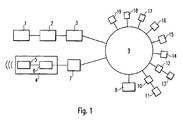
- Figure 1 shows a schematic representation of an inventive Communication system for the task-dependent provision of information.
- the communication system according to the invention comprises a receiving device 1 for Receive identification information that a respective one to be provided Identify information associated task.
- the definition of this task is For example, made by a provider of various types of information wants to provide for the user.
- the predefined task from Providing a pure dialog communication up to a pure Distribution communication is sufficient and includes mixed forms between distribution and Dialog communication in any variation.
- the receiving device 1 received task identification information, for example a Sequence of numbers, sequence of letters or a combination thereof can be sent to a Decoder 2 forwarded to the received Identification information is decoded and forwarded to a testing facility 3.
- the checking device 3 checks the received Identification information on their admissibility. In one with respect to the figures 2 and 3, the checking device 3 can For example, verify the identity of the user and a second from Verify user-entered confirmation signal, for example a Allow access control for sensitive or secret information.
- the task identification information received is from the Checking device 3 via a communication network 9 Processing device 8 fed.
- the communication network 9 is, for example Communication network such as the Internet or a wide area network, the one Support packet-switched transmission of information.
- the task identification information contains the corresponding address information, by means of which the communication network 9 for the task identification information Processing device 8 forwards.
- the communication network supports e.g. the TCP / IP protocol.
- the processing device 8 retrieves information depending on the task that the received identification information is based on one or more Data sources 10-19, which are also connected to the communication network 9.
- the task identification information is used like a key, so to speak which automatically gives access to a specific predefined group of Data sources enabled.
- the information provider i.e. for example one Airline, bank, insurance or the like, legitimized Information users about individual assignment of identification information. Different classes of information can be predefined correspond to the respective task.
- the assigned task can be done by a Allocation and provision of information via pure dialog communication in any stages up to the provision of information on the basis of a pure Distribution communication vary. Any combinations are conceivable here. Farther the information to be provided can be obtained from a wide variety of data sources 10-19 for example as voice data, image data, text data, etc. in a wide variety of ways and ways are provided.
- the information provided is processed by the processing device 8 via the Communication network 9 fed to a voice signal generating device 7, the standardized voice signals from the data sources 10-19 retrieved information generated and fed to an output device 4.
- the Output device 4 comprises a conversion device which converts the speech signals from the speech signal generating device 7 by electroacoustic conversion into converts acoustic speech signals and feeds a speaker 5, which the provides information provided to the user as acoustic voice signals.
- the Output device 4 and the receiving device 1 are usually at the same location arranged.
- the receiving device 1 can, for example, the microphone one Be handset and the speaker 5 of the output device 4 can for example, the loudspeaker of the telephone handset.
- the conversion device 6 is implemented in this case, for example, in the telephone terminal, while the Decoding device 2, the checking device 3 and the speech signal generating device 7 for example in a telephone computer as a soft or Hardware can be installed. In such a telephone computer could also the processing device 8 can be implemented.
- data sources 10-19 provide the respective user depending on the assigned task to be provided different ways and in different formats available.
- the Data sources 10-14 provide the information to be retrieved, for example, as Voice data ready.
- One of the data sources can include a receiving device 11, for example a microphone for receiving acoustic speech signals from one Account managers include.
- the received speech signals are from the Receiving device 11 fed to a conversion device 10, the received acoustic voice signals based on parameters related to the Language content and speech design converted into digital speech data.
- Another data source includes also a receiving device 13 for receiving acoustic speech signals for example from a customer service representative.
- the received speech signals are a conversion device 12 is supplied, which the received acoustic Voice signals directly converted into digital voice data.
- Another data source comprises a storage device 14 in which digitized announcements as files in different formats can be saved.
- Another data source includes, for example, a storage device 15 in which Image data are saved.
- Image data For example, the image data from a fax data containing image file exist, the information to be provided by Analysis of this image data can be converted into text data using OCR, which in turn is converted into voice data.
- Text data is provided in other data sources, e.g. in a Storage device 16 in which text data are stored.
- the storage device 16 can include text files of various formats that can be downloaded after the speech signal generating device 7 converted into digitized speech signals become. Further text data can be obtained from a website 17 via email 18, or via fax 19 are provided.
- the receiving device 1 can the task identification information from User for example as acoustic information, optical information, Receive radio information, information entered via the keyboard, etc.
- the kind of Implementation depends on the security relevance of those to be retrieved Information and from the location where the receiving device 1 and the Output device 4 are to be implemented.
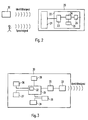
- FIGS. 2 and 3 show a preferred embodiment of the present invention shown in which the task identification information within an acoustic Signals from a portable transmitter 30 is generated and transmitted.
- the Acoustic signal from the portable transmitter 30 contains within the or in addition to the identification information, an identity information that is associated with the Identity of the user is related.
- FIG. 2 shows the receiving part of the communication system according to the invention as Receiving system 20, which includes a receiving device 21, e.g. a microphone, and comprises a checking device 22. Furthermore, in Figure 2 is the Portable transmitter 30 shown that an acoustic signal for Receiving device 21 sends out. The identity of the user is verified by the portable transmitter 30 emitted acoustic signal detected during the Verification and verification of the identity of the user via a by the user acoustic voice signal to be pronounced is checked and verified. The Acoustic voice signal of the user is also received by the receiving device 21 received and to the checking device 22 via lines or wirelessly forwarded.
- Receiving system 20 includes a receiving device 21, e.g. a microphone, and comprises a checking device 22.
- the Portable transmitter 30 shown that an acoustic signal for Receiving device 21 sends out.
- the identity of the user is verified by the portable transmitter 30 emitted acoustic signal detected during the Verification and verification of the identity of the user via a by the user
- the Receiving device 21 and the checking device 22 locally close to each other arranged and implemented for example in a single device or from each other be located away.
- the use of the from the acoustic signal and the acoustic voice signal existing acoustic key ensures a very high security and extensive protection against abuse.
- the checking device 22 of the receiving system 20 comprises one Controller 24, e.g. in the form of a digital signal processor in which the identity of the user based on the received acoustic signal from the portable Transmitting device 30 recognized and by means of the received acoustic voice signal is verified by the user.
- Controller 24 e.g. in the form of a digital signal processor in which the identity of the user based on the received acoustic signal from the portable Transmitting device 30 recognized and by means of the received acoustic voice signal is verified by the user.
- the acoustic signal from the portable transmitting device 30 to the receiving device 21 whereupon within a certain period of time or upon request via a Voice announcement or a display the acoustic voice signal from the user must be pronounced.
- the control device 24 is the Verifier 22 is able to identify the requesting user since the identity signal contains identity information that is related to the identity of the Related user.
- the established identity is then verified.
- the identity information that the User identified e.g. included in the task identification information or be additional information. If the verification is positive, the Access is activated, for example, by means of a release device 26 which Identification information is forwarded to the processing device and the Corresponding information can depend on the respective data sources the task assigned to the user.
- the Identity information associated with the acoustic signal from the portable Transmitting device 30 is transmitted, either the user directly characterizing data or data indirectly characterizing the user.
- the control device 24 compares this Data directly characterizing users directly with the acoustic voice signal from User.
- the identity information thus already contains the information that as acoustic voice signal is expected from the user, such as the password or the speaker parameters for frequency analysis or the like or one Combination of the two.
- the identity information from the portable transmitter 30 includes the Data indirectly characterizing users, i.e. Data that are related to the identity of the User related, but not directly with the acoustic Voice signal can be compared by the user.
- This indirectly the user Characterizing data can contain, for example, a memory address by means of the control device 24 of the checking device 22 to a Storage device 25 can access.
- the storage device 25 contains therein Case a database with data directly characterizing the authorized users.
- the control device 24 reads the user indirectly characterizing data directly characterizing data from the storage device 25 by means of the received data that characterize the user indirectly.
- the identity of the By comparing the data directly characterizing the user with the received acoustic voice signal verified by the user.
- the data characterizing the user directly characterize the Voice of the user, for example a frequency analysis of a specific one Password of the user, parameters of a fundamental frequency analysis, one Formant analysis or the like.
- the acoustic signal is portable Transmitting device 30 at least partially encrypted, in front of the control device 24 of the checking device 22 a decryption device 23 is switched, which is the encrypted part of the received acoustic signal decrypted.
- Security can be further increased if the acoustic signal or at least part of the acoustic signal from the portable transmitter 30 according to one of the portable transmission device 30 and the checking device 22 known rule is changed. The change can be temporal, for example be carried out regularly.
- Another option is to change the acoustic signal depending on the respective real time, in which case a real-time transmitter must be provided in the transmitting device 30.
- the possibility is to provide an operation counter in both the portable Transmitting device 30 as well as in the checking device 22, the acoustic Signal changes based on the number of transmissions counted.
- FIG. 3 schematically shows a portable transmission device 30 according to the invention Use with a communication system according to the invention 1.
- Die The portable transmission device 30 according to the invention comprises a central control device 31, e.g. a microcontroller that includes a memory 32. Also includes the transmission device 30 a triggering device 34 for triggering the generation and sending the acoustic signal.
- the triggering device 34 is shown in FIG Example shown connected to an event counter 39, which the send operations counts.
- Also provided are one connected to the control device 31 Signal generating device 35 and a separate memory 38. The from the signal generating device 35 signals generated by a transmitter 13 as the acoustic signal is emitted.
- the transmitting device 30 additionally includes one Clock generating device 36, for example in the form of a quartz, and one Power supply device 37, e.g. a battery.
- the transmitter 30 shown in Figure 3 is a preferred one Embodiment of the portable transmitter device according to the invention is a offers relatively high complexity and security.
- a portable Transmitting device according to the present invention only needs one Control device with appropriate memory, a trigger device and Include transmission device.
- the task identification information is in the storage device and possibly the one with the identity of the user in Related identity information stored when the Trigger device read out by the user via the control device and via the transmitting device can be transmitted as part of the acoustic signal.
- these functions are for use with the Communication system according to the invention for controlling the access authorization of a user is sufficient.
- the acoustic signal consists of two parts, the first the second part the identification information and, if applicable, the one with the identity of the User related identity information includes.
- the first part of the acoustic signal contains address information that the Identification information and possibly the identity information from the Routes receiving device 21 to checking device 22 of the receiving system, such as. a phone number or an internet address. That is especially for the Case important that the connection between the receiving device 21 and the Checking device 22 of the receiving system is not an exclusive connection, but is used by various users, e.g. a landline telephone network, cordless telephone network, Internet etc.
- the following is the portable transmitter 30 of Figure 2 with respect to transmission over a Fixed line telephone network explained, but these explanations also apply accordingly apply to the other transmission options.
- the first part consists of the portable transmitter 30 Receiving device 21 transmitted acoustic signal from the telephone number of the System to which the user wants to gain access.
- the review facility 22 is part of this system and can be reached via this telephone number, so to speak.
- the telephone number is stored in the memory 32 of the control device 31.
- the control device reads actuation of the triggering device 34 by the user 31 the telephone number from the memory 32 and forwards it to Signal generating device 35.
- the signal generating device 35 sets the Convert telephone number into an acoustic signal according to the multi-frequency method is emitted by the transmitting device 33.
- This first part of the acoustic signal is from the receiving device 21, for example, through the speaker shell (Microphone) of a telephone handset is formed, to an exchange of the fixed telephone network forwarded.
- the exchange identifies the address on the basis of the received phone number and then directs the second part of the acoustic signal to the checking device 23.
- the portable transmitter 30 has preferably the shape and size of a credit card, a key fob or the like, making it easy to store and easy to carry with you.
- the portable transmitting device 30 is simply operated to the receiving device 21, for example a microphone or a telephone handset, after which the user by actuation of the trigger device 34, e.g. a button, a pressure sensor or the like, the generation and transmission of the acoustic signal starts.
- the trigger device 34 e.g. a button, a pressure sensor or the like, the generation and transmission of the acoustic signal starts.
- the trigger device 34 e.g. a button, a pressure sensor or the like
- there can trigger device 34 several such buttons or pressure sensors include so that access to different systems is possible.
- everyone A button or each pressure sensor is assigned its own acoustic signal.
- the different buttons or pressure sensors can each different tasks can be assigned within the same system, whereby in in this case the first part of the acoustic signal, i.e
- the triggering device 34 can couple energy consumption in this way to a photodiode be that the trigger device 34 is not active in the dark. Only when the If the photodiode detects sufficient light intensity, it can be generated and sent of the acoustic signal can be activated via the trigger device 14. If the Trigger device 34 includes several buttons or pressure sensors should Pressing several buttons or pressure sensors simultaneously also none Activation.
- the identity information consists of either Data directly characterizing users, e.g. Language parameters or Speaker parameters, or data indirectly characterizing the user, e.g. Address information of a database of the checking device 22 of the Receiving system 20, a customer number, a device number or the like.
- a landline telephone line between the receiving device 21 and the checking device 22 is also the second part of the acoustic signal in the form of multi-frequency tones from the Signal generating device 35 is generated and transmitted by the transmitting device 33.
- the second part of the acoustic signal is shown in FIG. 3 encrypted example shown.
- the key used is in the Storage device 32 stored, together with the associated Address information or the like of the first part of the acoustic signal and the im second part of the acoustic signal to be transmitted identification information and possibly the identity information.
- the second part of the acoustic signal is transmitted by the portable transmission device 30, in addition to the identification and possibly include the changeable security information of the identity information, that changes with every transmission.
- the safety information is also with the encrypted the same key as the identification and possibly the Identity information.
- the change in security information can, for example on the basis of the transmission processes counted in a process counter 39.
- the Process counter 39 counts each transmission process.
- the accumulated number of Send processes are then encrypted and as security information of the Identification information added.
- the security information can be found on the basis of a real-time counter are generated in the portable transmission device 30, i.e. the respective real-time information is used to provide the Security information used.
- Both options can be done in a simple way Way to ensure that the system 20 over the same Security information is available there as well in the checking device 22 Process counter or a real-time clock can be provided so that the Checking device 22 easily check the correctness of the safety information can.
- the security information is based on the number of transmissions, in the checking device 22 checks whether the received number of transmission processes from the portable transmitter 30 greater than or equal to that of the event counter Checking device 22 is counted receiving operations. If the received Number of transmissions from the portable transmitter greater than or equal to reception processes counted by the process counter of the checking device 22, the security information is recognized as valid and the access can be made accordingly be released. This measure ensures that an accidental Triggering a transmission process on the portable transmission device and one corresponding increase in the number of operations in the operation counter of the portable Transmitting device no negative effects on the check according to the invention who has access authorization.
- the functions according to the invention implemented in the portable transmission device 30 can for example by a microcontroller as a storage device 32 and a tone generator and corresponding storage devices can be realized.
- the memory 32 in which the address information of the first part of the acoustic signal and the corresponding key are stored, part of the Be microcontrollers.
- the separate memory 38 can, for example be realized together with the signal generating device 35 in a sound module.
- all of the functions can be performed in a special semiconductor chip will be realized.
- each portable transmission device 30 is to be used by a single user and is to be personally assigned to the user, the portable transmission device 30 must be personalized before being put into operation.
- the portable transmission device 30 according to the invention should advantageously be designed so that the memory 38 containing the identity information can be personalized via an adapter with commercially available programming devices, for example for smart cards.
- the memory device 30 behaves like a simple memory card with an I 2 C interface, and supports the bidirectional 2-wire bus I 2 C.
- the portable transmission device according to the invention always works as a slave and can only be the recipient of data. The data is controlled by a master, which generates the clock for serial transmission and the start and stop signals. Reading data from the memory 38 from the outside is therefore not readily possible.
- the data stored in the memory 32 of the control device 31 data that are identical for many transmission devices 30, namely the Address information, such as phone number, and that for the second part of the acoustic signal key to be used for the receiving system 20.
- This data if the control device 31 is a microcontroller with an EPROM as Memory is written into the EPROM when programming the microcontroller. After programming, access to the EPROM is blocked.
- the portable transmitter device 30 is advantageously in the form and Size of a credit card, a keychain or the like the elements used should be as small and light as possible.
- Transmitting device 33 can, for example, use a piezo speaker, for its acoustic radiation area a circle with a diameter of approx. 35 mm is sufficient.
- the clock supply is provided by the clock generator 36 advantageously by a small quartz watch, here the minimum thickness of the Quartz is the most important selection criterion.
- the battery 37 must be a block diagram Supply the circuit shown in FIG. 3 with current at 3 volts for about 3 seconds. The electronics automatically switch to a standby state during idle times.
- the Battery capacity is said to be about a thousand times use within 3 years guarantee, so that for example a 3V button cell with a maximum height of 1.2 to 1.6 mm can be used.
- Such a battery can be permanently installed and ensures a reliable power supply during the total life of the transmitter.
- FIG. 4 schematically shows a preferred embodiment of an inventive one Communication system for the task-dependent provision of information shown.
- the design shown relates, for example, to a call center an airline that different customer groups different information depending on a task predefined for a customer group.
- the different customer groups are for example the public, Occasional flyers, regular travelers and participants in a frequent flyer program as well as special target groups.
- Each customer group will have a task identification number assigned to them either via the keyboards of landline telephone terminals, from cell phones and the like. Another The possibility of entering the task identification number is, for example Input via a portable transmission device 30, as described with reference to FIGS. 2 and 3 has been explained.
- receiving devices 41-47 there are several receiving devices 41-47 provided, for example, by landline telephone terminals, mobile phones, etc. can be formed.
- the two receiving devices 41 and 42 are with one Telephone computer 48 connected, the receiving devices 43-45 are connected to a second telephone computer 49 connected and the receiving devices 46 and 47 are connected to a third telephone computer 50.
- the receiving devices 41 to 47 which are formed by telephones in the example shown, thus combine the Functions of the receiving device 1 and the output device 4 of the in FIG shown communication system.
- the telephone computers 48, 49 and 50 combine in the functions of the decoding device 2, the checking device 3 and the speech signal generating device 7 of the one shown in FIG Communication system. To explain the corresponding functions, click on the corresponding explanations to Figure 1 referenced.
- the three telephone computers 48, 49 and 50 are via a so-called switching hub 51 with a communication network 55, such as the Internet or a wide area network.
- the Switching hub 51 continues to connect the three telephone computers 48, 49 and 50 a processing device 52, which in turn is connected to a data server 53 is.
- the processing device 52 corresponds in its functions to Processing device 8 of the communication system shown in Figure 1 and serves to retrieve information from one or more data from about the Telephone computers 48, 49 and 50 received job identification information.
- the processing device 52 controls the provision of the respectively assigned Information from the corresponding data sources using a corresponding one Query on the data sources.
- the processing device sets 52, for example, received task identification information with a Provides address information or based on that in the task identification information already contained address information about corresponding Routers 54, 56 and 58 forwards to a Local Area Network 57, in which the Data sources for example as data server 60 and as computers 61, 62 and 63 with Account managers are available.
- the data server 53 which with the Processing device 52 is connected, for example, administrative data, such as. Address information or a greeting message saved.
- the Local Area Network 57 includes the airline's entire telephone system Router 58, switching hub 59, which connects the local area network with the data server 60 and the computers 61, 62 and 63, and a private branch exchange 64 with accordingly connected telephones 65, 66 and 67.
- the data server 60 can for example voice data, image data or text data (cf. storage devices 14, 15 and 16 of Figure 1) and a calling customer depending on assigned task.
- the computers 61, 62 and 63 with The function of the voice card and telephone function corresponds to that of, for example Receiving device 13 and conversion device 12 of the communication system of Figure 1.
- the voice signal of the customer service representative converted into digital voice data via the respective computer 61, 62 or 63, and transmitted to the customer via the communication network 55 and as an acoustic Voice signals output.
- the different Predefined customer groups are the public, occasional flyers, regularly Travelers and participants in a frequent flyer program.
- the task identification number can also be specific to one Advertising campaign used and in this way targeted a specific one Customer approach can be assigned.
- the data sources can be at different locations from the information provider to be provided.
- the customer database in the German Customer service center
- the flight database in an international The airline's logistics center will be provided.
- Account managers can depending on the time and skills required (e.g. language) different places in the world.
- the special thing about this type of mediation is that for each task identification information in the switching computer (Processing device) individual processes can be programmed can be different and arbitrarily complex.
- the public can be very rigid and easy to read texts ready to read be provided while for the frequent flyer with the most miles a very individually tailored information flow can be programmed.
Landscapes
- Engineering & Computer Science (AREA)
- Signal Processing (AREA)
- Telephonic Communication Services (AREA)
Priority Applications (1)
| Application Number | Priority Date | Filing Date | Title |
|---|---|---|---|
| EP00101380A EP1120950A1 (fr) | 2000-01-24 | 2000-01-24 | Système de communication de mise à disposition d' informations dépendants du genre de communication. |
Applications Claiming Priority (1)
| Application Number | Priority Date | Filing Date | Title |
|---|---|---|---|
| EP00101380A EP1120950A1 (fr) | 2000-01-24 | 2000-01-24 | Système de communication de mise à disposition d' informations dépendants du genre de communication. |
Publications (1)
| Publication Number | Publication Date |
|---|---|
| EP1120950A1 true EP1120950A1 (fr) | 2001-08-01 |
Family
ID=8167692
Family Applications (1)
| Application Number | Title | Priority Date | Filing Date |
|---|---|---|---|
| EP00101380A Withdrawn EP1120950A1 (fr) | 2000-01-24 | 2000-01-24 | Système de communication de mise à disposition d' informations dépendants du genre de communication. |
Country Status (1)
| Country | Link |
|---|---|
| EP (1) | EP1120950A1 (fr) |
Citations (3)
| Publication number | Priority date | Publication date | Assignee | Title |
|---|---|---|---|---|
| EP0794648A2 (fr) * | 1996-03-09 | 1997-09-10 | Deutsche Telekom AG | Méthode et dispositif pour l'accès universel et sécurisé aux services multimédias offerts par le réseau téléphonique |
| US5884262A (en) * | 1996-03-28 | 1999-03-16 | Bell Atlantic Network Services, Inc. | Computer network audio access and conversion system |
| WO1999021349A1 (fr) * | 1997-10-22 | 1999-04-29 | British Telecommunications Public Limited Company | Noeud de reseau de communication |
-
2000
- 2000-01-24 EP EP00101380A patent/EP1120950A1/fr not_active Withdrawn
Patent Citations (3)
| Publication number | Priority date | Publication date | Assignee | Title |
|---|---|---|---|---|
| EP0794648A2 (fr) * | 1996-03-09 | 1997-09-10 | Deutsche Telekom AG | Méthode et dispositif pour l'accès universel et sécurisé aux services multimédias offerts par le réseau téléphonique |
| US5884262A (en) * | 1996-03-28 | 1999-03-16 | Bell Atlantic Network Services, Inc. | Computer network audio access and conversion system |
| WO1999021349A1 (fr) * | 1997-10-22 | 1999-04-29 | British Telecommunications Public Limited Company | Noeud de reseau de communication |
Similar Documents
| Publication | Publication Date | Title |
|---|---|---|
| DE69839068T2 (de) | System und Verfahren zur automatischen Verarbeitung von Anruf und Datenübertragung | |
| DE60128473T2 (de) | Integriertes sicherheits- und kommunikationssystem mit sicherer kommunikationsverbindung | |
| DE69906333T2 (de) | System und verfahren zur durchführung einer auktion über ein kommunikationsnetzwerk | |
| DE4041273C1 (fr) | ||
| DE602004005742T2 (de) | Authentifikationsverfahren und -einrichtung in einem telekommunikationsnetz mit einer tragbaren einrichtung | |
| EP0356568B1 (fr) | Procédé et arrangement pour la reconnaissance du locuteur dans un central téléphonique | |
| DE10208295A1 (de) | Verfahren zum Betrieb eines Sprach-Dialogsystems | |
| DE102010009765B4 (de) | Verfahren und Vorrichtung zur rechtssicheren Archivierung von Telefonieinhalten | |
| EP0655870B1 (fr) | Exécution de services dans un système de communications | |
| EP1858239A1 (fr) | Procédé destiné à la gestion du déroulement sur un terminal mobile, système de gestion et terminal mobile | |
| EP1120950A1 (fr) | Système de communication de mise à disposition d' informations dépendants du genre de communication. | |
| DE60208199T2 (de) | Verfahren zur Verarbeitung eines Texts, einer Geste, eines Gesichtsausdruckes und/oder Verhaltensbeschreibung mit einer Prüfung auf Autorisierung für die Verwendung entsprechender Profile für die Synthese | |
| EP0720340A2 (fr) | Méthode d'interception d'appels téléphoniques en réception | |
| DE3328059C2 (de) | Verfahren zur empfangsseitigen Auswahl von über eine Vermittlungsstelle einer Fernmelde- bzw. Fernsprechanlage laufende Daten- bzw. Sprechverbindungen | |
| DE102004013861A1 (de) | Bereitstellung einer personalisierten Anzeigeinformation bei einer Telekommunikationsanbahnung | |
| EP1116372A1 (fr) | Central de messagerie et procede de diffusion de messages dans des reseaux telephoniques | |
| WO2001061976A1 (fr) | Procede et dispositif pour surveiller des conversations telephoniques transmises par des moyens techniques | |
| EP0649240B1 (fr) | Système de communication | |
| WO2007131963A1 (fr) | ProcÉDÉ pour la transmission et le traitement LIÉS de messages dans un rÉseau de TÉLÉcommunication | |
| EP1244284B1 (fr) | Méthode et appareil pour établir deux liaisons vocales vers une position d'agent CTI | |
| EP2103060B1 (fr) | Porcédé pour distribuer des informations primaires qui existent au moins sous forme électronique | |
| DE19706781A1 (de) | Kommunikationssystem mit Fernzugriff zur Realisierung von Dienste-Prozeduren | |
| DE19611021C2 (de) | Verfahren zur Fernverwaltung von betriebstechnischen Daten in einem speicherprogrammierten Kommunikationssystem | |
| DE10131876B4 (de) | Verfahren zur teilnehmerindividuellen Informations- und Datenverwaltung in Telekommunikationsnetzen | |
| DE19937453A1 (de) | Einrichtung und Verfahren eines individuellen, zentralisierten Netz- Telefonbuches mit Spracherkennung |
Legal Events
| Date | Code | Title | Description |
|---|---|---|---|
| PUAI | Public reference made under article 153(3) epc to a published international application that has entered the european phase |
Free format text: ORIGINAL CODE: 0009012 |
|
| AK | Designated contracting states |
Kind code of ref document: A1 Designated state(s): AT BE CH CY DE DK ES FI FR GB GR IE IT LI LU MC NL PT SE |
|
| AX | Request for extension of the european patent |
Free format text: AL;LT;LV;MK;RO;SI |
|
| 17P | Request for examination filed |
Effective date: 20020131 |
|
| AKX | Designation fees paid |
Free format text: AT BE CH CY DE DK ES FI FR GB GR IE IT LI LU MC NL PT SE |
|
| 17Q | First examination report despatched |
Effective date: 20050217 |
|
| STAA | Information on the status of an ep patent application or granted ep patent |
Free format text: STATUS: THE APPLICATION IS DEEMED TO BE WITHDRAWN |
|
| 18D | Application deemed to be withdrawn |
Effective date: 20050802 |