EP1120966A2 - Verfahren zum Verhindern der Ausbreitung von Fehlern in einem Digitalbilddatenkommunikationssystem - Google Patents
Verfahren zum Verhindern der Ausbreitung von Fehlern in einem Digitalbilddatenkommunikationssystem Download PDFInfo
- Publication number
- EP1120966A2 EP1120966A2 EP00310072A EP00310072A EP1120966A2 EP 1120966 A2 EP1120966 A2 EP 1120966A2 EP 00310072 A EP00310072 A EP 00310072A EP 00310072 A EP00310072 A EP 00310072A EP 1120966 A2 EP1120966 A2 EP 1120966A2
- Authority
- EP
- European Patent Office
- Prior art keywords
- image frame
- error information
- block
- feedback error
- compressed image
- Prior art date
- Legal status (The legal status is an assumption and is not a legal conclusion. Google has not performed a legal analysis and makes no representation as to the accuracy of the status listed.)
- Withdrawn
Links
Images


Classifications
-
- H—ELECTRICITY
- H04—ELECTRIC COMMUNICATION TECHNIQUE
- H04N—PICTORIAL COMMUNICATION, e.g. TELEVISION
- H04N21/00—Selective content distribution, e.g. interactive television or video on demand [VOD]
- H04N21/60—Network structure or processes for video distribution between server and client or between remote clients; Control signalling between clients, server and network components; Transmission of management data between server and client, e.g. sending from server to client commands for recording incoming content stream; Communication details between server and client
- H04N21/65—Transmission of management data between client and server
- H04N21/658—Transmission by the client directed to the server
-
- H—ELECTRICITY
- H04—ELECTRIC COMMUNICATION TECHNIQUE
- H04N—PICTORIAL COMMUNICATION, e.g. TELEVISION
- H04N19/00—Methods or arrangements for coding, decoding, compressing or decompressing digital video signals
- H04N19/10—Methods or arrangements for coding, decoding, compressing or decompressing digital video signals using adaptive coding
- H04N19/102—Methods or arrangements for coding, decoding, compressing or decompressing digital video signals using adaptive coding characterised by the element, parameter or selection affected or controlled by the adaptive coding
- H04N19/103—Selection of coding mode or of prediction mode
- H04N19/107—Selection of coding mode or of prediction mode between spatial and temporal predictive coding, e.g. picture refresh
-
- H—ELECTRICITY
- H04—ELECTRIC COMMUNICATION TECHNIQUE
- H04N—PICTORIAL COMMUNICATION, e.g. TELEVISION
- H04N19/00—Methods or arrangements for coding, decoding, compressing or decompressing digital video signals
- H04N19/10—Methods or arrangements for coding, decoding, compressing or decompressing digital video signals using adaptive coding
- H04N19/134—Methods or arrangements for coding, decoding, compressing or decompressing digital video signals using adaptive coding characterised by the element, parameter or criterion affecting or controlling the adaptive coding
- H04N19/164—Feedback from the receiver or from the transmission channel
-
- H—ELECTRICITY
- H04—ELECTRIC COMMUNICATION TECHNIQUE
- H04N—PICTORIAL COMMUNICATION, e.g. TELEVISION
- H04N19/00—Methods or arrangements for coding, decoding, compressing or decompressing digital video signals
- H04N19/10—Methods or arrangements for coding, decoding, compressing or decompressing digital video signals using adaptive coding
- H04N19/169—Methods or arrangements for coding, decoding, compressing or decompressing digital video signals using adaptive coding characterised by the coding unit, i.e. the structural portion or semantic portion of the video signal being the object or the subject of the adaptive coding
- H04N19/17—Methods or arrangements for coding, decoding, compressing or decompressing digital video signals using adaptive coding characterised by the coding unit, i.e. the structural portion or semantic portion of the video signal being the object or the subject of the adaptive coding the unit being an image region, e.g. an object
- H04N19/176—Methods or arrangements for coding, decoding, compressing or decompressing digital video signals using adaptive coding characterised by the coding unit, i.e. the structural portion or semantic portion of the video signal being the object or the subject of the adaptive coding the unit being an image region, e.g. an object the region being a block, e.g. a macroblock
-
- H—ELECTRICITY
- H04—ELECTRIC COMMUNICATION TECHNIQUE
- H04N—PICTORIAL COMMUNICATION, e.g. TELEVISION
- H04N19/00—Methods or arrangements for coding, decoding, compressing or decompressing digital video signals
- H04N19/60—Methods or arrangements for coding, decoding, compressing or decompressing digital video signals using transform coding
- H04N19/61—Methods or arrangements for coding, decoding, compressing or decompressing digital video signals using transform coding in combination with predictive coding
-
- H—ELECTRICITY
- H04—ELECTRIC COMMUNICATION TECHNIQUE
- H04N—PICTORIAL COMMUNICATION, e.g. TELEVISION
- H04N19/00—Methods or arrangements for coding, decoding, compressing or decompressing digital video signals
- H04N19/85—Methods or arrangements for coding, decoding, compressing or decompressing digital video signals using pre-processing or post-processing specially adapted for video compression
- H04N19/89—Methods or arrangements for coding, decoding, compressing or decompressing digital video signals using pre-processing or post-processing specially adapted for video compression involving methods or arrangements for detection of transmission errors at the decoder
-
- H—ELECTRICITY
- H04—ELECTRIC COMMUNICATION TECHNIQUE
- H04N—PICTORIAL COMMUNICATION, e.g. TELEVISION
- H04N21/00—Selective content distribution, e.g. interactive television or video on demand [VOD]
- H04N21/60—Network structure or processes for video distribution between server and client or between remote clients; Control signalling between clients, server and network components; Transmission of management data between server and client, e.g. sending from server to client commands for recording incoming content stream; Communication details between server and client
- H04N21/63—Control signaling related to video distribution between client, server and network components; Network processes for video distribution between server and clients or between remote clients, e.g. transmitting basic layer and enhancement layers over different transmission paths, setting up a peer-to-peer communication via Internet between remote STB's; Communication protocols; Addressing
- H04N21/637—Control signals issued by the client directed to the server or network components
- H04N21/6377—Control signals issued by the client directed to the server or network components directed to server
Definitions
- the present invention relates to an image data communication system, and more particularly, to a method of inhibiting error propagation in a bidirectional digital compressed image data communication system.
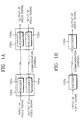
- Figure 1A is a schematic diagram illustrating one way of configuring a bidirectional digital image data communication system.
- two nodes 100a and 150a which are connected to each other via a communication network, include encoders 102a and 152a, respectively, and decoders 104a and 154a, respectively, and communicate with each other via a bidirectional communication channel.
- Figure 1B is a schematic diagram illustrating another way of configuring a bidirectional digital image data communication system.
- a node 100b includes only an encoder
- another node 150b includes only a decoder.
- image data is only transmitted from the node 100b having an encoder to the node 150b having a decoder via a forward channel.
- a backward channel is used to transmit feedback information on the image data received via the forward channel.
- a bidirectional digital image data communication system can be configured by the combination of Figures 1A and 1B.
- image data undergoes data compression and decompression to effectively use the bandwidth of a communication channel. That is, an external video signal is compressed during encoding by the encoder 102a, 152a, or 100b and transmitted via a communication network.
- the encoder 104a, 154a, or 150b decompresses the received compressed image data to restore the original image data during decoding, and outputs a restored video signal.
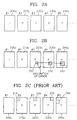
- Figure 2A is a schematic diagram illustrating a way of encoding each image frame in a digital image data communication system.
- the way of encoding an image frame includes intracoding and intercoding.
- Intracoding is encoding an image frame using the correlation between pixels within a screen
- intercoding is encoding a current image frame with reference to the previous frame (or the next frame) using the correlation between screens.
- An image frame encoded by intracoding is referred to as an I frame
- an image frame encoded by intercoding is referred to as a P frame.
- an image frame is encoded with reference to the next image frame, it is referred to as a B frame.
- the term P frame is used to refer to any intercoded frame, including a B frame.
- Intercoding generally has a high compression efficiency, so that most image frames are encoded by intercoding using the correlation between frames. That is, as shown in Figure 2A, the first image frame 200a in a sequence is encoded by intracoding to constitute an I frame, and the subsequent image frames 210a, 220a, 230a and 240a are encoded by intercoding to constitute P frames, until the corresponding sequence is ended.
- Figure 2B is a schematic diagram illustrating a conventional error propagation mechanism in a digital image data communication system.
- the first and second frames 200b and 210b in a sequence have no errors, while the third frame 220b has an error 222 at a specific block.
- the fourth frame 230b is encoded with reference to the third frame 220b, so that the error 222 in the third frame 220b is propagated into an error 232 in the fourth frame 230b.
- the fifth frame 240b has an error 242 propagated from the error 232 of the fourth frame 230b.
- an unrestorable error is generated at a specific block on a frame during transmission or for other reasons, it is not limited to the corresponding frame but affects the subsequent frames. Also, this propagated error is gradually magnified, since each block in a current frame is encoded with reference to both a corresponding block in the previous frame and its adjacent blocks in the intercoding method.
- Figure 2C is a schematic diagram illustrating a conventional error propagation prevention mechanism in a digital image data communication system.
- the I frame 200c is obtained by intracoding, and specific blocks 214, 224, 234, 244 of P frames 210c, 220c, 230c and 240c, respectively, obtained by intercoding, are compulsorily encoded by intracoding.
- a current recommendation is that an I block (which is a block compressed by intracoding) be included at least every 132 image frames, but a detailed method of selecting the I block is not prescribed separately.
- encoding is performed using the correlation between frames, so that both a previous frame and a current frame are referred to during encoding, and a process such as discrete cosine transformation (DCT) for encoding includes a floating point operation.
- DCT discrete cosine transformation
- decoding also includes a similar floating point operation.
- the results of the floating point operations of an encoder and a decoder may have a slight difference depending on the type of the corresponding system. Thus, in order to prevent accumulation of this slight difference, inclusion of one I block at least every 132 image frames has been recommended.
- a decoder minimizes an error recognized by a person while visually watching images, using a technique such as concealment, when an unrestorable error is detected from a specific block on a received image frame.
- this technique cannot fundamentally correct an error, so the conventional intercoding method cannot prevent an error from being propagated from a frame to another frame.
- An aim of the present invention is to provide a method of processing transmitting/received data to reduce and preferably prevent error propagation in a digital image data communication system.
- a method of processing transmission data to inhibit error propagation in a digital image data communication system comprising (a) inputting an image frame from an external source; (b) checking for feedback error information including the location of an erroneous block on a compressed image frame detected during decoding by a decoder, the feedback error information received via a communication network; (c) if it is determined in step (b) that there is feedback error information, intracoding an erroneous block, the location of which is included in the feedback error information, and its search range, which is referred to to encode the erroneous block using an intercoding method, among the image frame input in step (a), thereby constituting a compressed image frame; and (d) transmitting the compressed image frame constituted in step (c), via a communication network.
- the error block location included in the feedback error information in step (b) is set in units of 16 (pixel) ⁇ 16 (pixel) macro blocks.
- the search range in step (c) includes 16 pixels or 32 pixels in four directions on the basis of the erroneous block.
- the feedback error information in step (b) is associated with the image frame immediately preceding a current image frame.
- a method of processing transmission data to inhibit error propagation in a digital image data communication system comprising (a) inputting an image frame from an external source; (b) when the image frame input in step (a) is the first image frame in a specific sequence, encoding the entire image frame using an intracoding method, to constitute a compressed image frame; (c) when the image frame input in step (a) is not the first image frame in a specific sequence, checking feedback error information including the location of an erroneous block on a compressed image frame detected during decoding by a decoder, the feedback error information received via a communication network; (d) if it is determined in step (c) that there is feedback error information, intracoding an erroneous block, the location of which is included in the feedback error information, and its search range, which is referred to encode the erroneous block using an intercoding method, among the image frame input in step (a), while the remaining area is encoded by intercoding, thereby constituting a compressed image frame
- a method of processing received data to inhibit error propagation in a digital image data communication system includes: (a) receiving a compressed image frame via a communication network; (b) decoding the compressed image frame received in step (a) to constitute an image frame; (c) if an error is detected at a specific block on the compressed image frame received in step (a) during the decoding in the step (b), sending feedback error information including an error block location back to an encoder via a communication network; and (d) outputting an image frame restored in step (b).
- the present invention provides a computer-readable recording medium for recording a program which is executed in a computer for processing transmission data to inhibit error propagation in a digital image data communication system, according to an aspect of the present invention, wherein the program includes the steps of: (a) inputting an image frame from an external source; (b) checking feedback error information including the location of an erroneous block on a compressed image frame detected during decoding by a decoder, the feedback error information received via a communication network; (c) if it is determined in step (b) that there is feedback error information, intracoding an erroneous block, the location of which is included in the feedback error information, and its search range, which is referred to to encode the erroneous block using an intercoding method, among the image frame input in step (a), thereby constituting a compressed image frame; and (d) transmitting the compressed image frame constituted in step (c), via a communication network.
- a computer-readable recording medium records a program which is executed in a computer for processing transmission data to inhibit error propagation in a bidirectional digital image data communication system, the program including the steps of: (a) inputting an image frame from an external source; (b) when the image frame input in step (a) is the first image frame in a specific sequence, encoding the entire image frame using an intracoding method, to constitute a compressed image frame; (c) when the image frame input in step (a) is not the first image frame in a specific sequence, checking feedback error information including the location of an erroneous block on a compressed image frame detected during decoding by a decoder, the feedback error information received via a communication network; (d) if it is determined in step (c) that there is feedback error information, intracoding an erroneous block, the location of which is included in the feedback error information, and its search range, which is referred to encode the erroneous block using an intercoding method, among the image frame input in step (
- the present invention provides a computer-readable recording medium for recording a program which is executed in a computer for processing transmission data to inhibit error propagation in a digital image data communication system, wherein the program includes the steps of: (a) receiving a compressed image frame via a communication network; (b) decoding the compressed image frame received in step (a) to constitute an image frame; (c) if an error is detected at a specific block on the compressed image frame received in step (a) during the decoding in the step (b), sending feedback error information including an error block location back to an encoder via a communication network; and (d) outputting an image frame restored in step (b).
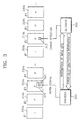
- an encoder 300 in principle, encodes the first frame 300a in a sequence using an intracoding method and encodes the subsequent frames 310a, 320a and 330a using an intercoding method.
- a decoder 350 decodes compressed image data 300b, 310b, 320b and 330b received via a communication channel.
- discrete cosine transformation, quantization, variable length encoding, inverse quantization, inverse discrete cosine transformation, or the like is usually used for encoding by the encoder 300 according to an embodiment of the present invention, and that the corresponding inverse transformation is usually used for decoding by the decoder 350.
- the decoder 350 has detected an error from a specific block 312 in the second frame 310b.
- an error is detected from a specific block by reverse variable length coding (RVLC) or the like.
- RVLC reverse variable length coding
- the detected error excludes errors that can be restored by forward error correction.
- An image frame having this unrestorable error is processed more naturally to a person by a technique such as concealment, and then output.
- feedback error information including the location of a block where the error has been detected, or the like, is transmitted to the encoder 300 via a backward channel.
- the encoder 300 encodes a corresponding error block 322 and a search range 324 of the block by compulsorily using an intracoding method when the next frame 320a is encoded, with reference to the feedback error information received via a backward channel.
- the search range denotes blocks which are referred to in order to encode a specific block using an intercoding method.
- the decoder 350 receives an image frame in which an error-detected block and a search range of the block have been encoded by intracoding, so does not refer to any frames to decode the corresponding block. Thus, an error generated on the previous frame is not propagated. Also, in this embodiment of the present invention, an error is restored or removed within a short period of time by inhibiting error propagation.
- Figure 4 is a flowchart illustrating a method of processing transmission data to inhibit error propagation in a digital image data communication system according to a preferred embodiment of the present invention.
- an encoder receives an external image signal, in step 400.
- the external image signal is input in units of frames, and an analog image signal must be converted into digital image data before encoding such as discrete cosine transformation is performed.
- a sequence denotes a group of a series of screens having the same property, the group being used at the uppermost layer in a data hierarchy structure in image data communications.
- the entire image frame in step 400 is encoded by intracoding to constitute an I frame, in step 412. Compression of an image frame during this encoding has already been described.
- step 420 If the input image frame in step 400 is not the first image frame in a specific sequence, feedback error information received from a decoder via a communication network is checked, in step 420.
- the feedback error information includes the location of an erroneous block on a compressed image frame detected during decoding by a decoder.
- the entire image frame is encoded by intracoding, so the feedback error information does not need to be checked.
- the erroneous block location included in the feedback error information is set in units of 16 (pixels) ⁇ 16 (pixels) macro blocks, since the basic unit of a motion vector used for intercoding is a macro block.
- feedback error information which is referred to to encode a current image frame, is associated with the image frame immediately preceding the current image frame, since as much error propagation as possible within a range allowed by the bandwidth of a communication channel can be inhibited.
- the image frame input in the step 400 is encoded and/or compressed in a conventional way, in step 422. That is, blocks selected in a predetermined way, among the blocks of the image frame input in step 400, are compulsorily encoded by intracoding, and the remaining blocks are encoded by intercoding, thereby forming a compressed image frame (which corresponds to a P frame on the whole).
- blocks to be encoded compulsorily by intracoding can be selected in an appropriate way within the range of the current recommendation that one I block is included at least every 132 image frames.
- an error block included in the feedback error information, and its search range from the image frame input in step 400 are encoded by intracoding, while the remaining area is encoded by intercoding, thereby forming a compressed image frame (which corresponds to a P frame on the whole), in step 424.
- the search range denotes an area which is referred to in order to encode a particular block by intercoding, as described above, and is set during the negotiation in the initial step between an encoder and a decoder.
- a search range includes from 16 pixels in four directions from a specific block, that is, 9 macro blocks including the corresponding block, or includes 32 pixels in four directions from a specific block, that is, 16 macro blocks including the corresponding block.
- a compressed image frame constituted through the step 412, 422 or 424 is transmitted via a communication network, in step 430.
- Figure 5 is a flowchart illustrating a method of processing received data to inhibit error propagation in a digital image data communication system according to a preferred embodiment of the present invention.
- a decoder receives a compressed image frame via a communication network, in step 500.
- the compressed image frame will be an I frame encoded by intracoding or a P frame encoded by intercoding.
- the blocks of the compressed image frame are decoded with reference to the encoding methods of each block of the compressed image frame received in step 500, thereby generating an output image frame, in step 510.
- step 520 If it is determined in step 520 that an error is detected from a specific block during the decoding of step 510, feedback error information is fed back to the encoder via a communication network, in step 522.
- the feedback error information includes the location of an erroneous block. As described above, it is preferable that the location of the erroneous block is set in units of 16 (pixels) ⁇ 16 (pixels) macro blocks.
- An error can be detected by various techniques according to the application field, for example, by reverse variable length coding (RVLC) as described above.
- RVLC reverse variable length coding
- FIG. 5 sequentially shows the feedback error information transmission procedure in steps 520 and 522 and the image frame outputting procedure in step 530.
- FIG. 5 shows the feedback error information transmission procedure in steps 520 and 522 and the image frame outputting procedure in step 530.
- an error when an error is detected by a decoder, it is fed back to an encoder, and the encoder uses a technique of compulsorily intracoding an erroneous block and the search range of the block with reference to feedback information, thereby inhibiting error propagation which occurs in a digital image data communication system. Also, through this inhibition of error propagation, error can be restored or removed within a short period of time.
- Embodiments of the present invention can be written in a program that can be executed in a computer system. Also, this program can be read from a recording medium and executed by a computer.
- the recording medium may be a magnetic storage medium (for example, ROM, floppy discs, hard discs, etc.), an optical reading medium (for example, CD-ROM, DVD, etc.), or a carrier wave (for example, transmission through Internet).
Landscapes
- Engineering & Computer Science (AREA)
- Multimedia (AREA)
- Signal Processing (AREA)
- Compression Or Coding Systems Of Tv Signals (AREA)
- Compression, Expansion, Code Conversion, And Decoders (AREA)
- Transmission Systems Not Characterized By The Medium Used For Transmission (AREA)
Applications Claiming Priority (2)
| Application Number | Priority Date | Filing Date | Title |
|---|---|---|---|
| KR20000004050A KR100677083B1 (ko) | 2000-01-27 | 2000-01-27 | 디지털 영상 데이터 통신 시스템에서의 오류 전파 억제를위한 송수신 데이터의 처리 방법 및 이를 위한 기록 매체 |
| KR2004000050 | 2000-01-27 |
Publications (2)
| Publication Number | Publication Date |
|---|---|
| EP1120966A2 true EP1120966A2 (de) | 2001-08-01 |
| EP1120966A3 EP1120966A3 (de) | 2003-09-24 |
Family
ID=19642132
Family Applications (1)
| Application Number | Title | Priority Date | Filing Date |
|---|---|---|---|
| EP20000310072 Withdrawn EP1120966A3 (de) | 2000-01-27 | 2000-11-13 | Verfahren zum Verhindern der Ausbreitung von Fehlern in einem Digitalbilddatenkommunikationssystem |
Country Status (5)
| Country | Link |
|---|---|
| US (1) | US6859498B1 (de) |
| EP (1) | EP1120966A3 (de) |
| JP (1) | JP2001245305A (de) |
| KR (1) | KR100677083B1 (de) |
| CN (1) | CN1202672C (de) |
Cited By (14)
| Publication number | Priority date | Publication date | Assignee | Title |
|---|---|---|---|---|
| WO2003041341A1 (en) * | 2001-11-05 | 2003-05-15 | Matsushita Electric Industrial Co., Ltd. | Server apparatus and terminal apparatus used in video transmission system |
| WO2003084244A1 (en) * | 2002-03-27 | 2003-10-09 | British Telecommunications Public Limited Company | Video coding and transmission |
| WO2004049719A1 (en) * | 2002-11-27 | 2004-06-10 | Koninklijke Philips Electronics N.V. | I-picture insertion on request |
| EP1815692A2 (de) * | 2004-11-16 | 2007-08-08 | Koninklijke Philips Electronics N.V. | Verfahren zur bestimmung einer verfälschungsindikation einer sequenz codierter datenrahmen |
| KR100827108B1 (ko) | 2006-10-25 | 2008-05-02 | 삼성전자주식회사 | 영상 서비스 제공 시스템 및 이를 위한 방법 및 장치 |
| EP1713277A4 (de) * | 2004-01-23 | 2010-02-03 | Nec Corp | Kommunikationseinrichtung für bewegliche bilder, kommunikationssystem für bewegliche bilder und kommunikationsverfahren für bewegliche bilder |
| US7761901B2 (en) | 2003-03-19 | 2010-07-20 | British Telecommunications Plc | Data transmission |
| US7974200B2 (en) | 2000-11-29 | 2011-07-05 | British Telecommunications Public Limited Company | Transmitting and receiving real-time data |
| US8135852B2 (en) | 2002-03-27 | 2012-03-13 | British Telecommunications Public Limited Company | Data streaming system and method |
| EP2412158A4 (de) * | 2009-03-23 | 2013-09-11 | Onlive Inc | System und verfahren zur videokomprmierung anhand von rückinformationen mit daten zum erfolgreichen empfang von videoinhalten |
| US9061207B2 (en) | 2002-12-10 | 2015-06-23 | Sony Computer Entertainment America Llc | Temporary decoder apparatus and method |
| US9077991B2 (en) | 2002-12-10 | 2015-07-07 | Sony Computer Entertainment America Llc | System and method for utilizing forward error correction with video compression |
| US9192859B2 (en) | 2002-12-10 | 2015-11-24 | Sony Computer Entertainment America Llc | System and method for compressing video based on latency measurements and other feedback |
| WO2021021550A1 (en) * | 2019-08-01 | 2021-02-04 | Qualcomm Incorporated | Intra refresh and error tracking based on feedback information |
Families Citing this family (25)
| Publication number | Priority date | Publication date | Assignee | Title |
|---|---|---|---|---|
| JP4116470B2 (ja) * | 2002-03-06 | 2008-07-09 | ヒューレット・パッカード・カンパニー | メディア・ストリーミング配信システム |
| US9446305B2 (en) | 2002-12-10 | 2016-09-20 | Sony Interactive Entertainment America Llc | System and method for improving the graphics performance of hosted applications |
| US8949922B2 (en) * | 2002-12-10 | 2015-02-03 | Ol2, Inc. | System for collaborative conferencing using streaming interactive video |
| US20090118019A1 (en) * | 2002-12-10 | 2009-05-07 | Onlive, Inc. | System for streaming databases serving real-time applications used through streaming interactive video |
| US9314691B2 (en) | 2002-12-10 | 2016-04-19 | Sony Computer Entertainment America Llc | System and method for compressing video frames or portions thereof based on feedback information from a client device |
| US8964830B2 (en) | 2002-12-10 | 2015-02-24 | Ol2, Inc. | System and method for multi-stream video compression using multiple encoding formats |
| US9138644B2 (en) | 2002-12-10 | 2015-09-22 | Sony Computer Entertainment America Llc | System and method for accelerated machine switching |
| US9108107B2 (en) | 2002-12-10 | 2015-08-18 | Sony Computer Entertainment America Llc | Hosting and broadcasting virtual events using streaming interactive video |
| US8366552B2 (en) * | 2002-12-10 | 2013-02-05 | Ol2, Inc. | System and method for multi-stream video compression |
| US8711923B2 (en) | 2002-12-10 | 2014-04-29 | Ol2, Inc. | System and method for selecting a video encoding format based on feedback data |
| US8549574B2 (en) | 2002-12-10 | 2013-10-01 | Ol2, Inc. | Method of combining linear content and interactive content compressed together as streaming interactive video |
| US10201760B2 (en) * | 2002-12-10 | 2019-02-12 | Sony Interactive Entertainment America Llc | System and method for compressing video based on detected intraframe motion |
| US8705613B2 (en) * | 2003-06-26 | 2014-04-22 | Sony Corporation | Adaptive joint source channel coding |
| US8582640B2 (en) * | 2003-12-16 | 2013-11-12 | Sony Corporation | Adaptive joint source channel coding |
| KR100987777B1 (ko) * | 2004-02-05 | 2010-10-13 | 삼성전자주식회사 | 에러의 전파를 방지하고 병렬 처리가 가능한 디코딩 방법및 그 디코딩 장치 |
| CN100459717C (zh) * | 2005-04-20 | 2009-02-04 | 华为技术有限公司 | 基于h.264的压缩视频传输误码消除方法 |
| CN101213843B (zh) * | 2005-06-30 | 2010-09-29 | 法国电信公司 | 视频编码方法和设备 |
| CN101132494B (zh) * | 2006-08-24 | 2011-05-11 | 康佳集团股份有限公司 | 一种将电视机切换到学习模式下的方法、系统及设备 |
| US9168457B2 (en) | 2010-09-14 | 2015-10-27 | Sony Computer Entertainment America Llc | System and method for retaining system state |
| CN101360243A (zh) | 2008-09-24 | 2009-02-04 | 腾讯科技(深圳)有限公司 | 基于反馈参考帧的视频通信系统及方法 |
| JP5347849B2 (ja) * | 2009-09-01 | 2013-11-20 | ソニー株式会社 | 画像符号化装置、画像受信装置、画像符号化方法及び画像受信方法 |
| CN105430417B (zh) * | 2014-09-22 | 2020-02-07 | 中兴通讯股份有限公司 | 编码方法、解码方法、装置及电子设备 |
| EP3035539A1 (de) * | 2014-12-19 | 2016-06-22 | Xieon Networks S.à r.l. | Codierer, Decodierer und Codierungsverfahren mit niedrigem Fehlersockel |
| US10652532B2 (en) * | 2016-07-06 | 2020-05-12 | Agora Lab, Inc. | Method and apparatus for reference frame management for video communication |
| CN108235150A (zh) * | 2018-01-03 | 2018-06-29 | 厦门亿联网络技术股份有限公司 | 一种网络传输特性友好的实时图像自适应恢复系统及方法 |
Family Cites Families (17)
| Publication number | Priority date | Publication date | Assignee | Title |
|---|---|---|---|---|
| JPH0490648A (ja) * | 1990-08-06 | 1992-03-24 | Fujitsu Ltd | 符号化送信方式 |
| JPH0498987A (ja) * | 1990-08-16 | 1992-03-31 | Matsushita Electric Ind Co Ltd | 誤り修整方法 |
| JPH04334189A (ja) | 1991-05-09 | 1992-11-20 | Mitsubishi Electric Corp | 画像伝送装置 |
| JP3210082B2 (ja) | 1992-07-14 | 2001-09-17 | キヤノン株式会社 | 符号化装置及びその方法 |
| JPH06237451A (ja) * | 1993-02-10 | 1994-08-23 | Hitachi Ltd | 動画通信方式および端末装置 |
| JP3496234B2 (ja) | 1993-06-16 | 2004-02-09 | 三菱電機株式会社 | 符号化方法 |
| JP3428697B2 (ja) * | 1993-09-07 | 2003-07-22 | キヤノン株式会社 | 画像復号化方法 |
| JPH07312755A (ja) * | 1994-05-18 | 1995-11-28 | N T T Idou Tsuushinmou Kk | 動画像符号化復号化装置 |
| JP3618783B2 (ja) | 1994-05-25 | 2005-02-09 | キヤノン株式会社 | 画像符号化方法及び画像符号化装置 |
| JPH0837663A (ja) | 1994-07-22 | 1996-02-06 | Canon Inc | 符号化装置 |
| US5550847A (en) * | 1994-10-11 | 1996-08-27 | Motorola, Inc. | Device and method of signal loss recovery for realtime and/or interactive communications |
| JP3630474B2 (ja) * | 1995-07-14 | 2005-03-16 | 沖電気工業株式会社 | 動画像伝送システム及び動画像伝送装置 |
| JP3068002B2 (ja) * | 1995-09-18 | 2000-07-24 | 沖電気工業株式会社 | 画像符号化装置、画像復号化装置及び画像伝送システム |
| JPH10145794A (ja) | 1996-11-11 | 1998-05-29 | Oki Electric Ind Co Ltd | 画像符号化方法及び画像符号化装置 |
| JPH1169355A (ja) | 1997-08-20 | 1999-03-09 | Sharp Corp | 画像伝送装置 |
| JP3905969B2 (ja) | 1998-01-30 | 2007-04-18 | 株式会社東芝 | 動画像符号化装置および動画像符号化方法 |
| KR100312419B1 (ko) * | 1998-12-12 | 2001-12-12 | 이계철 | 동영상부호화장치에서전송오류에의한오류전파방지방법 |
-
2000
- 2000-01-27 KR KR20000004050A patent/KR100677083B1/ko not_active Expired - Fee Related
- 2000-11-13 EP EP20000310072 patent/EP1120966A3/de not_active Withdrawn
- 2000-11-14 CN CNB001309420A patent/CN1202672C/zh not_active Expired - Fee Related
- 2000-11-15 US US09/712,230 patent/US6859498B1/en not_active Expired - Fee Related
-
2001
- 2001-01-15 JP JP2001006992A patent/JP2001245305A/ja active Pending
Cited By (17)
| Publication number | Priority date | Publication date | Assignee | Title |
|---|---|---|---|---|
| US7974200B2 (en) | 2000-11-29 | 2011-07-05 | British Telecommunications Public Limited Company | Transmitting and receiving real-time data |
| WO2003041341A1 (en) * | 2001-11-05 | 2003-05-15 | Matsushita Electric Industrial Co., Ltd. | Server apparatus and terminal apparatus used in video transmission system |
| WO2003084244A1 (en) * | 2002-03-27 | 2003-10-09 | British Telecommunications Public Limited Company | Video coding and transmission |
| US8386631B2 (en) | 2002-03-27 | 2013-02-26 | British Telecommunications Plc | Data streaming system and method |
| US8135852B2 (en) | 2002-03-27 | 2012-03-13 | British Telecommunications Public Limited Company | Data streaming system and method |
| WO2004049719A1 (en) * | 2002-11-27 | 2004-06-10 | Koninklijke Philips Electronics N.V. | I-picture insertion on request |
| US9061207B2 (en) | 2002-12-10 | 2015-06-23 | Sony Computer Entertainment America Llc | Temporary decoder apparatus and method |
| US9077991B2 (en) | 2002-12-10 | 2015-07-07 | Sony Computer Entertainment America Llc | System and method for utilizing forward error correction with video compression |
| US9192859B2 (en) | 2002-12-10 | 2015-11-24 | Sony Computer Entertainment America Llc | System and method for compressing video based on latency measurements and other feedback |
| US7761901B2 (en) | 2003-03-19 | 2010-07-20 | British Telecommunications Plc | Data transmission |
| EP1713277A4 (de) * | 2004-01-23 | 2010-02-03 | Nec Corp | Kommunikationseinrichtung für bewegliche bilder, kommunikationssystem für bewegliche bilder und kommunikationsverfahren für bewegliche bilder |
| US7702994B2 (en) | 2004-11-16 | 2010-04-20 | Nxp B.V. | Method of determining a corruption indication of a sequence of encoded data frames |
| EP1815692A2 (de) * | 2004-11-16 | 2007-08-08 | Koninklijke Philips Electronics N.V. | Verfahren zur bestimmung einer verfälschungsindikation einer sequenz codierter datenrahmen |
| KR100827108B1 (ko) | 2006-10-25 | 2008-05-02 | 삼성전자주식회사 | 영상 서비스 제공 시스템 및 이를 위한 방법 및 장치 |
| EP2412158A4 (de) * | 2009-03-23 | 2013-09-11 | Onlive Inc | System und verfahren zur videokomprmierung anhand von rückinformationen mit daten zum erfolgreichen empfang von videoinhalten |
| WO2021021550A1 (en) * | 2019-08-01 | 2021-02-04 | Qualcomm Incorporated | Intra refresh and error tracking based on feedback information |
| US11039149B2 (en) | 2019-08-01 | 2021-06-15 | Qualcomm Incorporated | Dynamic video insertion based on feedback information |
Also Published As
| Publication number | Publication date |
|---|---|
| KR20010076708A (ko) | 2001-08-16 |
| CN1202672C (zh) | 2005-05-18 |
| US6859498B1 (en) | 2005-02-22 |
| KR100677083B1 (ko) | 2007-02-01 |
| JP2001245305A (ja) | 2001-09-07 |
| EP1120966A3 (de) | 2003-09-24 |
| CN1307430A (zh) | 2001-08-08 |
Similar Documents
| Publication | Publication Date | Title |
|---|---|---|
| EP1120966A2 (de) | Verfahren zum Verhindern der Ausbreitung von Fehlern in einem Digitalbilddatenkommunikationssystem | |
| US5809139A (en) | Watermarking method and apparatus for compressed digital video | |
| Lam et al. | An error concealment algorithm for images subject to channel errors | |
| USRE42502E1 (en) | Moving-picture signal coding and/or decoding system resistant to transmission error | |
| EP1488645B1 (de) | Videokodierung und -übertragung | |
| KR100363162B1 (ko) | 영상신호의전송/복원방법및장치 | |
| US5614958A (en) | Image processing apparatus which conceals image data in accordance with motion data | |
| US6983016B2 (en) | Method for detecting errors in video information | |
| RU2283536C2 (ru) | Способ кодирования сигнала | |
| WO2000054512A1 (fr) | Procede et appareil de codage d'une image de film | |
| JP2003535522A (ja) | 画像フラックスを符号化する方法 | |
| US20040258163A1 (en) | Video communication system and video coding method | |
| KR100380230B1 (ko) | 다해상도 기반 영상신호 부호화 및 복호화 방법과 장치 | |
| JPH1118070A (ja) | 画像圧縮装置および画像伸長装置および伝送装置 | |
| Kaup | Error concealment for SNR scalable video coding in wireless communication | |
| Yan | Novel error resilient techniques for the robust transport of MPEG-4 video over error-prone networks | |
| Li et al. | An error-resilient H. 263+ coding scheme for video transmission over wireless networks | |
| JPH01303872A (ja) | ファクシミリ符号化方式 |
Legal Events
| Date | Code | Title | Description |
|---|---|---|---|
| PUAI | Public reference made under article 153(3) epc to a published international application that has entered the european phase |
Free format text: ORIGINAL CODE: 0009012 |
|
| 17P | Request for examination filed |
Effective date: 20001122 |
|
| AK | Designated contracting states |
Kind code of ref document: A2 Designated state(s): AT BE CH CY DE DK ES FI FR GB GR IE IT LI LU MC NL PT SE TR |
|
| AX | Request for extension of the european patent |
Free format text: AL;LT;LV;MK;RO;SI |
|
| PUAL | Search report despatched |
Free format text: ORIGINAL CODE: 0009013 |
|
| AK | Designated contracting states |
Kind code of ref document: A3 Designated state(s): AT BE CH CY DE DK ES FI FR GB GR IE IT LI LU MC NL PT SE TR |
|
| AX | Request for extension of the european patent |
Extension state: AL LT LV MK RO SI |
|
| RIC1 | Information provided on ipc code assigned before grant |
Ipc: 7H 04N 7/50 B Ipc: 7H 04N 7/64 B Ipc: 7H 04N 7/24 A |
|
| STAA | Information on the status of an ep patent application or granted ep patent |
Free format text: STATUS: THE APPLICATION HAS BEEN WITHDRAWN |
|
| 18W | Application withdrawn |
Effective date: 20040324 |