EP1121782B1 - Procédé de transmission de données - Google Patents
Procédé de transmission de données Download PDFInfo
- Publication number
- EP1121782B1 EP1121782B1 EP99953616A EP99953616A EP1121782B1 EP 1121782 B1 EP1121782 B1 EP 1121782B1 EP 99953616 A EP99953616 A EP 99953616A EP 99953616 A EP99953616 A EP 99953616A EP 1121782 B1 EP1121782 B1 EP 1121782B1
- Authority
- EP
- European Patent Office
- Prior art keywords
- signalling data
- data phase
- control centre
- protocol
- downlink
- Prior art date
- Legal status (The legal status is an assumption and is not a legal conclusion. Google has not performed a legal analysis and makes no representation as to the accuracy of the status listed.)
- Expired - Lifetime
Links
- 230000005540 biological transmission Effects 0.000 title claims abstract description 37
- 238000000034 method Methods 0.000 title claims description 17
- 230000011664 signaling Effects 0.000 claims abstract description 59
- 230000006854 communication Effects 0.000 description 7
- 238000004891 communication Methods 0.000 description 6
- 230000002123 temporal effect Effects 0.000 description 5
- 230000001934 delay Effects 0.000 description 1
- 238000013461 design Methods 0.000 description 1
- 230000000694 effects Effects 0.000 description 1
- 238000011156 evaluation Methods 0.000 description 1
- 230000002349 favourable effect Effects 0.000 description 1
- 239000000835 fiber Substances 0.000 description 1
- 238000010295 mobile communication Methods 0.000 description 1
- 230000003287 optical effect Effects 0.000 description 1
- 238000012545 processing Methods 0.000 description 1
Images

Classifications
-
- H—ELECTRICITY
- H04—ELECTRIC COMMUNICATION TECHNIQUE
- H04W—WIRELESS COMMUNICATION NETWORKS
- H04W74/00—Wireless channel access
- H04W74/002—Transmission of channel access control information
Definitions
- the invention relates to a device for data transmission a common medium with a headquarters and a multitude of participants who by sending data packets from the Central to the participants (downlink) and from the participants to the head office (uplink) is controllable.
- a procedure based on such a facility was already published in the unpublished German patent application DE 19726120A [1] proposed.
- the signaling period In this transmission framework, in addition to the Useful signal data phases Signaling data phases for the uplink and downlink housed.
- the method according to [1] has the property that the position of the Downlink signaling in the previous downlink signaling is announced. This procedure exists the problem that a subscriber (terminal) who is in the Communication process, none at all Advance information about the position of the downlink signaling (Broadcast Channel, BCH). It is therefore necessary that this Terminal demodulates the transmission channel until there is one BCH found and the information about the location of the next BCH has demodulated. Access to the transmission channel can thus only take place in the next transmission frame.
- BCH Broadcast Channel
- Document [4] shows examples of logical channels in GSM.
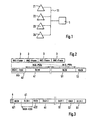
- Fig. 1 shows a communication network for a Communication system.
- a control center 1 communicates via a common transmission medium 11 with participants 21, 22, 23, ... in the form of terminals, the head office 1 coordinating Media access control (MAC) function perceives the shared medium. It is possible that the control center 1 is connected to an overlying network is, so that terminals with each other and with other participants of the Can connect to the network. But there is also Possibility that the control center 1 is not connected to a network is, so that the terminals only with the headquarters 1 and can communicate with each other. It is irrelevant whether Traffic is always routed through headquarters 1 or directly between terminals coordinated by headquarters 1 can be exchanged.
- the shared Transmission medium 11 is, for example, a radio channel but also a PON (passive optical network) or an HFC network (Hybrid Fiber Coax).
- the Transmission frames 3 are referred to here as MAC frames Contrary to [1] or [2], where they with signaling period are designated.
- the downlink signaling data phase 42 - BCH broadcast Channel
- the useful signal data phase 41 for the downlink It is called DLCH (Downlink Channel) and consists of N user data time slots for the DL-PDUs (Downlink Protocol Data Units).
- DLCH Downlink Channel
- N user data time slots for the DL-PDUs Downlink Protocol Data Units
- the uplink signaling data phase is 52 referred to as RACH (Random Access Channel).
- the downlink signaling data phase BCH is as in FIG. 2 shown divided into two categories, namely one the centralized signaling data phase 421 - BCCH (Broadcast Control Channel) - and a protocol-related Signaling data phase 422 - FCCH (Frame Control Channel).
- BCCH 421 can send the central 1 information to the terminals pass on that are of global relevance for the headquarters 1 and are communicating with the connected terminals. To include information such as the capabilities of the Central, manufacturer information, current operating modes and Head office address.
- the FCCH 422 determines the structure and content of the remaining transmission frame 3 (MAC frame).
- the FCCH has more local, related to the MAC frame Importance.
- Fig. 2 only the principle of the frame structure to show, the BCCH and the FCCH are immediate represented in a row without the solutions according to the invention for the frame structure to take into account the following are explained.
- MAC frame 3 begins with an identifier 6, which clearly shows that here the The beginning of the MAC frame is.
- An example of such an identifier is z. B. described in [1].
- the follows Signaling data phase 421 - BCCH - in which, among other things, the time interval (indirect identifier) between BCCH and FCCH - T Index (BCCH - FCCH) - is included. This information is provided by the terminals 21, 22, 23, ... evaluated so that the FCCH can be specifically demodulated.
- temporal reference points must be defined, which are in the 3 the end of the BCCH and the start of the FCCH are. It is equally possible that the temporal reference of the BCCH the beginning or a time in the middle of the BCCH or even the identifier is.
- the FCCH reference time could alternatively at the beginning or somewhere in the middle of the FCCH lie. It is possible that a terminal has this time Distance T Index (BCCH - FCCH) fixed by the manufacturer gets. This distance can be determined from manufacturer-specific considerations or from a standard be derived.
- BCCH - FCCH Another option is a flexible distance T index (BCCH - FCCH), which depends on the needs of each situation is calculated by headquarters 1 and communicated to the terminals becomes.
- the current distance can be transmitted in the BCCH the terminals are done. This favors that the entire DLCH 1 (Downlink user data signal phase 41) can be filled if, as previously explained, the length of the DL-PDUs is not constant and is composed of elements of different durations.
- the granularity of this time interval can be in system cycles are measured, this system clock generally in one Standard must be committed.
- One more way is the explicit establishment of a temporal granularity, the z. B. the duration of the smallest unit from which a DL-PDU can be composed, can correspond. Essential to it is that this temporal granularity is a common divisor of the Any DL-PDUs will last.
- the function of the FCCH is in [1] and [2] fully described; he shares the terminals Time slots for reception and transmission too. Also the temporal Sequence of the individual elements of a MAC frame 3 and the Effects of the FCCH are recorded there. A terminal that If you want to register again, you can use the knowledge of the FCCH timing of the remaining elements of the MAC frame 3 and of course also calculate the RACH and with its help in Establish communication with headquarters.
- the position of the BCCH 421 is not directly at the beginning of the MAC frame 3, but has a constant distance from the beginning of the MAC frames.
- the position of the BCCH 421 is not at the beginning of the MAC frame 3 lies, which is provided with the identifier 6 as a frame identifier, it may be advantageous to have an additional identifier 61 directly in front of it the BCCH 421, which is easy to detect. This is shown in Fig. 6. Here too there is the possibility insert another identifier before FCCH 422, where the Identification 61 before BCCH 421 can be present or omitted can be.
Landscapes
- Engineering & Computer Science (AREA)
- Computer Networks & Wireless Communication (AREA)
- Signal Processing (AREA)
- Mobile Radio Communication Systems (AREA)
- Small-Scale Networks (AREA)
- Time-Division Multiplex Systems (AREA)
- Communication Control (AREA)
Claims (13)
- Procédé de transmission de données sur un support commun avec une centrale (1) et un grand nombre de participants (21, 22, 23,...), au cours duquel les paquets de données sont envoyés « Downlink » de la centrale (1) vers les participants (21, 22, 23,...) « Uplink »et des participants (21, 22, 23,...) vers la centrale (1), au cours duquel la centrale (1) prend en charge une fonction de coordination pour l'accès au support via un cadre de diffusion orienté protocole et au cours duquel un cadre de diffusion (3), parallèlement aux phases de données du signal utile (41, 51) présente des phases de données de signalisation pour « Downlink » (42) et « Uplink » (52), tout en respectant les mesures suivantes :les phases de données de signalisation pour « Downlink » (42) sont réparties dans les phases de données de signalisation (421) de la centrale et les phases de données de signalisation (422) du protocole,il y a au moins une détection (6, 61, 62) de la position temporelle de la phase de données de signalisation du protocole (422) de « Downlink » dans le cadre de diffusion (3),la détection (6, 61, 62) de la position temporelle de la phase de données de signalisation du protocole (422) de « Downlink » est directement intégrée à une phase de données de signalisation pour « Downlink ».
- Procédé de transmission de données sur un support commun avec une centrale (1) et un grand nombre de participants (21, 22, 23,...), au cours duquel les paquets de données sont envoyés de la centrale (1) vers les participants (21, 22, 23,...) « Downlink » et des participants (21, 22, 23,...) vers la centrale (1), « Uplink », au cours duquel la centrale (1) prend en charge une fonction de coordination pour l'accès au support via un cadre de diffusion orienté protocole et au cours duquel un cadre de diffusion (3), parallèlement aux phases de données du signal utile (41, 51) présente des phases de données de signalisation pour « Downlink » (42) et « Uplink » (52), tout en respectant les mesures suivantes :les phases de données de signalisation pour « Downlink » (42) sont réparties dans les phases de données de signalisation (421) de la centrale et les phases de données de signalisation (422) du protocole,il y a au moins une détection (6, 61, 62) de la position temporelle de la phase de données de signalisation du protocole (422) de « Downlink » dans le cadre de diffusion (3),la détection (6, 61, 62) de la position temporelle de la phase de données de signalisation du protocole (422) de « Downlink » dérive d'une autre détection (6, 61, 62), particulièrement prévue pour le positionnement de la phase de données de signalisation (421) de la centrale.
- Procédé selon la revendication 1 ou 2,
caractérisé en ce que
dans la phase de données de signalisation (421) de la centrale, une indication de la dernière position est prévue pour assurer une détection indirecte de la phase de données de signalisation (422) du protocole, cette indication contenant en particulier l'intervalle de temps avec la phase de données de signalisation (422) du protocole. - Procédé selon l'une des revendications 1 à 3,
caractérisé en ce que
la phase de données de signalisation (421) du participant est prévue à chaque début d'un cadre de diffusion (3). - Procédé selon l'une des revendications 1 à 4,
caractérisé en ce que
immédiatement avant une phase de données de signalisation (421) de la centrale, une détection (6, 61, 62) est prévue et sert en particulier également à caractériser le début d'un cadre de diffusion (3). - Procédé selon l'une des revendications 1 à 3,
caractérisé en ce que
l'intervalle de temps entre une phase de données de signalisation de la centrale et une phase de données de signalisation du protocole (421, 422) est préalablement déterminé. - Procédé selon l'une des revendications 1 à 3,
caractérisé en ce que
l'intervalle de temps entre une phase de données de signalisation de la centrale et une phase de données de signalisation du protocole (421, 422) est variable et est à chaque fois communiqué aux participants (21, 22, 23,...) à partir de la centrale (1). - Procédé selon l'une des revendications 1 à 7,
caractérisé en ce que
l'intervalle de temps entre une phase de données de signalisation de la centrale et une phase de données de signalisation du protocole (421, 422) est rempli de données utiles. - Procédé selon l'une des revendications 1 à 3,
caractérisé en ce qu'
une phase de données de signalisation de la centrale (421) n'est pas prévue dès au début d'un cadre de diffusion (3), mais présente en particulier une distance constante depuis le début d'un cadre de diffusion. - Procédé selon l'une des revendications 1 à 9,
caractérisé en ce que
les points de référence temporels sont prévus aussi bien pour la phase de données de signalisation de la centrale que pour la phase de données de signalisation du protocole (421, 422), ces points de référence temporels se trouvant soit au début, soit au milieu de chaque phase de données de signalisation ou au moins dans une détection. - Procédé selon la revendication 9 ou 10,
caractérisé en ce qu'
avant une phase de données de signalisation de la centrale (421) et également avant une phase de données de signalisation du protocole (422), une détection est prévue, ces détections se différenciant en particulier l'une de l'autre indépendamment du fait que la position de la phase de données de signalisation du protocole (422) soit ou non indiquée dans la phase de données de signalisation de la centrale (421). - Procédé selon la revendication 9 ou 10,
caractérisé en ce qu'
uniquement avant la phase de données de signalisation du protocole (422), une détection (6, 61, 62) est prévue, indépendamment du fait que la position de la phase de données de signalisation du protocole (422) soit ou non indiquée dans la phase de données de signalisation de la centrale. - Procédé selon l'une des revendications 1 à 12,
caractérisé en ce qu'
indépendamment des détections (6, 61, 62), des phases de données de signalisation, une détection supplémentaire du cadre de diffusion (3) est prévue.
Applications Claiming Priority (3)
| Application Number | Priority Date | Filing Date | Title |
|---|---|---|---|
| DE19847777 | 1998-10-16 | ||
| DE19847777A DE19847777A1 (de) | 1998-10-16 | 1998-10-16 | Einrichtung zur Datenübertragung |
| PCT/DE1999/002685 WO2000024158A2 (fr) | 1998-10-16 | 1999-08-27 | Dispositif pour la transmission de donnees |
Publications (2)
| Publication Number | Publication Date |
|---|---|
| EP1121782A2 EP1121782A2 (fr) | 2001-08-08 |
| EP1121782B1 true EP1121782B1 (fr) | 2003-10-22 |
Family
ID=7884709
Family Applications (1)
| Application Number | Title | Priority Date | Filing Date |
|---|---|---|---|
| EP99953616A Expired - Lifetime EP1121782B1 (fr) | 1998-10-16 | 1999-08-27 | Procédé de transmission de données |
Country Status (7)
| Country | Link |
|---|---|
| US (1) | US7023834B1 (fr) |
| EP (1) | EP1121782B1 (fr) |
| JP (1) | JP4465116B2 (fr) |
| AT (1) | ATE252797T1 (fr) |
| DE (2) | DE19847777A1 (fr) |
| ES (1) | ES2211187T3 (fr) |
| WO (1) | WO2000024158A2 (fr) |
Families Citing this family (4)
| Publication number | Priority date | Publication date | Assignee | Title |
|---|---|---|---|---|
| JP4617000B2 (ja) * | 1999-04-07 | 2011-01-19 | テレフオンアクチーボラゲット エル エム エリクソン(パブル) | 長い通信チャネルと短い通信チャネルの順序付け |
| US7869801B2 (en) * | 2006-10-18 | 2011-01-11 | Pine Valley Investments, Inc. | Method for terminal configuration over a radio control channel |
| KR101352980B1 (ko) | 2006-11-01 | 2014-01-22 | 삼성전자주식회사 | 하향링크 제어 및 패킷 데이터 송수신 방법 및 장치 |
| CA2616623C (fr) * | 2007-01-03 | 2012-04-03 | Skyline Displays, Inc. | Systeme d'affichage tubulaire multiconfigurable |
Family Cites Families (6)
| Publication number | Priority date | Publication date | Assignee | Title |
|---|---|---|---|---|
| US6016319A (en) * | 1995-10-31 | 2000-01-18 | Lucent Technologies, Inc. | Communications system for transmission of datagram packets over connection-oriented networks |
| DE19726120A1 (de) | 1997-06-20 | 1998-12-24 | Bosch Gmbh Robert | Verfahren zur Datenübertragung auf einem gemeinsamen Medium |
| DE19856043A1 (de) * | 1998-12-04 | 2000-07-06 | Bosch Gmbh Robert | Einrichtung zur Datenübertragung |
| US6622251B1 (en) * | 1999-04-07 | 2003-09-16 | Telefonaktiebolaget Lm Ericsson (Publ) | Method to put a mobile terminal into sleep when a frame control channel containing a location of slow broadcast channel does not include wakeup information |
| US6363267B1 (en) * | 1999-04-07 | 2002-03-26 | Telefonaktiebolaget Lm Ericsson (Publ) | Mobile terminal decode failure procedure in a wireless local area network |
| ATE441301T1 (de) * | 1999-07-09 | 2009-09-15 | Sony Deutschland Gmbh | Zellreichweiten-erweiterung in radiokommunikationssystemen mit leistungsregelung der abwärtsrichtung |
-
1998
- 1998-10-16 DE DE19847777A patent/DE19847777A1/de not_active Withdrawn
-
1999
- 1999-08-27 JP JP2000577799A patent/JP4465116B2/ja not_active Expired - Lifetime
- 1999-08-27 WO PCT/DE1999/002685 patent/WO2000024158A2/fr not_active Ceased
- 1999-08-27 ES ES99953616T patent/ES2211187T3/es not_active Expired - Lifetime
- 1999-08-27 EP EP99953616A patent/EP1121782B1/fr not_active Expired - Lifetime
- 1999-08-27 DE DE59907476T patent/DE59907476D1/de not_active Expired - Lifetime
- 1999-08-27 AT AT99953616T patent/ATE252797T1/de not_active IP Right Cessation
- 1999-08-27 US US09/807,710 patent/US7023834B1/en not_active Expired - Lifetime
Non-Patent Citations (1)
| Title |
|---|
| GIBSON: "The Mobile Communications Handbook, Seiten 401 bis 402", 1996, SPRINGER VERLAG, HEIDELBERG, -1999 * |
Also Published As
| Publication number | Publication date |
|---|---|
| US7023834B1 (en) | 2006-04-04 |
| WO2000024158A3 (fr) | 2000-07-27 |
| EP1121782A2 (fr) | 2001-08-08 |
| ATE252797T1 (de) | 2003-11-15 |
| WO2000024158A2 (fr) | 2000-04-27 |
| JP4465116B2 (ja) | 2010-05-19 |
| JP2002528961A (ja) | 2002-09-03 |
| ES2211187T3 (es) | 2004-07-01 |
| DE19847777A1 (de) | 2000-04-20 |
| DE59907476D1 (de) | 2003-11-27 |
Similar Documents
| Publication | Publication Date | Title |
|---|---|---|
| DE69532467T2 (de) | Nachrichtenübertragungssystem für ein versorgungsnetz | |
| DE69025067T2 (de) | Datenübertragungsverfahren für ein digitales nachrichtennetz | |
| EP0425470B1 (fr) | Réseau de transmission optique et méthode de transmission d'information binaire dans un réseau de transmission optique | |
| DE69534813T2 (de) | Verfahren und Anordnung zur dynamischen Bandbreitenzuordnung in einem TDM/TDMA-Übertragungssystem | |
| DE69029513T2 (de) | Vielfachzugriffssystem für ein übertragungsnetz | |
| DE3047045A1 (de) | Dienstintegriertes uebertragungssystem | |
| DE4228583A1 (de) | System zur Schaffung einer Vielzahl von gleichzeitig an einer ISDN-Basisraten-S/T-Schnittstelle operierenden durchgeschalteten Kommunikationskanälen | |
| DE69627630T2 (de) | Fernmeldenetzwerk mit vielfachzugriff | |
| WO1994013112A1 (fr) | Installation et procede de commutation pour systeme de radiotelephonie du genre a central local ou a commutateur prive | |
| EP0233963B1 (fr) | Système radio-mobile numérique | |
| DE19856043A1 (de) | Einrichtung zur Datenübertragung | |
| DE3337646C2 (de) | Funknetz mit einer Vielzahl von mobilen Stationen | |
| DE19636394A1 (de) | Lokales, nach dem asynchronen Transfermodus arbeitendes Netzwerk in Ringstruktur mit drahtlosen Terminals | |
| EP0831663B1 (fr) | Procédé de transmission de données numériques sans fil | |
| DE69801728T2 (de) | Gerät und Verfahren zur Teilung eines Signalisierungskanals | |
| EP0202191A2 (fr) | Circuit pour un système de communication pour la transmission d'informations de message de terminaux à bande étroite et à large bande à l'intérieur de réseaux locaux en forme d'anneau | |
| EP0110464A1 (fr) | Standard privé | |
| DE4008729C2 (fr) | ||
| WO1987004035A1 (fr) | Systeme permettant le fonctionnement simultane de plusieurs terminaux sur un bloc de raccordement d'un reseau a large bande | |
| EP1121782A2 (fr) | Dispositif pour la transmission de donnees | |
| DE60004992T2 (de) | Verfahren zur funksignalverbreitung von einer radiokommunikation basisstation, basisstation und mobile endgeräte dafür | |
| DE60207533T2 (de) | Verfahren zur Zeitschlitzverwaltung und Struktur eines Aufwärtssignalrahmens | |
| DE3337643C2 (fr) | ||
| DE69107534T2 (de) | Digitales Kommunikationssystem für eine digitale dienstintegrierte Fernsprechanlage. | |
| DE69938502T2 (de) | Verfahren zur Verteilung von Aufwärtszeitschlitzen in einem Zeitverteilungszugangssystem, und entsprechende Leitungs- und Netzabschlusseinheit |
Legal Events
| Date | Code | Title | Description |
|---|---|---|---|
| PUAI | Public reference made under article 153(3) epc to a published international application that has entered the european phase |
Free format text: ORIGINAL CODE: 0009012 |
|
| 17P | Request for examination filed |
Effective date: 20010516 |
|
| AK | Designated contracting states |
Kind code of ref document: A2 Designated state(s): AT BE CH CY DE DK ES FI FR GB GR IE IT LI LU MC NL PT SE |
|
| RTI1 | Title (correction) |
Free format text: DATA TRANSMISSION METHOD |
|
| RTI1 | Title (correction) |
Free format text: DATA TRANSMISSION METHOD |
|
| GRAH | Despatch of communication of intention to grant a patent |
Free format text: ORIGINAL CODE: EPIDOS IGRA |
|
| RTI1 | Title (correction) |
Free format text: DATA TRANSMISSION METHOD |
|
| GRAS | Grant fee paid |
Free format text: ORIGINAL CODE: EPIDOSNIGR3 |
|
| GRAA | (expected) grant |
Free format text: ORIGINAL CODE: 0009210 |
|
| AK | Designated contracting states |
Kind code of ref document: B1 Designated state(s): AT BE CH CY DE DK ES FI FR GB GR IE IT LI LU MC NL PT SE |
|
| PG25 | Lapsed in a contracting state [announced via postgrant information from national office to epo] |
Ref country code: NL Free format text: LAPSE BECAUSE OF FAILURE TO SUBMIT A TRANSLATION OF THE DESCRIPTION OR TO PAY THE FEE WITHIN THE PRESCRIBED TIME-LIMIT Effective date: 20031022 Ref country code: IE Free format text: LAPSE BECAUSE OF FAILURE TO SUBMIT A TRANSLATION OF THE DESCRIPTION OR TO PAY THE FEE WITHIN THE PRESCRIBED TIME-LIMIT Effective date: 20031022 Ref country code: FI Free format text: LAPSE BECAUSE OF FAILURE TO SUBMIT A TRANSLATION OF THE DESCRIPTION OR TO PAY THE FEE WITHIN THE PRESCRIBED TIME-LIMIT Effective date: 20031022 Ref country code: CY Free format text: LAPSE BECAUSE OF FAILURE TO SUBMIT A TRANSLATION OF THE DESCRIPTION OR TO PAY THE FEE WITHIN THE PRESCRIBED TIME-LIMIT Effective date: 20031022 |
|
| REG | Reference to a national code |
Ref country code: GB Ref legal event code: FG4D Free format text: NOT ENGLISH |
|
| REG | Reference to a national code |
Ref country code: CH Ref legal event code: EP |
|
| REG | Reference to a national code |
Ref country code: IE Ref legal event code: FG4D Free format text: GERMAN |
|
| REF | Corresponds to: |
Ref document number: 59907476 Country of ref document: DE Date of ref document: 20031127 Kind code of ref document: P |
|
| PG25 | Lapsed in a contracting state [announced via postgrant information from national office to epo] |
Ref country code: GR Free format text: LAPSE BECAUSE OF FAILURE TO SUBMIT A TRANSLATION OF THE DESCRIPTION OR TO PAY THE FEE WITHIN THE PRESCRIBED TIME-LIMIT Effective date: 20040122 Ref country code: DK Free format text: LAPSE BECAUSE OF FAILURE TO SUBMIT A TRANSLATION OF THE DESCRIPTION OR TO PAY THE FEE WITHIN THE PRESCRIBED TIME-LIMIT Effective date: 20040122 |
|
| REG | Reference to a national code |
Ref country code: SE Ref legal event code: TRGR |
|
| REG | Reference to a national code |
Ref country code: CH Ref legal event code: NV Representative=s name: SCINTILLA AG, DIREKTION |
|
| GBT | Gb: translation of ep patent filed (gb section 77(6)(a)/1977) |
Effective date: 20040210 |
|
| NLV1 | Nl: lapsed or annulled due to failure to fulfill the requirements of art. 29p and 29m of the patents act | ||
| REG | Reference to a national code |
Ref country code: IE Ref legal event code: FD4D |
|
| REG | Reference to a national code |
Ref country code: ES Ref legal event code: FG2A Ref document number: 2211187 Country of ref document: ES Kind code of ref document: T3 |
|
| ET | Fr: translation filed | ||
| PG25 | Lapsed in a contracting state [announced via postgrant information from national office to epo] |
Ref country code: LU Free format text: LAPSE BECAUSE OF NON-PAYMENT OF DUE FEES Effective date: 20040827 Ref country code: AT Free format text: LAPSE BECAUSE OF NON-PAYMENT OF DUE FEES Effective date: 20040827 |
|
| PLBE | No opposition filed within time limit |
Free format text: ORIGINAL CODE: 0009261 |
|
| STAA | Information on the status of an ep patent application or granted ep patent |
Free format text: STATUS: NO OPPOSITION FILED WITHIN TIME LIMIT |
|
| PG25 | Lapsed in a contracting state [announced via postgrant information from national office to epo] |
Ref country code: MC Free format text: LAPSE BECAUSE OF NON-PAYMENT OF DUE FEES Effective date: 20040831 Ref country code: BE Free format text: LAPSE BECAUSE OF NON-PAYMENT OF DUE FEES Effective date: 20040831 |
|
| 26N | No opposition filed |
Effective date: 20040723 |
|
| BERE | Be: lapsed |
Owner name: ROBERT *BOSCH G.M.B.H. Effective date: 20040831 |
|
| BERE | Be: lapsed |
Owner name: ROBERT *BOSCH G.M.B.H. Effective date: 20040831 |
|
| PG25 | Lapsed in a contracting state [announced via postgrant information from national office to epo] |
Ref country code: PT Free format text: LAPSE BECAUSE OF NON-PAYMENT OF DUE FEES Effective date: 20040322 |
|
| REG | Reference to a national code |
Ref country code: FR Ref legal event code: PLFP Year of fee payment: 18 |
|
| REG | Reference to a national code |
Ref country code: FR Ref legal event code: PLFP Year of fee payment: 19 |
|
| REG | Reference to a national code |
Ref country code: FR Ref legal event code: PLFP Year of fee payment: 20 |
|
| PGFP | Annual fee paid to national office [announced via postgrant information from national office to epo] |
Ref country code: ES Payment date: 20180921 Year of fee payment: 20 Ref country code: FR Payment date: 20180824 Year of fee payment: 20 Ref country code: IT Payment date: 20180823 Year of fee payment: 20 |
|
| PGFP | Annual fee paid to national office [announced via postgrant information from national office to epo] |
Ref country code: GB Payment date: 20180828 Year of fee payment: 20 Ref country code: SE Payment date: 20180827 Year of fee payment: 20 Ref country code: CH Payment date: 20180827 Year of fee payment: 20 |
|
| PGFP | Annual fee paid to national office [announced via postgrant information from national office to epo] |
Ref country code: DE Payment date: 20181024 Year of fee payment: 20 |
|
| REG | Reference to a national code |
Ref country code: DE Ref legal event code: R071 Ref document number: 59907476 Country of ref document: DE |
|
| REG | Reference to a national code |
Ref country code: CH Ref legal event code: PL |
|
| REG | Reference to a national code |
Ref country code: GB Ref legal event code: PE20 Expiry date: 20190826 |
|
| REG | Reference to a national code |
Ref country code: SE Ref legal event code: EUG |
|
| PG25 | Lapsed in a contracting state [announced via postgrant information from national office to epo] |
Ref country code: GB Free format text: LAPSE BECAUSE OF EXPIRATION OF PROTECTION Effective date: 20190826 |
|
| REG | Reference to a national code |
Ref country code: ES Ref legal event code: FD2A Effective date: 20200721 |
|
| PG25 | Lapsed in a contracting state [announced via postgrant information from national office to epo] |
Ref country code: ES Free format text: LAPSE BECAUSE OF EXPIRATION OF PROTECTION Effective date: 20190828 |