EP1122194B1 - Vorrichtung und Verfahren für automatisiertes Warenlager - Google Patents
Vorrichtung und Verfahren für automatisiertes Warenlager Download PDFInfo
- Publication number
- EP1122194B1 EP1122194B1 EP01300846A EP01300846A EP1122194B1 EP 1122194 B1 EP1122194 B1 EP 1122194B1 EP 01300846 A EP01300846 A EP 01300846A EP 01300846 A EP01300846 A EP 01300846A EP 1122194 B1 EP1122194 B1 EP 1122194B1
- Authority
- EP
- European Patent Office
- Prior art keywords
- product
- products
- handling device
- storage
- rack
- Prior art date
- Legal status (The legal status is an assumption and is not a legal conclusion. Google has not performed a legal analysis and makes no representation as to the accuracy of the status listed.)
- Expired - Lifetime
Links
Images


Classifications
-
- B—PERFORMING OPERATIONS; TRANSPORTING
- B65—CONVEYING; PACKING; STORING; HANDLING THIN OR FILAMENTARY MATERIAL
- B65G—TRANSPORT OR STORAGE DEVICES, e.g. CONVEYORS FOR LOADING OR TIPPING, SHOP CONVEYOR SYSTEMS OR PNEUMATIC TUBE CONVEYORS
- B65G1/00—Storing articles, individually or in orderly arrangement, in warehouses or magazines
- B65G1/02—Storage devices
- B65G1/04—Storage devices mechanical
- B65G1/137—Storage devices mechanical with arrangements or automatic control means for selecting which articles are to be removed
- B65G1/1373—Storage devices mechanical with arrangements or automatic control means for selecting which articles are to be removed for fulfilling orders in warehouses
- B65G1/1378—Storage devices mechanical with arrangements or automatic control means for selecting which articles are to be removed for fulfilling orders in warehouses the orders being assembled on fixed commissioning areas remote from the storage areas
-
- G—PHYSICS
- G06—COMPUTING OR CALCULATING; COUNTING
- G06Q—INFORMATION AND COMMUNICATION TECHNOLOGY [ICT] SPECIALLY ADAPTED FOR ADMINISTRATIVE, COMMERCIAL, FINANCIAL, MANAGERIAL OR SUPERVISORY PURPOSES; SYSTEMS OR METHODS SPECIALLY ADAPTED FOR ADMINISTRATIVE, COMMERCIAL, FINANCIAL, MANAGERIAL OR SUPERVISORY PURPOSES, NOT OTHERWISE PROVIDED FOR
- G06Q50/00—Information and communication technology [ICT] specially adapted for implementation of business processes of specific business sectors, e.g. utilities or tourism
- G06Q50/04—Manufacturing
-
- B—PERFORMING OPERATIONS; TRANSPORTING
- B65—CONVEYING; PACKING; STORING; HANDLING THIN OR FILAMENTARY MATERIAL
- B65G—TRANSPORT OR STORAGE DEVICES, e.g. CONVEYORS FOR LOADING OR TIPPING, SHOP CONVEYOR SYSTEMS OR PNEUMATIC TUBE CONVEYORS
- B65G1/00—Storing articles, individually or in orderly arrangement, in warehouses or magazines
- B65G1/02—Storage devices
- B65G1/04—Storage devices mechanical
- B65G1/137—Storage devices mechanical with arrangements or automatic control means for selecting which articles are to be removed
- B65G1/1371—Storage devices mechanical with arrangements or automatic control means for selecting which articles are to be removed with data records
Definitions
- the instant invention relates generally to an apparatus and method for material or article handling, and relates more specifically to an apparatus and method for article handling which provides the ability to selectively charge a plurality of products from a source and selectively discharge a plurality of products to a location via a control system responsive to changeable operating instructions.
- Each method requires as its initial step that a manufactured product be delivered and stored in bulk at a product storing and order fulfillment area, such as a warehouse.
- a product storing and order fulfillment area such as a warehouse.
- a number of bulk cases of a particular product are then placed together on a pallet.
- Separate pallets, each containing one type of product are strategically located throughout the warehouse.
- Individual units of the product are then manually picked as needed from the cases.
- Types of products are picked in response to a plurality of customer orders. Due to the limited amount of space in any product storing and order fulfillment area, however, only a limited number of products can be placed near a picking device. It is at this point that the three methods mentioned above diverge.
- a product is stored in particular ones of a plurality of vertical channels associated with an order processing device.
- a belt section, or alternatively, a bin, on a conveyer is assigned to a specific customer order.
- the conveyor with the belt section, passes underneath the plurality of vertical channels. Those channels containing a product called for by the customer order dispense the proper number of units of the product onto the belt section.
- the belt section after receiving the product, passes under the next channel containing a next product called for by the product order. The process continues until the order is complete.
- a similar process is used to fill a next customer order.
- the A-frame apparatus When a vertical channel becomes depleted of a product, it is typically, as with the pick-to-light method and apparatus, manually replenished by employees from cases located behind the vertical channel. The same problem regarding substantial handling and human intervention is thus associated with the A-frame method and apparatus.
- the A-frame apparatus usually has large channels. Because of this, the A-frame apparatus is generally best suited for a high volume product which requires a low number of stocking units. Low volume products must be manually added to the belt sections prior to placement of products selected from the large vertical channels, which compounds the problem of labor costs. An additional problem arises in that because two systems of product dispensing are used, system maintenance costs are increased when using this method and apparatus.
- a product is stored in horizontal channels with a product being assigned to a pre-determined number of such channels.
- a belt section, or alternatively, a bin, on a conveyer is assigned to a specific customer order.
- the conveyor with the belt section, passes underneath the plurality of horizontal channels. Those channels containing a product requested by the customer order dispense the proper number of units of the product onto the belt section.
- the belt section after receiving the product, passes under the next channel containing a next product called for by the product order. The process then continues until the order is complete. A next order is processed in a similar manner.
- a further problem, associated with all three methods and apparatus described above, is that the pallet storage, as well as the horizontal and vertical channel apparatus with accompanying conveyor transportation center requires an expansive amount of floor space for the product storing and order fulfillment area.
- Yet another problem associated with each of the foregoing methods and their accompanying apparatus is that they are not well suited for multi-item inventories comprising small cartons.
- United States Patent 5,379,229 discloses an automated system for storing and retrieving objects from multiple object categories.
- a plurality of storage rack assemblies is included. Each storage rack assembly has a plurality of slots sized for storing objects.
- a storage transport is movable alongside each respective storage rack assembly for positioning adjacent any slot.
- a plurality of horizontal tracks are arranged to be perpendicular to the storage rack assemblies. Each storage rack assembly has an end adjacent the tracks.
- a runner transport is coupled to and movable on each track for receiving one of the objects from, or providing one of the objects to a storage transport.
- Two conveyor rack assemblies are located at opposite ends of the tracks, aligned perpendicularly to the track. Conveyor transports are adjacent the conveyor rack assemblies for transferring objects between the conveyor rack assembly and the runner transports.
- Storage and retrieval operation requests are generated by simultaneously providing positioning signals to a conveyor transport, a runner transport and a storage transport.
- Storage transports are selected in accordance with a predetermined transport selection function.
- Storage slots are selected in accordance with a predetermined slot selection function.
- a database stores the category, age and location of each of the objects.
- United States Patent 5,793,633 discloses a storage management system for controlling product supply to and product delivery from a product depot station disposed between two processing stations on a product transportation line where receptacles are loaded with a plurality of kinds of products so as to maintain an appropriate size of stock of various kinds of products, and to deliver products of any specific kind in conformity with a request of delivery from the succeeding station.
- the present invention provides an apparatus for handling products, comprising a computer processing system; two or more storage racks comprising a plurality of individually addressable storage locations for densely storing a plurality of products in a centralised area wherein at least one of said storage racks is capable of being moved in relation to at least one other storage rack, the positions of each of the storage racks are capable of being controlled by said computer processing system, and each of said storage locations is capable of being accessed by at lesat one product handling device; means for inputting identifying information for said plurality of products into said computer processing system; said at least one product handling device capable of being controlled by said computer processing system for placing at least one of the plurality of products into a storage location that is determined by said computer processing system just prior to placing said product; and memory in said computer processing system which stores the identifying information of said product and said storage location.
- the present invention further provides methods for handling products as recited in claims 21 to 36.
- Such methods and apparatus allow for dense storage of a plurality of products in a centralized area. Products may be continually placed in an apparatus of the instant invention, allowing for keeping the apparatus full of products with minimal additional labor. Thus, a nearly unlimited number of stocking units may be continually processed in a warehouse facility.
- the methods and apparatus of the instant invention allow for products to be picked in accordance with a customer order.
- a customer requires a plurality of contact lens packages in a plurality of prescriptions, i.e., a plurality of product types
- the present invention allows for the products to be automatically picked.
- the products within an order may be sorted prior to or after picking if desired, for example, according to either increasing or decreasing prescription sizes.
- Picked products may be sorted into orders after picking and then placing on the out-feed conveyor. Other product sorting methods may easily be accommodated. The picking and placing can occur simultaneously, intermittently, or as-needed.
- the "identification means” is a number, bar-code, two dimensional matrix, three dimensional matrix, inductive transmitting/receiving device, or radio frequency chip, or the like.
- each identification means contains some unique information for every part having one.
- Identification means may be machine readable and/or likewise readable, preferably at least machine readable.
- a machine readable identification means preferably has information stored in a database associated with the identification means.
- the information stored in the database associated with the identification means may not be present on the packaging in human-readable form. That is, the only way to know which product is in the packaging is to access the information in the database by inputting the identification means into the database, via a bar-code reader or the like.
- the preferred identification means is a bar-code, two dimensional matrix, or three dimensional matrix.
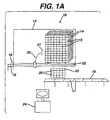
- FIGS. 1A through 3 display a preferred apparatus for automated product storage and order fulfillment and accompanying methods for using the same.
- Apparatus 10 is referred to herein as the Vertical Stacking Grid (VSG).
- VSG 10 includes an in-feed conveyor 12, racks 14, an out-feed conveyor 16, a reader 18, a robotic arm 20, rails 22, order staging areas 23, and a computer processing system (CPS) 24 which communicates with each of the foregoing via communication lines 19.
- CPS computer processing system
- In-feed conveyor 12 may be an automated conveyor belt or the like which transports products to a location accessible to robotic arm 20.
- the in-feed conveyor 12 is accessible to employees for placing manufactured products thereon or is accessible to one or more automatic product depositing devices (not shown) for accomplishing the same.
- the in-feed conveyor 12 may be controlled by CPS 24.
- Racks 14 each contain a plurality of storage locations or spaces 15 for storing individual product units, such as cartons or packages of a product.
- Each space 15 may be uniform in size or may be of varied dimensions so that a plurality of different product types, which may be of different sizes, may be accommodated.
- space 15 may instead be a hook, pocket, bracket, velcro strip, or any other implement for securing a product in a storage location.
- the racks 14 may be stationary or moveable along rails 22 so that each space 15 in the racks 14 is accessible to robotic arm 20.
- the racks 14 may be moveable in one, two or three dimensions.
- the racks 14 may be formed of any of a number of materials, such as, preferably, a lightweight material (for example, aluminum) which may be formed to have spaces 15 for storing products. Each space 15 is preferably individually addressable by CPS 24. In one embodiment, a space 15 may be assigned an address such as "051A,” meaning rack 5, row 1, column A. Other addressing schemes may be successfully implemented. It is further contemplated that the racks 14 may optionally be enclosed by an enclosure 13, for example, a glass or plexiglass enclosure to protect the stored products from dust, humidity, light, or the like. One of ordinary skill in the art will appreciate that any number of racks may be used with VSG 10.
- a lightweight material for example, aluminum
- racks 14 are shown to be rectangular and in a vertical orientation, it will be appreciated by one of ordinary skill in the art that they may have any shape and may be arranged in any useful orientation so long as assignable storage locations are accessible to a picking and/or placing device, as described further hereinbelow.
- Out-feed conveyor 16 includes a conveyor belt operative to transport groups of ordered products away from VSG 10.
- Out-feed conveyor 16 may include any number of belt sections 17, which may be individually assigned to a specific customer order and tracked by CPS 24.
- Each belt section 17 may have an identifying means which is preferably machine-readable, e.g. a bar code.
- Belt sections 17 may serve as a staging area for assembling ordered products in lieu of the plurality of staging areas 23, shown and described in more detail below. Conveyor 16 and/or belt sections 17 are further contemplated to be accessible to employees for removing assembled products from VSG 10 for shipping or the like.
- out-feed conveyor 16 may include individual bins or shipping boxes (not shown) which may be connected together or provided individually and which operate for the same purpose as belt sections 17.
- Out-feed conveyor 16 is, furthermore, optionally controllable by CPS 24.
- Reader 18 may be any type of scanner, such as an optical scanner coupled with optical character recognition software, which may be stored in reader 18 or in program 38 of CPS 24. Reader 18 may further be an infrared or magnetic scanner for reading compatible identification means on the products. In a preferred embodiment, reader 18 is a bar code scanner and the identification means is a bar code. Other useful readers will be apparent to one of ordinary skill in the art. The reader 18 reads the identification means from the product. Reader 18 is preferably operative to transmit the information in the identification means to CPS 24 in an intelligible format. It is further contemplated that product identification means or label information may be manually input to CPS 24, in which case reader 18 may be omitted. When product information is input into CPS 24, it is stored in the database 40 (Fig. 2).
- Reader 18 may further be used to automatically verify that the correct products were assembled after picking in response to a customer order prior to shipment of the assembled products by, for example, placing a second or multiple readers (not shown) near out-feed conveyor 16 so that the identification means on the picked products may be read and confirmed prior to placement of the product on the out-feed conveyor 16 or prior to shipping an order.
- Robotic arm 20 may be any product handling device.
- Robotic arm 20 preferably includes one or more grippers 21 operative to hold and move product to be placed in and picked from rack 14 in response to a customer order.
- Robotic arm 20 is preferably motorized and may be moveable in one, two or three dimensions so that it may access any space 15 on the plurality of racks 14.
- Robotic arm 20 is, furthermore, controllable by CPS 24 to direct the removal of a product from in-feed conveyor 12, place the product in an addressable space 15 on a rack 14, pick a product from that or another space 15, optionally sort the picked product in a staging area 23 and/or transport the product to out-feed conveyor 16 and/or a belt section 17.
- Robotic arm 20 is further contemplated to be moveable along the entire enclosure 13.
- Placement and picking operations performed by robotic arm 20 are optionally controllable by a separate programmable logic controller (PLC) (not shown) which may cooperate with CPS 24.
- PLC programmable logic controller
- the address of the storage location is stored in the database 40 with the corresponding product information.
- the availability of the storage location, which the product occupied, is noted by CPS 24.
- robotic arm 20 can pick and place a plurality (e.g. 2 to 10 or more) products at a time with a plurality of grippers 21.
- robotic arm 20 may be controlled to pick and place products on the fly (i.e. in an assembly-line fashion) optionally in conjunction with a single transport conveyor (not shown) which may take the place of the in-feed conveyor 12 and the out-feed conveyor 16.
- the picked products may be sorted downstream of VSG 10 by operators or a separate apparatus (not shown).
- each robotic arm can perform the picking and placing tasks, or one or more arms can just pick and one or more robotic arms can just place.
- each rack could have one or more robotic arms, which pick and/or place on just that rack.
- Alternative embodiments would be evident to a person of ordinary skill in the art. The description of what robotic arm 20 does applies to multiple robotic arms.
- Rails 22 preferably guide the racks 14 in a one-dimensional direction along the length of each rail 22. It is contemplated, however, that racks 14 may be moveable in more than one direction or dimension, in which case, rails 22 would be correspondingly adapted for such, or omitted altogether. If the racks are stationary, greater range of motion could be provided to the robotic arm 20.
- staging areas 23 are optionally included within VSG 10 for temporarily storing picked products while a particular customer order is being assembled, prior to transporting the assembled order to out-feed conveyor 16.
- the staging areas 23 can be like mini-racks, that is, they have storage locations called slots 25 which are preferably individually addressable so the products within the slots 25 or the availability of the slots can be tracked by a database.
- the database can be the same or different from the one that tracks the storage locations 15.
- the staging areas 23 may be constructed in a similar form and materials as the racks 14.
- staging areas 23 may be replaced by a method wherein robotic arm 20 places products onto an out-feed conveyor 16 as the products are picked, and sorting of the products into individual orders takes place downstream by a separate apparatus (not shown).
- staging areas 23 each having a plurality of individually addressable slots 25.
- Fig. 1A five staging areas are shown, each having four slots 25.
- a plurality of orders may be picked simultaneously. The maximum number of orders that can be so handled may correspond directly to the total number slots 25 if each order consists of one product.
- each staging area 23 Preferably only one order is assigned to each staging area 23, although multiple staging areas 23 may be assigned to one order.
- the maximum number of orders that may be picked simultaneously corresponds to the number of staging areas 23, if each order has the same number or fewer products in each order than the number of slots per staging area 23.
- VSG has ten staging areas having four slots each; therefore, preferably a maximum of ten orders each having 4 or fewer products, can be picked simultaneously.
- multiple staging areas will be assigned to that order. For example an order for seven products will be assigned to two staging areas. For orders having more than forty products, all the staging areas will be assigned as available to four products in the order until the order is filled.
- the product(s) in those staging area(s) are pushed by one or more pusher bar(s) 27, preferably there is one pusher bar for each staging area with fingers for each slot in the staging area, onto the conveyor belt preferably grouped together as sorted, (described in more detail below) and transported to packaging.
- the conveyor belt preferably grouped together as sorted, (described in more detail below) and transported to packaging.
- the next order or orders from the order list 33 are assigned to the now available staging area(s) 23. If needed multiple belt sections or groupings on the out-feed conveyor will be assigned to portions of the order.
- CPS 24 is preferably configured to coordinate operation of in-feed conveyor 12, racks 14, out-feed conveyor 16, reader 18 and robotic arm 20, and receive the order list 33, and optionally receive other inputs from other input devices 32, and produce other outputs to other output devices 34.
- CPS 24 may be any type of computer, PLC and the like. CPS 24 is operative to receive program instructions and user inputs, and is further operative to output results corresponding to such instructions and inputs, such as paper verifications of each customer order, in accordance with the present invention, and CPS 24 may generate signals for controlling any or all of in-feed conveyor 12, racks 14, out-feed conveyor 16, reader 18 and robotic arm 20. Alternatively CPS 24 may provide data to one or more PLC's (not shown) for accomplishing the same.
- CPS 24 includes a processor 26 which may be any commonly available microprocessor, such as the PENTIUM III manufactured by INTEL CORP, and memory 36 which stores program 38 and database 40.
- Other input device 32 may be one or more commonly known devices used for communicating information to CPS 24 via either another computer processing system or by user inputs. Accordingly, other input device 32 may include a keyboard, a mouse, a graphics tablet, a scanner, a voice recognition unit, a parallel or serial communication port, a network connection and any appropriate network or other communication card for receiving data. Other input device 32 is operative to allow a user to input instructions and values in accordance with the present invention.
- Other output device 34 may be one or more commonly known devices used by CPS 24 to communicate results of instructions and values to an employee. Accordingly, other output device 34 may include a display monitor, a voice synthesizer, a printer, a parallel or serial communication port, a network connection, any appropriate network, other communications apparatus for sending data, and the like.
- Memory 36 may be an internal or external high capacity memory device for storing computer processing system data, the storage capacity of which is typically measured in megabytes or gigabytes.
- Memory 36 stores, inter alia, an operating system such as WINDOWS NT by MICROSOFT CORP, and one or more application programs 38.
- memory 36 may be one or more of the following: a floppy disk drive, a hard disk drive, a CD-ROM disk and reader/writer, a DVD disk and reader/writer, a ZIP disk and a ZIP drive of the type manufactured by IOMEGA CORP., and/or any other computer processing system readable medium that may be encoded with processing instructions in a read-only or read-write format. Further functions of and available devices for memory 36 will be apparent to one of ordinary skill in the art.
- the memory 36 preferably comprises random-access memory (RAM) and read only memory (ROM).
- the RAM may be a suitable number of Single In-line Memory Module (SIMM) chips having a storage capacity (typically measured in kilobytes or megabytes) sufficient to store and transfer, inter alia, processing instructions utilized by processor 26 and received from program 38 during operation of CPS 24.
- the read-only memory (ROM) portion of memory 36 may be any permanent non-rewritable memory medium capable of storing and transferring, inter alia, processing instructions performed by processor 26 during a start-up routine of CPS 24. Further functions of memory 36 and available devices for memory 36 will be apparent to one of ordinary skill in the art.
- CPS 24 may comprise additional parts of a computer, e.g. clock. These parts are not described herein and are known to a person of ordinary skill in the art.
- Program 38 includes a plurality of processing instructions which enables CPS 24 to receive input data and information in accordance with the present invention, e.g. product information.
- the program 38 may be written in any conventional computer processing system language that is comprehensible to CPS 24, such as C++ or VISUAL BASIC and may include a database 40, such as an SQL-based database program.
- Program 38 preferably includes processing instructions allowing CPS 24 to receive products, to place the products into VSG, to store the product information and the storage location for a product in a database, to accept customer orders in the order list 33 received through a communication port or other input device 32, and to pick products on the order list 33 from the storage locations 15.
- the program 38 has processing instructions for sorting the products within each order by power, cylinder and axis (from highest to lowest for each). Further, preferably the program 38 has processing instructions for assigning the staging areas and the slots 25 in each staging area 23 to the orders and the products in each order. Preferably, the products in the orders are assigned slots 25 in the staging areas 23 in sequence after the orders products in the order are sorted by power, cylinder and axis to maintain the picked products within the orders in the sorted sequence.
- program 38 preferably includes processing instructions allowing CPS 24 to determine a placement priority of incoming products, and determine appropriate locations 15 in racks 14 for placing each product, based on their priority and available storage locations 15. In particular, a higher priority product will be placed in a more easily or more readily accessible storage location 15 in the racks 14. Priority may be determined based on any number of factors or combinations thereof including: an expiration date of the product, a demand or projected demand for the product and the type of product, including an SKU or serial number associated with the product.
- the highest priority type(s) of product(s) based on highest sales is (are) assigned a storage location in the first rack
- the lowest priority type(s) of product(s) based on the lowest sales is (are) assigned a storage location in the last rack.
- the first rack would be closest to the robotic arm 20 and the last rack is furthest from the robotic arm 20; therefore, the highest priority products would be stored in the rack closest to the robotic arm.
- the storage location 15 is determined in real time, that is, the storage location is determined for a product after the scanner 18 reads the identification means of the product and just before the product is placed in a storage location. If there are no available spaces in the rack or part of the rack which is to hold product of that priority, the product will be assigned to an available storage location for products of the next priority.
- the program 38 will not determine a priority for the products and instead products can be assigned a storage location based on the availability of storage locations in the rack most convenient to the robotic arm 20.
- the program 38 provides that during peak operating hours picking is accomplished by selecting an ordered product in the order list 33 which is in a closest storage location 15 to robotic arm 20 at the time a customer order is processed. That is, program 38 may be operative to pick products according to current accessibility. In particular, CPS 24 may determine which rack 14 is most accessible to robotic arm 20 at any given time, and products meeting the customer order will be selected from that rack first. Alternative picking schemes may be performed by CPS 24, during off-peak hours. That is, program 38 may be operative to pick products based on a first-in-first-out picking scheme implemented during non-peak operating hours.
- a date and time that each product was received by VGS 10 is stored in a field (not shown) of database 40 shown in Fig. 3 and products to be picked in response to a customer order are selected in order of when they were received by VSG 10.
- the most conveniently located products to the robotic arm are picked, except that this is overridden when products are close to their expiration date or within their expiration date window, which will be explained below.
- Program 38 updates the order list and the database 40 when products are picked and/or orders are satisfied.
- program 38 preferably includes processing instructions allowing CPS 24 to generate reports confirming that particular customer orders have been satisfied. These reports may be used by employees to visually verify each order assembled by VSG 10 prior to transporting the order via out-feed conveyor 16 or prior to to shipping the assembled orders to the customer/recipient. Program 38 may further generate inventory reconciliations, the use of which is well known to one of ordinary skill in the art.
- FIG. 3 illustrates exemplary fields which may be included in a database 40 used by CPS 24 to track products stored in VSG 10.
- the database 40 may include product type field 41, product SKU field 42, storage location field 43, priority field 44, expiration date field 45, and expiration date window field 46, each described in more detail below. Records stored in database 40 are automatically or manually updated upon receipt or removal of a product by VSG 10. Each record or row of database 40 preferably corresponds to one individual product unit. Additional or fewer fields may be used successfully with the present invention and many equivalent configurations of the data fields of database 40 exist as will be apparent to one of ordinary skill in the art.
- Product type field 41 optionally contains a human-comprehensible description of each product stored in VSG 10.
- Product SKU field 42 preferably contains a product serial number or the like read by reader 18 and transmitted to CPS 24 for each product stored in VSG 10.
- Storage location field 43 contains the address for a storage location 15 in which a particular product is stored, as determined, for example, by CPS 24, e.g. rack, row, column.
- Optional priority field 44 stores the assigned priority for the product as determined by CPS 24.
- Optional expiration date field 45 stores the expiration date for each product stored in VSG 10.
- an expiration date window field 46 which is determined in accordance with processing instructions in program 38 for each product based on the product's expiration date and demand for the product.
- the expiration date window stored in field 46 is a date before the actual expiration date of the product at and after which the program will instruct the robotic arm 20 to pick that product if ordered (instead of a more conveniently located product).
- Different products have different expiration date windows depending upon expected demand for the product. If demand for the product is high the expiration date window will be closer to the expiration date, e.g. 4 weeks before the expiration date. If demand for a product is low, then the expiration date window may be 6 months to a year before the expiration date of the product, to increase the chance that a product is picked in response to a customer order before the product actually expires.
- the information stored in field 42 is preferably transmitted to CPS 24 by reader 18 after being read from the identification means on the product label.
- the information in fields 43, 44 and 46 is preferably determined by program 38, as described above. Alternatively, information for any or all fields may be manually inputted via the input device 32. Additional information such as power, cylinder and axis information for contact lens product can be stored in database table 40 or in an alternative table (not shown) which is keyed to one or more of the fields shown in database 40.
- the product type 41 or other information can be copied from the production database into database 40 after the product SKU is read from the identification means on the product label.
- a warehousing or manufacturing facility receives or produces a plurality of different types of products, such as boxes of contact lenses of various sizes and prescriptions. These products are placed onto an in-feed conveyor 12 by manual or automatic means. Each of the plurality of products bears an identification means (preferably a bar code) which may contain an SKU or other product identifier.
- the in-feed conveyor 12 transports each of the products from its initial location to a reader 18. Reader 18 is preferably two bar code scanners which are controlled by CPS 24 to each read the identification means on a product, so that multiple products, in this case two products, may be scanned simultaneously.
- Each of the two bar code scanners transmits the scanned information to CPS 24 for storage in database 40.
- Each of the products waits under a scanner until picked up by robotic arm 20. When one or both of the products are picked up by the robotic arm 20 for placement into the rack 14, one or two products move into position under the scanner(s), and is (are) read. Presently, the robotic arm 20 moves one product at a time.
- Program 38 of CPS 24 determines a priority for each received product prior to lifting it from the in-feed conveyor 12.
- the priority of each product of the product types may be classified on a scale of, e.g. 1 to 10, each number in the scale representing the rack in which the product type or types will be placed. Presently there are ten racks in the preferred embodiment.
- the priority of each product is preferably determined by a demand associated with each of the product types, based on historical sales data for each product. Referring to FIG. 3, for example, a first product with SKU number CL0001 corresponds to a package of contact lenses of a first power, cylinder, and axis which is in the greatest demand. Accordingly, the first product will then receive the highest priority, for example, priority 1.
- the product having the next highest demand will be assigned priority 2, and so on.
- the top ten demanded products may each be assigned priority 1.
- the next ten products in decreasing order of demand will be assigned priority 2, and so on.
- the ten highest in demand may be assigned a priority of 1, the next 30 types of products in terms of demand assigned a priority of 2, the next 100 types of products in demand assigned a priority of 3, etc. and the lowest priority may be assigned to 500 types of products.
- priority field 44 of database 40 may be omitted and that products may be sorted by their SKU's which may each be directly associated with a particular historical demand level.
- the priority numbers in the scale do not have to match the number of racks, because product(s) having more than one priority may be assigned to a single rack, or product(s) having one priority may be assigned to more than one rack.
- CPS 24 determines an appropriate storage location 15 for the product.
- the storage location 15 is preferably selected based on the priority level determined for that product, which may be based upon a demand for that product as previously stated. Selection is also based on availability. If a rack has no available storage locations, then the program 38 will assign the product to the next closest available storage location. Thus, products having the highest priority may be stored in the first rack of VSG 10, unless the first rack is full, in which case the product will be assigned a storage location in the second rack. Products having the next highest demand may be stored in the second rack, and so on.
- Products are preferably assigned to the storage locations 15 in real time, or there may be a delay between the time of receipt of the product and its assignment to a storage location 15. It should be apparent to one of ordinary skill in the art that the ratio of the types of products to storage locations need not be one-to-one.
- the ratio of types of products to storage locations can vary as desired. This invention is particularly beneficial when there are many types of products to be stored in a minimum area.
- the ratio of types of products to storage locations in the apparatus can be larger than 1 to 1, even larger than 2 to 1, or 3 to 1, and theoretically there is no limit.
- the products may be placed in accordance with received customer orders.
- a customer order may call for twenty packages of a first product type and twenty packages of a second product type.
- CPS 24 may then direct robotic arm 20 to place the first twenty packages of the first and second product types as they are received from in-feed conveyor 12 into spaces of the rack 14 which are most conveniently located to the robotic arm 20.
- each product may be placed in the closest available storage location in the rack that the VSG is picking from or placing in.
- the products on the in-feed conveyor can be placed in a first rack until there are no more available storage locations and then the racks and/or the robotic arm may move to a second rack from which product is to be picked; the robotic arm may pick all the products for the orders that the VSG is filling from the second rack, and then place all the products from the in-feed conveyor until there are no more available storage locations in the second rack, or no more product is waiting on the in-feed conveyor 12 to be placed, and then move to a third rack which may be the same or different from the first rack, to pick the next product(s) from the order list for the orders which are being filled, and then place products from the in-feed conveyor, and so on.
- Other placing schemes may be implemented as will be apparent to one of ordinary skill in the art.
- Picking of the products preferably occurs in accordance with individual orders which are received by a separate order processing system and communicated to CPS 24, preferably from a central customer order machine servor (not shown). Customer orders can be received by phone, mail, internet, facsimile, or by any method. Some order taking procedures are disclosed in US Patent 4,958,280, others are known in the art.
- the orders are organized into a data-base and communicated to CPS 24 as order list 33.
- the orders are sorted by program 38 as described above. In the embodiment having one or more staging areas 23, depending upon the number of staging areas 23 and/or slots 25 available, the CPS 24 will assign particular orders from the order list 33 to the available staging areas 23 and/or slots.
- An order will be temporarily skipped if a product which is part of that order is not in any storage location 15 in VSG 10.
- all orders or parts of orders that have been assigned to staging areas 23 are preferably on a working order list, which can be a separate database (not shown) stored in CPS 24.
- orders will continuously be moved onto the working order list from the order list 33, and off the working order list when the products have been picked and placed onto the out-feed conveyor 16.
- the working order list can have fields which track the products stored in the staging areas, if present. Products are not removed from the working order list until the products in an entire order are pushed from the one or more staging areas onto the out-feed conveyor 16.
- the working order list is just a discrete number of products off the top of the order list to be picked by robotic arm 20.
- the working order list is updated as the products are picked and placed on the out-feed conveyor 16.
- CPS 24 will direct the robotic arm 20 to pick the next ordered product on the working order list, which may require the movement of one or more racks 14 to a rack at which the robotic arm 20 will pick and/or place product referred to as the working rack.
- the product is picked it is transported to its assigned staging area 23, and placed in the assigned slot 25 for that product. If there are additional products on the working order list to be picked from the working rack, then the robotic arm 20 will pick all the products from the working rack and place all the products into the assigned slot(s) 25 in the staging area 23.
- the CPS 24 checks the products under the scanner(s) 18 on the in-feed conveyor 12 for product that should be placed in the working rack. If the product is to be placed in the working rack, a storage location is assigned by CPS 24, the product is lifted by the robotic arm from the conveyor 12 and placed into storage location 15 in the working rack. The product information and storage locations are saved in database 40 after one or more products are removed from underneath the scanners 18, products on in-feed conveyor 12 move underneath the scanners 18, and are read by the scanners 18.
- the process of placing products into storage locations in the working rack continues until either both products underneath the scanners do not belong on the working rack in accordance with their assigned priorities, or the rack has no more available storage locations or there are no more products on the in-feed conveyor. Once no more products can be placed in the working rack, (and there are no products to pick on the working order from the working rack) the working rack changes to a different rack which has at least one product in the working order list to be picked from that rack.
- the program may change to a rack which has the most products on the working order list present on that rack or it may pick products in the order that they appear in the working order list, or some combination of the these methods, or another method.
- the robotic arm 20 picks products present on the working rack according to the working list and then the products, if any, on the conveyor under the scanners that belong on the working rack are placed, then the working rack is changed to pick the next product or products on the working order list.
- the filled order or orders are assigned to one or more belt sections, the identification means of the belt section is read and stored with the order information in a database and the order is pushed by a push-bar 27 into the belt section.
- the order is pushed so that the products are maintained in their sorted order. Therefore, for example if an order consists of 8 different products, the order will be assigned to two staging areas 23. The first four products will be assigned to one staging area 23 which may be the seventh staging area from the left, and the next 4 products may be assigned to the third staging area from the left.
- the staging areas are assigned to the products on the working order list (or order list) in the sequence in which the staging areas became available.)
- the products in the seventh stage are pushed into the belt section first and the products in third staging area are pushed into the same belt section behind the other products so that the proper order of the power, cyclinder and axis of all the products in the order will be maintained.
- the out-feed conveyor 16 transports them to another location in the manufacturing facility or Warehouse.
- the next products from the order list 33 are moved onto the working order list, assigned to slots in the staging area and the process continues.
- the staging area can be removed from VSG 10 and the program 38 of CPS 24 may direct the robotic arm 20 to pick the products from the working order list (or order list) and place them on the out-feed conveyor 16 as they are picked.
- the CPS 24 sorts the products on the working order list to determine preferably the most conveniently located storage locations for instructing the robotic arm to pick the products.
- CPS 24 preferably re-sorts the working order list anytime it changes, the working rack changes, products are placed, etc. so that the robotic arms operates at maximum efficiency.
- the robotic arm 20 picks all the products on the working order list which are present on the working rack, places products from the in-feed conveyor 12 on the working rack (preferably based on an assigned priority), picks and/or places on a different working rack, and continues picking and placing as long as there are products to be picked and/or there are products to be placed.
- the program may provide that the robotic arm can pick directly from the in-feed conveyor if a product on the working order list is present on the in-feed conveyor, or it may instruct the robotic arm to place the product(s) onto the working rack and then pick (and place) again from the working rack if a product that was just placed is on the working order list before changing to a different working rack.
- the working order list is updated.
- the program 38 reaccesses the most convenient locations to pick and place products depending upon the constantly changing working order list and storage location availabilities.
- a separate order sorter is used.
- the picked products are transported to the order sorter by the out-feed conveyor 16 or the like.
- the order sorter provides separate staging areas for assembling the picked products into orders.
- the picked products can either be sorted mechanically, or by operators.
- VSG 10 is envisioned to include at least two moveable racks 14 and may be expandable to include ten or more racks. Any number of racks 14 may be included. Each such rack 14 preferably has a capacity of 1492 spaces to store cartons of small items, yielding a total of 14,920 cartons for a ten rack device. The device is to be used to store greater than ten thousand different types of products. Testing indicates that a device of this capacity would be operable to store several days of inventory, based on average demand, of, for example, particular prescriptions and sizes of contact lenses or other product types kept in similarly-sized cartons.
- CPS 24 may be one or more computers, PLC's or combinations thereof, which cooperate in the control and operation of VSG 10. It is further contemplated that a plurality of VSG's 10 may be located in a single warehouse and may be commonly controlled by a single CPS 24. When such a plurality of VSG's 10 are cooperatively operated, it will be appreciated that any of the priority picking and placing schemes disclosed above may be adapted to account for products in each of the VSG's when fulfilling customer orders.
- VSG 10 may be required to supervise or troubleshoot the operation of VSG 10, which is otherwise an automated apparatus. Methods of supervision and troubleshooting will be apparent to one of ordinary skill in the art.
Landscapes
- Engineering & Computer Science (AREA)
- Mechanical Engineering (AREA)
- Business, Economics & Management (AREA)
- Primary Health Care (AREA)
- Tourism & Hospitality (AREA)
- General Health & Medical Sciences (AREA)
- Human Resources & Organizations (AREA)
- Marketing (AREA)
- Health & Medical Sciences (AREA)
- Strategic Management (AREA)
- Economics (AREA)
- Physics & Mathematics (AREA)
- General Business, Economics & Management (AREA)
- General Physics & Mathematics (AREA)
- Theoretical Computer Science (AREA)
- Manufacturing & Machinery (AREA)
- Warehouses Or Storage Devices (AREA)
- Management, Administration, Business Operations System, And Electronic Commerce (AREA)
Claims (36)
- Vorrichtung (10) zur Handhabung von Produkten, umfassend:wobei die zumindest eine Produkthandhabungseinrichtung (20) durch das Computerverarbeitungssystem (24) zur Plazierung von zumindest einem der Vielzahl von Produkten in einem Lagerplatz, der durch das Computerverarbeitungssystem (24) gerade vor der Plazierung dieses Produktes bestimmt wird, gesteuert wird; undein Computerverarbeitungssystem (24);zwei oder mehr Lagerregale (14), die eine Vielzahl von individuell adressierbaren Lagerplätzen (15) zum dichten Lagern einer Vielzahl von Produkten in einem zentralisierten Bereich umfaßt, wobei zumindest eines der Lagerregale (14) dazu geeignet ist, in Bezug auf zumindest eines der anderen Lagerregale (14) bewegt zu werden, wobei die Positionen jedes der Lagerregale (14) mittels des Computerverarbeitungssystems (24) gesteuert werden und jeder der Lagerplätze dazu geeignet ist, dass auf diesen durch zumindest eine Produkthandhabungseinrichtung (20) zugegriffen wird;Mittel (18) zur Eingabe von Identifizierungsinformationen für die Vielzahl von Produkten in das Computerverarbeitungssystem (24);
einen Speicher (36) in dem Computerverarbeitungssystem (24), welcher die Identifizierungsinformationen des Produktes und des Lagerplatzes (15) speichert. - Vorrichtung nach Anspruch 1, dadurch gekennzeichnet, daß
das Computerverarbeitungssystem (24) zur Bestimmung des Lagerplatzes basierend auf einer zugeordneten Priorität geeignet ist. - Vorrichtung nach Anspruch 1, dadurch gekennzeichnet, daß
das Computerverarbeitungssystem (24) zur Bestimmung des Lagerplatzes basierend auf der Nähe eines verfügbaren Lagerplatzes (15) relativ zu der Produkthandhabungseinrichtung (20) geeignet ist. - Vorrichtung nach Anspruch 1, dadurch gekennzeichnet, daß
die Vorrichtung ferner ein Zustellungsfördermittel (12) zum Transport der Vielzahl von Produkten zu der Produkthandhabungseinrichtung (20) umfaßt. - Vorrichtung nach Anspruch 1, dadurch gekennzeichnet, daß
es sich bei dem Mittel zur Eingabe um eine Leseeinrichtung (18) zum Lesen eines Identifikationsmittels, das dem zumindest einen Produkt zugeordnet ist, handelt. - Vorrichtung nach Anspruch 2, dadurch gekennzeichnet, daß
es sich bei dem Mittel zur Eingabe um eine Leseeinrichtung (18) zum Lesen eines Identifikationsmittels handelt, welches die Identifizierungsinformation für das Produkt, die durch den Computer genutzt wird, um die zugeordnete Priorität für das Produkt zu bestimmen, dem Computerverarbeitungssystem (24) zur Verfügung stellt. - Vorrichtung nach Anspruch 6, dadurch gekennzeichnet, daß
es sich bei der Leseeinrichtung (18) um ein Strichcode- Einlesegerät handelt und es sich bei dem Identifikationsmittel um einen Strichcode handelt. - Vorrichtung nach Anspruch 1, dadurch gekennzeichnet, daß
der Speicher des Computerverarbeitungssystems (24) zur Speicherung eines Ablaufdatumsfensters des Produktes, das durch das Computerverarbeitungssystem (24) bestimmt wird, geeignet ist. - Vorrichtung nach Anspruch 2, dadurch gekennzeichnet, daß
die zugeordnete Priorität auf zumindest einer der folgenden Größen basiert: einem Bedarf, einem hochgerechneten Bedarf, einem Typ und einem Ablaufdatum eines Produktes. - Vorrichtung nach Anspruch 1, dadurch gekennzeichnet, daß
die Vorrichtung ferner eine oder mehrere Schienen (22) umfaßt, wobei das zumindest eine bewegbare Lagerregal (14) entlang dieser einen oder mehreren Schienen (22) in zumindest eine Richtung bewegbar ist. - Vorrichtung nach Anspruch 1, dadurch gekennzeichnet, daß
die zumindest eine Produkthandhabungseinrichtung (20) vorgegebene Produkte aus den Lagerplätzen (15) für die vorgegebenen Produkte entnimmt. - Vorrichtung nach Anspruch 11, dadurch gekennzeichnet, daß
die Vorrichtung ferner ein Auslauffördermittel (16) zum Transport des entnommenen Produktes, von der Produkthandhabungseinrichtung (20) weg, umfaßt. - Vorrichtung nach Anspruch 11, dadurch gekennzeichnet, daß
es sich bei der zumindest einen Produkthandhabungseinrichtung (20) zur Plazierung und der zumindest einen Produkthandhabungseinrichtung (20) zur Entnahme um die gleiche Produkthandhabungseinrichtung handelt. - Vorrichtung nach Anspruch 13, dadurch gekennzeichnet, daß
die zumindest eine Produkthandhabungseinrichtung (20) intermittierend die Produkte plaziert und entnimmt. - Vorrichtung nach Anspruch 11, dadurch gekennzeichnet, daß
die Vorrichtung ferner zumindest einen Zwischenspeicherbereich (23) zum Sammeln der entnommen Produkte umfaßt. - Vorrichtung nach Anspruch 14, dadurch gekennzeichnet, daß
die zumindest eine Produkthandhabungseinrichtung (20) zur Entnahme der Produkte in Übereinstimmung mit Kundenbestellungen geeignet ist. - Vorrichtung nach Anspruch 15, dadurch gekennzeichnet, daß
die zumindest eine Produkthandhabungseinrichtung (20) zur Entnahme der Produkte in Übereinstimmung mit Kundenbestellungen, nachdem die Kundenbestellungen sortiert wurden und jedes der Produkte einem Platz in dem Zwischenspeicherbereich (23) zugeordnet wurde, geeignet ist. - Vorrichtung nach Anspruch 11, dadurch gekennzeichnet, daß
das Verhältnis von Typen von Produkten und Lagerplätzen (15) größer als 1: 1 ist. - Vorrichtung nach Anspruch 16, dadurch gekennzeichnet, daß
das Computerverarbeitungssystem (24) ferner
zum Empfang
einer Kundenbestellung mittels einer Kommunikationsschnittstelle, wobei die Bestellung eine Auswahl von einem Produkt oder mehreren Produkten aufweist; und
zur Lenkung der Produkthandhabungseinrichtung (20), so daß die Auswahl von Produkten aus der Vielzahl von Produkten in den Lagerplätzen (15) entnommen wird, geeignet ist. - Vorrichtung nach Anspruch 1, dadurch gekennzeichnet, daß
die Vorrichtung ferner umfaßt:zumindest ein Fördermittel (12,16) zum Transport der Vielzahl von Produkten zu und von der Produkthandhabungseinrichtung (20) weg. - Verfahren, das durch ein Computerverarbeitungssystem (24) ausgeführt wird, zur Handhabung von Produkten, umfassend die Schritte:Eingabe einer Produktidentifizierungsinformation für ein Produkt in eine Datenbank (40) in dem Computerverarbeitungssystem (24), wobei jeder Produkttyp eine andere Produktidentifizierungsinformation aufweist;Auswahl eines Lagerplatzes (15) für das Produkt, wobei der Lagerplatz (15) dazu geeignet ist, das auf ihn durch zumindest eine Produkthandhabungseinrichtung (20) zugegriffen wird und er von einer Vielzahl von individuell adressierbaren Lagerplätzen (15), die in einer Vielzahl von Lagerregalen (14) angeordnet sind, ausgewählt ist, und zumindest eines der Lagerregale (14) dazu geeignet ist, um relativ zu zumindest einem anderen Lagerregal (14) bewegt zu werden;Steuerung der Positionen jedes der Lagerregale (14);Lenkung der zumindest einen Produkthandhabungseinrichtung (20), um das Produkt in dem Lagerplatz (15) zu plazieren; undSpeicherung von Identifikationsinformationen zur Aufzeichnung des Lagerplatzes (15) in der Datenbank (40), die dem Produkt zugeordnet ist.
- Verfahren nach Anspruch 21, dadurch gekennzeichnet, daß
vor dem Auswahlschritt der Schritt der Bestimmung einer Priorität des Produktes vorhanden ist und darüber hinaus der Auswahlschritt auf dieser Priorität basiert. - Verfahren nach Anspruch 22, dadurch gekennzeichnet, daß
die Priorität basierend auf zumindest einer der folgenden Größen bestimmt wird:einem Bedarf, einem hochgerechneten Bedarf, einem Produkttyp und einem Ablaufdatum, der bzw. das zu dem Produkt korrespondiert. - Verfahren nach Anspruch 21, dadurch gekennzeichnet, daß
der Auswahlschritt auf der Nähe eines verfügbaren Lagerplatzes (15) zu der Handhabungsvorrichtung (20) basiert. - Verfahren nach Anspruch 21, dadurch gekennzeichnet, daß
das Verfahren ferner umfaßt:die SchritteEmpfangen von Kundenbestellungsinformationen; undLenken der Produkthandhabungseinrichtung (20), um das Produkt aus einem der Lagerplätze (15) zu entnehmen, um die Kundenbestellung zu erfüllen. - Verfahren nach Anspruch 25, dadurch gekennzeichnet, daß
der Lenkungsschritt entweder das Produkt aus dem Lagerplatz (15), am besten an die Produkthandhabungseinrichtung (20), entnimmt oder das Produkt basierend auf einem Ablaufdatum des Produktes entnimmt. - Verfahren nach Anspruch 21, dadurch gekennzeichnet, daß
das Verfahren ferner den Schritt des
Empfangens eines Produktes von einem Zustellungsfördermittel (12) vor dem Eingabeschritt umfaßt, wobei der Eingabeschritt durch Scannen eines Identifikationsmittels, das mit dem Produkt korrespondiert, auftritt. - Verfahren nach Anspruch 21, dadurch gekennzeichnet, daß
das Verfahren ferner umfaßt:Empfangen einer oder mehrerer Kundenbestellungen enthaltend eine Vielzahl von Produkttypen, wobei die Produkttypen in einer Vielzahl von Lagerplätzen (15) vorhanden sind;Abrufen einer Vielzahl von Datensätzen für die Lagerplätze (15), die zu der Vielzahl von bestellten Produkttypen, die durch die computergesteuerte Vorrichtung gelagert werden, korrespondiert, aus der Datenbank (40); undEntnehmen der Produkte aus den Lagerplätzen (15). - Verfahren nach Anspruch 28, dadurch gekennzeichnet, daß
der Entnahmeschritt durch Lenken der Produkthandhabungseinrichtung (20) zum Plazieren des Produktes auf einem Auslauffördermittel (16) durchgeführt wird. - Verfahren nach Anspruch 29, dadurch gekennzeichnet, daß
der Schritt des Lenkens der Produkthandhabungseinrichtung (20), um das Produkt auf dem Auslauffördermittel (16) zu plazieren, einen zusätzlichen Schritt des Lenkens der Produkthandhabungseinrichtung (20) zum Plazieren des Produktes in einem Bestellungszwischenspeicherbereich (23) mit der Vielzahl von Produkttypen in der Kundenbestellung umfaßt. - Verfahren nach Anspruch 28, dadurch gekennzeichnet, daß
der Entnahmeschritt die Auswahl des Produktes basierend auf einer der folgenden Größen umfaßt:einem Zeitpunkt, zu dem das Produkt empfangen wurde, oder dem Platz des Produktes. - Verfahren nach Anspruch 22, dadurch gekennzeichnet, daß
der Schritt der Bestimmung einer Priorität des Produktes die Bestimmung der Priorität basierend auf zumindest einer der folgenden Größen enthält:einem Bedarf an dem Produkt, einem hochgerechneten Bedarf an dem Produkt, einem Produkttyp und einem Ablaufdatum des Produktes. - Verfahren, daß von einem Computerverarbeitungssystem (24) zur Handhabung von Produkten ausgeführt wird, umfassend die Schritte:Platzieren einer Vielzahl von Produkttypen in Lagerplätzen (15), die in verschiedenen Regalen (14) angeordnet sind;Empfangen einer Vielzahl von Bestellungen für eine Auswahl von Produkttypen; Arbeiten mit einer begrenzten Anzahl von Bestellungen oder Produkten zur Entnahme der Produkttypen;Entnehmen erster bestellter Produkttypen unter Verwendung eines Produkthandhabers (20), wobei die ersten bestellten Produkttypen in einem ersten Arbeitsregal (14) angeordnet sind und das erste Arbeitsregal (14) benachbart zu einem Produkthandhaber (20) angeordnet ist;Ablegen des aus dem ersten Arbeitsregal (14) entnommenen Produkts auf einem Auslauffördermittel (16);Plazieren eines Produktes von einem Zustellungsfördermittel (12) in Lagerplätzen (15) in dem ersten Arbeitsregal (14), bis sich entweder kein Produkt mehr auf dem Zustellungsfördermittel (12) befindet, keine weiteren offenen Lagerplätze (15) auf dem Arbeitsregal (14) vorhanden sind oder das Produkt auf dem Zustellungsfördermittel (12) nicht in dem ersten Arbeitsregal (14) plaziert werden soll;Bewegen des ersten Arbeitsregals (14) und des Produkthandhabers (20) zum Entnehmen von zusätzlichen Produkttypen zu einem zweiten Arbeitsregal (14);Entnehmen von zweiten bestellten Produkttypen unter Verwendung eines Produkthandhabers (20) wobei die zweiten bestellten Produkttypen auf einem zweiten Arbeitsregal (14) angeordnet sind, wobei das zweite Arbeitsregal (14) benachbart dem Produkthandhaber (20) angeordnet ist;Ablegen des von dem zweiten Arbeitsregal (14) entnommenen Produktes auf einem Auslauffördermittel (16); undPlazieren eines Produktes von einem Zustellungsfördermittel (12) in einem Lagerplatz (15) auf dem zweiten Arbeitsregal (14), bis sich entweder kein Produkt mehr auf dem Zustellungsfördermittel (12) befindet, keine weiteren offenen Lagerplätze (15) auf dem zweiten Arbeitsregal (14) vorhanden sind oder das Produkt auf dem Zustellungsfördermittel (12) nicht in dem zweiten Arbeitsregal (14) plaziert werden soll.
- Verfahren nach Anspruch 33, dadurch gekennzeichnet, daß
der Ablegeschritt den zusätzlichen Schritt des Lenkens der Produkthandhabungseinrichtung (20) umfaßt, um das Produkt in einem Bestellungszwischenspeicherbereich (23), vor dem Ablegen der Produkte auf dem Auslauffördermittel (16), nachdem die Produkte in einer Kundenbestellung in dem Zwischenspeicherbereich (23) gesammelt wurden, zu plazieren. - Verfahren nach Anspruch 33, dadurch gekennzeichnet, daß
die Entnahme- und Plazierungsschritte gleichzeitig auftreten. - Verfahren nach Anspruch 33, dadurch gekennzeichnet, daß
die Bewegungs-, Entnahme-, Ablege- und Plazierungsschritte für dritte bestellte Produkttypen, die auf einem dritten Arbeitsregal (14), das das gleiche oder ein anderes als das erste Arbeitsregal (14) sein kann, angeordnet sind, wiederholt werden.
Applications Claiming Priority (2)
| Application Number | Priority Date | Filing Date | Title |
|---|---|---|---|
| US49486000A | 2000-02-01 | 2000-02-01 | |
| US494860 | 2000-02-01 |
Publications (2)
| Publication Number | Publication Date |
|---|---|
| EP1122194A1 EP1122194A1 (de) | 2001-08-08 |
| EP1122194B1 true EP1122194B1 (de) | 2004-11-10 |
Family
ID=23966278
Family Applications (1)
| Application Number | Title | Priority Date | Filing Date |
|---|---|---|---|
| EP01300846A Expired - Lifetime EP1122194B1 (de) | 2000-02-01 | 2001-01-31 | Vorrichtung und Verfahren für automatisiertes Warenlager |
Country Status (12)
| Country | Link |
|---|---|
| EP (1) | EP1122194B1 (de) |
| JP (1) | JP2001301930A (de) |
| KR (1) | KR20010078237A (de) |
| CN (1) | CN1236983C (de) |
| AR (1) | AR027340A1 (de) |
| AU (1) | AU1678301A (de) |
| BR (1) | BR0102364A (de) |
| CA (1) | CA2333334A1 (de) |
| DE (1) | DE60106989T2 (de) |
| HK (1) | HK1039310B (de) |
| SG (1) | SG99342A1 (de) |
| TW (1) | TW589275B (de) |
Cited By (7)
| Publication number | Priority date | Publication date | Assignee | Title |
|---|---|---|---|---|
| WO2010091275A3 (en) * | 2009-02-08 | 2014-03-13 | Perry North | Automated bike parking system |
| NO340173B1 (no) * | 2005-03-09 | 2017-03-20 | Konecranes Finland Oy | Fremgangsmåte for plassering av en palleløs varepakke på en lagerhylle og utlevering derfra, samt for styring av pakkelogistikken |
| WO2020121333A1 (en) * | 2018-12-14 | 2020-06-18 | Saint-Gobain Glass France | An order management and distribution center |
| WO2021161333A1 (en) * | 2020-02-13 | 2021-08-19 | Saint-Gobain Glass France | A system and method for design and manufacture of shower cubicles |
| EP3355255B1 (de) * | 2014-06-03 | 2022-08-03 | Ocado Innovation Limited | Lagersystem und verfahren zur steuerung der bewegung einer transportvorrichtung in einer anlage zur lagerung von behältern |
| EP4112235A4 (de) * | 2020-02-28 | 2024-06-12 | OMRON Corporation | Transportsystem und transportroboter |
| US12274382B2 (en) | 2023-06-05 | 2025-04-15 | LensLogix, Inc. | Automated product cabinet for inventory control |
Families Citing this family (109)
| Publication number | Priority date | Publication date | Assignee | Title |
|---|---|---|---|---|
| GB2396859B (en) * | 2000-08-21 | 2005-02-09 | Singapore Technologies Logisti | Order-handling inventory management system and method |
| US20030083890A1 (en) * | 2001-11-01 | 2003-05-01 | Duncan Gregory Scott | Automated pack out |
| DK1346929T3 (da) * | 2002-03-19 | 2006-03-27 | Swisslog Italia Spa | Automatisk, modulært lager |
| AU2003231430B8 (en) | 2002-05-13 | 2009-07-30 | Bakvertisi Limited | Apparatus for transporting containers |
| CA2736598C (en) * | 2002-05-13 | 2014-05-27 | Bakvertisi Limited | Apparatus for storing containers |
| AU2002346033A1 (en) * | 2002-07-02 | 2004-01-23 | Johnson And Johnson Vision Care, Inc. | Process and apparatus for automatically sorting a random assemblage of products associated with a particular order order builder |
| CN100460295C (zh) * | 2003-03-31 | 2009-02-11 | 株式会社戴福库 | 物品分类设备 |
| CN100453426C (zh) * | 2003-05-15 | 2009-01-21 | 周锡卫 | 可动态编码与自动提醒的多仓室存储盒控制方法 |
| CA2443755A1 (en) * | 2003-10-22 | 2005-04-22 | Martin Assmann | Combination shipping container and display rack |
| AU2005276960B2 (en) * | 2004-08-27 | 2010-11-25 | Hatch Associates Pty Limited | Control system for a material handling facility |
| WO2006021052A1 (en) * | 2004-08-27 | 2006-03-02 | Hatch Associates Pty Ltd | Control system for a material handling facility |
| KR100672085B1 (ko) * | 2004-12-21 | 2007-01-19 | 재단법인 포항산업과학연구원 | Rfid 태그를 이용한 원료 수송 방법 및 장치 |
| DE102005007730A1 (de) * | 2005-02-19 | 2006-08-31 | Dirk Rolf Beils | Verfahren und Lagersystem für die rechnergestützte Lagerung von Arzneimitteln |
| DE202006015150U1 (de) * | 2006-09-29 | 2007-10-25 | Vogt, Manfred | System zur automatischen Verpackung von Arzneimitteln |
| JP5115501B2 (ja) * | 2009-03-12 | 2013-01-09 | 株式会社Ihi | 基板仕分け装置及び基板仕分け方法 |
| US20180144574A9 (en) * | 2009-04-22 | 2018-05-24 | Franca Renna | Automated ophthalmic lens and solutions dispensing unit |
| KR101194189B1 (ko) * | 2010-04-06 | 2012-10-25 | (주)제이브이엠 | 약품보관 및 약품 인출입 자동화 관리시스템 |
| DE102010028769A1 (de) * | 2010-05-07 | 2011-11-10 | Pvt Probenverteiltechnik Gmbh | System zum Transportieren von Behältern zwischen unterschiedlichen Stationen und Behälterträger |
| WO2012077018A1 (en) * | 2010-12-10 | 2012-06-14 | Pirelli & C. S.P.A. | A method for organising an exhibitor |
| US9561905B2 (en) | 2010-12-15 | 2017-02-07 | Symbotic, LLC | Autonomous transport vehicle |
| US9499338B2 (en) | 2010-12-15 | 2016-11-22 | Symbotic, LLC | Automated bot transfer arm drive system |
| US8965619B2 (en) | 2010-12-15 | 2015-02-24 | Symbotic, LLC | Bot having high speed stability |
| TWI588072B (zh) * | 2010-12-15 | 2017-06-21 | 辛波提克有限責任公司 | 自動運輸機器酬載對準及感測 |
| CN102849387A (zh) * | 2011-07-28 | 2013-01-02 | 南通天华和睿科技创业有限公司 | 一种自动化立体仓库系统 |
| EP2589966A1 (de) | 2011-11-04 | 2013-05-08 | Roche Diagnostics GmbH | Laborprobenverteilungssystem und entsprechendes Betriebsverfahren |
| EP2589968A1 (de) | 2011-11-04 | 2013-05-08 | Roche Diagnostics GmbH | Laborprobenverteilungssystem, Laborsystem und Betriebsverfahren |
| EP2589967A1 (de) | 2011-11-04 | 2013-05-08 | Roche Diagnostics GmbH | Laborprobenverteilungssystem und entsprechendes Betriebsverfahren |
| WO2013144285A1 (en) * | 2012-03-30 | 2013-10-03 | Novartis Ag | Packaging method and system |
| CN109549400A (zh) * | 2012-04-18 | 2019-04-02 | Jvm有限公司 | 药物配发系统及其控制方法 |
| US9481516B1 (en) | 2013-03-15 | 2016-11-01 | Intelligrated Headquarters, Llc | Robotic sortation system |
| CN104118680B (zh) * | 2013-04-26 | 2017-05-03 | 钟志刚 | 智能模块化循环物流仓结构 |
| US8876100B1 (en) | 2013-09-04 | 2014-11-04 | Xerox Corporation | Robotic belt finishing system for high speed multiple card pick to sequenced stack |
| DE102013218389B4 (de) * | 2013-09-13 | 2023-01-12 | Krones Ag | Vorrichtung und Verfahren zum Schalten einer passiven Weiche für Transportsysteme mit Linearmotoren |
| EP2927167B1 (de) | 2014-03-31 | 2018-04-18 | F. Hoffmann-La Roche AG | Versandvorrichtung, Probenverteilungssystem und Laborautomatisierungssystem |
| EP2927625A1 (de) | 2014-03-31 | 2015-10-07 | Roche Diagniostics GmbH | Probenverteilungssystem und Laborautomatisierungssystem |
| EP2927695B1 (de) | 2014-03-31 | 2018-08-22 | Roche Diagniostics GmbH | Probenverteilungssystem und Laborautomatisierungssystem |
| EP2927163B1 (de) | 2014-03-31 | 2018-02-28 | Roche Diagnostics GmbH | Vertikalfördervorrichtung, Probenverteilungssystem und Laborautomatisierungssystem |
| EP2927168A1 (de) | 2014-03-31 | 2015-10-07 | Roche Diagniostics GmbH | Transportvorrichtung, Probenverteilungssystem und Laborautomatisierungssystem |
| EP2957914B1 (de) | 2014-06-17 | 2018-01-03 | Roche Diagnostics GmbH | Laborprobenverteilungssystem und Laborautomatisierungssystem |
| EP2977766A1 (de) | 2014-07-24 | 2016-01-27 | Roche Diagniostics GmbH | Laborprobenverteilungssystem und Laborautomatisierungssystem |
| EP2995580A1 (de) | 2014-09-09 | 2016-03-16 | Roche Diagniostics GmbH | Laborprobenverteilungssystem und Laborautomatisierungssystem |
| EP2995960B1 (de) | 2014-09-09 | 2020-07-15 | Roche Diagniostics GmbH | Laborprobenverteilungssystem und Verfahren zur Kalibrierung von magnetischen Sensoren |
| US9952242B2 (en) | 2014-09-12 | 2018-04-24 | Roche Diagnostics Operations, Inc. | Laboratory sample distribution system and laboratory automation system |
| EP2995958A1 (de) | 2014-09-15 | 2016-03-16 | Roche Diagniostics GmbH | Verfahren zum Betrieb einer Laborprobe Verteilungssystem, Laborprobenverteilungssystems und Laborautomatisierungssystem |
| EP3006943B1 (de) | 2014-10-07 | 2020-04-22 | Roche Diagniostics GmbH | Modul für ein Laborprobenverteilungssystem, Laborprobenverteilungssystem und Laborautomatisierungssystem |
| CN104376444A (zh) * | 2014-10-29 | 2015-02-25 | 中国建设银行股份有限公司 | 采用物联网方式进行贵金属库房操作的方法及物联网系统 |
| EP3016116A1 (de) | 2014-11-03 | 2016-05-04 | Roche Diagniostics GmbH | Leiterplattenanordnung, Spule für ein Laborprobenverteilungssystem, Laborprobenverteilungssystem und Laborautomatisierungssystem |
| EP3070479B1 (de) | 2015-03-16 | 2019-07-03 | Roche Diagniostics GmbH | Transportträger, laborfrachtverteilungssystem und laborautomatisierungssystem |
| EP3073270B1 (de) | 2015-03-23 | 2019-05-29 | Roche Diagniostics GmbH | Laborprobenverteilungssystem und laborautomatisierungssystem |
| US9327397B1 (en) | 2015-04-09 | 2016-05-03 | Codeshelf | Telepresence based inventory pick and place operations through robotic arms affixed to each row of a shelf |
| EP3096146A1 (de) | 2015-05-22 | 2016-11-23 | Roche Diagniostics GmbH | Verfahren zum betrieb eines laborprobenverteilungssystems, laborprobenverteilungssystem und laborautomatisierungssystem |
| EP3096145B1 (de) | 2015-05-22 | 2019-09-04 | Roche Diagniostics GmbH | Verfahren zum betrieb eines laborautomatisierungssystems und laborautomatisierungssystem |
| EP3095739A1 (de) | 2015-05-22 | 2016-11-23 | Roche Diagniostics GmbH | Verfahren zum betrieb eines laborprobenverteilungssystems, laborprobenverteilungssystem und laborautomatisierungssystem |
| EP3112874A1 (de) | 2015-07-02 | 2017-01-04 | Roche Diagnostics GmbH | Speichermodul, verfahren zum betrieb eines laborautomatisierungssystems und laborautomatisierungssystem |
| EP3121603A1 (de) | 2015-07-22 | 2017-01-25 | Roche Diagnostics GmbH | Probenbehälterträger, laborprobenverteilungssystem und laborautomatisierungssystem |
| EP3139175B1 (de) | 2015-09-01 | 2021-12-15 | Roche Diagnostics GmbH | Laborfrachtverteilungssystem, laborautomatisierungssystem und verfahren zum betrieb eines laborfrachtverteilungssystems |
| CN105173504A (zh) * | 2015-09-29 | 2015-12-23 | 扬中中科维康智能科技有限公司 | 一种自动仓储机器人系统 |
| EP3153866A1 (de) | 2015-10-06 | 2017-04-12 | Roche Diagnostics GmbH | Verfahren zur bestimmung einer übergabeposition und laborautomatisierungssystem |
| EP3153867B1 (de) | 2015-10-06 | 2018-11-14 | Roche Diagniostics GmbH | Verfahren zur konfiguration eines laborautomatisierungssystems, laborprobenverteilungssystem und laborautomatisierungssystem |
| EP3156352B1 (de) | 2015-10-13 | 2019-02-27 | Roche Diagniostics GmbH | Laborprobenverteilungssystem und laborautomatisierungssystem |
| EP3156353B1 (de) | 2015-10-14 | 2019-04-03 | Roche Diagniostics GmbH | Verfahren zum drehen eines probenbehälterträgers, laborprobenverteilungssystem und laborautomatisierungssystem |
| EP3211430A1 (de) | 2016-02-26 | 2017-08-30 | Roche Diagnostics GmbH | Transportvorrichtung mit grundplattenmodulen |
| EP3211428A1 (de) | 2016-02-26 | 2017-08-30 | Roche Diagnostics GmbH | Transportvorrichtungseinheit für ein laborprobenverteilungssystem |
| EP3211429A1 (de) | 2016-02-26 | 2017-08-30 | Roche Diagnostics GmbH | Transportvorrichtung mit gefliester fahroberfläche |
| US10639678B2 (en) | 2016-05-03 | 2020-05-05 | Opex Corporation | Material handling apparatus and method for automatic and manual sorting of items using a dynamically configurable sorting array |
| CN109196363A (zh) | 2016-06-03 | 2019-01-11 | 豪夫迈·罗氏有限公司 | 实验室样品分配系统和实验室自动化系统 |
| EP3255519B1 (de) | 2016-06-09 | 2019-02-20 | Roche Diagniostics GmbH | Laborprobenverteilungssystem und verfahren zum betrieb eines laborprobenverteilungssystems |
| EP3260867A1 (de) | 2016-06-21 | 2017-12-27 | Roche Diagnostics GmbH | Verfahren zur bestimmung einer übergabeposition und laborautomatisierungssystem |
| CN106081465A (zh) * | 2016-07-29 | 2016-11-09 | 梧州市自动化技术研究开发院 | 一种产品自动入库管理系统 |
| WO2018024885A1 (en) | 2016-08-04 | 2018-02-08 | EXCEPT de AND usROCHE DIAGNOSTICS GMBH | Laboratory sample distribution system and laboratory automation system |
| CN106144209B (zh) * | 2016-08-27 | 2019-04-16 | 苏州朗坤自动化设备有限公司 | 一种多载具供料机构 |
| US20210287159A1 (en) * | 2016-09-29 | 2021-09-16 | Nec Corporation | Work assistance system, work assistance method, and program recording medium |
| EP3330717B1 (de) | 2016-12-01 | 2022-04-06 | Roche Diagnostics GmbH | Laborprobenverteilungssystem und laborautomatisierungssystem |
| EP3343232B1 (de) | 2016-12-29 | 2021-09-15 | Roche Diagnostics GmbH | Laborprobenverteilungssystem und laborautomatisierungssystem |
| EP3355065B1 (de) | 2017-01-31 | 2021-08-18 | Roche Diagnostics GmbH | Laborprobenverteilungssystem und laborautomatisierungssystem |
| EP3357842B1 (de) | 2017-02-03 | 2022-03-23 | Roche Diagnostics GmbH | Laborautomatisierungssystem |
| EP3410123B1 (de) | 2017-06-02 | 2023-09-20 | Roche Diagnostics GmbH | Verfahren zum betrieb eines laborprobenverteilungssystems, laborprobenverteilungssystem und laborautomatisierungssystem |
| EP3428653B1 (de) | 2017-07-13 | 2021-09-15 | Roche Diagnostics GmbH | Verfahren zum betreiben eines laborprobenverteilungssystems, laborprobenverteilungssystem und laborautomatisierungssystem |
| CN107472787B (zh) * | 2017-08-14 | 2023-06-16 | 北京物资学院 | 智能物流拣选存储系统及方法 |
| CN109398788B (zh) * | 2017-08-18 | 2023-08-25 | 北新集团建材股份有限公司 | 一种板材自动包装的控制方法 |
| EP3457144B1 (de) | 2017-09-13 | 2021-10-20 | Roche Diagnostics GmbH | Probenbehälterträger, laborprobenverteilungssystem und laborautomatisierungssystem |
| EP3456415B1 (de) | 2017-09-13 | 2021-10-20 | Roche Diagnostics GmbH | Probenbehälterträger, laborprobenverteilungssystem und laborautomatisierungssystem |
| CN107444824A (zh) * | 2017-09-30 | 2017-12-08 | 山东兰剑物流科技股份有限公司 | 集货缓存系统及料箱存储拣选系统 |
| JP6950521B2 (ja) * | 2017-12-26 | 2021-10-13 | トヨタ自動車株式会社 | 集荷システム |
| EP3537159B1 (de) | 2018-03-07 | 2022-08-31 | Roche Diagnostics GmbH | Verfahren zum betrieb eines laborprobenverteilungssystems, laborprobenverteilungssystem und laborautomatisierungssystem |
| EP3540443B1 (de) | 2018-03-16 | 2023-08-30 | Roche Diagnostics GmbH | Laborsystem, laborprobenverteilungssystem und laborautomationssystem |
| CN108614564B (zh) * | 2018-06-14 | 2020-09-08 | 北京航空航天大学 | 一种基于信息素导航的智能集群仓储机器人系统 |
| TWI675331B (zh) * | 2018-08-31 | 2019-10-21 | 財團法人工業技術研究院 | 儲物裝置及儲物方法 |
| NO345595B1 (en) | 2018-09-28 | 2021-05-03 | Pickr As | System and method for automated storage, picking, and packing of items |
| CN110182528B (zh) * | 2019-04-11 | 2020-12-18 | 上海快仓智能科技有限公司 | 用于货架阵列的出入库控制方法和搬运系统 |
| CN112173530A (zh) * | 2019-07-01 | 2021-01-05 | 江苏卡邦电气科技股份有限公司 | 一种自动取料系统及其方法 |
| CN110315346B (zh) * | 2019-07-02 | 2024-05-28 | 东莞职业技术学院 | 自动化加工系统以及自动化加工方法 |
| KR102172426B1 (ko) | 2020-02-05 | 2020-10-30 | 쿠팡 주식회사 | 컨베이어를 제어하는 방법 및 이를 위한 전자 장치 |
| JP7409133B2 (ja) * | 2020-02-12 | 2024-01-09 | 株式会社ダイフク | ピッキング設備 |
| CN111260299B (zh) * | 2020-02-18 | 2023-07-18 | 中国联合网络通信集团有限公司 | 货品盘点及管理方法、装置、电子设备及存储介质 |
| EP3925911B1 (de) | 2020-06-19 | 2023-05-24 | Roche Diagnostics GmbH | Laborprobenverteilungssystem und entsprechendes verfahren zum betrieb |
| EP3940388B1 (de) | 2020-07-15 | 2024-04-10 | Roche Diagnostics GmbH | Laborprobenverteilungssystem und verfahren zum betrieb davon |
| KR102180868B1 (ko) * | 2020-07-29 | 2020-11-19 | 쿠팡 주식회사 | 컨베이어를 제어하는 방법 및 이를 위한 전자 장치 |
| KR102231076B1 (ko) * | 2020-07-29 | 2021-03-24 | 쿠팡 주식회사 | 컨베이어를 제어하는 방법 및 이를 위한 전자 장치 |
| CN112017665A (zh) * | 2020-08-20 | 2020-12-01 | 武汉理工大学 | 基于ld3320语音芯片的语音拣选系统及拣选方法 |
| KR102263887B1 (ko) * | 2020-09-29 | 2021-06-10 | 롯데글로벌로지스 주식회사 | 상품 분류 자동화 방법 및 이를 구현하기 위한 컴퓨터 판독 가능한 기록매체에 저장된 컴퓨터 프로그램 |
| KR102196411B1 (ko) * | 2020-10-22 | 2020-12-30 | 쿠팡 주식회사 | 컨베이어를 제어하는 방법 및 이를 위한 전자 장치 |
| EP4001923B1 (de) | 2020-11-23 | 2024-06-05 | Roche Diagnostics GmbH | Laborprobenverteilungssystem und laborautomatisierungssystem |
| US11747356B2 (en) | 2020-12-21 | 2023-09-05 | Roche Diagnostics Operations, Inc. | Support element for a modular transport plane, modular transport plane, and laboratory distribution system |
| CN113264364B (zh) * | 2021-05-10 | 2022-10-18 | 中国重型机械研究院股份公司 | 一种反向挤压机活动模转送系统及方法 |
| CN113443457B (zh) * | 2021-06-11 | 2022-05-20 | 中国农业大学 | 一种智能装车信息管理系统 |
| NO348205B1 (en) * | 2021-08-09 | 2024-09-30 | Pickr As | System for retrieving at least one object from a storage system and filling at least one container |
| CN117842615B (zh) * | 2023-08-09 | 2024-07-02 | 苏州阳泽丰精密科技有限公司 | 一种雷达组件自动输送回流线 |
| CN117342176B (zh) * | 2023-08-22 | 2024-06-25 | 宁波丞达精机股份有限公司 | 一种镜片存储装置 |
Family Cites Families (7)
| Publication number | Priority date | Publication date | Assignee | Title |
|---|---|---|---|---|
| DE3408081A1 (de) * | 1984-03-05 | 1985-09-19 | Siemens AG, 1000 Berlin und 8000 München | Kommissioniereinrichtung |
| NL8502276A (nl) * | 1985-08-19 | 1987-03-16 | Elten Tech Ontwickel Bv | Werkwijze voor het opslaan en daarna samenstellen van orders, bestaande uit in kratten of kunststof manden en dergelijke verpakte artikelen. |
| JPH0821794B2 (ja) * | 1988-09-09 | 1996-03-04 | 富士通株式会社 | プリント板ユニット管理システム |
| US5379229A (en) * | 1992-06-18 | 1995-01-03 | Communications Test Design, Inc. | Automated storage and retrieval system |
| US5636966A (en) * | 1992-10-07 | 1997-06-10 | Hk Systems, Inc. | Case picking system |
| US5636750A (en) * | 1993-05-10 | 1997-06-10 | Richards-Wilcox, Inc. | Method and apparatus for automatically locating an item in a movable storage system |
| US5793633A (en) * | 1993-12-01 | 1998-08-11 | Mazda Motor Corporation | Storage management system |
-
2001
- 2001-01-31 SG SG200100505A patent/SG99342A1/en unknown
- 2001-01-31 CA CA002333334A patent/CA2333334A1/en not_active Abandoned
- 2001-01-31 DE DE60106989T patent/DE60106989T2/de not_active Expired - Lifetime
- 2001-01-31 AR ARP010100442A patent/AR027340A1/es active IP Right Grant
- 2001-01-31 EP EP01300846A patent/EP1122194B1/de not_active Expired - Lifetime
- 2001-02-01 AU AU16783/01A patent/AU1678301A/en not_active Abandoned
- 2001-02-01 CN CNB011123915A patent/CN1236983C/zh not_active Expired - Fee Related
- 2001-02-01 JP JP2001026005A patent/JP2001301930A/ja active Pending
- 2001-02-01 KR KR1020010004801A patent/KR20010078237A/ko not_active Ceased
- 2001-02-01 BR BR0102364-0A patent/BR0102364A/pt not_active Application Discontinuation
- 2001-03-30 TW TW090101986A patent/TW589275B/zh not_active IP Right Cessation
-
2002
- 2002-02-04 HK HK02100853.4A patent/HK1039310B/zh not_active IP Right Cessation
Cited By (7)
| Publication number | Priority date | Publication date | Assignee | Title |
|---|---|---|---|---|
| NO340173B1 (no) * | 2005-03-09 | 2017-03-20 | Konecranes Finland Oy | Fremgangsmåte for plassering av en palleløs varepakke på en lagerhylle og utlevering derfra, samt for styring av pakkelogistikken |
| WO2010091275A3 (en) * | 2009-02-08 | 2014-03-13 | Perry North | Automated bike parking system |
| EP3355255B1 (de) * | 2014-06-03 | 2022-08-03 | Ocado Innovation Limited | Lagersystem und verfahren zur steuerung der bewegung einer transportvorrichtung in einer anlage zur lagerung von behältern |
| WO2020121333A1 (en) * | 2018-12-14 | 2020-06-18 | Saint-Gobain Glass France | An order management and distribution center |
| WO2021161333A1 (en) * | 2020-02-13 | 2021-08-19 | Saint-Gobain Glass France | A system and method for design and manufacture of shower cubicles |
| EP4112235A4 (de) * | 2020-02-28 | 2024-06-12 | OMRON Corporation | Transportsystem und transportroboter |
| US12274382B2 (en) | 2023-06-05 | 2025-04-15 | LensLogix, Inc. | Automated product cabinet for inventory control |
Also Published As
| Publication number | Publication date |
|---|---|
| TW589275B (en) | 2004-06-01 |
| AR027340A1 (es) | 2003-03-26 |
| CN1236983C (zh) | 2006-01-18 |
| CA2333334A1 (en) | 2001-08-01 |
| JP2001301930A (ja) | 2001-10-31 |
| BR0102364A (pt) | 2001-10-09 |
| DE60106989D1 (de) | 2004-12-16 |
| EP1122194A1 (de) | 2001-08-08 |
| HK1039310B (zh) | 2006-09-15 |
| CN1310125A (zh) | 2001-08-29 |
| AU1678301A (en) | 2001-08-02 |
| HK1039310A1 (en) | 2002-04-19 |
| KR20010078237A (ko) | 2001-08-20 |
| DE60106989T2 (de) | 2005-12-01 |
| SG99342A1 (en) | 2003-10-27 |
Similar Documents
| Publication | Publication Date | Title |
|---|---|---|
| EP1122194A1 (de) | Vorrichtung und Verfahren für automatisiertes Warenlager | |
| US5395206A (en) | Method and apparatus for filling orders in a warehouse | |
| US7331471B1 (en) | System and method for modular sorting stations | |
| CN1099988C (zh) | 安排异类元件库存物物位和物流的方法 | |
| JP2500986B2 (ja) | 物品処理システム及び複数の品目を分配する方法 | |
| US7246706B1 (en) | Sorting using modular stations | |
| CN101379494B (zh) | 用于处理材料管理设施中的装有货品的容器的方法和设备 | |
| US6314337B1 (en) | Automated consolidation station | |
| US5875434A (en) | System for picking articles | |
| US6924451B2 (en) | Method for sequentially ordering objects using a single pass delivery point process | |
| US6170630B1 (en) | Transportation apparatus for system monitored operations testing | |
| AU2008309073B2 (en) | Method and system for automated sorting of randomly supplied packs of lottery game tickets | |
| JP2002154620A (ja) | 配送センター | |
| AU2005220239A1 (en) | Apparatus and method for automated warehousing and for filling orders from multi-item inventories | |
| WO2003004177A1 (en) | Method and apparatus for sorting a plurality of items | |
| EP1495424A1 (de) | Verfahren und vorrichtung zum speichern und abrufen von artikeln | |
| CA2254641A1 (en) | Article sortation system | |
| JP4313494B2 (ja) | 商品ピッキング設備における荷卸し装置 | |
| JPH06100125A (ja) | 製品積み付け時の端数製品管理方法 | |
| CN117157235A (zh) | 对用于眼镜制造的物品进行拣选的系统、方法和用途 | |
| JP2025131151A (ja) | ピッキングシステム | |
| NZ536031A (en) | Method and apparatus for storing and retrieving items | |
| JPS63306128A (ja) | 物品収集設備 | |
| JPH0733216A (ja) | クラス分け収納方法 | |
| JPS63225004A (ja) | 物品の荷揃え方法及びその装置 |
Legal Events
| Date | Code | Title | Description |
|---|---|---|---|
| PUAI | Public reference made under article 153(3) epc to a published international application that has entered the european phase |
Free format text: ORIGINAL CODE: 0009012 |
|
| AK | Designated contracting states |
Kind code of ref document: A1 Designated state(s): DE FR GB IE IT |
|
| AX | Request for extension of the european patent |
Free format text: AL;LT;LV;MK;RO;SI |
|
| 17P | Request for examination filed |
Effective date: 20020114 |
|
| AKX | Designation fees paid |
Free format text: DE FR GB IE IT |
|
| 17Q | First examination report despatched |
Effective date: 20030704 |
|
| GRAP | Despatch of communication of intention to grant a patent |
Free format text: ORIGINAL CODE: EPIDOSNIGR1 |
|
| GRAS | Grant fee paid |
Free format text: ORIGINAL CODE: EPIDOSNIGR3 |
|
| GRAA | (expected) grant |
Free format text: ORIGINAL CODE: 0009210 |
|
| AK | Designated contracting states |
Kind code of ref document: B1 Designated state(s): DE FR GB IE IT |
|
| REG | Reference to a national code |
Ref country code: GB Ref legal event code: FG4D |
|
| REG | Reference to a national code |
Ref country code: IE Ref legal event code: FG4D |
|
| REF | Corresponds to: |
Ref document number: 60106989 Country of ref document: DE Date of ref document: 20041216 Kind code of ref document: P |
|
| PLBE | No opposition filed within time limit |
Free format text: ORIGINAL CODE: 0009261 |
|
| STAA | Information on the status of an ep patent application or granted ep patent |
Free format text: STATUS: NO OPPOSITION FILED WITHIN TIME LIMIT |
|
| ET | Fr: translation filed | ||
| 26N | No opposition filed |
Effective date: 20050811 |
|
| REG | Reference to a national code |
Ref country code: FR Ref legal event code: PLFP Year of fee payment: 16 |
|
| REG | Reference to a national code |
Ref country code: FR Ref legal event code: PLFP Year of fee payment: 17 |
|
| REG | Reference to a national code |
Ref country code: FR Ref legal event code: PLFP Year of fee payment: 18 |
|
| PGFP | Annual fee paid to national office [announced via postgrant information from national office to epo] |
Ref country code: FR Payment date: 20191216 Year of fee payment: 20 |
|
| PGFP | Annual fee paid to national office [announced via postgrant information from national office to epo] |
Ref country code: DE Payment date: 20200121 Year of fee payment: 20 Ref country code: IE Payment date: 20200109 Year of fee payment: 20 Ref country code: GB Payment date: 20200122 Year of fee payment: 20 |
|
| PG25 | Lapsed in a contracting state [announced via postgrant information from national office to epo] |
Ref country code: IT Free format text: LAPSE BECAUSE OF NON-PAYMENT OF DUE FEES Effective date: 20200131 |
|
| REG | Reference to a national code |
Ref country code: DE Ref legal event code: R071 Ref document number: 60106989 Country of ref document: DE |
|
| REG | Reference to a national code |
Ref country code: GB Ref legal event code: PE20 Expiry date: 20210130 |
|
| REG | Reference to a national code |
Ref country code: IE Ref legal event code: MK9A |
|
| PG25 | Lapsed in a contracting state [announced via postgrant information from national office to epo] |
Ref country code: GB Free format text: LAPSE BECAUSE OF EXPIRATION OF PROTECTION Effective date: 20210130 Ref country code: IE Free format text: LAPSE BECAUSE OF EXPIRATION OF PROTECTION Effective date: 20210131 |