EP1123814A2 - Verfahren und Vorrichtung zum Nachweis von UV-Bestrahlung - Google Patents
Verfahren und Vorrichtung zum Nachweis von UV-Bestrahlung Download PDFInfo
- Publication number
- EP1123814A2 EP1123814A2 EP01104058A EP01104058A EP1123814A2 EP 1123814 A2 EP1123814 A2 EP 1123814A2 EP 01104058 A EP01104058 A EP 01104058A EP 01104058 A EP01104058 A EP 01104058A EP 1123814 A2 EP1123814 A2 EP 1123814A2
- Authority
- EP
- European Patent Office
- Prior art keywords
- colorant
- ultraviolet radiation
- substrate
- mutable
- transorber
- Prior art date
- Legal status (The legal status is an assumption and is not a legal conclusion. Google has not performed a legal analysis and makes no representation as to the accuracy of the status listed.)
- Withdrawn
Links
Images




Classifications
-
- B—PERFORMING OPERATIONS; TRANSPORTING
- B41—PRINTING; LINING MACHINES; TYPEWRITERS; STAMPS
- B41M—PRINTING, DUPLICATING, MARKING, OR COPYING PROCESSES; COLOUR PRINTING
- B41M5/00—Duplicating or marking methods; Sheet materials for use therein
- B41M5/26—Thermography ; Marking by high energetic means, e.g. laser otherwise than by burning, and characterised by the material used
- B41M5/40—Thermography ; Marking by high energetic means, e.g. laser otherwise than by burning, and characterised by the material used characterised by the base backcoat, intermediate, or covering layers, e.g. for thermal transfer dye-donor or dye-receiver sheets; Heat, radiation filtering or absorbing means or layers; combined with other image registration layers or compositions; Special originals for reproduction by thermography
- B41M5/46—Thermography ; Marking by high energetic means, e.g. laser otherwise than by burning, and characterised by the material used characterised by the base backcoat, intermediate, or covering layers, e.g. for thermal transfer dye-donor or dye-receiver sheets; Heat, radiation filtering or absorbing means or layers; combined with other image registration layers or compositions; Special originals for reproduction by thermography characterised by the light-to-heat converting means; characterised by the heat or radiation filtering or absorbing means or layers
-
- B—PERFORMING OPERATIONS; TRANSPORTING
- B41—PRINTING; LINING MACHINES; TYPEWRITERS; STAMPS
- B41M—PRINTING, DUPLICATING, MARKING, OR COPYING PROCESSES; COLOUR PRINTING
- B41M3/00—Printing processes to produce particular kinds of printed work, e.g. patterns
- B41M3/14—Security printing
-
- B—PERFORMING OPERATIONS; TRANSPORTING
- B41—PRINTING; LINING MACHINES; TYPEWRITERS; STAMPS
- B41M—PRINTING, DUPLICATING, MARKING, OR COPYING PROCESSES; COLOUR PRINTING
- B41M3/00—Printing processes to produce particular kinds of printed work, e.g. patterns
- B41M3/14—Security printing
- B41M3/142—Security printing using chemical colour-formers or chemical reactions, e.g. leuco-dye/acid, photochromes
-
- B—PERFORMING OPERATIONS; TRANSPORTING
- B41—PRINTING; LINING MACHINES; TYPEWRITERS; STAMPS
- B41M—PRINTING, DUPLICATING, MARKING, OR COPYING PROCESSES; COLOUR PRINTING
- B41M5/00—Duplicating or marking methods; Sheet materials for use therein
- B41M5/26—Thermography ; Marking by high energetic means, e.g. laser otherwise than by burning, and characterised by the material used
-
- B—PERFORMING OPERATIONS; TRANSPORTING
- B41—PRINTING; LINING MACHINES; TYPEWRITERS; STAMPS
- B41M—PRINTING, DUPLICATING, MARKING, OR COPYING PROCESSES; COLOUR PRINTING
- B41M5/00—Duplicating or marking methods; Sheet materials for use therein
- B41M5/26—Thermography ; Marking by high energetic means, e.g. laser otherwise than by burning, and characterised by the material used
- B41M5/267—Marking of plastic artifacts, e.g. with laser
-
- B—PERFORMING OPERATIONS; TRANSPORTING
- B41—PRINTING; LINING MACHINES; TYPEWRITERS; STAMPS
- B41M—PRINTING, DUPLICATING, MARKING, OR COPYING PROCESSES; COLOUR PRINTING
- B41M5/00—Duplicating or marking methods; Sheet materials for use therein
- B41M5/26—Thermography ; Marking by high energetic means, e.g. laser otherwise than by burning, and characterised by the material used
- B41M5/28—Thermography ; Marking by high energetic means, e.g. laser otherwise than by burning, and characterised by the material used using thermochromic compounds or layers containing liquid crystals, microcapsules, bleachable dyes or heat- decomposable compounds, e.g. gas- liberating
- B41M5/282—Thermography ; Marking by high energetic means, e.g. laser otherwise than by burning, and characterised by the material used using thermochromic compounds or layers containing liquid crystals, microcapsules, bleachable dyes or heat- decomposable compounds, e.g. gas- liberating using thermochromic compounds
- B41M5/284—Organic thermochromic compounds
-
- B—PERFORMING OPERATIONS; TRANSPORTING
- B41—PRINTING; LINING MACHINES; TYPEWRITERS; STAMPS
- B41M—PRINTING, DUPLICATING, MARKING, OR COPYING PROCESSES; COLOUR PRINTING
- B41M7/00—After-treatment of prints, e.g. heating, irradiating, setting of the ink, protection of the printed stock
- B41M7/0009—Obliterating the printed matter; Non-destructive removal of the ink pattern, e.g. for repetitive use of the support
-
- B—PERFORMING OPERATIONS; TRANSPORTING
- B43—WRITING OR DRAWING IMPLEMENTS; BUREAU ACCESSORIES
- B43M—BUREAU ACCESSORIES NOT OTHERWISE PROVIDED FOR
- B43M11/00—Hand or desk devices of the office or personal type for applying liquid, other than ink, by contact to surfaces, e.g. for applying adhesive
- B43M11/06—Hand-held devices
- B43M11/08—Hand-held devices of the fountain-pen type
-
- C—CHEMISTRY; METALLURGY
- C07—ORGANIC CHEMISTRY
- C07C—ACYCLIC OR CARBOCYCLIC COMPOUNDS
- C07C65/00—Compounds having carboxyl groups bound to carbon atoms of six—membered aromatic rings and containing any of the groups OH, O—metal, —CHO, keto, ether, groups, groups, or groups
- C07C65/32—Compounds having carboxyl groups bound to carbon atoms of six—membered aromatic rings and containing any of the groups OH, O—metal, —CHO, keto, ether, groups, groups, or groups containing keto groups
- C07C65/38—Compounds having carboxyl groups bound to carbon atoms of six—membered aromatic rings and containing any of the groups OH, O—metal, —CHO, keto, ether, groups, groups, or groups containing keto groups having unsaturation outside the aromatic rings
-
- C—CHEMISTRY; METALLURGY
- C07—ORGANIC CHEMISTRY
- C07C—ACYCLIC OR CARBOCYCLIC COMPOUNDS
- C07C69/00—Esters of carboxylic acids; Esters of carbonic or haloformic acids
- C07C69/76—Esters of carboxylic acids having a carboxyl group bound to a carbon atom of a six-membered aromatic ring
-
- C—CHEMISTRY; METALLURGY
- C08—ORGANIC MACROMOLECULAR COMPOUNDS; THEIR PREPARATION OR CHEMICAL WORKING-UP; COMPOSITIONS BASED THEREON
- C08B—POLYSACCHARIDES; DERIVATIVES THEREOF
- C08B37/00—Preparation of polysaccharides not provided for in groups C08B1/00 - C08B35/00; Derivatives thereof
- C08B37/0006—Homoglycans, i.e. polysaccharides having a main chain consisting of one single sugar, e.g. colominic acid
- C08B37/0009—Homoglycans, i.e. polysaccharides having a main chain consisting of one single sugar, e.g. colominic acid alpha-D-Glucans, e.g. polydextrose, alternan, glycogen; (alpha-1,4)(alpha-1,6)-D-Glucans; (alpha-1,3)(alpha-1,4)-D-Glucans, e.g. isolichenan or nigeran; (alpha-1,4)-D-Glucans; (alpha-1,3)-D-Glucans, e.g. pseudonigeran; Derivatives thereof
- C08B37/0012—Cyclodextrin [CD], e.g. cycle with 6 units (alpha), with 7 units (beta) and with 8 units (gamma), large-ring cyclodextrin or cycloamylose with 9 units or more; Derivatives thereof
-
- C—CHEMISTRY; METALLURGY
- C08—ORGANIC MACROMOLECULAR COMPOUNDS; THEIR PREPARATION OR CHEMICAL WORKING-UP; COMPOSITIONS BASED THEREON
- C08B—POLYSACCHARIDES; DERIVATIVES THEREOF
- C08B37/00—Preparation of polysaccharides not provided for in groups C08B1/00 - C08B35/00; Derivatives thereof
- C08B37/0006—Homoglycans, i.e. polysaccharides having a main chain consisting of one single sugar, e.g. colominic acid
- C08B37/0009—Homoglycans, i.e. polysaccharides having a main chain consisting of one single sugar, e.g. colominic acid alpha-D-Glucans, e.g. polydextrose, alternan, glycogen; (alpha-1,4)(alpha-1,6)-D-Glucans; (alpha-1,3)(alpha-1,4)-D-Glucans, e.g. isolichenan or nigeran; (alpha-1,4)-D-Glucans; (alpha-1,3)-D-Glucans, e.g. pseudonigeran; Derivatives thereof
- C08B37/0012—Cyclodextrin [CD], e.g. cycle with 6 units (alpha), with 7 units (beta) and with 8 units (gamma), large-ring cyclodextrin or cycloamylose with 9 units or more; Derivatives thereof
- C08B37/0015—Inclusion compounds, i.e. host-guest compounds, e.g. polyrotaxanes
-
- C—CHEMISTRY; METALLURGY
- C09—DYES; PAINTS; POLISHES; NATURAL RESINS; ADHESIVES; COMPOSITIONS NOT OTHERWISE PROVIDED FOR; APPLICATIONS OF MATERIALS NOT OTHERWISE PROVIDED FOR
- C09B—ORGANIC DYES OR CLOSELY-RELATED COMPOUNDS FOR PRODUCING DYES, e.g. PIGMENTS; MORDANTS; LAKES
- C09B67/00—Influencing the physical, e.g. the dyeing or printing properties of dyestuffs without chemical reactions, e.g. by treating with solvents grinding or grinding assistants, coating of pigments or dyes; Process features in the making of dyestuff preparations; Dyestuff preparations of a special physical nature, e.g. tablets, films
- C09B67/0071—Process features in the making of dyestuff preparations; Dehydrating agents; Dispersing agents; Dustfree compositions
-
- C—CHEMISTRY; METALLURGY
- C09—DYES; PAINTS; POLISHES; NATURAL RESINS; ADHESIVES; COMPOSITIONS NOT OTHERWISE PROVIDED FOR; APPLICATIONS OF MATERIALS NOT OTHERWISE PROVIDED FOR
- C09D—COATING COMPOSITIONS, e.g. PAINTS, VARNISHES OR LACQUERS; FILLING PASTES; CHEMICAL PAINT OR INK REMOVERS; INKS; CORRECTING FLUIDS; WOODSTAINS; PASTES OR SOLIDS FOR COLOURING OR PRINTING; USE OF MATERIALS THEREFOR
- C09D11/00—Inks
- C09D11/16—Writing inks
- C09D11/17—Writing inks characterised by colouring agents
-
- C—CHEMISTRY; METALLURGY
- C09—DYES; PAINTS; POLISHES; NATURAL RESINS; ADHESIVES; COMPOSITIONS NOT OTHERWISE PROVIDED FOR; APPLICATIONS OF MATERIALS NOT OTHERWISE PROVIDED FOR
- C09D—COATING COMPOSITIONS, e.g. PAINTS, VARNISHES OR LACQUERS; FILLING PASTES; CHEMICAL PAINT OR INK REMOVERS; INKS; CORRECTING FLUIDS; WOODSTAINS; PASTES OR SOLIDS FOR COLOURING OR PRINTING; USE OF MATERIALS THEREFOR
- C09D11/00—Inks
- C09D11/30—Inkjet printing inks
-
- C—CHEMISTRY; METALLURGY
- C09—DYES; PAINTS; POLISHES; NATURAL RESINS; ADHESIVES; COMPOSITIONS NOT OTHERWISE PROVIDED FOR; APPLICATIONS OF MATERIALS NOT OTHERWISE PROVIDED FOR
- C09D—COATING COMPOSITIONS, e.g. PAINTS, VARNISHES OR LACQUERS; FILLING PASTES; CHEMICAL PAINT OR INK REMOVERS; INKS; CORRECTING FLUIDS; WOODSTAINS; PASTES OR SOLIDS FOR COLOURING OR PRINTING; USE OF MATERIALS THEREFOR
- C09D11/00—Inks
- C09D11/30—Inkjet printing inks
- C09D11/32—Inkjet printing inks characterised by colouring agents
- C09D11/328—Inkjet printing inks characterised by colouring agents characterised by dyes
-
- C—CHEMISTRY; METALLURGY
- C09—DYES; PAINTS; POLISHES; NATURAL RESINS; ADHESIVES; COMPOSITIONS NOT OTHERWISE PROVIDED FOR; APPLICATIONS OF MATERIALS NOT OTHERWISE PROVIDED FOR
- C09D—COATING COMPOSITIONS, e.g. PAINTS, VARNISHES OR LACQUERS; FILLING PASTES; CHEMICAL PAINT OR INK REMOVERS; INKS; CORRECTING FLUIDS; WOODSTAINS; PASTES OR SOLIDS FOR COLOURING OR PRINTING; USE OF MATERIALS THEREFOR
- C09D11/00—Inks
- C09D11/30—Inkjet printing inks
- C09D11/36—Inkjet printing inks based on non-aqueous solvents
-
- C—CHEMISTRY; METALLURGY
- C09—DYES; PAINTS; POLISHES; NATURAL RESINS; ADHESIVES; COMPOSITIONS NOT OTHERWISE PROVIDED FOR; APPLICATIONS OF MATERIALS NOT OTHERWISE PROVIDED FOR
- C09D—COATING COMPOSITIONS, e.g. PAINTS, VARNISHES OR LACQUERS; FILLING PASTES; CHEMICAL PAINT OR INK REMOVERS; INKS; CORRECTING FLUIDS; WOODSTAINS; PASTES OR SOLIDS FOR COLOURING OR PRINTING; USE OF MATERIALS THEREFOR
- C09D11/00—Inks
- C09D11/50—Sympathetic, colour changing or similar inks
-
- C—CHEMISTRY; METALLURGY
- C09—DYES; PAINTS; POLISHES; NATURAL RESINS; ADHESIVES; COMPOSITIONS NOT OTHERWISE PROVIDED FOR; APPLICATIONS OF MATERIALS NOT OTHERWISE PROVIDED FOR
- C09D—COATING COMPOSITIONS, e.g. PAINTS, VARNISHES OR LACQUERS; FILLING PASTES; CHEMICAL PAINT OR INK REMOVERS; INKS; CORRECTING FLUIDS; WOODSTAINS; PASTES OR SOLIDS FOR COLOURING OR PRINTING; USE OF MATERIALS THEREFOR
- C09D5/00—Coating compositions, e.g. paints, varnishes or lacquers, characterised by their physical nature or the effects produced; Filling pastes
- C09D5/004—Reflecting paints; Signal paints
-
- G—PHYSICS
- G03—PHOTOGRAPHY; CINEMATOGRAPHY; ANALOGOUS TECHNIQUES USING WAVES OTHER THAN OPTICAL WAVES; ELECTROGRAPHY; HOLOGRAPHY
- G03G—ELECTROGRAPHY; ELECTROPHOTOGRAPHY; MAGNETOGRAPHY
- G03G9/00—Developers
- G03G9/08—Developers with toner particles
-
- G—PHYSICS
- G03—PHOTOGRAPHY; CINEMATOGRAPHY; ANALOGOUS TECHNIQUES USING WAVES OTHER THAN OPTICAL WAVES; ELECTROGRAPHY; HOLOGRAPHY
- G03G—ELECTROGRAPHY; ELECTROPHOTOGRAPHY; MAGNETOGRAPHY
- G03G9/00—Developers
- G03G9/08—Developers with toner particles
- G03G9/0825—Developers with toner particles characterised by their structure; characterised by non-homogenuous distribution of components
-
- G—PHYSICS
- G03—PHOTOGRAPHY; CINEMATOGRAPHY; ANALOGOUS TECHNIQUES USING WAVES OTHER THAN OPTICAL WAVES; ELECTROGRAPHY; HOLOGRAPHY
- G03G—ELECTROGRAPHY; ELECTROPHOTOGRAPHY; MAGNETOGRAPHY
- G03G9/00—Developers
- G03G9/08—Developers with toner particles
- G03G9/087—Binders for toner particles
- G03G9/08775—Natural macromolecular compounds or derivatives thereof
- G03G9/08777—Cellulose or derivatives thereof
-
- G—PHYSICS
- G03—PHOTOGRAPHY; CINEMATOGRAPHY; ANALOGOUS TECHNIQUES USING WAVES OTHER THAN OPTICAL WAVES; ELECTROGRAPHY; HOLOGRAPHY
- G03G—ELECTROGRAPHY; ELECTROPHOTOGRAPHY; MAGNETOGRAPHY
- G03G9/00—Developers
- G03G9/08—Developers with toner particles
- G03G9/09—Colouring agents for toner particles
- G03G9/0906—Organic dyes
-
- G—PHYSICS
- G03—PHOTOGRAPHY; CINEMATOGRAPHY; ANALOGOUS TECHNIQUES USING WAVES OTHER THAN OPTICAL WAVES; ELECTROGRAPHY; HOLOGRAPHY
- G03G—ELECTROGRAPHY; ELECTROPHOTOGRAPHY; MAGNETOGRAPHY
- G03G9/00—Developers
- G03G9/08—Developers with toner particles
- G03G9/09—Colouring agents for toner particles
- G03G9/0926—Colouring agents for toner particles characterised by physical or chemical properties
-
- G—PHYSICS
- G03—PHOTOGRAPHY; CINEMATOGRAPHY; ANALOGOUS TECHNIQUES USING WAVES OTHER THAN OPTICAL WAVES; ELECTROGRAPHY; HOLOGRAPHY
- G03G—ELECTROGRAPHY; ELECTROPHOTOGRAPHY; MAGNETOGRAPHY
- G03G9/00—Developers
- G03G9/08—Developers with toner particles
- G03G9/097—Plasticisers; Charge controlling agents
- G03G9/09708—Inorganic compounds
-
- G—PHYSICS
- G03—PHOTOGRAPHY; CINEMATOGRAPHY; ANALOGOUS TECHNIQUES USING WAVES OTHER THAN OPTICAL WAVES; ELECTROGRAPHY; HOLOGRAPHY
- G03G—ELECTROGRAPHY; ELECTROPHOTOGRAPHY; MAGNETOGRAPHY
- G03G9/00—Developers
- G03G9/08—Developers with toner particles
- G03G9/097—Plasticisers; Charge controlling agents
- G03G9/09733—Organic compounds
-
- G—PHYSICS
- G03—PHOTOGRAPHY; CINEMATOGRAPHY; ANALOGOUS TECHNIQUES USING WAVES OTHER THAN OPTICAL WAVES; ELECTROGRAPHY; HOLOGRAPHY
- G03G—ELECTROGRAPHY; ELECTROPHOTOGRAPHY; MAGNETOGRAPHY
- G03G9/00—Developers
- G03G9/08—Developers with toner particles
- G03G9/097—Plasticisers; Charge controlling agents
- G03G9/09733—Organic compounds
- G03G9/09741—Organic compounds cationic
-
- G—PHYSICS
- G03—PHOTOGRAPHY; CINEMATOGRAPHY; ANALOGOUS TECHNIQUES USING WAVES OTHER THAN OPTICAL WAVES; ELECTROGRAPHY; HOLOGRAPHY
- G03G—ELECTROGRAPHY; ELECTROPHOTOGRAPHY; MAGNETOGRAPHY
- G03G9/00—Developers
- G03G9/08—Developers with toner particles
- G03G9/097—Plasticisers; Charge controlling agents
- G03G9/09733—Organic compounds
- G03G9/0975—Organic compounds anionic
-
- G—PHYSICS
- G03—PHOTOGRAPHY; CINEMATOGRAPHY; ANALOGOUS TECHNIQUES USING WAVES OTHER THAN OPTICAL WAVES; ELECTROGRAPHY; HOLOGRAPHY
- G03G—ELECTROGRAPHY; ELECTROPHOTOGRAPHY; MAGNETOGRAPHY
- G03G9/00—Developers
- G03G9/08—Developers with toner particles
- G03G9/097—Plasticisers; Charge controlling agents
- G03G9/09783—Organo-metallic compounds
- G03G9/09791—Metallic soaps of higher carboxylic acids
-
- G—PHYSICS
- G09—EDUCATION; CRYPTOGRAPHY; DISPLAY; ADVERTISING; SEALS
- G09B—EDUCATIONAL OR DEMONSTRATION APPLIANCES; APPLIANCES FOR TEACHING, OR COMMUNICATING WITH, THE BLIND, DEAF OR MUTE; MODELS; PLANETARIA; GLOBES; MAPS; DIAGRAMS
- G09B3/00—Manually or mechanically operated teaching appliances working with questions and answers
- G09B3/02—Manually or mechanically operated teaching appliances working with questions and answers of the type wherein the student is expected to construct an answer to the question which is presented or wherein the machine gives an answer to the question presented by a student
- G09B3/04—Manually or mechanically operated teaching appliances working with questions and answers of the type wherein the student is expected to construct an answer to the question which is presented or wherein the machine gives an answer to the question presented by a student of chart form
-
- G—PHYSICS
- G09—EDUCATION; CRYPTOGRAPHY; DISPLAY; ADVERTISING; SEALS
- G09F—DISPLAYING; ADVERTISING; SIGNS; LABELS OR NAME-PLATES; SEALS
- G09F3/00—Labels, tag tickets, or similar identification or indication means; Seals; Postage or like stamps
- G09F3/02—Forms or constructions
- G09F3/0291—Labels or tickets undergoing a change under particular conditions, e.g. heat, radiation, passage of time
- G09F3/0294—Labels or tickets undergoing a change under particular conditions, e.g. heat, radiation, passage of time where the change is not permanent, e.g. labels only readable under a special light, temperature indicating labels and the like
-
- G—PHYSICS
- G09—EDUCATION; CRYPTOGRAPHY; DISPLAY; ADVERTISING; SEALS
- G09F—DISPLAYING; ADVERTISING; SIGNS; LABELS OR NAME-PLATES; SEALS
- G09F7/00—Signs, name or number plates, letters, numerals, or symbols; Panels or boards
-
- B—PERFORMING OPERATIONS; TRANSPORTING
- B41—PRINTING; LINING MACHINES; TYPEWRITERS; STAMPS
- B41M—PRINTING, DUPLICATING, MARKING, OR COPYING PROCESSES; COLOUR PRINTING
- B41M7/00—After-treatment of prints, e.g. heating, irradiating, setting of the ink, protection of the printed stock
- B41M7/0081—After-treatment of prints, e.g. heating, irradiating, setting of the ink, protection of the printed stock using electromagnetic radiation or waves, e.g. ultraviolet radiation, electron beams
Definitions
- Temporary marking is desirable in many instances, but removing the marking can be difficult and costly, or at least annoying.
- temporary marking is desirable for price marking products for retail sale so that the price can be changed by the retailer or the purchaser can remove the price before giving the product to a recipient.
- a retailer often has to remove the existing price tag or label and replace it with a new one or place a new price label over the existing marking.
- substantially the entire label or tag must be removed which can involve scrapping off the adhesive label or cutting off the tag. Accordingly, there is a need for a temporary price marking which can be easily removed and replaced or changed.
- Gaming tickets typically comprise a cardboard or paper substrate printed with the win/loss status and a layer of metalized, opaque overprinting covering the printed win/loss status.
- the player, after purchasing the ticket, must remove the metalized coating by scraping the metalized coating with a coin or the like to reveal the status. This is an inconvenient and messy process.
- opaque temporary marking for concealing information printed on documents such as gaming tickets.
- the present invention address the needs described above by using a colorant composition which is mutable on exposure to radiation, such as ultraviolet radiation, and stable to natural light such as sunlight and artificial light.
- the present invention also encompasses several applications of this mutable colorant composition.
- the substrate can also comprise a non-mutable colorant dispersed therein for multicolored printing. Upon irradiation of selection portions of the substrate or film, the mutable color is rendered colorless and the non-mutable colorant remains at the selected portions.
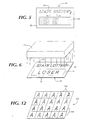
- Figure 12 is a printed transparency made in accordance with an aspect of the present invention. - This transparency is printed with multiple, discrete images for production of 35mm slides.
- Figure 15 is an illustration of several 222 nanometer excimer lamps arranged in four parallel columns wherein the nine numbers represent the locations where nine intensity measurements were obtained approximately 5.5 centimeters from the excimer lamps.
- Figure 16 is an illustration of several 222 nanometer excimer lamps arranged in four parallel columns wherein the location of the number "1" denotes the location where ten intensity measurements were obtained from increasing distances from the lamps at that location. (The measurements and their distances from the lamp are summarized in Table 12.)
- the present invention relates in general to applications of an extremely light-stable colorant system that is optionally mutable by exposure to narrow band-width radiation.
- the colorant composition of the present invention comprises a colorant which, in the presence of a radiation transorber, is stable under ordinary light but is mutable when exposed to specific, narrow band-width radiation.
- the radiation transorber is capable of absorbing radiation and interacting with the colorant to effect a mutation of the colorant.
- a molecular includant can be included in the composition which provides a more efficient mutable colorant and a colorant more stable to sunlight and artificial light.
- tne composition of the present invention includes a colorant and a radiation transorber.
- the colorant in the presence of the radiation transorber, is adapted, upon exposure of the transorber to radiation, desirably ultraviolet radiation, to be mutable.
- the radiation transorber is an ultraviolet radiation transorber.
- the ultraviolet radiation transorber is adapted to absorb ultraviolet radiation and interact with the colorant to effect the irreversible mutation of the colorant.
- the colorant, in the presence of the ultraviolet radiation transorber is stable in sunlight or artificial light.
- the novel method of dehydrating photoreactors that have a hydroxyl group in the alpha position to a carbonyl group can be used with a wide variety of photoreactors to provide the colorant stabilizing capability to the photoreactor.
- the resulting modified photoreactor can optionally be linked to a wavelength-selective sensitizer to impart the capability of decolorizing a colorant when exposed to a predetermined narrow wavelength of electromagnetic radiation. Accordingly, the present invention provides a photoreactor capable of stabilizing a colorant with which it is admixed.
- the colorant and radiation transorber is mutable upon exposure to radiation.
- the photoreactor may or may not be modified as described above to impart stability when admixed to a colorant.
- an ultraviolet radiation transorber is adapted to absorb ultraviolet radiation and interact with the colorant to effect the irreversible mutation of the colorant. It is desirable that the ultraviolet radiation transorber absorb ultraviolet radiation at a wavelength of from about 4 to about 400 nanometers. If the photoreactor in the radiation transorber is modified as described above, the colorant has improved stability when exposed to sunlight or artificial light.
- molecular includant is intended to mean any substance having a chemical structure which defines at least one cavity. That is, the molecular includant is a cavity-containing structure.
- cavity is meant to include any opening or space of a size sufficient to accept at least a portion of one or both of the colorant and the ultraviolet radiation transorber.
- the term "functionalized molecular includant” is used herein to mean a molecular includant to which one or more molecules of an ultraviolet radiation transorber or modified photoreactor or arylketoalkene stabilizer are covalently coupled to each molecule of the molecular includant.
- degree of substitution is used herein to refer to the number of these molecules or leaving groups (defined below) which are covalently coupled to each molecule of the molecular includant.
- the degree of substitution of the functionalized molecular includant may be in a range of from 1 to approximately 21. As another example, the degree of substitution may be in a range of from 3 to about 10. As a further example, the degree of substitution may be in a range of from about 4 to about 9.
- the efficiency of energy transfer from the ultraviolet radiation transorber to the colorant is, at least in part, a function of the number of ultraviolet radiation transorber molecules which are attached to the molecular includant.
- the time required to mutate the colorant should, at least in part, be a function of the number of ultraviolet radiation transorber molecules coupled to each molecule of molecular includant, there is a need for an improved colored composition in which an average of more than two ultraviolet radiation transorber molecules are covalently coupled to each molecule of the molecular includant.
- the derivatized ultraviolet radiation transorber and the derivatized molecular includant are selected to cause the covalent coupling of the ultraviolet radiation transorber to the molecular includant by means of a bimolecular nucleophilic substitution reaction. Consequently, the choice of the nucleophilic group and the leaving groups and the preparation of the derivatized ultraviolet radiation transorber and derivatized molecular includant, respectively, may be readily accomplished by those having ordinary skill in the art without the need for undue experimentation.
- phenylenediamine dyes such as Disperse Yellow 9 [N-(2,4-dinitrophenyl)-1,4-phenylenediamine or Solvent Orange 53]; diazo dyes, such as Disperse Orange 13 [Solvent Orange 52; 1-phenylazo-4-(4-hydroxyphenylazo)naphthalene]; anthraquinone dyes, such as Disperse Blue 3 [Celliton Fast Blue FFR; 1-methylamino-4-(2-hydroxyethylamino)-9,10-anthraquinone], Disperse Blue 14 [Celliton Fast Blue B; 1,4-bis(methylamino)-9,10-anthraquinone], and Alizarin Blue Black B (Mordant Black 13); trisazo dyes, such as Direct Blue 71 ⁇ Benzo Light Blue FFL or Sirius Light Blue B
- the colorant and the ultraviolet radiation transorber have been described as separate compounds, they can be part of the same molecule. For example, they can be covalently coupled to each other, either directly, or indirectly through a relatively small molecule, or spacer. Alternatively, the colorant and ultraviolet radiation transorber can be covalently coupled to a large molecule, such as an oligomer or a polymer. Further, the colorant and ultraviolet radiation transorber may be associated with a large molecule by van der Waals forces, and hydrogen bonding, among other means. Other variations will be readily apparent to those having ordinary skill in the art.
- the colorant and the ultraviolet radiation transorber are associated with the molecular includant
- the colorant is malachite green
- the ultraviolet radiation transorber is IRGACURE 184
- the molecular includant is beta-cyclodextrin as shown in Figure 1.
- the colorant and the ultraviolet radiation transorber are associated with the molecular includant
- the colorant is Victoria Pure Blue BO
- the ultraviolet radiation transorber is IRGACURE 184
- the molecular includant is beta-cyclodextrin as shown in Figure 2.
- the present invention also relates to a method of mutating the colorant in the composition of the present invention.
- the method comprises irradiating a composition containing a mutable colorant and a radiation transorber with radiation at a dosage level sufficient to mutate the colorant.
- the composition further includes a molecular includant.
- the composition is applied to a substrate before being irradiated with ultraviolet radiation.
- photochemical processes involve the absorption of light quanta, or photons, by a molecule, e.g., the ultraviolet radiation transorber, to produce a highly reactive electronically excited state.
- a molecule e.g., the ultraviolet radiation transorber
- the photon energy which is proportional to the wavelength of the radiation, cannot be absorbed by the molecule unless it matches the energy difference between the unexcited, or original, state and an excited state. Consequently, while the wavelength range of the ultraviolet radiation to which the colored composition is exposed is not directly of concern, at least a portion of the radiation must have wavelengths which will provide the necessary energy to raise the ultraviolet radiation transorber to an energy level which is capable of interacting with the colorant.
- the absorption maximum- of the ultraviolet radiation transorber ideally will be matched with the wavelength range of the ultraviolet radiation to increase the efficiency of the mutation of the colorant. Such efficiency also will be increased if the wavelength range of the ultraviolet radiation is relatively narrow, with the maximum of the ultraviolet radiation transorber coming within such range.
- especially suitable ultraviolet radiation has a wavelength of from about 100 to about 375 nanometers.
- Ultraviolet radiation within this range desirably may be incoherent, pulsed ultraviolet radiation from a dielectric barrier discharge excimer lamp.
- the excimer lamp emits radiation having a very narrow bandwidth, i.e., radiation in which the half width is of the order of 5-15 nanometers.
- This emitted radiation is incoherent and pulsed, the frequency of the pulses being dependent upon the frequency of the alternating current power supply which typically is in the range of from about 20 to about 300 kHz.
- An excimer lamp typically is identified or referred to by the wavelength at which the maximum intensity of the radiation occurs, which convention is followed throughout this specification.
- excimer lamp radiation is substantially monochromatic.
- Excimers are unstable molecular complexes which occur only under extreme conditions, such as those temporarily existing in special types of gas discharge. Typical examples are the molecular bonds between two rare gaseous atoms or between a rare gas atom and a halogen atom. Excimer complexes dissociate within less than a microsecond and, while they are dissociating, release their binding energy in the form of ultraviolet radiation. Known excimers, in general, emit in the range of from about 125 to about 360 nanometers, depending upon the excimer gas mixture.
- the colorant of the present invention is mutated by exposure to 222 nanometer excimer lamps. More particularly, the colorant crystal violet is mutated by exposure to 222 nanometer lamps. Even more particularly, the colorant crystal violet is mutated by exposure to 222 nanometer excimer lamps located approximately 5 to 6 centimeters from the colorant, wherein the lamps are arranged in four parallel columns approximately 30 centimeters long. It is to be understood that the arrangement of the lamps is not critical to this aspect of the invention. Accordingly, one or more lamps may be arranged in any configuration and at any distance which results in the colorant mutating upon exposure to the lamp's ultraviolet radiation.
- the excimer lamp used to mutate a colorant associated with an ultraviolet radiation transorber should produce ultraviolet radiation of a wavelength that is absorbed by the ultraviolet radiation transorber.
- Such free radical-generating compounds typically are hindered ketones, some examples of which include, but are not limited to: benzildimethyl ketal (available commercially as IRGACURE 651, Ciba-Geigy Corporation, Hawthorne, New York); 1-hydroxycyclohexyl phenyl ketone (IRGACURE 500); 2-methyl-1-[4-(methylthio)phenyl]-2-morpholino-propan-1-one] (IRGACURE 907); 2-benzyl-2-dimethylamino-1(4-morpholinophenyl)butan-1-one (IRGACURE 369); and 1-hydroxycyclohexyl phenyl ketone (IRGACURE 184).
- Cyracure UVI-6990 (Ciba-Geigy Corporation), which is a mixture of bis[4-(diphenylsulphonio)phenyl] sulfide bis(hexafluorophosphate) with related monosulphonium hexafluorophosphate salts; and n5-2,4-(cyclopentadienyl)[1,2,3,4,5,6-n-(methylethyl)benzene]-iron(II) hexafluorophosphate (IRGACURE 261).
- the dehydrated phthaloylglycine2959 can be attached to the molecular includant in a variety of ways.
- the dehydrated phthaloylglycine-2959 is covalently attached to the cyclodextrin and is represented by the following formula::
- the arylketoalkene may also function as a wavelength-specific sensitizer in the present invention, and it may be associated with any of the previously discussed photoreactors.
- One method of associating a photoreactor with the arylketoalkene compound of the present invention is described in Example 32.
- the arylketoalkene compound may optionally be covalently bonded to the reactive species-generating photoinitiator. It is to be understood that the arylketoalkene compound of the present invention is not to be used with photoreactors in a composition where stability in natural sunlight is desired.
- the arylketoalkene compound attached to cyclodextrin can be added to any aqueous colorant system to stabilize the colorant therein. It is to be understood that the stabilizing arylketoalkenes do not have to be attached to the molecular includants to exhibit their stabilizing activity.
- the colorant, ultraviolet radiation transorber, modified photoreactor, arylketoalkene stabilizer, and molecular includant are likely to be solids depending upon the constituents used to prepare the molecules.
- any or all of such materials can be a liquid.
- the colored composition can be a Liquid either because one or more of its components is a liquid, or, when the molecular includant is organic in nature, a solvent is employed.
- thermosetting polymers include, but are not limited to, alkyd resins, such as phthalic anhydride-glycerol resins, maleic acid-glycerol resins, adipic acid-glycerol resins, and phthalic anhydride-pentaerythritol resins; allylic resins, in which such monomers as diallyl phthalate, diallyl isophthalate diallyl maleate, and diallyl chlorendate serve as nonvolatile cross-linking agents in polyester compounds; amino resins, such as aniline-formaldehyde resins, ethylene urea-formaldehyde resins, dicyandiamide-formaldehyde resins, melamine-formaldehyde resins, sulfonamide-formaldehyde resins, and urea-formaldehyde resins; epoxy resins, such as cross-linked epichlorohydrin-bisphenol A resins; phenolic resins, such as
- reaction mixture was maintained at 50°C for an hour and allowed to cool to ambient temperature. In this preparation, no attempt was made to isolate the product, a ⁇ -cyclodextrin to which an ultraviolet radiation transorber had been covalently coupled (referred to hereinafter for convenience as ⁇ -cyclodextrin-transorber).
- this example describes the preparation of a beta-cyclodextrin molecular includant having (1) a colorant at least partially included within the cavity of the cyclodextrin and associated therewith by means of hydrogen bonds and/or van der Waals forces, and (2) an ultraviolet radiation transorber covalently bonded to the cyclodextrin substantially outside of the cavity of the cyclodextrin.
- the reaction mixture was maintained at 50°C for an hour and allowed to cool to ambient temperature.
- the reaction mixture then was worked up as described in Part A. above, to give 14.2 g of beta-cyclodextrin-transorber Colorant A inclusion complex, a blue-green powder.
- phthaloylglycine-2959 had the following physical parameters: IR [NUJOL MULL] ⁇ max 3440, 1760, 1740, 1680, 1600 cm-1 1H NMR [CDCl3] ⁇ ppm 1.64[s], 4.25[m], 4.49[m], 6.92[m], 7.25[m], 7.86[m], 7.98[m], 8.06[m] ppm
- This example describes a method of dehydrating the phthaloylglycine-2959 produced in Example 3.
- This example describes the Nohr-MacDonald elimination reaction used to dehydrate the phthaloylglycine-2959 produced in Example 3.
- reaction mixture was poured into 150 ml of weak sodium bicarbonate solution and extracted three times with 50 ml ethyl ether. The aqueous layer was then filtered to yield a white solid comprising the beta-cyclodextrin with phthaloylglycine-2959 group attached. A yield of 9.4 g was obtained. Reverse phase TLC plate using a 50:50 DMF:acetonitrile mixture showed a new product peak compared to the starting materials.
- the reaction is summarized as follows:
- This example describes a method of associating a colorant and an ultraviolet radiation transorber with a molecular includant. More particularly, this example describes a method of associating the colorant crystal violet with the molecular includant beta-cyclodextrin covalently bonded to the ultraviolet radiation transorber dehydrated phthaloylglycine-2959 of Example 6.
- This example describes a method of producing the ultraviolet radiation transorber 4(4-hydroxyphenyl) butan-2-one-2959 (chloro substituted).
- the resulting reaction product had the following physical parameters: IR [NUJOL MULL ] ⁇ max 3460, 1760, 1700, 1620, 1600 cm -1 1 H [CDCl 3 ] ⁇ ppm 1.62[s], 4.2[m], 4.5[m], 6.9[m] ppm
- composition number 3 the Victoria Pure Blue BO included in cyclodextrin with the radiation transorber covalently attached to the ⁇ -cyclodextrin was capable of stabilizing the dye under the mercury discharge light.
- reaction mixture was flushed with argon for 15 minutes and then poured into 70 ml of water to which was then added 100 ml acetone. A white precipitate occurred and was filtered to yield 20.2 g (84.1%) of a white powder which was used without further purification.
- the aqueous layer was then treated with 500 ml of acetone and the precipitate filtered and washed with acetone.
- the product was then run on a Sephadex column using n-butanol, ethanol, and water (5:4:3 by volume) to yield a white powder. The yield was 16.7 g.
- the precipitate was washed with 50 ml of water and dried to give 19.1 g (84 percent) of a blue powder, a colored composition consisting of a mutable colorant, Victoria Pure Blue B0, and a molecular includant having covalently coupled to it an average of about six ultraviolet radiation transorber molecules per molecular includant molecule.
- each plate was exposed to the radiation from a 222-nanometer excimer lamp assembly.
- the assembly consisted of a bank of four cylindrical lamps having a length of about 30 cm.
- the lamps were cooled by circulating water through a centrally located or inner tube of the lamp and, as a consequence, they operated at a relatively low temperature, i.e., about 50°C.
- the power density at the lamp's outer surface typically was in the range of from about 4 to about 20 joules per square meter (J/m 2 ). However, such range in reality merely reflects the capabilities of current excimer lamp power supplies; in the future, higher power densities may be practical.
- the distance from the lamp to the sample being irradiated was 4.5 cm. The time for each film to become colorless to the eye was measured. The results are summarized in Table 6. Decolorization Times for Various Compositions Composition Decolorization Times (Seconds) Example 18 1 Example 19 3-4 Example 7 7-8
- This example describes the preparation of a complex consisting of a mutable colorant and the derivatized molecular includant of Example 15.
- Example 18 The procedure of Example 18 was repeated, except that the functionalized molecular includant of Example 15 was replaced with 10 g (4.8 mmoles) of the derivatized molecular includant of Example 15 and the amount of Victoria Pure Blue BO was reduced to 2.5 g (4.8 mmoles).
- the yield of washed solid was 10.8 g (86 percent) of a mutable colorant associated with the ⁇ -cyclodextrin having an average of six tosyl groups per molecule of molecular includant.
- This example describes the preparation of a colored composition which includes a mutable colorant and a functionalized molecular includant.
- the polymer was one of the following: an epichlorohydrin-bisphenol A epoxy resin ("Polymer A”), Epon® 1004F (Shell Oil Company, Houston, Texas); a poly(ethylene glycol) having a weight-average molecular weight of about 8,000 (“Polymer B”), Carbowax 8000 (Aldrich Chemical Company); and a poly(ethylene glycol) having a weight-average molecular weight of about 4,600 (“Polymer C”), Carbowax 4600 (Aldrich Chemical Company).
- a control film was prepared which consisted only of colorant and polymer. The compositions of the films are summarized in Table 8.
- the excimer lamp 10 comprises a lamp housing 15 with four excimer lamp bulbs 20 positioned in parallel, the excimer lamp bulbs 20 are approximately 30 cm in length.
- the lamps are cooled by circulating water through a centrally located or inner tube (not shown) and, as a consequence. the lamps are operated at a relatively low temperature, i.e., about 50°C.
- the power density at the lamp's outer surface typically is in the range of from about 4 to about 20 joules per square meter (J/m 2 ).
- the excimer lamp 10 comprises a lamp housing 15 with four excimer lamp bulbs 20 positioned in parallel, the excimer lamp bulbs 20 are approximately 30 cm in length.
- the lamps are cooled by circulating water through a centrally located or inner tube (not shown) and, as a consequence, the lamps are operated at a relatively low temperature, i.e., about 50°C.
- the power density at the lamp's outer surface typically is in the range of from about 4 to about 20 joules per square meter (J/m 2 ).
- Table 12 summarizes the intensity readings which were obtained by a meter located on the surface of the substrate at position 1 as shown in Figure 16. Position 1 was centrally located approximately 17 centimeters from each end of the column as shown in Figure 16. Distance (cm) Background ( ⁇ W) Reading (mW/cm 2 ) 5.5 18.85 9.30 6.0 15.78 9.32 10 18.60 9.32 15 20.90 9.38 20 21.67 9.48 25 19.86 9.69 30 22.50 11.14 35 26.28 9.10 40 24.71 7.58 50 26.95 5.20
- This example describes a method of making the following wavelength-selective sensitizer as represented by the following formula:
- the wavelength-selective sensitizer is synthesized as summarized below:
- This example describes a method of covalently bonding the compound produced in Example 28 to cyclodextrin as summarized by the following reaction:
- This example describes a method of making the wavelength-selective sensitizer, namely 4-[4'-carboxy phenyl]-3-buten-2-one as represented by the following formula:
- the wavelength-selective sensitizer is synthesized as summarized below:
- Example 28 The method of Example 28 was followed except that acetone (Fisher, Optima Grade) was added first, and then the carboxybenzaldehyde was added. More particularly, 32.2 (0.21 mole) of carboxybenzaldehyde was reacted with 12.2 g (0.21 mole) of acetone in the sodium hydroxide/ethanol/water mixture described in Example 28. Dilute HCl was added to bring the reaction mixture to neutral pH, yielding 37.1 g (91%) of a pale yellow powder which was used without further purification in the following examples.
- acetone Fisher, Optima Grade
- This example describes a method of covalently bonding the 4-[4'-carboxy phenyl]-3-buten-2-one produced in Example 30 to cyclodextrin as is summarized below:
- Example 29 The method of Example 29 was followed except that 5.0 g of the 4-[4'-carboxy phenyl]-3-buten-2-one was used. More particularly, 5.0 g (0.026 mole) of the 4-[4'-carboxy phenyl]-3-buten-2-one produced in Example 30 was reacted with 3.3 g (0.026 mole) of oxalyl chloride in anyhydrous DMF at about 0°C. Next, approximately 7.1 g (0.005 mole) hydroxyethyl substituted cyclodextrin was added to the mixture (5:1 ratio) under the conditions described in Example 30 and was further processed as described therein, to produce 10.8 g of white powder. The NMR of the product showed both the aromatic protons of the 4-[4'-carboxy phenyl]-3-buten-2-one produced in Example 30 and the glucose protons of the cyclodextrin.
- This example describes a method of covalently bonding the compound produced in Example 28 to a photoreactor, namely DARCUR 2959, as is summarized below:
- Example 30 To determine whether the 4-[4'-carboxy phenyl]-3-buten-2-one produced in Example 30 has the capability to stabilize colorants, the following experiment was conducted. Test films were made up containing 90% carbowax 4600 and 10% of a 1 part Victoria Pure Blue BO (Aldrich) to 19 parts 4-[4'-carboxy phenyl]-3-buten-2-one. The mixture was melted on a hot plate, stirred, then drawn down on metal plates (at approximately 60°C), using a #3 drawdown bar. A similar sample was made with only 1% Victoria Pure Blue BO in 99% carbowax.
- Victoria Pure Blue BO Aldrich
- the plates were exposed to a 1200 Watt Mercury medium pressure lamp for one hour. the lamp being about 2 feet from the plates. After one hour, the Victoria Pure Blue BO plate was essentially colorless, while the plate having the mixture of Victoria Pure Blue BO and 4-[4'-carboxy phenyl]-3-buten-2-one thereon had not changed.
- the four cartridges were BJI-201, and the four inks (cyan, magenta, black, and yellow) were prepared as follows:
- the cartridges were then refilled with the corresponding ink solutions (1) through (4) above. Forty pages were run off, and the fortieth page was exposed to a 1200 Watt medium pressure mercury lamp with a control sheet for nine hours.
- the control sheet is the fortieth color test page run off using the ink compositions that were in the original ink cartridges.
- Example 29 The results of this experiment are as follows. After three hours under the 1200 Watt lamp, the control was 40 to 50% bleached, while the inks containing the compound produced in Example 29 were unchanged. After nine hours, the control was 50 to 60% bleached while the inks containing the compound of Example 29 were only about 10 to 20 % bleached. Accordingly, the compound produced in Example 29 is capable of stabilizing the dyes found in standard ink jet inks.
- Example 29 Another experiment to determine the colorant stabilizing capability of the compound produced in Example 29 is as follows. The stability of the ink solutions produced in Example 28 were studied as described below.
- Example 29 works well as a dye stabilizer to visible and ultraviolet radiation.
- the mutable colorant composition of the present invention can be used for temporary printing of markings such as labels, tags, tickets, stickers, and the like. This is advantageous for temporary printing of price markings, particularly for gift items where the buyer would like to conceal the price from the recipient.
- a typical marking comprises a substrate such as paper, cardboard, or plastic and is first printed with indicia indicating a price using the mutable colorant composition of the present invention.
- the indicia can be any image, but for price markings is normally in the form of alpha-numeric characters.
- the price on the marking is erased with ultraviolet radiation of the necessary wavelength and dosage. For example, convenient places for an ultraviolet lamp to erase price labels would be at a customer check-out counter or at a gift wrap counter.
- the price can be printed on labels with the colorant composition of the present invention using conventional methods of printing such as stamping.
- the markings may also contain nonphotoerasable printing with non-mutable colorants to indicate a brand name or logo or the name of the seller. Such indicia would remain after photoerasing the price.
- Figure 3 illustrates a label 10 adhered to a book 12:
- the label comprises a substrate 14, which in this embodiment is adhesive paper, and indicia 16 on the substrate surface visually indicating a price.
- the indicia 16 showing the price is defined by the mutable colorant composition of the present invention.
- the label also includes indicia 18 indicating the name of the store which sells the book 12. This indicia 18 is printed with non-erasable ink.
- Figure 4 illustrates photoerasure of the indicia 16 indicating the price on the label 10 using incoherent, pulsed ultraviolet radiation emitted from a dielectric barrier discharge excimer lamp 20.
- mutable color composition of the present invention is in the communication of concealed information.
- a written message which is to be confidentially communicated can be overprinted with a layer of the mutable color composition of the present invention. After delivery of the document, the overprinting layer can be photoerased to reveal the message.
- a particularly advantageous application of this concept is to gaming tickets wherein the status of the player is concealed by a layer of opaque overprinting.
- Conventional gaming tickets of this type typically comprise a paper or cardboard substrate printed with the status of the player and a opaque layer of metalized coating over the printing to conceal the player's status until the player purchases the gaming ticket and manually removes the metalized coating.
- the metalized coating is typically removed by scratching the coating off with a tool such as a coin.
- Suitable substrates 24 for a gaming ticket or any other type of document communicating concealed information include paper. cardboard, plastic, and the like.
- the gaming ticket 22 or other document can include non-erasable indicia of any type, but typically will be alphanumeric characters.
- the non-erasable indicia 26 to be concealed desirably should be of the same color as the overprinting layer 30.
- an overprinting layer 30 comprising a blue mutable colored composition in combination with non-erasable indicia 26 printed with blue non-erasable ink would be particularly secure.
- the photoerasable paint can have a variety of colors and is stable to sunlight.
- the photoerasable paint can be erased by irradiating the paint with ultraviolet radiation at a dosage level sufficient to irreversibly mutate the color.
- the markings will not fade outdoors until intentionally erased using radiation at the appropriate wavelength and dosage level.
- the photoerasable paint of the present invention allows for temporary marking and removal of that marking without the need for washing, abrasion, or chemical attack.
- the photoerasable paint of the present invention comprises a colorant vehicle which is transparent to ultraviolet radiation and the mutable colorant composition of the present invention dispersed in the vehicle.
- a colorant vehicle which is transparent to ultraviolet radiation
- mutable colorant composition of the present invention dispersed in the vehicle.
- suitable paint vehicles including latex, alkyd resins, polyurethane resins, acrylic resins, silicone resins, phenolic resins, nitrocellulose, epoxy resins, cellulose acetates and butyrates, natural oils, and the like.
- the photoerasable paint of the present invention may also include other additives such as surfactants and solvents.
- mutable color composition of the present invention is in writing or marking instruments such as pens and wick or felt tip markers, such as magic markers and highlighters.
- Markers using the mutable colorant composition of the present invention allow temporary marking which can be erased by irradiation with ultraviolet light having the appropriate wavelength and dosage.
- highlighters using ink including the mutable colorant composition of the present invention, can be used to highlight text in books. When resale of a book is desired, the highlighting can be erased by exposing the highlighted areas to ultraviolet radiation. The highlighted areas. however, would be stable to sunlight and artificial lighting.
- Another use of the mutable color composition of the present invention includes pens containing such a composition. wherein the notations made by the pens could be erased by irradiation thereby avoiding the need to shred high security documents, or thereby avoiding the need for chemically or mechanically removing such a composition during a recycling process.
- the marking instrument of the present invention comprises a marking fluid including a vehicle or carrier and the mutable colorant composition of the present invention.
- a marking fluid including a vehicle or carrier and the mutable colorant composition of the present invention.
- suitable vehicles for marking fluid such as ink, include water, glycerol, alkylene glycols, other alcohols, and the like.
- the marking fluid may also comprise other additives known to those skilled in the art.
- the marking fluid for use in writing instruments of the present invention are of conventional formulation except that conventional pigments are replaced by the mutable colorant composition of the present invention.
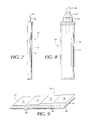
- a felt tip marker 50 is illustrated in Figure 8 and comprises a reservoir 52, an absorbent fibrous material 54 disposed in the reservoir and containing the ink supply, a head 56 enclosing an open end of the reservoir, and a wick 58 extending from the absorbent fibrous material within the reservoir, through the head, and to a felt tip 60 which is the ink applicator.
- the mutable colorant density is the amount of mutable colorant per area of the strip. Each level of increasing thickness forms regions having differing amounts of mutable colorant.
- the indicator 70 has thus regions of increasing colorant density. A given dose of ultraviolet radiation will decolorate at least a portion of the film 72 and the amount of the film decolored can be taken as an indication of the extent of exposure to ultraviolet radiation.
- the substrate 74 of the indicator 70 further includes a border 78 having indicia thereon for indicating the dosage of ultraviolet radiation to which the indicator is exposed. As will be understood to those skilled in the art. the strip will need to be calibrated to a particular source of ultraviolet radiation.
- the indicator 70 can be attached with the adhesive substrate 74 to a surface that is exposed to ultraviolet radiations such as an arc welders helmet.
- the printable colored article of the present invention comprises a substrate including a matrix and a mutable colorant composition dispersed in the matrix.
- the mutable colorant composition of the present invention comprises a mutable colorant and an ultraviolet radiation transorber which, upon irradiation with ultraviolet radiation, interacts with the colorant to irreversibly mutate the colorant and render the colorant substantially colorless.
- An image can be printed on the substrate by irradiating selected portions, of the substrates with ultraviolet radiation at a wavelength and dosage level sufficient to irreversibly mutable the colorant at the selected portions.
- the substrate may further comprise multiple mutable colorant compositions each including a mutable colorant and an ultraviolet radiation transorber.
- Each mutable colorant has a color and the colors are different from one another before mutation.
- Each colorant is mutable at different ultraviolet radiation wavelengths.
- multi-color images can be printed on the articles corresponding to the selected portions.
- the article is desirably printed by irradiating the substrate with incoherent, pulsed ultraviolet radiation emitted from a dielectric barrier discharge excimer lamp.
- the substrate can be directly printed with a mask having openings corresponding to the image desired to be printed.
- the openings in the mask direct the ultraviolet radiation to the selected portions of the substrate.
- High resolution printing, particularly on highly contoured surfaces. may require controlled sweeping of a tightly focused beam of ultraviolet radiation such as from an excimer laser.
- electrophotography techniques can be used to irradiate the selected portions of the plastic article to create the desired image.
- Corresponding pending U.S. Patent application Serial No. 08/258,858 discloses techniques for using mutable colorants in electrophotography and is expressly incorporated herein by reference. Photoerasing can be conducted in two or more stages or can be done simultaneously with the appropriate excimer ultraviolet lamps to achieve multicolor effects.
- the matrix is colored with a mutable cyan colorant, a mutable magenta colorant, and a mutable yellow colorant, each of the colorants being mutable at a different wavelength of ultraviolet radiation.
- the matrix can take the form of a single layer comprising a mixture of all three colorants or could comprise three separate layers, each comprising a different colorant stacked one on top of the other.
- a portion of the substrate that is unexposed is black.
- Different colors are created at the remaining locations by exposing each location to a ultraviolet radiation at one or more wavelengths. For example, a location exposed to radiation wavelengths capable of mutating the cyan and yellow colorant/would result in the location being magenta. This can be achieved by simultaneous exposures of selected portions of the substrate to ultraviolet radiation of the different wavelengths such as with three ultraviolet radiation excimer lasers or can be achieved by exposure of the substrate to ultraviolet radiation of different wavelengths in stages using three masks.
- the article substrate may be clear, opaque, or translucent and may be colored with non-mutable (nonphotoerasable) colorants in addition to the mutable colorant so that when the mutable colorant is erased in selected portions, the selected portions have the color of the non-mutable colorant.
- Suitable articles include a variety of items such as plastic containers, plastic films, and paper. Contoured or glossy plastic containers are particularly suitable articles as are transparent films for use in making transparencies or slides for visual projection.
- Suitable substrates include the article itself or a film adhered or otherwise attached to the article.
- Suitable matrix materials which form the substrate include the polymer of the plastic container or film or can be the paper when the substrate is a sheet of paper. The matrix should transmit a sufficient amount of ultraviolet light for mutation of the colorant. It is to be understood that the colorant composition of the present invention may be admixed with the matrix, and therefore is in the substrate, or it may be present as a layer on a surface of the substrate formed by the matrix. Colored plastic articles of the present invention alleviate the need for labels and adhesives and allow printing on contoured plastic surfaces and glossy plastic surfaces, which are not amenable to contact printing, labeling, or xerography.
- a photoerasable marking for goods comprising:
- a document for securely communicating concealed information comprising:
- a method of overprinting to conceal information comprising:
- a photoerasable paint for temporary markings comprising:
- a method for temporarily marking a substrate comprising:
- a marking instrument comprising:
- a colored plastic article for colored printing comprising:
- the mutable colorant compositions are three in number and the mutable colorants have the colors cyan, magenta, and yellow, respectively.
- a colored article for colored printing comprising a substrate including a matrix and a mutable colorant composition dispersed in the matrix, the mutable colorant composition comprising a mutable colorant and an ultraviolet radiation transorber which, upon irradiation with ultraviolet radiation, interacts with the colorant to irreversibly mutate the colorant and thereby render the colorant substantially colorless, whereby an image can be printed on the substrate by irradiating selected portions of the substrate with ultraviolet radiation at wavelengths and dosage levels sufficient to irreversibly mutate the colorants at the selected portions.
Landscapes
- Chemical & Material Sciences (AREA)
- Physics & Mathematics (AREA)
- Organic Chemistry (AREA)
- General Physics & Mathematics (AREA)
- Engineering & Computer Science (AREA)
- Life Sciences & Earth Sciences (AREA)
- Materials Engineering (AREA)
- Wood Science & Technology (AREA)
- Optics & Photonics (AREA)
- Health & Medical Sciences (AREA)
- Chemical Kinetics & Catalysis (AREA)
- Theoretical Computer Science (AREA)
- Biochemistry (AREA)
- Polymers & Plastics (AREA)
- Medicinal Chemistry (AREA)
- Molecular Biology (AREA)
- General Health & Medical Sciences (AREA)
- Educational Administration (AREA)
- Spectroscopy & Molecular Physics (AREA)
- General Chemical & Material Sciences (AREA)
- Business, Economics & Management (AREA)
- Inorganic Chemistry (AREA)
- Educational Technology (AREA)
- Photometry And Measurement Of Optical Pulse Characteristics (AREA)
- Paints Or Removers (AREA)
- Printing Methods (AREA)
- Credit Cards Or The Like (AREA)
- Pens And Brushes (AREA)
- Ink Jet Recording Methods And Recording Media Thereof (AREA)
- Coating Apparatus (AREA)
- Inks, Pencil-Leads, Or Crayons (AREA)
- Investigating Or Analysing Materials By The Use Of Chemical Reactions (AREA)
Applications Claiming Priority (3)
| Application Number | Priority Date | Filing Date | Title |
|---|---|---|---|
| US46210595A | 1995-06-05 | 1995-06-05 | |
| US462105 | 1995-06-05 | ||
| EP96917030A EP0830256A2 (de) | 1995-06-05 | 1996-06-03 | Zeitliche markierung,uv-strahlungsdetektion und druck unter verwendung von uv-löschbaren farbmitteln |
Related Parent Applications (1)
| Application Number | Title | Priority Date | Filing Date |
|---|---|---|---|
| EP96917030A Division EP0830256A2 (de) | 1995-06-05 | 1996-06-03 | Zeitliche markierung,uv-strahlungsdetektion und druck unter verwendung von uv-löschbaren farbmitteln |
Publications (1)
| Publication Number | Publication Date |
|---|---|
| EP1123814A2 true EP1123814A2 (de) | 2001-08-16 |
Family
ID=23835187
Family Applications (6)
| Application Number | Title | Priority Date | Filing Date |
|---|---|---|---|
| EP01104037A Withdrawn EP1123813A2 (de) | 1995-06-05 | 1996-06-03 | Aufzeichnungsinstrument für UV-löschbare Markierung |
| EP01104021A Withdrawn EP1123811A3 (de) | 1995-06-05 | 1996-06-03 | UV-löschbares Anstrichmittel und Verfahren zur Anwendung |
| EP01104058A Withdrawn EP1123814A2 (de) | 1995-06-05 | 1996-06-03 | Verfahren und Vorrichtung zum Nachweis von UV-Bestrahlung |
| EP01104057A Withdrawn EP1132119A3 (de) | 1995-06-05 | 1996-06-03 | Verfahren zum Informationsverbergen und Dokument zur gesicherten Kommunikation von verbergenden Informationen |
| EP96917030A Ceased EP0830256A2 (de) | 1995-06-05 | 1996-06-03 | Zeitliche markierung,uv-strahlungsdetektion und druck unter verwendung von uv-löschbaren farbmitteln |
| EP01104036A Withdrawn EP1123812A2 (de) | 1995-06-05 | 1996-06-03 | Gegenstand für Farbdruck und Druckverfahren |
Family Applications Before (2)
| Application Number | Title | Priority Date | Filing Date |
|---|---|---|---|
| EP01104037A Withdrawn EP1123813A2 (de) | 1995-06-05 | 1996-06-03 | Aufzeichnungsinstrument für UV-löschbare Markierung |
| EP01104021A Withdrawn EP1123811A3 (de) | 1995-06-05 | 1996-06-03 | UV-löschbares Anstrichmittel und Verfahren zur Anwendung |
Family Applications After (3)
| Application Number | Title | Priority Date | Filing Date |
|---|---|---|---|
| EP01104057A Withdrawn EP1132119A3 (de) | 1995-06-05 | 1996-06-03 | Verfahren zum Informationsverbergen und Dokument zur gesicherten Kommunikation von verbergenden Informationen |
| EP96917030A Ceased EP0830256A2 (de) | 1995-06-05 | 1996-06-03 | Zeitliche markierung,uv-strahlungsdetektion und druck unter verwendung von uv-löschbaren farbmitteln |
| EP01104036A Withdrawn EP1123812A2 (de) | 1995-06-05 | 1996-06-03 | Gegenstand für Farbdruck und Druckverfahren |
Country Status (9)
| Country | Link |
|---|---|
| EP (6) | EP1123813A2 (de) |
| JP (1) | JPH11507600A (de) |
| AU (1) | AU5972596A (de) |
| BR (1) | BR9608387A (de) |
| CA (1) | CA2219463A1 (de) |
| CO (1) | CO4440458A1 (de) |
| MX (1) | MX9709059A (de) |
| WO (1) | WO1996039302A2 (de) |
| ZA (1) | ZA964549B (de) |
Cited By (3)
| Publication number | Priority date | Publication date | Assignee | Title |
|---|---|---|---|---|
| US8284385B2 (en) | 2009-11-13 | 2012-10-09 | Lincoln Global, Inc. | Welding arc apparel with UV activated images |
| US9121776B2 (en) | 2009-11-13 | 2015-09-01 | Lincoln Global, Inc. | Welding arc apparel with UV or thermochromic activated images |
| US9615619B2 (en) | 2003-08-13 | 2017-04-11 | 3M Innovative Properties Company | Indicator devices and articles comprising the indicator device |
Families Citing this family (5)
| Publication number | Priority date | Publication date | Assignee | Title |
|---|---|---|---|---|
| FI114433B (fi) | 2002-01-23 | 2004-10-15 | Nokia Corp | Otossiirtymän koodaaminen videokoodauksessa |
| US7875457B2 (en) | 2004-05-12 | 2011-01-25 | Axsun Technologies, Inc. | Erasable taggant distribution channel validation method and system |
| FR2907126B1 (fr) * | 2006-10-12 | 2010-09-17 | Soppec | Dispositif de marquage de peinture, peinture incorporant un tel dispositif et procede de revelation associe |
| DE102008049848A1 (de) * | 2008-10-01 | 2010-04-08 | Tesa Se | Mehrbereichsindikator |
| JP5871204B1 (ja) * | 2014-06-17 | 2016-03-01 | Dic株式会社 | 土木建築材料 |
Family Cites Families (7)
| Publication number | Priority date | Publication date | Assignee | Title |
|---|---|---|---|---|
| JPH0749546B2 (ja) * | 1987-01-21 | 1995-05-31 | 株式会社巴川製紙所 | 紫外線発色性インキ |
| JPS63179977A (ja) * | 1987-01-21 | 1988-07-23 | Tomoegawa Paper Co Ltd | 紫外線発色性塗料 |
| JPH03134072A (ja) * | 1989-10-20 | 1991-06-07 | Tomoegawa Paper Co Ltd | 紫外線変色性インキ |
| US5865471A (en) * | 1993-08-05 | 1999-02-02 | Kimberly-Clark Worldwide, Inc. | Photo-erasable data processing forms |
| CN1131468A (zh) * | 1993-08-05 | 1996-09-18 | 金伯利-克拉克公司 | 可变色组合物及其使用方法 |
| ATE197594T1 (de) * | 1994-12-20 | 2000-12-15 | Kimberly Clark Co | Verbesserte, änderbare zusammensetzung |
| CO4560378A1 (es) * | 1995-01-17 | 1998-02-10 | Kimberly Clark Co | Composicion estabilizadora para colorantes y metodo para estabilizar a la luz un colorante |
-
1995
- 1995-08-23 CO CO95037887A patent/CO4440458A1/es unknown
-
1996
- 1996-06-03 EP EP01104037A patent/EP1123813A2/de not_active Withdrawn
- 1996-06-03 EP EP01104021A patent/EP1123811A3/de not_active Withdrawn
- 1996-06-03 WO PCT/US1996/008478 patent/WO1996039302A2/en not_active Ceased
- 1996-06-03 AU AU59725/96A patent/AU5972596A/en not_active Abandoned
- 1996-06-03 ZA ZA964549A patent/ZA964549B/xx unknown
- 1996-06-03 EP EP01104058A patent/EP1123814A2/de not_active Withdrawn
- 1996-06-03 JP JP9501069A patent/JPH11507600A/ja not_active Abandoned
- 1996-06-03 BR BR9608387A patent/BR9608387A/pt not_active IP Right Cessation
- 1996-06-03 EP EP01104057A patent/EP1132119A3/de not_active Withdrawn
- 1996-06-03 CA CA002219463A patent/CA2219463A1/en not_active Abandoned
- 1996-06-03 EP EP96917030A patent/EP0830256A2/de not_active Ceased
- 1996-06-03 EP EP01104036A patent/EP1123812A2/de not_active Withdrawn
-
1997
- 1997-11-24 MX MX9709059A patent/MX9709059A/es unknown
Cited By (3)
| Publication number | Priority date | Publication date | Assignee | Title |
|---|---|---|---|---|
| US9615619B2 (en) | 2003-08-13 | 2017-04-11 | 3M Innovative Properties Company | Indicator devices and articles comprising the indicator device |
| US8284385B2 (en) | 2009-11-13 | 2012-10-09 | Lincoln Global, Inc. | Welding arc apparel with UV activated images |
| US9121776B2 (en) | 2009-11-13 | 2015-09-01 | Lincoln Global, Inc. | Welding arc apparel with UV or thermochromic activated images |
Also Published As
| Publication number | Publication date |
|---|---|
| AU5972596A (en) | 1996-12-24 |
| EP1123812A2 (de) | 2001-08-16 |
| BR9608387A (pt) | 1999-05-11 |
| EP1123811A3 (de) | 2004-02-04 |
| EP0830256A2 (de) | 1998-03-25 |
| ZA964549B (en) | 1996-12-12 |
| CO4440458A1 (es) | 1997-05-07 |
| WO1996039302A2 (en) | 1996-12-12 |
| MX9709059A (es) | 1998-06-28 |
| EP1132119A3 (de) | 2004-02-04 |
| EP1132119A2 (de) | 2001-09-12 |
| EP1123813A2 (de) | 2001-08-16 |
| CA2219463A1 (en) | 1996-12-12 |
| JPH11507600A (ja) | 1999-07-06 |
| WO1996039302A3 (en) | 1997-07-17 |
| EP1123811A2 (de) | 2001-08-16 |
Similar Documents
| Publication | Publication Date | Title |
|---|---|---|
| US6054256A (en) | Method and apparatus for indicating ultraviolet light exposure | |
| EP0830676B1 (de) | Aufzeichnungsmedium für digitale information und verfahren zu seiner verwendung | |
| US6235095B1 (en) | Ink for inkjet printers | |
| US5643356A (en) | Ink for ink jet printers | |
| US6060200A (en) | Photo-erasable data processing forms and methods | |
| US5865471A (en) | Photo-erasable data processing forms | |
| US5721287A (en) | Method of mutating a colorant by irradiation | |
| US5700850A (en) | Colorant compositions and colorant stabilizers | |
| US5773182A (en) | Method of light stabilizing a colorant | |
| EP1123814A2 (de) | Verfahren und Vorrichtung zum Nachweis von UV-Bestrahlung | |
| EP0846146B1 (de) | Farbstoffstabilisierte zusammensetzungen | |
| EP1116708A1 (de) | Verfahren zum Dehydratisieren von tertiären Alkoholen | |
| US6017471A (en) | Colorants and colorant modifiers | |
| EP0799246B1 (de) | Verbesserte, änderbare zusammensetzung | |
| US6211383B1 (en) | Nohr-McDonald elimination reaction | |
| EP0830432A1 (de) | Verbesserte tinte zum strahldrucken |
Legal Events
| Date | Code | Title | Description |
|---|---|---|---|
| PUAI | Public reference made under article 153(3) epc to a published international application that has entered the european phase |
Free format text: ORIGINAL CODE: 0009012 |
|
| 17P | Request for examination filed |
Effective date: 20010220 |
|
| AC | Divisional application: reference to earlier application |
Ref document number: 830256 Country of ref document: EP |
|
| AK | Designated contracting states |
Kind code of ref document: A2 Designated state(s): AT BE CH DE DK ES FI FR GB GR IE IT LI LU MC NL PT SE |
|
| STAA | Information on the status of an ep patent application or granted ep patent |
Free format text: STATUS: THE APPLICATION HAS BEEN WITHDRAWN |
|
| 18W | Application withdrawn |
Effective date: 20031031 |