EP1124005B1 - Verschmutzungsschutzverfahren für eine papiermaschinenbespannung - Google Patents
Verschmutzungsschutzverfahren für eine papiermaschinenbespannung Download PDFInfo
- Publication number
- EP1124005B1 EP1124005B1 EP99943344.4A EP99943344A EP1124005B1 EP 1124005 B1 EP1124005 B1 EP 1124005B1 EP 99943344 A EP99943344 A EP 99943344A EP 1124005 B1 EP1124005 B1 EP 1124005B1
- Authority
- EP
- European Patent Office
- Prior art keywords
- canvas
- silicone oil
- paper
- treatment agent
- paper strip
- Prior art date
- Legal status (The legal status is an assumption and is not a legal conclusion. Google has not performed a legal analysis and makes no representation as to the accuracy of the status listed.)
- Expired - Lifetime
Links
- 238000000034 method Methods 0.000 title claims description 31
- 230000002265 prevention Effects 0.000 title description 2
- 229920002545 silicone oil Polymers 0.000 claims description 119
- 238000005507 spraying Methods 0.000 claims description 18
- XLYOFNOQVPJJNP-UHFFFAOYSA-N water Substances O XLYOFNOQVPJJNP-UHFFFAOYSA-N 0.000 claims description 17
- 238000011109 contamination Methods 0.000 claims description 13
- 238000001035 drying Methods 0.000 claims description 13
- 238000012546 transfer Methods 0.000 claims description 10
- 238000003825 pressing Methods 0.000 claims description 7
- 239000004094 surface-active agent Substances 0.000 claims description 6
- 239000012466 permeate Substances 0.000 claims description 4
- 239000012756 surface treatment agent Substances 0.000 description 53
- 239000007921 spray Substances 0.000 description 41
- 208000018747 cerebellar ataxia with neuropathy and bilateral vestibular areflexia syndrome Diseases 0.000 description 33
- 238000012360 testing method Methods 0.000 description 23
- 239000000126 substance Substances 0.000 description 18
- 239000000356 contaminant Substances 0.000 description 15
- 230000000052 comparative effect Effects 0.000 description 8
- 230000000694 effects Effects 0.000 description 8
- 230000003373 anti-fouling effect Effects 0.000 description 7
- 239000000463 material Substances 0.000 description 6
- 230000004048 modification Effects 0.000 description 6
- 238000012986 modification Methods 0.000 description 6
- 229920001296 polysiloxane Polymers 0.000 description 5
- 230000008569 process Effects 0.000 description 5
- 239000000654 additive Substances 0.000 description 4
- 230000003247 decreasing effect Effects 0.000 description 4
- 238000007865 diluting Methods 0.000 description 4
- 239000000047 product Substances 0.000 description 4
- 230000000996 additive effect Effects 0.000 description 3
- 239000000853 adhesive Substances 0.000 description 3
- 230000001070 adhesive effect Effects 0.000 description 3
- 239000007864 aqueous solution Substances 0.000 description 3
- 238000010790 dilution Methods 0.000 description 3
- 239000012895 dilution Substances 0.000 description 3
- 238000005516 engineering process Methods 0.000 description 3
- 239000004744 fabric Substances 0.000 description 3
- 230000005484 gravity Effects 0.000 description 3
- 238000010438 heat treatment Methods 0.000 description 3
- 230000009467 reduction Effects 0.000 description 3
- 230000002829 reductive effect Effects 0.000 description 3
- 238000009825 accumulation Methods 0.000 description 2
- 239000003795 chemical substances by application Substances 0.000 description 2
- 238000010276 construction Methods 0.000 description 2
- -1 for example Substances 0.000 description 2
- 239000000203 mixture Substances 0.000 description 2
- 239000000843 powder Substances 0.000 description 2
- 238000007639 printing Methods 0.000 description 2
- 239000005871 repellent Substances 0.000 description 2
- 239000011347 resin Substances 0.000 description 2
- 229920005989 resin Polymers 0.000 description 2
- 239000004925 Acrylic resin Substances 0.000 description 1
- 239000004593 Epoxy Substances 0.000 description 1
- VGGSQFUCUMXWEO-UHFFFAOYSA-N Ethene Chemical compound C=C VGGSQFUCUMXWEO-UHFFFAOYSA-N 0.000 description 1
- 239000005977 Ethylene Substances 0.000 description 1
- 229920001410 Microfiber Polymers 0.000 description 1
- 239000004809 Teflon Substances 0.000 description 1
- 229920006362 Teflon® Polymers 0.000 description 1
- 239000002390 adhesive tape Substances 0.000 description 1
- 230000002411 adverse Effects 0.000 description 1
- 229920013822 aminosilicone Polymers 0.000 description 1
- 230000008901 benefit Effects 0.000 description 1
- 230000015572 biosynthetic process Effects 0.000 description 1
- 150000001768 cations Chemical class 0.000 description 1
- 230000008859 change Effects 0.000 description 1
- 239000000470 constituent Substances 0.000 description 1
- 238000007796 conventional method Methods 0.000 description 1
- 230000002542 deteriorative effect Effects 0.000 description 1
- 238000011161 development Methods 0.000 description 1
- 235000014113 dietary fatty acids Nutrition 0.000 description 1
- 125000004177 diethyl group Chemical group [H]C([H])([H])C([H])([H])* 0.000 description 1
- 239000006185 dispersion Substances 0.000 description 1
- 238000004945 emulsification Methods 0.000 description 1
- 238000001704 evaporation Methods 0.000 description 1
- 230000008020 evaporation Effects 0.000 description 1
- 229930195729 fatty acid Natural products 0.000 description 1
- 239000000194 fatty acid Substances 0.000 description 1
- 150000004665 fatty acids Chemical class 0.000 description 1
- 239000000835 fiber Substances 0.000 description 1
- 210000003128 head Anatomy 0.000 description 1
- 239000012943 hotmelt Substances 0.000 description 1
- 230000002401 inhibitory effect Effects 0.000 description 1
- 239000000976 ink Substances 0.000 description 1
- 238000004519 manufacturing process Methods 0.000 description 1
- 239000003658 microfiber Substances 0.000 description 1
- 231100000989 no adverse effect Toxicity 0.000 description 1
- 239000003973 paint Substances 0.000 description 1
- 239000010893 paper waste Substances 0.000 description 1
- 230000002093 peripheral effect Effects 0.000 description 1
- 230000035699 permeability Effects 0.000 description 1
- 229920003216 poly(methylphenylsiloxane) Polymers 0.000 description 1
- 229920000728 polyester Polymers 0.000 description 1
- 239000011148 porous material Substances 0.000 description 1
- 239000002994 raw material Substances 0.000 description 1
- 230000003014 reinforcing effect Effects 0.000 description 1
- 238000004381 surface treatment Methods 0.000 description 1
- 229920002994 synthetic fiber Polymers 0.000 description 1
- 239000012209 synthetic fiber Substances 0.000 description 1
- 239000002759 woven fabric Substances 0.000 description 1
Images



Classifications
-
- D—TEXTILES; PAPER
- D21—PAPER-MAKING; PRODUCTION OF CELLULOSE
- D21F—PAPER-MAKING MACHINES; METHODS OF PRODUCING PAPER THEREON
- D21F1/00—Wet end of machines for making continuous webs of paper
- D21F1/32—Washing wire-cloths or felts
-
- D—TEXTILES; PAPER
- D21—PAPER-MAKING; PRODUCTION OF CELLULOSE
- D21F—PAPER-MAKING MACHINES; METHODS OF PRODUCING PAPER THEREON
- D21F1/00—Wet end of machines for making continuous webs of paper
- D21F1/30—Protecting wire-cloths from mechanical damage
-
- D—TEXTILES; PAPER
- D21—PAPER-MAKING; PRODUCTION OF CELLULOSE
- D21H—PULP COMPOSITIONS; PREPARATION THEREOF NOT COVERED BY SUBCLASSES D21C OR D21D; IMPREGNATING OR COATING OF PAPER; TREATMENT OF FINISHED PAPER NOT COVERED BY CLASS B31 OR SUBCLASS D21G; PAPER NOT OTHERWISE PROVIDED FOR
- D21H21/00—Non-fibrous material added to the pulp, characterised by its function, form or properties; Paper-impregnating or coating material, characterised by its function, form or properties
- D21H21/02—Agents for preventing deposition on the paper mill equipment, e.g. pitch or slime control
-
- Y—GENERAL TAGGING OF NEW TECHNOLOGICAL DEVELOPMENTS; GENERAL TAGGING OF CROSS-SECTIONAL TECHNOLOGIES SPANNING OVER SEVERAL SECTIONS OF THE IPC; TECHNICAL SUBJECTS COVERED BY FORMER USPC CROSS-REFERENCE ART COLLECTIONS [XRACs] AND DIGESTS
- Y10—TECHNICAL SUBJECTS COVERED BY FORMER USPC
- Y10S—TECHNICAL SUBJECTS COVERED BY FORMER USPC CROSS-REFERENCE ART COLLECTIONS [XRACs] AND DIGESTS
- Y10S162/00—Paper making and fiber liberation
- Y10S162/04—Pitch control
Definitions
- the present invention relates to a method of preventing contamination of a canvas used in conjunction with dryers of a paper machine.
- the paper machine is equipped with a plurality of dryers used for drying, and the dryers have a construction such that a heating medium such as steam and the like are contained therein for heating from inside of the dryers.
- Moist paper undried as yet is fed continuously to the dryers of the paper machine.
- the wet paper gives off moisture contained therein by absorbing heat from the surface of the dryers when pressed by the canvas.
- the canvas is normally formed of material flexible and porous, for example, woven fabric, felt (unwoven fabric), knitted fabric, and the like.
- An enlarged view of the surface of the canvas shows that a multitude of fine pores (so-called eyes of the canvas) are formed on the surface thereof between threads making up the canvas.
- Moisture contained in the wet paper is heated by the dryers at high temperatures, and dispersed through the eyes of the canvas.
- paper contains various substances, for example, pitch / tar component contained in pulp stock itself, hotmelt, ink and microfibers originating from waste paper stock, various additive chemicals for reinforcing strength and whiteness of paper, and inclusions (foreign matter) such as paint, and so forth.
- inclusions foreign matter
- Such inclusions having tackiness will be deposited on the surface of the canvas when the wet paper is pressed hard against the surface of the dryers by the canvas, turning into contaminant (the source of contamination).
- the longer service life means that there will be an increase in accumulation of the contaminant to that extent.
- Parts of the contaminant accumulated on the canvas are then transferred from the surface of the canvas to a portion of a paper strip, newly fed, resulting in contamination of product paper.
- the contaminant having strong tackiness is also accumulated on an out-roll serving as a guide-roll for the canvas and turned into large lumps.
- the wet paper When parts of such lumps are peeled off, and adhere to the surface of the wet paper, the wet paper will be provided with additional tensile force due to the effect of the tackiness of the contaminant at the time of the dryers coming in contact with the wet paper, creating a cause for breaks of the wet paper.
- the paper machine has been faced with major technical problems in that various inclusions contained in the wet paper are adhered to the canvas, and accumulated thereon along with the operation of the paper machine, whereupon the eyes of the canvas are clogged, thereby inhibiting evaporation of moisture, and resulting in poor drying efficiency, and also in that the contaminant accumulated on the canvas as well as the out-roll causes parts of the paper strip, newly fed, to be contaminated as well or create a cause for breaks of the paper strip being processed.
- JP-A-07-292 382 discloses a stain-proofing agent containing silicone oil for paper-making drier process in which the stain-proofing agent is sprayed on a canvas endless loop which supports paper as it dries; and GB-A-2 284 833 discloses paper-making machinery which employs a roller applicator to apply a thin hyrdrophobic film of silicone to the surface of the fabric which is in contact with the paper sheet.
- the present invention has been developed in an attempt to solve various problems described in the foregoing.
- a method of preventing contamination of a canvas running in a closed loop and having an outer surface for pressing a paper strip against the surface of drum-dryers used for drying the paper strip in a paper machine whereby a silicone oil is continuously sprayed, at a supply rate of 0.1 to 200 mg/m 2 per min, onto the surface of a canvas out-roll disposed on the outer side of the canvas for guiding the canvas, in a stage of operation prior to the paper strip being pressed into contact with the canvas as well as the drum-dryers, while the paper strip is being fed by operation of the paper machine.
- a silicone oil emulsified with a surfactant is used for supplying the silicone oil.
- the silicone oil is diluted with water before being sprayed.
- the silicone oil is diluted with water, heated to a temperature in the range of 50 to 80°C immediately before spraying
- the method comprises the following steps 1) to 5): 1) a silicone oil supply step for supplying a silicone oil at a supply rate of 0.1 to 200 mg/m 2 per min to the surface of the out-roll disposed on the outer side of the canvas for guiding the canvas; 2) a silicone oil shifting step for shifting the silicone oil from the surface of the out-roll to the canvas outer surface; 3) a silicone oil permeation and adhesion step for causing the silicone oil to permeate through the canvas and adhere to the outer surface thereof under heat and pressure; 4) a silicone oil transfer step for pressing the paper strip against the canvas outer surface, causing the silicone oil to be transferred to the paper strip; and 5) a silicone oil replenishment step for replenishing the silicone oil on the canvas outer surface depleted by said transfer.
- the inventors have carried out intense studies on the subjects described, and discovered as a result that silicone can be caused to adhere to the surface of the canvas to an extent not to cause the eyes of the canvas to be clogged by continuously supplying silicone oil to the canvas without interruption.
- the inventors have succeeded in the development of the present invention on the basis of this fact.
- the silicone oil By continuously supplying the silicone oil by a predetermined amount onto the surface of the canvas, the silicone oil is adhered to the surface of the canvas.
- the silicone oil permeates through the canvas and is adhered thereto.
- the silicone oil is gradually transferred to the paper strip and depleted but, on the other hand, since the canvas is continuously supplied with the silicone oil without interruption, the canvas remains in a condition with newly supplied silicone adhered thereto after depleted portions of the silicone oil is replenished.
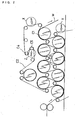
- Fig. 1 shows a paper machine equipped with multiple drum-dryers, comprising broadly a wire part A, a press part B, and a dry part C.
- feed stock (pulp and so forth) is fed from a flow spreader head box onto a Fourdrinier wire table A1 evenly so as to be formed into a sheet-like shape.
- a paper strip W formed in a sheet-like shape will have the moisture thereof reduced to the order of 80% while passing on the Fourdrinier wire table A1, and then be transferred to the press part B.
- the paper strip W is squeezed from both above and below by a pressing roller B1, an endless belt B2, and so forth.
- the paper strip W will have the moisture thereof reduced to the order of 50% while passing through the press part B, and thereafter, be transferred to the dry part (drying area) C.
- the greater part of humidity of the paper strip W will be given off, and the moisture thereof will be reduced to the order of 10%.
- the dry part C is provided with heated drum-dryers C1, canvases C2, C3 for pressing the paper strip against the drum-dryers, and canvas rollers C4 and so forth for guiding the canvases, so as to cause the paper strip W to give off the moisture thereof by the effect of heat.
- Fig. 1 The paper machine shown in Fig. 1 comprises two dry parts, each consisting of a group of drum-dryers, and Fig. 2 is an enlarged view of one of the dry parts.
- the dry part C has a construction such that the canvases C2, C3, disposed on the upper level and the lower level, respectively, are caused to run by a plurality of the canvas rollers along paths in a given closed loop, respectively, so as to be pressed into contact with a plurality of the drum-dryers C1.
- the drum-dryers C1 in use are of a multiple type, and the plurality thereof are juxtaposed on the upper level as well as the lower level, respectively.
- the canvases C2 and C3 act to press the paper strip into contact with the respective drum-dryers, and run between the respective canvas rolls C4 in sequence.
- the inner canvas rolls C4 are disposed on the inner side of the canvases C2, C3, and out-rolls C5 are disposed on the outer side thereof.
- the out-rolls are normally set so as to be freely movable, enabling tension of the respective canvases in whole to be adjusted.
- the paper strip W (in fact, wet paper) is fed and transferred along a given path, while being pressed in contact with both the canvases and the drum-dryers.
- Drying of the paper strip W gradually proceeds as the paper strip W is pressed between the canvas and the drum-dryers at the upper level, and between the canvas and drum-dryers at the lower level, respectively.
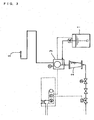
- a chemical spray unit used for spraying a chemical that is, the surface treatment agent, is shown in Fig. 3 .
- the surface treatment agent delivered from a chemical tank 1 is sprayed to the surface of the canvas through a spray nozzle S.
- Water may be taken in via a flow meter 2 as necessary, and mixed with the surface treatment agent through a mixer 3, so that water can be sprayed simultaneously through the spray nozzle S.
- a method of spraying onto the canvas may be selected in various ways by changing the type of the spray nozzle.
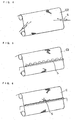
- Figs. 4 to 6 are schematic illustrations of modifications not forming part of the present invention showing various states in which the surface treatment agent is sprayed.
- Fig. 4 is a schematic illustration of a modification not forming part of the present invention showing a spraying state wherein a silicone oil is sprayed onto the surface of the canvas through fixed type spray nozzles of the chemical spray unit
- Fig. 5 a schematic illustration of a modification not forming part of the present invention showing same in the case of using the chemical spray unit provided with spray nozzles disposed lengthwise
- Fig. 6 a schematic illustration of a modification not forming part of the present invention showing same in the case of using the chemical spray unit provided with a movable spray nozzle.
- the surface treatment agent is sprayed onto the surface of the canvases through the spray nozzles set as shown in Figs. 4 to 6 , respectively, at the positions indicated by the letters X, Y, and so forth, respectively, in Fig. 2 .
- the surface treatment agent used in carrying out the invention is composed mainly of silicone oil.
- methylphenyl silicone oil diethyl silicone oil, denatured amino silicone oil, denatured epoxy silicone oil, denatured higher fatty acid silicone oil, and so forth are adopted for the silicone oil (silicone-based oil).
- the silicone oil (silicone-based oil), that is, the surface treatment agent, may preferably be emulsified by adding a surfactant thereto so as to lower viscosity thereof as well as to improve dispersion characteristic during spraying.
- the surfactant used for emulsification of the silicone oil may preferably be added in percentage corresponding to 15 to 70 wt. % of the silicone oil, and the surface treatment agent is normally prepared by diluting the silicone oil with water 4 to 15 times as much.
- the surface treatment agent is further diluted with water by a factor of 100 to 3000 in order to spray the surface treatment agent in a wider range on the canvases simultaneously.
- water used for dilution may preferably be heated to a temperature in the range of 50 to 80 DEG C to minimize a risk of the nozzles getting clogged with scum and slime.
- the surface treatment agent too is to be heated to a substantially equivalent temperature.
- the surface treatment agent containing the silicone oil is continuously supplied onto the surface of the canvases (a silicone oil supply step).
- the silicone oil supplied to the canvases is heated by conduction heat of the drum-dryers, and permeates through the canvases (a silicone oil permeation and adhesion step).
- the silicone oil makes ingress into the interior of the canvases from the surface thereof, and is closely adhered thereto.
- the silicone oil adhered to the surface of the canvases is continuously transferred by a predetermined amount to the paper strip as the canvases continue to be pressed against the paper strip (a silicone oil transfer step).
- any depleted portion of the silicone oil can be replenished quickly (a silicone oil replenishment step).
- the surface of the canvases is always in a condition where a suitable amount of the silicone oil contained in the surface treatment agent is present, enabling the canvases to withstand continuous operation satisfactorily.
- Fig. 7 is a schematic illustration showing how the surface of the canvases is treated with the surface treatment agent containing the silicone oil. The process of such treatment comprises the following steps.
- the silicone oil P is adhered to the surface of the canvas C2 (A).
- the silicone oil P is heated up by the drum-dryers, and makes ingress into the interior of the canvas C2 (B).
- the silicone oil P makes further ingress deeper into the interior of the canvas C2 (C).
- the silicone oil P is transferred to the paper strip W, undergoing natural depletion on the surface of the canvas C2 (D).
- the steps 1) to 3) described above are carried out by continuously supplying a new region of the surface of the canvas in motion with the surface treatment agent containing the silicone oil.
- an important point in carrying out the invention is an amount of the silicone oil to be supplied to the canvases at a time.
- the supply (spraying) of the silicone oil needs to be made so as to meet these two requirements.
- a supply rate of the silicone oil somewhat varies depending on the type of the canvas and quality of the paper strip, however, it is normally 0.1 to 200 mg / m 2 per min, preferably 1 to 100 mg / m 2 per min.
- the supply rate is less than 0.1 mg / m 2 per min, sufficient permeation of the silicone oil into the canvases does not occur while if the supply rate exceeds 200 mg / m 2 per min, dripping of the surface treatment agent containing the silicone oil occurs, causing clogging of the eyes of the canvases, oil stain on paper, or contamination of peripheral equipment.
- a test was carried out for a month, wherein a surface treatment agent was continuously sprayed onto the surface of a canvas through the nozzle of the chemical spray unit shown in Fig. 6 , and thereafter, the condition of the surface of the canvas at that point in time was observed.
- the surface treatment agent used in the test was an emulsified aqueous solution prepared by diluting a mixture composed of the silicone oil and a surfactant mixed at wt. ratio of 10 : 5 with water 6 times as much as the silicone oil (specific gravity at about 1.0 g / cc).
- a test was carried out for a month, wherein a surface treatment agent was continuously sprayed onto the surface of the canvas through the nozzle of the chemical spray unit shown in Fig. 5 , and thereafter, the surface condition of an outroll for the canvas at that point in time was observed.
- the surface treatment agent used in the test was an emulsified aqueous solution prepared by diluting the surface treatment agent used in the embodiment 1 with water heated to 60°C in quantity 200 times as much (specific gravity at about 1.0 g/ cc).
- breaks of paper occurred 8 times in the dry part during the test, representing a marked reduction in frequency of occurrence of the breaks in comparison with that experienced before application of the technology disclosed herein, which was 40 times per month.
- a test was carried out for a month, wherein a surface treatment agent was continuously sprayed onto the surface of the canvas through the nozzle of the chemical spray unit shown in Fig. 6 , and thereafter, the condition of the surface of the canvas at that point in time was observed.
- the surface treatment agent used in the test was an emulsified aqueous solution prepared by diluting a mixture composed of the silicone oil and the surfactant mixed at wt. ratio of 10 : 8 with water 14 times as much as the silicone oil (specific gravity at about 1.0 g / cc).
- breaks of paper occurred 6 times in the dry part during the test, representing a marked reduction in frequency of occurrence of the breaks in comparison with that experienced before application of the technology disclosed herein, which was 20 times per month.
- Test results showed that in the case of using water at room temperature, the nozzle was clogged up frequently (once a week or once every other week) while in the case of using water heated up, no clogging of the nozzle occurred at all, enabling efficient spraying to be carried out.
- Fig. 15 shows the result of such comparison.
- the method described hereinbefore relates to the method of supplying the surface treatment agent directly onto the surface of the canvas.
- This disclosure provides an alternative method, in accordance with the invention as claimed, of supplying the surface treatment agent indirectly onto the surface of the canvas other than the method of supplying the surface treatment agent directly onto the surface of the canvas.
- Fig. 8 shows a method of supplying a surface treatment agent indirectly onto the surface of the canvas by way of example, and particularly in this case, an example wherein the surface treatment agent is sprayed onto an outroll in a pulled-back position is shown.
- a surface treatment agent containing the silicone oil is sprayed onto the surface of the outroll through spray nozzles (fixed type) of the chemical spray unit.
- Fig. 9 is a view showing an example wherein the surface treatment agent is sprayed onto the surface of the outroll through a movable type spray nozzle of the chemical spray unit.
- Fig. 10 is a view showing an example wherein the surface treatment agent is sprayed onto the surface of the outroll using the chemical spray unit provided with spray nozzles disposed lengthwise.
- an advantage of preventing scattering of the surface treatment agent is gained by applying spraying to the outroll C5 disposed in a pulled-back position (position indicated by the letter Z in Fig. 2 ) because a narrow space formed between the top side and the underside of the outroll C5 can be isolated by a canvas C2.
- the silicone oil P is adhered to the surface of the outroll.
- the silicone oil P is shifted from the surface of the outroll to the canvas C2, and as a result, the silicone oil P is adhered to the surface of the canvas.
- a position where spraying is made is selectable optionally within the paper machine as long as the position will not interfere with the operation of the paper machine.
Landscapes
- Paper (AREA)
- Prevention Of Fouling (AREA)
- Materials Applied To Surfaces To Minimize Adherence Of Mist Or Water (AREA)
- Treatments For Attaching Organic Compounds To Fibrous Goods (AREA)
Claims (5)
- Verfahren zum Verhindern von Verschmutzung einer Leinwand (C2, C3), die in einem geschlossenen Kreis läuft, und eine äußere Oberfläche aufweist, um einen Papierstreifen (W) gegen die Oberfläche von Trommeltrocknern (C1) zu drücken, die zum Trocknen des Papierstreifens (W) in einer Papiermaschine verwendet werden, wobei ein Silikonöl mit einer Zufuhrrate von 0,1 bis 200 mg/m2 pro Min kontinuierlich auf die Oberfläche einer Leinwandaußenrolle (C5), die an der äußeren Seite der Leinwand zum Führen der Leinwand (C2, C3) angeordnet ist, in einer Betriebsphase gesprüht wird, bevor der Papierstreifen (W) in Kontakt mit der Leinwand (C2, C3) sowie den Trommeltrocknern (C1) gedrückt wird, während der Papierstreifen (W) durch den Betrieb der Papiermaschine gefördert wird.
- Verfahren zum Verhindern von Verschmutzung einer Leinwand (C2, C3) nach Anspruch 1, bei dem, zum Zuführen des Silikonöls, ein mit einer grenzflächenaktiven Substanz emulgiertes Silikonöl verwendet wird.
- Verfahren zum Verhindern von Verschmutzung einer Leinwand (C2, C3) nach Anspruch 1 oder 2, bei dem das Silikonöl, bevor es versprüht wird, mit Wasser verdünnt wird.
- Verfahren zum Verhindern von Verschmutzung einer Leinwand (C2, C3) nach Anspruch 1 oder 2, bei dem das Silikonöl, unmittelbar vor Versprühen, mit Wasser verdünnt wird, das auf eine Temperatur im Bereich von 50 °C bis 80 °C erwärmt ist.
- Verfahren nach Anspruch 1, bei dem das Verfahren die folgenden Schritte 1) bis 5) aufweist:1) einen Silikonöl-Zuführschritt, um das Silikonöl mit einer Zufuhrrate von 0,1 bis 200 mg/m2 pro Min auf die Oberfläche der Außenrolle (C5) zuzuführen, die an der äußeren Seite der Leinwand zum Führen der Leinwand (C2, C3) eingerichtet ist;2) einen Silikonöl-Übertragungsschritt um das Silikonöl von der Oberfläche der Außenrolle (C5) auf die äußere Oberfläche der Leinwand (C2, C3) zu übertragen;3) einen Silikonöl Durchdringungs- und Anhaftungsschritt, um das Silikonöl dazu zu veranlassen, die Leinwand (C2, C3) zu durchdringen und auf deren äußeren Oberfläche unter Hitze und Druck anzuhaften;4) einen Silikonöl-Transferschritt, um den Papierstreifen (W) gegen die äußere Oberfläche der Leinwand (C2, C3) zu drücken, was das Silikonöl dazu veranlasst, auf den Papierstreifen transferiert zu werden; und5) einen Silikonöl-Auffüllschritt, um das durch den Transfer aufgebrauchte Silikonöl auf der äußeren Oberfläche der Leinwand (C2, C3) aufzufüllen.
Applications Claiming Priority (3)
| Application Number | Priority Date | Filing Date | Title |
|---|---|---|---|
| JP28894598 | 1998-09-25 | ||
| JP28894598A JP3608709B2 (ja) | 1998-09-25 | 1998-09-25 | 抄紙機に使用されるカンバスの汚染防止方法 |
| PCT/JP1999/005023 WO2000019009A1 (en) | 1998-09-25 | 1999-09-14 | Pollution prevention method for canvas used in paper machine |
Publications (3)
| Publication Number | Publication Date |
|---|---|
| EP1124005A1 EP1124005A1 (de) | 2001-08-16 |
| EP1124005A4 EP1124005A4 (de) | 2005-05-25 |
| EP1124005B1 true EP1124005B1 (de) | 2014-01-08 |
Family
ID=17736849
Family Applications (1)
| Application Number | Title | Priority Date | Filing Date |
|---|---|---|---|
| EP99943344.4A Expired - Lifetime EP1124005B1 (de) | 1998-09-25 | 1999-09-14 | Verschmutzungsschutzverfahren für eine papiermaschinenbespannung |
Country Status (12)
| Country | Link |
|---|---|
| US (1) | US7323086B1 (de) |
| EP (1) | EP1124005B1 (de) |
| JP (1) | JP3608709B2 (de) |
| KR (1) | KR100388539B1 (de) |
| CN (1) | CN1170032C (de) |
| AU (1) | AU5651199A (de) |
| CA (1) | CA2345472C (de) |
| ES (1) | ES2453341T3 (de) |
| ID (1) | ID29456A (de) |
| PT (1) | PT1124005E (de) |
| TW (1) | TW445330B (de) |
| WO (1) | WO2000019009A1 (de) |
Families Citing this family (16)
| Publication number | Priority date | Publication date | Assignee | Title |
|---|---|---|---|---|
| JP3608709B2 (ja) | 1998-09-25 | 2005-01-12 | 株式会社メンテック | 抄紙機に使用されるカンバスの汚染防止方法 |
| JP2000096479A (ja) * | 1998-09-25 | 2000-04-04 | Mentec:Kk | 抄紙機に使用される円筒状ドライヤの汚染防止方法 |
| EP1312719A1 (de) | 2001-11-16 | 2003-05-21 | Wemas GmbH | Bakenfussgelenk |
| JP3388450B1 (ja) * | 2002-01-11 | 2003-03-24 | 株式会社メンテック | 抄紙機用汚染防止剤、及びそれを使用した汚染防止方法 |
| BR0317212A (pt) * | 2002-12-26 | 2005-11-01 | Maintech Co Ltd | Método de aspersão para aplicar agente antipoluente numa lona de máquina de fabricar papel, aparelho de aspersão deslizante e agente antipoluente para uso no mesmo |
| TW200422486A (en) * | 2003-02-18 | 2004-11-01 | Maintech Co Ltd | Method for preventing paper web surface from fraying in papermaking machine, printing paper for use in offset printing, and release agent |
| EP1855877A4 (de) | 2005-03-09 | 2009-12-23 | Astenjohnson Inc | Papiererzeugungsstoffe mit schmutzresistenter nanopartikelbeschichtung und verfahren zur in-situ-anwendung |
| DE102006042934A1 (de) * | 2006-09-13 | 2008-03-27 | Voith Patent Gmbh | Bandreinhaltung |
| JP5616578B2 (ja) | 2008-10-22 | 2014-10-29 | 東レ・ダウコーニング株式会社 | 非硬化型コーティング用組成物 |
| KR20130009973A (ko) | 2010-02-25 | 2013-01-24 | 다우 코닝 도레이 캄파니 리미티드 | 오염 억제제 |
| JP5634738B2 (ja) | 2010-04-20 | 2014-12-03 | 東レ・ダウコーニング株式会社 | 非硬化型コーティング用組成物 |
| CN105143550B (zh) * | 2013-03-04 | 2017-12-05 | 曼泰克株式会社 | 药液的喷涂方法 |
| JP5907576B2 (ja) * | 2014-03-31 | 2016-04-26 | 株式会社メンテック | 薬液の吹付け方法 |
| KR102051137B1 (ko) * | 2018-07-09 | 2019-12-03 | 주식회사 웨이브컴퍼니 | 기능성 실리콘고무 코팅 원단 |
| CN110922891A (zh) * | 2019-12-17 | 2020-03-27 | 山东易石环保新材料有限公司 | 一种乳液型有机硅纸机烘缸剥离剂及其制备方法 |
| CN110964436A (zh) * | 2019-12-17 | 2020-04-07 | 山东易石环保新材料有限公司 | 一种有机硅乳液型纸机干网剥离剂及其制备方法 |
Family Cites Families (16)
| Publication number | Priority date | Publication date | Assignee | Title |
|---|---|---|---|---|
| US3014832A (en) | 1957-02-12 | 1961-12-26 | Kimberly Clark Co | Method of fabricating tissue |
| JPS57171790A (en) * | 1980-12-06 | 1982-10-22 | Nihon Felt Kk | Papermaking cloth having anti-stain property |
| JPS60134092A (ja) | 1983-12-20 | 1985-07-17 | タイホ−工業株式会社 | クラフトパルプ製造工程における蒸解釜内のスケール付着防止方法 |
| JPS6314855A (ja) | 1986-07-07 | 1988-01-22 | Toyota Central Res & Dev Lab Inc | 表面処理方法及び表面処理剤 |
| US4861429A (en) | 1988-07-29 | 1989-08-29 | Betz Laboratories, Inc. | Process for inhibiting white pitch deposition in papermaking felts |
| JPH0369690A (ja) * | 1989-08-03 | 1991-03-26 | Permachem Asia Ltd | 製紙工程ピツチ付着防止方法 |
| US5073235A (en) * | 1990-04-12 | 1991-12-17 | The Procter & Gamble Company | Process for chemically treating papermaking belts |
| JPH07292591A (ja) | 1990-04-24 | 1995-11-07 | Kunio Sekiya | 抄紙機ドライヤー表面損傷防止法とそれに用いる薬液散布装置と水溶性潤滑油 |
| JPH04130190A (ja) | 1990-09-20 | 1992-05-01 | Nippon Oil & Fats Co Ltd | 抄紙用ドライヤー表面清浄潤滑剤 |
| JPH06280181A (ja) | 1992-09-07 | 1994-10-04 | Mentetsuku:Kk | 抄紙機ドライヤー表面に固体潤滑剤を散布し,表面に潤滑性被 膜を形成させる方法及びそれに用いる薬液散布装置と固体潤滑 剤 |
| JPH06175892A (ja) | 1992-12-08 | 1994-06-24 | Oki Electric Ind Co Ltd | 作業用磁気ディスクファイル管理装置 |
| GB2284833A (en) | 1993-11-02 | 1995-06-21 | Steven Frederick Finch | Inhibiting the deposition of sticky particles on paper mill dryer fabrics |
| JP3408320B2 (ja) | 1994-04-28 | 2003-05-19 | タイホー工業株式会社 | 抄紙ドライヤー工程用汚れ付着防止剤 |
| DE19519268C1 (de) | 1995-05-31 | 1997-01-23 | Stockhausen Chem Fab Gmbh | Verwendung von Mitteln zur Zellstoff- und Papierherstellung |
| JP3608709B2 (ja) | 1998-09-25 | 2005-01-12 | 株式会社メンテック | 抄紙機に使用されるカンバスの汚染防止方法 |
| JP2000096479A (ja) * | 1998-09-25 | 2000-04-04 | Mentec:Kk | 抄紙機に使用される円筒状ドライヤの汚染防止方法 |
-
1998
- 1998-09-25 JP JP28894598A patent/JP3608709B2/ja not_active Expired - Fee Related
-
1999
- 1999-09-14 KR KR10-2001-7003860A patent/KR100388539B1/ko not_active Expired - Fee Related
- 1999-09-14 ID IDW20010699A patent/ID29456A/id unknown
- 1999-09-14 WO PCT/JP1999/005023 patent/WO2000019009A1/ja not_active Ceased
- 1999-09-14 EP EP99943344.4A patent/EP1124005B1/de not_active Expired - Lifetime
- 1999-09-14 PT PT99943344T patent/PT1124005E/pt unknown
- 1999-09-14 CA CA002345472A patent/CA2345472C/en not_active Expired - Lifetime
- 1999-09-14 AU AU56511/99A patent/AU5651199A/en not_active Abandoned
- 1999-09-14 CN CNB998136603A patent/CN1170032C/zh not_active Expired - Fee Related
- 1999-09-14 ES ES99943344.4T patent/ES2453341T3/es not_active Expired - Lifetime
- 1999-09-14 US US09/486,483 patent/US7323086B1/en not_active Expired - Lifetime
- 1999-09-23 TW TW088116352A patent/TW445330B/zh not_active IP Right Cessation
Also Published As
| Publication number | Publication date |
|---|---|
| WO2000019009A1 (en) | 2000-04-06 |
| JP2000096476A (ja) | 2000-04-04 |
| EP1124005A4 (de) | 2005-05-25 |
| JP3608709B2 (ja) | 2005-01-12 |
| TW445330B (en) | 2001-07-11 |
| EP1124005A1 (de) | 2001-08-16 |
| CN1170032C (zh) | 2004-10-06 |
| AU5651199A (en) | 2000-04-17 |
| CA2345472C (en) | 2006-08-01 |
| CA2345472A1 (en) | 2000-04-06 |
| KR100388539B1 (ko) | 2003-06-25 |
| CN1328608A (zh) | 2001-12-26 |
| ID29456A (id) | 2001-08-30 |
| KR20010075379A (ko) | 2001-08-09 |
| ES2453341T3 (es) | 2014-04-07 |
| US7323086B1 (en) | 2008-01-29 |
| PT1124005E (pt) | 2014-02-14 |
Similar Documents
| Publication | Publication Date | Title |
|---|---|---|
| US7323086B1 (en) | Pollution prevention method for canvas used in paper machine | |
| EP1124006B1 (de) | Steuerungsverfahren der verschmutzung für zylindertrockner in papiermaschinen | |
| DE69914982T2 (de) | Papiermacherband | |
| US4761309A (en) | Coating apparatus and method | |
| DE69712412T2 (de) | Verwendung einer Beschichtungsbahn in einer Papierstreichanlage | |
| DE60016699T2 (de) | Transferband für eine Papiermaschine | |
| US6187142B1 (en) | Process and device for acting on a paper or cardboard web with one of a fluid and pasty coating medium | |
| JP3197576B2 (ja) | 紙のコーティング工程におけるブツの発生を防止するための装置及び方法 | |
| DE69213953T2 (de) | Öl-übertragungskomponente | |
| EP1124007B1 (de) | Verschmutzungsschutzverfahren für gewebe in papiermaschinen | |
| NO147997B (no) | Vire beregnet for bruk ved vaatenden til en papirmaskin | |
| CA2248892C (en) | Reverse feed film applicator | |
| JP4271636B2 (ja) | 抄紙機におけるドライパートの汚染防止方法 | |
| JP3273137B2 (ja) | 抄紙機のプレスロールに対する紙の過付着防止方法 | |
| US6468394B1 (en) | Method of preventing over-adhesion of paper onto press roll of paper machine | |
| EP0881329A2 (de) | Verfahren und Vorrichtung zum Hinzufügen von dünnen Fasern in der Pressenpartie einer Papiermaschine | |
| US20060213631A1 (en) | Staining prevention method for dry part of paper machine and staining inhibitor used for the method | |
| JP4185091B2 (ja) | 抄紙用シュープレスベルト | |
| JP3644643B2 (ja) | 抄紙機におけるドライパートの汚染防止方法 | |
| DD216643A1 (de) | Auftragsverfahren fuer metallbaender mit organischen beschichtungsstoffen, insbesondere pvc-plastisolen | |
| WO2007074685A1 (ja) | 湿紙搬送用ベルト | |
| KR19990023136A (ko) | 오염방지기능을 갖춘 제지기용 클로싱 및 오염방지방법 |
Legal Events
| Date | Code | Title | Description |
|---|---|---|---|
| PUAI | Public reference made under article 153(3) epc to a published international application that has entered the european phase |
Free format text: ORIGINAL CODE: 0009012 |
|
| 17P | Request for examination filed |
Effective date: 20010410 |
|
| AK | Designated contracting states |
Kind code of ref document: A1 Designated state(s): AT BE CH CY DE DK ES FI FR GB GR IE IT LI LU MC NL PT SE |
|
| A4 | Supplementary search report drawn up and despatched |
Effective date: 20050412 |
|
| RIC1 | Information provided on ipc code assigned before grant |
Ipc: 7D 21F 1/30 B Ipc: 7D 21F 1/32 A |
|
| 17Q | First examination report despatched |
Effective date: 20070820 |
|
| REG | Reference to a national code |
Ref country code: DE Ref legal event code: R079 Ref document number: 69944972 Country of ref document: DE Free format text: PREVIOUS MAIN CLASS: D21F0001320000 Ipc: D21F0001300000 |
|
| GRAP | Despatch of communication of intention to grant a patent |
Free format text: ORIGINAL CODE: EPIDOSNIGR1 |
|
| RIC1 | Information provided on ipc code assigned before grant |
Ipc: D21H 21/02 20060101ALI20130710BHEP Ipc: D21F 1/30 20060101AFI20130710BHEP Ipc: D21F 1/32 20060101ALI20130710BHEP |
|
| INTG | Intention to grant announced |
Effective date: 20130801 |
|
| GRAS | Grant fee paid |
Free format text: ORIGINAL CODE: EPIDOSNIGR3 |
|
| GRAA | (expected) grant |
Free format text: ORIGINAL CODE: 0009210 |
|
| AK | Designated contracting states |
Kind code of ref document: B1 Designated state(s): AT BE CH CY DE DK ES FI FR GB GR IE IT LI LU MC NL PT SE |
|
| REG | Reference to a national code |
Ref country code: GB Ref legal event code: FG4D |
|
| REG | Reference to a national code |
Ref country code: CH Ref legal event code: NV Representative=s name: NOVAGRAAF INTERNATIONAL SA, CH Ref country code: CH Ref legal event code: EP |
|
| REG | Reference to a national code |
Ref country code: IE Ref legal event code: FG4D |
|
| REG | Reference to a national code |
Ref country code: PT Ref legal event code: SC4A Free format text: AVAILABILITY OF NATIONAL TRANSLATION Effective date: 20140204 |
|
| REG | Reference to a national code |
Ref country code: AT Ref legal event code: REF Ref document number: 648850 Country of ref document: AT Kind code of ref document: T Effective date: 20140215 |
|
| REG | Reference to a national code |
Ref country code: DE Ref legal event code: R096 Ref document number: 69944972 Country of ref document: DE Effective date: 20140220 |
|
| REG | Reference to a national code |
Ref country code: SE Ref legal event code: TRGR |
|
| REG | Reference to a national code |
Ref country code: NL Ref legal event code: T3 |
|
| REG | Reference to a national code |
Ref country code: ES Ref legal event code: FG2A Ref document number: 2453341 Country of ref document: ES Kind code of ref document: T3 Effective date: 20140407 |
|
| PG25 | Lapsed in a contracting state [announced via postgrant information from national office to epo] |
Ref country code: CY Free format text: LAPSE BECAUSE OF FAILURE TO SUBMIT A TRANSLATION OF THE DESCRIPTION OR TO PAY THE FEE WITHIN THE PRESCRIBED TIME-LIMIT Effective date: 20140108 |
|
| REG | Reference to a national code |
Ref country code: DE Ref legal event code: R097 Ref document number: 69944972 Country of ref document: DE |
|
| PG25 | Lapsed in a contracting state [announced via postgrant information from national office to epo] |
Ref country code: DK Free format text: LAPSE BECAUSE OF FAILURE TO SUBMIT A TRANSLATION OF THE DESCRIPTION OR TO PAY THE FEE WITHIN THE PRESCRIBED TIME-LIMIT Effective date: 20140108 |
|
| PLBE | No opposition filed within time limit |
Free format text: ORIGINAL CODE: 0009261 |
|
| STAA | Information on the status of an ep patent application or granted ep patent |
Free format text: STATUS: NO OPPOSITION FILED WITHIN TIME LIMIT |
|
| 26N | No opposition filed |
Effective date: 20141009 |
|
| REG | Reference to a national code |
Ref country code: DE Ref legal event code: R097 Ref document number: 69944972 Country of ref document: DE Effective date: 20141009 |
|
| PG25 | Lapsed in a contracting state [announced via postgrant information from national office to epo] |
Ref country code: MC Free format text: LAPSE BECAUSE OF FAILURE TO SUBMIT A TRANSLATION OF THE DESCRIPTION OR TO PAY THE FEE WITHIN THE PRESCRIBED TIME-LIMIT Effective date: 20140108 Ref country code: LU Free format text: LAPSE BECAUSE OF FAILURE TO SUBMIT A TRANSLATION OF THE DESCRIPTION OR TO PAY THE FEE WITHIN THE PRESCRIBED TIME-LIMIT Effective date: 20140914 |
|
| REG | Reference to a national code |
Ref country code: IE Ref legal event code: MM4A |
|
| PG25 | Lapsed in a contracting state [announced via postgrant information from national office to epo] |
Ref country code: IE Free format text: LAPSE BECAUSE OF NON-PAYMENT OF DUE FEES Effective date: 20140914 |
|
| PG25 | Lapsed in a contracting state [announced via postgrant information from national office to epo] |
Ref country code: GR Free format text: LAPSE BECAUSE OF FAILURE TO SUBMIT A TRANSLATION OF THE DESCRIPTION OR TO PAY THE FEE WITHIN THE PRESCRIBED TIME-LIMIT Effective date: 20140409 |
|
| REG | Reference to a national code |
Ref country code: FR Ref legal event code: PLFP Year of fee payment: 18 |
|
| REG | Reference to a national code |
Ref country code: FR Ref legal event code: PLFP Year of fee payment: 19 |
|
| REG | Reference to a national code |
Ref country code: FR Ref legal event code: PLFP Year of fee payment: 20 |
|
| PGFP | Annual fee paid to national office [announced via postgrant information from national office to epo] |
Ref country code: IT Payment date: 20180920 Year of fee payment: 20 Ref country code: FR Payment date: 20180925 Year of fee payment: 20 Ref country code: DE Payment date: 20180927 Year of fee payment: 20 |
|
| PGFP | Annual fee paid to national office [announced via postgrant information from national office to epo] |
Ref country code: NL Payment date: 20180926 Year of fee payment: 20 Ref country code: GB Payment date: 20180927 Year of fee payment: 20 Ref country code: FI Payment date: 20180927 Year of fee payment: 20 Ref country code: AT Payment date: 20180904 Year of fee payment: 20 Ref country code: SE Payment date: 20180927 Year of fee payment: 20 |
|
| PGFP | Annual fee paid to national office [announced via postgrant information from national office to epo] |
Ref country code: PT Payment date: 20180906 Year of fee payment: 20 |
|
| PGFP | Annual fee paid to national office [announced via postgrant information from national office to epo] |
Ref country code: BE Payment date: 20180927 Year of fee payment: 20 Ref country code: CH Payment date: 20181002 Year of fee payment: 20 Ref country code: ES Payment date: 20181001 Year of fee payment: 20 |
|
| REG | Reference to a national code |
Ref country code: CH Ref legal event code: PL |
|
| REG | Reference to a national code |
Ref country code: DE Ref legal event code: R071 Ref document number: 69944972 Country of ref document: DE |
|
| REG | Reference to a national code |
Ref country code: NL Ref legal event code: MK Effective date: 20190913 |
|
| REG | Reference to a national code |
Ref country code: GB Ref legal event code: PE20 Expiry date: 20190913 |
|
| REG | Reference to a national code |
Ref country code: BE Ref legal event code: MK Effective date: 20190914 |
|
| REG | Reference to a national code |
Ref country code: SE Ref legal event code: EUG |
|
| PG25 | Lapsed in a contracting state [announced via postgrant information from national office to epo] |
Ref country code: PT Free format text: LAPSE BECAUSE OF EXPIRATION OF PROTECTION Effective date: 20190926 |
|
| REG | Reference to a national code |
Ref country code: AT Ref legal event code: MK07 Ref document number: 648850 Country of ref document: AT Kind code of ref document: T Effective date: 20190914 |
|
| PG25 | Lapsed in a contracting state [announced via postgrant information from national office to epo] |
Ref country code: GB Free format text: LAPSE BECAUSE OF EXPIRATION OF PROTECTION Effective date: 20190913 |
|
| REG | Reference to a national code |
Ref country code: ES Ref legal event code: FD2A Effective date: 20201203 |
|
| PG25 | Lapsed in a contracting state [announced via postgrant information from national office to epo] |
Ref country code: ES Free format text: LAPSE BECAUSE OF EXPIRATION OF PROTECTION Effective date: 20190915 |