EP1124007B1 - Verschmutzungsschutzverfahren für gewebe in papiermaschinen - Google Patents
Verschmutzungsschutzverfahren für gewebe in papiermaschinen Download PDFInfo
- Publication number
- EP1124007B1 EP1124007B1 EP99943343A EP99943343A EP1124007B1 EP 1124007 B1 EP1124007 B1 EP 1124007B1 EP 99943343 A EP99943343 A EP 99943343A EP 99943343 A EP99943343 A EP 99943343A EP 1124007 B1 EP1124007 B1 EP 1124007B1
- Authority
- EP
- European Patent Office
- Prior art keywords
- synthetic resin
- drum dryer
- paper
- forming agent
- oil
- Prior art date
- Legal status (The legal status is an assumption and is not a legal conclusion. Google has not performed a legal analysis and makes no representation as to the accuracy of the status listed.)
- Expired - Lifetime
Links
- 238000000034 method Methods 0.000 title claims abstract description 39
- 230000002265 prevention Effects 0.000 title description 4
- 238000011109 contamination Methods 0.000 claims abstract description 29
- 229920003002 synthetic resin Polymers 0.000 claims description 128
- 239000000057 synthetic resin Substances 0.000 claims description 128
- 239000000843 powder Substances 0.000 claims description 89
- 239000003795 chemical substances by application Substances 0.000 claims description 65
- 239000002245 particle Substances 0.000 claims description 9
- 239000004094 surface-active agent Substances 0.000 claims description 8
- 238000012546 transfer Methods 0.000 claims description 8
- 239000000470 constituent Substances 0.000 claims description 4
- 230000000779 depleting effect Effects 0.000 claims description 3
- 238000001035 drying Methods 0.000 abstract description 7
- 230000003373 anti-fouling effect Effects 0.000 abstract description 4
- 230000007774 longterm Effects 0.000 abstract description 4
- 239000007921 spray Substances 0.000 description 34
- 239000003921 oil Substances 0.000 description 27
- 238000012360 testing method Methods 0.000 description 22
- 238000005507 spraying Methods 0.000 description 14
- XLYOFNOQVPJJNP-UHFFFAOYSA-N water Substances O XLYOFNOQVPJJNP-UHFFFAOYSA-N 0.000 description 9
- 230000000694 effects Effects 0.000 description 8
- ZQKXQUJXLSSJCH-UHFFFAOYSA-N melamine cyanurate Chemical compound NC1=NC(N)=NC(N)=N1.O=C1NC(=O)NC(=O)N1 ZQKXQUJXLSSJCH-UHFFFAOYSA-N 0.000 description 7
- 239000000126 substance Substances 0.000 description 7
- 230000000052 comparative effect Effects 0.000 description 6
- 238000010410 dusting Methods 0.000 description 5
- 238000005516 engineering process Methods 0.000 description 5
- 239000003112 inhibitor Substances 0.000 description 5
- 239000000853 adhesive Substances 0.000 description 4
- 230000001070 adhesive effect Effects 0.000 description 4
- 208000018747 cerebellar ataxia with neuropathy and bilateral vestibular areflexia syndrome Diseases 0.000 description 4
- 238000007790 scraping Methods 0.000 description 4
- 230000015556 catabolic process Effects 0.000 description 3
- 238000010276 construction Methods 0.000 description 3
- 230000003247 decreasing effect Effects 0.000 description 3
- 238000006731 degradation reaction Methods 0.000 description 3
- 238000010790 dilution Methods 0.000 description 3
- 239000012895 dilution Substances 0.000 description 3
- 239000000203 mixture Substances 0.000 description 3
- 239000000654 additive Substances 0.000 description 2
- 230000001464 adherent effect Effects 0.000 description 2
- 239000007864 aqueous solution Substances 0.000 description 2
- 230000009286 beneficial effect Effects 0.000 description 2
- 239000000356 contaminant Substances 0.000 description 2
- 238000007796 conventional method Methods 0.000 description 2
- 230000007423 decrease Effects 0.000 description 2
- 238000007865 diluting Methods 0.000 description 2
- ZFSLODLOARCGLH-UHFFFAOYSA-N isocyanuric acid Chemical compound OC1=NC(O)=NC(O)=N1 ZFSLODLOARCGLH-UHFFFAOYSA-N 0.000 description 2
- 239000007788 liquid Substances 0.000 description 2
- 239000002932 luster Substances 0.000 description 2
- 239000000463 material Substances 0.000 description 2
- 238000002156 mixing Methods 0.000 description 2
- 229920000642 polymer Polymers 0.000 description 2
- 230000009467 reduction Effects 0.000 description 2
- VYZAMTAEIAYCRO-UHFFFAOYSA-N Chromium Chemical compound [Cr] VYZAMTAEIAYCRO-UHFFFAOYSA-N 0.000 description 1
- 229920000877 Melamine resin Polymers 0.000 description 1
- 229920001410 Microfiber Polymers 0.000 description 1
- 239000004809 Teflon Substances 0.000 description 1
- 229920006362 Teflon® Polymers 0.000 description 1
- 230000000996 additive effect Effects 0.000 description 1
- 230000002411 adverse Effects 0.000 description 1
- 239000002519 antifouling agent Substances 0.000 description 1
- 238000005266 casting Methods 0.000 description 1
- 230000008859 change Effects 0.000 description 1
- 229910052804 chromium Inorganic materials 0.000 description 1
- 239000011651 chromium Substances 0.000 description 1
- 239000011248 coating agent Substances 0.000 description 1
- 238000000576 coating method Methods 0.000 description 1
- 239000002131 composite material Substances 0.000 description 1
- 230000000593 degrading effect Effects 0.000 description 1
- 238000004925 denaturation Methods 0.000 description 1
- 230000036425 denaturation Effects 0.000 description 1
- 239000006185 dispersion Substances 0.000 description 1
- 239000000945 filler Substances 0.000 description 1
- 238000010438 heat treatment Methods 0.000 description 1
- 238000004519 manufacturing process Methods 0.000 description 1
- JDSHMPZPIAZGSV-UHFFFAOYSA-N melamine Chemical compound NC1=NC(N)=NC(N)=N1 JDSHMPZPIAZGSV-UHFFFAOYSA-N 0.000 description 1
- 229910052751 metal Inorganic materials 0.000 description 1
- 239000002184 metal Substances 0.000 description 1
- 239000003658 microfiber Substances 0.000 description 1
- 239000002480 mineral oil Substances 0.000 description 1
- 235000010446 mineral oil Nutrition 0.000 description 1
- 238000012986 modification Methods 0.000 description 1
- 230000004048 modification Effects 0.000 description 1
- 230000002093 peripheral effect Effects 0.000 description 1
- 238000007750 plasma spraying Methods 0.000 description 1
- 238000007747 plating Methods 0.000 description 1
- 238000003825 pressing Methods 0.000 description 1
- 238000007639 printing Methods 0.000 description 1
- 230000001737 promoting effect Effects 0.000 description 1
- 238000010791 quenching Methods 0.000 description 1
- 230000000171 quenching effect Effects 0.000 description 1
- 239000007787 solid Substances 0.000 description 1
- 238000003892 spreading Methods 0.000 description 1
- 230000007480 spreading Effects 0.000 description 1
- 239000012756 surface treatment agent Substances 0.000 description 1
Images


Classifications
-
- D—TEXTILES; PAPER
- D21—PAPER-MAKING; PRODUCTION OF CELLULOSE
- D21F—PAPER-MAKING MACHINES; METHODS OF PRODUCING PAPER THEREON
- D21F5/00—Dryer section of machines for making continuous webs of paper
-
- D—TEXTILES; PAPER
- D21—PAPER-MAKING; PRODUCTION OF CELLULOSE
- D21F—PAPER-MAKING MACHINES; METHODS OF PRODUCING PAPER THEREON
- D21F5/00—Dryer section of machines for making continuous webs of paper
- D21F5/02—Drying on cylinders
Definitions
- the present invention relates to a method of preventing contamination of a drum dryer used in a paper machine (pollution prevention method for cylindrical dryer used in paper machine).
- sheet-shaped wet paper is formed from feed stock, and the wet paper is processed into product paper by removing moisture from the former.
- drying is an essential step for removing moisture
- a so-called dry part where a drying process is carried out plays a very important role.
- the paper machine is equipped with a plurality of dryers for drying the wet paper, occupying the major part of the paper machine.
- the dryers normally have a construction such that the dryers can be heated from inside thereof by introducing heated steam and so forth thereinto.
- the surface of the dryers made of metal is generally a rough surface in microscopic terms, and especially since dryers made of casting are in widespread use, it is unavoidable that the surface thereof has such roughness.
- paper contains pitch, tar component, and microfibers that are included in pulp feed stock itself, additive chemicals contained in various papers, and other components such as filler.
- pitch tar component
- microfibers that are included in pulp feed stock itself
- additive chemicals contained in various papers and other components such as filler.
- the invention has been developed in an attempt to solve various problems described in the foregoing.
- the first aspect of the invention provides a method of preventing contamination of the surface of a drum dryer used in a paper machine, whereby a predetermined amount of a surface forming agent is continuously supplied to the surface of the drum dryer in rotation, facing a paper strip, while the paper strip is being fed by the paper machine in operation.
- the second aspect of the invention provides a method of preventing contamination of the surface of a drum dryer, wherein the surface forming agent in the first aspect of the invention contains synthetic resin powders as the main constituent thereof.
- the third aspect of the invention provides a method of preventing contamination of the surface of a drum dryer, wherein the surface forming agent in the second aspect of the invention further contains a surfactant.
- the fourth aspect of the invention provides a method of preventing contamination of the surface of a drum dryer, wherein the surface forming agent in the second aspect of the invention further contains oil.
- the fifth aspect of the invention provides a method of preventing contamination of the surface of a drum dryer, wherein the surface forming agent in the second aspect of the invention further contains a surfactant and oil.
- the sixth aspect of the invention provides a method of preventing contamination of the surface of a drum dryer, wherein the surface forming agent in the second aspect of the invention wherein a particle size of the synthetic resin powders in the second aspect of the invention is in the range of from 0.1 to 10 ⁇ m.
- the seventh aspect of the invention provides a method of preventing contamination of the surface of a drum dryer used in a paper machine, whereby synthetic resin powders are continuously supplied at a rate of 10 ⁇ g to 50 ⁇ g / m 2 per minute to the surface of the drum dryer in rotation, facing a paper strip, while the paper strip is being fed by the paper machine in operation.
- the eighth aspect of the invention provides a method of preventing contamination of the surface of a drum dryer, wherein the drum dryer in any one of the preceding first to seventh aspects of the invention is a Yankee dryer.
- the ninth aspect of the invention provides a method of preventing contamination of the surface of a drum dryer, wherein the drum dryer in any one of the preceding first to seventh aspects of the invention is multiple type drum dryers.
- the tenth aspect of the invention provides a method of preventing contamination of the surface of a drum dryer used in a paper machine, said method comprising the following steps 1) to 5):
- the eleventh aspect of the invention provides a method of preventing contamination of the surface of a drum dryer used in a paper machine, said method comprising the following steps 1) to 6):
- the method of the invention may comprise a combination of at least two methods, selected from a group of the above-mentioned methods (1) to (11) provided that the method serves the object of the invention.
- the synthetic resin (film) layer is further formed on the surface of the drum dryer with the recesses in the microscopic asperities thereof, already filled up with the synthetic resin powders.
- synthetic resin of the synthetic resin layer formed on the surface of the drum dryer is transferred to the paper strip, and on the other hand, parts of the surface thereof, where the synthetic resin layer has been depleted, are replenished with new synthetic resin.
- a paper machine is normally provided with a dry part, and the dry part comprises heated drum dryers, canvases for pressing a paper strip into contact with the drum dryers, canvas rollers for guiding the canvases, and so forth.
- a method of preventing contamination according to the invention is applied to the drum dryers assembled to the paper machine.
- Contamination of the drum dryers can be prevented by supplying continuously a surface treatment agent by a predetermined amount to the surface of the drum dryers, facing paper.
- the surface of the drum dryer is kept in a condition to have a film of a surface forming agent thereon.
- a surface forming agent containing synthetic resin powders as a main constituent is used.
- melamine cyanurate prepared by addition of an equal amount (by weight) of melamine and isocyanuric acid, polytetrafluoroethyelene, and so forth can be used for the synthetic resin powders, and particularly, melamine cyanurate (MCA) is preferable.
- the synthetic resin powders of particle size in the range of from 0. 1 to 10 ⁇ m are used, and a particle size in the range of from about 1 to 5 mm is more preferable.
- the particle size is smaller than 0.1 ⁇ m, a fill-up condition becomes unstable, and if the particle size is larger than 10 ⁇ m, it will become difficult to fill up the recesses in the microscopic asperities on the surface of the drum dryer.
- a synthetic resin powder content of from 1 to 20 percent by weight relative to the surface forming agent is adopted.
- the surface forming agent is prepared by addition of a surfactant to the synthetic resin powders to improve dispersivity, so that spraying as described hereinafter can be facilitated.
- a mixing ratio of the surfactant in the range of from 15 to 60 percent by weight relative to the synthetic resin powders, is adopted, and the surface forming agent is prepared normally by addition of water 5 to 100 times (by weight) as much as the synthetic resin powders to the synthetic resin powders with the surfactant mixed as above.
- additives such as an oil (solid wax included) based dusting inhibitor, a polymer based adhesive for promoting adhesion of wet paper onto the surface of the dryer, and so forth to an aqueous dispersion described above is practiced depending on the type of paper to be manufactured.
- a spray nozzle or spray nozzles are employed, and for preventing the spray nozzle / nozzles from getting clogged, further dilution (on the order of 10- to 100-fold) of the surface forming agent with water is also practiced before the surface forming agent is put to use.
- water used for dilution is preferably heated up to 50 to 80°C in order to minimize clogging of the spray nozzle / nozzles with scum and slime. Consequently, it is natural that the surface forming agent is heated up to a similar temperature.
- a supply rate (or a spray rate) of the surface forming agent containing the synthetic resin powders it is required that same is sprayed little by little on the surface of the dryer, and the supply rate in terms of the synthetic resin powders is 10 ⁇ g to 50 mg / m 2 per minute, preferably 30 ⁇ g to 10 mg /m 2 per minute.
- the supply rate is less than 10 ⁇ g / m 2 per minute, recesses in microscopic asperities on the surface of the drum dryer can not be filled up sufficiently (particularly, in the case of a Yankee dryer wherein scraping by a doctor takes place, a higher supply rate is required in comparison with the case of multiple drum-dryers), and if the supply rate exceeds 50 mg / m 2 per minute, the synthetic resin powders in excessive supply causes contamination of paper and peripheral facilities.
- Fig. 1 is a schematic illustration showing how treatment on the surface of the drum dryer is provided.
- the synthetic resin powders supplied onto the drum dryer is adhered to the surface of the drum dryer (refer to A in the figure).
- the synthetic resin powders adhered to the surface of the drum dryer proceed to fill up the recesses in the microscopic asperities (rough surface) of the drum dryer as a result of continuous supply of the surface forming agent P containing the synthetic resin powders (refer to B in the figure).
- the synthetic resin powders are in the form of a particulate, the synthetic resin powders are allowed to make ingress into the recesses in the microscopic asperities on the surface of the drum dryer with ease.
- the drum dryer is immediately replenished with the synthetic resin powders by an amount of reduction due to the depletion described (refer to E in the figure).
- the steps 1) to 3) described above are carried out in the initial stage of operation.
- the surface of the drum dryers is maintained in a condition such that a given synthetic resin film is constantly formed, enabling the paper machine to withstand continuous operation satisfactorily.
- the drum dryers will have a better mold-release characteristic against contamination.
- the surface of the drum dryer with the oil film described above formed thereon presents a mirror-like surface appearance.
- the spray rate of the surface forming agent containing the synthetic resin powders is to be in the range of from 10 ⁇ g to 50 mg/m 2 per minute in terms of the synthetic resin powders.
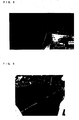
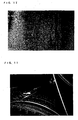
- test operation was carried out for a month, wherein a surface forming agent was continuously sprayed onto the surface of a Yankee dryer through a nozzle of a spray apparatus shown in Fig. 6, and upon completion of tests, the condition of the surface of the dryer as well as paper (one-side glazed paper) produced was observed.
- a surface forming agent used in the tests was an emulsified aqueous solution prepared by diluting a mixture composed of the synthetic resin powders (MCA) 3 ⁇ m in average particle size and a surfactant mixed at we. ratio of 10 : 5 with water 50 times as much as the mixture (density at about 1.0 g/ cc).
- a surface forming agent used in the tests was an emulsified aqueous solution prepared by diluting a mixture composed of the synthetic resin powders (MCA) 3 ⁇ m in average particle size, a surfactant and a polymer based adhesive, mixed at wt. ratio of 10 : 3 : 5, with water 50 times as much as the synthetic resin powders (density at about 1.0 g / cc).
- MCA synthetic resin powders
- test operation was carried out for a month, wherein a surface forming agent was continuously sprayed onto the surface of the dryers through a nozzle of a spray apparatus, shown in Fig. 6, and upon completion of tests, the condition of the surface of the dryers was observed.
- a surface forming agent used in the tests was prepared by mixing the synthetic resin powders (MCA) 3 ⁇ m in average particle size in an amount of 0.02 wt. percent relative to a wax based dusting inhibitor into the wax based dusting inhibitor (density at about 1.0 g / cc).
- the surface forming agent was sprayed through the nozzle. That is, in one case, the surface forming agent was heated up to 50 to 80°C immediately before spraying, and in the other case, the surface forming agent was kept at room temperature (on the order of 23°C).
- Test results showed that in the case of spraying at room temperature, the nozzle was clogged up frequently (once a week or once every other week) while in the case of heating up the surface forming agent, no clogging of the nozzle occurred, enabling efficient spraying to be carried out.
- test operation was carried out for a month, using a dryer with anti-fouling treatment applied thereto by plasma spraying, and upon completion of tests, the condition of the surface of the dryer was observed.
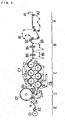
- Fig. 2 shows a standard paper machine comprising a wire part A, a press part B, and dryer parts C, D.
- feed stock (pulp) is fed from a head box A1 onto a Fourdrinier wire A2, dewatered, and formed into a paper strip in a sheet-like shape.
- the paper strip is squeezed from the upper side as well as the underside by rolls B2, B4, B6, and endless belts B1, B3, B5, thereby moisture thereof being reduced.
- the paper strip W is squeezed between canvases C7, C8, and the dryers C1, C2, C3, C4, C5, C6, and dried.
- Fig. 3 is an enlarged view of the Yankee dryer part D.
- the Yankee dryer part D comprises a Yankee dryer D1, a touch felt D2, a touch roll D3, a doctor D4, an auxiliary roll D5, and so forth.
- the Yankee dryer D1 is provided with an internal heat source, and heated up to an appropriate temperature, for example, to a surface temperature in the range of 110 to 120°C.
- a temperature to which the surface of the Yankee dryer D1 is heated up varies somewhat depending on the type of paper, an areal weight, a paper feed rate, and so forth.
- the paper strip is transferred, and then peeled away by a take-up force of a reel drum E1 from the surface of the Yankee dryer D1 at a point where the paper strip is transferred by 270° from the position opposite to the touch roll D3.
- the Yankee dryer D1 and the doctor D4 are juxtaposed with a given spacing therebetween, and the doctor D4 serves to remove adherents on the surface of the Yankee dryer D1 more effectively by continuous scraping of the adherents while being pressed into contact with the surface of the Yankee dryer D1.
- the surface forming agent containing the synthetic resin powders is sprayed over the surface of the Yankee dryer D1 at a position between a point where the paper strip is peeled way from the surface of the Yankee dryer D1 and the touch roll D3 (refer to Fig. 3).
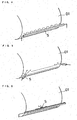
- Figs. 4 to 6 are schematic illustrations showing various means of spraying.
- Fig. 4 is a view showing a state of spraying by use of spray nozzles disposed lengthwise
- Fig. 5 a view showing a state of spraying by use of fixed type spray nozzles
- Fig. 6 a view showing a state of spraying by use of a movable spray nozzle
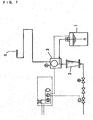
- Fig. 7 shows an exemplary construction of a chemical spray unit comprising a spray nozzle.
- the surface forming agent delivered from a chemical tank 1 is sprayed onto the surface of the dryer through a spray nozzle S.
- Water may be taken in via a flow meter 2 as necessary, and mixed with the surface forming agent by a mixer 3, so that water can be sprayed simultaneously through the spray nozzle S.
- the method according to the invention is applied to the Yankee dryer and the multiple type dryers, however, the scope of the invention is not limited thereto, and it goes without saying that the invention can be adapted to other types of dryers.
- the invention is a technology applied to a drum dryer used in a paper machine, it can be utilized in the entire technical field for manufacturing paper which is expected to have the same effect as the invention.
Landscapes
- Paper (AREA)
- Drying Of Solid Materials (AREA)
- Prevention Of Fouling (AREA)
- Materials Applied To Surfaces To Minimize Adherence Of Mist Or Water (AREA)
- Application Of Or Painting With Fluid Materials (AREA)
Claims (7)
- Verfahren zum Vorbeugen einer Verschmutzung der Oberfläche eines in einer Papiermaschine verwendeten Trommeltrockners,
dadurch gekennzeichnet, dass
der Oberfläche des eine Drehbewegung ausführenden Trommeltrockners, die einem Papierstreifen zugewendet ist, kontinuierlich eine vorbestimmte Menge eines eine Oberfläche bildenden Mittels, das als Hauptbestandteil Pulver aus synthetischem Kunststoff enthält, und Öl zugeführt wird, während der Papierstreifen während des Betriebs von der Papiermaschine zugeführt wird. - Verfahren zum Vorbeugen einer Verschmutzung der Oberfläche eines Trommeltrockners nach Anspruch 1, dadurch gekennzeichnet, dass der Oberfläche des eine Drehbewegung ausführenden Trommeltrockners, die einem Papierstreifen zugewendet ist, kontinuierlich eine vorbestimmte Menge eines eine Oberfläche bildenden Mittels, das als Hauptbestandteil Pulver aus synthetischem Kunststoff enthält, und ein oberflächenaktiver Stoff und Öl zugeführt wird, während der Papierstreifen während des Betriebs von der Papiermaschine zugeführt wird.
- Verfahren zum Vorbeugen einer Verschmutzung der Oberfläche eines Trommeltrockners nach Anspruch 1 oder 2, dadurch gekennzeichnet, dass die Partikelgröße der Pulver aus synthetischem Kunststoff im Bereich von 0,1 bis 10 µm ist.
- Verfahren zum Vorbeugen einer Verschmutzung der Oberfläche eines Trommeltrockners nach Anspruch 1, dadurch gekennzeichnet, dass die Pulver aus synthetischem Kunststoff der Oberfläche des Trommeltrockners, die einem Papierstreifen zugewendet ist, während des Betriebs kontinuierlich mit einer Rate von 10 µg bis 50 mg/m2 pro Minute zugeführt werden, während der Papierstreifen während des Betriebs von der Papiermaschine zugeführt wird.
- Verfahren zum Vorbeugen einer Verschmutzung der Oberfläche eines Trommeltrockners nach Anspruch 1 oder 2, dadurch gekennzeichnet, dass der Trommeltrockner ein Yankee-Trockner ist.
- Verfahren zum Vorbeugen einer Verschmutzung der Oberfläche eines Trommeltrockners nach Anspruch 1 oder 2, dadurch gekennzeichnet, dass der Trommeltrockner eine Art eines mehrfachen Trommeltrockners ist.
- Verfahren zum Vorbeugen einer Verschmutzung der Oberfläche eines Trommeltrockners nach Anspruch 1, gekennzeichnet durch die folgenden Schritte 1) bis 6):1) Zuführen eines eine Oberfläche bildenden Mittels, das als Hauptbestandteil Pulver aus synthetischem Kunststoff enthält, zu der Oberfläche eines eine Drehbewegung ausführenden Trommeltrockners, die einem Papierstreifen zugewendet ist, während der Papierstreifen während des Betriebs von der Papiermaschine zugeführt wird (Bereitstellungsschritt von Pulver aus synthetischem Kunststoff);2) Auffüllen von Ausnehmungen in mikroskopischen Unebenheiten auf der Oberfläche des Trommeltrockners mit den Pulvern aus synthetischem Kunststoff durch Zuführen des eine Oberfläche bildenden Mittels, das die Pulver aus synthetischem Kunststoff enthält (Unebenheiten-Auffüllsschritt);3) Bilden eines Films aus synthetischem Kunststoff auf der Oberfläche des Trommeltrockners mit den Ausnehmungen in den mikroskopischen Unebenheiten, die bereits durch kontinuierliches Zuführen des eine Oberfläche bildenden Mittels, dass die Pulver aus synthetischem Kunststoff und Öl enthält, ausgefüllt sind (Schritt zum Bilden eines Films aus synthetischem Kunststoff);4) Bilden eines Ölfilms über dem Film aus synthetischem Kunststoff durch Zuführen des eine Oberfläche bildenden Mittels, das die Pulver aus synthetischem Kunststoff enthält, und dem Öl (Ölfilm-Bildungsschritt);5) Übertragen des synthetischen Kunststoffs, der den Film aus synthetischem Kunststoff aufbaut, auf den Papierstreifen durch Zusammenpressen von Trommeltrockner und Papierstreifen, wodurch der Film aus synthetischem Kunststoff und der Ölfilm vermindert werden (Transferschritt von synthetischem Kunststoff); und6) Auffüllen des Trommeltrockners mit dem synthetischen Kunststoff und dem Öl mit der Menge der Verminderung des Films aus synthetischem Kunststoff und dem Ölfilm durch kontinuierliches Zuführen des die Oberfläche bildenden Mittels, das die Pulver aus synthetischem Kunststoff enthält, und Öl nach der Verminderung des Films aus synthetischem Kunststoff und dem Ölfilm (Auffüllschritt).
Applications Claiming Priority (3)
| Application Number | Priority Date | Filing Date | Title |
|---|---|---|---|
| JP28894298 | 1998-09-25 | ||
| JP10288942A JP2000096479A (ja) | 1998-09-25 | 1998-09-25 | 抄紙機に使用される円筒状ドライヤの汚染防止方法 |
| PCT/JP1999/005022 WO2000019012A1 (fr) | 1998-09-25 | 1999-09-14 | Procede de prevention de pollution d'un secheur cylindrique utilise dans une machine a papier |
Publications (3)
| Publication Number | Publication Date |
|---|---|
| EP1124007A1 EP1124007A1 (de) | 2001-08-16 |
| EP1124007A4 EP1124007A4 (de) | 2005-12-28 |
| EP1124007B1 true EP1124007B1 (de) | 2008-01-02 |
Family
ID=17736813
Family Applications (1)
| Application Number | Title | Priority Date | Filing Date |
|---|---|---|---|
| EP99943343A Expired - Lifetime EP1124007B1 (de) | 1998-09-25 | 1999-09-14 | Verschmutzungsschutzverfahren für gewebe in papiermaschinen |
Country Status (10)
| Country | Link |
|---|---|
| US (1) | US6858113B1 (de) |
| EP (1) | EP1124007B1 (de) |
| JP (1) | JP2000096479A (de) |
| KR (1) | KR20010075378A (de) |
| CN (1) | CN1328609A (de) |
| AT (1) | ATE382736T1 (de) |
| CA (1) | CA2345289A1 (de) |
| DE (1) | DE69937893T2 (de) |
| ES (1) | ES2296406T3 (de) |
| WO (1) | WO2000019012A1 (de) |
Families Citing this family (6)
| Publication number | Priority date | Publication date | Assignee | Title |
|---|---|---|---|---|
| JP3608709B2 (ja) * | 1998-09-25 | 2005-01-12 | 株式会社メンテック | 抄紙機に使用されるカンバスの汚染防止方法 |
| CN102899955B (zh) * | 2011-07-27 | 2016-03-30 | 金红叶纸业集团有限公司 | 烘缸表面修复剂、烘缸表面修复方法及烘缸 |
| US9937521B2 (en) | 2013-03-04 | 2018-04-10 | Maintech Co., Ltd. | Method for spraying chemical solution |
| CN103225226B (zh) * | 2013-04-15 | 2016-01-27 | 金红叶纸业集团有限公司 | 造纸设备及造纸方法 |
| CN105942572B (zh) * | 2016-07-13 | 2017-06-16 | 云南中烟再造烟叶有限责任公司 | 一种提升造纸法再造烟叶疏松度和柔韧性的起皱抄造方法 |
| WO2019187152A1 (ja) | 2018-03-30 | 2019-10-03 | 株式会社メンテック | 薬液の吹付け方法 |
Family Cites Families (10)
| Publication number | Priority date | Publication date | Assignee | Title |
|---|---|---|---|---|
| JPH07292591A (ja) | 1990-04-24 | 1995-11-07 | Kunio Sekiya | 抄紙機ドライヤー表面損傷防止法とそれに用いる薬液散布装置と水溶性潤滑油 |
| JPH04130190A (ja) * | 1990-09-20 | 1992-05-01 | Nippon Oil & Fats Co Ltd | 抄紙用ドライヤー表面清浄潤滑剤 |
| JPH06280181A (ja) * | 1992-09-07 | 1994-10-04 | Mentetsuku:Kk | 抄紙機ドライヤー表面に固体潤滑剤を散布し,表面に潤滑性被 膜を形成させる方法及びそれに用いる薬液散布装置と固体潤滑 剤 |
| US5389204A (en) * | 1994-03-10 | 1995-02-14 | The Procter & Gamble Company | Process for applying a thin film containing low levels of a functional-polysiloxane and a mineral oil to tissue paper |
| JP3408320B2 (ja) * | 1994-04-28 | 2003-05-19 | タイホー工業株式会社 | 抄紙ドライヤー工程用汚れ付着防止剤 |
| DE19519268C1 (de) | 1995-05-31 | 1997-01-23 | Stockhausen Chem Fab Gmbh | Verwendung von Mitteln zur Zellstoff- und Papierherstellung |
| JP3608709B2 (ja) * | 1998-09-25 | 2005-01-12 | 株式会社メンテック | 抄紙機に使用されるカンバスの汚染防止方法 |
| JP3273137B2 (ja) * | 1999-03-31 | 2002-04-08 | 株式会社メンテック | 抄紙機のプレスロールに対する紙の過付着防止方法 |
| JP3304318B2 (ja) * | 1999-08-24 | 2002-07-22 | 株式会社メンテック | 高品質クレープ紙の製造方法 |
| US6277242B1 (en) * | 2000-02-28 | 2001-08-21 | Calgon Corporation | Creping adhesive containing an admixture of PAE resins |
-
1998
- 1998-09-25 JP JP10288942A patent/JP2000096479A/ja active Pending
-
1999
- 1999-09-14 CN CN99813659A patent/CN1328609A/zh active Pending
- 1999-09-14 US US09/806,090 patent/US6858113B1/en not_active Expired - Fee Related
- 1999-09-14 DE DE69937893T patent/DE69937893T2/de not_active Expired - Lifetime
- 1999-09-14 CA CA002345289A patent/CA2345289A1/en not_active Abandoned
- 1999-09-14 ES ES99943343T patent/ES2296406T3/es not_active Expired - Lifetime
- 1999-09-14 EP EP99943343A patent/EP1124007B1/de not_active Expired - Lifetime
- 1999-09-14 KR KR1020017003858A patent/KR20010075378A/ko not_active Withdrawn
- 1999-09-14 AT AT99943343T patent/ATE382736T1/de not_active IP Right Cessation
- 1999-09-14 WO PCT/JP1999/005022 patent/WO2000019012A1/ja not_active Ceased
Also Published As
| Publication number | Publication date |
|---|---|
| KR20010075378A (ko) | 2001-08-09 |
| CA2345289A1 (en) | 2000-04-06 |
| ES2296406T3 (es) | 2008-04-16 |
| US6858113B1 (en) | 2005-02-22 |
| DE69937893D1 (de) | 2008-02-14 |
| WO2000019012A1 (fr) | 2000-04-06 |
| EP1124007A4 (de) | 2005-12-28 |
| EP1124007A1 (de) | 2001-08-16 |
| JP2000096479A (ja) | 2000-04-04 |
| DE69937893T2 (de) | 2008-04-17 |
| CN1328609A (zh) | 2001-12-26 |
| ATE382736T1 (de) | 2008-01-15 |
Similar Documents
| Publication | Publication Date | Title |
|---|---|---|
| EP1124006B1 (de) | Steuerungsverfahren der verschmutzung für zylindertrockner in papiermaschinen | |
| EP1123800B1 (de) | Verfahren zum herstellen von qualitäts-krepppapier | |
| EP1124005B1 (de) | Verschmutzungsschutzverfahren für eine papiermaschinenbespannung | |
| US4761309A (en) | Coating apparatus and method | |
| US20060147636A1 (en) | Method and apparatus of forming a coating fluid pattern | |
| US6858113B1 (en) | Pollution prevention method for cylindrical dryer used in paper machine | |
| EP0603145A1 (de) | Verfahren und Vorrichtung zum Beschichten einer Walze in einer Filmleimpresse | |
| JP3273137B2 (ja) | 抄紙機のプレスロールに対する紙の過付着防止方法 | |
| US6468394B1 (en) | Method of preventing over-adhesion of paper onto press roll of paper machine | |
| JP4271636B2 (ja) | 抄紙機におけるドライパートの汚染防止方法 | |
| JP2003113593A (ja) | 段ボール用中芯原紙、及びその製造方法 | |
| JP2004332198A5 (de) | ||
| DE10303119B4 (de) | Verfahren zur Beschichtung eines Walzenkörpers | |
| EP1624103A1 (de) | Fleckenschutzverfahren für trockenpartie der papiermaschine sowie dabei eingesetztes fleckenschutzmittel | |
| JP3644643B2 (ja) | 抄紙機におけるドライパートの汚染防止方法 | |
| JP2003089999A (ja) | 塗工紙の断紙防止方法 | |
| WO2001025535A1 (en) | Method for paper machine cleanliness | |
| JP2005273026A (ja) | ドクターブレードの摩耗防止方法 | |
| JPH0283060A (ja) | バッキングロール洗浄装置 |
Legal Events
| Date | Code | Title | Description |
|---|---|---|---|
| PUAI | Public reference made under article 153(3) epc to a published international application that has entered the european phase |
Free format text: ORIGINAL CODE: 0009012 |
|
| 17P | Request for examination filed |
Effective date: 20010323 |
|
| AK | Designated contracting states |
Kind code of ref document: A1 Designated state(s): AT BE CH CY DE DK ES FI FR GB GR IE IT LI LU MC NL PT SE |
|
| A4 | Supplementary search report drawn up and despatched |
Effective date: 20051111 |
|
| 17Q | First examination report despatched |
Effective date: 20061030 |
|
| GRAP | Despatch of communication of intention to grant a patent |
Free format text: ORIGINAL CODE: EPIDOSNIGR1 |
|
| RTI1 | Title (correction) |
Free format text: POLLUTION PREVENTION METHOD FOR CYLINDRICAL DRYERS USED IN PAPER MACHINES |
|
| GRAS | Grant fee paid |
Free format text: ORIGINAL CODE: EPIDOSNIGR3 |
|
| GRAA | (expected) grant |
Free format text: ORIGINAL CODE: 0009210 |
|
| AK | Designated contracting states |
Kind code of ref document: B1 Designated state(s): AT BE CH CY DE DK ES FI FR GB GR IE IT LI LU MC NL PT SE |
|
| REG | Reference to a national code |
Ref country code: GB Ref legal event code: FG4D |
|
| REG | Reference to a national code |
Ref country code: IE Ref legal event code: FG4D |
|
| REG | Reference to a national code |
Ref country code: CH Ref legal event code: EP |
|
| REF | Corresponds to: |
Ref document number: 69937893 Country of ref document: DE Date of ref document: 20080214 Kind code of ref document: P |
|
| REG | Reference to a national code |
Ref country code: ES Ref legal event code: FG2A Ref document number: 2296406 Country of ref document: ES Kind code of ref document: T3 |
|
| REG | Reference to a national code |
Ref country code: SE Ref legal event code: TRGR |
|
| PG25 | Lapsed in a contracting state [announced via postgrant information from national office to epo] |
Ref country code: NL Free format text: LAPSE BECAUSE OF FAILURE TO SUBMIT A TRANSLATION OF THE DESCRIPTION OR TO PAY THE FEE WITHIN THE PRESCRIBED TIME-LIMIT Effective date: 20080102 |
|
| NLV1 | Nl: lapsed or annulled due to failure to fulfill the requirements of art. 29p and 29m of the patents act | ||
| ET | Fr: translation filed | ||
| PG25 | Lapsed in a contracting state [announced via postgrant information from national office to epo] |
Ref country code: LI Free format text: LAPSE BECAUSE OF FAILURE TO SUBMIT A TRANSLATION OF THE DESCRIPTION OR TO PAY THE FEE WITHIN THE PRESCRIBED TIME-LIMIT Effective date: 20080102 Ref country code: FI Free format text: LAPSE BECAUSE OF FAILURE TO SUBMIT A TRANSLATION OF THE DESCRIPTION OR TO PAY THE FEE WITHIN THE PRESCRIBED TIME-LIMIT Effective date: 20080102 Ref country code: CH Free format text: LAPSE BECAUSE OF FAILURE TO SUBMIT A TRANSLATION OF THE DESCRIPTION OR TO PAY THE FEE WITHIN THE PRESCRIBED TIME-LIMIT Effective date: 20080102 |
|
| REG | Reference to a national code |
Ref country code: CH Ref legal event code: PL |
|
| PG25 | Lapsed in a contracting state [announced via postgrant information from national office to epo] |
Ref country code: AT Free format text: LAPSE BECAUSE OF FAILURE TO SUBMIT A TRANSLATION OF THE DESCRIPTION OR TO PAY THE FEE WITHIN THE PRESCRIBED TIME-LIMIT Effective date: 20080102 |
|
| PG25 | Lapsed in a contracting state [announced via postgrant information from national office to epo] |
Ref country code: BE Free format text: LAPSE BECAUSE OF FAILURE TO SUBMIT A TRANSLATION OF THE DESCRIPTION OR TO PAY THE FEE WITHIN THE PRESCRIBED TIME-LIMIT Effective date: 20080102 Ref country code: PT Free format text: LAPSE BECAUSE OF FAILURE TO SUBMIT A TRANSLATION OF THE DESCRIPTION OR TO PAY THE FEE WITHIN THE PRESCRIBED TIME-LIMIT Effective date: 20080602 |
|
| PG25 | Lapsed in a contracting state [announced via postgrant information from national office to epo] |
Ref country code: DK Free format text: LAPSE BECAUSE OF FAILURE TO SUBMIT A TRANSLATION OF THE DESCRIPTION OR TO PAY THE FEE WITHIN THE PRESCRIBED TIME-LIMIT Effective date: 20080102 |
|
| PLBE | No opposition filed within time limit |
Free format text: ORIGINAL CODE: 0009261 |
|
| STAA | Information on the status of an ep patent application or granted ep patent |
Free format text: STATUS: NO OPPOSITION FILED WITHIN TIME LIMIT |
|
| 26N | No opposition filed |
Effective date: 20081003 |
|
| PG25 | Lapsed in a contracting state [announced via postgrant information from national office to epo] |
Ref country code: MC Free format text: LAPSE BECAUSE OF NON-PAYMENT OF DUE FEES Effective date: 20080930 |
|
| PG25 | Lapsed in a contracting state [announced via postgrant information from national office to epo] |
Ref country code: IE Free format text: LAPSE BECAUSE OF NON-PAYMENT OF DUE FEES Effective date: 20080915 Ref country code: CY Free format text: LAPSE BECAUSE OF FAILURE TO SUBMIT A TRANSLATION OF THE DESCRIPTION OR TO PAY THE FEE WITHIN THE PRESCRIBED TIME-LIMIT Effective date: 20080102 |
|
| PGFP | Annual fee paid to national office [announced via postgrant information from national office to epo] |
Ref country code: SE Payment date: 20090910 Year of fee payment: 11 Ref country code: GB Payment date: 20090909 Year of fee payment: 11 |
|
| PGFP | Annual fee paid to national office [announced via postgrant information from national office to epo] |
Ref country code: ES Payment date: 20091006 Year of fee payment: 11 Ref country code: DE Payment date: 20090910 Year of fee payment: 11 |
|
| PGFP | Annual fee paid to national office [announced via postgrant information from national office to epo] |
Ref country code: IT Payment date: 20090912 Year of fee payment: 11 Ref country code: FR Payment date: 20091012 Year of fee payment: 11 |
|
| PG25 | Lapsed in a contracting state [announced via postgrant information from national office to epo] |
Ref country code: LU Free format text: LAPSE BECAUSE OF NON-PAYMENT OF DUE FEES Effective date: 20080914 |
|
| PG25 | Lapsed in a contracting state [announced via postgrant information from national office to epo] |
Ref country code: GR Free format text: LAPSE BECAUSE OF FAILURE TO SUBMIT A TRANSLATION OF THE DESCRIPTION OR TO PAY THE FEE WITHIN THE PRESCRIBED TIME-LIMIT Effective date: 20080403 |
|
| REG | Reference to a national code |
Ref country code: SE Ref legal event code: EUG |
|
| GBPC | Gb: european patent ceased through non-payment of renewal fee |
Effective date: 20100914 |
|
| PG25 | Lapsed in a contracting state [announced via postgrant information from national office to epo] |
Ref country code: IT Free format text: LAPSE BECAUSE OF NON-PAYMENT OF DUE FEES Effective date: 20100914 |
|
| REG | Reference to a national code |
Ref country code: FR Ref legal event code: ST Effective date: 20110531 |
|
| REG | Reference to a national code |
Ref country code: DE Ref legal event code: R119 Ref document number: 69937893 Country of ref document: DE Effective date: 20110401 |
|
| PG25 | Lapsed in a contracting state [announced via postgrant information from national office to epo] |
Ref country code: FR Free format text: LAPSE BECAUSE OF NON-PAYMENT OF DUE FEES Effective date: 20100930 Ref country code: DE Free format text: LAPSE BECAUSE OF NON-PAYMENT OF DUE FEES Effective date: 20110401 |
|
| PG25 | Lapsed in a contracting state [announced via postgrant information from national office to epo] |
Ref country code: GB Free format text: LAPSE BECAUSE OF NON-PAYMENT OF DUE FEES Effective date: 20100914 |
|
| REG | Reference to a national code |
Ref country code: ES Ref legal event code: FD2A Effective date: 20111019 |
|
| PG25 | Lapsed in a contracting state [announced via postgrant information from national office to epo] |
Ref country code: ES Free format text: LAPSE BECAUSE OF NON-PAYMENT OF DUE FEES Effective date: 20100915 |
|
| PG25 | Lapsed in a contracting state [announced via postgrant information from national office to epo] |
Ref country code: SE Free format text: LAPSE BECAUSE OF NON-PAYMENT OF DUE FEES Effective date: 20100915 |