EP1124341A2 - Unité de contrôle pour terminal d'un système de communications numérique sans fil et méthode associée - Google Patents
Unité de contrôle pour terminal d'un système de communications numérique sans fil et méthode associée Download PDFInfo
- Publication number
- EP1124341A2 EP1124341A2 EP01200432A EP01200432A EP1124341A2 EP 1124341 A2 EP1124341 A2 EP 1124341A2 EP 01200432 A EP01200432 A EP 01200432A EP 01200432 A EP01200432 A EP 01200432A EP 1124341 A2 EP1124341 A2 EP 1124341A2
- Authority
- EP
- European Patent Office
- Prior art keywords
- time
- control
- control unit
- control signals
- timer
- Prior art date
- Legal status (The legal status is an assumption and is not a legal conclusion. Google has not performed a legal analysis and makes no representation as to the accuracy of the status listed.)
- Granted
Links
- 238000000034 method Methods 0.000 title claims abstract description 14
- 238000004891 communication Methods 0.000 title description 2
- 238000012545 processing Methods 0.000 claims description 38
- 230000005540 biological transmission Effects 0.000 claims description 9
- 230000003213 activating effect Effects 0.000 claims 1
- 238000003491 array Methods 0.000 description 6
- 230000008859 change Effects 0.000 description 4
- 230000008569 process Effects 0.000 description 4
- 230000008901 benefit Effects 0.000 description 3
- 238000001514 detection method Methods 0.000 description 3
- 230000006978 adaptation Effects 0.000 description 2
- 230000004048 modification Effects 0.000 description 2
- 230000003068 static effect Effects 0.000 description 2
- 206010003830 Automatism Diseases 0.000 description 1
- 125000004122 cyclic group Chemical group 0.000 description 1
- 238000013461 design Methods 0.000 description 1
- 230000000694 effects Effects 0.000 description 1
- 230000010354 integration Effects 0.000 description 1
- 230000004044 response Effects 0.000 description 1
- 230000001360 synchronised effect Effects 0.000 description 1
Images


Classifications
-
- H—ELECTRICITY
- H04—ELECTRIC COMMUNICATION TECHNIQUE
- H04W—WIRELESS COMMUNICATION NETWORKS
- H04W88/00—Devices specially adapted for wireless communication networks, e.g. terminals, base stations or access point devices
- H04W88/02—Terminal devices
-
- H—ELECTRICITY
- H04—ELECTRIC COMMUNICATION TECHNIQUE
- H04B—TRANSMISSION
- H04B7/00—Radio transmission systems, i.e. using radiation field
- H04B7/24—Radio transmission systems, i.e. using radiation field for communication between two or more posts
- H04B7/26—Radio transmission systems, i.e. using radiation field for communication between two or more posts at least one of which is mobile
-
- H—ELECTRICITY
- H04—ELECTRIC COMMUNICATION TECHNIQUE
- H04B—TRANSMISSION
- H04B1/00—Details of transmission systems, not covered by a single one of groups H04B3/00 - H04B13/00; Details of transmission systems not characterised by the medium used for transmission
- H04B1/38—Transceivers, i.e. devices in which transmitter and receiver form a structural unit and in which at least one part is used for functions of transmitting and receiving
- H04B1/40—Circuits
- H04B1/401—Circuits for selecting or indicating operating mode
-
- H—ELECTRICITY
- H04—ELECTRIC COMMUNICATION TECHNIQUE
- H04M—TELEPHONIC COMMUNICATION
- H04M1/00—Substation equipment, e.g. for use by subscribers
- H04M1/72—Mobile telephones; Cordless telephones, i.e. devices for establishing wireless links to base stations without route selection
- H04M1/725—Cordless telephones
- H04M1/73—Battery saving arrangements
-
- Y—GENERAL TAGGING OF NEW TECHNOLOGICAL DEVELOPMENTS; GENERAL TAGGING OF CROSS-SECTIONAL TECHNOLOGIES SPANNING OVER SEVERAL SECTIONS OF THE IPC; TECHNICAL SUBJECTS COVERED BY FORMER USPC CROSS-REFERENCE ART COLLECTIONS [XRACs] AND DIGESTS
- Y02—TECHNOLOGIES OR APPLICATIONS FOR MITIGATION OR ADAPTATION AGAINST CLIMATE CHANGE
- Y02D—CLIMATE CHANGE MITIGATION TECHNOLOGIES IN INFORMATION AND COMMUNICATION TECHNOLOGIES [ICT], I.E. INFORMATION AND COMMUNICATION TECHNOLOGIES AIMING AT THE REDUCTION OF THEIR OWN ENERGY USE
- Y02D30/00—Reducing energy consumption in communication networks
- Y02D30/70—Reducing energy consumption in communication networks in wireless communication networks
Definitions
- Control unit for a terminal of a digital cordless telecommunication system and methods for such a control unit
- the invention relates to a control unit for a terminal of a digital, cordless Telecommunications system for supplying control signals to other units of the Terminal and a method for such a control unit.
- the typical one Structure of a terminal is shown in Figure 1.
- the radio control unit 2 will controlled by a control device 1 (BMC: Burst Mode Controller).
- the control device 1 is responsible for the time-critical processing of the data to be transmitted and of the received data. It also gives control signals to the control lines of the Radio control unit 2 off.
- the control device 1 is in turn operated by a microcontroller 3 controlled, the protocol functions and other less time-critical functions performs.
- a further unit 4 can be provided, the digital signal processing the data to be transmitted or received.
- the microcontroller 3 and the unit for digital signal processing 4 finally have access to the Applications 5 of the terminal.
- FIG. 2 A more detailed structure of the control device 1 is shown in FIG. 2.
- the main components of the control device 1 are a control unit 10 and a data processing unit 11.
- the control unit 10 receives commands 20 from the microcontroller 3, according to which they output control signals 22 on control lines to the radio control unit 2 controls and control signals 23 for the data processing unit 11 generates and outputs.
- the control unit 10 receives from the data processing unit 11 in addition, feedback information 24, which also shows the control behavior of the control unit 10 can influence.
- the data processing unit 11 is in turn used to certain functions on the received 27.29 and the 26.28 data bits to be sent apply, such as encryption (scrambling) 12,14 or generating one Checksum (CRC: Cyclic redundancy codes) 13.
- CRC Cyclic redundancy codes
- the control unit of a control device is typically a hardware automatism implemented. This creates problems as soon as a change in the output of the Control signals is required. So any change in the format of the data packets requires a redesign of the control unit, even if the same data processing functions to be used and only a different bit timing is provided. It also requires adding or removing data processing functions as well as a change in the specification of the radio interface or the clocking for the Radio control signals a redesign of the control unit. So is the hardware a control unit for a specific telecommunications standard, such as DECT, only with considerable adaptation effort for other telecommunication systems, such as the US ISM band system.
- a baseband control unit is known from the GSM, which is based on the hardware implemented automatic for the output of control signals.
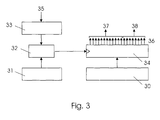
- the the unit used instead is illustrated in FIG. 3: a microcontroller writes values for an event containing control signals into a control signal register 30 and the values for a point in time at which the control signals of the event are linked to the control lines 36 connected to the control signal register 30 is to be output in a time register 31.
- a comparator 32 the time from the time register 31 constantly compared with the time specified by a timer 32.
- the Timer 32 is controlled by a local clock generator 35. If they match the event from the control signal register 30 via an output register 34 to the Control lines 36 issued.
- the control lines can be, for example, a radio control unit supply with control signals 38 and also a data processing unit Feed control signals 37.
- the time specifications and the assignment of the control lines can thus be freely selected, because the tasks of hardware automation of the software have been transferred.
- the registers it is also not necessary that the software bit by bit simulates the actions of hardware automation.
- the invention has for its object a flexible and energy-saving control unit for a terminal of a digital, cordless telecommunication system for delivery to provide control signals to further units of the terminal.
- the invention is also based on the object of providing a method which the use of a flexible and energy-saving control unit for a terminal device wireless telecommunication system.
- control unit and the method according to the invention are based on software control with sufficient hardware support, which makes a large Flexibility is achieved, but at the same time excessive demands on the microcontroller performance be avoided.
- the invention allows adaptations to changed framework conditions without a new design to require the hardware. So it is easily possible to make an adjustment to make applications of different systems by that of the microcontroller events and times delivered to the register arrays are adjusted accordingly become.
- changes in connected to the control lines can be made Units, such as in a radio interface or a data processing unit, responds be, for example, if control lines are occupied differently or the timing and the Signal level at the radio interface should be changed.
- the invention can be achieved by using the register arrays even in systems with high data rates such as DECT without significant software usage can be used because the microcontroller can load several commands simultaneously and thus does not have to respond in the time span of a single bit, so the real-time requirements can be realized more easily.
- Control unit 10 is shown schematically, the control device 1 in turn correspondingly Figure 1 forms part of a terminal.
- the control unit is divided into three sub-areas, one main control area, one Reception control area and a transmission control area, all of a similar arrangement exhibit.
- Each of the three sub-areas has a comparator 42, 52, 62 with controlling access an output register 44,54,64.
- the inputs of the comparators 42, 52, 62 are in each case connected to a timer 43,53,63 and a timing register array 41,51,61.
- the inputs of the output registers 44, 54, 64 are each with a control signal register array 40,50,60 connected and the outputs 46,56,66 each with control lines.
- a microcontroller (not shown in FIG. 4) has access to both the point in time 41,51,61 as well as to the control signal register array 40,50,60.
- the main control area timer 63 is controlled by a local clock 65.
- the outputs 66, 66a, 66b of the output register 64 are on the one hand connected via control lines a radio control unit and connected to elements of a data processing unit, on the other hand, each with an input 48a or 58a of the timer 43 of the reception control area and the timer 53 of the transmission control area.
- the timer 43 of the reception control area has in addition to that with the output register 64 of the main control area, input 48a connects three further inputs 45, 48b, 48c on. Via an input 45, it receives a timing obtained from the received data. Another input 48c is connected to a packet detection unit, not shown. Finally, there is an input 48b of the timer 43 with one of the outputs 46a of the output register 44 of the reception control area. The remaining exits 46 of the output register 44 are connected to the elements of the data processing unit, that process the received data packets in real time.
- the transmission control area timer 53 becomes like the main control area timer 63 controlled by a local clock 55. Another input 58b of the timer 53 of the transmit control area is connected to one of the outputs 56a of the output register 54 of the Send control area connected. The remaining outputs 56 of the output register 54 are connected to the elements of the data processing unit that are to be sent Process data packets.
- the timers 43, 53, 63 of the three sub-areas each consist of a bit counter, whose length is, for example, 11520.
- a combination of is also possible a bit counter with a length of 480 and a time slot counter with a length of 24 for a timer in which the bit counter counts the bits within a time slot and in each case with the last bit of a time slot of a frame, the time slot counter is incremented.
- a pure bit counter when using a pure bit counter however, greater flexibility in processing variable time slot structures can occur in some systems, such as when the different time slots within of a frame have different lengths.
- a Bit counter facilitates the simultaneous consideration of several clock specifications, since one second clock specification can simply be treated as a clock offset in which bit counter. Becomes one time slot counter is used, in this case there are two for the offset calculations Counter required, and the resulting overflow monitors etc. increase the Software effort.
- the three sub-areas from FIG. 4 each work similarly to the control unit from FIG 3: A comparator compares a given system time with a time from one Register and depending on this causes the output of control signals from events, which are stored in another register.
- a comparator compares a given system time with a time from one Register and depending on this causes the output of control signals from events, which are stored in another register.
- a register array 41.51.61 or 40.50.60 for the The microcontroller can have several times and for the events Commands consisting of an event and the time assigned to it at once load.
- the hardware accesses the registers of arrays 41, 51, 61 and 40, 50, 60 cyclically.
- a pointer 47, 57, 67 indicates which is the current time and the current one Control signal.
- the pointer 47, 57, 67 is preferably also controlled by the microcontroller controlled.
- the microcontroller does not need more to respond with new data within the time of a single bit, which is processing enabled in real time even at high data rates.
- control signals occur that relate to radio control, usually not during a time slot on, i.e. while the processing of a data packet is in progress.
- By dividing the control unit into three sub-areas can also split the events so that only one event with a smaller number of events occurs at a time Control signals must be issued. The breadth of events and therefore the amount the data that must be programmed by the microcontroller for each point in time, is thus significantly reduced, which benefits the load on the microcontroller.
- the main control area for the output of Control signals on the control lines to the radio control unit responsible.
- the main control area can be used to control data for data processing to provide that are not directly related to bits within a data packet which do not require synchronization with incoming data. It can be, for example, control signals for switching synchronization windows on and off act what can be done before the first bit of a Data packet was received.
- the main control area timer 63 runs continuously. Otherwise, the main control area can be turned off at times without activity to save energy.
- the transmit control area controls all data processing functions by the bit position depend within a data packet to be sent. It is only during the transmission of data packets is active and is controlled by the main control area activated via the control line that the output register 64 of the main control area with connects to the timer 53 of the transmission control area.
- the start signal starts Timer 53 to run according to the clock of the data packets to be transmitted. At With each restart, the send control area starts reading out again with the first saved one Time and the first event, not with the last pointer position before switching off.
- the events of the transmit control area have a control signal that is sent via the control line transferred from the output register 54 to the timer 53 of the transmission control area and that is suitable to stop the execution of further commands until a reactivated by the main control area.
- the receive control area controls all data processing functions by the bit position depend within a received data packet. He is only with Receive data packets activated.
- the reception control area is activated either like the transmit control area from a control signal of the main control area or by a start signal from the data processing units, which are to be received Packets are responsible if they detect the start of a packet, for example through the detection of a synchronization field (synchronization field detection). How the transmit control area also starts the timer 43 of the receive control area the start signal to run. Since the receive control area but with the received Data must be synchronized, the timer 43 is given a clock that is not comes from a local clock generator, but is obtained from the received data becomes. This enables processing of the received data independently of the system clock respectively.
- the receive control area also starts reading out with every restart the first saved time and the first event.
- one of the Control signals of the own events the receive control area via the control line disable from the output register 44 to the timer 43.
- control lines can also be used to Interrupts to the microcontroller so that the microcontroller can control the different sub-areas synchronously.
- the receive control area and need the transmit control area each have only one timer 43, 53, which is only the length of one single package includes. These timers 43, 53 can thus be shorter than the system timer 63, which is used by the main control area, making them less Space and less processing power to calculate and write.
- those specified in the receive control area and transmit control area Points of time each a certain offset from a fixed position within of a data packet so that it is not influenced by changes in the system clock stay. These times and the associated control signals can thus be static Data are stored and do not need to be updated by the microcontroller every time to be calculated, which further reduces the processing load.
Landscapes
- Engineering & Computer Science (AREA)
- Computer Networks & Wireless Communication (AREA)
- Signal Processing (AREA)
- Mobile Radio Communication Systems (AREA)
- Telephone Function (AREA)
Applications Claiming Priority (2)
| Application Number | Priority Date | Filing Date | Title |
|---|---|---|---|
| DE10005911A DE10005911A1 (de) | 2000-02-10 | 2000-02-10 | Steuereinheit für ein Endgerät eines digitalen schnurlosen Telekommunikationssystems sowie Verfahren für eine solche Steuereinheit |
| DE10005911 | 2000-02-10 |
Publications (3)
| Publication Number | Publication Date |
|---|---|
| EP1124341A2 true EP1124341A2 (fr) | 2001-08-16 |
| EP1124341A3 EP1124341A3 (fr) | 2004-10-06 |
| EP1124341B1 EP1124341B1 (fr) | 2008-04-30 |
Family
ID=7630460
Family Applications (1)
| Application Number | Title | Priority Date | Filing Date |
|---|---|---|---|
| EP01200432A Expired - Lifetime EP1124341B1 (fr) | 2000-02-10 | 2001-02-06 | Unité de contrôle pour terminal d'un système de communications numérique sans fil et méthode associée |
Country Status (6)
| Country | Link |
|---|---|
| US (1) | US6763239B2 (fr) |
| EP (1) | EP1124341B1 (fr) |
| JP (1) | JP4612205B2 (fr) |
| KR (1) | KR100756091B1 (fr) |
| CN (1) | CN1246980C (fr) |
| DE (2) | DE10005911A1 (fr) |
Cited By (2)
| Publication number | Priority date | Publication date | Assignee | Title |
|---|---|---|---|---|
| EP1592272A2 (fr) | 2004-04-30 | 2005-11-02 | Microsoft Corporation | Procédé pour maintenir le temps de réponse d'un réseau sans fil et l'économie d'énergie simultanée dans un adapteur sans fil |
| CN102740489A (zh) * | 2011-04-15 | 2012-10-17 | 中兴通讯股份有限公司 | 一种实现无绳电话通话的方法和装置 |
Families Citing this family (4)
| Publication number | Priority date | Publication date | Assignee | Title |
|---|---|---|---|---|
| EP1927949A1 (fr) * | 2006-12-01 | 2008-06-04 | Thomson Licensing | Réseau d'éléments de traitement avec registres locaux |
| DE102009029663A1 (de) * | 2009-09-22 | 2011-03-24 | Robert Bosch Gmbh | Verfahren zur Kommunikation zwischen einem Mikrokontroller und einem Endstufenbaustein sowie Endstufenbaustein |
| CN118276040B (zh) * | 2022-12-30 | 2026-01-02 | 深圳市速腾聚创科技有限公司 | 雷达主控芯片和激光雷达设备 |
| CN119473801B (zh) * | 2025-01-09 | 2025-07-11 | 牛芯半导体(深圳)有限公司 | 基于axi协议的总线超时监测方法、装置及系统 |
Family Cites Families (13)
| Publication number | Priority date | Publication date | Assignee | Title |
|---|---|---|---|---|
| US5185880A (en) * | 1989-06-05 | 1993-02-09 | Matsushita Electric Industrial Co., Ltd. | Stored instructions executing type timing signal generating system |
| US4941155A (en) * | 1989-11-16 | 1990-07-10 | Bell Communications Research, Inc. | Method and circuitry for symbol timing and frequency offset estimation in time division multiple access radio systems |
| DE4107729A1 (de) * | 1991-03-11 | 1992-09-17 | Philips Patentverwaltung | Anordnung zur erzeugung von digitalsignalen |
| TW327488U (en) * | 1991-05-29 | 1998-02-21 | Video Tech Eng | Digital cordless telephone apparatus |
| JP3343807B2 (ja) * | 1995-11-14 | 2002-11-11 | 松下電器産業株式会社 | タイミング信号発生装置 |
| US5978688A (en) * | 1995-12-29 | 1999-11-02 | Advanced Micro Devices, Inc. | Apparatus and method for protocol interface |
| WO1998018216A2 (fr) * | 1996-10-24 | 1998-04-30 | Philips Electronics N.V. | Systeme de communication numerique sans fil et station radio sans fil |
| JPH10304040A (ja) | 1997-04-25 | 1998-11-13 | Sony Corp | 電話機に対する情報データの記憶方法 |
| JP2901574B2 (ja) | 1997-06-05 | 1999-06-07 | 日本電気アイシーマイコンシステム株式会社 | クロック入力回路 |
| DE19747275A1 (de) * | 1997-10-25 | 1999-04-29 | Philips Patentverwaltung | Mobilfunkgerät mit einem Steuersignalgenerator |
| KR20010043498A (ko) * | 1998-05-11 | 2001-05-25 | 인피니언 테크놀로지스 아게 | 타이밍 장치 및 방법 |
| KR20000013139A (ko) * | 1998-08-05 | 2000-03-06 | 최문현 | 이동통신 단말기 및 이동통신 단말기용 데이터 저장장치 |
| KR100594687B1 (ko) * | 1998-12-24 | 2006-10-04 | 엘지전자 주식회사 | 휴대용단말기에서 대량의 데이타 저장 방법 |
-
2000
- 2000-02-10 DE DE10005911A patent/DE10005911A1/de not_active Withdrawn
-
2001
- 2001-02-06 DE DE50113903T patent/DE50113903D1/de not_active Expired - Lifetime
- 2001-02-06 EP EP01200432A patent/EP1124341B1/fr not_active Expired - Lifetime
- 2001-02-06 CN CNB011116439A patent/CN1246980C/zh not_active Expired - Fee Related
- 2001-02-07 US US09/778,867 patent/US6763239B2/en not_active Expired - Fee Related
- 2001-02-08 JP JP2001032110A patent/JP4612205B2/ja not_active Expired - Fee Related
- 2001-02-08 KR KR1020010006100A patent/KR100756091B1/ko not_active Expired - Fee Related
Cited By (4)
| Publication number | Priority date | Publication date | Assignee | Title |
|---|---|---|---|---|
| EP1592272A2 (fr) | 2004-04-30 | 2005-11-02 | Microsoft Corporation | Procédé pour maintenir le temps de réponse d'un réseau sans fil et l'économie d'énergie simultanée dans un adapteur sans fil |
| EP1592272A3 (fr) * | 2004-04-30 | 2008-08-20 | Microsoft Corporation | Procédé pour maintenir le temps de réponse d'un réseau sans fil et l'économie d'énergie simultanée dans un adapteur sans fil |
| CN102740489A (zh) * | 2011-04-15 | 2012-10-17 | 中兴通讯股份有限公司 | 一种实现无绳电话通话的方法和装置 |
| CN102740489B (zh) * | 2011-04-15 | 2015-09-16 | 中兴通讯股份有限公司 | 一种实现无绳电话通话的方法和装置 |
Also Published As
| Publication number | Publication date |
|---|---|
| DE50113903D1 (de) | 2008-06-12 |
| EP1124341A3 (fr) | 2004-10-06 |
| US20010024958A1 (en) | 2001-09-27 |
| KR20010082068A (ko) | 2001-08-29 |
| CN1308424A (zh) | 2001-08-15 |
| JP2001268164A (ja) | 2001-09-28 |
| CN1246980C (zh) | 2006-03-22 |
| JP4612205B2 (ja) | 2011-01-12 |
| US6763239B2 (en) | 2004-07-13 |
| DE10005911A1 (de) | 2001-08-16 |
| KR100756091B1 (ko) | 2007-09-05 |
| EP1124341B1 (fr) | 2008-04-30 |
Similar Documents
| Publication | Publication Date | Title |
|---|---|---|
| DE3787410T2 (de) | Veränderbare Steuerungs- und Datenübertragungsgeschwindigkeiten in hocheffizienten Multiplexern. | |
| EP2283616B1 (fr) | Système de communication comprenant un bus can et un procédé permettant de faire fonctionner un tel système de communication | |
| DE3115455C2 (fr) | ||
| DE3751853T2 (de) | Vorrichtung für ein fehlertolerantes Rechnersystem mit erweiterungsfähigem Prozessorabschnitt | |
| DE60111153T2 (de) | Funkkommunikationssystem mit Zeitüberschreitungssteuerung und flexible Intervalleinstellung | |
| DE60038699T2 (de) | Verfahren und vorrichtungen zur vermeidung/auslösung von interferenz bei einer drahtlosen vorrichtung | |
| DE69727721T2 (de) | Rechnervorrichtung und Bussteuerungsschema | |
| EP1875641A1 (fr) | Procede et dispositif pour synchroniser deux systemes de bus et ensemble comprenant deux systemes de bus | |
| EP0021290B1 (fr) | Procédé et circuit de synchronisation pour la transmission de signaux d'information numériques | |
| DE69631612T2 (de) | Elektronische Geräte und deren Betriebsartsteuerung | |
| EP1509005B1 (fr) | Méthode et appareil pour la transmission de données par diffusion dans un réseau bus | |
| EP1989598B1 (fr) | Procede, reseau de communication et unite de commande permettant une transmission cyclique de donnees | |
| EP0530749B1 (fr) | Méthode et dispositif pour la synchronisation d'un générateur d'horloge d'un système de commutation de communication | |
| EP1124341B1 (fr) | Unité de contrôle pour terminal d'un système de communications numérique sans fil et méthode associée | |
| EP1763768B1 (fr) | Procédé et dispositif pour commander un système de bus et système de bus correspondant | |
| EP1966944A1 (fr) | Unite de surveillance destinee a la surveillance ou a la commande de l'acces d'un abonne a un bus de donnees et abonne pourvu d'une telle unite de surveillance | |
| EP1639758A2 (fr) | Procede, dispositif et systeme pour l'echange de donnees par l'intermediaire d'un systeme de bus | |
| EP1428340B1 (fr) | Procede et dispositif pour produire des interruptions de programme au niveau d'utilisateurs d'un systeme de bus, et systeme de bus correspondant | |
| EP1357707B1 (fr) | Méthode pour transférer des messages via un système de bus | |
| EP1223698B1 (fr) | Procédé et module de compensation de phase des signaux d'horloge | |
| EP1078458B1 (fr) | Dispositif et procede de synchronisation | |
| DE69631849T2 (de) | Datenübertragungssystem und Relais dafür | |
| WO2000003325A2 (fr) | Module can | |
| AT501536B1 (de) | Zeitgesteuertes betriebssystem für echtzeitkritische anwendungen | |
| EP2203991B1 (fr) | Système de radiocommunication, appareil de coordination et terminal de communication |
Legal Events
| Date | Code | Title | Description |
|---|---|---|---|
| PUAI | Public reference made under article 153(3) epc to a published international application that has entered the european phase |
Free format text: ORIGINAL CODE: 0009012 |
|
| AK | Designated contracting states |
Kind code of ref document: A2 Designated state(s): AT BE CH CY DE DK ES FI FR GB GR IE IT LI LU MC NL PT SE TR |
|
| AX | Request for extension of the european patent |
Free format text: AL;LT;LV;MK;RO;SI |
|
| RAP1 | Party data changed (applicant data changed or rights of an application transferred) |
Owner name: PHILIPS CORPORATE INTELLECTUAL PROPERTY GMBH Owner name: KONINKLIJKE PHILIPS ELECTRONICS N.V. |
|
| RAP1 | Party data changed (applicant data changed or rights of an application transferred) |
Owner name: KONINKLIJKE PHILIPS ELECTRONICS N.V. Owner name: PHILIPS INTELLECTUAL PROPERTY & STANDARDS GMBH |
|
| PUAL | Search report despatched |
Free format text: ORIGINAL CODE: 0009013 |
|
| AK | Designated contracting states |
Kind code of ref document: A3 Designated state(s): AT BE CH CY DE DK ES FI FR GB GR IE IT LI LU MC NL PT SE TR |
|
| AX | Request for extension of the european patent |
Extension state: AL LT LV MK RO SI |
|
| RIC1 | Information provided on ipc code assigned before grant |
Ipc: 7H 04B 7/26 A Ipc: 7H 04J 3/06 B |
|
| 17P | Request for examination filed |
Effective date: 20050406 |
|
| AKX | Designation fees paid |
Designated state(s): DE FR GB |
|
| 17Q | First examination report despatched |
Effective date: 20060728 |
|
| RAP1 | Party data changed (applicant data changed or rights of an application transferred) |
Owner name: PHILIPS INTELLECTUAL PROPERTY & STANDARDS GMBH Owner name: NXP B.V. |
|
| GRAP | Despatch of communication of intention to grant a patent |
Free format text: ORIGINAL CODE: EPIDOSNIGR1 |
|
| GRAS | Grant fee paid |
Free format text: ORIGINAL CODE: EPIDOSNIGR3 |
|
| GRAA | (expected) grant |
Free format text: ORIGINAL CODE: 0009210 |
|
| AK | Designated contracting states |
Kind code of ref document: B1 Designated state(s): DE FR GB |
|
| RAP1 | Party data changed (applicant data changed or rights of an application transferred) |
Owner name: DSP GROUP SWITZERLAND AG Owner name: PHILIPS INTELLECTUAL PROPERTY & STANDARDS GMBH |
|
| REG | Reference to a national code |
Ref country code: GB Ref legal event code: FG4D Free format text: NOT ENGLISH |
|
| REF | Corresponds to: |
Ref document number: 50113903 Country of ref document: DE Date of ref document: 20080612 Kind code of ref document: P |
|
| RAP2 | Party data changed (patent owner data changed or rights of a patent transferred) |
Owner name: DSP GROUP SWITZERLAND AG |
|
| RAP2 | Party data changed (patent owner data changed or rights of a patent transferred) |
Owner name: DSP GROUP SWITZERLAND AG |
|
| ET | Fr: translation filed | ||
| PLBE | No opposition filed within time limit |
Free format text: ORIGINAL CODE: 0009261 |
|
| STAA | Information on the status of an ep patent application or granted ep patent |
Free format text: STATUS: NO OPPOSITION FILED WITHIN TIME LIMIT |
|
| 26N | No opposition filed |
Effective date: 20090202 |
|
| PGFP | Annual fee paid to national office [announced via postgrant information from national office to epo] |
Ref country code: DE Payment date: 20140219 Year of fee payment: 14 |
|
| PGFP | Annual fee paid to national office [announced via postgrant information from national office to epo] |
Ref country code: FR Payment date: 20140219 Year of fee payment: 14 |
|
| PGFP | Annual fee paid to national office [announced via postgrant information from national office to epo] |
Ref country code: GB Payment date: 20140218 Year of fee payment: 14 |
|
| REG | Reference to a national code |
Ref country code: DE Ref legal event code: R119 Ref document number: 50113903 Country of ref document: DE |
|
| GBPC | Gb: european patent ceased through non-payment of renewal fee |
Effective date: 20150206 |
|
| REG | Reference to a national code |
Ref country code: FR Ref legal event code: ST Effective date: 20151030 |
|
| PG25 | Lapsed in a contracting state [announced via postgrant information from national office to epo] |
Ref country code: GB Free format text: LAPSE BECAUSE OF NON-PAYMENT OF DUE FEES Effective date: 20150206 Ref country code: DE Free format text: LAPSE BECAUSE OF NON-PAYMENT OF DUE FEES Effective date: 20150901 |
|
| PG25 | Lapsed in a contracting state [announced via postgrant information from national office to epo] |
Ref country code: FR Free format text: LAPSE BECAUSE OF NON-PAYMENT OF DUE FEES Effective date: 20150302 |