EP1124437B1 - Composite, en particulier aliment pour alevins ou d'autres organismes marins, et procede de preparation d'un aliment de demarrage - Google Patents
Composite, en particulier aliment pour alevins ou d'autres organismes marins, et procede de preparation d'un aliment de demarrage Download PDFInfo
- Publication number
- EP1124437B1 EP1124437B1 EP99951279A EP99951279A EP1124437B1 EP 1124437 B1 EP1124437 B1 EP 1124437B1 EP 99951279 A EP99951279 A EP 99951279A EP 99951279 A EP99951279 A EP 99951279A EP 1124437 B1 EP1124437 B1 EP 1124437B1
- Authority
- EP
- European Patent Office
- Prior art keywords
- feed
- water
- soluble
- nutrients
- larvae
- Prior art date
- Legal status (The legal status is an assumption and is not a legal conclusion. Google has not performed a legal analysis and makes no representation as to the accuracy of the status listed.)
- Expired - Lifetime
Links
- 238000004519 manufacturing process Methods 0.000 title claims abstract description 13
- 239000002131 composite material Substances 0.000 title claims abstract description 5
- 150000003904 phospholipids Chemical class 0.000 claims abstract description 50
- 241000251468 Actinopterygii Species 0.000 claims abstract description 34
- 235000015097 nutrients Nutrition 0.000 claims abstract description 28
- 239000011159 matrix material Substances 0.000 claims abstract description 16
- 239000000126 substance Substances 0.000 claims description 13
- 150000002500 ions Chemical class 0.000 claims description 10
- 102000004169 proteins and genes Human genes 0.000 claims description 9
- 108090000623 proteins and genes Proteins 0.000 claims description 9
- 238000004132 cross linking Methods 0.000 claims description 8
- 238000000034 method Methods 0.000 claims description 8
- FHVDTGUDJYJELY-UHFFFAOYSA-N 6-{[2-carboxy-4,5-dihydroxy-6-(phosphanyloxy)oxan-3-yl]oxy}-4,5-dihydroxy-3-phosphanyloxane-2-carboxylic acid Chemical compound O1C(C(O)=O)C(P)C(O)C(O)C1OC1C(C(O)=O)OC(OP)C(O)C1O FHVDTGUDJYJELY-UHFFFAOYSA-N 0.000 claims description 7
- 229940072056 alginate Drugs 0.000 claims description 7
- 235000010443 alginic acid Nutrition 0.000 claims description 7
- 229920000615 alginic acid Polymers 0.000 claims description 7
- 239000013535 sea water Substances 0.000 claims description 7
- 150000001413 amino acids Chemical class 0.000 claims description 6
- 210000003205 muscle Anatomy 0.000 claims description 6
- 239000011782 vitamin Substances 0.000 claims description 6
- 235000013343 vitamin Nutrition 0.000 claims description 6
- 229940088594 vitamin Drugs 0.000 claims description 6
- 229930003231 vitamin Natural products 0.000 claims description 6
- 230000000975 bioactive effect Effects 0.000 claims description 4
- 229910052500 inorganic mineral Inorganic materials 0.000 claims description 4
- 239000011707 mineral Substances 0.000 claims description 4
- 239000000843 powder Substances 0.000 claims description 4
- 235000014633 carbohydrates Nutrition 0.000 claims description 2
- 150000001720 carbohydrates Chemical class 0.000 claims description 2
- 229910001424 calcium ion Inorganic materials 0.000 claims 2
- 239000002245 particle Substances 0.000 abstract description 38
- XLYOFNOQVPJJNP-UHFFFAOYSA-N water Substances O XLYOFNOQVPJJNP-UHFFFAOYSA-N 0.000 abstract description 8
- 230000012447 hatching Effects 0.000 abstract description 2
- 241001672739 Artemia salina Species 0.000 abstract 2
- 235000019688 fish Nutrition 0.000 description 32
- 239000005905 Hydrolysed protein Substances 0.000 description 18
- 230000001418 larval effect Effects 0.000 description 11
- 241000276438 Gadus morhua Species 0.000 description 10
- 230000035611 feeding Effects 0.000 description 10
- 241000894007 species Species 0.000 description 10
- 238000002474 experimental method Methods 0.000 description 9
- 239000000243 solution Substances 0.000 description 9
- 238000005516 engineering process Methods 0.000 description 8
- 239000000203 mixture Substances 0.000 description 7
- 238000004062 sedimentation Methods 0.000 description 7
- 230000029087 digestion Effects 0.000 description 6
- 235000016709 nutrition Nutrition 0.000 description 6
- 230000000384 rearing effect Effects 0.000 description 6
- UXVMQQNJUSDDNG-UHFFFAOYSA-L Calcium chloride Chemical compound [Cl-].[Cl-].[Ca+2] UXVMQQNJUSDDNG-UHFFFAOYSA-L 0.000 description 5
- 239000001110 calcium chloride Substances 0.000 description 5
- 229910001628 calcium chloride Inorganic materials 0.000 description 5
- 210000000936 intestine Anatomy 0.000 description 5
- 210000004379 membrane Anatomy 0.000 description 5
- 239000012528 membrane Substances 0.000 description 5
- 102000004196 processed proteins & peptides Human genes 0.000 description 5
- 108090000765 processed proteins & peptides Proteins 0.000 description 5
- 241000238582 Artemia Species 0.000 description 4
- 241000972773 Aulopiformes Species 0.000 description 4
- 241000723298 Dicentrarchus labrax Species 0.000 description 4
- 241000269911 Hippoglossus hippoglossus Species 0.000 description 4
- 241000269809 Sparus aurata Species 0.000 description 4
- 230000000052 comparative effect Effects 0.000 description 4
- 235000014113 dietary fatty acids Nutrition 0.000 description 4
- 239000000194 fatty acid Substances 0.000 description 4
- 229930195729 fatty acid Natural products 0.000 description 4
- 150000004665 fatty acids Chemical class 0.000 description 4
- 235000019515 salmon Nutrition 0.000 description 4
- 210000002784 stomach Anatomy 0.000 description 4
- 241000269858 Anarhichas lupus Species 0.000 description 3
- 241000252233 Cyprinus carpio Species 0.000 description 3
- 241000157468 Reinhardtius hippoglossoides Species 0.000 description 3
- 238000004458 analytical method Methods 0.000 description 3
- 238000013459 approach Methods 0.000 description 3
- 238000011161 development Methods 0.000 description 3
- 230000018109 developmental process Effects 0.000 description 3
- 210000002969 egg yolk Anatomy 0.000 description 3
- 239000000413 hydrolysate Substances 0.000 description 3
- 238000000338 in vitro Methods 0.000 description 3
- 238000001727 in vivo Methods 0.000 description 3
- 238000012856 packing Methods 0.000 description 3
- GPTONYMQFTZPKC-UHFFFAOYSA-N sulfamethoxydiazine Chemical compound N1=CC(OC)=CN=C1NS(=O)(=O)C1=CC=C(N)C=C1 GPTONYMQFTZPKC-UHFFFAOYSA-N 0.000 description 3
- 108090000790 Enzymes Proteins 0.000 description 2
- 102000004190 Enzymes Human genes 0.000 description 2
- 108010009736 Protein Hydrolysates Proteins 0.000 description 2
- 238000010521 absorption reaction Methods 0.000 description 2
- 238000000889 atomisation Methods 0.000 description 2
- 239000005667 attractant Substances 0.000 description 2
- HVYWMOMLDIMFJA-DPAQBDIFSA-N cholesterol Chemical compound C1C=C2C[C@@H](O)CC[C@]2(C)[C@@H]2[C@@H]1[C@@H]1CC[C@H]([C@H](C)CCCC(C)C)[C@@]1(C)CC2 HVYWMOMLDIMFJA-DPAQBDIFSA-N 0.000 description 2
- 230000001419 dependent effect Effects 0.000 description 2
- 230000000694 effects Effects 0.000 description 2
- 238000005538 encapsulation Methods 0.000 description 2
- 229940088598 enzyme Drugs 0.000 description 2
- 238000004108 freeze drying Methods 0.000 description 2
- 239000013505 freshwater Substances 0.000 description 2
- 239000006041 probiotic Substances 0.000 description 2
- 235000018291 probiotics Nutrition 0.000 description 2
- 230000008569 process Effects 0.000 description 2
- 239000003531 protein hydrolysate Substances 0.000 description 2
- 241000276484 Gadus ogac Species 0.000 description 1
- 244000068988 Glycine max Species 0.000 description 1
- 235000010469 Glycine max Nutrition 0.000 description 1
- 241000489861 Maximus Species 0.000 description 1
- 241001465754 Metazoa Species 0.000 description 1
- 241001137926 Solea Species 0.000 description 1
- 239000000654 additive Substances 0.000 description 1
- 239000003963 antioxidant agent Substances 0.000 description 1
- 238000009360 aquaculture Methods 0.000 description 1
- 244000144974 aquaculture Species 0.000 description 1
- 239000007864 aqueous solution Substances 0.000 description 1
- 210000004369 blood Anatomy 0.000 description 1
- 239000008280 blood Substances 0.000 description 1
- 230000031902 chemoattractant activity Effects 0.000 description 1
- 235000012000 cholesterol Nutrition 0.000 description 1
- 238000011109 contamination Methods 0.000 description 1
- 230000001236 detergent effect Effects 0.000 description 1
- 235000019621 digestibility Nutrition 0.000 description 1
- 230000001079 digestive effect Effects 0.000 description 1
- 201000010099 disease Diseases 0.000 description 1
- 208000037265 diseases, disorders, signs and symptoms Diseases 0.000 description 1
- 239000000428 dust Substances 0.000 description 1
- 235000013601 eggs Nutrition 0.000 description 1
- 230000006862 enzymatic digestion Effects 0.000 description 1
- 235000004626 essential fatty acids Nutrition 0.000 description 1
- 235000020774 essential nutrients Nutrition 0.000 description 1
- 235000012041 food component Nutrition 0.000 description 1
- 238000009472 formulation Methods 0.000 description 1
- 239000007789 gas Substances 0.000 description 1
- 239000008187 granular material Substances 0.000 description 1
- 230000005484 gravity Effects 0.000 description 1
- 238000000227 grinding Methods 0.000 description 1
- 230000002209 hydrophobic effect Effects 0.000 description 1
- 239000002198 insoluble material Substances 0.000 description 1
- 238000009309 intensive farming Methods 0.000 description 1
- 230000000968 intestinal effect Effects 0.000 description 1
- 210000003734 kidney Anatomy 0.000 description 1
- 239000000463 material Substances 0.000 description 1
- 238000002156 mixing Methods 0.000 description 1
- 235000020660 omega-3 fatty acid Nutrition 0.000 description 1
- 230000005868 ontogenesis Effects 0.000 description 1
- 210000000056 organ Anatomy 0.000 description 1
- 238000009372 pisciculture Methods 0.000 description 1
- 235000020777 polyunsaturated fatty acids Nutrition 0.000 description 1
- 239000002994 raw material Substances 0.000 description 1
- 230000004044 response Effects 0.000 description 1
- 150000003839 salts Chemical class 0.000 description 1
- 210000000952 spleen Anatomy 0.000 description 1
- 230000006641 stabilisation Effects 0.000 description 1
- 230000003019 stabilising effect Effects 0.000 description 1
- 239000006228 supernatant Substances 0.000 description 1
- 230000004083 survival effect Effects 0.000 description 1
- 238000012360 testing method Methods 0.000 description 1
- 230000007306 turnover Effects 0.000 description 1
- 210000001325 yolk sac Anatomy 0.000 description 1
Images




Classifications
-
- A—HUMAN NECESSITIES
- A23—FOODS OR FOODSTUFFS; TREATMENT THEREOF, NOT COVERED BY OTHER CLASSES
- A23K—FODDER
- A23K50/00—Feeding-stuffs specially adapted for particular animals
- A23K50/80—Feeding-stuffs specially adapted for particular animals for aquatic animals, e.g. fish, crustaceans or molluscs
-
- A—HUMAN NECESSITIES
- A23—FOODS OR FOODSTUFFS; TREATMENT THEREOF, NOT COVERED BY OTHER CLASSES
- A23K—FODDER
- A23K20/00—Accessory food factors for animal feeding-stuffs
- A23K20/10—Organic substances
- A23K20/158—Fatty acids; Fats; Products containing oils or fats
-
- A—HUMAN NECESSITIES
- A23—FOODS OR FOODSTUFFS; TREATMENT THEREOF, NOT COVERED BY OTHER CLASSES
- A23K—FODDER
- A23K40/00—Shaping or working-up of animal feeding-stuffs
- A23K40/30—Shaping or working-up of animal feeding-stuffs by encapsulating; by coating
-
- Y—GENERAL TAGGING OF NEW TECHNOLOGICAL DEVELOPMENTS; GENERAL TAGGING OF CROSS-SECTIONAL TECHNOLOGIES SPANNING OVER SEVERAL SECTIONS OF THE IPC; TECHNICAL SUBJECTS COVERED BY FORMER USPC CROSS-REFERENCE ART COLLECTIONS [XRACs] AND DIGESTS
- Y10—TECHNICAL SUBJECTS COVERED BY FORMER USPC
- Y10S—TECHNICAL SUBJECTS COVERED BY FORMER USPC CROSS-REFERENCE ART COLLECTIONS [XRACs] AND DIGESTS
- Y10S426/00—Food or edible material: processes, compositions, and products
- Y10S426/805—Pet food for dog, cat, bird, or fish
Definitions
- the present invention relates to a composite, particulate feed for fry or larvae of other marine organisms. Also, the invention relates to a method of manufacturing this feed.
- Rotatories and Artemia are the types of live feed which are used the most in intensive rearing systems (Naas et al 1992, Watanabe & Kiron 1994). To obtain the desired nutritional composition, these types are enriched with nutrients before they are offered as feed to the fry/larvae of fish. In semi-intensive systems collected natural animal plankton is used, and an addition of Artemia is used in periods when prey is scarce (van der Meeren & Naess 1993, Naess et al. 1995).
- Dabrowski (1984) divides larvae of fish into three categories based on the development of the digestive channel.
- Group 1 is larvae which have a functional stomach at first feed (salmon and wolffish). These species can be start-fed with formulated feed.
- Group 2 is larvae which develop a stomach later in the ontogenesis (sea bass, gilthead sea bream, Atlantic halibut, turbot, sole and cod).
- Group 3 is fishes which do not develop a stomach (carp). The problems by feeding formulated feed as the starting feed is connected, first and foremost, to the groups 2 and 3.
- Analyses of the chemical composition of natural prey is another approach which has been applied to establish the nutritional requirements of larval fish.
- the main focus in this context has been on the high level of poly-unsaturated fatty acids, in particular EPA and DHA (20:5 n-3 and 22:6 n-3) (Sargent et al. 1989, van der Meeren et al. 1993), the high level of phospholipids in nauplii (Sargent et al. 1989) and the content of free amino acids (Fyhn 1989).
- feed particles consist of a matrix of alginate that has been cross-linked in a solution of divalent ions, containing water-insoluble nutrients, the particles having, embedded therein, phospholipid biomembranes, the biomembranes containing fat-soluble components and encapsulating water-soluble nutrients.
- a method of manufacturing this feed for the larvae of fish or other organisms in the sea and in freshwater is defined in the accompanying claims.
- a matrix which contains water-insoluble nutrients, phospholipid biomembranes containing fat-soluble and water-soluble nutrients, further nutrients and water are mixed together, comminuted in a nozzle under a supply of gas and then cross-linking in a solution of divalent ions.
- Fig. 1 is shown schematically the packing in the feed particles of the water-soluble components of the phospholipid fraction of the feed. Open circles indicate water-soluble components encapsulated in the phospholipid biomembranes.
- Open rectangle indicates incorporated fat-soluble components of the phospholipid membrane.
- the water-soluble fractions of the feed which it is desirable to keep after the feeding, are packed into the phospholipids by mixing the latter with an aqueous solution of the water-soluble fractions.
- This may be solutions of hydrolysed proteins as attractants (peptides/amino acids), bioactive proteins/peptides (enzymes, probiotics), bioactive carbohydrates (probiotics), water-soluble vitamins and minerals.
- Fat-soluble components may be dissolved in the phospholipid membranes. They may be modified water-soluble vitamins, fat-soluble vitamins, antioxidants and substances for stabilising/reducing the leakage through the phospholipid membranes (e. g. cholesterol).
- the types of fatty acids in the phospholipids depend on the source.
- Marine phospholipids are rich in the essential fatty acids EPA (20: 5, n-3) and DHA (22: 6, n-3), and the phospholipids may therefore be a source of these fatty acids to the fish.
- EPA/DHA are in a ratio 1:2.
- the ratio of phospholipids and packed hydrolysed proteins may vary between 100:1 and 1:2, most typically 2:1.
- the ratio of phospholipids and bioactive proteins/peptides may vary between 100:1 and 1:2, most typically 10:1.
- the ratio of phospholipids and fat-soluble components of the phospholipid membrane may be between 1*10 6 :1 and 2:1.
- Table 1 is shown the composition of raw materials of an experimental feed as an example of the composition of the feed.
- the matrix material e.g. alginate
- the nutrients of the feed which are not water-soluble (f. and g. in the table)
- the solution of phospholipids d. and e. of the table
- the packed water-soluble elements b. and c. in the table
- the ratio of phospholipid and other nutrients of the feed may be between 1:100 and 1:3, most typically 1:10.
- the ratio of the matrix material and other nutrients of the feed may be between 1:200 and 1:10, most typically 1:50.
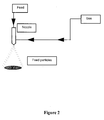
- Fig. 2 is schematically shown the process of manufacturing feed particles.
- alginate in the matrix material, it cross-links after particle propagation in a solution of divalent ions, most typically a CaCl 2 solution or directly in sea water.
- the size of the particles may be determined by means of atomisation and nozzle size in this process.
- the feed may be crushed later and sifted into the desired size fractions.
- the strength of a CaCl 2 solution for the cross-linking of the alginate matrix is between 0,5 M and 0,05 M, most typically 0,2 M.
- Fig. 3 is shown comparative leakage from different feeds produced as OD 280 with time.
- Feeds 1 and 2 are both feeds with phospholipid added to prevent leaking.
- Feed 1 has hydrolysed protein packed into the phospholipids, whereas feed 2 has no addition of hydrolysed protein.
- Feeds 3 and 4 are both without added phospholipid.
- Feed 3 has an addition of hydrolysed protein, whereas feed 4 has no addition of hydrolysed protein. From the figure it can be seen that the phospholipids reduce the leak from the particles.
- the leaks from feeds 2 and 4 represent the leaks of water-soluble protein of the particulate protein of the particle matrix.
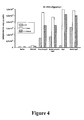
- Fig. 4 is shown in vitro digestion of the feed. It appears from the figure that it is the detergent effect of the gall salts that destabilises the phospholipids and releases the packed nutrients, in this case 125 I-BSA. The release of packed, marked protein was measured as recovered cpm (counts per minute) in the supernatant.
- Corresponding experiments have been done for salmon (100 g) and cod (10 g), and high count figures have been found both in muscle, blood and organs (spleen and kidney). The results from in vitro and in vivo experiments therefore show that fish is capable of releasing and utilising nutrients packed in phospholipid membranes.
- Fig. 6 comparative intakes of feed with and without packed hydrolysed protein.
- the experiment was carried out on larval cod from day 8 to 10 after hatching.
- the mean particle size of the feed was 100 ⁇ m.
- Small (3 ⁇ m) plastic balls marked with 125 I were used as indigestible markers for the intake of feed.
- All feeds contained phospholipid, two feeds had packed hydrolysed protein (hydrolysed protein and hydrolysed protein + wholeprotein in the figure) and one had no addition of hydrolysed protein (wholeprotein in the figure). This experiment clearly showed the attractant effect of the packed hydrolysed protein.
- Comparative growth experiments have also been carried out for feed with and without packed hydrolysed protein. Feed with packed hydrolysed protein resulted in greater growth than feed without packed hydrolysed protein.
- Feed 1 is a feed made according to the specification given herein above.
- the feed that it is compared with, is a granulate feed (NorAqua AS). It appears from the figure that feed 1 stays in the water column longer than feed 2.
- the experiment was carried out in small vessels (40 litres) with a slight upward current, corresponding to what is used in start-feeding experiments on larval fish.
- Fig. 8 is shown the rate of sedimentation of feed 1 (mentioned above) in a rearing vessel of 6000 litres, with a particle size of 125 ⁇ m ⁇ d ⁇ 180 ⁇ m.
- the water in the vessel was placed under current corresponding to that used by the start-feeding of larval fish. It is desirable to maintain a particle density of 2000-3000 particles per litre to have optimum pasturing conditions.
- this experiment there were added 10 g of dry feed every hour. There was no fish in the system, so that there was no pasturing on the feed. It is seen that the optimum feed density can be maintained in the vessel. By adding feed at shorter time intervals, a more stable particle density in the vessel can be achieved.
Landscapes
- Life Sciences & Earth Sciences (AREA)
- Chemical & Material Sciences (AREA)
- Polymers & Plastics (AREA)
- Food Science & Technology (AREA)
- Zoology (AREA)
- Engineering & Computer Science (AREA)
- Animal Husbandry (AREA)
- Insects & Arthropods (AREA)
- Marine Sciences & Fisheries (AREA)
- Birds (AREA)
- Feed For Specific Animals (AREA)
- Fodder In General (AREA)
- Farming Of Fish And Shellfish (AREA)
Claims (9)
- Aliment particulaire composite pour des larves ou des alevins de poissons ou d'autres organismes marins, caractérisé en ce que l'aliment comprend :a) des phospholipides ;b) des nutriments solubles dans l'eau ; etc) des nutriments insolubles dans l'eau ; etd) une matrice d'alginate qui a été réticulée dans une solution d'ions divalents ;
dans lequel les substances solubles dans l'eau sont encapsulées dans les phospholipides et les phospholipides qui encapsulent les substances solubles dans l'eau et les autres nutriments sont incorporés dans la matrice. - Aliment selon la revendication 1, caractérisé en ce que lesdites substances solubles dans l'eau sont des protéines solubles dans l'eau, des protéines hydrolysées, des acides aminés, des glucides bioactifs, des vitamines et des minéraux solubles dans l'eau.
- Aliment selon la revendication 1, dans lequel lesdits ions divalents comprennent des ions Ca.
- Aliment selon la revendication 1, dans lequel lesdits ions divalents comprennent des ions divalents provenant de l'eau de mer.
- Aliment selon la revendication 1, dans lequel lesdites substances insolubles dans l'eau sont de la poudre d'oeufs de morue et de la poudre de muscles de morue.
- Aliment selon la revendication 1, dans lequel lesdites substances insolubles dans l'eau sont particulaires.
- Procédé de fabrication d'un aliment particulaire composite pour les larves et les alevins de poissons et d'autres organismes aquatiques, caractérisé en ce que les phospholipides, les substances solubles dans l'eau et les substances insolubles dans l'eau et une matrice de réticulation d'alginate sont mélangés et broyés dans une buse par un apport de gaz et soumis à une réticulation dans une solution d'ions divalents.
- Procédé selon la revendication 7, dans lequel lesdits ions divalents comprennent des ions Ca.
- Procédé selon la revendication 7, dans lequel ladite solution d'ions divalents comprend de l'eau de mer.
Applications Claiming Priority (3)
| Application Number | Priority Date | Filing Date | Title |
|---|---|---|---|
| NO985005A NO308764B1 (no) | 1998-10-28 | 1998-10-28 | Sammensatt, partikkelformig fôr for larver eller yngel av fisk og andre marine organismer, samt fremgangsmåte for fremstilling derav |
| NO985005 | 1998-10-28 | ||
| PCT/NO1999/000325 WO2000027218A1 (fr) | 1998-10-28 | 1999-10-25 | Composite, en particulier aliment pour alevins ou d'autres organismes marins, et procede de preparation d'un aliment de demarrage |
Publications (2)
| Publication Number | Publication Date |
|---|---|
| EP1124437A1 EP1124437A1 (fr) | 2001-08-22 |
| EP1124437B1 true EP1124437B1 (fr) | 2011-05-11 |
Family
ID=19902555
Family Applications (1)
| Application Number | Title | Priority Date | Filing Date |
|---|---|---|---|
| EP99951279A Expired - Lifetime EP1124437B1 (fr) | 1998-10-28 | 1999-10-25 | Composite, en particulier aliment pour alevins ou d'autres organismes marins, et procede de preparation d'un aliment de demarrage |
Country Status (8)
| Country | Link |
|---|---|
| US (1) | US6623776B1 (fr) |
| EP (1) | EP1124437B1 (fr) |
| JP (1) | JP4673975B2 (fr) |
| AT (1) | ATE508645T1 (fr) |
| AU (1) | AU6374899A (fr) |
| CA (1) | CA2348504C (fr) |
| NO (1) | NO308764B1 (fr) |
| WO (1) | WO2000027218A1 (fr) |
Families Citing this family (10)
| Publication number | Priority date | Publication date | Assignee | Title |
|---|---|---|---|---|
| FR2793114B1 (fr) * | 1999-04-21 | 2002-11-29 | Agronomique Inst Nat Rech | Aliment complet pour larves de poissons et procede pour sa preparation |
| EP1414561A2 (fr) * | 2001-08-03 | 2004-05-06 | Maripro AS | Amelorations d'une encapsulation ou relatives a une encapsulation |
| US8865197B2 (en) * | 2005-09-06 | 2014-10-21 | Israel Oceanographic And Limnological Research Ltd. | Food formulation for aquatic animals with integrated targeted delivery of bioactive agents |
| US8067047B2 (en) * | 2006-06-27 | 2011-11-29 | James Fajt | Method and devices for forming articles |
| CA2702577A1 (fr) | 2007-10-15 | 2009-04-23 | Jbs United, Inc. | Procede permettant d'accroitre la performance d'une progeniture |
| WO2009102558A2 (fr) * | 2008-02-11 | 2009-08-20 | Monsanto Technology Llc | Aliments, produits et procédés d'aquaculture comprenant des acides gras bénéfiques |
| CL2011003025A1 (es) | 2011-11-30 | 2012-07-06 | Univ Arturo Prat 40% | Metodo para obtener un producto alimenticio microencapsulado para peces; producto alimenticio que contiene al menos, alginato, levadura, suero, harina de pescado y otros excipientes; y usos de dicho producto. |
| RU2535093C1 (ru) * | 2013-08-01 | 2014-12-10 | Федеральное государственное бюджетное образовательное учреждение высшего профессионального образования "Новосибирский государственный педагогический университет (ФГБОУ ВПО "НГПУ") | Способ защиты рыб на ранних этапах онтогенеза |
| NO348691B1 (en) * | 2022-04-19 | 2025-05-05 | Nutreco Ip Assets Bv | Gel structure to facilitate live feed substituton for early life stages of aquatic organisms |
| JP2025527320A (ja) * | 2022-08-08 | 2025-08-20 | ユータス・ネクサス・アクアサイエンシズ・プロプライエタリー・リミテッド | 栄養配合物およびその使用 |
Family Cites Families (10)
| Publication number | Priority date | Publication date | Assignee | Title |
|---|---|---|---|---|
| JPS5847447A (ja) * | 1981-09-17 | 1983-03-19 | Riken Vitamin Co Ltd | 稚仔魚用飼料 |
| JPH0753661B2 (ja) | 1984-03-08 | 1995-06-07 | フアレス フアーマスーチカル リサーチ エヌブイ | プロ―リポソーム組成物及びリポソームの水性分散物を作る方法 |
| GB8522963D0 (en) * | 1985-09-17 | 1985-10-23 | Biocompatibles Ltd | Microcapsules |
| JPH0681583B2 (ja) * | 1988-06-03 | 1994-10-19 | 理研ビタミン株式会社 | 甲殻類養殖用初期配合飼料 |
| JPH037546A (ja) * | 1989-06-05 | 1991-01-14 | Nippon Nousan Kogyo Kk | ヒラメ親魚用飼料 |
| JP2843647B2 (ja) * | 1990-05-31 | 1999-01-06 | キユーピー株式会社 | 稚魚用飼料 |
| JPH04173060A (ja) * | 1990-11-08 | 1992-06-19 | Ajinomoto Co Inc | 水産飼料及びその製造法 |
| JPH0525042A (ja) * | 1990-12-21 | 1993-02-02 | Takeda Chem Ind Ltd | 水溶性ビタミン類を含有する組成物 |
| US5698246A (en) * | 1996-01-29 | 1997-12-16 | Cargill, Incorporated | Foodstuff for and method of feeding crustaceans and fish |
| JP4189860B2 (ja) * | 1997-05-30 | 2008-12-03 | 株式会社 鹿児島Tlo | 飼料用マイクロカプセル |
-
1998
- 1998-10-28 NO NO985005A patent/NO308764B1/no not_active IP Right Cessation
-
1999
- 1999-10-25 JP JP2000580466A patent/JP4673975B2/ja not_active Expired - Fee Related
- 1999-10-25 CA CA002348504A patent/CA2348504C/fr not_active Expired - Fee Related
- 1999-10-25 AU AU63748/99A patent/AU6374899A/en not_active Abandoned
- 1999-10-25 US US09/830,505 patent/US6623776B1/en not_active Expired - Fee Related
- 1999-10-25 EP EP99951279A patent/EP1124437B1/fr not_active Expired - Lifetime
- 1999-10-25 WO PCT/NO1999/000325 patent/WO2000027218A1/fr not_active Ceased
- 1999-10-25 AT AT99951279T patent/ATE508645T1/de not_active IP Right Cessation
Also Published As
| Publication number | Publication date |
|---|---|
| CA2348504C (fr) | 2009-05-19 |
| JP4673975B2 (ja) | 2011-04-20 |
| NO308764B2 (no) | 2000-10-30 |
| JP2002529062A (ja) | 2002-09-10 |
| NO985005D0 (no) | 1998-10-28 |
| EP1124437A1 (fr) | 2001-08-22 |
| ATE508645T1 (de) | 2011-05-15 |
| US6623776B1 (en) | 2003-09-23 |
| CA2348504A1 (fr) | 2000-05-18 |
| NO985005L (no) | 2000-05-02 |
| AU6374899A (en) | 2000-05-29 |
| NO308764B1 (no) | 2000-10-30 |
| WO2000027218A1 (fr) | 2000-05-18 |
Similar Documents
| Publication | Publication Date | Title |
|---|---|---|
| People Le Ruyet et al. | Marine fish larvae feeding: formulated diets or live prey? | |
| Langdon | Microparticle types for delivering nutrients to marine fish larvae | |
| Kolkovski et al. | The effect of dietary exogenous digestive enzymes on ingestion, assimilation, growth and survival of gilthead seabream (Sparus aurata, Sparidae, Linnaeus) larvae | |
| US5698246A (en) | Foodstuff for and method of feeding crustaceans and fish | |
| López-Alvarado et al. | Effects of coating and encapsulation of crystalline amino acids on leaching in larval feeds | |
| Kolkovski et al. | The mode of action of Artemia in enhancing utilization of microdiet by gilthead seabream Sparus aurata larvae | |
| CN100456949C (zh) | 生物活性食品复合物,制备生物活性食品复合产品的方法 | |
| US5525353A (en) | Ambient temperature-processed aquatic animal feed and process for making same | |
| Appelbaum | Rearing of the Dover sole, Solea solea (L), through its larval stages using artificial diets | |
| US20040009160A1 (en) | Bioactive food complex, method for making bioactive food complex product and method for controlling disease | |
| Koven et al. | The effect of dietary phosphatidylcholine and its constituent fatty acids on microdiet ingestion and fatty acid absorption rate in gilthead sea bream, Sparus auratus, larvae | |
| EP1124437B1 (fr) | Composite, en particulier aliment pour alevins ou d'autres organismes marins, et procede de preparation d'un aliment de demarrage | |
| Santiago et al. | Influence of feeding rate and diet form on growth and survival of Nile tilapia (Oreochromis niloticus) fry | |
| EP0292052A2 (fr) | Procédé pour la production de nourriture pour poissons et méthode d'affouragement | |
| JPH0851937A (ja) | 養殖エビ用飼料及びエビの養殖法 | |
| Dhert et al. | Possible applications of modern fish larviculture technology to ornamental fish production | |
| Gordon et al. | Effect of feed type and age-at-weaning on growth and survival of clownfish Amphiprion percula (Pomacentridae) | |
| JP2003516714A (ja) | 稚魚用の完全飼料およびその製造方法 | |
| Kolkovski | Advances in marine fish larvae diets | |
| Pooramini et al. | The effects of different concentrations of probiotic Saccharomyces cerevisia on growth performance and survival rate of rainbow trout (Oncorhynchus mykiss), fry and resistance against salinity | |
| JPH0530923A (ja) | 魚類養殖用初期配合飼料 | |
| Koven | Gilt-head sea bream, Sparus aurata. | |
| ES2988959T3 (es) | Composición de pienso para acuicultura que comprende carbón vegetal y su uso | |
| KR20250004298A (ko) | 수생생물의 초기 생활단계에 대한 생물 사료 대체를 용이하게 하는 겔 구조 | |
| Han | Development and evaluation of a coagulated egg albumin microparticulate diet for larval culture of freshwater prawn Macrobrachium rosenbergii and striped bass Morone saxatilis |
Legal Events
| Date | Code | Title | Description |
|---|---|---|---|
| PUAI | Public reference made under article 153(3) epc to a published international application that has entered the european phase |
Free format text: ORIGINAL CODE: 0009012 |
|
| 17P | Request for examination filed |
Effective date: 20010412 |
|
| AK | Designated contracting states |
Kind code of ref document: A1 Designated state(s): AT BE CH CY DE DK ES FI FR GB GR IE IT LI LU MC NL PT SE |
|
| AX | Request for extension of the european patent |
Free format text: AL;LT;LV;MK;RO;SI |
|
| RAP1 | Party data changed (applicant data changed or rights of an application transferred) |
Owner name: EWOS INNOVATION AS |
|
| 17Q | First examination report despatched |
Effective date: 20050204 |
|
| GRAP | Despatch of communication of intention to grant a patent |
Free format text: ORIGINAL CODE: EPIDOSNIGR1 |
|
| GRAS | Grant fee paid |
Free format text: ORIGINAL CODE: EPIDOSNIGR3 |
|
| GRAA | (expected) grant |
Free format text: ORIGINAL CODE: 0009210 |
|
| AK | Designated contracting states |
Kind code of ref document: B1 Designated state(s): AT BE CH CY DE DK ES FI FR GB GR IE IT LI LU MC NL PT SE |
|
| REG | Reference to a national code |
Ref country code: GB Ref legal event code: FG4D |
|
| REG | Reference to a national code |
Ref country code: CH Ref legal event code: EP |
|
| REG | Reference to a national code |
Ref country code: IE Ref legal event code: FG4D |
|
| REG | Reference to a national code |
Ref country code: DE Ref legal event code: R096 Ref document number: 69943425 Country of ref document: DE Effective date: 20110622 |
|
| REG | Reference to a national code |
Ref country code: NL Ref legal event code: VDEP Effective date: 20110511 |
|
| REG | Reference to a national code |
Ref country code: GR Ref legal event code: EP Ref document number: 20110401909 Country of ref document: GR Effective date: 20110916 |
|
| PG25 | Lapsed in a contracting state [announced via postgrant information from national office to epo] |
Ref country code: SE Free format text: LAPSE BECAUSE OF FAILURE TO SUBMIT A TRANSLATION OF THE DESCRIPTION OR TO PAY THE FEE WITHIN THE PRESCRIBED TIME-LIMIT Effective date: 20110511 Ref country code: PT Free format text: LAPSE BECAUSE OF FAILURE TO SUBMIT A TRANSLATION OF THE DESCRIPTION OR TO PAY THE FEE WITHIN THE PRESCRIBED TIME-LIMIT Effective date: 20110912 |
|
| PG25 | Lapsed in a contracting state [announced via postgrant information from national office to epo] |
Ref country code: BE Free format text: LAPSE BECAUSE OF FAILURE TO SUBMIT A TRANSLATION OF THE DESCRIPTION OR TO PAY THE FEE WITHIN THE PRESCRIBED TIME-LIMIT Effective date: 20110511 Ref country code: CY Free format text: LAPSE BECAUSE OF FAILURE TO SUBMIT A TRANSLATION OF THE DESCRIPTION OR TO PAY THE FEE WITHIN THE PRESCRIBED TIME-LIMIT Effective date: 20110511 Ref country code: FI Free format text: LAPSE BECAUSE OF FAILURE TO SUBMIT A TRANSLATION OF THE DESCRIPTION OR TO PAY THE FEE WITHIN THE PRESCRIBED TIME-LIMIT Effective date: 20110511 Ref country code: AT Free format text: LAPSE BECAUSE OF FAILURE TO SUBMIT A TRANSLATION OF THE DESCRIPTION OR TO PAY THE FEE WITHIN THE PRESCRIBED TIME-LIMIT Effective date: 20110511 Ref country code: ES Free format text: LAPSE BECAUSE OF FAILURE TO SUBMIT A TRANSLATION OF THE DESCRIPTION OR TO PAY THE FEE WITHIN THE PRESCRIBED TIME-LIMIT Effective date: 20110822 |
|
| PG25 | Lapsed in a contracting state [announced via postgrant information from national office to epo] |
Ref country code: NL Free format text: LAPSE BECAUSE OF FAILURE TO SUBMIT A TRANSLATION OF THE DESCRIPTION OR TO PAY THE FEE WITHIN THE PRESCRIBED TIME-LIMIT Effective date: 20110511 |
|
| PG25 | Lapsed in a contracting state [announced via postgrant information from national office to epo] |
Ref country code: DK Free format text: LAPSE BECAUSE OF FAILURE TO SUBMIT A TRANSLATION OF THE DESCRIPTION OR TO PAY THE FEE WITHIN THE PRESCRIBED TIME-LIMIT Effective date: 20110511 |
|
| PLBE | No opposition filed within time limit |
Free format text: ORIGINAL CODE: 0009261 |
|
| STAA | Information on the status of an ep patent application or granted ep patent |
Free format text: STATUS: NO OPPOSITION FILED WITHIN TIME LIMIT |
|
| 26N | No opposition filed |
Effective date: 20120214 |
|
| PG25 | Lapsed in a contracting state [announced via postgrant information from national office to epo] |
Ref country code: MC Free format text: LAPSE BECAUSE OF NON-PAYMENT OF DUE FEES Effective date: 20111031 Ref country code: IT Free format text: LAPSE BECAUSE OF FAILURE TO SUBMIT A TRANSLATION OF THE DESCRIPTION OR TO PAY THE FEE WITHIN THE PRESCRIBED TIME-LIMIT Effective date: 20110511 |
|
| REG | Reference to a national code |
Ref country code: CH Ref legal event code: PL |
|
| REG | Reference to a national code |
Ref country code: DE Ref legal event code: R097 Ref document number: 69943425 Country of ref document: DE Effective date: 20120214 |
|
| REG | Reference to a national code |
Ref country code: FR Ref legal event code: ST Effective date: 20120629 |
|
| PG25 | Lapsed in a contracting state [announced via postgrant information from national office to epo] |
Ref country code: LI Free format text: LAPSE BECAUSE OF NON-PAYMENT OF DUE FEES Effective date: 20111031 Ref country code: CH Free format text: LAPSE BECAUSE OF NON-PAYMENT OF DUE FEES Effective date: 20111031 Ref country code: DE Free format text: LAPSE BECAUSE OF NON-PAYMENT OF DUE FEES Effective date: 20120501 |
|
| REG | Reference to a national code |
Ref country code: DE Ref legal event code: R119 Ref document number: 69943425 Country of ref document: DE Effective date: 20120501 |
|
| PG25 | Lapsed in a contracting state [announced via postgrant information from national office to epo] |
Ref country code: FR Free format text: LAPSE BECAUSE OF NON-PAYMENT OF DUE FEES Effective date: 20111102 |
|
| PG25 | Lapsed in a contracting state [announced via postgrant information from national office to epo] |
Ref country code: LU Free format text: LAPSE BECAUSE OF NON-PAYMENT OF DUE FEES Effective date: 20111025 |
|
| PGFP | Annual fee paid to national office [announced via postgrant information from national office to epo] |
Ref country code: IE Payment date: 20131007 Year of fee payment: 15 Ref country code: GB Payment date: 20131021 Year of fee payment: 15 |
|
| PGFP | Annual fee paid to national office [announced via postgrant information from national office to epo] |
Ref country code: GR Payment date: 20131016 Year of fee payment: 15 |
|
| GBPC | Gb: european patent ceased through non-payment of renewal fee |
Effective date: 20141025 |
|
| REG | Reference to a national code |
Ref country code: GR Ref legal event code: ML Ref document number: 20110401909 Country of ref document: GR Effective date: 20150505 |
|
| REG | Reference to a national code |
Ref country code: IE Ref legal event code: MM4A |
|
| PG25 | Lapsed in a contracting state [announced via postgrant information from national office to epo] |
Ref country code: GB Free format text: LAPSE BECAUSE OF NON-PAYMENT OF DUE FEES Effective date: 20141025 |
|
| PG25 | Lapsed in a contracting state [announced via postgrant information from national office to epo] |
Ref country code: GR Free format text: LAPSE BECAUSE OF NON-PAYMENT OF DUE FEES Effective date: 20150505 |
|
| PG25 | Lapsed in a contracting state [announced via postgrant information from national office to epo] |
Ref country code: IE Free format text: LAPSE BECAUSE OF NON-PAYMENT OF DUE FEES Effective date: 20141025 |