EP1124859B1 - Verbindung enthaltend ein übergangsmetall-kation und ein aluminoxat-anion und deren verwendung als katalysatorkomponente - Google Patents
Verbindung enthaltend ein übergangsmetall-kation und ein aluminoxat-anion und deren verwendung als katalysatorkomponente Download PDFInfo
- Publication number
- EP1124859B1 EP1124859B1 EP99955006A EP99955006A EP1124859B1 EP 1124859 B1 EP1124859 B1 EP 1124859B1 EP 99955006 A EP99955006 A EP 99955006A EP 99955006 A EP99955006 A EP 99955006A EP 1124859 B1 EP1124859 B1 EP 1124859B1
- Authority
- EP
- European Patent Office
- Prior art keywords
- compound
- block
- metal
- hydroxyaluminoxane
- groups
- Prior art date
- Legal status (The legal status is an assumption and is not a legal conclusion. Google has not performed a legal analysis and makes no representation as to the accuracy of the status listed.)
- Expired - Lifetime
Links
- 150000001875 compounds Chemical class 0.000 title claims abstract description 63
- 150000001450 anions Chemical class 0.000 title claims abstract description 27
- 239000003054 catalyst Substances 0.000 title abstract description 64
- -1 transition metal cation Chemical class 0.000 title description 55
- 229910052723 transition metal Inorganic materials 0.000 title description 4
- XAGFODPZIPBFFR-UHFFFAOYSA-N aluminium Chemical compound [Al] XAGFODPZIPBFFR-UHFFFAOYSA-N 0.000 claims abstract description 30
- 150000002736 metal compounds Chemical class 0.000 claims abstract description 26
- 238000012546 transfer Methods 0.000 claims abstract description 15
- 150000001768 cations Chemical class 0.000 claims abstract description 14
- 229910052751 metal Inorganic materials 0.000 claims description 52
- 239000002184 metal Substances 0.000 claims description 52
- 238000000034 method Methods 0.000 claims description 51
- 125000002887 hydroxy group Chemical group [H]O* 0.000 claims description 43
- 230000008569 process Effects 0.000 claims description 31
- 229910052726 zirconium Inorganic materials 0.000 claims description 20
- 125000000217 alkyl group Chemical group 0.000 claims description 18
- WCFQIFDACWBNJT-UHFFFAOYSA-N $l^{1}-alumanyloxy(2-methylpropyl)aluminum Chemical compound CC(C)C[Al]O[Al] WCFQIFDACWBNJT-UHFFFAOYSA-N 0.000 claims description 17
- 125000002496 methyl group Chemical group [H]C([H])([H])* 0.000 claims description 14
- 229930195733 hydrocarbon Natural products 0.000 claims description 12
- 125000001183 hydrocarbyl group Chemical group 0.000 claims description 11
- 239000004215 Carbon black (E152) Substances 0.000 claims description 10
- 125000004432 carbon atom Chemical group C* 0.000 claims description 10
- 150000002430 hydrocarbons Chemical class 0.000 claims description 10
- 239000007848 Bronsted acid Substances 0.000 claims description 9
- QCWXUUIWCKQGHC-UHFFFAOYSA-N Zirconium Chemical compound [Zr] QCWXUUIWCKQGHC-UHFFFAOYSA-N 0.000 claims description 6
- 229910052735 hafnium Inorganic materials 0.000 claims description 6
- 230000007935 neutral effect Effects 0.000 claims description 6
- 230000003993 interaction Effects 0.000 claims description 5
- VBJZVLUMGGDVMO-UHFFFAOYSA-N hafnium atom Chemical compound [Hf] VBJZVLUMGGDVMO-UHFFFAOYSA-N 0.000 claims description 4
- 230000009466 transformation Effects 0.000 claims description 2
- 125000000959 isobutyl group Chemical group [H]C([H])([H])C([H])(C([H])([H])[H])C([H])([H])* 0.000 claims 2
- 239000000203 mixture Substances 0.000 abstract description 42
- 229910052782 aluminium Inorganic materials 0.000 abstract description 30
- 229920000642 polymer Polymers 0.000 abstract description 20
- 239000002904 solvent Substances 0.000 abstract description 15
- 239000003426 co-catalyst Substances 0.000 abstract description 11
- 230000003197 catalytic effect Effects 0.000 abstract description 9
- 230000002829 reductive effect Effects 0.000 abstract description 5
- 238000011068 loading method Methods 0.000 abstract description 4
- YXFVVABEGXRONW-UHFFFAOYSA-N Toluene Chemical compound CC1=CC=CC=C1 YXFVVABEGXRONW-UHFFFAOYSA-N 0.000 description 63
- 238000006243 chemical reaction Methods 0.000 description 46
- 238000006116 polymerization reaction Methods 0.000 description 46
- 239000000243 solution Substances 0.000 description 36
- XLYOFNOQVPJJNP-UHFFFAOYSA-N water Substances O XLYOFNOQVPJJNP-UHFFFAOYSA-N 0.000 description 29
- VLKZOEOYAKHREP-UHFFFAOYSA-N n-Hexane Chemical compound CCCCCC VLKZOEOYAKHREP-UHFFFAOYSA-N 0.000 description 27
- 125000004429 atom Chemical group 0.000 description 23
- CPOFMOWDMVWCLF-UHFFFAOYSA-N methyl(oxo)alumane Chemical compound C[Al]=O CPOFMOWDMVWCLF-UHFFFAOYSA-N 0.000 description 22
- 239000000047 product Substances 0.000 description 22
- 239000007788 liquid Substances 0.000 description 17
- MCULRUJILOGHCJ-UHFFFAOYSA-N triisobutylaluminium Chemical compound CC(C)C[Al](CC(C)C)CC(C)C MCULRUJILOGHCJ-UHFFFAOYSA-N 0.000 description 16
- 239000000178 monomer Substances 0.000 description 15
- 239000005977 Ethylene Substances 0.000 description 14
- 238000001228 spectrum Methods 0.000 description 14
- VGGSQFUCUMXWEO-UHFFFAOYSA-N Ethene Chemical compound C=C VGGSQFUCUMXWEO-UHFFFAOYSA-N 0.000 description 13
- 239000007787 solid Substances 0.000 description 12
- 150000001336 alkenes Chemical class 0.000 description 11
- 238000002329 infrared spectrum Methods 0.000 description 11
- IJGRMHOSHXDMSA-UHFFFAOYSA-N Atomic nitrogen Chemical compound N#N IJGRMHOSHXDMSA-UHFFFAOYSA-N 0.000 description 10
- 238000001994 activation Methods 0.000 description 10
- 230000015572 biosynthetic process Effects 0.000 description 10
- 230000000052 comparative effect Effects 0.000 description 10
- 230000000694 effects Effects 0.000 description 10
- 239000000463 material Substances 0.000 description 10
- QQONPFPTGQHPMA-UHFFFAOYSA-N propylene Natural products CC=C QQONPFPTGQHPMA-UHFFFAOYSA-N 0.000 description 10
- 125000004805 propylene group Chemical group [H]C([H])([H])C([H])([*:1])C([H])([H])[*:2] 0.000 description 10
- 239000000376 reactant Substances 0.000 description 10
- JLTRXTDYQLMHGR-UHFFFAOYSA-N trimethylaluminium Chemical compound C[Al](C)C JLTRXTDYQLMHGR-UHFFFAOYSA-N 0.000 description 10
- 229910052768 actinide Inorganic materials 0.000 description 9
- 230000004913 activation Effects 0.000 description 9
- 239000012190 activator Substances 0.000 description 9
- 125000000058 cyclopentadienyl group Chemical group C1(=CC=CC1)* 0.000 description 9
- 229910052747 lanthanoid Inorganic materials 0.000 description 9
- 150000002602 lanthanoids Chemical class 0.000 description 9
- ZOXJGFHDIHLPTG-UHFFFAOYSA-N Boron Chemical compound [B] ZOXJGFHDIHLPTG-UHFFFAOYSA-N 0.000 description 8
- 238000004458 analytical method Methods 0.000 description 8
- 125000004122 cyclic group Chemical group 0.000 description 8
- ZSWFCLXCOIISFI-UHFFFAOYSA-N endo-cyclopentadiene Natural products C1C=CC=C1 ZSWFCLXCOIISFI-UHFFFAOYSA-N 0.000 description 8
- 239000002002 slurry Substances 0.000 description 8
- 230000007704 transition Effects 0.000 description 8
- CTNFGBKAHAEKFE-UHFFFAOYSA-N bis(2-methylpropyl)alumanyloxy-bis(2-methylpropyl)alumane Chemical compound CC(C)C[Al](CC(C)C)O[Al](CC(C)C)CC(C)C CTNFGBKAHAEKFE-UHFFFAOYSA-N 0.000 description 7
- 229910052796 boron Inorganic materials 0.000 description 7
- JRZJOMJEPLMPRA-UHFFFAOYSA-N olefin Natural products CCCCCCCC=C JRZJOMJEPLMPRA-UHFFFAOYSA-N 0.000 description 7
- 239000000126 substance Substances 0.000 description 7
- OKKJLVBELUTLKV-UHFFFAOYSA-N Methanol Chemical compound OC OKKJLVBELUTLKV-UHFFFAOYSA-N 0.000 description 6
- IMNFDUFMRHMDMM-UHFFFAOYSA-N N-Heptane Chemical compound CCCCCCC IMNFDUFMRHMDMM-UHFFFAOYSA-N 0.000 description 6
- 150000001993 dienes Chemical class 0.000 description 6
- 125000000118 dimethyl group Chemical group [H]C([H])([H])* 0.000 description 6
- 239000007789 gas Substances 0.000 description 6
- 150000004678 hydrides Chemical class 0.000 description 6
- 239000003446 ligand Substances 0.000 description 6
- AMXOYNBUYSYVKV-UHFFFAOYSA-M lithium bromide Chemical compound [Li+].[Br-] AMXOYNBUYSYVKV-UHFFFAOYSA-M 0.000 description 6
- 230000007246 mechanism Effects 0.000 description 6
- 150000002739 metals Chemical class 0.000 description 6
- 238000003756 stirring Methods 0.000 description 6
- YBYIRNPNPLQARY-UHFFFAOYSA-N 1H-indene Natural products C1=CC=C2CC=CC2=C1 YBYIRNPNPLQARY-UHFFFAOYSA-N 0.000 description 5
- 241000349731 Afzelia bipindensis Species 0.000 description 5
- 239000002841 Lewis acid Substances 0.000 description 5
- VYPSYNLAJGMNEJ-UHFFFAOYSA-N Silicium dioxide Chemical compound O=[Si]=O VYPSYNLAJGMNEJ-UHFFFAOYSA-N 0.000 description 5
- PNEYBMLMFCGWSK-UHFFFAOYSA-N aluminium oxide Inorganic materials [O-2].[O-2].[O-2].[Al+3].[Al+3] PNEYBMLMFCGWSK-UHFFFAOYSA-N 0.000 description 5
- 150000001639 boron compounds Chemical class 0.000 description 5
- 125000005843 halogen group Chemical group 0.000 description 5
- NNPPMTNAJDCUHE-UHFFFAOYSA-N isobutane Chemical compound CC(C)C NNPPMTNAJDCUHE-UHFFFAOYSA-N 0.000 description 5
- 150000007517 lewis acids Chemical class 0.000 description 5
- IHLVCKWPAMTVTG-UHFFFAOYSA-N lithium;carbanide Chemical compound [Li+].[CH3-] IHLVCKWPAMTVTG-UHFFFAOYSA-N 0.000 description 5
- 229910052757 nitrogen Inorganic materials 0.000 description 5
- 239000011541 reaction mixture Substances 0.000 description 5
- 229910052719 titanium Inorganic materials 0.000 description 5
- 239000010936 titanium Substances 0.000 description 5
- LIKMAJRDDDTEIG-UHFFFAOYSA-N 1-hexene Chemical compound CCCCC=C LIKMAJRDDDTEIG-UHFFFAOYSA-N 0.000 description 4
- KWKAKUADMBZCLK-UHFFFAOYSA-N 1-octene Chemical compound CCCCCCC=C KWKAKUADMBZCLK-UHFFFAOYSA-N 0.000 description 4
- WSSSPWUEQFSQQG-UHFFFAOYSA-N 4-methyl-1-pentene Chemical compound CC(C)CC=C WSSSPWUEQFSQQG-UHFFFAOYSA-N 0.000 description 4
- RTZKZFJDLAIYFH-UHFFFAOYSA-N Diethyl ether Chemical compound CCOCC RTZKZFJDLAIYFH-UHFFFAOYSA-N 0.000 description 4
- WYURNTSHIVDZCO-UHFFFAOYSA-N Tetrahydrofuran Chemical compound C1CCOC1 WYURNTSHIVDZCO-UHFFFAOYSA-N 0.000 description 4
- AZDRQVAHHNSJOQ-UHFFFAOYSA-N alumane Chemical class [AlH3] AZDRQVAHHNSJOQ-UHFFFAOYSA-N 0.000 description 4
- 150000004945 aromatic hydrocarbons Chemical class 0.000 description 4
- JLTDJTHDQAWBAV-UHFFFAOYSA-O dimethyl(phenyl)azanium Chemical compound C[NH+](C)C1=CC=CC=C1 JLTDJTHDQAWBAV-UHFFFAOYSA-O 0.000 description 4
- 229910052739 hydrogen Inorganic materials 0.000 description 4
- 239000001257 hydrogen Substances 0.000 description 4
- 238000006460 hydrolysis reaction Methods 0.000 description 4
- 230000003301 hydrolyzing effect Effects 0.000 description 4
- 125000003454 indenyl group Chemical group C1(C=CC2=CC=CC=C12)* 0.000 description 4
- 229910052809 inorganic oxide Inorganic materials 0.000 description 4
- 239000000543 intermediate Substances 0.000 description 4
- 229910052760 oxygen Inorganic materials 0.000 description 4
- 239000002685 polymerization catalyst Substances 0.000 description 4
- VOITXYVAKOUIBA-UHFFFAOYSA-N triethylaluminium Chemical compound CC[Al](CC)CC VOITXYVAKOUIBA-UHFFFAOYSA-N 0.000 description 4
- 238000002371 ultraviolet--visible spectrum Methods 0.000 description 4
- LEOYKWIXWJXYQJ-UHFFFAOYSA-L [Cl-].[Cl-].CC1=CC2=CC=CC=C2C1[Zr+2]([SiH](C)C)C1C2=CC=CC=C2C=C1C Chemical compound [Cl-].[Cl-].CC1=CC2=CC=CC=C2C1[Zr+2]([SiH](C)C)C1C2=CC=CC=C2C=C1C LEOYKWIXWJXYQJ-UHFFFAOYSA-L 0.000 description 3
- 238000002835 absorbance Methods 0.000 description 3
- 150000004703 alkoxides Chemical class 0.000 description 3
- 125000000129 anionic group Chemical group 0.000 description 3
- QVGXLLKOCUKJST-UHFFFAOYSA-N atomic oxygen Chemical compound [O] QVGXLLKOCUKJST-UHFFFAOYSA-N 0.000 description 3
- 125000001797 benzyl group Chemical group [H]C1=C([H])C([H])=C(C([H])=C1[H])C([H])([H])* 0.000 description 3
- 229910052799 carbon Inorganic materials 0.000 description 3
- 238000007334 copolymerization reaction Methods 0.000 description 3
- 239000006185 dispersion Substances 0.000 description 3
- 125000003983 fluorenyl group Chemical group C1(=CC=CC=2C3=CC=CC=C3CC12)* 0.000 description 3
- 230000006870 function Effects 0.000 description 3
- 238000012685 gas phase polymerization Methods 0.000 description 3
- 230000007062 hydrolysis Effects 0.000 description 3
- 239000012535 impurity Substances 0.000 description 3
- 150000008040 ionic compounds Chemical class 0.000 description 3
- 150000002500 ions Chemical class 0.000 description 3
- 238000004949 mass spectrometry Methods 0.000 description 3
- 229910052752 metalloid Inorganic materials 0.000 description 3
- 150000002738 metalloids Chemical class 0.000 description 3
- 125000002524 organometallic group Chemical group 0.000 description 3
- 239000001301 oxygen Substances 0.000 description 3
- 230000037048 polymerization activity Effects 0.000 description 3
- 238000002360 preparation method Methods 0.000 description 3
- 238000012360 testing method Methods 0.000 description 3
- SQBBHCOIQXKPHL-UHFFFAOYSA-N tributylalumane Chemical compound CCCC[Al](CCCC)CCCC SQBBHCOIQXKPHL-UHFFFAOYSA-N 0.000 description 3
- 238000012795 verification Methods 0.000 description 3
- 239000004711 α-olefin Substances 0.000 description 3
- AFFLGGQVNFXPEV-UHFFFAOYSA-N 1-decene Chemical compound CCCCCCCCC=C AFFLGGQVNFXPEV-UHFFFAOYSA-N 0.000 description 2
- CRSBERNSMYQZNG-UHFFFAOYSA-N 1-dodecene Chemical compound CCCCCCCCCCC=C CRSBERNSMYQZNG-UHFFFAOYSA-N 0.000 description 2
- GQEZCXVZFLOKMC-UHFFFAOYSA-N 1-hexadecene Chemical compound CCCCCCCCCCCCCCC=C GQEZCXVZFLOKMC-UHFFFAOYSA-N 0.000 description 2
- HFDVRLIODXPAHB-UHFFFAOYSA-N 1-tetradecene Chemical compound CCCCCCCCCCCCC=C HFDVRLIODXPAHB-UHFFFAOYSA-N 0.000 description 2
- LPHIYKWSEYTCLW-UHFFFAOYSA-N 1h-azaborole Chemical compound N1B=CC=C1 LPHIYKWSEYTCLW-UHFFFAOYSA-N 0.000 description 2
- CSCPPACGZOOCGX-UHFFFAOYSA-N Acetone Chemical compound CC(C)=O CSCPPACGZOOCGX-UHFFFAOYSA-N 0.000 description 2
- 229910018516 Al—O Inorganic materials 0.000 description 2
- KAKZBPTYRLMSJV-UHFFFAOYSA-N Butadiene Chemical compound C=CC=C KAKZBPTYRLMSJV-UHFFFAOYSA-N 0.000 description 2
- CKNXPIUXGGVRME-UHFFFAOYSA-L CCCCC1(C=CC(C)=C1)[Zr](Cl)(Cl)C1(CCCC)C=CC(C)=C1 Chemical compound CCCCC1(C=CC(C)=C1)[Zr](Cl)(Cl)C1(CCCC)C=CC(C)=C1 CKNXPIUXGGVRME-UHFFFAOYSA-L 0.000 description 2
- YNQLUTRBYVCPMQ-UHFFFAOYSA-N Ethylbenzene Chemical compound CCC1=CC=CC=C1 YNQLUTRBYVCPMQ-UHFFFAOYSA-N 0.000 description 2
- 238000004566 IR spectroscopy Methods 0.000 description 2
- CPLXHLVBOLITMK-UHFFFAOYSA-N Magnesium oxide Chemical compound [Mg]=O CPLXHLVBOLITMK-UHFFFAOYSA-N 0.000 description 2
- CTQNGGLPUBDAKN-UHFFFAOYSA-N O-Xylene Chemical compound CC1=CC=CC=C1C CTQNGGLPUBDAKN-UHFFFAOYSA-N 0.000 description 2
- 239000004698 Polyethylene Substances 0.000 description 2
- PPBRXRYQALVLMV-UHFFFAOYSA-N Styrene Chemical compound C=CC1=CC=CC=C1 PPBRXRYQALVLMV-UHFFFAOYSA-N 0.000 description 2
- GWEVSGVZZGPLCZ-UHFFFAOYSA-N Titan oxide Chemical compound O=[Ti]=O GWEVSGVZZGPLCZ-UHFFFAOYSA-N 0.000 description 2
- MCMNRKCIXSYSNV-UHFFFAOYSA-N Zirconium dioxide Chemical compound O=[Zr]=O MCMNRKCIXSYSNV-UHFFFAOYSA-N 0.000 description 2
- 239000002253 acid Substances 0.000 description 2
- 150000001255 actinides Chemical class 0.000 description 2
- 230000003213 activating effect Effects 0.000 description 2
- 125000003545 alkoxy group Chemical group 0.000 description 2
- 150000003863 ammonium salts Chemical class 0.000 description 2
- 230000008901 benefit Effects 0.000 description 2
- 125000005605 benzo group Chemical group 0.000 description 2
- 238000006555 catalytic reaction Methods 0.000 description 2
- 239000003153 chemical reaction reagent Substances 0.000 description 2
- 229910052804 chromium Inorganic materials 0.000 description 2
- 239000011651 chromium Substances 0.000 description 2
- 238000001816 cooling Methods 0.000 description 2
- 125000000753 cycloalkyl group Chemical group 0.000 description 2
- 230000009849 deactivation Effects 0.000 description 2
- 238000001035 drying Methods 0.000 description 2
- 238000010438 heat treatment Methods 0.000 description 2
- 125000004435 hydrogen atom Chemical group [H]* 0.000 description 2
- 238000011065 in-situ storage Methods 0.000 description 2
- 239000012442 inert solvent Substances 0.000 description 2
- 230000002427 irreversible effect Effects 0.000 description 2
- 239000001282 iso-butane Substances 0.000 description 2
- 229920002521 macromolecule Polymers 0.000 description 2
- SCEZYJKGDJPHQO-UHFFFAOYSA-M magnesium;methanidylbenzene;chloride Chemical compound [Mg+2].[Cl-].[CH2-]C1=CC=CC=C1 SCEZYJKGDJPHQO-UHFFFAOYSA-M 0.000 description 2
- 229910044991 metal oxide Inorganic materials 0.000 description 2
- 150000004706 metal oxides Chemical class 0.000 description 2
- 239000012968 metallocene catalyst Substances 0.000 description 2
- 238000002156 mixing Methods 0.000 description 2
- TVMXDCGIABBOFY-UHFFFAOYSA-N n-Octanol Natural products CCCCCCCC TVMXDCGIABBOFY-UHFFFAOYSA-N 0.000 description 2
- CCCMONHAUSKTEQ-UHFFFAOYSA-N octadec-1-ene Chemical compound CCCCCCCCCCCCCCCCC=C CCCMONHAUSKTEQ-UHFFFAOYSA-N 0.000 description 2
- 239000002245 particle Substances 0.000 description 2
- YCOZIPAWZNQLMR-UHFFFAOYSA-N pentadecane Chemical compound CCCCCCCCCCCCCCC YCOZIPAWZNQLMR-UHFFFAOYSA-N 0.000 description 2
- 230000000737 periodic effect Effects 0.000 description 2
- 239000012071 phase Substances 0.000 description 2
- BASFCYQUMIYNBI-UHFFFAOYSA-N platinum Chemical compound [Pt] BASFCYQUMIYNBI-UHFFFAOYSA-N 0.000 description 2
- 229920000573 polyethylene Polymers 0.000 description 2
- 229920000098 polyolefin Polymers 0.000 description 2
- 239000002516 radical scavenger Substances 0.000 description 2
- 239000012429 reaction media Substances 0.000 description 2
- 230000035484 reaction time Effects 0.000 description 2
- 230000000630 rising effect Effects 0.000 description 2
- 239000000523 sample Substances 0.000 description 2
- 238000000926 separation method Methods 0.000 description 2
- 239000000377 silicon dioxide Substances 0.000 description 2
- 125000004469 siloxy group Chemical group [SiH3]O* 0.000 description 2
- 239000011734 sodium Substances 0.000 description 2
- 241000894007 species Species 0.000 description 2
- 238000004611 spectroscopical analysis Methods 0.000 description 2
- 125000001424 substituent group Chemical group 0.000 description 2
- 238000003786 synthesis reaction Methods 0.000 description 2
- 150000003624 transition metals Chemical class 0.000 description 2
- YUPAWYWJNZDARM-UHFFFAOYSA-N tri(butan-2-yl)borane Chemical compound CCC(C)B(C(C)CC)C(C)CC YUPAWYWJNZDARM-UHFFFAOYSA-N 0.000 description 2
- LALRXNPLTWZJIJ-UHFFFAOYSA-N triethylborane Chemical compound CCB(CC)CC LALRXNPLTWZJIJ-UHFFFAOYSA-N 0.000 description 2
- 229910052720 vanadium Inorganic materials 0.000 description 2
- 239000008096 xylene Substances 0.000 description 2
- QMBQEXOLIRBNPN-UHFFFAOYSA-L zirconocene dichloride Chemical compound [Cl-].[Cl-].[Zr+4].C=1C=C[CH-]C=1.C=1C=C[CH-]C=1 QMBQEXOLIRBNPN-UHFFFAOYSA-L 0.000 description 2
- CHEANNSDVJOIBS-MHZLTWQESA-N (3s)-3-cyclopropyl-3-[3-[[3-(5,5-dimethylcyclopenten-1-yl)-4-(2-fluoro-5-methoxyphenyl)phenyl]methoxy]phenyl]propanoic acid Chemical compound COC1=CC=C(F)C(C=2C(=CC(COC=3C=C(C=CC=3)[C@@H](CC(O)=O)C3CC3)=CC=2)C=2C(CCC=2)(C)C)=C1 CHEANNSDVJOIBS-MHZLTWQESA-N 0.000 description 1
- PMJHHCWVYXUKFD-SNAWJCMRSA-N (E)-1,3-pentadiene Chemical compound C\C=C\C=C PMJHHCWVYXUKFD-SNAWJCMRSA-N 0.000 description 1
- AQZWEFBJYQSQEH-UHFFFAOYSA-N 2-methyloxaluminane Chemical compound C[Al]1CCCCO1 AQZWEFBJYQSQEH-UHFFFAOYSA-N 0.000 description 1
- 125000003903 2-propenyl group Chemical group [H]C([*])([H])C([H])=C([H])[H] 0.000 description 1
- YHQXBTXEYZIYOV-UHFFFAOYSA-N 3-methylbut-1-ene Chemical compound CC(C)C=C YHQXBTXEYZIYOV-UHFFFAOYSA-N 0.000 description 1
- QGZKDVFQNNGYKY-UHFFFAOYSA-N Ammonia Chemical class N QGZKDVFQNNGYKY-UHFFFAOYSA-N 0.000 description 1
- CURLTUGMZLYLDI-UHFFFAOYSA-N Carbon dioxide Chemical compound O=C=O CURLTUGMZLYLDI-UHFFFAOYSA-N 0.000 description 1
- YZCKVEUIGOORGS-OUBTZVSYSA-N Deuterium Chemical compound [2H] YZCKVEUIGOORGS-OUBTZVSYSA-N 0.000 description 1
- 239000004705 High-molecular-weight polyethylene Substances 0.000 description 1
- VEXZGXHMUGYJMC-UHFFFAOYSA-N Hydrochloric acid Chemical group Cl VEXZGXHMUGYJMC-UHFFFAOYSA-N 0.000 description 1
- UFHFLCQGNIYNRP-UHFFFAOYSA-N Hydrogen Chemical compound [H][H] UFHFLCQGNIYNRP-UHFFFAOYSA-N 0.000 description 1
- DGAQECJNVWCQMB-PUAWFVPOSA-M Ilexoside XXIX Chemical compound C[C@@H]1CC[C@@]2(CC[C@@]3(C(=CC[C@H]4[C@]3(CC[C@@H]5[C@@]4(CC[C@@H](C5(C)C)OS(=O)(=O)[O-])C)C)[C@@H]2[C@]1(C)O)C)C(=O)O[C@H]6[C@@H]([C@H]([C@@H]([C@H](O6)CO)O)O)O.[Na+] DGAQECJNVWCQMB-PUAWFVPOSA-M 0.000 description 1
- NHTMVDHEPJAVLT-UHFFFAOYSA-N Isooctane Chemical compound CC(C)CC(C)(C)C NHTMVDHEPJAVLT-UHFFFAOYSA-N 0.000 description 1
- 229910000799 K alloy Inorganic materials 0.000 description 1
- 239000002879 Lewis base Substances 0.000 description 1
- 229910000528 Na alloy Inorganic materials 0.000 description 1
- 239000004743 Polypropylene Substances 0.000 description 1
- BLRPTPMANUNPDV-UHFFFAOYSA-N Silane Chemical group [SiH4] BLRPTPMANUNPDV-UHFFFAOYSA-N 0.000 description 1
- 229910052776 Thorium Inorganic materials 0.000 description 1
- 229910052770 Uranium Inorganic materials 0.000 description 1
- 239000002250 absorbent Substances 0.000 description 1
- 230000002745 absorbent Effects 0.000 description 1
- 238000010521 absorption reaction Methods 0.000 description 1
- 150000007513 acids Chemical class 0.000 description 1
- 125000002015 acyclic group Chemical group 0.000 description 1
- 125000004423 acyloxy group Chemical class 0.000 description 1
- 230000006978 adaptation Effects 0.000 description 1
- 239000002671 adjuvant Substances 0.000 description 1
- 150000001335 aliphatic alkanes Chemical class 0.000 description 1
- 125000001931 aliphatic group Chemical group 0.000 description 1
- 125000003342 alkenyl group Chemical group 0.000 description 1
- 125000005234 alkyl aluminium group Chemical group 0.000 description 1
- 239000002168 alkylating agent Substances 0.000 description 1
- 229940100198 alkylating agent Drugs 0.000 description 1
- 125000001118 alkylidene group Chemical group 0.000 description 1
- IYABWNGZIDDRAK-UHFFFAOYSA-N allene Chemical group C=C=C IYABWNGZIDDRAK-UHFFFAOYSA-N 0.000 description 1
- HSFWRNGVRCDJHI-UHFFFAOYSA-N alpha-acetylene Natural products C#C HSFWRNGVRCDJHI-UHFFFAOYSA-N 0.000 description 1
- 125000003368 amide group Chemical group 0.000 description 1
- 125000003710 aryl alkyl group Chemical group 0.000 description 1
- 125000003118 aryl group Chemical group 0.000 description 1
- 125000004104 aryloxy group Chemical group 0.000 description 1
- 239000012298 atmosphere Substances 0.000 description 1
- RWCCWEUUXYIKHB-UHFFFAOYSA-N benzophenone Chemical compound C=1C=CC=CC=1C(=O)C1=CC=CC=C1 RWCCWEUUXYIKHB-UHFFFAOYSA-N 0.000 description 1
- 239000012965 benzophenone Substances 0.000 description 1
- KOKOAIPWTWDWTR-UHFFFAOYSA-N bis(2,4,4,6,6-pentamethylheptyl)alumane Chemical compound CC(C[AlH]CC(CC(CC(C)(C)C)(C)C)C)CC(CC(C)(C)C)(C)C KOKOAIPWTWDWTR-UHFFFAOYSA-N 0.000 description 1
- RIAYWWDCGFUPJC-UHFFFAOYSA-N bis(2,4,4-trimethylpentyl)alumane Chemical compound CC(C)(C)CC(C)C[AlH]CC(C)CC(C)(C)C RIAYWWDCGFUPJC-UHFFFAOYSA-N 0.000 description 1
- DIAIDKWGPSCBJH-UHFFFAOYSA-N bis(2-butyloctyl)alumane Chemical compound C(CCC)C(C[AlH]CC(CCCCCC)CCCC)CCCCCC DIAIDKWGPSCBJH-UHFFFAOYSA-N 0.000 description 1
- MLIAFIROLHSTIS-UHFFFAOYSA-N bis(2-ethylhexyl)alumane Chemical compound C(C)C(C[AlH]CC(CCCC)CC)CCCC MLIAFIROLHSTIS-UHFFFAOYSA-N 0.000 description 1
- CVHPLCIPGUWAMN-UHFFFAOYSA-N bis(2-hexyldecyl)alumane Chemical compound C(CCCCC)C(C[AlH]CC(CCCCCCCC)CCCCCC)CCCCCCCC CVHPLCIPGUWAMN-UHFFFAOYSA-N 0.000 description 1
- SIPUZPBQZHNSDW-UHFFFAOYSA-N bis(2-methylpropyl)aluminum Chemical compound CC(C)C[Al]CC(C)C SIPUZPBQZHNSDW-UHFFFAOYSA-N 0.000 description 1
- 230000006583 body weight regulation Effects 0.000 description 1
- UORVGPXVDQYIDP-UHFFFAOYSA-N borane Chemical class B UORVGPXVDQYIDP-UHFFFAOYSA-N 0.000 description 1
- 229910000085 borane Inorganic materials 0.000 description 1
- HQABUPZFAYXKJW-UHFFFAOYSA-N butan-1-amine Chemical compound CCCCN HQABUPZFAYXKJW-UHFFFAOYSA-N 0.000 description 1
- 239000006227 byproduct Substances 0.000 description 1
- 235000011089 carbon dioxide Nutrition 0.000 description 1
- 230000015556 catabolic process Effects 0.000 description 1
- 239000012018 catalyst precursor Substances 0.000 description 1
- 238000012512 characterization method Methods 0.000 description 1
- 239000007795 chemical reaction product Substances 0.000 description 1
- 239000003638 chemical reducing agent Substances 0.000 description 1
- 229910052801 chlorine Inorganic materials 0.000 description 1
- 125000001309 chloro group Chemical group Cl* 0.000 description 1
- 239000013065 commercial product Substances 0.000 description 1
- 230000009918 complex formation Effects 0.000 description 1
- 239000000470 constituent Substances 0.000 description 1
- 150000004696 coordination complex Chemical class 0.000 description 1
- 229920001577 copolymer Polymers 0.000 description 1
- 239000013078 crystal Substances 0.000 description 1
- 125000000392 cycloalkenyl group Chemical group 0.000 description 1
- 125000000113 cyclohexyl group Chemical group [H]C1([H])C([H])([H])C([H])([H])C([H])(*)C([H])([H])C1([H])[H] 0.000 description 1
- 230000006378 damage Effects 0.000 description 1
- DIOQZVSQGTUSAI-NJFSPNSNSA-N decane Chemical compound CCCCCCCCC[14CH3] DIOQZVSQGTUSAI-NJFSPNSNSA-N 0.000 description 1
- 238000010908 decantation Methods 0.000 description 1
- 230000007423 decrease Effects 0.000 description 1
- 238000006731 degradation reaction Methods 0.000 description 1
- 229910052805 deuterium Inorganic materials 0.000 description 1
- VKTXATHVMNFXEF-UHFFFAOYSA-N dicyclohexylalumane Chemical compound C1(CCCCC1)[AlH]C1CCCCC1 VKTXATHVMNFXEF-UHFFFAOYSA-N 0.000 description 1
- HJXBDPDUCXORKZ-UHFFFAOYSA-N diethylalumane Chemical compound CC[AlH]CC HJXBDPDUCXORKZ-UHFFFAOYSA-N 0.000 description 1
- 239000003085 diluting agent Substances 0.000 description 1
- JVSWJIKNEAIKJW-UHFFFAOYSA-N dimethyl-hexane Natural products CCCCCC(C)C JVSWJIKNEAIKJW-UHFFFAOYSA-N 0.000 description 1
- XOCWTYIVWYOSGQ-UHFFFAOYSA-N dipropylalumane Chemical compound C(CC)[AlH]CCC XOCWTYIVWYOSGQ-UHFFFAOYSA-N 0.000 description 1
- 230000008034 disappearance Effects 0.000 description 1
- 238000009826 distribution Methods 0.000 description 1
- 229940069096 dodecene Drugs 0.000 description 1
- 229920001971 elastomer Polymers 0.000 description 1
- GCPCLEKQVMKXJM-UHFFFAOYSA-N ethoxy(diethyl)alumane Chemical compound CCO[Al](CC)CC GCPCLEKQVMKXJM-UHFFFAOYSA-N 0.000 description 1
- 125000001495 ethyl group Chemical group [H]C([H])([H])C([H])([H])* 0.000 description 1
- 125000000816 ethylene group Chemical group [H]C([H])([*:1])C([H])([H])[*:2] 0.000 description 1
- 125000002534 ethynyl group Chemical group [H]C#C* 0.000 description 1
- 238000002474 experimental method Methods 0.000 description 1
- 239000000706 filtrate Substances 0.000 description 1
- 238000001914 filtration Methods 0.000 description 1
- 238000010528 free radical solution polymerization reaction Methods 0.000 description 1
- PCHJSUWPFVWCPO-UHFFFAOYSA-N gold Chemical compound [Au] PCHJSUWPFVWCPO-UHFFFAOYSA-N 0.000 description 1
- 229910052737 gold Inorganic materials 0.000 description 1
- 239000010931 gold Substances 0.000 description 1
- 150000004820 halides Chemical class 0.000 description 1
- YVXHZKKCZYLQOP-UHFFFAOYSA-N hept-1-yne Chemical compound CCCCCC#C YVXHZKKCZYLQOP-UHFFFAOYSA-N 0.000 description 1
- 125000005842 heteroatom Chemical group 0.000 description 1
- 239000002638 heterogeneous catalyst Substances 0.000 description 1
- AHAREKHAZNPPMI-UHFFFAOYSA-N hexa-1,3-diene Chemical compound CCC=CC=C AHAREKHAZNPPMI-UHFFFAOYSA-N 0.000 description 1
- 239000003701 inert diluent Substances 0.000 description 1
- 239000004615 ingredient Substances 0.000 description 1
- 238000005342 ion exchange Methods 0.000 description 1
- 229910052742 iron Inorganic materials 0.000 description 1
- 238000002372 labelling Methods 0.000 description 1
- 150000007527 lewis bases Chemical class 0.000 description 1
- 230000000670 limiting effect Effects 0.000 description 1
- 239000007791 liquid phase Substances 0.000 description 1
- 229910003002 lithium salt Inorganic materials 0.000 description 1
- 159000000002 lithium salts Chemical class 0.000 description 1
- 239000000395 magnesium oxide Substances 0.000 description 1
- 238000003760 magnetic stirring Methods 0.000 description 1
- AUHZEENZYGFFBQ-UHFFFAOYSA-N mesitylene Substances CC1=CC(C)=CC(C)=C1 AUHZEENZYGFFBQ-UHFFFAOYSA-N 0.000 description 1
- 125000001827 mesitylenyl group Chemical group [H]C1=C(C(*)=C(C([H])=C1C([H])([H])[H])C([H])([H])[H])C([H])([H])[H] 0.000 description 1
- 125000005525 methide group Chemical group 0.000 description 1
- 125000000325 methylidene group Chemical group [H]C([H])=* 0.000 description 1
- 238000012986 modification Methods 0.000 description 1
- 230000004048 modification Effects 0.000 description 1
- 239000002808 molecular sieve Substances 0.000 description 1
- 229910052750 molybdenum Inorganic materials 0.000 description 1
- DIOQZVSQGTUSAI-UHFFFAOYSA-N n-butylhexane Natural products CCCCCCCCCC DIOQZVSQGTUSAI-UHFFFAOYSA-N 0.000 description 1
- 229910052758 niobium Inorganic materials 0.000 description 1
- 125000004433 nitrogen atom Chemical group N* 0.000 description 1
- 239000012038 nucleophile Substances 0.000 description 1
- UMIPWJGWASORKV-UHFFFAOYSA-N oct-1-yne Chemical compound CCCCCCC#C UMIPWJGWASORKV-UHFFFAOYSA-N 0.000 description 1
- 150000002902 organometallic compounds Chemical class 0.000 description 1
- 239000007800 oxidant agent Substances 0.000 description 1
- 125000004430 oxygen atom Chemical group O* 0.000 description 1
- 229910052763 palladium Inorganic materials 0.000 description 1
- 239000012188 paraffin wax Substances 0.000 description 1
- 230000036961 partial effect Effects 0.000 description 1
- 125000001997 phenyl group Chemical group [H]C1=C([H])C([H])=C(*)C([H])=C1[H] 0.000 description 1
- 125000004437 phosphorous atom Chemical group 0.000 description 1
- PMJHHCWVYXUKFD-UHFFFAOYSA-N piperylene Natural products CC=CC=C PMJHHCWVYXUKFD-UHFFFAOYSA-N 0.000 description 1
- 229910052697 platinum Inorganic materials 0.000 description 1
- 230000000379 polymerizing effect Effects 0.000 description 1
- 229920001155 polypropylene Polymers 0.000 description 1
- 239000002244 precipitate Substances 0.000 description 1
- 239000002243 precursor Substances 0.000 description 1
- 230000002028 premature Effects 0.000 description 1
- 238000003825 pressing Methods 0.000 description 1
- 125000002924 primary amino group Chemical group [H]N([H])* 0.000 description 1
- 238000010926 purge Methods 0.000 description 1
- 238000000746 purification Methods 0.000 description 1
- 238000011002 quantification Methods 0.000 description 1
- 239000010453 quartz Substances 0.000 description 1
- 230000009467 reduction Effects 0.000 description 1
- 238000009877 rendering Methods 0.000 description 1
- 238000011160 research Methods 0.000 description 1
- 230000002441 reversible effect Effects 0.000 description 1
- 238000007142 ring opening reaction Methods 0.000 description 1
- 150000003839 salts Chemical class 0.000 description 1
- 229920006395 saturated elastomer Polymers 0.000 description 1
- 229910052706 scandium Inorganic materials 0.000 description 1
- 229910000077 silane Inorganic materials 0.000 description 1
- ZCBSOTLLNBJIEK-UHFFFAOYSA-N silane titanium Chemical compound [SiH4].[Ti] ZCBSOTLLNBJIEK-UHFFFAOYSA-N 0.000 description 1
- 125000003808 silyl group Chemical group [H][Si]([H])([H])[*] 0.000 description 1
- 229910052708 sodium Inorganic materials 0.000 description 1
- URGAHOPLAPQHLN-UHFFFAOYSA-N sodium aluminosilicate Chemical compound [Na+].[Al+3].[O-][Si]([O-])=O.[O-][Si]([O-])=O URGAHOPLAPQHLN-UHFFFAOYSA-N 0.000 description 1
- 239000011780 sodium chloride Substances 0.000 description 1
- FAPWRFPIFSIZLT-UHFFFAOYSA-M sodium chloride Inorganic materials [Na+].[Cl-] FAPWRFPIFSIZLT-UHFFFAOYSA-M 0.000 description 1
- 239000012265 solid product Substances 0.000 description 1
- 238000007614 solvation Methods 0.000 description 1
- 238000001179 sorption measurement Methods 0.000 description 1
- 239000010935 stainless steel Substances 0.000 description 1
- 229910001220 stainless steel Inorganic materials 0.000 description 1
- 229910052717 sulfur Inorganic materials 0.000 description 1
- 125000004434 sulfur atom Chemical group 0.000 description 1
- 239000006228 supernatant Substances 0.000 description 1
- 239000000725 suspension Substances 0.000 description 1
- 239000000454 talc Substances 0.000 description 1
- 229910052623 talc Inorganic materials 0.000 description 1
- 229910052715 tantalum Inorganic materials 0.000 description 1
- 229920001897 terpolymer Polymers 0.000 description 1
- YLQBMQCUIZJEEH-UHFFFAOYSA-N tetrahydrofuran Natural products C=1C=COC=1 YLQBMQCUIZJEEH-UHFFFAOYSA-N 0.000 description 1
- 150000003623 transition metal compounds Chemical class 0.000 description 1
- 238000013519 translation Methods 0.000 description 1
- IMFACGCPASFAPR-UHFFFAOYSA-O tributylazanium Chemical compound CCCC[NH+](CCCC)CCCC IMFACGCPASFAPR-UHFFFAOYSA-O 0.000 description 1
- CMHHITPYCHHOGT-UHFFFAOYSA-N tributylborane Chemical compound CCCCB(CCCC)CCCC CMHHITPYCHHOGT-UHFFFAOYSA-N 0.000 description 1
- ITMCEJHCFYSIIV-UHFFFAOYSA-M triflate Chemical class [O-]S(=O)(=O)C(F)(F)F ITMCEJHCFYSIIV-UHFFFAOYSA-M 0.000 description 1
- FQMMZTDQJFUYSA-UHFFFAOYSA-N triheptylalumane Chemical compound CCCCCCC[Al](CCCCCCC)CCCCCCC FQMMZTDQJFUYSA-UHFFFAOYSA-N 0.000 description 1
- ORYGRKHDLWYTKX-UHFFFAOYSA-N trihexylalumane Chemical compound CCCCCC[Al](CCCCCC)CCCCCC ORYGRKHDLWYTKX-UHFFFAOYSA-N 0.000 description 1
- LFXVBWRMVZPLFK-UHFFFAOYSA-N trioctylalumane Chemical compound CCCCCCCC[Al](CCCCCCCC)CCCCCCCC LFXVBWRMVZPLFK-UHFFFAOYSA-N 0.000 description 1
- JOJQVUCWSDRWJE-UHFFFAOYSA-N tripentylalumane Chemical compound CCCCC[Al](CCCCC)CCCCC JOJQVUCWSDRWJE-UHFFFAOYSA-N 0.000 description 1
- CNWZYDSEVLFSMS-UHFFFAOYSA-N tripropylalumane Chemical compound CCC[Al](CCC)CCC CNWZYDSEVLFSMS-UHFFFAOYSA-N 0.000 description 1
- ZMPKTELQGVLZTD-UHFFFAOYSA-N tripropylborane Chemical compound CCCB(CCC)CCC ZMPKTELQGVLZTD-UHFFFAOYSA-N 0.000 description 1
- RLAHVFHMDPTRKL-UHFFFAOYSA-N tris(2,4,4,6,6-pentamethylheptyl)alumane Chemical compound CC(C)(C)CC(C)(C)CC(C)C[Al](CC(C)CC(C)(C)CC(C)(C)C)CC(C)CC(C)(C)CC(C)(C)C RLAHVFHMDPTRKL-UHFFFAOYSA-N 0.000 description 1
- XZIKSWMNFLIAQP-UHFFFAOYSA-N tris(2,4,4-trimethylpentyl)alumane Chemical compound CC(C)(C)CC(C)C[Al](CC(C)CC(C)(C)C)CC(C)CC(C)(C)C XZIKSWMNFLIAQP-UHFFFAOYSA-N 0.000 description 1
- MTSCGCDHTLJJCY-UHFFFAOYSA-N tris(2-butyloctyl)alumane Chemical compound CCCCCCC(CCCC)C[Al](CC(CCCC)CCCCCC)CC(CCCC)CCCCCC MTSCGCDHTLJJCY-UHFFFAOYSA-N 0.000 description 1
- RRFDPGUAFDYXLS-UHFFFAOYSA-N tris(2-cyclohexylethyl)alumane Chemical compound C1CCCCC1CC[Al](CCC1CCCCC1)CCC1CCCCC1 RRFDPGUAFDYXLS-UHFFFAOYSA-N 0.000 description 1
- CFVZAESPBPBVHD-UHFFFAOYSA-N tris(2-heptylundecyl)alumane Chemical compound CCCCCCCCCC(CCCCCCC)C[Al](CC(CCCCCCC)CCCCCCCCC)CC(CCCCCCC)CCCCCCCCC CFVZAESPBPBVHD-UHFFFAOYSA-N 0.000 description 1
- ZYMOVZXNTDGPED-UHFFFAOYSA-N tris(2-hexyldecyl)alumane Chemical compound CCCCCCCCC(CCCCCC)C[Al](CC(CCCCCC)CCCCCCCC)CC(CCCCCC)CCCCCCCC ZYMOVZXNTDGPED-UHFFFAOYSA-N 0.000 description 1
- OLFPYUPGPBITMH-UHFFFAOYSA-N tritylium Chemical compound C1=CC=CC=C1[C+](C=1C=CC=CC=1)C1=CC=CC=C1 OLFPYUPGPBITMH-UHFFFAOYSA-N 0.000 description 1
- 229910052721 tungsten Inorganic materials 0.000 description 1
- 125000000391 vinyl group Chemical group [H]C([*])=C([H])[H] 0.000 description 1
- 229920002554 vinyl polymer Polymers 0.000 description 1
- 239000003039 volatile agent Substances 0.000 description 1
- 239000010457 zeolite Substances 0.000 description 1
Images


Classifications
-
- B—PERFORMING OPERATIONS; TRANSPORTING
- B01—PHYSICAL OR CHEMICAL PROCESSES OR APPARATUS IN GENERAL
- B01J—CHEMICAL OR PHYSICAL PROCESSES, e.g. CATALYSIS OR COLLOID CHEMISTRY; THEIR RELEVANT APPARATUS
- B01J31/00—Catalysts comprising hydrides, coordination complexes or organic compounds
- B01J31/02—Catalysts comprising hydrides, coordination complexes or organic compounds containing organic compounds or metal hydrides
- B01J31/12—Catalysts comprising hydrides, coordination complexes or organic compounds containing organic compounds or metal hydrides containing organo-metallic compounds or metal hydrides
- B01J31/14—Catalysts comprising hydrides, coordination complexes or organic compounds containing organic compounds or metal hydrides containing organo-metallic compounds or metal hydrides of aluminium or boron
- B01J31/143—Catalysts comprising hydrides, coordination complexes or organic compounds containing organic compounds or metal hydrides containing organo-metallic compounds or metal hydrides of aluminium or boron of aluminium
-
- B—PERFORMING OPERATIONS; TRANSPORTING
- B01—PHYSICAL OR CHEMICAL PROCESSES OR APPARATUS IN GENERAL
- B01J—CHEMICAL OR PHYSICAL PROCESSES, e.g. CATALYSIS OR COLLOID CHEMISTRY; THEIR RELEVANT APPARATUS
- B01J31/00—Catalysts comprising hydrides, coordination complexes or organic compounds
- B01J31/16—Catalysts comprising hydrides, coordination complexes or organic compounds containing coordination complexes
- B01J31/22—Organic complexes
- B01J31/2282—Unsaturated compounds used as ligands
- B01J31/2295—Cyclic compounds, e.g. cyclopentadienyls
-
- C—CHEMISTRY; METALLURGY
- C07—ORGANIC CHEMISTRY
- C07F—ACYCLIC, CARBOCYCLIC OR HETEROCYCLIC COMPOUNDS CONTAINING ELEMENTS OTHER THAN CARBON, HYDROGEN, HALOGEN, OXYGEN, NITROGEN, SULFUR, SELENIUM OR TELLURIUM
- C07F17/00—Metallocenes
-
- C—CHEMISTRY; METALLURGY
- C08—ORGANIC MACROMOLECULAR COMPOUNDS; THEIR PREPARATION OR CHEMICAL WORKING-UP; COMPOSITIONS BASED THEREON
- C08F—MACROMOLECULAR COMPOUNDS OBTAINED BY REACTIONS ONLY INVOLVING CARBON-TO-CARBON UNSATURATED BONDS
- C08F10/00—Homopolymers and copolymers of unsaturated aliphatic hydrocarbons having only one carbon-to-carbon double bond
-
- B—PERFORMING OPERATIONS; TRANSPORTING
- B01—PHYSICAL OR CHEMICAL PROCESSES OR APPARATUS IN GENERAL
- B01J—CHEMICAL OR PHYSICAL PROCESSES, e.g. CATALYSIS OR COLLOID CHEMISTRY; THEIR RELEVANT APPARATUS
- B01J2531/00—Additional information regarding catalytic systems classified in B01J31/00
- B01J2531/40—Complexes comprising metals of Group IV (IVA or IVB) as the central metal
- B01J2531/48—Zirconium
-
- B—PERFORMING OPERATIONS; TRANSPORTING
- B01—PHYSICAL OR CHEMICAL PROCESSES OR APPARATUS IN GENERAL
- B01J—CHEMICAL OR PHYSICAL PROCESSES, e.g. CATALYSIS OR COLLOID CHEMISTRY; THEIR RELEVANT APPARATUS
- B01J2531/00—Additional information regarding catalytic systems classified in B01J31/00
- B01J2531/40—Complexes comprising metals of Group IV (IVA or IVB) as the central metal
- B01J2531/49—Hafnium
-
- C—CHEMISTRY; METALLURGY
- C08—ORGANIC MACROMOLECULAR COMPOUNDS; THEIR PREPARATION OR CHEMICAL WORKING-UP; COMPOSITIONS BASED THEREON
- C08F—MACROMOLECULAR COMPOUNDS OBTAINED BY REACTIONS ONLY INVOLVING CARBON-TO-CARBON UNSATURATED BONDS
- C08F110/00—Homopolymers of unsaturated aliphatic hydrocarbons having only one carbon-to-carbon double bond
- C08F110/02—Ethene
-
- C—CHEMISTRY; METALLURGY
- C08—ORGANIC MACROMOLECULAR COMPOUNDS; THEIR PREPARATION OR CHEMICAL WORKING-UP; COMPOSITIONS BASED THEREON
- C08F—MACROMOLECULAR COMPOUNDS OBTAINED BY REACTIONS ONLY INVOLVING CARBON-TO-CARBON UNSATURATED BONDS
- C08F110/00—Homopolymers of unsaturated aliphatic hydrocarbons having only one carbon-to-carbon double bond
- C08F110/04—Monomers containing three or four carbon atoms
- C08F110/06—Propene
-
- C—CHEMISTRY; METALLURGY
- C08—ORGANIC MACROMOLECULAR COMPOUNDS; THEIR PREPARATION OR CHEMICAL WORKING-UP; COMPOSITIONS BASED THEREON
- C08F—MACROMOLECULAR COMPOUNDS OBTAINED BY REACTIONS ONLY INVOLVING CARBON-TO-CARBON UNSATURATED BONDS
- C08F4/00—Polymerisation catalysts
- C08F4/42—Metals; Metal hydrides; Metallo-organic compounds; Use thereof as catalyst precursors
- C08F4/44—Metals; Metal hydrides; Metallo-organic compounds; Use thereof as catalyst precursors selected from light metals, zinc, cadmium, mercury, copper, silver, gold, boron, gallium, indium, thallium, rare earths or actinides
- C08F4/60—Metals; Metal hydrides; Metallo-organic compounds; Use thereof as catalyst precursors selected from light metals, zinc, cadmium, mercury, copper, silver, gold, boron, gallium, indium, thallium, rare earths or actinides together with refractory metals, iron group metals, platinum group metals, manganese, rhenium technetium or compounds thereof
- C08F4/62—Refractory metals or compounds thereof
- C08F4/64—Titanium, zirconium, hafnium or compounds thereof
- C08F4/659—Component covered by group C08F4/64 containing a transition metal-carbon bond
- C08F4/6592—Component covered by group C08F4/64 containing a transition metal-carbon bond containing at least one cyclopentadienyl ring, condensed or not, e.g. an indenyl or a fluorenyl ring
- C08F4/65922—Component covered by group C08F4/64 containing a transition metal-carbon bond containing at least one cyclopentadienyl ring, condensed or not, e.g. an indenyl or a fluorenyl ring containing at least two cyclopentadienyl rings, fused or not
-
- Y—GENERAL TAGGING OF NEW TECHNOLOGICAL DEVELOPMENTS; GENERAL TAGGING OF CROSS-SECTIONAL TECHNOLOGIES SPANNING OVER SEVERAL SECTIONS OF THE IPC; TECHNICAL SUBJECTS COVERED BY FORMER USPC CROSS-REFERENCE ART COLLECTIONS [XRACs] AND DIGESTS
- Y10—TECHNICAL SUBJECTS COVERED BY FORMER USPC
- Y10S—TECHNICAL SUBJECTS COVERED BY FORMER USPC CROSS-REFERENCE ART COLLECTIONS [XRACs] AND DIGESTS
- Y10S526/00—Synthetic resins or natural rubbers -- part of the class 520 series
- Y10S526/943—Polymerization with metallocene catalysts
Definitions
- This invention relates to novel compositions of matter which are highly effective as catalyst components, and to the preparation and use of such compositions.
- Partially hydrolyzed aluminum alkyl compounds known as aiuminoxanes are effective in activating metallocenes for polymerization of olefins. Activating effects of water in such systems were initially noted by Reichert, et al. (1973) and Breslow, et al. (1975), and extended to trimethylaluminum-based systems by Sinn, Kaminsky, et al. (1976). Subsequent research by Sinn and Kaminsky demonstrated that this activation was due to formation of methylaluminoxane from partial hydrolysis of trimethylaluminum present in the system. Methylaluminoxane (a.k.a. methylalumoxane) has become the aluminum co-catalyst of choice in the industry.
- the cyclic and the linear aluminoxanes are depicted, respectively, by the formulas (R-Al-O) n and R(R-Al-O) n AlR 2 where n is from 1 to about 20, and R is most preferably methyl.
- the aluminoxanes are made by controlled hydrolysis of the corresponding aluminum trialkyl.
- modified methylaluminoxane is formed in several ways.
- TMA trimethylaluminum
- a third way involves conducting the latter reaction and then reacting the resultant product, which is indicated to be a complex between trimethylaluminum and the polyalkylaluminoxane, with water.
- the patent states that the water-to-aluminum ratios used to make the polyalkylaluminoxane reagent have an effect on the activity of the final methylaluminoxane.
- IBAO isobutylaluminoxane
- WO 96/02580 to Dall'occo, et al. describes olefin polymerization catalysts made by contacting a metallocene of Ti, Zr, or Hf, an organoaluminum compound having at least one specified hydrocarbon substituent on the ⁇ -carbon atom of an aliphatic group bonded to an aluminum atom, and water.
- a metallocene of Ti, Zr, or Hf an organoaluminum compound having at least one specified hydrocarbon substituent on the ⁇ -carbon atom of an aliphatic group bonded to an aluminum atom, and water.
- Various ways of bringing these components together are suggested. Polymerizations described were carried out using Al/Zr mole ratios ranging from 500 up to as high as 5000.
- EP 0 277 004 to Turner published in 1988, describes the successful preparation and use as catalysts composed of an ionic pair derived from certain metallocenes of Group 4, most preferably bis(cyclopentadienyl)zirconium dimethyl or bis(cyclopentadienyl)hafnium dimethyl, reacted with certain trisubstituted ammonium salts of a substituted or unsubstituted aromatic boron compound, most preferably N,N-dimethylanilinium tetra(pentafluorophenyl)boron.
- EP 0 277 004 mentions that compounds containing an element of Groups V-B, VI-B, VII-B, VIII, I-B, II-B, III-A, IV-A, and V-A may be used in forming the catalysts, no specific compounds other than boron compounds are identified. In fact, EP 0 277 004 appears to acknowledge inability to identify specific compounds other than boron compounds by stating: "Similar lists of suitable compounds containing other metals and metalloids which are useful as second components could be made, but such lists are not deemed necessary to a complete disclosure.” See in this connection Hlatky, Turner and Eckman, J. Am. Chem. Soc. 1989 , 111 , 2728-2729, and Hlatky and Upton, Macromolecules, 1996 , 29, 8019-8020.
- U.S. Pat. No. 5,153,157 to Hlatky and Turner states that its process "is practiced with that class of ionic catalysts referred to, disclosed, and described in European Patent Applications 277,003 and 277,004.”
- the process of U.S. Pat. No. 5,153,157 involves forming an ionic catalyst system from two components.
- the first is a bis(cyclopentadienyl) derivative of a Group IV-B metal compound containing at least one ligand which will combine with the second component or portion thereof such as a cation portion thereof.
- the second component is referred to as an ion exchange compound comprising (1) a cation which will irreversibly react with a ligand of the Group IV-B metal compound and (2) a noncoordinating anion which is bulky, labile, and stable.
- the second component also termed an activator component, comprises compounds of Groups V-B, VI-B, VII-B, VIII, I-B, II-B, III-A, IV-A, and V-A identified by a general formula.
- the U.S. '157 patent teaches use of boron compounds having a plurality of boron atoms, and also trialkyl aluminum compounds, triaryl aluminum compounds, dialkylaluminum alkoxides, diarylaluminum alkoxides, and analogous compounds of boron.
- organoaluminum activators triethylaluminum and trimethylaluminum are specified as most preferred.
- the Examples show use of a catalyst system formed from (1) a solution of bis(cyclopentadienyl)zirconium dimethyl or bis(cyclopentadienyl)hafnium dimethyl and N,N-dimethylanilinium tetra(pentafluorophenyl)boron together with (2) triethylborane, triethylaluminum, tri-sec-butylborane, trimethylaluminum, and diethylaluminum ethoxide.
- the catalyst formed from the metallocene and the N,N-dimethylanilinium tetra(pentafluorophenyl)boron without use of a compound of (2) gave no polymer at all under the polymerization conditions used.
- U.S. Pat. No. 5,198,401 to Turner, Hlatky, and Eckman refers, in part, to forming catalyst compositions derived from certain metallocenes of Group 4, such as bis(cyclopentadienyl)zirconium dimethyl or bis(cyclopentadienyl)hafnium dimethyl, reacted with certain trisubstituted ammonium salts of a substituted or unsubstituted aromatic boron compound, such as N,N-dimethylanilinium tetra(pentafluorophenyl)boron or tributylammonium tetra(pentafluorophenyl)boron as in EP 0 277 004.
- metallocenes of Group 4 such as bis(cyclopentadienyl)zirconium dimethyl or bis(cyclopentadienyl)hafnium dimethyl
- anion is described as being any stable and bulky anionic complex having the following molecular attributes: 1) the anion should have a molecular diameter about or greater than 4 angstroms; 2) the anion should form stable salts with reducible Lewis acids and protonated Lewis bases; 3) the negative charge on the anion should be delocalized over the framework of the anion or be localized within the core of the anion; 4) the anion should be a relatively poor nucleophile; and 5) the anion should not be a powerful reducing or oxidizing agent.
- Anions of this type are identified as polynuclear boranes, carboranes, metallacarboranes, polyoxoanions and anionic coordination complexes.
- any metal or metalloid capable of forming a coordination complex which is resistant to degradation by water (or other Bronsted or Lewis acids) may be used or contained in the second activator compound [the first activator compound appears not to be disclosed].
- Suitable metals of the second activator compound are stated to include, but not be limited to, aluminum, gold, platinum and the like. No such compound is identified. Again after listing boron compounds the statement is made that "Similar lists of suitable compounds containing other metals and metalloids which are useful as second components could be made, but such lists are not deemed necessary to a complete disclosure.” In this connection, again note Hlatky, Turner and Eckman, J. Am. Chem. Soc. 1989 , 111 , 2728-2729, and Hlatky and Upton, Macromolecules, 1996 , 29, 8019-8020.
- MAO MAO
- polymer manufacturers would find it of considerable advantage to have in hand aluminoxane and metallocene-based materials having high paraffin solubility.
- This invention is deemed to have fulfilled most, if not all, of the foregoing desirable objectives.
- This invention makes it possible to provide catalyst compositions in which a low cost co-catalyst can be employed at very low Al loadings.
- Such catalyst compositions typically have high solubility in paraffinic solvents. Moreover they yield reduced levels of ash and result in improved clarity in polymers formed from such catalyst compositions.
- a compound which comprises (i) a cation derived from a transition, lanthanide or actinide metal compound, preferably a metallocene, by loss of a leaving group, and (ii) an aluminoxate anion derived by transfer of a proton from a stable or metastable hydroxyaluminoxane to said leaving group.
- aluminoxanes used heretofore and acting as Lewis acids (Eq. 1)
- the present compositions utilize hydroxyaluminoxane species (HO-AO) acting as Br ⁇ nsted acids.
- a cation is derived from the transition, lanthanide or actinide metal compound by loss of a leaving group, and this cation forms an ion pair with an aluminoxate anion devoid of such leaving group.
- the leaving group is typically transformed into a neutral hydrocarbon thus rendering the catalyst-forming reaction irreversible as shown in Equation 2: Cp 2 MXR + HO-AO ⁇ [Cp 2 M-X] ⁇ (O-AO) ⁇ + RH Note the absence of the leaving group, X, in the anion OAO ⁇ as compared to the presence of X in the anion, (X-MAO) ⁇ , of Equation 1.
- this invention provides a process which comprises contacting a transition, lanthanide or actinide metal compound having at least two leaving groups with a hydroxyaluminoxane in which at least one aluminum atom has a hydroxyl group bonded thereto so that one of said leaving groups is lost.
- a transition, lanthanide or actinide metal compound having at least two leaving groups with a hydroxyaluminoxane in which at least one aluminum atom has a hydroxyl group bonded thereto so that one of said leaving groups is lost.
- an aluminoxate anion is formed that is devoid of the leaving group. Instead the leaving group is typically transformed into a neutral hydrocarbon so that the catalyst forming reaction is irreversible.
- Still another embodiment of this invention is a process of polymerizing at least one polymerizable unsaturated monomer, which process comprises contacting said monomer under polymerization conditions with a compound which comprises a cation derived from a transition, lanthanide or actinide metal compound, preferably a metallocene, by loss of a leaving group and an aluminoxate anion derived by transfer of a proton from a stable or metastable hydroxyaluminoxane to said leaving group.
- a compound which comprises a cation derived from a transition, lanthanide or actinide metal compound, preferably a metallocene by loss of a leaving group and an aluminoxate anion derived by transfer of a proton from a stable or metastable hydroxyaluminoxane to said leaving group.
- inventions include catalyst compositions in which a compound comprising a cation derived from a transition, lanthanide or actinide metal compound, preferably a metallocene, by loss of a leaving group and an aluminoxate anion derived by transfer of a proton from a stable or metastable hydroxyaluminoxane to said leaving group is supported on a carrier.
- the catalyst compositions of this invention are formed from a hydroxyaluminoxane.
- the hydroxyaluminoxane has a hydroxyl group bonded to at least one of its aluminum atoms.
- a sufficient amount of water is reacted with an alkyl aluminum compound to result in formation of a compound having at least one HO-Al group and having sufficient stability to allow reaction with a d- or f-block organometallic compound to form a hydrocarbon.
- the alkyl aluminum compound used in forming the hydroxyaluminoxane reactant can be any suitable alkyl aluminum compound other than trimethylaluminum.
- at least one alkyl group has two or more carbon atoms.
- each alkyl group in the alkyl aluminum compound has at least two carbon atoms. More preferably each alkyl group has in the range of 2 to about 24, and still more preferably in the range of 2 to about 16 carbon atoms.
- Particularly preferred are alkyl groups that have in the range of 2 to about 9 carbon atoms each.
- the alkyl groups can be cyclic ( e.g.
- alkyl aluminum compound contains at least one, desirably at least two, and most preferably three branched chained alkyl groups in the molecule.
- each alkyl group of the aluminum alkyl is a primary alkyl group, i.e. , the alpha-carbon atom of each alkyl group carries two hydrogen atoms.
- Suitable aluminum alkyl compounds which may be used to form the hydroxyaluminoxane reactant include dialkylaluminum hydrides and aluminum trialkyls.
- dialkylaluminum hydrides include diethylaluminum hydride, dipropylaluminum hydride, diisobutylaluminum hydride, di(2,4,4-trimethylpentyl)aluminum hydride, di(2-ethylhexyl)aluminum hydride, di(2-butyloctyl)aluminum hydride, di(2,4,4,6,6-pentamethylheptyl)aluminum hydride, di(2-hexyldecyl)aluminum hydride, dicyclopropylcarbinylaluminum hydride, dicyclohexylaluminum hydride, dicyclopentylcarbinylaluminum hydride, and analogous dialkylaluminum hydrides.
- trialkylaluminum compounds which may be used to form the hydroxyaluminoxane include triethylaluminum, tripropylaluminum, tributylaluminum, tripentylaluminum, trihexylaluminum, triheptylaluminum, trioctylaluminum, and their higher straight chain homologs; triisobutylaluminum, tris(2,4,4-trimethylpentyl)aluminum, tri-2-ethylhexylaluminum, tris(2,4,4,6,6-pentamethylheptyl)aluminum, tris(2-butyloctyl)aluminum, tris(2-hexyldecyl)aluminum, tris(2-heptylundecyl)aluminum, and their higher branched chain homologs; tri(cyclohexylcarbinyl)aluminum, tri(2-cyclohexylethyl
- a solution of the alkyl aluminum compound in an inert solvent preferably a saturated or aromatic hydrocarbon
- an inert solvent preferably a saturated or aromatic hydrocarbon
- the reaction mixture is stored at a low temperature, e.g. , below about 0°C until used in forming a compound of this invention.
- the reaction mixture can be subjected, if desired, to stripping under vacuum at a temperature below room temperature to remove some lower alkane hydrocarbon co-product formed during the reaction.
- such purification is usually unnecessary as the lower alkane co-product is merely an innocuous impurity.
- the water/aluminum mole ratio is in the range of 0.5/1 to 1.2/1, and preferably in the range of 0.8/1 to 1.1/1. At least in the case of hydroxyisobutylaluminoxane, these ratios typically result in the formation of hydroxyaluminoxane having at least about one hydroxyl group for every seven aluminum atoms in the overall product.
- the hydroxyisobutylaluminoxane is essentially devoid of unreacted triisobutylaluminum.
- d- and f-block metal compounds may be used in forming the catalytically active compounds of this invention.
- the d-block and f-block metals of this reactant are the transition, lanthanide and actinide metals. See, for example, the Periodic Table appearing on page 225 of Moeller, et al., Chemistry, Second Edition, Academic Press, Copyright 1984.
- the metal constituent preferred are compounds of Fe, Co, Pd, and V. More preferred are compounds of the metals of Groups 4-6 (Ti, Zr, Hf, V, Nb, Ta, Cr, Mo, and W), and most preferred are the Group 4 metals, especially hafnium, and most especially zirconium.
- a vital feature of the d- or f-block metal compound used in forming the ionic compounds of this invention is that it must contain at least one leaving group that forms a separate co-product by interaction with a proton from the hydroxyaluminoxane or that interacts with a proton from the hydroxyaluminoxane so as to be converted from a cyclic divalent group into an open chain univalent group bonded to the metal atom of the metallocene.
- the activity of the chemical bond between the d- or f-block metal atom and the leaving group must be at least comparable to and preferably greater than the activity of the aluminum-carbon bond of the hydroxyaluminoxane.
- the basicity of the leaving group must be such that the acidity of its conjugate acid is comparable to or less than the acidity of the hydroxyaluminoxane.
- Univalent leaving groups that meet these criteria include hydride, hydrocarbyl and silanylcarbinyl (R 3 SiCH 2 -) groups, such as methyl, ethyl, vinyl, allyl, cyclohexyl, phenyl, benzyl, trimethylsilanylcarbinyl, amido, alkylamido, or substituted alkylamido. Of these, the methyl group is the most preferred leaving group.
- Typical conjugated diene ligands of this type are set forth for example in U.S. Pat. No. 5,539,068.
- Metallocenes make up a preferred class of d- and f-block metal compounds used in making the ionic compounds of this invention. These compounds are characterized by containing at least one cyclopentadienyl moiety pi-bonded to the metal atom.
- the metallocene must also have bonded to the d- or f-block metal atom at least one leaving group capable of forming a stable co-product on interaction with a proton from the hydroxyaluminoxane.
- a halogen atom e.g., a chlorine atom
- bonded to such metal atom is incapable of serving as a leaving group in this regard in as much as the basicities of such halogen atoms are too low.
- Such leaving groups may be prepared separately or in situ.
- metallocene halides may be treated with alkylating agents such as dialkylaluminum alkoxides to generate the desired alkylmetallocene in situ. Reactions of this type are described for example in WO 95/10546.
- Metallocene structures in this specification are to be interpreted broadly, and include structures containing 1, 2, 3 or 4 Cp or substituted Cp rings.
- metallocenes suitable for use in this invention can be represented by the Formula I: B a Cp b ML c X d where Cp independently in each occurrence is a cyclopentadienyl-moiety-containing group which typically has in the range of 5 to about 24 carbon atoms; B is a bridging group or ansa group that links two Cp groups together or alternatively carries an alternate coordinating group such as alkylaminosilylalkyl, silylamido, alkoxy, siloxy, aminosilylalkyl, or analogous monodentate hetero atom electron donating groups; M is a d- or f-block metal atom; each L is, independently, a leaving group that is bonded to the d- or f-block metal atom and is capable of forming a stable co-product on interaction with a proton
- Cp is, independently, a cyclopentadienyl, indenyl, fluorenyl or related group that can ⁇ -bond to the metal, or a hydrocarbyl-, halo-, halohydrocarbyl-, hydrocarbylmetalloid-, and/or halohydrocarbylmetalloid-substituted derivative thereof.
- Cp typically contains up to 75 nonhydrogen atoms.
- B if present, is typically a silylene (-SiR 2 -), benzo (C 6 H 4 ⁇ ), substituted benzo, methylene (-CH 2 -), substituted methylene, ethylene (-CH 2 CH 2 -), or substituted ethylene bridge.
- M is preferably a metal atom of Groups 4-6, and most preferably is a Group 4 metal atom, especially hafnium, and most especially zirconium.
- L can be a divalent substituent such as an alkylidene group, a cyclometallated hydrocarbyl group, or any other divalent chelating ligand, two loci of which are singly bonded to M to form a cyclic moiety which includes M as a member. In most cases L is methyl.
- X can be a leaving group or a non-leaving group, and thus can be a halogen atom, a hydrocarbyl group (alkyl, cycloalkyl, alkenyl, cycloalkenyl, aryl, or aralkyl), hydrocarbyloxy, (alkoxy or aryloxy), siloxy, amino or substituted amino, hydride, acyloxy, triflate, and similar univalent groups that form stable metallocenes.
- the sum of b, c, and d is a whole number, and is often from 3-5.
- Also incorporated in this invention are compounds analogous to those of Formula I where one or more of the Cp groups are replaced by cyclic unsaturated charged groups isoelectronic with Cp, such as borabenzene or substituted borabenzene, azaborole or substituted azaborole, and various other isoelectronic Cp analogs. See for example Krishnamurti, et al., U.S. Pat. No. 5,554,775 and 5,756,611.
- b is 2, i.e., there are two cyclopentadienyl-moiety containing groups in the molecule, and these two groups can be the same or they can be different from each other.
- metallocenes of the type described in WO 98/32776 published July 30, 1998. These metallocenes are characterized in that one or more cyclopentadienyl groups in the metallocene are substituted by one or more polyatomic groups attached via a N, O, S, or P atom or by a carbon-to-carbon double bond.
- metallocenes to which this invention is applicable include such compounds as:
- a feature of this invention is that not all metallocenes can produce compositions having the excellent catalytic activity possessed by the compositions of this invention.
- bis(cyclopentadienyl)dichlorides of Zr cannot produce the compositions of this invention because the chloride atoms are not capable of serving as leaving groups under the conditions used in forming the compositions of this invention.
- the fact that two different metallocenes of the same metal have the same suitable leaving groups (e.g. , methyl groups) does not, in and of itself, guarantee that they both will form compositions having the excellent catalytic activity possessed by the compositions of this invention.
- the reactants, the d- or f-block metal compound, and the hydroxyaluminoxane that has either been freshly prepared or stored at low temperature are brought together preferably in solution form or on a support.
- the reaction between the hydroxy group and the bond between the leaving group and the d- or f-block metal is stoichiometric and thus the proportions used should be approximately equimolar.
- the temperature of the reaction mixture is kept in the range of -78 to 160°C and preferably in the range of 15 to 30°C.
- the reaction is conducted under an inert atmosphere and in an inert environment such as in an anhydrous solvent medium.
- Reaction times are short, typically within four hours.
- the suitably dried, essentially hydrate-free support can be included in the reaction mixture.
- the catalyst compositions of this invention can be used in solution or deposited on a solid support.
- the solvent can be, where applicable, a large excess quantity of the liquid oiefinic monomer.
- an ancillary inert solvent typically a liquid paraffinic or aromatic hydrocarbon solvent is used, such as heptane, isooctane, decane, toluene, xylene, ethylbenzene, mesitylene, or mixtures of liquid paraffinic hydrocarbons and/or liquid aromatic hydrocarbons.
- the solid support or carrier can be any suitable particulate solid, and particularly a porous support such as talc, zeolites, or inorganic oxides, or resinous support material such as polyolefins.
- the support material is an inorganic oxide in finely divided form.
- Suitable inorganic oxide support materials which are desirably employed include metal oxides such as silica, alumina, silica-alumina and mixtures thereof.
- metal oxides such as silica, alumina, silica-alumina and mixtures thereof.
- Other inorganic oxides that may be employed either alone or in combination with the silica, alumina or silica-alumina are magnesia, titania, zirconia, and like metal oxides.
- Other suitable support materials are finely divided polyolefins such as finely divided polyethylene.
- Polymers can be produced pursuant to this invention by homopolymerization of polymerizable olefins, typically 1-olefins (also known as ⁇ -olefins) such as ethylene, propylene, 1-butene, styrene, or copolymerization of two or more copolymerizable monomers, at least one of which is typically a 1-olefin.
- the other monomer(s) used in forming such copolymers can be one or more different 1-olefins and/or a diolefin, and/or a polymerizable acetylenic monomer.
- Olefins that can be polymerized in the presence of the catalysts of this invention include ⁇ -olefins having 2 to 20 carbon atoms such as ethylene, propylene, 1-butene, 1-hexene, 4-methyl-1-pentene, 1-octene, 1-decene, 1-dodecene, 1-tetradecene, 1-hexadecene, and 1-octadecene.
- the hydrocarbon monomers used such as 1-olefins, diolefins and/or acetylene monomers, will contain up to about 10 carbon atoms per molecule.
- Preferred 1-olefin monomers for use in the process include ethylene, propylene, 1-butene, 3-methyl-1-butene, 4-methyl-1-pentene, 1-hexene, and 1-octene. It is particularly preferred to use supported or unsupported catalysts of this invention in the polymerization of ethylene, or propylene, or ethylene and at least one C 3 -C 8 1-olefin copolymerizable with ethylene.
- Typical diolefin monomers which can be used to form terpolymers with ethylene and propylene include butadiene, hexadiene, norbomadiene, and similar copolymerizable diene hydrocarbons.
- 1-Heptyne and 1-octyne are illustrative of suitable acetylenic monomers which can be used.
- Polymerization of ethylene or copolymerization with ethylene and an ⁇ -olefin having 3 to 10 carbon atoms may be performed in either the gas or liquid phase ( e.g. in a solvent, such as toluene, or heptane).
- the polymerization can be conducted at conventional temperatures (e.g., 0° to 120°C.) and pressures ( e.g ., ambient to 50 kg/cm 2 ) using conventional procedures as to molecular weight regulations.
- the heterogeneous catalysts of this invention can be used in polymerizations conducted as slurry processes or as gas phase processes.
- slurry is meant that the particulate catalyst is used as a slurry or dispersion in a suitable liquid reaction medium which may be composed of one or more ancillary solvents (e.g. , liquid aromatic hydrocarbons) or an excess amount of liquid monomer to be polymerized in bulk.
- ancillary solvents e.g. , liquid aromatic hydrocarbons
- these polymerizations are conducted at one or more temperatures in the range of 0 to 160°C, and under atmospheric, subatmospheric, or superatmospheric conditions.
- Conventional polymerization adjuvants, such as hydrogen, may be employed if desired.
- Preferably polymerizations conducted in a liquid reaction medium containing a slurry or dispersion of a catalyst of this invention are conducted at temperatures in the range of 40 to 110°C.
- Typical liquid diluents for such processes include hexane, toluene, and like materials.
- superatmospheric pressures are used, and the reactions are conducted at temperatures in the range of 50 to 160°C.
- gas phase polymerizations can be performed in a stirred or fluidized bed of catalyst in a pressure vessel adapted to permit the separation of product particles from unreacted gases.
- Thermostated ethylene, comonomer, hydrogen and an inert diluent gas such as nitrogen can be introduced or recirculated to maintain the particles at the desired polymerization reaction temperature.
- An aluminum alkyl such as triethylaluminum may be added as a scavenger of water, oxygen and other impurities.
- the aluminum alkyl is preferably employed as a solution in a suitable dry liquid hydrocarbon solvent such as toluene or xylene. Concentrations of such solutions in the range of about 5 x 10 -5 molar are conveniently used. But solutions of greater or lesser concentrations can be used, if desired.
- Polymer product can be withdrawn continuously or semi-continuously at a rate that maintains a constant product inventory in the reactor.
- the catalyst compositions of this invention can also be used along with small amounts of hydrocarbylborane compounds such as triethylborane, tripropylborane, tributylborane, tri-sec-butylborane.
- hydrocarbylborane compounds such as triethylborane, tripropylborane, tributylborane, tri-sec-butylborane.
- the catalyst levels used in olefin polymerizations can be less than previously used in typical olefin polymerizations conducted on an equivalent scale.
- the polymerizations and copolymerizations conducted pursuant to this invention are carried out using a catalytically effective amount of a novel catalyst composition of this invention, which amount may be varied depending upon such factors such as the type of polymerization being conducted, the polymerization conditions being used, and the type of reaction equipment in which the polymerization is being conducted.
- the amount of the catalyst of this invention used will be such as to provide in the range of 0.000001 to 0.01 percent by weight of d- or f-block metal based on the weight of the monomer(s) being polymerized.
- the product polymer can be recovered from the polymerization reactor by any suitable means.
- the product typically is recovered by a physical separation technique (e.g. decantation).
- the recovered polymer is usually washed with one or more suitably volatile solvents to remove residual polymerization solvent or other impurities, and then dried, typically under reduced pressure with or without addition of heat.
- the product after removal from the gas phase reactor is typically freed of residual monomer by means of a nitrogen purge, and often can be used without further catalyst deactivation or catalyst removal.
- conditions may be used for preparing unimodal or multimodal polymer types.
- mixtures of catalysts of this invention formed from two or more different metallocenes having different propagation and termination rate constants for ethylene polymerizations can be used in preparing polymers having broad molecular weight distributions of the multimodal type.
- Ethylene and propylene were polymer grade from Matheson. Toluene for catalyst preparation and spectroscopy studies was Aldrich anhydrous grade and was distilled from sodium/benzophenone ketyl. Hexane was Aldrich anhydrous grade and stored over Na/K alloy. The metallocenes used in these Examples were prepared according to procedures given in the literature. Thus Cp 2 ZrMe 2 was prepared using the method of Samuel, et al., J . Am. Chem. Soc., 1973 , 95 , 6263; rac -dimethylsilylbis(2-methyl-1-indenyl)zirconium dichloride using the method of Spaleck, et al., Angew.
- the reaction was carried out in a 1-L, three-necked, round-bottomed Morton flask equipped with a thermometer, an outlet connected to a Schlenk line, and a rubber septum through which water was added via a syringe needle.
- a solution of triisobutylaluminum (98.4 g, 492.4 mmol) in hexane (276.4 g) with vigorous magnetic stirring was added degassed water (8.85 g, 491.4 mmol) using a syringe pump over a period of 65 minutes.
- degassed water 8.85 g, 491.4 mmol
- the solution was stirred for an additional ten minutes (or until the exothermic reaction subsided, which usually lasts about 5-10 minutes after completion of water addition), stripped of dissolved isobutane and some hexane under vacuum at a temperature somewhat below ambient, transferred, and stored in a -10°C freezer in a drybox.
- the solution weighed 252.2 g and was determined by analysis to have a wt% Al of 5.15.
- Example 3 The procedure of Example 3 was repeated with the exception that an equivalent amount of D 2 O was used in place of the water and the operation was conducted with similar amounts of the reactants.
- the hydroxyl groups can be replaced by deuteroxy groups by hydrolyzing TIBA with D 2 O.
- a new IR band assignable to OD stretching appeared at 2665 cm -1 corresponding to the 3615 cm -1 band for OH stretching (the corresponding OD band for the 3695 cm -1 stretching is not seen, presumably obscured by large C-H bands nearby).
- the ratio of two frequencies indicates that this OH or OD group is free or not engaged in any intra or intermolecular hydrogen bonding (the theoretical value is 1.35 which falls systematically as the strengths of the hydrogen bond increases; see L. J.
- Equation (2) The mechanism as depicted in Equation (2) above was proved by the use of two different experiments, one involving deuterium labeling and GC-mass spectographic analysis (Examples 7 and 8), and the other infra-red analysis (Example 7).
- DO-IBAO Deuterium-Labeled Reactant
- Unbridged Metallocene Into a 30 mL round-bottomed flask containing a cold solution of deuteroxyisobutylaluminoxane (DO-IBAO) (OD stretching at 2665 cm -1 , about 5-7 OD for every 100 Al) (3.31 wt% Al, 9.26 g solution, 11.4 mmol Al) prepared by hydrolyzing the TIBA with D 2 O was added solid bis(cyclopentadienyl)zirconium dimethyl (Cp 2 ZrMe 2 ) (33 mg, 0.13 mmol). The flask was immediately closed with a gas tight septum to prevent escape of any gaseous products.
- DO-IBAO deuteroxyisobutylaluminoxane
- the volume of the solution was ca. 15 mL which left about another 15 mL of headspace in the flask. It took about 2-3 minutes for the metallocene solids to dissolve completely to give a light yellow solution.
- a gaseous sample withdrawn from the head space of the flask was subjected to GC-Mass Spec analysis which showed a composition of 9.1 mol% CH 3 D and 90.9 mol% N 2 .
- 1.37 mL of the 15 mL headspace was CH 3 D, which corresponds to 43 % of the theoretical amount predicted by the reaction of Equation (2) above.
- the amount of CH 3 D remained dissolved in the solution was not determined. (In fact, if the solution was cooled to -10 to -20°C, CH 3 D in the headspace became too little to be detectable by GC-Mass Spec).
- LMCT ligand-to-metal charge transfer
- this spectroscopy tool is also useful for measuring the effectiveness of a metallocene activator.
- a hydroxy-depleted isobutylaluminoxane aged for three months at ambient temperature, and indicated by IR to contain no detectable amount of hydroxyl groups
- rac -dimethylsilylbis(2-methylindenyl)zirconium dimethyl even at a higher Al/Zr ratio of 50. See Fig. 5, middle.
- the hydroxy IBAO used in this run had 6.16.wt% Al and had been stored in a freezer at -10°C in drybox for six days.
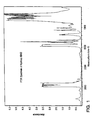
- the IR spectrum showed an absorbance of 0.458 for the 3623 cm -1 OH band, roughly 4.2 OH per 100 Al atoms.
- This polymerization of propylene used an IBAO with roughly 4.0 OH groups per 100 Al atoms.
- the materials and procedure were as in Example 11 except that an Al/Zr ratio of 50, and more toluene (800 mL) were used. Yield: 127 g; M.P.(onset of second melt): 144.9°C; MFI (230/5): 87.97 (g/10 min); mmmm%: 93.1 %; Isotactic Index: 97.4%.
- This IBAO used in this polymerization contained approximately 3.2 OH groups per 100 Al atoms.
- the materials and procedure were as in Example 11 except that an Al/Zr ratio of 30, and more toluene (800 mL) were used. Yield: 88.6 g.; M.P.(onset of second melt): 146.9°C; MFI (230/5): 56.28 (g/10 min); mmmm%: 93.1 %; Isotactic Index: 96.9%.
- MAO methylaluminoxane
- This polymerization was carried out in a 300 mL Parr reactor equipped with an internal cooling coil.
- a catalyst solution of rac -dimethylsilylbis(2-methylindenyl)zirconium dimethyl (0.3 ⁇ mol) and MAO (1.5 mmol, Al/Zr 5000) in about 150 mL of dry toluene.
- the reactor was sealed, transferred, and heated to 68°C. With stirring set at 800 rpm, the polymerization was initiated by pressing in 28 g of liquid propylene. The temperature was maintained at 70°C by applying cooling intermittently. After 10 minutes, the polymerization was quenched by adding MeOH. Yield: 7.2 g. M.P.(onset of second melt): 145.9°C.
- TIBAO tetraisobutylaluminoxane
- the procedure was as in Example 11 except that an Al/Zr ratio of 100 was used. No polymerization activity was observed.
- This polymerization used hydroxyisobutylaluminoxane having approximately 5.3 OH groups per 100 Al atoms.
- the procedure was as in Example 11 except that an Al/Zr ratio of 3000 was used.
- the polymerization was initially as exothermic as that in Example 11. However, when the temperature reached 63°C (from 50°C) after 4 minutes of reaction, the exothermic reaction suddenly ceased and the temperature quickly reversed its rising trend, returning to 52°C in the next 6 minutes. The reaction was allowed to continue for an additional 20 minutes. Yield: 38.6 g. M.P.(onset of second melt): 148.0 °C; MFI (230/5): 16.67 (g/10 min); mmmm%: 92.6%; Isotactic Index: 96.8%.
- This polymerization used hydroxyisobutylaluminoxane having approximately 3.8 OH groups per 100 Al atoms.
- the procedure was as in Example 11 except that the metallocene used was rac -dimethylsilylbis(2-methylindenyl)zirconium dichloride not the dimethyl analog.
- an Al/Zr ratio of 50, and more toluene (800 mL) were used. No reaction was observed.
- This ethylene polymerization used hydroxyisobutylaluminoxane made by hydrolyzing TIBA with 0.9 equivalent of water and with approximately 1.5 OH groups per 100 Al atoms at the time of use.
- the procedure was as in Example 11 with the following modifications:
- the catalyst used was a mixture of bis(1-butyl-3-methylcyclopentadienyl)zirconium dimethyl (2 ⁇ mol) and hydroxyisobutylaluminoxane (200 ⁇ mol), and was allowed to stand at ambient temperature for one hour before being injected.
- the reactor was charged with 900 mL of dry toluene and pressurized with 300 psig of ethylene, which was fed as needed during polymerization to maintain the pressure.
- Polyethylene yield 55.0 g.
- melt flow index (onset of first melt): 131.8°C.
- organometallic complexes described in the following publications will form ionic compounds of this invention, provided that at least one of the halogen atoms bonded to the d-block or f-block metal atom is replaced by a suitable leaving group such as a methyl, benzyl, or trimethylsilylmethyl group:
Landscapes
- Chemical & Material Sciences (AREA)
- Organic Chemistry (AREA)
- Chemical Kinetics & Catalysis (AREA)
- Engineering & Computer Science (AREA)
- Materials Engineering (AREA)
- Inorganic Chemistry (AREA)
- Health & Medical Sciences (AREA)
- Medicinal Chemistry (AREA)
- Polymers & Plastics (AREA)
- Transition And Organic Metals Composition Catalysts For Addition Polymerization (AREA)
- Catalysts (AREA)
Claims (39)
- Verbindung, die umfasst: ein Kation, abgeleitet von einer d-Block- oder f-Block-Metallverbindung durch Verlust einer Fluchtgruppe, und ein Aluminoxatanion, abgeleitet durch die Transfer eines Protons aus einem stabilen oder metastabilen Hydroxyaluminoxan zu dieser Fluchtgruppe.
- Verbindung nach Anspruch 1, bei der die Fluchtgruppe eine Hydrocarbylgruppe ist, die direkt an die d-Block- oder f-Block- Metallverbindung gebunden ist.
- Verbindung nach Anspruch 1, bei der die Fluchtgruppe eine Methylgruppe ist, die direkt an die d-Block- oder f-Block- Metallverbindung gebunden ist.
- Verbindung nach Anspruch 1, bei der das Aluminoxatanion von dem als Brönsted-Säure fungierenden Hydroxyaluminoxan abgeleitet ist.
- Verbindung nach Anspruch 1, bei der das Hydroxyaluminoxan vor dem Protonentransfer ein Verhältnis von weniger als einer Hydroxylgruppe pro Aluminiumatom hat.
- Verbindung nach Anspruch 1, bei der das Hydroxyaluminoxan vor dem Transfer ein Alkylaluminoxan ist, in dem mindestens ein Aluminiumatom eine daran gebundene Hydroxylgruppe aufweist und in dem die Alkylgruppen jeweils mindestens zwei Kohlenstoffatome enthalten.
- Verbindung nach Anspruch 6, bei der die Alkylgruppen Isobutylgruppen sind.
- Verbindung nach Anspruch 1, bei der die Metallverbindung vor dem Transfer ein Metallocen ist.
- Verbindung nach Anspruch 1, bei der in der Verbindung vor dem Transfer mindestens zwei Fluchtgruppen an das d-Block- oder f-Block-Metall gebunden sind.
- Verbindung nach Anspruch 1, bei der die Verbindung vor dem Transfer eine einzelne Fluchtgruppe aufweist, die an zwei verschiedenen Stellen an das d-Block- oder f-Block-Metall gebunden ist.
- Verbindung, die umfasst: (i) ein Kation, abgeleitet von einer d-Block- oder f-Block-Metallverbindung durch Verlust einer Fluchtgruppe und (ii) ein Aluminoxatanion, dem diese Fluchtgruppe fehlt.
- Verbindung, die umfasst: (i) ein Kation, abgeleitet von einer d-Block- oder f-Block-Metallverbindung durch Verlust einer in einen neutralen Kohlenwasserstoff umgewandelten Fluchtgruppe und (ii) ein Aluminoxatanion, abgeleitet durch Verlust eines Protons aus einem Hydroxyaluminoxan, das vor dem Verlust mindestens ein Aluminiumatom aufweist, an das eine Hydroxylgruppe gebunden ist.
- Verbindung nach einem der Ansprüche 1 bis 12, bei der das Metall der Metallverbindung ein Metall der Gruppen 4 bis 6 ist.
- Verbindung nach Anspruch 13, bei der das Metall ein Metall der Gruppe 4 ist.
- Verbindung nach Anspruch 14, bei der das Metall der Gruppe 4 Zirconium oder Hafnium ist.
- Verbindung nach Anspruch 15, bei der das Metall Zirconium ist.
- Verbindung nach Anspruch 1, bei der die Verbindung vor dem Transfer rac-Dimethylsilylbis(2-methylindenyl)zirconiumdimethyl ist.
- Verbindung nach Anspruch 1, bei der die Verbindung vor dem Transfer bis(1-Butyl-3-methylcyclopentadienyl)zirconiumdimethyl ist.
- Verbindung nach Anspruch 17 oder 18, bei der das Hydroxyaluminoxan vor dem Transfer ein Isobutylaluminoxan ist, in dem an mindestens ein Aluminiumatom eine Hydroxylgruppe gebunden ist.
- Verfahren, das das In-Kontakt-Bringen einer d-Block- oder f-Blockmetallverbindung mit mindestens zwei Fluchtgruppen mit einem Hydroxyaluminoxan umfasst, in dem an mindestens ein Aluminiumatom eine Hydroxylgruppe gebunden ist, so dass eine der Fluchtgruppen verloren geht.
- Verfahren nach Anspruch 20, bei dem eine der Fluchtgruppen in Form eines Kohlenwasserstoffs verloren geht.
- Verfahren nach Anspruch 20, bei dem mindestens eine der Fluchtgruppen eine Hydrocarbylgruppe ist, die direkt an die d-Block- oder f-Block-Metallverbindung gebunden ist.
- Verfahren nach Anspruch 20, bei dem die verlorengehende Fluchtgruppe eine Methylgruppe ist, die direkt an die d-Block- oder f-Block-Metallverbindung gebunden ist.
- Verfahren nach Anspruch 20, bei dem das Hydroxyaluminoxan dadurch, dass es als Brönsted-Säure fungiert, in ein Aluminoxatanion umgewandelt wird.
- Verfahren nach Anspruch 24, bei dem das Hydroxyaluminoxan vor der Umwandlung ein Verhältnis von weniger als einer Hydroxylgruppe pro Aluminiumatom aufweist.
- Verfahren nach Anspruch 20, bei dem das Hydroxyaluminoxan ein Alkylaluminoxan ist, in dem an mindestens ein Aluminiumatom eine Hydroxylgruppe gebunden ist und in dem die Alkylgruppen jeweils mindestens zwei Kohlenstoffatome enthalten.
- Verfahren nach Anspruch 28, bei dem die Alkylgruppen Isobutylgruppen sind.
- Verfahren nach Anspruch 20, bei dem die Metallverbindung vor dem Kontakt ein Metallocen ist.
- Verfahren, das die Abgabe eines Protons von einem Hydroxyaluminoxan an eine Fluchtgruppe einer d-Block- oder f-Block-Metallverbindung umfasst, um eine Verbindung zu bilden, die aus einer von der Metallverbindung abgeleiteten Verbindung und einem Aluminoxatanion, dem die Fluchtgruppe fehlt, zusammengesetzt ist.
- Verfahren, das das Interagieren einer d-Block- oder f-Blockmetallverbindung mit zwei Fluchtgruppen und eines Hydroxyaluminoxans mit mindestens einem Aluminiumatom, an das eine Hydroxylgruppe gebunden ist, umfasst, um eine Verbindung zu bilden, die aus einem Kation durch Verlust einer Fluchtgruppe, welche in einen neutralen Kohlenwasserstoff umgewandelt wird, und einem Aluminoxatanion, das durch Verlust eines Protons aus dem Hydroxyaluminoxan abgeleitet ist, zusammengesetzt ist.
- Verfahren nach Anspruch 30, bei dem die d-Block- oder f-Blockmetallverbindung vor der Interaktion mindestens zwei Fluchtgruppen aufweist, die an das d-Block- oder f-Blockmetall gebunden sind.
- Verfahren nach Anspruch 30, bei dem die Verbindung vor der Interaktion eine einzelne Fluchtgruppe aufweist, die an zwei verschiedenen Stellen an das d-Block- oder f-Blockmetall gebunden ist.
- Verfahren nach einem der Ansprüche 20 bis 32, bei dem das Metall der Metallverbindung ein Metall der Gruppen 4 bis 6 ist.
- Verfahren nach Anspruch 33, bei dem das Metall ein Metall der Gruppe 4 ist.
- Verfahren nach Anspruch 34, bei dem das Metall der Gruppe 4 Zirconium oder Hafnium ist.
- Verfahren nach Anspruch 35, bei dem das Metall Zirconium ist.
- Verfahren nach Anspruch 20, bei dem die Verbindung vor dem Kontakt rac-Dimethylsilylbis(2-methylindenyl)zirconiumdimethyl ist.
- Verfahren nach Anspruch 20, bei dem die Verbindung vor dem Kontakt bis(1-Butyl-3-methylcyclopentadienyl)zirconiumdimethyl ist.
- Verfahren nach Anspruch 37 oder 38, bei dem das Hydroxyaluminoxan vor dem Kontakt ein Isobutylaluminoxan ist, in dem an mindestens ein Aluminiumatom eine Hydroxylgruppe gebunden ist.
Applications Claiming Priority (3)
| Application Number | Priority Date | Filing Date | Title |
|---|---|---|---|
| US177736 | 1998-10-23 | ||
| US09/177,736 US6160145A (en) | 1998-10-23 | 1998-10-23 | Transition metal compounds having conjugate aluminoxate anions and their use as catalyst components |
| PCT/US1999/024337 WO2000024787A1 (en) | 1998-10-23 | 1999-10-19 | Compound comprising a transition metal cation linked to an aluminoxate anion and its use as catalyst components |
Publications (2)
| Publication Number | Publication Date |
|---|---|
| EP1124859A1 EP1124859A1 (de) | 2001-08-22 |
| EP1124859B1 true EP1124859B1 (de) | 2005-01-12 |
Family
ID=22649789
Family Applications (1)
| Application Number | Title | Priority Date | Filing Date |
|---|---|---|---|
| EP99955006A Expired - Lifetime EP1124859B1 (de) | 1998-10-23 | 1999-10-19 | Verbindung enthaltend ein übergangsmetall-kation und ein aluminoxat-anion und deren verwendung als katalysatorkomponente |
Country Status (8)
| Country | Link |
|---|---|
| US (1) | US6160145A (de) |
| EP (1) | EP1124859B1 (de) |
| JP (1) | JP2002528572A (de) |
| AT (1) | ATE286916T1 (de) |
| CA (1) | CA2347732A1 (de) |
| DE (1) | DE69923207T2 (de) |
| ES (1) | ES2237175T3 (de) |
| WO (1) | WO2000024787A1 (de) |
Families Citing this family (33)
| Publication number | Priority date | Publication date | Assignee | Title |
|---|---|---|---|---|
| US6555494B2 (en) * | 1998-10-23 | 2003-04-29 | Albemarle Corporation | Transition metal compounds having conjugate aluminoxate anions, their preparation and their use as catalyst components |
| US6812182B2 (en) * | 1998-10-23 | 2004-11-02 | Albemarle Corporation | Compositions formed from hydroxyaluminoxane and their use as catalyst components |
| US6462212B1 (en) * | 1998-10-23 | 2002-10-08 | Albemarle Corporation | Transition metal compounds having conjugate aluminoxate anions and their use as catalyst components |
| US20040002420A1 (en) * | 1998-10-23 | 2004-01-01 | Feng-Jung Wu | Stable catalysts and co-catalyst compositions formed from hydroxyaluminoxane and their use |
| US6492292B2 (en) | 1998-10-23 | 2002-12-10 | Albemarle Corporation | Gelatinous compositions formed from hydroxyaluminoxane, solid compositions formed therefrom, and the use of such compositions as catalyst components |
| US6291382B1 (en) * | 1999-05-24 | 2001-09-18 | Phillips Petroleum Company | Metallocenes, polymerization catalyst systems, their preparation, and use |
| DE10132519A1 (de) * | 2001-07-09 | 2003-02-06 | Basf Ag | Verfahren zur Bestimmung der Polymerisationsaktivität von Metallocenkatalysatoren mit der UV/VS-Spektroskopie |
| ATE364047T1 (de) | 2002-08-22 | 2007-06-15 | Basell Polyolefine Gmbh | Monocyclopentadienylkomplexe |
| RU2349606C2 (ru) | 2002-12-20 | 2009-03-20 | Базелль Полиолефине Гмбх | СОПОЛИМЕРЫ ЭТИЛЕНА С α-ОЛЕФИНАМИ |
| EP1572360B1 (de) | 2002-12-20 | 2008-06-25 | Basell Polyolefine GmbH | Monocyclopentadienylkomplexe |
| EP1608690B1 (de) | 2003-04-03 | 2007-06-13 | Basell Polyolefine GmbH | Herstellung von hochmolekularen polyolefinen in gegenwart einer organischen übergangsmetallverbindung in einem gasphasen-wirbelschichtreaktor |
| JP2006528951A (ja) | 2003-05-21 | 2006-12-28 | バーゼル、ポリオレフィン、ゲゼルシャフト、ミット、ベシュレンクテル、ハフツング | 三座の窒素含有リガンドを有する遷移金属錯体 |
| US7122606B2 (en) | 2003-07-04 | 2006-10-17 | Basell Polyolefine Gmbh | Olefin polymerization process |
| ES2321947T3 (es) | 2003-12-16 | 2009-06-15 | Basell Polyolefine Gmbh | Complejos de monociclopentadienilo. |
| WO2005058983A2 (en) | 2003-12-19 | 2005-06-30 | Basell Polyolefine Gmbh | Monocyclopentadienyl complexes |
| DE102004020524A1 (de) | 2004-04-26 | 2005-11-10 | Basell Polyolefine Gmbh | Polyethylen und Katalysatorzusammensetzung zu dessen Herstellung |
| DE102004020525A1 (de) | 2004-04-26 | 2005-11-10 | Basell Polyolefine Gmbh | Katalysatorsystem zur Olefinpolymerisation, dessen Herstellung und Verwendung |
| DE102004039877A1 (de) | 2004-08-17 | 2006-02-23 | Basell Polyolefine Gmbh | Silylhalogenidsubstituierte Cyclopentadienylkomplexe der Gruppe 6 |
| KR20070110050A (ko) * | 2005-02-10 | 2007-11-15 | 미쓰이 가가쿠 가부시키가이샤 | 프로필렌 이량화용 촉매 및 이량화 방법 |
| DE102005014395A1 (de) | 2005-03-24 | 2006-09-28 | Basell Polyolefine Gmbh | Monocyclopentadienylkomplexe |
| DE102005019393A1 (de) | 2005-04-25 | 2006-10-26 | Basell Polyolefine Gmbh | Polyethylenformmassen für Spritzgussanwendungen |
| WO2007005921A2 (en) * | 2005-07-01 | 2007-01-11 | Albemarle Corporation | Bronsted acidic aluminoxane compositions and their use in olefin polymerization catalyst compositions |
| DE102006001959A1 (de) | 2006-01-13 | 2007-07-19 | Basell Polyolefine Gmbh | Verfahren zur Herstellung von unsymmetrischen Bis(imino)verbindungen |
| JP5462634B2 (ja) | 2007-03-06 | 2014-04-02 | バーゼル・ポリオレフィン・ゲーエムベーハー | 鉄コンプレックス及び重合プロセスにおけるそれらの使用 |
| DE102007017903A1 (de) | 2007-04-13 | 2008-10-16 | Basell Polyolefine Gmbh | Polyethylen und Katalysatorzusammensetzung und Verfahren zu dessen Herstellung |
| WO2009080216A1 (en) | 2007-12-19 | 2009-07-02 | Basell Polyolefine Gmbh | Mono-hydroindacenyl complexes |
| BRPI0821085A2 (pt) | 2007-12-19 | 2015-06-16 | Basell Polyolefine Gmbh | Terpolímeros de etileno |
| JP2011511760A (ja) * | 2007-12-21 | 2011-04-14 | バーゼル・ポリオレフィン・ゲーエムベーハー | フェナントロリン含有コンプレックス |
| US7999043B2 (en) | 2007-12-24 | 2011-08-16 | Basell Polyolefine Gmbh | Multistage process for the polymerization of olefins |
| MX2010009009A (es) | 2008-02-18 | 2010-12-15 | Basell Polyolefine Gmbh | Composicion polimerica adhesiva. |
| EP2356155B1 (de) | 2008-12-01 | 2013-01-23 | Basell Polyolefine GmbH | Verfahren zur polymerisation von ethylen und ethylenpolymere mit breiter molekulargewichtsverteilung und langkettenverzweigung |
| US9029478B2 (en) | 2011-02-07 | 2015-05-12 | Equistar Chemicals, Lp | High clarity polyethylene films |
| JP6326202B2 (ja) * | 2013-05-16 | 2018-05-16 | 三井化学株式会社 | オレフィン重合用固体触媒成分およびそれを用いたオレフィン系重合体の製造方法 |
Family Cites Families (37)
| Publication number | Priority date | Publication date | Assignee | Title |
|---|---|---|---|---|
| GB1235063A (en) * | 1968-05-15 | 1971-06-09 | Stamicarbon | Process for the preparation of alkene polymers and activated catalysts therefor |
| DE2608863A1 (de) * | 1976-03-04 | 1977-09-08 | Basf Ag | Verfahren zum herstellen von polyaethylen |
| DE2608933A1 (de) * | 1976-03-04 | 1977-09-08 | Basf Ag | Verfahren zum herstellen von polyaethylen |
| DE3240382A1 (de) * | 1982-11-02 | 1984-05-03 | Hoechst Ag, 6230 Frankfurt | Verfahren zur herstellung von gefuellten polyolefinen |
| US5324800A (en) * | 1983-06-06 | 1994-06-28 | Exxon Chemical Patents Inc. | Process and catalyst for polyolefin density and molecular weight control |
| US4752597A (en) * | 1985-12-12 | 1988-06-21 | Exxon Chemical Patents Inc. | New polymerization catalyst |
| US4658078A (en) * | 1986-08-15 | 1987-04-14 | Shell Oil Company | Vinylidene olefin process |
| DE3772331D1 (de) * | 1986-11-13 | 1991-09-26 | Idemitsu Kosan Co | Verfahren zur oligomerisierung von propen. |
| US5621126A (en) * | 1987-01-30 | 1997-04-15 | Exxon Chemical Patents Inc. | Monocyclopentadienyl metal compounds for ethylene-α-olefin-copolymer production catalysts |
| US5384299A (en) * | 1987-01-30 | 1995-01-24 | Exxon Chemical Patents Inc. | Ionic metallocene catalyst compositions |
| US5153157A (en) * | 1987-01-30 | 1992-10-06 | Exxon Chemical Patents Inc. | Catalyst system of enhanced productivity |
| PL276385A1 (en) * | 1987-01-30 | 1989-07-24 | Exxon Chemical Patents Inc | Method for polymerization of olefines,diolefins and acetylene unsaturated compounds |
| IL85097A (en) * | 1987-01-30 | 1992-02-16 | Exxon Chemical Patents Inc | Catalysts based on derivatives of a bis(cyclopentadienyl)group ivb metal compound,their preparation and their use in polymerization processes |
| US5241025A (en) * | 1987-01-30 | 1993-08-31 | Exxon Chemical Patents Inc. | Catalyst system of enhanced productivity |
| US5408017A (en) * | 1987-01-30 | 1995-04-18 | Exxon Chemical Patents Inc. | High temperature polymerization process using ionic catalysts to produce polyolefins |
| US5391629A (en) * | 1987-01-30 | 1995-02-21 | Exxon Chemical Patents Inc. | Block copolymers from ionic catalysts |
| US5198401A (en) * | 1987-01-30 | 1993-03-30 | Exxon Chemical Patents Inc. | Ionic metallocene catalyst compositions |
| US5340786A (en) * | 1988-02-12 | 1994-08-23 | Mitsui Petrochemical Industries, Ltd. | Olefin polymerization catalyst and process for the polymerization of olefins |
| US5008228A (en) * | 1988-03-29 | 1991-04-16 | Exxon Chemical Patents Inc. | Method for preparing a silica gel supported metallocene-alumoxane catalyst |
| US5147949A (en) * | 1988-03-29 | 1992-09-15 | Exxon Chemical Patents Inc. | Polymerization process using a silica gel supported metallocene-alumoxane catalyst |
| US4960878A (en) * | 1988-12-02 | 1990-10-02 | Texas Alkyls, Inc. | Synthesis of methylaluminoxanes |
| US5041584A (en) * | 1988-12-02 | 1991-08-20 | Texas Alkyls, Inc. | Modified methylaluminoxane |
| IT1237398B (it) * | 1989-01-31 | 1993-06-01 | Ausimont Srl | Catalizzatori per la polimerizzazione di olefine. |
| US5321107A (en) * | 1989-01-31 | 1994-06-14 | Mitsui Petrochemical Industries, Ltd. | Olefin polymerization catalyst and process for the polymerization of olefins |
| ES2071888T3 (es) * | 1990-11-12 | 1995-07-01 | Hoechst Ag | Bisindenilmetalocenos sustituidos en posicion 2, procedimiento para su preparacion y su utilizacion como catalizadores en la polimerizacion de olefinas. |
| US5087788A (en) * | 1991-03-04 | 1992-02-11 | Ethyl Corporation | Preparation of high purity vinylindene olefin |
| US5296433A (en) * | 1992-04-14 | 1994-03-22 | Minnesota Mining And Manufacturing Company | Tris(pentafluorophenyl)borane complexes and catalysts derived therefrom |
| WO1993025591A1 (en) * | 1992-06-18 | 1993-12-23 | Spherilene S.R.L. | Process for preparing an ethylenic polymer |
| JP2936189B2 (ja) * | 1992-09-09 | 1999-08-23 | 東ソー株式会社 | 有機遷移金属錯体 |
| US5502017A (en) * | 1994-03-10 | 1996-03-26 | Northwestern University | Metallocene catalyst containing bulky organic group |
| US5486632A (en) * | 1994-06-28 | 1996-01-23 | The Dow Chemical Company | Group 4 metal diene complexes and addition polymerization catalysts therefrom |
| IT1273661B (it) * | 1994-07-20 | 1997-07-09 | Spherilene Srl | Catalizzatori per la polimerizzazione delle olefine |
| US5763543A (en) * | 1994-09-14 | 1998-06-09 | Exxon Chemical Patents Inc. | Olefin polymerization process with little or no scavenger present |
| US5693727A (en) * | 1996-06-06 | 1997-12-02 | Union Carbide Chemicals & Plastics Technology Corporation | Method for feeding a liquid catalyst to a fluidized bed polymerization reactor |
| IT1284097B1 (it) * | 1996-07-02 | 1998-05-08 | Montell Tecnology Company Bv | Processo in sospensione per la preparazione di copolimeri elastomerici dell'etilene |
| US5854166A (en) * | 1996-08-19 | 1998-12-29 | Northwestern University | Synthesis and use of (perfluoroaryl) fluoro-aluminate anion |
| FI972230A7 (fi) * | 1997-01-28 | 1998-07-29 | Borealis As | Uusi homogeeninen olefiinien polymerointikatalysaattorikoostumus |
-
1998
- 1998-10-23 US US09/177,736 patent/US6160145A/en not_active Expired - Fee Related
-
1999
- 1999-10-19 AT AT99955006T patent/ATE286916T1/de not_active IP Right Cessation
- 1999-10-19 ES ES99955006T patent/ES2237175T3/es not_active Expired - Lifetime
- 1999-10-19 CA CA002347732A patent/CA2347732A1/en not_active Abandoned
- 1999-10-19 DE DE69923207T patent/DE69923207T2/de not_active Expired - Fee Related
- 1999-10-19 JP JP2000578356A patent/JP2002528572A/ja not_active Withdrawn
- 1999-10-19 WO PCT/US1999/024337 patent/WO2000024787A1/en not_active Ceased
- 1999-10-19 EP EP99955006A patent/EP1124859B1/de not_active Expired - Lifetime
Also Published As
| Publication number | Publication date |
|---|---|
| CA2347732A1 (en) | 2000-05-04 |
| DE69923207T2 (de) | 2005-06-23 |
| ES2237175T3 (es) | 2005-07-16 |
| ATE286916T1 (de) | 2005-01-15 |
| WO2000024787A1 (en) | 2000-05-04 |
| US6160145A (en) | 2000-12-12 |
| EP1124859A1 (de) | 2001-08-22 |
| DE69923207D1 (de) | 2005-02-17 |
| JP2002528572A (ja) | 2002-09-03 |
Similar Documents
| Publication | Publication Date | Title |
|---|---|---|
| US6160145A (en) | Transition metal compounds having conjugate aluminoxate anions and their use as catalyst components | |
| US6346586B1 (en) | Method for preparing a supported catalyst system and its use in a polymerization process | |
| EP0601830A2 (de) | Katalysator Komponente für die Polymerisation von Olefinen und deren Verwendung | |
| MXPA05004868A (es) | Sintesis de componentes de catalizador de polimerizacion. | |
| CA2420631A1 (en) | A catalyst system and its use in a polymerization process | |
| HK1049294B (en) | Organometal compound catalyst | |
| EP1114069B1 (de) | Ein verfahren zur herstellung eines geträgerten katalysators und dessen verwendung in einem polymerisationsverfahren | |
| US6555494B2 (en) | Transition metal compounds having conjugate aluminoxate anions, their preparation and their use as catalyst components | |
| CA2313244A1 (en) | Catalyst compositions of enhanced productivity | |
| US6492292B2 (en) | Gelatinous compositions formed from hydroxyaluminoxane, solid compositions formed therefrom, and the use of such compositions as catalyst components | |
| US6812182B2 (en) | Compositions formed from hydroxyaluminoxane and their use as catalyst components | |
| US6462212B1 (en) | Transition metal compounds having conjugate aluminoxate anions and their use as catalyst components | |
| US7776977B2 (en) | Method for preparing a catalyst system and its use in a polymerization process | |
| US20040002420A1 (en) | Stable catalysts and co-catalyst compositions formed from hydroxyaluminoxane and their use | |
| US6797791B2 (en) | Catalyst systems, method for preparing and using same in a polymerization process | |
| US6538081B2 (en) | Polymerization process | |
| CA2337332A1 (en) | Ansa group-4- metal bis (.mu.-substituted) aluminum metallocenes | |
| JPH05239140A (ja) | オレフィン重合用触媒及びこれを用いたポリオレフィンの製造方法 | |
| WO2003054037A1 (en) | Complexes based on hetero-cyclobutenyl ligands |
Legal Events
| Date | Code | Title | Description |
|---|---|---|---|
| PUAI | Public reference made under article 153(3) epc to a published international application that has entered the european phase |
Free format text: ORIGINAL CODE: 0009012 |
|
| 17P | Request for examination filed |
Effective date: 20010508 |
|
| AK | Designated contracting states |
Kind code of ref document: A1 Designated state(s): AT BE CH CY DE DK ES FI FR GB GR IE IT LI LU MC NL PT SE |
|
| GRAP | Despatch of communication of intention to grant a patent |
Free format text: ORIGINAL CODE: EPIDOSNIGR1 |
|
| GRAP | Despatch of communication of intention to grant a patent |
Free format text: ORIGINAL CODE: EPIDOSNIGR1 |
|
| GRAS | Grant fee paid |
Free format text: ORIGINAL CODE: EPIDOSNIGR3 |
|
| GRAA | (expected) grant |
Free format text: ORIGINAL CODE: 0009210 |
|
| AK | Designated contracting states |
Kind code of ref document: B1 Designated state(s): AT BE CH CY DE DK ES FI FR GB GR IE IT LI LU MC NL PT SE |
|
| PG25 | Lapsed in a contracting state [announced via postgrant information from national office to epo] |
Ref country code: LI Free format text: LAPSE BECAUSE OF FAILURE TO SUBMIT A TRANSLATION OF THE DESCRIPTION OR TO PAY THE FEE WITHIN THE PRESCRIBED TIME-LIMIT Effective date: 20050112 Ref country code: FI Free format text: LAPSE BECAUSE OF FAILURE TO SUBMIT A TRANSLATION OF THE DESCRIPTION OR TO PAY THE FEE WITHIN THE PRESCRIBED TIME-LIMIT Effective date: 20050112 Ref country code: CH Free format text: LAPSE BECAUSE OF FAILURE TO SUBMIT A TRANSLATION OF THE DESCRIPTION OR TO PAY THE FEE WITHIN THE PRESCRIBED TIME-LIMIT Effective date: 20050112 Ref country code: AT Free format text: LAPSE BECAUSE OF FAILURE TO SUBMIT A TRANSLATION OF THE DESCRIPTION OR TO PAY THE FEE WITHIN THE PRESCRIBED TIME-LIMIT Effective date: 20050112 |
|
| REG | Reference to a national code |
Ref country code: GB Ref legal event code: FG4D |
|
| REG | Reference to a national code |
Ref country code: CH Ref legal event code: EP |
|
| REF | Corresponds to: |
Ref document number: 69923207 Country of ref document: DE Date of ref document: 20050217 Kind code of ref document: P |
|
| REG | Reference to a national code |
Ref country code: IE Ref legal event code: FG4D |
|
| PG25 | Lapsed in a contracting state [announced via postgrant information from national office to epo] |
Ref country code: SE Free format text: LAPSE BECAUSE OF FAILURE TO SUBMIT A TRANSLATION OF THE DESCRIPTION OR TO PAY THE FEE WITHIN THE PRESCRIBED TIME-LIMIT Effective date: 20050412 Ref country code: DK Free format text: LAPSE BECAUSE OF FAILURE TO SUBMIT A TRANSLATION OF THE DESCRIPTION OR TO PAY THE FEE WITHIN THE PRESCRIBED TIME-LIMIT Effective date: 20050412 |
|
| REG | Reference to a national code |
Ref country code: ES Ref legal event code: FG2A Ref document number: 2237175 Country of ref document: ES Kind code of ref document: T3 |
|
| REG | Reference to a national code |
Ref country code: CH Ref legal event code: PL |
|
| PGFP | Annual fee paid to national office [announced via postgrant information from national office to epo] |
Ref country code: NL Payment date: 20050929 Year of fee payment: 7 |
|
| PGFP | Annual fee paid to national office [announced via postgrant information from national office to epo] |
Ref country code: GB Payment date: 20051013 Year of fee payment: 7 |
|
| PGFP | Annual fee paid to national office [announced via postgrant information from national office to epo] |
Ref country code: FR Payment date: 20051017 Year of fee payment: 7 |
|
| PG25 | Lapsed in a contracting state [announced via postgrant information from national office to epo] |
Ref country code: IE Free format text: LAPSE BECAUSE OF NON-PAYMENT OF DUE FEES Effective date: 20051019 Ref country code: CY Free format text: LAPSE BECAUSE OF FAILURE TO SUBMIT A TRANSLATION OF THE DESCRIPTION OR TO PAY THE FEE WITHIN THE PRESCRIBED TIME-LIMIT Effective date: 20051019 |
|
| PGFP | Annual fee paid to national office [announced via postgrant information from national office to epo] |
Ref country code: ES Payment date: 20051026 Year of fee payment: 7 |
|
| PG25 | Lapsed in a contracting state [announced via postgrant information from national office to epo] |
Ref country code: MC Free format text: LAPSE BECAUSE OF NON-PAYMENT OF DUE FEES Effective date: 20051031 Ref country code: LU Free format text: LAPSE BECAUSE OF NON-PAYMENT OF DUE FEES Effective date: 20051031 |
|
| PLBE | No opposition filed within time limit |
Free format text: ORIGINAL CODE: 0009261 |
|
| STAA | Information on the status of an ep patent application or granted ep patent |
Free format text: STATUS: NO OPPOSITION FILED WITHIN TIME LIMIT |
|
| PGFP | Annual fee paid to national office [announced via postgrant information from national office to epo] |
Ref country code: BE Payment date: 20051122 Year of fee payment: 7 |
|
| PGFP | Annual fee paid to national office [announced via postgrant information from national office to epo] |
Ref country code: DE Payment date: 20051130 Year of fee payment: 7 |
|
| ET | Fr: translation filed | ||
| 26N | No opposition filed |
Effective date: 20051013 |
|
| REG | Reference to a national code |
Ref country code: IE Ref legal event code: MM4A |
|
| PGFP | Annual fee paid to national office [announced via postgrant information from national office to epo] |
Ref country code: IT Payment date: 20061031 Year of fee payment: 8 |
|
| PG25 | Lapsed in a contracting state [announced via postgrant information from national office to epo] |
Ref country code: NL Free format text: LAPSE BECAUSE OF NON-PAYMENT OF DUE FEES Effective date: 20070501 Ref country code: DE Free format text: LAPSE BECAUSE OF NON-PAYMENT OF DUE FEES Effective date: 20070501 |
|
| GBPC | Gb: european patent ceased through non-payment of renewal fee |
Effective date: 20061019 |
|
| NLV4 | Nl: lapsed or anulled due to non-payment of the annual fee |
Effective date: 20070501 |
|
| REG | Reference to a national code |
Ref country code: FR Ref legal event code: ST Effective date: 20070629 |
|
| PG25 | Lapsed in a contracting state [announced via postgrant information from national office to epo] |
Ref country code: GB Free format text: LAPSE BECAUSE OF NON-PAYMENT OF DUE FEES Effective date: 20061019 |
|
| BERE | Be: lapsed |
Owner name: *ALBEMARLE CORP. Effective date: 20061031 |
|
| PG25 | Lapsed in a contracting state [announced via postgrant information from national office to epo] |
Ref country code: PT Free format text: LAPSE BECAUSE OF NON-PAYMENT OF DUE FEES Effective date: 20050612 |
|
| REG | Reference to a national code |
Ref country code: ES Ref legal event code: FD2A Effective date: 20061020 |
|
| PG25 | Lapsed in a contracting state [announced via postgrant information from national office to epo] |
Ref country code: GR Free format text: LAPSE BECAUSE OF NON-PAYMENT OF DUE FEES Effective date: 20050112 Ref country code: FR Free format text: LAPSE BECAUSE OF NON-PAYMENT OF DUE FEES Effective date: 20061031 Ref country code: ES Free format text: LAPSE BECAUSE OF NON-PAYMENT OF DUE FEES Effective date: 20061020 |
|
| PG25 | Lapsed in a contracting state [announced via postgrant information from national office to epo] |
Ref country code: IT Free format text: LAPSE BECAUSE OF NON-PAYMENT OF DUE FEES Effective date: 20071019 Ref country code: BE Free format text: LAPSE BECAUSE OF FAILURE TO SUBMIT A TRANSLATION OF THE DESCRIPTION OR TO PAY THE FEE WITHIN THE PRESCRIBED TIME-LIMIT Effective date: 20061031 |