EP1125944A1 - Pluraflavine und Derivate davon, Verfahren zu ihrer Herstellung und Verwendung derselben - Google Patents
Pluraflavine und Derivate davon, Verfahren zu ihrer Herstellung und Verwendung derselben Download PDFInfo
- Publication number
- EP1125944A1 EP1125944A1 EP00103540A EP00103540A EP1125944A1 EP 1125944 A1 EP1125944 A1 EP 1125944A1 EP 00103540 A EP00103540 A EP 00103540A EP 00103540 A EP00103540 A EP 00103540A EP 1125944 A1 EP1125944 A1 EP 1125944A1
- Authority
- EP
- European Patent Office
- Prior art keywords
- formula
- compound
- alkyl
- alkenyl
- physiologically acceptable
- Prior art date
- Legal status (The legal status is an assumption and is not a legal conclusion. Google has not performed a legal analysis and makes no representation as to the accuracy of the status listed.)
- Withdrawn
Links
- NXVFOCZKPDWDTH-UHFFFAOYSA-N CC(C(C)(C(Oc(c1c(COC(CC2(C)N)OC(C)C2O)cc2C(c3c4c(O)c(C(CC5N(C)C)OC(C)C5OC(CC5O)OC(C)C5O)cc3)=O)c2C4=O)=CC1=O)O)O Chemical compound CC(C(C)(C(Oc(c1c(COC(CC2(C)N)OC(C)C2O)cc2C(c3c4c(O)c(C(CC5N(C)C)OC(C)C5OC(CC5O)OC(C)C5O)cc3)=O)c2C4=O)=CC1=O)O)O NXVFOCZKPDWDTH-UHFFFAOYSA-N 0.000 description 1
- NELZONQMFBOUNL-UHFFFAOYSA-N CC1OC1(C)C(Oc(c1c(c2c3ccc(C(CC4N(C)C)OC(C)C4OC(CC4O)OC(C)C4O)c2O)O)c2c(COC(CC4(C)N)OC(C)C4O)cc1c3O)=CC2=O Chemical compound CC1OC1(C)C(Oc(c1c(c2c3ccc(C(CC4N(C)C)OC(C)C4OC(CC4O)OC(C)C4O)c2O)O)c2c(COC(CC4(C)N)OC(C)C4O)cc1c3O)=CC2=O NELZONQMFBOUNL-UHFFFAOYSA-N 0.000 description 1
Classifications
-
- C—CHEMISTRY; METALLURGY
- C07—ORGANIC CHEMISTRY
- C07H—SUGARS; DERIVATIVES THEREOF; NUCLEOSIDES; NUCLEOTIDES; NUCLEIC ACIDS
- C07H17/00—Compounds containing heterocyclic radicals directly attached to hetero atoms of saccharide radicals
- C07H17/04—Heterocyclic radicals containing only oxygen as ring hetero atoms
-
- C—CHEMISTRY; METALLURGY
- C12—BIOCHEMISTRY; BEER; SPIRITS; WINE; VINEGAR; MICROBIOLOGY; ENZYMOLOGY; MUTATION OR GENETIC ENGINEERING
- C12N—MICROORGANISMS OR ENZYMES; COMPOSITIONS THEREOF; PROPAGATING, PRESERVING, OR MAINTAINING MICROORGANISMS; MUTATION OR GENETIC ENGINEERING; CULTURE MEDIA
- C12N1/00—Microorganisms; Compositions thereof; Processes of propagating, maintaining or preserving microorganisms or compositions thereof; Processes of preparing or isolating a composition containing a microorganism; Culture media therefor
- C12N1/20—Bacteria; Culture media therefor
- C12N1/205—Bacterial isolates
-
- A—HUMAN NECESSITIES
- A61—MEDICAL OR VETERINARY SCIENCE; HYGIENE
- A61K—PREPARATIONS FOR MEDICAL, DENTAL OR TOILETRY PURPOSES
- A61K31/00—Medicinal preparations containing organic active ingredients
- A61K31/70—Carbohydrates; Sugars; Derivatives thereof
- A61K31/7042—Compounds having saccharide radicals and heterocyclic rings
- A61K31/7048—Compounds having saccharide radicals and heterocyclic rings having oxygen as a ring hetero atom, e.g. leucoglucosan, hesperidin, erythromycin, nystatin, digitoxin or digoxin
-
- A—HUMAN NECESSITIES
- A61—MEDICAL OR VETERINARY SCIENCE; HYGIENE
- A61P—SPECIFIC THERAPEUTIC ACTIVITY OF CHEMICAL COMPOUNDS OR MEDICINAL PREPARATIONS
- A61P1/00—Drugs for disorders of the alimentary tract or the digestive system
-
- A—HUMAN NECESSITIES
- A61—MEDICAL OR VETERINARY SCIENCE; HYGIENE
- A61P—SPECIFIC THERAPEUTIC ACTIVITY OF CHEMICAL COMPOUNDS OR MEDICINAL PREPARATIONS
- A61P11/00—Drugs for disorders of the respiratory system
-
- A—HUMAN NECESSITIES
- A61—MEDICAL OR VETERINARY SCIENCE; HYGIENE
- A61P—SPECIFIC THERAPEUTIC ACTIVITY OF CHEMICAL COMPOUNDS OR MEDICINAL PREPARATIONS
- A61P15/00—Drugs for genital or sexual disorders; Contraceptives
-
- A—HUMAN NECESSITIES
- A61—MEDICAL OR VETERINARY SCIENCE; HYGIENE
- A61P—SPECIFIC THERAPEUTIC ACTIVITY OF CHEMICAL COMPOUNDS OR MEDICINAL PREPARATIONS
- A61P3/00—Drugs for disorders of the metabolism
-
- A—HUMAN NECESSITIES
- A61—MEDICAL OR VETERINARY SCIENCE; HYGIENE
- A61P—SPECIFIC THERAPEUTIC ACTIVITY OF CHEMICAL COMPOUNDS OR MEDICINAL PREPARATIONS
- A61P31/00—Antiinfectives, i.e. antibiotics, antiseptics, chemotherapeutics
-
- A—HUMAN NECESSITIES
- A61—MEDICAL OR VETERINARY SCIENCE; HYGIENE
- A61P—SPECIFIC THERAPEUTIC ACTIVITY OF CHEMICAL COMPOUNDS OR MEDICINAL PREPARATIONS
- A61P31/00—Antiinfectives, i.e. antibiotics, antiseptics, chemotherapeutics
- A61P31/04—Antibacterial agents
-
- A—HUMAN NECESSITIES
- A61—MEDICAL OR VETERINARY SCIENCE; HYGIENE
- A61P—SPECIFIC THERAPEUTIC ACTIVITY OF CHEMICAL COMPOUNDS OR MEDICINAL PREPARATIONS
- A61P31/00—Antiinfectives, i.e. antibiotics, antiseptics, chemotherapeutics
- A61P31/10—Antimycotics
-
- A—HUMAN NECESSITIES
- A61—MEDICAL OR VETERINARY SCIENCE; HYGIENE
- A61P—SPECIFIC THERAPEUTIC ACTIVITY OF CHEMICAL COMPOUNDS OR MEDICINAL PREPARATIONS
- A61P35/00—Antineoplastic agents
-
- A—HUMAN NECESSITIES
- A61—MEDICAL OR VETERINARY SCIENCE; HYGIENE
- A61P—SPECIFIC THERAPEUTIC ACTIVITY OF CHEMICAL COMPOUNDS OR MEDICINAL PREPARATIONS
- A61P35/00—Antineoplastic agents
- A61P35/02—Antineoplastic agents specific for leukemia
-
- C—CHEMISTRY; METALLURGY
- C12—BIOCHEMISTRY; BEER; SPIRITS; WINE; VINEGAR; MICROBIOLOGY; ENZYMOLOGY; MUTATION OR GENETIC ENGINEERING
- C12P—FERMENTATION OR ENZYME-USING PROCESSES TO SYNTHESISE A DESIRED CHEMICAL COMPOUND OR COMPOSITION OR TO SEPARATE OPTICAL ISOMERS FROM A RACEMIC MIXTURE
- C12P19/00—Preparation of compounds containing saccharide radicals
- C12P19/26—Preparation of nitrogen-containing carbohydrates
-
- C—CHEMISTRY; METALLURGY
- C12—BIOCHEMISTRY; BEER; SPIRITS; WINE; VINEGAR; MICROBIOLOGY; ENZYMOLOGY; MUTATION OR GENETIC ENGINEERING
- C12P—FERMENTATION OR ENZYME-USING PROCESSES TO SYNTHESISE A DESIRED CHEMICAL COMPOUND OR COMPOSITION OR TO SEPARATE OPTICAL ISOMERS FROM A RACEMIC MIXTURE
- C12P19/00—Preparation of compounds containing saccharide radicals
- C12P19/44—Preparation of O-glycosides, e.g. glucosides
- C12P19/58—Preparation of O-glycosides, e.g. glucosides having an oxygen atom of the saccharide radical directly bound through only acyclic carbon atoms to a non-saccharide heterocyclic ring, e.g. bleomycin, phleomycin
-
- C—CHEMISTRY; METALLURGY
- C12—BIOCHEMISTRY; BEER; SPIRITS; WINE; VINEGAR; MICROBIOLOGY; ENZYMOLOGY; MUTATION OR GENETIC ENGINEERING
- C12P—FERMENTATION OR ENZYME-USING PROCESSES TO SYNTHESISE A DESIRED CHEMICAL COMPOUND OR COMPOSITION OR TO SEPARATE OPTICAL ISOMERS FROM A RACEMIC MIXTURE
- C12P19/00—Preparation of compounds containing saccharide radicals
- C12P19/44—Preparation of O-glycosides, e.g. glucosides
- C12P19/60—Preparation of O-glycosides, e.g. glucosides having an oxygen of the saccharide radical directly bound to a non-saccharide heterocyclic ring or a condensed ring system containing a non-saccharide heterocyclic ring, e.g. coumermycin, novobiocin
-
- C—CHEMISTRY; METALLURGY
- C12—BIOCHEMISTRY; BEER; SPIRITS; WINE; VINEGAR; MICROBIOLOGY; ENZYMOLOGY; MUTATION OR GENETIC ENGINEERING
- C12R—INDEXING SCHEME ASSOCIATED WITH SUBCLASSES C12C - C12Q, RELATING TO MICROORGANISMS
- C12R2001/00—Microorganisms ; Processes using microorganisms
- C12R2001/01—Bacteria or Actinomycetales ; using bacteria or Actinomycetales
Definitions
- the present invention relates to new compounds of general formula I. wherein R 1 , R 2 , R 3 , R 4 , R 5 , R 6 , R 8 , R 10 , m and n have the meaning as described below.
- the compounds of the formula I inhibit transcriptase, have cytostatic effects and are particularly suitable for the treatment of tumors.
- the compounds of the formula I can be obtained by fermentation of Actinomycetales species HAG 003959, DSM 12931 in a culture medium.
- the invention thus relates to a process for the preparation of the compounds of the formula I, the use of the compounds for the production of a medicament for the treatment of malignant diseases and diseases which can be treated by inhibiting transcriptase, and to pharmaceutical preparations containing at least one compound of the Formula I.
- Cancer is a mostly fatal human and animal disease that caused by the uncontrolled growth of the body's own cells.
- cancer is the name for the formation of malignant tumors (malignancies) of Neoplasms (tumors or carcinoma) or for malignant degeneration as well White blood cell maturation disorder (leukemia, blood cancer).
- malignancies malignant tumors
- Neoplasms tumors or carcinoma
- leukemia blood cancer
- Cancer or tumor cells arise through the conversion of the body's own cells.
- the malignancy of the cancer cell is expressed in the autonomy of growth, that is in their ability to uninhibited and without classification in the blueprint of the organs and under Tissue destruction to grow infiltrating.
- a sure sign of malignancy is the formation of tumor-free settlements (metastases) after hematogenous or lymphogenic spread of tumor cells.
- Cancer is one of the most common causes of death of humans and therefore there is a great need for methods and Agents for the healing or treatment of malignancies.
- the possibility of treating malignant tumors includes - if possible radical - surgical removal of the tumor using radiological therapy X-rays, ⁇ , ⁇ , ⁇ rays, immunotherapy and chemotherapy.
- the Immunotherapy can currently only be used to a limited extent.
- Under the Chemotherapy of tumors means the administration of cell toxins (cytostatics) Treatment of tumors and remaining tumor cells after local surgical treatment or radiation. These substances specifically intervene certain processes of cell division, so that tissue with a high proportion in itself dividing cells, such as the rapidly growing tumor tissue, are more sensitive.
- Alkylating compounds such as e.g. B. the cyclophosphamide (The Merck Index, 12th ed.
- the microorganism strain Actinomycetales species HAG 003959, DSM 12931 is able to form highly effective new cytostatics which still inhibit the growth of cells in very low concentrations.
- the new compounds are referred to below as pluraflavins and, together with pluraflavin derivatives, are the subject of the invention.
- the pluraflavins are antibiotics that consist of a p-quinoid ring system and various sugar components and that inhibit transcription by intercalation of the nucleic acid double strand and, if necessary, additional alkylation.
- the ring structure is first part of the pluramycin by S. Kondo et al.
- Aryl can e.g. stand for phenyl, benzyl or 1- or 2-naphthyl, that too may be substituted, for example by halogen, such as chlorine, bromine, fluorine Alkyl with 1-4 C atoms, preferably methyl, by hydroxy, by alkoxy with 1-4C Atoms, especially methoxyl and / or by trifluoromethyl.
- halogen such as chlorine, bromine, fluorine Alkyl with 1-4 C atoms, preferably methyl, by hydroxy, by alkoxy with 1-4C Atoms, especially methoxyl and / or by trifluoromethyl.
- Acyl can stand for aliphatic or aromatic acyl radicals.
- the aliphatic Acyl has 1-7, preferably 1-4 C atoms, e.g. Formyl, acetyl, propionyl, butyryl, Hexanoyl, acryloyl, crotonoyl, propioloyl, which can be further substituted, for example by halogen, such as chlorine, bromine, fluorine, by amino, and / or by Alkylamino with 1-4 C atoms, preferably methyl or ethylamino groups.
- Aromatic acyl can e.g.
- Be benzoyl or naphthoyl, that goes even further may be substituted, for example by halogen, such as chlorine, bromine, fluorine Alkyl with 1-4 C atoms, preferably methyl, by hydroxyl, by amino groups, such as. Ethylamino, or by alkoxy groups with 1-7, preferably 1-4C Atoms, especially methoxy.
- halogen such as chlorine, bromine, fluorine Alkyl with 1-4 C atoms, preferably methyl, by hydroxyl, by amino groups, such as. Ethylamino, or by alkoxy groups with 1-7, preferably 1-4C Atoms, especially methoxy.
- the sugar R 1 and / or R 2 is preferably an aldohexose.
- M is preferably 1.
- R 2 can be an amino sugar residue of the general formula in which R 13 , R 14 , R 16 , R 18 , R 20 , R 22 , R 24 , R 26 and R 28 , independently of one another, H, OH, NH 2 , NHAlkyl, N (alkyl) 2 , alkoxy can be, wherein alkyl is a C 1 -C 4 radical.
- alkyl examples for Examples of alkyl are methyl, ethyl, propyl, isobutyl and butyl, in particular methyl, for alkoxy are methoxy, ethoxy or butoxy, especially methoxy.
- R 2 is preferably an amino sugar of the formula IIA: R 1 can stand for an aminosugar. N is preferably 2.
- R 1 can have the general formula III have, in which R 30 to R 60 , independently of one another, can be H, OH, NH 2 , NH-alkyl, N (alkyl) 2 , or alkoxy, with the proviso that alkyl is a C 1 -C 4 radical, such as, for example Methyl, ethyl, propyl, isobutyl and butyl, in particular methyl and O-alkyl, such as methoxy, ethoxy or butoxy, in particular methoxy.
- R 30 to R 60 independently of one another, can be H, OH, NH 2 , NH-alkyl, N (alkyl) 2 , or alkoxy, with the proviso that alkyl is a C 1 -C 4 radical, such as, for example Methyl, ethyl, propyl, isobutyl and butyl, in particular methyl and O-alkyl, such as methoxy, ethoxy
- R 1 preferably has the formula IIIA
- R 3 preferably denotes an epoxy-containing group.
- the epoxy-containing group can be a straight-chain or branched alkyl or alkenyl radical with 2 to 12, preferably 2 to 6, carbon atoms, which contains one or two epoxy rings (oxiranes).
- R 3 can be a straight-chain or branched alkyl having 1 or 12, preferably 1 to 6, carbon atoms, such as, for example, methyl, ethyl, i-propyl, tert-butyl, hexyl and, for example, octyl, dodecyl, or be a straight-chain or branched alkenyl having 2 to 12, preferably 2 to 6, carbon atoms, such as, for example, allyl, crotyl, pentenyl and dodecenyl, it being possible for these alkyl or alkenyl groups to be substituted one or more times, for. B. by hydroxy.
- the compounds of formula 1 are obtainable by fermentation of the Actinomycetales species HAG 003959, DSM 12931, or their variants or mutants under suitable conditions in a culture medium until one or more of the pluraflavins of the formula IA and / or IB accumulate in the culture medium.
- the pluraflavins are obtained by subsequently isolating the compounds and, if appropriate, converting them into chemical derivatives and their physiologically tolerable salts.
- the invention therefore further relates to a process for the preparation of a compound of formula 1, characterized in that the microorganism Actinomycetales species HAG 003959, DSM 12931, or its variants or mutants, is fermented in a culture medium under suitable conditions until one or more of the pluraflavins of the formula IA and / or IB accumulate in the culture medium and then isolated from the culture medium and optionally converted into chemical derivatives and / or physiologically tolerable salts.
- the strain is preferably HAG 003959, DSM 12931, its mutants and / or Variants in a nutrient solution (also called culture medium) with carbon and nitrogen source and the usual inorganic salts fermented until accumulate the new pluraflavins in the culture medium, then the Pluraflavine isolated from the culture medium and, if necessary, into the individual active components separated.
- a nutrient solution also called culture medium
- the fermentation is preferably carried out under aerobic conditions runs particularly well at a temperature between 18 and 35 ⁇ C and at one pH between 6 and 8.
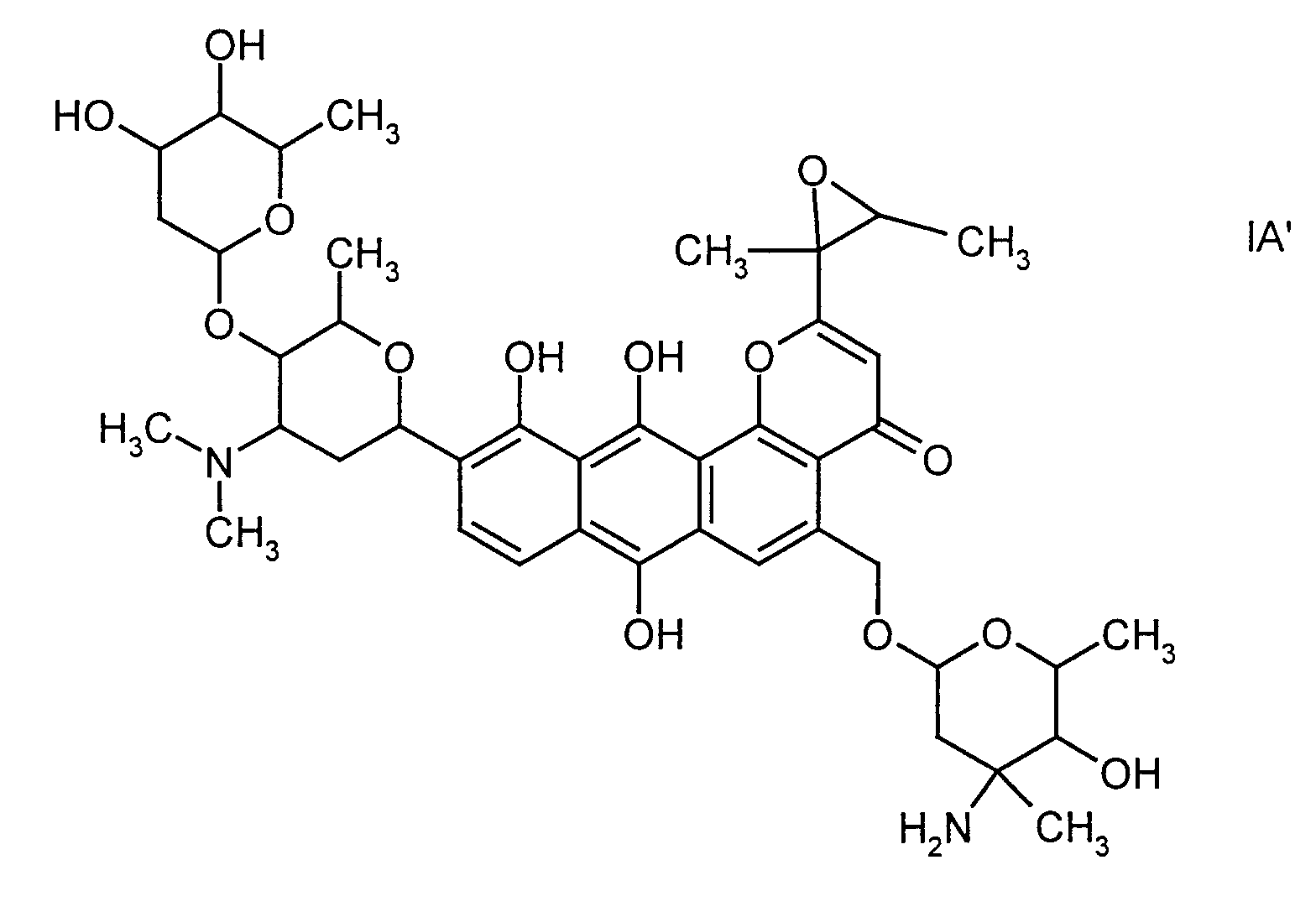
- the pluraflavin derivatives of the formulas IA 'and IB' have been derived from the pluraflavins of the formulas IA and IB and likewise form the subject of this invention.
- the invention is described in detail below, in particular in its preferred embodiments.
- the pluraflavins according to the invention are produced by Actinomycetales species, preferably by Actinomycetales spec HAG 003959, DSM 12931.
- Actinomycetales species HAG 003959, DSM 12931 has a beige-red mycelium and is characterized by the conidiophores which are characteristic of Actinomycetes.
- mutants and variants which synthesize one or more compounds of the pluraflavins according to the invention.
- Such mutants can be known in a manner known per se by physical means, for example radiation, such as with ultraviolet or X-rays, or chemical mutagens, for example ethyl methanesulfonate (EMS), 2-hydroxy-4-methoxy-benzophenone (MOB) or N-methyl N'-nitro-N-nitrosoguanidine (MNNG) can be generated.
- EMS ethyl methanesulfonate
- MOB 2-hydroxy-4-methoxy-benzophenone
- MNNG N-methyl N'-nitro-N-nitrosoguanidine
- the process according to the invention can be used for fermentation on a laboratory scale (Milliliter to liter range) and for the industrial scale (cubic meter scale) be used. All percentages relate unless otherwise is indicated on the weight. Obtain mixing ratios for liquids refer to the volume if no other information is given.
- Suitable carbon sources for aerobic fermentation are suitable assimilable carbohydrates and sugar alcohols, such as glucose, lactose, Sucrose or D-mannitol as well as natural products containing carbohydrates, e.g. Malt extract.
- Suitable nitrogenous nutrients are: amino acids, Peptides and proteins and their degradation products, such as peptones or tryptones, also meat extracts, yeast extracts, ground seeds, for example of maize, Wheat, beans, soybeans or the cotton plant, distillation residues of the Alcohol production, meat flours or yeast extracts, but also ammonium salts and Nitrates.
- the nutrient solution can be, for example, chlorides, Carbonates, sulfates or phosphates of alkali or alkaline earth metals, iron, zinc, Contain cobalt and manganese.
- the formation of the pluraflavins according to the invention proceeds particularly well in one Culture medium containing about 0.1 to 5%, preferably 0.3 to 2% glucose and 0.2 to 5 %, preferably 0.5 to 3% soy flour and 0.05 to 2%, preferably 0.2 to 1.0 g / l Cornsteep and 0.05 to 1.0 g / l, preferably 0.1 to 0.5% calcium carbonate and 0.05 contain up to 1.0 g / l, preferably 0.1 to 1.0 g / l sodium chloride.
- the information in percent are each based on the weight of the entire culture medium.
- Actinomycetales species HAG 003959, DSM 12931 forms a mixture of pluraflavins in the culture medium.
- the quantitative proportion of one or more of the pluraflavins according to the invention can vary.
- the synthesis of individual pluraflavins can be controlled by the media composition, so that one or more of the pluraflavins are not produced at all or in an amount below the detection limit by the microorganism.
- the culture preferably contains a detectable pluraflavin. To be favoured the pluraflavins A or B are formed.
- pluraflavins A and B compounds of the formula IA and IB
- further related compounds are formed in the culture medium of the Actinomycetales species HAG 003959, DSM 12931, which are characterized by a changed glycosylation of the compounds shown in the formulas IA and IB differentiate.
- a further pluraflavin with a molecular weight of 974 Da and a degradation product of pluraflavin A, molecular weight 692.77, C 37 H 44 N 2 O 11 were detected as a by-product.
- hexose 1 is absent, and 2,6-dideoxy-aldohexose can be split off hydrolytically from pluraflavin A under acidic conditions.
- the microorganism is cultivated aerobically, for example submerged with shaking or stirring in shake flasks or fermenters, if necessary with the introduction of air or oxygen. It can be in a temperature range of about 18 to 35 ° C, preferably at about 25 to 32 ° C, especially at 27 to 30 ° C be performed.
- the pH range should be between 6 and 8, preferably between 6.5 and 7.5.
- the microorganism is cultivated among them Conditions generally over a period of 24 to 300 hours, preferably 36 to 140 hours.
- Cultivation is advantageously carried out in several stages, i. H. you first put an or several precultures in a liquid culture medium, which are then in the actual production medium, the main crop, for example in volume ratio 1:10, be vaccinated.
- the pre-culture can be obtained, e.g. by using a Inoculated mycelium into a nutrient solution and about 36 to 120 hours, preferably 48 to 96 hours, growing.
- the mycelium can be obtained, for example, by the strain is kept on a solid for about 3 to 40 days, preferably 4 to 10 days or liquid culture medium, for example malt-yeast agar or oatmeal agar lets grow.
- the fermentation process can be based on the pH of the cultures or Mycelium volume as well as by chromatographic methods, e.g. Thin Layer Chromatography or High Pressure Liquid Chromatography or Checking biological activity will be monitored.
- the invention Pluraflavins are contained in both the mycelium and the culture filtrate. That in The insulation process described below is used to purify the Pluraflavins according to the invention, preferably for purifying pluraflavins A and B.
- the isolation or purification of the pluraflavins according to the invention from the Culture medium takes place according to known methods taking into account the chemical, physical and biological properties of natural products.
- the pluraflavine concentration in the culture medium or in the individual Isolation levels can be found in thin layer chromatography, for example Silica gel with chloroform-methanol-glacial acetic acid-water mixtures (e.g. in Quantity ratio 8: 1: 1: 0.2) can be used as eluent or HPLC.
- the Detection in thin-layer chromatography separation can for example by dyeing agents such as ⁇ -naphthol / sulfuric acid, the The amount of substance formed is expediently compared with a calibration solution.
- the mycelium is first of all the culture medium separated by the usual methods and then the Pluraflavine from the cell mass with an optionally with water miscible organic solvent extracted.
- the organic solvent phase contains the pluraflavins according to the invention, they are optionally in Vacuum concentrated and further purified as described below.
- the culture filtrate is optionally with the concentrate of the mycelium extract combined and with a suitable, water-immiscible organic Solvent extracted, for example with n-butanol.
- the one subsequently separated organic phase is optionally concentrated in vacuo.
- the precipitate here Pluraflavine, the lipophilic impurities remain dissolved and are caused by usual solid / liquid phase separations removed.
- the precipitation that the Total Pluraflavine contains 1/30 of the original volume Water / methanol dissolved.
- the precipitate completely dissolves and is lyophilized.
- the lyophilisate hereinafter referred to as the crude product, contains 0.5 to 50% pluraflavin and is used for further isolation.
- the further purification of one or more of the pluraflavins according to the invention is carried out by chromatography on suitable materials, preferably e.g. on Molecular sieves on normal phase supports, such as. B. silica gel, aluminum oxide ion exchangers or on adsorber resins or on reverse phases (reversed phase, RP).
- suitable materials preferably e.g. on Molecular sieves on normal phase supports, such as. B. silica gel, aluminum oxide ion exchangers or on adsorber resins or on reverse phases (reversed phase, RP).
- the pluraflavins are separated using this chromatography.
- the Chromatography of the pluraflavins is carried out with buffered aqueous solutions or Mixtures of aqueous and organic solutions.
- Mixtures of aqueous or organic solutions mean all of them Water-miscible organic solvents, preferably methanol, propanol and Acetonitrile, in a concentration of 10 to 80% solvent, preferably 40 to 60% solvent or all buffered aqueous solutions containing organic solvents are miscible.
- the buffers to be used are the same as you can read above.
- the pluraflavins are separated due to their different polarity Using reverse phase chromatography, for example on MCI® (adsorber resin from Mitsubishi, Japan) or Amberlite XAD® (TOSOHAAS), and others hydrophobic materials, such as on RP-8 or RP-18 phases.
- reverse phase chromatography for example on MCI® (adsorber resin from Mitsubishi, Japan) or Amberlite XAD® (TOSOHAAS), and others hydrophobic materials, such as on RP-8 or RP-18 phases.
- the separation can be carried out using normal phase chromatography Example on silica gel, aluminum oxide and the like.
- the pluraflavins are chromatographed with buffered or acidified aqueous solutions or mixtures of aqueous solutions with alcohols or other water-miscible organic solvents.
- organic Solvent is preferably used propanol and acetonitrile.
- Buffered or acidified aqueous solutions are e.g. Water, phosphate buffer, ammonium acetate, citrate buffer in a concentration of 1 mM to 0.5 M and formic acid, acetic acid, trifluoroacetic acid or all commercially available acids known to those skilled in the art, preferably in one Concentration from 0.01 to 3%, especially 0.1%.
- Chromatography is carried out with a gradient using 100% aqueous buffer starts and ends with 100% solvent, preferably a linear gradient driven from 10 to 50% 2-propanol or acetonitrile.
- gel chromatography or chromatography can also be used hydrophobic phases take place.
- Gel chromatography is performed on polyacrylamide or mixed polymer gels carried out, e.g. Biogel-P 2® (Biorad), Fractogel TSK HW 40® (Merck, Germany or Toso Haas, USA) or to Sephadex® (Pharmacia, Uppsala, Sweden).
- Biogel-P 2® Biorad
- Fractogel TSK HW 40® Merck, Germany or Toso Haas, USA
- Sephadex® Pharmacia, Uppsala, Sweden.
- the pluraflavins crystallize from solutions in organic solvents and from Mixtures of water with organic solvents.
- the crystallization is in in a manner known per se, for example by concentrating or cooling saturated plurflavine solutions.
- the pluraflavins according to the invention are in the solid state and in solutions in the pH range between 3 and 8, especially 4 and 6, stable and can thus be used in Incorporate the usual galenical preparations.
- the pluraflavins and derived chemical derivatives of formula I can according to methods known to the person skilled in the relevant physiological tolerated salts.
- physiologically tolerable salts of compounds of formula 1 one understands both their organic and inorganic salts as described in Remington's Pharmaceutical Sciences (17th edition, page 1418 (1985)) are. Due to the physical and chemical stability and the Solubility for acidic groups include sodium, potassium, calcium and ammonium salts preferred; for basic groups are among others Salts of hydrochloric acid, sulfuric acid, phosphoric acid or carboxylic acids or sulfonic acids, e.g. Acetic acid, citric acid, benzoic acid, Maleic acid, fumaric acid, tartaric acid and p-toluenesulfonic acid are preferred.
- the invention further obviously includes chemical equivalents of Compounds of formula 1 which have a slight chemical difference have the same effectiveness or under mild conditions can be converted into the compound of the invention.
- Equivalents include e.g. Esters and ethers as well as reduction products of compounds of the invention.
- Ester and ether derivatives and reduction products can be prepared by methods described in the literature, for example, in "Advanced Organic Synthesis, 4 th Edition, J. March, John Wiley & sons., Are established in 1992.
- the present invention encompasses all stereoisomeric forms of the compounds of the formula 1.
- Asymmetry centers contained in the compounds of the formula IA and IB can all have the S configuration or the R configuration independently of one another.
- the oxiranes of the epoxy-containing group can lie in any position, the oxiranes with the participation of the C atoms 2 'and 3' are preferred.
- the invention includes all possible enantiomers and diastereomers, as well as mixtures of two or more stereoisomeric forms, for example mixtures of enantiomers and / or diastereomers, in all ratios.
- Enantiomers are therefore the subject of the invention in all ratios in enantiomerically pure form, both as left-handed and as right-handed antipodes, R and S configurations, in the form of racemates and in the form of mixtures of the two enantiomers.
- a cis / trans isomerism both the cis form and the trans form and mixtures of these forms are the subject of the invention in all proportions.
- the Compounds according to the invention for use as medicaments in human and / or veterinary medicine. They are antibiotic active and possess besides that antibacterial effect, antifungal, d. H. antifungal including the phytopathogenic fungi, antiprotozoic and antiparasitic properties.
- the compounds according to the invention can be used to fight cancer be used, especially as chemotherapy drugs. Because of your cytostatic properties, especially their strong antitumor activity as well An antimicrobial effect can be used in particular as a cytostatics malignant degeneration in animals and humans.
- the invention also relates to pharmaceutical preparations which have one or more of the pluraflavins according to the invention and / or chemical derivatives thereof. Use in a mixture with suitable auxiliaries or is preferred Backing material. All humans can use pharmacologically as carrier material compatible carrier materials and / or auxiliaries are used.
- the invention also relates to a method for producing a Medicament according to the invention, which is characterized in that at least one of the compounds according to the invention with a pharmaceutically suitable and physiologically compatible carriers and optionally other suitable active ingredients, additives or auxiliaries in one brings suitable dosage form.
- the medicaments according to the invention are generally administered orally, locally or administered parenterally, but rectal use is also possible in principle.
- suitable solid or liquid pharmaceutical preparation forms are, for example Granules, powders, tablets, coated tablets, (micro) capsules, suppositories, syrups, Emulsions, suspensions, aerosols, drops or injectable solutions in Ampoule shape and preparations with protracted release of active ingredient, in their Manufacture of carriers and additives and / or auxiliaries such as explosives, Binding agents, coating agents, swelling agents, lubricants or lubricants, flavorings, Sweeteners or solubilizers are used.
- Carriers or auxiliaries are e.g.
- the dosage units can be used for oral administration microencapsulated to delay delivery or over a longer period Extend the period, such as by covering or embedding the Active ingredient in particle form in suitable polymers, waxes or the like.
- the pharmaceutical preparations are preferably in dosage units manufactured and administered, each unit as an active ingredient certain dose of one or more compounds of the invention Pluraflavine and / or chemical derivatives thereof contains.
- fixed Dosage units such as tablets, capsules and suppositories can increase this dose about 200 mg, but preferably about 0.1 to 100 mg, and for solutions for injection in ampoule form up to about 200 mg, but preferably about 0.1 to 100 mg, per Day.
- the daily dose to be administered depends on body weight, age, Sex and condition of the mammal. However, under certain circumstances you can higher or lower daily doses may be appropriate.
- the administration of the Daily dose can be given both as a single dose Dosage unit or in several smaller dosage units as well by giving divided doses several times at certain intervals.
- a sterile 300 ml Erlenmeyer flask with 100 ml of the following nutrient solution: 15 g / l glucose, 15 g / l soy flour, 5 g / l corn steep, 2 g / l CaCO 3 and 5 g / l NaCl is placed on a slant tube (same Nutrient solution, but inoculated with 2% agar) or with 1 ml of a glycerol culture (see Example 1) and incubated on a shaker at 180 rpm and 30 ° C.
- the maximum production of one or more compounds of the pluraflavins according to the invention is reached after about 120 hours.
- a 48 to 96 hour old submerged culture (inoculation amount approx. 10%) from the same nutrient solution is sufficient for inoculating 10 and 200 1 fermenters.
- a 9 l fermenter is operated under the following conditions: Nutrient medium 15 g / l glucose; 15 g / l soy flour; 5 g / l corn steep, firm; 2 g / l CaCO 3; 5 g / l NaCl; pH 7.0 (before sterilization) Process duration 92 hours Incubation temperature 28 ° C Stirrer speed 300 rpm ventilation 5 I min -1
- the culture broth of the fermenter obtained according to Example 3, (90 liters) is filtered with the addition of about 2% filter aid (for example Celite®) and the cell mass (0.6 liter) with 3 liters of methanol extracted.
- the active substance-containing, methanolic solution is freed from the mycelium by filtration and concentrated in vacuo.
- the concentrate is applied together with the culture filtrate (7 liters) to a prepared, 0.4 liter ®MCI GEL, CHP20P column. Elution is carried out with a gradient of 0.1% acetic acid in water to 0.1% acetic acid in propanol-2.
- the column flow rate (1.2 liters per hour) is collected fractionally (0.25 liter each) and the fractions containing pluraflavins (20 to 23) are combined. Concentration in vacuo and freeze drying give 1.4 g of a brown powder.
- the eluent water-acetonitrile (1: 1) is at a flow rate of Pumped 50 ml per minute over the column and fractionated the column outflow (65 ml) caught. They are mainly found in fractions 13 to 16 Pluraflavine. They are summarized and in a vacuum from the solvent exempted. They give 130 mg of plurflavine mixture.
- Fractions 35 to 37, obtained according to Example 6, are freeze-dried (22 mg), dissolved in 10% acetonitrile in water, with trifluoroacetic acid to pH 2.8 adjusted, applied to a 250/10 LiChrospher RP-18e (5 ⁇ m) ® column. The Elution is carried out with 0.05% aqueous trifluoroacetic acid in 11 to 22% acetonitrile. To Concentrate in vacuo and freeze-dry to 18 mg pluraflavin A - Trifluoroacetate salt obtained.
- UV maxima 214, 243, 270 (Sh), 290 (Sh), 426 nm in water-acetonitrile (8: 2), pH 2 and 214, 243, 270 (Sh), 290 (Sh) and 426 nm in Water acetonitrile (6: 4), pH 7.
- IR bands 3424, 1680, 1600, 1464, 1427, 1300, 1203, 1131, 1066, 1009, 801, 721 cm -1 .
- NOEs are consistent with a relative stereochemistry SRSS or RSRR of the chiral centers 1 ', 3', 4 ', 5' (Fig. 1). This corresponds to the C-3 epimer of vancosamine.
- Fig. 1 Relative stereochemistry of hexose III.
- Appearance deep yellow substance soluble in polar organic solvents, but only sparingly soluble in water.
- the acid addition salts are soluble in water.
- the compound is stable in a neutral and mildly acidic environment, but is not stable in the alkaline range.
- UV maxima 214, 243, 270 (Sh), 290 (Sh), 426 nm in water-acetonitrile (8: 2), pH 2 and 214, 243, 270 (Sh), 290 (Sh) and 426 nm in Water-acetonitrile (6: 4), pH 7.
- Pluraflavin B has the empirical formula C 43 H 56 N 2 O 15 , the molecular weight is 840.9 Da.
- NMR signals see Table 2.
Landscapes
- Health & Medical Sciences (AREA)
- Chemical & Material Sciences (AREA)
- Organic Chemistry (AREA)
- Life Sciences & Earth Sciences (AREA)
- Engineering & Computer Science (AREA)
- General Health & Medical Sciences (AREA)
- Chemical Kinetics & Catalysis (AREA)
- General Chemical & Material Sciences (AREA)
- Zoology (AREA)
- Wood Science & Technology (AREA)
- Bioinformatics & Cheminformatics (AREA)
- Genetics & Genomics (AREA)
- Biotechnology (AREA)
- Medicinal Chemistry (AREA)
- Biochemistry (AREA)
- Veterinary Medicine (AREA)
- Pharmacology & Pharmacy (AREA)
- Public Health (AREA)
- Animal Behavior & Ethology (AREA)
- Nuclear Medicine, Radiotherapy & Molecular Imaging (AREA)
- General Engineering & Computer Science (AREA)
- Microbiology (AREA)
- Molecular Biology (AREA)
- Oncology (AREA)
- Communicable Diseases (AREA)
- Virology (AREA)
- Tropical Medicine & Parasitology (AREA)
- Biomedical Technology (AREA)
- Hematology (AREA)
- Obesity (AREA)
- Diabetes (AREA)
- Epidemiology (AREA)
- Pulmonology (AREA)
- Endocrinology (AREA)
- Reproductive Health (AREA)
- Pharmaceuticals Containing Other Organic And Inorganic Compounds (AREA)
- Preparation Of Compounds By Using Micro-Organisms (AREA)
- Micro-Organisms Or Cultivation Processes Thereof (AREA)
- Saccharide Compounds (AREA)
- Medicines Containing Material From Animals Or Micro-Organisms (AREA)
Abstract
Die Erfindung betrifft Verbindungen der allgemeinen Formel I <IMAGE> worin R1 und R2 unabhängig von einander jeweils einen Zucker bedeuten; R3 eine Epoxid-enthaltende Gruppe, oder C1-C6-Alkyl oder C2-C6-Alkenyl, gegebenenfalls mit einem oder mehreren OH substituiert, bedeutet; R5 H, C1-C6-Alkyl, C2-C6-Alkenyl oder C2-C6-Alkinyl bedeutet; R4, R6, R8 und R10, können, unabhängig von einander, H, C1-C6-Alkyl, C2-C6-Alkenyl, C2-C6-Alkinyl, -X2H, oder -X2R12 bedeuten, oder R4 und R6 können zusammen und/oder R8 und R10 zusammen =X2 sein; X2 kann O, NH, N-C1-C6 Alkyl, N-C2-C6-Alkenyl, N-C2-C6-Alkinyl oder S bedeuten; R12 C1-C6-Alkyl, C2-C6-Alkenyl, C2-C6-Alkinyl, Aryl oder Acyl bedeutet; und m und n 1 oder 2; in allen stereochemischen Formen und Gemische dieser Formen in allen Verhältnissen, sowie deren physiologisch verträglichen Salze. Die Verbindungen sind erhältlich aus Kulturen des Mikroorganismus Actinomycetales species HAG 003959, DSM 12931, durch Fermentation. Die Erfindung betrifft somit ein Verfahren zur deren Herstellung und die Verwendung der Verbindungen als Arzneimittel, insbesondere als Antitumor Mittel.
Description
Die vorliegende Erfindung betrifft neue Verbindungen der allgemeinen Formel I
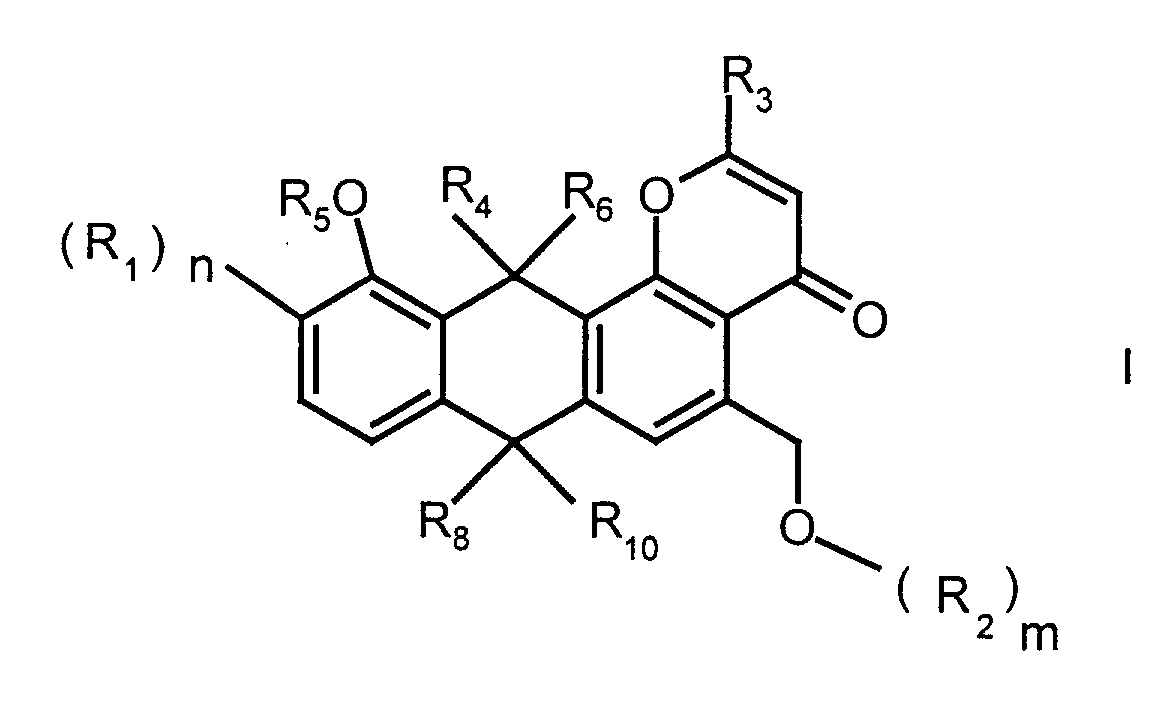 worin R1, R2, R3, R4, R5, R6, R8, R10, m und n die Bedeutung wie unten beschrieben
haben. Die Verbindungen der Formel I hemmen die Transkriptase, besitzen
cytostatische Wirkungen und sind besonders geeignet zur Behandlung von
Tumoren. Die Verbindungen der Formel I sind erhältlich durch Fermentierung von
Actinomycetales species HAG 003959, DSM 12931 in einem Kulturmedium. Die
Erfindung betrifft somit ein Verfahren zur Herstellung der Verbindungen der Formel
I, die Verwendung der Verbindungen zur Herstellung eines Arzneimittels zur
Behandlung von malignen Erkrankungen und von Krankheiten die durch hemmen
von Transkriptase Behandelt werden können, sowie pharmazeutischen
Zubereitungen mit einem Gehalt an mindestens einer Verbindung der Formel I.
worin R1, R2, R3, R4, R5, R6, R8, R10, m und n die Bedeutung wie unten beschrieben
haben. Die Verbindungen der Formel I hemmen die Transkriptase, besitzen
cytostatische Wirkungen und sind besonders geeignet zur Behandlung von
Tumoren. Die Verbindungen der Formel I sind erhältlich durch Fermentierung von
Actinomycetales species HAG 003959, DSM 12931 in einem Kulturmedium. Die
Erfindung betrifft somit ein Verfahren zur Herstellung der Verbindungen der Formel
I, die Verwendung der Verbindungen zur Herstellung eines Arzneimittels zur
Behandlung von malignen Erkrankungen und von Krankheiten die durch hemmen
von Transkriptase Behandelt werden können, sowie pharmazeutischen
Zubereitungen mit einem Gehalt an mindestens einer Verbindung der Formel I.
Krebs ist eine zumeist tödlich verlaufende Erkrankung von Mensch und Tier, die
durch das unkontrollierte Wachsen von körpereigenen Zellen verursacht wird. Krebs
ist die Bezeichnung für die Bildung von bösartigen Geschwülsten (Malignome), von
Neoplasmen (Tumoren bzw. Carcinoma) oder für die maligne Entartung sowie
Reifungsstörung weißer Blutzellen (Leukämie, Blutkrebs). Krebs- oder Tumorzellen
entstehen durch Umwandlung körpereigener Zellen. Die Bösartigkeit der Krebszelle
drückt sich in der Autonomie des Wachstums aus, das heißt in ihrer Fähigkeit,
ungehemmt und ohne Einordnung in den Bauplan der Organe und unter
Gewebszerstörung infiltrierend zu wachsen. Ein sicheres Zeichen der Malignität ist
die Bildung tumorferner Absiedlungen (Metastasen) nach hämatogener oder
lymphogener Ausbreitung von Tumorzellen. Krebs gehört zu den häufigsten Todesursachen
des Menschen und deshalb besteht ein großer Bedarf an Methoden und
Mitteln zur Heilung oder Behandlung von malignen Entartungen.
Die Möglichkeit einer Therapie maligner Tumoren umfaßt neben der - wenn möglich
radikalen - operativen Entfernung des Tumors, die radiologische Therapie mit
Röntgenstrahlen, α-, β-, γ-Strahlen, die Immuntherapie und die Chemotherapie. Die
Immuntherapie ist derzeit nur in eingeschränktem Maß anwendbar. Unter der
Chemotherapie von Tumoren versteht man die Gabe von Zellgiften (Cytostatika) zur
Behandlung von Tumoren und von verbliebenen Tumorzellen nach lokaler
chirurgischer Behandlung oder Bestrahlung. Diese Stoffe greifen spezifisch in
bestimmte Vorgänge der Zellteilung ein, so daß Gewebe mit hohem Anteil an sich
teilenden Zellen, wie das rasch wachsende Tumorgewebe, empfindlicher reagieren.
Zum Einsatz kommen alkylierende Verbindungen, wie z. B. das Cyclophosphamid
(The Merck Index, 12. Ed. Seite 463), Antimetabolite, wie das Methotrexat (The
Merck Index, 12. Ed. Seite 1025), Alkaloide, wie das Vincristin (The Merck Index, 12.
Ed. Seite 1704) und Antibiotika, wie das Daunomycin (The Merck Index, 12. Ed.
Seite 479) sowie das Adriamycin (The Merck Index, 12. Ed. Seite 581-582). All diese
Agenzien haben aber aufgrund von massiven Nebenwirkungen große Nachteile, so
daß der Tod der Erkrankten nur hinausgezögert, nicht jedoch abgewendet wird.
Zudem treten bei entarteten (Krebs-) Zellen Resistenzen gegen die angewandten
Mittel auf, die derzeitigen Medikamente wirken dann nicht mehr cytostatisch, wohl
aber toxisch infolge der Nebenwirkungen. Zudem hat sich gezeigt, daß eine
kombinierte bzw. sequentielle Anwendung von Cytostatika die Wirksamkeit eines
einzelnen Cytostatikums (Monotherapie) übertrifft und dadurch möglich ist, daß sich
die erheblichen Nebeneffekte bei der Polychemotherapie nicht addieren. Aus all
diesen Gründen werden neue Chemotherapeutika dringend benötigt und deshalb
weltweit gesucht.
Es ist überraschend gefunden worden, daß der Mikroorganismus-Stamm
Actinomycetales species HAG 003959, DSM 12931, hoch wirksame neue
Cytostatika zu bilden vermag, die das Wachstum von Zellen noch in sehr geringen
Konzentrationen hemmen. Die neuen Verbindungen werden in Folgendem
Pluraflavine genannt und sind, zusammen mit Pluraflavin- Derivaten, Gegenstand
der Erfindung. Die Pluraflavine sind Antibiotika, die aus einem p-chinoiden
Ringsystem und verschiedenen Zuckerbausteinen bestehen und die Transkription
durch Interkalierung des Nukleinsäure-Doppelstrang sowie gegebenenfalls
zusätzliche Alkylierung hemmen. Das Ringgerüst ist erstmals als ein Teil des
Pluramycins von S. Kondo et al. im Journal of Antibiotics, Band 30, Seite 1143-1145,
1977 beschrieben worden. Dieses Ringgerüst wurde später in mehreren
Antibiotika gefunden: neben dem Pluramycin und Neopluramycin sind die
Verbindungen Saptomycine (N. Abe et al. J. Antibiotics, 46, 1536-1549, 1993),
Ankinomycin (Y. Sato et al. J. Antibiotics 42, 149, 1989), Kidamycin (N. Kanda et al.
J. Antibiotics, 24, 599, 1971), Hedamycin ( U. Sequin et al. Tetrahedron, 34, 761,
1978) sowie die Altromycine (G. M. Brill et al. J. Antibiotics, 43, 229-237, 1990) als
strukturverwandte Verbindungen charakterisiert. Die bisher bekannten Substanzen
weisen oft Nachteile auf, die sich in unbefriedigender Wirkhöhe, hoher Toxizität
und/oder unerwünschten Nebenwirkungen äußern.
Die vorliegende Erfindung betrifft daher Verbindungen der allgemeinen Formel I
 worin bedeuten
sowie deren physiologisch verträgliche Salze.
In der Formel I bedeutet
Aryl kann z.B. stehen für Phenyl, Benzyl oder 1- oder 2- Naphthyl, das auch noch
substituiert sein kann, beispielsweise durch Halogen, wie Chlor, Brom, Fluor, durch
Alkyl mit 1-4 C-Atomen, vorzugsweise Methyl-, durch Hydroxy, durch Alkoxy mit 1-4C
Atomen, insbesondere Methoxyl und/oder durch Trifluormethyl.
Acyl kann stehen für aliphatische oder aromatische Acyl-Reste. Das aliphatische
Acyl hat 1-7, vorzugsweise 1-4 C Atome, wie z.B. Formyl, Acetyl, Propionyl, Butyryl,
Hexanoyl, Acryloyl, Crotonoyl, Propioloyl, das noch weiter substituiert sein kann,
beispielsweise durch Halogen, wie Chlor, Brom, Fluor, durch Amino, und/oder durch
Alkylamino mit 1-4 C Atomen, vorzugsweise Methyl- oder Ethylamino-Gruppen.
Aromatisches Acyl kann z.B. Benzoyl oder Naphthoyl sein, das auch noch weiter
substituiert sein kann, beispielsweise durch Halogen, wie Chlor, Brom, Fluor, durch
Alkyl mit 1-4 C-Atomen, vorzugsweise Methyl, durch Hydroxy, durch Amino-Gruppen,
wie z.B. Ethylamino, oder durch Alkoxy-Gruppen mit 1-7, vorzugsweise 1-4C
Atomen, insbesondere Methoxy.
Der Zucker R1 und/oder R2 ist vorzugsweise einen Aldohexose.
Vorzugsweise bedeutet m 1.
R2 kann ein Aminozuckerrest der allgemeinen Formel
 sein, worin
R13, R14, R16, R18, R20, R22, R24, R26 und R28, unabhängig von einander, H, OH, NH2,
NHAlkyl, N(Alkyl)2, Alkoxy sein kann, wobei Alkyl einen C1-C4-Rest bedeutet.
Beispiele für
sein, worin
R13, R14, R16, R18, R20, R22, R24, R26 und R28, unabhängig von einander, H, OH, NH2,
NHAlkyl, N(Alkyl)2, Alkoxy sein kann, wobei Alkyl einen C1-C4-Rest bedeutet.
Beispiele für
Alkyl sind z.B. Methyl, Ethyl, Propyl, Isobutyl und Butyl, insbesondere Methyl, für Alkoxy sind Methoxy, Ethoxy oder Butoxy, insbesondere Methoxy.
Alkyl sind z.B. Methyl, Ethyl, Propyl, Isobutyl und Butyl, insbesondere Methyl, für Alkoxy sind Methoxy, Ethoxy oder Butoxy, insbesondere Methoxy.
Vorzugsweise ist R2 einer Aminozucker der Formel IIA:
 R1 kann für einen Aminozucker stehen. Vorzugsweise bedeutet n 2.
R1 kann die allgemeinen Formel III
 haben, worin R30 bis R60, unabhängig von einander, H, OH, NH2, NHAlkyl, N(Alkyl)2,
oder Alkoxy sein kann, mit der Maßgabe, daß Alkyl einen C1-C4-Rest, wie z.B.
Methyl, Ethyl, Propyl, Isobutyl und Butyl, insbesondere Methyl und O-Alkyl, wie z.B.
Methoxy, Ethoxy oder Butoxy, insbesondere Methoxy bedeutet.
haben, worin R30 bis R60, unabhängig von einander, H, OH, NH2, NHAlkyl, N(Alkyl)2,
oder Alkoxy sein kann, mit der Maßgabe, daß Alkyl einen C1-C4-Rest, wie z.B.
Methyl, Ethyl, Propyl, Isobutyl und Butyl, insbesondere Methyl und O-Alkyl, wie z.B.
Methoxy, Ethoxy oder Butoxy, insbesondere Methoxy bedeutet.
Vorzuqsweise hat R1 die Formel IIIA
 R3 bedeutet vorzugsweise eine Epoxid-enthaltende-Gruppe. Die Epoxid-enthaltende
Gruppe kann ein geradkettiger oder verzweigter Alkyl- oder Alkenyl-Rest mit 2 bis
12, vorzugsweise 2 bis 6 C-Atomen sein, der eine oder zwei Epoxid-Ringe (Oxirane)
enthält. Als Beispiele kommen hierfür in Betracht
R3 bedeutet vorzugsweise eine Epoxid-enthaltende-Gruppe. Die Epoxid-enthaltende
Gruppe kann ein geradkettiger oder verzweigter Alkyl- oder Alkenyl-Rest mit 2 bis
12, vorzugsweise 2 bis 6 C-Atomen sein, der eine oder zwei Epoxid-Ringe (Oxirane)
enthält. Als Beispiele kommen hierfür in Betracht

 und
und
 R3 kann statt einer Epoxid-enthaltenden Gruppe ein geradkettiger oder verzweigter
Alkyl mit 1 oder 12, vorzugsweise 1 bis 6 C-Atomen, wie z.B. Methyl, Ethyl, i-Propyl,
tert-Butyl, Hexyl, sowie beispielsweise Octyl, Dodecyl, oder ein geradekettiges oder
verzweigtes Alkenyl mit 2 bis 12, vorzugsweise 2 bis 6 C-Atomen, wie z.B. Allyl,
Crotyl, Pentenyl, sowie Dodecenyl, sein, wobei diese Alkyl- oder Alkenyl- Gruppen
noch ein oder mehrfach, substituiert sein können z. B. durch Hydroxy.
R3 kann statt einer Epoxid-enthaltenden Gruppe ein geradkettiger oder verzweigter
Alkyl mit 1 oder 12, vorzugsweise 1 bis 6 C-Atomen, wie z.B. Methyl, Ethyl, i-Propyl,
tert-Butyl, Hexyl, sowie beispielsweise Octyl, Dodecyl, oder ein geradekettiges oder
verzweigtes Alkenyl mit 2 bis 12, vorzugsweise 2 bis 6 C-Atomen, wie z.B. Allyl,
Crotyl, Pentenyl, sowie Dodecenyl, sein, wobei diese Alkyl- oder Alkenyl- Gruppen
noch ein oder mehrfach, substituiert sein können z. B. durch Hydroxy.
Die Erfindung betrifft somit das Pluraflavin A der Formel IA
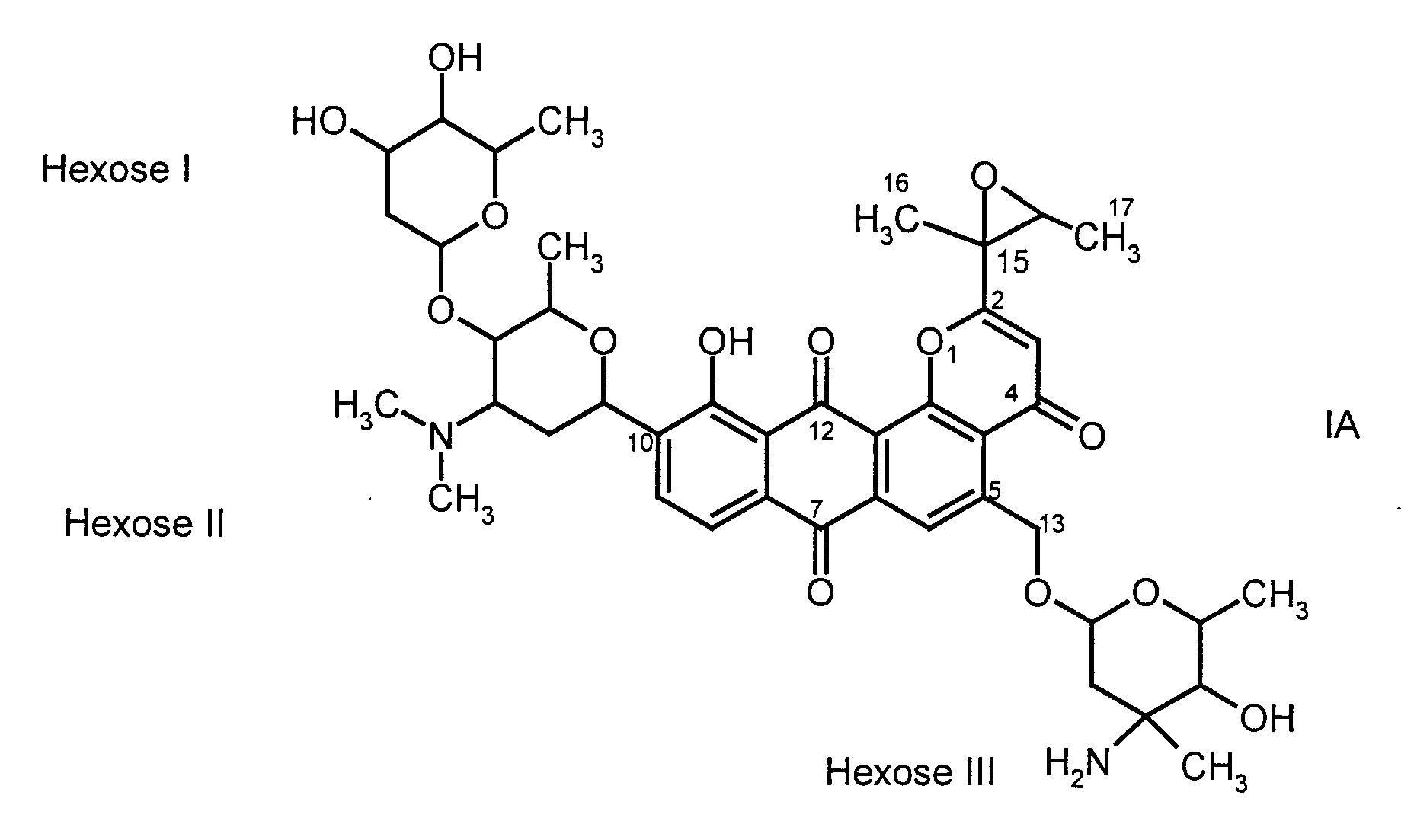 und das Pluraflavin B der Formel IB
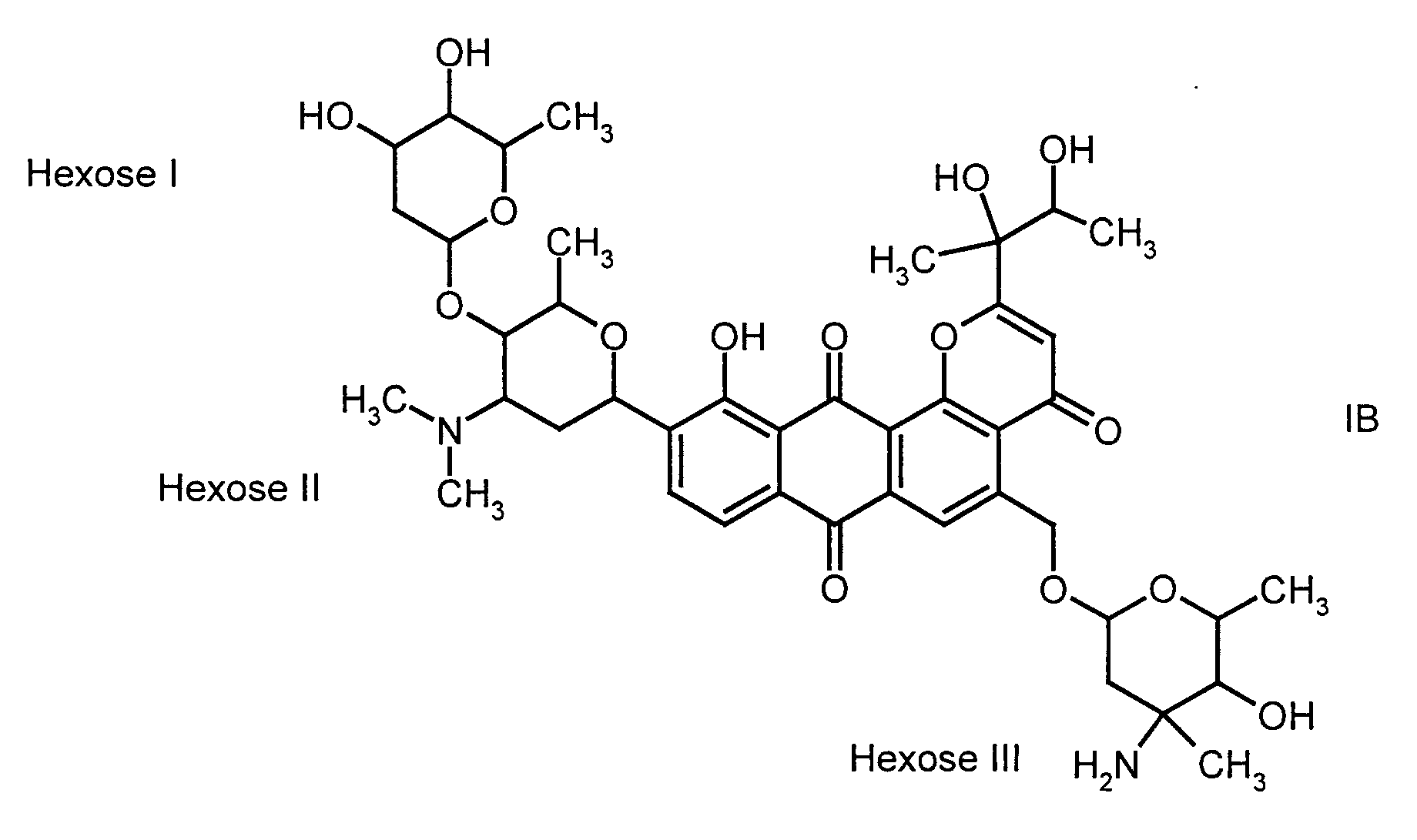
Bevorzugt sind die Verbindungen der Formel IA und IB, in denen
Erfindungsgemäß sind die Verbindungen der Formel 1 erhältlich durch Fermentation
des Actinomycetales species HAG 003959, DSM 12931, oder deren Varianten oder
Mutanten unter geeigneten Bedingungen in einem Kulturmedium, bis sich eines
oder mehrere der Pluraflavine der Formel IA und/oder IB im Kulturmedium
anhäufen. Durch anschließende Isolierung der Verbindungen und gegebenenfalls
Umwandlung in chemische Derivate, sowie deren physiologisch verträglichen Salze
werden die Pluraflavine gewonnen.
Die Erfindung betrifft daher weiterhin ein Verfahren zur Herstellung einer Verbindung
der Formel 1, dadurch gekennzeichnet, daß der Mikroorganismus Actinomycetales
species HAG 003959, DSM 12931, oder deren Varianten oder Mutanten unter
geeigneten Bedingungen in einem Kulturmedium fermentiert wird, bis sich eines
oder mehrere der Pluraflavine der Formel IA und/oder IB in dem Kulturmedium
anhäufen und anschließend aus dem Kulturmedium isoliert und gegebenenfalls in
chemische Derivate und /oder physiologisch verträglichen Salze umgewandelt
werden.
Vorzugsweise wird der Stamm HAG 003959, DSM 12931, seine Mutanten und/oder
Varianten in einer Nährlösung (auch als Kulturmedium bezeichnet) mit Kohlenstoff-
und Stickstoffquelle sowie den üblichen anorganischen Salzen fermentiert, bis sich
die neuen Pluraflavine in dem Kulturmedium anhäufen, anschließend werden die
Pluraflavine aus dem Kulturmedium isoliert und gegebenenfalls in die einzelnen
aktiven Komponenten aufgetrennt.
Die Fermentation wird vorzugsweise unter aeroben Bedingungen durchgeführt, sie
verläuft besonders gut bei einer Temperatur zwischen 18 und 35□C und bei einem
pH zwischen 6 und 8.
In der Literatur sind viele Reaktionen zur chemischen Abwandlung von Chinonen
beschrieben worden. Die Derivatisierung der Chinon-Formen der vorliegenden
Verbindungen kann daher mit an sich bekannten chemischen Reaktionen
durchgeführt werden. Eine Reduktion zu den Hydrochinon-Formen der
Verbindungen kann zum Beispiel mit Wasserstoff katalytisch erreicht werden oder
mit Metall-Hydriden, wie Aluminium-Hydriden oder Bor-Hydriden. Als ein weiteres
Beispiel kommt die Umsetzung von Chinonen mit Hydroxylamin oder mit seinen
Derivaten zu den Oximen in Betracht, die ihrerseits weiter chemisch umgewandelt
werden können.
Die Pluraflavin Derivate der Formel IA' und IB' sind von den Pluraflavinen der
Formeln IA bzw. IB abgeleitet worden und bilden ebenfalls den Gegenstand dieser
Erfindung.
 Im folgenden wird die Erfindung detailliert beschrieben, insbesondere in ihren
bevorzugten Ausführungsformen.
Im folgenden wird die Erfindung detailliert beschrieben, insbesondere in ihren
bevorzugten Ausführungsformen.
Die erfindungsgemäßen Pluraflavine werden durch Actinomycetales species
bevorzugt durch Actinomycetales spec HAG 003959, DSM 12931 produziert.
Actinomycetales species HAG 003959, DSM 12931 besitzt ein beigerotes Mycel
und ist durch die für Actinomyceten charakteristischen Conidiophoren
gekennzeichnet.
Ein Isolat wurde bei der Deutschen Sammlung von Mikroorganismen und
Zellkulturen GmbH, Mascheroder Weg 1B, D 38124 Braunschweig, Deutschland,
nach den Regeln des Budapester Vertrages am 16. Juli 1999 unter der folgenden
Nummer hinterlegt: Actinomycetales species HAG 003959, DSM 12931.
Anstelle des Stammes Actinomycetales species HAG 003959, DSM 12931 können
auch dessen Mutanten und Varianten eingesetzt werden, die eine oder mehrere
Verbindungen der erfindungsgemäßen Pluraflavine synthetisieren. Solche Mutanten
können in an sich bekannter Weise durch physikalische Mittel, beispielsweise
Bestrahlung, wie mit Ultraviolet- oder Röntgenstrahlen, oder chemische Mutagene,
wie beispielsweise Ethylmethansulfonat (EMS), 2-Hydroxy-4-methoxy-benzophenon
(MOB) oder N-Methyl-N'-nitro-N-nitrosoguanidin (MNNG) erzeugt werden.
Das erfindungsgemäße Verfahren kann für die Fermentation im Labormaßstab
(Milliliter- bis Literbereich) und für den industriellen Maßstab (Kubikmetermaßstab)
eingesetzt werden. Alle Prozentangaben beziehen sich, wenn nichts anderes
angegeben ist, auf das Gewicht. Mischungsverhältnisse bei Flüssigkeiten beziehen
sich auf das Volumen, wenn keine anderen Angaben gemacht werden.
Als bevorzugte Kohlenstoffquellen für die aerobe Fermentation eignen sich
assimilierbare Kohlenhydrate und Zuckeralkohole, wie Glukose, Laktose,
Saccharose oder D-Mannit sowie kohlenhydrathaltige Naturprodukte, wie z.B.
Malzextrakt. Als stickstoffhaltige Nährstoffe kommen in Betracht: Aminosäuren,
Peptide und Proteine sowie deren Abbauprodukte, wie Peptone oder Tryptone,
ferner Fleischextrakte, Hefeextrakte, gemahlene Samen, beispielsweise von Mais,
Weizen, Bohnen, Soja oder der Baumwollpflanze, Destillationsrückstände der
Alkoholherstellung, Fleischmehle oder Hefeextrakte, aber auch Ammoniumsalze und
Nitrate. An anorganischen Salzen kann die Nährlösung beispielsweise Chloride,
Carbonate, Sulfate oder Phosphate der Alkali- oder Erdalkalimetalle, Eisen, Zink,
Kobalt und Mangan enthalten.
Die Bildung der erfindungsgemäßen Pluraflavine verläuft besonders gut in einem
Kulturmedium, das etwa 0,1 bis 5 %, bevorzugt 0,3 bis 2 % Glucose und 0,2 bis 5
%, bevorzugt 0,5 bis 3 % Sojamehl und 0,05 bis 2 %, bevorzugt 0,2 bis 1,0 g/l
Cornsteep und 0,05 bis 1,0 g/l, bevorzugt 0,1 bis 0,5 % Calciumcarbonat und 0,05
bis 1,0 g/l, bevorzugt 0,1 bis 1,0 g/l Natriumchlorid enthalten. Die Angaben in Prozent
sind jeweils bezogen auf das Gewicht des gesamten Kulturmediums.
In dem Kulturmedium bildet Actinomycetales species HAG 003959, DSM 12931, ein
Gemisch aus Pluraflavinen. Je nach Zusammensetzung des Kulturmediums kann
der mengenmäßige Anteil eines oder mehrerer der erfindungsgemäßen Pluraflavine
variieren. Außerdem kann durch die Medienzusammensetzung die Synthese
einzelner Pluraflavine gesteuert werden, so daß eines oder auch mehrere der
Pluraflavine gar nicht bzw. in einer Menge unterhalb der Nachweisgrenze vom
Mikroorganismus hergestellt werden.
Vorzugsweise enthält die Kultur ein nachweisbares Pluraflavin. Bevorzugt werden
die Pluraflavine A oder B gebildet.
Neben den Pluraflavinen A und B (Verbindungen der Formel IA bzw. IB) werden in
dem Kulturmedium des Actinomycetales species HAG 003959, DSM 12931, auch
weiter verwandte Verbindungen gebildet, die sich durch eine veränderte
Glycosylierung von den in den Formeln IA und IB wiedergegebenen Verbindungen
unterscheiden. So wurde als Nebenprodukt ein weiteres Pluraflavin mit dem
Molekulargewicht 974 Da sowie ein Abbauprodukt des Pluraflavin A, Molekulargewicht
692,77, C37H44N2O11, nachgewiesen. In Letzterem fehlt die Hexose 1, durch
saure Bedingungen kann aus Pluraflavin A die 2,6-Didesoxy-aldohexose
hydrolytisch abgespalten werden.
Die Kultivierung des Mikroorganismus erfolgt aerob, also beispielsweise submers
unter Schütteln oder Rühren in Schüttelkolben oder Fermentern, gegebenenfalls
unter Einführen von Luft oder Sauerstoff. Sie kann in einem Temperaturbereich von
etwa 18 bis 35°C, vorzugsweise bei etwa 25 bis 32°C, insbesondere bei 27 bis 30°C
durchgeführt werden. Der pH-Bereich sollte zwischen 6 und 8 liegen, vorzugsweise
zwischen 6,5 und 7,5. Man kultiviert den Mikroorganismus unter diesen
Bedingungen im allgemeinen über einen Zeitraum von 24 bis 300 Stunden,
vorzugsweise 36 bis 140 Stunden.
Vorteilhaft kultiviert man in mehreren Stufen, d. h. man stellt zunächst eine oder
mehrere Vorkulturen in einem flüssigen Kulturmedium her, die dann in das
eigentliche Produktionsmedium, die Hauptkultur, beispielsweise im Volumenverhältnis
1:10, überimpft werden. Die Vorkultur erhält man, z.B., indem man ein
Mycel in eine Nährlösung überimpft und etwa 36 bis 120 Stunden, bevorzugt 48 bis
96 Stunden, wachsen läßt. Das Mycel kann beispielsweise erhalten werden, indem
man den Stamm etwa 3 bis 40 Tage, bevorzugt 4 bis 10 Tage, auf einem festen
oder flüssigen Nährboden, beispielsweise Malz-Hefe-Agar oder Haferflocken-Agar
wachsen läßt.
Der Fermentationsverlauf kann anhand des pH-Wertes der Kulturen oder des
Mycelvolumens sowie durch chromatographische Methoden, wie z.B.
Dünnschichtchromatographie oder High Pressure Liquid Chromatography oder
Ausprüfen der biologischen Aktivität überwacht werden. Die erfindungsgemäßen
Pluraflavine sind sowohl im Mycel als auch im Kulturfiltrat enthalten. Das im
folgenden beschriebene Isolierungsverfahren dient zur Aufreinigung der
erfindungsgemäßen Pluraflavine, vorzugsweise zur Aufreinigung der Pluraflavine A
und B.
Die Isolierung bzw. Aufreinigung der erfindungsgemäßen Pluraflavine aus dem
Kulturmedium erfolgt nach bekannten Methoden unter Berücksichtigung der
chemischen, physikalischen und biologischen Eigenschaften der Naturstoffe. Zum
Testen der Pluraflavine-Konzentration im Kulturmedium oder in den einzelnen
Isolierungsstufen kann die Dünnschichtchromatographie, beispielsweise an
Kieselgel mit Chloroform-Methanol-Eisessig-Wasser - Gemischen (z. B. im
Mengenverhältnis 8:1:1:0,2) als Laufmittel oder HPLC verwendet werden. Die
Detektion bei der dünnschichtchromatographischen Auftrennung kann beispielsweise
durch Färbereagentien wie α-Naphthol/Schwefelsäure erfolgen, wobei die
Menge der gebildeten Substanz zweckmäßig mit einer Eichlösung verglichen wird.
Zur Isolierung der erfindungsgemäßen Pluraflavine wird das Mycel zunächst von
dem Kulturmedium nach den üblichen Verfahren abgetrennt und anschließend
werden die Pluraflavine von der Zellmasse mit einem gegebenenfalls mit Wasser
mischbaren organischen Lösungsmittel extrahiert. Die organische Lösungsmittelphase
enthält die erfindungsgemäßen Pluraflavine, sie werden gegebenenfalls im
Vakuum konzentriert und wie unten beschrieben weiter aufgereinigt.
Das Kulturfiltrat wird gegebenenfalls mit dem Konzentrat des Mycel-Extraktes
vereinigt und mit einem geeigneten, mit Wasser nicht mischbarem organischen
Lösungsmittel, zum Beispiel mit n-Butanol, extrahiert. Die anschließend abgetrennte
organische Phase wird ggf. im Vakuum konzentriert. Man kann das Konzentrat zum
entfetten des Wertproduktes mit einem unpolaren Lösungsmittel, in dem die
erfindungsgemäßen Pluraflavine sehr wenig löslich sind, wie zum Beispiel mit
Hexan, Petroleum-ether, Diethylether verdünnen. Hierbei präzipitieren die
Pluraflavine, die lipophilen Verunreinigungen bleiben gelöst und werden durch
übliche Fest/flüssig-Phasentrennungen entfernt. Der Niederschlag, der die
gesamten Pluraflavine enthält, wird in 1/30 des ursprünglichen Volumens
Wasser/Methanol gelöst. Der Niederschlag geht dabei vollständig in Lösung und
wird lyophilisiert. Das Lyophilisat, in der Folge als Rohprodukt bezeichnet, enthält
0,5 bis 50 % Pluraflavin und wird für die weitere Isolierung eingesetzt.
Die weitere Aufreinigung eines oder mehrerer der erfindungsgemäßen Pluraflavine
erfolgt durch Chromatographie an geeigneten Materialien, vorzugsweise z.B. an
Molekularsieben, an Normal-Phasenträger, wie z. B. Kieselgel, Aluminiumoxid, an
lonenaustauschern oder an Adsorberharzen bzw. an Umkehr-Phasen (reversed
phase, RP). Mit Hilfe dieser Chromatographie werden die Pluraflavine getrennt. Die
Chromatographie der Pluraflavine erfolgt mit gepufferten wässrigen Lösungen oder
Gemischen von wässrigen und organischen Lösungen.
Unter Gemischen von wässrigen oder organischen Lösungen versteht man alle mit
Wasser mischbaren organischen Lösemittel, vorzugsweise Methanol, Propanol und
Acetonitril, in einer Konzentration von 10 bis 80 % Lösemittel, vorzugsweise 40 bis
60 % Lösemittel oder auch alle gepufferten wässrigen Lösungen, die mit
organischen Lösemitteln mischbar sind. Die zu verwendeten Puffer sind die gleichen
wie oben angegeben.
Die Trennung der Pluraflavine aufgrund ihrer unterschiedlichen Polarität erfolgt mit
Hilfe der Reversed Phase Chromatographie, beispielsweise an MCI® (Adsorberharz
von Mitsubishi, Japan) oder Amberlite XAD® (TOSOHAAS), an weiteren
hydrophoben Materialien, wie zum Beispiel an RP-8- oder RP-18-Phasen.
Außerdem kann die Trennung mit Hilfe der Normalphasen-Chromatographie, zum
Beispiel an Kieselgel, Aluminiumoxyd und ähnlichen erfolgen.
Die Chromatographie der Pluraflavine erfolgt mit gepufferten oder angesäuerten
wäßrigen Lösungen oder Gemischen von wäßrigen Lösungen mit Alkoholen oder
anderen, mit Wasser mischbaren organischen Lösemitteln. Als organisches
Lösemittel wird vorzugsweise Propanol und Acetonitril verwendet.
Unter gepufferten oder angesäuerten wäßrigen Lösungen versteht man z.B.
Wasser, Phosphatpuffer, Ammoniumacetat, Citratpuffer in einer Konzentration von 1
mM bis 0,5 M sowie Ameisensäure, Essigsäure, Trifluoressigsäure oder allen
handelsüblichen, dem Fachmann bekannten Säuren, vorzugsweise in einer
Konzentration von 0,01 bis 3 %, insbesondere 0,1 %.
Chromatographiert wird mit einem Gradienten, der mit 100 % wäßrigem Puffer
beginnt und mit 100 % Lösemittel endet, vorzugsweise wird ein linearer Gradient
von 10 bis 50 % 2-Propanol oder Acetonitril gefahren.
Alternativ kann auch eine Gelchromatographie oder die Chromatographie an
hydrophoben Phasen erfolgen.
Die Gelchromatographie wird an Polyacrylamid- oder Mischpolymergelen
durchgeführt, wie z.B. Biogel-P 2® (Fa. Biorad), Fractogel TSK HW 40® (Fa. Merck,
Deutschland oder Toso Haas, USA) oder an Sephadex® (Fa. Pharmacia, Uppsala,
Schweden).
Die Reihenfolge der vorgenannten Chromatographien ist umkehrbar.
Ein weiterer, sehr wirksamer Reinigungsschritt für Pluraflavine ist die Kristallisation.
Die Pluraflavine kristallisieren aus Lösungen in organischen Lösungsmitteln und aus
Mischungen von Wasser mit organischen Lösungsmitteln. Die Kristallisation wird in
an sich bekannter Weise, zum Beispiel durch Konzentrieren oder Abkühlen
gesättigter Plurflavine-Lösungen, durchgeführt.
Die erfindungsgemäßen Pluraflavine sind im festen Zustand und in Lösungen im pH-Bereich
zwischen 3 und 8, insbesondere 4 und 6, stabil und lassen sich damit in
übliche galenische Zubereitungen einarbeiten.
Die Pluraflavine und abgeleitete chemische Derivate der Formel l können nach
dem Fachmann bekannten Methoden in die entsprechenden physiologisch
verträglichen Salzen übergeführt werden.
Unter physiologisch verträglichen Salzen von Verbindungen der Formel 1
versteht man sowohl deren organische als auch anorganische Salze, wie sie in
Remington's Pharmaceutical Sciences (17. Auflage, Seite 1418 (1985)) beschrieben
sind. Aufgrund der physikalischen und chemischen Stabilität und der
Löslichkeit sind für saure Gruppen unter anderem Natrium-, Kalium-, Calcium-
und Ammoniumsalze bevorzugt; für basische Gruppen sind unter anderem
Salze der Salzsäure, Schwefelsäure, Phosphorsäure oder von Carbonsäuren
oder Sulfonsäuren, wie z.B. Essigsäure, Zitronensäure, Benzoesäure,
Maleinsäure, Fumarsäure, Weinsäure und p-Toluolsulfonsäure bevorzugt.
Die Erfindung umfaßt weiterhin offensichtlich chemische Äquivalente der
Verbindungen der Formel 1 die einen geringfügigen chemischen Unterschied
aufweisen, also die gleiche Wirksamkeit haben oder sich unter milden Bedingungen
in die erfindungsgemäße Verbindung umwandeln lassen. Zu den genannten
Äquivalenten gehören z.B. Ester und Ether sowie Reduktionsprodukte der
erfindungsgemäßen Verbindungen.
Ester, und Ether Derivate sowie Reduktionsprodukte können nach in der Literatur
beschriebenen Verfahren, z.B., in "Advanced Organic Synthesis, 4th Edition, J.
March, John Wiley & sons., 1992, hergestellt werden.
Die vorliegende Erfindung umfaßt allen stereoisomeren Formen der Verbindungen
der Formel 1. In den Verbindungen der Formel IA und IB enthaltene
Asymmetriezentren können alle unabhängig voneinander die S-Konfiguration oder
die R-Konfiguration aufweisen. Die Oxirane der Epoxid-enthaltendegruppe können
in jede Positon liegen, bevorzugt sind die Oxirane mit der Beteilung der C-Atome 2'
und 3'. Zur Erfindung gehören alle möglichen Enantiomeren und Diastereomeren,
ebenso Mischungen von zwei oder mehr stereoisomeren Formen, zum Beispiel
Mischungen von Enantiomeren und/oder Diastereomeren, in allen Verhältnissen.
Enantiomere sind also in enantiomerenreiner Form, sowohl als linksdrehende als
auch als rechtsdrehende Antipoden, R- und S-Konfigurationen, in Form von
Racematen und in Form von Mischungen der beiden Enantiomeren in allen
Verhältnissen Gegenstand der Erfindung. Bei Vorliegen einer cis/trans-Isomerie sind
sowohl die cis-Form als auch die trans-Form und Gemische dieser Formen in allen
Verhältnissen Gegenstand der Erfindung.
Aufgrund ihrer wertvollen pharmakologischen Eigenschaften eignen sich die
erfindungsgemäßen Verbindungen zur Anwendung als Arzneimittel in der Human-
und/oder Tiermedizin. Sie sind antibiotisch aktiv und besitzen neben der
antibakteriellen Wirkung, antimykotische, d. h. pilzhemmende einschließlich der
pflanzenpathogenen Pilze, antiprotozoische und antiparasitische Eigenschaften.
Die erfindungsgemäßen Verbindungen können gegen Krebserkrankungen
verwendet werden, insbesondere als Chemotherapeutika. Aufgrund ihrer
cytostatischen Eigenschaften, insbesondere ihrer stark antitumor Aktivität sowie
einer antimikrobiellen Wirkung können sie insbesondere als Cytostatika gegen
maligne Entartungen bei Tieren sowie beim Menschen eingesetzt werden.
Bei Tumorzellen, die Resistenzen gegen herkömmliche Mittel ausgebildet haben,
besitzen nur neue Agentien eine therapeutisch ausreichende Wirkung. Die
erfindungsgemäßen Pluraflavine und chemische Derivate davon der Formel I weisen
somit potentiell eine hervorragende Wirkung auch gegen diese Problem-Zelltypen
auf.
Die Erfindung betrifft auch pharmazeutische Zubereitungen, die eine oder mehrere
der erfindungsgemäßen Pluraflavine und/oder chemische Derivate davon enthalten.
Bevorzugt ist die Verwendung in Mischung mit geeigneten Hilfsstoffen oder
Trägermaterial. Als Trägermaterial können beim Menschen alle pharmakologisch
verträglichen Trägermaterialien und/oder Hilfsstoffe verwendet werden.
Die Erfindung betrifft auch ein Verfahren zur Herstellung eines
erfindungsgemäßen Arzneimittels, das dadurch gekennzeichnet ist, daß man
mindestens eine der erfindungsgemäßen Verbindungen mit einem
pharmazeutisch geeigneten und physiologisch verträglichen Träger und
gegebenenfalls weiteren geeigneten Wirk, Zusatz- oder Hilfsstoffen in eine
geeignete Darreichungsform bringt.
Die erfindungsgemäßen Arzneimittel werden im allgemeinen oral, lokal oder
parenteral verabreicht, aber auch eine rektale Anwendung ist prinzipiell möglich.
Geeignete feste oder flüssige galenische Zubereitungsformen sind beispielsweise
Granulate, Pulver, Tabletten, Dragees, (Mikro-)Kapseln, Zäpfchen, Sirupe,
Emulsionen, Suspensionen, Aerosole, Tropfen oder injizierbare Lösungen in
Ampullenform sowie Präparate mit protrahierter Wirkstoff-Freigabe, bei deren
Herstellung üblicherweise Trägerstoffe und Zusätze und/oder Hilfsmittel wie Spreng,
Binde-, Überzugs-, Quellungs-, Gleit- oder Schmiermittel, Geschmacksstoffe,
Süßungsmittel oder Lösungsvermittler Verwendung finden. Als häufig verwendete
Träger- oder Hilfsstoffe seien z.B. Magnesiumcarbonat, Titandioxid, Laktose, Mannit
und andere Zucker, Talkum, Micheiweiß, Gelatine, Stärke, Vitamine, Cellulose und
ihre Derivate, tierische oder pflanzliche Öle, Polyethylenglykole und Lösungsmittel,
wie etwa steriles Wasser, Alkohole, Glycerin und mehrwertige Alkohole genannt.
Gegebenenfalls können die Dosierungseinheiten für die orale Verabreichung
mikroverkapselt werden, um die Abgabe zu verzögern oder über einen längeren
Zeitraum auszudehnen, wie beispielsweise durch Überziehen oder Einbetten des
Wirkstoffs in Teilchenform in geeignete Polymere, Wachse oder dergleichen.
Vorzugsweise werden die pharmazeutischen Präparate in Dosierungseinheiten
hergestellt und verabreicht, wobei jede Einheit als aktiven Bestandteil eine
bestimmte Dosis einer oder mehrerer Verbindungen der erfindungsgemäßen
Pluraflavine und/oder chemische Derivate davon enthält. Bei festen
Dosierungseinheiten wie Tabletten, Kapseln und Suppositorien kann diese Dosis bis
zu etwa 200 mg, bevorzugt jedoch etwa 0,1 bis 100 mg, und bei Injektionslösungen
in Ampullenform bis zu etwa 200 mg, vorzugsweise aber etwa 0,1 bis 100 mg, pro
Tag betragen.
Die zu verabreichende Tagesdosis ist abhängig vom Körpergewicht, Alter,
Geschlecht und Zustand des Säugers. Unter Umständen können jedoch auch
höhere oder niedrigere Tagesdosen angebracht sein. Die Verabreichung der
Tagesdosis kann sowohl durch Einmalgabe in Form einer einzelnen
Dosierungseinheit oder aber in mehreren kleineren Dosierungseinheiten als auch
durch Mehrfachgabe unterteilter Dosen in bestimmten Intervallen erfolgen.
In den sich anschließenden Beispielen wird die Erfindung weiter erläutert.
Prozentangaben beziehen sich auf das Gewicht. Mischungsverhältnisse bei
Flüssigkeiten beziehen sich auf das Volumen, wenn keine anderen Angaben
gemacht wurden.
100 ml Nährlösung (Malzextrakt 2,0%, Hefeextract 0,2 %, Glucose 1,0 %
(NH4)2HPO4 0,05 %, pH 6,0) in einem sterilen 300 ml Erlenmeyerkolben werden mit
dem Stamm Actinomycetales species HAG 003959, DSM 12931, beimpft und 7
Tage bei 28° C und 180 UpM auf einer rotierenden Schüttelmaschine inkubiert. 1,5
ml dieser Kultur werden anschließend mit 1,5 ml 99 %igem Glycerin verdünnt und
bei -20° C gelagert.
Ein steriler 300 ml Erlenmeyerkolben mit 100 ml der folgende Nährlösung: 15 g/l
Glucose, 15 g/l Sojamehl, 5 g/l Cornsteep, 2 g/l CaCO3 und 5 g/l NaCI wird mit
einer auf einem Schrägröhrchen (gleiche Nährlösung, jedoch mit 2 % Agar)
gewachsenen Kultur oder mit 1 ml einer Glycerinkultur (s. Beispiel 1) beimpft und
auf einer Schüttelmaschine bei 180 UpM und 30 °C inkubiert. Die maximale
Produktion einer oder mehrerer Verbindungen der erfindungsgemäßen Pluraflavine
ist nach ca. 120 Stunden erreicht. Zum Animpfen von 10 und 200 1 Fermentern
genügt eine 48 bis 96 Std. alte Submerskultur (Animpfmenge ca. 10 %) aus der
gleichen Nährlösung.
Ein 9 I Fermenter wird unter folgenden Bedingungen betrieben:
| Nährmedium | 15 g/l Glucose; |
| 15 g/l Sojamehl; | |
| 5 g/l Cornsteep, fest; | |
| 2 g/l CaCO3; | |
| 5 g/l NaCI; | |
| pH 7.0 (vor der Sterilisation) | |
| Prozessdauer | 92 Stunden |
| Inkubationstemperatur | 28° C |
| Rührergeschwindigkeit | 300 UpM |
| Belüftung | 5 I Min-1 |
Durch wiederholte Zugabe von ethanolischer Polyollösung kann die Schaumbildung
unterdrückt werden. Das Produktionsmaximum wird nach ca. 70 bis 96 Stunden
erreicht.
Nach Beendigung der Fermentation von Actinomycetales species HAG 003959,
DSM 12931, wird die Kulturbrühe des Fermentern, gewonnen nach Beispiel 3, (90
Liter) unter Zusatz von ca. 2 % Filterhilfsmittel (z.B. Celite®) filtriert und die
Zellmasse (0.6 Liter) mit 3 Liter Methanol extrahiert. Die Wirkstoff-haltige,
methanolische Lösung wird durch Filtration vom Mycel befreit und im Vakuum
konzentriert. Das Konzentrat wird gemeinsam mit dem Kulturfiltrat (7 Liter) auf eine
vorbereitete, 0.4 Liter ®MCI GEL, CHP20P-Säule aufgetragen. Eluiert wird mit
einem Gradienten von 0.1% Essigsäure in Wasser nach 0.1% Essigsäure in
Propanol-2. Der Säulendurchfluß (1.2 Liter pro Stunde) wird fraktioniert aufgefangen
(je 0.25 Liter) und die Pluraflavine enthaltenden Fraktionen (20 bis 23)
zusammengefaßt. Konzentrieren im Vakuum und Gefriertrocknung ergeben 1.4 g
eines braunen Pulvers.
1.4 g des nach Beispiel 4 gewonnenen Produktes werden auf eine 3,9 Liter
fassende mit Fractogel® TSK HW-40 s gefüllte Säule (Breite x Höhe = 10 cm x 50
cm) aufgetragen. Das Laufmittel Wasser-Acetonitril (1:1) wird mit einer Flußrate von
50 ml pro Minute über die Säule gepumpt und der Säulenausfluß fraktioniert (65 ml)
aufgefangen. Hauptsächlich in den Fraktionen 13 bis 16 befinden sich die
Pluraflavine. Sie werden zusammengefaßt und im Vakuum vom Lösungsmittel
befreit. Sie ergeben 130 mg Plurflavinegemisch.
Es wird eine 122 ml fassende präparative HPLC-Säule (1.25 cm (ID) x 25 cm H) mit
®Nucleosil 100-7 C18 HD, gefüllt und die 130 mg des Pluraflavinegemisches,
gewonnen nach Beispiel 5, aufgetragen. Eluiert wird mit 10 % Acetonitril in 0,1 M
wässriger Ammoniumacetat-Lösung. Der Säulendurchfluß beträgt 50 ml / Minute, es
werden Fraktionen von je 50 ml Inhalt gesammelt. In den Fraktion 12-17 befindet
sich das Pluraflavin C, in Fraktionen 25 bis 27 das Pluraflavin B und in den
Fraktionen 35 bis 37 das Pluraflavin A. Nach dem Konzentrieren im Vakuum und
Gefriertrocknung werden folgende Mengen ausgewogen:
Die Fraktionen 35 bis 37, gewonnen nach Beispiel 6, wird nach Gefriertrocknung (22
mg), gelöst in 10% Acetonitril in Wasser, mit Trifluoressigsäure auf pH 2,8
eingestellt, auf eine 250/10 LiChrospher RP-18e (5µm)® - Säule aufgetragen. Die
Elution erfolgt mit 0,05% wäßriger Trifluoressigsäure in 11 bis 22% Acetonitril. Nach
Konzentrieren im Vakuum und Gefriertocknung werden 18 mg Pluraflavin A -
Trifluoracetatsalz gewonnen.
Aussehen: in polaren organischen Lösungsmitteln lösliche, jedoch in Wasser nur
wenig lösliche, tiefgelbe Substanz. Die Säure-Additionssalze sind in Wasser löslich.
Die Verbindung ist stabil im neutralem und mild-saurem Milieu, jedoch unbeständig
im alkalischen und stark-saurem Bereich.
UV-Maxima: 214, 243, 270 (Sh), 290 (Sh), 426 nm in Wasser-Acetonitril (8:2), pH 2 sowie 214, 243, 270 (Sh), 290 (Sh) und 426 nm in Wasser-Acetonitril (6:4), pH 7.
IR-Banden: 3424, 1680, 1600, 1464, 1427, 1300, 1203, 1131, 1066, 1009, 801, 721 cm-1.
Durch hochauflösende Massenspektrometrie wurde für (M + H)+ folgendes Molekulargewicht gefunden: 823,370631 Da, entsprechen der Summenformel für das Pluraflavin A von C43H54N2O14. Durch Elektronenspray ― lonisation (ESI, positiv) werden mittels MS/MS-Fragmentierung folgende lonen erhalten: 823, 693, 680, 550, 480, 390, 320, 144 und 131 Da.
NMR-Signale: siehe Tabelle 1.
UV-Maxima: 214, 243, 270 (Sh), 290 (Sh), 426 nm in Wasser-Acetonitril (8:2), pH 2 sowie 214, 243, 270 (Sh), 290 (Sh) und 426 nm in Wasser-Acetonitril (6:4), pH 7.
IR-Banden: 3424, 1680, 1600, 1464, 1427, 1300, 1203, 1131, 1066, 1009, 801, 721 cm-1.
Durch hochauflösende Massenspektrometrie wurde für (M + H)+ folgendes Molekulargewicht gefunden: 823,370631 Da, entsprechen der Summenformel für das Pluraflavin A von C43H54N2O14. Durch Elektronenspray ― lonisation (ESI, positiv) werden mittels MS/MS-Fragmentierung folgende lonen erhalten: 823, 693, 680, 550, 480, 390, 320, 144 und 131 Da.
NMR-Signale: siehe Tabelle 1.
| 1H- und 13C- chemische Verschiebungen von Pluraflavin A in Methanol-d4 und DMSO-d6 bei 300K | ||||
| Methanol-d4 | DMSO-d6 | |||
| Position | 13C □ (ppm) | 1H □ (ppm) | 13C □ (ppm) | 1H □ (ppm) |
| 2 | 168.39 | - | 165.62 | - |
| 3 | 111.95 | 6.37 s | 110.39 | 6.27 s |
| 4 | 180.25 | - | 177.56 | - |
| 4a | 126.08 | - | 124.33 | - |
| 5 | 150.44 | - | 148.22 | - |
| 6 | 121.34 | 8.61 s | 119.05 | 8.43s |
| 6a | 138.34 | - | 136.28 | - |
| 7 | 182.68 | - | 181.12 | - |
| 7a | 133.23 | - | 131.18 | - |
| 8 | 120.05 | 7.86 d | 118.29 | 7.78 d |
| 9 | 135.63 | 7.90 d | 134.41 | 7.87 d |
| 10 | 137.35 | - | 135.79 | - |
| 11 | 161.06 | - | 159.39 | - |
| 11-OH | - | - | - | 13.38 s, br |
| 11a | 118.14 | - | 116.43 | - |
| 12 | 189.12 | - | 187.39 | - |
| 12a | 122.00 | - | 120.35 | - |
| 12b | 157.66 | - | 155.50 | - |
| 13 | 70.83 | 5.38 d, 5.63 d | 68.48 | 5.30 d, 5.51 d |
| 14 | 61.17 | - | 59.35 | - |
| 15 | 63.69 | 3.41 q | 61.61 | 3.48 q |
| 16 | 20.24 | 1.92 s | 19.32 | 1.86 s |
| 17 | 13.69 | 1.27 d | 12.93 | 1.22 d |
| 1' | 98.90 | 5.04 dd | 96.57 | 5.06 d, br |
| 2' | 37.24 | 2.05, 2.12 | 35.50 | 1.87, 1.95 |
| 3' | 58.32 | - | 56.33 | - |
| 3'Me | 24.57 | 1.50 s | 1.35 s | |
| 3'NH2 | - | - | - | 8.16 s, br |
| 4' | 71.15 | 3.27 s, br | 68.65 | 3.17 d |
| 4'-OH | - | - | - | 5.47 d |
| 5' | 70.44 | 4.00 q | 68.19 | 4.01 q |
| 6' | 17.21 | 1.34 d | 16.75 | 1.18 d |
| 1" | 70.23 | 5.51 t | 68.21 | 5.44 br |
| 2" | 28.00 br | 2.48 m, 2.91 m,br | 2.35 br, 2.78 br | |
| 3" | 65.19 | 3.45 m, br | 62.19 | 3.43 br |
| 3"NMe | 43.24 br, 41.65 br | 3.05 br, 3.05 br | 42.14, 39.25 | 2.89, 2.97 |
| 3"NH+ | - | - | - | 8.78 br |
| 4" | 75.13 | 4.32 s, br | 71.88 | 4.20 s, br |
| 5" | 72.55 | 3.97 q, br | 70.22 | 3.75 q, br |
| 6" | 18.09 | 1.40 d | 17.54 | 1.28d |
| 1"' | 101.39 | 5.24 m, br | 98.89 | 5.11 br |
| 2"' | 33.40 | 2.05, 2.10 | 32.07 | 1.75, 1.92 |
| 3"' | 66.61 | 4.12 m | 64.17 | 3.96 m, br |
| 3"'-OH | - | - | - | 4.70 s, br |
| 4"' | 71.98 | 3.67 | 70.13 | 3.45 br |
| 4"'-OH | - | - | - | 4.44 s, br |
| 5"' | 69.52 | 4.16 q, br | 67.05 | 4.10 q, br |
| 6"' | 17.51 | 1.28 d | 16.94 | 1.10 d |
Für die Aldohexose III stehen die beobachteten NOEs in Einklang mit einer relativen
Stereochemie SRSS bzw. RSRR der chiralen Zentren 1', 3', 4', 5' (Abb. 1). Dies
entspricht dem C-3-Epimer des Vancosamins.
 Abb. 1 Relative Stereochemie der Hexose III.
Die für die Hexose II beobachteten NOE-Effekte favorisieren die relative
Stereochemie RSSS bzw. SRRR für die chiralen Zentren 1", 3", 4", 5" (Abb. 2).
 Abb. 2 Relative Stereochemie der Hexose II.
Die gleiche relative Stereochemie (RSSS, SRRR) für die asymmetrischen
Kohlenstoffe 1''', 3"', 4"', 5"' steht mit den detektierten NOEs der Hexose I in
Einklang (Abb. 3).
 Abb. 3 Relative Stereochemie der Hexose I.
Aussehen: in polaren organischen Lösungsmitteln lösliche, jedoch in Wasser nur
wenig lösliche, tiefgelbe Substanz. Die Säure-Additionssalze sind in Wasser löslich.
Die Verbindung ist stabil im neutralem und mild-saurem Milieu, jedoch unbeständig
im alkalischen Bereich.
UV-Maxima: 214, 243, 270 (Sh), 290 (Sh), 426 nm in Wasser-Acetonitril (8:2), pH 2 sowie 214, 243, 270 (Sh), 290 (Sh) und 426 nm in Wasser-Acetonitril (6:4), pH 7. Pluraflavin B hat die Summenformel C43H56N2O15, das Molekulargewicht ist 840,9 Da.
NMR-Signale: siehe Tabelle 2.
UV-Maxima: 214, 243, 270 (Sh), 290 (Sh), 426 nm in Wasser-Acetonitril (8:2), pH 2 sowie 214, 243, 270 (Sh), 290 (Sh) und 426 nm in Wasser-Acetonitril (6:4), pH 7. Pluraflavin B hat die Summenformel C43H56N2O15, das Molekulargewicht ist 840,9 Da.
NMR-Signale: siehe Tabelle 2.
| 1H- und 13C- chemische Verschiebungen von Pluraflavin B in Methanol-d4 und Vergleich mit Pluraflavin A bei 300K | ||||
| Pluraflavin B (Methanol-d4) | Pluraflavin A (Methanol-d4) | |||
| Position | 13C □ (ppm) | 1H □ (ppm) | 13C □ (ppm) | 1H □ (ppm) |
| 2 | 176.38 | - | 168.39 | - |
| 3 | 111.10 | 6.73 s | 111.95 | 6.37 s |
| 4 | 181.26 | - | 180.25 | - |
| 4a | 125.96 | - | 126.08 | - |
| 5 | 150.43 | - | 150.44 | - |
| 6 | 121.03 | 8.52 s | 121.34 | 8.61 s |
| 6a | 138.12 | - | 138.34 | - |
| 7 | 182.66 | - | 182.68 | - |
| 7a | 133.16 | - | 133.23 | - |
| 8 | 120.04 | 7.81 d | 120.05 | 7.86 d |
| 9 | 135.52 | 7.83 d | 135.63 | 7.90 d |
| 10 | 137.44 | - | 137.35 | - |
| 11 | 161.02 | - | 161.06 | - |
| 11-OH | - | - | - | - |
| 11a | 118.01 | - | 118.14 | - |
| 12 | 189.24 | - | 189.12 | - |
| 12a | 121.89 | - | 122.00 | - |
| 12b | 157.41 | - | 157.66 | - |
| 13 | 70.83 | 5.36 d, 5.60 d | 70.83 | 5.38 d, 5.63 d |
| 14 | 77.67 | - | 61.17 | - |
| 15 | 72.61 | 4.40 q | 63.69 | 3.41 q |
| 16 | 23.90 | 1.67 s | 20.24 | 1.92 s |
| 17 | 17.00 | 1.35 d | 13.69 | 1.27 d |
| 1' | 98.87 | 5.05 dd | 98.90 | 5.04 dd |
| 2' | 37.20 | 2.09 m | 37.24 | 2.05, 2.12 |
| 3' | 58.39 | - | 58.32 | - |
| 3'Me | 24.45 | 1.51 s | 24.57 | 1.50 s |
| 3'NH2 | - | - | - | - |
| 4' | 71.08 | 3.29 s, br | 71.15 | 3.27 s, br |
| 4'-OH | - | - | - | - |
| 5' | 70.42 | 4.01 q | 70.44 | 4.00 q |
| 6' | 17.19 | 1.33 d | 17.21 | 1.34d |
| 1" | 70.13 | 5.48 t | 70.23 | 5.51 t |
| 2" | 27.74 | 2.50 m, 2.88 m | 28.00 br | 2.48 m, 2.91 m,br |
| 3" | 65.14 | 3.46 m | 65.19 | 3.45 m, br |
| 3"NMe | 43.30, 41.40 | 3.01 s, 3.12 s | 43.24 br, 41.65 br | 3.05 br, 3.05 br |
| 3"NH+ | - | - | - | - |
| 4" | 75.02 | 4.32 s, br | 75.13 | 4.32 s, br |
| 5" | 72.61 | 3.97 q, br | 72.55 | 3.97 q, br |
| 6" | 18.15 | 1.39 d | 18.09 | 1.40 d |
| 1''' | 101.38 | 5.24 m, br | 101.39 | 5.24 m, br |
| 2"' | 33.42 | 2.07 m | 33.40 | 2.05, 2.10 |
| 3"' | 66.59 | 4.13 m | 66.61 | 4.12 m |
| 3"'-OH | - | - | - | - |
| 4"' | 71.97 | 3.67 br | 71.98 | 3.67 |
| 4"'-OH | - | - | - | - |
| 5"' | 69.52 | 4.16 q, br | 69.52 | 4.16 q, br |
| 6"' | 17.49 | 1.27 d | 17.51 | 1.28 d |
(a) Zur Bestimmung der cytostatischen Aktivität wurde mit Ratten-Hepatomazellen
gearbeitet, die von der Stammsammlung American Type Culture
Collection unter der Nummer ATCC CRL-1548, Jo Nr. 223 und 228 beschafft
worden sind. Die Stammhaltung geschah im "MEM (EAGLE) with Glutamax"-Medium
[Fa. GIBCO BRL N° 4109-028] mit 10% fötalem Kälberserum [Fa. GIBCO
BRL N° 10270-106] und 10 µl/ml Penicillin-Streptomycin [Fa. GIBCO BRL N° 15140-114].
Gearbeitet wurde in 96-er Mikrotiterplatten [Fa. Greiner, N° 15140-114]. Je
Vertiefung (Well) wurden 140 µl Stammhaltungs-Nährlösung vorgelegt und mit je
215.000 Zellen eingesät. Hiernach wurde 20-24 Stunden bei 37° C und 5% CO2
inkubiert. Eine vorher vorbereitete Verdünnungsreihe der Pluraflavine mit
Konzentrationen von 100, 50, 25, 12.5, 6.25, 3.125, 1.5625, 0.7813, 0.3906, 0.195,
0.094, 0.047 und 0 µM wurde dann in der entsprechenden Reihenfolge pipettiert.
Nach einer weiteren Inkubationszeit von 22 Stunden bei 37° C in einer Atmosphäre
von 5% CO2 ist dann das flüssige Medium abgesaugt worden. Die Anfärbung der
zurückbleibenden Zellen wurden mit 100 µl/Well RPMI 1640 [Fa. GIBCO BRL N°
32404-014] und 20 µl/Well Cell Titer 96 Aqueous [Fa. PROMEGA N° G5430]
durchgeführt. Die Messung der Lichtabsorption geschah bei 590 nm direkt nach
Zugabe und nach 2 Stunden Inkubation, wie oben. Aus der Veränderung der
Lichtabsorption wurde die cytostatische Wirkung berechnet.
Claims (19)
- Verbindung der allgemeinen Formel Iworin bedeuten
 sowie deren physiologisch verträglichen Salze.R1 und R2 unabhängig von einander jeweils einen Zucker,R3 eine Epoxid-enthaltende Gruppe, oderC1-C6-Alkyl oder C2-C6-Alkenyl, gegebenenfalls mit einem oder mehreren OH substituiert,R5 H, C1-C6-Alkyl, C2-C6-Alkenyl oder C2-C6-Alkinyl,R4, R6, R8 und R10, unabhängig von einander, H, C1-C6-Alkyl, C2-C6-Alkenyl, C2-C6-Alkinyl, -X2H, oder -X2R12, oder R4 und R6 zusammen und/oder R8 und R10 zusammen =X2,X2 O, NH, N-C1-C6-Alkyl, N-C2-C6-Alkenyl, N-C2-C6-Alkinyl oder S,R12 C1-C6-Alkyl, C2-C6-Alkenyl, C2-C6-Alkinyl, Aryl oder Acyl, undm und n 1 oder 2, in allen ihren stereochemischen Formen und Gemische dieser Formen in jedem Verhältnis,
 - Verbindung der Formel I gemäß Anspruch 1, worin R2 einen Aminozucker bedeutet.
- Verbindung der Formel 1 gemäß Anspruch 1 oder 2, worin R2 die Formelhat.

- Verbindung der Formel I gemäß einem oder mehreren der Ansprüche 1 - 3, worin n 2 bedeutet.
- Verbindung der Formel 1 gemäß einem oder mehreren der Ansprüche 1 - 4, worin R1 einen Aminozucker bedeutet.
- Verbindung der Formel I gemäß einem oder mehreren der Ansprüche 1-5, worin R1 die Formelhat.

- Verbindung der Formel 1 gemäß einem oder mehreren der Ansprüche 1 - 6, worin R3 die Formelhat.

- Verbindung der Formel IAin allen ihren stereochemischen Formen und Gemische dieser Formen in jedem Verhältnis, sowie deren physiologisch verträglichen Salzen
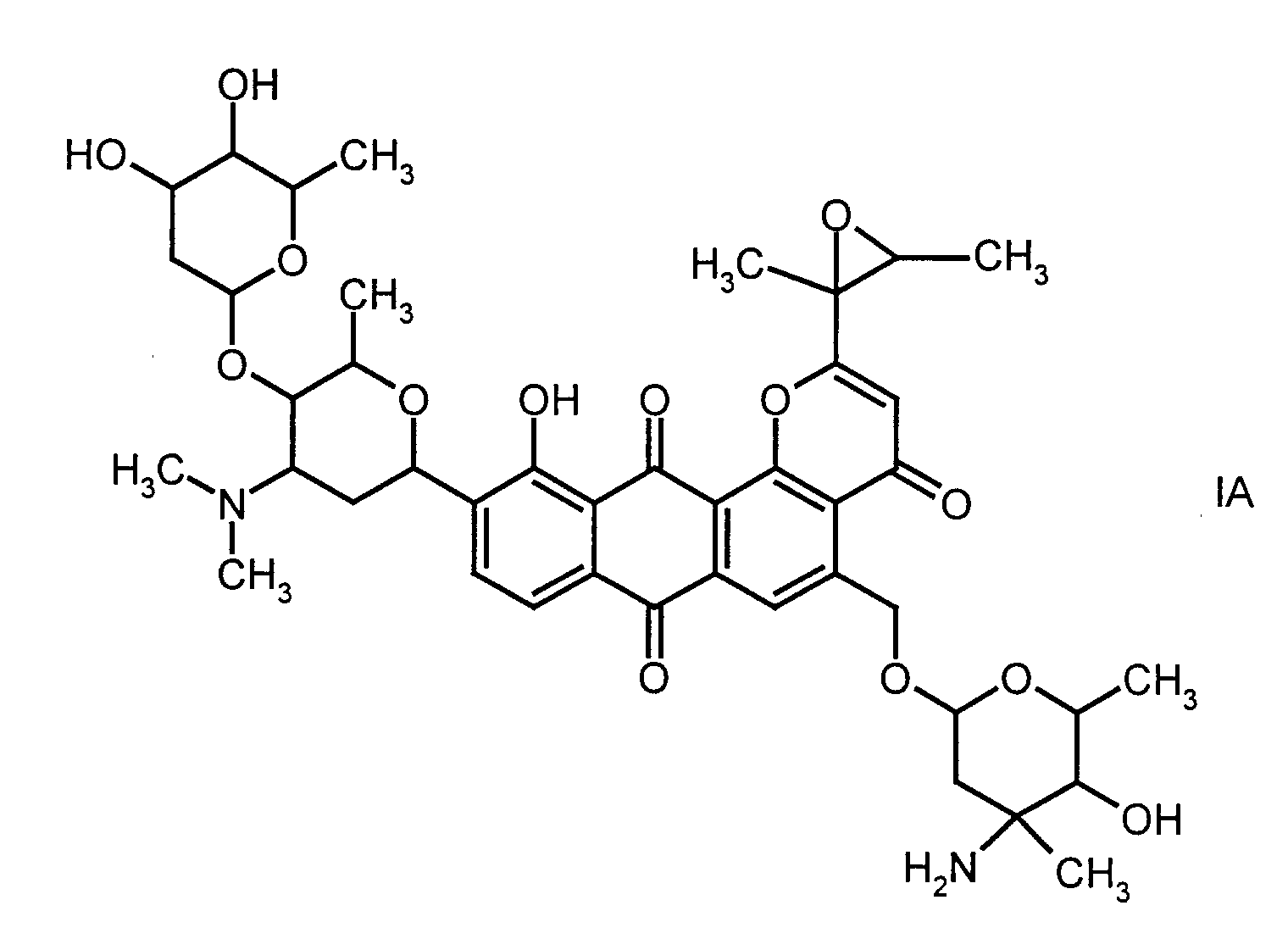
- Verbindung der Formel IBin allen ihren stereochemischen Formen und Gemische dieser Formen in jedem Verhältnis, sowie deren physiologisch verträglichen Salzen.
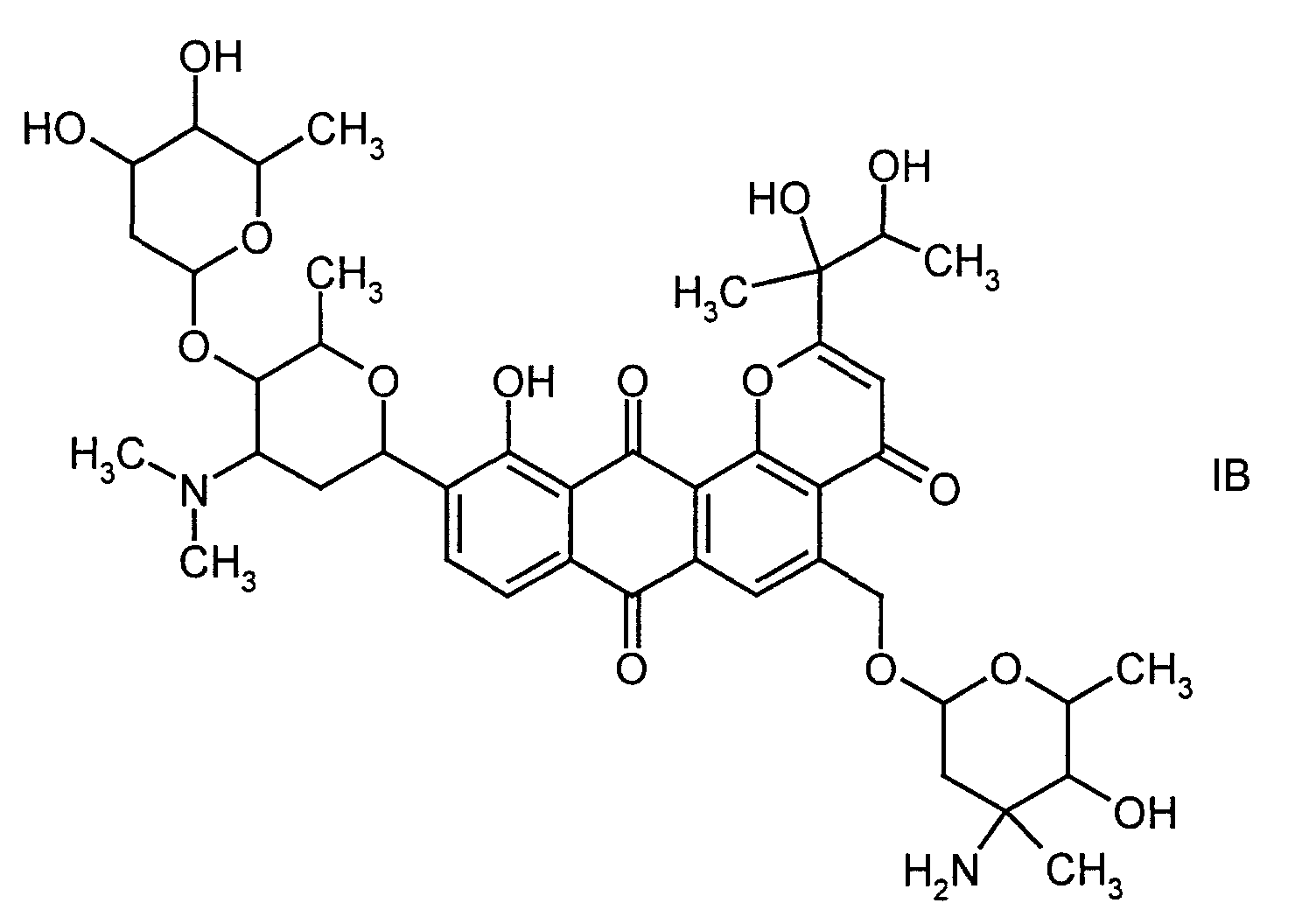
- Verbindung der Formel I gemäß einem oder mehreren der Ansprüche 1 -9, erhältlich durch Fermentierung von Actinomycetales species HAG 003959, DSM 12931, oder einer seiner Varianten oder Mutanten unter geeigneten Bedingungen in einem Kulturmedium, bis sich eine Verbindung der Formel IA und/oder IB in dem Kulturmedium anhäuft und durch anschließende Isolierung der Verbindung und gegebenenfalls Umwandlung in chemische Derivate, sowie deren physiologisch verträglichen Salze.
- Verfahren zur Herstellung einer Verbindung der Formel 1 oder ein physiologisch verträgliches Salz davon gemäß einem oder mehreren der Ansprüche 1 - 10, dadurch gekennzeichnet, daß der Mikroorganismus Actinomycetales species HAG 003959, DSM 12931, oder einer seiner Varianten oder Mutanten unter geeigneten Bedingungen in einem Kulturmedium fermentiert wird, bis sich eine Verbindung der Formel IA und/oder IB in dem Kulturmedium anhäuft und anschließend aus dem Kulturmedium isoliert und gegebenenfalls in chemische Derivate und physiologisch verträglichen Salze umgewandelt werden.
- Verfahren gemäß Anspruch 11, dadurch gekennzeichnet, daß die Fermentation unter aeroben Bedingungen bei einer Temperatur zwischen 18 und 35°C und bei einem pH zwischen 6 und 8 durchgeführt wird.
- Verfahren gemäß Anspruch 11 oder 12 , dadurch gekennzeichnet, daß die Verbindung der Formel IA oder IB mit einem Reduktionsmittel in ein chemisches Derivat umgewandelt wird.
- Verbindung der Formel 1 oder ein physiologisch verträgliches Salz davon gemäß einem oder mehreren der Ansprüche 1 - 10 zur Verwendung als Arzneimittel.
- Verbindung der Formel 1 oder ein physiologisch verträgliches Salz davon gemäß einem oder mehreren der Ansprüche 1 - 10 zur Verwendung alsArzneimittel zur Hemmung von Transkriptasen.
- Verbindung der Formel I oder ein physiologisch verträgliches Salz davongemäß einem oder mehreren der Ansprüche 1 - 10 zur Verwendung als Cytostatikum.
- Pharmazeutische Zubereitung mit einem Gehalt an mindestens einer Verbindung der Formel 1 oder ein physiologisch verträgliches Salz davon gemäß einem oder mehreren der Ansprüche 1-10.
- Verfahren zur Herstellung von pharmazeutischen Zubereitungen gemäß Anspruch 17, dadurch gekennzeichnet, daß man mindestens eine Verbindung der Formel 1 oder ein physiologisch verträgliches Salz davon gemäß einem oder mehreren der Ansprüche 1-10 mit geeigneten Hilfs- und/oder Trägerstoffen in eine geeignete Darreichungsform bringt.
- Actinomycetales species HAG 003959 (DSM 12931).
Priority Applications (34)
| Application Number | Priority Date | Filing Date | Title |
|---|---|---|---|
| EP00103540A EP1125944A1 (de) | 2000-02-18 | 2000-02-18 | Pluraflavine und Derivate davon, Verfahren zu ihrer Herstellung und Verwendung derselben |
| CZ20022826A CZ303810B6 (cs) | 2000-02-18 | 2001-02-15 | Pluraflaviny a jejich deriváty, zpusob jejich prípravy a jejich pouzití |
| MXPA02006919A MXPA02006919A (es) | 2000-02-18 | 2001-02-15 | Pluraflavinas y sus derivados, proceso para su preparacion y uso. |
| ARP010100689A AR027436A1 (es) | 2000-02-18 | 2001-02-15 | Pluraflavinas y sus derivados, procedimiento para su preparacion y utilizacion de los mismos |
| EEP200200438A EE05137B1 (et) | 2000-02-18 | 2001-02-15 | Pluraflaviinid ja nende derivaadid, nende valmistamismeetod ja kasutamine, kompositsioon ja Actinomycetales liik |
| CA002400237A CA2400237C (en) | 2000-02-18 | 2001-02-15 | Pluraflavins and derivatives thereof, process for their preparation and use thereof |
| HK03104938.4A HK1052709B (zh) | 2000-02-18 | 2001-02-15 | Pluraflavin和其衍生物,及它們的製備方法和用途 |
| ES01915255T ES2207609T3 (es) | 2000-02-18 | 2001-02-15 | Pluraflavinas y sus derivados, procedimiento para su preparacion y su uso de las mismas. |
| AU2001242404A AU2001242404B2 (en) | 2000-02-18 | 2001-02-15 | Pluraflavins and derivatives thereof, process for their preparation and use thereof |
| DK01915255T DK1259523T3 (da) | 2000-02-18 | 2001-02-15 | Pluraflaviner og derivater deraf, fremgangsmåde til fremstilling og anvendelse deraf |
| HR20020672A HRP20020672B1 (en) | 2000-02-18 | 2001-02-15 | Pluraflavins and derivatives thereof, process for their preparation and use thereof |
| EP01915255A EP1259523B1 (de) | 2000-02-18 | 2001-02-15 | Pluraflavine und derivate davon, verfahren zu ihrer herstellung und verwendung derselben |
| PCT/EP2001/001660 WO2001060832A2 (en) | 2000-02-18 | 2001-02-15 | Pluraflavins and derivatives thereof, process for their preparation and use thereof |
| AT01915255T ATE255120T1 (de) | 2000-02-18 | 2001-02-15 | Pluraflavine und derivate davon, verfahren zu ihrer herstellung und verwendung derselben |
| RU2002124772/04A RU2255940C2 (ru) | 2000-02-18 | 2001-02-15 | Плюрафлавины, способ их получения и композиция на их основе |
| IL15121601A IL151216A0 (en) | 2000-02-18 | 2001-02-15 | Pluraflavins and derivatives thereof, process for their preparation and use thereof |
| AU4240401A AU4240401A (en) | 2000-02-18 | 2001-02-15 | Pluraflavins and derivatives thereof, process for their preparation and use thereof |
| HU0204393A HU228332B1 (en) | 2000-02-18 | 2001-02-15 | Pluraflavins and derivatives thereof, process for their preparation and use thereof |
| PL358297A PL204842B1 (pl) | 2000-02-18 | 2001-02-15 | Pluraflawiny, sposób ich wytwarzania, kompozycja zawierająca pluraflawiny i ich zastosowanie |
| SK1180-2002A SK286691B6 (sk) | 2000-02-18 | 2001-02-15 | Pluraflavíny a ich deriváty, spôsob ich prípravy a ich použitie |
| SI200130056T SI1259523T1 (en) | 2000-02-18 | 2001-02-15 | Pluraflavins and derivatives thereof, process for their preparation and use thereof |
| DE60101313T DE60101313T2 (de) | 2000-02-18 | 2001-02-15 | Pluraflavine und derivate davon, verfahren zu ihrer herstellung und verwendung derselben |
| PT01915255T PT1259523E (pt) | 2000-02-18 | 2001-02-15 | Pluraflavinas e seus derivados processo para sua preparacao e utilizacao dos mesmos |
| YUP-576/02A RS49991B (sr) | 2000-02-18 | 2001-02-15 | Pluraflavini i njihovi derivati, postupci njihovog dobijanja i upotrebe |
| JP2001560216A JP4801307B2 (ja) | 2000-02-18 | 2001-02-15 | プルラフラビンおよびその誘導体、それらの製造方法および使用 |
| TR2003/02180T TR200302180T4 (tr) | 2000-02-18 | 2001-02-15 | Pluflavinler ve onların türevleri, hazırlanmaları için işlem ve kullanımları |
| CNB01805207XA CN1162441C (zh) | 2000-02-18 | 2001-02-15 | Pluraflavin和其衍生物,及它们的制备方法和用途 |
| KR1020027010629A KR100743380B1 (ko) | 2000-02-18 | 2001-02-15 | 플루라플라빈, 이의 제조 방법 및 이를 포함하는 약제학적 조성물 |
| MEP-2008-286A ME00179B (me) | 2000-02-18 | 2001-02-15 | Pluraflavini i njihovi derivati, postupci njihovog dobijanja i upotrebe |
| BR0108128-4A BR0108128A (pt) | 2000-02-18 | 2001-02-15 | Pluraflavinas e derivados das mesmas, processo para a sua preparação e uso das mesmas |
| US09/784,035 US6500936B2 (en) | 2000-02-18 | 2001-02-16 | Pluraflavins and derivatives thereof, process for their preparation and use thereof |
| IL151216A IL151216A (en) | 2000-02-18 | 2002-08-12 | Fluoroflavins and their derivatives A process for their preparation and use |
| NO20023845A NO323413B1 (no) | 2000-02-18 | 2002-08-14 | Pluraflaviner og derivater derav, prparater omfattende disse, fremgangsmate for fremstilling av disse og deres anvendelse, samt en type actinomycetales. |
| ZA200206795A ZA200206795B (en) | 2000-02-18 | 2002-08-26 | Pluraflavins and derivatives thereof, process for their preparation and use thereof. |
Applications Claiming Priority (1)
| Application Number | Priority Date | Filing Date | Title |
|---|---|---|---|
| EP00103540A EP1125944A1 (de) | 2000-02-18 | 2000-02-18 | Pluraflavine und Derivate davon, Verfahren zu ihrer Herstellung und Verwendung derselben |
Publications (1)
| Publication Number | Publication Date |
|---|---|
| EP1125944A1 true EP1125944A1 (de) | 2001-08-22 |
Family
ID=8167898
Family Applications (2)
| Application Number | Title | Priority Date | Filing Date |
|---|---|---|---|
| EP00103540A Withdrawn EP1125944A1 (de) | 2000-02-18 | 2000-02-18 | Pluraflavine und Derivate davon, Verfahren zu ihrer Herstellung und Verwendung derselben |
| EP01915255A Expired - Lifetime EP1259523B1 (de) | 2000-02-18 | 2001-02-15 | Pluraflavine und derivate davon, verfahren zu ihrer herstellung und verwendung derselben |
Family Applications After (1)
| Application Number | Title | Priority Date | Filing Date |
|---|---|---|---|
| EP01915255A Expired - Lifetime EP1259523B1 (de) | 2000-02-18 | 2001-02-15 | Pluraflavine und derivate davon, verfahren zu ihrer herstellung und verwendung derselben |
Country Status (31)
| Country | Link |
|---|---|
| US (1) | US6500936B2 (de) |
| EP (2) | EP1125944A1 (de) |
| JP (1) | JP4801307B2 (de) |
| KR (1) | KR100743380B1 (de) |
| CN (1) | CN1162441C (de) |
| AR (1) | AR027436A1 (de) |
| AT (1) | ATE255120T1 (de) |
| AU (2) | AU4240401A (de) |
| BR (1) | BR0108128A (de) |
| CA (1) | CA2400237C (de) |
| CZ (1) | CZ303810B6 (de) |
| DE (1) | DE60101313T2 (de) |
| DK (1) | DK1259523T3 (de) |
| EE (1) | EE05137B1 (de) |
| ES (1) | ES2207609T3 (de) |
| HK (1) | HK1052709B (de) |
| HR (1) | HRP20020672B1 (de) |
| HU (1) | HU228332B1 (de) |
| IL (2) | IL151216A0 (de) |
| ME (1) | ME00179B (de) |
| MX (1) | MXPA02006919A (de) |
| NO (1) | NO323413B1 (de) |
| PL (1) | PL204842B1 (de) |
| PT (1) | PT1259523E (de) |
| RS (1) | RS49991B (de) |
| RU (1) | RU2255940C2 (de) |
| SI (1) | SI1259523T1 (de) |
| SK (1) | SK286691B6 (de) |
| TR (1) | TR200302180T4 (de) |
| WO (1) | WO2001060832A2 (de) |
| ZA (1) | ZA200206795B (de) |
Families Citing this family (2)
| Publication number | Priority date | Publication date | Assignee | Title |
|---|---|---|---|---|
| US6989386B2 (en) * | 2002-04-30 | 2006-01-24 | Dana-Farber Cancer Institute | Pharmaceutically active ornithine derivatives, ammonium salts thereof and methods of making same |
| CN101921300B (zh) * | 2009-06-10 | 2014-04-02 | 上海来益生物药物研究开发中心有限责任公司 | 一种异黄酮苷类化合物及其制备方法 |
Citations (1)
| Publication number | Priority date | Publication date | Assignee | Title |
|---|---|---|---|---|
| WO1990009435A1 (en) * | 1989-02-07 | 1990-08-23 | Abbott Laboratories | Altromycin compounds |
Family Cites Families (6)
| Publication number | Priority date | Publication date | Assignee | Title |
|---|---|---|---|---|
| US4187292A (en) * | 1977-03-31 | 1980-02-05 | Takeda Chemical Industries, Ltd. | Antibiotics produced from the microorganism nocardice |
| ATE82982T1 (de) * | 1986-07-21 | 1992-12-15 | Kyowa Hakko Kogyo Kk | Neue mittel dc-92b und dc-92d, sowie deren verfahren zur herstellung. |
| AU623923B2 (en) * | 1988-07-22 | 1992-05-28 | Masco Corporation | A small hand-held shower head for domestic sinks connected to a faucet |
| US5001058A (en) * | 1988-09-19 | 1991-03-19 | Bristol-Myers Company | BU-3839T antibiotic |
| US5168100A (en) * | 1990-03-16 | 1992-12-01 | Sapporo Breweries Limited | Hp530 compounds and process for preparing the same |
| MX2009014082A (es) * | 2007-07-06 | 2010-03-01 | Rite Hite Holding Corp | Barreras de seguridad retráctiles y sus métodos de operación. |
-
2000
- 2000-02-18 EP EP00103540A patent/EP1125944A1/de not_active Withdrawn
-
2001
- 2001-02-15 JP JP2001560216A patent/JP4801307B2/ja not_active Expired - Fee Related
- 2001-02-15 AR ARP010100689A patent/AR027436A1/es not_active Application Discontinuation
- 2001-02-15 RU RU2002124772/04A patent/RU2255940C2/ru not_active IP Right Cessation
- 2001-02-15 CZ CZ20022826A patent/CZ303810B6/cs not_active IP Right Cessation
- 2001-02-15 SK SK1180-2002A patent/SK286691B6/sk not_active IP Right Cessation
- 2001-02-15 TR TR2003/02180T patent/TR200302180T4/xx unknown
- 2001-02-15 WO PCT/EP2001/001660 patent/WO2001060832A2/en not_active Ceased
- 2001-02-15 KR KR1020027010629A patent/KR100743380B1/ko not_active Expired - Fee Related
- 2001-02-15 CA CA002400237A patent/CA2400237C/en not_active Expired - Fee Related
- 2001-02-15 HR HR20020672A patent/HRP20020672B1/xx not_active IP Right Cessation
- 2001-02-15 SI SI200130056T patent/SI1259523T1/xx unknown
- 2001-02-15 RS YUP-576/02A patent/RS49991B/sr unknown
- 2001-02-15 IL IL15121601A patent/IL151216A0/xx unknown
- 2001-02-15 AT AT01915255T patent/ATE255120T1/de active
- 2001-02-15 AU AU4240401A patent/AU4240401A/xx active Pending
- 2001-02-15 AU AU2001242404A patent/AU2001242404B2/en not_active Ceased
- 2001-02-15 HK HK03104938.4A patent/HK1052709B/zh not_active IP Right Cessation
- 2001-02-15 EP EP01915255A patent/EP1259523B1/de not_active Expired - Lifetime
- 2001-02-15 CN CNB01805207XA patent/CN1162441C/zh not_active Expired - Fee Related
- 2001-02-15 PL PL358297A patent/PL204842B1/pl unknown
- 2001-02-15 EE EEP200200438A patent/EE05137B1/xx not_active IP Right Cessation
- 2001-02-15 BR BR0108128-4A patent/BR0108128A/pt not_active Application Discontinuation
- 2001-02-15 DE DE60101313T patent/DE60101313T2/de not_active Expired - Lifetime
- 2001-02-15 DK DK01915255T patent/DK1259523T3/da active
- 2001-02-15 ES ES01915255T patent/ES2207609T3/es not_active Expired - Lifetime
- 2001-02-15 HU HU0204393A patent/HU228332B1/hu not_active IP Right Cessation
- 2001-02-15 PT PT01915255T patent/PT1259523E/pt unknown
- 2001-02-15 MX MXPA02006919A patent/MXPA02006919A/es active IP Right Grant
- 2001-02-15 ME MEP-2008-286A patent/ME00179B/me unknown
- 2001-02-16 US US09/784,035 patent/US6500936B2/en not_active Expired - Lifetime
-
2002
- 2002-08-12 IL IL151216A patent/IL151216A/en not_active IP Right Cessation
- 2002-08-14 NO NO20023845A patent/NO323413B1/no not_active IP Right Cessation
- 2002-08-26 ZA ZA200206795A patent/ZA200206795B/en unknown
Patent Citations (1)
| Publication number | Priority date | Publication date | Assignee | Title |
|---|---|---|---|---|
| WO1990009435A1 (en) * | 1989-02-07 | 1990-08-23 | Abbott Laboratories | Altromycin compounds |
Non-Patent Citations (1)
| Title |
|---|
| BRILL, GREGORY M. ET AL: "Altromycins E, F, G, H and I;additional novel components of the altromycin complex", J. ANTIBIOT. (1994), 47(10), 1160-4, XP002143378 * |
Also Published As
Similar Documents
| Publication | Publication Date | Title |
|---|---|---|
| EP0629636A1 (de) | Lipopeptide aus Actinoplanes sp. mit pharmakologischer Wirkung, Verfahren zu ihrer Herstellung und Verwendung derselben | |
| EP2173756B1 (de) | Makrolakton-derivate | |
| EP1175435B1 (de) | Cephaibole, antiparasitika aus acremonium tubakii, verfahren zu ihrer herstellung und verwendung derselben | |
| DE19745583A1 (de) | Neues Lantibiotikum verwandt mit Actagardine, Verfahren zur Herstellung und Verwendung derselben | |
| EP1280812B1 (de) | Cyclipostine, verfahren zu ihrer herstellung und verwendung derselben | |
| EP1341758B1 (de) | Coniosetin und derivate davon, verfahren zur herstellung und verwendung derselben | |
| EP0829487B1 (de) | Neue Polyenantibiotika 3874 H1 bis H6, Verfahren zu ihrer Herstellung und Verwendung | |
| DE69903465T2 (de) | Vancoresmycin, verfahren zu dessen herstellung und dessen anwendung als arzneimittel | |
| DE60101313T2 (de) | Pluraflavine und derivate davon, verfahren zu ihrer herstellung und verwendung derselben | |
| DE10111682B4 (de) | Caloporosid-Derivate, Verfahren zu deren Herstellung und deren Verwendung | |
| DE69711506T2 (de) | Methylsulfomycin 1, Verfahren zu dessen Herstellung und Verwendung | |
| EP0848064B1 (de) | Neues Antibiotikum, Feglymycin, Verfahren zu seiner Herstellung und Verwendung | |
| EP1519909B1 (de) | Polyencarbonsäure-derivate, verfahren zu ihrer herstellung und ihre verwendung | |
| DE60021109T2 (de) | Amycomycin, verfahren zu dessen herstellung und seine verwendung als arzneimittel | |
| EP1404663B1 (de) | Eurotinone und derivate davon, verfahren zu ihrer herstellung und verwendung derselben | |
| EP0259778B1 (de) | Antibiotisch wirksames Gentisinsäurederivat | |
| DE10206849A1 (de) | Phenalenon-Derivate, Verfahren zur Herstellung und Verwendung derselben | |
| DE3333553A1 (de) | Neues antibiotikum und dieses enthaltende pharmazeutische zusammensetzungen, sowie verfahren zur herstellung desselben | |
| DE4303684A1 (de) | Musacine, neue Metabolite aus Streptomyces sp., und chemische Derivate mit pharmakologischer Wirkung, ein Verfahren zu ihrer Herstellung und ihre Verwendung | |
| DE4305351A1 (de) | Aurantimycin, Peptidantibiotikum aus Streptomyces aurantiacus, und chemische Derivate mit pharmakologischer Wirkung, ein Verfahren zur Herstellung und Verwendung derselben | |
| DE19612807A1 (de) | Neue Benzaldehyd-Derivate aus Hericeum erinaceus | |
| WO2003043984A1 (de) | Gabusectin-derivate, verfahren zur deren herstellung und deren verwendung | |
| DE4337630A1 (de) | MA mit hydroxylierter oder oxidierter Lipidseitenkette und Moenomycin-Analoga, ein Verfahren zur Herstellung und die Verwendung dieser Verbindungen |
Legal Events
| Date | Code | Title | Description |
|---|---|---|---|
| PUAI | Public reference made under article 153(3) epc to a published international application that has entered the european phase |
Free format text: ORIGINAL CODE: 0009012 |
|
| AK | Designated contracting states |
Kind code of ref document: A1 Designated state(s): AT BE CH CY DE DK ES FI FR GB GR IE IT LI LU MC NL PT SE |
|
| AX | Request for extension of the european patent |
Free format text: AL;LT;LV;MK;RO;SI |
|
| STAA | Information on the status of an ep patent application or granted ep patent |
Free format text: STATUS: THE APPLICATION HAS BEEN WITHDRAWN |
|
| 18W | Application withdrawn |
Withdrawal date: 20020212 |