EP1125964A2 - Procédé et dispositif de rechapage de pneus - Google Patents
Procédé et dispositif de rechapage de pneus Download PDFInfo
- Publication number
- EP1125964A2 EP1125964A2 EP01103451A EP01103451A EP1125964A2 EP 1125964 A2 EP1125964 A2 EP 1125964A2 EP 01103451 A EP01103451 A EP 01103451A EP 01103451 A EP01103451 A EP 01103451A EP 1125964 A2 EP1125964 A2 EP 1125964A2
- Authority
- EP
- European Patent Office
- Prior art keywords
- plasma
- rubber
- treated
- carcass
- binding
- Prior art date
- Legal status (The legal status is an assumption and is not a legal conclusion. Google has not performed a legal analysis and makes no representation as to the accuracy of the status listed.)
- Ceased
Links
Images
Classifications
-
- C—CHEMISTRY; METALLURGY
- C08—ORGANIC MACROMOLECULAR COMPOUNDS; THEIR PREPARATION OR CHEMICAL WORKING-UP; COMPOSITIONS BASED THEREON
- C08J—WORKING-UP; GENERAL PROCESSES OF COMPOUNDING; AFTER-TREATMENT NOT COVERED BY SUBCLASSES C08B, C08C, C08F, C08G or C08H
- C08J5/00—Manufacture of articles or shaped materials containing macromolecular substances
- C08J5/12—Bonding of a preformed macromolecular material to the same or other solid material such as metal, glass, leather, e.g. using adhesives
-
- B—PERFORMING OPERATIONS; TRANSPORTING
- B29—WORKING OF PLASTICS; WORKING OF SUBSTANCES IN A PLASTIC STATE IN GENERAL
- B29D—PRODUCING PARTICULAR ARTICLES FROM PLASTICS OR FROM SUBSTANCES IN A PLASTIC STATE
- B29D30/00—Producing pneumatic or solid tyres or parts thereof
- B29D30/0005—Pretreatment of tyres or parts thereof, e.g. preheating, irradiation, precuring
-
- B—PERFORMING OPERATIONS; TRANSPORTING
- B29—WORKING OF PLASTICS; WORKING OF SUBSTANCES IN A PLASTIC STATE IN GENERAL
- B29D—PRODUCING PARTICULAR ARTICLES FROM PLASTICS OR FROM SUBSTANCES IN A PLASTIC STATE
- B29D30/00—Producing pneumatic or solid tyres or parts thereof
- B29D30/06—Pneumatic tyres or parts thereof (e.g. produced by casting, moulding, compression moulding, injection moulding, centrifugal casting)
- B29D30/52—Unvulcanised treads, e.g. on used tyres; Retreading
- B29D30/54—Retreading
- B29D30/56—Retreading with prevulcanised tread
-
- C—CHEMISTRY; METALLURGY
- C08—ORGANIC MACROMOLECULAR COMPOUNDS; THEIR PREPARATION OR CHEMICAL WORKING-UP; COMPOSITIONS BASED THEREON
- C08J—WORKING-UP; GENERAL PROCESSES OF COMPOUNDING; AFTER-TREATMENT NOT COVERED BY SUBCLASSES C08B, C08C, C08F, C08G or C08H
- C08J7/00—Chemical treatment or coating of shaped articles made of macromolecular substances
- C08J7/12—Chemical modification
- C08J7/123—Treatment by wave energy or particle radiation
-
- B—PERFORMING OPERATIONS; TRANSPORTING
- B29—WORKING OF PLASTICS; WORKING OF SUBSTANCES IN A PLASTIC STATE IN GENERAL
- B29C—SHAPING OR JOINING OF PLASTICS; SHAPING OF MATERIAL IN A PLASTIC STATE, NOT OTHERWISE PROVIDED FOR; AFTER-TREATMENT OF THE SHAPED PRODUCTS, e.g. REPAIRING
- B29C66/00—General aspects of processes or apparatus for joining preformed parts
- B29C66/01—General aspects dealing with the joint area or with the area to be joined
- B29C66/02—Preparation of the material, in the area to be joined, prior to joining or welding
- B29C66/024—Thermal pre-treatments
-
- B—PERFORMING OPERATIONS; TRANSPORTING
- B29—WORKING OF PLASTICS; WORKING OF SUBSTANCES IN A PLASTIC STATE IN GENERAL
- B29D—PRODUCING PARTICULAR ARTICLES FROM PLASTICS OR FROM SUBSTANCES IN A PLASTIC STATE
- B29D30/00—Producing pneumatic or solid tyres or parts thereof
- B29D30/0005—Pretreatment of tyres or parts thereof, e.g. preheating, irradiation, precuring
- B29D2030/0011—Surface activation of tyres or parts thereof, e.g. by plasma treatment
-
- B—PERFORMING OPERATIONS; TRANSPORTING
- B29—WORKING OF PLASTICS; WORKING OF SUBSTANCES IN A PLASTIC STATE IN GENERAL
- B29D—PRODUCING PARTICULAR ARTICLES FROM PLASTICS OR FROM SUBSTANCES IN A PLASTIC STATE
- B29D30/00—Producing pneumatic or solid tyres or parts thereof
- B29D30/06—Pneumatic tyres or parts thereof (e.g. produced by casting, moulding, compression moulding, injection moulding, centrifugal casting)
- B29D30/52—Unvulcanised treads, e.g. on used tyres; Retreading
- B29D30/54—Retreading
- B29D2030/544—Applying an intermediate adhesive layer, e.g. cement or cushioning element between carcass and tread
-
- C—CHEMISTRY; METALLURGY
- C08—ORGANIC MACROMOLECULAR COMPOUNDS; THEIR PREPARATION OR CHEMICAL WORKING-UP; COMPOSITIONS BASED THEREON
- C08J—WORKING-UP; GENERAL PROCESSES OF COMPOUNDING; AFTER-TREATMENT NOT COVERED BY SUBCLASSES C08B, C08C, C08F, C08G or C08H
- C08J2321/00—Characterised by the use of unspecified rubbers
Definitions
- the invention relates to a method for connecting vulcanized Rubber surfaces and in particular a method for retreading tires and a retreading device.
- Both procedures require the preparation of the carcass Removal of the worn tread and peeling / Roughen to create a uniform surface that is in is curved in a plane parallel to the axis of the tire (the so-called “rough radius” and the “rough contour”). This creates a predetermined degree of roughness to weld on of the new tread.
- An advantageous lap renewal device is, for example in EP-0 637 506 B1, which is incorporated herein by reference in the disclosure is recorded.
- DE 690 27 303 T2 describes a method for surface treatment known from polymers in which reinforcing polymers for a direct bond to rubber in a plasma chamber treated, which are a polymerizing gas or contains a polymerizing gas mixture.
- EP 0 591 843 B1 also discloses a process for the production a rubber article containing a polymeric reinforcement, the polymeric reinforcement being plasma treated and then into an unvulcanized rubber composition is introduced.
- the invention is therefore based on the object of a method according to the preamble of claim 1 to create the optimal connection of vulcanized rubber surfaces, in particular when retreading tires, allows, as well a corresponding device for performing the method to provide.
- plasma In addition to solids, liquids and gases, plasma is considered to be so-called "fourth state of matter". It is about a Kind of gag cloud with electrically charged particles (ions) are very reactive. In the state of the art you do takes advantage of this property to provide a smooth surface, for example in the. Aerospace Industry to produce suitable smoother. Surfaces for gluing, The parts are glued before using Plasma cleaned optimally.
- the compound or adhesion between two vulcanized rubber surfaces can be increased significantly by at least one of the vulcanized rubber surfaces before application of the Binding rubber or the binding rubber mixture, which is usually a unvulcanized rubber compound, with a Plasma is treated.
- both are vulcanized Rubber surfaces plasma treated.
- the binding rubber mixture is plasma treated. If the. Bind rubber extruded directly plasma treatment of the binding rubber can advantageously after the extrudate has been applied. If however, the binding rubber is applied in the form of a calendered layer the plasma treatment of the binding rubber can also before application to the vulcanized rubber surface respectively.
- the invention provides particularly advantageous results a method for retreading tires according to one of the Claims 8 to 12.
- a device for retreading tires according to one of the claims 13 to 17 are provided.
- Plasma can be any known to those skilled in the art Procedures are used.
- resulting particles e.g. radical ions, electrons, Molecules
- Plasma treatment is generally between low pressure plasma and normal pressure plasma.
- a reduced pressure e.g. 0.5 to 2 mbar
- a gas or introduced a gas mixture By applying a high frequency AC voltage, a gas discharge (plasma) is ignited, whereby the gas is converted to the ionized state.
- a gas can preferably be air, noble gases, oxygen or nitrogen, especially air, can be used.
- the resulting Fragments of the gas or the gas mixture meet in the inventive Process on the surface of the vulcanized Rubber compounds and effect their modification.
- Advantageous the low pressure plasma process is the high efficiency, because the life of the active particles at reduced pressure is high. Due to the closed process space, defined Gases or gas mixtures are used. Furthermore an inhomogeneous or insufficient activation is avoided.
- rubber mixtures can be made from various Materials are used. So mixtures that are considered Rubber component e.g. Natural rubber (NR), butadiene rubber (BR), styrene-butadiene copolymer (SBR), butyl rubber, synthetic polyisoprene, ethylene-propylene-diene copolymer and other sulfur-crosslinkable rubbers and mixtures included from this can be used.
- Rubber component e.g. Natural rubber (NR), butadiene rubber (BR), styrene-butadiene copolymer (SBR), butyl rubber, synthetic polyisoprene, ethylene-propylene-diene copolymer and other sulfur-crosslinkable rubbers and mixtures included from this can be used.
- the rubber materials mentioned find in particular provided with conventional additives in the production of solid rubber tires and pneumatic tires for cars and trucks use.
- the corona discharge is applied. This procedure is Can be accomplished inexpensively and with little equipment.
- the Katushuk surface in the immediate vicinity serves as the tread of this gas discharge.
- the advantage the radio frequency radio discharge is that the Corona treatment of the surface energetically regulated and optimized can be.
- the low frequency spark discharge works at 50 to 60Hz.
- the low frequency discharge will preferred for the method according to the invention, since a simple Implementation due to the lower expenditure on equipment can.
- Air is preferably used as the gas medium. Due to the easy handling of the associated device can the surface can be treated easily. In principle but other gases are also conceivable that are able to Suitable surface to modify, such as oxygen and nitrogen. About the vulcanization process at the interface with the binding rubber to influence positively, it is conceivable the surface to be provided with sulfur-containing substances.
- Suitable devices for the plasma treatment of surfaces are for example from DE 298 05 999 from Agodyn Hochputstechnik GmbH and from DE 195 32 412 of same applicant known. So it is according to newer procedures Surface treatment possible for plasma (pre) cleaning to be carried out at normal pressure, e.g. with the Plasmatreat system from Agrodyn High Voltage Technology GmbH, Steinhagen.
- Device used for plasma generation dimensioned so that the vulcanized rubber surface to be treated is flat can be plasma treated.
- one or more devices for plasma surface treatment can be used in parallel or sequentially become.
- the surface of the carcass in a spiral band or in several parallel bands be plasma treated around the circumference of the carcass.
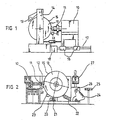
- a carcass 13 is in a tire building system 14 stored with a known construction, with a center drive is provided for rotating the carcass 13.
- the extruder 10 is slidable toward the carcass and guided away from the carcass by means of four ball bearing boxes 16, two of which are shown and which are easy to slide allow the extruder 10 on rails 17.
- a working cylinder 18 moves the extruder relative to the tire building system 14, preferably pneumatic, which is also an easy one adjustable approach force for the application shoe of the nozzle mouthpiece 12 for deforming the carcass 13, as explained below.
- the tire building system 14 also has a rolling device 19 for the pre-vulcanized tread after this on the surfaces 15 provided with binding rubber Carcass 13 is applied in a known manner.
- the plasma treatment device 28 is arranged so that the Plasma treatment of the carcass surface immediately before The binding rubber is applied. It has an electrode head with two electrodes (not shown), and will at a distance of about 4 to 15 mm from the person to be treated Carcass surface, e.g. from conventional silica containing rubber mixture, introduced so that the gas particles discharged during the ignition of the electrodes (Air particles) can act on the surface. A corresponding Air flow causes the discharged particles are carried out from between the electrodes and hit the surface of the katushuk.
- the treatment time is approx. 0.17 to 0.3 sec.
- For the specified system (Arcojet PG 051) was the sum of the treatment times for both rubber surfaces approx.> 0.8 sec.
- Fig. 2 shows an integrated unit of a binding rubber extruder 10 and a tire building system, with the same reference numerals refer to the same parts as in Fig. 1.
- a pivot arm 20 which is about a pivot point 21st is pivotable by a linear screw drive 22, which is actuated by an electric motor 23.
- This arrangement allows the tire carcass 13 in the position shown can move in an arc, which is approximated to the horizontal, and essentially pressed radially against the extrusion nozzle 12 according to the invention with an approach force by the drive motor 23 of the linear drive 22, which acts on the swivel arm 20, monitored becomes.
- the swivel arm 20 serve to easily assemble the carcass 13 from the floor to allow, as well, the carcass 13 into the unit for to press the application of the tread and the rolling 24, towards the carcass for guiding the precured Tread from the roller table 25 and for attaching at least the rolling force against the carcass by means of the Roll 26 can be pivoted.
- This embodiment creates a particularly effective and rapid integration of all work steps for tire building in a pre-vulcanized process, details from the - not prepublished - DE-A1-42 03 027, to which full reference is made.
- the plasma treatment device 28 is similar integrated as in the device according to FIG. 1. It can also an additional plasma treatment device (not shown) for the treatment of the side facing the binding rubber of the tread be provided, especially after the turntable 25 or at the level of the unit for applying the Tread and rolling 24.
Landscapes
- Chemical & Material Sciences (AREA)
- Engineering & Computer Science (AREA)
- Organic Chemistry (AREA)
- Health & Medical Sciences (AREA)
- Chemical Kinetics & Catalysis (AREA)
- Medicinal Chemistry (AREA)
- Polymers & Plastics (AREA)
- Mechanical Engineering (AREA)
- Manufacturing & Machinery (AREA)
- Materials Engineering (AREA)
- General Chemical & Material Sciences (AREA)
- Tyre Moulding (AREA)
- Treatments Of Macromolecular Shaped Articles (AREA)
- Separation, Recovery Or Treatment Of Waste Materials Containing Plastics (AREA)
Applications Claiming Priority (2)
| Application Number | Priority Date | Filing Date | Title |
|---|---|---|---|
| DE10007143 | 2000-02-17 | ||
| DE2000107143 DE10007143B4 (de) | 2000-02-17 | 2000-02-17 | Runderneuerungsverfahren |
Publications (2)
| Publication Number | Publication Date |
|---|---|
| EP1125964A2 true EP1125964A2 (fr) | 2001-08-22 |
| EP1125964A3 EP1125964A3 (fr) | 2002-08-14 |
Family
ID=7631244
Family Applications (1)
| Application Number | Title | Priority Date | Filing Date |
|---|---|---|---|
| EP01103451A Ceased EP1125964A3 (fr) | 2000-02-17 | 2001-02-14 | Procédé et dispositif de rechapage de pneus |
Country Status (2)
| Country | Link |
|---|---|
| EP (1) | EP1125964A3 (fr) |
| DE (1) | DE10007143B4 (fr) |
Cited By (4)
| Publication number | Priority date | Publication date | Assignee | Title |
|---|---|---|---|---|
| EP1759829A1 (fr) | 2005-08-31 | 2007-03-07 | The Goodyear Tire & Rubber Company | Procédé de préparation d'un pneumatique utilisant un traitement au plasma |
| CN107283888A (zh) * | 2017-06-21 | 2017-10-24 | 太仓轮达汽车配件有限公司 | 一种轮胎翻新用的前后挤压胎面的胎面贴合装置 |
| EP3237189A4 (fr) * | 2014-12-22 | 2018-08-01 | Bridgestone Americas Tire Operations, LLC | Procédé d'application d'un stratifié postdurcissement à un pneu |
| EP4098429A1 (fr) * | 2021-06-04 | 2022-12-07 | Continental Reifen Deutschland GmbH | Procédé de préparation de composants de pneu pour l'utilisation lors du rechapage à froid des pneus |
Families Citing this family (1)
| Publication number | Priority date | Publication date | Assignee | Title |
|---|---|---|---|---|
| DE102017221102B4 (de) | 2017-11-24 | 2020-12-17 | Technische Universität Clausthal | Verfahren und Vorrichtung zur Entvulkanisierung von vulkanisiertem Gummi |
Family Cites Families (14)
| Publication number | Priority date | Publication date | Assignee | Title |
|---|---|---|---|---|
| DE3827598A1 (de) * | 1988-08-13 | 1990-02-15 | Bayer Ag | Verfahren zur herstellung eines verbundsystems aus einem gummielastischen material und einer polyurethanschaumstoff-schicht |
| US5053246A (en) * | 1990-03-30 | 1991-10-01 | The Goodyear Tire & Rubber Company | Process for the surface treatment of polymers for reinforcement-to-rubber adhesion |
| US5462617A (en) * | 1991-05-30 | 1995-10-31 | Bandag Licensing Corporation | Tire bonding systems |
| GB2259185B (en) * | 1991-08-20 | 1995-08-16 | Bridgestone Corp | Method and apparatus for surface treatment |
| DE4203027A1 (de) * | 1992-02-03 | 1993-08-05 | Az Formen & Maschbau Gmbh | Runderneuerungsvorrichtung |
| CA2088814A1 (fr) * | 1992-10-05 | 1994-04-06 | Dane Kenton Parker | Procede servant a ameliorer le liage interfacial entre des fibres et du caoutchouc |
| US5466424A (en) * | 1992-12-28 | 1995-11-14 | Bridgestone Corporation | Corona discharge surface treating method |
| DE9314733U1 (de) * | 1993-08-05 | 1994-06-30 | A-Z Formen- und Maschinenbau GmbH, 80992 München | Runderneuerungsvorrichtung |
| DE19532412C2 (de) * | 1995-09-01 | 1999-09-30 | Agrodyn Hochspannungstechnik G | Vorrichtung zur Oberflächen-Vorbehandlung von Werkstücken |
| JP3395507B2 (ja) * | 1996-02-08 | 2003-04-14 | 株式会社ブリヂストン | 加硫ゴムの表面処理方法及びゴム系複合材料の製造方法 |
| DE19715296C2 (de) * | 1997-04-11 | 1999-05-27 | Continental Ag | Verfahren zur Herstellung eines Rohlings für Fahrzeugreifen |
| DE29805999U1 (de) * | 1998-04-03 | 1998-06-25 | Agrodyn Hochspannungstechnik GmbH, 33803 Steinhagen | Vorrichtung zur Plasmabehandlung von Oberflächen |
| DE19837817C1 (de) * | 1998-08-20 | 2000-02-17 | Continental Ag | Verfahren zur Herstellung eines Fahrzeugluftreifens sowie Fahrzeugluftreifen |
| FR2812653A1 (fr) * | 2000-08-03 | 2002-02-08 | Michelin Soc Tech | Colle pour compositions de caoutchouc, son procede de preparation et articles comportant cette colle |
-
2000
- 2000-02-17 DE DE2000107143 patent/DE10007143B4/de not_active Expired - Fee Related
-
2001
- 2001-02-14 EP EP01103451A patent/EP1125964A3/fr not_active Ceased
Cited By (5)
| Publication number | Priority date | Publication date | Assignee | Title |
|---|---|---|---|---|
| EP1759829A1 (fr) | 2005-08-31 | 2007-03-07 | The Goodyear Tire & Rubber Company | Procédé de préparation d'un pneumatique utilisant un traitement au plasma |
| EP3237189A4 (fr) * | 2014-12-22 | 2018-08-01 | Bridgestone Americas Tire Operations, LLC | Procédé d'application d'un stratifié postdurcissement à un pneu |
| US10406770B2 (en) | 2014-12-22 | 2019-09-10 | Bridgestone Americas Tire Operations, Llc | Method of applying a post cure laminate to a tire |
| CN107283888A (zh) * | 2017-06-21 | 2017-10-24 | 太仓轮达汽车配件有限公司 | 一种轮胎翻新用的前后挤压胎面的胎面贴合装置 |
| EP4098429A1 (fr) * | 2021-06-04 | 2022-12-07 | Continental Reifen Deutschland GmbH | Procédé de préparation de composants de pneu pour l'utilisation lors du rechapage à froid des pneus |
Also Published As
| Publication number | Publication date |
|---|---|
| DE10007143A1 (de) | 2001-09-06 |
| EP1125964A3 (fr) | 2002-08-14 |
| DE10007143B4 (de) | 2005-09-15 |
Similar Documents
| Publication | Publication Date | Title |
|---|---|---|
| DE4227631B4 (de) | Verfahren und Vorrichtung zur Oberflächenbehandlung | |
| EP0637506B1 (fr) | Dispositif de rechapage de pneus | |
| DE19715296C2 (de) | Verfahren zur Herstellung eines Rohlings für Fahrzeugreifen | |
| DE4335150A1 (de) | Profilverstärkende Zusatzschicht für die Laufstreifen von Luftreifen und Verfahren zu ihrer Aufbringung | |
| DE10007143B4 (de) | Runderneuerungsverfahren | |
| DE19837817C1 (de) | Verfahren zur Herstellung eines Fahrzeugluftreifens sowie Fahrzeugluftreifen | |
| DE2744391A1 (de) | Verfahren zum runderneuern von luftreifenlaufflaechen | |
| EP3012095B1 (fr) | Procede de fabrication d'un pneu de vehicule et pneu de vehicule | |
| DE19718701C1 (de) | Verfahren zum Herstellen eines Fahrzeugluftreifens | |
| EP0141087B1 (fr) | Procédé de traitement d'articles ou d'ébauches d'élastomères non vulcanisés | |
| DE60218212T2 (de) | Herstellungsverfahren für nicht vulkanisierte kautschukelemente und reifen | |
| EP0565922B1 (fr) | Procédé et dispositif pour l'élaboration d'un demi-produit en caoutchouc | |
| DE102018116939A1 (de) | Luftreifen | |
| DE10228372A1 (de) | Vorrichtung und Verfahren zur Fülllung von Vertiefungen und zum Verlegen der Unterschicht bei der Runderneuerung von Reifen großer Dimensionen | |
| DE102021211889A1 (de) | Verfahren zur Verbindung von Reifenkomponenten | |
| EP1882531A2 (fr) | Procédé et installation destinés au nettoyage de canaux d'aération pourvus de corps d'aération en plastique | |
| DE102017221102B4 (de) | Verfahren und Vorrichtung zur Entvulkanisierung von vulkanisiertem Gummi | |
| EP0893535A1 (fr) | Procédé et appareil pour le traitement interne de bandes en mouvement, par décharge électrique à pression atmosphérique ou proche | |
| WO2019011493A1 (fr) | Procédé et dispositif de rugosification d'une bande de roulement profilée destinée à un rechapage à froid | |
| DE102021127776A1 (de) | Reifenherstellungsverfahren | |
| US5686505A (en) | Process and apparatus for surface treatment of unvulcanized rubber sheet | |
| DE10119809A1 (de) | Verfahren und Vorrichtung zur Herstellung eines Profils | |
| EP4098429B1 (fr) | Procédé de préparation de composants de pneu pour l'utilisation lors du rechapage à froid des pneus | |
| EP0086977A1 (fr) | Procédé et dispositif pour le traitement de surface de feuilles continues au moyen de décharges électriques par effet de corona | |
| KR101000814B1 (ko) | 대기압 플라즈마를 이용한 트레드의 표면개질방법 |
Legal Events
| Date | Code | Title | Description |
|---|---|---|---|
| PUAI | Public reference made under article 153(3) epc to a published international application that has entered the european phase |
Free format text: ORIGINAL CODE: 0009012 |
|
| AK | Designated contracting states |
Kind code of ref document: A2 Designated state(s): AT BE CH CY DE DK ES FI FR GB GR IE IT LI LU MC NL PT SE TR |
|
| AX | Request for extension of the european patent |
Free format text: AL;LT;LV;MK;RO;SI |
|
| PUAL | Search report despatched |
Free format text: ORIGINAL CODE: 0009013 |
|
| AK | Designated contracting states |
Kind code of ref document: A3 Designated state(s): AT BE CH CY DE DK ES FI FR GB GR IE IT LI LU MC NL PT SE TR |
|
| AX | Request for extension of the european patent |
Free format text: AL;LT;LV;MK;RO;SI |
|
| 17P | Request for examination filed |
Effective date: 20030214 |
|
| AKX | Designation fees paid |
Designated state(s): AT BE CH CY DE DK ES FI FR GB GR IE IT LI LU MC NL PT SE TR |
|
| 17Q | First examination report despatched |
Effective date: 20030718 |
|
| STAA | Information on the status of an ep patent application or granted ep patent |
Free format text: STATUS: THE APPLICATION HAS BEEN REFUSED |
|
| 18R | Application refused |
Effective date: 20040827 |