EP1126002A2 - Verfahren zur Herstellung eines Abdeckklebebandes - Google Patents
Verfahren zur Herstellung eines Abdeckklebebandes Download PDFInfo
- Publication number
- EP1126002A2 EP1126002A2 EP00116916A EP00116916A EP1126002A2 EP 1126002 A2 EP1126002 A2 EP 1126002A2 EP 00116916 A EP00116916 A EP 00116916A EP 00116916 A EP00116916 A EP 00116916A EP 1126002 A2 EP1126002 A2 EP 1126002A2
- Authority
- EP
- European Patent Office
- Prior art keywords
- adhesive
- backing
- laminate
- coating
- onto
- Prior art date
- Legal status (The legal status is an assumption and is not a legal conclusion. Google has not performed a legal analysis and makes no representation as to the accuracy of the status listed.)
- Granted
Links
Images


Classifications
-
- C—CHEMISTRY; METALLURGY
- C09—DYES; PAINTS; POLISHES; NATURAL RESINS; ADHESIVES; COMPOSITIONS NOT OTHERWISE PROVIDED FOR; APPLICATIONS OF MATERIALS NOT OTHERWISE PROVIDED FOR
- C09J—ADHESIVES; NON-MECHANICAL ASPECTS OF ADHESIVE PROCESSES IN GENERAL; ADHESIVE PROCESSES NOT PROVIDED FOR ELSEWHERE; USE OF MATERIALS AS ADHESIVES
- C09J7/00—Adhesives in the form of films or foils
- C09J7/20—Adhesives in the form of films or foils characterised by their carriers
- C09J7/21—Paper; Textile fabrics
-
- C—CHEMISTRY; METALLURGY
- C09—DYES; PAINTS; POLISHES; NATURAL RESINS; ADHESIVES; COMPOSITIONS NOT OTHERWISE PROVIDED FOR; APPLICATIONS OF MATERIALS NOT OTHERWISE PROVIDED FOR
- C09J—ADHESIVES; NON-MECHANICAL ASPECTS OF ADHESIVE PROCESSES IN GENERAL; ADHESIVE PROCESSES NOT PROVIDED FOR ELSEWHERE; USE OF MATERIALS AS ADHESIVES
- C09J7/00—Adhesives in the form of films or foils
- C09J7/30—Adhesives in the form of films or foils characterised by the adhesive composition
- C09J7/38—Pressure-sensitive adhesives [PSA]
-
- C—CHEMISTRY; METALLURGY
- C09—DYES; PAINTS; POLISHES; NATURAL RESINS; ADHESIVES; COMPOSITIONS NOT OTHERWISE PROVIDED FOR; APPLICATIONS OF MATERIALS NOT OTHERWISE PROVIDED FOR
- C09J—ADHESIVES; NON-MECHANICAL ASPECTS OF ADHESIVE PROCESSES IN GENERAL; ADHESIVE PROCESSES NOT PROVIDED FOR ELSEWHERE; USE OF MATERIALS AS ADHESIVES
- C09J2203/00—Applications of adhesives in processes or use of adhesives in the form of films or foils
- C09J2203/31—Applications of adhesives in processes or use of adhesives in the form of films or foils as a masking tape for painting
-
- C—CHEMISTRY; METALLURGY
- C09—DYES; PAINTS; POLISHES; NATURAL RESINS; ADHESIVES; COMPOSITIONS NOT OTHERWISE PROVIDED FOR; APPLICATIONS OF MATERIALS NOT OTHERWISE PROVIDED FOR
- C09J—ADHESIVES; NON-MECHANICAL ASPECTS OF ADHESIVE PROCESSES IN GENERAL; ADHESIVE PROCESSES NOT PROVIDED FOR ELSEWHERE; USE OF MATERIALS AS ADHESIVES
- C09J2400/00—Presence of inorganic and organic materials
- C09J2400/20—Presence of organic materials
- C09J2400/28—Presence of paper
- C09J2400/283—Presence of paper in the substrate
Definitions
- the present invention relates in general to a method and apparatus for making pressure-sensitive tape, and more particularly to a method and apparatus for making masking tape having a non-solvent based foamed adhesive.
- Pressure-sensitive tapes have been commercially used on a large scale for many years. Such tapes are widely used as maskings during painting, for sealing containers, and many other uses where a removably affixed tape is desirable.
- Pressure-sensitive tapes are commonly formed using solvent-based adhesives, whereby an adhesive composition is first dissolved in a volatile solvent and the solution is applied to a tape backing, such as a polymeric strip or a creped paper. Upon heating the adhesive-coated tape, the solvent evaporates to leave a pressure-sensitive adhesive on the backing.
- solvent-based adhesives perform satisfactorily, the use of solvents has certain disadvantages. More specifically, the evaporated volatile solvents must be collected and disposed of properly to avoid environmental pollution, and the solvents must not be overheated to avoid igniting the evaporated fumes.
- Hot melt or thermoplastic adhesives can be used as alternatives to solvent-based adhesives.
- Hot melt adhesives typically are dense, non-solvent based materials comprising a natural or synthetic polymer or polymeric composition and are applied to the backing through extrusion or similar processes. The material is normally solid or semi-solid at room temperature and becomes flowable upon heating to a higher temperature. Upon cooling, the material returns to a solid or semi-solid state.
- Foaming of the adhesive is typically accomplished by adding to the adhesive composition a chemical foaming or blowing agent, which can be broadly classified as either chemical or physical. Chemical foaming or blowing agents form a foam or cell structure by decomposition of the foaming agent when a decomposition temperature is reached. Physical foaming agents, such as chlorinated hydrocarbons, ketones, and alcohols, cause a cell structure to form by evaporation upon heating. In both cases, heating the adhesive-coated tape causes the foaming agents to react and foam the adhesive. Also known are gaseous foaming agents, which are incorporated into a thermoplastic mix at a higher pressure and foam as the pressure is reduced. Thus, foaming or blowing agents cause tiny bubbles to form in the hot melt adhesive, giving the adhesive layer a porous or rough surface finish having improved release characteristics and better aesthetic qualities, such as a desirable dull surface finish.
- a release liner such as a silicone coated paper
- the foaming agent instead of added foaming or blowing agents in the hot melt adhesive.
- U.S. Patent No. 5,605,717 to Simmons et al. discloses a process for vaporizing the moisture present in a release liner by applying a molten hot melt adhesive to a silicone-coated surface of the release liner to cause the moisture present therein to turn to gas and migrate as small bubbles from the silicone coated paper into the adhesive.
- the Simmons patent is not directed towards masking tapes and thus is not concerned with forming a strong bond between the adhesive and the release liner, as evidenced by providing a silicone coated paper instead of an uncoated paper.
- the Simmons patent discloses applying the adhesive in a molten state to the release liner to foam the adhesive. This may be disadvantageous in certain applications, such as when applying a very thin layer of adhesive to a thicker backing, because the backing can act as a heat sink and quickly cool the adhesive to below the boiling point of water such that foaming prematurely ceases.
- a process and apparatus for making masking tape having a foamed adhesive wherein the foamed adhesive is formed by moisture present in the tape that vaporizes and disperses through the adhesive to give the adhesive a foam-like quality.
- a hot melt adhesive without added foaming or blowing agents is applied to an uncoated surface of a backing, such as a creped paper having a moisture content of 2-8%, to form a laminate wherein the hot melt adhesive when applied to the backing is at a sufficiently low temperature that moisture in the backing remains substantially unvaporized.
- the laminate is then heated, such as by a forced air blower or heated roller, to cause the moisture in the backing to vaporize and disperse at least partially through the adhesive.
- the moisture in the backing acts as a foaming agent, thereby eliminating the need for added chemical or physical foaming or blowing agents in the hot melt adhesive as described above.
- heating the laminate also creates a desirable strong bond between the adhesive and the backing.
- the method can be used regardless of how thick the backing is in relation to the adhesive.
- the backing is paper based, such as creped paper, having a surface resembling tiny peaks and valleys.
- the paper backing has a relatively fixed moisture content, such as 2-8%, and in another embodiment about 3-5%, that is controlled by a conditioning unit.
- the backing may also include a release coat on the non-adhesive side to prevent the tape from adhering to itself when wound on a roll, and to inhibit the moisture contained therein from escaping in a direction other than through the adhesive.
- the adhesive is applied to the paper backing in a sufficiently non-flowable state so that it does not significantly flow down into the tiny valleys on the uncoated surface of the backing. Rather, the adhesive contacts the peaks of the backing and is substantially suspended over the valleys.
- the adhesive traps tiny amounts of air between the adhesive and the paper backing during the extrusion process.
- the adhesive-coated backing is then forwarded to a heating device to heat the combination to a temperature of about 300-500° F in order to foam the adhesive and substantially adhere the adhesive to the backing.
- a heating device to heat the combination to a temperature of about 300-500° F in order to foam the adhesive and substantially adhere the adhesive to the backing.
- the moisture in the tape vaporizes and the air trapped between the adhesive and the tape expands, causing water vapor and air to disperse through the adhesive and give the adhesive a foam-like quality.
- no foaming or blowing agents are added to the hot melt adhesive to create the foam-like characteristics.
- the adhesive becomes sufficiently flowable to intimately adhere to the contour of the backing, thus forming an improved bond therebetween.
- the apparatus 10 comprises a roll of backing material 12 mounted to a let off roll 14 , a coating device 16 comprising a die head 18 , a heating device 20, and a take-up roll 30.
- the apparatus 10 can have other forms and other applications without departing from the spirit and scope of the present invention.
- Figure 1 illustrates one embodiment of the present invention for forming a laminate comprising a foamed pressure-sensitive adhesive and a backing.
- a roll of backing material 12 is provided having a relatively fixed moisture content throughout the roll.
- the moisture content is about 2-8%, and more preferably about 3-5%.
- the resulting foamed pressure-sensitive adhesive is affected by the moisture content in the backing.
- the particular moisture content should be determined based on a desired amount of foaming of the adhesive and environmental conditions during processing, such as relative humidity and temperature in the operations environment. Other factors may be considered as well, such as line speed and heating processes.
- a conditioning unit 32 is shown between the let off roll 14 and the coating device 16.
- the conditioning unit 32 comprises a plurality of nozzles for directing steam to both surfaces of the backing material 12.
- the conditioning unit directs steam to the backing material 12 in order to provide the backing material with a moisture content of about 2-8%.
- the conditioning unit may be an off-line unit comprising any conditioning unit known in the art, such as a humidifier, such that the roll of backing material 12 may be stored in the conditioning unit for a sufficient time to achieve the desired moisture content uniformly throughout the roll. If the backing material 12 has a suitable moisture content without using the conditioning unit, the conditioning unit is not required. However, the conditioning unit provides a more precise level of preparation that may be desirable if the moisture content of the roll of backing material is not known or may have fluctuations throughout the roll.
- the roll of backing material 12 is mounted on the let-off roll 14 , which may be controlled by a brake or other tension controlling devices (not shown) in order to provide a suitable degree of tension to the backing material as it is processed through the apparatus 10 .
- a series of tension rollers may be used alone or in combination with the let-off roll 14 to provide tension in the backing material 12 .
- the backing material 12 comprises a backing layer 40 and a release coat 42.
- the backing layer 40 comprises creped paper, although other products, such as fiberglass or cloth, may also be used.
- the backing layer 40 is approximately 1-7 mils in thickness and more particularly about 4 mils in thickness, and includes an uncoated side having a multiplicity of depressions in the surface thereof resembling a series of tiny peaks 44 and valleys 46.
- the peaks 44 and valleys 46 provide more surface area to the backing layer 40 and improve the adhesive characteristics thereof, as discussed more fully below.
- the release coat 42 is applied to the backing layer 40 on a side opposite the side to which a layer of adhesive 50 is applied and is allowed to dry before further processing.
- the release coat 42 comprises a latex or other water-based material, although other materials, such as solvent-based polymers or waxes, may also be used.
- the release coat 42 provides a barrier to the passage of moisture present in the backing material 12 , as well as a release surface so that a finished roll of tape can be easily unrolled without excessively sticking to itself, as discussed more fully below.
- the backing material 12 is advanced to the coating device 16 , wherein the layer of adhesive 50 is applied to the uncoated side of the backing layer 40. As shown in Figures 3 and 4, the layer of adhesive 50 exits the coating device 16 through a die head 18 and contacts the backing layer 40. More specifically, the coating device 16 receives a flow of molten hot melt adhesive 50 from a preparation unit (not shown).
- the hot melt adhesive 50 comprises synthetic rubber and resin, wherein the rubber comprises 50% and the resin 50% by weight. Other combinations and/or materials may also be used, such as acrylic, butyl rubber, and silicone pressure-sensitive adhesives. Natural rubber compositions may also be used either alone or in combination.
- the hot melt adhesive 50 does not contain foaming agents, blowing agents, or surfactants, which are well known in the art and have heretofore been recognized as desirable to promote and stabilize the foaming process.
- the hot melt adhesive 50 is extruded onto the backing material 12 through the die head 18, and may be extruded to provide a desired thickness of adhesive, typically about 0.1-10.0 mils, although the present invention is particularly desirable when using thicknesses of less than 2 mils.
- the die head 18 is positioned such that the hot melt adhesive 50 is in a sufficiently "stiff' state when applied to the backing material 12 that air pockets 48 are created between the adhesive 50 and backing material.
- the adhesive 50 is applied such that the adhesive does not follow the contour of the backing layer 40, i.e., the adhesive does not flow into the valleys 46 of the backing layer, but rather rests on the peaks 44 of the backing layer 40 and does not substantially flow down into the valleys 46 thereof.
- the air pockets 48 are created between the valleys 46 of the backing layer 40 and the adhesive 50.
- the creation of the air pockets 48 may be also be influenced by positioning the die head 18 such that the adhesive 50 is extruded from the die head at an angle X relative to the surface of the backing 40.
- the angle X which may be determined experimentally and ranges between 0-90°, and more specifically between 10-60°, takes into account several characteristics for the apparatus 10 , such as line speed, adhesive temperature at the die head 18, and type of backing material 12.
- line speed adhesive temperature at the die head 18, and type of backing material 12.
- the adhesive 50 cools as it travels towards the backing layer 40 such that the adhesive is in a sufficiently stiff state when it contacts the backing layer that the adhesive rests upon the peaks 44 of the backing layer.
- the adhesive 50 tends to travel a greater distance before contacting the backing layer 40 .
- the adhesive 50 cools to a greater extent as the angle X decreases because the adhesive has more time to cool and has more contact with air before reaching the backing.
- the adhesive 50 cools it becomes less flowable, which causes the adhesive 50 to rest upon the peaks 44 of the backing layer 40 and resist flowing into the valleys 46.
- the amount of air trapped in the air pockets 48 and flowability of the adhesive 50 are at least partially controlled by the angle X of the die head 18, as a cooler adhesive 50 will trap more air in the air pockets 48 and a warmer adhesive will trap less air because the adhesive will be sufficiently flowable and extend toward the valleys 46, thus causing relatively smaller air pockets.
- the adhesive 50 when applied to the backing material 12 is near or below the boiling temperature of water, and thus at a temperature insufficient to cause substantial vaporization of the moisture in the backing layer 40.
- the adhesive 50 at a temperature near or below the boiling temperature of water, the moisture will still be present in the backing layer 40 in the desirable amount for the subsequent foaming process.
- the foaming process of the present invention is particularly advantageous when very thin layers of adhesive 50 are used.
- the adhesive 50 applied to the backing layer 40 is very thin (e.g., 1 mil before foaming) in relation to the backing, the temperature of the adhesive may drop rapidly as the adhesive contacts the backing material 12 because the backing material acts as a heat sink to rapidly draw heat away from the adhesive.
- the adhesive is above the boiling point of water when the adhesive is applied to the release liner in order to foam the adhesive by vaporizing the moisture present in the release liner.
- the rapid temperature drop may cause a very thin layer of adhesive to quickly cool below the boiling point of water, which ceases any further vaporization of the moisture in the release liner.
- the moisture in the release liner may not substantially vaporize and disperse throughout the adhesive, which may cause inferior foaming of the adhesive.
- the present invention allows more precise control of the moisture in the backing layer 40 and of the vaporization of the moisture, by applying the adhesive 50 to the backing material 12 at a temperature near or below the boiling point of water and then advancing the adhesive and backing material to a heating device 20. More specifically, the subsequent heating of the tape using the heating device 20 allows the moisture to substantially vaporize and disperse throughout the adhesive with more control and precision than conventional systems. As such, the present invention allows for the use of very thin adhesives while achieving adequate foaming, as discussed more fully below.
- the tape is advanced to the heating device 20.
- the heating device 20 provides heat to the adhesive-coated tape 49 sufficient to substantially vaporize the moisture in the tape and cause the vapor to disperse through the adhesive 50 so as to foam the adhesive.
- the adhesive has been applied so as to trap air as described above, the trapped air in the air pockets 48 is also heated by the heating device 20 and expands through the adhesive 50 so as to further foam the adhesive.
- Figure 5 shows one embodiment of the present invention wherein the heating device 20 is a forced air heater 60.
- Individual heating elements 61, 62 force heated air 63 against the adhesive-coated tape 49.
- the heated air 63 exits from the heating elements 61, 62 at a temperature of about 500-600° F so that the adhesive-coated tape 49 is heated to a surface temperature of about 300-400° F.
- Other temperatures for the heated air 63 may be used, however, depending on other factors, such as line speed and the moisture content in the adhesive layer 40.
- Figure 6 shows another embodiment of the present invention wherein the heating device 20 is a heated roll 60.
- the heated roll 60 may be heated by any method known in the art, such as by electricity, hot oil, or the like.
- the heated roll 60 contains hot oil at a temperature of about 500° F, such that the adhesive-coated tape 49 is heated to a surface temperature of about 300-400° F.
- Figures 5 and 6 show two embodiments of the heating device 20, the heating device can be of many other configurations, such as infrared or microwave, without departing from the spirit and intent of the present invention.
- the heating device 20 heats the adhesive-coated tape 49 to a temperature of about 300-400°. At this temperature, the moisture in the tape 49 substantially vaporizes and disperses through the adhesive 50 so as to give the adhesive a foam-like quality.
- the trapped air in the air pockets 48 is also heated and expands throughout the adhesive 50.
- the release coat 42 prevents the moisture and trapped air from escaping in a direction away from the adhesive 50 so that substantially all of the liberated water vapor in the tape 49 and trapped air in the air pockets 48 are dispersed throughout the adhesive.
- the adhesive 50 is heated to become sufficiently flowable so that the adhesive flows into the valleys 46 of the backing surface 40 and thus intimately adheres to the contour thereof so that a stronger bond is formed therebetween.
- the present invention allows trapped air and water vapor to act as foaming agents, yet provides sufficient adhesion between the adhesive 50 and the backing layer 40.
- other systems such as the aforementioned Simmons patent, disclose a foamed adhesive without the use of added foaming or blowing agents, the present invention is particularly advantageous for paper masking tapes, where good adhesion between the adhesive and the backing layer is desired.
- the Simmons patent on the other hand, is not directed to making masking tape, as evidenced by the inclusion of a silicone coated paper such that the adhesive is able to release therefrom. Accordingly, the Simmons patent is not concerned with the adhesion between the adhesive and the backing layer.
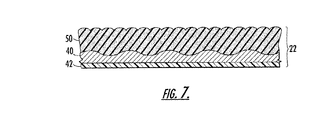
- Figure 7 shows a cross-section of a foamed tape laminate or masking tape 22.
- the adhesive 50 has a foam-like quality and has increased in volume and thickness.
- the foamed adhesive 50 has a thickness of about 2 mils.
- the adhesive 50 follows the contour of the backing layer 40, thus eliminating the air pockets 48 and providing more contact surface area and a stronger bond between the adhesive 50 and the backing layer 40.
- the foamed masking tape 22 is then advanced to a take-up roll 30.
- the take-up roll 30, is a motor-driven roll which is known in the art. Other take-up devices may also be used, such as an accumulator.
- the foamed masking tape 22 may encounter at least one roller 32 before the take-up roll 30 in order to provide tension to the foamed masking tape 22.
- the foamed masking tape 22 should also be sufficiently cooled before being wound onto the take-up roll 30. More specifically, the foamed masking tape 22 should be cooled to a temperature no greater than about 200° F in order to adequately solidify the adhesive 50 and secure contact between the adhesive and the backing layer 40. This cooling can be achieved simply by exposing the tape 22 to air.
Landscapes
- Chemical & Material Sciences (AREA)
- Organic Chemistry (AREA)
- Adhesive Tapes (AREA)
- Application Of Or Painting With Fluid Materials (AREA)
- Adhesives Or Adhesive Processes (AREA)
- Details Or Accessories Of Spraying Plant Or Apparatus (AREA)
Applications Claiming Priority (2)
| Application Number | Priority Date | Filing Date | Title |
|---|---|---|---|
| US09/501,673 US6136371A (en) | 2000-02-10 | 2000-02-10 | Process for making masking tape and apparatus |
| US501673 | 2000-02-10 |
Publications (3)
| Publication Number | Publication Date |
|---|---|
| EP1126002A2 true EP1126002A2 (de) | 2001-08-22 |
| EP1126002A3 EP1126002A3 (de) | 2001-11-28 |
| EP1126002B1 EP1126002B1 (de) | 2006-12-13 |
Family
ID=23994553
Family Applications (1)
| Application Number | Title | Priority Date | Filing Date |
|---|---|---|---|
| EP00116916A Expired - Lifetime EP1126002B1 (de) | 2000-02-10 | 2000-08-05 | Verfahren zur Herstellung eines Abdeckklebebandes |
Country Status (4)
| Country | Link |
|---|---|
| US (1) | US6136371A (de) |
| EP (1) | EP1126002B1 (de) |
| AT (1) | ATE348134T1 (de) |
| DE (1) | DE60032329T2 (de) |
Cited By (4)
| Publication number | Priority date | Publication date | Assignee | Title |
|---|---|---|---|---|
| WO2006076116A1 (en) * | 2005-01-12 | 2006-07-20 | Avery Dennison Corporation | Adhesive article having improved application properties |
| CN103173158A (zh) * | 2013-04-18 | 2013-06-26 | 上海晶华粘胶制品发展有限公司 | 热熔美纹胶带的制作工艺 |
| US9240131B2 (en) | 2007-06-04 | 2016-01-19 | Avery Dennison Corporation | Adhesive articles having repositionability or slidability characteristics |
| CN109504293A (zh) * | 2018-10-29 | 2019-03-22 | 昆山国显光电有限公司 | 光学胶贴合方法及其贴合装置 |
Families Citing this family (6)
| Publication number | Priority date | Publication date | Assignee | Title |
|---|---|---|---|---|
| DE102006062247A1 (de) * | 2006-12-22 | 2008-06-26 | Tesa Ag | Klebschicht für eine blasenfreie Verklebung |
| US20100086778A1 (en) * | 2008-10-08 | 2010-04-08 | Shurtape Technologies, Inc. | Multilayer adhesive tape |
| US20100307411A1 (en) * | 2009-05-12 | 2010-12-09 | 3M Innovative Properties Company | Masking article for producing precise paint lines and method of improving paint line performance of masking articles |
| EP3452230A4 (de) | 2016-05-06 | 2020-01-01 | Bostik, Inc. | Verfahren und system zur verbesserung der kriechleistung bei elastischen anwendungen |
| US20220306420A1 (en) * | 2021-03-24 | 2022-09-29 | Sandar Industries, Inc. | Methods and apparatus to reduce condensation in a track |
| WO2023027972A1 (en) * | 2021-08-25 | 2023-03-02 | Corning Incorporated | Methods for etching glass-based substrates |
Family Cites Families (10)
| Publication number | Priority date | Publication date | Assignee | Title |
|---|---|---|---|---|
| US2940591A (en) * | 1958-08-22 | 1960-06-14 | Minnesota Mining & Mfg | Masking tape |
| US3565247A (en) * | 1968-10-21 | 1971-02-23 | Minnesota Mining & Mfg | Pressure-sensitive adhesive tape product |
| US3503495A (en) * | 1968-11-29 | 1970-03-31 | Minnesota Mining & Mfg | Masking tape |
| US4156754A (en) * | 1977-04-27 | 1979-05-29 | Nordson Corporation | Method of making foamed thermoplastic adhesive materials and adhesive process therefor |
| US4415615A (en) * | 1982-01-15 | 1983-11-15 | Minnesota Mining And Manufacturing Co. | Cellular pressure-sensitive adhesive product and method of making |
| JPH064827B2 (ja) * | 1984-03-29 | 1994-01-19 | 日東電工株式会社 | 接着テ−プの製造方法 |
| DE4032776A1 (de) * | 1990-10-16 | 1992-04-23 | Beiersdorf Ag | Verfahren zur herstellung von poroesen klebstoffschichten, mit solchen verfahren erhaeltliche klebstoffschichten und mit solchen klebstoffschichten beschichtete traeger |
| US5322709A (en) * | 1992-04-28 | 1994-06-21 | Tesa Tuck, Inc. | Production of pressure sensitive hot melt-adhesive coated tape |
| US5605717A (en) * | 1995-06-01 | 1997-02-25 | Morgan Adhesives Company | Process for foaming an adhesive using moisture in a backing |
| JPH1161057A (ja) * | 1997-08-12 | 1999-03-05 | Sekisui Chem Co Ltd | 粘着テープの製造方法 |
-
2000
- 2000-02-10 US US09/501,673 patent/US6136371A/en not_active Expired - Lifetime
- 2000-08-05 EP EP00116916A patent/EP1126002B1/de not_active Expired - Lifetime
- 2000-08-05 DE DE60032329T patent/DE60032329T2/de not_active Expired - Lifetime
- 2000-08-05 AT AT00116916T patent/ATE348134T1/de not_active IP Right Cessation
Cited By (5)
| Publication number | Priority date | Publication date | Assignee | Title |
|---|---|---|---|---|
| WO2006076116A1 (en) * | 2005-01-12 | 2006-07-20 | Avery Dennison Corporation | Adhesive article having improved application properties |
| US8252407B2 (en) | 2005-01-12 | 2012-08-28 | Avery Dennison Corporation | Adhesive article having improved application properties |
| US9240131B2 (en) | 2007-06-04 | 2016-01-19 | Avery Dennison Corporation | Adhesive articles having repositionability or slidability characteristics |
| CN103173158A (zh) * | 2013-04-18 | 2013-06-26 | 上海晶华粘胶制品发展有限公司 | 热熔美纹胶带的制作工艺 |
| CN109504293A (zh) * | 2018-10-29 | 2019-03-22 | 昆山国显光电有限公司 | 光学胶贴合方法及其贴合装置 |
Also Published As
| Publication number | Publication date |
|---|---|
| US6136371A (en) | 2000-10-24 |
| DE60032329T2 (de) | 2007-06-21 |
| ATE348134T1 (de) | 2007-01-15 |
| DE60032329D1 (de) | 2007-01-25 |
| EP1126002B1 (de) | 2006-12-13 |
| EP1126002A3 (de) | 2001-11-28 |
Similar Documents
| Publication | Publication Date | Title |
|---|---|---|
| US4061820A (en) | Self-adhering material | |
| US6136371A (en) | Process for making masking tape and apparatus | |
| US5762643A (en) | Vacuum assisted application of thin vapor permeable, liquid impermeable coatings on apertured substrates and articles produced therefrom | |
| US5858150A (en) | Pressure-sensitive adhesive based on partially oriented and partially crystallized elastomer | |
| JP4805502B2 (ja) | 接着剤塗布方法および接着剤塗布物品 | |
| US3843480A (en) | Dry dry transfer | |
| KR960704966A (ko) | 핫멜트 접착제의 코팅방법 | |
| US5614050A (en) | Method and article for producing flexible, flat substrates with porous adhesive coatings | |
| EP0577768A1 (de) | Druckempfindliches klebeband und sein herstellungsverfahren. | |
| US5525375A (en) | Process for producing hot melt release coating | |
| US3490971A (en) | Foamable layer and method of applying same to substrate | |
| CN1422190A (zh) | 对局部表面涂层进行涂覆的方法和装置 | |
| JPH09324158A (ja) | 粘着テープの製造方法 | |
| JP2801132B2 (ja) | 布粘着テープの製造方法 | |
| JP4156050B2 (ja) | 簡易施工シート及び施工方法 | |
| JPS5936856B2 (ja) | ラミネ−ト物の製造方法およびその装置 | |
| JPH0546936U (ja) | 発泡体基材粘着テープ及びテープ用発泡体基材 | |
| JPS6045063B2 (ja) | マスキング材及びマスキング法 | |
| JPS60203687A (ja) | 接着テ−プの製造方法 | |
| JP3115379B2 (ja) | 剥離紙の製造方法 | |
| JP2526782Y2 (ja) | ポリスチレン系樹脂押出発泡積層板 | |
| JPS60250938A (ja) | プロピレン系樹脂の押出ラミネ−ト方法 | |
| JPH1161057A (ja) | 粘着テープの製造方法 | |
| JP2000301604A (ja) | 易接着性ポリアミドフィルムの製造方法 | |
| JPH1120056A (ja) | 鋼管ライニング用樹脂管とその製造方法 |
Legal Events
| Date | Code | Title | Description |
|---|---|---|---|
| PUAI | Public reference made under article 153(3) epc to a published international application that has entered the european phase |
Free format text: ORIGINAL CODE: 0009012 |
|
| AK | Designated contracting states |
Kind code of ref document: A2 Designated state(s): AT BE CH CY DE DK ES FI FR GB GR IE IT LI LU MC NL PT SE |
|
| AX | Request for extension of the european patent |
Free format text: AL;LT;LV;MK;RO;SI |
|
| PUAL | Search report despatched |
Free format text: ORIGINAL CODE: 0009013 |
|
| AK | Designated contracting states |
Kind code of ref document: A3 Designated state(s): AT BE CH CY DE DK ES FI FR GB GR IE IT LI LU MC NL PT SE |
|
| AX | Request for extension of the european patent |
Free format text: AL;LT;LV;MK;RO;SI |
|
| 17P | Request for examination filed |
Effective date: 20020124 |
|
| 17Q | First examination report despatched |
Effective date: 20020531 |
|
| AKX | Designation fees paid |
Free format text: AT BE CH CY DE DK ES FI FR GB GR IE IT LI LU MC NL PT SE |
|
| GRAP | Despatch of communication of intention to grant a patent |
Free format text: ORIGINAL CODE: EPIDOSNIGR1 |
|
| GRAS | Grant fee paid |
Free format text: ORIGINAL CODE: EPIDOSNIGR3 |
|
| GRAA | (expected) grant |
Free format text: ORIGINAL CODE: 0009210 |
|
| AK | Designated contracting states |
Kind code of ref document: B1 Designated state(s): AT BE CH CY DE DK ES FI FR GB GR IE IT LI LU MC NL PT SE |
|
| PG25 | Lapsed in a contracting state [announced via postgrant information from national office to epo] |
Ref country code: CH Free format text: LAPSE BECAUSE OF FAILURE TO SUBMIT A TRANSLATION OF THE DESCRIPTION OR TO PAY THE FEE WITHIN THE PRESCRIBED TIME-LIMIT Effective date: 20061213 Ref country code: FI Free format text: LAPSE BECAUSE OF FAILURE TO SUBMIT A TRANSLATION OF THE DESCRIPTION OR TO PAY THE FEE WITHIN THE PRESCRIBED TIME-LIMIT Effective date: 20061213 Ref country code: AT Free format text: LAPSE BECAUSE OF FAILURE TO SUBMIT A TRANSLATION OF THE DESCRIPTION OR TO PAY THE FEE WITHIN THE PRESCRIBED TIME-LIMIT Effective date: 20061213 Ref country code: NL Free format text: LAPSE BECAUSE OF FAILURE TO SUBMIT A TRANSLATION OF THE DESCRIPTION OR TO PAY THE FEE WITHIN THE PRESCRIBED TIME-LIMIT Effective date: 20061213 Ref country code: BE Free format text: LAPSE BECAUSE OF FAILURE TO SUBMIT A TRANSLATION OF THE DESCRIPTION OR TO PAY THE FEE WITHIN THE PRESCRIBED TIME-LIMIT Effective date: 20061213 Ref country code: LI Free format text: LAPSE BECAUSE OF FAILURE TO SUBMIT A TRANSLATION OF THE DESCRIPTION OR TO PAY THE FEE WITHIN THE PRESCRIBED TIME-LIMIT Effective date: 20061213 Ref country code: DK Free format text: LAPSE BECAUSE OF FAILURE TO SUBMIT A TRANSLATION OF THE DESCRIPTION OR TO PAY THE FEE WITHIN THE PRESCRIBED TIME-LIMIT Effective date: 20061213 |
|
| REG | Reference to a national code |
Ref country code: GB Ref legal event code: FG4D |
|
| REG | Reference to a national code |
Ref country code: CH Ref legal event code: EP |
|
| REG | Reference to a national code |
Ref country code: IE Ref legal event code: FG4D |
|
| REF | Corresponds to: |
Ref document number: 60032329 Country of ref document: DE Date of ref document: 20070125 Kind code of ref document: P |
|
| PG25 | Lapsed in a contracting state [announced via postgrant information from national office to epo] |
Ref country code: SE Free format text: LAPSE BECAUSE OF FAILURE TO SUBMIT A TRANSLATION OF THE DESCRIPTION OR TO PAY THE FEE WITHIN THE PRESCRIBED TIME-LIMIT Effective date: 20070313 |
|
| PG25 | Lapsed in a contracting state [announced via postgrant information from national office to epo] |
Ref country code: ES Free format text: LAPSE BECAUSE OF FAILURE TO SUBMIT A TRANSLATION OF THE DESCRIPTION OR TO PAY THE FEE WITHIN THE PRESCRIBED TIME-LIMIT Effective date: 20070324 |
|
| PG25 | Lapsed in a contracting state [announced via postgrant information from national office to epo] |
Ref country code: PT Free format text: LAPSE BECAUSE OF FAILURE TO SUBMIT A TRANSLATION OF THE DESCRIPTION OR TO PAY THE FEE WITHIN THE PRESCRIBED TIME-LIMIT Effective date: 20070514 |
|
| NLV1 | Nl: lapsed or annulled due to failure to fulfill the requirements of art. 29p and 29m of the patents act | ||
| REG | Reference to a national code |
Ref country code: CH Ref legal event code: PL |
|
| EN | Fr: translation not filed | ||
| PLBE | No opposition filed within time limit |
Free format text: ORIGINAL CODE: 0009261 |
|
| STAA | Information on the status of an ep patent application or granted ep patent |
Free format text: STATUS: NO OPPOSITION FILED WITHIN TIME LIMIT |
|
| 26N | No opposition filed |
Effective date: 20070914 |
|
| GBPC | Gb: european patent ceased through non-payment of renewal fee |
Effective date: 20070805 |
|
| PG25 | Lapsed in a contracting state [announced via postgrant information from national office to epo] |
Ref country code: GR Free format text: LAPSE BECAUSE OF FAILURE TO SUBMIT A TRANSLATION OF THE DESCRIPTION OR TO PAY THE FEE WITHIN THE PRESCRIBED TIME-LIMIT Effective date: 20070314 Ref country code: MC Free format text: LAPSE BECAUSE OF NON-PAYMENT OF DUE FEES Effective date: 20070831 Ref country code: FR Free format text: LAPSE BECAUSE OF FAILURE TO SUBMIT A TRANSLATION OF THE DESCRIPTION OR TO PAY THE FEE WITHIN THE PRESCRIBED TIME-LIMIT Effective date: 20070803 |
|
| PG25 | Lapsed in a contracting state [announced via postgrant information from national office to epo] |
Ref country code: IE Free format text: LAPSE BECAUSE OF NON-PAYMENT OF DUE FEES Effective date: 20070807 |
|
| PG25 | Lapsed in a contracting state [announced via postgrant information from national office to epo] |
Ref country code: FR Free format text: LAPSE BECAUSE OF FAILURE TO SUBMIT A TRANSLATION OF THE DESCRIPTION OR TO PAY THE FEE WITHIN THE PRESCRIBED TIME-LIMIT Effective date: 20061213 Ref country code: GB Free format text: LAPSE BECAUSE OF NON-PAYMENT OF DUE FEES Effective date: 20070805 |
|
| PG25 | Lapsed in a contracting state [announced via postgrant information from national office to epo] |
Ref country code: LU Free format text: LAPSE BECAUSE OF NON-PAYMENT OF DUE FEES Effective date: 20070805 Ref country code: CY Free format text: LAPSE BECAUSE OF FAILURE TO SUBMIT A TRANSLATION OF THE DESCRIPTION OR TO PAY THE FEE WITHIN THE PRESCRIBED TIME-LIMIT Effective date: 20061213 |
|
| REG | Reference to a national code |
Ref country code: DE Ref legal event code: R079 Ref document number: 60032329 Country of ref document: DE Free format text: PREVIOUS MAIN CLASS: C09J0007040000 Ipc: C09J0007210000 |
|
| PGFP | Annual fee paid to national office [announced via postgrant information from national office to epo] |
Ref country code: IT Payment date: 20190826 Year of fee payment: 20 Ref country code: DE Payment date: 20190828 Year of fee payment: 20 |