EP1126617A2 - Circuit et méthode pour déterminer la différence de phase entre une horloge d'échantillonnage et un signal échantillonné par approximation linéaire - Google Patents
Circuit et méthode pour déterminer la différence de phase entre une horloge d'échantillonnage et un signal échantillonné par approximation linéaire Download PDFInfo
- Publication number
- EP1126617A2 EP1126617A2 EP01300806A EP01300806A EP1126617A2 EP 1126617 A2 EP1126617 A2 EP 1126617A2 EP 01300806 A EP01300806 A EP 01300806A EP 01300806 A EP01300806 A EP 01300806A EP 1126617 A2 EP1126617 A2 EP 1126617A2
- Authority
- EP
- European Patent Office
- Prior art keywords
- sample
- samples
- signal
- circuit
- absolute value
- Prior art date
- Legal status (The legal status is an assumption and is not a legal conclusion. Google has not performed a legal analysis and makes no representation as to the accuracy of the status listed.)
- Withdrawn
Links
Images





Classifications
-
- H—ELECTRICITY
- H04—ELECTRIC COMMUNICATION TECHNIQUE
- H04L—TRANSMISSION OF DIGITAL INFORMATION, e.g. TELEGRAPHIC COMMUNICATION
- H04L7/00—Arrangements for synchronising receiver with transmitter
- H04L7/0054—Detection of the synchronisation error by features other than the received signal transition
-
- G—PHYSICS
- G11—INFORMATION STORAGE
- G11B—INFORMATION STORAGE BASED ON RELATIVE MOVEMENT BETWEEN RECORD CARRIER AND TRANSDUCER
- G11B20/00—Signal processing not specific to the method of recording or reproducing; Circuits therefor
- G11B20/10—Digital recording or reproducing
- G11B20/10009—Improvement or modification of read or write signals
-
- G—PHYSICS
- G11—INFORMATION STORAGE
- G11B—INFORMATION STORAGE BASED ON RELATIVE MOVEMENT BETWEEN RECORD CARRIER AND TRANSDUCER
- G11B20/00—Signal processing not specific to the method of recording or reproducing; Circuits therefor
- G11B20/10—Digital recording or reproducing
- G11B20/10009—Improvement or modification of read or write signals
- G11B20/10037—A/D conversion, D/A conversion, sampling, slicing and digital quantisation or adjusting parameters thereof
-
- G—PHYSICS
- G11—INFORMATION STORAGE
- G11B—INFORMATION STORAGE BASED ON RELATIVE MOVEMENT BETWEEN RECORD CARRIER AND TRANSDUCER
- G11B20/00—Signal processing not specific to the method of recording or reproducing; Circuits therefor
- G11B20/10—Digital recording or reproducing
- G11B20/10009—Improvement or modification of read or write signals
- G11B20/10268—Improvement or modification of read or write signals bit detection or demodulation methods
- G11B20/10287—Improvement or modification of read or write signals bit detection or demodulation methods using probabilistic methods, e.g. maximum likelihood detectors
- G11B20/10296—Improvement or modification of read or write signals bit detection or demodulation methods using probabilistic methods, e.g. maximum likelihood detectors using the Viterbi algorithm
-
- G—PHYSICS
- G11—INFORMATION STORAGE
- G11B—INFORMATION STORAGE BASED ON RELATIVE MOVEMENT BETWEEN RECORD CARRIER AND TRANSDUCER
- G11B20/00—Signal processing not specific to the method of recording or reproducing; Circuits therefor
- G11B20/10—Digital recording or reproducing
- G11B20/14—Digital recording or reproducing using self-clocking codes
- G11B20/1403—Digital recording or reproducing using self-clocking codes characterised by the use of two levels
-
- H—ELECTRICITY
- H03—ELECTRONIC CIRCUITRY
- H03L—AUTOMATIC CONTROL, STARTING, SYNCHRONISATION OR STABILISATION OF GENERATORS OF ELECTRONIC OSCILLATIONS OR PULSES
- H03L7/00—Automatic control of frequency or phase; Synchronisation
- H03L7/06—Automatic control of frequency or phase; Synchronisation using a reference signal applied to a frequency- or phase-locked loop
- H03L7/08—Details of the phase-locked loop
- H03L7/085—Details of the phase-locked loop concerning mainly the frequency- or phase-detection arrangement including the filtering or amplification of its output signal
- H03L7/091—Details of the phase-locked loop concerning mainly the frequency- or phase-detection arrangement including the filtering or amplification of its output signal the phase or frequency detector using a sampling device
-
- H—ELECTRICITY
- H04—ELECTRIC COMMUNICATION TECHNIQUE
- H04L—TRANSMISSION OF DIGITAL INFORMATION, e.g. TELEGRAPHIC COMMUNICATION
- H04L7/00—Arrangements for synchronising receiver with transmitter
- H04L7/04—Speed or phase control by synchronisation signals
- H04L7/041—Speed or phase control by synchronisation signals using special codes as synchronising signal
- H04L2007/047—Speed or phase control by synchronisation signals using special codes as synchronising signal using a sine signal or unmodulated carrier
-
- H—ELECTRICITY
- H04—ELECTRIC COMMUNICATION TECHNIQUE
- H04L—TRANSMISSION OF DIGITAL INFORMATION, e.g. TELEGRAPHIC COMMUNICATION
- H04L7/00—Arrangements for synchronising receiver with transmitter
- H04L7/0016—Arrangements for synchronising receiver with transmitter correction of synchronization errors
- H04L7/002—Arrangements for synchronising receiver with transmitter correction of synchronization errors correction by interpolation
- H04L7/0029—Arrangements for synchronising receiver with transmitter correction of synchronization errors correction by interpolation interpolation of received data signal
Definitions
- the invention relates generally to electronic circuits, and more particularly to a circuit and method for providing an initial phase difference between a disk-drive read signal and a read-signal sample clock using a linear approximation of the read-signal preamble.
- a digital timing-recovery circuit can use this phase difference to provide an initial coarse alignment between the read signal and the sample clock. By providing an initial coarse alignment, the recovery circuit can reduce the overall alignment-acquisition time.
- Switching and other types of noise can cause today's high-speed integrated circuits (ICs) to operate improperly.
- One solution is to electrically isolate a noise-susceptible circuit from a noisy circuit using a ground plane, shielding, or other isolation techniques.
- Another solution is modify the noisy circuit so that it generates less noise.
- FIG. 1 is a block diagram of a conventional disk-drive read channel 10 having a voltage-controlled oscillator (VC0) 12, which may inject noise or transients into other circuits within the read channel 10 or elsewhere.
- the read channel 10 includes a read path 14, which includes a disk 16 for storing data, a read head 18 for reading the disk 16 and for generating a read signal that represents the read data, a read circuit 20 for sampling the read signal in response to a sample clock, and a Viterbi detector 22 for recovering the stored data from the samples of the read signal.
- the read channel 10 also includes a phase-locked timing loop 24 for generating the sample clock, for aligning the sample clock with the read signal such that the read circuit 20 samples the read signal at appropriate times, and for maintaining the alignment of the sample clock.
- the timing loop 24 includes a phase detector 26 for generating an error signal that represents the phase difference between the read signal and the sample clock, a filter 28 for filtering the error signal, the VCO 12 for generating the sample clock at a frequency indicated by the filtered error signal, and a frequency divider 30 for allowing the frequency of the sample clock to be greater than the data rate of the read signal.
- the read circuit 20 effectively closes the loop 24, i.e., couples the loop input to the loop output.
- Figure 2 is a timing diagram showing the desired alignment between the sample clock and the preamble portion of the read signal.
- the preamble is a bit pattern stored at the beginning of every sector (individual sectors not shown) of the disk 16.
- the read channel 10 uses the preamble to calibrate the channel timing with respect to the read signal.
- the read head 18 While reading the preamble, the read head 18 generates a sinusoid (or an approximate sinusoid). The peaks and zero crossings of this preamble sinusoid correspond to the centers of respective data windows 34.
- the centers of the data windows 34 correspond to the data points of the read signal ⁇ the data points are the portions of the read signal that the head 18 generates while positioned directly over the respective storage locations on the surface of the disk 16.
- the timing loop 24 aligns the sample clock with the read signal during the preamble portion and maintains this alignment during the data portion of the read signal.
- a start-up circuit causes the VCO to generate a predetermined edge of the sample clock ⁇ a falling edge in this example - and thus provides a coarse alignment between the preamble sinusoid and the sample clock.
- the timing loop 24 uses negative feedback to align the rising edges of the sample clock with the sinusoid peaks and to align the falling edges of the sample clock with the sinusoid zero crossings.
- the timing loop 24 provides a fine alignment between the preamble sinusoid and the sample clock. At a predetermined time t 1 , the timing loop 24 is deemed to have aligned sample clock with the preamble sinusoid. To maintain this alignment, however, the loop 24 continues to adjust the VCO frequency as necessary during the remainder of the preamble portion and throughout the data portion of the read signal.
- the timing loop 24 may generate noise that adversely affects other circuits such as those in the read path 14. Specifically, the adjusting of the VCO frequency to acquire and maintain alignment between the sample clock and the read signal often generates significant amounts of noise. Because the timing loop 24 is often integrated on the same die as noise-sensitive circuits, isolation techniques such as using ground plane or shielding are often unavailable, ineffective, prohibitively complex, or prohibitively expensive.
- the timing loop 24 often has a relatively high latency, which often limits the data-read rate of the read channel 10.
- the loop's latency is equivalent to the loop delay, or the time it takes for a signal to travel from an arbitrary starting point in the loop, through the loop, and back to the starting point.
- the phase detector 26 processes a sample of the read signal
- the filtered error signal adjusts the frequency of the sample clock, in response to the phase difference between the sample point of the read signal and the sample clock
- the read circuit 20 generates a subsequent sample in response to the adjusted sample clock, and then the process repeats.
- the timing loop 24 effectively responds more slowly to phase changes between the read signal and sample clock, and thus the loop's margin of stability decreases. If the frequency of the sample clock increases beyond the frequency of the loop 24, then the loop 24 oscillates and causes the read channel 10 to operate improperly. Thus, the relatively high latency of the loop 24 limits the frequency of the sample clock, and thus limits the data-read rate of the read channel 10.
- a conventional digital timing-recovery loop does not suffer from the above-described limitations of the timing loop 24 ( Figure 1).
- a digital timing-recovery loop includes a free-running VCO having a frequency that corresponds to the expected rate at which the read head 18 will read data bits from the disk 16. But instead of adjusting the VCO frequency to acquire and maintain alignment between the sample clock and the read signal, the digital timing-recovery loop adjusts the values of the read samples to the values they would have had if the sample clock and read signal were aligned.
- the digital timing-recovery loop lacks a start-up circuit to provide a coarse alignment between the sample clock and the read signal. Without such a start-up circuit, the digital timing-recovery loop requires a longer time to acquire alignment than the timing loop 24, and thus requires a longer preamble. Because the preamble data pattern is stored at the beginning of each sector of the disk 16, the longer the preamble, the fewer the data bits that the disk 16 can store, and thus the lower the disk's data-storage density.
- a circuit in one aspect of the invention, includes a buffer, an approximation circuit, and an interpolator.
- the buffer receives and stores first and second samples of a periodic signal having a peak amplitude.
- the approximation circuit linearly approximates a portion of the periodic signal, and calculates the relative phase of one of the samples within the signal portion.
- the interpolator then calculates the absolute phase of the one sample with respect to a predetermined point of the signal using the relative phase of the sample within the signal portion and the values of the first and second samples.
- Such a circuit can be used to decrease the alignment-acquisition time of a digital timing-recovery loop, and thus allows a shortening of the preamble and a corresponding increase in the data-storage density of a disk.
- the circuit determines an initial phase difference between a disk-drive read signal and a read-signal sample clock.
- the digital timing-recovery circuit uses this phase difference to provide an initial coarse alignment between the read signal and the sample clock. By providing an initial coarse alignment, the recovery circuit reduces the overall alignment-acquisition time.
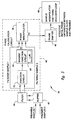
- FIG. 3 is a block diagram of an initial-phase circuit 38 according to an embodiment of the invention.
- the circuit 38 determines an initial phase difference between a disk-drive read signal and a read-signal sample clock.
- a read-sample-interpolator-and-digital-timing-recovery circuit 40 uses this initial phase difference to provide an initial coarse alignment between the read signal and the sample clock. Providing this initial coarse alignment often reduces the overall read-signal/sample-clock alignment-acquisition time, and thus allows one to use a shorter preamble, which allows a corresponding increase in the data-storage density of a storage disk.
- the initial-phase circuit 38 includes a conventional buffer 42 for receiving and storing read-signal samples, a conventional filter 44 for filtering the samples, a phase calculation circuit 46 for calculating the initial phase difference between the read signal and the sample clock, and a phase shifter 48 for adding an anticipated post-sampling phase shift to the initial phase difference.
- the circuit 38 provides this shifted initial phase difference to the circuit 40, which uses this phase difference to obtain an initial coarse alignment between the read signal and the sampling clock.
- the buffer 42, filter 44, and shifter 48 may be omitted such that the circuit 46 receives the read-signal samples directly and provides the initial phase difference directly to the circuit 40.
- the buffer 42 receives and stores first and second raw samples of the read signal from respective sampling analog-to-digital (A/D) converters (not shown).
- the buffer 42 receives eight first raw samples that correspond to eight respective rising edges of the sample clock ( Figures 4 - 10), and receives eight second raw samples that correspond to eight respective falling edges of the sample clock.
- the buffer 42 may receive the first raw samples alternated with the second raw samples - first raw sample #1, second raw sample #1, first raw sample #2, second raw sample #2 ... - from a single A/D converter.
- the filter 44 receives the first and second raw samples from the buffer 40 and filters the raw samples to generate a first filtered sample and a second filtered sample. In one embodiment, the filter 44 sets the first filtered sample equal to the average of the first raw samples, and sets the second filtered sample equal to the average of the second raw samples. This averaging typically eliminates most or all of the noise superimposed on the read signal.
- the phase-calculation circuit 46 includes a function circuit 52 for calculating a value that represents the relative phase difference ⁇ ', or the absolute phase difference ⁇ between the read signal and the sample clock, an inverse function circuit 54 for calculating ⁇ ' or ⁇ from the calculated value, and an optional phase interpolator 56 for calculating ⁇ in embodiments where the circuits 52 and 54 calculate only ⁇ '.
- the circuit 46 calculates ⁇ equal to the absolute phase lead of a sample-clock rising edge - which in these embodiments corresponds to the first filtered sample as discussed above - with respect to the immediately succeeding peak of the preamble sinusoid.
- the function circuit 52 calculates the tangent of the absolute phase lead ⁇ equal to the ratio of the first filtered sample to the second filtered sample.
- the circuit 54 includes a look-up memory 58, which provides ⁇ equal to the arctangent of this ratio. Therefore, in this embodiment, the phase interpolator 56 is omitted.
- the circuit 46 takes advantage of the range of the tangent magnitudes, and thus the range of the corresponding arctangent values, being the same for each quadrant of the preamble sinusoid.
- the size of the look-up memory 58 is half that of the memory 58 in the first embodiment, and the arctangent value provided by the memory 58, i.e., the relative phase lead ⁇ ', is the phase lead of the first filtered sample within the quadrant of the preamble sinusoid with which the sample coincides.
- the interpolator 56 identifies this quadrant by examining the polarities of the first and second filtered samples. The interpolator 56 then combines this quadrant information with ⁇ ' to calculate ⁇ .
- the circuit 46 takes advantage of the range of the tangent magnitudes from 0 to 1, and thus the range of corresponding arctangent values, being the same for each half quadrant of the preamble sinusoid. Consequently, the look-up memory 58 need only store half a quadrant's worth of arctangent values.
- the size of the memory 58 is half the size of the memory 58 in the second embodiment of the circuit 46 and one quarter the size of the memory 58 in the first embodiment.
- the function circuit 52 determines the ratio of the minimum of the first and second samples to the maximum of the first and second samples. This insures that the ratio, and thus the tangent of ⁇ ', is always between 0 and 1.
- the arctangent value ⁇ ' provided by the memory 58 is the relative phase of the first filtered sample within the half quadrant of the preamble sinusoid with which the sample coincides.
- the interpolator 56 identifies this half quadrant by examining the polarities of the first and second filtered samples. The interpolator 56 then combines with ⁇ ' to calculate ⁇ .
- the phase shifter 48 adds to ⁇ any phase shift that the read signal experiences between the sampling A/Ds (not shown) and the read-sample interpolation portion of the circuit 40. This allows the interpolation portion of the circuit 40 to accurately interpolate the values of the read signal at the data points.
- a finite-impulse-response (FIR) filter ( Figure 16) may process the read-signal samples before the interpolation portion of the circuit 40 interpolates them. Therefore, the shifter 48 is programmed with the expected phase shift (lead or lag) that the FIR will impart to the read signal. Because the interpolation portion of the circuit 40 requires the total phase between the sample clock and read signal at the point of interpolation, the shifter 48 adjusts ⁇ such that ⁇ reflects the phase shift of the FIR filter.
- the operation of the initial-phase circuit 38 is discussed below in conjunction with Figures 3 - 13, and a specific example is discussed below in conjunction with Figures 3, 7, 12, and 13. For example purposes, this operation is discussed where the circuit 38 incorporates the third embodiment (discussed above) of the phase-calculation circuit 46, it being understood that the circuit 38 operates in a similar manner where it incorporates the first or second embodiments of the circuit 46.
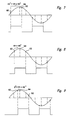
- Figures 4 - 10 respectively illustrate seven possible alignments between the preamble sinusoid of the read signal and the sample clock, and thus illustrate seven possible regions of the absolute phase ⁇ .
- the preamble sinusoid is shown as noiseless such that first samples 60 and second samples 62 respectively equal the first and second filtered samples from the filter 44 ( Figure 3). More specifically, Figures 4 - 10 illustrate seven possible positions that the rising edges of the sample clock, and thus the first samples 60, can have with respect to the peaks 64 of the sinusoid.
- the alignment convention is that the rising edges, and thus the first samples 60, lead the immediately following peaks 64 by a phase angle 0° ⁇ ⁇ 180°, where values of ⁇ are given with respect to the period of the preamble sinusoid.
- other alignment conventions can be used, such as where values of ⁇ are given with respect to the sampling period, which here is one fourth the period of the preamble sinusoid.
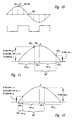
- Figures 11 -12 illustrate how the phase calculation circuit 46 (Figure 3) can use a tangent function to obtain the phase angle between the preamble sinusoid and the sample clock.
- Figure 11 is a phase diagram showing the positive half of the preamble sinusoid of Figure 9.
- the first sample 60 1 which corresponds to a rising edge of the sample clock, leads the sinusoid peak 64 by the phase angle ⁇ 1 .
- Figure 12 is a phase diagram of the positive half of the preamble sinusoid of Figure 7.
- Tan ⁇ (0° ⁇ 45°) 1/Tan(90°- ⁇ ) (90° ⁇ (90°- ⁇ ) ⁇ 45°).
- the look-up memory 58 stores values of arctan ⁇ over only a half quadrant (0° - 45°). This allows the look-up memory 58 to be 1 ⁇ 4 the size needed for the first embodiment and 1 ⁇ 2 the size needed for the second embodiment.
- ⁇ ' is the relative phase angle of the first sample 60 within the half-quadrant of the preamble sinusoid in which the first sample lies.
- ⁇ ' indicates the location of the first sample 60 within the half quadrant 66 (45° - 90°).
- Figure 13 is a 7-bit word 70 of the phase angle ⁇ according to an embodiment of the invention.
- the bits A0 - A4 are derived from arctan ⁇ ', and thus indicate the relative phase of the first sample 60 ( Figures 11 and 12) within a half quadrant. Therefore, the resolution of the byte 70 is 45° ⁇ 2 5 ⁇ 1.41°.
- A5 indicates whether ⁇ is greater than or less than 45°.
- A6 indicates whether ⁇ is greater than or less than 90°.
- the circuit 54 retrieves the corresponding value for Arctan ⁇ ', which approximately equals 2.81°, from the look-up memory 58.
- the circuit 56 then calculates an intermediate binary value X and bit A6 according to the following equation.
- the values of the first and second samples 60 2 and 62 2 ( Figure 12) are respectively represented by FS and SS.
- X - X6 0111111
- the shifter 48 adds any post-sampling phase shift to ⁇ to obtain the total phase shift between the sample clock and the preamble sinusoid as seen by the sample interpolator portion of the circuit 40.
- an FIR filter ( Figure 16) in the read path may add to or subtract from the phase lead ⁇ generated by the initial-phase circuit 46. Because this post-sampling phase shift may cause A6:A0 to "wrap around", A6:A0 is altered as described below.
- wrap around refers to the post-sampling phase shift causing ⁇ to cross a 90° boundary. That is, if ⁇ ⁇ 90°, the post-sampling phase shift wraps around the total phase lead ⁇ to greater than 90°, and if ⁇ > 90°, the post-sampling phase shift wraps around ⁇ to less than 90°.
- Figure 14 is a block diagram of a fourth embodiment of the phase-calculation circuit 46 of Figure 3.
- This embodiment generates the relative half-quadrant phase ⁇ ' by approximating a portion of the preamble sinusoid as linear and then successively approximating ⁇ '.
- this embodiment needs more time to calculate ⁇ ' and depends on the sampled peak amplitude of the preamble sinusoid. But it does not require the look-up memory 58 ( Figure 3), and thus occupies less die-layout area than the first, second, and third embodiments.
- the fourth embodiment of the circuit 46 includes a linear-approximation circuit 70, which replaces the function and inverse function circuits 52 and 54 of Figure 3, and includes the phase-interpolator 56.
- the circuit 70 calculates ⁇ ' from the first and second filtered samples and from the sampled peak amplitude of the preamble sinusoid.
- a circuit for calculating and providing the sampled peak amplitude is discussed in U.S. Patent App. entitled “A Circuit And Method For Controlling The Gain Of An Amplifier Based On The Sum Of Samples Of The Amplified Signal", Pat. App. Serial No. , Attorney Docket No. 99-S-165 (1678-17) which has the same filing date as the present application, and U.S. Patent App. entitled “A Circuit And Method For Controlling The Gain Of An Amplifier", Pat. App. Serial No. , Attorney Docket No. 99-S-188 (1678-19) which has the same filing date as the present application and incorporated by reference.
- Figure 15 shows the preamble sinusoid of Figure 7 superimposed on linear approximations of the following half-quadrants of the preamble sinusoid: 0° - 45°, 135° - 225°, and 315° - 360°. These half-quadrants are chosen because they are more linear than the other half-quadrants of the preamble sinusoid. By linearizing these half-quadrants, the circuit 46 can calculate ⁇ ' within a half quadrant as proportional to the sample lying within that half quadrant as discussed below. Referring to Figures 14 and 15, the operation of the circuit 46 is discussed by way of example.
- phase lead ⁇ of the first sample 60 is 87.18° with respect to the peak 64
- the first sample 60 0.049
- the peak amplitude 1
- ⁇ ' has a resolution of 5 bits B4:B0.
- the phase of the linearly approximated half quadrant ranges from 0° - 45°
- a 1 for B3 represents 0.176, which is the linear halfway point between 0 and 0.353
- a 1 for B2 represents 0.088, which is the linear halfway point between 0 and 0.176
- a 1 for B1 represents 0.044, which is the linear halfway point between 0 and 0.088
- a 1 for B0 represents 0.022, which is the linear halfway point between 0 and .044.
- the linear-approximation circuit 70 uses these values to successively approximate ⁇ ' in five steps, one step for each bit B4:B0.
- the linear-approximation circuit 70 determines which of the first and second filtered samples lies within one of the linearly approximated half quadrants. Therefore, in this example, the circuit 70 determines that the first sample 60 lies within such a half quadrant.
- the circuit 70 uses the first sample 60 to successively approximate ⁇ '.
- the circuit 70 compares the sample to 0.353 to generate B4.
- the circuit 70 compares the sample to 0.176 to generate B3.
- the circuit 70 compares the sample to 0.088 to generate B2.
- the circuit 70 compares the sample to 0.044 to generate B1.
- B4:B0 00010, which is the same as calculated by the inverse-function circuit 54 of Figure 3 in the above example for the same value, 0.049, of the first sample.
- the interpolator 56 then calculates ⁇ from B4:B0 and the values of the first and second samples 60 and 62 in the manner described above in conjunction with Figures 3 - 13.
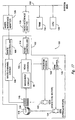
- Figure 16 is a block diagram of a digital-baud-rate-timing-recovery circuit 80 according to an embodiment of the invention.
- the circuit 80 incorporates the initial-phase circuit 38 and the sample interpolator and timing recovery loop 40 of Figure 3.
- the circuit 38 may include any of the embodiments of the phase-calculation circuit 46 of Figures 3 and 14. Although details of the circuit 80 are discussed below, further details are disclosed in U.S. Patent Application Ser. No. 09/387,146, "Digital Timing Recovery Using Baud Rate Sampling", filed August 31, 1999 and incorporated by reference.
- the first and second samples are input to an finite-impulse-response (FIR) filter 82, which equalizes each sample to its nearest expected signal level, and then provides the equalized first and second samples on data paths 84 and 85, respectively.
- FIR finite-impulse-response
- a sample interpolator 86 operates on the incoming equalized samples and provides interpolated samples calculated at an interpolation interval provided by an accumulator 88.
- the sample interpolator 86 has three output paths. Two of the output paths provide the two interpolated samples S1 and S2, which are derived in parallel by the interpolator 86.
- the third output path provides an un-interpolated sample S3 as may be necessary in an undersampling condition.
- the interpolator 86 provides all three samples S1, S2, and S3 to an elastic buffer 90 and to a mini-elastic buffer 92, which provides the correct stream of data to a phase detector 94 (described below). Note that because of the parallel sampling paths throughout the system, the interpolator 86 outputs two interpolated samples S1 and S2 during each cycle of normal operation. During an oversample condition, the interpolator 86 provides one valid interpolated sample and one bogus interpolated sample.
- the interpolator 86 outputs three samples: the interpolated sample S1, the interpolated sample S2, and the uninterpolated sample S3, which is provided by the interpolator 86 to compensate for the fact that the interpolator 86 cannot interpolate two samples in one (half-rate) cycle.
- the interpolator 86 also provides the interpolated samples S1 and S2 to the phase detector 94, which determines the phase difference between the interpolated samples S1 and S2 and the expected values of the samples S1 and S2, and which generates a corresponding phase-error signal.
- the phase detector 94 provides this phase-error signal to a proportional-integral filter 96, which provides the filtered error signal to the accumulator 88.
- the accumulator 88 derives the fractional delay, also known as the interpolation value tau ( ⁇ ), from the filtered error signal.
- the interpolation value ⁇ is used to select a set of coefficients employed by the sample interpolator 86 to derive the interpolation samples S1 and S2. These coefficient values are stored in a read only memory (ROM) 98, which receives the ⁇ value from the accumulator 88 and provides to the sample interpolator 86 the appropriate coefficient values corresponding to the desired interpolation interval.
- ROM read only memory
- the initial phase circuit 38 calculates a gain-independent initial phase ⁇ representing the phase lead of the sample clock with respect to the preamble sinusoid.
- the circuit 38 provides the bits A5:A0 of ⁇ to the accumulator 88 and to the ROM 98. This portion of ⁇ is used to select the initial value that is input to the sample interpolator 86 at the start of a read cycle.
- the circuit 38 provides the bit A6 of ⁇ to the elastic buffer 90 and to the phase detector 94.
- Figure 17 is a block diagram of a disk-drive system 100, which includes a disk drive 102, according to an embodiment of the invention.
- the disk drive 102 includes a read channel 103, which incorporates the recovery circuit 80 of Figure 16.
- the disk drive 102 includes a combination write/read head 104, a write-channel circuit 106 for generating and driving the head 104 with a write signal, and a write controller 108 for interfacing the write data to the write-channel circuit 106.
- the disk drive 102 also includes the read channel 103 for receiving a read signal from the head 104 and for recovering data from the read signal, and includes a read controller 114 for organizing the read data.
- the disk drive 102 further includes a storage medium such as one or more disks 116, each of which may store data on one or both sides.
- the read/write head 104 writes/reads the data stored on the disks 116 and is connected to a movable support arm 118.
- a position system 120 provides a control signal to a voice-coil motor (VCM) 122, which positionally maintains/moves the arm 118 so as to positionally maintain/radially move the head 104 over the desired data on the respective disks 116.
- VCM voice-coil motor
- a spindle motor (SPM) 124 and a SPM control circuit 126 respectively rotate the disks 116 and maintain them at the proper rotational speed.
- the disk-drive system 100 also includes write and read interface adapters 128 and 130 for respectively interfacing the write and read controllers 108 and 114 to a system bus 132, which is specific to the system used.
- Typical system busses include ISA, PCI, S-Bus, Nu-Bus, etc.
- the system 10 also typically has other devices, such as a random access memory (RAM) 134 and a central processing unit (CPU) 136 coupled to the bus 132.
- RAM random access memory
- CPU central processing unit
Landscapes
- Engineering & Computer Science (AREA)
- Signal Processing (AREA)
- Computer Networks & Wireless Communication (AREA)
- Physics & Mathematics (AREA)
- Probability & Statistics with Applications (AREA)
- Synchronisation In Digital Transmission Systems (AREA)
- Signal Processing For Digital Recording And Reproducing (AREA)
Applications Claiming Priority (2)
| Application Number | Priority Date | Filing Date | Title |
|---|---|---|---|
| US503929 | 2000-02-14 | ||
| US09/503,929 US6366225B1 (en) | 2000-02-14 | 2000-02-14 | Circuit and method for determining the phase difference between a sample clock and a sample signal by linear approximation |
Publications (2)
| Publication Number | Publication Date |
|---|---|
| EP1126617A2 true EP1126617A2 (fr) | 2001-08-22 |
| EP1126617A3 EP1126617A3 (fr) | 2003-11-12 |
Family
ID=24004116
Family Applications (1)
| Application Number | Title | Priority Date | Filing Date |
|---|---|---|---|
| EP01300806A Withdrawn EP1126617A3 (fr) | 2000-02-14 | 2001-01-30 | Circuit et méthode pour déterminer la différence de phase entre une horloge d'échantillonnage et un signal échantillonné par approximation linéaire |
Country Status (3)
| Country | Link |
|---|---|
| US (1) | US6366225B1 (fr) |
| EP (1) | EP1126617A3 (fr) |
| JP (1) | JP2001291341A (fr) |
Cited By (1)
| Publication number | Priority date | Publication date | Assignee | Title |
|---|---|---|---|---|
| WO2021063219A1 (fr) * | 2019-09-30 | 2021-04-08 | 深圳市中兴微电子技术有限公司 | Procédé et appareil d'échantillonnage de signal, et récepteur optique |
Families Citing this family (28)
| Publication number | Priority date | Publication date | Assignee | Title |
|---|---|---|---|---|
| US5978379A (en) | 1997-01-23 | 1999-11-02 | Gadzoox Networks, Inc. | Fiber channel learning bridge, learning half bridge, and protocol |
| US7430171B2 (en) | 1998-11-19 | 2008-09-30 | Broadcom Corporation | Fibre channel arbitrated loop bufferless switch circuitry to increase bandwidth without significant increase in cost |
| US6661852B1 (en) | 1999-07-21 | 2003-12-09 | Raytheon Company | Apparatus and method for quadrature tuner error correction |
| US6590948B1 (en) * | 2000-03-17 | 2003-07-08 | Raytheon Company | Parallel asynchronous sample rate reducer |
| US6647075B1 (en) | 2000-03-17 | 2003-11-11 | Raytheon Company | Digital tuner with optimized clock frequency and integrated parallel CIC filter and local oscillator |
| US7830630B2 (en) | 2001-06-28 | 2010-11-09 | Stmicroelectronics, Inc. | Circuit and method for detecting the phase of a servo signal |
| US7839594B2 (en) * | 2001-06-28 | 2010-11-23 | Stmicroelectronics, Inc. | Data-storage disk having few or no spin-up wedges and method for writing servo wedges onto the disk |
| DE10131712B4 (de) * | 2001-06-29 | 2009-04-09 | Qimonda Ag | Elektronisches Bauelement, Testereinrichtung und Verfahren zur Kalibrierung einer Testereinrichtung |
| KR100574938B1 (ko) * | 2003-02-20 | 2006-04-28 | 삼성전자주식회사 | 고속 직렬 링크에서 데이터 복원시 에러 발생을감소시키는 데이터 복원장치 및 그 복원방법 |
| US7149269B2 (en) * | 2003-02-27 | 2006-12-12 | International Business Machines Corporation | Receiver for clock and data recovery and method for calibrating sampling phases in a receiver for clock and data recovery |
| US6943978B1 (en) | 2004-01-31 | 2005-09-13 | Western Digital Technologies, Inc. | Servo writing a disk drive by synchronizing a servo write clock to a high frequency signal in a spiral track |
| US6967799B1 (en) | 2004-05-28 | 2005-11-22 | Western Digital Technologies, Inc. | Servo writing a disk drive from spiral tracks by generating a time-stamped sync mark detect signal processed by timing recovery firmware |
| US7330327B1 (en) | 2004-06-23 | 2008-02-12 | Western Digital Technologies, Inc. | Servo writing a disk drive by writing discontinuous spiral tracks to prevent overheating |
| US7440210B1 (en) | 2004-06-23 | 2008-10-21 | Western Digital Technologies, Inc. | Servo writing a disk drive by writing multi-bit sync marks in spiral tracks for improved servo writing |
| US7333280B1 (en) | 2004-08-03 | 2008-02-19 | Western Digital Technologies, Inc. | Servo writing a disk drive by synchronizing a servo write clock to a reference pattern on the disk and compensating for repeatable phase error |
| US7583459B1 (en) | 2004-11-18 | 2009-09-01 | Marvell International Ltd. | Method and apparatus for write precompensation in a magnetic recording system |
| US7773324B2 (en) * | 2005-04-12 | 2010-08-10 | Stmicroelectronics, Inc. | Phase acquisition loop for a read channel and related read channel, system, and method |
| US7768732B2 (en) * | 2005-04-12 | 2010-08-03 | Stmicroelectronics, Inc. | Gain controller for a gain loop of a read channel and related gain loops, read channels, systems, and methods |
| US7307560B2 (en) * | 2006-04-28 | 2007-12-11 | Rambus Inc. | Phase linearity test circuit |
| US7298574B1 (en) | 2006-05-10 | 2007-11-20 | Western Digital Technologies, Inc. | Servo writing a disk drive using correction values that attenuate phase error propagation |
| US7391584B1 (en) | 2006-11-07 | 2008-06-24 | Western Digital Technologies, Inc. | Compensating for repeatable phase error when servo writing a disk drive from spiral tracks |
| US8036312B2 (en) | 2007-03-30 | 2011-10-11 | Freescale Semiconductor, Inc. | System and method for determining signal phase |
| GB2469140B (en) | 2009-04-04 | 2013-12-11 | Dyson Technology Ltd | Control of an electric machine |
| GB2469129B (en) | 2009-04-04 | 2013-12-11 | Dyson Technology Ltd | Current controller for an electric machine |
| GB2469128A (en) * | 2009-04-04 | 2010-10-06 | Dyson Technology Ltd | Generating control signals for an electric machine from a position sensor |
| GB2469130B (en) * | 2009-04-04 | 2014-01-29 | Dyson Technology Ltd | Control system for an electric machine |
| US7995304B2 (en) * | 2009-05-27 | 2011-08-09 | Seagate Technology Llc | Circuits that use a postamble signal to determine phase and frequency errors in the acquisition of a preamble signal |
| US8780470B1 (en) | 2013-03-11 | 2014-07-15 | Western Digital Technologies, Inc. | Disk drive adjusting digital phase locked loop over sector data with frequency induced phase error measured over preamble |
Family Cites Families (8)
| Publication number | Priority date | Publication date | Assignee | Title |
|---|---|---|---|---|
| US4412339A (en) * | 1981-09-24 | 1983-10-25 | Advanced Micro Devices, Inc. | Zero-crossing interpolator to reduce isochronous distortion in a digital FSK modem |
| US4912729A (en) * | 1988-05-16 | 1990-03-27 | U.S. Philips Corporation | Phase-locked-loop circuit and bit detection arrangement comprising such a phase-locked-loop circuit |
| JP2589759B2 (ja) * | 1988-05-27 | 1997-03-12 | 松下電器産業株式会社 | データ識別装置 |
| US5486867A (en) * | 1993-11-30 | 1996-01-23 | Raytheon Company | High resolution digital phase detector |
| US5848099A (en) * | 1996-05-30 | 1998-12-08 | Qualcomm Incorporation | Method and system for testing phase imbalance in QPSK receivers |
| JPH1027435A (ja) * | 1996-07-15 | 1998-01-27 | Sony Corp | 再生装置および方法 |
| US5835295A (en) * | 1996-11-18 | 1998-11-10 | Cirrus Logice, Inc. | Zero phase restart interpolated timing recovery in a sampled amplitude read channel |
| US5892632A (en) * | 1996-11-18 | 1999-04-06 | Cirrus Logic, Inc. | Sampled amplitude read channel employing a residue number system FIR filter in an adaptive equalizer and in interpolated timing recovery |
-
2000
- 2000-02-14 US US09/503,929 patent/US6366225B1/en not_active Expired - Lifetime
-
2001
- 2001-01-30 EP EP01300806A patent/EP1126617A3/fr not_active Withdrawn
- 2001-02-14 JP JP2001036455A patent/JP2001291341A/ja active Pending
Cited By (2)
| Publication number | Priority date | Publication date | Assignee | Title |
|---|---|---|---|---|
| WO2021063219A1 (fr) * | 2019-09-30 | 2021-04-08 | 深圳市中兴微电子技术有限公司 | Procédé et appareil d'échantillonnage de signal, et récepteur optique |
| US12219042B2 (en) | 2019-09-30 | 2025-02-04 | Sanechips Technology Co., Ltd. | Signal sampling method and apparatus, and optical receiver |
Also Published As
| Publication number | Publication date |
|---|---|
| JP2001291341A (ja) | 2001-10-19 |
| US6366225B1 (en) | 2002-04-02 |
| EP1126617A3 (fr) | 2003-11-12 |
Similar Documents
| Publication | Publication Date | Title |
|---|---|---|
| US6366225B1 (en) | Circuit and method for determining the phase difference between a sample clock and a sample signal by linear approximation | |
| EP1126616B1 (fr) | Circuit et méthode pour déterminer la différence de phase entre une horloge d'échantillonnage et un signal échantillonné | |
| US6487672B1 (en) | Digital timing recovery using baud rate sampling | |
| US6587529B1 (en) | Phase detector architecture for phase error estimating and zero phase restarting | |
| JP3164519B2 (ja) | 埋め込みサーボデータを読み出すサンプル振幅読み出しチャネル、およびその方法 | |
| US5917668A (en) | Synchronous read channel employing a frequency synthesizer for locking a timing recovery phase-lock loop to a reference frequency | |
| US6369661B1 (en) | Phase interpolation circuits and methods and systems using the same | |
| US8837068B1 (en) | Two dimensional magnetic recording servo system adaptive combination | |
| US4425646A (en) | Input data synchronizing circuit | |
| TW201104677A (en) | Systems and methods for two tier sampling correction in a data processing circuit | |
| JPH07169033A (ja) | ディスク駆動装置 | |
| US10068609B1 (en) | Variable frequency write pattern generation | |
| JP4480191B2 (ja) | 位相固定ループ・システム | |
| US6867941B1 (en) | Circuit and method for controlling the gain of an amplifier based on the sum of samples of the amplified signal | |
| US6157604A (en) | Sampled amplitude read channel employing a baud rate estimator for digital timing recovery in an optical disk storage device | |
| EP1111606B1 (fr) | Appareil d'ajustement d'horloge pour un système de reproduction de données et un appareil ayant un système de reproduction de données comportant un tel appareil d'ajustement d'horloge | |
| JP4480584B2 (ja) | 適応等化回路及び適応等化方法 | |
| US20060208766A1 (en) | Jitter detection apparatus | |
| US6636120B2 (en) | Decimated digital phase-locked loop for high-speed implementation | |
| US7345839B2 (en) | Signal processing in a disc drive | |
| US6778345B1 (en) | Circuit and method for controlling the gain of an amplifier | |
| JP4098660B2 (ja) | ディスク記憶装置及びシンクマーク検出方法 | |
| US9171571B2 (en) | Read channel operable to calibrate a coefficient of a filter, such as an FIR filter, disposed before an interpolated-timing-recovery circuit, and related integrated circuit, system, and method | |
| US6996168B2 (en) | Signal-processing circuit, and recording and playback apparatus employing the same | |
| US7697224B2 (en) | Storing AD sampled data of read/write channel into ECC SRAM |
Legal Events
| Date | Code | Title | Description |
|---|---|---|---|
| PUAI | Public reference made under article 153(3) epc to a published international application that has entered the european phase |
Free format text: ORIGINAL CODE: 0009012 |
|
| AK | Designated contracting states |
Kind code of ref document: A2 Designated state(s): AT BE CH CY DE DK ES FI FR GB GR IE IT LI LU MC NL PT SE TR |
|
| AX | Request for extension of the european patent |
Free format text: AL;LT;LV;MK;RO;SI |
|
| PUAL | Search report despatched |
Free format text: ORIGINAL CODE: 0009013 |
|
| AK | Designated contracting states |
Kind code of ref document: A3 Designated state(s): AT BE CH CY DE DK ES FI FR GB GR IE IT LI LU MC NL PT SE TR |
|
| AX | Request for extension of the european patent |
Extension state: AL LT LV MK RO SI |
|
| 17P | Request for examination filed |
Effective date: 20040511 |
|
| AKX | Designation fees paid |
Designated state(s): DE FR GB |
|
| RBV | Designated contracting states (corrected) |
Designated state(s): DE FR GB IT |
|
| 17Q | First examination report despatched |
Effective date: 20050224 |
|
| STAA | Information on the status of an ep patent application or granted ep patent |
Free format text: STATUS: THE APPLICATION IS DEEMED TO BE WITHDRAWN |
|
| 18D | Application deemed to be withdrawn |
Effective date: 20050707 |