EP1126735A1 - Mobilkommunikationssystem - Google Patents
Mobilkommunikationssystem Download PDFInfo
- Publication number
- EP1126735A1 EP1126735A1 EP00301169A EP00301169A EP1126735A1 EP 1126735 A1 EP1126735 A1 EP 1126735A1 EP 00301169 A EP00301169 A EP 00301169A EP 00301169 A EP00301169 A EP 00301169A EP 1126735 A1 EP1126735 A1 EP 1126735A1
- Authority
- EP
- European Patent Office
- Prior art keywords
- cell
- physical channel
- power
- width
- base transceiver
- Prior art date
- Legal status (The legal status is an assumption and is not a legal conclusion. Google has not performed a legal analysis and makes no representation as to the accuracy of the status listed.)
- Withdrawn
Links
- 238000000034 method Methods 0.000 claims description 2
- 230000003247 decreasing effect Effects 0.000 claims 1
- 230000029058 respiratory gaseous exchange Effects 0.000 description 9
- 230000005540 biological transmission Effects 0.000 description 4
- 230000000694 effects Effects 0.000 description 3
- 238000007689 inspection Methods 0.000 description 2
- 108010003272 Hyaluronate lyase Proteins 0.000 description 1
- 230000000903 blocking effect Effects 0.000 description 1
- 230000007423 decrease Effects 0.000 description 1
- 238000009795 derivation Methods 0.000 description 1
- 230000035945 sensitivity Effects 0.000 description 1
Images

Classifications
-
- H—ELECTRICITY
- H04—ELECTRIC COMMUNICATION TECHNIQUE
- H04W—WIRELESS COMMUNICATION NETWORKS
- H04W52/00—Power management, e.g. Transmission Power Control [TPC] or power classes
- H04W52/04—Transmission power control [TPC]
- H04W52/30—Transmission power control [TPC] using constraints in the total amount of available transmission power
- H04W52/32—TPC of broadcast or control channels
- H04W52/325—Power control of control or pilot channels
-
- H—ELECTRICITY
- H04—ELECTRIC COMMUNICATION TECHNIQUE
- H04W—WIRELESS COMMUNICATION NETWORKS
- H04W16/00—Network planning, e.g. coverage or traffic planning tools; Network deployment, e.g. resource partitioning or cells structures
- H04W16/02—Resource partitioning among network components, e.g. reuse partitioning
- H04W16/06—Hybrid resource partitioning, e.g. channel borrowing
-
- H—ELECTRICITY
- H04—ELECTRIC COMMUNICATION TECHNIQUE
- H04W—WIRELESS COMMUNICATION NETWORKS
- H04W52/00—Power management, e.g. Transmission Power Control [TPC] or power classes
- H04W52/04—Transmission power control [TPC]
- H04W52/30—Transmission power control [TPC] using constraints in the total amount of available transmission power
- H04W52/34—TPC management, i.e. sharing limited amount of power among users or channels or data types, e.g. cell loading
-
- H—ELECTRICITY
- H04—ELECTRIC COMMUNICATION TECHNIQUE
- H04W—WIRELESS COMMUNICATION NETWORKS
- H04W52/00—Power management, e.g. Transmission Power Control [TPC] or power classes
- H04W52/04—Transmission power control [TPC]
- H04W52/38—TPC being performed in particular situations
- H04W52/40—TPC being performed in particular situations during macro-diversity or soft handoff
Definitions
- This invention relates to a mobile radio telecommunications system with improved control of handoff, that is, the transfer of control of a call from one telecommunications cell to another.
- the invention relates especially to a system which has an improved response to the phenomenon known as "cell breathing".
- the area of coverage is divided into telecommunications cells which are circular in shape and which have overlapping parts known as handoff regions.
- the cell overlaps are arranged so that there are no coverage holes.
- a power budget is calculated to provide maximum usable path loss, and takes into account transmission power, the receiver sensitivity, and the gains and losses for the link.
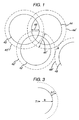
- FIG. 1 Such an arrangement is illustrated in Figure 1, in which three circular cells 40, 42, 44, shown by the full lines, have overlaps or handover zones, such as zone 46, of a desired width, the width in the nominal case.
- a mobile system on the edge of a cell area may operate in a satisfactory manner, but be unable to operate when traffic load within the cell is high.
- the coverage area of the cells 40, 42, 44 has shrunk.
- a fourth cell 48 may have a smaller overlap and inspection of Figure 1 shows that there may be positions, such as at reference A, where effective shrinkage of the cell 48 would leave a mobile without connection, i.e. in a coverage hole.
- CDMA Code Division Multiple Access
- UMTS Universal Mobile Telephone System
- a solution to this problem is to provide proper cell dimensioning for a certain blocking probability.
- a system designed to accommodate the predicted traffic including the high bit rate traffic of CDMA and UMTS, coverage holes induced by cell breathing are avoided.
- systems are designed assuming a traffic of fifty per cent loading, which provides some capacity to respond to a sudden increase in traffic.
- Cell breathing can cause particular difficulty in relation to information on a channel which must be received by all users, such as information on a Broadcast Channel or a Common Pilot Channel or a Synchronization Channel.
- Another effect of cell breathing occurs during low traffic periods, e.g. at night.
- the effective area of a cell increases, as shown by the dotted lines 40', 42', 44' in Figure 1; the handoff zone, such as zone 46', increases when both cells carry low traffic, which is likely to be the case at night, but also increases when only one of the two overlapping cells carries low traffic.
- a mobile system in an enlarged handoff zone will "see" many pilots, and will have legs to several base transceiver stations which is undesirable. The effect is especially problematic in overlay-underlay cell hierarchies.
- a mobile radio telecommunications system comprising a plurality of base transceiver stations which provide communications in a plurality of telecommunication cells each having a predetermined radius and a predetermined handover width , said communications to each cell being provided by a plurality of physical channels, one said physical channel bearing a pilot signal, characterised in that the power of said physical channel bearing the pilot signal is varied in accordance with the loading in the associated cell.
- a mobile radio telecommunications system comprising a plurality of base transceiver stations each transmitting information on a physical channel, said physical channel defining a plurality of telecommunications cells of radius R and a certain required handoff width, each base transceiver station being arranged to sense the telecommunications traffic in the cell which it controls, a method of controlling the hand off width characterized by each base transceiver station varying the power of its physical channel in accordance with the sensed telecommunications traffic.
- Figure 1 illustrates three telecommunications cells subject to cell breathing
- the GSM comprises a Core Network (CN) 10 with an interface 12 to the Radio Access Network (RAN) 14 which in turn has a radio interface 16 to mobile users 18, 20.
- CN Core Network
- RAN Radio Access Network
- BSCs 22 Base Station Controllers 22
- BSC 22 controls two BTSs 26, 28 and BSC 24 controls to BTSs 30, 32; in practice each BSC controls several BTSs but two only are shown for clarity.
- BTSs 26, 28 control the mobile users 18 and BTSs 30, 32 control the mobile users 20.
- Each BTS controls one telecommunications cell as referred to above and shown in Figure 1.
- Each BTS transmits a low rate Common Pilot Channel (CPICH) which carries the system and cell specific information for the mobile users within the cell controlled by that BTS.
- CPICH Common Pilot Channel
- the CPICH is mapped to the Common Downlink Control Physical Channel (CCPCH).
- CPCH Common Downlink Control Physical Channel
- any of the mobiles 20 could receive signals from the CCPCH channels transmitted by either of the BTSs 30, 32, and any mobile 20 could be within an overlap region. In an extreme case, any of the mobiles 20 could also receive signals from the BTSs 26, 28.
- each BTS 26, 28, 30, 32 is arranged to vary the power of its CCPCH channel.
- CCPCH power is reduced. Such a reduction is arranged to ensure that the handoff region 46 (see Figure 1) of the cell controlled by that BTS remains at the width in the nominal case. Traffic levels in a cell are conventionally measured by a BTS.
- Figure 3 illustrates a signal transmitted at power P T for the centre of the cell.
- power decreases with distance
- path loss is where d is distance.
- n the path loss exponent
- the value 3.8 is often used for in-city cell planning.
Landscapes
- Engineering & Computer Science (AREA)
- Computer Networks & Wireless Communication (AREA)
- Signal Processing (AREA)
- Mobile Radio Communication Systems (AREA)
Priority Applications (1)
| Application Number | Priority Date | Filing Date | Title |
|---|---|---|---|
| EP00301169A EP1126735A1 (de) | 2000-02-15 | 2000-02-15 | Mobilkommunikationssystem |
Applications Claiming Priority (1)
| Application Number | Priority Date | Filing Date | Title |
|---|---|---|---|
| EP00301169A EP1126735A1 (de) | 2000-02-15 | 2000-02-15 | Mobilkommunikationssystem |
Publications (1)
| Publication Number | Publication Date |
|---|---|
| EP1126735A1 true EP1126735A1 (de) | 2001-08-22 |
Family
ID=8172705
Family Applications (1)
| Application Number | Title | Priority Date | Filing Date |
|---|---|---|---|
| EP00301169A Withdrawn EP1126735A1 (de) | 2000-02-15 | 2000-02-15 | Mobilkommunikationssystem |
Country Status (1)
| Country | Link |
|---|---|
| EP (1) | EP1126735A1 (de) |
Cited By (3)
| Publication number | Priority date | Publication date | Assignee | Title |
|---|---|---|---|---|
| KR100420914B1 (ko) * | 2001-11-28 | 2004-03-02 | 한국전자통신연구원 | 이동국에서의 트래픽 부하 분산 시스템 및 그 방법 |
| GB2396522A (en) * | 2002-12-18 | 2004-06-23 | Motorola Inc | Determining transmission power |
| EP1838116A1 (de) * | 2006-03-22 | 2007-09-26 | Matsushita Electric Industrial Co., Ltd. | Verwaltung von Nachbarfunkzelleninterferenz in einem SC-FDMA System |
Citations (4)
| Publication number | Priority date | Publication date | Assignee | Title |
|---|---|---|---|---|
| EP0615395A1 (de) * | 1993-03-11 | 1994-09-14 | Hitachi, Ltd. | Mobilfunksystem mit Verkehrsverteilungssteuerung durch Änderung der Zellengrösse |
| US5475870A (en) * | 1994-09-12 | 1995-12-12 | Qualcomm Incorporated | Apparatus and method for adding and removing a base station from a cellular communications system |
| WO1997008909A1 (en) * | 1995-08-31 | 1997-03-06 | Nokia Telecommunications Oy | A method of levelling a traffic load of a base station in a cellular radio system, and a cellular radio system |
| GB2311191A (en) * | 1996-03-11 | 1997-09-17 | Nec Corp | Cell size adjustment in a cellular communication system |
-
2000
- 2000-02-15 EP EP00301169A patent/EP1126735A1/de not_active Withdrawn
Patent Citations (4)
| Publication number | Priority date | Publication date | Assignee | Title |
|---|---|---|---|---|
| EP0615395A1 (de) * | 1993-03-11 | 1994-09-14 | Hitachi, Ltd. | Mobilfunksystem mit Verkehrsverteilungssteuerung durch Änderung der Zellengrösse |
| US5475870A (en) * | 1994-09-12 | 1995-12-12 | Qualcomm Incorporated | Apparatus and method for adding and removing a base station from a cellular communications system |
| WO1997008909A1 (en) * | 1995-08-31 | 1997-03-06 | Nokia Telecommunications Oy | A method of levelling a traffic load of a base station in a cellular radio system, and a cellular radio system |
| GB2311191A (en) * | 1996-03-11 | 1997-09-17 | Nec Corp | Cell size adjustment in a cellular communication system |
Cited By (10)
| Publication number | Priority date | Publication date | Assignee | Title |
|---|---|---|---|---|
| KR100420914B1 (ko) * | 2001-11-28 | 2004-03-02 | 한국전자통신연구원 | 이동국에서의 트래픽 부하 분산 시스템 및 그 방법 |
| GB2396522A (en) * | 2002-12-18 | 2004-06-23 | Motorola Inc | Determining transmission power |
| GB2396522B (en) * | 2002-12-18 | 2006-01-04 | Motorola Inc | Method and apparatus for determining a transmit power |
| EP1838116A1 (de) * | 2006-03-22 | 2007-09-26 | Matsushita Electric Industrial Co., Ltd. | Verwaltung von Nachbarfunkzelleninterferenz in einem SC-FDMA System |
| WO2007107207A1 (en) * | 2006-03-22 | 2007-09-27 | Matsushita Electric Industrial Co., Ltd. | Neigboring cell interference management in a sc-fdma system |
| JP2009530929A (ja) * | 2006-03-22 | 2009-08-27 | パナソニック株式会社 | Sc−fdmaシステムにおける隣接セル干渉の管理 |
| EP2259613A1 (de) * | 2006-03-22 | 2010-12-08 | Panasonic Corporation | Verwaltung von Nachbarfunkzelleninterferenz in einem SC-FDMA system |
| EP2346276A1 (de) * | 2006-03-22 | 2011-07-20 | Panasonic Corporation | Verwaltung von Nachbarfunkzelleninterferenz in einem SC-FDMA-System |
| CN101406082B (zh) * | 2006-03-22 | 2012-06-27 | 松下电器产业株式会社 | 单载波频分多址系统中的相邻小区干扰管理 |
| US8483743B2 (en) | 2006-03-22 | 2013-07-09 | Panasonic Corporation | Neighboring cell interference management in SC-FDMA |
Similar Documents
| Publication | Publication Date | Title |
|---|---|---|
| US6763237B1 (en) | Method and apparatus for the selection of radio transmission resources | |
| AU673576B2 (en) | Access burst power control | |
| EP2264912B1 (de) | Verfahren und System zur unterdrückung von Interferenzen zwischen Zellen | |
| EP0720808B1 (de) | Verfahren und gerät zum ausgleichen der vorwärtsverbindungsübergabeabgrenzung zur rückwärtsverbindungsübergabeabgrenzung in einem zellularen übertragungssystem | |
| US6438379B1 (en) | Power control and cell site location technique for CDMA systems with hierarchical architecture | |
| US5771451A (en) | Method of transmission power control in a cellular mobile communication system and apparatus thereof | |
| CA2290094C (en) | Asymmetric forward power control in a cdma communication network | |
| KR100723106B1 (ko) | 기지국의 전송 파워 레벨 제어 방법 | |
| EP0765586B1 (de) | Verfahren und system zum sichern eines kommunikationsdienstes in einer deckungslosen zone | |
| US6173188B1 (en) | Method of a forward power control using an erasure indicator bit | |
| EP0728401B1 (de) | Gerät und verfahren zur hinzufügung und entfernung einer feststation aus einem zellularen kommunikationssystem | |
| US20020061731A1 (en) | Mobile communication control method and system and mobile station thereof | |
| EP1069702B1 (de) | Synchronisierung der Sendeleistungspegeleinstellungen während weichem Weiterreichen in einem drahtlosen System mittels Leistungspegelbegrenzungen | |
| KR100199785B1 (ko) | 시디엠에이통신시스템 | |
| US7319883B2 (en) | Method and apparatus for determining a transmit power | |
| Furukawa et al. | Self-organized reuse partitioning, a dynamic channel assignment method in cellular system | |
| US7146169B2 (en) | Power balancing for downlink fast power control using central processing | |
| US6597673B1 (en) | CDMA soft handoff control method | |
| EP1243150B1 (de) | Verfahren zum Einstellen eines Synchronisationszustands zwischen benachbarten Basisstationen | |
| Shapira et al. | Spatial topology and dynamics in CDMA cellular radio | |
| CN100365949C (zh) | 在具有智能天线的移动通信系统中实现下行功控的方法 | |
| EP0771512A2 (de) | Verfahren zur verhinderung der trennung von anrufen schlechter qualität in einem zellularen mobilfunksystem | |
| Yang et al. | Optimization of power management in a CDMA radio network | |
| WO2002015326A2 (en) | Optimizing clever antenna by beam tilting | |
| Goto et al. | Cell size adaptation in W-CDMA cellular system |
Legal Events
| Date | Code | Title | Description |
|---|---|---|---|
| PUAI | Public reference made under article 153(3) epc to a published international application that has entered the european phase |
Free format text: ORIGINAL CODE: 0009012 |
|
| AK | Designated contracting states |
Kind code of ref document: A1 Designated state(s): AT BE CH CY DE DK ES FI FR GB GR IE IT LI LU MC NL PT SE |
|
| AX | Request for extension of the european patent |
Free format text: AL;LT;LV;MK;RO;SI |
|
| AKX | Designation fees paid | ||
| REG | Reference to a national code |
Ref country code: DE Ref legal event code: 8566 |
|
| STAA | Information on the status of an ep patent application or granted ep patent |
Free format text: STATUS: THE APPLICATION IS DEEMED TO BE WITHDRAWN |
|
| 18D | Application deemed to be withdrawn |
Effective date: 20020225 |