EP1127714A2 - Pneus à forte courbure transversale, en particulier pour véhicules à deux roues - Google Patents
Pneus à forte courbure transversale, en particulier pour véhicules à deux roues Download PDFInfo
- Publication number
- EP1127714A2 EP1127714A2 EP01109906A EP01109906A EP1127714A2 EP 1127714 A2 EP1127714 A2 EP 1127714A2 EP 01109906 A EP01109906 A EP 01109906A EP 01109906 A EP01109906 A EP 01109906A EP 1127714 A2 EP1127714 A2 EP 1127714A2
- Authority
- EP
- European Patent Office
- Prior art keywords
- tyre
- belt
- equatorial plane
- cords
- carcass
- Prior art date
- Legal status (The legal status is an assumption and is not a legal conclusion. Google has not performed a legal analysis and makes no representation as to the accuracy of the status listed.)
- Withdrawn
Links
- 230000003014 reinforcing effect Effects 0.000 claims abstract description 42
- 239000000463 material Substances 0.000 claims description 18
- 239000011324 bead Substances 0.000 claims description 13
- 238000004873 anchoring Methods 0.000 claims description 9
- 230000015572 biosynthetic process Effects 0.000 claims description 5
- 239000000470 constituent Substances 0.000 claims description 5
- 238000009826 distribution Methods 0.000 abstract description 7
- 229910000677 High-carbon steel Inorganic materials 0.000 abstract description 2
- 238000004804 winding Methods 0.000 description 20
- 238000004519 manufacturing process Methods 0.000 description 13
- 230000000694 effects Effects 0.000 description 11
- 239000004760 aramid Substances 0.000 description 7
- 229920003235 aromatic polyamide Polymers 0.000 description 7
- 239000011295 pitch Substances 0.000 description 7
- 239000004753 textile Substances 0.000 description 7
- 239000004677 Nylon Substances 0.000 description 5
- 229920001778 nylon Polymers 0.000 description 5
- 238000012360 testing method Methods 0.000 description 5
- 230000008901 benefit Effects 0.000 description 4
- 229910000831 Steel Inorganic materials 0.000 description 3
- 239000013536 elastomeric material Substances 0.000 description 3
- 239000000835 fiber Substances 0.000 description 3
- 230000014509 gene expression Effects 0.000 description 3
- 239000002184 metal Substances 0.000 description 3
- 238000000034 method Methods 0.000 description 3
- 239000010959 steel Substances 0.000 description 3
- 230000003542 behavioural effect Effects 0.000 description 2
- 229910052799 carbon Inorganic materials 0.000 description 2
- 230000000052 comparative effect Effects 0.000 description 2
- 230000003247 decreasing effect Effects 0.000 description 2
- 239000004744 fabric Substances 0.000 description 2
- 239000000945 filler Substances 0.000 description 2
- 239000003365 glass fiber Substances 0.000 description 2
- 239000011159 matrix material Substances 0.000 description 2
- 230000002093 peripheral effect Effects 0.000 description 2
- 230000008569 process Effects 0.000 description 2
- 230000009467 reduction Effects 0.000 description 2
- OKTJSMMVPCPJKN-UHFFFAOYSA-N Carbon Chemical compound [C] OKTJSMMVPCPJKN-UHFFFAOYSA-N 0.000 description 1
- 229920000742 Cotton Polymers 0.000 description 1
- 229920000271 Kevlar® Polymers 0.000 description 1
- 239000004952 Polyamide Substances 0.000 description 1
- 229920000297 Rayon Polymers 0.000 description 1
- 238000010521 absorption reaction Methods 0.000 description 1
- 239000000853 adhesive Substances 0.000 description 1
- 230000001070 adhesive effect Effects 0.000 description 1
- 230000008878 coupling Effects 0.000 description 1
- 238000010168 coupling process Methods 0.000 description 1
- 238000005859 coupling reaction Methods 0.000 description 1
- 230000007423 decrease Effects 0.000 description 1
- 238000011156 evaluation Methods 0.000 description 1
- 230000006872 improvement Effects 0.000 description 1
- 239000004761 kevlar Substances 0.000 description 1
- 238000005259 measurement Methods 0.000 description 1
- 239000007769 metal material Substances 0.000 description 1
- 238000012986 modification Methods 0.000 description 1
- 230000004048 modification Effects 0.000 description 1
- 229920002647 polyamide Polymers 0.000 description 1
- 230000001737 promoting effect Effects 0.000 description 1
- 239000002964 rayon Substances 0.000 description 1
- 238000005096 rolling process Methods 0.000 description 1
- 230000035945 sensitivity Effects 0.000 description 1
- 229920002994 synthetic fiber Polymers 0.000 description 1
- 230000008719 thickening Effects 0.000 description 1
- 238000004073 vulcanization Methods 0.000 description 1
- 208000016254 weariness Diseases 0.000 description 1
Images

Classifications
-
- B—PERFORMING OPERATIONS; TRANSPORTING
- B60—VEHICLES IN GENERAL
- B60C—VEHICLE TYRES; TYRE INFLATION; TYRE CHANGING; CONNECTING VALVES TO INFLATABLE ELASTIC BODIES IN GENERAL; DEVICES OR ARRANGEMENTS RELATED TO TYRES
- B60C9/00—Reinforcements or ply arrangement of pneumatic tyres
- B60C9/18—Structure or arrangement of belts or breakers, crown-reinforcing or cushioning layers
- B60C9/20—Structure or arrangement of belts or breakers, crown-reinforcing or cushioning layers built-up from rubberised plies each having all cords arranged substantially parallel
- B60C9/22—Structure or arrangement of belts or breakers, crown-reinforcing or cushioning layers built-up from rubberised plies each having all cords arranged substantially parallel the plies being arranged with all cords disposed along the circumference of the tyre
- B60C9/2204—Structure or arrangement of belts or breakers, crown-reinforcing or cushioning layers built-up from rubberised plies each having all cords arranged substantially parallel the plies being arranged with all cords disposed along the circumference of the tyre obtained by circumferentially narrow strip winding
-
- B—PERFORMING OPERATIONS; TRANSPORTING
- B60—VEHICLES IN GENERAL
- B60C—VEHICLE TYRES; TYRE INFLATION; TYRE CHANGING; CONNECTING VALVES TO INFLATABLE ELASTIC BODIES IN GENERAL; DEVICES OR ARRANGEMENTS RELATED TO TYRES
- B60C9/00—Reinforcements or ply arrangement of pneumatic tyres
- B60C9/18—Structure or arrangement of belts or breakers, crown-reinforcing or cushioning layers
-
- B—PERFORMING OPERATIONS; TRANSPORTING
- B60—VEHICLES IN GENERAL
- B60C—VEHICLE TYRES; TYRE INFLATION; TYRE CHANGING; CONNECTING VALVES TO INFLATABLE ELASTIC BODIES IN GENERAL; DEVICES OR ARRANGEMENTS RELATED TO TYRES
- B60C19/00—Tyre parts or constructions not otherwise provided for
- B60C19/001—Tyres requiring an asymmetric or a special mounting
-
- B—PERFORMING OPERATIONS; TRANSPORTING
- B60—VEHICLES IN GENERAL
- B60C—VEHICLE TYRES; TYRE INFLATION; TYRE CHANGING; CONNECTING VALVES TO INFLATABLE ELASTIC BODIES IN GENERAL; DEVICES OR ARRANGEMENTS RELATED TO TYRES
- B60C9/00—Reinforcements or ply arrangement of pneumatic tyres
- B60C9/18—Structure or arrangement of belts or breakers, crown-reinforcing or cushioning layers
- B60C9/20—Structure or arrangement of belts or breakers, crown-reinforcing or cushioning layers built-up from rubberised plies each having all cords arranged substantially parallel
- B60C9/22—Structure or arrangement of belts or breakers, crown-reinforcing or cushioning layers built-up from rubberised plies each having all cords arranged substantially parallel the plies being arranged with all cords disposed along the circumference of the tyre
-
- B—PERFORMING OPERATIONS; TRANSPORTING
- B60—VEHICLES IN GENERAL
- B60C—VEHICLE TYRES; TYRE INFLATION; TYRE CHANGING; CONNECTING VALVES TO INFLATABLE ELASTIC BODIES IN GENERAL; DEVICES OR ARRANGEMENTS RELATED TO TYRES
- B60C9/00—Reinforcements or ply arrangement of pneumatic tyres
- B60C9/18—Structure or arrangement of belts or breakers, crown-reinforcing or cushioning layers
- B60C9/20—Structure or arrangement of belts or breakers, crown-reinforcing or cushioning layers built-up from rubberised plies each having all cords arranged substantially parallel
- B60C9/22—Structure or arrangement of belts or breakers, crown-reinforcing or cushioning layers built-up from rubberised plies each having all cords arranged substantially parallel the plies being arranged with all cords disposed along the circumference of the tyre
- B60C9/2204—Structure or arrangement of belts or breakers, crown-reinforcing or cushioning layers built-up from rubberised plies each having all cords arranged substantially parallel the plies being arranged with all cords disposed along the circumference of the tyre obtained by circumferentially narrow strip winding
- B60C2009/2209—Structure or arrangement of belts or breakers, crown-reinforcing or cushioning layers built-up from rubberised plies each having all cords arranged substantially parallel the plies being arranged with all cords disposed along the circumference of the tyre obtained by circumferentially narrow strip winding characterised by tension of the cord during winding
-
- B—PERFORMING OPERATIONS; TRANSPORTING
- B60—VEHICLES IN GENERAL
- B60C—VEHICLE TYRES; TYRE INFLATION; TYRE CHANGING; CONNECTING VALVES TO INFLATABLE ELASTIC BODIES IN GENERAL; DEVICES OR ARRANGEMENTS RELATED TO TYRES
- B60C9/00—Reinforcements or ply arrangement of pneumatic tyres
- B60C9/18—Structure or arrangement of belts or breakers, crown-reinforcing or cushioning layers
- B60C9/20—Structure or arrangement of belts or breakers, crown-reinforcing or cushioning layers built-up from rubberised plies each having all cords arranged substantially parallel
- B60C9/22—Structure or arrangement of belts or breakers, crown-reinforcing or cushioning layers built-up from rubberised plies each having all cords arranged substantially parallel the plies being arranged with all cords disposed along the circumference of the tyre
- B60C2009/2252—Physical properties or dimension of the zero degree ply cords
- B60C2009/2266—Density of the cords in width direction
- B60C2009/2271—Density of the cords in width direction with variable density
-
- B—PERFORMING OPERATIONS; TRANSPORTING
- B60—VEHICLES IN GENERAL
- B60C—VEHICLE TYRES; TYRE INFLATION; TYRE CHANGING; CONNECTING VALVES TO INFLATABLE ELASTIC BODIES IN GENERAL; DEVICES OR ARRANGEMENTS RELATED TO TYRES
- B60C2200/00—Tyres specially adapted for particular applications
- B60C2200/10—Tyres specially adapted for particular applications for motorcycles, scooters or the like
-
- Y—GENERAL TAGGING OF NEW TECHNOLOGICAL DEVELOPMENTS; GENERAL TAGGING OF CROSS-SECTIONAL TECHNOLOGIES SPANNING OVER SEVERAL SECTIONS OF THE IPC; TECHNICAL SUBJECTS COVERED BY FORMER USPC CROSS-REFERENCE ART COLLECTIONS [XRACs] AND DIGESTS
- Y10—TECHNICAL SUBJECTS COVERED BY FORMER USPC
- Y10T—TECHNICAL SUBJECTS COVERED BY FORMER US CLASSIFICATION
- Y10T152/00—Resilient tires and wheels
- Y10T152/10—Tires, resilient
- Y10T152/10495—Pneumatic tire or inner tube
-
- Y—GENERAL TAGGING OF NEW TECHNOLOGICAL DEVELOPMENTS; GENERAL TAGGING OF CROSS-SECTIONAL TECHNOLOGIES SPANNING OVER SEVERAL SECTIONS OF THE IPC; TECHNICAL SUBJECTS COVERED BY FORMER USPC CROSS-REFERENCE ART COLLECTIONS [XRACs] AND DIGESTS
- Y10—TECHNICAL SUBJECTS COVERED BY FORMER USPC
- Y10T—TECHNICAL SUBJECTS COVERED BY FORMER US CLASSIFICATION
- Y10T152/00—Resilient tires and wheels
- Y10T152/10—Tires, resilient
- Y10T152/10495—Pneumatic tire or inner tube
- Y10T152/10513—Tire reinforcement material characterized by short length fibers or the like
-
- Y—GENERAL TAGGING OF NEW TECHNOLOGICAL DEVELOPMENTS; GENERAL TAGGING OF CROSS-SECTIONAL TECHNOLOGIES SPANNING OVER SEVERAL SECTIONS OF THE IPC; TECHNICAL SUBJECTS COVERED BY FORMER USPC CROSS-REFERENCE ART COLLECTIONS [XRACs] AND DIGESTS
- Y10—TECHNICAL SUBJECTS COVERED BY FORMER USPC
- Y10T—TECHNICAL SUBJECTS COVERED BY FORMER US CLASSIFICATION
- Y10T152/00—Resilient tires and wheels
- Y10T152/10—Tires, resilient
- Y10T152/10495—Pneumatic tire or inner tube
- Y10T152/10765—Characterized by belt or breaker structure
-
- Y—GENERAL TAGGING OF NEW TECHNOLOGICAL DEVELOPMENTS; GENERAL TAGGING OF CROSS-SECTIONAL TECHNOLOGIES SPANNING OVER SEVERAL SECTIONS OF THE IPC; TECHNICAL SUBJECTS COVERED BY FORMER USPC CROSS-REFERENCE ART COLLECTIONS [XRACs] AND DIGESTS
- Y10—TECHNICAL SUBJECTS COVERED BY FORMER USPC
- Y10T—TECHNICAL SUBJECTS COVERED BY FORMER US CLASSIFICATION
- Y10T152/00—Resilient tires and wheels
- Y10T152/10—Tires, resilient
- Y10T152/10495—Pneumatic tire or inner tube
- Y10T152/10765—Characterized by belt or breaker structure
- Y10T152/10783—Reinforcing plies made up from wound narrow ribbons
Definitions
- the present invention relates to a high-transverse-curvature tyre, in particular for motor-vehicles.
- the invention is more particularly addressed to a front tyre for two-wheeled vehicles in which the high transverse curvature is defined by particular values of the ratio between the distance of the tread crown from the line passing by the tread extremities, measured in the equatorial plane, and the distance between said tread extremities.
- This value in any case at least as high as 0.3, is higher than that concerning the corresponding rear tyre, usually not exceeding 0.3.
- the front tyre comprises a belt, disposed between the carcass and the tread, formed of at least two radially superposed strips of cords symmetrically inclined to the equatorial plane of the tyre.
- This structure has a high stiffness, useful to generate appropriate thrust slips, which stiffness is however too great under the point of view of comfort, because the handlebar my only be controlled with a very strong effort, which will bring about weariness of the driver, and vibrations resulting from the road-bed unevennesses are transmitted to the handlebar.
- a tyre of this type is described for example in the European Patent Application EP 0 565 339 A1; said tyre is provided with a belt, between the carcass and tread, comprising at least one layer of zero-degree cords distributed in a configuration offering a greater thickness at the sides than in the middle.
- the cord amount in a given central area has a value included between 60% and 80% of the amount of cords close to the tyre shoulders.
- the zero-degree cord layer does not offer a sufficient strength to the tangential forces acting in a direction transverse to the cord lying.
- the zero-degree winding up must be carried out on a previously shaped support, in particular an auxiliary manufacturing drum suitably made convex, such as for example the drum described in the Italian Patent Application 22730A/89 filed by the same Appicant, or directly on the previously shaped carcass.
- the rubberized layer has the only function of ensuring, by its adhesive character, the geometrical and structural stability of the layer of coils being formed as a result of winding of the cord on the drum, so that in the finished tyre said rubberized layer is only a nuisance element increasing the tyre cost and weight (which weight increase exactly occurs in the region where the centrifugal force takes the highest values) without involving any structural and behavioural advantage.
- This differentiated stiffness could be achieved by grading the thickness values of the cords in the corresponding belt portions.
- the two belt strips with crossed cords are disposed in a flat arrangement on the shaped carcass and the side portions of the strips are bent down onto the carcass sidewalls.
- a greater thickness of the cords on the sidewalls is achieved, according to wishes.
- this operation involves a very important deformation of the strips which must conform to the sidewall surface of the carcass of decreasing diameter and therefore causes a strong structural unevenness in the carcass of the finished tyre.
- the belt is disposed in a flat arrangement on the carcass in the form of a cylindrical sleeve or on the already mentioned auxiliary manufacturing drum and the assembly is then expanded until a toric form is reached; the operation involves a reduction in the crossing angles between the strip cords and in the cord angle of each strip relative to the equatorial plane of the tyre close to said plane, which will result in a greater thickness of the cords in the central area and lower thickness in the side areas of the belt.
- US Patent 5,301,730 discloses a tyre comprising a toric carcass, a tread band and a belt between the carcass and tread, in which the belt is formed of three cord layers and more particularly:
- German Patent DE 34 10 857 is a tyre for motor-bikes comprising a radial carcass, a tread and a three-layered belt interposed between the carcass and tread.
- the belt is comprised of two layers of cords crossed with each other respectively at angles of 56° and 135° to the equatorial plane and a radially outermost layer of cords at an angle of zero degrees.
- the Applicant has become aware of the fact that the problem to cope with could be solved by resorting to a belt comprising a layer of zero-degree cords supported by one or more underlying layers of reinforcing elements, by assigning predetermined arrangements to the zero-degree cords and the reinforcing elements, so as to simultaneously achieve the greatest structural evenness in the carcass, a high resistance to the centrifugal forces acting on the tyre, and a differentiated stiffness between the belt centre and extremities, while at the same time ensuring a high comfort and appropriate slip thrust values; and so as, in addition, through the support of said layers of reinforcing elements, to enable tyre manufacturing steps to be carried out in which it was possible to wind up the zero-degree cords according to given tensions both in the middle and at the extremities of the belt, where the curvature effect gives rise to particular difficulties in winding the cord coils.
- the invention relates to a tyre for two-wheeled vehicles comprising a carcass of toric form having a high transverse curvature and provided with a central crown and two sidewalls terminating in a pair of beads for anchoring to a corresponding mounting rim, a tread band located on said crown and having a curvature ratio at least as high as 0.3 and a circumferentially-inextensible belt structure disposed between said carcass and tread band, in which tyre said belt structure at a radially external position is comprised of a layer of cord coils substantially disposed at a zero angle to the equatorial plane of the tyre.
- the invention in another aspect, relates to a tyre for two-wheeled vehicles comprising a carcass of toric form having a high transverse curvature and provided with a central crown and two sidewalls terminating in a pair of beads for anchoring to a corresponding mounting rim, a tread band located on said crown and a circumferentially-inextensible belt structure disposed between said carcass and tread band, which belt comprises a radially external layer provided with a plurality of cord coils disposed at a substantially zero angle to the equatorial plane of the tyre, in axial side-by-side relationship and extended from one extremity to the other extremity of said belt, and at least one radially internal layer provided with reinforcing elements oriented in a crossed direction relative to the equatorial plane of the tyre, said tyre having a curvature ratio or tread camber at least as high as 0.3.
- the invention relates to a tyre of the above described type in which the thickness of the cord coils at zero degrees increasingly grows from the equatorial plane to the belt extremities according to a predetermined law that keeps to a constant value the product of the mass of the cord coils disposed in a unitary portion of given value along the axial extension of said belt by the square of the distance between the centre of said portion and the rotation axis of the tyre, so as to cause a uniform tension state in the belt structure under the effect of the centrifugal force acting on the tyre under working conditions.
- Nx K R 2 r 2 No
- the invention relates to a tyre for two-wheeled vehicles of the already described type, in which said zero-degree cords are distributed along the peripheral belt extension with an increasing thickness from the equatorial plane to the belt extremities in such a way that a correct distribution of the slip thrusts of an increasing amount towards the tread extremities is achieved, even in the presence of a more reduced thickness of the reinforcing elements in a radially internal position, due to the fact that the zero-degree cords, by getting thicker in an outwardly axial direction, compensate for the more reduced thickness values of the transverse reinforcing elements as compared with the usual values, and are tied with said transverse reinforcing elements, at the mutually crossing points, thereby giving the corresponding belt portion a high stiffness.
- the invention relates to a tyre for two-wheeled vehicles comprising a carcass of toric form having a high transverse curvature and provided with a central crown and two sidewalls terminating in a pair of beads for anchoring to a corresponding mounting rim, a tread band located on said crown and a circumferentially-inextensible belt structure disposed between said carcass and tread band, which belt comprises a radially external layer provided with a plurality of cord coils disposed at a substantially zero angle to the equatorial plane of the tyre, in axial side-by-side relationship and extended from one extremity to the other extremity of said belt, and at least one radially internal layer provided with reinforcing elements oriented in a crossed direction relative to the equatorial plane of the tyre, characterized in that:
- a belt which is simultaneously flexible in the middle, so that it can absorb and damper the vibrations due to ground unevennesses, and rigid at the sides so that it is able to develop important slip thrusts, is achieved, by providing a central portion mainly having zero-degree cords together with a reduced amount or the complete absence of reinforcing elements oriented in a transverse direction, and side portions having both zero-degree cords and reinforcing elements oriented in a crossed direction relative to the equatorial plane.
- the radially external layer of said belt can comprise high-elongation metallic cords preferably made of high-carbon steel wires, as well as textile cords, in particular made of aramid.
- the radially internal layer may comprise two radially superposed strips provided with reinforcing elements parallel to each other in each strip and crossed with the elements of the adjacent strip, symmetrically inclined to the equatorial plane of the tyre; in this case the reinforcing elements in one of said strips can be of a material different from that of the reinforcing elements in the radially adjacent strip.
- said layer may comprise one or more pairs of strips disposed axially in side-by-side relationship or spaced apart from each other, provided with reinforcing elements oriented in directions that are inclined to the equatorial plane of the tyre and opposite to each other in each pair of side-by-side strips.
- said radially internal layer consists of an elastomeric material layer charged with appropriate fibrous reinforcing fillings: according to the foregoing and to different convenient embodiments of the invention, said fibres can be of a material selected from the group consisting of textile, metallic or glass fibres disposed randomly or oriented according to a preferential direction inclined to said equatorial plane.
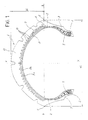
- a high-transverse-curvature tyre for equipment of two-wheeled vehicles, particularly suitable for mounting to the front wheel of a motor-cycle, is identified by 1 in fig. 1.
- the degree of this transverse curvature is defined by the particular ratio value between the distance ht (measured along the equatorial plane X-X) of the tread crown from the line b-b passing by the tread extremities C and the distance wt between said extremities.
- tread extremities cannot be easily identified, for example due to lack of a precise reference such as the corner denoted by C in Fig. 1 for example, distance wt will be considered the measurement of the maximum chord of the tyre.
- curvature ratio As already disclosed, this ratio is referred to as curvature ratio or, preferably, "tread camber”.
- This value in front tyres for two-wheeled vehicles is greater than 0.2 and always higher than the value of the corresponding rear tyre having a camber included between 0.15 and 0.30.
- the invention is not limited to tyres for front wheels, but can efficiently and conveniently also apply to tyres for rear wheels.
- Tyre 1 comprises a carcass provided with a reinforcing structure formed of at least one ply 2 of rubberized fabric, preferably but not exclusively of the radial type, the end flaps 3 of which are folded back around anchoring bead cores 4.
- the tyre area comprising the bead core 4 and fillers 5 forms the tyre bead intended for anchoring of the tyre to a corresponding mounting rim, not shown.
- tyre 1 comprises a belt structure 6 consisting of at least one radially external layer 9 and one radially internal layer 8 both comprised of structure reinforcing elements.
- the reinforcing elements of the radially external layer are cords 10 wound up around the carcass in a circumferential direction, usually called “at zero degrees” with reference to its lying relative to the equatorial plane of the tyre.
- the reinforcing elements of the radially internal layer can be individual threads/wires or cords of any appropriate material, in any case always oriented in a crossed direction to the equatorial plane, or reinforcing fillings such as fibrous fillings for example, disposed randomly but preferably oriented according to a preferential direction too, and crossed relative to the equatorial plane.
- a tread band 11 is disposed in known manner on the belt 6.
- Said tread band is provided with a tread pattern and is intended as the ground-contacting area of the tyre.
- Said radially external layer is formed of a plurality of distinct cords or at least one cord or one ribbon of few (preferably 2 to 5) cords wound up spiral-wise on the crown portion of the carcass according to a given pitch which is preferably variable and at all events has a variable thickness increasing from the centre to the belt extremities.
- said cords 10 are the well-known high elongation (HE) metallic cords the use and features of which have already been widely described in the Italian Patent Application No. 20646 A/90 for example, in the name of the same Applicant.
- HE high elongation
- these cords consist of a given number of strands (1 to 5, and preferably between 3 and 4), each strand being formed of a given number of individual wires, (2 to 10 and preferably between 4 and 7), each of a diameter greater than 0.10 mm, preferably included between 0.12 and 0.35 mm.
- the wires in the strands and the strands in the cord are helically wound together in the same direction, according to the same winding pitches or to different winding pitches for the wires and the strands.
- said cords are made of high-carbon (HT) steel wires, that is wires containing carbon in an amount greater than 0.9%.
- HT high-carbon
- the helical winding of layer 9 consisted of a single cord 10, known as 3x4x0.20 HE HT cord spiralled from one extremity of the belt to the other: said quotation identifies a metal cord formed of 3 strands each consisting of four elementary wires wound in the same direction as the strands and of a diameter corresponding to 0.20 mm; as is known the abbreviation HE means "high elongation” and the abbreviation HT means “high tensile” steel.
- cords have an ultimate elongation included between 4% and 8% and a typical well-known behaviour to tensile stress, the so-called "spring behaviour”.
- the preferential use of the metallic cords does not exclude the use of other cords, to the ends of the present invention; in particular, the well-known textile cords made of aramidic fibre and commercially known as Kevlar (trademark by DuPont) can be also employed.
- the distribution thickness of the cord 10 coils progressively varies along the layer from the equatorial plane towards the extremities, preferably following a predetermined relation.
- the product of the mass of the cord coils disposed in a unitary portion of given value by the square of the distance between the centre of said portion and the rotation axis r-r of the tyre should keep a substantially constant value over the whole axial extension of the belt in such a manner that during the tyre rotation the resulting centrifugal forces in each of said portions have all the same value thereby giving rise to a given uniform stress condition from one extremity of the belt to the other one.
- This parameter will take a value substantially close to 1 in the case in which the cords have the same formation and all the connected materials are the same over the whole extension of the layers, and different values in connection with variations in the materials and the formation of the reinforcing elements along the perimetric extension of the belt.
- a steel HE HT 3x4x0.20 cord is selected the ultimate-elongation value of which is equal to 6% and which is rubberized in the usual manner, and a ribbon consisting of three side-by-side cords is formed in advance and spiralled around the carcass with an axial winding pitch of 7 mm and a tension of 400 grams and more.
- a value of 4 cords/cm was selected (see Fig. 4) as the number of coils No included within the portion To, located on either side of the equatorial plane, of a unitary length of 1 cm; the overall weight of the cord coils in said portion was 0.36 kg.
- the product of this overall weight by the square of R identifies the constant value V designed to control the coil number and/or thickness and/or the cord type in any other unitary portion included between the equatorial plane X-X and the belt extremities.
- thickness of said cords at zero degrees in the area located on either side of the equatorial plane where the maximum thinning out takes place it does not exceed 8 and preferably is included between 4 and 6 cords/cm.
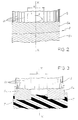
- First of all the layer may comprise two strips 8a, 8b of rubberized fabric consisting of reinforcing elements incorporated into an elastomeric matrix, oriented according to preferential directions crossing each other in the two strips and preferably symmetrically inclined to the equatorial plane X-X, substantially in the same manner as the traditional belt of the prior art.
- the important difference from the prior art belt resides in the more reduced stiffness of the new belt at a wide area a (included between 10% and 30% of the axial extension of the belt) on either side of the equatorial plane; this more reduced stiffness can be conveniently achieved by acting either on the thickness of the reinforcing elements, or on the constituent material, or on the orientation of said elements to the equatorial plane, or on any other combination of the above expedients.
- This stiffness value can be expressed in different ways, for example by the thickness of said reinforcing elements (any other condition being equal), but more generally it is expressed by the modulus of elasticity or ultimate tensile stress of said radially internal belt layer, measured in the circumferential direction of the tyre; said layer preferably will have a stiffness that does not exceed 65% of the stiffness of the equivalent belts in the known art.
- the material, structure and lying angles being equal, the overall thickness of the reinforcing elements crossing a right section of unitary width, on either side of the equatorial plane, in an oblique direction relative to said plane (as shown in Fig. 2) does not exceed, and preferably is lower than the usual thickness of the elements of said traditional belt, which is, as known, in the order of 14 cords/cm.
- angles formed by said cords relative to the equatorial plane are included between 18° and 50° and preferably between 22° and 45°.
- said strips are even interrupted at the equatorial plane, giving rise to an area a of a width included between 10% and 30% of the axial extension of said belt, in which only circumferentially-directed reinforcing cords 10 are present.
- the end edges of said strips are in a stepped relationship, as currently occurs in the art.
- the above described version has the advantage that appropriate thickness values can be selected in said strips for the side portions of the belt structure without correspondingly thickening the central crown portion of the belt structure.
- the reinforcing elements of said strips are monofilaments and/or twisted or untwisted yarns, and their cords are made either of varied textile materials, for example natural fibres such as rayon or cotton, or of synthetic fibres such as polyamide, nylon and aramid, or even of metal.
- both strips comprise cords of the same material, whereas in another embodiment the cords of one strip are of a different material from those of the other strip, nylon-aramid or aramid-metal couplings being for example selected; in this case the angles of said cords included within the above described range are preferably different from each other and not symmetric.
- the radially internal layer is formed of only two strips, disposed axially side by side along the perimetric outline, provided each (8c, 8d) with reinforcing elements oriented in a crossed direction inclined to the equatorial plane, so that the two strips give rise to a substantially herringbone configuration of the reinforcing elements.
- the two side-by-side strips can be maintained close to each other or also joined along their facing longitudinal edges, or completely separated. In this case it is useful for the facing edges to keep the same axial width as pointed out above in the case of the superposed strips.
- said radially internal layer consists of a sheet 7 of elastomeric material, which is axially continuous or interrupted at the plane X-X, as already described, charged with a reinforcing filling consisting of short discontinuous fibres, optionally randomly dispersed within the elastomeric matrix but preferably substantially oriented in an axial direction or a direction inclined to the equatorial plane X-X of the tyre, symmetric with the direction of the adjacent sheet portion.
- this density is preferably included between 0.5% and 5% of the overall volume.
- said fibrous reinforcing fillings are of a material selected from the group consisting of textile, metallic or glass fibres.
- aramid better known as "aramid pulp” or “Kevlar-pulp” have proved to be convenient.
- tyres were two tyres of usual production manufactured by the Applicant and the tyre of a different manufacturer, considered as the best of the competitors' tyres, under normal-drive and top-limit-drive conditions, respectively.
- MOTOR-CYCLE HONDA CBR 1000 Front tyre size 120/70 ZR 17 ⁇ Inflation pressure 2.5 bar ⁇ Rim 3.50 - 17
- Rear tyre size 170/60 ZR 17 ⁇ Inflation pressure 2.9 bar ⁇ Rim 5.50 - 17
- the road test consisted in evaluating the qualitative level of the most important behavioural drive features especially depending on the belt structure, giving a subjective judgement, converted to a score variable from 1 to 7, awarding the maximum score to the tyre showing the best behaviour in each of the considered features.
- the tyre of the invention had a radial two-ply carcass with nylon (title 940/2) cords, two radially-superposed belt strips provided with nylon (title 940/2) cords, symmetrically crossed with each other in the two strips, distributed according to a thickness of 6 cords/cm and inclined to an angle of 40° relative to the equatorial plane, which values were measured at the crown.
- the radially external layer was made of metallic HE cords and consisted of a band winding as previously described.
- the comparative tyres substantially identical with each other had a radial two-ply carcass made of nylon (title 940/2), and only a pair of radially-superposed belt strips, provided with cords made of aramid (title 1100/2), symmetrically crossed with each other in the two strips, distributed according to a thickness of 9 cords/cm and inclined to an angle of 23° relative to the equatorial plane, according to the known art, which values were all measured at the tyre crown.
- the tyre of the invention has a better performance level taken as a whole than the competitors' one, in particular a better level not only as regards the absorption capability of the road-bed unevennesses, corresponding to expectations, but also and surprisingly, as regards the braking behaviour, that is roadholding and braking distance.
- the invention achieves all the intended purposes.
- the reinforcing layer at a position radially internal to the zero-degree cord layer, in particular at the side areas of the tread, of a rapidly decreasing diameter constitutes a support element of appropriate consistence and mechanical strength, capable of enabling winding of the cord or cords at zero degrees on the manufacturing drum even under a tension of non-negligible value, in order to control the pre-loading condition of the winding in the raw tyre.
- the combination of a zero-degree winding with a more internal reinforcing layer, in a single or double strip, optionally interrupted at the central tread section enables the two and conflicting requirements of a high flexibility of the belt under running conditions on a straight stretch and high stiffness for withstanding slip thrusts during a running on a bend, to be balanced.
Landscapes
- Engineering & Computer Science (AREA)
- Mechanical Engineering (AREA)
- Tires In General (AREA)
Applications Claiming Priority (3)
| Application Number | Priority Date | Filing Date | Title |
|---|---|---|---|
| IT95MI001681A IT1277400B1 (it) | 1995-08-01 | 1995-08-01 | Pneumatico ad elevata curvatura trasversale particolarmente per veicolo a due ruote |
| ITMI951681 | 1995-08-01 | ||
| EP96111804A EP0756949B1 (fr) | 1995-08-01 | 1996-07-23 | Bandage pneumatique à grande courbure transversale, en particulier pour véhicule à deux roues |
Related Parent Applications (1)
| Application Number | Title | Priority Date | Filing Date |
|---|---|---|---|
| EP96111804A Division EP0756949B1 (fr) | 1995-08-01 | 1996-07-23 | Bandage pneumatique à grande courbure transversale, en particulier pour véhicule à deux roues |
Publications (2)
| Publication Number | Publication Date |
|---|---|
| EP1127714A2 true EP1127714A2 (fr) | 2001-08-29 |
| EP1127714A3 EP1127714A3 (fr) | 2003-07-02 |
Family
ID=11372100
Family Applications (2)
| Application Number | Title | Priority Date | Filing Date |
|---|---|---|---|
| EP01109906A Withdrawn EP1127714A3 (fr) | 1995-08-01 | 1996-07-23 | Pneus à forte courbure transversale, en particulier pour véhicules à deux roues |
| EP96111804A Expired - Lifetime EP0756949B1 (fr) | 1995-08-01 | 1996-07-23 | Bandage pneumatique à grande courbure transversale, en particulier pour véhicule à deux roues |
Family Applications After (1)
| Application Number | Title | Priority Date | Filing Date |
|---|---|---|---|
| EP96111804A Expired - Lifetime EP0756949B1 (fr) | 1995-08-01 | 1996-07-23 | Bandage pneumatique à grande courbure transversale, en particulier pour véhicule à deux roues |
Country Status (11)
| Country | Link |
|---|---|
| US (3) | US5902425A (fr) |
| EP (2) | EP1127714A3 (fr) |
| JP (1) | JP4107689B2 (fr) |
| KR (1) | KR100428036B1 (fr) |
| AR (1) | AR003153A1 (fr) |
| AT (1) | ATE208713T1 (fr) |
| BR (1) | BR9604055A (fr) |
| DE (1) | DE69616894T2 (fr) |
| ES (1) | ES2168415T3 (fr) |
| IT (1) | IT1277400B1 (fr) |
| TR (1) | TR199600630A1 (fr) |
Cited By (2)
| Publication number | Priority date | Publication date | Assignee | Title |
|---|---|---|---|---|
| EP1531063A1 (fr) * | 2003-11-14 | 2005-05-18 | The Goodyear Tire & Rubber Company | Bandage pneumatique |
| WO2006090418A1 (fr) * | 2005-02-28 | 2006-08-31 | Pirelli Tyre S.P.A. | Procede et appareil de fabrication de pneumatiques pour roues de vehicule |
Families Citing this family (44)
| Publication number | Priority date | Publication date | Assignee | Title |
|---|---|---|---|---|
| IT1277400B1 (it) * | 1995-08-01 | 1997-11-10 | Pirelli | Pneumatico ad elevata curvatura trasversale particolarmente per veicolo a due ruote |
| IT1283051B1 (it) * | 1996-05-22 | 1998-04-07 | Pirelli | Coppia di pneumatici ad elevata curvatura trasversale,particolarmente per veicoli a due ruote e metodo per il controllo del comportamento |
| IT1283351B1 (it) * | 1996-07-29 | 1998-04-17 | Pirelli | Pneumatico ad elevata curvatura trasversale in particolare per ruote anteriori |
| IT1283350B1 (it) | 1996-07-29 | 1998-04-17 | Pirelli | Pneumatico ad elevata curvatura trasversale in particolare per ruote posteriori di motoveicoli |
| JP3782875B2 (ja) * | 1997-09-30 | 2006-06-07 | 横浜ゴム株式会社 | 空気入りラジアルタイヤ |
| EP0928703A1 (fr) * | 1997-12-29 | 1999-07-14 | PIRELLI PNEUMATICI S.p.A. | Bandage pneumatique à grande courbure transversale pour véhicule à deux roues, et son procédé de fabrication |
| ES2219746T3 (es) * | 1997-12-29 | 2004-12-01 | Pirelli Pneumatici S.P.A. | Neumatico de alta curvatura transversal para vehiculos de dos ruedas. |
| US6397911B1 (en) | 1997-12-29 | 2002-06-04 | Pirelli Pneumatici S.P.A. | High transverse-curvature motor-bike tire |
| US6412533B1 (en) | 1997-12-29 | 2002-07-02 | Pirelli Pneumatici S.P.A. | High transverse-curvature tire for two-wheeled vehicles including specified belt structure |
| ES2230760T3 (es) * | 1998-04-16 | 2005-05-01 | Pirelli Pneumatici S.P.A. | Neumatico de gran curbatura transversal, en particular para vehiculos de dos ruedas. |
| US6244315B1 (en) | 1998-04-16 | 2001-06-12 | Pirelli Pneumatici S.P.A. | Tyre with high transverse curvature coefficient in particular for a two-wheeled vehicle |
| EP1004460A3 (fr) * | 1998-11-26 | 2001-11-14 | Bridgestone Corporation | Bandage pneumatique pour roue avant de moto |
| FR2800325B1 (fr) * | 1999-11-03 | 2002-10-11 | Dunlop Sa | Pneumatique de motocyclette |
| US6651716B1 (en) * | 2000-02-23 | 2003-11-25 | The Goodyear Tire & Rubber Company | Method and tire adapted for post cure tire uniformity correction |
| JP2001301422A (ja) * | 2000-04-25 | 2001-10-31 | Bridgestone Corp | 空気入りタイヤの装着構造 |
| US20050269005A1 (en) * | 2000-09-20 | 2005-12-08 | Steinke Richard A | Air no air elastomeric tire |
| BR0116584B1 (pt) * | 2000-12-27 | 2010-06-01 | pneu para rodas de veìculo, par de pneus para veìculos de duas rodas, veìculo a motor equipado com um par de pneus e métodos para emborrachar cordonéis de reforço metálicos para pneus para rodas de veìculos e para assentar pelo menos um cordonel de reforço metálico sobre o tambor de confecção de um pneu para rodas de veìculos. | |
| US7404425B2 (en) * | 2002-04-24 | 2008-07-29 | The Goodyear Tire & Rubber Company | Belt package for super single truck tires |
| AU2003240615A1 (en) | 2002-05-10 | 2003-11-11 | Michelin Recherche Et Techniques S.A. | Two-wheeler tyre |
| CN100408357C (zh) * | 2002-08-09 | 2008-08-06 | 米其林技术公司 | 用于两轮车辆的轮胎 |
| BR0318177A (pt) * | 2003-03-26 | 2006-03-21 | Pirelli | pneu para veìculos de duas rodas |
| EP1636052B1 (fr) * | 2003-06-19 | 2018-08-08 | Pirelli Tyre S.p.A. | Pneu presentant une structure de ceinture amelioree |
| GB2404636B (en) * | 2003-08-01 | 2006-12-20 | Dunlop Tyres Ltd | Motorcycle radial tyre |
| JP4533181B2 (ja) | 2005-02-21 | 2010-09-01 | 株式会社ブリヂストン | 二輪車用空気入りタイヤ |
| KR100578101B1 (ko) * | 2005-03-29 | 2006-05-10 | 금호타이어 주식회사 | 고속 주행용 공기입 타이어 |
| FR2885846B1 (fr) * | 2005-05-18 | 2007-07-06 | Michelin Soc Tech | Pneumatique pour deux roues |
| CN100569545C (zh) * | 2005-05-31 | 2009-12-16 | 横滨橡胶株式会社 | 充气子午线轮胎 |
| FR2897557B1 (fr) * | 2006-02-21 | 2008-04-18 | Michelin Soc Tech | Pneumatique pour vehicules |
| JP5013522B2 (ja) * | 2007-09-07 | 2012-08-29 | 株式会社ブリヂストン | 空気入りラジアルタイヤ |
| FR2939719B1 (fr) * | 2008-12-17 | 2010-12-31 | Michelin Soc Tech | Pneumatique pour vehicules comportant une bande de roulement constituee de plusieurs melanges et une couche d'elements de renforcement circonferentiels a pas variable |
| FR2939723B1 (fr) | 2008-12-17 | 2010-12-31 | Michelin Soc Tech | Pneumatique pour vehicules comportant une couche d'elements de renforcement circonferentiels |
| JP4659099B2 (ja) * | 2009-02-16 | 2011-03-30 | 住友ゴム工業株式会社 | 自動二輪車用タイヤ、及びその製造方法 |
| US20120118467A1 (en) * | 2009-07-30 | 2012-05-17 | Luca Bruschelli | Tyre for a motor vehicle and method for controlling a motor vehicle during a manoeuvre to change direction and/or speed |
| JP5342366B2 (ja) * | 2009-08-05 | 2013-11-13 | 株式会社ブリヂストン | 空気入りタイヤ |
| FR2956355B1 (fr) * | 2010-02-12 | 2012-05-18 | Michelin Soc Tech | Pneumatique pour vehicules a deux roues comportant une bande de roulement presentant des incisions. |
| CN102390225B (zh) * | 2011-10-24 | 2013-06-12 | 厦门正新橡胶工业有限公司 | 低扁平摩托车轮胎 |
| JP6043065B2 (ja) * | 2012-01-10 | 2016-12-14 | 住友ゴム工業株式会社 | 自動二輪車用タイヤの製造方法 |
| US20150000813A1 (en) * | 2012-02-06 | 2015-01-01 | Bridgestone Corporation | Pneumatic radial tire |
| US10556466B2 (en) * | 2013-10-29 | 2020-02-11 | Bridgestone Corporation | Tire |
| JP5918742B2 (ja) | 2013-12-03 | 2016-05-18 | 住友ゴム工業株式会社 | 自動二輪用空気入りタイヤの製造方法 |
| EP3312023B1 (fr) | 2016-08-30 | 2019-10-09 | Sumitomo Rubber Industries, Ltd. | Pneu de moto |
| US11633983B2 (en) * | 2017-05-08 | 2023-04-25 | Pirelli Tyre S.P.A. | Tyre for bicycle wheels |
| JP7467964B2 (ja) * | 2019-03-22 | 2024-04-16 | 住友ゴム工業株式会社 | 自動二輪車用タイヤ |
| JP7268434B2 (ja) * | 2019-03-22 | 2023-05-08 | 住友ゴム工業株式会社 | 自動二輪車用タイヤ |
Family Cites Families (20)
| Publication number | Priority date | Publication date | Assignee | Title |
|---|---|---|---|---|
| GB1438288A (fr) * | 1972-09-01 | 1976-06-03 | ||
| IT1081053B (it) * | 1976-05-17 | 1985-05-16 | Pirelli | Perfezionamento alla struttura resistente dei pneumatici per ruote di veicoli |
| IT1093433B (it) * | 1978-03-09 | 1985-07-19 | Pirelli | Perfezionamento alla struttura anulare di rinforzo per pneumatici radiali |
| JPS5671604A (en) * | 1979-11-16 | 1981-06-15 | Ohtsu Tire & Rubber Co Ltd | Radial tire |
| DE3410857C2 (de) | 1984-03-23 | 1993-11-04 | Metzeler Gmbh | Guertelreifen |
| DE3606934A1 (de) * | 1986-03-04 | 1987-09-10 | Continental Gummi Werke Ag | Fahrzeugluftreifen |
| DE3855332T2 (de) * | 1987-06-18 | 1996-10-02 | Sumitomo Rubber Ind | Gürtelreifen und Verfahren zur Herstellung |
| US4871004A (en) * | 1988-02-17 | 1989-10-03 | The Goodyear Tire & Rubber Company | Rubber containing aramid pulp reinforcement |
| GB8813776D0 (en) * | 1988-06-10 | 1988-07-13 | Sumitomo Rubber Ind | Motor cycle radial tyre |
| IT1236885B (it) * | 1989-12-19 | 1993-04-26 | Pirelli | Procedimento per la fabbricazione di pneumatici con profilo torico ad elevata curvatura trasversale,apparato per la sua attuazione e prodotto ottenuto |
| JP2842558B2 (ja) * | 1990-05-02 | 1999-01-06 | 住友ゴム工業 株式会社 | 自動二輪車用ラジアルタイヤ |
| IT1248851B (it) * | 1990-06-14 | 1995-01-30 | Pirelli | Procedimento per la fabbricazione di pneumatici per veicoli a due ruote e pneumatici cosi' prodotti |
| AU653323B2 (en) | 1991-01-07 | 1994-09-29 | Compagnie Generale Des Etablissements Michelin - Michelin & Cie | Pneumatic tyre for motorbikes |
| JP3083862B2 (ja) * | 1991-03-05 | 2000-09-04 | 株式会社ブリヂストン | 二輪車用空気入りタイヤ |
| JP3142920B2 (ja) * | 1991-11-06 | 2001-03-07 | 株式会社ブリヂストン | 二輪車用空気入りラジアルタイヤ |
| AT399130B (de) * | 1992-03-18 | 1995-03-27 | Hoerbiger Fluidtechnik Gmbh | Anordnung zur hydraulischen betätigung eines fahrzeugverdeckes |
| DE69301366T2 (de) | 1992-04-06 | 1996-05-30 | Sumitomo Rubber Ind | Motorradreifen |
| JP2799322B2 (ja) * | 1993-06-07 | 1998-09-17 | 住友ゴム工業株式会社 | 自動二輪車用空気入りタイヤ |
| GB2283215B (en) * | 1993-10-29 | 1997-07-23 | Sumitomo Rubber Ind | Motor-cycle radial tyre |
| IT1277400B1 (it) * | 1995-08-01 | 1997-11-10 | Pirelli | Pneumatico ad elevata curvatura trasversale particolarmente per veicolo a due ruote |
-
1995
- 1995-08-01 IT IT95MI001681A patent/IT1277400B1/it active IP Right Grant
-
1996
- 1996-07-23 EP EP01109906A patent/EP1127714A3/fr not_active Withdrawn
- 1996-07-23 ES ES96111804T patent/ES2168415T3/es not_active Expired - Lifetime
- 1996-07-23 AT AT96111804T patent/ATE208713T1/de not_active IP Right Cessation
- 1996-07-23 EP EP96111804A patent/EP0756949B1/fr not_active Expired - Lifetime
- 1996-07-23 DE DE69616894T patent/DE69616894T2/de not_active Expired - Lifetime
- 1996-07-30 US US08/681,952 patent/US5902425A/en not_active Expired - Lifetime
- 1996-07-31 AR ARP960103820A patent/AR003153A1/es unknown
- 1996-08-01 TR TR96/00630A patent/TR199600630A1/xx unknown
- 1996-08-01 BR BR9604055A patent/BR9604055A/pt not_active IP Right Cessation
- 1996-08-01 KR KR1019960032207A patent/KR100428036B1/ko not_active Expired - Lifetime
- 1996-08-01 JP JP20358296A patent/JP4107689B2/ja not_active Expired - Lifetime
-
1998
- 1998-11-30 US US09/200,928 patent/US6530408B1/en not_active Expired - Lifetime
-
2003
- 2003-01-06 US US10/336,762 patent/US20030155056A1/en not_active Abandoned
Cited By (4)
| Publication number | Priority date | Publication date | Assignee | Title |
|---|---|---|---|---|
| EP1531063A1 (fr) * | 2003-11-14 | 2005-05-18 | The Goodyear Tire & Rubber Company | Bandage pneumatique |
| US7086440B2 (en) | 2003-11-14 | 2006-08-08 | The Goodyear Tire & Rubber Company | Pneumatic tire with annular reinforcing strip layer |
| US7900672B2 (en) | 2003-11-14 | 2011-03-08 | The Goodyear Tire & Rubber Company | Pneumatic tire with annular reinforcing strip layer |
| WO2006090418A1 (fr) * | 2005-02-28 | 2006-08-31 | Pirelli Tyre S.P.A. | Procede et appareil de fabrication de pneumatiques pour roues de vehicule |
Also Published As
| Publication number | Publication date |
|---|---|
| AR003153A1 (es) | 1998-07-08 |
| ATE208713T1 (de) | 2001-11-15 |
| ITMI951681A0 (it) | 1995-08-01 |
| JP4107689B2 (ja) | 2008-06-25 |
| IT1277400B1 (it) | 1997-11-10 |
| US20030155056A1 (en) | 2003-08-21 |
| TR199600630A1 (tr) | 1997-02-21 |
| US6530408B1 (en) | 2003-03-11 |
| KR100428036B1 (ko) | 2004-07-19 |
| ITMI951681A1 (it) | 1997-02-01 |
| US5902425A (en) | 1999-05-11 |
| DE69616894T2 (de) | 2002-08-29 |
| BR9604055A (pt) | 1998-06-16 |
| DE69616894D1 (de) | 2001-12-20 |
| EP0756949B1 (fr) | 2001-11-14 |
| EP1127714A3 (fr) | 2003-07-02 |
| KR970010146A (ko) | 1997-03-27 |
| EP0756949A1 (fr) | 1997-02-05 |
| ES2168415T3 (es) | 2002-06-16 |
| JPH09118109A (ja) | 1997-05-06 |
Similar Documents
| Publication | Publication Date | Title |
|---|---|---|
| EP0756949B1 (fr) | Bandage pneumatique à grande courbure transversale, en particulier pour véhicule à deux roues | |
| EP0808730B1 (fr) | Paire de pneus à forte courbure transversale pour véhicules à deux roues | |
| US6755227B2 (en) | High-transverse-curvature tire, in particular for use in front wheels of motor-vehicles | |
| KR100637852B1 (ko) | 2륜차량용고횡곡률타이어 | |
| KR100572048B1 (ko) | 높은 횡곡률 계수를 갖는, 특히 2륜 차량용 타이어 | |
| US6397911B1 (en) | High transverse-curvature motor-bike tire | |
| JP4650917B2 (ja) | 空気入りタイヤ | |
| JP4548925B2 (ja) | 空気入りタイヤ | |
| JP2733428B2 (ja) | 空気入りタイヤ | |
| US6244315B1 (en) | Tyre with high transverse curvature coefficient in particular for a two-wheeled vehicle | |
| JPH11245616A (ja) | 2輪車用の横断曲率の大きいタイヤ及びその製造方法 | |
| JPH1111107A (ja) | 乗用車用空気入りラジアルタイヤ | |
| JP2005507338A (ja) | 改善されたビード構造体を備えた自動車ホイール用のタイヤ | |
| CN1208701A (zh) | 特别用于两轮机动车的高横向曲率轮胎对 | |
| JP2892927B2 (ja) | 空気入りラジアルタイヤ | |
| JPH05270209A (ja) | 自動二輪車用タイヤ | |
| JPH04151305A (ja) | ラジアルタイヤ | |
| HK1019320B (en) | Pair of high-transverse-curvature tyres, in particular for two-wheeled vehicles | |
| JPH11321232A (ja) | 空気入りラジアルタイヤ |
Legal Events
| Date | Code | Title | Description |
|---|---|---|---|
| PUAI | Public reference made under article 153(3) epc to a published international application that has entered the european phase |
Free format text: ORIGINAL CODE: 0009012 |
|
| AC | Divisional application: reference to earlier application |
Ref document number: 756949 Country of ref document: EP |
|
| AK | Designated contracting states |
Kind code of ref document: A2 Designated state(s): AT BE CH DE DK ES FI FR GB GR IT LI LU NL PT SE |
|
| PUAL | Search report despatched |
Free format text: ORIGINAL CODE: 0009013 |
|
| AK | Designated contracting states |
Designated state(s): AT BE CH DE DK ES FI FR GB GR IT LI LU NL PT SE |
|
| RIC1 | Information provided on ipc code assigned before grant |
Ipc: 7B 60C 9/22 A |
|
| AKX | Designation fees paid |
Designated state(s): AT BE CH DE DK ES FI FR GB GR IT LI LU NL PT SE |
|
| STAA | Information on the status of an ep patent application or granted ep patent |
Free format text: STATUS: THE APPLICATION IS DEEMED TO BE WITHDRAWN |
|
| 18D | Application deemed to be withdrawn |
Effective date: 20040103 |