EP1127844B1 - Feinverteilte titan-enthaltende verbindung, beschichtungslösung diese enthaltend, verfahren zur herstellung und damit beschichtete formteile - Google Patents
Feinverteilte titan-enthaltende verbindung, beschichtungslösung diese enthaltend, verfahren zur herstellung und damit beschichtete formteile Download PDFInfo
- Publication number
- EP1127844B1 EP1127844B1 EP99919667A EP99919667A EP1127844B1 EP 1127844 B1 EP1127844 B1 EP 1127844B1 EP 99919667 A EP99919667 A EP 99919667A EP 99919667 A EP99919667 A EP 99919667A EP 1127844 B1 EP1127844 B1 EP 1127844B1
- Authority
- EP
- European Patent Office
- Prior art keywords
- titanium
- acid
- aqueous
- finely divided
- particulate material
- Prior art date
- Legal status (The legal status is an assumption and is not a legal conclusion. Google has not performed a legal analysis and makes no representation as to the accuracy of the status listed.)
- Expired - Lifetime
Links
Images

Classifications
-
- C—CHEMISTRY; METALLURGY
- C09—DYES; PAINTS; POLISHES; NATURAL RESINS; ADHESIVES; COMPOSITIONS NOT OTHERWISE PROVIDED FOR; APPLICATIONS OF MATERIALS NOT OTHERWISE PROVIDED FOR
- C09C—TREATMENT OF INORGANIC MATERIALS, OTHER THAN FIBROUS FILLERS, TO ENHANCE THEIR PIGMENTING OR FILLING PROPERTIES ; PREPARATION OF CARBON BLACK ; PREPARATION OF INORGANIC MATERIALS WHICH ARE NO SINGLE CHEMICAL COMPOUNDS AND WHICH ARE MAINLY USED AS PIGMENTS OR FILLERS
- C09C1/00—Treatment of specific inorganic materials other than fibrous fillers; Preparation of carbon black
- C09C1/36—Compounds of titanium
- C09C1/3607—Titanium dioxide
- C09C1/3669—Treatment with low-molecular organic compounds
-
- B—PERFORMING OPERATIONS; TRANSPORTING
- B01—PHYSICAL OR CHEMICAL PROCESSES OR APPARATUS IN GENERAL
- B01J—CHEMICAL OR PHYSICAL PROCESSES, e.g. CATALYSIS OR COLLOID CHEMISTRY; THEIR RELEVANT APPARATUS
- B01J21/00—Catalysts comprising the elements, oxides, or hydroxides of magnesium, boron, aluminium, carbon, silicon, titanium, zirconium, or hafnium
- B01J21/06—Silicon, titanium, zirconium or hafnium; Oxides or hydroxides thereof
- B01J21/063—Titanium; Oxides or hydroxides thereof
-
- B—PERFORMING OPERATIONS; TRANSPORTING
- B01—PHYSICAL OR CHEMICAL PROCESSES OR APPARATUS IN GENERAL
- B01J—CHEMICAL OR PHYSICAL PROCESSES, e.g. CATALYSIS OR COLLOID CHEMISTRY; THEIR RELEVANT APPARATUS
- B01J35/00—Catalysts, in general, characterised by their form or physical properties
- B01J35/30—Catalysts, in general, characterised by their form or physical properties characterised by their physical properties
- B01J35/39—Photocatalytic properties
-
- B—PERFORMING OPERATIONS; TRANSPORTING
- B01—PHYSICAL OR CHEMICAL PROCESSES OR APPARATUS IN GENERAL
- B01J—CHEMICAL OR PHYSICAL PROCESSES, e.g. CATALYSIS OR COLLOID CHEMISTRY; THEIR RELEVANT APPARATUS
- B01J35/00—Catalysts, in general, characterised by their form or physical properties
- B01J35/40—Catalysts, in general, characterised by their form or physical properties characterised by dimensions, e.g. grain size
- B01J35/45—Nanoparticles
-
- B—PERFORMING OPERATIONS; TRANSPORTING
- B82—NANOTECHNOLOGY
- B82Y—SPECIFIC USES OR APPLICATIONS OF NANOSTRUCTURES; MEASUREMENT OR ANALYSIS OF NANOSTRUCTURES; MANUFACTURE OR TREATMENT OF NANOSTRUCTURES
- B82Y30/00—Nanotechnology for materials or surface science, e.g. nanocomposites
-
- C—CHEMISTRY; METALLURGY
- C01—INORGANIC CHEMISTRY
- C01G—COMPOUNDS CONTAINING METALS NOT COVERED BY SUBCLASSES C01D OR C01F
- C01G23/00—Compounds of titanium
- C01G23/04—Oxides; Hydroxides
- C01G23/047—Titanium dioxide
- C01G23/053—Producing by wet processes, e.g. hydrolysing titanium salts
- C01G23/0536—Producing by wet processes, e.g. hydrolysing titanium salts by hydrolysing chloride-containing salts
-
- C—CHEMISTRY; METALLURGY
- C01—INORGANIC CHEMISTRY
- C01P—INDEXING SCHEME RELATING TO STRUCTURAL AND PHYSICAL ASPECTS OF SOLID INORGANIC COMPOUNDS
- C01P2002/00—Crystal-structural characteristics
- C01P2002/02—Amorphous compounds
-
- C—CHEMISTRY; METALLURGY
- C01—INORGANIC CHEMISTRY
- C01P—INDEXING SCHEME RELATING TO STRUCTURAL AND PHYSICAL ASPECTS OF SOLID INORGANIC COMPOUNDS
- C01P2002/00—Crystal-structural characteristics
- C01P2002/80—Crystal-structural characteristics defined by measured data other than those specified in group C01P2002/70
- C01P2002/84—Crystal-structural characteristics defined by measured data other than those specified in group C01P2002/70 by UV- or VIS- data
-
- C—CHEMISTRY; METALLURGY
- C01—INORGANIC CHEMISTRY
- C01P—INDEXING SCHEME RELATING TO STRUCTURAL AND PHYSICAL ASPECTS OF SOLID INORGANIC COMPOUNDS
- C01P2004/00—Particle morphology
- C01P2004/60—Particles characterised by their size
- C01P2004/64—Nanometer sized, i.e. from 1-100 nanometer
-
- C—CHEMISTRY; METALLURGY
- C01—INORGANIC CHEMISTRY
- C01P—INDEXING SCHEME RELATING TO STRUCTURAL AND PHYSICAL ASPECTS OF SOLID INORGANIC COMPOUNDS
- C01P2006/00—Physical properties of inorganic compounds
- C01P2006/60—Optical properties, e.g. expressed in CIELAB-values
-
- C—CHEMISTRY; METALLURGY
- C04—CEMENTS; CONCRETE; ARTIFICIAL STONE; CERAMICS; REFRACTORIES
- C04B—LIME, MAGNESIA; SLAG; CEMENTS; COMPOSITIONS THEREOF, e.g. MORTARS, CONCRETE OR LIKE BUILDING MATERIALS; ARTIFICIAL STONE; CERAMICS; REFRACTORIES; TREATMENT OF NATURAL STONE
- C04B35/00—Shaped ceramic products characterised by their composition; Ceramics compositions; Processing powders of inorganic compounds preparatory to the manufacturing of ceramic products
- C04B35/01—Shaped ceramic products characterised by their composition; Ceramics compositions; Processing powders of inorganic compounds preparatory to the manufacturing of ceramic products based on oxide ceramics
- C04B35/46—Shaped ceramic products characterised by their composition; Ceramics compositions; Processing powders of inorganic compounds preparatory to the manufacturing of ceramic products based on oxide ceramics based on titanium oxides or titanates
-
- C—CHEMISTRY; METALLURGY
- C04—CEMENTS; CONCRETE; ARTIFICIAL STONE; CERAMICS; REFRACTORIES
- C04B—LIME, MAGNESIA; SLAG; CEMENTS; COMPOSITIONS THEREOF, e.g. MORTARS, CONCRETE OR LIKE BUILDING MATERIALS; ARTIFICIAL STONE; CERAMICS; REFRACTORIES; TREATMENT OF NATURAL STONE
- C04B35/00—Shaped ceramic products characterised by their composition; Ceramics compositions; Processing powders of inorganic compounds preparatory to the manufacturing of ceramic products
- C04B35/622—Forming processes; Processing powders of inorganic compounds preparatory to the manufacturing of ceramic products
- C04B35/62222—Forming processes; Processing powders of inorganic compounds preparatory to the manufacturing of ceramic products obtaining ceramic coatings
-
- Y—GENERAL TAGGING OF NEW TECHNOLOGICAL DEVELOPMENTS; GENERAL TAGGING OF CROSS-SECTIONAL TECHNOLOGIES SPANNING OVER SEVERAL SECTIONS OF THE IPC; TECHNICAL SUBJECTS COVERED BY FORMER USPC CROSS-REFERENCE ART COLLECTIONS [XRACs] AND DIGESTS
- Y10—TECHNICAL SUBJECTS COVERED BY FORMER USPC
- Y10T—TECHNICAL SUBJECTS COVERED BY FORMER US CLASSIFICATION
- Y10T428/00—Stock material or miscellaneous articles
- Y10T428/29—Coated or structually defined flake, particle, cell, strand, strand portion, rod, filament, macroscopic fiber or mass thereof
- Y10T428/2982—Particulate matter [e.g., sphere, flake, etc.]
Definitions
- This invention relates to a titanium-containing finely divided particulate material having a minute particle diameter, an aqueous sol composition and coating liquid containing the titanium-containing material, a process for producing the titanium-containing material, a process for producing the coating liquid, and a shaped article having a film of the titanium-containing material.
- the titanium-containing finely divided particulate material of the invention, and an aqueous sol composition and coating liquid containing the titanium-containing material are suitably used for the formation of a film on a substrate such as a ceramic or a synthetic resin.
- a substrate such as a ceramic or a synthetic resin.
- the thus-formed film exhibits excellent transparency, high photocatalytic activity, good adhesion to a substrate, and high ultraviolet rays absorption.
- titanium oxide is produced by hydrolysis of a titanium alkoxide or an aqueous solution of titanium tetrachloride, whereby a titanium oxide sol is produced.
- Titanium oxide is known as exhibiting a photocatalytic activity. Recently, there have been proposed many techniques utilizing the photocatalytic activity. For example, a technique has been proposed wherein a titanium oxide sol is coated on the surface of a lighting appliance such as, for example, a glass tube of a fluorescent lamp or a cover thereof to form a film of titanium oxide. According to this technique, the titanium oxide film acts as a photocatalyst to decompose organic substances such as lampblack that adhere to the tube or cover, and thus, contaminants on the glass tube or cover are removed, and the glass or cover is prevented from contaminated.
- a lighting appliance such as, for example, a glass tube of a fluorescent lamp or a cover thereof
- the titanium oxide film acts as a photocatalyst to decompose organic substances such as lampblack that adhere to the tube or cover, and thus, contaminants on the glass tube or cover are removed, and the glass or cover is prevented from contaminated.
- JP02196029 A discloses porous titanium oxide fine particles obtained by adding to a hot aqueous solution of an organic acid an aqueous solution of titanium tetrachloride, whereby particles of a hydrated titanium dioxide comprising the organic acid are obtained.
- EP0335773 A discloses a process for preparing titanium dioxide by adding to an aqueous solution of titanium oxychloride an organic acid, followed by heating the solution for some hours to the boiling point. The solution is filtered and the precipitate is washed and dried under vacuum.
- US4923682 A discloses a titania thin film forming material comprising titania and an organic acid, whereby a thin film forming material is prepared which is applied onto a substrate to afford a titania thin film.
- JP02014820 A discloses a titanium oxide thin film-forming material obtained by reacting an organic acid with titanic acid to provide a titanium oxide thin film-forming material in the form of a sol.
- a primary object of the present invention is to provide a titanium-containing finely divided particulate material which is capable of giving a film exhibiting an enhanced transparency while high catalytic activity is kept.
- the inventors made extensive research into a process for producing titanium oxide by hydrolysis of titanium tetrachloride, and found that, by hydrolyzing titanium tetrachloride in an aqueous solution in the presence of a specific carboxylic acid, an aqueous coating liquid (i.e., a sol) of a titanium-containing finely divided particulate material having an average particle diameter of about 0.8 to 50 nm can be obtained, which has hitherto not been obtained; and that a film exhibiting excellent transparency which has hitherto not been obtained, while high catalytic activity is kept, can be formed from the sol. Based on these findings, the present invention has been completed.
- the present invention provides the following.
- the amorphous titanium-containing finely divided particulate material of the present inventors can be produced by hydrolyzing titanium tetrachloride in the presence of a carboxylic acid in an aqueous solution.
- the details of chemical composition and structure of the titanium-containing finely divided particulate material produced by the hydrolysis are not clear.
- the titanium-containing material is in the form of very finely divided monodisperse particles, and is clearly different from conventional titanium dioxide particles prepared by hydrolyzing titanium tetrachloride in an aqueous solution in the conventional manner.
- a film formed from an aqueous liquid containing a finely dispersed titanium-containing particulate material of the present invention keeps high catalytic activity and has excellent transparency as compared with a film formed from the conventional titanium dioxide.
- the process for producing the titanium-containing finely divided particulate material of the present invention comprises a step of hydrolyzing titanium tetrachloride in an aqueous solution at an elevated temperature, characterized in that the hydrolysis is carried out in the presence of a specific carboxylic acid.
- the hydrolysis of titanium tetrachloride can also be carried out in a water-soluble organic solvent, but the hydrolysis in such solvent is not preferable.
- the concentration of titanium tetrachloride in an aqueous solution of titanium tetrachloride for hydrolysis is too low, productivity of the target titanium-containing material is poor.
- the concentration is too high, the reaction proceeds vigorously and finely divided particles are difficult to produce, and the resulting particles have poor dispersibility. Therefore, the concentration is in the range of 0.1 to 6.5 moles per liter as titanium.
- a carboxylic acid is used in a form of dissolved in an aqueous medium, and hence, carboxylic acids which are readily soluble in water are used, i.e. oxalic acid, citric acid, tartaric acid, malic acid and succinic acid.
- carboxylic acids which are readily soluble in water are used, i.e. oxalic acid, citric acid, tartaric acid, malic acid and succinic acid.
- Oxalic acid, citric acid, tartaric acid, malic acid and succinic acid are usually used alone, but may be used as a combination of at least two thereof.
- the amount of carboxylic acid used is preferably in the range of 0.01 to 10 moles, more preferably 0.01 to 5 moles per mole of titanium atom.
- the concentration of carboxylic acid in an aqueous solution for hydrolysis is preferably in the range of 0.1 to 10 moles per liter.
- a predetermined amount of carboxylic acid is incorporated in a solvent and dissolved thoroughly therein prior to hydrolysis. Then, titanium tetrachloride is added to the aqueous solution.
- Titanium tetrachloride is hydrolyzed by maintaining an aqueous titanium tetrachloride solution at an elevated temperature.
- the temperature for hydrolysis of titanium tetrachloride is preferably within a range from 50°C to the boiling point of the aqueous solution of titanium tetrachloride. When the temperature is lower than 50°C, completion of hydrolysis requires a long time. To conduct hydrolysis, the solution is heated to fall within the above temperature range, and the solution is allowed to react for 10 minutes to 12 hours at that temperature. When the temperature for hydrolysis falls within a higher side within the above-described range, the reaction time becomes shorter.
- a procedure for hydrolysis of titanium tetrachloride at an elevated temperature, which includes a procedure of heating an aqueous titanium tetrachloride solution to a predetermined temperature in a reaction vessel, and a procedure of heating water to a predetermined temperature in a reaction vessel, adding titanium tetrachloride to the pre-heated water, and then heating the aqueous solution to a predetermined temperature.
- Hydrogen chloride generated from hydrolysis is preferably prevented from escaping from the reaction system, although some amount may escape so long as the amount is controlled.
- No particular limitation is imposed on a method for controlling the amount of escaping hydrogen chloride, and one possible method is pressurizing.
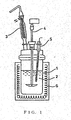
- the easiest and the most effective method comprises carrying out hydrolysis in an apparatus having a reaction vessel equipped with a reflux condenser.
- a reaction vessel 1 charged with an aqueous titanium tetrachloride solution 2 is equipped with a reflux condenser 3, a stirrer 4, a thermometer 5, and a heating means 6 for heating the vessel.
- An aqueous sol produced by hydrolysis may be dried to yield a dry powder of the produced titanium-containing finely divided particulate material.
- the powder since the powder is in the form of super micro-particles, it coagulates strongly, and the powder is difficult to recover as it is. Thus the intended excellent effect of the present invention becomes difficult to attain, and such a drying process is not practical.
- the sol is subjected to a dechlorination treatment after hydrolysis.
- a dechlorination treatment By carrying out the dechlorination treatment, a film having high photocatalytic activity and high transparency can be obtained more easily.
- Dechlorination can be performed by conventional methods such as electrodialysis, ion exchange by use of a resin, and electrolysis.
- the pH of the aqueous sol can be an index for the degree of dechlorination.
- the pH value falls within the range of about 0.5 to 5 in the case where the chlorine ion concentration is in the range of 50 to 10,000 ppm, and the pH value falls within the range of about 1 to 4 in the case where the chlorine ion concentration falls within the range of 100 to 4,000 ppm.
- An aqueous sol having dispersed therein the titanium-containing finely divided particulate material of the present invention may have incorporated with an organic solvent whereby a dispersion of the titanium-containing material in a mixed solvent of water and the organic solvent can be obtained.
- aqueous sol produced through hydrolysis followed by dechlorination without drying is used as it is. It is not preferable that the aqueous sol is dried into a powder and the powder is dispersed in water to prepare an aqueous sol used for film-formation. This is because finely divided particles of the hydrolyzed material have high surface activity, and the surface activity becomes higher when the size of particles is reduced, making it very difficult to disperse the finely divided particles in water; in other words, the finely divided particles undergo coagulation, and a film formed from the coagulated particles exhibits poor transparency and low photocatalytic activity.
- a stabilizer can be incorporated in the aqueous liquid as prepared by hydrolysis or the aqueous sol as prepared from the aqueous liquid for preventing coagulation of the aqueous liquid or the aqueous sol.
- the stabilizer used includes, for example, various surfactants such as conventionally used nonionic surfactants.
- the amount of the stabilizer is preferably in the range of 0.1% to 1% by weight based on the weight of the aqueous liquid or the aqueous sol.
- the production process of the present invention preferably comprises the following steps: controlling the escape of hydrogen chloride which is generated during hydrolysis of an aqueous solution of titanium tetrachloride; adding a stabilizer to the liquid for preventing coagulation of particles; and subjecting the resultant liquid to a dechlorination treatment without drying the liquid.
- a film having high photocatalytic activity and high transparency can easily be formed from the thus-produced sol.
- the chemical composition and structure of the titanium-containing finely divided particulate material having a minute particle diameter of the present invention has not been completely identified, but, in view of results of analysis and the characteristics, it is clear that the titanium-containing finely divided particulate material of the present invention is different from conventional titanium oxide sol particles prepared by hydrolyzing titanium tetrachloride according to the conventional procedure.
- the titanium-containing finely divided particulate material prepared by the process of the present invention has an average particle diameter d 50 in the range of 0.0008 to 0.050 ⁇ m (0.8 to 50 nm), and preferably 0.0008 to 0.015 ⁇ m (0.8 to 15 nm).
- average particle diameter d 50 used herein we mean a particle diameter corresponding to 50% of the integral particle diameter distribution curve.
- the aqueous sol or coating liquid of the titanium-containing finely divided particulate material of the present invention is, in contrast to the conventional titanium oxide sol, not white-turbid at ambient temperature, but is kept at a colorless transparent state even when it is heated to the boiling point.
- the aqueous sol or coating liquid exhibits a light transmittance of at least 85%, preferably at least 95%, as measured at a wavelength of 450-700 nm in a state placed in a square box-shaped quartz cell having a size of 10 mm ⁇ 10 mm ⁇ 45 mm (height); i.e., for a thickness of 10 mm.
- the concentration of the titanium-containing finely divided particulate material in the aqueous sol is in the range of 0.1 to 6.5 moles/liter, preferably 0.1 to 4 moles/liter, as titanium, and is in the range of 1 to 30% by weight based on the weight of the sol.
- concentration of the titanium-containing material is too low, a process for application of the sol to form a film requires a long time, and the cost for film formation becomes high.
- the concentration of the titanium-containing material is too high, the particles are coagulated and the aqueous sol becomes unstable. Further, a sol containing the titanium-containing material in a concentration exceeding 6.5 moles/liter as titanium is difficult to produce.
- a water-soluble polymer can be added to the aqueous sol or coating liquid of the titanium-containing finely divided particulate material prepared by the process of the present invention.
- the water-soluble polymer added to the aqueous sol or coating liquid of the titanium-containing finely divided particulate material there can be mentioned polyvinyl alcohol, methyl cellulose, ethyl cellulose and nitrocellulose.
- the polymer must be completely dissolved in the aqueous sol.
- the amount of the polymer in the aqueous sol is preferably not more than 10% by weight in view of the photocatalytic activity of a film.
- the polymer is preferably added to the aqueous sol after a dechlorination treatment, but may be added before a dechlorination treatment.
- the hydrolysis process has been described above on a batch-type process, but a continuous process may also be employed, wherein a single reaction vessel is effectively employed as a continuous reactor while titanium tetrachloride is continuously added through an inlet port of the vessel and a reaction solution is continuously taken out from the outlet port located on the side opposite to the inlet port, and subsequently the solution is subjected to a dechlorination treatment.
- An aqueous sol or coating liquid of the titanium-containing finely divided particulate material can be applied onto surfaces of substrates such as various materials and molded articles, to form a film on the surface of each substrate.
- substrates such as various materials and molded articles
- the substrates include, for example, ceramic, metal, plastic, wood and paper.
- a catalyst carrier comprising, for example, alumina or zirconia is used as a substrate onto which the aqueous sol is applied to form a film
- the film-coating formed on the carrier is used as a filmy supported catalyst.
- the resulting film effectively prevents adhesion of contaminants on the surface of the glass tube or the cover, since the film exhibits enhanced photocatalytic activity and can decompose organic substances, such as lampblack, present on the film surface.
- the aqueous sol is used for formation of a film on the surface of glass used for building construction or a wall substrate, the film can also prevent adhesion of contaminants.
- the method of applying the aqueous sol or coating liquid of the titanium-containing finely divided particulate material of the present invention onto a substrate to form a film there can be employed, for example, a method of soaking the substrate into the sol, a method of spraying the sol on the substrate, or a method of applying the sol onto the substrate by a brush.
- the aqueous sol is applied to a thickness of 0.01 to 0.2 mm as measured in the liquid state.
- a solvent contained in the sol is removed by drying to obtain the intended film.
- the as-formed film can be used as a catalyst or for other applications.
- a film formed on the substrate can be calcined.
- the calcination temperature is preferably at least 200°C. No particular limitation is imposed on the highest calcination temperature, and the temperature is suitable determined depending upon the particular heat resistance of the substrate.
- the calcination temperature is preferably around 800°C, since even when calcination temperature is excessively high, the hardness of the film and the adhesion to the substrate do not increase as an increase of the calcination temperature.
- the thickness of the calcined film is about 0.02 to 1.0 ⁇ m when the aqueous sol is applied to a thickness as described above.
- Distilled water 300 g was placed in a reaction vessel comprising a reflux condenser as shown in Fig. 1 , and citric acid (38.4 g) was dissolved in the water while a stirring rate was maintained at about 200 rpm.
- citric acid 38.4 g was dissolved in the water while a stirring rate was maintained at about 200 rpm.
- an aqueous titanium tetrachloride solution (63.4 g) (Ti content: 16.3% by weight, specific gravity: 1.59, purity: 99.9%) was added to the aqueous solution.
- the resultant aqueous solution was heated to around 100°C and maintained at this temperature for 60 minutes to thereby complete a hydrolysis reaction.
- residual chlorine generated by the reaction was removed through electrodialysis until the concentration of chlorine reached 600 ppm.
- the pH value of the reaction solution was adjusted to 2, and polyvinyl alcohol, which was a water-soluble polymer serving as an auxiliary for film formation, was added to the solution to obtain a titanium-containing coating liquid containing 1.0% by weight of the polymer.
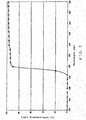
- Transmission spectra of the thus-obtained coating liquid was measured at a wavelength of 200-700 nm in a quartz cell having a size of 10 mm ⁇ 10 mm ⁇ 45 mm by a spectrophotometer (Ubest 300 available from Nippon Spectrum). The results are shown in Fig. 2 . As is apparent from Fig. 2 , absorbance of the liquid was low within the range of visible rays between 380 nm and 700 nm, and the liquid was almost transparent. The light transmittance of the liquid at a wavelength of 450-700 nm was 95%.
- the coating liquid containing this titanium-containing material was very stable, and the produced minute particles did not precipitate even when one week or more elapsed after the production of the liquid.
- the particles were taken from the liquid by using a vacuum dryer at 60°C, and then subjected to electron diffraction by a transmission-type electron microscope. However, the particle was not identified as being formed of a particular compound.
- the dried particle was amorphous as determined by X-ray diffraction. When the particle was calcined at 400°C, a peak was observed which showed a rutile-type titanium oxide.
- the above-described coating liquid was uniformly applied onto the surface of a glass substrate by a spin coater, and dried at 100°C by a dryer to form a transparent film on the glass surface.
- Transmission spectra in a wavelength region of 200 nm to 700 nm of the glass substrate coated with the film was measured. The results are shown in Fig. 3 .
- the light transmittance of the film was at least 97% within the range of visible rays, and the film was almost transparent.
- an absorption peak similar to a specific UV absorption of titanium oxide was observed within the range of UV rays.
- Photocatalytic activity of the transparent film was performed by a color-fading test according to the following procedure: red ink containing an organic dyestuff was uniformly applied onto the surface of the film; and the film was irradiated with UV rays for one hour by a UV lamp (Black Light); and the absorption in % at a wavelength of 550 nm (i.e., central wavelength of red light) of the film after fading was compared with that obtained before fading. The results are shown in Table 1. As is apparent from Table 1, red color faded and the film was proved to exhibit photocatalytic activity when absorbing UV rays.
- Example 1 The procedure of Example 1 was repeated except that the amount of citric acid added was changed to 153.6 g, to obtain a titanium-containing coating liquid (i.e., an aqueous sol of titanium-containing material).
- a titanium-containing coating liquid i.e., an aqueous sol of titanium-containing material.
- Measurement of transmission spectra of the thus-obtained aqueous sol revealed that absorbance of the liquid was low within the range of visible rays, and the liquid was almost transparent. Within the UV range, an absorption peak similar to a specific UV absorption of titanium oxide was observed.
- measurement of particle-size distribution revealed that the titanium-containing material had an average particle diameter d 50 of 4.14 nm.
- the above-described sol was uniformly applied onto the surface of a glass substrate by a spin coater and dried at 100°C by a dryer to form a transparent film on the surface. Subsequently, the film was calcined in an electric furnace at 400°C under an air atmosphere for 30 minutes, which caused the film to adhere to the glass substrate. Measurement of transmission spectra of the glass substrate having the film revealed that the light transmittance was at least 95% within the range of visible rays and the film was almost transparent. In addition, an absorption peak similar to a specific W absorption of titanium oxide was observed within the UV range.
- Photocatalytic activity of the titanium-containing material was evaluated by a fading test with red ink in the same manner as in Example 1. The results are shown in Table 1. As is apparent from Table 1, red color faded and the film was proved to exhibit photocatalytic activity.
- Example 2 The procedure of Example 1 was repeated except that citric acid was replaced by tartaric acid (60 g) to obtain a titanium-containing liquid (an aqueous titanium-containing sol).
- the absorbance of the obtained sol was the same as in Example 1.
- the titanium-containing material had an average particle diameter d 50 of 3.5 nm.
- the above-described sol was coated on a glass substrate to form a film on the glass substrate.
- the film was dried at 200°C in air, which caused the film to adhere to the substrate.
- the transmission spectra of the glass substrate with the film were the same as in Example 1.
- Photocatalytic activity of the titanium-containing material was evaluated by a-fading test with red ink in the same manner as in Example 1. The results are shown in Table 1.
- the transparent sol prepared in Example 1 was applied onto a pre-coated steel sheet, and then the sheet was sintered at 400°C for 15 minutes to form a titanium oxide transparent film.
- the pencil hardness of thus-formed film was 5H, and a cross cut test of the film gave a value of 90/100.
- titanium-containing material sols were prepared under the conditions as follows: the concentration of titanium tetrachloride in an aqueous solution of the titanium tetrachloride was 0.25 mole/l as titanium, and the mole ratio of citric acid added was 0.01, 1.0 or 10 (as ratio of 'concentration of citric acid' to 'titanium-converted concentration' by mole). Other conditions and operations were the same as those employed in Example 1. For the mole ratios of 0.01, 1.0, and 10, the average particle diameters d 50 of the titanium oxide particles in the sols were 1.10 nm, 4.4 nm, and 12.5 nm, respectively.
- Example 1 The procedure of Example 1 for the preparation of an aqueous titanium-containing liquid was repeated except that citric acid was not added.
- the solution maintained transparency for about five minutes after addition of titanium tetrachloride.
- the temperature of the solution elevated to about 60°C or higher, the solution gradually became white-turbid, and the solution turned to white at a temperature of about 90°C or higher.
- Measurement of particle-size distribution revealed that the titanium-containing particles in the thus-obtained liquid had an average particle diameter d 50 of 65 nm.
- Photocatalytic activity of the titanium-containing material was evaluated by a fading test with red ink in the same manner as in Example 1. But, the film became white-turbid and measurement could not be performed.
- Anatase-type titanium oxide particles having a particle diameter of 7 nm were dispersed in water by an ultrasonic dispersing apparatus to obtain an aqueous titanium oxide-containing liquid having a 2% by weight concentration.
- Hydrochloric acid serving as a deflocculating agent was added to the liquid to adjust the pH value of the solution to 1, to thereby obtain an aqueous titanium oxide-containing sol.
- Measurement of particle-size distribution revealed that the titanium oxide-containing particles in the sol had an average particle diameter d 50 of 35 nm. But, the sol was white-turbid.
- Photocatalytic activity of the titanium oxide-containing material was evaluated by a fading test with red ink in the same manner as in Example 1. The results are shown in Table 1.
- a titanium-containing finely divided particulate material comprising minute particles having a particle size of 2 to 5 nm (which cannot be attained by the conventional process), and a sol or coating liquid containing the titanium-containing finely divided particulate material can be produced.
- the titanium-containing finely divided particulate material exhibits excellent transparency while maintaining high photocatalytic activity, which heretofore has not been produced.
- an aqueous liquid containing the titanium-containing finely divided particulate material exhibits a light transmittance of at least 85% as measured at a wavelength of 450-700 nm for a thickness of 10 mm even when the aqueous liquid is heated to the boiling point.
- the aqueous sol obtained by the production process of the present invention is highly transparent within the range of visible rays, and the film formed from the aqueous sol exhibits excellent photocatalytic activity and high transparency. These characteristics are due to the fact that the finely divided particles are so minute that they do not scatter nor absorb the visible rays, and the particles exist almost completely as primary particles without undergoing coagulation in the dispersion system.
- the titanium-containing material of the present invention and the coating liquid or sol thereof exhibit high photocatalytic effect and high ultraviolet rays absorption, and thus, are useful as highly transparent photocatalytic material and UV shielding material.
- the titanium-containing finely divided particulate material of the present invention and a sol or coating liquid thereof are used for applying them onto surfaces of substrates such as various materials, for example, ceramic, metal, plastic, wood and paper, and molded articles, to form a film having the above-mentioned characteristics.
- substrates such as various materials, for example, ceramic, metal, plastic, wood and paper, and molded articles.
- a catalyst carrier comprising, for example, alumina or zirconia is used as a substrate onto which the aqueous sol is applied to form a film
- the film-coating formed on the carrier is used as a filmy supported catalyst.
- the resulting film When a glass tube or a plastic cover of a lighting appliance such as a fluorescence lamp is used as a substrate for the formation of a film thereon, the resulting film is transparent and has catalytic activity, and further, effectively prevents adhesion of contaminants on the surface of the glass tube or the cover.
- This film does not shield light and exhibits enhanced photocatalytic activity, and can decompose organic substances, such as lampblack, present on the surface.
- the aqueous sol is used for formation of a film on the surface of glass used for building construction or a wall material, the film can also prevent adhesion of contaminants. Consequently, a glass window pane and a wall material of a tall building do not require cleaning, thus leading to reduction of the cost for building maintenance.
Landscapes
- Chemical & Material Sciences (AREA)
- Organic Chemistry (AREA)
- Engineering & Computer Science (AREA)
- Materials Engineering (AREA)
- Chemical Kinetics & Catalysis (AREA)
- Nanotechnology (AREA)
- Environmental & Geological Engineering (AREA)
- Life Sciences & Earth Sciences (AREA)
- Geology (AREA)
- Inorganic Chemistry (AREA)
- General Life Sciences & Earth Sciences (AREA)
- Physics & Mathematics (AREA)
- Composite Materials (AREA)
- Condensed Matter Physics & Semiconductors (AREA)
- General Physics & Mathematics (AREA)
- Crystallography & Structural Chemistry (AREA)
- Catalysts (AREA)
- Inorganic Compounds Of Heavy Metals (AREA)
Claims (13)
- Amorphes titanhaltiges fein verteiltes teilchenförmiges Material, dadurch gekennzeichnet, dass das titanhaltige Material einen mittleren Teilchendurchmesser im Bereich von 0,8 bis 15 nm hat und hergestellt ist durch Hydrolysieren von Titantetrachlorid in einer wässerigen Lösung in Anwesenheit mindestens einer unter Oxalsäure, Zitronensäure, Weinsäure, Äpfelsäure und Bernsteinsäure ausgewählten Carbonsäure und durch Unterziehen des so hydrolysierten wässerigen Sols einer Entchlorungsbehandlung in einem Ausmaß, dass das Sol eine Chlorionenkonzentration im Bereich von 100 bis 4000 ppm hat; und das titanhaltige Material eine bei einer Wellenlänge von 450-700 nm gemessenen Lichtdurchlässigkeit von mindestens 85% bei einer Dicke von 10 mm auf einer wässerigen Flüssigkeit aufweist, die das titanhaltige Material in einer Konzentration von 0,1 bis 6,5 Mol Titan pro Liter enthält.
- Wässerige Solzusammensetzung eines titanhaltigen fein verteilten teilchenförmigen Materials, dadurch gekennzeichnet, dass das titanhaltige fein verteilte teilchenförmige Material nach Anspruch 1 in einer Konzentration von 0,1 bis 6,5 Mol Titan pro Liter enthalten ist, und dass außerdem mindestens eine unter Oxalsäure, Zitronensäure, Weinsäure, Äpfelsäure und Bernsteinsäure ausgewählte Carbonsäure enthalten ist.
- Verfahren zum Herstellen des titanhaltigen fein verteilten teilchenförmigen Materials nach Anspruch 1, dadurch gekennzeichnet, dass Titantetrachlorid in einer wässerigen Flüssigkeit in Anwesenheit mindestens einer unter Oxalsäure, Zitronensäure, Weinsäure, Äpfelsäure und Bernsteinsäure ausgewählten Carbonsäure hydrolysiert wird.
- Verfahren zum Herstellen des titanhaltigen fein verteilten teilchenförmigen Materials nach Anspruch 3, wobei die Menge der Carbonsäure im Bereich von 0,01 bis 10 Mol pro Mol Titanatome und im Bereich von 0,01 bis 10 Mol pro Liter der wässerigen Flüssigkeit ist.
- Verfahren zum Herstellen des titanhaltigen fein verteilten teilchenförmigen Materials nach Anspruch 3 oder 4, wobei die wässerige Titantetrachloridlösung bei einer Temperatur von mindestens 50°C, jedoch nicht höher als dem Siedepunkt der wässerigen Lösung, hydrolysiert wird.
- Verfahren zum Herstellen des titanhaltigen fein verteilten teilchenförmigen Materials nach einem der Ansprüche 3 bis 5, wobei die Hydrolyse durchgeführt wird, während das durch die Hydrolyse erzeugte Wasserstoffchlorid so kontrolliert wird, dass es aus dem Reaktionssystem nicht entweicht, und dann die so erhaltene wässerige Flüssigkeit einer Entchlorungsbehandlung unterworfen wird.
- Titanhaltige Beschichtungsflüssigkeit, gekennzeichnet als eine wässerige Flüssigkeit, die ein amorphes titanhaltiges fein verteiltes teilchenförmiges Material mit einem mittleren Teilchendurchmesser im Bereich von 0,8 bis 15 nm enthält, wobei die wässerige Flüssigkeit hergestellt ist durch Hydrolysieren von Titantetrachlorid in einer wässerigen Lösung in Anwesenheit mindestens einer unter Oxalsäure, Zitronensäure, Weinsäure, Äpfelsäure und Bernsteinsäure ausgewählten Carbonsäure und durch Unterziehen des so hydrolysierten wässerigen Sols einer Entchlorungsbehandlung in einem Ausmaß, dass das Sol eine Chlorionenkonzentration im Bereich von 100 bis 4000 ppm hat; wobei das titanhaltige Material in einer fein dispergierten Form in einer Konzentration von 0,1 bis 6,5 Mol Titan pro Liter der wässerigen Flüssigkeit enthalten ist; und die wässerige Flüssigkeit eine bei einer Wellenlänge von 450 bis 700 nm gemessene Lichtdurchlässigkeit von mindestens 85 % bei einer Dicke von 10 mm aufweist.
- Titanhaltige Beschichtungsflüssigkeit nach Anspruch 7, wobei die wässerige Flüssigkeit außerdem nicht mehr als 10 Gew.-% eines wasserlöslichen hohen Polymers enthält.
- Verfahren zum Herstellen der titanhaltigen Beschichtungsflüssigkeit nach Anspruch 7 oder 8, dadurch gekennzeichnet, dass Titantetrachlorid in einer wässerigen Flüssigkeit in Anwesenheit mindestens einer unter Oxalsäure, Zitronensäure, Weinsäure, Äpfelsäure und Bernsteinsäure ausgewählten Carbonsäure hydrolysiert wird.
- Verfahren zum Herstellen der titanhaltigen Beschichtungsflüssigkeit nach Anspruch 9, wobei die Menge der Carbonsäure im Bereich von 0,01 bis 10 Mol pro Mol Titanatome und im Bereich von 0,01 bis 10 Mol pro Liter der wässerigen Flüssigkeit ist.
- Verfahren zum Herstellen der titanhaltigen Beschichtungsflüssigkeit nach Anspruch 9 oder 10, wobei eine wässerige Titantetrachloridlösung bei einer Temperatur von mindestens 50°C, jedoch nicht höher als dem Siedepunkt der wässerigen Lösung, hydrolysiert wird.
- Verfahren zum Herstellen der titanhaltigen Beschichtungsflüssigkeit nach einem der Ansprüche 9 bis 11, wobei die Hydrolyse durchgeführt wird, während das durch die Hydrolyse erzeugte Wasserstoffchlorid so kontrolliert wird, dass es aus dem Reaktionssystem nicht entweichen kann, und dann die so erhaltene wässerige Flüssigkeit einer Entchlorungsbehandlung unterworfen wird.
- Formgegenstand, der ein geformtes Substrat und einen auf einer Oberfläche des Substrats gebildeten Film umfasst, wobei der Film das titanhaltige fein verteilte teilchenförmige Material nach Anspruch 1 umfasst.
Applications Claiming Priority (5)
| Application Number | Priority Date | Filing Date | Title |
|---|---|---|---|
| JP10233011A JPH11171544A (ja) | 1997-08-20 | 1998-08-19 | チタン含有物質およびその製造方法 |
| JP23301198 | 1998-08-19 | ||
| US13514099P | 1999-05-20 | 1999-05-20 | |
| US135140P | 1999-05-20 | ||
| PCT/JP1999/002712 WO2000010921A1 (en) | 1998-08-19 | 1999-05-24 | Finely particulate titanium-containing substance, coating fluid containing the same, processes for producing these, and molded article having thin film comprising the substance |
Publications (3)
| Publication Number | Publication Date |
|---|---|
| EP1127844A1 EP1127844A1 (de) | 2001-08-29 |
| EP1127844A4 EP1127844A4 (de) | 2008-04-09 |
| EP1127844B1 true EP1127844B1 (de) | 2012-08-01 |
Family
ID=26530793
Family Applications (1)
| Application Number | Title | Priority Date | Filing Date |
|---|---|---|---|
| EP99919667A Expired - Lifetime EP1127844B1 (de) | 1998-08-19 | 1999-05-24 | Feinverteilte titan-enthaltende verbindung, beschichtungslösung diese enthaltend, verfahren zur herstellung und damit beschichtete formteile |
Country Status (5)
| Country | Link |
|---|---|
| US (1) | US6610135B1 (de) |
| EP (1) | EP1127844B1 (de) |
| KR (1) | KR100630285B1 (de) |
| CA (1) | CA2343085C (de) |
| WO (1) | WO2000010921A1 (de) |
Families Citing this family (28)
| Publication number | Priority date | Publication date | Assignee | Title |
|---|---|---|---|---|
| US6340711B1 (en) * | 1996-08-30 | 2002-01-22 | Showa Denko K.K. | Particles aqueous dispersion and film of titanium oxide and preparation thereof |
| TWI240700B (en) * | 2001-07-19 | 2005-10-01 | Sumitomo Chemical Co | Ceramics dispersion liquid, method for producing the same, and hydrophilic coating agent using the same |
| JP4374869B2 (ja) | 2002-05-27 | 2009-12-02 | 住友化学株式会社 | セラミックス分散液の製造方法 |
| JP2004026553A (ja) * | 2002-06-25 | 2004-01-29 | Sumitomo Chem Co Ltd | 酸化チタン分散液およびその保存容器 |
| JP2004196626A (ja) | 2002-12-20 | 2004-07-15 | Sumitomo Chem Co Ltd | 酸化チタンの製造方法 |
| KR100514107B1 (ko) * | 2003-03-05 | 2005-09-09 | 한국화학연구원 | 마이크로파를 이용한 나노크기 지르코니아 수화물 졸의연속 제조방법 |
| KR100544628B1 (ko) * | 2003-03-07 | 2006-01-23 | 한국화학연구원 | 지르코니아 수화물 나노입자 졸의 연속 제조방법 |
| US7118727B2 (en) * | 2003-06-16 | 2006-10-10 | General Electric Company | Method of making oxide particles |
| US7241500B2 (en) * | 2003-10-06 | 2007-07-10 | Certainteed Corporation | Colored roofing granules with increased solar heat reflectance, solar heat-reflective shingles, and process for producing same |
| DE102004037118A1 (de) * | 2004-07-30 | 2006-03-23 | Degussa Ag | Titandioxid enthaltende Dispersion |
| CN101006016A (zh) * | 2004-08-26 | 2007-07-25 | 三井化学株式会社 | 金红石型氧化钛超微粒子 |
| FR2884111B1 (fr) | 2005-04-07 | 2007-05-18 | Saint Gobain Mat Constr Sas | Granule biocide, notamment pour la fabrication de bardeau d'asphalte |
| WO2006119311A2 (en) * | 2005-05-02 | 2006-11-09 | Symyx Technologies, Inc. | High surface area metal and metal oxide materials and methods of making same |
| US9044921B2 (en) | 2005-09-07 | 2015-06-02 | Certainteed Corporation | Solar heat reflective roofing membrane and process for making the same |
| CZ300800B6 (cs) * | 2006-04-27 | 2009-08-12 | Rokospol, A. S. | Zpusob výroby transparentních fotokatalyticky aktivních cástic oxidu titanicitého |
| US7749593B2 (en) * | 2006-07-07 | 2010-07-06 | Certainteed Corporation | Solar heat responsive exterior surface covering |
| DE102006057903A1 (de) * | 2006-12-08 | 2008-06-12 | Evonik Degussa Gmbh | Titandioxid enthaltende Dispersion |
| US7632332B2 (en) | 2006-12-12 | 2009-12-15 | Honda Motor Co., Ltd. | Preparation of iron-titanium nanoparticles |
| US8361597B2 (en) * | 2007-04-02 | 2013-01-29 | Certainteed Corporation | Solar heat-reflective roofing granules, solar heat-reflective shingles, and process for producing same |
| US20080261007A1 (en) | 2007-04-19 | 2008-10-23 | Hong Keith C | Post-functionalized roofing granules, and process for preparing same |
| CA2688340C (en) | 2007-05-24 | 2016-02-09 | Certainteed Corporation | Roofing granules with high solar reflectance, roofing products with high solar reflectance, and processes for preparing same |
| US8491985B2 (en) * | 2008-03-31 | 2013-07-23 | Certainteed Corporation | Coating compositions for roofing granules, dark colored roofing granules with increased solar heat reflectance, solar heat-reflective shingles, and process for producing the same |
| US8394498B2 (en) * | 2008-12-16 | 2013-03-12 | Certainteed Corporation | Roofing granules with high solar reflectance, roofing materials with high solar reflectance, and the process of making the same |
| US8637116B2 (en) | 2009-08-20 | 2014-01-28 | Certainteed Corporation | Process for preparing roofing granules comprising organic colorant, with improved luster, and roofing products including such granules |
| US9540822B2 (en) | 2009-11-24 | 2017-01-10 | Certainteed Corporation | Composite nanoparticles for roofing granules, roofing shingles containing such granules, and process for producing same |
| US20110223385A1 (en) | 2010-03-15 | 2011-09-15 | Ming Liang Shiao | Roofing granules with high solar reflectance, roofing products with high solar reflectance, and process for preparing same |
| US8673427B2 (en) | 2011-08-18 | 2014-03-18 | Certainteed Corporation | System, method and apparatus for increasing average reflectance of a roofing product for sloped roof |
| US10730799B2 (en) | 2016-12-31 | 2020-08-04 | Certainteed Corporation | Solar reflective composite granules and method of making solar reflective composite granules |
Family Cites Families (17)
| Publication number | Priority date | Publication date | Assignee | Title |
|---|---|---|---|---|
| US3861946A (en) * | 1972-07-21 | 1975-01-21 | Mearl Corp | Titanium dioxide nacreous pigments and process for the preparation thereof |
| JPS61283629A (ja) | 1985-06-10 | 1986-12-13 | Nippon Shokubai Kagaku Kogyo Co Ltd | プラスチツク複合材料 |
| GB8712752D0 (en) * | 1987-05-30 | 1987-07-01 | Tioxide Group Plc | Particulate material |
| JP2608758B2 (ja) | 1988-03-23 | 1997-05-14 | 富士チタン工業株式会社 | 酸化チタン薄膜形成材料の製造方法 |
| ES2063151T3 (es) | 1988-03-30 | 1995-01-01 | Rhone Poulenc Chimie | Procedimiento de preparacion de oxido de titanio. |
| BE1001780A4 (fr) * | 1988-06-13 | 1990-03-06 | Solvay | Procede pour la fabrication de cristaux de titanate de baryum et/ou de strontium et cristaux de titanate de baryum et/ou de strontium. |
| EP0376216B1 (de) * | 1988-12-28 | 1994-11-30 | Ishihara Sangyo Kaisha, Ltd. | Titandioxidaggregate, Verfahren zu ihrer Herstellung und elektrophotographisches, photosensibles Material, das diese Aggregate enthält |
| JPH02196029A (ja) | 1989-01-25 | 1990-08-02 | Sanyo Shikiso Kk | 多孔質性酸化チタン微粒子及びその製造法 |
| US4923682A (en) | 1989-03-30 | 1990-05-08 | Kemira, Inc. | Preparation of pure titanium dioxide with anatase crystal structure from titanium oxychloride solution |
| GB9302559D0 (en) | 1993-02-10 | 1993-03-24 | Tioxide Specialties Dioxide | Preparation of titanium dioxide |
| DE69411662T2 (de) * | 1993-10-22 | 1998-12-24 | Ishihara Sangyo Kaisha | Dendrit- oder sternförmige Titandioxid-Mikropartikel und Verfahren zur seiner Herstellung |
| US5837050A (en) * | 1995-08-11 | 1998-11-17 | Ishihara Sangyo Kaisha, Ltd. | Ultrafine iron-containing rutile titanium oxide and process for producing the same |
| JP3198238B2 (ja) | 1995-08-30 | 2001-08-13 | 昭和電工株式会社 | 酸化チタン微粉末及びその製造法 |
| WO1997015526A1 (en) * | 1995-10-27 | 1997-05-01 | E.I. Du Pont De Nemours And Company | Hydrothermal process for making ultrafine metal oxide powders |
| DE19543204C2 (de) * | 1995-11-20 | 1997-09-18 | Bayer Ag | Verfahren zur Herstellung von nanodispersem Titandioxid und seine Verwendung |
| US5824145A (en) * | 1997-05-14 | 1998-10-20 | E. I. Du Pont De Nemours And Company | Method for making a photodurable aqueous titanium dioxide pigment slurry |
| US5981425A (en) * | 1998-04-14 | 1999-11-09 | Agency Of Industrial Science & Tech. | Photocatalyst-containing coating composition |
-
1999
- 1999-05-24 KR KR1020017001978A patent/KR100630285B1/ko not_active Expired - Fee Related
- 1999-05-24 WO PCT/JP1999/002712 patent/WO2000010921A1/ja not_active Ceased
- 1999-05-24 CA CA002343085A patent/CA2343085C/en not_active Expired - Fee Related
- 1999-05-24 EP EP99919667A patent/EP1127844B1/de not_active Expired - Lifetime
- 1999-05-24 US US09/763,172 patent/US6610135B1/en not_active Expired - Fee Related
Also Published As
| Publication number | Publication date |
|---|---|
| KR100630285B1 (ko) | 2006-09-29 |
| EP1127844A4 (de) | 2008-04-09 |
| US6610135B1 (en) | 2003-08-26 |
| CA2343085C (en) | 2005-07-05 |
| CA2343085A1 (en) | 2000-03-02 |
| KR20010074835A (ko) | 2001-08-09 |
| WO2000010921A1 (en) | 2000-03-02 |
| EP1127844A1 (de) | 2001-08-29 |
Similar Documents
| Publication | Publication Date | Title |
|---|---|---|
| US6610135B1 (en) | Titanium-containing finely divided particulate material, aqueous sol composition and coating liquid containing same, process for producing same, and shaped article having film thereof | |
| EP1052224B2 (de) | Teilchen, wässrige Dispersion und Film aus Titanoxid und seine Herstellung | |
| EP0581216B1 (de) | Verfahren zur Herstellung von Überzugfilmen aus Titanoxyd | |
| EP1083152B1 (de) | Titandioxid sol, dünner film und verfahren zu deren herstellung | |
| JP3524342B2 (ja) | 薄膜形成用二酸化チタンゾル及び薄膜 | |
| US6479141B1 (en) | Photocatalytic coating composition and product having photocatalytic thin film | |
| EP1153999B1 (de) | Photokatalytische zusammensetzung für beschichtungen und produkte mit einer dünnen photokatalytischen beschichtung | |
| JPH11171544A (ja) | チタン含有物質およびその製造方法 | |
| CN113896231A (zh) | 一种二氧化钛材料的制备方法 | |
| CN1310840C (zh) | 无定形含钛的细微颗粒物质及包括由其形成的薄膜的制品 | |
| JP4187632B2 (ja) | 二酸化チタン薄膜の形成方法およびその二酸化チタン薄膜を有する触媒等 | |
| JP4010934B2 (ja) | 酸化チタン粒子、その水分散ゾル、薄膜及びそれらの製造法 | |
| JP3726366B2 (ja) | 蛍光ランプ |
Legal Events
| Date | Code | Title | Description |
|---|---|---|---|
| PUAI | Public reference made under article 153(3) epc to a published international application that has entered the european phase |
Free format text: ORIGINAL CODE: 0009012 |
|
| 17P | Request for examination filed |
Effective date: 20010307 |
|
| AK | Designated contracting states |
Kind code of ref document: A1 Designated state(s): AT BE CH CY DE DK ES FI FR GB GR IE IT LI LU MC NL PT SE |
|
| A4 | Supplementary search report drawn up and despatched |
Effective date: 20080306 |
|
| RIC1 | Information provided on ipc code assigned before grant |
Ipc: C09C 1/36 20060101ALI20080229BHEP Ipc: C01G 23/053 20060101AFI20000308BHEP |
|
| 17Q | First examination report despatched |
Effective date: 20080722 |
|
| GRAP | Despatch of communication of intention to grant a patent |
Free format text: ORIGINAL CODE: EPIDOSNIGR1 |
|
| RIN1 | Information on inventor provided before grant (corrected) |
Inventor name: TAMURA,KATSUTOSHI, CENTRAL RESEARCH LABORATORY Inventor name: OHMORI, MASAHIRO, CENTRAL RESEARCH LABORATORY |
|
| GRAS | Grant fee paid |
Free format text: ORIGINAL CODE: EPIDOSNIGR3 |
|
| GRAA | (expected) grant |
Free format text: ORIGINAL CODE: 0009210 |
|
| AK | Designated contracting states |
Kind code of ref document: B1 Designated state(s): AT BE CH CY DE DK ES FI FR GB GR IE IT LI LU MC NL PT SE |
|
| REG | Reference to a national code |
Ref country code: GB Ref legal event code: FG4D |
|
| REG | Reference to a national code |
Ref country code: AT Ref legal event code: REF Ref document number: 568578 Country of ref document: AT Kind code of ref document: T Effective date: 20120815 Ref country code: CH Ref legal event code: EP |
|
| REG | Reference to a national code |
Ref country code: IE Ref legal event code: FG4D |
|
| REG | Reference to a national code |
Ref country code: DE Ref legal event code: R096 Ref document number: 69944321 Country of ref document: DE Effective date: 20120920 |
|
| REG | Reference to a national code |
Ref country code: NL Ref legal event code: VDEP Effective date: 20120801 |
|
| REG | Reference to a national code |
Ref country code: AT Ref legal event code: MK05 Ref document number: 568578 Country of ref document: AT Kind code of ref document: T Effective date: 20120801 |
|
| PG25 | Lapsed in a contracting state [announced via postgrant information from national office to epo] |
Ref country code: CY Free format text: LAPSE BECAUSE OF FAILURE TO SUBMIT A TRANSLATION OF THE DESCRIPTION OR TO PAY THE FEE WITHIN THE PRESCRIBED TIME-LIMIT Effective date: 20120801 Ref country code: FI Free format text: LAPSE BECAUSE OF FAILURE TO SUBMIT A TRANSLATION OF THE DESCRIPTION OR TO PAY THE FEE WITHIN THE PRESCRIBED TIME-LIMIT Effective date: 20120801 Ref country code: AT Free format text: LAPSE BECAUSE OF FAILURE TO SUBMIT A TRANSLATION OF THE DESCRIPTION OR TO PAY THE FEE WITHIN THE PRESCRIBED TIME-LIMIT Effective date: 20120801 |
|
| PG25 | Lapsed in a contracting state [announced via postgrant information from national office to epo] |
Ref country code: PT Free format text: LAPSE BECAUSE OF FAILURE TO SUBMIT A TRANSLATION OF THE DESCRIPTION OR TO PAY THE FEE WITHIN THE PRESCRIBED TIME-LIMIT Effective date: 20121203 Ref country code: SE Free format text: LAPSE BECAUSE OF FAILURE TO SUBMIT A TRANSLATION OF THE DESCRIPTION OR TO PAY THE FEE WITHIN THE PRESCRIBED TIME-LIMIT Effective date: 20120801 Ref country code: BE Free format text: LAPSE BECAUSE OF FAILURE TO SUBMIT A TRANSLATION OF THE DESCRIPTION OR TO PAY THE FEE WITHIN THE PRESCRIBED TIME-LIMIT Effective date: 20120801 Ref country code: GR Free format text: LAPSE BECAUSE OF FAILURE TO SUBMIT A TRANSLATION OF THE DESCRIPTION OR TO PAY THE FEE WITHIN THE PRESCRIBED TIME-LIMIT Effective date: 20121102 |
|
| PG25 | Lapsed in a contracting state [announced via postgrant information from national office to epo] |
Ref country code: NL Free format text: LAPSE BECAUSE OF FAILURE TO SUBMIT A TRANSLATION OF THE DESCRIPTION OR TO PAY THE FEE WITHIN THE PRESCRIBED TIME-LIMIT Effective date: 20120801 |
|
| PG25 | Lapsed in a contracting state [announced via postgrant information from national office to epo] |
Ref country code: ES Free format text: LAPSE BECAUSE OF FAILURE TO SUBMIT A TRANSLATION OF THE DESCRIPTION OR TO PAY THE FEE WITHIN THE PRESCRIBED TIME-LIMIT Effective date: 20121112 Ref country code: DK Free format text: LAPSE BECAUSE OF FAILURE TO SUBMIT A TRANSLATION OF THE DESCRIPTION OR TO PAY THE FEE WITHIN THE PRESCRIBED TIME-LIMIT Effective date: 20120801 |
|
| PG25 | Lapsed in a contracting state [announced via postgrant information from national office to epo] |
Ref country code: IT Free format text: LAPSE BECAUSE OF FAILURE TO SUBMIT A TRANSLATION OF THE DESCRIPTION OR TO PAY THE FEE WITHIN THE PRESCRIBED TIME-LIMIT Effective date: 20120801 |
|
| PLBE | No opposition filed within time limit |
Free format text: ORIGINAL CODE: 0009261 |
|
| STAA | Information on the status of an ep patent application or granted ep patent |
Free format text: STATUS: NO OPPOSITION FILED WITHIN TIME LIMIT |
|
| 26N | No opposition filed |
Effective date: 20130503 |
|
| REG | Reference to a national code |
Ref country code: DE Ref legal event code: R097 Ref document number: 69944321 Country of ref document: DE Effective date: 20130503 |
|
| PG25 | Lapsed in a contracting state [announced via postgrant information from national office to epo] |
Ref country code: MC Free format text: LAPSE BECAUSE OF FAILURE TO SUBMIT A TRANSLATION OF THE DESCRIPTION OR TO PAY THE FEE WITHIN THE PRESCRIBED TIME-LIMIT Effective date: 20120801 |
|
| REG | Reference to a national code |
Ref country code: CH Ref legal event code: PL |
|
| PG25 | Lapsed in a contracting state [announced via postgrant information from national office to epo] |
Ref country code: CH Free format text: LAPSE BECAUSE OF NON-PAYMENT OF DUE FEES Effective date: 20130531 Ref country code: LI Free format text: LAPSE BECAUSE OF NON-PAYMENT OF DUE FEES Effective date: 20130531 |
|
| REG | Reference to a national code |
Ref country code: IE Ref legal event code: MM4A |
|
| REG | Reference to a national code |
Ref country code: FR Ref legal event code: ST Effective date: 20140131 |
|
| PG25 | Lapsed in a contracting state [announced via postgrant information from national office to epo] |
Ref country code: IE Free format text: LAPSE BECAUSE OF NON-PAYMENT OF DUE FEES Effective date: 20130524 |
|
| PG25 | Lapsed in a contracting state [announced via postgrant information from national office to epo] |
Ref country code: FR Free format text: LAPSE BECAUSE OF NON-PAYMENT OF DUE FEES Effective date: 20130531 |
|
| PGFP | Annual fee paid to national office [announced via postgrant information from national office to epo] |
Ref country code: GB Payment date: 20140521 Year of fee payment: 16 |
|
| PGFP | Annual fee paid to national office [announced via postgrant information from national office to epo] |
Ref country code: DE Payment date: 20140521 Year of fee payment: 16 |
|
| PG25 | Lapsed in a contracting state [announced via postgrant information from national office to epo] |
Ref country code: LU Free format text: LAPSE BECAUSE OF NON-PAYMENT OF DUE FEES Effective date: 20130524 |
|
| REG | Reference to a national code |
Ref country code: DE Ref legal event code: R119 Ref document number: 69944321 Country of ref document: DE |
|
| GBPC | Gb: european patent ceased through non-payment of renewal fee |
Effective date: 20150524 |
|
| PG25 | Lapsed in a contracting state [announced via postgrant information from national office to epo] |
Ref country code: DE Free format text: LAPSE BECAUSE OF NON-PAYMENT OF DUE FEES Effective date: 20151201 Ref country code: GB Free format text: LAPSE BECAUSE OF NON-PAYMENT OF DUE FEES Effective date: 20150524 |