EP1127897A2 - Eisen- oder Kobalt-Komplexe enthaltende Katalysatorzusammensetzung und Verfahren zur Ethylenoligomerisation oder Ethylenpolymerisation unter Verwendung derselben - Google Patents
Eisen- oder Kobalt-Komplexe enthaltende Katalysatorzusammensetzung und Verfahren zur Ethylenoligomerisation oder Ethylenpolymerisation unter Verwendung derselben Download PDFInfo
- Publication number
- EP1127897A2 EP1127897A2 EP01200886A EP01200886A EP1127897A2 EP 1127897 A2 EP1127897 A2 EP 1127897A2 EP 01200886 A EP01200886 A EP 01200886A EP 01200886 A EP01200886 A EP 01200886A EP 1127897 A2 EP1127897 A2 EP 1127897A2
- Authority
- EP
- European Patent Office
- Prior art keywords
- ethylene
- catalyst composition
- iii
- added
- dry
- Prior art date
- Legal status (The legal status is an assumption and is not a legal conclusion. Google has not performed a legal analysis and makes no representation as to the accuracy of the status listed.)
- Withdrawn
Links
- VGGSQFUCUMXWEO-UHFFFAOYSA-N Ethene Chemical compound C=C VGGSQFUCUMXWEO-UHFFFAOYSA-N 0.000 title claims abstract description 116
- 239000005977 Ethylene Substances 0.000 title claims abstract description 87
- 239000000203 mixture Substances 0.000 title claims description 51
- 238000006116 polymerization reaction Methods 0.000 title claims description 47
- 238000000034 method Methods 0.000 title claims description 38
- 239000003054 catalyst Substances 0.000 title claims description 36
- XEEYBQQBJWHFJM-UHFFFAOYSA-N Iron Chemical compound [Fe] XEEYBQQBJWHFJM-UHFFFAOYSA-N 0.000 title abstract description 42
- 229910052742 iron Inorganic materials 0.000 title abstract description 20
- 150000001868 cobalt Chemical class 0.000 title abstract description 8
- 238000006384 oligomerization reaction Methods 0.000 title 1
- 229920000642 polymer Polymers 0.000 claims abstract description 71
- 150000002466 imines Chemical class 0.000 claims abstract description 20
- -1 cationic Lewis acid Chemical class 0.000 claims description 73
- 239000003446 ligand Substances 0.000 claims description 29
- 239000002841 Lewis acid Substances 0.000 claims description 24
- 150000007517 lewis acids Chemical class 0.000 claims description 17
- 230000007935 neutral effect Effects 0.000 claims description 14
- VTLYFUHAOXGGBS-UHFFFAOYSA-N Fe3+ Chemical group [Fe+3] VTLYFUHAOXGGBS-UHFFFAOYSA-N 0.000 claims description 13
- 239000002638 heterogeneous catalyst Substances 0.000 claims description 8
- 239000007848 Bronsted acid Substances 0.000 claims description 7
- 239000003426 co-catalyst Substances 0.000 claims description 4
- 239000002685 polymerization catalyst Substances 0.000 claims description 3
- 239000000758 substrate Substances 0.000 claims description 3
- 229910017052 cobalt Inorganic materials 0.000 abstract description 5
- 239000010941 cobalt Substances 0.000 abstract description 5
- GUTLYIVDDKVIGB-UHFFFAOYSA-N cobalt atom Chemical compound [Co] GUTLYIVDDKVIGB-UHFFFAOYSA-N 0.000 abstract description 4
- 238000000465 moulding Methods 0.000 abstract description 2
- 229920005989 resin Polymers 0.000 abstract description 2
- 239000011347 resin Substances 0.000 abstract description 2
- OKKJLVBELUTLKV-UHFFFAOYSA-N Methanol Chemical compound OC OKKJLVBELUTLKV-UHFFFAOYSA-N 0.000 description 261
- YXFVVABEGXRONW-UHFFFAOYSA-N Toluene Chemical compound CC1=CC=CC=C1 YXFVVABEGXRONW-UHFFFAOYSA-N 0.000 description 213
- 239000000243 solution Substances 0.000 description 86
- OFBQJSOFQDEBGM-UHFFFAOYSA-N Pentane Chemical compound CCCCC OFBQJSOFQDEBGM-UHFFFAOYSA-N 0.000 description 70
- 239000007787 solid Substances 0.000 description 70
- CSCPPACGZOOCGX-UHFFFAOYSA-N Acetone Chemical compound CC(C)=O CSCPPACGZOOCGX-UHFFFAOYSA-N 0.000 description 68
- 238000006243 chemical reaction Methods 0.000 description 62
- 125000001183 hydrocarbyl group Chemical group 0.000 description 59
- 239000000047 product Substances 0.000 description 54
- 239000004698 Polyethylene Substances 0.000 description 53
- 229920000573 polyethylene Polymers 0.000 description 53
- 238000003756 stirring Methods 0.000 description 45
- 239000012298 atmosphere Substances 0.000 description 44
- IJGRMHOSHXDMSA-UHFFFAOYSA-N Atomic nitrogen Chemical compound N#N IJGRMHOSHXDMSA-UHFFFAOYSA-N 0.000 description 42
- WYURNTSHIVDZCO-UHFFFAOYSA-N Tetrahydrofuran Chemical compound C1CCOC1 WYURNTSHIVDZCO-UHFFFAOYSA-N 0.000 description 42
- 150000001875 compounds Chemical class 0.000 description 40
- 229910052739 hydrogen Inorganic materials 0.000 description 38
- 239000001257 hydrogen Substances 0.000 description 38
- 229910052782 aluminium Inorganic materials 0.000 description 36
- 230000007306 turnover Effects 0.000 description 36
- 125000004435 hydrogen atom Chemical group [H]* 0.000 description 34
- VEXZGXHMUGYJMC-UHFFFAOYSA-N Hydrochloric acid Chemical compound Cl VEXZGXHMUGYJMC-UHFFFAOYSA-N 0.000 description 33
- 125000000524 functional group Chemical group 0.000 description 28
- 238000005227 gel permeation chromatography Methods 0.000 description 26
- RELMFMZEBKVZJC-UHFFFAOYSA-N 1,2,3-trichlorobenzene Chemical compound ClC1=CC=CC(Cl)=C1Cl RELMFMZEBKVZJC-UHFFFAOYSA-N 0.000 description 25
- 229910052757 nitrogen Inorganic materials 0.000 description 25
- 239000002244 precipitate Substances 0.000 description 22
- 125000000217 alkyl group Chemical group 0.000 description 21
- HEDRZPFGACZZDS-MICDWDOJSA-N Trichloro(2H)methane Chemical compound [2H]C(Cl)(Cl)Cl HEDRZPFGACZZDS-MICDWDOJSA-N 0.000 description 20
- 150000004700 cobalt complex Chemical class 0.000 description 20
- 229910052751 metal Inorganic materials 0.000 description 20
- 239000002184 metal Substances 0.000 description 20
- 150000001450 anions Chemical class 0.000 description 19
- 238000005160 1H NMR spectroscopy Methods 0.000 description 18
- YMWUJEATGCHHMB-UHFFFAOYSA-N Dichloromethane Chemical compound ClCCl YMWUJEATGCHHMB-UHFFFAOYSA-N 0.000 description 17
- VYPSYNLAJGMNEJ-UHFFFAOYSA-N Silicium dioxide Chemical compound O=[Si]=O VYPSYNLAJGMNEJ-UHFFFAOYSA-N 0.000 description 17
- 125000004429 atom Chemical group 0.000 description 16
- BDAGIHXWWSANSR-UHFFFAOYSA-N methanoic acid Natural products OC=O BDAGIHXWWSANSR-UHFFFAOYSA-N 0.000 description 16
- LBFUKZWYPLNNJC-UHFFFAOYSA-N cobalt(ii,iii) oxide Chemical compound [Co]=O.O=[Co]O[Co]=O LBFUKZWYPLNNJC-UHFFFAOYSA-N 0.000 description 15
- 150000004678 hydrides Chemical group 0.000 description 13
- 125000002496 methyl group Chemical group [H]C([H])([H])* 0.000 description 13
- 239000011541 reaction mixture Substances 0.000 description 13
- 125000004432 carbon atom Chemical group C* 0.000 description 12
- VLKZOEOYAKHREP-UHFFFAOYSA-N n-Hexane Chemical compound CCCCCC VLKZOEOYAKHREP-UHFFFAOYSA-N 0.000 description 12
- 229910021580 Cobalt(II) chloride Inorganic materials 0.000 description 11
- WEVYAHXRMPXWCK-UHFFFAOYSA-N Acetonitrile Chemical compound CC#N WEVYAHXRMPXWCK-UHFFFAOYSA-N 0.000 description 9
- OSWFIVFLDKOXQC-UHFFFAOYSA-N 4-(3-methoxyphenyl)aniline Chemical compound COC1=CC=CC(C=2C=CC(N)=CC=2)=C1 OSWFIVFLDKOXQC-UHFFFAOYSA-N 0.000 description 8
- 235000019253 formic acid Nutrition 0.000 description 8
- 239000002904 solvent Substances 0.000 description 8
- RTZKZFJDLAIYFH-UHFFFAOYSA-N Diethyl ether Chemical compound CCOCC RTZKZFJDLAIYFH-UHFFFAOYSA-N 0.000 description 7
- 125000003118 aryl group Chemical group 0.000 description 7
- 125000001449 isopropyl group Chemical group [H]C([H])([H])C([H])(*)C([H])([H])[H] 0.000 description 7
- 239000000377 silicon dioxide Substances 0.000 description 7
- 239000012265 solid product Substances 0.000 description 7
- UHOVQNZJYSORNB-UHFFFAOYSA-N Benzene Chemical compound C1=CC=CC=C1 UHOVQNZJYSORNB-UHFFFAOYSA-N 0.000 description 6
- HEDRZPFGACZZDS-UHFFFAOYSA-N Chloroform Chemical compound ClC(Cl)Cl HEDRZPFGACZZDS-UHFFFAOYSA-N 0.000 description 6
- 150000001336 alkenes Chemical class 0.000 description 6
- 238000004458 analytical method Methods 0.000 description 6
- 239000000706 filtrate Substances 0.000 description 6
- UCNNJGDEJXIUCC-UHFFFAOYSA-L hydroxy(oxo)iron;iron Chemical compound [Fe].O[Fe]=O.O[Fe]=O UCNNJGDEJXIUCC-UHFFFAOYSA-L 0.000 description 6
- 239000007788 liquid Substances 0.000 description 6
- JRZJOMJEPLMPRA-UHFFFAOYSA-N olefin Natural products CCCCCCCC=C JRZJOMJEPLMPRA-UHFFFAOYSA-N 0.000 description 6
- 125000003107 substituted aryl group Chemical group 0.000 description 6
- WKBALTUBRZPIPZ-UHFFFAOYSA-N 2,6-di(propan-2-yl)aniline Chemical compound CC(C)C1=CC=CC(C(C)C)=C1N WKBALTUBRZPIPZ-UHFFFAOYSA-N 0.000 description 5
- BEZVGIHGZPLGBL-UHFFFAOYSA-N 2,6-diacetylpyridine Chemical compound CC(=O)C1=CC=CC(C(C)=O)=N1 BEZVGIHGZPLGBL-UHFFFAOYSA-N 0.000 description 5
- 229910052736 halogen Chemical group 0.000 description 5
- 150000002367 halogens Chemical group 0.000 description 5
- NMCUIPGRVMDVDB-UHFFFAOYSA-L iron dichloride Chemical compound Cl[Fe]Cl NMCUIPGRVMDVDB-UHFFFAOYSA-L 0.000 description 5
- 238000005406 washing Methods 0.000 description 5
- PCTJPPBMHPZOLS-UHFFFAOYSA-N 2-phenylcyclohexa-2,4-dien-1-imine Chemical compound N=C1CC=CC=C1C1=CC=CC=C1 PCTJPPBMHPZOLS-UHFFFAOYSA-N 0.000 description 4
- XDTMQSROBMDMFD-UHFFFAOYSA-N Cyclohexane Chemical compound C1CCCCC1 XDTMQSROBMDMFD-UHFFFAOYSA-N 0.000 description 4
- CWYNVVGOOAEACU-UHFFFAOYSA-N Fe2+ Chemical compound [Fe+2] CWYNVVGOOAEACU-UHFFFAOYSA-N 0.000 description 4
- UFHFLCQGNIYNRP-UHFFFAOYSA-N Hydrogen Chemical compound [H][H] UFHFLCQGNIYNRP-UHFFFAOYSA-N 0.000 description 4
- 229910021577 Iron(II) chloride Inorganic materials 0.000 description 4
- NHTMVDHEPJAVLT-UHFFFAOYSA-N Isooctane Chemical compound CC(C)CC(C)(C)C NHTMVDHEPJAVLT-UHFFFAOYSA-N 0.000 description 4
- KFZMGEQAYNKOFK-UHFFFAOYSA-N Isopropanol Chemical compound CC(C)O KFZMGEQAYNKOFK-UHFFFAOYSA-N 0.000 description 4
- ZMANZCXQSJIPKH-UHFFFAOYSA-N Triethylamine Chemical compound CCN(CC)CC ZMANZCXQSJIPKH-UHFFFAOYSA-N 0.000 description 4
- 150000001869 cobalt compounds Chemical class 0.000 description 4
- LPIQUOYDBNQMRZ-UHFFFAOYSA-N cyclopentene Chemical compound C1CC=CC1 LPIQUOYDBNQMRZ-UHFFFAOYSA-N 0.000 description 4
- YMWUJEATGCHHMB-DICFDUPASA-N dichloromethane-d2 Chemical compound [2H]C([2H])(Cl)Cl YMWUJEATGCHHMB-DICFDUPASA-N 0.000 description 4
- 125000000816 ethylene group Chemical group [H]C([H])([*:1])C([H])([H])[*:2] 0.000 description 4
- 238000001914 filtration Methods 0.000 description 4
- 238000004817 gas chromatography Methods 0.000 description 4
- 238000011065 in-situ storage Methods 0.000 description 4
- 238000009616 inductively coupled plasma Methods 0.000 description 4
- 239000003921 oil Substances 0.000 description 4
- 125000001997 phenyl group Chemical group [H]C1=C([H])C([H])=C(*)C([H])=C1[H] 0.000 description 4
- 239000002002 slurry Substances 0.000 description 4
- OBAJXDYVZBHCGT-UHFFFAOYSA-N tris(pentafluorophenyl)borane Chemical compound FC1=C(F)C(F)=C(F)C(F)=C1B(C=1C(=C(F)C(F)=C(F)C=1F)F)C1=C(F)C(F)=C(F)C(F)=C1F OBAJXDYVZBHCGT-UHFFFAOYSA-N 0.000 description 4
- 238000001644 13C nuclear magnetic resonance spectroscopy Methods 0.000 description 3
- XEKOWRVHYACXOJ-UHFFFAOYSA-N Ethyl acetate Chemical compound CCOC(C)=O XEKOWRVHYACXOJ-UHFFFAOYSA-N 0.000 description 3
- 238000005481 NMR spectroscopy Methods 0.000 description 3
- 125000005234 alkyl aluminium group Chemical group 0.000 description 3
- PNEYBMLMFCGWSK-UHFFFAOYSA-N aluminium oxide Inorganic materials [O-2].[O-2].[O-2].[Al+3].[Al+3] PNEYBMLMFCGWSK-UHFFFAOYSA-N 0.000 description 3
- 125000000129 anionic group Chemical group 0.000 description 3
- 239000007789 gas Substances 0.000 description 3
- 150000004698 iron complex Chemical class 0.000 description 3
- 230000003647 oxidation Effects 0.000 description 3
- 238000007254 oxidation reaction Methods 0.000 description 3
- 239000012071 phase Substances 0.000 description 3
- 229910052717 sulfur Inorganic materials 0.000 description 3
- 125000000999 tert-butyl group Chemical group [H]C([H])([H])C(*)(C([H])([H])[H])C([H])([H])[H] 0.000 description 3
- VOITXYVAKOUIBA-UHFFFAOYSA-N triethylaluminium Chemical compound CC[Al](CC)CC VOITXYVAKOUIBA-UHFFFAOYSA-N 0.000 description 3
- 238000002424 x-ray crystallography Methods 0.000 description 3
- SCYULBFZEHDVBN-UHFFFAOYSA-N 1,1-Dichloroethane Chemical compound CC(Cl)Cl SCYULBFZEHDVBN-UHFFFAOYSA-N 0.000 description 2
- AEIOZWYBDBVCGW-UHFFFAOYSA-N 2-tert-butylaniline Chemical compound CC(C)(C)C1=CC=CC=C1N AEIOZWYBDBVCGW-UHFFFAOYSA-N 0.000 description 2
- 239000002879 Lewis base Substances 0.000 description 2
- AZDRQVAHHNSJOQ-UHFFFAOYSA-N alumane Chemical group [AlH3] AZDRQVAHHNSJOQ-UHFFFAOYSA-N 0.000 description 2
- 230000015572 biosynthetic process Effects 0.000 description 2
- 125000002091 cationic group Chemical group 0.000 description 2
- 150000001768 cations Chemical class 0.000 description 2
- 239000003795 chemical substances by application Substances 0.000 description 2
- 125000001309 chloro group Chemical group Cl* 0.000 description 2
- GVPFVAHMJGGAJG-UHFFFAOYSA-L cobalt dichloride Chemical compound [Cl-].[Cl-].[Co+2] GVPFVAHMJGGAJG-UHFFFAOYSA-L 0.000 description 2
- XLJKHNWPARRRJB-UHFFFAOYSA-N cobalt(2+) Chemical compound [Co+2] XLJKHNWPARRRJB-UHFFFAOYSA-N 0.000 description 2
- 229910052681 coesite Inorganic materials 0.000 description 2
- 238000001816 cooling Methods 0.000 description 2
- 150000004696 coordination complex Chemical class 0.000 description 2
- 229910052906 cristobalite Inorganic materials 0.000 description 2
- 239000013078 crystal Substances 0.000 description 2
- YNLAOSYQHBDIKW-UHFFFAOYSA-M diethylaluminium chloride Chemical compound CC[Al](Cl)CC YNLAOSYQHBDIKW-UHFFFAOYSA-M 0.000 description 2
- 238000009826 distribution Methods 0.000 description 2
- 238000010438 heat treatment Methods 0.000 description 2
- RAXXELZNTBOGNW-UHFFFAOYSA-N imidazole Natural products C1=CNC=N1 RAXXELZNTBOGNW-UHFFFAOYSA-N 0.000 description 2
- 150000002506 iron compounds Chemical class 0.000 description 2
- 150000007527 lewis bases Chemical class 0.000 description 2
- CPOFMOWDMVWCLF-UHFFFAOYSA-N methyl(oxo)alumane Chemical compound C[Al]=O CPOFMOWDMVWCLF-UHFFFAOYSA-N 0.000 description 2
- RGSFGYAAUTVSQA-UHFFFAOYSA-N pentamethylene Natural products C1CCCC1 RGSFGYAAUTVSQA-UHFFFAOYSA-N 0.000 description 2
- 239000000843 powder Substances 0.000 description 2
- PMWXGSWIOOVHEQ-UHFFFAOYSA-N pyridine-2,6-dicarbaldehyde Chemical compound O=CC1=CC=CC(C=O)=N1 PMWXGSWIOOVHEQ-UHFFFAOYSA-N 0.000 description 2
- 238000010992 reflux Methods 0.000 description 2
- 150000003839 salts Chemical class 0.000 description 2
- 229910052682 stishovite Inorganic materials 0.000 description 2
- 125000001424 substituent group Chemical group 0.000 description 2
- 229910052905 tridymite Inorganic materials 0.000 description 2
- 125000002023 trifluoromethyl group Chemical group FC(F)(F)* 0.000 description 2
- XLYOFNOQVPJJNP-UHFFFAOYSA-N water Substances O XLYOFNOQVPJJNP-UHFFFAOYSA-N 0.000 description 2
- GGQQNYXPYWCUHG-RMTFUQJTSA-N (3e,6e)-deca-3,6-diene Chemical compound CCC\C=C\C\C=C\CC GGQQNYXPYWCUHG-RMTFUQJTSA-N 0.000 description 1
- POILWHVDKZOXJZ-ARJAWSKDSA-M (z)-4-oxopent-2-en-2-olate Chemical compound C\C([O-])=C\C(C)=O POILWHVDKZOXJZ-ARJAWSKDSA-M 0.000 description 1
- BGDQJDBYLXYIMD-UHFFFAOYSA-N 1-[6-acetyl-4-(trifluoromethyl)pyridin-2-yl]ethanone Chemical compound CC(=O)C1=CC(C(F)(F)F)=CC(C(C)=O)=N1 BGDQJDBYLXYIMD-UHFFFAOYSA-N 0.000 description 1
- KWVPRPSXBZNOHS-UHFFFAOYSA-N 2,4,6-Trimethylaniline Chemical compound CC1=CC(C)=C(N)C(C)=C1 KWVPRPSXBZNOHS-UHFFFAOYSA-N 0.000 description 1
- WFNLHDJJZSJARK-UHFFFAOYSA-N 2-chloro-6-methylaniline Chemical compound CC1=CC=CC(Cl)=C1N WFNLHDJJZSJARK-UHFFFAOYSA-N 0.000 description 1
- NSJYUOHQHJBSOE-UHFFFAOYSA-N 2-n,6-n-bis[2,6-di(propan-2-yl)phenyl]pyridine-2,6-dicarboxamide Chemical compound CC(C)C1=CC=CC(C(C)C)=C1NC(=O)C1=CC=CC(C(=O)NC=2C(=CC=CC=2C(C)C)C(C)C)=N1 NSJYUOHQHJBSOE-UHFFFAOYSA-N 0.000 description 1
- 229910021630 Antimony pentafluoride Inorganic materials 0.000 description 1
- CPELXLSAUQHCOX-UHFFFAOYSA-M Bromide Chemical group [Br-] CPELXLSAUQHCOX-UHFFFAOYSA-M 0.000 description 1
- OKTJSMMVPCPJKN-UHFFFAOYSA-N Carbon Chemical compound [C] OKTJSMMVPCPJKN-UHFFFAOYSA-N 0.000 description 1
- 229910019131 CoBr2 Inorganic materials 0.000 description 1
- 229910004039 HBF4 Inorganic materials 0.000 description 1
- DGAQECJNVWCQMB-PUAWFVPOSA-M Ilexoside XXIX Chemical compound C[C@@H]1CC[C@@]2(CC[C@@]3(C(=CC[C@H]4[C@]3(CC[C@@H]5[C@@]4(CC[C@@H](C5(C)C)OS(=O)(=O)[O-])C)C)[C@@H]2[C@]1(C)O)C)C(=O)O[C@H]6[C@@H]([C@H]([C@@H]([C@H](O6)CO)O)O)O.[Na+] DGAQECJNVWCQMB-PUAWFVPOSA-M 0.000 description 1
- 229910021576 Iron(III) bromide Inorganic materials 0.000 description 1
- 240000007817 Olea europaea Species 0.000 description 1
- YGYAWVDWMABLBF-UHFFFAOYSA-N Phosgene Chemical compound ClC(Cl)=O YGYAWVDWMABLBF-UHFFFAOYSA-N 0.000 description 1
- 229910021607 Silver chloride Inorganic materials 0.000 description 1
- 241000287181 Sturnus vulgaris Species 0.000 description 1
- GPWHDDKQSYOYBF-UHFFFAOYSA-N ac1l2u0q Chemical compound Br[Br-]Br GPWHDDKQSYOYBF-UHFFFAOYSA-N 0.000 description 1
- 150000001242 acetic acid derivatives Chemical class 0.000 description 1
- 230000002378 acidificating effect Effects 0.000 description 1
- 230000003213 activating effect Effects 0.000 description 1
- 239000012190 activator Substances 0.000 description 1
- 150000001335 aliphatic alkanes Chemical class 0.000 description 1
- 150000004703 alkoxides Chemical group 0.000 description 1
- 239000002168 alkylating agent Substances 0.000 description 1
- 229940100198 alkylating agent Drugs 0.000 description 1
- 230000002152 alkylating effect Effects 0.000 description 1
- XAGFODPZIPBFFR-UHFFFAOYSA-N aluminium Chemical group [Al] XAGFODPZIPBFFR-UHFFFAOYSA-N 0.000 description 1
- 150000001412 amines Chemical class 0.000 description 1
- VBVBHWZYQGJZLR-UHFFFAOYSA-I antimony pentafluoride Chemical compound F[Sb](F)(F)(F)F VBVBHWZYQGJZLR-UHFFFAOYSA-I 0.000 description 1
- 150000004945 aromatic hydrocarbons Chemical class 0.000 description 1
- 239000003637 basic solution Substances 0.000 description 1
- 125000001246 bromo group Chemical group Br* 0.000 description 1
- 229910052799 carbon Inorganic materials 0.000 description 1
- 238000001460 carbon-13 nuclear magnetic resonance spectrum Methods 0.000 description 1
- 150000007942 carboxylates Chemical class 0.000 description 1
- 150000001735 carboxylic acids Chemical class 0.000 description 1
- 150000001805 chlorine compounds Chemical group 0.000 description 1
- CZKMPDNXOGQMFW-UHFFFAOYSA-N chloro(triethyl)germane Chemical compound CC[Ge](Cl)(CC)CC CZKMPDNXOGQMFW-UHFFFAOYSA-N 0.000 description 1
- 239000004927 clay Substances 0.000 description 1
- GSOLWAFGMNOBSY-UHFFFAOYSA-N cobalt Chemical compound [Co][Co][Co][Co][Co][Co][Co][Co] GSOLWAFGMNOBSY-UHFFFAOYSA-N 0.000 description 1
- BKFAZDGHFACXKY-UHFFFAOYSA-N cobalt(II) bis(acetylacetonate) Chemical compound [Co+2].CC(=O)[CH-]C(C)=O.CC(=O)[CH-]C(C)=O BKFAZDGHFACXKY-UHFFFAOYSA-N 0.000 description 1
- FCEOGYWNOSBEPV-FDGPNNRMSA-N cobalt;(z)-4-hydroxypent-3-en-2-one Chemical compound [Co].C\C(O)=C\C(C)=O.C\C(O)=C\C(C)=O FCEOGYWNOSBEPV-FDGPNNRMSA-N 0.000 description 1
- 238000002425 crystallisation Methods 0.000 description 1
- 230000008025 crystallization Effects 0.000 description 1
- 125000004122 cyclic group Chemical group 0.000 description 1
- 150000001924 cycloalkanes Chemical class 0.000 description 1
- GUJOJGAPFQRJSV-UHFFFAOYSA-N dialuminum;dioxosilane;oxygen(2-);hydrate Chemical compound O.[O-2].[O-2].[O-2].[Al+3].[Al+3].O=[Si]=O.O=[Si]=O.O=[Si]=O.O=[Si]=O GUJOJGAPFQRJSV-UHFFFAOYSA-N 0.000 description 1
- RAABOESOVLLHRU-UHFFFAOYSA-N diazene Chemical compound N=N RAABOESOVLLHRU-UHFFFAOYSA-N 0.000 description 1
- 229910000071 diazene Inorganic materials 0.000 description 1
- JSYGRUBHOCKMGQ-UHFFFAOYSA-N dichloramine Chemical compound ClNCl JSYGRUBHOCKMGQ-UHFFFAOYSA-N 0.000 description 1
- 238000000113 differential scanning calorimetry Methods 0.000 description 1
- 238000001035 drying Methods 0.000 description 1
- 150000002170 ethers Chemical class 0.000 description 1
- 125000001495 ethyl group Chemical group [H]C([H])([H])C([H])([H])* 0.000 description 1
- 239000000835 fiber Substances 0.000 description 1
- 238000003818 flash chromatography Methods 0.000 description 1
- 125000001153 fluoro group Chemical group F* 0.000 description 1
- 230000004927 fusion Effects 0.000 description 1
- 238000002290 gas chromatography-mass spectrometry Methods 0.000 description 1
- 150000008282 halocarbons Chemical class 0.000 description 1
- 125000005843 halogen group Chemical group 0.000 description 1
- 125000001072 heteroaryl group Chemical group 0.000 description 1
- 238000004845 hydriding Methods 0.000 description 1
- 239000004615 ingredient Substances 0.000 description 1
- 230000000977 initiatory effect Effects 0.000 description 1
- 239000000543 intermediate Substances 0.000 description 1
- 125000002346 iodo group Chemical group I* 0.000 description 1
- 150000002500 ions Chemical class 0.000 description 1
- 150000002505 iron Chemical class 0.000 description 1
- 238000002955 isolation Methods 0.000 description 1
- 239000007791 liquid phase Substances 0.000 description 1
- 239000000314 lubricant Substances 0.000 description 1
- 238000004519 manufacturing process Methods 0.000 description 1
- 239000000463 material Substances 0.000 description 1
- 239000011159 matrix material Substances 0.000 description 1
- 238000002844 melting Methods 0.000 description 1
- 230000008018 melting Effects 0.000 description 1
- COTNUBDHGSIOTA-UHFFFAOYSA-N meoh methanol Chemical compound OC.OC COTNUBDHGSIOTA-UHFFFAOYSA-N 0.000 description 1
- 150000002736 metal compounds Chemical class 0.000 description 1
- 229910001507 metal halide Inorganic materials 0.000 description 1
- 150000005309 metal halides Chemical class 0.000 description 1
- 229910052987 metal hydride Inorganic materials 0.000 description 1
- 150000004681 metal hydrides Chemical class 0.000 description 1
- 150000002739 metals Chemical class 0.000 description 1
- 125000001570 methylene group Chemical group [H]C([H])([*:1])[*:2] 0.000 description 1
- 125000002816 methylsulfanyl group Chemical group [H]C([H])([H])S[*] 0.000 description 1
- 239000000178 monomer Substances 0.000 description 1
- 229910052901 montmorillonite Inorganic materials 0.000 description 1
- AFFLGGQVNFXPEV-UHFFFAOYSA-N n-decene Natural products CCCCCCCCC=C AFFLGGQVNFXPEV-UHFFFAOYSA-N 0.000 description 1
- 150000002825 nitriles Chemical class 0.000 description 1
- WYURNTSHIVDZCO-SVYQBANQSA-N oxolane-d8 Chemical compound [2H]C1([2H])OC([2H])([2H])C([2H])([2H])C1([2H])[2H] WYURNTSHIVDZCO-SVYQBANQSA-N 0.000 description 1
- 239000002245 particle Substances 0.000 description 1
- UHZYTMXLRWXGPK-UHFFFAOYSA-N phosphorus pentachloride Chemical compound ClP(Cl)(Cl)(Cl)Cl UHZYTMXLRWXGPK-UHFFFAOYSA-N 0.000 description 1
- 230000000379 polymerizing effect Effects 0.000 description 1
- 239000002243 precursor Substances 0.000 description 1
- 238000002360 preparation method Methods 0.000 description 1
- 238000000425 proton nuclear magnetic resonance spectrum Methods 0.000 description 1
- 230000005855 radiation Effects 0.000 description 1
- 238000001953 recrystallisation Methods 0.000 description 1
- 239000000741 silica gel Substances 0.000 description 1
- 229910002027 silica gel Inorganic materials 0.000 description 1
- 229910052709 silver Inorganic materials 0.000 description 1
- 239000004332 silver Substances 0.000 description 1
- HKZLPVFGJNLROG-UHFFFAOYSA-M silver monochloride Chemical compound [Cl-].[Ag+] HKZLPVFGJNLROG-UHFFFAOYSA-M 0.000 description 1
- 229910001494 silver tetrafluoroborate Inorganic materials 0.000 description 1
- 150000003385 sodium Chemical class 0.000 description 1
- 229910052708 sodium Inorganic materials 0.000 description 1
- 239000011734 sodium Substances 0.000 description 1
- 239000012279 sodium borohydride Substances 0.000 description 1
- 229910000033 sodium borohydride Inorganic materials 0.000 description 1
- 238000003786 synthesis reaction Methods 0.000 description 1
- WHRNULOCNSKMGB-UHFFFAOYSA-N tetrahydrofuran thf Chemical compound C1CCOC1.C1CCOC1 WHRNULOCNSKMGB-UHFFFAOYSA-N 0.000 description 1
- 125000004001 thioalkyl group Chemical group 0.000 description 1
- 150000003568 thioethers Chemical class 0.000 description 1
- JOXIMZWYDAKGHI-UHFFFAOYSA-N toluene-4-sulfonic acid Chemical compound CC1=CC=C(S(O)(=O)=O)C=C1 JOXIMZWYDAKGHI-UHFFFAOYSA-N 0.000 description 1
- 230000001988 toxicity Effects 0.000 description 1
- 231100000419 toxicity Toxicity 0.000 description 1
- 150000003623 transition metal compounds Chemical class 0.000 description 1
- FEONEKOZSGPOFN-UHFFFAOYSA-K tribromoiron Chemical compound Br[Fe](Br)Br FEONEKOZSGPOFN-UHFFFAOYSA-K 0.000 description 1
- ITMCEJHCFYSIIV-UHFFFAOYSA-M triflate Chemical compound [O-]S(=O)(=O)C(F)(F)F ITMCEJHCFYSIIV-UHFFFAOYSA-M 0.000 description 1
- 239000001993 wax Substances 0.000 description 1
- 239000004711 α-olefin Substances 0.000 description 1
Images
Classifications
-
- C—CHEMISTRY; METALLURGY
- C07—ORGANIC CHEMISTRY
- C07F—ACYCLIC, CARBOCYCLIC OR HETEROCYCLIC COMPOUNDS CONTAINING ELEMENTS OTHER THAN CARBON, HYDROGEN, HALOGEN, OXYGEN, NITROGEN, SULFUR, SELENIUM OR TELLURIUM
- C07F15/00—Compounds containing elements of Groups 8, 9, 10 or 18 of the Periodic Table
- C07F15/04—Nickel compounds
- C07F15/045—Nickel compounds without a metal-carbon linkage
-
- B—PERFORMING OPERATIONS; TRANSPORTING
- B01—PHYSICAL OR CHEMICAL PROCESSES OR APPARATUS IN GENERAL
- B01J—CHEMICAL OR PHYSICAL PROCESSES, e.g. CATALYSIS OR COLLOID CHEMISTRY; THEIR RELEVANT APPARATUS
- B01J31/00—Catalysts comprising hydrides, coordination complexes or organic compounds
- B01J31/02—Catalysts comprising hydrides, coordination complexes or organic compounds containing organic compounds or metal hydrides
- B01J31/12—Catalysts comprising hydrides, coordination complexes or organic compounds containing organic compounds or metal hydrides containing organo-metallic compounds or metal hydrides
- B01J31/14—Catalysts comprising hydrides, coordination complexes or organic compounds containing organic compounds or metal hydrides containing organo-metallic compounds or metal hydrides of aluminium or boron
- B01J31/143—Catalysts comprising hydrides, coordination complexes or organic compounds containing organic compounds or metal hydrides containing organo-metallic compounds or metal hydrides of aluminium or boron of aluminium
-
- B—PERFORMING OPERATIONS; TRANSPORTING
- B01—PHYSICAL OR CHEMICAL PROCESSES OR APPARATUS IN GENERAL
- B01J—CHEMICAL OR PHYSICAL PROCESSES, e.g. CATALYSIS OR COLLOID CHEMISTRY; THEIR RELEVANT APPARATUS
- B01J31/00—Catalysts comprising hydrides, coordination complexes or organic compounds
- B01J31/16—Catalysts comprising hydrides, coordination complexes or organic compounds containing coordination complexes
- B01J31/1616—Coordination complexes, e.g. organometallic complexes, immobilised on an inorganic support, e.g. ship-in-a-bottle type catalysts
-
- B—PERFORMING OPERATIONS; TRANSPORTING
- B01—PHYSICAL OR CHEMICAL PROCESSES OR APPARATUS IN GENERAL
- B01J—CHEMICAL OR PHYSICAL PROCESSES, e.g. CATALYSIS OR COLLOID CHEMISTRY; THEIR RELEVANT APPARATUS
- B01J31/00—Catalysts comprising hydrides, coordination complexes or organic compounds
- B01J31/16—Catalysts comprising hydrides, coordination complexes or organic compounds containing coordination complexes
- B01J31/18—Catalysts comprising hydrides, coordination complexes or organic compounds containing coordination complexes containing nitrogen, phosphorus, arsenic or antimony as complexing atoms, e.g. in pyridine ligands, or in resonance therewith, e.g. in isocyanide ligands C=N-R or as complexed central atoms
- B01J31/1805—Catalysts comprising hydrides, coordination complexes or organic compounds containing coordination complexes containing nitrogen, phosphorus, arsenic or antimony as complexing atoms, e.g. in pyridine ligands, or in resonance therewith, e.g. in isocyanide ligands C=N-R or as complexed central atoms the ligands containing nitrogen
- B01J31/181—Cyclic ligands, including e.g. non-condensed polycyclic ligands, comprising at least one complexing nitrogen atom as ring member, e.g. pyridine
- B01J31/1815—Cyclic ligands, including e.g. non-condensed polycyclic ligands, comprising at least one complexing nitrogen atom as ring member, e.g. pyridine with more than one complexing nitrogen atom, e.g. bipyridyl, 2-aminopyridine
-
- C—CHEMISTRY; METALLURGY
- C07—ORGANIC CHEMISTRY
- C07C—ACYCLIC OR CARBOCYCLIC COMPOUNDS
- C07C2/00—Preparation of hydrocarbons from hydrocarbons containing a smaller number of carbon atoms
- C07C2/02—Preparation of hydrocarbons from hydrocarbons containing a smaller number of carbon atoms by addition between unsaturated hydrocarbons
- C07C2/04—Preparation of hydrocarbons from hydrocarbons containing a smaller number of carbon atoms by addition between unsaturated hydrocarbons by oligomerisation of well-defined unsaturated hydrocarbons without ring formation
- C07C2/06—Preparation of hydrocarbons from hydrocarbons containing a smaller number of carbon atoms by addition between unsaturated hydrocarbons by oligomerisation of well-defined unsaturated hydrocarbons without ring formation of alkenes, i.e. acyclic hydrocarbons having only one carbon-to-carbon double bond
- C07C2/08—Catalytic processes
- C07C2/26—Catalytic processes with hydrides or organic compounds
- C07C2/32—Catalytic processes with hydrides or organic compounds as complexes, e.g. acetyl-acetonates
-
- C—CHEMISTRY; METALLURGY
- C07—ORGANIC CHEMISTRY
- C07D—HETEROCYCLIC COMPOUNDS
- C07D213/00—Heterocyclic compounds containing six-membered rings, not condensed with other rings, with one nitrogen atom as the only ring hetero atom and three or more double bonds between ring members or between ring members and non-ring members
- C07D213/02—Heterocyclic compounds containing six-membered rings, not condensed with other rings, with one nitrogen atom as the only ring hetero atom and three or more double bonds between ring members or between ring members and non-ring members having three double bonds between ring members or between ring members and non-ring members
- C07D213/04—Heterocyclic compounds containing six-membered rings, not condensed with other rings, with one nitrogen atom as the only ring hetero atom and three or more double bonds between ring members or between ring members and non-ring members having three double bonds between ring members or between ring members and non-ring members having no bond between the ring nitrogen atom and a non-ring member or having only hydrogen or carbon atoms directly attached to the ring nitrogen atom
- C07D213/24—Heterocyclic compounds containing six-membered rings, not condensed with other rings, with one nitrogen atom as the only ring hetero atom and three or more double bonds between ring members or between ring members and non-ring members having three double bonds between ring members or between ring members and non-ring members having no bond between the ring nitrogen atom and a non-ring member or having only hydrogen or carbon atoms directly attached to the ring nitrogen atom with substituted hydrocarbon radicals attached to ring carbon atoms
- C07D213/44—Radicals substituted by doubly-bound oxygen, sulfur, or nitrogen atoms, or by two such atoms singly-bound to the same carbon atom
- C07D213/53—Nitrogen atoms
-
- C—CHEMISTRY; METALLURGY
- C07—ORGANIC CHEMISTRY
- C07D—HETEROCYCLIC COMPOUNDS
- C07D213/00—Heterocyclic compounds containing six-membered rings, not condensed with other rings, with one nitrogen atom as the only ring hetero atom and three or more double bonds between ring members or between ring members and non-ring members
- C07D213/02—Heterocyclic compounds containing six-membered rings, not condensed with other rings, with one nitrogen atom as the only ring hetero atom and three or more double bonds between ring members or between ring members and non-ring members having three double bonds between ring members or between ring members and non-ring members
- C07D213/04—Heterocyclic compounds containing six-membered rings, not condensed with other rings, with one nitrogen atom as the only ring hetero atom and three or more double bonds between ring members or between ring members and non-ring members having three double bonds between ring members or between ring members and non-ring members having no bond between the ring nitrogen atom and a non-ring member or having only hydrogen or carbon atoms directly attached to the ring nitrogen atom
- C07D213/60—Heterocyclic compounds containing six-membered rings, not condensed with other rings, with one nitrogen atom as the only ring hetero atom and three or more double bonds between ring members or between ring members and non-ring members having three double bonds between ring members or between ring members and non-ring members having no bond between the ring nitrogen atom and a non-ring member or having only hydrogen or carbon atoms directly attached to the ring nitrogen atom with hetero atoms or with carbon atoms having three bonds to hetero atoms with at the most one bond to halogen, e.g. ester or nitrile radicals, directly attached to ring carbon atoms
- C07D213/78—Carbon atoms having three bonds to hetero atoms, with at the most one bond to halogen, e.g. ester or nitrile radicals
- C07D213/81—Amides; Imides
-
- C—CHEMISTRY; METALLURGY
- C07—ORGANIC CHEMISTRY
- C07F—ACYCLIC, CARBOCYCLIC OR HETEROCYCLIC COMPOUNDS CONTAINING ELEMENTS OTHER THAN CARBON, HYDROGEN, HALOGEN, OXYGEN, NITROGEN, SULFUR, SELENIUM OR TELLURIUM
- C07F15/00—Compounds containing elements of Groups 8, 9, 10 or 18 of the Periodic Table
- C07F15/02—Iron compounds
-
- C—CHEMISTRY; METALLURGY
- C07—ORGANIC CHEMISTRY
- C07F—ACYCLIC, CARBOCYCLIC OR HETEROCYCLIC COMPOUNDS CONTAINING ELEMENTS OTHER THAN CARBON, HYDROGEN, HALOGEN, OXYGEN, NITROGEN, SULFUR, SELENIUM OR TELLURIUM
- C07F15/00—Compounds containing elements of Groups 8, 9, 10 or 18 of the Periodic Table
- C07F15/02—Iron compounds
- C07F15/025—Iron compounds without a metal-carbon linkage
-
- C—CHEMISTRY; METALLURGY
- C07—ORGANIC CHEMISTRY
- C07F—ACYCLIC, CARBOCYCLIC OR HETEROCYCLIC COMPOUNDS CONTAINING ELEMENTS OTHER THAN CARBON, HYDROGEN, HALOGEN, OXYGEN, NITROGEN, SULFUR, SELENIUM OR TELLURIUM
- C07F15/00—Compounds containing elements of Groups 8, 9, 10 or 18 of the Periodic Table
- C07F15/04—Nickel compounds
-
- C—CHEMISTRY; METALLURGY
- C08—ORGANIC MACROMOLECULAR COMPOUNDS; THEIR PREPARATION OR CHEMICAL WORKING-UP; COMPOSITIONS BASED THEREON
- C08F—MACROMOLECULAR COMPOUNDS OBTAINED BY REACTIONS ONLY INVOLVING CARBON-TO-CARBON UNSATURATED BONDS
- C08F10/00—Homopolymers and copolymers of unsaturated aliphatic hydrocarbons having only one carbon-to-carbon double bond
-
- B—PERFORMING OPERATIONS; TRANSPORTING
- B01—PHYSICAL OR CHEMICAL PROCESSES OR APPARATUS IN GENERAL
- B01J—CHEMICAL OR PHYSICAL PROCESSES, e.g. CATALYSIS OR COLLOID CHEMISTRY; THEIR RELEVANT APPARATUS
- B01J2231/00—Catalytic reactions performed with catalysts classified in B01J31/00
- B01J2231/10—Polymerisation reactions involving at least dual use catalysts, e.g. for both oligomerisation and polymerisation
- B01J2231/12—Olefin polymerisation or copolymerisation
-
- B—PERFORMING OPERATIONS; TRANSPORTING
- B01—PHYSICAL OR CHEMICAL PROCESSES OR APPARATUS IN GENERAL
- B01J—CHEMICAL OR PHYSICAL PROCESSES, e.g. CATALYSIS OR COLLOID CHEMISTRY; THEIR RELEVANT APPARATUS
- B01J2231/00—Catalytic reactions performed with catalysts classified in B01J31/00
- B01J2231/20—Olefin oligomerisation or telomerisation
-
- B—PERFORMING OPERATIONS; TRANSPORTING
- B01—PHYSICAL OR CHEMICAL PROCESSES OR APPARATUS IN GENERAL
- B01J—CHEMICAL OR PHYSICAL PROCESSES, e.g. CATALYSIS OR COLLOID CHEMISTRY; THEIR RELEVANT APPARATUS
- B01J2531/00—Additional information regarding catalytic systems classified in B01J31/00
- B01J2531/02—Compositional aspects of complexes used, e.g. polynuclearity
- B01J2531/0238—Complexes comprising multidentate ligands, i.e. more than 2 ionic or coordinative bonds from the central metal to the ligand, the latter having at least two donor atoms, e.g. N, O, S, P
- B01J2531/0241—Rigid ligands, e.g. extended sp2-carbon frameworks or geminal di- or trisubstitution
- B01J2531/0244—Pincer-type complexes, i.e. consisting of a tridentate skeleton bound to a metal, e.g. by one to three metal-carbon sigma-bonds
-
- C—CHEMISTRY; METALLURGY
- C07—ORGANIC CHEMISTRY
- C07C—ACYCLIC OR CARBOCYCLIC COMPOUNDS
- C07C2531/00—Catalysts comprising hydrides, coordination complexes or organic compounds
- C07C2531/16—Catalysts comprising hydrides, coordination complexes or organic compounds containing coordination complexes
- C07C2531/22—Organic complexes
-
- C—CHEMISTRY; METALLURGY
- C08—ORGANIC MACROMOLECULAR COMPOUNDS; THEIR PREPARATION OR CHEMICAL WORKING-UP; COMPOSITIONS BASED THEREON
- C08F—MACROMOLECULAR COMPOUNDS OBTAINED BY REACTIONS ONLY INVOLVING CARBON-TO-CARBON UNSATURATED BONDS
- C08F110/00—Homopolymers of unsaturated aliphatic hydrocarbons having only one carbon-to-carbon double bond
- C08F110/02—Ethene
Definitions
- Selected iron and cobalt complexes of 2,6-pyridinecarboxaldehydebis(imines) and 2,6-diacylpyridinebis(imines) are catalysts for the polymerization of ethylene. Also disclosed herein are novel 2,6-pyridinecarboxaldehydebis(imines) and 2,6-diacylpyridinebis(imines), and cobalt and iron complexes of such compounds.
- Polymers of ethylene are important items of commerce, millions of tons being produced annually. These polymers are used in a myriad of ways, from low molecular weight polyethylene (PE) being used as a lubricant and mold release, to higher molecular weight grades being used for fiber, films, molding resins, etc.
- PE polyethylene
- ethylene is polymerized using a catalyst, often a transition metal compound or complex. These catalysts vary in cost per unit weight of PE produced, the structure of the polymer produced, the possible need to remove the catalyst from the PE, the toxicity of the catalyst, etc. Due to the commercial importance of polymerizing ethylene, new polymerization catalysts are constantly being sought.
- Japanese Patent Application 89-045,712 reports the compound T. W. Bell, et al., J. Am. Chem. Soc., vol. 113, p. 3115-3122 (1991) reports the compound and Japanese Patent Application 02-078,663 reports the compound and an iron[II] complex of this latter compound in which two molecules of the 2,6-diacetylpyridinebis(imine) are present in the complex. None of these compounds are claimed herein.
- This invention concerns a first process for the polymerization of ethylene, comprising, contacting, at a temperature of about -100°C to about +200°C, a compound of the formula with ethylene and:
- This invention includes a compound of the formula wherein:
- This invention also concerns a second process for the polymerization of ethylene, comprising contacting, at a temperature of about -100°C to about +200°C, a Co[II], Co[III], Fe[II] or Fe[III] complex of a tridentate ligand of the formula with ethylene, wherein:
- This invention also includes a compound of the formula or wherein:
- This invention also concerns a third process for the polymerization of ethylene, comprising, contacting, at a temperature of about -100°C to about +200°C, ethylene and a compound of the formula or wherein:
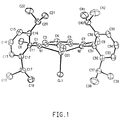
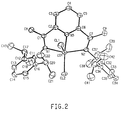
- Figures 1 and 2 are two different views of the X-ray crystallographic structure of the compound made in Example 7.
- Compounds useful as ligands herein in iron and cobalt complexes are diimines of 2,6-pyridinedicarboxaldehyde or 2,6-diacylpyridines of the general formula wherein R 1 , R 2 and R 3 are each independently hydrogen, hydrocarbyl, substituted hydrocarbyl, or an inert functional group, R 4 and R 5 are each independently hydrogen, hydrocarbyl, an inert functional group or substituted hydrocarbyl, and R 6 and R 7 are aryl or substituted aryl.
- (IV) may be made by the reaction of a compound of the formula with a compound of the formula H 2 NR 6 or H 2 NR 7 , wherein R 1 , R 2 and R 3 are each independently hydrogen, hydrocarbyl, substituted hydrocarbyl, or an inert functional group, R 4 and R 5 are each independently hydrogen, hydrocarbyl or substituted hydrocarbyl, R 4 and R 5 are each hydrocarbyl or substituted hydrocarbyl, and R 6 and R 7 are aryl or substituted aryl. These reactions are often catalyzed by carboxylic acids, such as formic acid. Reactions such as these are described in Examples 1-6.
- Preferred compounds of formula (IV) and compounds in which (IV) is a ligand are those of compound (III) [note that (III) is a subset of (IV)], whether present in compounds such as (I), (II), (IV), (VII), (IX) and (XII). In (III), and hence in (I), (II), (IV) (VII), (IX) and (XII) that match the formula of (III), it is preferred that:
- X is chloride, bromide and tetrafluoroborate. It is also preferred that M is Fe[II], Fe[III], or Co[II].
- an iron or cobalt complex (II) is contacted with ethylene and a neutral Lewis acid W capable of abstracting X - , hydride or alkyl from (II) to form a weakly coordinating anion, and must alkylate or be capable of adding a hydride ion to the metal atom, or an additional alkylating agent or an agent capable of adding a hydride anion to the metal atom must be present.
- the neutral Lewis acid is originally uncharged (i.e., not ionic). Suitable neutral Lewis acids include SbF 5 , Ar 3 B (wherein Ar is aryl), and BF 3 .
- Suitable cationic Lewis acids or Bronsted acids include NaBAF, silver trifluoromethanesulfonate, HBF 4 , or [C 6 H 5 N(CH 3 ) 2 ] + [B(C 6 F 5 ) 4 ] - .
- the neutral Lewis acid or a cationic Lewis or Bronsted acid also alkylates or adds a hydride to the metal or a separate alkylating or hydriding agent is present, i.e., causes an alkyl group or hydride to become bonded to the metal atom.
- R 20 contains 1 to 4 carbon atoms, and more preferred that R 20 is methyl or ethyl.
- alkyl aluminum compounds may alkylate (II).
- alkyl aluminum compounds may be strong enough Lewis acids to abstract X - or an alkyl group from the metal atom. In that case a separate Lewis acid strong enough to do the abstraction must be present.
- polymethyaluminoxane is used as the "sole” Lewis acid, it both alkylates and does the abstraction from the metal atom.
- B(C 6 F 5 ) 3 triethylaluminum alkylates the metal atom, but is not a strong enough Lewis acid to abstract an anion from the metal atom, so another (stronger) Lewis acid, B(C 6 F 5 ) 3 , was also added to the polymerization. Without the stronger Lewis acid B(C 6 F 5 ) 3 present, the polymerization does not proceed.
- a preferred neutral Lewis acid which can alkylate the metal, is a selected alkyl aluminum compound, such as R 19 3 Al, R 19 AlCl 2 , R 19 2 AlCl, and "R 19 AlO" (alkylaluminoxanes), wherein R 19 is alkyl containing 1 to 25 carbon atoms, preferably 1 to 4 carbon atoms.
- Suitable alkyl aluminum compounds include methylaluminoxane (which is an oligomer with the general formula [MeAlO] n ), (C 2 H 5 ) 2 AlCl, C 2 H 5 AlCl 2 , and [(CH 3 ) 2 CHCH 2 ] 3 Al.
- Metal hydrides such as NaBH 4 may be used to bond hydride groups to the metal M.
- a cobalt or iron complex of (I) is either added to the polymerization process or formed in situ in the process.
- more than one such complex may be formed during the course of the process, for instance formation of an initial complex and then reaction of that complex to form a living ended polymer containing such a complex.
- complexes which may be formed initially in situ include and wherein R 1 through R 7 , and M are as defined above, T 1 is hydride or alkyl or any other anionic ligand into which ethylene can insert, Y is a neutral ligand capable of being displaced by ethylene or a vacant coordination site, the "parallel lines" are an ethylene molecule coordinated to the metal, and Q is a relatively non-coordinating anion.
- Complexes may be added directly to the process or formed in situ. For instance, (VII) may be formed by the reaction of (II) with a neutral Lewis acid such as an alkyl aluminum compound.
- Another method of forming such a complex in situ is adding a suitable iron or cobalt compound such cobalt [II] acetylacetonate (see Example 18), (I) and an alkyl aluminum compound.
- a suitable iron or cobalt compound such as cobalt [II] acetylacetonate (see Example 18), (I) and an alkyl aluminum compound.
- metal halides and carboxylates such as acetates
- these precursor metal salts be at least somewhat soluble in the process medium.
- the complex may be in a form such as wherein R 1 through R 7 , M, and Q are as defined above, and P is a divalent (poly) ethylene group of the formula - (CH 2 CH 2 ) x -wherein x is an integer of 1 or more, and T 2 is an end group, for example the groups listed for T 1 above.
- (IX) is in essence a polymer containing a so-called living end.
- M be in +2 oxidation state in (VII), (VIII) and (IX).
- Compounds such as (VII), (IX) and (XII) may or may not be stable away from an environment similar to that of the polymerization process, but they may be detected by NMR spectroscopy, particularly one or both of 1 H and 13 C NMR, and particularly at lower temperatures.
- NMR spectroscopy particularly one or both of 1 H and 13 C NMR, and particularly at lower temperatures.
- Such techniques, especially for polymerization "intermediates" of these types are known, see for instance World Patent Application 96/23010, especially Examples 197-203, which is hereby included by reference.
- (VII), (IX) and (XII) may also be used, in the absence of any "co-catalysts” or "activators” to polymerize ethylene in a third polymerization process.
- the process conditions for the third process such as temperature pressure, polymerization medium, etc., may be the same as for the first and second polymerization processes, and preferred conditions for those processes are also preferred for the third polymerization process.
- the temperature at which the ethylene polymerization is carried out is about -100°C to about +200°C, preferably about -60°C to about 150°C, more preferably about -50°C to about 100°C.
- the ethylene pressure at which the polymerization is carried out is not critical, atmospheric pressure to about 275 MPa being a suitable range.
- the polymerization processes herein may be run in the presence of various liquids, particularly aprotic organic liquids.
- the catalyst system, ethylene, and polyethylene may be soluble or insoluble in these liquids, but obviously these liquids should not prevent the polymerization from occurring.
- Suitable liquids include alkanes, cycloalkanes, selected halogenated hydrocarbons, and aromatic hydrocarbons.
- Specific useful solvents include hexane, toluene and benzene.
- the ethylene polymerizations herein may also initially be carried out in the solid state [assuming (II), (III) (IV) or (VII) is a solid] by, for instance, supporting (II), (III) (IV) or (VII) on a substrate such as silica or alumina, activating it with the Lewis (such as W, for instance an alkylaluminum compound) or Bronsted acid and exposing it to ethylene.
- the support may also be able to take the place of the Lewis or Bronsted acid, for instance an acidic clay such as montmorillonite.
- Another method of making a supported catalyst is to start a polymerization or at least make an iron or cobalt complex of another olefin or oligomer of an olefin such as cyclopentene on a support such as silica or alumina.
- These "heterogeneous" catalysts may be used to catalyze polymerization in the gas phase or the liquid phase.
- gas phase is meant that the ethylene is transported to contact with the catalyst particle while the ethylene is in the gas phase.
- Preparations of these types of heterogeneous catalysts are found in Examples 43-46.
- oligomers and polymers of ethylene are made. They may range in molecular weight from oligomeric olefins (see Example 32, which is mostly decenes), to lower molecular weight polyethylene oils and waxes, to higher molecular weight polyethylenes.
- One preferred product is a polymer with a degree of polymerization (DP) of about 10 or more, preferably about 40 or more.
- DP is meant the average number of repeat (monomer) units in a polymer molecule.
- Structures were determined by X-ray crystallography using a Rigaku RU300 instrument with an R-AXIS image plate detector using MoK ⁇ radiation.
- the structure was solved by direct methods (SHELXS or MULTAN), using a refinement by full-matrix least squares on F.
- the apparatus for polymerization run at about 34.5 kPa ethylene pressure were run in Schlenk tubes.
- the metal complex (or metal compound and ligand) was dissolved or slurried in dry "solvent" under nitrogen.
- the stoppered flask was then brought to the desired reaction temperature, flushed well with ethylene, placed under a pressure of about 34.5 kPa of ethylene and stirred vigorously.
- the other catalyst component(s) were then added and the polymerization was allowed to proceed.
- CoCl 2 anhydrous, 0.240 g
- 2,6-Diacetylpyridinebis(2,6-diisopropylphenylimine) 0.93 g
- the mixture was stirred at room temperature for 3 days after which the solid product was filtered off, washed with pentane and dried. Yield 1.02 g.
- the structure of the cobalt complex was determined by X-ray crystallography.
- FeCl 2 (anhydrous, 0.100g) was slurried in 10 ml dry THF. 2,6-Diacetylpyridinebis(2,6-diisopropylphenylimine) (0.378 g) was added and the solution slowly turned dark and a blue precipitate formed. The mixture was stirred at room temperature for 3 days after which the product was filtered off, washed with pentane and dried. Yield 0.489 g.
- the structure of the iron complex was determined by X-ray crystallography, and is similar to the cobalt complex made in Example 8.
- FeBr 3 anhydrous, 0.321 g
- 10 ml dry THF 2,6-Diacetylpyridinebis(2,6-diisopropylphenylimine) (0.340 g) was added and the solution slowly turned dark orange brown.
- the mixture was stirred at RT for 3 d after which the volume was reduced and pentane added to precipitate the product, which was filtered off, washed with pentane and dried. Yield 0.620 g.
- CoCl 2 (anhydrous, 0.062 g) was dissolved in a minimum of dry THF. 2,6-Diacetylpyridinebis(2-chloro-6-methylphenylimine) (0.205 g) was added and the solution turned green and a green precipitate formed. The mixture was stirred at RT for 2 days after which the volume of the solution was reduced by half and pentane added to precipitate the product, which was filtered off, washed with pentane and dried. Yield 0.240 g.
- CoCl 2 (anhydrous, 0.140 g) was dissolved in a minimum of dry THF. 2,6-Diacetylpyridinebis(2,4,6-trimethylphenylimine) (0.460 g) was added and the solution turned green and a green precipitate formed. The mixture was stirred at room temperature for 4 d after which the product which was filtered off, washed with THF, and then pentane and dried. Yield 0.480 g.
- CoCl 2 (anhydrous, 0.135 g) was dissolved in a minimum of dry THF. 2,6-Diacetylpyridinebis(2-biphenylimine) (0.500 g) was added and the solution darkened and a brown precipitate formed. The mixture was stirred at RT for 2 d after which the volume was reduced and pentane added. The product was filtered off, washed with pentane and dried. Yield 0.500 g.
- CoCl 2 (anhydrous, 0.072 g) was dissolved in a minimum of dry THF. 2,6-Pyridinedicarboxaldehydebis(2,6-diisopropylphenylimine) (0.256 g) was added and the solution darkened and turned green. The mixture was stirred at RT for 4 d after which the volume was reduced and pentane added. The product was filtered off, washed with benzene and pentane and dried. Yield 0.26 g.
- CoCl 2 anhydrous, 0.168 g
- 2,6-Diacetylpyridinebis(2-t-butylphenylimine) 0.553 g was added and the solution darkened and a brown precipitate formed rapidly.
- the mixture was stirred at RT overnight after which pentane was added.
- FeCl 2 (anhydrous, 0.085 g) was slurried in dry THF (10 ml). 2,6-Diacetylpyridinebis(2-tert-butylphenylimine) (0.285 g) was added and the solution darkened and a blue precipitate formed rapidly. The mixture was stirred at RT overnight after which pentane was added. The product was filtered off, washed with pentane and dried. Yield 0.30 g.
- CoBr 2 anhydrous, 0.190 g
- CoBr 2 anhydrous, 0.190 g
- THF dry THF
- 2,6-Diacetylpyridinebis(2,6-diisopropylphenylimine) 0.19 g
- the mixture was stirred at RT overnight after which the volume was reduced and pentane was added.
- CoCl 2 (anhydrous, 0.848 g) was dissolved in 20 ml dry acetonitrile.
- AgBF 4 (2.543 g) was added and the solution stirred overnight.
- the solid AgCl was removed by filtration through Celite® and most of the acetonitrile was removed and diethyl ether added.
- the solution was shaken and the ether decanted. This was repeated several times until a solid product remained. Yield 2.8 g.
- the cobalt salt prepared above (0.173 g) was dissolved in methylene chloride. 2,6-Diacetylpyridinebis(2,6-diisopropylphenylimine) (0.188 g) was added to give a clear red solution. This was stirred for 2 d at RT after which the solvent was removed and pentane added. The solid was filtered and washed 3 times with pentane and dried. Yield 0.271 g of a red/brown solid.
- Co(acac) 2 (0.03 mmol) was dissolved in 25 ml dry toluene.
- 2,6-Diacetylpyridinebis(2,6-diisopropylphenylimine) (0.045 mmol) was added and the solution placed under 34.5 kPa of ethylene at room temperature.
- PMAO 0.7 ml
- 9.5 wt% Al in toluene, Akzo was added with vigorous stirring.
- the solution turned green and the temperature increased to -60°C. Solid polymer rapidly precipitated.
- the reaction was allowed to run for 16 h at which time the surface of the mixture had formed a solid polymer crust thus preventing further polymerization.
- Example 7 In a dry, oxygen-free atmosphere the cobalt complex prepared in Example 7 (0.007 mmol) was slurried in 50 ml dry toluene and the solution placed under 172 kPa of ethylene at RT in a Parr® autoclave. PMAO (0.6 ml) (9.5 wt% Al in toluene, Akzo) was added with vigorous stirring. The temperature increased to a maximum of 43°C. The reaction mixture was stirred for 2 h at constant pressure (172 kPa) after which time the reaction was terminated by addition of i-PrOH/10% HCl (15 ml). The polymer product was filtered, washed well with MeOH and acetone and dried. Yield 11.1 g polyethylene.
- Example 7 In a dry, oxygen-free atmosphere the cobalt complex prepared in Example 7 (0.06 mmol) was slurried in 25 ml dry toluene and the solution placed under 34.5 kPa of ethylene at RT. PMAO (0.6 ml) (9.5 wt% Al in toluene, Akzo) was added with vigorous stirring. The solution darkened and the temperature increased. Solid polymer rapidly precipitated. The reaction was allowed to run for 17 h at which time the surface of the mixture had formed a solid polymer crust thus preventing further polymerization. The reaction was terminated by addition of MeOH/10% HCl (15 ml). The polymer product was filtered, washed well with MeOH and acetone and dried.
- Oligomers are mainly linear internal olefins. Using 13 C-NMR (CDCl 3 ) and GC-MS the distribution of oligomers with 10 or more C atoms was found to be the following: 3-methylene olefin (1.2%), 4+ methylene olefin (0.8%), alpha-olefin (9.0%), trans -2-olefin (16.0%), cis -2-olefin (5.6%), trans -3-olefin (30.2%), cis -3-olefin (6.5%), trans -4-clefin (21.1%), remainder of olefins (9.3%).
- the approximate weight distribution of the oligomers is: C 10 - 63%; C 12 - 25%; C 14 -9%; C 16 - 3%. Based on the gas chromatography of the crude reaction mixture there was also a significant amount of C, compounds present in the original product mix.
- Example 39 In a dry, oxygen-free atmosphere the compound prepared in Example 39 (0.427g) was placed in THF (10 ml) and NaSMe (0.228 g) was added. The mixture was heated at 60°C for 3 days at which time the solids were removed by filtration and the filtrate evaporated to dryness. Toluene was added and the solution filtered and evaporated to dryness. The 1 H NMR spectrum indicated that the reaction was complete. 1 H NMR (ppm, THF-d 8 ): 1.05(doublet, 12H), 1.1(doublet, 12H), 2.3 (singlet, 6H), 2.9(multiplet, 4H), 7.0(triplet, 2H), 7.1(doublet, 4H), 7.6 and 7.8(broad, 3H).
- CoCl 2 (anhydrous, 0.060g) was dissolved in dry THF.
- S,S'-Dimethyl pyridine-2,6-bis[N,N'-(2,6-disopropylphenyl)carboximidothioate](0.253 g, 2 eq) was added and the solution turned green. After stirring for 3 days a brown solid had precipitated from solution. The volume of the solution was reduced and pentane added. The solid product was filtered off, washed with pentane and dried. Yield 0.252g.
- Example 7 Inside a dry box under nitrogen, 36.0 mg of the cobalt compound prepared in Example 7 was weighed into a vial and toluene (15 ml) was added. The solution was shaken until the catalyst was partly dissolved. Silica supported MAO (0.5g, 14.3 wt. % Al, Grace Davison) was added to the vial and the solution shaken for 20 min. The solids were filtered, washed with toluene until the washings were colorless and then washed twice with pentane. The product was dried under vacuum and stored inside a drybox freezer. Collected 0.473 g of solid. It contained 13.0% Al and 0.52% Co.
- Silica supported MAO 0.5g, 14.3 wt. % Al, Grace Davison
- Example 8 Inside a dry box under nitrogen, 36.0 mg of the iron compound prepared in Example 8 was weighed into a vial and toluene (15 ml) was added. The solution was shaken until the catalyst was partly dissolved. Silica supported MAO (0.5g, 14.3 wt. % Al, Grace Davison) was added to the vial and the solution shaken for 20 min. The solids were filtered, washed with toluene until the washings were colorless and then washed twice with pentane. The product was dried under vacuum and stored inside the drybox freezer. Collected 0.502 g of solid. It contained 13.5% Al and 0.40% Fe.
- Silica supported MAO 0.5g, 14.3 wt. % Al, Grace Davison
- Example 7 Inside a dry box under nitrogen, 36.0 mg of the cobalt compound prepared in Example 7 was weighed into a vial and toluene (15 ml) was added. The solution was shaken until the catalyst was partly dissolved. Dry cyclopentene (10 eq, 0.046 ml) was added followed by silica supported MAO (0.5g, 14.3 wt. % Al, Grace Davison) and the solution shaken for 10 min. The solids were filtered, washed with toluene until the washings were colorless and then washed twice with pentane. The product was dried under vacuum and stored inside a drybox freezer. Collected 0.472 g of purple solid. It contained 14.5% Al and 0.7% Co.
- Example 7 Inside a dry box under nitrogen, 36.0 mg of the cobalt compound prepared in Example 7 was weighed into a vial and toluene (15 ml) was added. The solution was shaken until the catalyst was partly dissolved. Next 0.6 ml PMAO-IP (Akzo, 12.9% Al in toluene, an "improved" grade of PMAO whose solution is clear) was added and the solution shaken for 1 min. Dehydrated silica (0.5 g, XPO-2402, Grace Davison) was added to the vial and the solution shaken for a further 10 min. The solids were filtered, washed with toluene until the washings were colorless and then washed twice with pentane. The product was dried under vacuum and stored inside a drybox freezer. Collected 0.660 g of solid. It contained 9.16% Al and 0.36% Co.
- the cobalt complex prepared in Example 7 (3.3 mg) was weighed into a vial and dissolved in dry dichloromethane (5 ml).
- PMAO 4.4 ml, Akzo 9.5 wt% Al
- the cobalt complex was added and at the same time the reactor was pressurized to 43 MPa with ethylene.
- the reaction was allowed to run for 2 min at which time cold water was admitted to internal cooling coils to control internal temperature. After 4 min the temperature had reached 38.7°C.
- the reaction was quenched by addition of MeOH/10% HCl solution and the polymer filtered from solution, washed with MeOH and finally acetone and dried.
- the iron complex prepared in Example 8 (2.0 mg) was weighed into a vial and dissolved in dry dichloromethane (5ml).
- PMAO 3.4ml, Akzo 9.5wt% Al
- the cobalt complex was added and at the same time the reactor was pressurized to 39 MPa with ethylene.
- the reaction was allowed to run for 2 min with water cooling after which time the temperature had increased to 94°C.
- the supported cobalt complex prepared above (85 mg, 0.0046 mmol) was slurried in dry pentane and placed under 34.5 kPa of ethylene.
- PMAO 0.6 ml, 9.5 wt% Al in toluene, Akzo
- Tm(DSC) 131.7°C.
- ⁇ H 178.6 J/g.
- the supported cobalt complex prepared above (100 mg, 0.0056 mmol) was slurried in dry pentane (10 ml) and placed under 34.5 kPa of ethylene.
- PMAO 0.6 ml, 9.5wt% Al in toluene, Akzo
- Tm(DSC) 136.8°C.
- ⁇ H 193.1 J/g.
- Example 39 In a dry, oxygen-free atmosphere the compound prepared in Example 39 (0.322 g) was placed in THF (10 ml) and the sodium derivative of imidazole (0.300 g) was added. The mixture was heated at 60°C for 10 days at which time the solids were removed by filtration and the filtrate evaporated to dryness. Pentane was added to the oily solid and the solution stood overnight after which time the oil had solidified. The product was filtered, washed with pentane and dried, to give
Landscapes
- Chemical & Material Sciences (AREA)
- Organic Chemistry (AREA)
- Chemical Kinetics & Catalysis (AREA)
- Engineering & Computer Science (AREA)
- Materials Engineering (AREA)
- Inorganic Chemistry (AREA)
- Health & Medical Sciences (AREA)
- Medicinal Chemistry (AREA)
- Polymers & Plastics (AREA)
- Transition And Organic Metals Composition Catalysts For Addition Polymerization (AREA)
- Macromolecular Compounds Obtained By Forming Nitrogen-Containing Linkages In General (AREA)
Applications Claiming Priority (3)
| Application Number | Priority Date | Filing Date | Title |
|---|---|---|---|
| US3365696P | 1996-12-17 | 1996-12-17 | |
| US33656P | 1996-12-17 | ||
| EP97953340A EP0946609B1 (de) | 1996-12-17 | 1997-12-16 | Ethylenpolymerisation mit spezifischen eisen- oder kobaltkomplexen, neue pyridinbis(imine) und neue komplexe von pyridinbis(iminen) mit eisen und kobalt |
Related Parent Applications (2)
| Application Number | Title | Priority Date | Filing Date |
|---|---|---|---|
| EP97953340A Division-Into EP0946609B1 (de) | 1996-12-17 | 1997-12-16 | Ethylenpolymerisation mit spezifischen eisen- oder kobaltkomplexen, neue pyridinbis(imine) und neue komplexe von pyridinbis(iminen) mit eisen und kobalt |
| EP97953340A Division EP0946609B1 (de) | 1996-12-17 | 1997-12-16 | Ethylenpolymerisation mit spezifischen eisen- oder kobaltkomplexen, neue pyridinbis(imine) und neue komplexe von pyridinbis(iminen) mit eisen und kobalt |
Publications (2)
| Publication Number | Publication Date |
|---|---|
| EP1127897A2 true EP1127897A2 (de) | 2001-08-29 |
| EP1127897A3 EP1127897A3 (de) | 2004-01-02 |
Family
ID=26148938
Family Applications (1)
| Application Number | Title | Priority Date | Filing Date |
|---|---|---|---|
| EP01200886A Withdrawn EP1127897A3 (de) | 1996-12-17 | 1997-12-16 | Eisen- oder Kobalt-Komplexe enthaltende Katalysatorzusammensetzung und Verfahren zur Ethylenoligomerisation oder Ethylenpolymerisation unter Verwendung derselben |
Country Status (1)
| Country | Link |
|---|---|
| EP (1) | EP1127897A3 (de) |
Cited By (3)
| Publication number | Priority date | Publication date | Assignee | Title |
|---|---|---|---|---|
| US7081506B2 (en) | 2003-10-23 | 2006-07-25 | Fina Technology, Inc. | Ethylene polymerization employing bis-imino pyridinyl transition metal catalyst components |
| WO2011015547A1 (de) | 2009-08-07 | 2011-02-10 | Wacker Chemie Ag | Bindemittel auf der basis von silangruppenhaltigen hochverzweigten polyolefinen |
| CN114920861A (zh) * | 2022-06-22 | 2022-08-19 | 宁夏清研高分子新材料有限公司 | 一种催化剂及其制备方法、tpx聚合物的制备方法 |
Family Cites Families (2)
| Publication number | Priority date | Publication date | Assignee | Title |
|---|---|---|---|---|
| JPH0278663A (ja) * | 1988-09-14 | 1990-03-19 | N O K Sogo Gijutsu Kenkyusho:Kk | 2,6―エチリデンニトリロフェニルピリジン、その製造法ならびに金属塩錯体 |
| US5986027A (en) * | 1995-05-22 | 1999-11-16 | Basf Aktiengesellschaft | Olefin polymerization using a catalyst comprising a group VIIIB metal, and acid, and a bidentate chelating compound |
-
1997
- 1997-12-16 EP EP01200886A patent/EP1127897A3/de not_active Withdrawn
Cited By (4)
| Publication number | Priority date | Publication date | Assignee | Title |
|---|---|---|---|---|
| US7081506B2 (en) | 2003-10-23 | 2006-07-25 | Fina Technology, Inc. | Ethylene polymerization employing bis-imino pyridinyl transition metal catalyst components |
| WO2011015547A1 (de) | 2009-08-07 | 2011-02-10 | Wacker Chemie Ag | Bindemittel auf der basis von silangruppenhaltigen hochverzweigten polyolefinen |
| DE102009028353A1 (de) | 2009-08-07 | 2011-04-14 | Wacker Chemie Ag | Bindemittel auf der Basis von silangruppenhaltigen hochverzweigten Polyolefinen |
| CN114920861A (zh) * | 2022-06-22 | 2022-08-19 | 宁夏清研高分子新材料有限公司 | 一种催化剂及其制备方法、tpx聚合物的制备方法 |
Also Published As
| Publication number | Publication date |
|---|---|
| EP1127897A3 (de) | 2004-01-02 |
Similar Documents
| Publication | Publication Date | Title |
|---|---|---|
| EP0946609B1 (de) | Ethylenpolymerisation mit spezifischen eisen- oder kobaltkomplexen, neue pyridinbis(imine) und neue komplexe von pyridinbis(iminen) mit eisen und kobalt | |
| US6150482A (en) | Polymerization of propylene | |
| KR100531701B1 (ko) | 알파-올레핀의 제조 | |
| EP1183279B1 (de) | Polymerisation von ethylen | |
| EP1066229B1 (de) | Verfahren zur oligomerisierung von propen | |
| US6740715B2 (en) | Manufacture of alpha-olefins | |
| WO2002079276A2 (en) | Supported olefin polymerization catalysts | |
| EP1237951A1 (de) | Katalysatoren zur olefinpolymerisation | |
| MXPA99005619A (en) | Polymerization of ethylene with specific iron or cobalt complexes, novel pyridinebis(imines) and novel complexes of pyridinebis(imines) with iron and cobalt | |
| CZ216199A3 (cs) | Způsob polymerace ethylenu | |
| EP1754723A1 (de) | Single-site Katalysatorsystem mit Skorpionatstruktur | |
| CZ200078A3 (cs) | Způsob výroby alfa-olefinů | |
| MXPA01000875A (en) | Polymerization of olefins |
Legal Events
| Date | Code | Title | Description |
|---|---|---|---|
| PUAI | Public reference made under article 153(3) epc to a published international application that has entered the european phase |
Free format text: ORIGINAL CODE: 0009012 |
|
| AC | Divisional application: reference to earlier application |
Ref document number: 946609 Country of ref document: EP |
|
| AK | Designated contracting states |
Kind code of ref document: A2 Designated state(s): AT BE CH DE DK ES FI FR GB GR IE IT LI LU NL PT SE |
|
| PUAL | Search report despatched |
Free format text: ORIGINAL CODE: 0009013 |
|
| AK | Designated contracting states |
Kind code of ref document: A3 Designated state(s): AT BE CH DE DK ES FI FR GB GR IE IT LI LU NL PT SE |
|
| RIC1 | Information provided on ipc code assigned before grant |
Ipc: 7C 07F 15/06 B Ipc: 7C 07F 15/02 B Ipc: 7C 08F 10/02 B Ipc: 7B 01J 31/18 B Ipc: 7C 07C 2/32 B Ipc: 7C 08F 10/00 B Ipc: 7C 08F 4/26 B Ipc: 7C 08F 4/70 A |
|
| 17P | Request for examination filed |
Effective date: 20040518 |
|
| AKX | Designation fees paid |
Designated state(s): DE FR GB IT |
|
| 17Q | First examination report despatched |
Effective date: 20040924 |
|
| STAA | Information on the status of an ep patent application or granted ep patent |
Free format text: STATUS: THE APPLICATION IS DEEMED TO BE WITHDRAWN |
|
| 18D | Application deemed to be withdrawn |
Effective date: 20050405 |