EP1128191B1 - Lentilles de contact à base de macromonomères contenant des segments de polysiloxane dans la chaíne latérale - Google Patents
Lentilles de contact à base de macromonomères contenant des segments de polysiloxane dans la chaíne latérale Download PDFInfo
- Publication number
- EP1128191B1 EP1128191B1 EP01104618A EP01104618A EP1128191B1 EP 1128191 B1 EP1128191 B1 EP 1128191B1 EP 01104618 A EP01104618 A EP 01104618A EP 01104618 A EP01104618 A EP 01104618A EP 1128191 B1 EP1128191 B1 EP 1128191B1
- Authority
- EP
- European Patent Office
- Prior art keywords
- component
- water
- contact lenses
- integer
- weight
- Prior art date
- Legal status (The legal status is an assumption and is not a legal conclusion. Google has not performed a legal analysis and makes no representation as to the accuracy of the status listed.)
- Expired - Lifetime
Links
- 0 CN(C)OC(**(*)=N)=O Chemical compound CN(C)OC(**(*)=N)=O 0.000 description 1
Classifications
-
- C—CHEMISTRY; METALLURGY
- C08—ORGANIC MACROMOLECULAR COMPOUNDS; THEIR PREPARATION OR CHEMICAL WORKING-UP; COMPOSITIONS BASED THEREON
- C08G—MACROMOLECULAR COMPOUNDS OBTAINED OTHERWISE THAN BY REACTIONS ONLY INVOLVING UNSATURATED CARBON-TO-CARBON BONDS
- C08G77/00—Macromolecular compounds obtained by reactions forming a linkage containing silicon with or without sulfur, nitrogen, oxygen or carbon in the main chain of the macromolecule
- C08G77/42—Block-or graft-polymers containing polysiloxane sequences
-
- C—CHEMISTRY; METALLURGY
- C08—ORGANIC MACROMOLECULAR COMPOUNDS; THEIR PREPARATION OR CHEMICAL WORKING-UP; COMPOSITIONS BASED THEREON
- C08G—MACROMOLECULAR COMPOUNDS OBTAINED OTHERWISE THAN BY REACTIONS ONLY INVOLVING UNSATURATED CARBON-TO-CARBON BONDS
- C08G18/00—Polymeric products of isocyanates or isothiocyanates
- C08G18/06—Polymeric products of isocyanates or isothiocyanates with compounds having active hydrogen
- C08G18/28—Polymeric products of isocyanates or isothiocyanates with compounds having active hydrogen characterised by the compounds used containing active hydrogen
- C08G18/67—Unsaturated compounds having active hydrogen
- C08G18/6795—Unsaturated polyethers
-
- C—CHEMISTRY; METALLURGY
- C08—ORGANIC MACROMOLECULAR COMPOUNDS; THEIR PREPARATION OR CHEMICAL WORKING-UP; COMPOSITIONS BASED THEREON
- C08F—MACROMOLECULAR COMPOUNDS OBTAINED BY REACTIONS ONLY INVOLVING CARBON-TO-CARBON UNSATURATED BONDS
- C08F283/00—Macromolecular compounds obtained by polymerising monomers on to polymers provided for in subclass C08G
- C08F283/12—Macromolecular compounds obtained by polymerising monomers on to polymers provided for in subclass C08G on to polysiloxanes
-
- C—CHEMISTRY; METALLURGY
- C08—ORGANIC MACROMOLECULAR COMPOUNDS; THEIR PREPARATION OR CHEMICAL WORKING-UP; COMPOSITIONS BASED THEREON
- C08F—MACROMOLECULAR COMPOUNDS OBTAINED BY REACTIONS ONLY INVOLVING CARBON-TO-CARBON UNSATURATED BONDS
- C08F290/00—Macromolecular compounds obtained by polymerising monomers on to polymers modified by introduction of aliphatic unsaturated end or side groups
- C08F290/02—Macromolecular compounds obtained by polymerising monomers on to polymers modified by introduction of aliphatic unsaturated end or side groups on to polymers modified by introduction of unsaturated end groups
- C08F290/06—Polymers provided for in subclass C08G
- C08F290/068—Polysiloxanes
-
- C—CHEMISTRY; METALLURGY
- C08—ORGANIC MACROMOLECULAR COMPOUNDS; THEIR PREPARATION OR CHEMICAL WORKING-UP; COMPOSITIONS BASED THEREON
- C08G—MACROMOLECULAR COMPOUNDS OBTAINED OTHERWISE THAN BY REACTIONS ONLY INVOLVING UNSATURATED CARBON-TO-CARBON BONDS
- C08G18/00—Polymeric products of isocyanates or isothiocyanates
- C08G18/06—Polymeric products of isocyanates or isothiocyanates with compounds having active hydrogen
- C08G18/28—Polymeric products of isocyanates or isothiocyanates with compounds having active hydrogen characterised by the compounds used containing active hydrogen
- C08G18/40—High-molecular-weight compounds
- C08G18/61—Polysiloxanes
-
- G—PHYSICS
- G02—OPTICS
- G02B—OPTICAL ELEMENTS, SYSTEMS OR APPARATUS
- G02B1/00—Optical elements characterised by the material of which they are made; Optical coatings for optical elements
- G02B1/04—Optical elements characterised by the material of which they are made; Optical coatings for optical elements made of organic materials, e.g. plastics
- G02B1/041—Lenses
- G02B1/043—Contact lenses
Definitions
- the present invention relates to a material for contact lenses which is suitable as a polymer having biocompatibility and oxygen permeability, and to soft contact lenses.
- the soft contact lenses of the present invention have the water content of, for example, from 15 to 35%, and excellent flexibility and oxygen permeability.
- soft contact lenses are categorized into no-water-containing soft contact lenses and water-containing (hydrogel) lenses.
- silicone lenses for example, have high oxygen permeability; however, too much elasticity causes lenses to stick to the cornea, and accordingly, they have not been practically utilized.
- Lenses made of (meth)acrylic esters have a rather low oxygen permeability constant, which is an insufficient value.
- the water-containing soft contact lenses are known to be comfortable in use due to flexibility of the material; however, their oxygen permeability is derived from the water content of the lenses, and thereby lower compared with that of hard contact lenses.
- a material for water-containing soft lenses having the water content of 80% has the oxygen permeability constant of about 40 ⁇ 10 -11 (cm 2 /sec) ⁇ (mL O 2 /mL ⁇ mmHg).
- prior art 1 discloses, as a soft contact lense having excellent oxygen permeability, low water-containing soft contact lenses which substantially comprise an organosiloxanyl (meth)acrylate, a fluorine-containing monomer and dimethylacrylamide as the main components.
- oxygen permeability may be improved by introducing silicone and the fluorine-containing monomer as the components of the contact lenses; however, the improvement is insufficient, and the resulting lenses are hard and poor in shape restorablility, which is caused by low molecule movability between a moiety having silicone group or fluorine group and a functional group (e.g., methacroyl group).
- prior art 2 discloses soft contact lenses having excellent oxygen permeability which comprise a siloxane macromer as the main component.
- soft contact lenses having high oxygen permeability and excellent flexibility can be obtained by using a siloxane macromer having a high molecular weight as the main component.
- the macromer having the structure disclosed in the prior art 2 has the siloxane structure in the main chain and functional groups at the both ends, and thereby, the both ends of the macromer bind to other components in the polymer to inhibit the movability of the siloxane structure. Therefore, it cannot be actually expected to dramatically improve the oxygen permeability.
- an object of the present invention is to provide a material for contact lenses and soft contact lenses having excellent flexibility and oxygen permeability.
- the inventors of the present invention made intensive studies on the basis of the aforementioned prior arts in order to develop soft contact lenses having oxygen permeability in the same degree as or more than hard contact lenses. As a result, they successfully developed a material for soft contact lenses having satisfactory flexibility and oxygen permeability by using a siloxane macromer in which a polymerizing group binds to the polysiloxane side chain by means of urethane bond to maintain high movability of the siloxane structure which contributes to oxygen permeability in the polymer.
- the present invention was achieved on the basis of these findings.
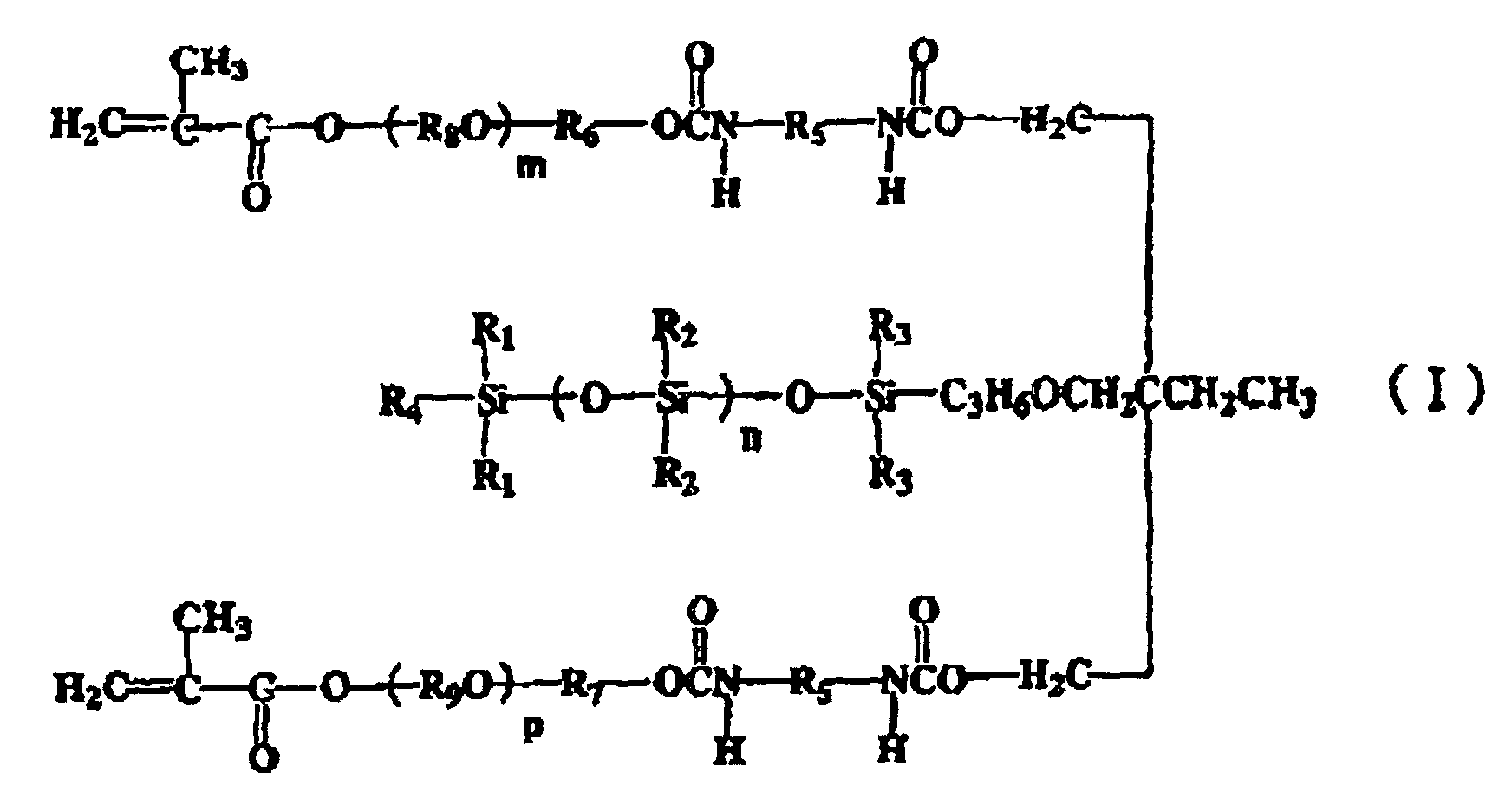
- the present invention relates to a material for contact lenses which comprises a copolymer essentially comprising a siloxane macromer of component (A) which has the number-average molecular weight of from about 1,000 to 10,000 and is represented by the general formula (I): wherein R 1 , R 2 and R 3 are independently selected from C1-C4 alkyl groups; R 4 is selected from C1-C6 alkyl groups; R 5 is a residue obtained by removing NCO group from an aliphatic, alicyclic or aromatic diisocyanate; R 6 , R 7 , R 8 and R 9 are independently selected from C1-C3 alkylene groups; n is an integer of from 4 to 80; and m and p are independently an integer of from 3 to 40, a water-insoluble monoolefin monomer of component (B) , and a water-soluble monoolefin monomer of component (C).
- R 1 , R 2 and R 3 are independently selected from C1-C4 alkyl groups; R
- the present invention further relates to a soft contact lens which is obtained by molding the aforementioned material for contact lenses in the shape of contact lens, and making the lens contain water.
- the present invention relates to a soft contact lens which is obtained by injecting to a mold in the shape of contact lens a monomer mixture comprising a siloxane macromer of component (A) which has the number-average molecular weight of from about 1,000 to 10,000 and is represented by the general formula (I): wherein R 1 , R 2 and R 3 are independently selected from C1-C4 alkyl groups; R 4 is selected from C1-C6 alkyl groups; R 5 is a residue obtained by removing NCO group from an aliphatic, alicyclic or aromatic diisocyanate; R 6 , R 7 , R 8 and R 9 are independently selected from C1-C3 alkylene groups; n is an integer of from 4 to 80; and m and p are independently an integer of from 3 to 40, a water-insoluble monoolefin monomer of component (B) , and a water-soluble monoolefin monomer of component (C); copolymerizing the monomer mixture; and making the general formula (
- the material for contact lenses of the present invention comprises a copolymer essentially comprising a siloxane macromer of component (A) , a water-insoluble monoolefinmonomer of component (B), and a water-soluble monoolefin monomer of component (C).
- the siloxane macromer of component (A) is a component which may provide excellent flexibility and oxygen permeability
- the water-insoluble monoolefin monomer of component (B) and the water-soluble monoolefin monomer of component (C) are those whichmay provide properties corresponding to the purposes such as flexibility, oxygen permeability, and the desired water content.
- the material for contact lenses of the present invention comprises the copolymer components comprising these 3 components, thereby is a material for contact lenses having excellent flexibility and oxygen permeability, which have not been obtained in the conventional materials.
- the siloxane macromer of component (A) is represented by the aforementioned general formula (I) and has the number-average molecular weight of from about 1,000 to 10,000.
- the number-average molecular weight of the siloxane macromer of component (A) is preferably from 2,000 to 8,000.
- R 1 , R 2 and R 3 may be the same or different.
- the C1-C4 alkyl groups include, for example, methyl group, ethyl group, propyl group, n-butyl group, tert-butyl group and the like, and preferred is methyl group.
- the C1-C6 alkyl groups represented by R 4 include, for example, methyl group, ethyl group, propyl group, n-butyl group, n-pentyl group, n-hexyl group and the like, and preferred is n-butyl group.
- the aliphatic diisocyanate includes, for example, 1,4-diisocyanatobutane, 1,6-diisocyanatohexane and the like.
- the alicyclic diisocyanate includes, for example, 1,2-diisocyanatocyclohexane, 1,3-diisocyanatocyclohexane, isophorone diisocyanate and the like.
- the aromatic diisocyanate includes, for example, 2,4-toluenediisocyanate, 2,6-toluenediisocyanate, diphenylmethane-4,4'-diisocyanate and the like.
- the residue obtained by removing NCO group from an aliphatic, alicyclic or aromatic diisocyanate represented by R 5 preferably has the isophorone structure.
- R 6 , R 7 , R 8 and R 9 may be the same or different.
- the C1-C3 alkylene groups include, for example, methylene group, ethylene group, propylene group and the like, and preferred is C2 alkylene (ethylene) group.
- n is an integer of from 4 to 80. It is not preferred that “n” is less than 4 because the lens cannot have sufficient oxygen permeability, and that "n” is more than 80 because the compatibility with other copolymer components may be degraded and the component (A) may sometimes dissolve insufficiently in formulation.
- the symbol “n” is preferably an integer of from 4 to 60, and more preferably an integer of from 4 to 40 .
- the symbols “m” and “p” may be the same or different, and are integers of from 3 to 40. It is not preferred that “m” and “p” are less than 3 because the lens cannot have sufficient flexibility, and that they are more than 40 because the lens tends to have reduced strength or to be fragile.
- the symbols “m” and “p” are preferably integers of from 3 to 30, and more preferably integers of from 3 to 20.
- the material for contact lenses of the present invention is preferably those wherein R 1 , R 2 and R 3 are methyl groups, R 4 is n-butyl group, "n” is an integer of from 4 to 60, and "m” and “p” are independently an integer of from 3 to 30 in the general formula (I) because they have good physical properties such as flexibility and oxygen permeability.
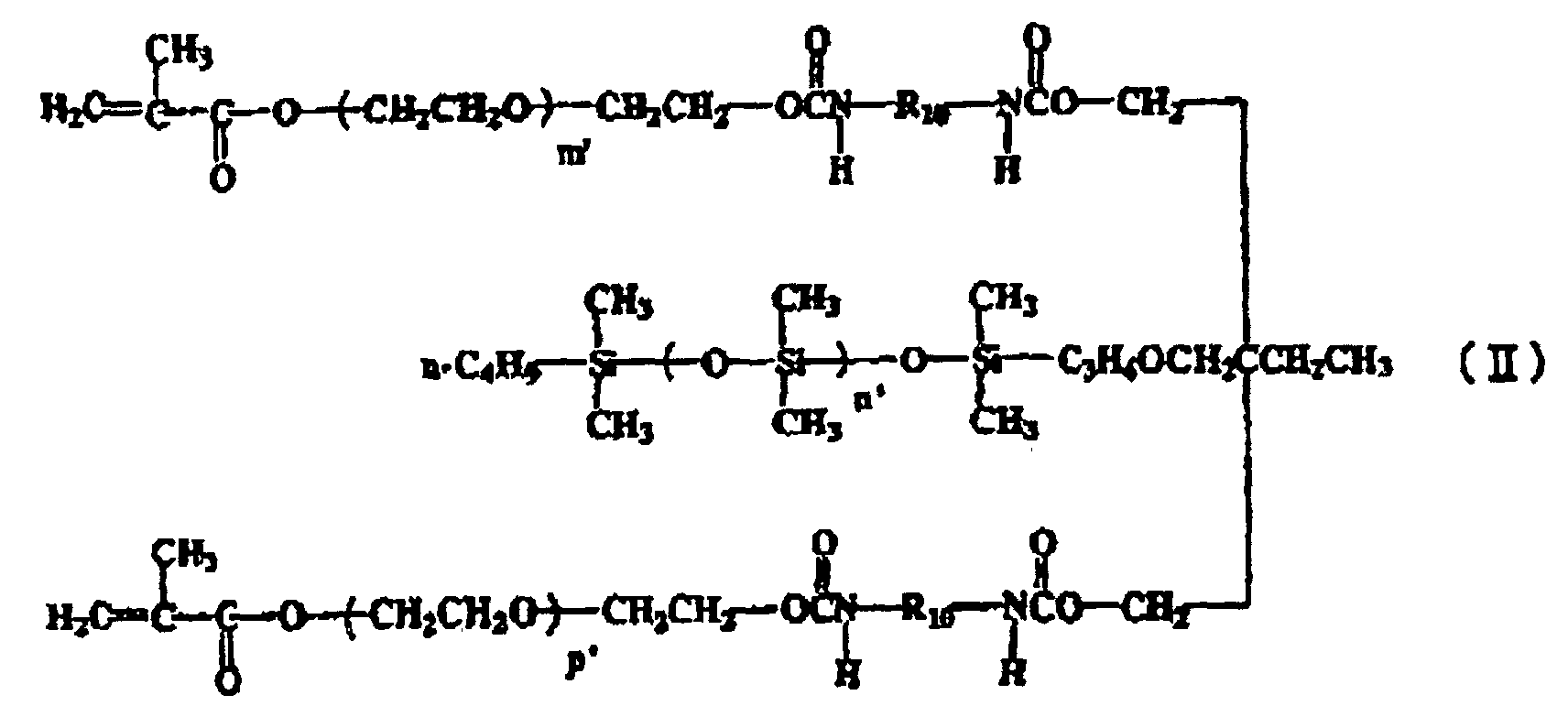
- the siloxane macromer of component (A) is preferably a component represented by the general formula (II):
- R 10 is a residue obtained by removing NCO group from an aliphatic, alicyclic or aromatic diisocyanate.
- the aliphatic diisocyanate includes, for example, 1,4-diisocyanatobutane, 1,6-diisocyanatohexane and the like.
- the alicyclic diisocyanate includes, for example, 1,2-diisocyanatocyclohexane, 1,3-diisocyanatocyclohexane, isophorone diisocyanate and the like.
- the aromatic diisocyanate includes, for example, 2,4-toluenediisocyanate, 2,6-toluenediisocyanate, diphenylmethane-4,4'-diisocyanate and the like.
- the residue obtained by removing NCO group from an aliphatic, alicyclic or aromatic diisocyanate represented by R 10 preferably has the isophorone structure.
- n' is an integer of from 4 to 40.
- the lens may advantageously have much better physical properties such as the strength, flexibility, and oxygen permeability.
- the symbol “n'” is preferably an integer of from 4 to 30.
- the symbols “m' “ and “p' “ are the same or different, and are integers of from 3 to 20.
- the symbols “m' “ and “p' “ to be in the range of from 3 to 20 provide advantages of much better physical properties such as the strength, flexibility and oxygen permeability of the lens.
- the symbols “m' " and “p'” are preferably integers of from 3 to 15.
- the water-insoluble monoolefin monomer of component (B) is used for the purpose of providing oxygen permeability to the material for contact lenses as an assistance, and improving the mechanical strength.
- the water-insoluble monoolefin monomer of component (B) includes, for example, components derived from one or more monomers selected from the group consisting of tris(trimethylsiloxy)- ⁇ -methacryloxypropylsilane, 2,2,2-trifluoroethyl methacrylate, hexafluoroisopropyl methacrylate, and perfluorooctylethyloxypropylene methacrylate.
- the water-soluble monoolefin monomer of component (C) is used for the purpose of adjusting the water content of the soft contact lenses prepared from thematerial for contact lenses, and providing flexibility as an assistance.
- the water-soluble monoolefin monomer of component (C) includes, for example, components derived from at least one or more monomers selected from the group consisting of 2-hydroxyethyl methacrylate, N,N-dimethylacrylamide, N-vinyl-2-pyrrolidone, and methacrylic acid.
- the content of the siloxane macromer of component (A) is preferably from 10 to 60% by weight.
- the content of the siloxane macromer of component (A) of 10% by weight or more can provide sufficient flexibility and oxygen permeability to the lenses prepared from the material, and that of 60% by weight or less can prevent the bridge density from excessively increasing and the lenses from being brittle. More preferably, the content of the siloxane macromer of component (A) is from 15 to 50% by weight.
- the content of the water-insoluble monoolefin monomer of component (B) is preferably from 10 to 50% by weight.
- the content of the water-insoluble monoolefin monomer of component (B) of 10% by weight or more can provide a sufficient effect of addition of the water-insoluble monoolefin monomer of component (B), and that of 50% by weight or less can provide adequate flexibility and shape recovery to the lenses.
- the content of the water-insoluble monoolefin monomer of component (B) is from 15 to 45% by weight.
- the content of the water-solublemonoolefinmonomer of component (C) is preferably from 10 to 45% by weight.
- the content of the water-soluble monoolefin monomer of component (C) of 10% by weight or more can provide an appropriate water content to the lenses prepared from the material, and that of 45% by weight or less can prevent the water content in the lenses prepared from the material from excessively increasing, and oxygen permeability, which depends upon the water content, from markedly decreasing. More preferably, the content of the water-soluble monoolefin monomer of component (C) is from 15 to 40% by weight.
- the material for contact lenses of the present invention may be a copolymer which comprises, in addition to the aforementioned 3 components, a component derived from a bridging monomer, for example, ethylene glycol di(meth)acrylate, diethylene glycol di(meth)acrylate, triethylene glycol di(meth)acrylate, allyl methacrylate, diallyl phthalate, diallyl maleate, diallyl isophthalate, triallyl isocyanurate and the like, in order to obtain the mechanical strength and endurance.
- a component derived from a bridging monomer for example, ethylene glycol di(meth)acrylate, diethylene glycol di(meth)acrylate, triethylene glycol di(meth)acrylate, allyl methacrylate, diallyl phthalate, diallyl maleate, diallyl isophthalate, triallyl isocyanurate and the like, in order to obtain the mechanical strength and endurance.
- a component derived from a bridging monomer
- the content of the aforementioned bridging monomer is preferably from 0.01 to 1% by weight to the total amount of the copolymerizing components .
- the amount of the bridging monomer of 0.01% by weight or more can provide the effect of addition of the mechanical strength and endurance, and that of 1% by weight or less can prevent the resulting soft contact lenses from being brittle.
- the material for contact lenses of the present invention may further contain, for example, a polymerizing ultraviolet absorber, a polymerizing coloring matter and the like as copolymerizing components in order to add ultraviolet absorbability or a color to the resulting soft contact lenses.
- a polymerizing ultraviolet absorber include 5-chloro-2-[2-hydroxy-5-( ⁇ -methacryloyloxyethylcarbamoylox yethyl)]phenyl-2H-benzotriazole, 2-[2-hydroxy-5-( ⁇ -methacryloyloxyethylcarbamoyloxyethyl)]p henyl-2H-benzotriazole, 5-chloro-2-[2-hydroxy-4-(p-vinylbenzyloxy-2-hydroxypropylo xy)]phenyl-2H-benzotriazole and the like.
- polymerizing coloring matter examples include 1,4-bis(4-vinylbenzylamino)anthraquinone, 1-p-hydroxybenzylamino-4-p-vinylbenzylaminoanthraquinone, 1-anilino-4-methacryloylaminoanthraquinone and the like.
- the vat dyeing method may be used which comprises soaking the lenses in a vat without using these coloring matters to sufficiently impregnate the whole lenses with a leucocompound of a dye, and then soaking the lenses in an oxidizing bath to convert the leucocompound into an oxidative compound and fix the dye.
- the material for contact lenses of the present invention may contain a phthalocyanine coloring matter such as Alcian Blue 8GX and Alcian Green 2GX.
- the suitable content of the aforementioned polymerizing ultraviolet absorber and polymerizing dye is 5% by weight or less of the copolymerizing components, and the particularly preferred is from 0.02 to 3% by weight, owing to the effect of the thickness of the lens prepared from the material.
- the amount of 5% by weight or less can prevent a decrease in the mechanical strength of the resulting contact lenses, and is preferable in safety as contact lenses which directly contact to the living body.
- the present invention includes a soft contact lens which is obtained by molding thematerial for contact lenses according to the aforementioned present invention in the shape of contact lens, and making the lens contain water.
- the method of molding the material for contact lenses in the shape of contact lens and making the lens contain water may be performed in a conventional manner.
- the present invention further includes a soft contact lens which is obtained by injecting to a mold in the shape of contact lens a monomer mixture comprising a siloxane macromer of component (A), a water-insoluble monoolefin monomer of component (B), and a water-soluble monoolefin monomer of component (C) ; copolymerizing the monomer mixture; and making the resulting copolymer contain water.
- a soft contact lens which is obtained by injecting to a mold in the shape of contact lens a monomer mixture comprising a siloxane macromer of component (A), a water-insoluble monoolefin monomer of component (B), and a water-soluble monoolefin monomer of component (C) ; copolymerizing the monomer mixture; and making the resulting copolymer contain water.
- siloxane macromer of component (A) the water-insoluble monoolefin monomer of component (B) , and the water-soluble monoolefin monomer of component (C) are the same as those explained for the aforementioned material for contact lenses.
- R 1 , R 2 and R 3 are methyl groups
- R 4 is n-butyl group
- n is an integer of from 4 to 60
- m is independently an integer of from 3 to 30 in the aforementioned general formula (I) from the viewpoint of good physical properties such as the strength, flexibility, and oxygen permeability of the lenses.
- the siloxane macromer (A) is preferably a monomer represented by the general formula (II) which is explained for the aforementioned material for contact lenses from the viewpoint of much better physical properties such as the strength, flexibility and oxygen permeability of the lenses.
- a mixture containing the aforementioned monomer is at first added with a polymerization initiator and sufficiently stirred to give a homogeneous monomer mixture.
- the suitable content of the siloxane macromer (A) in the monomer mixture is from 10 to 60% by weight, that of the water-insoluble monoolefin monomer (B) is from 10 to 50% by weight, and that of the water-soluble monoolefin monomer (C) is from 10 to 45% by weight.
- a peroxide such as lauroyl peroxide, qumene hydroperoxide, and benzoyl peroxide, 2,2'-azobis(2,4-dimethylvaleronitrile), and 2,2'-azobisisobutyronitirle may be used, and when applying the photopolymerization, a photoinitiator such as benzoin methyl ether, 1-hydroxycyclohexyl phenyl ketone, 2,2-dimethoxy-2-phenylacetophenone, and 2-hydroxy-2-dimethoxy-1-phenylpropane-1-one may be used.
- a photoinitiator such as benzoin methyl ether, 1-hydroxycyclohexyl phenyl ketone, 2,2-dimethoxy-2-phenylacetophenone, and 2-hydroxy-2-dimethoxy-1-phenylpropane-1-one may be used.
- the polymerization may be performed in the presence or absence of an appropriate diluent.
- the appropriate diluent may be any one so long as it homogeneously dissolves the monomer components used.
- the diluent includes, for example, an alcohol (e.g., ethanol, isopropanol, n-hexanol), a dipolar aprotic solvent such as dimethylsulfoxide, an ether (e.g., THF, dimethoxyethane), an ester (e.g., propyl acetate, isopropyl acetate, isobutyl acetate, tert-butyl acetate, butyl propionate, butyl butyrate), a mixed solvent of water and an alcohol (a water/ethanol mixed solvent) and the like.
- an alcohol e.g., ethanol, isopropanol, n-hexanol
- a dipolar aprotic solvent such as dimethylsulfox
- the effects may be sometimes expected which are an easy injection into a mold caused by a decrease in the viscosity of the monomer mixture, and an improvement of the mechanical strength of the resulting lens by effective removal of the polymerization heat in polymerization.
- the aforementioned monomer mixture is injected to a mold for preparation of contact lenses with or without the shape of contact lens, and then polymerized.
- the mold is in the combined shape having a convex curvature and a concave curvature, and may be made of a material such as metal, glass, resin and the like.
- the material preferably has excellent removability of the polymer and excellent resistance to solvent and heat.
- a mold made of resin is preferred because it can easily be prepared in the shape necessary to the desired lens design.
- the resin material is preferably selected from those having low contraction in formation, good surface transcription from the die, and excellent dimensional accuracy and resistance to solvent.
- Such resin materials include, for example, polyethylene, polypropylene, polymethylpentene (TPX), polysulfone, polyphenylene sulfide, cyclic olefin copolymers (e.g., "Apel”, Mitsui Petrochemical Co. Ltd.; “ZEONEX”, Nippon Zeon Co. Ltd.) and the like.
- TPX polymethylpentene
- polysulfone polysulfone
- polyphenylene sulfide cyclic olefin copolymers
- the polymerization method includes, for example, a method of elevating the temperature stepwise or continuously in the range of from 25 to 120°C, and completing the polymerization for 1 to 24 hours.
- a method of elevating the temperature stepwise or continuously in the range of from 25 to 120°C, and completing the polymerization for 1 to 24 hours it is desirable that the polymerization is carried out under an atmosphere of an inert gas such as nitrogen and argon in the polymerization furnace at atmospheric pressure or under pressurized conditions.
- an inert gas such as nitrogen and argon
- a photopolymerization method by ultraviolet, visible radiation or the like may be applied after adding the aforementioned photopolymerization initiator.
- the lens is taken out of the mold, and then it may be applied to a known surface treatment if necessary.
- a known surface treatment for example, the technique and apparatus known so far may be used, and an active gas such as air, oxygen, hydrogen and nitrogen, or an inert gas such as helium, neon and argon, and an organic low-molecular compound such as N-vinylpyrrolidone and acetylene may be used.
- a molding method commonly used by persons with ordinary skill in the art may be applied.
- Such a molding method includes, for example, a cutting method, and a method of cutting or freeze-cutting the copolymer may be carried out after obtaining the copolymer in the shape of bars or blocks to mold the copolymer into the shape of contact lens.
- the mold in the shape of contact lens obtained by cutting or the like, or the copolymer taken out of the mold in the shape of contact lens for preparation of contact lenses may be soaked in physiological saline or a preserving medium for soft contact lenses to be impregnated with water, and the desired contact lenses can be obtained.
- the water content and the oxygen permeability constant can be adjusted to the range of from 15 to 35% and not less than 70 ⁇ 10 -11 (cm 2 /sec) ⁇ (mL O 2 /mL ⁇ mmHg), respectively, by means of adjusting the aforementioned monomer components and the ratio thereof.
- the resulting macromer had the following characteristics.
- the resulting monomer mixture was placed in a mold made of polypropylene in the shape of contact lens, and polymerization was carried out under a nitrogen atmosphere of 196, 000 Pa (about 2 kgf/cm 2 ) at 25 to 110°C for 5 hours. After completion of the polymerization, the polymer was taken out of the mold, and then soaked in physiological saline to obtain the desired contact lens.
- the resulting contact lens had excellent flexibility and oxygen permeability.
- the contact lens which attained the equilibratory swelling in physiological saline at 25°C was folded double, then the shape was observed by using a contact lens shape measurement device, Contact Analyzer by Optimec Co. in physiological saline at 25°C and evaluated on the basis of the evaluation criterion.
- the water content was calculated from the following equation, provided that the weight of the contact lens which attains the equilibratory swelling in physiological saline at 25°C after hydration swelling is defined as Ww, and the weight after re-drying (80°C, 4 hours) is defined as Dw.
- Water content (%) [(Ww-Dw)/Ww] ⁇ 100
- the oxygen permeability constant of the test peaces was determined in physiological saline at 35°C with a Seika-Ken type film oxygen permeation meter by Rika-Seiki-Kogyo Co. Ltd.
- the unit of the oxygen permeability constant is (cm 2 /sec) ⁇ (mL O 2 /mL ⁇ mmHg), and the oxygen permeability constant in the table is a value obtained by multiplying the original value of the oxygen permeability constant by 10 11 .
- DMAA and HEMA mean N,N-dimethylacrylamide and 2-hydroxyethyl methacrylate, respectively.
- the monomer mixture was placed in a mold made of polypropylene in the shape of contact lens, and polymerization was carried out by irradiating ultraviolet light (300 to 400 nm) of about 25 mW/cm 2 at room temperature for about 80 minutes.
- the contact lenses obtained by a similar treatment to that in Example 1 had excellent flexibility and oxygen permeability as shown in Table 1.
- a monomer mixture was prepared by mixing 10.6 g of RAVINOL (53% by weight), 4.2 g of 2,2,2-trifluoroethyl methacrylate (hereinafter referred to as 3FMA) (21% by weight), 5 g of N,N-dimethylacrylamide (hereinafter referred to as DMAA) (25% by weight) , 0.2 g of ethylene glycol dimethacrylate (hereinafter referred to as EDMA) (1% by weight), and 0.1 g of 2,2'-azobis(2,4-dimethylvaleronitrile) (hereinafter referred to as V-65) (0.5% by weight to the total amount of the monomers), and contact lenses were obtained in a similar manner to that in Example 1. The resulting contact lenses had poor flexibility and did not return to the original shape after folding double.
- 3FMA 2,2,2-trifluoroethyl methacrylate
- DMAA N,N-dimethylacrylamide
- EDMA ethylene glycol dimeth
- a monomer mixture was prepared by mixing and sufficiently stirring 20 g of RAVINOL (50% by weight), 20 g of 3FMA (50% by weight), 0.8 g of EDMA (2% by weight to the total amount of RAVINOL and 3FMA), and 0.14 g of AIBN (0.35% by weight to the total amount of RAVINOL and 3FMA).
- the resulting monomer mixture was placed in a pipe made of polyethylene, and polymerization was carried out at 45°C for 120 hours. After the polymerization, the polymer in the shape of bar was taken out of the pipe and dried in a dryer at 110°C overnight. The resulting polymer was cut by the fixed thickness, and used for the determination of the oxygen permeability constant.
- the oxygen permeability constant of the resulting polymer was less than those of the contact lenses described in Examples 1 to 10.
- the contact lenses in Comparative Example 1 had poor flexibility (e.g., when folding double, the shape did not return to the original) and was not able to be used as soft contact lenses .
- the contact lenses of Comparative Examples 2 and 3 had low oxygen permeability constants.
- any one of the contact lenses of Examples 1 to 10 had excellent flexibility and also a high oxygen permeability constant. This can be considered as the effect resulting from a use of the siloxane macromer of the present invention in which the polymerizing group is bound to the polydimethylsiloxane side chain by means of urethane bond.
- the material for contact lenses of the present invention has excellent flexibility and high oxygen permeability. Accordingly, the material prepared by the present invention is suitable for contact lenses, especially for water-containing soft contact lenses.
Landscapes
- Chemical & Material Sciences (AREA)
- Health & Medical Sciences (AREA)
- Chemical Kinetics & Catalysis (AREA)
- Medicinal Chemistry (AREA)
- Polymers & Plastics (AREA)
- Organic Chemistry (AREA)
- Physics & Mathematics (AREA)
- General Physics & Mathematics (AREA)
- Optics & Photonics (AREA)
- Eyeglasses (AREA)
- Macromonomer-Based Addition Polymer (AREA)
- Silicon Polymers (AREA)
Claims (14)
- Matériau pour lentilles de contact, qui comprend un copolymère comprenant essentiellement un macromère siloxane du constituant (A) qui a un poids moléculaire moyen en nombre d'environ 1 000 à 10 000 et est représenté par la formule générale (I) :dans laquelle R1, R2 et R3 sont indépendamment choisis parmi les groupes alkyles en C1 à C4 ; R4 est choisi parmi les groupes alkyles en C1 à C6 ; R5 est un résidu obtenu en enlevant un groupe NCO d'un diisocyanate aliphatique, alicyclique ou aromatique ; R6, R7, R8 et R9 sont indépendamment choisis parmi les groupes alkylènes en C1 à C3 ; n est un entier de 4 à 80 ; et m et p sont indépendamment un entier de 3 à 40,

un monomère monooléfinique insoluble dans l'eau du constituant (B), et un monomère monooléfinique soluble dans l'eau du constituant (C). - Matériau pour lentilles de contact selon la revendication 1, dans lequel R1, R2 et R3 sont des groupes méthyles, R4 est un groupe n-butyle, n est un entier de 4 à 60, et m et p sont indépendamment un entier de 3 à 30 dans la formule générale (I).
- Matériau pour lentilles de contact selon la revendication 1 ou 2, dans lequel ledit macromère siloxane du constituant (A) est représenté par la formule générale (II) suivante :dans laquelle R10 est un résidu obtenu en enlevant un groupe NCO d'un diisocyanate aliphatique, alicyclique ou aromatique ; n' est un entier de 4 à 40 ; et m' et p' sont indépendamment un entier de 3 à 20.

- Matériau pour lentilles de contact selon l'une quelconque des revendications 1 à 3, dans lequel la teneur en le monomère siloxane du constituant (A) est de 10 à 60 % en poids, la teneur en le monomère monooléfinique insoluble dans l'eau du constituant (B) est de 10 à 50 % en poids, et la teneur en le monomère monooléfinique soluble dans l'eau du constituant (C) est de 10 à 45 % en poids.
- Matériau pour lentilles de contact selon l'une quelconque des revendications 1 à 4, dans lequel ledit monomère monooléfinique insoluble dans l'eau du constituant (B) est une ou plusieurs sortes de monomères choisis dans le groupe constitué par le tris(triméthylsiloxy)-γ-méthacryloxypropylsilane, le méthacrylate de 2,2,2-trifiuoroéthyle, le méthacrylate d'hexafluoroisopropyle et le méthacrylate de perfluorooctyléthyloxypropylène.
- Matériau pour lentilles de contact selon l'une quelconque des revendications 1 à 5, dans lequel ledit monomère monooléfinique soluble dans l'eau du constituant (C) est une ou plusieurs sortes de monomères choisis parmi le méthacrylate de 2-hydroxyéthyle, le N,N-diméthylacrylamide, la N-vinyl-2-pyrrolidone et l'acide méthacrylique.
- Lentille de contact souple qui est obtenue en moulant le matériau pour lentilles de contact selon l'une quelconque des revendications 1 à 6 sous la forme d'une lentille de contact, et en faisant en sorte que la lentille contienne de l'eau.
- Lentille de contact souple, qui est obtenue en injectant dans un moule en forme de lentille de contact un mélange de monomères comprenant un macromère siloxane du constituant (A) qui a un poids moléculaire moyen en nombre d'environ 1 000 à environ 10 000 et est représenté par la formule générale (I) :dans laquelle R1, R2 et R3 sont indépendamment choisis parmi les groupes alkyles en C1 à C4 ; R4 est choisi parmi les groupes alkyles en C1 à C6 ; R5 est un résidu obtenu en enlevant un groupe NCO d'un diisocyanate aliphatique, alicyclique ou aromatique ; R6, R7, R8 et R9 sont indépendamment choisis parmi les groupes alkylènes en C1 à C3 ; n est un entier de 4 à 80 ; et m et p sont indépendamment un entier de 3 à 40,
un monomère monooléfinique insoluble dans l'eau du constituant (B), et un monomère monooléfinique soluble dans l'eau du constituant (C) ;
en copolymérisant le mélange de monomères ; et en faisant en sorte que le copolymère obtenu contienne de l'eau. - Lentille de contact souple selon la revendication 8, dans laquelle R1, R2 et R3 sont des groupes méthyles, R4 est un groupe n-butyle, n est un entier de 4 à 60, et m et p sont indépendamment un entier de 3 à 30 dans la formule générale (I).
- Lentille de contact souple selon la revendication 8 ou 9, dans laquelle ledit macromère siloxane du constituant (A) est représenté par la formule générale (II) suivante :dans laquelle R10 est un résidu obtenu en enlevant un groupe NCO d'un diisocyanate aliphatique, alicyclique ou aromatique ; n' est un entier de 4 à 40 ; et m' et p' sont indépendamment un entier de 3 à 20.
- Lentille de contact souple selon l'une que(conque des revendications 8 à 10, dans laquelle la teneur en macromère siloxane du constituant (A) dans le mélange de monomères est de 10 à 60 % en poids, la teneur en monomère monooléfinique insoluble dans l'eau du constituant (B) est de 10 à 50 % en poids, et la teneur en monomère monooléfinique soluble dans l'eau du constituant (C) est de 10 à 45 % en poids.
- Lentille de contact souple selon l'une quelconque des revendications 8 à 11, dans laquelle ledit monomère monooléfinique insoluble dans l'eau du constituant (B) est une ou plusieurs sortes de monomères choisis dans le groupe constitué par le tris(triméthylsiloxy)-γ-méthacryloxypropylsilane, le méthacrylate de 2,2,2-trifluoroéthyle, le méthacrylate d'hexafluoroisopropyle et le méthacrylate de perfluorooctyléthyloxypropylène.
- Lentille de contact souple selon l'une quelconque des revendications 8 à 12, dans laquelle ledit monomère monooléfinique soluble dans l'eau du constituant (C) est une ou plusieurs sortes de monomères choisis parmi le méthacrylate de 2-hydroxyéthyle, le N,N-diméthylacrylamide, la N-vinyl-2-pyrrolidone et l'acide méthacrylique.
- Lentille de contact souple selon l'une quelconque des revendications 7 à 13, dans laquelle la teneur en eau est de 15 à 35 %, et la constante de perméabilité à l'oxygène n'est pas inférieure à 70 × 10-11 (cm2/s).(ml.O2/ml × mm de Hg).
Applications Claiming Priority (4)
| Application Number | Priority Date | Filing Date | Title |
|---|---|---|---|
| JP2000047171 | 2000-02-24 | ||
| JP2000047171 | 2000-02-24 | ||
| JP2001002135 | 2001-01-10 | ||
| JP2001002135A JP3929014B2 (ja) | 2000-02-24 | 2001-01-10 | 側鎖にポリシロキサン構造を有するマクロマーからなるコンタクトレンズ材料 |
Publications (3)
| Publication Number | Publication Date |
|---|---|
| EP1128191A2 EP1128191A2 (fr) | 2001-08-29 |
| EP1128191A3 EP1128191A3 (fr) | 2003-03-05 |
| EP1128191B1 true EP1128191B1 (fr) | 2005-04-20 |
Family
ID=26585980
Family Applications (1)
| Application Number | Title | Priority Date | Filing Date |
|---|---|---|---|
| EP01104618A Expired - Lifetime EP1128191B1 (fr) | 2000-02-24 | 2001-02-23 | Lentilles de contact à base de macromonomères contenant des segments de polysiloxane dans la chaíne latérale |
Country Status (13)
| Country | Link |
|---|---|
| US (1) | US6602930B2 (fr) |
| EP (1) | EP1128191B1 (fr) |
| JP (1) | JP3929014B2 (fr) |
| KR (1) | KR100654028B1 (fr) |
| CN (1) | CN1151399C (fr) |
| AT (1) | ATE293799T1 (fr) |
| CA (1) | CA2337911C (fr) |
| DE (1) | DE60110140T2 (fr) |
| ES (1) | ES2240258T3 (fr) |
| HK (1) | HK1039958B (fr) |
| ID (1) | ID29379A (fr) |
| SG (1) | SG91900A1 (fr) |
| TW (1) | TW491951B (fr) |
Cited By (1)
| Publication number | Priority date | Publication date | Assignee | Title |
|---|---|---|---|---|
| US9423528B2 (en) | 2012-06-25 | 2016-08-23 | Johnson & Johnson Vision Care, Inc. | Method of making silicone containing contact lens with reduced amount of diluents |
Families Citing this family (39)
| Publication number | Priority date | Publication date | Assignee | Title |
|---|---|---|---|---|
| KR20100119802A (ko) * | 2002-08-16 | 2010-11-10 | 존슨 앤드 존슨 비젼 케어, 인코포레이티드 | 콘택트 렌즈 제조용 금형 |
| US7617450B2 (en) * | 2004-09-30 | 2009-11-10 | Microsoft Corporation | Method, system, and computer-readable medium for creating, inserting, and reusing document parts in an electronic document |
| JP4782508B2 (ja) | 2004-09-30 | 2011-09-28 | 株式会社シード | 高酸素透過含水性眼用レンズ |
| JP4809022B2 (ja) | 2005-09-05 | 2011-11-02 | Hoya株式会社 | コンタクトレンズ材料の製造方法およびソフトコンタクトレンズの製造方法 |
| GB2433207B (en) * | 2006-02-21 | 2009-01-07 | Jianhe Li | Active suction actuated inhalers with timing devices |
| JP5189798B2 (ja) * | 2007-07-04 | 2013-04-24 | 株式会社シード | 含水性眼用レンズ |
| BRPI0906434B1 (pt) | 2008-02-08 | 2019-11-19 | Asahi Kasei Aime Co Ltd | macromonômero de polissiloxano hidrofílico purificado, método de produzir o mesmo, homopolímero, material de lente oftálmica, lente oftálmica e lente de contato |
| WO2010080384A2 (fr) * | 2008-12-18 | 2010-07-15 | Novartis Ag | Moules de verres réutilisables et procédés d'utilisation associés |
| KR102159909B1 (ko) | 2010-07-30 | 2020-09-25 | 알콘 인코포레이티드 | 수분이 풍부한 표면을 갖는 실리콘 히드로겔 렌즈 |
| SG192236A1 (en) * | 2011-02-28 | 2013-09-30 | Coopervision Int Holding Co Lp | Wettable silicone hydrogel contact lenses |
| KR101528997B1 (ko) * | 2011-02-28 | 2015-06-15 | 쿠퍼비젼 인터내셔날 홀딩 캄파니, 엘피 | 치수 안정한 실리콘 히드로겔 콘택트 렌즈 |
| BR112013021871B1 (pt) * | 2011-02-28 | 2021-01-05 | Coopervision International Holding Company, Lp | lente de contato de silicone hidrogel, lote da dita lente e método de fabricação da mesma |
| KR101311134B1 (ko) * | 2011-03-18 | 2013-09-25 | 가부시키가이샤 시드 | 약물 서방성 의료용 디바이스 |
| TWI459071B (zh) | 2011-09-02 | 2014-11-01 | Benq Materials Corp | 隱形眼鏡材料、隱形眼鏡的製造方法與由此方法所製造出之隱形眼鏡 |
| CN103917899B (zh) | 2011-10-12 | 2018-04-03 | 诺华股份有限公司 | 通过涂布制备uv吸收性眼用透镜的方法 |
| US8937110B2 (en) | 2011-12-23 | 2015-01-20 | Johnson & Johnson Vision Care, Inc. | Silicone hydrogels having a structure formed via controlled reaction kinetics |
| US9125808B2 (en) | 2011-12-23 | 2015-09-08 | Johnson & Johnson Vision Care, Inc. | Ionic silicone hydrogels |
| US9156934B2 (en) | 2011-12-23 | 2015-10-13 | Johnson & Johnson Vision Care, Inc. | Silicone hydrogels comprising n-vinyl amides and hydroxyalkyl (meth)acrylates or (meth)acrylamides |
| US8937111B2 (en) | 2011-12-23 | 2015-01-20 | Johnson & Johnson Vision Care, Inc. | Silicone hydrogels comprising desirable water content and oxygen permeability |
| US9140825B2 (en) | 2011-12-23 | 2015-09-22 | Johnson & Johnson Vision Care, Inc. | Ionic silicone hydrogels |
| US9588258B2 (en) | 2011-12-23 | 2017-03-07 | Johnson & Johnson Vision Care, Inc. | Silicone hydrogels formed from zero diluent reactive mixtures |
| JP5927014B2 (ja) | 2012-04-18 | 2016-05-25 | Hoya株式会社 | 湿潤性表面を有するシリコーンハイドロゲルソフトコンタクトレンズ |
| US10338408B2 (en) | 2012-12-17 | 2019-07-02 | Novartis Ag | Method for making improved UV-absorbing ophthalmic lenses |
| TWI535793B (zh) * | 2013-01-31 | 2016-06-01 | 明基材料股份有限公司 | 隱形眼鏡材料、隱形眼鏡的製造方法與由此方法所製造出之隱形眼鏡 |
| TWI477560B (zh) * | 2013-02-07 | 2015-03-21 | Benq Materials Corp | 隱形眼鏡材料、隱形眼鏡的製造方法與由此方法所製造出之隱形眼鏡 |
| TWI483965B (zh) * | 2013-06-14 | 2015-05-11 | Benq Materials Corp | 用於製造隱形眼鏡的含氟醚單體、隱形眼鏡材料與由此材料所製造出之隱形眼鏡 |
| US9221939B2 (en) | 2013-06-14 | 2015-12-29 | Benq Materials Corporation | Fluoro-containing ether monomer for fabricating contact lenses, contact lenses materials and contact lenses obtained therefrom |
| JP5452756B1 (ja) | 2013-07-02 | 2014-03-26 | Hoya株式会社 | 親水性表面を有するシリコーン含有共重合体成形品を作製する方法及び親水性表面を有するシリコーンハイドロゲルコンタクトレンズ |
| EP3086162B1 (fr) | 2013-12-16 | 2019-04-17 | Menicon Co., Ltd. | Lentille oculaire |
| EP3086163B1 (fr) | 2013-12-16 | 2018-11-14 | Menicon Co., Ltd. | Macromonomère à base de polysiloxane destiné à être utilisé dans une lentille oculaire, et lentille oculaire utilisant ce macromonomère |
| CN105829081B (zh) | 2013-12-17 | 2017-12-19 | 诺华股份有限公司 | 具有交联的亲水性涂层的硅水凝胶镜片 |
| US11002884B2 (en) | 2014-08-26 | 2021-05-11 | Alcon Inc. | Method for applying stable coating on silicone hydrogel contact lenses |
| MY184638A (en) | 2015-12-15 | 2021-04-13 | Alcon Inc | Method for applying stable coating on silicone hydrogel contact lenses |
| TWI636297B (zh) * | 2016-02-05 | 2018-09-21 | 逢甲大學 | 利用水凝膠膜之隱形眼鏡及其製造方法 |
| JP6956633B2 (ja) * | 2016-04-04 | 2021-11-02 | 株式会社シード | 軟質コンタクトレンズ |
| JP6934475B2 (ja) * | 2016-08-26 | 2021-09-15 | クラレノリタケデンタル株式会社 | 光硬化性樹脂組成物 |
| JP6919992B2 (ja) * | 2017-01-30 | 2021-08-18 | 信越化学工業株式会社 | 伸縮性膜及びその形成方法 |
| MY201826A (en) | 2017-12-13 | 2024-03-19 | Alcon Inc | Method for producing mps-compatible water gradient contact lenses |
| JP7186508B2 (ja) * | 2018-03-15 | 2022-12-09 | マクセル株式会社 | モデル材用組成物 |
Family Cites Families (19)
| Publication number | Priority date | Publication date | Assignee | Title |
|---|---|---|---|---|
| US4486577A (en) | 1982-10-12 | 1984-12-04 | Ciba-Geigy Corporation | Strong, silicone containing polymers with high oxygen permeability |
| US5070169A (en) | 1988-02-26 | 1991-12-03 | Ciba-Geigy Corporation | Wettable, flexible, oxygen permeable contact lens containing block copolymer polysiloxane-polyoxyalkylene backbone units and use thereof |
| US4983702A (en) | 1988-09-28 | 1991-01-08 | Ciba-Geigy Corporation | Crosslinked siloxane-urethane polymer contact lens |
| AU637361B2 (en) | 1989-04-24 | 1993-05-27 | Novartis Ag | Polysiloxane-polyoxyalkylene block copolymers and ophthalmic devices containing them |
| US5070215A (en) | 1989-05-02 | 1991-12-03 | Bausch & Lomb Incorporated | Novel vinyl carbonate and vinyl carbamate contact lens material monomers |
| US5034461A (en) | 1989-06-07 | 1991-07-23 | Bausch & Lomb Incorporated | Novel prepolymers useful in biomedical devices |
| JPH03294818A (ja) | 1990-04-13 | 1991-12-26 | Seiko Epson Corp | ソフトコンタクトレンズ |
| US5480946A (en) | 1990-04-26 | 1996-01-02 | Ciba Geigy Corporation | Unsaturated urea polysiloxanes |
| US5310779A (en) * | 1991-11-05 | 1994-05-10 | Bausch & Lomb Incorporated | UV curable crosslinking agents useful in copolymerization |
| US5352714A (en) | 1991-11-05 | 1994-10-04 | Bausch & Lomb Incorporated | Wettable silicone hydrogel compositions and methods for their manufacture |
| US5260000A (en) | 1992-08-03 | 1993-11-09 | Bausch & Lomb Incorporated | Process for making silicone containing hydrogel lenses |
| US5760100B1 (en) * | 1994-09-06 | 2000-11-14 | Ciba Vision Corp | Extended wear ophthalmic lens |
| TW393498B (en) | 1995-04-04 | 2000-06-11 | Novartis Ag | The preparation and use of Polysiloxane-comprising perfluoroalkyl ethers |
| JP2000501853A (ja) * | 1995-12-08 | 2000-02-15 | ノバルティス アクチエンゲゼルシャフト | コンタクトレンズを製造する方法 |
| US5729235A (en) | 1995-12-13 | 1998-03-17 | Northrop Grumman Corporation | Coherent GPS translator with spread spectrum pilot tone |
| US5952444A (en) | 1997-05-22 | 1999-09-14 | Chisso Corporation | Polyurethane coating resin composition |
| US5962548A (en) | 1998-03-02 | 1999-10-05 | Johnson & Johnson Vision Products, Inc. | Silicone hydrogel polymers |
| US5981675A (en) | 1998-12-07 | 1999-11-09 | Bausch & Lomb Incorporated | Silicone-containing macromonomers and low water materials |
| JP2000178336A (ja) * | 1998-12-17 | 2000-06-27 | Hoya Corp | 眼装着用レンズ材料及び眼装着用レンズ |
-
2001
- 2001-01-10 JP JP2001002135A patent/JP3929014B2/ja not_active Expired - Lifetime
- 2001-02-23 CN CNB011049529A patent/CN1151399C/zh not_active Expired - Lifetime
- 2001-02-23 DE DE60110140T patent/DE60110140T2/de not_active Expired - Lifetime
- 2001-02-23 EP EP01104618A patent/EP1128191B1/fr not_active Expired - Lifetime
- 2001-02-23 TW TW090104234A patent/TW491951B/zh not_active IP Right Cessation
- 2001-02-23 ES ES01104618T patent/ES2240258T3/es not_active Expired - Lifetime
- 2001-02-23 SG SG200101070A patent/SG91900A1/en unknown
- 2001-02-23 CA CA002337911A patent/CA2337911C/fr not_active Expired - Lifetime
- 2001-02-23 AT AT01104618T patent/ATE293799T1/de not_active IP Right Cessation
- 2001-02-23 KR KR1020010009215A patent/KR100654028B1/ko not_active Expired - Lifetime
- 2001-02-23 ID IDP20010165D patent/ID29379A/id unknown
- 2001-02-23 US US09/790,891 patent/US6602930B2/en not_active Expired - Lifetime
-
2002
- 2002-02-06 HK HK02100931.0A patent/HK1039958B/zh unknown
Cited By (5)
| Publication number | Priority date | Publication date | Assignee | Title |
|---|---|---|---|---|
| US9423528B2 (en) | 2012-06-25 | 2016-08-23 | Johnson & Johnson Vision Care, Inc. | Method of making silicone containing contact lens with reduced amount of diluents |
| US9981434B2 (en) | 2012-06-25 | 2018-05-29 | Johnson & Johnson Vision Care, Inc. | Method of making silicone containing contact lens with reduced amount of diluents |
| US10265916B2 (en) | 2012-06-25 | 2019-04-23 | Johnson & Johnson Vision Care, Inc. | Method of making silicone containing contact lens with reduced amount of diluents |
| US10792874B2 (en) | 2012-06-25 | 2020-10-06 | Johnson & Johnson Vision Care, Inc. | Method of making silicone containing contact lens with reduced amount of diluents |
| US11945180B2 (en) | 2012-06-25 | 2024-04-02 | Johnson & Johnson Vision Care, Inc. | Method of making silicone containing contact lens with reduced amount of diluents |
Also Published As
| Publication number | Publication date |
|---|---|
| US20020005933A1 (en) | 2002-01-17 |
| CA2337911C (fr) | 2009-08-04 |
| KR100654028B1 (ko) | 2006-12-04 |
| DE60110140T2 (de) | 2006-03-02 |
| ES2240258T3 (es) | 2005-10-16 |
| SG91900A1 (en) | 2002-10-15 |
| CN1151399C (zh) | 2004-05-26 |
| US6602930B2 (en) | 2003-08-05 |
| HK1039958B (zh) | 2005-01-28 |
| EP1128191A3 (fr) | 2003-03-05 |
| KR20010085526A (ko) | 2001-09-07 |
| JP3929014B2 (ja) | 2007-06-13 |
| JP2001311917A (ja) | 2001-11-09 |
| DE60110140D1 (de) | 2005-05-25 |
| ATE293799T1 (de) | 2005-05-15 |
| CA2337911A1 (fr) | 2001-08-24 |
| CN1314434A (zh) | 2001-09-26 |
| TW491951B (en) | 2002-06-21 |
| HK1039958A1 (en) | 2002-05-17 |
| EP1128191A2 (fr) | 2001-08-29 |
| ID29379A (id) | 2001-08-30 |
Similar Documents
| Publication | Publication Date | Title |
|---|---|---|
| US6602930B2 (en) | Materials for contact lenses comprising a macromer having the polysiloxane structure in the side chain | |
| US5336797A (en) | Siloxane macromonomers | |
| RU2748735C2 (ru) | Полимерные композиции, содержащие привитые полимерные сетки, и способы их получения и применения | |
| JP3422996B2 (ja) | 表面ぬれ性シリコーンヒドロゲル | |
| JP4493745B2 (ja) | ソフトコンタクトレンズ | |
| EP1266246B1 (fr) | Prepolymeres reticulables ou polymerisables | |
| KR101918645B1 (ko) | 습윤성 표면을 가지는 실리콘 하이드로겔 소프트 콘택트 렌즈 | |
| US7847016B2 (en) | Tinted, high DK ophthalmic molding and a method for making same | |
| US5002978A (en) | Crosslinked copolymers and ophthalmic devices amde from vinylic macromers containing perfluoropolyalkylether and polyalkylether segments and minor amounts of vinylic comonomers | |
| EP4121802B1 (fr) | Matériaux d'insert en siloxane à indice de réfraction élevé pour lentilles de contact à insert incorporé | |
| EP4121801B1 (fr) | Matériaux d'insert ayant une perméabilité à l'oxygène élevée et un indice de réfraction élevé | |
| US4933408A (en) | Vinylic macromers containing perfluoropolyalkyl ether and polyalkyl ether segments, polymers and opthalmic devices made therefrom | |
| WO2009079245A2 (fr) | Dispositifs biomédicaux | |
| WO2009045886A1 (fr) | Nouveaux monomères tensio-actifs polymérisables ayant des groupes contenant du fluore et des groupes hydrophiles | |
| HK1001590B (en) | Novel macromonomers |
Legal Events
| Date | Code | Title | Description |
|---|---|---|---|
| PUAI | Public reference made under article 153(3) epc to a published international application that has entered the european phase |
Free format text: ORIGINAL CODE: 0009012 |
|
| AK | Designated contracting states |
Kind code of ref document: A2 Designated state(s): AT BE CH CY DE DK ES FI FR GB GR IE IT LI LU MC NL PT SE TR |
|
| AX | Request for extension of the european patent |
Free format text: AL;LT;LV;MK;RO;SI |
|
| RIC1 | Information provided on ipc code assigned before grant |
Free format text: 7G 02B 1/04 A, 7C 08F 283/12 B, 7C 08G 18/61 B, 7C 08F 290/06 B |
|
| PUAL | Search report despatched |
Free format text: ORIGINAL CODE: 0009013 |
|
| AK | Designated contracting states |
Kind code of ref document: A3 Designated state(s): AT BE CH CY DE DK ES FI FR GB GR IE IT LI LU MC NL PT SE TR Designated state(s): AT BE CH CY DE DK ES FI FR GB GR IE IT LI LU MC NL PT SE TR |
|
| AX | Request for extension of the european patent |
Extension state: AL LT LV MK RO SI |
|
| 17P | Request for examination filed |
Effective date: 20030724 |
|
| AKX | Designation fees paid |
Designated state(s): AT BE CH CY DE DK ES FI FR GB GR IE IT LI LU MC NL PT SE TR |
|
| GRAP | Despatch of communication of intention to grant a patent |
Free format text: ORIGINAL CODE: EPIDOSNIGR1 |
|
| GRAS | Grant fee paid |
Free format text: ORIGINAL CODE: EPIDOSNIGR3 |
|
| GRAA | (expected) grant |
Free format text: ORIGINAL CODE: 0009210 |
|
| AK | Designated contracting states |
Kind code of ref document: B1 Designated state(s): AT BE CH CY DE DK ES FI FR GB GR IE IT LI LU MC NL PT SE TR |
|
| PG25 | Lapsed in a contracting state [announced via postgrant information from national office to epo] |
Ref country code: BE Free format text: LAPSE BECAUSE OF FAILURE TO SUBMIT A TRANSLATION OF THE DESCRIPTION OR TO PAY THE FEE WITHIN THE PRESCRIBED TIME-LIMIT Effective date: 20050420 Ref country code: AT Free format text: LAPSE BECAUSE OF FAILURE TO SUBMIT A TRANSLATION OF THE DESCRIPTION OR TO PAY THE FEE WITHIN THE PRESCRIBED TIME-LIMIT Effective date: 20050420 Ref country code: LI Free format text: LAPSE BECAUSE OF FAILURE TO SUBMIT A TRANSLATION OF THE DESCRIPTION OR TO PAY THE FEE WITHIN THE PRESCRIBED TIME-LIMIT Effective date: 20050420 Ref country code: CH Free format text: LAPSE BECAUSE OF FAILURE TO SUBMIT A TRANSLATION OF THE DESCRIPTION OR TO PAY THE FEE WITHIN THE PRESCRIBED TIME-LIMIT Effective date: 20050420 Ref country code: FI Free format text: LAPSE BECAUSE OF FAILURE TO SUBMIT A TRANSLATION OF THE DESCRIPTION OR TO PAY THE FEE WITHIN THE PRESCRIBED TIME-LIMIT Effective date: 20050420 |
|
| REG | Reference to a national code |
Ref country code: GB Ref legal event code: FG4D |
|
| RAP2 | Party data changed (patent owner data changed or rights of a patent transferred) |
Owner name: HOYA HEALTHCARE CORPORATION |
|
| REG | Reference to a national code |
Ref country code: CH Ref legal event code: EP |
|
| REG | Reference to a national code |
Ref country code: IE Ref legal event code: FG4D |
|
| REF | Corresponds to: |
Ref document number: 60110140 Country of ref document: DE Date of ref document: 20050525 Kind code of ref document: P |
|
| NLT2 | Nl: modifications (of names), taken from the european patent patent bulletin |
Owner name: HOYA HEALTHCARE CORPORATION |
|
| PG25 | Lapsed in a contracting state [announced via postgrant information from national office to epo] |
Ref country code: GR Free format text: LAPSE BECAUSE OF FAILURE TO SUBMIT A TRANSLATION OF THE DESCRIPTION OR TO PAY THE FEE WITHIN THE PRESCRIBED TIME-LIMIT Effective date: 20050720 Ref country code: DK Free format text: LAPSE BECAUSE OF FAILURE TO SUBMIT A TRANSLATION OF THE DESCRIPTION OR TO PAY THE FEE WITHIN THE PRESCRIBED TIME-LIMIT Effective date: 20050720 Ref country code: SE Free format text: LAPSE BECAUSE OF FAILURE TO SUBMIT A TRANSLATION OF THE DESCRIPTION OR TO PAY THE FEE WITHIN THE PRESCRIBED TIME-LIMIT Effective date: 20050720 |
|
| PG25 | Lapsed in a contracting state [announced via postgrant information from national office to epo] |
Ref country code: PT Free format text: LAPSE BECAUSE OF FAILURE TO SUBMIT A TRANSLATION OF THE DESCRIPTION OR TO PAY THE FEE WITHIN THE PRESCRIBED TIME-LIMIT Effective date: 20050920 |
|
| REG | Reference to a national code |
Ref country code: ES Ref legal event code: FG2A Ref document number: 2240258 Country of ref document: ES Kind code of ref document: T3 |
|
| REG | Reference to a national code |
Ref country code: CH Ref legal event code: PL |
|
| PG25 | Lapsed in a contracting state [announced via postgrant information from national office to epo] |
Ref country code: IE Free format text: LAPSE BECAUSE OF NON-PAYMENT OF DUE FEES Effective date: 20060223 |
|
| PLBE | No opposition filed within time limit |
Free format text: ORIGINAL CODE: 0009261 |
|
| STAA | Information on the status of an ep patent application or granted ep patent |
Free format text: STATUS: NO OPPOSITION FILED WITHIN TIME LIMIT |
|
| PG25 | Lapsed in a contracting state [announced via postgrant information from national office to epo] |
Ref country code: MC Free format text: LAPSE BECAUSE OF NON-PAYMENT OF DUE FEES Effective date: 20060228 Ref country code: LU Free format text: LAPSE BECAUSE OF NON-PAYMENT OF DUE FEES Effective date: 20060228 |
|
| ET | Fr: translation filed | ||
| 26N | No opposition filed |
Effective date: 20060123 |
|
| REG | Reference to a national code |
Ref country code: IE Ref legal event code: MM4A |
|
| PG25 | Lapsed in a contracting state [announced via postgrant information from national office to epo] |
Ref country code: TR Free format text: LAPSE BECAUSE OF FAILURE TO SUBMIT A TRANSLATION OF THE DESCRIPTION OR TO PAY THE FEE WITHIN THE PRESCRIBED TIME-LIMIT Effective date: 20050420 |
|
| PG25 | Lapsed in a contracting state [announced via postgrant information from national office to epo] |
Ref country code: CY Free format text: LAPSE BECAUSE OF FAILURE TO SUBMIT A TRANSLATION OF THE DESCRIPTION OR TO PAY THE FEE WITHIN THE PRESCRIBED TIME-LIMIT Effective date: 20050420 |
|
| REG | Reference to a national code |
Ref country code: GB Ref legal event code: 732E Free format text: REGISTERED BETWEEN 20100429 AND 20100505 |
|
| REG | Reference to a national code |
Ref country code: FR Ref legal event code: TP |
|
| REG | Reference to a national code |
Ref country code: NL Ref legal event code: SD Effective date: 20100713 |
|
| REG | Reference to a national code |
Ref country code: ES Ref legal event code: PC2A |
|
| REG | Reference to a national code |
Ref country code: FR Ref legal event code: PLFP Year of fee payment: 16 |
|
| REG | Reference to a national code |
Ref country code: FR Ref legal event code: CA Effective date: 20160927 |
|
| REG | Reference to a national code |
Ref country code: FR Ref legal event code: PLFP Year of fee payment: 17 |
|
| REG | Reference to a national code |
Ref country code: FR Ref legal event code: PLFP Year of fee payment: 18 |
|
| PGFP | Annual fee paid to national office [announced via postgrant information from national office to epo] |
Ref country code: NL Payment date: 20200130 Year of fee payment: 20 Ref country code: DE Payment date: 20200211 Year of fee payment: 20 Ref country code: GB Payment date: 20200212 Year of fee payment: 20 Ref country code: ES Payment date: 20200302 Year of fee payment: 20 Ref country code: IT Payment date: 20200128 Year of fee payment: 20 |
|
| PGFP | Annual fee paid to national office [announced via postgrant information from national office to epo] |
Ref country code: FR Payment date: 20200113 Year of fee payment: 20 |
|
| REG | Reference to a national code |
Ref country code: DE Ref legal event code: R071 Ref document number: 60110140 Country of ref document: DE |
|
| REG | Reference to a national code |
Ref country code: NL Ref legal event code: MK Effective date: 20210222 |
|
| REG | Reference to a national code |
Ref country code: GB Ref legal event code: PE20 Expiry date: 20210222 |
|
| PG25 | Lapsed in a contracting state [announced via postgrant information from national office to epo] |
Ref country code: GB Free format text: LAPSE BECAUSE OF EXPIRATION OF PROTECTION Effective date: 20210222 |
|
| REG | Reference to a national code |
Ref country code: ES Ref legal event code: FD2A Effective date: 20210805 |
|
| PG25 | Lapsed in a contracting state [announced via postgrant information from national office to epo] |
Ref country code: ES Free format text: LAPSE BECAUSE OF EXPIRATION OF PROTECTION Effective date: 20210224 |