EP1128633A2 - Un convertisseur pour des differentes interfaces de télécommunication d'un dispositif de télécommunication - Google Patents
Un convertisseur pour des differentes interfaces de télécommunication d'un dispositif de télécommunication Download PDFInfo
- Publication number
- EP1128633A2 EP1128633A2 EP01103903A EP01103903A EP1128633A2 EP 1128633 A2 EP1128633 A2 EP 1128633A2 EP 01103903 A EP01103903 A EP 01103903A EP 01103903 A EP01103903 A EP 01103903A EP 1128633 A2 EP1128633 A2 EP 1128633A2
- Authority
- EP
- European Patent Office
- Prior art keywords
- converter
- interface
- interfaces
- telecommunication
- com
- Prior art date
- Legal status (The legal status is an assumption and is not a legal conclusion. Google has not performed a legal analysis and makes no representation as to the accuracy of the status listed.)
- Withdrawn
Links
- 102100031237 Cystatin-A Human genes 0.000 claims description 33
- 101000921786 Homo sapiens Cystatin-A Proteins 0.000 claims description 33
- 238000000034 method Methods 0.000 claims description 14
- 238000006243 chemical reaction Methods 0.000 abstract description 9
- 238000004891 communication Methods 0.000 description 5
- 230000005540 biological transmission Effects 0.000 description 4
- 230000004044 response Effects 0.000 description 4
- 238000010586 diagram Methods 0.000 description 3
- 230000010354 integration Effects 0.000 description 3
- 101100189471 Mus musculus Pbx1 gene Proteins 0.000 description 2
- 230000006978 adaptation Effects 0.000 description 1
- 238000012545 processing Methods 0.000 description 1
- 230000029305 taxis Effects 0.000 description 1
- 238000012549 training Methods 0.000 description 1
- 238000012546 transfer Methods 0.000 description 1
- 238000013519 translation Methods 0.000 description 1
Images

Classifications
-
- H—ELECTRICITY
- H04—ELECTRIC COMMUNICATION TECHNIQUE
- H04M—TELEPHONIC COMMUNICATION
- H04M3/00—Automatic or semi-automatic exchanges
- H04M3/42—Systems providing special services or facilities to subscribers
- H04M3/42314—Systems providing special services or facilities to subscribers in private branch exchanges
- H04M3/42323—PBX's with CTI arrangements
Definitions
- the invention relates to a converter for the connection of two different telecommunication interfaces having elements of a Telecommunication system.
- a converter is known from EP 0 691 056 B1, the data to be transmitted on a transport network translated into a log for this data transmit the local network connected to the converter to be able to.
- the converter also translates data in the local network protocol prevailing in the transport network.
- the communication protocol i.e. the Convention according to which the communication partner Establishing, implementing and clearing a transmission connection arrange in the communication protocol of the other data transmission model translated. It is a pure one Code conversion or data format conversion.
- converter offers the advantage that elements a telecommunications system with different Telecommunication interfaces nevertheless can be connected to telecommunications to execute.
- So converters are the ones described at the beginning Incompatibilities of the different telecommunication interfaces canceled.
- the converter is characterized in particular by a converter unit off that one or more converter functions owns, for example stores, one on both elements available telecommunications function a converter function is assigned.
- the Telecommunication function is about the execution request responsive. Every converter function is the same execution requirements of different Elements associated, however, these Execution request of the one element log is different than the execution request of the other element.
- the invention Converter unit assigns one to both elements available specific execution request Converter function too.
- the Converter function can therefore in the direction of change corresponding embodiment for the execution request be issued.
- telephone systems are basically two different ones Execution requirements or telecommunications functions known, namely once the Call (service request) and the message (event), the reverse direction of change as the call he follows.
- a call for example a phone call over from an item the telecommunications system to another subscriber be accepted. At least you have to takes into account two parameters for the execution request become, namely the identification of the calling device and identification of the called device.
- a call can, however also be an invitation to an internal To change or query the (operating) state of the PBX.
- This can be used as an example of a message so-called acknowledgment are viewed, the either positive (if the call was accepted) or negative (if the call was issued incorrectly was) can be.
- the message or event contains a negative acknowledgment Parameters, such as an error code that can be displayed on the calling device.
- the different telecommunication interfaces adapt to each other and the user the ability to offer desired options or set functions, especially suitable to these functions that the communication system and that offer one element are more preferred Embodiment the converter interfaces and / or the converter unit is programmable and / or configured to be configurable.
- one of the telecommunications interfaces is an object-model interface (Component object model, hereinafter referred to as the COM interface), that has at least one object model that at least has a method interface that the Represents telecommunications function.
- Method interfaces offer the advantage of being a central Use of the assigned telecommunication functions is possible so that multiple users over the methods, i.e. the telecommunication functions, can dispose of.
- one of the converter interfaces is an object-model interface which is at least one object model has at least one method interface which has the telecommunications function represents. This is the converter interface easily configurable with the telecommunications interface. In an alternative embodiment However, the converter interface can also be put on hold own so that the converter interface waiting for execution requests and these deals with.
- Is at least one of the telecommunication interfaces designed as a COM interface is in preferred embodiment provided that the Converter unit the converter function depending the assigned execution request the corresponding one Assigns object model.
- the converter has several converter functions.
- a converter function can also cause multiple calls, each at least can cause a message, each A converter function is assigned to the message.
- FIG. 1 shows a simplified diagram in a block diagram a telecommunications system 1, the comprises two elements 2 and 3, each element 2 and 3 each have a telecommunications interface, hereinafter referred to as TC interface 4, 5, having.
- Element 2 is for example formed by a central unit 6 of the PBX 1.
- the central unit 6 can be, for example Telecommunication server.
- the element 3 forms in a preferred embodiment an extension 7 by a CTI application 8 (computer telephony integration) is controlled.
- This extension 7 includes a computer with which telecommunications can be operated. These include in In the course of this registration, for example, arranging of phone calls, faxes and the like Criteria defined in the CTI application are.
- the CTI application 8 is available on the computer and controls telecommunications.
- the telecommunications interface works 4 according to the TAPI protocol, it is So designed as a programming interface.
- the TC interface 5 works according to the CSTA protocol.
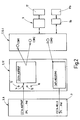
- the two converter interfaces 10 and 11 and a converter unit 12 includes.
- the converter interfaces 10 and 11 are programmable so that they are easy to work with or to the protocol of the TC interfaces 4 and 5 can be adjusted.
- the converter interface 10 as CSTA interface and the converter interface 11 designed as a TAPI interface.
- the converter unit 12 is also programmable educated.
- the converter unit has - according to the figure 2- several, here four, telecommunication functions 13 to 16, in particular these telecommunications functions 13 to 16 are programmable.
- Each converter function 13 to 16 is exactly one execution request, a telecommunications function assigned to the TC interface 3.
- a CSTA call which can also be referred to as a CSTA service, is shown.
- a call may be the request to establish a telephone connection from one extension 17 to another extension 17b.
- Both extensions 17 and 17b which form elements of the PBX 1, are connected to the central unit 6. If these elements 17, 17b have a different telecommunications interface than the central unit 6, converters 9 and 9b are also interposed here.
- the CSTA call has several parameters P 1 to P n , with at least one identification of the calling person for a telephone connection Elements 17b or 7 and the identification of the element 17 to be called must be contained in the CSTA call as parameters P 1 to P n .
- converter unit 12 determines the associated converter function 14, which is uniquely assigned to the CSTA call.
- the converter function 14 is output in the direction of conversion to element 2 in accordance with the telecommunications interface 4 used in the corresponding embodiment.
- the converter unit becomes 12 the corresponding CSTA call - as mentioned above - is issued in the embodiment which corresponds to the TC interface 4 and is assigned to at least one specific object model COM 1 or COM 2.
- the elements 17 and / or 17b to be called are then determined from the central unit 6, which can have a connection to a public telecommunications network, and the connection establishment request is sent to these elements 17 and / or 17b, so that the telephone connection can be established.
- the converter unit 12 therefore has the task of assigning a CSTA call and the associated parameters P 1 to P n to certain COM objects COM 1 or COM 2 and their methods.
- a CSTA call can also result in several COM method calls.
- a method call can also trigger several CSTA calls.
- Another task of the converter unit is in it, the change also in the reverse direction perform. For example, needed the TC interface working according to the CSTA protocol 3 a response from the central unit 6, whether the desired CSTA call can also be executed can. To the question necessary for this answer another CSTA call can be issued which then corresponds to one of the converter functions 13 to 16 as a CSTA call, however in Embodiment for the TAPI interface the element 2 is discontinued, to the right one Object model, for example COM 2.
- the TC interface 3 In response to this question as to whether the telephone connection can be carried out correctly, the TC interface 3 expects a corresponding answer, which is also referred to as acknowledgment. This is output by a further object model COM 3 in TA-PI format to the converter 9 as a TAPI message.
- the converter 9 uniquely converts this TAPI message in accordance with a telecommunications function by means of one of the converter functions 14 to 16 into the associated CSTA message with the associated parameters P 1 to P n , so that these are correctly recognized and processed at the TC interface 3 can.
- the converter 9 with its converter unit 12 offers an interface with exactly one function 13 to 16 per possible CSTA call, which converter function 13 to 16 can be output in the associated correct output format or embodiment according to the direction of conversion.
- the converter unit 12, which forms this interface can be implemented in various ways. This includes, for example, training as an RPC interface (Remote Procedure Call), CORBA interface (Common Object Request Broker Architecture) or, as with TAPI interface 4, as a COM interface that has several object models.
- the converter unit 12 determines the converter function 13 to 16, possibly with the aid of the parameters P 1 to P n supplied by the CSTA call, the relevant COM objects COM 1 or COM 2 of the TAPI interface in order to determine the To transfer converter functions 13 to 16 in the corresponding protocol to the associated objects. Furthermore, the converter unit 12 determines the methods contained in the COM objects COM 1 and COM 2, which correspond to telecommunications functions that are called there. In addition, the parameters P 1 to P n are determined, which must be given to these methods in order to be able to execute the CSTA call correctly. After the COM objects and the methods have been determined, the converter unit 12 issues the corresponding CSTA call.
- the response to the CSTA call is to be transmitted, the TAPI interface 4 "sends" this response, which is also referred to as a message or event, to the converter 9.
- this - Can also have a COM interface, the corresponding COM object is determined in the converter unit 12.
- the converter unit 12 determines the telecommunications function or converter function 13 to 16 corresponding to the TAPI message and outputs it in the direction of conversion as a CSTA message with the parameters P 1 to P n .
- the converter can be used instead of a COM interface or the converter unit 12 also one Windows Message Loop, which waiting for reports and then dealing with them. On the type of report or event and to those given by the TAPI interface 4 The converter unit 12 must correspond to the corresponding parameters Recognize CSTA event from one of the Generate converter functions 13 to 16 and on the CTI application 8 is to be sent.
- the converter 9 is thus between the central unit 6 and a CTI application 8, which the Converts log messages from CSTA to TAPI and vice versa. Because CSTA and TAPI are functional may not match completely, there may be performance restrictions in the conversion give. If necessary, the converter 9 at TAPI or CSTA missing functions independently emulate, so these performance constraints are essentially canceled. Basically however, 9 become incompatibilities with the converter between different telecommunication interfaces 3 and 4 canceled.
- converter 9 There are several ways to implement converter 9 depending on what type of telecommunications interface 3 or 4 the PABX and Make CTI application 8 available to the outside world, such as so-called socket interfaces or the above mentioned RPC interfaces. Basically can the converter 9 all the usual respectively known telecommunication interface types and then give the user the opportunity offer to set the desired interface type or to program and accordingly to configure. Then in particular it is of advantage if the converter 9 together the converter unit 12 provided as a software component is installed on each CTI application 8 can be.
Landscapes
- Engineering & Computer Science (AREA)
- Signal Processing (AREA)
- Telephonic Communication Services (AREA)
- Communication Control (AREA)
Applications Claiming Priority (2)
| Application Number | Priority Date | Filing Date | Title |
|---|---|---|---|
| DE10008452A DE10008452A1 (de) | 2000-02-23 | 2000-02-23 | Wandler für unterschiedliche Telekommunationsschnittstellen einer Telekommunikationsanlage |
| DE10008452 | 2000-02-23 |
Publications (2)
| Publication Number | Publication Date |
|---|---|
| EP1128633A2 true EP1128633A2 (fr) | 2001-08-29 |
| EP1128633A3 EP1128633A3 (fr) | 2004-02-25 |
Family
ID=7632113
Family Applications (1)
| Application Number | Title | Priority Date | Filing Date |
|---|---|---|---|
| EP01103903A Withdrawn EP1128633A3 (fr) | 2000-02-23 | 2001-02-17 | Un convertisseur pour des differentes interfaces de télécommunication d'un dispositif de télécommunication |
Country Status (2)
| Country | Link |
|---|---|
| EP (1) | EP1128633A3 (fr) |
| DE (1) | DE10008452A1 (fr) |
Family Cites Families (4)
| Publication number | Priority date | Publication date | Assignee | Title |
|---|---|---|---|---|
| GB9107884D0 (en) * | 1991-04-12 | 1991-05-29 | Plessey Telecomm | Computer supported telephony application system |
| US6094479A (en) * | 1997-05-06 | 2000-07-25 | Telefonaktiebolaget Lm Ericsson | Computer telephony integration gateway |
| US8130749B2 (en) * | 1998-02-17 | 2012-03-06 | Genesys Telecommunications Laboratories Inc., A Corp of California | Telephone network interface bridge between data telephony networks and dedicated connection telephony networks |
| DE19828485A1 (de) * | 1998-06-25 | 1999-12-30 | Siemens Ag | Verfahren zur Steuerung einer Telekommunikationsanlage durch einen Computer und zugehörige Schnittstellen zwischen einem Computernetzwerk und einem Datenkanal sowie zwischen dem Datenkanal und der Telekommunikationsanlage |
-
2000
- 2000-02-23 DE DE10008452A patent/DE10008452A1/de not_active Withdrawn
-
2001
- 2001-02-17 EP EP01103903A patent/EP1128633A3/fr not_active Withdrawn
Also Published As
| Publication number | Publication date |
|---|---|
| EP1128633A3 (fr) | 2004-02-25 |
| DE10008452A1 (de) | 2001-08-30 |
Similar Documents
| Publication | Publication Date | Title |
|---|---|---|
| DE69431939T2 (de) | Verteiltes System für Anrufverarbeitung | |
| DE3903257C2 (fr) | ||
| DE69621128T2 (de) | Leitweglenkung von ankommenden rufen zu einer nebenstellenanlage in reaktion auf weglenkungsanfragen von einem hauptrechner | |
| EP0731618A2 (fr) | Procédé pour commander un réseau d'accès et central avec un tel réseau d'accès | |
| EP1117236A2 (fr) | Traitement des appels entrant pendant une session de données en ligne | |
| EP1492300A1 (fr) | Procédé et arrangement pour l'accès à un premier terminal d'un premier réseau de transmissions depuis un noeud de communication d'un deuxième réseau de transmissions | |
| DE9303214U1 (de) | Schaltungsanordnung zur Integration von EDV-Systemen bei der Benutzung von Telefonanlagen | |
| EP0817511B1 (fr) | Procédé pour fournir un service de télécommunication | |
| DE19947032B4 (de) | System zur Steuerung und Überwachung von an Nebenstellenanlagen angekoppelten ersten oder von an Weitverkehrsnetze angekoppelten zweiten Telekommunikationsendgeräten | |
| EP1117243A2 (fr) | Etablissement d'un appel PC-à-téléphone dans un réseau de télécommunications intelligent | |
| EP0303870A2 (fr) | Système de commutation digitale à structure modulaire avec des composants opérationnels et mûrs | |
| EP0810801A2 (fr) | Procédé d'établissement d'une connexion, ainsi qu'un central, un processeur de service et un réseau de communication | |
| EP0813330A2 (fr) | Procédé d'établissement de connexion, central de commutation, processeur de service et réseau de communication | |
| EP1424845B1 (fr) | Procédé pour intégrer un réseau à commutation par paquets dans un système de communication | |
| EP1128633A2 (fr) | Un convertisseur pour des differentes interfaces de télécommunication d'un dispositif de télécommunication | |
| EP1305957B1 (fr) | Systeme permettant de connecter un dispositif de telecommunication a un reseau de communication a commutation de paquets | |
| EP2875627B1 (fr) | Procédé et dispositif pour établir des liaisons de télécommunication | |
| DE10001417A1 (de) | Verfahren, Vermittlungsstelle, Diensterechner, Programm-Modul und Schnittstelleneinrichtung zur Übermittlung von Telekommunikationsdienst-Daten zwischen einer Vermittlungsstelle und einem Diensterechner | |
| EP0961508A2 (fr) | Méthode et système de télécommunication pour la transmission de données d'un premier vers un deuxième autocommutateur privé | |
| EP1001589B1 (fr) | Telecommunications exchange | |
| DE10117366B4 (de) | Verfahren und Anordnung zum Betreiben eines Telekommunikationsnetzes | |
| EP1285541B1 (fr) | Transmission de donnees de commande de service par au moins une station intermediaire | |
| EP1325617B1 (fr) | Systeme de communication et procede pour commander des fonctions dans un systeme de communication | |
| EP0967823A2 (fr) | Méthode de contrÔle d'un central de télécommunication par un ordinateur et interfaces correspondantes | |
| DE19948090B4 (de) | Verfahren zum Anschliessen eines Endgerätes an eine Telekommunikationsanlage sowie zugehörige elektronische Baueinheiten |
Legal Events
| Date | Code | Title | Description |
|---|---|---|---|
| PUAI | Public reference made under article 153(3) epc to a published international application that has entered the european phase |
Free format text: ORIGINAL CODE: 0009012 |
|
| AK | Designated contracting states |
Kind code of ref document: A2 Designated state(s): AT BE CH CY DE DK ES FI FR GB GR IE IT LI LU MC NL PT SE TR |
|
| AX | Request for extension of the european patent |
Free format text: AL;LT;LV;MK;RO;SI |
|
| PUAL | Search report despatched |
Free format text: ORIGINAL CODE: 0009013 |
|
| RIC1 | Information provided on ipc code assigned before grant |
Ipc: 7H 04M 3/42 B Ipc: 7H 04L 29/06 A |
|
| AK | Designated contracting states |
Kind code of ref document: A3 Designated state(s): AT BE CH CY DE DK ES FI FR GB GR IE IT LI LU MC NL PT SE TR |
|
| AX | Request for extension of the european patent |
Extension state: AL LT LV MK RO SI |
|
| 17P | Request for examination filed |
Effective date: 20040825 |
|
| 17Q | First examination report despatched |
Effective date: 20040915 |
|
| AKX | Designation fees paid |
Designated state(s): DE GB IT SE |
|
| STAA | Information on the status of an ep patent application or granted ep patent |
Free format text: STATUS: THE APPLICATION IS DEEMED TO BE WITHDRAWN |
|
| 18D | Application deemed to be withdrawn |
Effective date: 20060909 |