EP1129878A2 - Türe oder sonstiges Karossererieteil eines Kraftfahrzeuges - Google Patents
Türe oder sonstiges Karossererieteil eines Kraftfahrzeuges Download PDFInfo
- Publication number
- EP1129878A2 EP1129878A2 EP01104865A EP01104865A EP1129878A2 EP 1129878 A2 EP1129878 A2 EP 1129878A2 EP 01104865 A EP01104865 A EP 01104865A EP 01104865 A EP01104865 A EP 01104865A EP 1129878 A2 EP1129878 A2 EP 1129878A2
- Authority
- EP
- European Patent Office
- Prior art keywords
- outer skin
- door
- body part
- motor vehicle
- inner panel
- Prior art date
- Legal status (The legal status is an assumption and is not a legal conclusion. Google has not performed a legal analysis and makes no representation as to the accuracy of the status listed.)
- Granted
Links
Images
Classifications
-
- B—PERFORMING OPERATIONS; TRANSPORTING
- B60—VEHICLES IN GENERAL
- B60J—WINDOWS, WINDSCREENS, NON-FIXED ROOFS, DOORS, OR SIMILAR DEVICES FOR VEHICLES; REMOVABLE EXTERNAL PROTECTIVE COVERINGS SPECIALLY ADAPTED FOR VEHICLES
- B60J5/00—Doors
- B60J5/04—Doors arranged at the vehicle sides
- B60J5/0468—Fixation or mounting means specific for door components
- B60J5/0469—Fixation or mounting means specific for door components for door panels, e.g. hemming
Definitions
- the invention relates to a door or another body part of a motor vehicle.
- the doors and other body parts of a motor vehicle usually include an inner sheet and an attached outer skin.
- the outer skin and the inner sheet must be painted.
- the outer skin is fastened to the inner sheet by a flange and into the Body installed for subsequent painting. Only then will the other functional elements attached in the door or in the other body part. Care must then be taken when installing these functional elements that the already painted outer skin is not damaged. The assembly must therefore be carried out with particular care. Nevertheless, it can happen that the painted outer skin is damaged during assembly.
- the object of the invention is an improved door or an improved other To propose body part of a motor vehicle.
- the door or the other body part of the motor vehicle comprises an inner panel and a preferably painted outer skin.
- the outer skin is through punch rivets or other fasteners attached to the inner panel.
- paint the outer skin in particular only at the end of the assembly process to be attached to the inner panel, that is, only then to the inner panel to fix if the other functional elements are already in the door or in the other body parts have been installed.
- the assembly of the functional elements can be done easier and faster. In particular, during assembly the functional elements no longer on the sensitive painted outer skin be respected.
- This outer skin can be used during the assembly of the functional elements also not be damaged since it is only installed last. Another The advantage is that the outer skin can also be removed if necessary. This is a particular service advantage.
- All fastening elements are for fastening the outer skin to the inner sheet suitable that allow attachment at the end of the assembly process.
- Fastening elements are advantageous.
- punch rivets especially proven.
- the inner sheet has a bevel in one end region.
- the bends can each run at a right angle. But it is also possible that the bevels have a larger angle of, for example Have 135 °.
- a bend also known as an offset can be achieved that the outer skin and the inner sheet in the middle of the door or the other body part at a distance run from each other and that they are then connected to one another in their edge region can be. Furthermore, the stability in the edge area can be increased become. Finally, it is also possible to cover the hinge area (under the fender) or in the area of the axis of rotation of a door.
- outer skin has a bevel or bend in an end region.
- the outer skin the inner sheet protrudes and is folded is folded.
- the inner sheet projecting area may be folded, this area preferably is folded inwards. This will round off the outer skin in your End area reached.
- the bevel can include any angle, for example 90 ° or 180 °, although other folding angles are also possible are.
- a seal is preferably provided between the inner sheet and the outer skin.
- the invention further relates to a motor vehicle which has a door according to the invention and / or an other body part according to the invention.
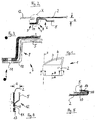
- the motor vehicle door 1 shown in Fig. 1 comprises a painted outer skin 2, a Inner sheet (not visible in FIG. 1, as covered by the outer skin 2), one Frame 3 and a pane 4.
- the motor vehicle door 1 is about the vertical axis Z swiveling.
- the distance between the painted outer skin 2 and the Inner sheet 5 is in the end region of the motor vehicle door by the fold 6 of the Inner sheet 5 reduced.
- the pivot axis z of the motor vehicle door is in that designated X in FIG. 2 Area where the door hinges are attached.
- X The pivot axis z of the motor vehicle door is in that designated X in FIG. 2 Area where the door hinges are attached.
- the end legs 9 are in the from FIG. 2 visible way below the end of the body part 12 (fender).
- the lower edge of the motor vehicle door 1 is designed as shown in FIG. 4.
- the distance a In the center area of the motor vehicle door reduced by a bevel 12 of the inner sheet, the bevel 12 in essentially corresponds to the fold 6.
- the outer skin 2 projects beyond the inner sheet 5.
- Your end 13 projecting over the inner plate 5 is bent inwards by 90 °.
- the painted outer skin 2 and the inner panel 5 are in their end region connected by punch rivets 11. In this area there is also a seal 10 provided between the painted outer skin 2 and the inner panel 5.
- FIG. 5 The formation of the rear vertical edge of the motor vehicle door 1 is shown in FIG. 5 shown.
- the outer skin 2 projects beyond the inner plate 5. That the inner plate 5 protruding end 14 of the outer skin 2 is about 180 ° or smaller around the end of the inner plate 5 folded around. Is between the inner plate 5 and the outer skin 2 a surrounding the end of the inner plate 5 on both sides or on one side Seal 10 provided.
- the assembly of the painted outer skin without Flanging enables. Simple assembly is carried out using punch rivets. All functional elements are easily accessible and can be easily installed. The outer skin can be installed last. Furthermore, disassembly of the Outer skin possible (service advantage). There will be an independence from online painting created.
- the invention can be implemented in a cost-effective manner.
Landscapes
- Engineering & Computer Science (AREA)
- Mechanical Engineering (AREA)
- Automobile Manufacture Line, Endless Track Vehicle, Trailer (AREA)
- Body Structure For Vehicles (AREA)
Abstract
Description
- Fig. 1
- eine Kraftfahrzeugtüre in einer Seitenansicht,
- Fig. 2
- einen Schnitt längs der Linie A-A in Fig. 1,
- Fig. 3
- eine vergrößerte Darstellung der Einzelheit X in Fig. 2,
- Fig. 4
- einen Schnitt längs der Linie B-B in Fig. 1 und
- Fig. 5
- einen Schnitt längs der Linie C-C in Fig. 1.
Claims (6)
- Türe oder sonstiges Karosserieteil eines Kraftfahrzeugs mit einem Innenblech (5) und einer daran befestigten, vorzugsweise lackierten Außenhaut (2),
dadurch gekennzeichnet,
daß die vorzugsweise lackierte Außenhaut (2) an dem Innenblech (5) durch Stanzniete (11) oder andere Befestigungselemente befestigt ist. - Türe oder sonstiges Karosserieteil nach Anspruch 1, dadurch gekennzeichnet, daß das Innenblech (5) in einem Endbereich eine Abkantung (6, 12) aufweist.
- Türe oder sonstiges Karosserieteil nach Anspruch 1 oder 2, dadurch gekennzeichnet, daß die Außenhaut (2) in einem Endbereich eine Abkantung (8) aufweist.
- Türe oder sonstiges Karosserieteil nach einem der vorhergehenden Ansprüche, dadurch gekennzeichnet, daß die Außenhaut (2) das Innenblech (5) überragt und abgekantet (13, 14) ist.
- Türe oder sonstiges Karosserieteil nach einem der vorhergehenden Ansprüche, dadurch gekennzeichnet, daß zwischen Innenblech (5) und Außenhaut (2) eine Dichtung (10) vorgesehen ist.
- Kraftfahrzeug, gekennzeichnet durch eine Türe oder ein sonstiges Karosserieteil nach einem der Ansprüche 1 bis 5.
Applications Claiming Priority (4)
| Application Number | Priority Date | Filing Date | Title |
|---|---|---|---|
| DE10010084 | 2000-03-02 | ||
| DE10010084 | 2000-03-02 | ||
| DE10013868 | 2000-03-21 | ||
| DE10013868A DE10013868A1 (de) | 2000-03-02 | 2000-03-21 | Türe oder sonstiges Karosserieteil eines Kraftfahrzeuges |
Publications (3)
| Publication Number | Publication Date |
|---|---|
| EP1129878A2 true EP1129878A2 (de) | 2001-09-05 |
| EP1129878A3 EP1129878A3 (de) | 2002-07-31 |
| EP1129878B1 EP1129878B1 (de) | 2004-04-28 |
Family
ID=26004629
Family Applications (1)
| Application Number | Title | Priority Date | Filing Date |
|---|---|---|---|
| EP01104865A Expired - Lifetime EP1129878B1 (de) | 2000-03-02 | 2001-02-28 | Türe oder sonstiges Karossererieteil eines Kraftfahrzeuges |
Country Status (2)
| Country | Link |
|---|---|
| US (1) | US6464286B2 (de) |
| EP (1) | EP1129878B1 (de) |
Families Citing this family (8)
| Publication number | Priority date | Publication date | Assignee | Title |
|---|---|---|---|---|
| DE20211948U1 (de) * | 2002-08-03 | 2003-12-18 | Nothelfer Gmbh | Verbindung der Ränder von geformten Blechen |
| DE10317552B3 (de) * | 2003-04-15 | 2005-01-27 | Nothelfer Gmbh | Verfahren zur Herstellung von Anbauteilen für ein Kraftfahrzeug und nach diesem Verfahren hergestellte Anbauteile |
| US20060082187A1 (en) * | 2004-10-19 | 2006-04-20 | Arvinmeritor Technology, Llc | Snap pin for door module positioning |
| CN100420545C (zh) * | 2006-08-16 | 2008-09-24 | 南车株洲电力机车有限公司 | 一种流线型机车司机室三维曲面蒙皮成型方法及模具 |
| JP5446570B2 (ja) * | 2009-08-11 | 2014-03-19 | 日産自動車株式会社 | パネル部品、およびパネル部品の製造方法 |
| DE102009040636B4 (de) * | 2009-09-09 | 2014-05-08 | Johnson Controls Interiors Gmbh & Co. Kg | Fahrzeugtüranordnung und Verfahren zur Montage |
| US8550537B2 (en) * | 2010-11-05 | 2013-10-08 | Honda Motor Co., Ltd. | Automotive vehicle passage seal |
| KR101637785B1 (ko) * | 2014-12-22 | 2016-07-08 | 현대자동차주식회사 | 자동차용 하이브리드 도어 |
Family Cites Families (17)
| Publication number | Priority date | Publication date | Assignee | Title |
|---|---|---|---|---|
| ATA290786A (de) | 1986-10-31 | 1991-08-15 | Austria Metall | Fahrzeugtuer, insbesondere fuer einen personenkraftwagen |
| JPS649019A (en) * | 1987-07-02 | 1989-01-12 | Mazda Motor | Door handle of automobile |
| DE3724648A1 (de) | 1987-07-25 | 1989-02-02 | Scheible Ohg Geb | Fuegenaht |
| US4818014A (en) * | 1987-09-10 | 1989-04-04 | Schlegel Corporation | Mounting arrangement for sealing strips |
| US4866883A (en) * | 1988-04-08 | 1989-09-19 | General Motors Corporation | Vehicle door separable for access to door hardware |
| US4888919A (en) * | 1989-01-12 | 1989-12-26 | Ford Motor Company | Closure panel for automative bodies |
| IT1238527B (it) * | 1989-11-09 | 1993-08-18 | Roltra Spa | Portiera per autoveicoli. |
| JPH05116532A (ja) * | 1991-10-29 | 1993-05-14 | Mazda Motor Corp | 自動車のドア構造 |
| US5446999A (en) * | 1993-06-28 | 1995-09-05 | Nissan Motor Co., Ltd. | Vehicle door assembly having an easily removable outside panel |
| US5667868A (en) * | 1993-09-14 | 1997-09-16 | The Budd Company | Outer door panel and method for molding and attaching same |
| DE4331616B4 (de) * | 1993-09-17 | 2005-04-07 | Schade Gmbh & Co. Kg | Kraftfahrzeugtür |
| DE4431991A1 (de) | 1994-09-08 | 1996-03-14 | Bayerische Motoren Werke Ag | Verfahren zum Verbinden flächiger Bauteile |
| DE19538595A1 (de) * | 1995-10-17 | 1997-04-24 | Thyssen Industrie | Kfz-Tür oder Kfz-Klappe |
| DE19616788A1 (de) | 1996-04-26 | 1997-11-06 | Bayerische Motoren Werke Ag | Fahrzeugtür |
| JP3624579B2 (ja) * | 1996-10-04 | 2005-03-02 | いすゞ自動車株式会社 | ドアのシール構造を有する自動車 |
| DE19737160C2 (de) * | 1997-08-26 | 2003-01-16 | Va Tech Transport & Montagesysteme Gmbh & Co | Verfahren zur Serienfertigung von Türen oder Klappen für Fahrzeuge sowie Anlage zur Durchführung des Verfahrens |
| DE19810643C1 (de) * | 1998-03-12 | 1999-08-19 | Daimler Chrysler Ag | Karosserieabschnitt für eine Kraftfahrzeugkarosserie |
-
2001
- 2001-02-28 EP EP01104865A patent/EP1129878B1/de not_active Expired - Lifetime
- 2001-03-02 US US09/796,741 patent/US6464286B2/en not_active Expired - Fee Related
Non-Patent Citations (1)
| Title |
|---|
| None |
Also Published As
| Publication number | Publication date |
|---|---|
| EP1129878A3 (de) | 2002-07-31 |
| EP1129878B1 (de) | 2004-04-28 |
| US6464286B2 (en) | 2002-10-15 |
| US20010029702A1 (en) | 2001-10-18 |
Similar Documents
| Publication | Publication Date | Title |
|---|---|---|
| DE69514091T2 (de) | Drehverbindung für einen seitlichen aussenrückblickspiegel | |
| DE60309846T2 (de) | Rahmenstruktur für ein kraftfahrzeug und schutzteil dafür | |
| DE3301072C2 (de) | ||
| EP1326757B1 (de) | Türmodulträger | |
| EP1036730A2 (de) | Verfahren zur toleranzgenauen Montage von Bestandteilen eines Kraftfahrzeug-Vorderwagens sowie Anornung zur Durchführung des Verfahrens | |
| DE60019677T2 (de) | Verstellbare Montageplatte | |
| DE19717027C2 (de) | Verschraubung einer Scharnierlasche für Fahrzeugtüren | |
| EP0791715A1 (de) | Scharnier-und Feststellereinheit für aushängbare Kraftwagentüren | |
| EP0702123A1 (de) | Mit einem Türfeststeller baulich vereinigtes Türscharnier für Kraftwagentüren | |
| EP1331138A2 (de) | Deckel zum Verschliessen einer Wandöffnung | |
| DE3835810C2 (de) | Einrichtung zur Fixierung von Türen und/oder Klappen von Kraftfahrzeugen während der Fahrzeugmontage | |
| DE102022120799A1 (de) | Klappscharnier | |
| DE10326883B4 (de) | Stauraum für eine Fahrgastzelle | |
| EP1129878B1 (de) | Türe oder sonstiges Karossererieteil eines Kraftfahrzeuges | |
| DE102007035145B4 (de) | Scharnieranordnung für eine Kraftfahrzeugtür | |
| EP0579006A1 (de) | Fahrzeugtür | |
| EP0097219B1 (de) | Haltegriff od. dgl. für Fahrzeuge | |
| DE69609015T2 (de) | Einrastbarer Stützschaft für Seilrollen | |
| DE69604964T2 (de) | Verriegelungsvorrichtung für Kraftwagenflügel mit verbesserten Einbaumitteln für Verkleidungskappe | |
| DE4308675C2 (de) | Weitwinkel-Kraftwagentürscharnier | |
| EP0611347A1 (de) | Wischarm, insbesondere zur reinigung einer scheibe eines kraftfahrzeugs. | |
| DE19946666C2 (de) | Scharnieranordnung für eine Tür eines Kraftfahrzeugs | |
| DE10013868A1 (de) | Türe oder sonstiges Karosserieteil eines Kraftfahrzeuges | |
| DE7902216U1 (de) | Geräteschrank | |
| EP0785331B1 (de) | Heckklappenanlenkung für Kraftfahrzeuge |
Legal Events
| Date | Code | Title | Description |
|---|---|---|---|
| PUAI | Public reference made under article 153(3) epc to a published international application that has entered the european phase |
Free format text: ORIGINAL CODE: 0009012 |
|
| AK | Designated contracting states |
Kind code of ref document: A2 Designated state(s): AT BE CH CY DE DK ES FI FR GB GR IE IT LI LU MC NL PT SE TR |
|
| AX | Request for extension of the european patent |
Free format text: AL;LT;LV;MK;RO;SI |
|
| PUAL | Search report despatched |
Free format text: ORIGINAL CODE: 0009013 |
|
| AK | Designated contracting states |
Kind code of ref document: A3 Designated state(s): AT BE CH CY DE DK ES FI FR GB GR IE IT LI LU MC NL PT SE TR |
|
| AX | Request for extension of the european patent |
Free format text: AL;LT;LV;MK;RO;SI |
|
| 17P | Request for examination filed |
Effective date: 20030122 |
|
| AKX | Designation fees paid |
Designated state(s): DE FR GB IT |
|
| 17Q | First examination report despatched |
Effective date: 20030317 |
|
| GRAP | Despatch of communication of intention to grant a patent |
Free format text: ORIGINAL CODE: EPIDOSNIGR1 |
|
| GRAS | Grant fee paid |
Free format text: ORIGINAL CODE: EPIDOSNIGR3 |
|
| GRAA | (expected) grant |
Free format text: ORIGINAL CODE: 0009210 |
|
| AK | Designated contracting states |
Kind code of ref document: B1 Designated state(s): DE FR GB IT |
|
| REG | Reference to a national code |
Ref country code: GB Ref legal event code: FG4D Free format text: NOT ENGLISH |
|
| REG | Reference to a national code |
Ref country code: IE Ref legal event code: FG4D Free format text: GERMAN |
|
| REF | Corresponds to: |
Ref document number: 50102091 Country of ref document: DE Date of ref document: 20040603 Kind code of ref document: P |
|
| GBT | Gb: translation of ep patent filed (gb section 77(6)(a)/1977) |
Effective date: 20040723 |
|
| REG | Reference to a national code |
Ref country code: IE Ref legal event code: FD4D |
|
| ET | Fr: translation filed | ||
| PLBE | No opposition filed within time limit |
Free format text: ORIGINAL CODE: 0009261 |
|
| STAA | Information on the status of an ep patent application or granted ep patent |
Free format text: STATUS: NO OPPOSITION FILED WITHIN TIME LIMIT |
|
| 26N | No opposition filed |
Effective date: 20050131 |
|
| PGFP | Annual fee paid to national office [announced via postgrant information from national office to epo] |
Ref country code: IT Payment date: 20060228 Year of fee payment: 6 |
|
| PG25 | Lapsed in a contracting state [announced via postgrant information from national office to epo] |
Ref country code: IT Free format text: LAPSE BECAUSE OF NON-PAYMENT OF DUE FEES Effective date: 20070228 |
|
| PGFP | Annual fee paid to national office [announced via postgrant information from national office to epo] |
Ref country code: FR Payment date: 20100519 Year of fee payment: 10 |
|
| PGFP | Annual fee paid to national office [announced via postgrant information from national office to epo] |
Ref country code: GB Payment date: 20100429 Year of fee payment: 10 |
|
| GBPC | Gb: european patent ceased through non-payment of renewal fee |
Effective date: 20110228 |
|
| REG | Reference to a national code |
Ref country code: FR Ref legal event code: ST Effective date: 20111102 |
|
| PG25 | Lapsed in a contracting state [announced via postgrant information from national office to epo] |
Ref country code: FR Free format text: LAPSE BECAUSE OF NON-PAYMENT OF DUE FEES Effective date: 20110228 |
|
| PG25 | Lapsed in a contracting state [announced via postgrant information from national office to epo] |
Ref country code: GB Free format text: LAPSE BECAUSE OF NON-PAYMENT OF DUE FEES Effective date: 20110228 |
|
| PGFP | Annual fee paid to national office [announced via postgrant information from national office to epo] |
Ref country code: DE Payment date: 20160226 Year of fee payment: 16 |
|
| REG | Reference to a national code |
Ref country code: DE Ref legal event code: R119 Ref document number: 50102091 Country of ref document: DE |
|
| PG25 | Lapsed in a contracting state [announced via postgrant information from national office to epo] |
Ref country code: DE Free format text: LAPSE BECAUSE OF NON-PAYMENT OF DUE FEES Effective date: 20170901 |