EP1130146A1 - Verfahren zum stricken dreidimensionaler strickwaren - Google Patents
Verfahren zum stricken dreidimensionaler strickwaren Download PDFInfo
- Publication number
- EP1130146A1 EP1130146A1 EP99954408A EP99954408A EP1130146A1 EP 1130146 A1 EP1130146 A1 EP 1130146A1 EP 99954408 A EP99954408 A EP 99954408A EP 99954408 A EP99954408 A EP 99954408A EP 1130146 A1 EP1130146 A1 EP 1130146A1
- Authority
- EP
- European Patent Office
- Prior art keywords
- fabric
- knitting
- loops
- knitted
- needles
- Prior art date
- Legal status (The legal status is an assumption and is not a legal conclusion. Google has not performed a legal analysis and makes no representation as to the accuracy of the status listed.)
- Withdrawn
Links
Images





Classifications
-
- D—TEXTILES; PAPER
- D04—BRAIDING; LACE-MAKING; KNITTING; TRIMMINGS; NON-WOVEN FABRICS
- D04B—KNITTING
- D04B1/00—Weft knitting processes for the production of fabrics or articles not dependent on the use of particular machines; Fabrics or articles defined by such processes
- D04B1/22—Weft knitting processes for the production of fabrics or articles not dependent on the use of particular machines; Fabrics or articles defined by such processes specially adapted for knitting goods of particular configuration
-
- D—TEXTILES; PAPER
- D04—BRAIDING; LACE-MAKING; KNITTING; TRIMMINGS; NON-WOVEN FABRICS
- D04B—KNITTING
- D04B1/00—Weft knitting processes for the production of fabrics or articles not dependent on the use of particular machines; Fabrics or articles defined by such processes
- D04B1/10—Patterned fabrics or articles
- D04B1/102—Patterned fabrics or articles with stitch pattern
- D04B1/108—Gussets, e.g. pouches or heel or toe portions
-
- D—TEXTILES; PAPER
- D10—INDEXING SCHEME ASSOCIATED WITH SUBLASSES OF SECTION D, RELATING TO TEXTILES
- D10B—INDEXING SCHEME ASSOCIATED WITH SUBLASSES OF SECTION D, RELATING TO TEXTILES
- D10B2403/00—Details of fabric structure established in the fabric forming process
- D10B2403/03—Shape features
- D10B2403/033—Three dimensional fabric, e.g. forming or comprising cavities in or protrusions from the basic planar configuration, or deviations from the cylindrical shape as generally imposed by the fabric forming process
- D10B2403/0332—Three dimensional fabric, e.g. forming or comprising cavities in or protrusions from the basic planar configuration, or deviations from the cylindrical shape as generally imposed by the fabric forming process with gussets folding into three dimensional shape, e.g. seat covers
-
- D—TEXTILES; PAPER
- D10—INDEXING SCHEME ASSOCIATED WITH SUBLASSES OF SECTION D, RELATING TO TEXTILES
- D10B—INDEXING SCHEME ASSOCIATED WITH SUBLASSES OF SECTION D, RELATING TO TEXTILES
- D10B2501/00—Wearing apparel
- D10B2501/04—Outerwear; Protective garments
- D10B2501/042—Headwear
Definitions
- the present invention relates to a method of a three-dimensional shape fabric requiring no post-treatment after completion of knitting by using a flat knitting machine including at least a pair of front and back needle beds, either or both of which is/are movable in a lateral direction thereof.
- shaping knits include, for example, (i) a knitting method in which while a front body portion is knitted, the widening or narrowing is performed to change the knitting width so as to correspond in configuration to a dress pattern, or a pocket is formed in the front body portion, so as to relieve the post-treatment after completion of the knitting, which is called “the integral garment”, and (ii) a knitting method in which after front and back bodies and right and left sleeves are each knitted in the form of tube in adjacent regions, the sleeves are moved toward the bodies at the armpits and are joined thereto by repetition of the knitting step that loops of the sleeves are superposed on loops of the bodies at the sleeve sides so as to form the loops in the next courses, followed by the knitting step that the final courses of the front and back bodies are joined in the shoulders,
- the flechage knitting in which in the knitting of a fabric, needles associated with a part of a knitting region are put into the rested state and a yarn feeder is reversed on the way in the knitting region to form loops at only a part of the needles and then loops of the next courses are formed on the loops retained at the needles as are in the rested state as well as on the loops retained at the needles as are put in the rested state after completion of the knitting in the other knitting region, so that the number of courses are varied between the wale in the rested state and the wale in the region in which the loops are continuously formed to allow a portion of the fabric having an increased number of courses to project in a convex form, whereby desired undulations are formed in the fabric.
- German patent specification No. DE 3937406C2 discloses a knitting method of making use of flechage knitting to form a three-dimensional knitted article.
- DE 3937406C2 discloses that after the setup, the fabric is branched off back and forth, and one of the branched fabrics is put into the rested state, keeping the loops formed by the setup in their retained state. Then, the other needle bed is used and the other of the branched fabrics is knitted by the flechage knitting at both lengthwise end portions of the other needle bed, so as to form a part. Further, a next part to the previously formed part is knitted by the same flechage knitting to join that part to the previously formed part.
- the next part to the part formed by the flechage knitting is further knitted by the flechage knitting, whereby that part is joined to the previously formed part.
- This knitting is repeatedly performed in order, to join the parts to each other, to thereby produce a generally spherical knitted fabric.
- the bind-off process is performed.
- This method provides the advantages that the number of times and the locations of the flechage knitting can be selectively changed in accordance with the configuration of the fabric in which the flechage is formed, to knit a fabric of a desired configuration and that the setup portion and the finishing portion of the knitted fabric can be joined in the process of knitting.
- the knitting method disclosed by DE3937406C2 has however the disadvantage that the fabric which is put in the rested state after the knitting of the setup portion is being kept in the condition in which the loops formed by the knitting the setup portion are retained by the related needles until they are superposed on the loops of the final course of the other fabric and, as a result of this, a downward tensile force is exerted on the same loops for a long while.
- the loops may be stretched while the other fabric is knitted or yarn breakage may occur and the resultant drop stitch may occur.
- the present invention provides a knitting method of a three-dimensional shape fabric whose front fabric and back fabric are knitted by use of a flat knitting machine, which comprises at least a pair of front and back needle beds, either or both of which are movable in a lateral direction thereof, and a plurality of cam systems, to transfer loops between the front needle bed and the back needle bed, and are joined at setup portions thereof and finishing portions thereof,
- the knitting method of the three-dimensional fabric comprising: the step of forming the setup portion of the three-dimensional shape fabric by use of needles of the both front and back needle beds; the step of knitting a non-rectangular front fabric and a non-rectangular back fabric by performing a flechage knitting in which a first part of the front fabric and a first part of the back fabric are varied in number of courses from one wale to another so as to put a part of loops into a rested state in the process in which the front fabric knitted in association with the front needle bed and the back fabric knitted in association
- the front fabric and the back fabric are knitted while they are kept in the condition of being overlapped back and forth and also the parts continuously formed by the flechage knitting are joined to each other and the final course of the front fabric and the final course of the back fabric are joined to each other, so that the three-dimensional shape fabric requiring no post-treatment after completion of the knitting can be knitted.
- cam systems with different carriages are used for the knitting of the front fabric and the back fabric, both of the front fabric and the back fabric can be knitted in one operation of the carriage.
- an interlock structure is formed by a knitting using the alternate needles, which is one of the characteristic feature of the invention.
- the construction of the present invention can produce the result that knit structure such as rib stitch or garter stitch that provides a reinforcing effect or an ornamental effect is formed in the three-dimensional shape knitted fabric.
- this knit structure is formed in the fabric at desired locations, the fabric of a high commercial value can be provided.
- FIG. 1-A is a front view of a beret-use fabric
- FIG. 1-B is a rear view of the same
- FIG. 1-C is a sectional view of the same taken along line X-X of FIG. 1-A.
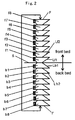
- FIG. 2 is an illustration of the knitting of the beret-use fabric, wherein the knitting on the front bed is illustrated upwards and the knitting on the back bed is illustrated downwards from a starting point S of the knitting of the beret-use fabric as the center.
- FIG. 3 is an illustration of knitting courses showing an embodiment of the present invention.
- FIG. 4 is an illustration of knitting courses showing the embodiment of the present invention.
- FIG. 5 is an illustration of knitting courses showing the embodiment of the present invention.
- FIG. 1 is a front view of a beret-use fabric
- FIG. 1-B is a rear view of the same
- FIG. 1-C is a sectional view of the same taken along line X-X of FIG. 1-A.
- FIG. 2 is an illustration of the knitting of
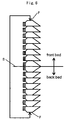
- FIG. 6 is an illustration of the knitting of the fabric of another example of the embodiment, wherein the knitting on the front bed is illustrated upwards and the knitting on the back bed is illustrated downwards from a starting point S of the knitting of the beret-use fabric as the center.
- FIG. 7 is an illustration of a brimmed hat knitted in another embodiment of the present invention.
- FIG. 8 is an illustration of the knitting of the brimmed hat of FIG. 7, wherein the knitting on the front bed is illustrated upwards and the knitting on the back bed is illustrated downwards from a starting point S of the knitting of the brimmed hat-use fabric as the center.
- FIG. 1-A is a front view of a beret-use fabric formed by the knitting method of the embodiment;
- FIG. 1-B is a rear view of the same;
- FIG. 1-C is a sectional view of the same taken along a chain line X-X of FIG. 1-A.
- S designates a starting point of the knitting of the beret-use fabric 1
- F designates a finishing point of the knitting of the same.
- FIG. 2 is an illustration of the knitting of the beret-use fabric 1, plotting the wale in vertical direction and the courses in horizontal direction, wherein the knitting on the front bed is illustrated upwards and the knitting on the back bed is illustrated downwards, with starting point S of the knitting as the center.
- FIGS. 3-5 are illustrations of knitting courses of the beret-use fabric 1.
- the beret-use fabric 1 comprises a front fabric FF and back fabric BF.
- the front fabric FF is knitted in the direction of an arrow Y and the back fabric BF is knitted in the direction of an arrow Z.
- the front fabric FF and the back fabric BF are formed into a fabric into which their parts are joined, as shown in FIG. 2, by parts f1-f8 of the front fabric FF being continuously formed in order from a near side of the starting point S of the knitting of the parts and parts b1-b8 of the back fabric BF being continuously knitted in order from the near side of the starting point.
- the front fabric FF and the back fabric BF are joined to each other at the starting point S and the finishing point F of the knitting.
- the fabric has a rib-stitched hem portion 3 formed around a hem portion of its opening for the reinforcing purpose.
- FIGS. 3-5 illustrating the knitting courses, the knitting of the beret-use fabric will be described.
- the numeric characters at the left side of the knitting course diagram of FIG. 3 designate the number of courses, and the numeric characters at the right side thereof designate the knitting performed by the 2nd, 3rd and 4th cam units in order from the 1st cam unit located upstream to downstream with respect to the traveling direction of the carriage.
- Horizontal arrows at the right side of the knitting course diagram indicate the traveling direction of the carriage and the vertical arrows indicate the transferring direction.
- Needles of the front needle bed are represented in capitals of alphabetical letters and needles of the back needle bed are represented in lowercase letters.
- the knitting of the setup portion in which a yarn is fed to the alternate needles of the front and back needle beds is performed to knit the part f1 of the front fabric FF and the part b1 of the back fabric BF of FIG. 2.
- the hem portion 3 is knitted with alternate needles as disclosed by Japanese Patent Publication No. Hei 3-75656 and the remaining portion is knitted with all needles without preparing any empty needle between the needles used for forming the loops.
- Hei 3-75656 is a knitting method using a two-bed flat knitting machine having two needle beds disposed in back and forth to be opposed to each other wherein the knitting of the front fabric is allotted to odd needles and the knitting of the back fabric is allotted to even needles, so that the fabrics are knitted into a tubular form by use of alternate needles of the front and back needle beds.
- the back fabric BF is associated with the needles of the back needle bed
- the front fabric FF is associated with the needles of the front needle bed, so that the fabrics are knitted while they are kept in the condition of being overlapped back and forth.
- the fabrics having the structure pattern in which front stitches and back stitches are mixed such as links, garter stitches and rib stitches, are knitted into the tubular form.
- the stitch structure such as garter stitches and rib stitches
- the needles of the both needle beds are used to knit the front fabric FF and the back fabric BF.
- the loops of the front fabric FF all come into the state of being retained at the needles of the front needle bed, which is referred to as being knitted in association with the front needle bed in the embodiment.
- the loops of the back fabric BF all come into the state of being retained at the needles of the back needle bed, which is referred to as being knitted in association with the back needle bed.
- the front fabric FF of the beret-use fabric 1 shown in FIG. 1 is knitted in association with the front needle bed and the back fabric BF is knitted in association with the back needle bed, so that the front fabric FF and the back fabric BF are knitted in the condition of being overlapped back and forth.
- the yarn is fed to the needles of the front needle bed retaining the knitting yarn by the knitting of the setup portion of the course 1, while also, in the course 3 the yarn is fed to the needles of the back needle bed retaining the knitting yarn through the yarn feeder 5 in the same manner, to form the loops in the setup portion.
- the yarn is fed to the needles Y to L in the center part of the knitting region from the right end of the knitting region through the front fabric knitting yarn feeder 5 by use of the first cam, to start the knitting of the part f1 of the front fabric FF and also the yarn is fed to the needles y to 1 through a back fabric knitting yarn feeder 7 by use of the second cam, to start the knitting of the part b1 of the back fabric BF.
- the carriage is reversed to reverse the yarn feeders resting in the center part of the knitting region in the knitting of the former course, so that the yarn is fed to the needles L to Q of the front needle bed through the first leading cam and the front fabric knitting yarn feeder 5 and the yarn is fed to the needles 1 to q of the back needle bed through the second cam and the back fabric knitting yarn feeder 7 in the same manner, so as to perform the flechage knitting.
- the knitting shown in the courses 6 to 7 are repeated, during which the knitting width is gradually widened from the center part of the knitting region to the both lateral sides while restoring the needles from the resting state from the course 5, to perform the flechage knitting.
- the loops of the front fabric FF formed on the back needle bed and the loops of the back fabric BF formed on the front needle bed as the back stitches are transferred to the confronting needles of the front needle bed via the third cam, prior to the knitting of the back fabric.
- the yarn is fed to the needles r to j and f and b of the back needle bed and the needles G and C of the front needle bed through the back fabric knitting yarn feeder 7 via the fourth cam, to knit the back fabric BF.
- the loops of the back fabric BF formed on the front needle bed and the loops of the front fabric FF formed as the back stitches are transferred to the back needle bed via the first cam, prior to the knitting of the front fabric FF.
- the yarn is fed to the needles B and F of the front needle bed, the needles e and i of the back needle bed, and the needles J to S of the front needle bed through the front fabric knitting yarn feeder 5 via the second cam, to knit the front fabric FF.
- the yarn is fed to the needles b and f of the back needle bed, the needles C and G of the front needle bed, and the needles j to s of the back needle bed through the back fabric knitting yarn feeder 7 via the fourth cam, to knit the back fabric BF.
- the knitting region is expanded rightwards while the knitting of the courses 8 and 9 are repeated and thereby the part f1 of the front fabric FF and the part b1 of the back fabric BF shown in FIG. 2 are formed.
- the knitting goes into the knitting of the part f2 of the front fabric FF and the part b2 of the back fabric BF.
- the yarn is fed to the needles Y to L in the center part of the knitting region of the needles retaining the loops of the final courses of the parts f1 and b1 from the right end of the knitting region in the same manner as in the knitting of the parts f1 and b1 of the course 4 of FIG.
- the newly formed loop is transferred to the confronting needle of the back needle bed.
- the newly formed loop is transferred to the front needle bed, so as to be superposed on the loop of the adjacent wale.
- the yarn is fed to the needles holding the loops of the final course of the front fabric FF and the loops of the final course of the back fabric BF and the needle holding the newly formed loops in the superposed state, to form the loops of the next course, so as to bind off the loops in the known manner.
- the bind-off process is repeatedly performed between one end side of the knitting region and the other end side to cast off the loops of the final courses of the front fabric FF and the back fabric BF and, thereafter, the front fabric and the back fabric are slipped from the needles.
- the final course of the front fabric FF and the final course of the back fabric BF are joined to each other to form the beret-use fabric 1 as shown in FIG. 1.
- the flechage knitting is performed in such a manner that the center part of the knitting region has an increased number of knitting courses and the both end parts thereof has a reduced number of knitting courses, so as to form the part whose center part is raised. Further, the parts are joined in order so that the front fabric FF and the back fabric BF can be knitted while they are kept in the condition of being overlapped back and forth. After the final course of the front fabric FF and the final course of the back fabric BF are joined, the bind-off process is performed.
- This knitting method of the embodiment of the present invention can produce a knitted fabric having a three-dimensional shape that could not be knitted by the conventional knitting method.
- the fabric is divided into the. plurality of parts and the divided parts are joined in order, to knit the knitted fabric, even when a spherical fabric is knitted, variation in number of knitting courses from one wale to another, which is caused by the flechage knitting, does not become large to such an extent that yarn breakage may occur in the loops in the knitting region put in the rested state.
- the front fabric FF and the back fabric BF are both knitted in parallel, the same loops are prevented from being kept in the rested state for a long while. Consequently, there is little possibility of occurrence of the yarn breakage in the loops put in the rested state.
- the flat knitting machine having a plurality of knitting cam units permits both of the front fabric and the back fabric to be knitted in one operation of the carriage, for example, by knitting the front fabric FF via the leading cam system and the back fabric BF via the trailing cam system, thus providing improved efficiency in the knitting. Furthermore, since the knitting is performed by use of the both front and back needle beds, interlock structure such as rib-stitch structure or garter stitch structure, can be formed in the three-dimensional shape knitted fabric.
- the brimmed hat 11 comprises three parts of a top-of-head part L, a side portion M and a sunshade portion N.
- the knitting of the first part of the hat is initiated from the outside of the sunshade portion by use of the both front and back needle beds.
- the knitting width of the same part is gradually increased.
- the knitting width of the sunshade portion is sized up to its full width
- the yarn is fed to the whole region of the side portion of the hat and then the knitting of the top-of-head portion of the hat is initiated from the outside thereof continuing to the side portion of the hat. Subsequently, the yarn is fed to the whole region of the sunshade portion and the side portion and also the top-of-head portion is knitted so that the knitting width thereof can be gradually widened from the outside to the inside.
- the knitting width of the top-of-head portion is sized up to the whole region of the same, the knitting of the first part is completed.
- the same knitting as the knitting of the part mentioned above is repeatedly performed until the knitting of the eight parts is completed by use of the front needle bed and the back needle bed, whereby the brimmed hat shown in FIG. 7 is knitted.
- This knitting produces the brimmed hat 11 having the side portion M of a nearly even knitting width formed into a cylindrical form, the top-of-head portion L having a reduced number of knitting courses at the right side thereof when viewed in FIG. 8 and an increased number of knitting courses at the left side thereof, and the sunshade portion N formed as a plan orthogonal to the side portion M.
- alteration may also be made in the knitting of the brimmed hat that all the parts are knitted to narrow their knitting widths, as is the case with FIG. 6. Further, another alteration may be made that the knitting for the parts to be widened in knitting width and the knitting for the parts to be narrowed in knitting width are mixed.
- the present invention is not limited to any particular number of cams.
- the present invention can be practically applied to even the flat knitting machine having only a single knitting cam unit.
- the present invention can also be practically applied to the flat knitting machine of the type that the individual needles are controllably moved back and forth by means of back-and-force movement control means such as a linear motor.
- the present invention can also be practically applied to a three-bed flat knitting machine or a four-bed flat knitting machine having an upper auxiliary needle bed(s) arranged over a pair of lower, front and back, needle beds.
- the four-bed flat knitting machine even when the interlock structure, such as the rib-stitched structure, is knitted, since the front fabric is knitted by use of the needles of the lower front needle bed and the upper back needle bed and the back fabric is likewise knitted by use of the needles of the lower back bed and the upper front bed, there is no need to take the step that the front fabric are assigned to the odd needles and the back fabric to the even needles, for preparation of the empty needles for transference of the loops, as in the knitting of the interlock by use of the two-bed flat knitting machine, and thus even the parts in which the interlock structure is formed can be knitted by use of all the needles.
- the front fabric FF and the back fabric BF are knitted into the form of their both ends opening.
- a spherical fabric used as a material of an airbag and the like it may be knitted in such a manner that the yarn of the front fabric knitting yarn feeder and the yarn of the back fabric knitting yarn feeder can be crossed at one end of the knitting region or in such a manner that the parts are knitted in an alternate order, such as the part f1 of the front fabric FF ⁇ the part b1 of the back fabric BF ⁇ the part f2 ⁇ the part b2 ....
- the number of knitting courses at both lateral end portions thereof may be reduced to a very small number to knit the three-dimensional shape fabric with the both ends closed.
- a single yarn feeder may be used for both of the knitting of the front fabric FF and the knitting of the back fabric BF.
- the fabrics of a columnar form, cubic form and conical form can be knitted by the application of the knitting method of the embodiment of the present invention.
- the knitting method of a three-dimensional shape fabric of the present invention can provide an improved efficiency in the knitting of the three-dimensional fabric.
- different cam systems are respectively used for the front fabric knitted in association with the front needle bed and the back fabric knitted in association with the back needle bed and also the front fabric and the back fabric are knitted in parallel with each other while they are kept in the condition of overlapping back and forth, the downward tensile force is not exerted on the same loops for a long while.
- the loops can be prevented from being brought to stretch by the downward tensile force or the yarn can be prevented from being broken by the downward tensile force.
- the interlock structure such as the rib stitches and the garter stitches, can be formed on the three-dimensional shape fabric.
Landscapes
- Engineering & Computer Science (AREA)
- Textile Engineering (AREA)
- Knitting Machines (AREA)
- Knitting Of Fabric (AREA)
Applications Claiming Priority (3)
| Application Number | Priority Date | Filing Date | Title |
|---|---|---|---|
| JP31916798 | 1998-11-10 | ||
| JP31916798 | 1998-11-10 | ||
| PCT/JP1999/006178 WO2000028121A1 (fr) | 1998-11-10 | 1999-11-04 | Procede de tricotage d'un tricot tridimensionnel |
Publications (2)
| Publication Number | Publication Date |
|---|---|
| EP1130146A1 true EP1130146A1 (de) | 2001-09-05 |
| EP1130146A4 EP1130146A4 (de) | 2004-09-08 |
Family
ID=18107186
Family Applications (1)
| Application Number | Title | Priority Date | Filing Date |
|---|---|---|---|
| EP99954408A Withdrawn EP1130146A4 (de) | 1998-11-10 | 1999-11-04 | Verfahren zum stricken dreidimensionaler strickwaren |
Country Status (5)
| Country | Link |
|---|---|
| US (1) | US6318131B1 (de) |
| EP (1) | EP1130146A4 (de) |
| JP (1) | JP3688996B2 (de) |
| KR (1) | KR100554235B1 (de) |
| WO (1) | WO2000028121A1 (de) |
Cited By (3)
| Publication number | Priority date | Publication date | Assignee | Title |
|---|---|---|---|---|
| WO2016115231A3 (en) * | 2015-01-16 | 2016-09-15 | Nike Innovate C.V. | Method of simultaneously knitting opposing sides of an article of footwear |
| US10051918B2 (en) | 2015-05-08 | 2018-08-21 | Under Armour, Inc. | Footwear including a textile upper |
| US11492735B2 (en) | 2018-01-19 | 2022-11-08 | Nike, Inc. | Knitted tensile structures |
Families Citing this family (15)
| Publication number | Priority date | Publication date | Assignee | Title |
|---|---|---|---|---|
| US6840064B2 (en) | 2001-05-25 | 2005-01-11 | Shima Seiki Mfg., Ltd. | Cylindrical knitting fabric sound with depth formed and method of knitting it |
| WO2003017795A1 (en) * | 2001-08-22 | 2003-03-06 | Song-Taek Li | Method for manufacturing peak-integrated type cap |
| US20050274310A1 (en) * | 2004-06-01 | 2005-12-15 | Yi-Hsing Liu | Method for manufacturing knit hat |
| US20060277952A1 (en) * | 2004-06-01 | 2006-12-14 | Shiuh-Huei Knitting Co., Ltd. | Method for manufacturing knit hat |
| US20060021109A1 (en) * | 2004-06-23 | 2006-02-02 | Mower Moanna A | Apparatus, system, and method for making a decorative hat |
| KR101140838B1 (ko) * | 2005-05-10 | 2012-05-03 | 이성택 | 모자의 크라운 제조방법 |
| NZ772753A (en) | 2011-08-22 | 2022-08-26 | ResMed Pty Ltd | Manufactured to shape headgear and masks |
| JP5844578B2 (ja) * | 2011-09-01 | 2016-01-20 | 株式会社島精機製作所 | 引き返し編成方法、および編地 |
| JP6084047B2 (ja) * | 2013-01-24 | 2017-02-22 | 株式会社島精機製作所 | ニットデザイン方法とニットデザイン装置 |
| US10688357B2 (en) * | 2014-08-07 | 2020-06-23 | Warrior Sport, Inc. | Lacrosse head pocket and related method of manufacture |
| US10695631B2 (en) | 2014-08-07 | 2020-06-30 | Warrior Sports, Inc. | Lacrosse head pocket and related method of manufacture |
| US10376760B2 (en) * | 2014-08-07 | 2019-08-13 | Warrior Sports, Inc. | Lacrosse head pocket and related method of manufacture |
| US10092805B2 (en) * | 2014-08-07 | 2018-10-09 | Warrior Sports, Inc. | Lacrosse head pocket and related method of manufacture |
| JP6932076B2 (ja) * | 2017-12-21 | 2021-09-08 | 株式会社島精機製作所 | 編地の編成方法 |
| US11186946B2 (en) | 2019-08-26 | 2021-11-30 | Personal Habitat, LLC | Reflective knit article |
Family Cites Families (10)
| Publication number | Priority date | Publication date | Assignee | Title |
|---|---|---|---|---|
| GB478596A (en) * | 1935-12-09 | 1938-01-21 | Lebocey Soc Ets | Improvements in automatic knitting machines |
| DE3937406C2 (de) * | 1989-11-10 | 1998-04-16 | Stoll & Co H | Verfahren zur Herstellung einer dreidimensional geformten Maschenware auf einer Flachstrickmaschine |
| DE4027606A1 (de) * | 1990-08-31 | 1992-03-05 | Stoll & Co H | Verfahren zur herstellung eines formgerechten flachgestrickes fuer ein mit aermeln versehenes kleidungsstueck |
| US5202070A (en) * | 1991-02-01 | 1993-04-13 | Schneider Robert J | Method for making composite products having an integral knit matrix |
| JPH0781228B2 (ja) | 1991-07-05 | 1995-08-30 | 株式会社島精機製作所 | 立体的なシルエットを有する筒状編地及びその編成方法 |
| DE4228408A1 (de) * | 1992-08-26 | 1994-03-03 | Stoll & Co H | Verfahren zur Herstellung eines formgerechten, einstückigen Flachgestricks, für ein mit Ärmeln versehenes Kleidungsstück |
| GB9422650D0 (en) * | 1994-11-10 | 1995-01-04 | Gen Motors Corp | A knitting method |
| GB2297562B (en) * | 1995-02-01 | 1998-07-01 | Gen Motors Corp | Knitting method |
| DE19616003A1 (de) * | 1996-04-18 | 1997-10-23 | Beckmann Wolfgang Dr | Spickeln/Zunehmen/Mindern |
| DE19717415A1 (de) * | 1997-04-25 | 1998-10-29 | Stoll & Co H | Verfahren zur Herstellung von räumlichen, ein- oder mehrflächigen Gestrickstücken auf einer Flachstrickmaschine |
-
1999
- 1999-11-04 US US09/807,984 patent/US6318131B1/en not_active Expired - Fee Related
- 1999-11-04 WO PCT/JP1999/006178 patent/WO2000028121A1/ja not_active Ceased
- 1999-11-04 JP JP2000581283A patent/JP3688996B2/ja not_active Expired - Fee Related
- 1999-11-04 KR KR1020017004556A patent/KR100554235B1/ko not_active Expired - Fee Related
- 1999-11-04 EP EP99954408A patent/EP1130146A4/de not_active Withdrawn
Cited By (10)
| Publication number | Priority date | Publication date | Assignee | Title |
|---|---|---|---|---|
| WO2016115231A3 (en) * | 2015-01-16 | 2016-09-15 | Nike Innovate C.V. | Method of simultaneously knitting opposing sides of an article of footwear |
| CN107205517A (zh) * | 2015-01-16 | 2017-09-26 | 耐克创新有限合伙公司 | 同时针织鞋类物品的相对侧部的方法 |
| US9970134B2 (en) | 2015-01-16 | 2018-05-15 | Nike, Inc. | Method of simultaneously knitting opposing sides of an article of footwear |
| US10051918B2 (en) | 2015-05-08 | 2018-08-21 | Under Armour, Inc. | Footwear including a textile upper |
| US11857028B2 (en) | 2015-05-08 | 2024-01-02 | Under Armour, Inc. | Footwear including an adaptable and adjustable lacing system |
| US12091786B2 (en) | 2015-05-08 | 2024-09-17 | Under Armour, Inc. | Footwear including a textile upper |
| US12146246B2 (en) | 2015-05-08 | 2024-11-19 | Under Armour, Inc. | Footwear including a textile upper |
| US12514324B2 (en) | 2015-05-08 | 2026-01-06 | Under Armour, Inc. | Footwear including an adaptable and adjustable lacing system |
| US11492735B2 (en) | 2018-01-19 | 2022-11-08 | Nike, Inc. | Knitted tensile structures |
| US12195889B2 (en) | 2018-01-19 | 2025-01-14 | Nike, Inc. | Knitted tensile structures |
Also Published As
| Publication number | Publication date |
|---|---|
| JP3688996B2 (ja) | 2005-08-31 |
| US6318131B1 (en) | 2001-11-20 |
| KR100554235B1 (ko) | 2006-02-22 |
| KR20010080094A (ko) | 2001-08-22 |
| EP1130146A4 (de) | 2004-09-08 |
| WO2000028121A1 (fr) | 2000-05-18 |
Similar Documents
| Publication | Publication Date | Title |
|---|---|---|
| US6318131B1 (en) | Method of knitting 3-d shape knit fabric | |
| EP0839940A2 (de) | Verfahren zur Herstellung von Rundstrickwaren mit 2X1 Rippenmaschen | |
| EP1371767B1 (de) | Strickverfahren | |
| JP3071147B2 (ja) | 衿付衣服の編成方法 | |
| KR101022353B1 (ko) | 스트라이프 패턴을 구비하는 통 모양 편성포의 편성방법및 스트라이프 패턴을 구비하는 통 모양 편성포 | |
| JPH0375656B2 (de) | ||
| JPWO2000028121A1 (ja) | 立体成型編地の編成方法 | |
| US6658899B2 (en) | Method of knitting neck of knit wear by weft knitting machine and the knit wear | |
| JPH0737699B2 (ja) | 厚手の伸縮性の少ないしっかりした編地の編成方法 | |
| EP1211341B1 (de) | Verfahren zum nähen von einem saum mit ausgezeichneter dehnbarkeit | |
| EP1471175B1 (de) | Formgerechte herstellung des halsausschnitts | |
| EP0940491B1 (de) | Verfahren zum Weitern | |
| EP0867547B1 (de) | Verfahren zum Stricken von Schlauchwaren | |
| CN102965823B (zh) | 筒状针织物的编织方法及筒状针织物 | |
| EP0466439B1 (de) | Verfahren zum Maschenanschlag bei Stricken und derart hergestelltes Gestrick | |
| JP3673107B2 (ja) | 増目形成方法 | |
| JPH11124757A (ja) | 吊りバンド付筒状体およびその編成方法 | |
| JP3121278B2 (ja) | 編地終端部の編成方法及び該編地終端部の編成方法により編成された編地 | |
| JP3541097B2 (ja) | 筒状編成における増し目形成方法 | |
| JPH09273051A (ja) | 横編機によるニット衣類の編成方法 | |
| JP3954324B2 (ja) | 伏目方法および伏目処理された編地 | |
| GB2331110A (en) | Method of narrowing knitted fabric |
Legal Events
| Date | Code | Title | Description |
|---|---|---|---|
| PUAI | Public reference made under article 153(3) epc to a published international application that has entered the european phase |
Free format text: ORIGINAL CODE: 0009012 |
|
| 17P | Request for examination filed |
Effective date: 20010608 |
|
| AK | Designated contracting states |
Kind code of ref document: A1 Designated state(s): AT BE CH CY DE DK ES FI FR GB GR IE IT LI LU MC NL PT SE |
|
| RBV | Designated contracting states (corrected) |
Designated state(s): DE FR GB IT |
|
| A4 | Supplementary search report drawn up and despatched |
Effective date: 20040728 |
|
| STAA | Information on the status of an ep patent application or granted ep patent |
Free format text: STATUS: THE APPLICATION IS DEEMED TO BE WITHDRAWN |
|
| 18D | Application deemed to be withdrawn |
Effective date: 20060914 |