EP1130414A2 - Système GPS et/ou GLONASS différentiel avec une capacité de communication sans fil - Google Patents
Système GPS et/ou GLONASS différentiel avec une capacité de communication sans fil Download PDFInfo
- Publication number
- EP1130414A2 EP1130414A2 EP01301437A EP01301437A EP1130414A2 EP 1130414 A2 EP1130414 A2 EP 1130414A2 EP 01301437 A EP01301437 A EP 01301437A EP 01301437 A EP01301437 A EP 01301437A EP 1130414 A2 EP1130414 A2 EP 1130414A2
- Authority
- EP
- European Patent Office
- Prior art keywords
- location
- cellular telephone
- wireless communications
- received
- signal
- Prior art date
- Legal status (The legal status is an assumption and is not a legal conclusion. Google has not performed a legal analysis and makes no representation as to the accuracy of the status listed.)
- Ceased
Links
Images
Classifications
-
- G—PHYSICS
- G01—MEASURING; TESTING
- G01S—RADIO DIRECTION-FINDING; RADIO NAVIGATION; DETERMINING DISTANCE OR VELOCITY BY USE OF RADIO WAVES; LOCATING OR PRESENCE-DETECTING BY USE OF THE REFLECTION OR RERADIATION OF RADIO WAVES; ANALOGOUS ARRANGEMENTS USING OTHER WAVES
- G01S19/00—Satellite radio beacon positioning systems; Determining position, velocity or attitude using signals transmitted by such systems
- G01S19/38—Determining a navigation solution using signals transmitted by a satellite radio beacon positioning system
- G01S19/39—Determining a navigation solution using signals transmitted by a satellite radio beacon positioning system the satellite radio beacon positioning system transmitting time-stamped messages, e.g. GPS [Global Positioning System], GLONASS [Global Orbiting Navigation Satellite System] or GALILEO
- G01S19/40—Correcting position, velocity or attitude
- G01S19/41—Differential correction, e.g. DGPS [differential GPS]
-
- G—PHYSICS
- G01—MEASURING; TESTING
- G01S—RADIO DIRECTION-FINDING; RADIO NAVIGATION; DETERMINING DISTANCE OR VELOCITY BY USE OF RADIO WAVES; LOCATING OR PRESENCE-DETECTING BY USE OF THE REFLECTION OR RERADIATION OF RADIO WAVES; ANALOGOUS ARRANGEMENTS USING OTHER WAVES
- G01S19/00—Satellite radio beacon positioning systems; Determining position, velocity or attitude using signals transmitted by such systems
- G01S19/01—Satellite radio beacon positioning systems transmitting time-stamped messages, e.g. GPS [Global Positioning System], GLONASS [Global Orbiting Navigation Satellite System] or GALILEO
- G01S19/03—Cooperating elements; Interaction or communication between different cooperating elements or between cooperating elements and receivers
- G01S19/07—Cooperating elements; Interaction or communication between different cooperating elements or between cooperating elements and receivers providing data for correcting measured positioning data, e.g. DGPS [differential GPS] or ionosphere corrections
- G01S19/071—DGPS corrections
-
- G—PHYSICS
- G01—MEASURING; TESTING
- G01S—RADIO DIRECTION-FINDING; RADIO NAVIGATION; DETERMINING DISTANCE OR VELOCITY BY USE OF RADIO WAVES; LOCATING OR PRESENCE-DETECTING BY USE OF THE REFLECTION OR RERADIATION OF RADIO WAVES; ANALOGOUS ARRANGEMENTS USING OTHER WAVES
- G01S5/00—Position-fixing by co-ordinating two or more direction or position line determinations; Position-fixing by co-ordinating two or more distance determinations
- G01S5/0009—Transmission of position information to remote stations
- G01S5/009—Transmission of differential positioning data to mobile
-
- G—PHYSICS
- G01—MEASURING; TESTING
- G01S—RADIO DIRECTION-FINDING; RADIO NAVIGATION; DETERMINING DISTANCE OR VELOCITY BY USE OF RADIO WAVES; LOCATING OR PRESENCE-DETECTING BY USE OF THE REFLECTION OR RERADIATION OF RADIO WAVES; ANALOGOUS ARRANGEMENTS USING OTHER WAVES
- G01S2205/00—Position-fixing by co-ordinating two or more direction or position line determinations; Position-fixing by co-ordinating two or more distance determinations
- G01S2205/001—Transmission of position information to remote stations
- G01S2205/008—Transmission of position information to remote stations using a mobile telephone network
Definitions
- This invention relates generally to wireless systems. More particularly, it relates to a wireless telephone system (e.g., a cellular telephone) which transmits location information to a called party.
- a wireless telephone system e.g., a cellular telephone
- a wireless telephone system such as a cellular telephone system allows users to make and receive telephone calls via a portable handset.
- cellular telephone systems provide a public service by allowing a user to dial special telephone numbers to, e.g., report traffic accidents, call police, etc. Perhaps most importantly cellular telephone systems allow a user to dial an emergency telephone number such as '911'.
- a 911 telephone call includes call related information to the called party (e.g., a street address of the caller) allowing emergency personnel to rapidly arrive at the correct address. Address information is transmitted in a 911 capable system to the called emergency center regardless of the ability of the caller to speak, giving emergency personnel crucial identity and address information even in the most extreme emergency cases where the caller is unable to speak.
- call related information e.g., a street address of the caller
- 911 systems have become well known in the wireline telephone system, but use of a 911 call using a wireless telephone such as a cellular telephone presents its own challenges. For instance, since cellular telephones are -able to roam just about anywhere, address information is not indicative of the location of the cellular telephone at any one time. Thus, at best, when a 911 call is placed in conventional cellular telephone systems the location of the fixed component of the cellular telephone system, i.e., the location of the base station servicing the cellular telephone at the time of the 911 telephone call, is all the location information that can be transmitted to the emergency personnel. However, since base stations usually service cellular telephones within a very large area (e.g., many square miles), a 911 system is rather impractical using conventional cellular telephones.
- a conventional solution which provides more useful location information to a called party includes a global positioning satellite (GPS) within a cellular telephone handset.
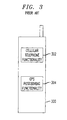
- Fig. 3 shows such a conventional cellular telephone 300 including cellular telephone functionality 302 combined with a GPS system 304. Using the GPS system in the cellular handset, location information can be determined using the GPS, then transmitted to a called party during a 911 telephone call.
- GPS global positioning satellite
- a 911 system in a cellular telephone system carries great potential. For instance, a caller who is moving may stay on the line while emergency personnel are en route to reach them, and the cellular telephone may provide updated location information to the emergency personnel as the 911 caller moves.
- a GPS system is at best accurate to about 10-15 meters (e.g., 30 to 45 feet). Certain factors such as what is known as the ionosphere delay effect can affect the accuracy of the GPS system in any particular location at any particular time. In a wide-open area, a 10-15 meter accuracy is close enough for emergency personnel to locate the calling party. However, in many situations (e.g., in a crowded building, on a crowded street, etc.), a 15 meter may not direct emergency personnel
- a GPS system may be adjusted to have less accuracy, e.g., about 100 meters (e.g., 300 feet).
- the Department of Defense may adjust the GPS system using selective availability (SA) to have a less precise accuracy at any time (e.g., when the national interest outweighs commercial use of the GPS system).
- SA selective availability
- the accuracy of the location of the user transmitted during a 911 call is limited to the accuracy of the GPS system at any one time.
- the accuracy of the GPS system is manipulated, so is the ability of emergency personnel to quickly locate persons making 911 telephone calls from GPS equipped cellular telephones. During such times, use of a GPS system to provide location information to emergency personnel during a 911 telephone call becomes somewhat impractical or useless.
- a wireless telephone system such as a cellular telephone system which is capable of transmitting more accurate location information to a called party or other emergency personnel not only when the GPS and/or Global Navigation Satellite System (GLONASS) systems are operating in a less accurate mode, but also when the GPS and/or GLONASS systems are operating in a typical accuracy mode (e.g., 10-15 meters).
- GLONASS Global Navigation Satellite System
- a base station location determining system comprises a satellite positioning system receiver, predetermined location coordinates of the satellite positioning system receiver, and a module which determines a difference between a location signal received by the satellite positioning system receiver and the predetermined location coordinates.
- a method of improving an accuracy of a received navigational satellite signal in a cellular telephone handset in accordance with another aspect of the present invention comprises receiving location information from a navigational satellite system.
- a differential GPS correction signal relating to an error in the received location information is received.
- the location information and the differential GPS correction signal are combined to generate highly accurate location information.
- a navigational system in accordance with the principles of the present invention comprises a satellite positioning system receiver, a a wireless communications front end, and a module adapted to output a corrected location signal comprising a location signal received by the satellite positioning system receiver and a correction factor received by the wireless communications front end.
- a method of increasing accuracy of a navigational satellite system in a wireless communications device in accordance with yet another aspect of the present invention comprises receiving using cellular telephone functionality of the wireless communications device a differential GPS correction signal containing a location correction factor.
- a location of the wireless communications device is determined using a navigational satellite system portion of the wireless communications device.
- the location correction factor is combined with the determined location of the wireless communications device.
- the present invention relates to the implementation of a differential GPS or GLONASS system (collectively referred to herein as a 'GPS system') for use by a base station of a wireless telephone system (e.g., by a cellular telephone base station).
- the differential GPS system may be implemented in a base station or other convenient location for use by the base station in servicing users in communication with the base station.
- a differential location 'correction' factor is determined based on a difference between a received GPS location signal and a known fixed location of a GPS system receiver for the base station.
- a differential GPS correction signal containing the correction factor is transmitted to any or all cellular telephone users of that base station to allow the cellular telephones to improve the accuracy of location information independently measured by GPS receivers located in each of the cellular telephones.
- the differential GPS correction signal may be transmitted using a voice channel or a control channel of a particular connection, or using a separate broadcast channel to all users.
- the differential GPS correction signal containing the correction factor is received by the cellular functionality of a cellular telephone, and combined with the location information determined by the GPS functionality of the cellular telephone, to provide highly accurate location information determined by the cellular telephone.
- the differential GPS signal may be used to increase the accuracy of the GPS system, whatever the current accuracy of the GPS system, allowing practical implementation of an emergency telephone system such as a 911 system using a wireless system such as a cellular telephone system.
- IC integrated circuit
- GPS Global System for Mobile communications
- Such cellular telephone handsets include both cellular telephone functions and/or GPS system related services.
- the GPS portion of the cellular telephone/GPS handset may be used for providing conventionally accurate (e.g., 10-15 meters) location information for use in, e.g., hiking, bicycling, or other travels.
- a base station when using the cellular telephone/GPS handset as a cellular telephone, transmits a differential GPS correction signal to the cellular telephone/GPS handset to 'correct' for inaccuracy in GPS signals which are independently received by the cellular telephone/GPS handset.
- the invention relates to the implementation of a differential GPS device using a correction factor received over a wireless communications system (e.g., using a cellular telephone channel) to improve the accuracy of the GPS system to, e.g., within a few meters or less.
- a wireless communications system e.g., using a cellular telephone channel
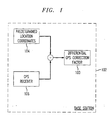
- Fig. 1 is a block diagram of the relevant portion of a wireless system base station showing the combination of predetermined location coordinates such as longitude, latitude, and/or altitude, with information received by a navigational satellite system receiver such as a GPS or GLONASS receiver, to formulate a differential GPS correction factor for use by cellular telephones, in accordance with the principles of the present invention.
- a navigational satellite system receiver such as a GPS or GLONASS receiver
- a base station 102 of a wireless communications system includes a navigational satellite system receiver such as a GPS receiver 106.
- the base station 102 also includes storage for predetermined location coordinates 104.
- the predetermined location coordinates 104 are determined using conventional techniques, e.g., using surveying techniques.
- the predetermined location coordinates 104 may include longitude information, latitude information, and/or altitude information regarding the precise location of the antenna of the GPS receiver 106.
- the longitude information, latitude information, and/or altitude information stored as the predetermined location coordinates 104 are preferably of high accuracy, e.g., to within less than one (1) meter, although the particular accuracy of the predetermined location coordinates should be determined based on the particular application.
- the GPS receiver 106 of the base station 102 is preferably fixed, i.e., not movable, such that the predetermined location coordinates 104 will not change.
- a differential GPS correction factor 100 is determined by the base station 102 based on a difference between location information received by the fixed GPS receiver 106 at the base station 102 and the known, highly accurate location information stored in the predetermined location coordinates 104 of the base station 102.
- This differential GPS correction factor 100 is transmitted to any or all cellular telephone handsets including GPS positioning capability serviced by the base station.
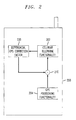
- Fig. 2 is a block diagram of a wireless communications device such as a cellular telephone 200 including a storage area for a differential GPS correction factor 220 received using cellular telephone functionality, and the combination of the differential GPS correction factor 220 with a location determined by a GPS system, in accordance with the principles of the present invention.
- the differential GPS correction factor 100 transmitted by the base station 102 is received by cellular telephone functionality 202 in a cellular telephone 200 and stored in an appropriate location.
- the differential GPS correction factor 220 is combined with current location information determined by a GPS system 204 using an appropriate combiner 210 to provide highly accurate location information to the cellular telephone module 202.
- the cellular telephone module 202 may use the highly accurate location information, e.g., to provide exact location information to emergency personnel using, e.g., a 911 emergency telephone call.
- the highly accurate location information may be transmitted to the emergency bureau either in using the voice channel and/or a control channel.
- the differential GPS correction factor 100 may be transmitted by the base station 102 to all active cellular telephones 200 .
- the differential GPS correction factor 100 may be reserved for use by users of the wireless communications system only for particular needs, e.g., during 911 telephone calls.
- the differential GPS correction factor 100 may be transmitted any number of times to a particular user's cellular telephone 200.
- the differential GPS correction factor 100 may be transmitted to the cellular telephone/GPS receiver 200 once with respect to any particular telephone call.
- the differential GPS correction factor 100 may be transmitted to the cellular telephone 200 during call setup with the base station 102, or at some other appropriate time during the telephone call.
- the differential GPS correction factor 100 determined by the base station 102 is stored in an appropriate location 220 in the cellular telephone 200.
- a one-time transmission of the differential GPS correction factor 100 (with respect to a single telephone call) may be appropriate if the accuracy of the GPS system in general is not frequently changing.
- a broadcast channel can be used to periodically or otherwise transmit the differential GPS correction factor 100.
- the differential GPS correction factor 100 be transmitted to active cellular telephone/GPS receivers 200 on a more frequent basis, e.g., periodically during any particular telephone call (e.g., during 911 telephone calls). For instance, the differential GPS correction factor 100 may be calculated by the base station 102 periodically (e.g., once every second, once every few seconds, etc.), and transmitted to any or all cellular telephones 200 active at that time.
- Use of the present invention is not limited to transmission of location information for the purposes of an emergency telephone call or for the implementation of a differential GPS system. Indeed, the principles of the present invention can be utilized to provide improved location information in a variety of applications, e.g., to transmit a location of a child using the telephone to a parent at the opposite end of a telephone call.
- the disclosed embodiments were described with respect to a differential GPS correction factor 100 determined by a servicing base station 102 in a wireless communications system. However, the principles of the present invention relate equally to a differential GPS correction factor 100 determined by a device separate from the base station 102 and communicated to the base station 102 for relay to active cellular telephones 200.
- a database of geological corrections may also be made available to a servicing or other base station 102 in a wireless telephone system to enable an even more accurate differential GPS correction factor 100 to be transmitted for storage and/or use in correcting location information determined by a cellular telephone/GPS receiver 200.
Landscapes
- Engineering & Computer Science (AREA)
- Radar, Positioning & Navigation (AREA)
- Remote Sensing (AREA)
- Physics & Mathematics (AREA)
- General Physics & Mathematics (AREA)
- Computer Networks & Wireless Communication (AREA)
- Position Fixing By Use Of Radio Waves (AREA)
- Mobile Radio Communication Systems (AREA)
Applications Claiming Priority (2)
| Application Number | Priority Date | Filing Date | Title |
|---|---|---|---|
| US518678 | 2000-03-03 | ||
| US09/518,678 US6901260B1 (en) | 2000-03-03 | 2000-03-03 | Differential GPS and/or glonass with wireless communications capability |
Publications (2)
| Publication Number | Publication Date |
|---|---|
| EP1130414A2 true EP1130414A2 (fr) | 2001-09-05 |
| EP1130414A3 EP1130414A3 (fr) | 2003-09-17 |
Family
ID=24065001
Family Applications (1)
| Application Number | Title | Priority Date | Filing Date |
|---|---|---|---|
| EP01301437A Ceased EP1130414A3 (fr) | 2000-03-03 | 2001-02-19 | Système GPS et/ou GLONASS différentiel avec une capacité de communication sans fil |
Country Status (3)
| Country | Link |
|---|---|
| US (1) | US6901260B1 (fr) |
| EP (1) | EP1130414A3 (fr) |
| JP (1) | JP2001285926A (fr) |
Cited By (1)
| Publication number | Priority date | Publication date | Assignee | Title |
|---|---|---|---|---|
| EP3396895B1 (fr) * | 2015-12-25 | 2025-12-24 | Mitsubishi Electric Corporation | Appareil de stockage de données et programme de stockage de données |
Families Citing this family (19)
| Publication number | Priority date | Publication date | Assignee | Title |
|---|---|---|---|---|
| US7680178B2 (en) | 2000-08-24 | 2010-03-16 | Sirf Technology, Inc. | Cross-correlation detection and elimination in a receiver |
| US6466161B2 (en) * | 2000-08-24 | 2002-10-15 | Sirf Technology, Inc. | Location services system that reduces auto-correlation or cross-correlation in weak signals |
| US20040203845A1 (en) * | 2002-03-22 | 2004-10-14 | Lal Amrish K. | Method and system for associating location specific data with data in a mobile database |
| US6999761B2 (en) * | 2002-08-26 | 2006-02-14 | Bellsouth International Property Corporation | Fixed wireless telephone device |
| US20050159170A1 (en) * | 2004-01-16 | 2005-07-21 | Gagan Puranik | Method and system for transmitting assistance location data for fleet and asset management |
| US7365680B2 (en) * | 2004-02-10 | 2008-04-29 | Sirf Technology, Inc. | Location services system that reduces auto-correlation or cross-correlation in weak signals |
| US20060244461A1 (en) * | 2005-01-19 | 2006-11-02 | Yuh-Shen Song | Intelligent portable personal communication device |
| US7353034B2 (en) | 2005-04-04 | 2008-04-01 | X One, Inc. | Location sharing and tracking using mobile phones or other wireless devices |
| US7647041B2 (en) * | 2006-03-30 | 2010-01-12 | Sbc Knowledge Ventures, L.P. | Systems, methods, and apparatus to enable backup wireless devices |
| KR100768573B1 (ko) * | 2006-06-17 | 2007-10-19 | 한국항공대학교산학협력단 | 이동 단말기의 위치 정보 보정 방법 및 그 장치 |
| US8401567B2 (en) * | 2008-12-19 | 2013-03-19 | International Business Machines Corporation | Method and system to locate an object |
| US9405010B2 (en) | 2012-05-02 | 2016-08-02 | Raven Industries, Inc. | Geospatial positioning using correction information provided over cellular control channels |
| US9612341B2 (en) | 2012-12-28 | 2017-04-04 | Trimble Inc. | GNSS receiver positioning system |
| US9602974B2 (en) | 2012-12-28 | 2017-03-21 | Trimble Inc. | Dead reconing system based on locally measured movement |
| US9880286B2 (en) * | 2012-12-28 | 2018-01-30 | Trimble Inc. | Locally measured movement smoothing of position fixes based on extracted pseudoranges |
| US10101465B2 (en) * | 2012-12-28 | 2018-10-16 | Trimble Inc. | Electronic tape measure on a cellphone |
| US9910158B2 (en) * | 2012-12-28 | 2018-03-06 | Trimble Inc. | Position determination of a cellular device using carrier phase smoothing |
| US10012719B2 (en) | 2015-07-31 | 2018-07-03 | At&T Mobility Ii Llc | E911 locating by nearby proxy device location |
| CN110069584B (zh) * | 2017-11-29 | 2023-04-14 | 星际空间(天津)科技发展有限公司 | 一种基于移动端的信息采集和特征匹配的方法 |
Family Cites Families (9)
| Publication number | Priority date | Publication date | Assignee | Title |
|---|---|---|---|---|
| US5604765A (en) * | 1994-12-23 | 1997-02-18 | Stanford Telecommunications, Inc. | Position enhanced communication system including system for embedding CDMA navigation beacons under the communications signals of a wireless communication system |
| JPH09304506A (ja) * | 1996-05-09 | 1997-11-28 | Matsushita Electric Ind Co Ltd | Gps受信機を用いた救助システム |
| US6411811B2 (en) | 1998-04-20 | 2002-06-25 | Ericsson Inc. | System and method for provisioning assistance global positioning system information to a mobile station |
| JPH11353576A (ja) * | 1998-06-05 | 1999-12-24 | Toyota Motor Corp | 緊急通報装置およびそのシステム |
| US20010012771A1 (en) | 1998-08-07 | 2001-08-09 | Everardo Ruiz | A system of correcting error in received gps signals of a mobile station in a cdma system by transmitting error references to the mobile station |
| US6295455B1 (en) * | 1999-06-11 | 2001-09-25 | Telefonaktiebolaget Lm Ericsson (Publ) | Methods and arrangements for locating a mobile telecommunications station |
| US6275707B1 (en) * | 1999-10-08 | 2001-08-14 | Motorola, Inc. | Method and apparatus for assigning location estimates from a first transceiver to a second transceiver |
| US6580372B1 (en) * | 2000-06-06 | 2003-06-17 | Scott C. Harris | Automatic electronic device detection |
| US6246376B1 (en) * | 2000-06-28 | 2001-06-12 | Texas Instruments Incorporated | Wireless location and direction indicator for multiple devices |
-
2000
- 2000-03-03 US US09/518,678 patent/US6901260B1/en not_active Expired - Lifetime
-
2001
- 2001-02-19 EP EP01301437A patent/EP1130414A3/fr not_active Ceased
- 2001-03-01 JP JP2001056622A patent/JP2001285926A/ja active Pending
Cited By (1)
| Publication number | Priority date | Publication date | Assignee | Title |
|---|---|---|---|---|
| EP3396895B1 (fr) * | 2015-12-25 | 2025-12-24 | Mitsubishi Electric Corporation | Appareil de stockage de données et programme de stockage de données |
Also Published As
| Publication number | Publication date |
|---|---|
| JP2001285926A (ja) | 2001-10-12 |
| EP1130414A3 (fr) | 2003-09-17 |
| US6901260B1 (en) | 2005-05-31 |
Similar Documents
| Publication | Publication Date | Title |
|---|---|---|
| US6901260B1 (en) | Differential GPS and/or glonass with wireless communications capability | |
| US6816734B2 (en) | Method and apparatus for improved location determination in a private radio network using a public network system | |
| US6411811B2 (en) | System and method for provisioning assistance global positioning system information to a mobile station | |
| US7251493B2 (en) | Mobile terminals and methods for determining a location based on acceleration information | |
| US6765528B2 (en) | Mobile radio with GPS capability | |
| KR100323156B1 (ko) | 무선단말기가항해위성으로부터송신된신호로부터자신의위치를결정하도록도와주는보조시스템및보조시스템작동방법 | |
| US7430422B2 (en) | Position information notifying method and device | |
| US20120191340A1 (en) | Navigation systems | |
| US20030036379A1 (en) | Mobile radio network and mobile terminal for location-based services | |
| JP2002512373A (ja) | 無線通信信号による衛星位置決めの強化 | |
| KR19990029722A (ko) | 무선 단말기 및 무선 단말기 작동 방법 | |
| WO1998053573A2 (fr) | Systeme et procede utilisant des reseaux de telecommunications pour transmettre une position geographique en trois d a marquage temporel | |
| JP2001218250A (ja) | 位置情報提供システム | |
| KR20000059199A (ko) | 위치정보 서비스 시스템 | |
| JPH05102906A (ja) | 移動通信方式 | |
| EP1215508A1 (fr) | Système et procédé de localisation sans fil utilisant l'information DGPS et la technologie de service paquet radio généralisé | |
| EP0978728A1 (fr) | Système de positionnement | |
| KR100547873B1 (ko) | 무선호출망을 이용한 agps 시스템 및 그를 이용한단말 위치 측정 방법 | |
| WO2004062312A2 (fr) | Procede et dispositif permettant de determiner la position d'un dispositif sans fil | |
| JPH099339A (ja) | 移動通信システムを用いた測位方式及び移動通信システムの呼出方式 | |
| US7738878B2 (en) | Method for obtaining location information of a mobile unit using a wireline telephone number | |
| Chakrabarti et al. | A network architecture for global wireless position location services | |
| JP2005286795A (ja) | 緊急通報システム | |
| KR20030039035A (ko) | 이동통신 단말기의 위치정보를 이용한 지역정보 서비스 방법 | |
| KR101100637B1 (ko) | 빌딩 내부 이동국 위치 결정 |
Legal Events
| Date | Code | Title | Description |
|---|---|---|---|
| PUAI | Public reference made under article 153(3) epc to a published international application that has entered the european phase |
Free format text: ORIGINAL CODE: 0009012 |
|
| AK | Designated contracting states |
Kind code of ref document: A2 Designated state(s): AT BE CH CY DE DK ES FI FR GB GR IE IT LI LU MC NL PT SE TR |
|
| AX | Request for extension of the european patent |
Free format text: AL;LT;LV;MK;RO;SI |
|
| PUAL | Search report despatched |
Free format text: ORIGINAL CODE: 0009013 |
|
| AK | Designated contracting states |
Kind code of ref document: A3 Designated state(s): AT BE CH CY DE DK ES FI FR GB GR IE IT LI LU MC NL PT SE TR |
|
| AX | Request for extension of the european patent |
Extension state: AL LT LV MK RO SI |
|
| 17P | Request for examination filed |
Effective date: 20040306 |
|
| AKX | Designation fees paid |
Designated state(s): DE GB |
|
| 17Q | First examination report despatched |
Effective date: 20040805 |
|
| APBK | Appeal reference recorded |
Free format text: ORIGINAL CODE: EPIDOSNREFNE |
|
| APBN | Date of receipt of notice of appeal recorded |
Free format text: ORIGINAL CODE: EPIDOSNNOA2E |
|
| APBR | Date of receipt of statement of grounds of appeal recorded |
Free format text: ORIGINAL CODE: EPIDOSNNOA3E |
|
| APAF | Appeal reference modified |
Free format text: ORIGINAL CODE: EPIDOSCREFNE |
|
| RAP3 | Party data changed (applicant data changed or rights of an application transferred) |
Owner name: LUCENT TECHNOLOGIES INC. |
|
| RAP1 | Party data changed (applicant data changed or rights of an application transferred) |
Owner name: ALCATEL-LUCENT USA INC. |
|
| 111Z | Information provided on other rights and legal means of execution |
Free format text: DE GB Effective date: 20130410 |
|
| APBT | Appeal procedure closed |
Free format text: ORIGINAL CODE: EPIDOSNNOA9E |
|
| STAA | Information on the status of an ep patent application or granted ep patent |
Free format text: STATUS: THE APPLICATION HAS BEEN REFUSED |
|
| D11X | Information provided on other rights and legal means of execution (deleted) | ||
| 18R | Application refused |
Effective date: 20140624 |