EP1130788A2 - Méthode de stockage de la métrique de chemin dans un décodeur de Viterbi - Google Patents
Méthode de stockage de la métrique de chemin dans un décodeur de Viterbi Download PDFInfo
- Publication number
- EP1130788A2 EP1130788A2 EP01105112A EP01105112A EP1130788A2 EP 1130788 A2 EP1130788 A2 EP 1130788A2 EP 01105112 A EP01105112 A EP 01105112A EP 01105112 A EP01105112 A EP 01105112A EP 1130788 A2 EP1130788 A2 EP 1130788A2
- Authority
- EP
- European Patent Office
- Prior art keywords
- states
- butterfly
- state
- path metrics
- path
- Prior art date
- Legal status (The legal status is an assumption and is not a legal conclusion. Google has not performed a legal analysis and makes no representation as to the accuracy of the status listed.)
- Withdrawn
Links
- 238000000034 method Methods 0.000 title claims description 25
- 238000010586 diagram Methods 0.000 claims abstract description 35
- 230000007704 transition Effects 0.000 claims description 14
- 230000006870 function Effects 0.000 claims description 11
- 241000255777 Lepidoptera Species 0.000 description 17
- 238000013459 approach Methods 0.000 description 6
- 230000005540 biological transmission Effects 0.000 description 6
- 238000004364 calculation method Methods 0.000 description 5
- 238000013507 mapping Methods 0.000 description 4
- 230000008569 process Effects 0.000 description 3
- 238000004422 calculation algorithm Methods 0.000 description 2
- 230000014509 gene expression Effects 0.000 description 2
- 230000036962 time dependent Effects 0.000 description 2
- 238000007476 Maximum Likelihood Methods 0.000 description 1
- 230000001413 cellular effect Effects 0.000 description 1
- 230000008859 change Effects 0.000 description 1
- 230000002860 competitive effect Effects 0.000 description 1
- 230000001419 dependent effect Effects 0.000 description 1
- 238000009795 derivation Methods 0.000 description 1
- 238000013461 design Methods 0.000 description 1
- 238000011161 development Methods 0.000 description 1
- 230000008521 reorganization Effects 0.000 description 1
- 230000004044 response Effects 0.000 description 1
Images


Classifications
-
- H—ELECTRICITY
- H03—ELECTRONIC CIRCUITRY
- H03M—CODING; DECODING; CODE CONVERSION IN GENERAL
- H03M13/00—Coding, decoding or code conversion, for error detection or error correction; Coding theory basic assumptions; Coding bounds; Error probability evaluation methods; Channel models; Simulation or testing of codes
- H03M13/37—Decoding methods or techniques, not specific to the particular type of coding provided for in groups H03M13/03 - H03M13/35
- H03M13/39—Sequence estimation, i.e. using statistical methods for the reconstruction of the original codes
- H03M13/41—Sequence estimation, i.e. using statistical methods for the reconstruction of the original codes using the Viterbi algorithm or Viterbi processors
-
- H—ELECTRICITY
- H03—ELECTRONIC CIRCUITRY
- H03M—CODING; DECODING; CODE CONVERSION IN GENERAL
- H03M13/00—Coding, decoding or code conversion, for error detection or error correction; Coding theory basic assumptions; Coding bounds; Error probability evaluation methods; Channel models; Simulation or testing of codes
- H03M13/37—Decoding methods or techniques, not specific to the particular type of coding provided for in groups H03M13/03 - H03M13/35
- H03M13/39—Sequence estimation, i.e. using statistical methods for the reconstruction of the original codes
- H03M13/41—Sequence estimation, i.e. using statistical methods for the reconstruction of the original codes using the Viterbi algorithm or Viterbi processors
- H03M13/4107—Sequence estimation, i.e. using statistical methods for the reconstruction of the original codes using the Viterbi algorithm or Viterbi processors implementing add, compare, select [ACS] operations
Definitions
- the present invention relates to a method for storing of path metrics in a Viterbi decoder after Preamble of claim 1, the method in particular for Viterbi decoders in mobile radio receivers for decoding of channel-coded mobile radio signals can be used.
- Such a method is known from Wo 00/08768, which a Viterbi decoder with a reduced path metric memory disclosed.
- From US-A-5,327,440 is a method for effective Storage of path metrics in a Viterbi decoder of the generic type Kind of revealed.
- a Viterbi decoder is a so-called maximum likelihood decoder, which is usually for decoding channel-coded, in particular convolutionally coded Mobile radio signals is used.
- maximum likelihood decoder With channel coding the symbols to be transmitted become redundant in the transmitter Information added to the transmission security to increase. When transmitting a mobile radio signal however, this is overlaid by noise.
- the task of The recipient therefore consists of the reception sequence from all possible transmission sequences that transmission sequence find out the most likely corresponds to the actual transmission sequence. This task is perceived by the Viterbi decoder.
- the coding rule used in channel coding can be described by a corresponding trellis diagram.
- the Viterbi decoder calculates so-called Metrics the path of the trellis diagram that is dependent the largest of the respective design of the decoder or has the smallest path metric. Using this path of the Trellis diagram can then determine the decoded sequence and be spent.
- a corresponding path is assigned to each symbol sequence in the trellis diagram.
- a path comprises a sequence of branches between two successive states. Each branch symbolizes a state transition between two successive states in time, the upper branch emanating from one state, for example, corresponding to a receive symbol with the binary '0' and the lower branch emanating from the same state corresponding to a receive symbol with the binary value '1'.
- branch metric ⁇ t y ' t - r t 2
- r t corresponds to the reception symbol at time t and y ' t to the transmission symbol expected therefrom at time t.
- a path metric ⁇ t is assigned to each path through the trellis diagram up to the time or time step t.
- the trellis diagram shown in FIG. 4 is in particular a trellis diagram with a so-called 'butterfly' structure. This means that two states of a time step t + 1 of the trellis diagram are assigned two states of the previous time step t, the branches of which lead to the first-mentioned states of the time step t + 1, two branch metrics of the branches originating from different states being identical are. For example, the states shown in FIG.
- the Viterbi decoder must now be based on the trellis diagram the corresponding algorithm determine the path, that has the best path metric. Usually is this is by definition the path with the smallest path metric.
- FIG. 5 shows the typical structure of a Viterbi decoder shown.
- a branch metric unit (BMU) 1 and a survivor memory unit 4 are provided.
- the task of the 'Branch Metric Unit' is to calculate the branch metrics ⁇ t (s) , which are a measure of the difference between a receive symbol and the symbol which causes the corresponding state transition in the trellis diagram.
- the branch metrics calculated by the 'Branch Metric Unit' 1 are fed to the ACS unit 2 for determining the optimal paths ('Survivor Paths'), the 'Survivor Memory Unit' 4 storing these 'Survivor Paths' so that finally a decoding based on the 'survivor path' that has the best path metric.
- the symbol sequence assigned to this path corresponds with the greatest probability to the sequence actually sent.
- the ACS unit 2 comprises several processor elements, wherein in usually each state of the trellis diagram from a separate one Processor element is evaluated.
- the task of everyone single processor element consists of two together competing paths (the so-called “Competitor Paths ”) that lead to a state of the trellis diagram, the path (the so-called “survivor path”) with the best, i.e. smallest path metric to select. Then be the saved values for the one leading to this state 'Survivor Path' and its path metric updated.
- each state s at the time t + 1 is connected to a corresponding previous state via an upper branch and a lower branch.
- the path metric of the path leading to state s via the upper branch must therefore be compared with the path metric of the path leading to state s via the lower branch, ie the task of each processor element is to do this , to determine the 'survivor path' with the path metric ⁇ t + 1 (s) either the one leading over the previous 'upper' state with the path metric ⁇ t (u) and the 'upper' branch with the branch metric ⁇ t (u) Path whose path metric corresponds to the sum ⁇ t (u) + ⁇ t (u) , or which leads over the 'lower' state with the path metric ⁇ t (1) and the 'lower' branch with the branch metric ⁇ t (1) Select the path whose path
- each result ⁇ t (s) calculated for a state s in the time step t is also the basis for the calculation of a path metric for a temporally subsequent state
- the feedback of the ACS unit 2 via the memory 3 shown in FIG. 5 is necessary.
- the calculated path metrics are buffered in the memory 3.
- the structure of the memory 3 must correspond to the structure of the respective trellis diagram. While each symbol period must be one of the number of states of the Corresponding number of path metrics read out from memory 3 and written to memory 3 become. For each 'butterfly' of the trellis diagram processed two states simultaneously, so that two output path metrics read out from memory 3 and two from it calculated path metrics are written into memory 3 have to.
- FIG. 6 Another trellis diagram with eight states is shown in FIG. 6.
- the trellis diagram has the already described butterfly structure, wherein an exemplary Butterfly is shown in phantom and the output states S t Nos. 1 and 5 and the goal states S t + 1, no. 2 and 3 includes.
- the path metrics of the initial states No. 1 and 5 must first be read out.
- the memory 3 must be twice the size as required, since both memory banks must be able to store the path metrics of all states S t and S t + 1, respectively.
- 'mapping' Another related to storing path metrics
- the problem is the mapping of the path metrics called 'mapping' on the memory, i.e. the assignment of each Path metrics to the different memory addresses.
- 'mapping' must be selected so that for the read and write operations of the path metrics Different memory areas are used to avoid conflicts between reads and writes reliably avoid.
- the present invention is based on the object Method for storing path metrics in a Viterbi decoder propose which one with a lower memory requirement can be realized and reliable Read / write conflicts prevented.
- a method for Storage of path metrics presented in a Viterbi decoder which is based on the principle of a time-variant trellis diagram based and especially for using trellis diagrams Butterfly structure or corresponding. ACS units suitable is.
- the method according to the invention requires only one Memory and enables the reading and saving of path metrics from or in the same memory areas, i.e. the Path metrics calculated based on two output path metrics corresponding target conditions are below that Memory address saved from which previously the two output path metrics have been read out.
- the scope of the Memory is of the chosen degree of parallelism the trellis is independent and only needs to be the product of the Number of different trellis states and the number of Correspond to bits per memory word. In particular is only then memory is required if the path metrics for several processor elements are stored together should.
- the invention requires minimal space and Power consumption of the used for Viterbi decoding Chips, since only one memory address for two path metrics is required.
- the invention is for both forward codes ('Feedforward Codes'), such as SDSL, as well suitable and enabled for backward codes ('feedback codes') the use of programmable Viterbi decoders, where the corresponding path metrics for each 'butterfly' can be easily programmed.
- N TS 2 M T
- N TS denotes the number of different states in the corresponding trellis diagram.
- the length of the impulse response for a forward code of code rate 1/2 is M T +1.
- the state transitions in the trellis diagram depend, as described, on the respectively coded bit B, the state S t + 1 at time t + 1 resulting from the previous state S t according to the following relationship:
- each 'butterfly' is assigned two initial states and two target states, each with reference to the geometry of the trellis between one with the index (u) ( for 'upper') designated upper state and a lower state designated with the index (l) (for 'lower').
- index (u) for 'upper'
- l index (l) (for 'lower').
- the present invention is based on the idea for the target states calculated path metrics of a 'butterfly' save under the same memory address from which the corresponding output path metrics have been read out, so that an unwanted overwriting of the path metrics in the memory 3 can be avoided.
- This measure has one time-dependent change in the trellis structure that the resulting trellis representation also as 'Time Varying Trellis' (TVT) can be called.
- FIG. 3 The TVT of the trellis structure shown in FIG. 6 is shown in FIG. 3 shown.
- the State transitions of the individual 'Butterflies' with the in Fig. 6 shown state transitions agree with each time step or with each iteration, however, is the consequence of the states rearranged in such a way that each target state of a 'butterfly' through a horizontal branch with the corresponding one Initial state of the same 'Butterfly' is connected.
- Fig. 3 are two 'butterflies' for the individual iterations, which the initial states No. 2 and No. 6 or No. 3 and No. 7 as well as the target states No. 4 and No. 5 or No. 6 and No. 7 include, dashed or dash-dotted lines, see above that especially on the basis of these 'butterflies' the principle of time-dependent reorganization of the trellis structure can be.
- the target states [0,1] of the 'butterfly' with the initial states [0,4] not simultaneously Starting conditions for a common 'butterfly' of the Represent iteration 2. It therefore makes no sense to and target path metrics of each 'butterfly' in the form of a save common memory word.
- the target states [0.1] and [4.5] of the two 'butterflies' which have the initial states [0.4] and [2.6] are also the initial states for in the trellis
- the following 'Butterflies' with the initial states [0,4] and [1,5] can be used. It can be proven that all 2 M T -1 'Butterflies' can be combined in pairs in such a way that the path metrics of the target states of the 'Butterfly' pairs can also be used as starting path metrics for two other 'Butterflies', if those for the target states determined path metrics are reordered accordingly.
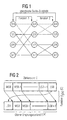
- Fig. 1 The word width of each Memory words of the memory 3 is compared to the state of the Technology doubled, so the results or path metrics the target states of two 'butterflies' in pairs of at least two path metrics are saved per memory word can.
- the size of the memory depends on the number of the processor elements used, only that The number of read / write processes changes.
- each circle corresponds to the two initial states or their output path metrics of a corresponding 'butterfly' in the form S (u) / S (l) .
- FIG. 1 shows, for example, a superordinate 'butterfly', shown in dashed lines, which, as described, shows the original 'butterflies' with the initial states [0.4] or [2.6] and the target states [0.1] or [ 4,5] and the resulting target states are rearranged into pairs of [0,4] and [1,5], so that these rearranged target state pairs can also serve as starting states for subsequent 'butterflies' (cf. the butterfly structure of Fig 6, from which it can be seen that the initial states [0.4] and [1.5] are each assigned to a 'butterfly').
- each row corresponds to the trellis shown in Fig. 1 thus a memory address of the memory 3, so that, for example with regard to the second line of the shown Trellis the path metrics of the state pairs [1,5], [2,6] and again [1,5] in succession under one and the same memory address get saved.
- the dimension of the trellis is reduced due to the pairing of the individual 'butterflies' compared to FIG. 3 to 2 M T -1 states, so that the number of iterations, which up to are required to recover the original sequence of states, reduced by the value 1 compared to FIG. 3.
- This has the consequence that the addressing effort with regard to the address generation for the memory 3 can be reduced accordingly.
- ⁇ S ( u ) ( C ) is non-linear. It can be shown that this function can be implemented in the form of a simple bit map, as shown in FIG. 2, where MSB is the most significant bit and LSB is the least significant bit. ) designated.
- the addressing function ⁇ addr ( S ( u ) , I ) can be described by the following relationship due to the properties of a forward trellis coding:
- ADDR designates the memory address for the respective path metric pair determined as a function of S (u) , M T and I with I ⁇ [0 ... M T -1].
- This addressing function is easy to implement, since it only corresponds to an (M T -1) bit addition of the first and second terms shown, without having to pay attention to a possible overflow. All multiplications within the formula shown can be realized by simple bit shift operations.
- the invention was previously explained using forward codes, for example an SDSL code. However, the invention is also applicable to reverse codes.
- the trellis structure of a Viterbi decoder for reverse codes differs considerably from that for forward codes.
- the 'Butterflies' trellis can also be combined in pairs in such a way that the corresponding path metrics of the target states also represent the starting path metrics for two 'Butterflies' following in the Trellis diagram.
- the number of iterations that are required until the original sequence of states reappears in the trellis diagram does not depend directly on the value M T.
Landscapes
- Physics & Mathematics (AREA)
- Probability & Statistics with Applications (AREA)
- Engineering & Computer Science (AREA)
- Theoretical Computer Science (AREA)
- Error Detection And Correction (AREA)
Applications Claiming Priority (2)
| Application Number | Priority Date | Filing Date | Title |
|---|---|---|---|
| DE10010238 | 2000-03-02 | ||
| DE10010238A DE10010238C2 (de) | 2000-03-02 | 2000-03-02 | Verfahren zum Speichern von Pfadmetriken in einem Viterbi-Decodierer |
Publications (2)
| Publication Number | Publication Date |
|---|---|
| EP1130788A2 true EP1130788A2 (fr) | 2001-09-05 |
| EP1130788A3 EP1130788A3 (fr) | 2003-11-05 |
Family
ID=7633279
Family Applications (1)
| Application Number | Title | Priority Date | Filing Date |
|---|---|---|---|
| EP01105112A Withdrawn EP1130788A3 (fr) | 2000-03-02 | 2001-03-02 | Méthode de stockage de la métrique de chemin dans un décodeur de Viterbi |
Country Status (6)
| Country | Link |
|---|---|
| US (1) | US7062701B2 (fr) |
| EP (1) | EP1130788A3 (fr) |
| JP (1) | JP3550369B2 (fr) |
| KR (1) | KR20010087298A (fr) |
| CN (1) | CN1165193C (fr) |
| DE (1) | DE10010238C2 (fr) |
Cited By (1)
| Publication number | Priority date | Publication date | Assignee | Title |
|---|---|---|---|---|
| WO2001078239A3 (fr) * | 2000-04-06 | 2002-03-14 | Qualcomm Inc | Procede et dispositif servant a lire et memoriser des parametres d'etat pour mise en application d'un decodeur viterbi acs tres rapide |
Families Citing this family (9)
| Publication number | Priority date | Publication date | Assignee | Title |
|---|---|---|---|---|
| US6848074B2 (en) | 2001-06-21 | 2005-01-25 | Arc International | Method and apparatus for implementing a single cycle operation in a data processing system |
| US7450631B2 (en) * | 2001-10-26 | 2008-11-11 | Intel Corporation | Metric correction for multi user detection, for long codes DS-CDMA |
| US6910177B2 (en) * | 2001-12-21 | 2005-06-21 | Texas Instruments Incorporated | Viterbi decoder using restructured trellis |
| US20080109709A1 (en) * | 2003-08-19 | 2008-05-08 | Chao Cheng | Hardware-Efficient, Low-Latency Architectures for High Throughput Viterbi Decoders |
| KR101127333B1 (ko) * | 2007-10-26 | 2012-03-29 | 콸콤 인코포레이티드 | 최적화된 비터비 디코더 및 gnss 수신기 |
| JP5196567B2 (ja) * | 2008-12-02 | 2013-05-15 | 日本電気株式会社 | 演算装置、復号化装置およびメモリ制御方法ならびにプログラム |
| WO2014041401A1 (fr) * | 2012-09-14 | 2014-03-20 | Freescale Semiconductor, Inc. | Dispositif de décodage viterbi et procédé de décodage d'un signal produit par un codeur pour code de convolution |
| JP6551534B2 (ja) * | 2015-03-23 | 2019-07-31 | 日本電気株式会社 | 情報処理装置、情報処理方法、及びプログラム |
| CN105610550B (zh) * | 2016-02-05 | 2016-11-30 | 南京飞腾电子科技有限公司 | 一种用于电力线载波通信的Viterbi译码方法 |
Family Cites Families (14)
| Publication number | Priority date | Publication date | Assignee | Title |
|---|---|---|---|---|
| US4979175A (en) | 1988-07-05 | 1990-12-18 | Motorola, Inc. | State metric memory arrangement for a viterbi decoder |
| US5416787A (en) | 1991-07-30 | 1995-05-16 | Kabushiki Kaisha Toshiba | Method and apparatus for encoding and decoding convolutional codes |
| US5327440A (en) * | 1991-10-15 | 1994-07-05 | International Business Machines Corporation | Viterbi trellis coding methods and apparatus for a direct access storage device |
| US5539757A (en) | 1993-12-22 | 1996-07-23 | At&T Corp. | Error correction systems with modified Viterbi decoding |
| JPH07336239A (ja) | 1994-06-07 | 1995-12-22 | Japan Radio Co Ltd | ビタビ復号器 |
| US5619514A (en) | 1994-12-29 | 1997-04-08 | Lucent Technologies Inc. | In-place present state/next state registers |
| US6148431A (en) * | 1998-03-26 | 2000-11-14 | Lucent Technologies Inc. | Add compare select circuit and method implementing a viterbi algorithm |
| WO2000008768A1 (fr) * | 1998-08-04 | 2000-02-17 | Qualcomm Incorporated | Decodeur de viterbi equipe d'une memoire de metrique de chemin de taille reduite |
| EP1024604A3 (fr) | 1999-01-29 | 2000-12-13 | Texas Instruments Incorporated | Décodeur Viterbi flexible pour applications sans fil |
| JP4331371B2 (ja) | 1999-01-29 | 2009-09-16 | テキサス インスツルメンツ インコーポレイテツド | 無線応用のためのフレキシブルなビタビ・デコーダ |
| US6438181B1 (en) * | 1999-05-28 | 2002-08-20 | Koninklijke Philips Electronics N.V. | Efficient metric memory configuration for a Viterbi decoder |
| EP1192719A1 (fr) * | 1999-07-06 | 2002-04-03 | Fraunhofer-Gesellschaft Zur Förderung Der Angewandten Forschung E.V. | Decodeur de viterbi |
| JP2001058766A (ja) | 1999-08-19 | 2001-03-06 | Hitachi Building Systems Co Ltd | エレベータの映像装置 |
| US6622283B1 (en) * | 2000-01-28 | 2003-09-16 | Nec Electronics, Inc. | Digital signal processor decoding of convolutionally encoded symbols |
-
2000
- 2000-03-02 DE DE10010238A patent/DE10010238C2/de not_active Expired - Fee Related
-
2001
- 2001-03-02 KR KR1020010010906A patent/KR20010087298A/ko not_active Ceased
- 2001-03-02 JP JP2001058766A patent/JP3550369B2/ja not_active Expired - Fee Related
- 2001-03-02 US US09/798,263 patent/US7062701B2/en not_active Expired - Fee Related
- 2001-03-02 CN CNB011093749A patent/CN1165193C/zh not_active Expired - Fee Related
- 2001-03-02 EP EP01105112A patent/EP1130788A3/fr not_active Withdrawn
Cited By (2)
| Publication number | Priority date | Publication date | Assignee | Title |
|---|---|---|---|---|
| WO2001078239A3 (fr) * | 2000-04-06 | 2002-03-14 | Qualcomm Inc | Procede et dispositif servant a lire et memoriser des parametres d'etat pour mise en application d'un decodeur viterbi acs tres rapide |
| US6757864B1 (en) | 2000-04-06 | 2004-06-29 | Qualcomm, Incorporated | Method and apparatus for efficiently reading and storing state metrics in memory for high-speed ACS viterbi decoder implementations |
Also Published As
| Publication number | Publication date |
|---|---|
| DE10010238A1 (de) | 2001-09-27 |
| US20010037486A1 (en) | 2001-11-01 |
| JP3550369B2 (ja) | 2004-08-04 |
| CN1311620A (zh) | 2001-09-05 |
| CN1165193C (zh) | 2004-09-01 |
| EP1130788A3 (fr) | 2003-11-05 |
| KR20010087298A (ko) | 2001-09-15 |
| US7062701B2 (en) | 2006-06-13 |
| JP2001313572A (ja) | 2001-11-09 |
| DE10010238C2 (de) | 2003-12-18 |
Similar Documents
| Publication | Publication Date | Title |
|---|---|---|
| DE69323020T2 (de) | Dekodierer für veränderliche Längenkodes | |
| DE69029542T2 (de) | Viterbidekodierer | |
| DE69500157T2 (de) | Signalverarbeitungsschaltung zur Durchführung des Viterbi Algorithmus | |
| DE69634155T2 (de) | Erfassung einer Konfidenz und eines Rahmen-Qualitäts-Signals in einem "soft decision"-Faltungs-Dekoder | |
| DE69929652T2 (de) | Datenfehlerkorrektursystem | |
| DE69333460T2 (de) | Arithmetisches Gerät | |
| EP0392603B1 (fr) | Système de transmission | |
| DE69212695T2 (de) | Decodierungseinrichtung | |
| EP0737389B1 (fr) | Systeme de transmission avec decodage "soft-output" et demande en capacite memoire reduite | |
| DE69936067T2 (de) | Verfahren und Vorrichtung zur Maximum-a-Posteriori Warscheinlichkeits-Dekodierung | |
| DE2614916A1 (de) | Konverter zur codeumwandlung | |
| DE69305371T2 (de) | Verfahren zur Maximalwahrscheinlichkeitsdekodierung mit unterabgetastetem Dekodierungstrellis und entsprechende Dekodierungsvorrichtung | |
| DE10010238C2 (de) | Verfahren zum Speichern von Pfadmetriken in einem Viterbi-Decodierer | |
| DE69425313T2 (de) | Viterbi-Entzerrer mit Rechenleistungsparendem Trace-Back-Verfahren | |
| DE4038251A1 (de) | Entzerrer fuer ein digitales uebertragungssystem | |
| DE19937506A1 (de) | ACS-Einheit für einen Viterbi-Decodierer | |
| DE60101745T2 (de) | Viterbi dekodierung mit pfadmetrikaktualisierung durchgeführt in einheiten von bitscheiben | |
| EP0769853B1 (fr) | Bloc logique pour décodeur viterbi | |
| EP1334563B1 (fr) | Procede et dispositif pour le decodage d'une suite de signaux physiques, unite de determination de valeurs de fiabilite et decodeur de viterbi | |
| DE3852569T2 (de) | Verfahren und Gerät zur Dekodierung von blockkodierten Daten, beeinträchtigt durch Ersatz, Einfügungen und Verlust von Symbolen. | |
| DE10256462A1 (de) | Vorrichtung und Verfahren zum Minimieren der durch Puncturing verursachten Ausgangsverzögerung | |
| DE60118716T2 (de) | Log-MAP Dekodierung | |
| EP1252716B1 (fr) | Procede et systeme pour le decodage d'informations | |
| EP1393514B1 (fr) | Procede et circuit permettant la transmission de donnees entre un processeur et une unite de calcul materielle | |
| EP1223679B1 (fr) | Calcul et allocation de métriques de transitions pour décodeur de Viterbi |
Legal Events
| Date | Code | Title | Description |
|---|---|---|---|
| PUAI | Public reference made under article 153(3) epc to a published international application that has entered the european phase |
Free format text: ORIGINAL CODE: 0009012 |
|
| AK | Designated contracting states |
Kind code of ref document: A2 Designated state(s): AT BE CH CY DE DK ES FI FR GB GR IE IT LI LU MC NL PT SE TR |
|
| AX | Request for extension of the european patent |
Free format text: AL;LT;LV;MK;RO;SI |
|
| PUAL | Search report despatched |
Free format text: ORIGINAL CODE: 0009013 |
|
| AK | Designated contracting states |
Kind code of ref document: A3 Designated state(s): AT BE CH CY DE DK ES FI FR GB GR IE IT LI LU MC NL PT SE TR |
|
| AX | Request for extension of the european patent |
Extension state: AL LT LV MK RO SI |
|
| 17P | Request for examination filed |
Effective date: 20040130 |
|
| AKX | Designation fees paid |
Designated state(s): DE FR GB |
|
| 17Q | First examination report despatched |
Effective date: 20041008 |
|
| STAA | Information on the status of an ep patent application or granted ep patent |
Free format text: STATUS: THE APPLICATION IS DEEMED TO BE WITHDRAWN |
|
| 18D | Application deemed to be withdrawn |
Effective date: 20051108 |