EP1130963B1 - Fungizide wirkstoffkombinationen - Google Patents
Fungizide wirkstoffkombinationen Download PDFInfo
- Publication number
- EP1130963B1 EP1130963B1 EP99953975A EP99953975A EP1130963B1 EP 1130963 B1 EP1130963 B1 EP 1130963B1 EP 99953975 A EP99953975 A EP 99953975A EP 99953975 A EP99953975 A EP 99953975A EP 1130963 B1 EP1130963 B1 EP 1130963B1
- Authority
- EP
- European Patent Office
- Prior art keywords
- active
- active compound
- methyl
- combinations
- compound
- Prior art date
- Legal status (The legal status is an assumption and is not a legal conclusion. Google has not performed a legal analysis and makes no representation as to the accuracy of the status listed.)
- Expired - Lifetime
Links
- 230000000855 fungicidal effect Effects 0.000 title claims description 12
- 239000013543 active substance Substances 0.000 title description 7
- 150000001875 compounds Chemical class 0.000 claims abstract description 21
- 241000233866 Fungi Species 0.000 claims abstract description 7
- 239000000203 mixture Substances 0.000 claims description 14
- 229940125904 compound 1 Drugs 0.000 claims description 5
- 239000004606 Fillers/Extenders Substances 0.000 claims description 3
- 125000004093 cyano group Chemical group *C#N 0.000 claims description 3
- 125000001495 ethyl group Chemical group [H]C([H])([H])C([H])([H])* 0.000 claims description 3
- 125000002496 methyl group Chemical group [H]C([H])([H])* 0.000 claims description 3
- WKBOTKDWSSQWDR-UHFFFAOYSA-N Bromine atom Chemical compound [Br] WKBOTKDWSSQWDR-UHFFFAOYSA-N 0.000 claims description 2
- PXGOKWXKJXAPGV-UHFFFAOYSA-N Fluorine Chemical compound FF PXGOKWXKJXAPGV-UHFFFAOYSA-N 0.000 claims description 2
- GDTBXPJZTBHREO-UHFFFAOYSA-N bromine Substances BrBr GDTBXPJZTBHREO-UHFFFAOYSA-N 0.000 claims description 2
- 229910052794 bromium Inorganic materials 0.000 claims description 2
- 239000011737 fluorine Substances 0.000 claims description 2
- 229910052731 fluorine Inorganic materials 0.000 claims description 2
- 239000001257 hydrogen Substances 0.000 claims description 2
- 229910052739 hydrogen Inorganic materials 0.000 claims description 2
- UCFFGYASXIPWPD-UHFFFAOYSA-N methyl hypochlorite Chemical compound COCl UCFFGYASXIPWPD-UHFFFAOYSA-N 0.000 claims description 2
- 239000004094 surface-active agent Substances 0.000 claims description 2
- 125000004435 hydrogen atom Chemical class [H]* 0.000 claims 1
- 238000004519 manufacturing process Methods 0.000 claims 1
- 238000000034 method Methods 0.000 claims 1
- 230000003032 phytopathogenic effect Effects 0.000 abstract description 3
- -1 butanol or glycol Chemical class 0.000 description 34
- 239000004480 active ingredient Substances 0.000 description 14
- 230000000694 effects Effects 0.000 description 7
- 238000009472 formulation Methods 0.000 description 7
- 241000196324 Embryophyta Species 0.000 description 6
- 239000008187 granular material Substances 0.000 description 5
- 230000002195 synergetic effect Effects 0.000 description 5
- 239000000969 carrier Substances 0.000 description 4
- 239000000890 drug combination Substances 0.000 description 4
- 238000005554 pickling Methods 0.000 description 4
- ZWEHNKRNPOVVGH-UHFFFAOYSA-N 2-Butanone Chemical compound CCC(C)=O ZWEHNKRNPOVVGH-UHFFFAOYSA-N 0.000 description 3
- 239000005660 Abamectin Substances 0.000 description 3
- CSCPPACGZOOCGX-UHFFFAOYSA-N Acetone Chemical compound CC(C)=O CSCPPACGZOOCGX-UHFFFAOYSA-N 0.000 description 3
- RYGMFSIKBFXOCR-UHFFFAOYSA-N Copper Chemical compound [Cu] RYGMFSIKBFXOCR-UHFFFAOYSA-N 0.000 description 3
- YMWUJEATGCHHMB-UHFFFAOYSA-N Dichloromethane Chemical compound ClCCl YMWUJEATGCHHMB-UHFFFAOYSA-N 0.000 description 3
- ZMXDDKWLCZADIW-UHFFFAOYSA-N N,N-Dimethylformamide Chemical compound CN(C)C=O ZMXDDKWLCZADIW-UHFFFAOYSA-N 0.000 description 3
- YXFVVABEGXRONW-UHFFFAOYSA-N Toluene Chemical compound CC1=CC=CC=C1 YXFVVABEGXRONW-UHFFFAOYSA-N 0.000 description 3
- 239000010949 copper Substances 0.000 description 3
- 229910052802 copper Inorganic materials 0.000 description 3
- 229940079593 drug Drugs 0.000 description 3
- 239000003814 drug Substances 0.000 description 3
- 239000003995 emulsifying agent Substances 0.000 description 3
- NYPJDWWKZLNGGM-UHFFFAOYSA-N fenvalerate Aalpha Natural products C=1C=C(Cl)C=CC=1C(C(C)C)C(=O)OC(C#N)C(C=1)=CC=CC=1OC1=CC=CC=C1 NYPJDWWKZLNGGM-UHFFFAOYSA-N 0.000 description 3
- 239000000417 fungicide Substances 0.000 description 3
- 229910052500 inorganic mineral Inorganic materials 0.000 description 3
- 239000007788 liquid Substances 0.000 description 3
- 239000011707 mineral Substances 0.000 description 3
- 239000000843 powder Substances 0.000 description 3
- 238000002360 preparation method Methods 0.000 description 3
- VYPSYNLAJGMNEJ-UHFFFAOYSA-N silicon dioxide Inorganic materials O=[Si]=O VYPSYNLAJGMNEJ-UHFFFAOYSA-N 0.000 description 3
- 239000007787 solid Substances 0.000 description 3
- 239000002904 solvent Substances 0.000 description 3
- IBSREHMXUMOFBB-JFUDTMANSA-N 5u8924t11h Chemical compound O1[C@@H](C)[C@H](O)[C@@H](OC)C[C@@H]1O[C@@H]1[C@@H](OC)C[C@H](O[C@@H]2C(=C/C[C@@H]3C[C@@H](C[C@@]4(O3)C=C[C@H](C)[C@@H](C(C)C)O4)OC(=O)[C@@H]3C=C(C)[C@@H](O)[C@H]4OC\C([C@@]34O)=C/C=C/[C@@H]2C)/C)O[C@H]1C.C1=C[C@H](C)[C@@H]([C@@H](C)CC)O[C@]11O[C@H](C\C=C(C)\[C@@H](O[C@@H]2O[C@@H](C)[C@H](O[C@@H]3O[C@@H](C)[C@H](O)[C@@H](OC)C3)[C@@H](OC)C2)[C@@H](C)\C=C\C=C/2[C@]3([C@H](C(=O)O4)C=C(C)[C@@H](O)[C@H]3OC\2)O)C[C@H]4C1 IBSREHMXUMOFBB-JFUDTMANSA-N 0.000 description 2
- CURLTUGMZLYLDI-UHFFFAOYSA-N Carbon dioxide Chemical compound O=C=O CURLTUGMZLYLDI-UHFFFAOYSA-N 0.000 description 2
- MDNWOSOZYLHTCG-UHFFFAOYSA-N Dichlorophen Chemical compound OC1=CC=C(Cl)C=C1CC1=CC(Cl)=CC=C1O MDNWOSOZYLHTCG-UHFFFAOYSA-N 0.000 description 2
- IAZDPXIOMUYVGZ-UHFFFAOYSA-N Dimethylsulphoxide Chemical compound CS(C)=O IAZDPXIOMUYVGZ-UHFFFAOYSA-N 0.000 description 2
- LYCAIKOWRPUZTN-UHFFFAOYSA-N Ethylene glycol Chemical compound OCCO LYCAIKOWRPUZTN-UHFFFAOYSA-N 0.000 description 2
- 239000005780 Fluazinam Substances 0.000 description 2
- XEEYBQQBJWHFJM-UHFFFAOYSA-N Iron Chemical class [Fe] XEEYBQQBJWHFJM-UHFFFAOYSA-N 0.000 description 2
- UQSXHKLRYXJYBZ-UHFFFAOYSA-N Iron oxide Chemical compound [Fe]=O UQSXHKLRYXJYBZ-UHFFFAOYSA-N 0.000 description 2
- LRHPLDYGYMQRHN-UHFFFAOYSA-N N-Butanol Chemical compound CCCCO LRHPLDYGYMQRHN-UHFFFAOYSA-N 0.000 description 2
- 229920003171 Poly (ethylene oxide) Polymers 0.000 description 2
- ATUOYWHBWRKTHZ-UHFFFAOYSA-N Propane Chemical compound CCC ATUOYWHBWRKTHZ-UHFFFAOYSA-N 0.000 description 2
- 239000005837 Spiroxamine Substances 0.000 description 2
- NINIDFKCEFEMDL-UHFFFAOYSA-N Sulfur Chemical compound [S] NINIDFKCEFEMDL-UHFFFAOYSA-N 0.000 description 2
- 229950008167 abamectin Drugs 0.000 description 2
- 230000000895 acaricidal effect Effects 0.000 description 2
- 239000000642 acaricide Substances 0.000 description 2
- 239000000654 additive Substances 0.000 description 2
- 150000001338 aliphatic hydrocarbons Chemical class 0.000 description 2
- FPIPGXGPPPQFEQ-OVSJKPMPSA-N all-trans-retinol Chemical compound OC\C=C(/C)\C=C\C=C(/C)\C=C\C1=C(C)CCCC1(C)C FPIPGXGPPPQFEQ-OVSJKPMPSA-N 0.000 description 2
- CJJOSEISRRTUQB-UHFFFAOYSA-N azinphos-methyl Chemical compound C1=CC=C2C(=O)N(CSP(=S)(OC)OC)N=NC2=C1 CJJOSEISRRTUQB-UHFFFAOYSA-N 0.000 description 2
- LLEMOWNGBBNAJR-UHFFFAOYSA-N biphenyl-2-ol Chemical compound OC1=CC=CC=C1C1=CC=CC=C1 LLEMOWNGBBNAJR-UHFFFAOYSA-N 0.000 description 2
- KXRPCFINVWWFHQ-UHFFFAOYSA-N cadusafos Chemical compound CCC(C)SP(=O)(OCC)SC(C)CC KXRPCFINVWWFHQ-UHFFFAOYSA-N 0.000 description 2
- 229910000365 copper sulfate Inorganic materials 0.000 description 2
- ARUVKPQLZAKDPS-UHFFFAOYSA-L copper(II) sulfate Chemical compound [Cu+2].[O-][S+2]([O-])([O-])[O-] ARUVKPQLZAKDPS-UHFFFAOYSA-L 0.000 description 2
- JHIVVAPYMSGYDF-UHFFFAOYSA-N cyclohexanone Chemical compound O=C1CCCCC1 JHIVVAPYMSGYDF-UHFFFAOYSA-N 0.000 description 2
- 229960003887 dichlorophen Drugs 0.000 description 2
- ZUOUZKKEUPVFJK-UHFFFAOYSA-N diphenyl Chemical compound C1=CC=CC=C1C1=CC=CC=C1 ZUOUZKKEUPVFJK-UHFFFAOYSA-N 0.000 description 2
- DMBHHRLKUKUOEG-UHFFFAOYSA-N diphenylamine Chemical compound C=1C=CC=CC=1NC1=CC=CC=C1 DMBHHRLKUKUOEG-UHFFFAOYSA-N 0.000 description 2
- 239000000975 dye Substances 0.000 description 2
- AWZOLILCOUMRDG-UHFFFAOYSA-N edifenphos Chemical compound C=1C=CC=CC=1SP(=O)(OCC)SC1=CC=CC=C1 AWZOLILCOUMRDG-UHFFFAOYSA-N 0.000 description 2
- 239000000839 emulsion Substances 0.000 description 2
- YREQHYQNNWYQCJ-UHFFFAOYSA-N etofenprox Chemical compound C1=CC(OCC)=CC=C1C(C)(C)COCC1=CC=CC(OC=2C=CC=CC=2)=C1 YREQHYQNNWYQCJ-UHFFFAOYSA-N 0.000 description 2
- DIRFUJHNVNOBMY-UHFFFAOYSA-N fenobucarb Chemical compound CCC(C)C1=CC=CC=C1OC(=O)NC DIRFUJHNVNOBMY-UHFFFAOYSA-N 0.000 description 2
- UZCGKGPEKUCDTF-UHFFFAOYSA-N fluazinam Chemical compound [O-][N+](=O)C1=CC(C(F)(F)F)=C(Cl)C([N+]([O-])=O)=C1NC1=NC=C(C(F)(F)F)C=C1Cl UZCGKGPEKUCDTF-UHFFFAOYSA-N 0.000 description 2
- 239000004088 foaming agent Substances 0.000 description 2
- RONFGUROBZGJKP-UHFFFAOYSA-N iminoctadine Chemical compound NC(N)=NCCCCCCCCNCCCCCCCCN=C(N)N RONFGUROBZGJKP-UHFFFAOYSA-N 0.000 description 2
- 239000002917 insecticide Substances 0.000 description 2
- FCOAHACKGGIURQ-UHFFFAOYSA-N iprobenfos Chemical compound CC(C)OP(=O)(OC(C)C)SCC1=CC=CC=C1 FCOAHACKGGIURQ-UHFFFAOYSA-N 0.000 description 2
- PVTHJAPFENJVNC-MHRBZPPQSA-N kasugamycin Chemical compound N[C@H]1C[C@H](NC(=N)C(O)=O)[C@@H](C)O[C@@H]1O[C@H]1[C@H](O)[C@@H](O)[C@@H](O)[C@H](O)[C@@H]1O PVTHJAPFENJVNC-MHRBZPPQSA-N 0.000 description 2
- PWPJGUXAGUPAHP-UHFFFAOYSA-N lufenuron Chemical compound C1=C(Cl)C(OC(F)(F)C(C(F)(F)F)F)=CC(Cl)=C1NC(=O)NC(=O)C1=C(F)C=CC=C1F PWPJGUXAGUPAHP-UHFFFAOYSA-N 0.000 description 2
- 239000000463 material Substances 0.000 description 2
- BLCKKNLGFULNRC-UHFFFAOYSA-L n,n-dimethylcarbamodithioate;nickel(2+) Chemical compound [Ni+2].CN(C)C([S-])=S.CN(C)C([S-])=S BLCKKNLGFULNRC-UHFFFAOYSA-L 0.000 description 2
- LCCNCVORNKJIRZ-UHFFFAOYSA-N parathion Chemical compound CCOP(=S)(OCC)OC1=CC=C([N+]([O-])=O)C=C1 LCCNCVORNKJIRZ-UHFFFAOYSA-N 0.000 description 2
- LKPLKUMXSAEKID-UHFFFAOYSA-N pentachloronitrobenzene Chemical compound [O-][N+](=O)C1=C(Cl)C(Cl)=C(Cl)C(Cl)=C1Cl LKPLKUMXSAEKID-UHFFFAOYSA-N 0.000 description 2
- WHHIPMZEDGBUCC-UHFFFAOYSA-N probenazole Chemical compound C1=CC=C2C(OCC=C)=NS(=O)(=O)C2=C1 WHHIPMZEDGBUCC-UHFFFAOYSA-N 0.000 description 2
- QYMMJNLHFKGANY-UHFFFAOYSA-N profenofos Chemical compound CCCSP(=O)(OCC)OC1=CC=C(Br)C=C1Cl QYMMJNLHFKGANY-UHFFFAOYSA-N 0.000 description 2
- FITIWKDOCAUBQD-UHFFFAOYSA-N prothiofos Chemical compound CCCSP(=S)(OCC)OC1=CC=C(Cl)C=C1Cl FITIWKDOCAUBQD-UHFFFAOYSA-N 0.000 description 2
- 229940083082 pyrimidine derivative acting on arteriolar smooth muscle Drugs 0.000 description 2
- 150000003230 pyrimidines Chemical class 0.000 description 2
- FBQQHUGEACOBDN-UHFFFAOYSA-N quinomethionate Chemical compound N1=C2SC(=O)SC2=NC2=CC(C)=CC=C21 FBQQHUGEACOBDN-UHFFFAOYSA-N 0.000 description 2
- 239000002689 soil Substances 0.000 description 2
- 239000000243 solution Substances 0.000 description 2
- PUYXTUJWRLOUCW-UHFFFAOYSA-N spiroxamine Chemical compound O1C(CN(CC)CCC)COC11CCC(C(C)(C)C)CC1 PUYXTUJWRLOUCW-UHFFFAOYSA-N 0.000 description 2
- UCSJYZPVAKXKNQ-HZYVHMACSA-N streptomycin Chemical compound CN[C@H]1[C@H](O)[C@@H](O)[C@H](CO)O[C@H]1O[C@@H]1[C@](C=O)(O)[C@H](C)O[C@H]1O[C@@H]1[C@@H](NC(N)=N)[C@H](O)[C@@H](NC(N)=N)[C@H](O)[C@H]1O UCSJYZPVAKXKNQ-HZYVHMACSA-N 0.000 description 2
- 239000000126 substance Substances 0.000 description 2
- 229910052717 sulfur Inorganic materials 0.000 description 2
- 239000011593 sulfur Substances 0.000 description 2
- 239000000725 suspension Substances 0.000 description 2
- ROZUQUDEWZIBHV-UHFFFAOYSA-N tecloftalam Chemical compound OC(=O)C1=C(Cl)C(Cl)=C(Cl)C(Cl)=C1C(=O)NC1=CC=CC(Cl)=C1Cl ROZUQUDEWZIBHV-UHFFFAOYSA-N 0.000 description 2
- XLNZEKHULJKQBA-UHFFFAOYSA-N terbufos Chemical compound CCOP(=S)(OCC)SCSC(C)(C)C XLNZEKHULJKQBA-UHFFFAOYSA-N 0.000 description 2
- XLYOFNOQVPJJNP-UHFFFAOYSA-N water Substances O XLYOFNOQVPJJNP-UHFFFAOYSA-N 0.000 description 2
- KAATUXNTWXVJKI-NSHGMRRFSA-N (1R)-cis-(alphaS)-cypermethrin Chemical compound CC1(C)[C@@H](C=C(Cl)Cl)[C@H]1C(=O)O[C@H](C#N)C1=CC=CC(OC=2C=CC=CC=2)=C1 KAATUXNTWXVJKI-NSHGMRRFSA-N 0.000 description 1
- XERJKGMBORTKEO-VZUCSPMQSA-N (1e)-2-(ethylcarbamoylamino)-n-methoxy-2-oxoethanimidoyl cyanide Chemical compound CCNC(=O)NC(=O)C(\C#N)=N\OC XERJKGMBORTKEO-VZUCSPMQSA-N 0.000 description 1
- NHOWDZOIZKMVAI-UHFFFAOYSA-N (2-chlorophenyl)(4-chlorophenyl)pyrimidin-5-ylmethanol Chemical compound C=1N=CN=CC=1C(C=1C(=CC=CC=1)Cl)(O)C1=CC=C(Cl)C=C1 NHOWDZOIZKMVAI-UHFFFAOYSA-N 0.000 description 1
- SAPGTCDSBGMXCD-UHFFFAOYSA-N (2-chlorophenyl)-(4-fluorophenyl)-pyrimidin-5-ylmethanol Chemical compound C=1N=CN=CC=1C(C=1C(=CC=CC=1)Cl)(O)C1=CC=C(F)C=C1 SAPGTCDSBGMXCD-UHFFFAOYSA-N 0.000 description 1
- OTLLEIBWKHEHGU-TUNUFRSWSA-N (2R,3S,4S,5S)-2-[(2R,3R,4R,5S,6R)-5-[[(2R,3S,4R,5R)-5-(6-aminopurin-9-yl)-3,4-dihydroxyoxolan-2-yl]methoxy]-3,4-dihydroxy-6-(hydroxymethyl)oxan-2-yl]oxy-3,5-dihydroxy-4-phosphonooxyhexanedioic acid Chemical compound C([C@H]1O[C@H]([C@@H]([C@@H]1O)O)N1C=2N=CN=C(C=2N=C1)N)O[C@@H]1[C@@H](CO)O[C@H](O[C@H]([C@H](O)[C@H](OP(O)(O)=O)[C@H](O)C(O)=O)C(O)=O)[C@H](O)[C@H]1O OTLLEIBWKHEHGU-TUNUFRSWSA-N 0.000 description 1
- ZMYFCFLJBGAQRS-IAGOWNOFSA-N (2S,3R)-epoxiconazole Chemical compound C1=CC(F)=CC=C1[C@]1(CN2N=CN=C2)[C@@H](C=2C(=CC=CC=2)Cl)O1 ZMYFCFLJBGAQRS-IAGOWNOFSA-N 0.000 description 1
- RYAUSSKQMZRMAI-ALOPSCKCSA-N (2S,6R)-4-[3-(4-tert-butylphenyl)-2-methylpropyl]-2,6-dimethylmorpholine Chemical compound C=1C=C(C(C)(C)C)C=CC=1CC(C)CN1C[C@H](C)O[C@H](C)C1 RYAUSSKQMZRMAI-ALOPSCKCSA-N 0.000 description 1
- CXNPLSGKWMLZPZ-GIFSMMMISA-N (2r,3r,6s)-3-[[(3s)-3-amino-5-[carbamimidoyl(methyl)amino]pentanoyl]amino]-6-(4-amino-2-oxopyrimidin-1-yl)-3,6-dihydro-2h-pyran-2-carboxylic acid Chemical compound O1[C@@H](C(O)=O)[C@H](NC(=O)C[C@@H](N)CCN(C)C(N)=N)C=C[C@H]1N1C(=O)N=C(N)C=C1 CXNPLSGKWMLZPZ-GIFSMMMISA-N 0.000 description 1
- FSJYRLHKLVGCNH-UHFFFAOYSA-N (3-tert-butylphenyl) n-methylcarbamate Chemical compound CNC(=O)OC1=CC=CC(C(C)(C)C)=C1 FSJYRLHKLVGCNH-UHFFFAOYSA-N 0.000 description 1
- LDVVMCZRFWMZSG-OLQVQODUSA-N (3ar,7as)-2-(trichloromethylsulfanyl)-3a,4,7,7a-tetrahydroisoindole-1,3-dione Chemical compound C1C=CC[C@H]2C(=O)N(SC(Cl)(Cl)Cl)C(=O)[C@H]21 LDVVMCZRFWMZSG-OLQVQODUSA-N 0.000 description 1
- YSEUOPNOQRVVDY-OGEJUEGTSA-N (5-benzylfuran-3-yl)methyl (1r,3r)-3-[(e)-3-methoxy-2-methyl-3-oxoprop-1-enyl]-2,2-dimethylcyclopropane-1-carboxylate Chemical compound CC1(C)[C@H](/C=C(\C)C(=O)OC)[C@H]1C(=O)OCC1=COC(CC=2C=CC=CC=2)=C1 YSEUOPNOQRVVDY-OGEJUEGTSA-N 0.000 description 1
- VEMKTZHHVJILDY-WOJBJXKFSA-N (5-benzylfuran-3-yl)methyl (1s,3r)-2,2-dimethyl-3-(2-methylprop-1-enyl)cyclopropane-1-carboxylate Chemical compound CC1(C)[C@H](C=C(C)C)[C@@H]1C(=O)OCC1=COC(CC=2C=CC=CC=2)=C1 VEMKTZHHVJILDY-WOJBJXKFSA-N 0.000 description 1
- PPDBOQMNKNNODG-NTEUORMPSA-N (5E)-5-(4-chlorobenzylidene)-2,2-dimethyl-1-(1,2,4-triazol-1-ylmethyl)cyclopentanol Chemical compound C1=NC=NN1CC1(O)C(C)(C)CC\C1=C/C1=CC=C(Cl)C=C1 PPDBOQMNKNNODG-NTEUORMPSA-N 0.000 description 1
- CFRPSFYHXJZSBI-DHZHZOJOSA-N (E)-nitenpyram Chemical compound [O-][N+](=O)/C=C(\NC)N(CC)CC1=CC=C(Cl)N=C1 CFRPSFYHXJZSBI-DHZHZOJOSA-N 0.000 description 1
- XGWIJUOSCAQSSV-XHDPSFHLSA-N (S,S)-hexythiazox Chemical compound S([C@H]([C@@H]1C)C=2C=CC(Cl)=CC=2)C(=O)N1C(=O)NC1CCCCC1 XGWIJUOSCAQSSV-XHDPSFHLSA-N 0.000 description 1
- ZFHGXWPMULPQSE-SZGBIDFHSA-N (Z)-(1S)-cis-tefluthrin Chemical compound FC1=C(F)C(C)=C(F)C(F)=C1COC(=O)[C@@H]1C(C)(C)[C@@H]1\C=C(/Cl)C(F)(F)F ZFHGXWPMULPQSE-SZGBIDFHSA-N 0.000 description 1
- QNBTYORWCCMPQP-JXAWBTAJSA-N (Z)-dimethomorph Chemical compound C1=C(OC)C(OC)=CC=C1C(\C=1C=CC(Cl)=CC=1)=C/C(=O)N1CCOCC1 QNBTYORWCCMPQP-JXAWBTAJSA-N 0.000 description 1
- PCKNFPQPGUWFHO-SXBRIOAWSA-N (Z)-flucycloxuron Chemical compound FC1=CC=CC(F)=C1C(=O)NC(=O)NC(C=C1)=CC=C1CO\N=C(C=1C=CC(Cl)=CC=1)\C1CC1 PCKNFPQPGUWFHO-SXBRIOAWSA-N 0.000 description 1
- CKPCAYZTYMHQEX-NBVRZTHBSA-N (e)-1-(2,4-dichlorophenyl)-n-methoxy-2-pyridin-3-ylethanimine Chemical compound C=1C=C(Cl)C=C(Cl)C=1C(=N/OC)/CC1=CC=CN=C1 CKPCAYZTYMHQEX-NBVRZTHBSA-N 0.000 description 1
- JWUCHKBSVLQQCO-UHFFFAOYSA-N 1-(2-fluorophenyl)-1-(4-fluorophenyl)-2-(1H-1,2,4-triazol-1-yl)ethanol Chemical compound C=1C=C(F)C=CC=1C(C=1C(=CC=CC=1)F)(O)CN1C=NC=N1 JWUCHKBSVLQQCO-UHFFFAOYSA-N 0.000 description 1
- WURBVZBTWMNKQT-UHFFFAOYSA-N 1-(4-chlorophenoxy)-3,3-dimethyl-1-(1,2,4-triazol-1-yl)butan-2-one Chemical compound C1=NC=NN1C(C(=O)C(C)(C)C)OC1=CC=C(Cl)C=C1 WURBVZBTWMNKQT-UHFFFAOYSA-N 0.000 description 1
- RURQAJURNPMSSK-UHFFFAOYSA-N 1-(4-chlorophenoxy)-3-{[2-(4-ethoxyphenyl)-3,3,3-trifluoropropoxy]methyl}benzene Chemical compound C1=CC(OCC)=CC=C1C(C(F)(F)F)COCC1=CC=CC(OC=2C=CC(Cl)=CC=2)=C1 RURQAJURNPMSSK-UHFFFAOYSA-N 0.000 description 1
- PXMNMQRDXWABCY-UHFFFAOYSA-N 1-(4-chlorophenyl)-4,4-dimethyl-3-(1H-1,2,4-triazol-1-ylmethyl)pentan-3-ol Chemical compound C1=NC=NN1CC(O)(C(C)(C)C)CCC1=CC=C(Cl)C=C1 PXMNMQRDXWABCY-UHFFFAOYSA-N 0.000 description 1
- VGPIBGGRCVEHQZ-UHFFFAOYSA-N 1-(biphenyl-4-yloxy)-3,3-dimethyl-1-(1,2,4-triazol-1-yl)butan-2-ol Chemical compound C1=NC=NN1C(C(O)C(C)(C)C)OC(C=C1)=CC=C1C1=CC=CC=C1 VGPIBGGRCVEHQZ-UHFFFAOYSA-N 0.000 description 1
- LQDARGUHUSPFNL-UHFFFAOYSA-N 1-[2-(2,4-dichlorophenyl)-3-(1,1,2,2-tetrafluoroethoxy)propyl]1,2,4-triazole Chemical compound C=1C=C(Cl)C=C(Cl)C=1C(COC(F)(F)C(F)F)CN1C=NC=N1 LQDARGUHUSPFNL-UHFFFAOYSA-N 0.000 description 1
- WKBPZYKAUNRMKP-UHFFFAOYSA-N 1-[2-(2,4-dichlorophenyl)pentyl]1,2,4-triazole Chemical compound C=1C=C(Cl)C=C(Cl)C=1C(CCC)CN1C=NC=N1 WKBPZYKAUNRMKP-UHFFFAOYSA-N 0.000 description 1
- PZBPKYOVPCNPJY-UHFFFAOYSA-N 1-[2-(allyloxy)-2-(2,4-dichlorophenyl)ethyl]imidazole Chemical compound ClC1=CC(Cl)=CC=C1C(OCC=C)CN1C=NC=C1 PZBPKYOVPCNPJY-UHFFFAOYSA-N 0.000 description 1
- MGNFYQILYYYUBS-UHFFFAOYSA-N 1-[3-(4-tert-butylphenyl)-2-methylpropyl]piperidine Chemical compound C=1C=C(C(C)(C)C)C=CC=1CC(C)CN1CCCCC1 MGNFYQILYYYUBS-UHFFFAOYSA-N 0.000 description 1
- DELJNDWGTWHHFA-UHFFFAOYSA-N 1-azaniumylpropyl(hydroxy)phosphinate Chemical compound CCC(N)P(O)(O)=O DELJNDWGTWHHFA-UHFFFAOYSA-N 0.000 description 1
- KPNPDRFFWQBXGT-UHFFFAOYSA-N 1-dimethoxyphosphorylsulfanyl-2-ethylsulfanylethane;2-ethylsulfanylethoxy-dimethoxy-sulfanylidene-$l^{5}-phosphane Chemical compound CCSCCOP(=S)(OC)OC.CCSCCSP(=O)(OC)OC KPNPDRFFWQBXGT-UHFFFAOYSA-N 0.000 description 1
- YIKWKLYQRFRGPM-UHFFFAOYSA-N 1-dodecylguanidine acetate Chemical compound CC(O)=O.CCCCCCCCCCCCN=C(N)N YIKWKLYQRFRGPM-UHFFFAOYSA-N 0.000 description 1
- YTOPFCCWCSOHFV-UHFFFAOYSA-N 2,6-dimethyl-4-tridecylmorpholine Chemical compound CCCCCCCCCCCCCN1CC(C)OC(C)C1 YTOPFCCWCSOHFV-UHFFFAOYSA-N 0.000 description 1
- STMIIPIFODONDC-UHFFFAOYSA-N 2-(2,4-dichlorophenyl)-1-(1H-1,2,4-triazol-1-yl)hexan-2-ol Chemical compound C=1C=C(Cl)C=C(Cl)C=1C(O)(CCCC)CN1C=NC=N1 STMIIPIFODONDC-UHFFFAOYSA-N 0.000 description 1
- HZJKXKUJVSEEFU-UHFFFAOYSA-N 2-(4-chlorophenyl)-2-(1H-1,2,4-triazol-1-ylmethyl)hexanenitrile Chemical compound C=1C=C(Cl)C=CC=1C(CCCC)(C#N)CN1C=NC=N1 HZJKXKUJVSEEFU-UHFFFAOYSA-N 0.000 description 1
- UFNOUKDBUJZYDE-UHFFFAOYSA-N 2-(4-chlorophenyl)-3-cyclopropyl-1-(1H-1,2,4-triazol-1-yl)butan-2-ol Chemical compound C1=NC=NN1CC(O)(C=1C=CC(Cl)=CC=1)C(C)C1CC1 UFNOUKDBUJZYDE-UHFFFAOYSA-N 0.000 description 1
- BOTNFCTYKJBUMU-UHFFFAOYSA-N 2-[4-(2-methylpropyl)piperazin-4-ium-1-yl]-2-oxoacetate Chemical compound CC(C)C[NH+]1CCN(C(=O)C([O-])=O)CC1 BOTNFCTYKJBUMU-UHFFFAOYSA-N 0.000 description 1
- OWDLFBLNMPCXSD-UHFFFAOYSA-N 2-chloro-N-(2,6-dimethylphenyl)-N-(2-oxotetrahydrofuran-3-yl)acetamide Chemical compound CC1=CC=CC(C)=C1N(C(=O)CCl)C1C(=O)OCC1 OWDLFBLNMPCXSD-UHFFFAOYSA-N 0.000 description 1
- SMNDYUVBFMFKNZ-UHFFFAOYSA-N 2-furoic acid Chemical compound OC(=O)C1=CC=CO1 SMNDYUVBFMFKNZ-UHFFFAOYSA-N 0.000 description 1
- 229940044120 2-n-octyl-4-isothiazolin-3-one Drugs 0.000 description 1
- AVGVFDSUDIUXEU-UHFFFAOYSA-N 2-octyl-1,2-thiazolidin-3-one Chemical compound CCCCCCCCN1SCCC1=O AVGVFDSUDIUXEU-UHFFFAOYSA-N 0.000 description 1
- 229940061334 2-phenylphenol Drugs 0.000 description 1
- ZRDUSMYWDRPZRM-UHFFFAOYSA-N 2-sec-butyl-4,6-dinitrophenyl 3-methylbut-2-enoate Chemical compound CCC(C)C1=CC([N+]([O-])=O)=CC([N+]([O-])=O)=C1OC(=O)C=C(C)C ZRDUSMYWDRPZRM-UHFFFAOYSA-N 0.000 description 1
- AUQAUAIUNJIIEP-UHFFFAOYSA-N 3,4,5-trimethylphenyl methylcarbamate Chemical compound CNC(=O)OC1=CC(C)=C(C)C(C)=C1 AUQAUAIUNJIIEP-UHFFFAOYSA-N 0.000 description 1
- BZGLBXYQOMFXAU-UHFFFAOYSA-N 3-(2-methylpiperidin-1-yl)propyl 3,4-dichlorobenzoate Chemical compound CC1CCCCN1CCCOC(=O)C1=CC=C(Cl)C(Cl)=C1 BZGLBXYQOMFXAU-UHFFFAOYSA-N 0.000 description 1
- FSCWZHGZWWDELK-UHFFFAOYSA-N 3-(3,5-dichlorophenyl)-5-ethenyl-5-methyl-2,4-oxazolidinedione Chemical compound O=C1C(C)(C=C)OC(=O)N1C1=CC(Cl)=CC(Cl)=C1 FSCWZHGZWWDELK-UHFFFAOYSA-N 0.000 description 1
- NMWKWBPNKPGATC-UHFFFAOYSA-N 4,5,6,7-tetrachloro-2-benzofuran-1(3H)-one Chemical compound ClC1=C(Cl)C(Cl)=C2COC(=O)C2=C1Cl NMWKWBPNKPGATC-UHFFFAOYSA-N 0.000 description 1
- RQDJADAKIFFEKQ-UHFFFAOYSA-N 4-(4-chlorophenyl)-2-phenyl-2-(1,2,4-triazol-1-ylmethyl)butanenitrile Chemical compound C1=CC(Cl)=CC=C1CCC(C=1C=CC=CC=1)(C#N)CN1N=CN=C1 RQDJADAKIFFEKQ-UHFFFAOYSA-N 0.000 description 1
- ZRGHYHHYHYAJBT-UHFFFAOYSA-N 4-[(2-chlorophenyl)diazenyl]-3-methyl-2H-1,2-oxazol-5-one Chemical compound ClC1=C(C=CC=C1)N=NC1=C(NOC1=O)C ZRGHYHHYHYAJBT-UHFFFAOYSA-N 0.000 description 1
- BQMRHYBXRAYYQS-UHFFFAOYSA-N 4-dihydroxyphosphinothioyloxy-n,n-diethyl-6-methylpyrimidin-2-amine Chemical compound CCN(CC)C1=NC(C)=CC(OP(O)(O)=S)=N1 BQMRHYBXRAYYQS-UHFFFAOYSA-N 0.000 description 1
- SBUKOHLFHYSZNG-UHFFFAOYSA-N 4-dodecyl-2,6-dimethylmorpholine Chemical compound CCCCCCCCCCCCN1CC(C)OC(C)C1 SBUKOHLFHYSZNG-UHFFFAOYSA-N 0.000 description 1
- ZOCSXAVNDGMNBV-UHFFFAOYSA-N 5-amino-1-[2,6-dichloro-4-(trifluoromethyl)phenyl]-4-[(trifluoromethyl)sulfinyl]-1H-pyrazole-3-carbonitrile Chemical compound NC1=C(S(=O)C(F)(F)F)C(C#N)=NN1C1=C(Cl)C=C(C(F)(F)F)C=C1Cl ZOCSXAVNDGMNBV-UHFFFAOYSA-N 0.000 description 1
- 244000215068 Acacia senegal Species 0.000 description 1
- 239000005652 Acrinathrin Substances 0.000 description 1
- RGCKGOZRHPZPFP-UHFFFAOYSA-N Alizarin Natural products C1=CC=C2C(=O)C3=C(O)C(O)=CC=C3C(=O)C2=C1 RGCKGOZRHPZPFP-UHFFFAOYSA-N 0.000 description 1
- 239000005877 Alpha-Cypermethrin Substances 0.000 description 1
- 241000235349 Ascomycota Species 0.000 description 1
- IJGRMHOSHXDMSA-UHFFFAOYSA-N Atomic nitrogen Chemical compound N#N IJGRMHOSHXDMSA-UHFFFAOYSA-N 0.000 description 1
- 239000005878 Azadirachtin Substances 0.000 description 1
- 241000193388 Bacillus thuringiensis Species 0.000 description 1
- 241000221198 Basidiomycota Species 0.000 description 1
- 239000005734 Benalaxyl Substances 0.000 description 1
- 239000005874 Bifenthrin Substances 0.000 description 1
- 239000005739 Bordeaux mixture Substances 0.000 description 1
- ZOXJGFHDIHLPTG-UHFFFAOYSA-N Boron Chemical compound [B] ZOXJGFHDIHLPTG-UHFFFAOYSA-N 0.000 description 1
- NYQDCVLCJXRDSK-UHFFFAOYSA-N Bromofos Chemical compound COP(=S)(OC)OC1=CC(Cl)=C(Br)C=C1Cl NYQDCVLCJXRDSK-UHFFFAOYSA-N 0.000 description 1
- 239000005741 Bromuconazole Substances 0.000 description 1
- LVDKZNITIUWNER-UHFFFAOYSA-N Bronopol Chemical compound OCC(Br)(CO)[N+]([O-])=O LVDKZNITIUWNER-UHFFFAOYSA-N 0.000 description 1
- MYTVVMGUDBRCDJ-UHFFFAOYSA-N Bufencarb Chemical compound CCCC(C)C1=CC=CC(OC(=O)NC)=C1.CCC(CC)C1=CC=CC(OC(=O)NC)=C1 MYTVVMGUDBRCDJ-UHFFFAOYSA-N 0.000 description 1
- 239000005742 Bupirimate Substances 0.000 description 1
- 239000005885 Buprofezin Substances 0.000 description 1
- ZZVVDIVWGXTDRQ-BSYVCWPDSA-N Buthiobate Chemical compound C=1C=CN=CC=1\N=C(/SCCCC)SCC1=CC=C(C(C)(C)C)C=C1 ZZVVDIVWGXTDRQ-BSYVCWPDSA-N 0.000 description 1
- 229910021532 Calcite Inorganic materials 0.000 description 1
- OYPRJOBELJOOCE-UHFFFAOYSA-N Calcium Chemical compound [Ca] OYPRJOBELJOOCE-UHFFFAOYSA-N 0.000 description 1
- 239000005745 Captan Substances 0.000 description 1
- TWFZGCMQGLPBSX-UHFFFAOYSA-N Carbendazim Natural products C1=CC=C2NC(NC(=O)OC)=NC2=C1 TWFZGCMQGLPBSX-UHFFFAOYSA-N 0.000 description 1
- 239000005746 Carboxin Substances 0.000 description 1
- 229920002134 Carboxymethyl cellulose Polymers 0.000 description 1
- 239000005747 Chlorothalonil Substances 0.000 description 1
- 239000005944 Chlorpyrifos Substances 0.000 description 1
- 241000760356 Chytridiomycetes Species 0.000 description 1
- 239000005654 Clofentezine Substances 0.000 description 1
- 244000060011 Cocos nucifera Species 0.000 description 1
- 235000013162 Cocos nucifera Nutrition 0.000 description 1
- JJLJMEJHUUYSSY-UHFFFAOYSA-L Copper hydroxide Chemical compound [OH-].[OH-].[Cu+2] JJLJMEJHUUYSSY-UHFFFAOYSA-L 0.000 description 1
- 239000005750 Copper hydroxide Substances 0.000 description 1
- QPLDLSVMHZLSFG-UHFFFAOYSA-N Copper oxide Chemical compound [Cu]=O QPLDLSVMHZLSFG-UHFFFAOYSA-N 0.000 description 1
- 239000005751 Copper oxide Substances 0.000 description 1
- 239000005752 Copper oxychloride Substances 0.000 description 1
- XDTMQSROBMDMFD-UHFFFAOYSA-N Cyclohexane Chemical compound C1CCCCC1 XDTMQSROBMDMFD-UHFFFAOYSA-N 0.000 description 1
- 239000005756 Cymoxanil Substances 0.000 description 1
- 239000005946 Cypermethrin Substances 0.000 description 1
- 239000005757 Cyproconazole Substances 0.000 description 1
- KRZUZYJEQBXUIN-UHFFFAOYSA-N Cyprofuram Chemical compound ClC1=CC=CC(N(C2C(OCC2)=O)C(=O)C2CC2)=C1 KRZUZYJEQBXUIN-UHFFFAOYSA-N 0.000 description 1
- 239000005891 Cyromazine Substances 0.000 description 1
- 239000005892 Deltamethrin Substances 0.000 description 1
- URDNHJIVMYZFRT-UHFFFAOYSA-N Diclobutrazol Chemical compound C1=NC=NN1C(C(O)C(C)(C)C)CC1=CC=C(Cl)C=C1Cl URDNHJIVMYZFRT-UHFFFAOYSA-N 0.000 description 1
- 239000005759 Diethofencarb Substances 0.000 description 1
- 239000005760 Difenoconazole Substances 0.000 description 1
- 239000005893 Diflubenzuron Substances 0.000 description 1
- 239000005947 Dimethoate Substances 0.000 description 1
- 239000005761 Dimethomorph Substances 0.000 description 1
- MTBZIGHNGSTDJV-UHFFFAOYSA-N Ditalimfos Chemical compound C1=CC=C2C(=O)N(P(=S)(OCC)OCC)C(=O)C2=C1 MTBZIGHNGSTDJV-UHFFFAOYSA-N 0.000 description 1
- 239000005764 Dithianon Substances 0.000 description 1
- 239000005894 Emamectin Substances 0.000 description 1
- 239000005895 Esfenvalerate Substances 0.000 description 1
- 239000005961 Ethoprophos Substances 0.000 description 1
- 239000005896 Etofenprox Substances 0.000 description 1
- 239000005769 Etridiazole Substances 0.000 description 1
- FGIWFCGDPUIBEZ-UHFFFAOYSA-N Etrimfos Chemical compound CCOC1=CC(OP(=S)(OC)OC)=NC(CC)=N1 FGIWFCGDPUIBEZ-UHFFFAOYSA-N 0.000 description 1
- 239000005958 Fenamiphos (aka phenamiphos) Substances 0.000 description 1
- 239000005656 Fenazaquin Substances 0.000 description 1
- 239000005775 Fenbuconazole Substances 0.000 description 1
- AYBALPYBYZFKDS-OLZOCXBDSA-N Fenitropan Chemical compound CC(=O)OC[C@@H]([N+]([O-])=O)[C@@H](OC(C)=O)C1=CC=CC=C1 AYBALPYBYZFKDS-OLZOCXBDSA-N 0.000 description 1
- HMIBKHHNXANVHR-UHFFFAOYSA-N Fenothiocarb Chemical compound CN(C)C(=O)SCCCCOC1=CC=CC=C1 HMIBKHHNXANVHR-UHFFFAOYSA-N 0.000 description 1
- 239000005898 Fenoxycarb Substances 0.000 description 1
- 239000005777 Fenpropidin Substances 0.000 description 1
- 239000005778 Fenpropimorph Substances 0.000 description 1
- 239000005657 Fenpyroximate Substances 0.000 description 1
- PNVJTZOFSHSLTO-UHFFFAOYSA-N Fenthion Chemical compound COP(=S)(OC)OC1=CC=C(SC)C(C)=C1 PNVJTZOFSHSLTO-UHFFFAOYSA-N 0.000 description 1
- 239000005899 Fipronil Substances 0.000 description 1
- 239000005781 Fludioxonil Substances 0.000 description 1
- 239000005785 Fluquinconazole Substances 0.000 description 1
- 239000005786 Flutolanil Substances 0.000 description 1
- 239000005787 Flutriafol Substances 0.000 description 1
- 239000005789 Folpet Substances 0.000 description 1
- AIKKULXCBHRFOS-UHFFFAOYSA-N Formothion Chemical compound COP(=S)(OC)SCC(=O)N(C)C=O AIKKULXCBHRFOS-UHFFFAOYSA-N 0.000 description 1
- 239000005959 Fosthiazate Substances 0.000 description 1
- 239000005791 Fuberidazole Substances 0.000 description 1
- QTDRLOKFLJJHTG-UHFFFAOYSA-N Furmecyclox Chemical compound C1=C(C)OC(C)=C1C(=O)N(OC)C1CCCCC1 QTDRLOKFLJJHTG-UHFFFAOYSA-N 0.000 description 1
- 229920000084 Gum arabic Polymers 0.000 description 1
- 239000005661 Hexythiazox Substances 0.000 description 1
- UFHFLCQGNIYNRP-UHFFFAOYSA-N Hydrogen Chemical compound [H][H] UFHFLCQGNIYNRP-UHFFFAOYSA-N 0.000 description 1
- 239000005795 Imazalil Substances 0.000 description 1
- 239000005906 Imidacloprid Substances 0.000 description 1
- 239000005867 Iprodione Substances 0.000 description 1
- 239000005909 Kieselgur Substances 0.000 description 1
- 239000005912 Lufenuron Substances 0.000 description 1
- 239000005949 Malathion Substances 0.000 description 1
- 239000005802 Mancozeb Substances 0.000 description 1
- 239000005805 Mepanipyrim Substances 0.000 description 1
- 239000005807 Metalaxyl Substances 0.000 description 1
- 239000005956 Metaldehyde Substances 0.000 description 1
- 239000005868 Metconazole Substances 0.000 description 1
- NTAHCMPOMKHKEU-AATRIKPKSA-N Methacrifos Chemical compound COC(=O)C(\C)=C\OP(=S)(OC)OC NTAHCMPOMKHKEU-AATRIKPKSA-N 0.000 description 1
- 239000005951 Methiocarb Substances 0.000 description 1
- 239000005916 Methomyl Substances 0.000 description 1
- NTIZESTWPVYFNL-UHFFFAOYSA-N Methyl isobutyl ketone Chemical compound CC(C)CC(C)=O NTIZESTWPVYFNL-UHFFFAOYSA-N 0.000 description 1
- UIHCLUNTQKBZGK-UHFFFAOYSA-N Methyl isobutyl ketone Natural products CCC(C)C(C)=O UIHCLUNTQKBZGK-UHFFFAOYSA-N 0.000 description 1
- 239000005809 Metiram Substances 0.000 description 1
- UDSJPFPDKCMYBD-UHFFFAOYSA-N Metsulfovax Chemical compound S1C(C)=NC(C)=C1C(=O)NC1=CC=CC=C1 UDSJPFPDKCMYBD-UHFFFAOYSA-N 0.000 description 1
- 239000005918 Milbemectin Substances 0.000 description 1
- ZOKXTWBITQBERF-UHFFFAOYSA-N Molybdenum Chemical compound [Mo] ZOKXTWBITQBERF-UHFFFAOYSA-N 0.000 description 1
- 239000005811 Myclobutanil Substances 0.000 description 1
- 244000061176 Nicotiana tabacum Species 0.000 description 1
- 235000002637 Nicotiana tabacum Nutrition 0.000 description 1
- VJAWBEFMCIINFU-UHFFFAOYSA-N Nitrothal-isopropyl Chemical group CC(C)OC(=O)C1=CC(C(=O)OC(C)C)=CC([N+]([O-])=O)=C1 VJAWBEFMCIINFU-UHFFFAOYSA-N 0.000 description 1
- CTQNGGLPUBDAKN-UHFFFAOYSA-N O-Xylene Chemical compound CC1=CC=CC=C1C CTQNGGLPUBDAKN-UHFFFAOYSA-N 0.000 description 1
- 241000233654 Oomycetes Species 0.000 description 1
- 239000005950 Oxamyl Substances 0.000 description 1
- YXLXNENXOJSQEI-UHFFFAOYSA-L Oxine-copper Chemical compound [Cu+2].C1=CN=C2C([O-])=CC=CC2=C1.C1=CN=C2C([O-])=CC=CC2=C1 YXLXNENXOJSQEI-UHFFFAOYSA-L 0.000 description 1
- JAYZFNIOOYPIAH-UHFFFAOYSA-N Oxydeprofos Chemical compound CCS(=O)CC(C)SP(=O)(OC)OC JAYZFNIOOYPIAH-UHFFFAOYSA-N 0.000 description 1
- 239000004100 Oxytetracycline Substances 0.000 description 1
- 239000005813 Penconazole Substances 0.000 description 1
- 239000005814 Pencycuron Substances 0.000 description 1
- 239000005921 Phosmet Substances 0.000 description 1
- NCXMLFZGDNKEPB-UHFFFAOYSA-N Pimaricin Natural products OC1C(N)C(O)C(C)OC1OC1C=CC=CC=CC=CCC(C)OC(=O)C=CC2OC2CC(O)CC(O)(CC(O)C2C(O)=O)OC2C1 NCXMLFZGDNKEPB-UHFFFAOYSA-N 0.000 description 1
- 239000005923 Pirimicarb Substances 0.000 description 1
- 241001503460 Plasmodiophorida Species 0.000 description 1
- 229930182764 Polyoxin Natural products 0.000 description 1
- 239000004372 Polyvinyl alcohol Substances 0.000 description 1
- 239000005820 Prochloraz Substances 0.000 description 1
- DTAPQAJKAFRNJB-UHFFFAOYSA-N Promecarb Chemical compound CNC(=O)OC1=CC(C)=CC(C(C)C)=C1 DTAPQAJKAFRNJB-UHFFFAOYSA-N 0.000 description 1
- 239000005821 Propamocarb Substances 0.000 description 1
- 239000005822 Propiconazole Substances 0.000 description 1
- 239000005823 Propineb Substances 0.000 description 1
- 108010009736 Protein Hydrolysates Proteins 0.000 description 1
- QTXHFDHVLBDJIO-UHFFFAOYSA-N Prothoate Chemical compound CCOP(=S)(OCC)SCC(=O)NC(C)C QTXHFDHVLBDJIO-UHFFFAOYSA-N 0.000 description 1
- 239000005925 Pymetrozine Substances 0.000 description 1
- 239000005663 Pyridaben Substances 0.000 description 1
- 239000005828 Pyrimethanil Substances 0.000 description 1
- ISRUGXGCCGIOQO-UHFFFAOYSA-N Rhoden Chemical compound CNC(=O)OC1=CC=CC=C1OC(C)C ISRUGXGCCGIOQO-UHFFFAOYSA-N 0.000 description 1
- OUNSASXJZHBGAI-UHFFFAOYSA-N Salithion Chemical compound C1=CC=C2OP(OC)(=S)OCC2=C1 OUNSASXJZHBGAI-UHFFFAOYSA-N 0.000 description 1
- 239000004113 Sepiolite Substances 0.000 description 1
- 240000004460 Tanacetum coccineum Species 0.000 description 1
- 239000005839 Tebuconazole Substances 0.000 description 1
- 239000005937 Tebufenozide Substances 0.000 description 1
- 239000005658 Tebufenpyrad Substances 0.000 description 1
- 239000005938 Teflubenzuron Substances 0.000 description 1
- 239000005939 Tefluthrin Substances 0.000 description 1
- 239000005840 Tetraconazole Substances 0.000 description 1
- GNOOAFGERMHQJE-UHFFFAOYSA-N Thicyofen Chemical compound CCS(=O)C=1SC(C#N)=C(Cl)C=1C#N GNOOAFGERMHQJE-UHFFFAOYSA-N 0.000 description 1
- IRVDMKJLOCGUBJ-UHFFFAOYSA-N Thionazin Chemical compound CCOP(=S)(OCC)OC1=CN=CC=N1 IRVDMKJLOCGUBJ-UHFFFAOYSA-N 0.000 description 1
- 239000005842 Thiophanate-methyl Substances 0.000 description 1
- 239000005843 Thiram Substances 0.000 description 1
- OTLLEIBWKHEHGU-UHFFFAOYSA-N Thuringiensin Natural products C1=NC=2C(N)=NC=NC=2N1C(C(C1O)O)OC1COC1C(CO)OC(OC(C(O)C(OP(O)(O)=O)C(O)C(O)=O)C(O)=O)C(O)C1O OTLLEIBWKHEHGU-UHFFFAOYSA-N 0.000 description 1
- GWEVSGVZZGPLCZ-UHFFFAOYSA-N Titan oxide Chemical compound O=[Ti]=O GWEVSGVZZGPLCZ-UHFFFAOYSA-N 0.000 description 1
- 239000005846 Triadimenol Substances 0.000 description 1
- 239000005847 Triazoxide Substances 0.000 description 1
- NHTFLYKPEGXOAN-UHFFFAOYSA-N Trichlamide Chemical compound CCCCOC(C(Cl)(Cl)Cl)NC(=O)C1=CC=CC=C1O NHTFLYKPEGXOAN-UHFFFAOYSA-N 0.000 description 1
- 239000005858 Triflumizole Substances 0.000 description 1
- 239000005942 Triflumuron Substances 0.000 description 1
- 239000005859 Triticonazole Substances 0.000 description 1
- JARYYMUOCXVXNK-UHFFFAOYSA-N Validamycin A Natural products OC1C(O)C(OC2C(C(O)C(O)C(CO)O2)O)C(CO)CC1NC1C=C(CO)C(O)C(O)C1O JARYYMUOCXVXNK-UHFFFAOYSA-N 0.000 description 1
- BZHJMEDXRYGGRV-UHFFFAOYSA-N Vinyl chloride Chemical group ClC=C BZHJMEDXRYGGRV-UHFFFAOYSA-N 0.000 description 1
- 240000008042 Zea mays Species 0.000 description 1
- 235000005824 Zea mays ssp. parviglumis Nutrition 0.000 description 1
- 235000002017 Zea mays subsp mays Nutrition 0.000 description 1
- HCHKCACWOHOZIP-UHFFFAOYSA-N Zinc Chemical compound [Zn] HCHKCACWOHOZIP-UHFFFAOYSA-N 0.000 description 1
- 239000005870 Ziram Substances 0.000 description 1
- GBAWQJNHVWMTLU-RQJHMYQMSA-N [(1R,5S)-7-chloro-6-bicyclo[3.2.0]hepta-2,6-dienyl] dimethyl phosphate Chemical compound C1=CC[C@@H]2C(OP(=O)(OC)OC)=C(Cl)[C@@H]21 GBAWQJNHVWMTLU-RQJHMYQMSA-N 0.000 description 1
- FZSVSABTBYGOQH-XFFZJAGNSA-N [(e)-(3,3-dimethyl-1-methylsulfanylbutan-2-ylidene)amino] n-methylcarbamate Chemical compound CNC(=O)O\N=C(C(C)(C)C)\CSC FZSVSABTBYGOQH-XFFZJAGNSA-N 0.000 description 1
- FSAVDKDHPDSCTO-WQLSENKSSA-N [(z)-2-chloro-1-(2,4-dichlorophenyl)ethenyl] diethyl phosphate Chemical compound CCOP(=O)(OCC)O\C(=C/Cl)C1=CC=C(Cl)C=C1Cl FSAVDKDHPDSCTO-WQLSENKSSA-N 0.000 description 1
- QSGNQELHULIMSJ-POHAHGRESA-N [(z)-2-chloro-1-(2,4-dichlorophenyl)ethenyl] dimethyl phosphate Chemical compound COP(=O)(OC)O\C(=C/Cl)C1=CC=C(Cl)C=C1Cl QSGNQELHULIMSJ-POHAHGRESA-N 0.000 description 1
- ROVGZAWFACYCSP-MQBLHHJJSA-N [2-methyl-4-oxo-3-[(2z)-penta-2,4-dienyl]cyclopent-2-en-1-yl] (1r,3r)-2,2-dimethyl-3-(2-methylprop-1-enyl)cyclopropane-1-carboxylate Chemical compound CC1(C)[C@H](C=C(C)C)[C@H]1C(=O)OC1C(C)=C(C\C=C/C=C)C(=O)C1 ROVGZAWFACYCSP-MQBLHHJJSA-N 0.000 description 1
- OMOVVBIIQSXZSZ-UHFFFAOYSA-N [6-(4-acetyloxy-5,9a-dimethyl-2,7-dioxo-4,5a,6,9-tetrahydro-3h-pyrano[3,4-b]oxepin-5-yl)-5-formyloxy-3-(furan-3-yl)-3a-methyl-7-methylidene-1a,2,3,4,5,6-hexahydroindeno[1,7a-b]oxiren-4-yl] 2-hydroxy-3-methylpentanoate Chemical compound CC12C(OC(=O)C(O)C(C)CC)C(OC=O)C(C3(C)C(CC(=O)OC4(C)COC(=O)CC43)OC(C)=O)C(=C)C32OC3CC1C=1C=COC=1 OMOVVBIIQSXZSZ-UHFFFAOYSA-N 0.000 description 1
- INISTDXBRIBGOC-CGAIIQECSA-N [cyano-(3-phenoxyphenyl)methyl] (2s)-2-[2-chloro-4-(trifluoromethyl)anilino]-3-methylbutanoate Chemical compound N([C@@H](C(C)C)C(=O)OC(C#N)C=1C=C(OC=2C=CC=CC=2)C=CC=1)C1=CC=C(C(F)(F)F)C=C1Cl INISTDXBRIBGOC-CGAIIQECSA-N 0.000 description 1
- 239000000205 acacia gum Substances 0.000 description 1
- 235000010489 acacia gum Nutrition 0.000 description 1
- YASYVMFAVPKPKE-UHFFFAOYSA-N acephate Chemical compound COP(=O)(SC)NC(C)=O YASYVMFAVPKPKE-UHFFFAOYSA-N 0.000 description 1
- YLFSVIMMRPNPFK-WEQBUNFVSA-N acrinathrin Chemical compound CC1(C)[C@@H](\C=C/C(=O)OC(C(F)(F)F)C(F)(F)F)[C@H]1C(=O)O[C@H](C#N)C1=CC=CC(OC=2C=CC=CC=2)=C1 YLFSVIMMRPNPFK-WEQBUNFVSA-N 0.000 description 1
- 239000000853 adhesive Substances 0.000 description 1
- 230000001070 adhesive effect Effects 0.000 description 1
- 239000000443 aerosol Substances 0.000 description 1
- GMAUQNJOSOMMHI-JXAWBTAJSA-N alanycarb Chemical compound CSC(\C)=N/OC(=O)N(C)SN(CCC(=O)OCC)CC1=CC=CC=C1 GMAUQNJOSOMMHI-JXAWBTAJSA-N 0.000 description 1
- 150000001298 alcohols Chemical class 0.000 description 1
- QGLZXHRNAYXIBU-WEVVVXLNSA-N aldicarb Chemical compound CNC(=O)O\N=C\C(C)(C)SC QGLZXHRNAYXIBU-WEVVVXLNSA-N 0.000 description 1
- HFVAFDPGUJEFBQ-UHFFFAOYSA-M alizarin red S Chemical compound [Na+].O=C1C2=CC=CC=C2C(=O)C2=C1C=C(S([O-])(=O)=O)C(O)=C2O HFVAFDPGUJEFBQ-UHFFFAOYSA-M 0.000 description 1
- 150000001346 alkyl aryl ethers Chemical class 0.000 description 1
- 150000008055 alkyl aryl sulfonates Chemical class 0.000 description 1
- 150000008051 alkyl sulfates Chemical class 0.000 description 1
- 229940045714 alkyl sulfonate alkylating agent Drugs 0.000 description 1
- 150000008052 alkyl sulfonates Chemical class 0.000 description 1
- 239000011717 all-trans-retinol Substances 0.000 description 1
- 235000019169 all-trans-retinol Nutrition 0.000 description 1
- PNEYBMLMFCGWSK-UHFFFAOYSA-N aluminium oxide Inorganic materials [O-2].[O-2].[O-2].[Al+3].[Al+3] PNEYBMLMFCGWSK-UHFFFAOYSA-N 0.000 description 1
- 235000012211 aluminium silicate Nutrition 0.000 description 1
- 229960002587 amitraz Drugs 0.000 description 1
- QXAITBQSYVNQDR-ZIOPAAQOSA-N amitraz Chemical compound C=1C=C(C)C=C(C)C=1/N=C/N(C)\C=N\C1=CC=C(C)C=C1C QXAITBQSYVNQDR-ZIOPAAQOSA-N 0.000 description 1
- IMHBYKMAHXWHRP-UHFFFAOYSA-N anilazine Chemical compound ClC1=CC=CC=C1NC1=NC(Cl)=NC(Cl)=N1 IMHBYKMAHXWHRP-UHFFFAOYSA-N 0.000 description 1
- 125000000129 anionic group Chemical group 0.000 description 1
- 230000003042 antagnostic effect Effects 0.000 description 1
- 230000000844 anti-bacterial effect Effects 0.000 description 1
- 229960000892 attapulgite Drugs 0.000 description 1
- RRZXIRBKKLTSOM-XPNPUAGNSA-N avermectin B1a Chemical compound C1=C[C@H](C)[C@@H]([C@@H](C)CC)O[C@]11O[C@H](C\C=C(C)\[C@@H](O[C@@H]2O[C@@H](C)[C@H](O[C@@H]3O[C@@H](C)[C@H](O)[C@@H](OC)C3)[C@@H](OC)C2)[C@@H](C)\C=C\C=C/2[C@]3([C@H](C(=O)O4)C=C(C)[C@@H](O)[C@H]3OC\2)O)C[C@H]4C1 RRZXIRBKKLTSOM-XPNPUAGNSA-N 0.000 description 1
- AKNQMEBLVAMSNZ-UHFFFAOYSA-N azaconazole Chemical compound ClC1=CC(Cl)=CC=C1C1(CN2N=CN=C2)OCCO1 AKNQMEBLVAMSNZ-UHFFFAOYSA-N 0.000 description 1
- 229950000294 azaconazole Drugs 0.000 description 1
- VEHPJKVTJQSSKL-UHFFFAOYSA-N azadirachtin Natural products O1C2(C)C(C3(C=COC3O3)O)CC3C21C1(C)C(O)C(OCC2(OC(C)=O)C(CC3OC(=O)C(C)=CC)OC(C)=O)C2C32COC(C(=O)OC)(O)C12 VEHPJKVTJQSSKL-UHFFFAOYSA-N 0.000 description 1
- FTNJWQUOZFUQQJ-NDAWSKJSSA-N azadirachtin A Chemical compound C([C@@H]([C@]1(C=CO[C@H]1O1)O)[C@]2(C)O3)[C@H]1[C@]23[C@]1(C)[C@H](O)[C@H](OC[C@@]2([C@@H](C[C@@H]3OC(=O)C(\C)=C\C)OC(C)=O)C(=O)OC)[C@@H]2[C@]32CO[C@@](C(=O)OC)(O)[C@@H]12 FTNJWQUOZFUQQJ-NDAWSKJSSA-N 0.000 description 1
- FTNJWQUOZFUQQJ-IRYYUVNJSA-N azadirachtin A Natural products C([C@@H]([C@]1(C=CO[C@H]1O1)O)[C@]2(C)O3)[C@H]1[C@]23[C@]1(C)[C@H](O)[C@H](OC[C@@]2([C@@H](C[C@@H]3OC(=O)C(\C)=C/C)OC(C)=O)C(=O)OC)[C@@H]2[C@]32CO[C@@](C(=O)OC)(O)[C@@H]12 FTNJWQUOZFUQQJ-IRYYUVNJSA-N 0.000 description 1
- ONHBDDJJTDTLIR-UHFFFAOYSA-N azocyclotin Chemical compound C1CCCCC1[Sn](N1N=CN=C1)(C1CCCCC1)C1CCCCC1 ONHBDDJJTDTLIR-UHFFFAOYSA-N 0.000 description 1
- 150000007980 azole derivatives Chemical class 0.000 description 1
- WFDXOXNFNRHQEC-GHRIWEEISA-N azoxystrobin Chemical compound CO\C=C(\C(=O)OC)C1=CC=CC=C1OC1=CC(OC=2C(=CC=CC=2)C#N)=NC=N1 WFDXOXNFNRHQEC-GHRIWEEISA-N 0.000 description 1
- 229940097012 bacillus thuringiensis Drugs 0.000 description 1
- 239000003899 bactericide agent Substances 0.000 description 1
- XEGGRYVFLWGFHI-UHFFFAOYSA-N bendiocarb Chemical compound CNC(=O)OC1=CC=CC2=C1OC(C)(C)O2 XEGGRYVFLWGFHI-UHFFFAOYSA-N 0.000 description 1
- FYZBOYWSHKHDMT-UHFFFAOYSA-N benfuracarb Chemical compound CCOC(=O)CCN(C(C)C)SN(C)C(=O)OC1=CC=CC2=C1OC(C)(C)C2 FYZBOYWSHKHDMT-UHFFFAOYSA-N 0.000 description 1
- LJOZMWRYMKECFF-UHFFFAOYSA-N benodanil Chemical compound IC1=CC=CC=C1C(=O)NC1=CC=CC=C1 LJOZMWRYMKECFF-UHFFFAOYSA-N 0.000 description 1
- RIOXQFHNBCKOKP-UHFFFAOYSA-N benomyl Chemical compound C1=CC=C2N(C(=O)NCCCC)C(NC(=O)OC)=NC2=C1 RIOXQFHNBCKOKP-UHFFFAOYSA-N 0.000 description 1
- YFXPPSKYMBTNAV-UHFFFAOYSA-N bensultap Chemical compound C=1C=CC=CC=1S(=O)(=O)SCC(N(C)C)CSS(=O)(=O)C1=CC=CC=C1 YFXPPSKYMBTNAV-UHFFFAOYSA-N 0.000 description 1
- WPYMKLBDIGXBTP-UHFFFAOYSA-N benzoic acid Chemical class OC(=O)C1=CC=CC=C1 WPYMKLBDIGXBTP-UHFFFAOYSA-N 0.000 description 1
- MITFXPHMIHQXPI-UHFFFAOYSA-N benzoxaprofen Natural products N=1C2=CC(C(C(O)=O)C)=CC=C2OC=1C1=CC=C(Cl)C=C1 MITFXPHMIHQXPI-UHFFFAOYSA-N 0.000 description 1
- OMFRMAHOUUJSGP-IRHGGOMRSA-N bifenthrin Chemical compound C1=CC=C(C=2C=CC=CC=2)C(C)=C1COC(=O)[C@@H]1[C@H](\C=C(/Cl)C(F)(F)F)C1(C)C OMFRMAHOUUJSGP-IRHGGOMRSA-N 0.000 description 1
- 235000010290 biphenyl Nutrition 0.000 description 1
- 239000004305 biphenyl Substances 0.000 description 1
- OIPMQULDKWSNGX-UHFFFAOYSA-N bis[[ethoxy(oxo)phosphaniumyl]oxy]alumanyloxy-ethoxy-oxophosphanium Chemical compound [Al+3].CCO[P+]([O-])=O.CCO[P+]([O-])=O.CCO[P+]([O-])=O OIPMQULDKWSNGX-UHFFFAOYSA-N 0.000 description 1
- CXNPLSGKWMLZPZ-UHFFFAOYSA-N blasticidin-S Natural products O1C(C(O)=O)C(NC(=O)CC(N)CCN(C)C(N)=N)C=CC1N1C(=O)N=C(N)C=C1 CXNPLSGKWMLZPZ-UHFFFAOYSA-N 0.000 description 1
- 229910052796 boron Inorganic materials 0.000 description 1
- HJJVPARKXDDIQD-UHFFFAOYSA-N bromuconazole Chemical compound ClC1=CC(Cl)=CC=C1C1(CN2N=CN=C2)OCC(Br)C1 HJJVPARKXDDIQD-UHFFFAOYSA-N 0.000 description 1
- 229960003168 bronopol Drugs 0.000 description 1
- DSKJPMWIHSOYEA-UHFFFAOYSA-N bupirimate Chemical compound CCCCC1=C(C)N=C(NCC)N=C1OS(=O)(=O)N(C)C DSKJPMWIHSOYEA-UHFFFAOYSA-N 0.000 description 1
- PRLVTUNWOQKEAI-VKAVYKQESA-N buprofezin Chemical compound O=C1N(C(C)C)\C(=N\C(C)(C)C)SCN1C1=CC=CC=C1 PRLVTUNWOQKEAI-VKAVYKQESA-N 0.000 description 1
- 239000001273 butane Substances 0.000 description 1
- 239000011575 calcium Substances 0.000 description 1
- 229910052791 calcium Inorganic materials 0.000 description 1
- JHRWWRDRBPCWTF-OLQVQODUSA-N captafol Chemical compound C1C=CC[C@H]2C(=O)N(SC(Cl)(Cl)C(Cl)Cl)C(=O)[C@H]21 JHRWWRDRBPCWTF-OLQVQODUSA-N 0.000 description 1
- 229940117949 captan Drugs 0.000 description 1
- 229960005286 carbaryl Drugs 0.000 description 1
- CVXBEEMKQHEXEN-UHFFFAOYSA-N carbaryl Chemical compound C1=CC=C2C(OC(=O)NC)=CC=CC2=C1 CVXBEEMKQHEXEN-UHFFFAOYSA-N 0.000 description 1
- 239000006013 carbendazim Substances 0.000 description 1
- JNPZQRQPIHJYNM-UHFFFAOYSA-N carbendazim Chemical compound C1=C[CH]C2=NC(NC(=O)OC)=NC2=C1 JNPZQRQPIHJYNM-UHFFFAOYSA-N 0.000 description 1
- DUEPRVBVGDRKAG-UHFFFAOYSA-N carbofuran Chemical compound CNC(=O)OC1=CC=CC2=C1OC(C)(C)C2 DUEPRVBVGDRKAG-UHFFFAOYSA-N 0.000 description 1
- 239000001569 carbon dioxide Substances 0.000 description 1
- 229910002092 carbon dioxide Inorganic materials 0.000 description 1
- JLQUFIHWVLZVTJ-UHFFFAOYSA-N carbosulfan Chemical compound CCCCN(CCCC)SN(C)C(=O)OC1=CC=CC2=C1OC(C)(C)C2 JLQUFIHWVLZVTJ-UHFFFAOYSA-N 0.000 description 1
- GYSSRZJIHXQEHQ-UHFFFAOYSA-N carboxin Chemical compound S1CCOC(C)=C1C(=O)NC1=CC=CC=C1 GYSSRZJIHXQEHQ-UHFFFAOYSA-N 0.000 description 1
- 239000001768 carboxy methyl cellulose Substances 0.000 description 1
- 235000010948 carboxy methyl cellulose Nutrition 0.000 description 1
- 239000008112 carboxymethyl-cellulose Substances 0.000 description 1
- IRUJZVNXZWPBMU-UHFFFAOYSA-N cartap Chemical compound NC(=O)SCC(N(C)C)CSC(N)=O IRUJZVNXZWPBMU-UHFFFAOYSA-N 0.000 description 1
- 239000003795 chemical substances by application Substances 0.000 description 1
- XFDJMIHUAHSGKG-UHFFFAOYSA-N chlorethoxyfos Chemical compound CCOP(=S)(OCC)OC(Cl)C(Cl)(Cl)Cl XFDJMIHUAHSGKG-UHFFFAOYSA-N 0.000 description 1
- QGTYWWGEWOBMAK-UHFFFAOYSA-N chlormephos Chemical compound CCOP(=S)(OCC)SCCl QGTYWWGEWOBMAK-UHFFFAOYSA-N 0.000 description 1
- HKMOPYJWSFRURD-UHFFFAOYSA-N chloro hypochlorite;copper Chemical compound [Cu].ClOCl HKMOPYJWSFRURD-UHFFFAOYSA-N 0.000 description 1
- CXLNXEBLZGCPMI-UHFFFAOYSA-N chloro-fluoro-methoxy-lambda3-bromane Chemical compound COBr(F)Cl CXLNXEBLZGCPMI-UHFFFAOYSA-N 0.000 description 1
- 150000008422 chlorobenzenes Chemical class 0.000 description 1
- PFIADAMVCJPXSF-UHFFFAOYSA-N chloroneb Chemical compound COC1=CC(Cl)=C(OC)C=C1Cl PFIADAMVCJPXSF-UHFFFAOYSA-N 0.000 description 1
- LFHISGNCFUNFFM-UHFFFAOYSA-N chloropicrin Chemical compound [O-][N+](=O)C(Cl)(Cl)Cl LFHISGNCFUNFFM-UHFFFAOYSA-N 0.000 description 1
- CRQQGFGUEAVUIL-UHFFFAOYSA-N chlorothalonil Chemical compound ClC1=C(Cl)C(C#N)=C(Cl)C(C#N)=C1Cl CRQQGFGUEAVUIL-UHFFFAOYSA-N 0.000 description 1
- SBPBAQFWLVIOKP-UHFFFAOYSA-N chlorpyrifos Chemical compound CCOP(=S)(OCC)OC1=NC(Cl)=C(Cl)C=C1Cl SBPBAQFWLVIOKP-UHFFFAOYSA-N 0.000 description 1
- HRBKVYFZANMGRE-UHFFFAOYSA-N chlorpyrifos-methyl Chemical compound COP(=S)(OC)OC1=NC(Cl)=C(Cl)C=C1Cl HRBKVYFZANMGRE-UHFFFAOYSA-N 0.000 description 1
- UXADOQPNKNTIHB-UHFFFAOYSA-N clofentezine Chemical compound ClC1=CC=CC=C1C1=NN=C(C=2C(=CC=CC=2)Cl)N=N1 UXADOQPNKNTIHB-UHFFFAOYSA-N 0.000 description 1
- 239000011248 coating agent Substances 0.000 description 1
- 238000000576 coating method Methods 0.000 description 1
- 239000010941 cobalt Substances 0.000 description 1
- 229910017052 cobalt Inorganic materials 0.000 description 1
- GUTLYIVDDKVIGB-UHFFFAOYSA-N cobalt atom Chemical compound [Co] GUTLYIVDDKVIGB-UHFFFAOYSA-N 0.000 description 1
- 229910001956 copper hydroxide Inorganic materials 0.000 description 1
- 229940120693 copper naphthenate Drugs 0.000 description 1
- 229910000431 copper oxide Inorganic materials 0.000 description 1
- SEVNKWFHTNVOLD-UHFFFAOYSA-L copper;3-(4-ethylcyclohexyl)propanoate;3-(3-ethylcyclopentyl)propanoate Chemical compound [Cu+2].CCC1CCC(CCC([O-])=O)C1.CCC1CCC(CCC([O-])=O)CC1 SEVNKWFHTNVOLD-UHFFFAOYSA-L 0.000 description 1
- JOXAXMBQVHFGQT-UHFFFAOYSA-J copper;manganese(2+);n-[2-(sulfidocarbothioylamino)ethyl]carbamodithioate Chemical compound [Mn+2].[Cu+2].[S-]C(=S)NCCNC([S-])=S.[S-]C(=S)NCCNC([S-])=S JOXAXMBQVHFGQT-UHFFFAOYSA-J 0.000 description 1
- 235000005822 corn Nutrition 0.000 description 1
- SCKHCCSZFPSHGR-UHFFFAOYSA-N cyanophos Chemical compound COP(=S)(OC)OC1=CC=C(C#N)C=C1 SCKHCCSZFPSHGR-UHFFFAOYSA-N 0.000 description 1
- 229960001591 cyfluthrin Drugs 0.000 description 1
- QQODLKZGRKWIFG-QSFXBCCZSA-N cyfluthrin Chemical compound CC1(C)[C@@H](C=C(Cl)Cl)[C@H]1C(=O)O[C@@H](C#N)C1=CC=C(F)C(OC=2C=CC=CC=2)=C1 QQODLKZGRKWIFG-QSFXBCCZSA-N 0.000 description 1
- ZXQYGBMAQZUVMI-UNOMPAQXSA-N cyhalothrin Chemical compound CC1(C)C(\C=C(/Cl)C(F)(F)F)C1C(=O)OC(C#N)C1=CC=CC(OC=2C=CC=CC=2)=C1 ZXQYGBMAQZUVMI-UNOMPAQXSA-N 0.000 description 1
- WCMMILVIRZAPLE-UHFFFAOYSA-M cyhexatin Chemical compound C1CCCCC1[Sn](C1CCCCC1)(O)C1CCCCC1 WCMMILVIRZAPLE-UHFFFAOYSA-M 0.000 description 1
- 229960005424 cypermethrin Drugs 0.000 description 1
- KAATUXNTWXVJKI-UHFFFAOYSA-N cypermethrin Chemical compound CC1(C)C(C=C(Cl)Cl)C1C(=O)OC(C#N)C1=CC=CC(OC=2C=CC=CC=2)=C1 KAATUXNTWXVJKI-UHFFFAOYSA-N 0.000 description 1
- HAORKNGNJCEJBX-UHFFFAOYSA-N cyprodinil Chemical compound N=1C(C)=CC(C2CC2)=NC=1NC1=CC=CC=C1 HAORKNGNJCEJBX-UHFFFAOYSA-N 0.000 description 1
- LVQDKIWDGQRHTE-UHFFFAOYSA-N cyromazine Chemical compound NC1=NC(N)=NC(NC2CC2)=N1 LVQDKIWDGQRHTE-UHFFFAOYSA-N 0.000 description 1
- 229950000775 cyromazine Drugs 0.000 description 1
- 229960002483 decamethrin Drugs 0.000 description 1
- OWZREIFADZCYQD-NSHGMRRFSA-N deltamethrin Chemical compound CC1(C)[C@@H](C=C(Br)Br)[C@H]1C(=O)O[C@H](C#N)C1=CC=CC(OC=2C=CC=CC=2)=C1 OWZREIFADZCYQD-NSHGMRRFSA-N 0.000 description 1
- WEBQKRLKWNIYKK-UHFFFAOYSA-N demeton-S-methyl Chemical group CCSCCSP(=O)(OC)OC WEBQKRLKWNIYKK-UHFFFAOYSA-N 0.000 description 1
- WOWBFOBYOAGEEA-UHFFFAOYSA-N diafenthiuron Chemical compound CC(C)C1=C(NC(=S)NC(C)(C)C)C(C(C)C)=CC(OC=2C=CC=CC=2)=C1 WOWBFOBYOAGEEA-UHFFFAOYSA-N 0.000 description 1
- GUJOJGAPFQRJSV-UHFFFAOYSA-N dialuminum;dioxosilane;oxygen(2-);hydrate Chemical compound O.[O-2].[O-2].[O-2].[Al+3].[Al+3].O=[Si]=O.O=[Si]=O.O=[Si]=O.O=[Si]=O GUJOJGAPFQRJSV-UHFFFAOYSA-N 0.000 description 1
- FHIVAFMUCKRCQO-UHFFFAOYSA-N diazinon Chemical compound CCOP(=S)(OCC)OC1=CC(C)=NC(C(C)C)=N1 FHIVAFMUCKRCQO-UHFFFAOYSA-N 0.000 description 1
- BIXZHMJUSMUDOQ-UHFFFAOYSA-N dichloran Chemical compound NC1=C(Cl)C=C([N+]([O-])=O)C=C1Cl BIXZHMJUSMUDOQ-UHFFFAOYSA-N 0.000 description 1
- OEBRKCOSUFCWJD-UHFFFAOYSA-N dichlorvos Chemical compound COP(=O)(OC)OC=C(Cl)Cl OEBRKCOSUFCWJD-UHFFFAOYSA-N 0.000 description 1
- 229950001327 dichlorvos Drugs 0.000 description 1
- 229940004812 dicloran Drugs 0.000 description 1
- VEENJGZXVHKXNB-VOTSOKGWSA-N dicrotophos Chemical compound COP(=O)(OC)O\C(C)=C\C(=O)N(C)C VEENJGZXVHKXNB-VOTSOKGWSA-N 0.000 description 1
- 235000014113 dietary fatty acids Nutrition 0.000 description 1
- LNJNFVJKDJYTEU-UHFFFAOYSA-N diethofencarb Chemical compound CCOC1=CC=C(NC(=O)OC(C)C)C=C1OCC LNJNFVJKDJYTEU-UHFFFAOYSA-N 0.000 description 1
- FAXIJTUDSBIMHY-UHFFFAOYSA-N diethoxy-(2-ethylsulfanylethoxy)-sulfanylidene-$l^{5}-phosphane;1-diethoxyphosphorylsulfanyl-2-ethylsulfanylethane Chemical compound CCOP(=O)(OCC)SCCSCC.CCOP(=S)(OCC)OCCSCC FAXIJTUDSBIMHY-UHFFFAOYSA-N 0.000 description 1
- JXSJBGJIGXNWCI-UHFFFAOYSA-N diethyl 2-[(dimethoxyphosphorothioyl)thio]succinate Chemical compound CCOC(=O)CC(SP(=S)(OC)OC)C(=O)OCC JXSJBGJIGXNWCI-UHFFFAOYSA-N 0.000 description 1
- BQYJATMQXGBDHF-UHFFFAOYSA-N difenoconazole Chemical compound O1C(C)COC1(C=1C(=CC(OC=2C=CC(Cl)=CC=2)=CC=1)Cl)CN1N=CN=C1 BQYJATMQXGBDHF-UHFFFAOYSA-N 0.000 description 1
- QQQYTWIFVNKMRW-UHFFFAOYSA-N diflubenzuron Chemical compound FC1=CC=CC(F)=C1C(=O)NC(=O)NC1=CC=C(Cl)C=C1 QQQYTWIFVNKMRW-UHFFFAOYSA-N 0.000 description 1
- 229940019503 diflubenzuron Drugs 0.000 description 1
- 239000003085 diluting agent Substances 0.000 description 1
- CJHXCRMKMMBYJQ-UHFFFAOYSA-N dimethirimol Chemical compound CCCCC1=C(C)NC(N(C)C)=NC1=O CJHXCRMKMMBYJQ-UHFFFAOYSA-N 0.000 description 1
- MCWXGJITAZMZEV-UHFFFAOYSA-N dimethoate Chemical compound CNC(=O)CSP(=S)(OC)OC MCWXGJITAZMZEV-UHFFFAOYSA-N 0.000 description 1
- DLAPIMGBBDILHJ-UHFFFAOYSA-N dimethoxy-(3-methyl-4-methylsulfinylphenoxy)-sulfanylidene-$l^{5}-phosphane Chemical compound COP(=S)(OC)OC1=CC=C(S(C)=O)C(C)=C1 DLAPIMGBBDILHJ-UHFFFAOYSA-N 0.000 description 1
- FBOUIAKEJMZPQG-BLXFFLACSA-N diniconazole-M Chemical compound C1=NC=NN1/C([C@H](O)C(C)(C)C)=C/C1=CC=C(Cl)C=C1Cl FBOUIAKEJMZPQG-BLXFFLACSA-N 0.000 description 1
- 201000010099 disease Diseases 0.000 description 1
- 208000037265 diseases, disorders, signs and symptoms Diseases 0.000 description 1
- 239000002270 dispersing agent Substances 0.000 description 1
- PYZSVQVRHDXQSL-UHFFFAOYSA-N dithianon Chemical compound S1C(C#N)=C(C#N)SC2=C1C(=O)C1=CC=CC=C1C2=O PYZSVQVRHDXQSL-UHFFFAOYSA-N 0.000 description 1
- 239000010459 dolomite Substances 0.000 description 1
- 229910000514 dolomite Inorganic materials 0.000 description 1
- GCKZANITAMOIAR-XWVCPFKXSA-N dsstox_cid_14566 Chemical compound [O-]C(=O)C1=CC=CC=C1.C1=C[C@H](C)[C@@H]([C@@H](C)CC)O[C@]11O[C@H](C\C=C(C)\[C@@H](O[C@@H]2O[C@@H](C)[C@H](O[C@@H]3O[C@@H](C)[C@H]([NH2+]C)[C@@H](OC)C3)[C@@H](OC)C2)[C@@H](C)\C=C\C=C/2[C@]3([C@H](C(=O)O4)C=C(C)[C@@H](O)[C@H]3OC\2)O)C[C@H]4C1 GCKZANITAMOIAR-XWVCPFKXSA-N 0.000 description 1
- 239000004495 emulsifiable concentrate Substances 0.000 description 1
- 230000001804 emulsifying effect Effects 0.000 description 1
- 229960002125 enilconazole Drugs 0.000 description 1
- NYPJDWWKZLNGGM-RPWUZVMVSA-N esfenvalerate Chemical compound C=1C([C@@H](C#N)OC(=O)[C@@H](C(C)C)C=2C=CC(Cl)=CC=2)=CC=CC=1OC1=CC=CC=C1 NYPJDWWKZLNGGM-RPWUZVMVSA-N 0.000 description 1
- 150000002148 esters Chemical class 0.000 description 1
- 150000002170 ethers Chemical class 0.000 description 1
- HEZNVIYQEUHLNI-UHFFFAOYSA-N ethiofencarb Chemical compound CCSCC1=CC=CC=C1OC(=O)NC HEZNVIYQEUHLNI-UHFFFAOYSA-N 0.000 description 1
- RIZMRRKBZQXFOY-UHFFFAOYSA-N ethion Chemical compound CCOP(=S)(OCC)SCSP(=S)(OCC)OCC RIZMRRKBZQXFOY-UHFFFAOYSA-N 0.000 description 1
- BBXXLROWFHWFQY-UHFFFAOYSA-N ethirimol Chemical compound CCCCC1=C(C)NC(NCC)=NC1=O BBXXLROWFHWFQY-UHFFFAOYSA-N 0.000 description 1
- VJYFKVYYMZPMAB-UHFFFAOYSA-N ethoprophos Chemical compound CCCSP(=O)(OCC)SCCC VJYFKVYYMZPMAB-UHFFFAOYSA-N 0.000 description 1
- IGUYEXXAGBDLLX-UHFFFAOYSA-N ethyl 3-(3,5-dichlorophenyl)-5-methyl-2,4-dioxo-1,3-oxazolidine-5-carboxylate Chemical compound O=C1C(C(=O)OCC)(C)OC(=O)N1C1=CC(Cl)=CC(Cl)=C1 IGUYEXXAGBDLLX-UHFFFAOYSA-N 0.000 description 1
- 229950005085 etofenprox Drugs 0.000 description 1
- KQTVWCSONPJJPE-UHFFFAOYSA-N etridiazole Chemical compound CCOC1=NC(C(Cl)(Cl)Cl)=NS1 KQTVWCSONPJJPE-UHFFFAOYSA-N 0.000 description 1
- 230000003631 expected effect Effects 0.000 description 1
- 239000000194 fatty acid Substances 0.000 description 1
- 229930195729 fatty acid Natural products 0.000 description 1
- ZCJPOPBZHLUFHF-UHFFFAOYSA-N fenamiphos Chemical compound CCOP(=O)(NC(C)C)OC1=CC=C(SC)C(C)=C1 ZCJPOPBZHLUFHF-UHFFFAOYSA-N 0.000 description 1
- DMYHGDXADUDKCQ-UHFFFAOYSA-N fenazaquin Chemical compound C1=CC(C(C)(C)C)=CC=C1CCOC1=NC=NC2=CC=CC=C12 DMYHGDXADUDKCQ-UHFFFAOYSA-N 0.000 description 1
- JFSPBVWPKOEZCB-UHFFFAOYSA-N fenfuram Chemical compound O1C=CC(C(=O)NC=2C=CC=CC=2)=C1C JFSPBVWPKOEZCB-UHFFFAOYSA-N 0.000 description 1
- ZNOLGFHPUIJIMJ-UHFFFAOYSA-N fenitrothion Chemical compound COP(=S)(OC)OC1=CC=C([N+]([O-])=O)C(C)=C1 ZNOLGFHPUIJIMJ-UHFFFAOYSA-N 0.000 description 1
- HJUFTIJOISQSKQ-UHFFFAOYSA-N fenoxycarb Chemical compound C1=CC(OCCNC(=O)OCC)=CC=C1OC1=CC=CC=C1 HJUFTIJOISQSKQ-UHFFFAOYSA-N 0.000 description 1
- FKLFBQCQQYDUAM-UHFFFAOYSA-N fenpiclonil Chemical compound ClC1=CC=CC(C=2C(=CNC=2)C#N)=C1Cl FKLFBQCQQYDUAM-UHFFFAOYSA-N 0.000 description 1
- XQUXKZZNEFRCAW-UHFFFAOYSA-N fenpropathrin Chemical compound CC1(C)C(C)(C)C1C(=O)OC(C#N)C1=CC=CC(OC=2C=CC=CC=2)=C1 XQUXKZZNEFRCAW-UHFFFAOYSA-N 0.000 description 1
- YYJNOYZRYGDPNH-MFKUBSTISA-N fenpyroximate Chemical compound C=1C=C(C(=O)OC(C)(C)C)C=CC=1CO/N=C/C=1C(C)=NN(C)C=1OC1=CC=CC=C1 YYJNOYZRYGDPNH-MFKUBSTISA-N 0.000 description 1
- WDQNIWFZKXZFAY-UHFFFAOYSA-M fentin acetate Chemical compound CC([O-])=O.C1=CC=CC=C1[Sn+](C=1C=CC=CC=1)C1=CC=CC=C1 WDQNIWFZKXZFAY-UHFFFAOYSA-M 0.000 description 1
- WHDGWKAJBYRJJL-UHFFFAOYSA-K ferbam Chemical compound [Fe+3].CN(C)C([S-])=S.CN(C)C([S-])=S.CN(C)C([S-])=S WHDGWKAJBYRJJL-UHFFFAOYSA-K 0.000 description 1
- GOWLARCWZRESHU-AQTBWJFISA-N ferimzone Chemical compound C=1C=CC=C(C)C=1C(/C)=N\NC1=NC(C)=CC(C)=N1 GOWLARCWZRESHU-AQTBWJFISA-N 0.000 description 1
- 239000003337 fertilizer Substances 0.000 description 1
- 229940013764 fipronil Drugs 0.000 description 1
- 235000013312 flour Nutrition 0.000 description 1
- GBIHOLCMZGAKNG-CGAIIQECSA-N flucythrinate Chemical compound O=C([C@@H](C(C)C)C=1C=CC(OC(F)F)=CC=1)OC(C#N)C(C=1)=CC=CC=1OC1=CC=CC=C1 GBIHOLCMZGAKNG-CGAIIQECSA-N 0.000 description 1
- MUJOIMFVNIBMKC-UHFFFAOYSA-N fludioxonil Chemical compound C=12OC(F)(F)OC2=CC=CC=1C1=CNC=C1C#N MUJOIMFVNIBMKC-UHFFFAOYSA-N 0.000 description 1
- RYLHNOVXKPXDIP-UHFFFAOYSA-N flufenoxuron Chemical compound C=1C=C(NC(=O)NC(=O)C=2C(=CC=CC=2F)F)C(F)=CC=1OC1=CC=C(C(F)(F)F)C=C1Cl RYLHNOVXKPXDIP-UHFFFAOYSA-N 0.000 description 1
- IPENDKRRWFURRE-UHFFFAOYSA-N fluoroimide Chemical compound C1=CC(F)=CC=C1N1C(=O)C(Cl)=C(Cl)C1=O IPENDKRRWFURRE-UHFFFAOYSA-N 0.000 description 1
- IJJVMEJXYNJXOJ-UHFFFAOYSA-N fluquinconazole Chemical compound C=1C=C(Cl)C=C(Cl)C=1N1C(=O)C2=CC(F)=CC=C2N=C1N1C=NC=N1 IJJVMEJXYNJXOJ-UHFFFAOYSA-N 0.000 description 1
- FQKUGOMFVDPBIZ-UHFFFAOYSA-N flusilazole Chemical compound C=1C=C(F)C=CC=1[Si](C=1C=CC(F)=CC=1)(C)CN1C=NC=N1 FQKUGOMFVDPBIZ-UHFFFAOYSA-N 0.000 description 1
- GNVDAZSPJWCIQZ-UHFFFAOYSA-N flusulfamide Chemical compound ClC1=CC([N+](=O)[O-])=CC=C1NS(=O)(=O)C1=CC=C(Cl)C(C(F)(F)F)=C1 GNVDAZSPJWCIQZ-UHFFFAOYSA-N 0.000 description 1
- PTCGDEVVHUXTMP-UHFFFAOYSA-N flutolanil Chemical compound CC(C)OC1=CC=CC(NC(=O)C=2C(=CC=CC=2)C(F)(F)F)=C1 PTCGDEVVHUXTMP-UHFFFAOYSA-N 0.000 description 1
- 239000006260 foam Substances 0.000 description 1
- HKIOYBQGHSTUDB-UHFFFAOYSA-N folpet Chemical compound C1=CC=C2C(=O)N(SC(Cl)(Cl)Cl)C(=O)C2=C1 HKIOYBQGHSTUDB-UHFFFAOYSA-N 0.000 description 1
- KVGLBTYUCJYMND-UHFFFAOYSA-N fonofos Chemical compound CCOP(=S)(CC)SC1=CC=CC=C1 KVGLBTYUCJYMND-UHFFFAOYSA-N 0.000 description 1
- DUFVKSUJRWYZQP-UHFFFAOYSA-N fosthiazate Chemical compound CCC(C)SP(=O)(OCC)N1CCSC1=O DUFVKSUJRWYZQP-UHFFFAOYSA-N 0.000 description 1
- ZEYJIQLVKGBLEM-UHFFFAOYSA-N fuberidazole Chemical compound C1=COC(C=2N=C3[CH]C=CC=C3N=2)=C1 ZEYJIQLVKGBLEM-UHFFFAOYSA-N 0.000 description 1
- 229910021485 fumed silica Inorganic materials 0.000 description 1
- HAWJXYBZNNRMNO-UHFFFAOYSA-N furathiocarb Chemical compound CCCCOC(=O)N(C)SN(C)C(=O)OC1=CC=CC2=C1OC(C)(C)C2 HAWJXYBZNNRMNO-UHFFFAOYSA-N 0.000 description 1
- 239000007789 gas Substances 0.000 description 1
- WIFXJBMOTMKRMM-UHFFFAOYSA-N halfenprox Chemical compound C=1C=C(OC(F)(F)Br)C=CC=1C(C)(C)COCC(C=1)=CC=CC=1OC1=CC=CC=C1 WIFXJBMOTMKRMM-UHFFFAOYSA-N 0.000 description 1
- 230000002363 herbicidal effect Effects 0.000 description 1
- 239000004009 herbicide Substances 0.000 description 1
- 125000000623 heterocyclic group Chemical group 0.000 description 1
- CKAPSXZOOQJIBF-UHFFFAOYSA-N hexachlorobenzene Chemical compound ClC1=C(Cl)C(Cl)=C(Cl)C(Cl)=C1Cl CKAPSXZOOQJIBF-UHFFFAOYSA-N 0.000 description 1
- RGNPBRKPHBKNKX-UHFFFAOYSA-N hexaflumuron Chemical compound C1=C(Cl)C(OC(F)(F)C(F)F)=C(Cl)C=C1NC(=O)NC(=O)C1=C(F)C=CC=C1F RGNPBRKPHBKNKX-UHFFFAOYSA-N 0.000 description 1
- 150000002431 hydrogen Chemical class 0.000 description 1
- WGCNASOHLSPBMP-UHFFFAOYSA-N hydroxyacetaldehyde Natural products OCC=O WGCNASOHLSPBMP-UHFFFAOYSA-N 0.000 description 1
- KGVPNLBXJKTABS-UHFFFAOYSA-N hymexazol Chemical compound CC1=CC(O)=NO1 KGVPNLBXJKTABS-UHFFFAOYSA-N 0.000 description 1
- AGKSTYPVMZODRV-UHFFFAOYSA-N imibenconazole Chemical compound C1=CC(Cl)=CC=C1CSC(CN1N=CN=C1)=NC1=CC=C(Cl)C=C1Cl AGKSTYPVMZODRV-UHFFFAOYSA-N 0.000 description 1
- 229940056881 imidacloprid Drugs 0.000 description 1
- YWTYJOPNNQFBPC-UHFFFAOYSA-N imidacloprid Chemical compound [O-][N+](=O)\N=C1/NCCN1CC1=CC=C(Cl)N=C1 YWTYJOPNNQFBPC-UHFFFAOYSA-N 0.000 description 1
- 239000001023 inorganic pigment Substances 0.000 description 1
- ONUFESLQCSAYKA-UHFFFAOYSA-N iprodione Chemical compound O=C1N(C(=O)NC(C)C)CC(=O)N1C1=CC(Cl)=CC(Cl)=C1 ONUFESLQCSAYKA-UHFFFAOYSA-N 0.000 description 1
- 229910052742 iron Inorganic materials 0.000 description 1
- HOQADATXFBOEGG-UHFFFAOYSA-N isofenphos Chemical compound CCOP(=S)(NC(C)C)OC1=CC=CC=C1C(=O)OC(C)C HOQADATXFBOEGG-UHFFFAOYSA-N 0.000 description 1
- QBSJMKIUCUGGNG-UHFFFAOYSA-N isoprocarb Chemical compound CNC(=O)OC1=CC=CC=C1C(C)C QBSJMKIUCUGGNG-UHFFFAOYSA-N 0.000 description 1
- UFHLMYOGRXOCSL-UHFFFAOYSA-N isoprothiolane Chemical compound CC(C)OC(=O)C(C(=O)OC(C)C)=C1SCCS1 UFHLMYOGRXOCSL-UHFFFAOYSA-N 0.000 description 1
- 150000002576 ketones Chemical class 0.000 description 1
- 239000000787 lecithin Substances 0.000 description 1
- 235000010445 lecithin Nutrition 0.000 description 1
- 229960000521 lufenuron Drugs 0.000 description 1
- 229960000453 malathion Drugs 0.000 description 1
- YKSNLCVSTHTHJA-UHFFFAOYSA-L maneb Chemical compound [Mn+2].[S-]C(=S)NCCNC([S-])=S YKSNLCVSTHTHJA-UHFFFAOYSA-L 0.000 description 1
- 229920000940 maneb Polymers 0.000 description 1
- WPBNNNQJVZRUHP-UHFFFAOYSA-L manganese(2+);methyl n-[[2-(methoxycarbonylcarbamothioylamino)phenyl]carbamothioyl]carbamate;n-[2-(sulfidocarbothioylamino)ethyl]carbamodithioate Chemical class [Mn+2].[S-]C(=S)NCCNC([S-])=S.COC(=O)NC(=S)NC1=CC=CC=C1NC(=S)NC(=O)OC WPBNNNQJVZRUHP-UHFFFAOYSA-L 0.000 description 1
- 239000004579 marble Substances 0.000 description 1
- KLGMSAOQDHLCOS-UHFFFAOYSA-N mecarbam Chemical compound CCOC(=O)N(C)C(=O)CSP(=S)(OCC)OCC KLGMSAOQDHLCOS-UHFFFAOYSA-N 0.000 description 1
- CIFWZNRJIBNXRE-UHFFFAOYSA-N mepanipyrim Chemical compound CC#CC1=CC(C)=NC(NC=2C=CC=CC=2)=N1 CIFWZNRJIBNXRE-UHFFFAOYSA-N 0.000 description 1
- BCTQJXQXJVLSIG-UHFFFAOYSA-N mepronil Chemical compound CC(C)OC1=CC=CC(NC(=O)C=2C(=CC=CC=2)C)=C1 BCTQJXQXJVLSIG-UHFFFAOYSA-N 0.000 description 1
- 229910052751 metal Inorganic materials 0.000 description 1
- 239000002184 metal Substances 0.000 description 1
- GKKDCARASOJPNG-UHFFFAOYSA-N metaldehyde Chemical compound CC1OC(C)OC(C)OC(C)O1 GKKDCARASOJPNG-UHFFFAOYSA-N 0.000 description 1
- XWPZUHJBOLQNMN-UHFFFAOYSA-N metconazole Chemical compound C1=NC=NN1CC1(O)C(C)(C)CCC1CC1=CC=C(Cl)C=C1 XWPZUHJBOLQNMN-UHFFFAOYSA-N 0.000 description 1
- NNKVPIKMPCQWCG-UHFFFAOYSA-N methamidophos Chemical compound COP(N)(=O)SC NNKVPIKMPCQWCG-UHFFFAOYSA-N 0.000 description 1
- IXJOSTZEBSTPAG-UHFFFAOYSA-N methasulfocarb Chemical compound CNC(=O)SC1=CC=C(OS(C)(=O)=O)C=C1 IXJOSTZEBSTPAG-UHFFFAOYSA-N 0.000 description 1
- ZWJNEYVWPYIKMB-UHFFFAOYSA-N methfuroxam Chemical compound CC1=C(C)OC(C)=C1C(=O)NC1=CC=CC=C1 ZWJNEYVWPYIKMB-UHFFFAOYSA-N 0.000 description 1
- MEBQXILRKZHVCX-UHFFFAOYSA-N methidathion Chemical compound COC1=NN(CSP(=S)(OC)OC)C(=O)S1 MEBQXILRKZHVCX-UHFFFAOYSA-N 0.000 description 1
- YFBPRJGDJKVWAH-UHFFFAOYSA-N methiocarb Chemical compound CNC(=O)OC1=CC(C)=C(SC)C(C)=C1 YFBPRJGDJKVWAH-UHFFFAOYSA-N 0.000 description 1
- UHXUZOCRWCRNSJ-QPJJXVBHSA-N methomyl Chemical compound CNC(=O)O\N=C(/C)SC UHXUZOCRWCRNSJ-QPJJXVBHSA-N 0.000 description 1
- ZQEIXNIJLIKNTD-UHFFFAOYSA-N methyl N-(2,6-dimethylphenyl)-N-(methoxyacetyl)alaninate Chemical compound COCC(=O)N(C(C)C(=O)OC)C1=C(C)C=CC=C1C ZQEIXNIJLIKNTD-UHFFFAOYSA-N 0.000 description 1
- CJPQIRJHIZUAQP-UHFFFAOYSA-N methyl N-(2,6-dimethylphenyl)-N-(phenylacetyl)alaninate Chemical compound CC=1C=CC=C(C)C=1N(C(C)C(=O)OC)C(=O)CC1=CC=CC=C1 CJPQIRJHIZUAQP-UHFFFAOYSA-N 0.000 description 1
- CIEXPHRYOLIQQD-UHFFFAOYSA-N methyl N-(2,6-dimethylphenyl)-N-2-furoylalaninate Chemical compound CC=1C=CC=C(C)C=1N(C(C)C(=O)OC)C(=O)C1=CC=CO1 CIEXPHRYOLIQQD-UHFFFAOYSA-N 0.000 description 1
- 229920000609 methyl cellulose Polymers 0.000 description 1
- 239000001923 methylcellulose Substances 0.000 description 1
- 229920000257 metiram Polymers 0.000 description 1
- VOEYXMAFNDNNED-UHFFFAOYSA-N metolcarb Chemical compound CNC(=O)OC1=CC=CC(C)=C1 VOEYXMAFNDNNED-UHFFFAOYSA-N 0.000 description 1
- 229960001952 metrifonate Drugs 0.000 description 1
- ZLBGSRMUSVULIE-GSMJGMFJSA-N milbemycin A3 Chemical compound O1[C@H](C)[C@@H](C)CC[C@@]11O[C@H](C\C=C(C)\C[C@@H](C)\C=C\C=C/2[C@]3([C@H](C(=O)O4)C=C(C)[C@@H](O)[C@H]3OC\2)O)C[C@H]4C1 ZLBGSRMUSVULIE-GSMJGMFJSA-N 0.000 description 1
- 229910052750 molybdenum Inorganic materials 0.000 description 1
- 239000011733 molybdenum Substances 0.000 description 1
- KRTSDMXIXPKRQR-AATRIKPKSA-N monocrotophos Chemical compound CNC(=O)\C=C(/C)OP(=O)(OC)OC KRTSDMXIXPKRQR-AATRIKPKSA-N 0.000 description 1
- 229910052901 montmorillonite Inorganic materials 0.000 description 1
- 150000002780 morpholines Chemical class 0.000 description 1
- YZBLFMPOMVTDJY-CBYMMZEQSA-N moxidectin Chemical compound O1[C@H](C(\C)=C\C(C)C)[C@@H](C)C(=N/OC)\C[C@@]11O[C@H](C\C=C(C)\C[C@@H](C)\C=C\C=C/2[C@]3([C@H](C(=O)O4)C=C(C)[C@@H](O)[C@H]3OC\2)O)C[C@H]4C1 YZBLFMPOMVTDJY-CBYMMZEQSA-N 0.000 description 1
- 229960004816 moxidectin Drugs 0.000 description 1
- IJDNQMDRQITEOD-UHFFFAOYSA-N n-butane Chemical compound CCCC IJDNQMDRQITEOD-UHFFFAOYSA-N 0.000 description 1
- OFBQJSOFQDEBGM-UHFFFAOYSA-N n-pentane Natural products CCCCC OFBQJSOFQDEBGM-UHFFFAOYSA-N 0.000 description 1
- NCXMLFZGDNKEPB-FFPOYIOWSA-N natamycin Chemical compound O[C@H]1[C@@H](N)[C@H](O)[C@@H](C)O[C@H]1O[C@H]1/C=C/C=C/C=C/C=C/C[C@@H](C)OC(=O)/C=C/[C@H]2O[C@@H]2C[C@H](O)C[C@](O)(C[C@H](O)[C@H]2C(O)=O)O[C@H]2C1 NCXMLFZGDNKEPB-FFPOYIOWSA-N 0.000 description 1
- 229960003255 natamycin Drugs 0.000 description 1
- 229940042880 natural phospholipid Drugs 0.000 description 1
- 239000005645 nematicide Substances 0.000 description 1
- 229940079888 nitenpyram Drugs 0.000 description 1
- DCUJJWWUNKIJPH-UHFFFAOYSA-N nitrapyrin Chemical compound ClC1=CC=CC(C(Cl)(Cl)Cl)=N1 DCUJJWWUNKIJPH-UHFFFAOYSA-N 0.000 description 1
- JCXJVPUVTGWSNB-UHFFFAOYSA-N nitrogen dioxide Inorganic materials O=[N]=O JCXJVPUVTGWSNB-UHFFFAOYSA-N 0.000 description 1
- 235000015097 nutrients Nutrition 0.000 description 1
- 239000003921 oil Substances 0.000 description 1
- PZXOQEXFMJCDPG-UHFFFAOYSA-N omethoate Chemical compound CNC(=O)CSP(=O)(OC)OC PZXOQEXFMJCDPG-UHFFFAOYSA-N 0.000 description 1
- 239000011368 organic material Substances 0.000 description 1
- 239000003960 organic solvent Substances 0.000 description 1
- 235000010292 orthophenyl phenol Nutrition 0.000 description 1
- UWVQIROCRJWDKL-UHFFFAOYSA-N oxadixyl Chemical compound CC=1C=CC=C(C)C=1N(C(=O)COC)N1CCOC1=O UWVQIROCRJWDKL-UHFFFAOYSA-N 0.000 description 1
- KZAUOCCYDRDERY-UHFFFAOYSA-N oxamyl Chemical compound CNC(=O)ON=C(SC)C(=O)N(C)C KZAUOCCYDRDERY-UHFFFAOYSA-N 0.000 description 1
- AMEKQAFGQBKLKX-UHFFFAOYSA-N oxycarboxin Chemical compound O=S1(=O)CCOC(C)=C1C(=O)NC1=CC=CC=C1 AMEKQAFGQBKLKX-UHFFFAOYSA-N 0.000 description 1
- IWVCMVBTMGNXQD-PXOLEDIWSA-N oxytetracycline Chemical compound C1=CC=C2[C@](O)(C)[C@H]3[C@H](O)[C@H]4[C@H](N(C)C)C(O)=C(C(N)=O)C(=O)[C@@]4(O)C(O)=C3C(=O)C2=C1O IWVCMVBTMGNXQD-PXOLEDIWSA-N 0.000 description 1
- 229960000625 oxytetracycline Drugs 0.000 description 1
- 235000019366 oxytetracycline Nutrition 0.000 description 1
- 229910052625 palygorskite Inorganic materials 0.000 description 1
- 239000006072 paste Substances 0.000 description 1
- OGYFATSSENRIKG-UHFFFAOYSA-N pencycuron Chemical compound C1=CC(Cl)=CC=C1CN(C(=O)NC=1C=CC=CC=1)C1CCCC1 OGYFATSSENRIKG-UHFFFAOYSA-N 0.000 description 1
- WBTYBAGIHOISOQ-UHFFFAOYSA-N pent-4-en-1-yl 2-[(2-furylmethyl)(imidazol-1-ylcarbonyl)amino]butanoate Chemical compound C1=CN=CN1C(=O)N(C(CC)C(=O)OCCCC=C)CC1=CC=CO1 WBTYBAGIHOISOQ-UHFFFAOYSA-N 0.000 description 1
- 229960000490 permethrin Drugs 0.000 description 1
- RLLPVAHGXHCWKJ-UHFFFAOYSA-N permethrin Chemical compound CC1(C)C(C=C(Cl)Cl)C1C(=O)OCC1=CC=CC(OC=2C=CC=CC=2)=C1 RLLPVAHGXHCWKJ-UHFFFAOYSA-N 0.000 description 1
- 239000003208 petroleum Substances 0.000 description 1
- XAMUDJHXFNRLCY-UHFFFAOYSA-N phenthoate Chemical compound CCOC(=O)C(SP(=S)(OC)OC)C1=CC=CC=C1 XAMUDJHXFNRLCY-UHFFFAOYSA-N 0.000 description 1
- BULVZWIRKLYCBC-UHFFFAOYSA-N phorate Chemical compound CCOP(=S)(OCC)SCSCC BULVZWIRKLYCBC-UHFFFAOYSA-N 0.000 description 1
- IOUNQDKNJZEDEP-UHFFFAOYSA-N phosalone Chemical compound C1=C(Cl)C=C2OC(=O)N(CSP(=S)(OCC)OCC)C2=C1 IOUNQDKNJZEDEP-UHFFFAOYSA-N 0.000 description 1
- LMNZTLDVJIUSHT-UHFFFAOYSA-N phosmet Chemical compound C1=CC=C2C(=O)N(CSP(=S)(OC)OC)C(=O)C2=C1 LMNZTLDVJIUSHT-UHFFFAOYSA-N 0.000 description 1
- 150000003904 phospholipids Chemical class 0.000 description 1
- ATROHALUCMTWTB-OWBHPGMISA-N phoxim Chemical compound CCOP(=S)(OCC)O\N=C(\C#N)C1=CC=CC=C1 ATROHALUCMTWTB-OWBHPGMISA-N 0.000 description 1
- 229950001664 phoxim Drugs 0.000 description 1
- 239000001007 phthalocyanine dye Substances 0.000 description 1
- YFGYUFNIOHWBOB-UHFFFAOYSA-N pirimicarb Chemical compound CN(C)C(=O)OC1=NC(N(C)C)=NC(C)=C1C YFGYUFNIOHWBOB-UHFFFAOYSA-N 0.000 description 1
- 239000005648 plant growth regulator Substances 0.000 description 1
- 239000002798 polar solvent Substances 0.000 description 1
- 229920000642 polymer Polymers 0.000 description 1
- YEBIHIICWDDQOL-YBHNRIQQSA-N polyoxin Polymers O[C@@H]1[C@H](O)[C@@H](C(C=O)N)O[C@H]1N1C(=O)NC(=O)C(C(O)=O)=C1 YEBIHIICWDDQOL-YBHNRIQQSA-N 0.000 description 1
- 239000005077 polysulfide Substances 0.000 description 1
- 229920001021 polysulfide Polymers 0.000 description 1
- 150000008117 polysulfides Polymers 0.000 description 1
- 239000011118 polyvinyl acetate Substances 0.000 description 1
- 229920002689 polyvinyl acetate Polymers 0.000 description 1
- 229920002451 polyvinyl alcohol Polymers 0.000 description 1
- TVLSRXXIMLFWEO-UHFFFAOYSA-N prochloraz Chemical compound C1=CN=CN1C(=O)N(CCC)CCOC1=C(Cl)C=C(Cl)C=C1Cl TVLSRXXIMLFWEO-UHFFFAOYSA-N 0.000 description 1
- QXJKBPAVAHBARF-BETUJISGSA-N procymidone Chemical compound O=C([C@]1(C)C[C@@]1(C1=O)C)N1C1=CC(Cl)=CC(Cl)=C1 QXJKBPAVAHBARF-BETUJISGSA-N 0.000 description 1
- WZZLDXDUQPOXNW-UHFFFAOYSA-N propamocarb Chemical compound CCCOC(=O)NCCCN(C)C WZZLDXDUQPOXNW-UHFFFAOYSA-N 0.000 description 1
- 239000001294 propane Substances 0.000 description 1
- PWYIUEFFPNVCMW-UHFFFAOYSA-N propaphos Chemical compound CCCOP(=O)(OCCC)OC1=CC=C(SC)C=C1 PWYIUEFFPNVCMW-UHFFFAOYSA-N 0.000 description 1
- 239000003380 propellant Substances 0.000 description 1
- STJLVHWMYQXCPB-UHFFFAOYSA-N propiconazole Chemical compound O1C(CCC)COC1(C=1C(=CC(Cl)=CC=1)Cl)CN1N=CN=C1 STJLVHWMYQXCPB-UHFFFAOYSA-N 0.000 description 1
- KKMLIVYBGSAJPM-UHFFFAOYSA-L propineb Chemical compound [Zn+2].[S-]C(=S)NC(C)CNC([S-])=S KKMLIVYBGSAJPM-UHFFFAOYSA-L 0.000 description 1
- 239000003531 protein hydrolysate Substances 0.000 description 1
- 239000008262 pumice Substances 0.000 description 1
- QHMTXANCGGJZRX-WUXMJOGZSA-N pymetrozine Chemical compound C1C(C)=NNC(=O)N1\N=C\C1=CC=CN=C1 QHMTXANCGGJZRX-WUXMJOGZSA-N 0.000 description 1
- QHGVXILFMXYDRS-UHFFFAOYSA-N pyraclofos Chemical compound C1=C(OP(=O)(OCC)SCCC)C=NN1C1=CC=C(Cl)C=C1 QHGVXILFMXYDRS-UHFFFAOYSA-N 0.000 description 1
- JOOMJVFZQRQWKR-UHFFFAOYSA-N pyrazophos Chemical compound N1=C(C)C(C(=O)OCC)=CN2N=C(OP(=S)(OCC)OCC)C=C21 JOOMJVFZQRQWKR-UHFFFAOYSA-N 0.000 description 1
- 229940015367 pyrethrum Drugs 0.000 description 1
- DWFZBUWUXWZWKD-UHFFFAOYSA-N pyridaben Chemical compound C1=CC(C(C)(C)C)=CC=C1CSC1=C(Cl)C(=O)N(C(C)(C)C)N=C1 DWFZBUWUXWZWKD-UHFFFAOYSA-N 0.000 description 1
- ZLIBICFPKPWGIZ-UHFFFAOYSA-N pyrimethanil Chemical compound CC1=CC(C)=NC(NC=2C=CC=CC=2)=N1 ZLIBICFPKPWGIZ-UHFFFAOYSA-N 0.000 description 1
- ITKAIUGKVKDENI-UHFFFAOYSA-N pyrimidifen Chemical compound CC1=C(C)C(CCOCC)=CC=C1OCCNC1=NC=NC(CC)=C1Cl ITKAIUGKVKDENI-UHFFFAOYSA-N 0.000 description 1
- NHDHVHZZCFYRSB-UHFFFAOYSA-N pyriproxyfen Chemical compound C=1C=CC=NC=1OC(C)COC(C=C1)=CC=C1OC1=CC=CC=C1 NHDHVHZZCFYRSB-UHFFFAOYSA-N 0.000 description 1
- XRJLAOUDSILTFT-UHFFFAOYSA-N pyroquilon Chemical compound O=C1CCC2=CC=CC3=C2N1CC3 XRJLAOUDSILTFT-UHFFFAOYSA-N 0.000 description 1
- 239000010453 quartz Substances 0.000 description 1
- JYQUHIFYBATCCY-UHFFFAOYSA-N quinalphos Chemical compound C1=CC=CC2=NC(OP(=S)(OCC)OCC)=CN=C21 JYQUHIFYBATCCY-UHFFFAOYSA-N 0.000 description 1
- 239000011435 rock Substances 0.000 description 1
- 150000003839 salts Chemical class 0.000 description 1
- BHRZNVHARXXAHW-UHFFFAOYSA-N sec-butylamine Chemical compound CCC(C)N BHRZNVHARXXAHW-UHFFFAOYSA-N 0.000 description 1
- 229910052624 sepiolite Inorganic materials 0.000 description 1
- 235000019355 sepiolite Nutrition 0.000 description 1
- HPYNBECUCCGGPA-UHFFFAOYSA-N silafluofen Chemical compound C1=CC(OCC)=CC=C1[Si](C)(C)CCCC1=CC=C(F)C(OC=2C=CC=CC=2)=C1 HPYNBECUCCGGPA-UHFFFAOYSA-N 0.000 description 1
- 150000004760 silicates Chemical class 0.000 description 1
- 239000002002 slurry Substances 0.000 description 1
- 238000005507 spraying Methods 0.000 description 1
- 229960005322 streptomycin Drugs 0.000 description 1
- XIUROWKZWPIAIB-UHFFFAOYSA-N sulfotep Chemical compound CCOP(=S)(OCC)OP(=S)(OCC)OCC XIUROWKZWPIAIB-UHFFFAOYSA-N 0.000 description 1
- JXHJNEJVUNHLKO-UHFFFAOYSA-N sulprofos Chemical compound CCCSP(=S)(OCC)OC1=CC=C(SC)C=C1 JXHJNEJVUNHLKO-UHFFFAOYSA-N 0.000 description 1
- 239000013589 supplement Substances 0.000 description 1
- 239000000454 talc Substances 0.000 description 1
- 229910052623 talc Inorganic materials 0.000 description 1
- QYPNKSZPJQQLRK-UHFFFAOYSA-N tebufenozide Chemical compound C1=CC(CC)=CC=C1C(=O)NN(C(C)(C)C)C(=O)C1=CC(C)=CC(C)=C1 QYPNKSZPJQQLRK-UHFFFAOYSA-N 0.000 description 1
- ZZYSLNWGKKDOML-UHFFFAOYSA-N tebufenpyrad Chemical compound CCC1=NN(C)C(C(=O)NCC=2C=CC(=CC=2)C(C)(C)C)=C1Cl ZZYSLNWGKKDOML-UHFFFAOYSA-N 0.000 description 1
- AWYOMXWDGWUJHS-UHFFFAOYSA-N tebupirimfos Chemical compound CCOP(=S)(OC(C)C)OC1=CN=C(C(C)(C)C)N=C1 AWYOMXWDGWUJHS-UHFFFAOYSA-N 0.000 description 1
- XQTLDIFVVHJORV-UHFFFAOYSA-N tecnazene Chemical compound [O-][N+](=O)C1=C(Cl)C(Cl)=CC(Cl)=C1Cl XQTLDIFVVHJORV-UHFFFAOYSA-N 0.000 description 1
- CJDWRQLODFKPEL-UHFFFAOYSA-N teflubenzuron Chemical compound FC1=CC=CC(F)=C1C(=O)NC(=O)NC1=CC(Cl)=C(F)C(Cl)=C1F CJDWRQLODFKPEL-UHFFFAOYSA-N 0.000 description 1
- WWJZWCUNLNYYAU-UHFFFAOYSA-N temephos Chemical compound C1=CC(OP(=S)(OC)OC)=CC=C1SC1=CC=C(OP(=S)(OC)OC)C=C1 WWJZWCUNLNYYAU-UHFFFAOYSA-N 0.000 description 1
- IWVCMVBTMGNXQD-UHFFFAOYSA-N terramycin dehydrate Natural products C1=CC=C2C(O)(C)C3C(O)C4C(N(C)C)C(O)=C(C(N)=O)C(=O)C4(O)C(O)=C3C(=O)C2=C1O IWVCMVBTMGNXQD-UHFFFAOYSA-N 0.000 description 1
- UBCKGWBNUIFUST-YHYXMXQVSA-N tetrachlorvinphos Chemical compound COP(=O)(OC)O\C(=C/Cl)C1=CC(Cl)=C(Cl)C=C1Cl UBCKGWBNUIFUST-YHYXMXQVSA-N 0.000 description 1
- 239000004308 thiabendazole Substances 0.000 description 1
- WJCNZQLZVWNLKY-UHFFFAOYSA-N thiabendazole Chemical compound S1C=NC(C=2NC3=CC=CC=C3N=2)=C1 WJCNZQLZVWNLKY-UHFFFAOYSA-N 0.000 description 1
- 235000010296 thiabendazole Nutrition 0.000 description 1
- 229960004546 thiabendazole Drugs 0.000 description 1
- BAKXBZPQTXCKRR-UHFFFAOYSA-N thiodicarb Chemical compound CSC(C)=NOC(=O)NSNC(=O)ON=C(C)SC BAKXBZPQTXCKRR-UHFFFAOYSA-N 0.000 description 1
- QGHREAKMXXNCOA-UHFFFAOYSA-N thiophanate-methyl Chemical compound COC(=O)NC(=S)NC1=CC=CC=C1NC(=S)NC(=O)OC QGHREAKMXXNCOA-UHFFFAOYSA-N 0.000 description 1
- 229960002447 thiram Drugs 0.000 description 1
- KUAZQDVKQLNFPE-UHFFFAOYSA-N thiram Chemical compound CN(C)C(=S)SSC(=S)N(C)C KUAZQDVKQLNFPE-UHFFFAOYSA-N 0.000 description 1
- 229940074152 thuringiensin Drugs 0.000 description 1
- OGIDPMRJRNCKJF-UHFFFAOYSA-N titanium oxide Inorganic materials [Ti]=O OGIDPMRJRNCKJF-UHFFFAOYSA-N 0.000 description 1
- OBZIQQJJIKNWNO-UHFFFAOYSA-N tolclofos-methyl Chemical group COP(=S)(OC)OC1=C(Cl)C=C(C)C=C1Cl OBZIQQJJIKNWNO-UHFFFAOYSA-N 0.000 description 1
- HYVWIQDYBVKITD-UHFFFAOYSA-N tolylfluanid Chemical compound CN(C)S(=O)(=O)N(SC(F)(Cl)Cl)C1=CC=C(C)C=C1 HYVWIQDYBVKITD-UHFFFAOYSA-N 0.000 description 1
- YWSCPYYRJXKUDB-KAKFPZCNSA-N tralomethrin Chemical compound CC1(C)[C@@H](C(Br)C(Br)(Br)Br)[C@H]1C(=O)O[C@H](C#N)C1=CC=CC(OC=2C=CC=CC=2)=C1 YWSCPYYRJXKUDB-KAKFPZCNSA-N 0.000 description 1
- BAZVSMNPJJMILC-UHFFFAOYSA-N triadimenol Chemical compound C1=NC=NN1C(C(O)C(C)(C)C)OC1=CC=C(Cl)C=C1 BAZVSMNPJJMILC-UHFFFAOYSA-N 0.000 description 1
- JWXZLCFGVKMEEK-UHFFFAOYSA-N triarathene Chemical compound C1=CC(Cl)=CC=C1C1=CC(C=2C=CC=CC=2)=C(C=2C=CC=CC=2)S1 JWXZLCFGVKMEEK-UHFFFAOYSA-N 0.000 description 1
- NKNFWVNSBIXGLL-UHFFFAOYSA-N triazamate Chemical compound CCOC(=O)CSC1=NC(C(C)(C)C)=NN1C(=O)N(C)C NKNFWVNSBIXGLL-UHFFFAOYSA-N 0.000 description 1
- AMFGTOFWMRQMEM-UHFFFAOYSA-N triazophos Chemical compound N1=C(OP(=S)(OCC)OCC)N=CN1C1=CC=CC=C1 AMFGTOFWMRQMEM-UHFFFAOYSA-N 0.000 description 1
- IQGKIPDJXCAMSM-UHFFFAOYSA-N triazoxide Chemical compound N=1C2=CC=C(Cl)C=C2[N+]([O-])=NC=1N1C=CN=C1 IQGKIPDJXCAMSM-UHFFFAOYSA-N 0.000 description 1
- NFACJZMKEDPNKN-UHFFFAOYSA-N trichlorfon Chemical compound COP(=O)(OC)C(O)C(Cl)(Cl)Cl NFACJZMKEDPNKN-UHFFFAOYSA-N 0.000 description 1
- DQJCHOQLCLEDLL-UHFFFAOYSA-N tricyclazole Chemical compound CC1=CC=CC2=C1N1C=NN=C1S2 DQJCHOQLCLEDLL-UHFFFAOYSA-N 0.000 description 1
- HSMVPDGQOIQYSR-KGENOOAVSA-N triflumizole Chemical compound C1=CN=CN1C(/COCCC)=N/C1=CC=C(Cl)C=C1C(F)(F)F HSMVPDGQOIQYSR-KGENOOAVSA-N 0.000 description 1
- XAIPTRIXGHTTNT-UHFFFAOYSA-N triflumuron Chemical compound C1=CC(OC(F)(F)F)=CC=C1NC(=O)NC(=O)C1=CC=CC=C1Cl XAIPTRIXGHTTNT-UHFFFAOYSA-N 0.000 description 1
- RROQIUMZODEXOR-UHFFFAOYSA-N triforine Chemical compound O=CNC(C(Cl)(Cl)Cl)N1CCN(C(NC=O)C(Cl)(Cl)Cl)CC1 RROQIUMZODEXOR-UHFFFAOYSA-N 0.000 description 1
- JARYYMUOCXVXNK-CSLFJTBJSA-N validamycin A Chemical compound N([C@H]1C[C@@H]([C@H]([C@H](O)[C@H]1O)O[C@H]1[C@@H]([C@@H](O)[C@H](O)[C@@H](CO)O1)O)CO)[C@H]1C=C(CO)[C@@H](O)[C@H](O)[C@H]1O JARYYMUOCXVXNK-CSLFJTBJSA-N 0.000 description 1
- 235000013311 vegetables Nutrition 0.000 description 1
- 239000008096 xylene Substances 0.000 description 1
- WCJYTPVNMWIZCG-UHFFFAOYSA-N xylylcarb Chemical compound CNC(=O)OC1=CC=C(C)C(C)=C1 WCJYTPVNMWIZCG-UHFFFAOYSA-N 0.000 description 1
- 229910052725 zinc Inorganic materials 0.000 description 1
- 239000011701 zinc Substances 0.000 description 1
- DUBNHZYBDBBJHD-UHFFFAOYSA-L ziram Chemical compound [Zn+2].CN(C)C([S-])=S.CN(C)C([S-])=S DUBNHZYBDBBJHD-UHFFFAOYSA-L 0.000 description 1
- JLYXXMFPNIAWKQ-UHFFFAOYSA-N γ Benzene hexachloride Chemical compound ClC1C(Cl)C(Cl)C(Cl)C(Cl)C1Cl JLYXXMFPNIAWKQ-UHFFFAOYSA-N 0.000 description 1
Classifications
-
- A—HUMAN NECESSITIES
- A01—AGRICULTURE; FORESTRY; ANIMAL HUSBANDRY; HUNTING; TRAPPING; FISHING
- A01N—PRESERVATION OF BODIES OF HUMANS OR ANIMALS OR PLANTS OR PARTS THEREOF; BIOCIDES, e.g. AS DISINFECTANTS, AS PESTICIDES OR AS HERBICIDES; PEST REPELLANTS OR ATTRACTANTS; PLANT GROWTH REGULATORS
- A01N43/00—Biocides, pest repellants or attractants, or plant growth regulators containing heterocyclic compounds
- A01N43/48—Biocides, pest repellants or attractants, or plant growth regulators containing heterocyclic compounds having rings with two nitrogen atoms as the only ring hetero atoms
- A01N43/54—1,3-Diazines; Hydrogenated 1,3-diazines
Definitions
- the present application relates to novel drug combinations consisting of pyrimidine derivatives
- other known fungicidal active ingredients on the other hand exist and very good for combating phytopathogenic fungi are suitable.
- the active compounds of the formula (I) are known (compare, for example, DE-A 19 646 407, WO 97-27189 or GB 2253624).
- the active ingredients present in the combinations according to the invention are likewise known.
- the active ingredients are e.g. in The Pepticide Manual, 11th Edition, British Crop Protection Council (BCPC).
- the active compound combinations according to the invention contain, in addition to an active ingredient of the formula (I) an active ingredient of compound 1). You can also get more fungicidal Containing admixed components.
- the combinations according to the invention contain the active ingredient of the formula (I) and the mixing partner in the preferred and particularly preferred mixing ratios indicated in the table below: mix partners preferred mixing ratio particularly preferred mixing ratio * spiroxamine 10: 1 to 1:20 5: 1 to 1:10
- the active compound combinations according to the invention have very good fungicidal properties and can be used especially for controlling phytopathogenic fungi, such as Plasmodiophoromycetes, Oomycetes, Chytridiomycetes, Zygomycetes, Ascomycetes, Basidiomycetes, Deuteromycetes, etc. deploy.
- phytopathogenic fungi such as Plasmodiophoromycetes, Oomycetes, Chytridiomycetes, Zygomycetes, Ascomycetes, Basidiomycetes, Deuteromycetes, etc. deploy.
- the active compound combinations according to the invention can be converted into the customary formulations such as solutions, emulsions, suspensions, powders, foams, pastes, Granules, aerosols, microencapsulations in polymeric materials and in seed coating materials, as well as ULV formulations.
- formulations are prepared in a known manner, e.g. by mixing the Active substances or the active substance combinations with extenders, ie liquid solvents, pressurized liquefied gases and / or solid carriers, optionally below Use of surface-active agents, ie emulsifiers and / or dispersants and / or foaming agents.
- extenders ie liquid solvents, pressurized liquefied gases and / or solid carriers, optionally below
- surface-active agents ie emulsifiers and / or dispersants and / or foaming agents.
- organic solvents can be used as auxiliary solvents.
- liquid Solvents are essentially: aromatics, such as xylene, toluene or alkylnaphthalenes, chlorinated aromatics or chlorinated aliphatic hydrocarbons, such as chlorobenzenes, Chloroethylene or methylene chloride, aliphatic hydrocarbons, such as cyclohexane or Paraffins, e.g. Petroleum fractions, alcohols, such as butanol or glycol, and their ethers and esters, Ketones, such as acetone, methyl ethyl ketone, methyl isobutyl ketone or cyclohexanone, strongly polar Solvents such as dimethylformamide and dimethyl sulfoxide, as well as water.
- aromatics such as xylene, toluene or alkylnaphthalenes
- chlorinated aromatics or chlorinated aliphatic hydrocarbons such as chlorobenzenes, Chloroethylene or methylene chloride
- liquids which are normal Temperature and under normal pressure are gaseous, e.g. Aerosol propellants, such as butane, Propane, nitrogen and carbon dioxide.
- gaseous e.g. Aerosol propellants, such as butane, Propane, nitrogen and carbon dioxide.
- Suitable solid carriers are: e.g. natural Ground minerals, such as kaolins, clays, talc, chalk, quartz, attapulgite, montmorillonite or Diatomaceous earth and ground synthetic minerals, such as fumed silica, alumina and silicates.
- Suitable solid carriers for granules are: e.g.
- emulsifying and / or Foaming agents are suitable: e.g. nonionic and anionic emulsifiers, such as Polyoxyethylene fatty acid esters, polyoxyethylene fatty alcohol ethers, e.g. Alkylaryl ether, Alkyl sulfonates, alkyl sulfates, aryl sulfonates and protein hydrolysates.
- emulsifying and / or Foaming agents are suitable: e.g. nonionic and anionic emulsifiers, such as Polyoxyethylene fatty acid esters, polyoxyethylene fatty alcohol ethers, e.g. Alkylaryl ether, Alkyl sulfonates, alkyl sulfates, aryl sulfonates and protein hydrolysates.
- Dispergiennittel are suitable: e.g. Lignin-sulphite liquors and methylcellulose.
- adhesives such as carboxymethylcellulose, natural and synthetic powdery, granular or latex-shaped polymers are used, such as gum arabic, Polyvinyl alcohol, polyvinyl acetate, as well as natural phospholipids such as cephalins and Lecithins, and synthetic phospholipids.
- Other additives can be mineral and vegetable Be oils.
- Dyes such as inorganic pigments, e.g. Iron oxide, titanium oxide, ferrocyan blue and organic dyes such as alizarin, azo and metal phthalocyanine dyes and trace nutrients, how salts of iron, manganese, boron, copper, cobalt, molybdenum and zinc are used.
- inorganic pigments e.g. Iron oxide, titanium oxide, ferrocyan blue and organic dyes such as alizarin, azo and metal phthalocyanine dyes and trace nutrients, how salts of iron, manganese, boron, copper, cobalt, molybdenum and zinc are used.
- the formulations generally contain between 0.1 and 95% by weight of active ingredient, preferably between 0.5 and 90%.
- the active compounds of the formula (I) and the active compound combinations according to the invention can be found in the Formulations in mixture with other active ingredients, such as fungicides, insecticides, Acaricides and herbicides, as well as in mixtures with fertilizers or plant growth regulators.
- such mixtures may be:
- the active ingredient combinations can be used as such, in the form of their formulations or the resulting prepared application forms, such as ready-to-use solutions, emulsifiable concentrates, emulsions, Suspensions, wettable powders, soluble powders and granules.
- the Application is done in the usual way, e.g. by pouring, splashing, spraying, scattering, Spreading, dry pickling, wet pickling, wet pickling, slurry pickling or encrusting.
- the drug concentrations in.den the application forms be varied in a wider range. They are generally between 1 and 0.0001% by weight, preferably between 0.5 and 0.001%.
- seed treatment in general, amounts of active ingredient of 0.001 to 50 g each Kilograms of seed, preferably 0.01 to 10 g needed.
- active ingredient concentrations of 0.00001 to 0.1 wt .-%, preferably from 0.0001 to 0.02% by weight, required at the site of action.
- the good fungicidal action of the active compound combinations according to the invention starts from the following examples. While the individual active ingredients in the fungicidal action Have weaknesses, the combinations show an effect that has a simple effect summation goes.
- a synergistic effect is always present in fungicides when the fungicidal action of the Drug combinations is greater than the sum of the effects of the individually applied drugs.
- the combination is in theirs Effect of over-additive, i. there is a synergistic effect. In this case, the must actually observed efficiency to be greater than that from the above formula calculated value for the expected efficiency (E).
Landscapes
- Life Sciences & Earth Sciences (AREA)
- Agronomy & Crop Science (AREA)
- Pest Control & Pesticides (AREA)
- Plant Pathology (AREA)
- Health & Medical Sciences (AREA)
- Engineering & Computer Science (AREA)
- Dentistry (AREA)
- General Health & Medical Sciences (AREA)
- Wood Science & Technology (AREA)
- Zoology (AREA)
- Environmental Sciences (AREA)
- Agricultural Chemicals And Associated Chemicals (AREA)
- Organic Low-Molecular-Weight Compounds And Preparation Thereof (AREA)
- Plural Heterocyclic Compounds (AREA)
Description
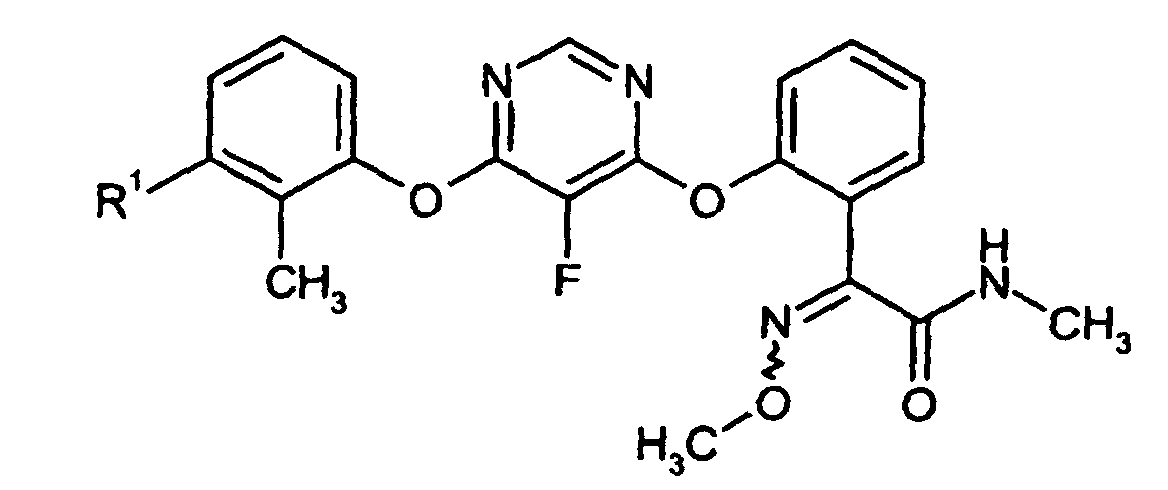
- R1
- für Wasserstoff, Methyl, Ethyl, Methoxy, Chlor, Brom, Fluor oder Cyano steht und
| 1) | Spiroxamin |
| Mischpartner | bevorzugtes Mischungsverhältnis | besonders bevorzugtes Mischungsverhältnis* |
| Spiroxamin | 10:1 bis 1:20 | 5:1 bis 1:10 |
- X
- den Wirkungsgrad, ausgedrückt in % der unbehandelten Kontrolle, beim Einsatz des Wirkstoffes A in einer Konzentration von m ppm,
- Y
- den Wirkungsgrad, ausgedrückt in % der unbehandelten Kontrolle, beim Einsatz des Wirkstoffes B in einer Konzentration von m ppm,
- E
- den erwarteten Wirkungsgrad, ausgedrückt in % der unbehandelten Kontrolle, beim Einsatz des Wirkstoffes A und B in einer Konzentrationen von m und n ppm bedeutet,
Claims (5)
- Wirkstoffkombination enthaltend eine Verbindung der Formel (I),in welcher
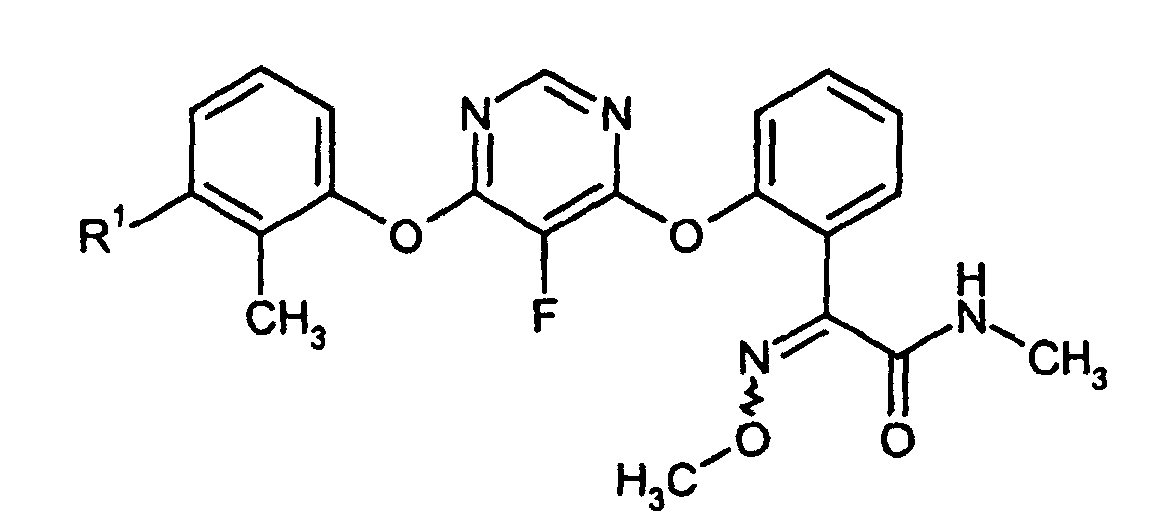
- R1
- für Wasserstoff, Methyl, Ethyl, Methoxy, Chlor, Brom, Fluor oder Cyano steht und
1) Spiroxamin - Mittel, gekennzeichnet durch einen Gehalt an einer Wirkstoffkombination wie in Anspruch 1 definiert.
- Verfahren zur Bekämpfung von Pilzen, dadurch gekennzeichnet, daß man Wirkstoffkombinationen wie in Anspruch 1 bzw. Mittel wie in Anspruch 2 definiert auf die Pilze und/oder deren Lebensraum einwirken läßt.
- Verwendung von Wirkstoffkombinationen wie in Anspruch 1 definiert zur Bekämpfung von Pilzen.
- Verfahren zur Herstellung von fungiziden Mitteln, dadurch gekennzeichnet, daß man Wirkstoffkombinationen wie in Anspruch 1 definiert mit Streckmitteln und/oder oberfächenaktiven Stoffen vermischt.
Priority Applications (1)
| Application Number | Priority Date | Filing Date | Title |
|---|---|---|---|
| EP04024463A EP1506711A3 (de) | 1998-11-20 | 1999-11-08 | Fungizide Wirkstoffkombinationen |
Applications Claiming Priority (5)
| Application Number | Priority Date | Filing Date | Title |
|---|---|---|---|
| DE19853559 | 1998-11-20 | ||
| DE19853559 | 1998-11-20 | ||
| DE19939841 | 1999-08-23 | ||
| DE19939841A DE19939841A1 (de) | 1998-11-20 | 1999-08-23 | Fungizide Wirkstoffkombinationen |
| PCT/EP1999/008558 WO2000030440A2 (de) | 1998-11-20 | 1999-11-08 | Fungizide wirkstoffkombinationen |
Related Child Applications (1)
| Application Number | Title | Priority Date | Filing Date |
|---|---|---|---|
| EP04024463A Division EP1506711A3 (de) | 1998-11-20 | 1999-11-08 | Fungizide Wirkstoffkombinationen |
Publications (2)
| Publication Number | Publication Date |
|---|---|
| EP1130963A2 EP1130963A2 (de) | 2001-09-12 |
| EP1130963B1 true EP1130963B1 (de) | 2005-03-02 |
Family
ID=26050276
Family Applications (1)
| Application Number | Title | Priority Date | Filing Date |
|---|---|---|---|
| EP99953975A Expired - Lifetime EP1130963B1 (de) | 1998-11-20 | 1999-11-08 | Fungizide wirkstoffkombinationen |
Country Status (20)
| Country | Link |
|---|---|
| US (2) | US6559136B1 (de) |
| EP (1) | EP1130963B1 (de) |
| JP (1) | JP2002530297A (de) |
| CN (1) | CN1157118C (de) |
| AT (1) | ATE289750T1 (de) |
| AU (1) | AU752441B2 (de) |
| BR (1) | BR9915518A (de) |
| CA (1) | CA2351500A1 (de) |
| CZ (1) | CZ20011749A3 (de) |
| DK (1) | DK1130963T3 (de) |
| ES (1) | ES2238853T3 (de) |
| HU (1) | HUP0104483A3 (de) |
| ID (1) | ID29076A (de) |
| IL (1) | IL142644A0 (de) |
| PL (1) | PL348355A1 (de) |
| PT (1) | PT1130963E (de) |
| RU (1) | RU2001117068A (de) |
| TR (3) | TR200103811T2 (de) |
| TW (1) | TW521994B (de) |
| WO (1) | WO2000030440A2 (de) |
Families Citing this family (40)
| Publication number | Priority date | Publication date | Assignee | Title |
|---|---|---|---|---|
| EP1085810B1 (de) | 1998-06-10 | 2005-12-28 | Bayer CropScience AG | Mittel zur bekämpfung von pflanzenschädlingen |
| DE19829113A1 (de) * | 1998-06-10 | 1999-12-16 | Bayer Ag | Mittel zur Bekämpfung von Pflanzenschädlingen |
| HK1039034B (zh) * | 1998-06-17 | 2005-07-22 | 拜尔公司 | 防治植物害蟲的組合物 |
| UA72490C2 (uk) * | 1998-12-22 | 2005-03-15 | Басф Акцієнгезелльшафт | Фунгіцидна суміш та спосіб боротьби з фітопатогенними грибами |
| DE10103832A1 (de) * | 2000-05-11 | 2001-11-15 | Bayer Ag | Fungizide Wirkstoffkombinationen |
| DE10063046A1 (de) * | 2000-12-18 | 2002-06-20 | Basf Ag | Fungizide Mischungen |
| US7687434B2 (en) * | 2000-12-22 | 2010-03-30 | Monsanto Technology, Llc | Method of improving yield and vigor of plants |
| KR20030066815A (ko) * | 2001-01-16 | 2003-08-09 | 바스프 악티엔게젤샤프트 | 살진균제 혼합물 |
| EP1416793A4 (de) * | 2001-06-14 | 2010-07-14 | Syngenta Participations Ag | Zusammensetzung und verfahren zur verbesserung des pflanzenwachstums |
| DE10140108A1 (de) | 2001-08-16 | 2003-03-06 | Bayer Cropscience Ag | Fungizide Wirkstoffkombinationen |
| DE10141618A1 (de) * | 2001-08-24 | 2003-03-06 | Bayer Cropscience Ag | Fungizide Wirkstoffkombinationen |
| BRPI0213586B1 (pt) * | 2001-09-27 | 2017-06-20 | Monsanto Technology Llc | Compositions, method of protecting a plant or its propagation materials against fungus disease or damage, as a controlled release formulation |
| GB0128390D0 (en) * | 2001-11-27 | 2002-01-16 | Syngenta Participations Ag | Seed treatment compositions |
| GB0128389D0 (en) * | 2001-11-27 | 2002-01-16 | Syngenta Participations Ag | Seed treatment compositions |
| GB0128722D0 (en) * | 2001-11-30 | 2002-01-23 | Syngenta Participations Ag | Seed treatment compositions |
| DE10203688A1 (de) * | 2002-01-31 | 2003-08-07 | Bayer Cropscience Ag | Synergistische insektizide Mischungen |
| BR0307912B1 (pt) * | 2002-03-01 | 2013-12-03 | Mistura fungicida, método para combater fungos nocivos, e, agente fungicida | |
| EP1539240A2 (de) * | 2002-05-02 | 2005-06-15 | The Washington University | Verfahren und zusammensetzungen zur behandlung von t-zell-vermittelten entzündlichen/autoimmunkrankheiten und störungen bei patienten mit glucocorticoid-regulierungsmangel |
| BR0316289A (pt) * | 2002-11-15 | 2005-10-11 | Basf Ag | Misturas e agentes fungicidas, processo para combater fungos nocivos fitopatogênicos, e, uso dos compostos |
| ATE397861T1 (de) * | 2002-12-06 | 2008-07-15 | Dow Agrosciences Llc | Synergistische zusammensetzungen |
| DE10333373A1 (de) * | 2003-07-23 | 2005-02-10 | Bayer Ag | Fungizide Wirkstoffkombinationen |
| DE10335183A1 (de) * | 2003-07-30 | 2005-02-24 | Bayer Cropscience Ag | Fungizide Wirkstoffkombinationen |
| DE10343872A1 (de) * | 2003-09-23 | 2005-04-21 | Bayer Cropscience Ag | Suspensionskonzentrate |
| DE10347090A1 (de) | 2003-10-10 | 2005-05-04 | Bayer Cropscience Ag | Synergistische fungizide Wirkstoffkombinationen |
| EP1796465B9 (de) * | 2004-09-27 | 2010-02-17 | E.I. Du Pont De Nemours And Company | Fungizide mischungen mit thiophenderivaten |
| DE102004049761A1 (de) * | 2004-10-12 | 2006-04-13 | Bayer Cropscience Ag | Fungizide Wirkstoffkombinationen |
| CA2597643C (en) | 2005-02-22 | 2014-01-28 | Basf Aktiengesellschaft | Compositions comprising a neonicotinoid and boscalid and use thereof as pesticides |
| US20090281157A1 (en) * | 2006-07-11 | 2009-11-12 | Bayer Cropscience Ag | Active Ingredient Combinations With Insecticidal and Acaricidal Properties |
| DE102006031978A1 (de) * | 2006-07-11 | 2008-01-17 | Bayer Cropscience Ag | Wirkstoffkombinationen mit insektiziden und akariziden Eigenschaften |
| DE102006031976A1 (de) * | 2006-07-11 | 2008-01-17 | Bayer Cropscience Ag | Wirkstoffkombinationen mit insektiziden und akariziden Eigenschaften |
| BRPI0808372A2 (pt) * | 2007-02-01 | 2014-07-01 | Basf Se | Misturas peticidas, métodos para melhorar a saúde de plantas, para controlar ou prevenir infestação fúngica em plantas, partes de plantas, sementes, ou em seu local de crescimento, para controlar ou prevenir nematódeos ou insetos nocivos em plantas, partes de plantas, sementes, ou em seu local de crescimento, e para proteger sementes, material de propagação de planta, e, composição pesticida |
| EP2124557B1 (de) * | 2007-02-02 | 2014-12-31 | Plant Health Care, Inc. | Synergistische fungizidzusammensetzungen mit formononetin |
| EP1982596A1 (de) | 2007-04-18 | 2008-10-22 | Bayer CropScience Deutschland GmbH | Fungizide Wirkstoffkombinationen |
| US8683346B2 (en) * | 2008-11-17 | 2014-03-25 | Sap Portals Israel Ltd. | Client integration of information from a supplemental server into a portal |
| CN101524070B (zh) * | 2009-01-16 | 2012-05-23 | 陕西韦尔奇作物保护有限公司 | 一种含有氰霜唑和氟环唑的杀菌组合物 |
| CN105494345B (zh) * | 2012-04-24 | 2017-12-19 | 陕西韦尔奇作物保护有限公司 | 一种高效杀菌组合物 |
| JP6576829B2 (ja) * | 2012-12-20 | 2019-09-18 | ビーエーエスエフ アグロ ベー.ブイ. | トリアゾール化合物を含む組成物 |
| CN104206396A (zh) * | 2014-09-25 | 2014-12-17 | 江苏省绿盾植保农药实验有限公司 | 含有戊菌唑和克菌丹的杀菌组合物及应用 |
| EP3047731A1 (de) | 2015-01-21 | 2016-07-27 | Basf Se | Verfahren zur Bekämpfung von Sojabohnenrost mittels Behandlung von Sojabohnen mit (2E)-2-[3-substituierten-2 [[(E)-[(2E)-2-Alkoxyimino-1-Methyl-2-Phenyl-Ethylidene]Amino]Oxymethyl]Phenyl]-2-Methoxymin-N-Methyl-Acet-Amiden |
| CN106366020B (zh) * | 2016-08-31 | 2018-12-11 | 京博农化科技股份有限公司 | 一种合成手性稻瘟酰胺的方法 |
Family Cites Families (6)
| Publication number | Priority date | Publication date | Assignee | Title |
|---|---|---|---|---|
| DE2742173A1 (de) | 1977-09-20 | 1979-03-29 | Bayer Ag | Phenoxy-pyridinyl(pyrimidinyl)-alkanole, verfahren zu ihrer herstellung sowie ihre verwendung als fungizide |
| GB2253624A (en) * | 1991-01-30 | 1992-09-16 | Ici Plc | Pyrimidine fungicides |
| NL9300855A (nl) | 1993-05-17 | 1994-12-16 | Friesland Frico Domo Coop | Werkwijze voor de bereiding van geëvaporeerde melk. |
| DE19646407A1 (de) * | 1996-11-11 | 1998-05-14 | Bayer Ag | Halogenpyrimidine |
| DE19739982A1 (de) | 1996-12-10 | 1998-06-18 | Bayer Ag | Fungizide Wirkstoffkombinationen |
| AP1119A (en) * | 1996-12-13 | 2002-11-29 | Bayer Ag | A microbicide composition for plant protection. |
-
1999
- 1999-11-08 ID IDW00200101100A patent/ID29076A/id unknown
- 1999-11-08 DK DK99953975T patent/DK1130963T3/da active
- 1999-11-08 TR TR2001/03811T patent/TR200103811T2/xx unknown
- 1999-11-08 CZ CZ20011749A patent/CZ20011749A3/cs unknown
- 1999-11-08 PT PT99953975T patent/PT1130963E/pt unknown
- 1999-11-08 BR BR9915518-4A patent/BR9915518A/pt not_active IP Right Cessation
- 1999-11-08 TR TR2001/01379T patent/TR200101379T2/xx unknown
- 1999-11-08 TR TR2001/03810T patent/TR200103810T2/xx unknown
- 1999-11-08 ES ES99953975T patent/ES2238853T3/es not_active Expired - Lifetime
- 1999-11-08 WO PCT/EP1999/008558 patent/WO2000030440A2/de not_active Ceased
- 1999-11-08 RU RU2001117068/04A patent/RU2001117068A/ru not_active Application Discontinuation
- 1999-11-08 JP JP2000583338A patent/JP2002530297A/ja active Pending
- 1999-11-08 US US09/856,023 patent/US6559136B1/en not_active Expired - Fee Related
- 1999-11-08 HU HU0104483A patent/HUP0104483A3/hu unknown
- 1999-11-08 AU AU10460/00A patent/AU752441B2/en not_active Ceased
- 1999-11-08 AT AT99953975T patent/ATE289750T1/de not_active IP Right Cessation
- 1999-11-08 EP EP99953975A patent/EP1130963B1/de not_active Expired - Lifetime
- 1999-11-08 CN CNB998135186A patent/CN1157118C/zh not_active Expired - Fee Related
- 1999-11-08 IL IL14264499A patent/IL142644A0/xx unknown
- 1999-11-08 PL PL99348355A patent/PL348355A1/xx not_active Application Discontinuation
- 1999-11-08 CA CA002351500A patent/CA2351500A1/en not_active Abandoned
- 1999-11-15 TW TW088119807A patent/TW521994B/zh not_active IP Right Cessation
-
2003
- 2003-02-21 US US10/371,770 patent/US20030161896A1/en not_active Abandoned
Also Published As
| Publication number | Publication date |
|---|---|
| AU752441B2 (en) | 2002-09-19 |
| US6559136B1 (en) | 2003-05-06 |
| DK1130963T3 (da) | 2005-05-30 |
| US20030161896A1 (en) | 2003-08-28 |
| PT1130963E (pt) | 2005-06-30 |
| HUP0104483A2 (hu) | 2002-03-28 |
| ATE289750T1 (de) | 2005-03-15 |
| CN1326316A (zh) | 2001-12-12 |
| PL348355A1 (en) | 2002-05-20 |
| CA2351500A1 (en) | 2000-06-02 |
| WO2000030440A3 (de) | 2000-08-31 |
| BR9915518A (pt) | 2001-07-17 |
| ID29076A (id) | 2001-07-26 |
| ES2238853T3 (es) | 2005-09-01 |
| WO2000030440A2 (de) | 2000-06-02 |
| HUP0104483A3 (en) | 2002-04-29 |
| EP1130963A2 (de) | 2001-09-12 |
| TW521994B (en) | 2003-03-01 |
| TR200101379T2 (tr) | 2001-11-21 |
| AU1046000A (en) | 2000-06-13 |
| JP2002530297A (ja) | 2002-09-17 |
| RU2001117068A (ru) | 2003-06-27 |
| CZ20011749A3 (cs) | 2001-12-12 |
| TR200103810T2 (tr) | 2002-06-21 |
| TR200103811T2 (tr) | 2002-06-21 |
| CN1157118C (zh) | 2004-07-14 |
| IL142644A0 (en) | 2002-03-10 |
Similar Documents
| Publication | Publication Date | Title |
|---|---|---|
| EP0610764B1 (de) | Fungizide Wirkstoffkombinationen | |
| EP1130963A2 (de) | Fungizide wirkstoffkombinationen | |
| EP1150568B1 (de) | Fungizide wirkstoffkombinationen | |
| EP1506711A2 (de) | Fungizide Wirkstoffkombinationen | |
| EP0730583B1 (de) | 3-methoxy-2-phenyl-acrylsäuremethylester | |
| EP0755185B1 (de) | Verwendung von Dibrom-thiophen-carbonsäure-Derivaten als Mikrobizide | |
| EP0767780B1 (de) | Aminosäure-derivate und ihre verwendung als schädlingsbekämpfungsmittel | |
| DE19948590A1 (de) | Wirkstoffkombination mit fungiziden und akariziden Eigenschaften | |
| DE19546462A1 (de) | Diarylacetylenketone | |
| EP0730592A1 (de) | Derivate der 2,3,5,6-tetrafluorobenzoesäure und ihre verwendung zur bekämpfung von schädlingen | |
| EP0911318B1 (de) | Aminosäure-Derivate und ihre Verwendung als Schädlingsbekämpfungsmittel | |
| MXPA01005029A (es) | Combinaciones de productos activos fungicidas | |
| EP0767784A1 (de) | Pyridin-3-imino-alkylester als fungizide | |
| DE4422765A1 (de) | Pyridin-3-imino-phenylthioester | |
| EP0699183A1 (de) | 3-methoxy-2-phenyl-acrylsäureester als schädlingsbekämpfungsmittel, insbesondere fungizide | |
| WO1995008537A1 (de) | Pyridin-3-imino-thioester und deren verwendung als fungizide | |
| WO1995008538A1 (de) | Pyridin-3-imino-thioester und deren verwendung als fungizide | |
| DE4422766A1 (de) | Pyridin-3-imino-alkylthioester | |
| DE4419710A1 (de) | Pyridin-3-imino-thioester |
Legal Events
| Date | Code | Title | Description |
|---|---|---|---|
| PUAI | Public reference made under article 153(3) epc to a published international application that has entered the european phase |
Free format text: ORIGINAL CODE: 0009012 |
|
| 17P | Request for examination filed |
Effective date: 20010620 |
|
| AK | Designated contracting states |
Kind code of ref document: A2 Designated state(s): AT BE CH CY DE DK ES FI FR GB GR IE IT LI LU MC NL PT SE |
|
| AX | Request for extension of the european patent |
Free format text: AL;LT;LV;MK;RO;SI |
|
| RAP1 | Party data changed (applicant data changed or rights of an application transferred) |
Owner name: BAYER CROPSCIENCE AG |
|
| 17Q | First examination report despatched |
Effective date: 20031030 |
|
| GRAP | Despatch of communication of intention to grant a patent |
Free format text: ORIGINAL CODE: EPIDOSNIGR1 |
|
| GRAS | Grant fee paid |
Free format text: ORIGINAL CODE: EPIDOSNIGR3 |
|
| GRAA | (expected) grant |
Free format text: ORIGINAL CODE: 0009210 |
|
| AK | Designated contracting states |
Kind code of ref document: B1 Designated state(s): AT BE CH CY DE DK ES FI FR GB GR IE IT LI LU MC NL PT SE |
|
| PG25 | Lapsed in a contracting state [announced via postgrant information from national office to epo] |
Ref country code: FI Free format text: LAPSE BECAUSE OF FAILURE TO SUBMIT A TRANSLATION OF THE DESCRIPTION OR TO PAY THE FEE WITHIN THE PRESCRIBED TIME-LIMIT Effective date: 20050302 |
|
| REG | Reference to a national code |
Ref country code: GB Ref legal event code: FG4D Free format text: NOT ENGLISH |
|
| REG | Reference to a national code |
Ref country code: CH Ref legal event code: NV Representative=s name: E. BLUM & CO. PATENTANWAELTE Ref country code: CH Ref legal event code: EP |
|
| REG | Reference to a national code |
Ref country code: IE Ref legal event code: FG4D Free format text: GERMAN |
|
| REF | Corresponds to: |
Ref document number: 59911707 Country of ref document: DE Date of ref document: 20050407 Kind code of ref document: P |
|
| GBT | Gb: translation of ep patent filed (gb section 77(6)(a)/1977) |
Effective date: 20050427 |
|
| REG | Reference to a national code |
Ref country code: DK Ref legal event code: T3 |
|
| REG | Reference to a national code |
Ref country code: GR Ref legal event code: EP Ref document number: 20050401446 Country of ref document: GR |
|
| REG | Reference to a national code |
Ref country code: PT Ref legal event code: SC4A Free format text: AVAILABILITY OF NATIONAL TRANSLATION Effective date: 20050429 |
|
| REG | Reference to a national code |
Ref country code: ES Ref legal event code: FG2A Ref document number: 2238853 Country of ref document: ES Kind code of ref document: T3 |
|
| PG25 | Lapsed in a contracting state [announced via postgrant information from national office to epo] |
Ref country code: IT Free format text: LAPSE BECAUSE OF NON-PAYMENT OF DUE FEES Effective date: 20051108 Ref country code: IE Free format text: LAPSE BECAUSE OF NON-PAYMENT OF DUE FEES Effective date: 20051108 Ref country code: GB Free format text: LAPSE BECAUSE OF NON-PAYMENT OF DUE FEES Effective date: 20051108 Ref country code: CY Free format text: LAPSE BECAUSE OF FAILURE TO SUBMIT A TRANSLATION OF THE DESCRIPTION OR TO PAY THE FEE WITHIN THE PRESCRIBED TIME-LIMIT Effective date: 20051108 |
|
| PG25 | Lapsed in a contracting state [announced via postgrant information from national office to epo] |
Ref country code: ES Free format text: LAPSE BECAUSE OF NON-PAYMENT OF DUE FEES Effective date: 20051110 |
|
| PG25 | Lapsed in a contracting state [announced via postgrant information from national office to epo] |
Ref country code: MC Free format text: LAPSE BECAUSE OF NON-PAYMENT OF DUE FEES Effective date: 20051130 Ref country code: LU Free format text: LAPSE BECAUSE OF NON-PAYMENT OF DUE FEES Effective date: 20051130 Ref country code: LI Free format text: LAPSE BECAUSE OF NON-PAYMENT OF DUE FEES Effective date: 20051130 Ref country code: DK Free format text: LAPSE BECAUSE OF NON-PAYMENT OF DUE FEES Effective date: 20051130 Ref country code: CH Free format text: LAPSE BECAUSE OF NON-PAYMENT OF DUE FEES Effective date: 20051130 Ref country code: BE Free format text: LAPSE BECAUSE OF NON-PAYMENT OF DUE FEES Effective date: 20051130 |
|
| PLBE | No opposition filed within time limit |
Free format text: ORIGINAL CODE: 0009261 |
|
| STAA | Information on the status of an ep patent application or granted ep patent |
Free format text: STATUS: NO OPPOSITION FILED WITHIN TIME LIMIT |
|
| ET | Fr: translation filed | ||
| 26N | No opposition filed |
Effective date: 20051205 |
|
| PG25 | Lapsed in a contracting state [announced via postgrant information from national office to epo] |
Ref country code: NL Free format text: LAPSE BECAUSE OF NON-PAYMENT OF DUE FEES Effective date: 20060601 Ref country code: DE Free format text: LAPSE BECAUSE OF NON-PAYMENT OF DUE FEES Effective date: 20060601 |
|
| REG | Reference to a national code |
Ref country code: DK Ref legal event code: EBP |
|
| REG | Reference to a national code |
Ref country code: CH Ref legal event code: PL |
|
| GBPC | Gb: european patent ceased through non-payment of renewal fee |
Effective date: 20051108 |
|
| NLV4 | Nl: lapsed or anulled due to non-payment of the annual fee |
Effective date: 20060601 |
|
| PG25 | Lapsed in a contracting state [announced via postgrant information from national office to epo] |
Ref country code: PT Free format text: LAPSE BECAUSE OF NON-PAYMENT OF DUE FEES Effective date: 20060808 |
|
| REG | Reference to a national code |
Ref country code: IE Ref legal event code: MM4A |
|
| REG | Reference to a national code |
Ref country code: PT Ref legal event code: MM4A Effective date: 20060808 |
|
| REG | Reference to a national code |
Ref country code: ES Ref legal event code: FD2A Effective date: 20051110 |
|
| BERE | Be: lapsed |
Owner name: *BAYER CROPSCIENCE A.G. Effective date: 20051130 |
|
| PG25 | Lapsed in a contracting state [announced via postgrant information from national office to epo] |
Ref country code: SE Free format text: LAPSE BECAUSE OF FAILURE TO SUBMIT A TRANSLATION OF THE DESCRIPTION OR TO PAY THE FEE WITHIN THE PRESCRIBED TIME-LIMIT Effective date: 20050602 |
|
| PG25 | Lapsed in a contracting state [announced via postgrant information from national office to epo] |
Ref country code: GR Free format text: LAPSE BECAUSE OF NON-PAYMENT OF DUE FEES Effective date: 20050302 |
|
| PG25 | Lapsed in a contracting state [announced via postgrant information from national office to epo] |
Ref country code: PT Free format text: LAPSE BECAUSE OF NON-PAYMENT OF DUE FEES Effective date: 20051108 |
|
| PG25 | Lapsed in a contracting state [announced via postgrant information from national office to epo] |
Ref country code: FR Free format text: LAPSE BECAUSE OF NON-PAYMENT OF DUE FEES Effective date: 20051130 |
|
| REG | Reference to a national code |
Ref country code: FR Ref legal event code: ST Effective date: 20111021 |