EP1133927A2 - Rohrförmige Snack-Produkte auf Basis von Kartoffelschnitzeln und Verfahren zu ihrer Herstellung - Google Patents
Rohrförmige Snack-Produkte auf Basis von Kartoffelschnitzeln und Verfahren zu ihrer Herstellung Download PDFInfo
- Publication number
- EP1133927A2 EP1133927A2 EP01302028A EP01302028A EP1133927A2 EP 1133927 A2 EP1133927 A2 EP 1133927A2 EP 01302028 A EP01302028 A EP 01302028A EP 01302028 A EP01302028 A EP 01302028A EP 1133927 A2 EP1133927 A2 EP 1133927A2
- Authority
- EP
- European Patent Office
- Prior art keywords
- potato
- casing
- shreds
- product
- starch
- Prior art date
- Legal status (The legal status is an assumption and is not a legal conclusion. Google has not performed a legal analysis and makes no representation as to the accuracy of the status listed.)
- Withdrawn
Links
- 244000061456 Solanum tuberosum Species 0.000 title claims abstract description 141
- 235000002595 Solanum tuberosum Nutrition 0.000 title claims abstract description 141
- 235000013305 food Nutrition 0.000 title claims abstract description 37
- 235000011888 snacks Nutrition 0.000 title claims description 27
- 238000004519 manufacturing process Methods 0.000 title 1
- 238000011049 filling Methods 0.000 claims abstract description 40
- 229920002472 Starch Polymers 0.000 claims abstract description 38
- 235000019698 starch Nutrition 0.000 claims abstract description 38
- 239000000463 material Substances 0.000 claims abstract description 36
- 239000008107 starch Substances 0.000 claims abstract description 36
- 229920002134 Carboxymethyl cellulose Polymers 0.000 claims abstract description 31
- 239000001768 carboxy methyl cellulose Substances 0.000 claims abstract description 31
- 235000010948 carboxy methyl cellulose Nutrition 0.000 claims abstract description 31
- 238000000034 method Methods 0.000 claims abstract description 17
- 239000000203 mixture Substances 0.000 claims abstract description 14
- 238000001125 extrusion Methods 0.000 claims description 27
- 239000004615 ingredient Substances 0.000 claims description 22
- XLYOFNOQVPJJNP-UHFFFAOYSA-N water Substances O XLYOFNOQVPJJNP-UHFFFAOYSA-N 0.000 claims description 17
- 238000010411 cooking Methods 0.000 claims description 16
- 238000002156 mixing Methods 0.000 claims description 12
- 230000008569 process Effects 0.000 claims description 12
- 235000003599 food sweetener Nutrition 0.000 claims description 11
- 239000003765 sweetening agent Substances 0.000 claims description 11
- 238000005520 cutting process Methods 0.000 claims description 8
- 235000013351 cheese Nutrition 0.000 claims description 7
- 238000012545 processing Methods 0.000 claims description 7
- 235000015067 sauces Nutrition 0.000 claims description 7
- 235000013372 meat Nutrition 0.000 claims description 6
- 238000002788 crimping Methods 0.000 claims description 5
- 235000013599 spices Nutrition 0.000 claims description 5
- 230000008014 freezing Effects 0.000 claims description 4
- 238000007710 freezing Methods 0.000 claims description 4
- -1 flavorings Substances 0.000 claims 3
- 230000006835 compression Effects 0.000 claims 1
- 238000007906 compression Methods 0.000 claims 1
- 235000005135 Micromeria juliana Nutrition 0.000 abstract description 6
- 235000007315 Satureja hortensis Nutrition 0.000 abstract description 6
- 235000013410 fast food Nutrition 0.000 abstract description 3
- 240000002114 Satureja hortensis Species 0.000 abstract 1
- 239000011159 matrix material Substances 0.000 description 20
- 238000006703 hydration reaction Methods 0.000 description 15
- 238000010438 heat treatment Methods 0.000 description 13
- 238000002386 leaching Methods 0.000 description 10
- 238000002360 preparation method Methods 0.000 description 9
- 235000013573 potato product Nutrition 0.000 description 8
- 229920000881 Modified starch Polymers 0.000 description 7
- 235000019426 modified starch Nutrition 0.000 description 7
- 239000004368 Modified starch Substances 0.000 description 6
- WQZGKKKJIJFFOK-GASJEMHNSA-N Glucose Natural products OC[C@H]1OC(O)[C@H](O)[C@@H](O)[C@@H]1O WQZGKKKJIJFFOK-GASJEMHNSA-N 0.000 description 5
- 241000246354 Satureja Species 0.000 description 5
- 239000008121 dextrose Substances 0.000 description 5
- 239000002245 particle Substances 0.000 description 5
- 235000012015 potatoes Nutrition 0.000 description 5
- 239000011800 void material Substances 0.000 description 5
- 230000004888 barrier function Effects 0.000 description 4
- 229920002678 cellulose Polymers 0.000 description 4
- 239000001913 cellulose Substances 0.000 description 4
- 235000010980 cellulose Nutrition 0.000 description 4
- 235000013339 cereals Nutrition 0.000 description 4
- 235000013365 dairy product Nutrition 0.000 description 4
- 235000014594 pastries Nutrition 0.000 description 4
- 239000000843 powder Substances 0.000 description 4
- 239000007787 solid Substances 0.000 description 4
- 238000012360 testing method Methods 0.000 description 4
- 244000291564 Allium cepa Species 0.000 description 3
- 240000002129 Malva sylvestris Species 0.000 description 3
- 235000006770 Malva sylvestris Nutrition 0.000 description 3
- 230000004323 axial length Effects 0.000 description 3
- 239000011230 binding agent Substances 0.000 description 3
- 230000009977 dual effect Effects 0.000 description 3
- 235000013312 flour Nutrition 0.000 description 3
- 229920003088 hydroxypropyl methyl cellulose Polymers 0.000 description 3
- 230000001788 irregular Effects 0.000 description 3
- 229920000609 methyl cellulose Polymers 0.000 description 3
- 239000001923 methylcellulose Substances 0.000 description 3
- 235000010981 methylcellulose Nutrition 0.000 description 3
- 235000002732 Allium cepa var. cepa Nutrition 0.000 description 2
- PTHCMJGKKRQCBF-UHFFFAOYSA-N Cellulose, microcrystalline Chemical compound OC1C(O)C(OC)OC(CO)C1OC1C(O)C(O)C(OC)C(CO)O1 PTHCMJGKKRQCBF-UHFFFAOYSA-N 0.000 description 2
- 229920002153 Hydroxypropyl cellulose Polymers 0.000 description 2
- 229920000168 Microcrystalline cellulose Polymers 0.000 description 2
- 238000010521 absorption reaction Methods 0.000 description 2
- 239000008112 carboxymethyl-cellulose Substances 0.000 description 2
- 230000006378 damage Effects 0.000 description 2
- 238000005429 filling process Methods 0.000 description 2
- 239000000416 hydrocolloid Substances 0.000 description 2
- 239000001863 hydroxypropyl cellulose Substances 0.000 description 2
- 235000010977 hydroxypropyl cellulose Nutrition 0.000 description 2
- 239000001866 hydroxypropyl methyl cellulose Substances 0.000 description 2
- 235000010979 hydroxypropyl methyl cellulose Nutrition 0.000 description 2
- UFVKGYZPFZQRLF-UHFFFAOYSA-N hydroxypropyl methyl cellulose Chemical compound OC1C(O)C(OC)OC(CO)C1OC1C(O)C(O)C(OC2C(C(O)C(OC3C(C(O)C(O)C(CO)O3)O)C(CO)O2)O)C(CO)O1 UFVKGYZPFZQRLF-UHFFFAOYSA-N 0.000 description 2
- 238000007654 immersion Methods 0.000 description 2
- 239000002655 kraft paper Substances 0.000 description 2
- 235000019813 microcrystalline cellulose Nutrition 0.000 description 2
- 239000008108 microcrystalline cellulose Substances 0.000 description 2
- 229940016286 microcrystalline cellulose Drugs 0.000 description 2
- 150000003839 salts Chemical class 0.000 description 2
- IXPNQXFRVYWDDI-UHFFFAOYSA-N 1-methyl-2,4-dioxo-1,3-diazinane-5-carboximidamide Chemical compound CN1CC(C(N)=N)C(=O)NC1=O IXPNQXFRVYWDDI-UHFFFAOYSA-N 0.000 description 1
- 229920000856 Amylose Polymers 0.000 description 1
- 229920002907 Guar gum Polymers 0.000 description 1
- 239000004354 Hydroxyethyl cellulose Substances 0.000 description 1
- 229920000663 Hydroxyethyl cellulose Polymers 0.000 description 1
- 244000217433 Melampodium divaricatum Species 0.000 description 1
- 239000006057 Non-nutritive feed additive Substances 0.000 description 1
- 230000002411 adverse Effects 0.000 description 1
- 230000005540 biological transmission Effects 0.000 description 1
- 230000015572 biosynthetic process Effects 0.000 description 1
- 230000015556 catabolic process Effects 0.000 description 1
- 229920003086 cellulose ether Polymers 0.000 description 1
- 239000011248 coating agent Substances 0.000 description 1
- 238000000576 coating method Methods 0.000 description 1
- 238000004132 cross linking Methods 0.000 description 1
- 230000003247 decreasing effect Effects 0.000 description 1
- 230000006735 deficit Effects 0.000 description 1
- 230000001419 dependent effect Effects 0.000 description 1
- 235000005911 diet Nutrition 0.000 description 1
- 230000000378 dietary effect Effects 0.000 description 1
- 230000000694 effects Effects 0.000 description 1
- 230000009969 flowable effect Effects 0.000 description 1
- 235000012020 french fries Nutrition 0.000 description 1
- 239000003349 gelling agent Substances 0.000 description 1
- 239000008187 granular material Substances 0.000 description 1
- 238000000227 grinding Methods 0.000 description 1
- 239000000665 guar gum Substances 0.000 description 1
- 235000010417 guar gum Nutrition 0.000 description 1
- 229960002154 guar gum Drugs 0.000 description 1
- 235000021182 hors d'oeuvre Nutrition 0.000 description 1
- 230000036571 hydration Effects 0.000 description 1
- 235000019447 hydroxyethyl cellulose Nutrition 0.000 description 1
- 238000010348 incorporation Methods 0.000 description 1
- 230000003993 interaction Effects 0.000 description 1
- 235000013575 mashed potatoes Nutrition 0.000 description 1
- 238000003801 milling Methods 0.000 description 1
- 238000012986 modification Methods 0.000 description 1
- 230000004048 modification Effects 0.000 description 1
- 230000009467 reduction Effects 0.000 description 1
- 238000004626 scanning electron microscopy Methods 0.000 description 1
- 235000010413 sodium alginate Nutrition 0.000 description 1
- 239000000661 sodium alginate Substances 0.000 description 1
- 229940005550 sodium alginate Drugs 0.000 description 1
- 238000001179 sorption measurement Methods 0.000 description 1
- 239000000126 substance Substances 0.000 description 1
- 230000000007 visual effect Effects 0.000 description 1
Images
Classifications
-
- A—HUMAN NECESSITIES
- A23—FOODS OR FOODSTUFFS; TREATMENT THEREOF, NOT COVERED BY OTHER CLASSES
- A23L—FOODS, FOODSTUFFS OR NON-ALCOHOLIC BEVERAGES, NOT OTHERWISE PROVIDED FOR; PREPARATION OR TREATMENT THEREOF
- A23L19/00—Products from fruits or vegetables; Preparation or treatment thereof
- A23L19/10—Products from fruits or vegetables; Preparation or treatment thereof of tuberous or like starch containing root crops
- A23L19/12—Products from fruits or vegetables; Preparation or treatment thereof of tuberous or like starch containing root crops of potatoes
- A23L19/18—Roasted or fried products, e.g. snacks or chips
- A23L19/19—Roasted or fried products, e.g. snacks or chips from powdered or mashed potato products
-
- A—HUMAN NECESSITIES
- A23—FOODS OR FOODSTUFFS; TREATMENT THEREOF, NOT COVERED BY OTHER CLASSES
- A23L—FOODS, FOODSTUFFS OR NON-ALCOHOLIC BEVERAGES, NOT OTHERWISE PROVIDED FOR; PREPARATION OR TREATMENT THEREOF
- A23L19/00—Products from fruits or vegetables; Preparation or treatment thereof
- A23L19/10—Products from fruits or vegetables; Preparation or treatment thereof of tuberous or like starch containing root crops
- A23L19/12—Products from fruits or vegetables; Preparation or treatment thereof of tuberous or like starch containing root crops of potatoes
- A23L19/13—Mashed potato products
- A23L19/135—Preformed edible shells filled with mashed potatoes; Stuffed mashed potato products
-
- A—HUMAN NECESSITIES
- A23—FOODS OR FOODSTUFFS; TREATMENT THEREOF, NOT COVERED BY OTHER CLASSES
- A23P—SHAPING OR WORKING OF FOODSTUFFS, NOT FULLY COVERED BY A SINGLE OTHER SUBCLASS
- A23P30/00—Shaping or working of foodstuffs characterised by the process or apparatus
- A23P30/20—Extruding
- A23P30/25—Co-extrusion of different foodstuffs
Definitions
- the invention concerns tubular hand held and convenience snack food products comprising potato shreds.
- the product comprises cylindrically shaped hollow casings comprising potato shreds and savory fillings, such as meats, cheeses or other processed dairy products, flavorings, spices, sauces and the like or combinations of savory fillings.
- the snack food is formed, cooked by frying, baking, par-frying, par-baking or combinations thereof, or otherwise, and then frozen.
- the product can be reconstituted by re-heating through conventional means, such as heating in an oven, toasting in a conventional residential toaster or toaster oven, or by microwave cooking.
- two or more ropes are connected through an axial indented ridge type connector to make a convenience snack food product with pull apart functionality.
- the casing comprises potato shreds, starch, preferably modified starch, and cellulose gum.
- the potato shreds can be either fresh cut, dehydrated or combinations of fresh cut and dehydrated.
- the cellulose gum and starch independently interact with the potato shreds, and other ingredients of the casing, to support a potato shred matrix with a film on exposed surfaces and fill Voids in the matrix at the exposed surfaces of the casing which allows the casing to be extruded and maintain its shape. This is particularly important when the casing is extruded in the form of hollow continuous ropes, to maintain the center core, axial cavity, during and after extrusion.
- the gum, starch and potato shreds form a structural matrix, and the gum and starch form a film around the outer shell of the casing.
- the film serves a number of functions including providing a moisture barrier to regulate fat pick-up during frying of the product and to inhibit fat from leaching during reconstitution.
- the casing has the texture of processed hash brown potato patties that enhances product acceptability.
- the invention also relates to methods for making the tube shaped snacks.
- the method comprises mixing potato shreds, either fresh cut, reconstituted dehydrated shreds or combinations thereof, with other ingredients, including starch and cellulose gum.
- the mixture is extruded through a nozzle or multiple nozzles, to form one or two or more continuous ropes on a conveyor system.
- the continuous ropes can be solid, or in the preferred embodiment, hollow (i.e. with an axial cavity, as in a tube).
- the filling can be either extruded into the axial cavity defined by the inner walls of the hollow continuous rope, such as co-extrusion in the casing, or injected into the axial cavity.
- the continuous ropes can be physically moved together to form co-joined continuous ropes to obtain two or more ropes in an axial side-by-side arrangement which can be cut to a desired lengthwise size. After two or more ropes are arranged side-by-side, the product can be compressed. When two or more ropes are connected an axial indented ridge type connector is formed lengthwise along adjacent ropes. The axial indented ridge type connector provides the product with pull apart functionality. As such, when two or more continuous ropes are connected to form the product, the ropes can be broken apart at the axial indented ridge type connector without causing the casing around the filling to break or lose significant structure.
- Hand held convenience snack foods having a filling surrounded by a casing typically have casings made from bakery formulas involving pastry dough.
- Bakery formulas generally involve grains and flours and the pastry dough tends to be homogenous which is both easy to form by extrusion or other means, or otherwise easy to fill.
- An example is cereal bar mixes made with pastry dough comprising multi-grains, and although these materials tend to have coarser grains compared to other pastry dough ingredients, the particles have substantial uniformity thus facilitating extrusion and filling.
- Potato shreds are nonuniform and have bigger and longer particle size compared to grains and flours. As a result, dough comprising potato shreds lacks uniformity and is more difficult to handle and extrude. Dough comprising potato shreds will have the tendency to form open surfaces after extrusion or during the forming or filling process.
- U.S. Patent No. 4,828,856 describes hash brown type potato products made from de-hydrated formed or fabricated potato shreds which can be re-hydrated and formed into patties said to simulate fresh cut potato products.
- the re-hydrated mass has a moisture content of 40% to 55% so that the product can be sheeted with a 1 to 2 millimeter opening between sheeting rolls.
- the potato dough made from the shreds described in this patent cannot be extruded because of needed high extrusion pressures which are said to rupture a significant portion of the potato cells.
- Non-critical ingredients for these products are carboxymethylcellulose, which is said to be a processing aid for the sheeting operation, and certain food gums to reduce fat or oil pickup (uptake) during frying.
- U.S. Patent No. 5,492,704 describes a process for making potato strands comprising shreds for use in hash brown potatoes, and re-hydration of the shreds in the form of sheets to make a hash brown potato product is exempl
- U.S. Patent No. 5,891,596 describes potato mixtures shaped by extrusion or otherwise that are processed as a reduced fat flash frozen potato product.
- the formed potato shapes are made from blended potato pieces, and the blended product contains small pieces and, thus, not potato shreds.
- U.S. Patent No. 3,399,062 describes dehydrated granular products, such as crushed dehydrated potatoes, containing some aggregates of individual cells, re-hydrated at low temperature in the presence of cellulose ether thermal gelling agent and extruded to obtain a french fried potato product.
- U.S. Patent No. 3,975,549 describes agglomerated dehydrated potato products made from dehydrated potato particles that, after re-hydration with a binder, are extruded to form french fries.
- the binder may be either a gum, such as guar gum, or free starch from modifying the potato solids.
- U.S. Patent No. 3,987,210 describes an extruded french fried potato product comprising dehydrated potatoes in the form of flakes, granules, flour, diced pieces or mixtures thereof with a binder comprising more than about 25% amylose starch. The starch is said to retrograde when heated with water to form a film around the product and provide an oil barrier.
- U.S. Patent No. 3,486,673 describes extruded french fried potato products comprising dehydrated mashed potatoes, methyl cellulose and polygalacomannan gum, which are said to be essential ingredients. The combination of ingredients reportedly provide the product with an irregular external crust which permits the product to pick up a modest amount oil during frying.
- U.S. Patent No. 5,242,699 addresses an application of a hydrocolloid coating to potato strips to provide an exterior crust when the strips are blanched or par-fried which may also retard oil adsorption into the potato strip.
- U.S. Patent No. 5,620,727 concerns use of low molecular weight ionic hydrocolloid compositions to make film to reduce oil uptake.
- U.S. Patent No. 3,687,688 concerns immersion of potato into a batter comprising sodium alginate for moisture control, and U.S. Patent No. 4,900,573 concerns batter comprising hydroxypropyl methylcellulose which is said to function as an oil barrier.
- Fat absorption/uptake of fried foods is one of the major concerns of consumers, particularly with respect to dietary concerns as fat provides approximately 9 calories per gram to the food. Also, fat leaching from a prepared product during re-heating or reconstituting causes a greasy feel to food, and imparts undesirable organoleptic qualities to the food.
- An object of the invention is to make a hand held convenience snack food product that comprises a casing with potato shreds that can be extruded and filled and then partially or fully fried or baked without significant excess oil absorption during cooking and without oil or fat leaching during reconstitution.
- An object of the invention is also an extrudable casing comprising potato shreds that has structural integrity which can withstand the extrusion and filling process, and other processing to axially join outer walls of two or more tubular casings in a snack food.
- the invention provides for an extruded baked or fried product comprising potato shreds wherein the integrity of the shreds is maintained despite the extrusion process.
- the cellulose gums and starch form a film around the exposed surfaces of the potato shred casing filling the voids at the exposed surfaces of the casing.
- the casing maintains its shape during and after extrusion and the film helps control both oil pick-up during cooking and oil or fat leaching when the product is reconstituted.
- the moisture content is also important to processability as the moisture content of the casing, about 55% to about 75%, preferably about 60% to about 72%, facilitates extrusion and regulates oil uptake during cooking.
- the hand held and convenience tubular shaped snack products are formed from a single, or two or more, continuous ropes, that are either hollow or solid.
- the casing is hollow and cylindrical shaped having an inner wall, outer wall and an axial cavity defined by the inner wall, which can be filled with a variety of savory fillings, such as meats, cheeses, or other processed dairy products, flavorings, spices, sauces and the like, or combinations of these.
- the continuous ropes are formed by extrusion and two or more continuous ropes can be axially joined, and an axial indented ridge type connector lengthwise along adjacent ropes provides the product with pull apart functionality.
- a plurality of ropes are connected axially and radially cut to a lengthwise size to accommodate reconstitution, e.g., re-heating, in a conventional residential toaster or toaster oven.
- the casing is crimped to form ends of potato shred casing material which seals the filling within the axial cavity and the ends.
- the continuous ropes comprise potato shreds and are formed by extrusion.
- the potato shreds can be fresh cut or dehydrated, or a combination of fresh cut and dehydrated.
- the casing further comprises cellulose gum and starch, preferably modified starch, which form a film and fill voids in the potato shred matrix at the exposed surfaces of the casing, and serves to facilitate a stable potato shred matrix and provides a fat/moisture barrier for the casing material.
- Cellulose gums useful for the casing are microcrystalline cellulose, methylcellulose, carboxymethylcellulose, hydroxyethylcellulose, hydroxypropylcellulose, hydroxypropylmethylcellulose or combinations thereof.
- the matrix is critical to the mechanical properties of the product and, together with the moisture content of the extruded casing, allows for extrusion of the casing with sufficient structural support, particularly when the casing is extruded in hollow form so that the casing material will not collapse into the axial cavity.
- the film regulates moisture loss during frying to control fat uptake, and also retards fat from leaching from the product during reconstitution.
- the snack product can be reconstituted by a number of means, including oven cooking, microwave cooking and heating in a conventional residential toaster or toaster oven. Leaching of fat during preparation would result in a greasy texture to the outer surface of the casing and poor organoleptic qualities.
- the matrix and film formed by the interaction of the gum and starch and potato shreds provide for an organoleptically acceptable product with a hash brown like texture and, particularly in the methods of toaster or toaster oven preparation, a product that will not undesirably leach oil or fat during re-heating or reconstitution.
- the casing can comprise dehydrated potato shreds, fresh cut potato shreds or combinations thereof.
- the casing comprises about 20% to about 24% dehydrated potato shreds, about 3% to about 10% dried potato flakes, about 1 % to about 4% starch, about 0.5% to about 2% flavorings, about 0.5% to about 2% sweetener, preferably dextrose, about 0.5% to about 2.5% cellulose gum and about 55% to about 75% water, preferably about 60% to about 72%.
- the casing comprises about 75% to about 95% fresh cut potato shreds, which may be moisture adjusted (e.g.
- Potato shreds as discussed herein are rectangular shaped potato pieces of random axial length, preferably up to about 76 millimeters, and a cross section of from about 6.4 millimeters to about 2.5 millimeters by about 3.2 millimeters to about 6.4 millimeters, preferably about 4.0 millimeters to about 2.5 millimeters by about 4.8 millimeters, and may be in dehydrated form.
- the ingredients of the casing are mixed together and then the mixture is extruded through a nozzle or multiple nozzles to obtain one, or two or more cylindrically shaped ropes.
- the casing is extruded in hollow form, (i.e. tube like, having an axial cavity) and then filling is either co-extruded with the casing or injected into the axial cavity.
- Multiple nozzles can be used which result in an array of two or more ropes extruded onto a moving conveyor.
- the ropes As the ropes move on the conveyor, the ropes physically move together, either through the movement of the conveyor or by physical means such as guides or wedges, and become connected at adjacent axial portions of outer walls of the casings to form a tube shaped snack food comprising two or more axially connected ropes.
- a rollover operation may be employed which involves moving the continuous ropes under one or more rollers that compress the ropes as desired.
- An axial indented ridge type connector having a radial width of about 2 to about 12 millimeters is formed along adjacent outer walls of the ropes thereby making co-joined ropes as a result of only a portion of outer walls of adjacent casings becoming attached.
- the axial indented ridge type connector provides the product with pull apart functionality, and adds rigidity to the casing of the overall product comprising two or more ropes.
- the ropes can then be cut radially to a desired length, to accommodate the method of preparation and size of equipment, (e.g. oven, microwave oven, toaster, etc.) for reconstitution, and the ropes are crimped at the time they are cut to form ends of potato shred casing material which seals the filling within the axial cavity and ends.
- the cutting and crimping of the continuous ropes results in uncooked cut casings which are then cooked by frying or baking, including par-frying or par-baking and then frozen.
- the product can be reconstituted or reheated by means, such as a toaster, toaster oven or oven, or by microwave heating.
- the gum and starch provide a film around the casing which in part, inhibits the leaching of oil from the product during reconstitution thereby providing the product with acceptable organoleptic properties and texture, and reduced undesired greasy feel and, thus, the product has particular utility for hand held consumption.
- the gum and film also serves to enhance the structural support of the casing.
- the process allows significant variation in product dimensions, particularly axial length, to accommodate differences in equipment sizes for re-heating and for future modifications by equipment manufacturers.
- the ability to vary the size of the product also allows for products to meet particular consumer choices.
- the product can be cut to an axial length of about 8.5 centimeters to about 11 centimeters for current conventional toasters or toaster ovens, or could be cut longer for oven preparation or smaller to make a single serving pieces or hors d'oeuvres.
- the thickness is determined by the extrusion parameters and the roll over operation, the length is determined by cutting and the width is a function of the number of ropes axially attached together.
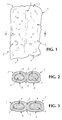
- Fig. 1 is a top view elevation of the hand held snack food product in an embodiment where two continuous ropes are attached and cut and crimped for toaster or toaster oven preparation.
- Fig. 2 is a cross sectioned view along line 2-2 of Fig. 1 of the hand held snack food product in an embodiment where two continuous ropes are attached and cut and crimped for toaster or toaster oven preparation.
- Fig. 3 is a cross sectioned view of two attached continuous ropes.
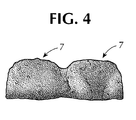
- Fig. 4 is an end view elevation of the hand held snack food product in an embodiment where two continuous ropes are attached and cut and crimped for toaster or toaster oven preparation.
- the hand held snack foods are a convenience food product designed to move from the package to serving with merely reconstitution, such as re-heating, by the consumer.
- the hand held snack food product 1 is generally depicted in Fig. 1.
- the product comprises a cylindrical shaped casing (ropes) 2 and filling 3 in the axial cavity defined by inner walls 4 of the casing 2 as shown in Figs. 2 and 3 .
- an axial indented ridge type connector 5 is formed lengthwise along adjacent casings and is located at the point of attachment between the casings (ropes) 2 as shown in Figs. 1-3 . It is to be understood that while Figs.
- the product comprises at least one; and preferably two, ends 7 as shown in Figs. 1 and 4 ; of casing material which encloses the filling within the inner walls 4 of the casing and ends 7 forming uncooked cut casings wherein the filling is isolated within potato shred casing material.
- the axial indented ridge type connector 5 as shown in Figs. 1-3 results from the manner of the attachment.
- the axial indented ridge type connector has a radial width of about 2 to about 12 millimeters.
- the axial indented ridge type connector allows the attached casings to be broken or split apart lengthwise without the aid of any utensils or tools.
- the product breaks at the axial indented ridge type connector without breaking the walls of the casing and exposing filling or impairing the basic structure of the cylindrical rope casings.
- the product can be broken down to serving sizes without the risk of filling escaping out from the casing during reconstitution and/or consumption. Accordingly, the product can be a hand held convenience food product.
- the product comprises potato shreds and has a casing comprising potato shreds, cellulose gum, starch, and savory fillings which can be any variety of dairy or meat based substances, such as meat, cheeses or other processed dairy foods, flavorings, sauces, spices and the like, and combinations of these.
- the potato shreds have random length, preferably up to about 76 millimeters, and a cross section of from about 6.4 millimeters to about 2.5 millimeters by about 3.2 millimeters to about 6.4 millimeters, preferably about 4.0 millimeters to about 2.5 millimeters by about 4.8 millimeters.
- the moisture content of the casing is important for extrusion of the potato shred and for the properties of the cooked product.
- the dough can be extruded without significant damage to the particulate structure of the potato and without impairment of the organoleptic characteristics of the potato shreds. If the moisture content is too low, the potato shred will tend to swell during extrusion creating difficulties with the extrusion, such as significant breakdown or destruction of the shred and individual potato particles so that the shreds lose their character, texture and organoleptic qualities.
- Low moisture content will also cause discontinuities in the outer surface of the casing and potato shred matrix and insufficient formation of the film or filling of the void spaces in the matrix on the exposed surfaces of the casing by the gum and starch which can result in undesired product properties, including appearance, taste, organoleptic characteristics and undesired oil uptake during cooking, and leaching during reconstitution. If the moisture content is too high uncooked casings, such as uncooked cut casings, will take up a greater amount of fat during frying or baking because repelled moisture during cooking is replaced with fat, thus resulting in poor organoleptic qualities and texture and undesired greasy feel and taste of the product after reconstitution. Accordingly, the moisture content regulates fat uptake.
- the casing can be made with either fresh cut potato shreds or dehydrated potato shreds or combinations thereof.
- Fresh cut shreds are made from fresh potatoes which are comminuted by conventional means such as ricing, cutting, grinding or milling, and then the comminuted particles are sieved to obtain the desired size.
- Dehydrated potato shreds may be fresh cut dehydrated pieces. Fresh cut and dehydrated potato shreds are available from Nonpareil Co., Blackfoot, Idaho, U.S.A. The source or type of shred is not critical to the invention.
- the casing also comprises dried potato flakes which can be in the form of granulated, mashed or other processed potatoes and potato pieces.
- the casing comprises about 20% to about 24% dehydrated potato shreds, about 3% to about 10% dried potato flakes, about 1% to about 4% starch, preferably modified starch, about 0.5% to about 2% flavorings, about 0.5% to about 2% sweetener, preferably dextrose, about 0.5% to about 2.5% cellulose gum and about 55% to about 75% water, preferably about 60% to about 72% water.
- the casing comprises about 75% to about 95% fresh cut potato shreds, which may be adjusted (e.g.
- the dehydrated potato shreds and added water, or freshly cut shreds, are combined with the other ingredients to form a mixture.
- the mixture is then extruded through a nozzle or multiple nozzles to form one, or two or more, continuous ropes of material.
- the continuous ropes may be in the form of a casing material in cylindrical form as shown in Figs. 1-4, having an inner wall 4, outer wall 6 and an axial cavity defined by the inner wall 4, and the axial cavity may be filled with filling material 3.
- the multiple nozzle arrangement would form an array of two or more continuous ropes which can then be mechanically attached, as desired with a lengthwise axial indented ridge type connector 5 as shown in Figs. 1-3.
- the ropes which may be hollow and filled with savory filling are cut and crimped to form ends 7 of potato shred casing material as shown in Figs. 1 and 4 , which encloses the filling within the axial cavity and ends 7 forming uncooked cut casings.
- the ropes are cut into lengths to accommodate reconstitution by re-heating in current conventional residential toaster or toaster oven.
- the dimensions of the product can vary by processing conditions to accommodate different sizes of equipment for re-heating and future size changes, and to provide different sized products for consumer choice.
- the first step in the process of making the snack food product concerns preparation of the potato shreds for extrusion.
- fresh cut shreds or a combination of fresh cut shreds and dehydrated shreds are used, re-hydration may not be necessary provided the moisture content is between about 55% and about 75%.
- dehydrated potato shreds When dehydrated potato shreds are used, the shreds must be re-hydrated to a moisture content of about 55% to about 75% prior to further processing. In either embodiment the preferred moisture content of the casing material prior to extrusion and cooking is between about 60% and about 72%.
- Dehydrated shreds are re-hydrated with water at a temperature of about 45 °C to about 95 °C for about 18 to about 60 minutes with interval mixing of about 1 to about 1.5 minutes about every 3 to 5 minutes during the time period.
- Mixing can be performed in any vessel capable of interval mixing, such as a standard paddle mixer available from Hobart Corporation, Troy, Ohio, U.S.A. or a ribbon type mixer. These mixers are understood in the art and require no further discussion.
- the total mixing time and intervals for re-hydration of the dehydrated potato shreds is a function of the water temperature, and re-hydration of the shreds is possible at water temperatures less than about 45 °C or greater than about 95 °C.
- temperatures lower than about 45 °C are used for re-hydration, an acceptable casing is feasible, however the mixing and standing intervals are too great for making a product on a commercial basis, as the re-hydration process can take overnight or more than 24 hours. Water temperatures above about 95 °C will have an adverse effect on the potato shred.
- dehydrated shreds After the dehydrated shreds are re-hydrated; or if fresh cut potato shreds are used, after the moisture content is adjusted to the range of between about 55% and 75%, preferably about 60% to about 72%; other dry ingredients can then combined with the potato shreds, although the other dry ingredients can be added during the re-hydration.
- these other dry ingredients such as dried potato flakes, starch, flavorings, (e.g. onion flakes or powder), sweetener, preferably dextrose, and cellulose gum, are added after re-hydration of dehydrated potato shreds to avoid competition for water between the shreds and other ingredients during the re-hydration which could affect complete hydration of the dehydrated potato shreds.
- the cellulose gum and/or flavorings can be combined and mixed with or dispersed in the water used for re-hydrating the potato shreds either prior to or during the re-hydration step, or the cellulose gum can be added with the other ingredients after re-hydration is complete.
- the ingredients and shreds are mixed continuously for about 3 to about 5 minutes in a mixing vessel, such as a continuous mixer equipped with a dough hook, available from Hobart Corporation.
- a mixing vessel such as a continuous mixer equipped with a dough hook, available from Hobart Corporation.
- the potato shreds and other dry ingredients are in the form of a dough which can then be processed by extrusion to obtain the casing material.
- the dough Prior to extrusion, the dough can sit at ambient temperature for an indefinite amount of time, however a period of up to about 1 hour is preferred for making an acceptable potato shred casing.
- the potato shred dough is then extruded in a single nozzle extruder, a series of single nozzle extruders or a multiple nozzle extruder, each of which may be a dual nozzle providing means for placing the filling within the axial cavity of the casing material to form one, or two or more continuous ropes.
- Preferred extruders are Model Nos. KN300, KN400, CN100 and 207 from Rheon USA, Huntersville, North Carolina, U.S.A.
- the filling is either injected into the casing or co-extruded in dual nozzle with the casing extruded in an outer nozzle and filling in an inner nozzle.
- the ratio of outer diameter/inner diameter of the preferred nozzles for extruding casings for products for toaster oven preparation in current equipment are 22/18 millimeters, 22/16 millimeters and 22/22 millimeters, available from Rheon USA.
- the thickness of the casing is dependent on the nozzle and the filling/casing ratio.
- the casing, or casing/filling as the case may be, is extruded in continuous ropes onto a conveying system, such as a conveyor belt.
- a conveying system such as a conveyor belt.
- two or more ropes are extruded and deposited on the conveying system such that two or more ropes become attached while on the conveying system.
- the ropes may be attached by orientation of the ropes on the conveyor and forward movement of the conveyor, and the ropes may be attached by physical means, such as the application of force by wedges and/or guides, while the ropes move on the conveyor.
- the two or more attached ropes comprise axial indented ridge type connectors having a radial width of about 2 to about 12 millimeters. For example, when three ropes are attached, a total of two axial indented ridge type connectors will be formed at the points of attachment between each outer rope and the middle rope.
- the ropes or attached ropes move beneath one or two or more stationary rollers which can be adjusted to obtain a desired thickness and shape of the casings.
- the casings are compressed. This rollover operation is preferably performed after axial attachment of the continuous ropes when two or more ropes are attached together.
- the ropes can be cut to desired size and crimped on each end to seal each end with casing material thereby enclosing the filling material within the axial cavity and the ends to obtain uncooked cut casings.
- the cutting and crimping operation generally occurs after the roll over operation.
- the cutting and crimping of the product can occur simultaneously by cutting with a blade while the continuous ropes are moving along the conveying system.
- the actual dimensions of uncooked cut casings can be varied to accommodate a variety of means for reconstituting and heating the product, such as a conventional residential toaster or toaster oven.
- the uncooked casings are then cooked by being fried, baked, par-fried or par-baked to prepare the cooked product for freezing. Freezing may be done in any commercial type freezer, preferably in a blaster type freezer, such as a Rinox Blast Chiller and Freezer available from Servolift Eastern Co., Boston, Massachusetts, U.S.A.
- the casing material will experience a moisture loss, during cooking of about 8% to about 15%, and will experience about 6% to about 10% fat or oil uptake during cooking.
- the moisture content of the casing of the cooked product is about 45% to about 60%. Because moisture in the casing is replaced by oil, the moisture content of the casing regulates oil uptake as higher moisture content in the casing (e.g. more than about 75%) would result in greater amounts of moisture loss and oil uptake during cooking.
- the axial indented ridge type connector between attached ropes serves to provide the product with break apart functionality.
- the axial indented ridge type connector also provides structural rigidity to the product.
- the cellulose gum and starch form a film around the casing and seals the potato shred matrix by filling the void spaces of the exposed surfaces of the casing which provides the casing with structural integrity.
- the gum also regulates fat uptake during frying, or cooking and inhibits fat from leaching during reconstitution.
- inclusion of cellulose gum in amounts from 0.5% to 2.0% reduces fat uptake from between 16.5% and 27.0%, and the casing formula should include at least about 0.5% cellulose gum.
- the filling of the void spaces and film also retards oil from leaching from the product during reconstitution and provides for a crispier texture when the product is reconstituted, particularly by re-heating in a toaster or toaster oven.
- Preferred cellulose gums are microcrystalline cellulose, methylcellulose, carboxymethyecllulose, hydroxyethycellulose, hydroxypropylcellulose, hydroxypropylmethycellulose and combinations thereof.
- AVICEL® Type C-611F cellulose gel available from FMC Corporation, Philadelphia, Pennsylvania, USA can be used in the casing formula.
- the gum may be added in powder form with the other dry ingredients or dispersed in the water used to re-hydrate the dehydrated potato shreds.
- Physically or chemically modified starches are preferred because these types of starches impart better freeze thaw stability than native starches.
- the tube shaped snack food product has an exterior surface texture reminiscent of processed hash brown potato patties.
- the potato shred matrix creates an irregular surface with shreds slightly protruding from the surface and the cellulose gum and starch seal the surface. This surface texture results in a hand held convenience snack food type product with visual appeal and organoleptically enhanced properties because of the textured surface.
- the potato shreds having irregular and random sizes results in a cross linked potato shred matrix throughout the casing material.
- This cross linking enhances the structural integrity of the casing.
- the gum and starch seal the exposed surfaces of the casing material and fills the void space in the matrix at the exposed surfaces of the casing thus fixing the cross-linked shreds in the form of a matrix providing further product stability and sets the textured surface of the product.
- the matrix also provides a casing material with greater homogeneity such that extrusion is facilitated and the casing material is devoid of undesirable gaps which affect product appearance and the potential for filling material to escape from the casing during extrusion and processing or when the finished product is reconstituted.
- the composition of the casing material and ingredients is set forth in Table II.
- the casing material comprised AVICEL Type CL-611F cellulose gel available from FMC Corporation and Crisp Film Starch available from National Starch, Bridgewater, New Jersey, USA.
- Two casings were extruded using two Rheon 207 extruders, with dual nozzles having a ratio of 22/18 millimeters (outer diameter/inner diameter) with a casing setting at 3 and filling setting at low.
- the potato shred casing was filled with restricted melt cheese sauce available from Kraft Foods Ingredients, Memphis, Tennessee, U.S.A.
- the extruded multiple rope casings were conveyed on a conveyor and the 2 ropes were physically attached and then compressed. The attached ropes were cut by hand to length of approximately 85 to 110 millimeters to obtain uncooked cut casings.
- the uncooked cut casings were then cooked by immersion in partially hydrogenated oil at a temperature of 375°F for a period of 90 seconds using a Pitco Frialator Model E14 electric fryer available from Pitco Frialator, Concord, New Hampshire, USA.
- the cooked product was then cooled, frozen in a Rinox Blast Chiller and Freezer available from Servolift Eastern Company and reconstituted by par-baking using a baking oven, Model UB-3T from NU-VU, Menominee, Michigan, USA.
- the snack food performed adequately during extrusion, frying and par-baking.
- Frozen product of Example 1 was subjected to scanning electron microscopy (SEM) to observe the outer surface of the product.
- SEM scanning electron microscopy
- the textured surface of the casing and a continuous potato shred matrix were observed.
- the casing had little, if any, discontinuities and cellulose gum was observed to be filling void spaces in the potato shred matrix on the outer surface of the casing.
- Casing formulas were prepared to evaluate the replacement of potato shreds with dried potato flakes in the formula.
- the test casing formula comprising a higher amount of dried potato flakes, is set forth in Table III and a control formula is set forth in Table IV. Twenty five percent of the dehydrated potato shreds in the control formula (Table IV) are replaced with dried potato flakes in the test formula (Table III).
- Dehydrated Potato Shreds 16.99% Dried Potato Flake 9.66% Water 68.0% Flavorings (Onion Powder) 1.0% Dry Mix 4.35%
- the dry mix comprises modified starch, sugar, salt and AVICEL Type CL-611F cellulose gum from FMC Corporation.
- the casing was formulated and extruded in accordance with the process and extrusion methods, and equipment described in Example 1. Restricted melt cheese sauce from Kraft Foods was used for the filling material.
- the filled product had a ratio of 75 parts casing to 25 parts filling.
- the casings were hand cut into pieces and fried in a Model E14 electric fryer from Pitco Frialator in partially hydrogenated frying oil at a temperature of 375 °F. Samples of the control and test runs were fried for periods of 90, 120 and 150 seconds.
- test samples comprising a greater amount of dried potato flake performed adequately.
- the dried potato flake has significantly less cost than potato shreds, and potato shred processing time, e.g. re-hydration, can be decreased with use of more dried potato flakes.
- potato shred processing time e.g. re-hydration
- the ability to use larger quantities of dried potato flakes in lieu of potato shreds in the casing represents a substantial cost savings.
Landscapes
- Engineering & Computer Science (AREA)
- Life Sciences & Earth Sciences (AREA)
- Chemical & Material Sciences (AREA)
- Food Science & Technology (AREA)
- Polymers & Plastics (AREA)
- Health & Medical Sciences (AREA)
- Nutrition Science (AREA)
- Manufacturing & Machinery (AREA)
- Preparation Of Fruits And Vegetables (AREA)
- Confectionery (AREA)
- Jellies, Jams, And Syrups (AREA)
Applications Claiming Priority (2)
| Application Number | Priority Date | Filing Date | Title |
|---|---|---|---|
| US526347 | 2000-03-16 | ||
| US09/526,347 US6383535B1 (en) | 2000-03-16 | 2000-03-16 | Extruded potato casing and method of making |
Publications (2)
| Publication Number | Publication Date |
|---|---|
| EP1133927A2 true EP1133927A2 (de) | 2001-09-19 |
| EP1133927A3 EP1133927A3 (de) | 2003-08-20 |
Family
ID=24096960
Family Applications (1)
| Application Number | Title | Priority Date | Filing Date |
|---|---|---|---|
| EP01302028A Withdrawn EP1133927A3 (de) | 2000-03-16 | 2001-03-06 | Rohrförmige Snack-Produkte auf Basis von Kartoffelschnitzeln und Verfahren zu ihrer Herstellung |
Country Status (11)
| Country | Link |
|---|---|
| US (3) | US6383535B1 (de) |
| EP (1) | EP1133927A3 (de) |
| JP (1) | JP2001275607A (de) |
| AU (1) | AU782743B2 (de) |
| BG (1) | BG105352A (de) |
| CA (1) | CA2341003A1 (de) |
| CZ (1) | CZ2001937A3 (de) |
| HU (1) | HUP0101068A3 (de) |
| IL (1) | IL141837A (de) |
| SK (1) | SK3292001A3 (de) |
| ZA (3) | ZA200102039B (de) |
Cited By (4)
| Publication number | Priority date | Publication date | Assignee | Title |
|---|---|---|---|---|
| EP1559329A3 (de) * | 2004-01-23 | 2006-04-12 | Unilever Plc | Gefüllte Reis- oder Kartoffelprodukte und deren Herstellungsverfahren |
| WO2006095351A1 (en) * | 2005-03-09 | 2006-09-14 | Tapugan Industries Ltd. | Methods for producing potato or other vegetable compositions and products thereof |
| JP2014217294A (ja) * | 2013-05-07 | 2014-11-20 | 株式会社カネサン佐藤水産 | ジャガイモ生地包み食品およびその製造方法 |
| KR20220149095A (ko) * | 2021-04-30 | 2022-11-08 | 농업회사법인 이경 주식회사 | 해시 브라운 제조장치 |
Families Citing this family (41)
| Publication number | Priority date | Publication date | Assignee | Title |
|---|---|---|---|---|
| US6692782B1 (en) | 1999-10-19 | 2004-02-17 | The Pillsbury Company | Filled potato product |
| US7134861B2 (en) * | 2000-02-01 | 2006-11-14 | Barber Foods | Extrusion nozzle |
| US6733263B2 (en) * | 2001-04-13 | 2004-05-11 | Hills Pet Nutrition Inc. | Composition, process and apparatus |
| US6586031B1 (en) * | 2002-05-21 | 2003-07-01 | Recot, Inc. | Method for producing expanded, shaped pellet products |
| US6555153B1 (en) | 2002-05-30 | 2003-04-29 | Recot, Inc. | Method for producing extruded, pellet products with minimal tempering time |
| US7220442B2 (en) * | 2003-02-20 | 2007-05-22 | Slim-Fast Foods Company, Division Of Conopco, Inc. | Nutrition bar and process of making components |
| US20050214421A1 (en) * | 2004-03-24 | 2005-09-29 | Kraft Foods Holdings, Inc. | Method and apparatus for extruding filled doughs |
| USD522211S1 (en) * | 2004-05-21 | 2006-06-06 | Kellogg Company | Food product |
| US7281917B2 (en) * | 2004-12-01 | 2007-10-16 | Patwin Plastics, Inc. | Extrusion/reaction injection molding system |
| US20060165849A1 (en) * | 2004-12-27 | 2006-07-27 | Kenrick Rampersad | Edible manually holdable food product with hydrophilic liquid absorbent insert |
| FR2885772B1 (fr) * | 2005-05-18 | 2009-07-31 | Mars Inc | Procede de fabrication de barres glacees presentant des variations de section |
| US20070169232A1 (en) * | 2005-12-28 | 2007-07-19 | Kenrick Rampersad | Edible manually holdable food product with hydrophilic liquid absorbent insert |
| USD561426S1 (en) * | 2006-01-10 | 2008-02-12 | Mars, Incorporated | Confectionery |
| US20070231451A1 (en) * | 2006-04-04 | 2007-10-04 | 2093468 Ontario Inc. | Food product with a condiment filling portion |
| CA2648460C (en) | 2006-04-05 | 2014-09-23 | Cadbury Adams Usa Llc | Calcium phosphate complex and salts in oral delivery systems |
| US20070237729A1 (en) * | 2006-04-05 | 2007-10-11 | Cadbury Adams Usa, Llc. | Impact of calcium phosphate complex on dental caries |
| JP2009532065A (ja) * | 2006-04-05 | 2009-09-10 | キャドバリー アダムス ユーエスエー エルエルシー | 酸含有チューインガム中のリン酸カルシウム錯体 |
| DE602006016240D1 (de) * | 2006-05-16 | 2010-09-30 | Cooperatie Avebe U A | Verfahren zur Reduktion der Oelaufnahme in fritierten Lebensmitelln |
| MX2008016481A (es) * | 2006-06-29 | 2009-01-22 | Cadbury Adams Usa Llc | Cortador de cadenas mejorado para formar continuamente piezas de goma de mascar con relleno. |
| PL2187758T5 (pl) * | 2007-07-27 | 2022-01-31 | Intercontinental Great Brands Llc | Sposób i urządzenie do przetwarzania wyrobów cukierniczych |
| US20090081341A1 (en) * | 2007-09-25 | 2009-03-26 | Isar Mandelboum | Method and device for printing color images on chocolate products |
| EP2312956B1 (de) * | 2008-06-27 | 2014-11-05 | Mars, Incorporated | Nahrungsmittelprodukt mit vertiefungen |
| US20090324780A1 (en) * | 2008-06-27 | 2009-12-31 | Mars, Incorporated | Dimpled Food Product |
| US7611347B1 (en) * | 2009-04-08 | 2009-11-03 | Wenger Manufacturing Inc. | Extrusion die assembly for high density products |
| US7588789B1 (en) * | 2009-04-08 | 2009-09-15 | Wenger Manufacturing, Inc. | High capacity extrusion die assembly |
| JP5536405B2 (ja) * | 2009-09-30 | 2014-07-02 | 旭化成ケミカルズ株式会社 | 成型ポテトスナック |
| BR112012015514A2 (pt) * | 2009-12-23 | 2015-08-25 | Mccain Foods Ltd | "folha de alimento, produto alimentício enrolado, macarrão,uso,método de preparação de um produto alimentício enrilado, composição de aditivo alimentar, e método de formação de uma folha de alimento" |
| US20110217424A1 (en) * | 2010-03-04 | 2011-09-08 | Michael Edwards | Food snack on a stick |
| GB201004895D0 (en) * | 2010-03-23 | 2010-05-05 | Cadbury Uk Ltd | Consumables and methods of production thereof |
| US8926308B2 (en) | 2010-04-21 | 2015-01-06 | Intercontinental Great Brands Llc | Dough extruders and methods |
| US8944798B2 (en) | 2010-06-16 | 2015-02-03 | Kellogg Company | Gas assisted co-extrusion apparatus and process for forming foods |
| US9173412B2 (en) * | 2011-09-12 | 2015-11-03 | Formtec, Llc. | Venturi effect technology on a food product molding machine |
| US8979522B2 (en) * | 2011-09-12 | 2015-03-17 | Formtec, Llc. | Fiber orienting technology for a grinding machine |
| US9089242B2 (en) * | 2011-09-12 | 2015-07-28 | Formtec, Llc. | Fiber orienting technology for a grinding machine |
| US8985993B2 (en) * | 2011-09-12 | 2015-03-24 | Formtec, Llc. | Fiber orienting technology |
| US9022772B2 (en) * | 2011-09-12 | 2015-05-05 | Formtec, LLC | Fiber orienting technology for a fill plate |
| US20150351434A1 (en) * | 2014-06-09 | 2015-12-10 | Frito-Lay North America, Inc. | Stuffed Fries |
| USD809240S1 (en) * | 2015-04-24 | 2018-02-06 | Mars, Incorporated | Confectionery bar |
| GB2538243B (en) * | 2015-05-11 | 2021-07-28 | Lawlor Harry | Cheese product |
| USD858931S1 (en) * | 2018-12-03 | 2019-09-10 | Spectrum Brands, Inc. | Rib pet treat |
| AU2022278542A1 (en) * | 2021-05-17 | 2024-01-04 | Lamb Weston, Inc. | Gluten-free flexible vegetable hash-based food product |
Family Cites Families (49)
| Publication number | Priority date | Publication date | Assignee | Title |
|---|---|---|---|---|
| CA508065A (en) * | 1954-12-14 | Read Alfred | Manufacture of pasties | |
| US3056683A (en) | 1958-08-04 | 1962-10-02 | H C Baxter & Bro | Manufacture of potato products |
| US3085020A (en) * | 1960-08-18 | 1963-04-09 | Gen Foods Corp | Method of making a french fried potato product |
| US3399062A (en) | 1965-01-08 | 1968-08-27 | Rogers Brothers Company | Producing french fried vegetables from starch-containing dehydrated vegetables and acellulose ether binder |
| US3468673A (en) | 1966-05-19 | 1969-09-23 | Gen Mills Inc | French fried potato mix made from dehydrated mashed potatoes |
| GB1191243A (en) * | 1968-08-07 | 1970-05-13 | Rogers Brothers Company | Improvements in or relating to the preparation of Preformed Food Products |
| US3687688A (en) | 1969-10-27 | 1972-08-29 | Rulon Floyd Stapley | Method of making potato products |
| US3987210A (en) | 1969-11-04 | 1976-10-19 | A. E. Staley Manufacturing Company | Method for producing french fried potatoes |
| US3975549A (en) | 1969-11-18 | 1976-08-17 | American Potato Company | Agglomerated dehydrated potato product and method for forming a reconstituted dough-like product therefrom |
| US3800054A (en) * | 1971-05-19 | 1974-03-26 | Baskettes Ltd | Method for making potato baskets |
| US3767338A (en) | 1971-09-03 | 1973-10-23 | Kellog Co | Apparatus for producing overland extrudates |
| US3876743A (en) | 1971-09-03 | 1975-04-08 | Kellog Co | Process for producing overlaid extrudates |
| US3761282A (en) * | 1971-10-21 | 1973-09-25 | American Potato Co | Fabricated onion ring with dehydrated potato shell |
| CA1029596A (en) | 1973-09-28 | 1978-04-18 | Corporate Foods Limited | Process for rehydration of potato solids |
| US4076568A (en) * | 1974-03-04 | 1978-02-28 | Josef Kubat | Process for the preparation of a multilayer film |
| US4007292A (en) | 1975-12-05 | 1977-02-08 | Ampco Foods Inc. | Method of making a parfried frozen potato product |
| US4259051A (en) | 1979-05-10 | 1981-03-31 | Ampco Foods Inc. | Extrusion apparatus for food material |
| US4293582A (en) * | 1980-06-09 | 1981-10-06 | J. R. Simplot Company | Potato dough with process oil for formed and extruded potato products |
| DE3147709C2 (de) | 1981-11-27 | 1984-12-06 | Mannesmann AG, 4000 Düsseldorf | Extruderkopf zum Ummanteln eines Stahlrohres |
| US4689236A (en) | 1983-10-11 | 1987-08-25 | Nabisco Brands | Method for forming edible products having an inner portion enveloped by a dissimilar outer portion |
| US4663180A (en) | 1983-10-11 | 1987-05-05 | Padula Michael A | Process for producing a stable, non-frozen, structured potato product |
| US4520034A (en) * | 1983-11-15 | 1985-05-28 | Nakamuraya Co., Ltd. | Pasty mass of a processed tuber and an edible outer cover and method for making the same |
| GB8403966D0 (en) | 1984-02-15 | 1984-03-21 | United Biscuits Ltd | Filled products involving extrusion |
| US4647468A (en) | 1984-05-18 | 1987-03-03 | Nabisco Brands, Inc. | Apparatus for forming filled edible products without waste |
| US4613509A (en) * | 1984-06-07 | 1986-09-23 | Frito-Lay, Inc. | Process for producing center-filled food products |
| US4648821A (en) | 1984-08-31 | 1987-03-10 | Nabisco Brands, Inc. | Apparatus for co-extrusion of a dough mass having dissimilar inner and outer portions |
| US4614489A (en) | 1985-01-07 | 1986-09-30 | Star-Kist Foods, Inc. | Simultaneous extrusion of multiple streams of a fibrous food product |
| US4888192A (en) | 1986-03-05 | 1989-12-19 | Nabisco Brands, Inc. | Method for extrusion of baked goods |
| US4828856A (en) | 1986-05-19 | 1989-05-09 | Willard Miles J | Method of making dehydrated hash brown potato mixture |
| US4900572A (en) | 1987-08-28 | 1990-02-13 | Quaker Oats Company | Multi-orifice coextrusion method |
| GB8730125D0 (en) | 1987-12-24 | 1988-02-03 | Matthews Bernard Plc | Improvements in extrusion of plastic material |
| US4931296A (en) | 1988-05-12 | 1990-06-05 | Horizons International Foods Inc. | Process for preparing potato granule coated french fried potatoes |
| US4900573A (en) | 1988-06-17 | 1990-02-13 | The Dow Chemical Company | Method of inhibiting oil adsorption in coated fried foods using hydroxypropyl methyl cellulose |
| US5124161A (en) * | 1989-06-07 | 1992-06-23 | Nabisco Brands, Inc. | Filled, microwave expandable snack food product and method and apparatus for its production |
| US5071661A (en) | 1990-09-12 | 1991-12-10 | Miles J. Willard | Process for dehydrating potato products |
| KR100243552B1 (ko) | 1990-11-21 | 2000-03-02 | 마이클 비. 키한 | 저 오일 함량의 식품 조성물 및 그의 제조방법 |
| ATE146118T1 (de) * | 1991-08-15 | 1996-12-15 | Unilever Nv | Verfahren und vorrichtung zur herstellung von coextrudierten produkten |
| US5242699A (en) | 1992-08-24 | 1993-09-07 | Nothern Star Co. | Process for preparing microwavable French fried potatoes |
| JP2945263B2 (ja) | 1994-02-24 | 1999-09-06 | 明治製菓株式会社 | 円筒中空状スナック製造用の型ノズル装置 |
| US5540775A (en) * | 1994-06-10 | 1996-07-30 | Milliman; James A. | Tip holder/flow guide element for cross-head dies |
| JPH0856592A (ja) | 1994-08-23 | 1996-03-05 | Mitsutoyo Kiko Kk | 管状食品の製造方法と管状食品製造用金型 |
| US5601861A (en) | 1995-05-30 | 1997-02-11 | Gerrish; Timothy | Method of making battered and/breaded food compositions using calcium pectins |
| US5695805A (en) | 1995-05-30 | 1997-12-09 | General Mills, Inc. | Multistrand twist cereal pieces |
| US5609903A (en) | 1995-06-07 | 1997-03-11 | Pepperidge Farm, Incorporated | Process for forming extruded multi-strand products |
| US5622741A (en) | 1996-06-03 | 1997-04-22 | Miles J. Willard | Process for preparing a potato product having an extended hold time |
| US5753286A (en) | 1996-10-31 | 1998-05-19 | Kerry Ingredients, Inc. | Coated food and method of coating |
| US6558730B1 (en) * | 1997-07-01 | 2003-05-06 | The Procter & Gamble Co. | Potato-based fabricated snacks made from continuously sheeted doughs and methods for controlling the texture and organoleptical properties thereof |
| US5891496A (en) | 1997-08-06 | 1999-04-06 | Hannah; Scott C. | Fat-free chopped and formed potato products and process |
| US6692782B1 (en) * | 1999-10-19 | 2004-02-17 | The Pillsbury Company | Filled potato product |
-
2000
- 2000-03-16 US US09/526,347 patent/US6383535B1/en not_active Expired - Fee Related
- 2000-04-28 US US09/561,432 patent/US6328550B1/en not_active Expired - Fee Related
- 2000-04-28 US US09/561,420 patent/US6375997B1/en not_active Expired - Fee Related
-
2001
- 2001-03-06 EP EP01302028A patent/EP1133927A3/de not_active Withdrawn
- 2001-03-06 IL IL14183701A patent/IL141837A/en not_active IP Right Cessation
- 2001-03-09 SK SK329-2001A patent/SK3292001A3/sk unknown
- 2001-03-12 ZA ZA200102039A patent/ZA200102039B/xx unknown
- 2001-03-12 ZA ZA200102041A patent/ZA200102041B/xx unknown
- 2001-03-12 ZA ZA200102042A patent/ZA200102042B/xx unknown
- 2001-03-13 HU HU0101068A patent/HUP0101068A3/hu unknown
- 2001-03-14 CZ CZ2001937A patent/CZ2001937A3/cs unknown
- 2001-03-15 JP JP2001074554A patent/JP2001275607A/ja not_active Withdrawn
- 2001-03-15 CA CA002341003A patent/CA2341003A1/en not_active Abandoned
- 2001-03-15 AU AU28034/01A patent/AU782743B2/en not_active Ceased
- 2001-03-16 BG BG105352A patent/BG105352A/xx unknown
Cited By (4)
| Publication number | Priority date | Publication date | Assignee | Title |
|---|---|---|---|---|
| EP1559329A3 (de) * | 2004-01-23 | 2006-04-12 | Unilever Plc | Gefüllte Reis- oder Kartoffelprodukte und deren Herstellungsverfahren |
| WO2006095351A1 (en) * | 2005-03-09 | 2006-09-14 | Tapugan Industries Ltd. | Methods for producing potato or other vegetable compositions and products thereof |
| JP2014217294A (ja) * | 2013-05-07 | 2014-11-20 | 株式会社カネサン佐藤水産 | ジャガイモ生地包み食品およびその製造方法 |
| KR20220149095A (ko) * | 2021-04-30 | 2022-11-08 | 농업회사법인 이경 주식회사 | 해시 브라운 제조장치 |
Also Published As
| Publication number | Publication date |
|---|---|
| AU782743B2 (en) | 2005-08-25 |
| ZA200102041B (en) | 2001-09-17 |
| IL141837A (en) | 2004-05-12 |
| HUP0101068A2 (hu) | 2002-02-28 |
| HU0101068D0 (en) | 2001-05-28 |
| IL141837A0 (en) | 2002-03-10 |
| BG105352A (en) | 2001-11-30 |
| US6383535B1 (en) | 2002-05-07 |
| ZA200102039B (en) | 2001-09-17 |
| SK3292001A3 (en) | 2001-12-03 |
| US6328550B1 (en) | 2001-12-11 |
| CZ2001937A3 (cs) | 2002-02-13 |
| EP1133927A3 (de) | 2003-08-20 |
| AU2803401A (en) | 2001-09-20 |
| JP2001275607A (ja) | 2001-10-09 |
| HUP0101068A3 (en) | 2002-05-28 |
| ZA200102042B (en) | 2001-09-13 |
| US6375997B1 (en) | 2002-04-23 |
| CA2341003A1 (en) | 2001-09-16 |
Similar Documents
| Publication | Publication Date | Title |
|---|---|---|
| US6383535B1 (en) | Extruded potato casing and method of making | |
| US5874120A (en) | Method for preparing multistrand twist food pieces | |
| CN102137598B (zh) | 用于食品的裹涂 | |
| CA1330007C (en) | Fried pie and method of making same | |
| AU608814B2 (en) | Food product | |
| EP3897195B1 (de) | Mikrowellentaugliches gefrorenes paniertes produkt | |
| US6001400A (en) | Process for producing combination cream cheese and bagel dough product | |
| WO1987001564A1 (en) | Process for preparing readily reconstituted frozen comestibles and frozen comestibles produced thereby | |
| JPH0626502B2 (ja) | 食 品 | |
| AU775358B2 (en) | Nozzle for making snack foods having two or more filled axial cavities | |
| AU775372B2 (en) | Process for making snack foods having two or more filled axial cavities | |
| HK1036385A (en) | Tube-shaped snack foods based on potato shreds and method of making same | |
| HK1036386A (en) | Process for making snack foods from dehydrated potato shreds and having multiple filled axial cavities by means of extrusion | |
| HK1036387A (en) | Nozzle for making snack foods having two or more filled axial cavities | |
| CA1333024C (en) | Shaped grain casseroles and carriers | |
| WO1995011599A1 (en) | Snack product comprising a dough envelope and a filling based on crumbs, fat and starch | |
| GB2099277A (en) | Bread crumb coating composition | |
| RU2285415C1 (ru) | Способ приготовления сухариков | |
| EP3669664A1 (de) | Mikrowellentaugliches gefrorenes paniertes produkt |
Legal Events
| Date | Code | Title | Description |
|---|---|---|---|
| PUAI | Public reference made under article 153(3) epc to a published international application that has entered the european phase |
Free format text: ORIGINAL CODE: 0009012 |
|
| AK | Designated contracting states |
Kind code of ref document: A2 Designated state(s): AT BE CH CY DE DK ES FI FR GB GR IE IT LI LU MC NL PT SE TR |
|
| AX | Request for extension of the european patent |
Free format text: AL;LT;LV;MK;RO PAYMENT 20010322;SI |
|
| PUAL | Search report despatched |
Free format text: ORIGINAL CODE: 0009013 |
|
| AK | Designated contracting states |
Designated state(s): AT BE CH CY DE DK ES FI FR GB GR IE IT LI LU MC NL PT SE TR |
|
| AX | Request for extension of the european patent |
Extension state: AL LT LV MK RO SI |
|
| 17P | Request for examination filed |
Effective date: 20030718 |
|
| 17Q | First examination report despatched |
Effective date: 20040305 |
|
| AKX | Designation fees paid |
Designated state(s): AT BE CH CY DE DK ES FI FR GB GR IE IT LI LU MC NL PT SE TR |
|
| AXX | Extension fees paid |
Extension state: RO Payment date: 20010322 |
|
| GRAP | Despatch of communication of intention to grant a patent |
Free format text: ORIGINAL CODE: EPIDOSNIGR1 |
|
| STAA | Information on the status of an ep patent application or granted ep patent |
Free format text: STATUS: THE APPLICATION IS DEEMED TO BE WITHDRAWN |
|
| 18D | Application deemed to be withdrawn |
Effective date: 20050907 |
|
| REG | Reference to a national code |
Ref country code: HK Ref legal event code: WD Ref document number: 1036385 Country of ref document: HK |