EP1134797A2 - Transistor bipolaire ayant une surface creusée et arrondie et procédé pour sa fabrication - Google Patents
Transistor bipolaire ayant une surface creusée et arrondie et procédé pour sa fabrication Download PDFInfo
- Publication number
- EP1134797A2 EP1134797A2 EP01104417A EP01104417A EP1134797A2 EP 1134797 A2 EP1134797 A2 EP 1134797A2 EP 01104417 A EP01104417 A EP 01104417A EP 01104417 A EP01104417 A EP 01104417A EP 1134797 A2 EP1134797 A2 EP 1134797A2
- Authority
- EP
- European Patent Office
- Prior art keywords
- semiconductor substrate
- layer
- base region
- recessed
- conductive layer
- Prior art date
- Legal status (The legal status is an assumption and is not a legal conclusion. Google has not performed a legal analysis and makes no representation as to the accuracy of the status listed.)
- Withdrawn
Links
- 238000004519 manufacturing process Methods 0.000 title claims description 11
- 239000000758 substrate Substances 0.000 claims abstract description 67
- 239000004065 semiconductor Substances 0.000 claims abstract description 38
- 238000000034 method Methods 0.000 claims description 58
- 239000012535 impurity Substances 0.000 claims description 10
- 238000000137 annealing Methods 0.000 claims description 7
- 238000005530 etching Methods 0.000 claims description 7
- 238000001020 plasma etching Methods 0.000 claims description 6
- 238000000059 patterning Methods 0.000 claims 1
- 229910021420 polycrystalline silicon Inorganic materials 0.000 description 50
- 229910021421 monocrystalline silicon Inorganic materials 0.000 description 29
- 229910052581 Si3N4 Inorganic materials 0.000 description 19
- HQVNEWCFYHHQES-UHFFFAOYSA-N silicon nitride Chemical compound N12[Si]34N5[Si]62N3[Si]51N64 HQVNEWCFYHHQES-UHFFFAOYSA-N 0.000 description 19
- VYPSYNLAJGMNEJ-UHFFFAOYSA-N Silicium dioxide Chemical compound O=[Si]=O VYPSYNLAJGMNEJ-UHFFFAOYSA-N 0.000 description 18
- 229910052814 silicon oxide Inorganic materials 0.000 description 18
- 238000005229 chemical vapour deposition Methods 0.000 description 15
- 230000015556 catabolic process Effects 0.000 description 13
- 229920002120 photoresistant polymer Polymers 0.000 description 9
- -1 boron ions Chemical class 0.000 description 8
- 238000001039 wet etching Methods 0.000 description 7
- 229910052796 boron Inorganic materials 0.000 description 6
- 230000003247 decreasing effect Effects 0.000 description 4
- 238000001312 dry etching Methods 0.000 description 4
- 238000000206 photolithography Methods 0.000 description 4
- 238000003780 insertion Methods 0.000 description 3
- 230000037431 insertion Effects 0.000 description 3
- 230000003647 oxidation Effects 0.000 description 3
- 238000007254 oxidation reaction Methods 0.000 description 3
- 229910052785 arsenic Inorganic materials 0.000 description 2
- 230000001419 dependent effect Effects 0.000 description 2
- 238000009792 diffusion process Methods 0.000 description 2
- 238000002955 isolation Methods 0.000 description 2
- KRHYYFGTRYWZRS-UHFFFAOYSA-N Fluorane Chemical compound F KRHYYFGTRYWZRS-UHFFFAOYSA-N 0.000 description 1
- 239000011521 glass Substances 0.000 description 1
- 229910000040 hydrogen fluoride Inorganic materials 0.000 description 1
- 230000001590 oxidative effect Effects 0.000 description 1
- 239000007790 solid phase Substances 0.000 description 1
- 239000012808 vapor phase Substances 0.000 description 1
Images






Classifications
-
- H—ELECTRICITY
- H10—SEMICONDUCTOR DEVICES; ELECTRIC SOLID-STATE DEVICES NOT OTHERWISE PROVIDED FOR
- H10D—INORGANIC ELECTRIC SEMICONDUCTOR DEVICES
- H10D10/00—Bipolar junction transistors [BJT]
- H10D10/01—Manufacture or treatment
- H10D10/051—Manufacture or treatment of vertical BJTs
-
- H—ELECTRICITY
- H10—SEMICONDUCTOR DEVICES; ELECTRIC SOLID-STATE DEVICES NOT OTHERWISE PROVIDED FOR
- H10D—INORGANIC ELECTRIC SEMICONDUCTOR DEVICES
- H10D10/00—Bipolar junction transistors [BJT]
- H10D10/40—Vertical BJTs
- H10D10/421—Vertical BJTs having both emitter-base and base-collector junctions ending at the same surface of the body
-
- H—ELECTRICITY
- H10—SEMICONDUCTOR DEVICES; ELECTRIC SOLID-STATE DEVICES NOT OTHERWISE PROVIDED FOR
- H10D—INORGANIC ELECTRIC SEMICONDUCTOR DEVICES
- H10D62/00—Semiconductor bodies, or regions thereof, of devices having potential barriers
- H10D62/10—Shapes, relative sizes or dispositions of the regions of the semiconductor bodies; Shapes of the semiconductor bodies
- H10D62/17—Semiconductor regions connected to electrodes not carrying current to be rectified, amplified or switched, e.g. channel regions
- H10D62/177—Base regions of bipolar transistors, e.g. BJTs or IGBTs
Definitions
- the present invention relates to a bipolar transistor and its manufacturing method.
- a first insulating layer, a first polycrystalline silicon layer of a second conductivity type and a second insulating layer are sequentially formed on a semiconductor substrate of a first conductivity type. Then, the second insulating layer and the first polycrystalline silicon layer are patterned to form an opening therein. Then, the first insulating layer is overetched by using the second insulating layer and the first polycrystalline silicon layer as a mask. Then, a second polycrystalline silicon layer is formed on the entire surface.
- an oxidizing process is performed upon the second polycrystalline silicon layer except for a part of the second polycrystalline silicon layer under the first polycrystalline silicon layer, and the oxidized part of the second polycrystalline silicon layer is removed by a wet etching process.
- impurities of the second conductivity type are implanted into the semiconductor substrate to form a base region.
- a sidewall insulating layer is formed on a sidewall of the first and second polycrystalline silicon layers.
- a third polycrystalline silicon layer of the first conductivity type is formed on the base region. Finally, an annealing operation is carried out.
- impurities of the second conductivity type are diffused from the first polycrystalline silicon layer via the second polycrystalline silicon layer into the semiconductor substrate to form a graft base region, and impurities of the first conductivity type are diffused from the third polycrystalline silicon layer into the base region to form an emitter region.
- the semiconductor substrate is hardly etched at the wet etching process for etching the second polycrystalline silicon layer, the transistor characteristics are hardly deteriorated (see JP-A-11-283991 & U.S.Patent No. 6124181). This will be explained later in detail.
- the base region is formed by implanting impurities into the semiconductor substrate whose surface is flat, the base region is sharply edged.
- a base-to-collector current is focused on the edged portions, so that the base-to-collector breakdown voltage is mainly dependent upon the current flowing through the edged portions, to decrease the base-to-collector breakdown voltage.
- the bipolar transistor is more-fined, the base-to-collector breakdown voltage is remarkably decreased.
- a bipolar transistor is constructed by a semiconductor substrate having a recessed and rounded surface, a collector region formed in the semiconductor substrate, a base region formed in the semiconductor substrate in contact with the collector region and having a configuration along the recessed and rounded surface, an emitter region formed between the recessed and round surface and the base region, and a graft base region formed in the semiconductor substrate in contact with the base region at an outer portion of the recessed and rounded surface.
- an isotropic microwave plasma etching process is performed upon the second conductive layer and the semiconductor substrate so that the second conductive layer is left only on sidewalls of the first insulating layer and an exposed surface of the semiconductor substrate is recessed and rounded.
- impurities of the second conductivity type are implanted into the semiconductor substrate to form a base region in the semiconductor substrate.
- a third insulating layer is formed on sidewalls of the second insulating layer and the first and second conductive layers.
- a third conductive layer of the first conductivity type is formed on the base region in contact with the third insulating layer.
- an annealing operation is carried out.
- impurities of the second conductivity type are diffused from the first conductive layer via the second conductive layer into the semiconductor substrate to form a graft base region in the semiconductor substrate in contact with the base region, and impurities of the first conductivity type are diffused from the third conductive layer into the base region to form an emitter region in the base region.
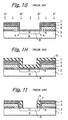
- a photoresist pattern layer 5 is formed on the silicon nitride layer 4 by a photolithography process. Then, the silicon nitride layer 4 and the boron-doped polycrystalline silicon layer 3 are etched by an anistopic dry etching process using the photoresist pattern layer 5 as a mask. Then, an opening is perforated in the silicon nitride layer 4 and the boron-doped polycrystalline silicon layer 3.
- the silicon oxide layer 2 is side-etched by an isotropic ethcing process, i.e., a wet etching process using the photoresist pattern layer 5, the silicon nitride layer 4 and the boron-doped polycrystalline silicon layer 3 as a mask. Then, the photoresist pattern layer 5 is removed.
- an isotropic ethcing process i.e., a wet etching process using the photoresist pattern layer 5, the silicon nitride layer 4 and the boron-doped polycrystalline silicon layer 3 as a mask.
- the silicon oxide layer 6a is etched by a wet etching process using hydrogen fluoride and using the silicon nitride layer 4 as a mask.
- the non-doped polycrystalline silicon layer 6 is left only on the sidewalls of the silicon oxide layer 6, so that the boron-doped polycrystalline silicon layer 3 is connected via the non-doped polycrystalline silicon layer 6 to the monocrystalline silicon substrate.
- the monocrystalline silicon substrate 1 is hardly etched, so that the surface thereof is flat.
- Figs. 1E and IF although the non-doped polycrystalline silicon layer 6 is oxidized, an anisotropic plasma etching process can be performed directly upon the non-doped polycrystalline silicon layer 6, so that the non-doped polycrystalline silicon layer 6 is left only on the sidewalls of the silicon oxide layer 6. Even in this case, the surface of the monocrystalline silicon substrate 1 is flat.
- a silicon nitride layer 9 is deposited on the entire surface by a CVD process.
- the silicon nitride layer 9 is etched back by an anisotropic dry etching process, and then, the silicon oxide layer 7 is etched by a wet etching process.
- a sidewall insulating layer serving as an isolation region between a base lead-out portion and an emitter lead-out portion is formed by the silicon oxide layer 7 and the silicon nitride layer 9.
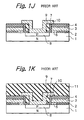
- an arsenic-doped polycrystalline silicon layer 10 is deposited on the entire surface by a CVD process. Then, the arsenic-doped polycrystalline silicon layer is patterned by a photolithography and etching process.
- an insulating layer 11 made of phospho-silicated glass (PSG) or the like is deposited on the entire surface by a CVD process.
- an annealing operation is carried out.
- boron ions are diffused from the boron-doped polycrystalline silicon layer 3 via the non-doped polycrystalline silicon layer 6 into the monocrystalline silicon substrate 1, to form a P + -type graft base region 12 within the monocrystalline silicon substrate.
- the P-type base region 8 per se is expanded by the annealing operation, so that the P-type base region 8 is in contact with the P + -type graft base region 12.
- the edged portions X remain in the P-type base region 8.
- arsenic ions are diffused from the arsenic-doped polycrystalline silicon layer 10 into the monocrystalline silicon substrate 1, to form an N-type emitter region 13 within the P-type base region 8.
- a vertical NPN-type bipolar transistor having the monocrystalline silicon substrate 1 as a collector connected to a collector electrode (not shown) is completed.
- the P-type base region 8 is formed by implanting boron ions into the monocrystalline silicon substrate 1 whose surface is flat, the P-type base region 8 is edged as indicated by arrows X in Fig. 1M.
- a base-to-collector current is focused on the edged portions X, so that the base-to-collector breakdown voltage is mainly dependent upon the current flowing through the edged portions X, to decrease the base-to-collector breakdown voltage.
- the bipolar transistor is more-fined, the base-to-collector breakdown voltage is remarkably decreased.
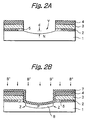
- the silicon nitride layer 4 and the boron-doped polycrystalline silicon layer 3 are etched by an anisotropic dry etching process using the photoresist pattern layer 5 as a mask. Then, an opening is perforated in the silicon nitride layer 4 and the boron-doped polycrystalline silicon layer 3. Then, the silicon oxide layer 2 is side-etched by an isotropic etching process, i.e., a wet etching process using the photoresist pattern layer 5, the silicon nitride layer 4 and the boron-doped polycrystalline silicon layer 3 as a mask. Then, the photoresist pattern layer 5 is removed. Then, a non-doped polycrystalline silicon layer 6 is deposited on the entire surface by a CVD process.
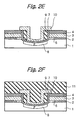
- an isotropic microwave plasma etching process is performed upon the non-doped polycrystalline silicon layer 6.
- the non-doped polycrystalline silicon layer 6 is left only on the sidewalls of the silicon oxide layer 6, so that the boron-doped polycrystalline silicon layer 3 is connected via the non-doped polycrystalline silicon layer 6 to the monocrystalline silicon substrate.
- the monocrystalline silicon substrate 1 is also etched by the isotropic microwave plasma etching process, so that the surface of the monocrystalline silicon substrate 1 is recessed and rounded, as indicated by an arrow Y.
- the depth "d" of the recessed and rounded portion Y is about 1000 to 1500 ⁇ .
- a silicon oxide layer 7 is deposited on the entire surface by a CVD process.
- boron ions are implanted into the monocrystalline silicon substrate 1 by using the silicon nitride layer 4 and the boron-doped polycrystalline silicon layer 3 as a mask.
- a P-type base layer 8 is formed within the monocrystalline silicon substrate 1.
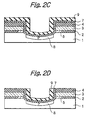
- the P-type base region 8 is edged as indicated by arrows Z.
- the sharpness of the edged portions Z are alleviated as compared with the edged portions X of Fig. 1G, due to the rounded surface of the monocrystalline silicon substrate 1.
- a silicon nitride layer 9 is deposited on the entire surface by a CVD process.
- the silicon nitride layer 9 is etched back by an anisotropic dry etching process, and then, the silicon oxide layer 7 is etched by a wet etching process.
- a sidewall insulating layer serving as an isolation region between a base lead-out portion and an emitter lead-out portion is formed by the silicon oxide layer 7 and the silicon nitride layer 9.
- an arsenic-doped polycrystalline silicon layer 10 is deposited on the entire surface by a CVD process. Then, the arsenic-doped polycrystalline silicon layer is patterned by a photolithography and etching process.
- an insulating layer 11 made of PSG or the like is deposited on the entire surface by a CVD process.
- annealing operation is carried out.
- boron ions are diffused from the boron-doped polycrystalline silicon layer 3 via the non-doped polycrystalline silicon layer 6 into the monocrystalline silicon substrate 1, to form a P + -type graft base region 12 within the monocrystalline silicon substrate 1.
- the P-type base region 8 per se is expanded by the annealing operation, so that the P-type base region 8 is in contact with the P + -type graft base region 12.
- the edged portions Z of the P-type base region 8 are absorbed into the P + -type graft base region 12.
- arsenic ions are diffused from the arsenic-doped polycrystalline silicon layer 10 into the monocrystalline silicon substrate 1, to form an N-type emitter region 13 within the P-type base region 8.
- a contact hole is perforated in the insulating layer 11, and then, an emitter electrode 14E is formed therein. Also, a base electrode 14B is formed and connected to the P + -type graft base region 12. Further, a collector electrode 15 is formed on the back surface of the monocrystalline silicon substrate 1.
- a vertical NPN-type bipolar transistor having the monocrystalline silicon substrate 1 as a collector connected to a collector electrode (not shown) is completed.
- the P-type base region 8 is formed by implanting boron ions into the monocrystalline silicon substrate 1 whose surface is recessed and rounded, the P-type base region 8 is rounded as illustrated in Fig. 2H.
- a base-to-collector current is not focused on the portions near the P + -type graft base region 12, so that the base-to-collector current is made uniform within the P-type base region 8, to increase the base-to-collector breakdown voltage.
- the base-to-collector breakdown voltage is not decreased.
- Fig. 3 which shows a relationship between the insertion gain G and the depth "d" of the recessed and rounded portion Y of the monocrystalline silicon substrate 1 of Fig. 2A
- the depth "d" is less than about 1500 ⁇
- the insertion gain G is not decreased.
- the depth "d" is more than about 1500 ⁇
- the length of the P-type base region 8 between the P + -type graft base regions 12 is substantially increased, so that the base resistance is increased, which would deteriorate the high frequency characteristics.
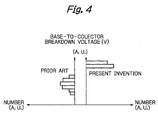
- the larger the depth "d” the larger the base-to-collector breakdown voltage.
- the depth "d" is more than about 500 ⁇ , particularly, more than about 1000 ⁇
- the base-to-collector breakdown voltage has been increased, as shown in Fig. 4.
- the depth "d" of the recessed and rounded portion Y of the monocrystalline silicon substrate 1 of Fig. 2A is about 500 ⁇ to 1500 ⁇ , preferably, about 1000 ⁇ to 1500 ⁇ .
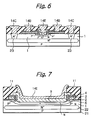
- Figs. 5, 6 and 7 are cross-sectional views taken along the lines VI - VI and VII-VII, respectively, of Fig. 5.
- reference numeral 21 designates a P-type monocrystalline silicon substrate
- 22 designates an N + -type buried collector region
- 23 designates an N + -type collector lead-out region.
- the N'-type buried collector region 22 and the N + -type collector lead-out region 23 as well as the N-type monocrystalline silicon substrate 1 can be formed by an epitaxial layer.
- reference numerals 14B and 14C designate a base electrode and a collector electrode, respectively.
- the above-described embodiment is related to a vertical NPN-type bipolar transistor; however, the present invention can be applied to a vertical PNP-type bipolar transistor.
- the base region 8 can be formed by a vapor phase diffusion process, a solid phase diffusion process or an epitaxial growth process.
- the base region is rounded, the base-to-collector breakdown voltage characteristics can be improved.
Landscapes
- Bipolar Transistors (AREA)
Applications Claiming Priority (2)
| Application Number | Priority Date | Filing Date | Title |
|---|---|---|---|
| JP2000071181A JP2001267326A (ja) | 2000-03-14 | 2000-03-14 | 半導体装置及びその製造方法 |
| JP2000071181 | 2000-03-14 |
Publications (1)
| Publication Number | Publication Date |
|---|---|
| EP1134797A2 true EP1134797A2 (fr) | 2001-09-19 |
Family
ID=18589803
Family Applications (1)
| Application Number | Title | Priority Date | Filing Date |
|---|---|---|---|
| EP01104417A Withdrawn EP1134797A2 (fr) | 2000-03-14 | 2001-02-26 | Transistor bipolaire ayant une surface creusée et arrondie et procédé pour sa fabrication |
Country Status (3)
| Country | Link |
|---|---|
| US (1) | US20010022386A1 (fr) |
| EP (1) | EP1134797A2 (fr) |
| JP (1) | JP2001267326A (fr) |
Cited By (2)
| Publication number | Priority date | Publication date | Assignee | Title |
|---|---|---|---|---|
| EP1289005A3 (fr) * | 2001-08-27 | 2004-06-16 | NEC Compound Semiconductor Devices, Ltd. | Procédé de fabrication d'un transistor bipolaire à émetteur et base auto-alignés |
| EP2372754A1 (fr) * | 2010-04-01 | 2011-10-05 | Nxp B.V. | Formation d'espaceurs dans la fabrication de transistors bipolaires planaires |
Families Citing this family (3)
| Publication number | Priority date | Publication date | Assignee | Title |
|---|---|---|---|---|
| JP2004022720A (ja) | 2002-06-14 | 2004-01-22 | Renesas Technology Corp | 半導体装置 |
| CN100361281C (zh) * | 2005-11-11 | 2008-01-09 | 中国电子科技集团公司第五十五研究所 | 半导体平台工艺 |
| CN102203912B (zh) * | 2008-10-31 | 2013-11-13 | 应用材料公司 | 改善p3i腔室中共形掺杂的方法 |
-
2000
- 2000-03-14 JP JP2000071181A patent/JP2001267326A/ja active Pending
-
2001
- 2001-01-29 US US09/770,247 patent/US20010022386A1/en not_active Abandoned
- 2001-02-26 EP EP01104417A patent/EP1134797A2/fr not_active Withdrawn
Cited By (5)
| Publication number | Priority date | Publication date | Assignee | Title |
|---|---|---|---|---|
| EP1289005A3 (fr) * | 2001-08-27 | 2004-06-16 | NEC Compound Semiconductor Devices, Ltd. | Procédé de fabrication d'un transistor bipolaire à émetteur et base auto-alignés |
| EP2372754A1 (fr) * | 2010-04-01 | 2011-10-05 | Nxp B.V. | Formation d'espaceurs dans la fabrication de transistors bipolaires planaires |
| CN102214572A (zh) * | 2010-04-01 | 2011-10-12 | Nxp股份有限公司 | 在制造平面双极型晶体管中的间隔物形成 |
| US8704335B2 (en) | 2010-04-01 | 2014-04-22 | Nxp, B.V. | Spacer formation in the fabrication of planar bipolar transistors |
| CN102214572B (zh) * | 2010-04-01 | 2014-11-05 | Nxp股份有限公司 | 在制造平面双极型晶体管中的间隔物形成 |
Also Published As
| Publication number | Publication date |
|---|---|
| US20010022386A1 (en) | 2001-09-20 |
| JP2001267326A (ja) | 2001-09-28 |
Similar Documents
| Publication | Publication Date | Title |
|---|---|---|
| US5320972A (en) | Method of forming a bipolar transistor | |
| US7968416B2 (en) | Integrated circuit arrangement with NPN and PNP bipolar transistors and corresponding production method | |
| JPH05335266A (ja) | 自己整合接点及びその形成方法 | |
| EP1134797A2 (fr) | Transistor bipolaire ayant une surface creusée et arrondie et procédé pour sa fabrication | |
| KR20030047274A (ko) | 초자기정렬 이종접합 바이폴라 소자 및 그 제조방법 | |
| US5882976A (en) | Method of fabricating a self-aligned double polysilicon NPN transistor with poly etch stop | |
| EP0948040B1 (fr) | Méthode pour la fabrication d'un transistor bipolaire capable de supprimer la détérioration des characteristiques de transistor | |
| US6603188B1 (en) | Polysilicon-edge, low-power, high-frequency bipolar transistor and method of forming the transistor | |
| EP0490236A2 (fr) | Procédé de fabrication pour des diodes à barrière de Schottky sur un substrat | |
| US6387768B1 (en) | Method of manufacturing a semiconductor component and semiconductor component thereof | |
| US6610143B2 (en) | Method of manufacturing a semiconductor component | |
| US6750528B2 (en) | Bipolar device | |
| US6579774B2 (en) | Semiconductor device fabrication method | |
| KR100210330B1 (ko) | 바이폴라 소자 및 이의 제조 방법 | |
| JP3186676B2 (ja) | 半導体装置の構造と製法 | |
| JPH0812866B2 (ja) | バイポーラ型半導体装置 | |
| EP0260058A1 (fr) | Procédé auto-aligné pour fabriquer des dispositifs semi-conducteurs du type bipolaire | |
| JP4122197B2 (ja) | 半導体装置の製造方法 | |
| JP2888652B2 (ja) | 半導体集積回路装置及びその製造方法 | |
| JPH05218319A (ja) | 半導体装置の製造方法 | |
| JPH1174366A (ja) | 半導体装置およびその製造方法 | |
| CN120583691A (zh) | 锗硅异质结双极晶体管及其制造方法 | |
| JPH0831843A (ja) | 半導体装置および半導体装置の製造方法 | |
| JP2003109965A (ja) | 半導体装置及びその製造方法 | |
| JPH11260829A (ja) | 半導体装置及びその製造方法 |
Legal Events
| Date | Code | Title | Description |
|---|---|---|---|
| PUAI | Public reference made under article 153(3) epc to a published international application that has entered the european phase |
Free format text: ORIGINAL CODE: 0009012 |
|
| AK | Designated contracting states |
Kind code of ref document: A2 Designated state(s): AT BE CH CY DE DK ES FI FR GB GR IE IT LI LU MC NL PT SE TR |
|
| AX | Request for extension of the european patent |
Free format text: AL;LT;LV;MK;RO;SI |
|
| RAP1 | Party data changed (applicant data changed or rights of an application transferred) |
Owner name: NEC ELECTRONICS CORPORATION |
|
| STAA | Information on the status of an ep patent application or granted ep patent |
Free format text: STATUS: THE APPLICATION HAS BEEN WITHDRAWN |
|
| 18W | Application withdrawn |
Effective date: 20030522 |