EP1134997A1 - Formation des groupes de terminaux dans un réseau de communications mobiles - Google Patents
Formation des groupes de terminaux dans un réseau de communications mobiles Download PDFInfo
- Publication number
- EP1134997A1 EP1134997A1 EP01440051A EP01440051A EP1134997A1 EP 1134997 A1 EP1134997 A1 EP 1134997A1 EP 01440051 A EP01440051 A EP 01440051A EP 01440051 A EP01440051 A EP 01440051A EP 1134997 A1 EP1134997 A1 EP 1134997A1
- Authority
- EP
- European Patent Office
- Prior art keywords
- terminal
- net
- telecommunications network
- assigned
- grp
- Prior art date
- Legal status (The legal status is an assumption and is not a legal conclusion. Google has not performed a legal analysis and makes no representation as to the accuracy of the status listed.)
- Withdrawn
Links
- 238000010295 mobile communication Methods 0.000 title 1
- 238000004891 communication Methods 0.000 abstract description 13
- 238000000034 method Methods 0.000 abstract description 8
- 101150117600 msc1 gene Proteins 0.000 description 71
- 230000006870 function Effects 0.000 description 25
- 101150080339 BTS1 gene Proteins 0.000 description 17
- 101100078001 Saccharomyces cerevisiae (strain ATCC 204508 / S288c) MSC2 gene Proteins 0.000 description 11
- 230000007704 transition Effects 0.000 description 9
- 230000001413 cellular effect Effects 0.000 description 7
- 230000011664 signaling Effects 0.000 description 6
- 238000013475 authorization Methods 0.000 description 4
- 230000001419 dependent effect Effects 0.000 description 4
- 102000047724 Member 2 Solute Carrier Family 12 Human genes 0.000 description 3
- 108091006621 SLC12A1 Proteins 0.000 description 3
- 108091006620 SLC12A2 Proteins 0.000 description 3
- 101001003569 Homo sapiens LIM domain only protein 3 Proteins 0.000 description 2
- 101000639972 Homo sapiens Sodium-dependent dopamine transporter Proteins 0.000 description 2
- 102100026460 LIM domain only protein 3 Human genes 0.000 description 2
- 102100032813 Hepatocyte growth factor-like protein Human genes 0.000 description 1
- 101001066435 Homo sapiens Hepatocyte growth factor-like protein Proteins 0.000 description 1
- 101000880431 Homo sapiens Serine/threonine-protein kinase 4 Proteins 0.000 description 1
- 230000000712 assembly Effects 0.000 description 1
- 238000000429 assembly Methods 0.000 description 1
- 230000010267 cellular communication Effects 0.000 description 1
- 230000008878 coupling Effects 0.000 description 1
- 238000010168 coupling process Methods 0.000 description 1
- 238000005859 coupling reaction Methods 0.000 description 1
- 238000010586 diagram Methods 0.000 description 1
- 230000007958 sleep Effects 0.000 description 1
Images

Classifications
-
- H—ELECTRICITY
- H04—ELECTRIC COMMUNICATION TECHNIQUE
- H04W—WIRELESS COMMUNICATION NETWORKS
- H04W4/00—Services specially adapted for wireless communication networks; Facilities therefor
- H04W4/06—Selective distribution of broadcast services, e.g. multimedia broadcast multicast service [MBMS]; Services to user groups; One-way selective calling services
Definitions
- the present invention relates to a method for managing a first and at least one second mobile radio terminal, which is via a mobile radio telecommunications network connections to communication partner terminals can build, according to the preamble of claim 1 and a device according to the preamble of claim 12, a program module according to the preamble of claim 13, a mobile terminal according to the Preamble of claim 14, a program module for a mobile radio terminal according to the preamble of claim 15 and an identification module for a Mobile radio terminal according to the preamble of claim 16.
- a subscriber the telecommunication services of a cellular telecommunication network want to avail, is usually a individual, participant-specific license as well as an individual Participant number assigned.
- each participant must therefore have a personal License to use the telecommunications services of the Acquire telecommunications network.
- a personal License can be very expensive, however.
- a subscriber does not just have one mobile terminal, but several The user has end devices, but only has a mobile radio license insert his SIM card into the device he wants to use. This is the case, for example, if the participant is on the one hand in his Motor vehicle wants to use built-in mobile terminal and on the other hand a terminal that he also carries with him outside of the motor vehicle. The respective replacement of the SIM card is uncomfortable for the subscriber and laborious.
- the invention is based on the idea of a plurality of mobile radio terminals to form a common mobile radio terminal group.
- This Terminal group is assigned a common subscriber number, under the respective end devices of the end device group for communication partners are reachable.
- the terminals in the terminal group also each receive one individual identifier with which the end devices can be distinguished. With help this identifier can be used for the telecommunications network Terminal group incoming call connections individually one Assign end device to the end device group. So for example it is with the initially mentioned example possible, both in the motor vehicle built-in terminal as well as usable outside the motor vehicle Assign terminal to a common mobile radio terminal group in which then only a cellular license is required.
- members of one Group of people for example for members of a family or one Working group, it is advantageous if it becomes a terminal group use summarized devices.
- the members of the group can namely can be reached via a common subscriber number, so that a external communication partner not individual subscriber numbers, but only has to remember the common participant number.
- a maximum number of simultaneous call connections e.g. one or two call connections to communication partner terminals outside the terminal group or between the terminals of the Device group are allowed.
- a group license assigned to a family on the one hand the respective Telecommunications network are optimally utilized and on the other hand one excessive and therefore costly use of the group license avoided become.
- the respective terminal-specific identifier that is assigned to a terminal Terminal group is assigned is in an advantageous variant of each transmitted to the terminal to the telecommunications network. So this can recognize when the terminal is ready for communication. It is also possible that the identifier is designed as a final digit, in addition to that of the Terminal group assigned subscriber number from one Communication partner is selectable.
- the end devices are then from the Telecommunications network like a telecommunications system with Subscriber-specific direct dialing is handled at each of the end devices can be individually addressed to the terminal group via the telecommunications network is. It is also possible that the telecommunications network is the respective Terminals of a terminal group individually such an identifier assigns when the terminals register with the telecommunications network.
- one of the terminals can be a preferred destination for incoming from the telecommunication network to the subscriber number call connections directed to the terminal group can be determined. So can for example, the participant mentioned at the beginning, who has both one in his Motor vehicle installed terminal as well as outside of the motor vehicle usable terminal operates, the terminal installed in the motor vehicle as set temporary preferred destination for incoming call connections, as long as the participant is in the motor vehicle.
- one of the terminals receives from one Terminal group a so-called master authorization. Only with this master authorization it is then possible to set parameters of the end device group as a whole or to modify individual devices in the device group. Such a Parameter is, for example, whether a terminal is the preferred destination for incoming Calls to be handled. With the help of the master authorization individual can Terminal devices in the group are blocked or released for call connections.
- the functions assigned to the master authorization are preferably carried out one or more passwords protected.
- Is the maximum number of call connections permitted simultaneously for a terminal group may be less than the number of end devices from a terminal in the terminal group to the telecommunications network sent connection request are not fulfilled by this.
- the telecommunications network then carries the connection request into one Queue on and establish the desired connection as soon as the above again falls below the specified maximum number of call connections.
- the Sequence of processing of those entered in such a queue Connection requests can be made in the respective connection requests specified destination numbers and / or the order of their entry in the queue may be dependent.
- a call connection can be made to a Terminal of a terminal group leads from this over the Telecommunications network to another terminal in the terminal group be passed on.
- the first terminal sends an instruction the telecommunications network, the respective call connection to the latter Switch terminal.
- FIG. 1 shows a very schematic arrangement in which a group of Cellular terminals M1, M2 and M3 as a group of terminals by one Telecommunications network NET can be operated.
- the telecommunications network NET is a cellular telecommunications network or a Network that is both cellular communication and wired Communication allowed.
- the telecommunications network NET are exemplary for other facilities, not shown in Figure 1, mobile switching centers MSC1 and MSC2 shown over a trunk group TR1 are interconnected.
- the switching centers MSC1 and MSC2 perform in addition to the invention Functions also known from so-called mobile switching centers Basic functions.
- the switching center MSC1 are an access device BTS1 and a control device BSC1 for controlling the Access device BTS1 assigned. Further the switching center MSC1 assigned access facilities are not for reasons of clarity shown.
- the access device BTS1 can, for example, function as a so-called base transceiver station of a mobile radio network.
- the Access device BTS 1 provides a radio interface for the terminals M1 to M3 available, which is expressed in Figure 1 by an indicated antenna is coming.
- the access device BTS1 and the control device BSC1 can also be integrated in the switching center MSC1.
- the switching center MSC1 Some important components are examples of the switching center MSC1 shown, namely a connecting means TRSC and a control means CPUSC and a memory means MEMSC.
- the control means CPUSC is a processor or to a group of processors that program code from program modules can execute, which are stored in the memory means MEMSC.
- the Control means CPUSC controls the functions of the switching center MSC1 and takes on, for example, the functions of the connection means TRSC Influence.
- the connection means TRSC, the control means CPUSC and the Memory means MEMSC are through connections not shown in Figure 1 interconnected.
- the switching center MSC1 can Have assemblies, e.g. a coupling network or an interface to one Network management system.
- the switching center MSC2 can also internally be equipped like the switching center MSC1.
- the exchange MSC2 can also be a conventional, well-known exchange.
- the access device BTS1 and the control device BSC1 also have storage means and control means, not shown, with which Program code saved or executed by program modules can be.
- the access device BTS1 can also be in the Control device BSC1 can be integrated.
- the switching center MSC2 are an access device BTS2 and a Control device BSC2 assigned.
- the access device BTS2 fulfills functions similar to the access device BTS1, the Control device BSC2 functions similar to the control device BSC1.
- the access device BTS1, the control device BSC1 and the Switch MSC1 and the access facility BTS2, the Control device BSC2 and the switching center MSC2 are mutually each connected.
- the mobile radio terminals M1, M2 and M3 are basically constructed the same way. Therefore, only the terminal M1 is explained in more detail below.
- an interface module M1TR From the terminal M1 are an interface module M1TR, a control means M1CPU as well Storage means M1MEM shown schematically.
- Other components such as Example a keyboard for entering commands, a microphone for voice input, a loudspeaker for voice output and a display for displaying For reasons of simplification, information is not shown in FIG. 1.
- the terminal M1 can transmit data via radio via the interface module M1TR exchange the telecommunications network NET.
- a radio connection C11 for this is between the terminal M1 and the access device BTS1 drawn as an example.
- the control means M1CPU is a processor or Arrangement of processors and controls the functions of the terminal M1.
- the control means M1CPU executes program code from program modules, which are stored in the storage means M1MEM.
- the terminal M2 has an interface module M2TR, the terminals M3 Interface module M3TR, each in its function the Interface module M1TR correspond. Furthermore, the terminals M2 and M3 Control means M2CPU or M3CPU, which basically have the same functions as fulfill the control means M1CPU. Furthermore, M2 and M3 are in the terminals Storage means M2MEM or M3MEM contain, the functions of which the Storage means correspond to M1MEM.
- the terminals M1 to M3 form a terminal group GRP, the one common subscriber number is assigned to GRPNR. Furthermore, the Terminal M1 an identifier ID1, the terminal M2 an identifier ID2 and an identifier ID3 is assigned to the terminal M3.
- the participant number GRPNR is in the respective storage means of the terminals M1 to M3 and in a database device DB of the mobile telecommunications network NET filed.
- the identifiers ID1 to ID3 are in the respectively assigned Terminals M1 to M3 and stored in the database device DB. With With the help of the identifiers ID1 to ID3, the terminals M1 to M3 can be customized can be addressed by the telecommunications network NET.
- the database device DB is in Figure 1 as a separate device designed, of which some essential components are shown by way of example, namely a connection means TRLR and a control means CPULR and Storage means MEMLR.
- connection means TRLR the Database device DB a data connection DAT1 to the exchange Build MSC1 as well as to other switching centers, not shown.
- the switching center MSC1 has access to the data connection DAT1 data stored in the database device DB.
- the control means CPULR is it a processor or a group of processors that Program code of program modules that can run in the Storage means MEMLR are stored.
- the identifiers ID1 to are also there ID3 and the participant number GRPNR saved.
- the control means CPULR controls the functions of the database device DB and thereby takes influence, for example, on the functions of the connecting means TRLR. Further the control means CPULR manages those stored in the memory means MEMLR Data.
- the connection means TRLR, the control means CPULR and the Storage means MEMLR are through connections not shown in Figure 1 interconnected.
- the database device DB can also be in the switching center MSC1 or in the access device BTS or integrated into the control device BSC1 his.
- the control means CPUSC then performs the functions of the control means CPULR and the memory means MEMSC the functions of the memory means MEMLR.
- one of the Switch MSC1 managed, accordingly modified so-called Home location register contains data from the GRP terminal group.
- the Database device DB can also be used in FIG Simplification data not shown can be stored.
- the switching center MSC2 can also access the database device DB access and, for example, create a mirror database when a Terminal of the terminal group GRP, for example terminal M3, in Framework of a so-called "roaming" in the radio area of the access device BTS2 stops.
- the terminal M1 When the terminal M1 registers with the telecommunications network NET, thus makes contact for the first time, the terminal M1 sends its identifier ID1 and further identification identifiers to the access device BTS1. Further procedures in the context of registering a device with one Mobile telecommunications network, for example the exchange of Passwords and the encryption of information are known per se and are therefore not to be explained further at this point.
- the Access device BTS1 gives the identifier ID1 to the Control device BSC1 further from where the identifier ID1 on the Switch MSC1 arrives at and from the database device DB is compared with the identifier ID1 already stored.
- the Switch MSC1 recognize that the terminal M1 of the terminal group GRP is assigned.
- the terminal M1 can be one of the terminal group GRP total assigned terminal group identifier to the Access device BTS1 and thus sends to the switching center MSC1 which the exchange MSC1 can recognize that the terminal M1 to the Terminal group GRP belongs.
- it can Telecommunications network NET the identifier ID1 each new to the terminal Assign M1 when logging in.
- the identifier ID1 can then for example generated by a random generator or as a continuous one Number of the respective terminal depending on the order of its Be assigned.
- the identifier ID1 can also be a Final number for the participant number GRPNR.
- SIM Subscriber Identity Module
- Such a SIM module is an identification module, which is usually based on a Card is arranged.
- the SIM module can either be in the terminal M1 or can also be inserted into another terminal. The respective terminal then reads the subscriber-specific data stored on the identification module and works with the read data.
- the terminal M1 With the help of a stored in the storage medium M1MEM and by the Control means M1CPU executed program module, the terminal M1 both the identifier ID1 and the subscriber number GRPNR evaluate. Furthermore, the interface module M1TR is also designed to Send and receive signaling telegrams in which the Identifier ID1 is included. Using the identifier ID1 or also based on another, not shown, the terminal group GRP The terminal M1 can be assigned to the terminal group identifier recognize that it is assigned to the GRP terminal group.
- the terminal M1 sends one Connection request on the connection C11 to the access device BTS1.
- the terminal M1 gives the connection request one Communication partner terminal device KPM1 assigned subscriber number.
- the Terminal KPM1 is also a mobile radio terminal, but could also be one Landline phone.
- the end device KPM1 becomes like other end devices KPM2 and KPM3 served by the switching center MSC2. According to the The switching center MSC1 establishes a connection on the Line bundle TR1 to the switching center MSC2, from where the Connection then via a radio link C21 to the terminal KPM1 is completed.
- the mobile radio terminal device KPM2 then sends on a connection C22 a connection request to the GRP terminal group to the Access device BTS2.
- this connection request is the Participant number GRPNR of the terminal group GRP included.
- the Switch MSC2 therefore builds one on the trunk group TR1 Connection to the switching center MSC1. This is determined using an in the table stored in the database device DB that the terminal M1 the preferred call destination within the terminal group GRP is that to the Terminal M1, however, is already connected. Therefore, the Switch MSC1 via the access device BTS1 a connection C12 to the terminal M2 as an alternative call destination. However, it is also possible that only one call connection is permitted for the GRP terminal group.
- the switching center MSC1 signals the switching center MSC2, that currently no connection to the GRP terminal group is possible and the terminal KPM2 receives a "busy" character. It is also possible that in the connection request of the identifier sent by the terminal device KPM2 ID3 is included, for example in the form of an in addition to the Subscriber number GRPNR dialed final digit, so that the exchange MSC1 immediately and without considering a more preferred connection C13 to the terminal M3. Furthermore, it can also be stipulated that the Terminal group GRP always directed connection requests to the Terminal M3 should be put through and only if this is not can be reached, are forwarded to the terminal M1 or M2. The data in Regarding the preferred destinations in the GRP terminal group are in the Database device DB entered.
- the terminal M1 connects C11 and the terminal M2 the connection C12 to the access device BTS1 to chat. It should also be specified that only two simultaneous connections for the terminal group GRP are allowed. If the terminal M3 now on a Connection C13 a connection request for a connection to the terminal KPM3 sends, the switching center MSC1 determines that the permissible number of connections for the GRP terminal group has been reached. The Switch MSC1 therefore sends terminal M3, for example "Occupied" sign or a message with information that the Connection request cannot be fulfilled at the moment.
- the switching center MSC1 carries the connection request of the Terminal MR3 in a queue. If, for example, that Terminal M2 terminates its connection C12, reads the exchange MSC1 the connection request of the terminal M3 entered in the queue off and establishes the desired call connection. Are in the queue
- the switching center can enter several call connection requests MSC1 determine which of these connection requests should be processed preferentially. It is possible, for example, that the connection requests in the Order of their entry can be processed again or that for example, the last connection request entered was processed first becomes.
- the switching center MSC1 can also be used in the respective in the Queue entered connection requests entered destination numbers evaluate, and connection requests to preferred destinations give preference to.
- the switching center MSC1 When the connection request sent from the terminal M3 turns on preferred destination, for example to an emergency call device, it is also possible that the switching center MSC1 the connection C12 or the Connection C11 is terminated or interrupted by the terminal M3 establish the desired connection immediately.
- the respective terminal M1 or M2 the switching center MSC1 can, for example, an announcement message send that the respective connection C11 or C12 is interrupted becomes.
- the switching center MSC1 After the terminal M3 the call connection thus established again has ended, the switching center MSC1 can also the original Reconnect connections C12 or C11.
- the terminal M2 sends the Switch MSC1 an instruction that the terminal M3 in place of Terminal M2 one between the terminal M2 and the terminal KPM2 existing connection C12-TR1-C22 should take over. Then the Switch MSC1 connects C13 and switches the connection C12-TR1-C22 to the desired connection C13-TR1-C22.
- the terminal M1 is a so-called master function assigned.
- Terminal M1 is therefore entitled to the terminal group GRP-assigned parameters and the respective end devices M2 and M3 to modify individually assigned parameters.
- Such parameters are for example, in what order for the terminal group GRP incoming connection requests through the switching center MSC1 are edit.
- a connection is first created established between the terminal M1 and the connection point MSC1. Then an identification code and a password on the terminal M1 indicated by which the switching center MSC1 can recognize that the Terminal M1 is authorized to modify the data.
- the end device can M1 e.g.
- a so-called WAP browser execute, via which the terminal M1 to its respective operator from the Exchange MSC1 can display sent configuration data.
- WAP Wireless Application Protocol
- about the WAP browser can be specified on the terminal M1, for example, that the maximum number of simultaneous call connections for the Terminal group GRP is limited to two call connections or that first of all through incoming connection requests to the terminal M1 are and if this is not ready to receive, to the terminal M2 and possibly to be signaled to the terminal M3.
- the terminal M1 e.g. also the terminal M2 for call connections via the Telecommunications network NET blocked or released.
- the Master function can also call specific destinations, for example particularly intensive service numbers for all end devices M1 to M3 Terminal group GRP can be blocked.
- the terminal M1 can Master function permanently or temporarily to the end device M2 or the end device Delete M3.
- the respective of the terminal M1 in the context of The exchange MSC1 carries the data sent in the master function Database device DB.
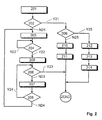
- FIG. 2 shows a flowchart for a connection request made by the Terminal M1 is sent to the switching center MSC1 in a step 201.
- the switching center MSC1 checks whether the maximum number of call connections of the GRP terminal group is maintained via the telecommunications network NET. If not, comes the exchange MSC1 to a negative result N21 and therefore goes to a step 203 in which the switching center MSC1 the desired call connection establishes and the existence of the call connection in the Database device DB enters.
- the checks Switch MSC1 whether the call connection from the terminal M1 or whose communication partner has ended.
- Step 204 is in that Diagram shown in Figure 2 as an endless loop, in which step 204 in each case if the result is negative N22, that is to say if the terminal M1 still holds it Connection, is repeated.
- the exchange is MSC1 event-driven, so that the process shown in Figure 2 "sleeps" until a Another process, not shown, is the termination of terminal M1 held call connection to the process shown in Figure 2 as an event Y22 reports so that it "wakes up", that is, continues.
- the Switch MSC1 When the call connection of the terminal M1 is ended, the Switch MSC1 the related status information of the terminal M1 in the database device DB and checked in one subsequent step 206, whether there may already be connection requests in the Queue mentioned in connection with Figure 1 for Connection requests are.
- step 207 MSC1 immediately registered the queued saved connection is established. Simultaneously with the signaling mentioned the switching center MSC1 starts a timer with a predetermined runtime, in which the respective device must establish the connection that is now possible.
- a step 208 the switching center MSC1 checks whether the timer has expired. If so, switch MSC1 goes in one Transition Y24 back to step 206 and checks for more Connection requests are in the queue.
- the exchange MSC still receives in during the running time of the timer step 208 a connection request from the terminal to which the Possibility of a connection has been signaled, so the exchange goes in a transition N24 back to step 203 and builds the desired call connection and removes the connection request from the Queue.
- the switching center MSC1 goes in one with Y21 designated transition to a step 209 in which checks whether the connection request is an emergency call or a call to one preferred target concerns. If this is not the case, then N24 becomes in a transition proceeded to a step 210 in which the terminal M1 is signaled that no call is currently possible. In a step 211, the Connection request entered in the queue and to the end step 2END passed.
- step 209 the switching center MSC1 comes to the conclusion that the connection request received in step 201 is an emergency call or an If a call to a preferred destination is concerned, it goes to in a transition Y25 a step 212, in which a terminal is selected, its call connection should now be interrupted.
- a step 213 the Switch MSC1 this terminal that its call connection ends is terminated and terminates its call connection. Furthermore, in step 213 also be noted that the call connection now ended after Completion of the emergency call is to be resumed.
- the switching center MSC1 fulfills the one received in step 201 Connection request and establishes the desired emergency call connection. Then it will be proceeded to the end step 2END.
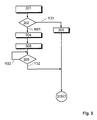
- FIG. 3 shows the treatment of one for the terminal group GRP in the Switch MST1 arriving in a step 301 Connection request.
- the exchange checks MSC1 whether one or more of the terminals M1 to M3 are ready to receive and whether the allowed for the maximum number of GRP for the terminal group Call connections have not yet been reached. Is this maximum number reached, goes the switching center MSC1 in a transition Y31 to a step 303 in which the switching center MSC1 signals to the caller that the Terminal group GRP is currently not available.
- the Switch MSC1 the unsatisfied connection request in a Enter the queue for unfulfilled connection requests, e.g. in a Callback On Busy Queue.
- Step 303 leads directly to one End-step 3END.
- the switching center MSC1 goes in a transition N31 to a step 304 in which the switching center MSC1 queries the data relevant for the GRP terminal group.
- the switching center MSC1 determines in step 304 to which of the Terminals M1 to M3 the present connection request is to be put through. in the In the present case, the connection request to the terminal M2 must be put through.
- the exchange MSC1 therefore makes the desired call connection in a step 305 to the terminal M2.
- the Exchange MSC1 also check in this step which of the Terminals M1 or M3 should be selected as an alternative call destination.
- Step 306 is configured analogously to step 204 from FIG. the Switch MSC1 checks in step 306 whether the terminal M2 or whose communication partner terminal the connection now established break up. If the result is negative, step 306 is in a path N32 repeated, if the result is positive, the exchange MSC1 comes in one Transition Y32 to step 3 END.
- FIGS. 2 and 3 are program modules realized, preferably by the control means CPUSC Switch MSC1 run. Such program modules can but also by control means of the access device BTS1 and / or Control device BSC1 are executed.
- soft keys i.e. context-dependent function keys
- the Configuration of the master functions on the terminal M1 via such Function keys can be implemented.
- DECT digital European Cordless Telecommunication
- the Terminals M1 to M3 with each other via the telecommunications network NET can communicate, especially if the each internally communicating devices in the area of a single Access device, e.g. the access device BTS1, or one Switching center, e.g. the exchange MSC1.
Landscapes
- Engineering & Computer Science (AREA)
- Multimedia (AREA)
- Computer Networks & Wireless Communication (AREA)
- Signal Processing (AREA)
- Mobile Radio Communication Systems (AREA)
- Telephonic Communication Services (AREA)
Applications Claiming Priority (2)
| Application Number | Priority Date | Filing Date | Title |
|---|---|---|---|
| DE10012945A DE10012945A1 (de) | 2000-03-16 | 2000-03-16 | Verfahren, Endgerät und Infrastruktureinrichtung zur Bildung von Endgerätegruppen in einem Mobilfunk-Telekommunikationsnetz |
| DE10012945 | 2000-03-16 |
Publications (1)
| Publication Number | Publication Date |
|---|---|
| EP1134997A1 true EP1134997A1 (fr) | 2001-09-19 |
Family
ID=7635036
Family Applications (1)
| Application Number | Title | Priority Date | Filing Date |
|---|---|---|---|
| EP01440051A Withdrawn EP1134997A1 (fr) | 2000-03-16 | 2001-02-28 | Formation des groupes de terminaux dans un réseau de communications mobiles |
Country Status (7)
| Country | Link |
|---|---|
| US (1) | US20010023187A1 (fr) |
| EP (1) | EP1134997A1 (fr) |
| JP (1) | JP2001313986A (fr) |
| CN (1) | CN1314769A (fr) |
| AU (1) | AU2485401A (fr) |
| CA (1) | CA2340860A1 (fr) |
| DE (1) | DE10012945A1 (fr) |
Families Citing this family (18)
| Publication number | Priority date | Publication date | Assignee | Title |
|---|---|---|---|---|
| US7221933B2 (en) | 2001-10-22 | 2007-05-22 | Kyocera Wireless Corp. | Messaging system for mobile communication |
| US20040205244A1 (en) * | 2003-02-14 | 2004-10-14 | Marsico Robert G. | Network device management |
| US7171194B2 (en) * | 2003-02-14 | 2007-01-30 | Maxon, Llc | Network device management |
| US7486649B2 (en) * | 2003-02-14 | 2009-02-03 | Marsico Robert G | Telephone management system and method |
| KR100548370B1 (ko) * | 2003-07-04 | 2006-02-02 | 엘지전자 주식회사 | 영상 통화 휴대 단말기의 영상 송신 선택 장치 |
| JP4412456B2 (ja) * | 2003-10-09 | 2010-02-10 | 日本電気株式会社 | 移動体通信システム |
| US7050785B2 (en) | 2003-12-08 | 2006-05-23 | Research In Motion Limited | Apparatus and method of explicit indication of call from emergency call centre |
| GB0421408D0 (en) * | 2004-09-25 | 2004-10-27 | Koninkl Philips Electronics Nv | Registration of a mobile station in a communication network |
| KR100651951B1 (ko) * | 2004-10-28 | 2006-12-07 | 엘지전자 주식회사 | 이동통신 단말기의 전화번호 설정 방법 |
| US20090157798A1 (en) * | 2005-02-17 | 2009-06-18 | Infineon Technologies Ag | Management of dynamic groups in a communication system |
| KR101078175B1 (ko) * | 2007-02-12 | 2011-10-28 | 이민화 | 이동 단말 사용자들의 가상 그룹을 형성하는 시스템 및방법 |
| US7933581B2 (en) * | 2007-06-08 | 2011-04-26 | Research In Motion Limited | Methods and apparatus for use in processing disconnected emergency calls and other communications involving mobile communication devices and the remote monitoring thereof |
| CN101945368A (zh) * | 2009-07-06 | 2011-01-12 | 华为技术有限公司 | 群组计费方法、计费处理装置以及通信系统 |
| EP2504985B1 (fr) * | 2009-11-23 | 2019-02-27 | Telefonaktiebolaget LM Ericsson (publ) | Contrôle d'accès selon une politique définie pour un groupe de dispositifs électroniques associés comprenant un modem cellulaire |
| EP3216238B1 (fr) * | 2014-11-03 | 2020-06-03 | ZTE Corporation | Fonction de communication de groupe permettant de distribuer des messages de communication de groupe dans des réseaux de communication |
| JP7139658B2 (ja) * | 2018-03-30 | 2022-09-21 | ソニーグループ株式会社 | 情報処理装置、情報処理方法、およびプログラム |
| CA3108091A1 (fr) | 2018-07-30 | 2020-02-06 | Dejero Labs Inc. | Systeme et procede servant a adapter des communications en reponse a des renseignements exploitables |
| CN112055365B (zh) * | 2020-09-16 | 2024-04-09 | 北京数码视讯技术有限公司 | 终端组网的方法及装置、终端、可读存储介质 |
Citations (6)
| Publication number | Priority date | Publication date | Assignee | Title |
|---|---|---|---|---|
| EP0711090A2 (fr) * | 1994-11-07 | 1996-05-08 | Oki Electric Industry Co., Ltd. | Système de radio-communication capable d'utiliser une pluralité d'identités d'abonnés partageant une seule identité d'abonné |
| US5574977A (en) * | 1995-04-17 | 1996-11-12 | Telefonaktiebolaget Lm Ericsson | System and method for providing priority access and channel assignment in a cellular telecommunication system |
| EP0858233A2 (fr) * | 1996-12-27 | 1998-08-12 | AT&T Corp. | Extension du service cellulaire |
| WO1999001998A1 (fr) * | 1997-07-02 | 1999-01-14 | Telefonaktiebolaget Lm Ericsson (Publ) | Abonnement de groupe a un radiotelephone mobile |
| US5943620A (en) * | 1996-12-09 | 1999-08-24 | Ericsson Inc. | Method for associating one directory number with two mobile stations within a mobile telecommunications network |
| EP1058465A2 (fr) * | 1999-06-03 | 2000-12-06 | AT&T Corp. | Téléphones sans fil multiples différentiables par un seul numéro d'identité mobile |
-
2000
- 2000-03-16 DE DE10012945A patent/DE10012945A1/de not_active Withdrawn
-
2001
- 2001-02-28 EP EP01440051A patent/EP1134997A1/fr not_active Withdrawn
- 2001-03-02 AU AU24854/01A patent/AU2485401A/en not_active Abandoned
- 2001-03-02 US US09/796,652 patent/US20010023187A1/en not_active Abandoned
- 2001-03-09 JP JP2001066193A patent/JP2001313986A/ja not_active Withdrawn
- 2001-03-15 CA CA002340860A patent/CA2340860A1/fr not_active Abandoned
- 2001-03-16 CN CN01111603.XA patent/CN1314769A/zh active Pending
Patent Citations (6)
| Publication number | Priority date | Publication date | Assignee | Title |
|---|---|---|---|---|
| EP0711090A2 (fr) * | 1994-11-07 | 1996-05-08 | Oki Electric Industry Co., Ltd. | Système de radio-communication capable d'utiliser une pluralité d'identités d'abonnés partageant une seule identité d'abonné |
| US5574977A (en) * | 1995-04-17 | 1996-11-12 | Telefonaktiebolaget Lm Ericsson | System and method for providing priority access and channel assignment in a cellular telecommunication system |
| US5943620A (en) * | 1996-12-09 | 1999-08-24 | Ericsson Inc. | Method for associating one directory number with two mobile stations within a mobile telecommunications network |
| EP0858233A2 (fr) * | 1996-12-27 | 1998-08-12 | AT&T Corp. | Extension du service cellulaire |
| WO1999001998A1 (fr) * | 1997-07-02 | 1999-01-14 | Telefonaktiebolaget Lm Ericsson (Publ) | Abonnement de groupe a un radiotelephone mobile |
| EP1058465A2 (fr) * | 1999-06-03 | 2000-12-06 | AT&T Corp. | Téléphones sans fil multiples différentiables par un seul numéro d'identité mobile |
Also Published As
| Publication number | Publication date |
|---|---|
| DE10012945A1 (de) | 2001-09-20 |
| CN1314769A (zh) | 2001-09-26 |
| US20010023187A1 (en) | 2001-09-20 |
| JP2001313986A (ja) | 2001-11-09 |
| AU2485401A (en) | 2001-09-20 |
| CA2340860A1 (fr) | 2001-09-16 |
Similar Documents
| Publication | Publication Date | Title |
|---|---|---|
| DE69108454T2 (de) | Verfahren zur Anrufsvermittlung für einen Teilnehmer eines schnurlosen Telefondienstes. | |
| DE69825420T2 (de) | Schnurloses übertragungssystem und betriebsverfahren zur betrugseindämmung | |
| DE69217545T2 (de) | Verfahren zur durchführung einer standortsaktualisierung von einem zellularen mobilfunksystem zu einem anderen zellularen funktelefonsystem | |
| DE69532629T2 (de) | System und verfahren zur vorrangsgesteuerten anrufumlenkung von ferngesprächen zu teilnehmern | |
| DE69732519T2 (de) | Mobilitätsverwaltungssystem in einem persönlichen Kommunikationssystem | |
| DE10012945A1 (de) | Verfahren, Endgerät und Infrastruktureinrichtung zur Bildung von Endgerätegruppen in einem Mobilfunk-Telekommunikationsnetz | |
| DE69927867T2 (de) | System zum Integrieren von privaten Kommunikationsendgeräten | |
| DE60035921T2 (de) | Mehrere unterschiedliche drahtlose Hangeräte mit einer einzigen mobilen Identitätsnummer | |
| DE19814450A1 (de) | Steuervorrichtung, Steuerverfahren und Telekommunikationssystem zum Steuern des Aufbaus von Anrufen zwischen Teilnehmerstationen | |
| DE69527302T2 (de) | Anrufsteuerung in einem telekommunikationssystem | |
| DE69433628T2 (de) | Einrichtung in einem telekommunikationssystem | |
| DE4292232C2 (de) | Verfahren zum Verbindungsaufbau zwischen einem Funktelefon-Teilnehmer mit einem Anrufer innerhalb eines Funktelefonnetzwerkes | |
| DE19520632C2 (de) | Verfahren und Anordnung zum Rufen eines Teilnehmers über ein Mobilfunknetz | |
| EP1104978A1 (fr) | Procédé et dispositif pour la selection de services | |
| DE69534611T2 (de) | Kommunikationsverfahren mit allgemeiner benutzung eines mobilkommunikationsendgerätes und kommunikationssystemsteuereinrichtung dafür | |
| EP0544100B1 (fr) | Méthode permettant l'écoute accompagnée pour téléphone sans fil | |
| DE69824228T2 (de) | Mobilitätsverwaltungssystem für ein verteiltes Kommunikationssystem | |
| DE69320174T2 (de) | Aufnahme der teilnehmerdaten von der heimatdatei (hlr) in die besucherdatei (vlr) einer mobilen vermittlungsanlage (msc) im globalen mobilkommunikationssystem (gsm). | |
| DE69632036T2 (de) | Mobiles übertragungssystem mit intelligenten netzwerkdiensten | |
| DE69324989T2 (de) | Verbindungssteuerverfahren für persönliche Kommunikationen | |
| EP0929982B1 (fr) | Procede pour communiquer un appel arrivant dans une installation de telecommunication sans fil, a un terminal en mode binaire | |
| EP0973349A2 (fr) | Appeler un station mobile avec plusiers identités d'abonnés par radiodiffusion | |
| DE602004005148T2 (de) | Verfahren, Vorrichtung und Netzwerkanordnung zum Verbindungsaufbau in einem Kommunikationsnetz | |
| DE602004010027T2 (de) | System zur Mehrfachaussendung, sowie entsprechendes Kommunikationsendgerät | |
| EP0928120B1 (fr) | Gestion de l'accessibilité d'u terminal dans un réseau radio mobile et dans un réseau intelligent. |
Legal Events
| Date | Code | Title | Description |
|---|---|---|---|
| PUAI | Public reference made under article 153(3) epc to a published international application that has entered the european phase |
Free format text: ORIGINAL CODE: 0009012 |
|
| AK | Designated contracting states |
Kind code of ref document: A1 Designated state(s): AT BE CH CY DE DK ES FI FR GB GR IE IT LI LU MC NL PT SE TR |
|
| AX | Request for extension of the european patent |
Free format text: AL;LT;LV;MK;RO;SI |
|
| AKX | Designation fees paid |
Free format text: AT BE CH CY DE DK ES FI FR GB GR IE IT LI LU MC NL PT SE TR |
|
| STAA | Information on the status of an ep patent application or granted ep patent |
Free format text: STATUS: THE APPLICATION IS DEEMED TO BE WITHDRAWN |
|
| 18D | Application deemed to be withdrawn |
Effective date: 20020320 |