EP1136468A2 - Verfahren zur Herstellung von Diglyceroltetranitrat und Feststoffraketenmotortriebsatz dieses enthaltend - Google Patents
Verfahren zur Herstellung von Diglyceroltetranitrat und Feststoffraketenmotortriebsatz dieses enthaltend Download PDFInfo
- Publication number
- EP1136468A2 EP1136468A2 EP01302508A EP01302508A EP1136468A2 EP 1136468 A2 EP1136468 A2 EP 1136468A2 EP 01302508 A EP01302508 A EP 01302508A EP 01302508 A EP01302508 A EP 01302508A EP 1136468 A2 EP1136468 A2 EP 1136468A2
- Authority
- EP
- European Patent Office
- Prior art keywords
- diglycerol
- organic phase
- tetranitrate
- inert organic
- phase
- Prior art date
- Legal status (The legal status is an assumption and is not a legal conclusion. Google has not performed a legal analysis and makes no representation as to the accuracy of the status listed.)
- Withdrawn
Links
Images
Classifications
-
- C—CHEMISTRY; METALLURGY
- C06—EXPLOSIVES; MATCHES
- C06B—EXPLOSIVES OR THERMIC COMPOSITIONS; MANUFACTURE THEREOF; USE OF SINGLE SUBSTANCES AS EXPLOSIVES
- C06B25/00—Compositions containing a nitrated organic compound
- C06B25/10—Compositions containing a nitrated organic compound the compound being nitroglycerine
-
- C—CHEMISTRY; METALLURGY
- C06—EXPLOSIVES; MATCHES
- C06B—EXPLOSIVES OR THERMIC COMPOSITIONS; MANUFACTURE THEREOF; USE OF SINGLE SUBSTANCES AS EXPLOSIVES
- C06B45/00—Compositions or products which are defined by structure or arrangement of component of product
- C06B45/04—Compositions or products which are defined by structure or arrangement of component of product comprising solid particles dispersed in solid solution or matrix not used for explosives where the matrix consists essentially of nitrated carbohydrates or a low molecular organic explosive
- C06B45/06—Compositions or products which are defined by structure or arrangement of component of product comprising solid particles dispersed in solid solution or matrix not used for explosives where the matrix consists essentially of nitrated carbohydrates or a low molecular organic explosive the solid solution or matrix containing an organic component
- C06B45/10—Compositions or products which are defined by structure or arrangement of component of product comprising solid particles dispersed in solid solution or matrix not used for explosives where the matrix consists essentially of nitrated carbohydrates or a low molecular organic explosive the solid solution or matrix containing an organic component the organic component containing a resin
- C06B45/105—The resin being a polymer bearing energetic groups or containing a soluble organic explosive
-
- C—CHEMISTRY; METALLURGY
- C07—ORGANIC CHEMISTRY
- C07C—ACYCLIC OR CARBOCYCLIC COMPOUNDS
- C07C201/00—Preparation of esters of nitric or nitrous acid or of compounds containing nitro or nitroso groups bound to a carbon skeleton
- C07C201/02—Preparation of esters of nitric acid
Definitions
- This invention relates to a method of synthesizing diglycerol tetranitrate, which is an excellent plasticizer for energetic materials such as rocket motor propellants, explosives, and pyrotechnics.
- This invention is also directed to a solid rocket motor propellant comprising diglycerol tetranitrate as the plasticizer.
- Energetic materials used in solid rocket motor propellants, explosives, and pyrotechnics comprise an energetic material that, when ignited, releases sufficient amounts of energy to provide, in the case of a propellant, the interior pressures needed to attain rocket motor flight or, in the case of an explosive, sufficient energy to demolish an intended target.
- energetic materials comprise, among other ingredients, a fuel and oxidizing agent immobilized in a polymeric binder. Selection of an appropriate binder can enhance the mechanical properties of the energetic material. Enhanced mechanical properties are important for maintaining the structural integrity of the energetic materials during operation and storage, especially when the energetic materials are subjected to operation and storage conditions characterized by extremely low and high temperatures.
- Other ingredients are added to the composite solid propellant, as are needed or desired, to provide additional energy performance, improve the mechanical properties of the propellant, and/or simplify processing.
- Nitrate ester plasticizers have found wide acceptance as energetic plasticizers due to the ability of nitrate ester plasticizers to enhance energetic performance. Nitrate ester plasticizers provide the added benefits of improving rheological properties during processing, preventing crystallization of the binder, and enhancing mechanical properties of the energetic material.
- Inferior low temperature mechanical properties such as poor tensile strength and low strain capability, can generate mechanical strain in the energetic material at low temperatures and can promote the likelihood of fracture to the energetic material. For instance, in the case of a solid propellant grain, fractures in the propellant grain can, if widespread, significantly increase the propellant grain surface area available for combustion reaction. As a consequence, the chamber pressure created during combustion of a propellant grain can be increased to unanticipated levels, leading in extreme cases to catastrophic failure of the rocket motor in which the propellant grain is loaded upon ignition.
- nitrate ester plasticizers reach their freezing points well above the military design specification of -54°C.
- nitroglycerin has a freezing point of about -13°C.
- Butanetrioltrinitrate (BTTN) has a freezing point of -27°C.
- TMETN trimethylolethanetrinitrate
- nitrate ester plasticizer diglycerol tetranitrate
- nitroglycerin nitrate ester plasticizer for nitrocellulose-based explosives.
- BTTN nitrate ester plasticizer for nitrocellulose-based explosives.
- TMETN diglycerol tetranitrate does not have a freezing point, much less a freezing point below -54°C.
- Another problem of the conventional synthesis method stems from the solubility of the diglycerol tetranitrate in the mixed acid. During quenching an emulsion tends to form in the spent mixed acid. The emulsion is difficult and slow to separate from the spent mixed acid, thus increasing process time and the likelihood for fume-off.
- An object of this invention is to fulfill a long-felt need in the art by providing a method of synthesizing diglycerol tetranitrate that attains the above-discussed improvement.
- nitrating diglycerol in a nitrating (or reaction) medium comprising a mixed acid phase and an inert organic phase.
- the mixed acid phase comprises, as ingredients, at least one nitronium ion source capable of nitrating each of the four hydroxyl groups of diglycerol and at least one acid having sufficient strength to generate nitronium ions from the nitronium ion source.
- the inert organic phase comprises at least one organic liquid that is immiscible with the mixed acid phase, so that the inert organic phase and mixed acid phase are stratified. The organic liquid should neither dissolve nor nitrate the diglycerol.
- the inert organic phase provides a liquid medium for receiving from the mixed acid phase the diglycerol tetranitrate generated by nitration of the diglycerol.
- the diglycerol tetranitrate has greater solubility in the inert organic phase than the mixed acid phase, and upon synthesis migrates from the mixed acid phase to the inert organic phase.
- heat and diglycerol tetranitrate generated during the exothermic nitration reaction migrate from the mixed acid phase and into the inert organic phase, thereby reducing the likelihood of fume-off and degradation of diglycerol tetranitrate in the mixed acid phase.
- the migration of the diglycerol tetranitrate into the inert organic phase simplifies and improves the efficiency of diglycerol tetranitrate recovery, thereby providing improved yields compared to the conventional synthesis route.
- diglycerol tetranitrate yields are routinely on the order of 95% molar or greater according to the inventive method, and often approach or attain quantitative maximum yields.
- the spent mixed acid phase can then be neutralized and disposed of with lesser concerns over fume off and other safety issues.
- Synthesis by the method of this invention is particularly useful for making diglycerol tetranitrate for solid rocket motor propellants, especially tactical propellants designed for enduring storage and operating temperatures as low as -54°C.
- propellants comprising diglycerol tetranitrate have significantly better safety handling properties compared to other energetic plasticizers, such as BTTN.
- diglycerol tetranitrate exhibits a surprisingly low sensitivity to ignition and detonation from accidental impact and shock stimuli.
- Diglycerol tetranitrate is also characterized by high viscosity and low vapor pressures, improving the handleability and processability of diglycerol tetranitrate in the production of solid rocket motor propellants.
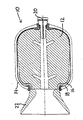
- the accompanying drawing serves to elucidate the principles of this invention by illustrating a rocket motor assembly in which a solid propellant comprising diglycerol tetranitrate made in accordance with the method of this invention may be loaded.
- Diglycerol is a tetraol ether usually found as a mixture of three isomers: 3,3'-oxy-di(1,2-propanediol), 2,2'-oxy-di(1,3-propanediol), and 2-(hydroxymethyl) -3-oxyhexane-1,5,6-triol.
- diglycerol includes one or a combination of more than one of these isomers.
- nitronium ion sources that can be used in accordance with the present invention to nitrate the diglycerol are nitric acid and nitronium salts, such as nitronium nitrate and nitronium tetrafluoroborate.
- the generation of nitronium ions from the nitronium ion source is performed with a strong acid.
- sulfuric acid is preferred, other strong acids and anhydrides capable of generating nitronium ions from the nitronium ion source, while being substantially inert with the nitronium ions, may be used as the strong acid in addition to or as an alternative for sulfuric acid.
- nitronium ions from the nitronium ion source include methane sulfonic acid (CH 3 SO 2 OH), acetic anhydride, acetic acid, and phosphoric acid, as well as combinations thereof.
- the molar ratio of nitronium ion source (e.g., nitric acid) to diglycerol is at least a stoichiometric amount of 4:1 (four nitronium ions for the four hydroxyl groups of each diglycerol), but preferably is not greater than about 10:1, more preferably 8:1, for economic reasons.
- nitric acid is used in combination with sulfuric acid to form a mixed acid phase.
- Various grades of nitric acid and sulfuric acid can be used to make the mixed acid phase, the proportions of mixed acid (nitronium ion source and strong acid) to water in the mixed acid phase can be from about 100:0 to about 80:20 by weight.
- the mixed acid phase Prior to the addition of diglycerol to the mixed acid phase, the mixed acid phase is combined with at least one organic liquid, which is immiscible with the mixed acid and stratifies the mixed acid phase to form a separate inert organic phase.
- the inert organic phase preferably comprises dichloromethane (also known as methylene chloride), although other chlorocarbons such as chloroform and dichloroethane may be used alone or in combination with dichloromethane to provide the inert organic phase.
- the chlorocarbons of the inert organic phase should be inert and non-solvents with respect to the diglycerol reagent, yet should be capable of dissolving the diglycerol tetranitrate into solution without degrading (or solvolyzing) the diglycerol tetranitrate.
- One of the advantages associated with the presence of the inert organic phase is that upon synthesis, the diglycerol tetranitrate product is removed from the mixed acid phase as the product is received into the inert organic phase, thus eliminating the risks and hazards of fume-off that would otherwise be associated with retention of the diglycerol tetranitrate in the mixed acid phase.
- a sufficient volume of inert organic phase should be present to permit all of the diglycerol tetranitrate product to be received into the inert organic phase.
- the weight ratio of inert organic phase to diglycerol tetranitrate is preferably at least 1:1.
- the temperature of the nitrating medium is preferably maintained in a range of from about 5°C to about 20°C, more preferably 10°C to 15°C. This may be accomplished, for example, by conducting the nitration reaction in a jacketed reactor.
- the inert organic phase containing the diglycerol tetranitrate can be separated from the mixed acid phase by liquid/liquid separation techniques known in the art, including phase inversion, in which a sufficient amount of water is added to the reaction medium to quench the mixed acid phase and cause the inert organic phase to become denser than the mixed acid phase. Separation funnels can be used to separate the inverted phases.
- Any residual acid in the separated inert organic phase can then be neutralized by addition of one or more suitable neutralization agents, typically in the form of a weak base or weak bases.
- suitable neutralization agents include: carbonates, such as sodium carbonate and potassium carbonate, and calcium carbonate; and bicarbonates, such as sodium bicarbonate, and potassium bicarbonate.
- the glycerol tetranitrate can then be separated from the organic liquid (e.g., methylene chloride), for example, by evaporation.
- organic liquid e.g., methylene chloride
- evaporation can be performed under reduced pressures at temperatures of about 30°C.
- the diglycerol tetranitrate is especially useful as a plasticizer for solid rocket motor propellants, including elastomer-based composite propellants, modified composite propellants, crosslinked double-base propellants, and other plasticized propellants.
- the propellant can also include one or more inert plasticizers, such as triacetin (glycerol triacetate), dioctyladipate, isodecylperlargonate, dioctylphthalate, dioctylmaleate, dibutylphthalate, di-n-propyl adipate, diethylphthalate, dipropylphthalate, CITROFLEX® , diethyl suberate, diethyl sebacate, diethyl pimelate, or combinations thereof.
- inert plasticizers such as triacetin (glycerol triacetate), dioctyladipate, isodecylperlargonate, dioctylphthalate, dioctylmaleate, dibutylphthalate, di-n-propyl adipate, diethylphthalate, dipropylphthalate, CITROFLEX® , diethyl suberate, dieth
- Solid rocket motor propellants also commonly include inorganic oxidizers and metal fuels.
- Representative inorganic oxidizers include, by way of example, ammonium perchlorate, ammonium nitrate, hydroxylammonium nitrate, ammonium dinitramide, potassium dinitramide, potassium perchlorate, or combinations thereof.
- Representative fuels include metals, such as aluminum, magnesium, boron, titanium, silicon, and alloys and/or mixtures thereof. The fuel and oxidizer may be present as powder, or in particulate or other forms.
- ingredients known in the art that optionally can be included in the solid propellant in various combinations include the following: bonding agents such as TEPANOL; energetic fillers such as nitramines; thermal stabilizers such as N-methyl-p-nitroaniline; ballistic modifiers such as titanium dioxide, lead compounds, and bismuth compounds; reinforcing fibers; and pressure oscillation stabilizers, such as zirconium carbide and alumina.
- bonding agents such as TEPANOL
- energetic fillers such as nitramines
- thermal stabilizers such as N-methyl-p-nitroaniline
- ballistic modifiers such as titanium dioxide, lead compounds, and bismuth compounds
- reinforcing fibers and pressure oscillation stabilizers, such as zirconium carbide and alumina.
- FIG. 10 An example of a rocket motor assembly comprising a solid rocket motor propellant containing diglycerol tetranitrate is shown in the Figure, in which the rocket motor assembly is generally designated by reference numeral 10.
- the assembly 10 includes a solid propellant grain 12 loaded within the interior surface of the rocket motor case 14.
- insulation 16 and a liner 18 are interposed between the case 14 and the solid propellant grain 12.
- the insulation 16 and the liner 18 serve to protect the case from the extreme conditions produced during combustion of the solid propellant grain 12.
- Methods for loading a rocket motor case 14 with the insulation 16, the liner 18, and the solid propellant grain 12 are known to those skilled in the art, and can be readily adapted without undue experimentation to incorporate the propellant of this invention.
- Liner compositions and methods for applying liners into a rocket motor case are also well known in the art. Also shown in the Figure is an igniter 20 attached to the forward end of the case 14 for igniting the solid propellant grain 12 and a nozzle assembly 22 attached at the aft end of the case 14 for expelling at high velocities combustion products generated during burning of the solid propellant grain 12.
- the organic phase was separated from the dilute acid with a separation funnel and was washed with 50 ml of saturated sodium bicarbonate solution. The organic phase was then dried over 5 grams of magnesium sulfate, filtered, and the volatiles were removed at 30°C under reduced pressure to give diglycerol tetranitrate as a pale yellow oil in 96% yield.
- the organic phase was separated from the dilute acid with a separation funnel and was washed twice with 500 ml of saturated sodium bicarbonate solution. The organic phase was then dried over 5 grams of magnesium sulfate, filtered, and the volatiles were removed at 30°C under reduced pressure to give diglycerol tetranitrate as a pale yellow oil in 96% yield.
Landscapes
- Chemical & Material Sciences (AREA)
- Organic Chemistry (AREA)
- Health & Medical Sciences (AREA)
- Life Sciences & Earth Sciences (AREA)
- Dispersion Chemistry (AREA)
- Molecular Biology (AREA)
- Crystallography & Structural Chemistry (AREA)
- Emergency Medicine (AREA)
- Organic Low-Molecular-Weight Compounds And Preparation Thereof (AREA)
Applications Claiming Priority (2)
| Application Number | Priority Date | Filing Date | Title |
|---|---|---|---|
| US19154800P | 2000-03-23 | 2000-03-23 | |
| US191548P | 2000-03-23 |
Publications (2)
| Publication Number | Publication Date |
|---|---|
| EP1136468A2 true EP1136468A2 (de) | 2001-09-26 |
| EP1136468A3 EP1136468A3 (de) | 2001-11-14 |
Family
ID=22705929
Family Applications (1)
| Application Number | Title | Priority Date | Filing Date |
|---|---|---|---|
| EP01302508A Withdrawn EP1136468A3 (de) | 2000-03-23 | 2001-03-19 | Verfahren zur Herstellung von Diglyceroltetranitrat und Feststoffraketenmotortriebsatz dieses enthaltend |
Country Status (1)
| Country | Link |
|---|---|
| EP (1) | EP1136468A3 (de) |
Family Cites Families (2)
| Publication number | Priority date | Publication date | Assignee | Title |
|---|---|---|---|---|
| DE181754C (de) * | ||||
| BE632627A (de) * | 1962-06-07 |
-
2001
- 2001-03-19 EP EP01302508A patent/EP1136468A3/de not_active Withdrawn
Also Published As
| Publication number | Publication date |
|---|---|
| EP1136468A3 (de) | 2001-11-14 |
Similar Documents
| Publication | Publication Date | Title |
|---|---|---|
| Klapötke | Chemistry of high-energy materials | |
| EP0120668B1 (de) | Azido-Nitramin | |
| US5567912A (en) | Insensitive energetic compositions, and related articles and systems and processes | |
| US6425966B1 (en) | Energetic plasticizer, and explosive and propellant composition containing same | |
| EP0066999B1 (de) | Verfahren zur gleichzeitigen Nitrierung von Trimethylolethan und Diethylenglycol | |
| US4421578A (en) | Castable high explosive compositions of low sensitivity | |
| Klapötke | Chemistry of high-energy materials: explosives, propellants, pyrotechnics | |
| US6291711B2 (en) | Guanylurea dinitramide, an explosive, propellant, rocket motor charge and gas generator | |
| US3306939A (en) | Orthoesters of 2,2,2-trinitroethanol | |
| US5472531A (en) | Insensitive explosive composition | |
| US20030089435A1 (en) | Method of synthesizing diglycerol tetranitrate, and solid rocket motor propellant containing the same | |
| US2461582A (en) | Nitramines and their preparation | |
| US3994756A (en) | Castable composite explosive compositions containing a mixture of trinitrobenzene and trinitroxylene | |
| Vandel’ et al. | Application of dinitramide salts | |
| KR960016613B1 (ko) | 탄두 및 고체로켓추진제용 폭약 | |
| EP1136468A2 (de) | Verfahren zur Herstellung von Diglyceroltetranitrat und Feststoffraketenmotortriebsatz dieses enthaltend | |
| Akhavan | Explosives and propellants | |
| US5205983A (en) | Energetic plasticizer and improved gas producing charges | |
| US3222233A (en) | Methylamine nitroform oxidizer in nitrocellulose, aluminum and metriol trinitrate propellants | |
| US5387297A (en) | 2,4-dinitroimidazole- a less sensitive explosive and propellant made by thermal rearrangement of molten 1,4 dinitroimidazole | |
| US4214929A (en) | Liquid monopropellants containing dissolved combustion modifiers | |
| NO156559B (no) | Apparat for paasetting av sting av et klebebaand paa en sammenhengende bane. | |
| US10246428B2 (en) | Insensitive plasticizer and melt-castable energetic material | |
| US3399235A (en) | Polynitro trifluoromethyl amines | |
| IL29373A (en) | Explosives containing an impact-sensitive liquid nitrated |
Legal Events
| Date | Code | Title | Description |
|---|---|---|---|
| PUAI | Public reference made under article 153(3) epc to a published international application that has entered the european phase |
Free format text: ORIGINAL CODE: 0009012 |
|
| AK | Designated contracting states |
Kind code of ref document: A2 Designated state(s): FR GB SE Kind code of ref document: A2 Designated state(s): AT BE CH CY DE DK ES FI FR GB GR IE IT LI LU MC NL PT SE TR |
|
| AX | Request for extension of the european patent |
Free format text: AL;LT;LV;MK;RO;SI |
|
| PUAL | Search report despatched |
Free format text: ORIGINAL CODE: 0009013 |
|
| AK | Designated contracting states |
Kind code of ref document: A3 Designated state(s): AT BE CH CY DE DK ES FI FR GB GR IE IT LI LU MC NL PT SE TR |
|
| AX | Request for extension of the european patent |
Free format text: AL;LT;LV;MK;RO;SI |
|
| 17P | Request for examination filed |
Effective date: 20020114 |
|
| RAP1 | Party data changed (applicant data changed or rights of an application transferred) |
Owner name: ALLIANT TECHSYSTEMS INC. |
|
| AKX | Designation fees paid |
Free format text: FR GB SE |
|
| 17Q | First examination report despatched |
Effective date: 20020718 |
|
| REG | Reference to a national code |
Ref country code: DE Ref legal event code: 8566 |
|
| STAA | Information on the status of an ep patent application or granted ep patent |
Free format text: STATUS: THE APPLICATION IS DEEMED TO BE WITHDRAWN |
|
| 18D | Application deemed to be withdrawn |
Effective date: 20030129 |