EP1136664A2 - Soupapes avec levée et calage variable - Google Patents
Soupapes avec levée et calage variable Download PDFInfo
- Publication number
- EP1136664A2 EP1136664A2 EP01830069A EP01830069A EP1136664A2 EP 1136664 A2 EP1136664 A2 EP 1136664A2 EP 01830069 A EP01830069 A EP 01830069A EP 01830069 A EP01830069 A EP 01830069A EP 1136664 A2 EP1136664 A2 EP 1136664A2
- Authority
- EP
- European Patent Office
- Prior art keywords
- timing system
- accordance
- valve
- inlet passage
- annular element
- Prior art date
- Legal status (The legal status is an assumption and is not a legal conclusion. Google has not performed a legal analysis and makes no representation as to the accuracy of the status listed.)
- Withdrawn
Links
Images




Classifications
-
- F—MECHANICAL ENGINEERING; LIGHTING; HEATING; WEAPONS; BLASTING
- F01—MACHINES OR ENGINES IN GENERAL; ENGINE PLANTS IN GENERAL; STEAM ENGINES
- F01L—CYCLICALLY OPERATING VALVES FOR MACHINES OR ENGINES
- F01L1/00—Valve-gear or valve arrangements, e.g. lift-valve gear
- F01L1/12—Transmitting gear between valve drive and valve
- F01L1/14—Tappets; Push rods
- F01L1/143—Tappets; Push rods for use with overhead camshafts
-
- F—MECHANICAL ENGINEERING; LIGHTING; HEATING; WEAPONS; BLASTING
- F01—MACHINES OR ENGINES IN GENERAL; ENGINE PLANTS IN GENERAL; STEAM ENGINES
- F01L—CYCLICALLY OPERATING VALVES FOR MACHINES OR ENGINES
- F01L1/00—Valve-gear or valve arrangements, e.g. lift-valve gear
- F01L1/02—Valve drive
- F01L1/04—Valve drive by means of cams, camshafts, cam discs, eccentrics or the like
- F01L1/047—Camshafts
- F01L1/053—Camshafts overhead type
- F01L1/0532—Camshafts overhead type the cams being directly in contact with the driven valve
-
- F—MECHANICAL ENGINEERING; LIGHTING; HEATING; WEAPONS; BLASTING
- F01—MACHINES OR ENGINES IN GENERAL; ENGINE PLANTS IN GENERAL; STEAM ENGINES
- F01L—CYCLICALLY OPERATING VALVES FOR MACHINES OR ENGINES
- F01L13/00—Modifications of valve-gear to facilitate reversing, braking, starting, changing compression ratio, or other specific operations
- F01L13/0015—Modifications of valve-gear to facilitate reversing, braking, starting, changing compression ratio, or other specific operations for optimising engine performances by modifying valve lift according to various working parameters, e.g. rotational speed, load, torque
- F01L13/0031—Modifications of valve-gear to facilitate reversing, braking, starting, changing compression ratio, or other specific operations for optimising engine performances by modifying valve lift according to various working parameters, e.g. rotational speed, load, torque by modification of tappet or pushrod length
-
- F—MECHANICAL ENGINEERING; LIGHTING; HEATING; WEAPONS; BLASTING
- F01—MACHINES OR ENGINES IN GENERAL; ENGINE PLANTS IN GENERAL; STEAM ENGINES
- F01L—CYCLICALLY OPERATING VALVES FOR MACHINES OR ENGINES
- F01L9/00—Valve-gear or valve arrangements actuated non-mechanically
- F01L9/10—Valve-gear or valve arrangements actuated non-mechanically by fluid means, e.g. hydraulic
- F01L9/11—Valve-gear or valve arrangements actuated non-mechanically by fluid means, e.g. hydraulic in which the action of a cam is being transmitted to a valve by a liquid column
-
- F—MECHANICAL ENGINEERING; LIGHTING; HEATING; WEAPONS; BLASTING
- F01—MACHINES OR ENGINES IN GENERAL; ENGINE PLANTS IN GENERAL; STEAM ENGINES
- F01L—CYCLICALLY OPERATING VALVES FOR MACHINES OR ENGINES
- F01L1/00—Valve-gear or valve arrangements, e.g. lift-valve gear
- F01L1/34—Valve-gear or valve arrangements, e.g. lift-valve gear characterised by the provision of means for changing the timing of the valves without changing the duration of opening and without affecting the magnitude of the valve lift
- F01L1/344—Valve-gear or valve arrangements, e.g. lift-valve gear characterised by the provision of means for changing the timing of the valves without changing the duration of opening and without affecting the magnitude of the valve lift changing the angular relationship between crankshaft and camshaft, e.g. using helicoidal gear
- F01L1/3442—Valve-gear or valve arrangements, e.g. lift-valve gear characterised by the provision of means for changing the timing of the valves without changing the duration of opening and without affecting the magnitude of the valve lift changing the angular relationship between crankshaft and camshaft, e.g. using helicoidal gear using hydraulic chambers with variable volume to transmit the rotating force
- F01L2001/34423—Details relating to the hydraulic feeding circuit
- F01L2001/34446—Fluid accumulators for the feeding circuit
-
- F—MECHANICAL ENGINEERING; LIGHTING; HEATING; WEAPONS; BLASTING
- F01—MACHINES OR ENGINES IN GENERAL; ENGINE PLANTS IN GENERAL; STEAM ENGINES
- F01L—CYCLICALLY OPERATING VALVES FOR MACHINES OR ENGINES
- F01L2307/00—Preventing the rotation of tappets
Definitions
- the present invention relates in general to the timing systems of i.c. engines, especially for motor vehicles, comprising at least one distribution shaft provided with cam means and at least one valve operated by the said cam means.
- the first of these envisages a twofold possibility of the distribution diagramme: normally the suction phase is advanced or retarded with respect to the exhaust phase, or a second suction valve is brought into operation at a certain speed of rotation, this with a view to obtaining at least two different distribution patterns in the course of engine use (one more suitable at low rotation regimes, the other for obtaining the maximum power).
- a compromise because the total valve opening angle, which necessarily remains constant, imposes limits on both the first and the second case.
- valve opening At low regimes and/or low loads the valve opening is retarded (but, consequently, this also applies as regards its closure) so as to avoid the discharge of unburnt gases in the exhaust phase. But when this is done, the pumping work has to be increased and there is a backflow of the gases already sucked in on account of the low intake speed. As a result one obtains a low volumetric efficiency and a smaller mechanical efficiency.
- the instantaneous phase variation produces a torque curve that is humped rather than homogeneous, because it is the resultant of two different curves that have apices well apart from each other.
- the second line is the one that aims at complicated intake manifolds, designed in such a way that, inserting two or three butterfly valves at particular points and combining the opening of one with the opening and/or closure of the others, there are created different lengths of the intake ducts, each suitable for obtaining the best possible torque, though necessarily only for a limited range of engine rotation regimes, thus exploiting both the inertia of the gases and the pressure waves set up by the opening and closing of the valves.
- the programmed intervention of these combinations gives rise - always within a particular range of engine rotation regimes - to a more favourable driving torque, but in this case, once again, the resulting curve is not homogeneous and is characterized by two or three humps corresponding to the various maximum values..
- the limit to the degree of poverty is however conditioned by the possibility of igniting the mixture (ignition must remain certain if damage to the catalytic silencer/converter is to be avoided), and ignition becomes more efficient as speed and turbulence become greater in both the intake ducts and the combustion chamber. But at low regimes and/or low loads greater speeds can be obtained only by reducing the passage section.
- the present invention has the purpose of attaining one or more of the objectives listed below:
- the aforesaid purposes can be obtained by means of the possibility of mechanically varying - either directly or via an electronic control, but in either case connected with the gas control of the i.c. engine - the position of appropriate oil passage holes in appropriately designed hydraulic tappet (valve follower) systems and thus to determine valve lifts and distribution diagrammes that can be gradually and continuously varied from zero to the maximum permitted by the cam and thus to introduce into the cylinder, and also at the most favourable moment, the quantity of air or of air-fuel mixture that is optimal no matter what the required running condition, and this without having to make use of a so-called "butterfly" choke valve.
- the invention envisages a timing system of i.c.
- engines especially for motor vehicles, comprising at least one distribution shaft provided with cam means, at least one suction or exhaust valve operated by the said cam means, and control means for providing variable lifts and timings of the said valve, in which between the said cam means and the valve there is arranged a hydraulic tappet system including a cup member and a piston delimiting therebetween a chamber that communicates with inlet passage means for feeding oil from a hydraulic circuit, wherein closure of said inlet passage means is performed by the said cup member as a result of displacement thereof towards the said piston operated by the said cam means, characterized by the fact that the position of the said inlet passage means can be selectively regulated in such a way as to correspondingly vary the moment at which they become closed by the said cup member and, consequently, retard or, respectively, advance the opening of the said valve i.e. decrease or increase the lift thereof, respectively.
- the invention will now be described by way of example with reference to an i.c. motor-vehicle-type engine with four cylinders, each provided with two suction valves and two exhaust valves.
- the reference number 1 generically indicates the cylinder head of the engine with two timing shafts 11 with respective cams 12 for operating respectively the suction valves and the exhaust valves indicated by the reference number 13 .
- suction valves 13 represented in detail in Figure 4, but can be applied identically to all the other valves of the engine.
- the suction valve 13 conventionally comprises a stem 14 that can move in a seating 17 of the cylinder head with which there is associated a hydraulic tappet that will be described in detail by reference to Figure 4.
- the said hydraulic tappet consists of a cup member 8 and a piston or pusher 7 that, together, delimit a chamber 15 connected - in a manner to be explained further on - to an oil passage hole 2 linked to the lubrication circuit of the engine.
- the cup member 8 of the hydraulic tappet is in contact with the profile of the appropriate cam 12 of the timing shaft 11 , while the piston 7 rests against the end of the stem 14 of the valve 13 .
- a return device that in the example here illustrated consists of a spring 25 that could, however, be replaced by any equivalent hydraulic or pneumatic arrangement.
- a return spring 9 designed for a modest load proportional to the weight of the cup member 8 .
- the cup member 8 and the piston 7 can slide axially within an annular element 4 that, in its turn, is housed in a stationary socket 16 inserted in the cavity 17.
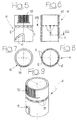
- the annular element 4 which is shown in greater detail in Figures 5 to 9, is of a general cylindrical shape and is mounted axially in such a manner as to be capable of sliding and rotating with respect to the socket 16 . On its outside it has a helicoidal groove 6 that engages with a fixed pin 3 projecting from the socket 16 , and it also bears a circumferential crown of apertures 5 .
- the annular element 4 is provided with a dented sector 18 that engages with a rack 10 running parallel with the timing shaft 11 and can be linearly displaced by means of an electric stepper (step-by-step) motor 19 .
- the apertures 5 place the chamber 15 in communication with the oil passage hole 2 through an opening 26 of the stationary socket 16.
- the annular element 4 can be made to rotate in either one or the other direction and, thanks to the interaction between the pin 3 and the helicoidal groove 6 , it is therefore displaced axially in such a way as to alter the axial position of the apertures 5 .
- the chamber 15 defined by the cup member 8 of the tappet and the piston 7 is therefore occupied by low-temperature oil that enters it from the lubrication circuit through the passage 2 , the opening 26 and the circumferential apertures 5 of the annular element 4 .
- the opening of the valve 13 can be retarded or advanced by varying the axial position of the apertures 5 with respect to the cup member 8 of the tappet, so that the lift of the valve can be adjusted to any desired value in a continuous and gradual manner.
- an electric stepper motor (electronic accelerator) is used to control the translation of the two racks 10 associated with, respectively, the suction valves and the exhaust valves 13 of the engine.
- the rotation of the annular elements 4 is obtained by means of endless screws 20 controlled in rotation by the electric stepper motor 19 .
- the linear displacement of the rack 10 is obtained by means of a linear actuator 21 , which may be of either the mechanical or the hydraulic type.
- Figures 16a, 16b and 16c illustrate the variations of the lift and the opening and closing angles of the valves 13 as a function of the axial positions of the of the annular elements 4 at, respectively, zero lift (Figure 16a), average lift (Figure 16b) and maximum lift (Figure 16c). These diagrammes also show the opening retards at low loads that, given the depression created in the engine cylinders and the instantaneous maximum linear speed of the pistons, that make it possible to obtain a high air turbulence and therefore better formation of the air-fuel mixture.
- the diagramme in Figure 17 provides an example of differentiated opening when there are two suction valves and shows the passage areas as functions of the desired angular distance between the appropriate annular elements 4 .
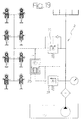
- Figure 19 shows an example of the hydraulic circuit 2 connected with the engine lubrication circuit and comprising not only a maximum pressure valve 22 and a pressure reduction valve 22, but also a small hydraulic accumulator that has the function of damping the pressure peaks.
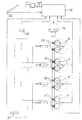
- Figure 20 shows an example of the layout of the control system, complete with the electric stepper motor 19 controlled by an electronic unit 24 that, with the help of sensors 30 , 31 and 32 of , respectively, the rotation regime, the quantity of air sucked in and the required torque (gas pedal), automatically regulates the position of the annular elements 4 associated with the suction and exhaust valves 13 of the engine, controlling also the injection and sparking equipment.
- the timing system as herein described has the following advantages:
Landscapes
- Engineering & Computer Science (AREA)
- Mechanical Engineering (AREA)
- General Engineering & Computer Science (AREA)
- Valve Device For Special Equipments (AREA)
- Valve-Gear Or Valve Arrangements (AREA)
- Output Control And Ontrol Of Special Type Engine (AREA)
Applications Claiming Priority (2)
| Application Number | Priority Date | Filing Date | Title |
|---|---|---|---|
| IT2000TO000131A IT1319908B1 (it) | 2000-02-10 | 2000-02-10 | Valvole per motori endotermici ad alzate e fasature variabili. |
| ITTO000131 | 2000-02-10 |
Publications (2)
| Publication Number | Publication Date |
|---|---|
| EP1136664A2 true EP1136664A2 (fr) | 2001-09-26 |
| EP1136664A3 EP1136664A3 (fr) | 2001-12-19 |
Family
ID=11457403
Family Applications (1)
| Application Number | Title | Priority Date | Filing Date |
|---|---|---|---|
| EP01830069A Withdrawn EP1136664A3 (fr) | 2000-02-10 | 2001-02-05 | Soupapes avec levée et calage variable |
Country Status (3)
| Country | Link |
|---|---|
| US (1) | US6516760B2 (fr) |
| EP (1) | EP1136664A3 (fr) |
| IT (1) | IT1319908B1 (fr) |
Cited By (4)
| Publication number | Priority date | Publication date | Assignee | Title |
|---|---|---|---|---|
| WO2007002582A1 (fr) * | 2005-06-27 | 2007-01-04 | Borgwarner Inc | Verin et methode de controle pour un mecanisme de distribution a programme variable |
| DE102009006894A1 (de) * | 2009-01-28 | 2010-07-29 | Iav Gmbh Ingenieurgesellschaft Auto Und Verkehr | Vorrichtung zur Schaltbetätigung eines hydraulischen Ventilspielausgleichselements |
| CN104454065A (zh) * | 2014-10-29 | 2015-03-25 | 浙江大学 | 气动发动机电液驱动全可变气门机构及全可变实现方法 |
| CN104454065B (zh) * | 2014-10-29 | 2017-01-04 | 浙江大学 | 气动发动机电液驱动全可变气门机构及全可变实现方法 |
Families Citing this family (10)
| Publication number | Priority date | Publication date | Assignee | Title |
|---|---|---|---|---|
| EP1380728B1 (fr) * | 2002-07-12 | 2005-04-06 | AVL List GmbH | Dispositif de commande de soupape |
| EP1493902A1 (fr) * | 2003-06-30 | 2005-01-05 | Ford Global Technologies, LLC, A subsidary of Ford Motor Company | Dispositif pour désactiver une soupape |
| KR101251712B1 (ko) | 2007-12-13 | 2013-04-05 | 현대자동차주식회사 | 가변식 밸브 리프트를 위한 태핏 구조 |
| KR20120050967A (ko) * | 2009-06-17 | 2012-05-21 | 발레오 시스템므 드 꽁트롤르 모뙤르 | 운동 전환 장치를 포함하는 밸브 |
| KR20120017982A (ko) * | 2010-08-20 | 2012-02-29 | 현대자동차주식회사 | 전기-유압 가변 밸브 리프트 장치 |
| KR101251818B1 (ko) * | 2011-10-04 | 2013-04-09 | 영신정공 주식회사 | 복수의 작동 수단에 의해 구동되는 밸브 리프트 장치 |
| FR3004752A1 (fr) * | 2013-04-22 | 2014-10-24 | Peugeot Citroen Automobiles Sa | Moteur a combustion de vehicule automobile a desactivation de cylindre hydraulique |
| DE112021000372T5 (de) | 2020-02-07 | 2022-09-29 | Eaton Intelligent Power Limited | Zylinderabschaltmechanismus fürstösselstangen-ventiltriebsysteme und kipphebel |
| CN113785106B (zh) | 2020-02-19 | 2026-05-22 | 伊顿智能动力有限公司 | 堞形装置、机械囊盒和摇臂 |
| CN116420006B (zh) | 2020-11-10 | 2026-04-21 | 康明斯有限公司 | 用于气门升程廓线修改的挺杆组件 |
Family Cites Families (9)
| Publication number | Priority date | Publication date | Assignee | Title |
|---|---|---|---|---|
| DE1191992B (de) * | 1961-10-11 | 1965-04-29 | Kloeckner Humboldt Deutz Ag | Ventilgesteuerte Hubkolbenbrennkraftmaschine mit hydraulisch betaetigtem Stellglied zur Veraenderung des Ventilhubes |
| JPS59101516A (ja) * | 1982-11-30 | 1984-06-12 | Hino Motors Ltd | 内燃機関のバルブの開閉装置 |
| JPH0612058B2 (ja) * | 1984-12-27 | 1994-02-16 | トヨタ自動車株式会社 | 可変バルブタイミング・リフト装置 |
| US4892067A (en) * | 1988-07-25 | 1990-01-09 | Paul Marius A | Valve control system for engines |
| US5002022A (en) * | 1989-08-30 | 1991-03-26 | Cummins Engine Company, Inc. | Valve control system with a variable timing hydraulic link |
| DE4124184A1 (de) * | 1991-07-20 | 1993-01-21 | Schaeffler Waelzlager Kg | Hydraulischer tassenstoessel |
| DE4221097A1 (de) * | 1992-06-26 | 1994-01-05 | Rexroth Mannesmann Gmbh | Ventilsteuerung für ein Ventil einer Brennkraftmaschine |
| IT1285853B1 (it) * | 1996-04-24 | 1998-06-24 | Fiat Ricerche | Motore a combustione interna con valvole ad azionamento variabile. |
| GB9612178D0 (en) * | 1996-06-11 | 1996-08-14 | Ricardo Consulating Engineers | Hydraulic tappets |
-
2000
- 2000-02-10 IT IT2000TO000131A patent/IT1319908B1/it active
-
2001
- 2001-02-05 EP EP01830069A patent/EP1136664A3/fr not_active Withdrawn
- 2001-02-12 US US09/780,352 patent/US6516760B2/en not_active Expired - Fee Related
Cited By (6)
| Publication number | Priority date | Publication date | Assignee | Title |
|---|---|---|---|---|
| WO2007002582A1 (fr) * | 2005-06-27 | 2007-01-04 | Borgwarner Inc | Verin et methode de controle pour un mecanisme de distribution a programme variable |
| DE102009006894A1 (de) * | 2009-01-28 | 2010-07-29 | Iav Gmbh Ingenieurgesellschaft Auto Und Verkehr | Vorrichtung zur Schaltbetätigung eines hydraulischen Ventilspielausgleichselements |
| DE102009006894B4 (de) * | 2009-01-28 | 2010-10-14 | Iav Gmbh Ingenieurgesellschaft Auto Und Verkehr | Vorrichtung zur Schaltbetätigung eines hydraulischen Ventilspielausgleichselements |
| US8166941B2 (en) | 2009-01-28 | 2012-05-01 | Iav Gmbh Ingenieurgesellschaft Auto Und Verkehr | Device for switching activation of a hydraulic valve play equalization element |
| CN104454065A (zh) * | 2014-10-29 | 2015-03-25 | 浙江大学 | 气动发动机电液驱动全可变气门机构及全可变实现方法 |
| CN104454065B (zh) * | 2014-10-29 | 2017-01-04 | 浙江大学 | 气动发动机电液驱动全可变气门机构及全可变实现方法 |
Also Published As
| Publication number | Publication date |
|---|---|
| ITTO20000131A1 (it) | 2001-08-10 |
| US20010013325A1 (en) | 2001-08-16 |
| IT1319908B1 (it) | 2003-11-12 |
| US6516760B2 (en) | 2003-02-11 |
| EP1136664A3 (fr) | 2001-12-19 |
Similar Documents
| Publication | Publication Date | Title |
|---|---|---|
| US5622144A (en) | System for operating internal combustion engine | |
| JP4154622B2 (ja) | ピストンエンジンの動作中において有効排気量および/または容積比を変更するための装置 | |
| USRE31917E (en) | Valve timing mechanisms | |
| US6516760B2 (en) | Valves for i.c. engines with variable lifts and timings | |
| US9181822B2 (en) | Variably operated valve system for multi-cylinder internal combustion engine and control apparatus for variably operated valve system | |
| JP2007332870A (ja) | 火花点火式内燃機関 | |
| US6386155B2 (en) | Internal combustion engine variable valve characteristic control apparatus and three-dimensional cam | |
| US5893345A (en) | Valve control apparatus for an internal combustion engine | |
| US6595170B2 (en) | Hydraulic valve-operating mechanism | |
| AU2003269033B2 (en) | Hydraulic valve actuator for reciprocating engine | |
| KR100258047B1 (ko) | 내연 기관의 밸브 특성 제어 장치 | |
| US10648373B2 (en) | Device for controlling at least one valve in an internal combustion engine | |
| EP0775252B1 (fr) | Systeme de distribution a programme variable | |
| KR101648620B1 (ko) | 내연 기관의 가변 밸브 작동 장치 | |
| JP2001059405A (ja) | カムおよび内燃機関の可変バルブ特性装置 | |
| JP4109795B2 (ja) | 弁作動特性可変装置 | |
| KR20080055396A (ko) | 가변 밸브 리프트 장치 | |
| KR100970051B1 (ko) | 왕복식 엔진용 유압 밸브 액츄에이터 | |
| KR970000749B1 (ko) | 자동차용 흡,배기 밸브 가변 개폐장치 | |
| KR960013355B1 (ko) | 자동차용 흡, 배기밸브 개폐 가변장치 | |
| JPH039026A (ja) | 内燃機関の吸排気装置 | |
| GB2466513A (en) | Computer controlled hydraulic and mechanical system for variable valve timing, valve lift and valve opening duration in car engines | |
| JPH08189317A (ja) | 弁開閉ゼロから連続可変する,弁タイミング装置. | |
| JPH11182219A (ja) | 可変バルブ | |
| JP2011137414A (ja) | エンジン可変動弁装置 |
Legal Events
| Date | Code | Title | Description |
|---|---|---|---|
| PUAI | Public reference made under article 153(3) epc to a published international application that has entered the european phase |
Free format text: ORIGINAL CODE: 0009012 |
|
| AK | Designated contracting states |
Kind code of ref document: A2 Designated state(s): AT BE CH CY DE DK ES FI FR GB GR IE IT LI LU MC NL PT SE TR |
|
| AX | Request for extension of the european patent |
Free format text: AL;LT;LV;MK;RO;SI |
|
| PUAL | Search report despatched |
Free format text: ORIGINAL CODE: 0009013 |
|
| AK | Designated contracting states |
Kind code of ref document: A3 Designated state(s): AT BE CH CY DE DK ES FI FR GB GR IE IT LI LU MC NL PT SE TR |
|
| AX | Request for extension of the european patent |
Free format text: AL;LT;LV;MK;RO;SI |
|
| AKX | Designation fees paid | ||
| REG | Reference to a national code |
Ref country code: DE Ref legal event code: 8566 |
|
| STAA | Information on the status of an ep patent application or granted ep patent |
Free format text: STATUS: THE APPLICATION IS DEEMED TO BE WITHDRAWN |
|
| 18D | Application deemed to be withdrawn |
Effective date: 20020620 |