EP1136716A1 - Procédé de reconnaissance d'un état de débrayage dans un embrayage - Google Patents
Procédé de reconnaissance d'un état de débrayage dans un embrayage Download PDFInfo
- Publication number
- EP1136716A1 EP1136716A1 EP01106758A EP01106758A EP1136716A1 EP 1136716 A1 EP1136716 A1 EP 1136716A1 EP 01106758 A EP01106758 A EP 01106758A EP 01106758 A EP01106758 A EP 01106758A EP 1136716 A1 EP1136716 A1 EP 1136716A1
- Authority
- EP
- European Patent Office
- Prior art keywords
- engine speed
- declutch
- transition
- open
- throttle
- Prior art date
- Legal status (The legal status is an assumption and is not a legal conclusion. Google has not performed a legal analysis and makes no representation as to the accuracy of the status listed.)
- Granted
Links
- 238000000034 method Methods 0.000 title claims abstract description 45
- 230000007704 transition Effects 0.000 claims abstract description 37
- 238000002485 combustion reaction Methods 0.000 claims abstract description 17
- 238000012544 monitoring process Methods 0.000 claims abstract description 15
- 239000000446 fuel Substances 0.000 claims description 26
- 230000001419 dependent effect Effects 0.000 claims description 14
- 230000010355 oscillation Effects 0.000 claims description 14
- 230000003247 decreasing effect Effects 0.000 claims description 7
- 238000001514 detection method Methods 0.000 abstract description 12
- 230000000994 depressogenic effect Effects 0.000 description 7
- 230000007423 decrease Effects 0.000 description 6
- 230000000881 depressing effect Effects 0.000 description 1
- 230000003071 parasitic effect Effects 0.000 description 1
Images

Classifications
-
- F—MECHANICAL ENGINEERING; LIGHTING; HEATING; WEAPONS; BLASTING
- F02—COMBUSTION ENGINES; HOT-GAS OR COMBUSTION-PRODUCT ENGINE PLANTS
- F02D—CONTROLLING COMBUSTION ENGINES
- F02D17/00—Controlling engines by cutting out individual cylinders; Rendering engines inoperative or idling
- F02D17/02—Cutting-out
-
- F—MECHANICAL ENGINEERING; LIGHTING; HEATING; WEAPONS; BLASTING
- F16—ENGINEERING ELEMENTS AND UNITS; GENERAL MEASURES FOR PRODUCING AND MAINTAINING EFFECTIVE FUNCTIONING OF MACHINES OR INSTALLATIONS; THERMAL INSULATION IN GENERAL
- F16D—COUPLINGS FOR TRANSMITTING ROTATION; CLUTCHES; BRAKES
- F16D48/00—External control of clutches
- F16D48/06—Control by electric or electronic means, e.g. of fluid pressure
-
- F—MECHANICAL ENGINEERING; LIGHTING; HEATING; WEAPONS; BLASTING
- F16—ENGINEERING ELEMENTS AND UNITS; GENERAL MEASURES FOR PRODUCING AND MAINTAINING EFFECTIVE FUNCTIONING OF MACHINES OR INSTALLATIONS; THERMAL INSULATION IN GENERAL
- F16D—COUPLINGS FOR TRANSMITTING ROTATION; CLUTCHES; BRAKES
- F16D2500/00—External control of clutches by electric or electronic means
- F16D2500/10—System to be controlled
- F16D2500/104—Clutch
- F16D2500/10406—Clutch position
- F16D2500/10412—Transmission line of a vehicle
-
- F—MECHANICAL ENGINEERING; LIGHTING; HEATING; WEAPONS; BLASTING
- F16—ENGINEERING ELEMENTS AND UNITS; GENERAL MEASURES FOR PRODUCING AND MAINTAINING EFFECTIVE FUNCTIONING OF MACHINES OR INSTALLATIONS; THERMAL INSULATION IN GENERAL
- F16D—COUPLINGS FOR TRANSMITTING ROTATION; CLUTCHES; BRAKES
- F16D2500/00—External control of clutches by electric or electronic means
- F16D2500/30—Signal inputs
- F16D2500/304—Signal inputs from the clutch
- F16D2500/30401—On-off signal indicating the engage or disengaged position of the clutch
-
- F—MECHANICAL ENGINEERING; LIGHTING; HEATING; WEAPONS; BLASTING
- F16—ENGINEERING ELEMENTS AND UNITS; GENERAL MEASURES FOR PRODUCING AND MAINTAINING EFFECTIVE FUNCTIONING OF MACHINES OR INSTALLATIONS; THERMAL INSULATION IN GENERAL
- F16D—COUPLINGS FOR TRANSMITTING ROTATION; CLUTCHES; BRAKES
- F16D2500/00—External control of clutches by electric or electronic means
- F16D2500/30—Signal inputs
- F16D2500/306—Signal inputs from the engine
- F16D2500/3061—Engine inlet air flow rate
-
- F—MECHANICAL ENGINEERING; LIGHTING; HEATING; WEAPONS; BLASTING
- F16—ENGINEERING ELEMENTS AND UNITS; GENERAL MEASURES FOR PRODUCING AND MAINTAINING EFFECTIVE FUNCTIONING OF MACHINES OR INSTALLATIONS; THERMAL INSULATION IN GENERAL
- F16D—COUPLINGS FOR TRANSMITTING ROTATION; CLUTCHES; BRAKES
- F16D2500/00—External control of clutches by electric or electronic means
- F16D2500/30—Signal inputs
- F16D2500/306—Signal inputs from the engine
- F16D2500/3067—Speed of the engine
-
- F—MECHANICAL ENGINEERING; LIGHTING; HEATING; WEAPONS; BLASTING
- F16—ENGINEERING ELEMENTS AND UNITS; GENERAL MEASURES FOR PRODUCING AND MAINTAINING EFFECTIVE FUNCTIONING OF MACHINES OR INSTALLATIONS; THERMAL INSULATION IN GENERAL
- F16D—COUPLINGS FOR TRANSMITTING ROTATION; CLUTCHES; BRAKES
- F16D2500/00—External control of clutches by electric or electronic means
- F16D2500/30—Signal inputs
- F16D2500/308—Signal inputs from the transmission
- F16D2500/30806—Engaged transmission ratio
-
- F—MECHANICAL ENGINEERING; LIGHTING; HEATING; WEAPONS; BLASTING
- F16—ENGINEERING ELEMENTS AND UNITS; GENERAL MEASURES FOR PRODUCING AND MAINTAINING EFFECTIVE FUNCTIONING OF MACHINES OR INSTALLATIONS; THERMAL INSULATION IN GENERAL
- F16D—COUPLINGS FOR TRANSMITTING ROTATION; CLUTCHES; BRAKES
- F16D2500/00—External control of clutches by electric or electronic means
- F16D2500/30—Signal inputs
- F16D2500/31—Signal inputs from the vehicle
- F16D2500/3108—Vehicle speed
-
- F—MECHANICAL ENGINEERING; LIGHTING; HEATING; WEAPONS; BLASTING
- F16—ENGINEERING ELEMENTS AND UNITS; GENERAL MEASURES FOR PRODUCING AND MAINTAINING EFFECTIVE FUNCTIONING OF MACHINES OR INSTALLATIONS; THERMAL INSULATION IN GENERAL
- F16D—COUPLINGS FOR TRANSMITTING ROTATION; CLUTCHES; BRAKES
- F16D2500/00—External control of clutches by electric or electronic means
- F16D2500/30—Signal inputs
- F16D2500/314—Signal inputs from the user
- F16D2500/31406—Signal inputs from the user input from pedals
- F16D2500/3144—Accelerator pedal position
-
- F—MECHANICAL ENGINEERING; LIGHTING; HEATING; WEAPONS; BLASTING
- F16—ENGINEERING ELEMENTS AND UNITS; GENERAL MEASURES FOR PRODUCING AND MAINTAINING EFFECTIVE FUNCTIONING OF MACHINES OR INSTALLATIONS; THERMAL INSULATION IN GENERAL
- F16D—COUPLINGS FOR TRANSMITTING ROTATION; CLUTCHES; BRAKES
- F16D2500/00—External control of clutches by electric or electronic means
- F16D2500/30—Signal inputs
- F16D2500/316—Other signal inputs not covered by the groups above
- F16D2500/3166—Detection of an elapsed period of time
-
- F—MECHANICAL ENGINEERING; LIGHTING; HEATING; WEAPONS; BLASTING
- F16—ENGINEERING ELEMENTS AND UNITS; GENERAL MEASURES FOR PRODUCING AND MAINTAINING EFFECTIVE FUNCTIONING OF MACHINES OR INSTALLATIONS; THERMAL INSULATION IN GENERAL
- F16D—COUPLINGS FOR TRANSMITTING ROTATION; CLUTCHES; BRAKES
- F16D2500/00—External control of clutches by electric or electronic means
- F16D2500/70—Details about the implementation of the control system
- F16D2500/706—Strategy of control
- F16D2500/70605—Adaptive correction; Modifying control system parameters, e.g. gains, constants, look-up tables
Definitions
- the present invention generally relates to a method for detecting the occurrence of a declutch of an internal combustion engine coupled to a clutch and a method for controlling an internal combustion engine.
- the object of the present invention is to propose a simple and efficient method for detecting the occurrence of a declutch. This object is achieved by a method as claimed in claim 1.
- a method in accordance with the invention concerns the detection of the occurrence of a declutch of an internal combustion engine coupled to a clutch and having a throttle valve for controlling intake air flow.
- the method comprises the steps of:
- the expected engine response is a decrease in engine speed.
- the clutch pedal is depressed, the engine speed has a tendency to increase.
- an increase in engine speed after a transition from open to closed throttle is a reliable criterion for detecting the occurrence of a declutch.
- the method can be easily implemented as it uses conventional parameters.
- transition from open to closed throttle means the transition from any open position of the throttle to the idle speed throttle position. In other words, if a transition to closed throttle position occurs, the throttle does not necessarily be fully closed.
- the occurrence of a declutch is only determined if the increase of the engine speed exceeds a predetermined delta engine speed threshold.
- the declutch is only detected, if the engine speed increases by a predetermined value above the engine speed at the transition from open to closed throttle. Hence the conclusion of the occurrence of a declutch on the basis of a parasitic increase in engine speed can be avoided.
- the drivetrain which is connected to the clutch, can be excited because of an abrupt engine torque change.
- these oscillations cause engine speed fluctuations, also in the form of gear dependent oscillations. Therefore, to prevent the erroneous detection of a declutch, the monitoring of the engine speed is preferably only started after a delay period following said transition from open to closed throttle.
- the monitoring of engine speed is preferably carried out during a limited time, called monitoring period, after a transition from open to closed throttle. This is to prevent the erroneous detection of a declutch when the throttle is closed driving downhill, thus causing an increase in engine speed over a certain time period depending on the gear.
- the delay period, the monitoring period, and/or the delta engine speed threshold are defined for each gear.
- the method is optimized in function of the gear, and permits an error free detection of a declutch.
- the engine speed is monitored during a gear dependent time window after the transition from open to closed throttle, starting after said delay period.
- the time window is defined so as to coincide temporally with the first valley of engine speed oscillations that would be caused by a let-off without a declutch. This permits to select a time interval during which, if no declutch is performed, the engine speed reaches a minimum. Hence, if an increase in engine speed is monitored during this time window, it can without any doubt be concluded to the occurrence of a declutch.
- the transition from open to closed throttle can easily be determined by a sensor associated to the throttle valve. However, this transition may also be determined on the basis of the position of the accelerator pedal. A let-off can thereby be used in the present method as an indication of a transition from open to closed throttle.
- a method for generating a signal indicating a declutch of an internal combustion engine coupled to a clutch, the engine having a throttle valve for controlling intake air flow.
- the method comprises the steps of:
- Such a method may be advantageously implemented on electronic engine controls where the indication of a declutch is needed as a condition in different procedures. It will be understood that the above described embodiments and preferences can be adapted to this method for generating a signal indicating a declutch.
- a method for controlling an internal combustion engine coupled to a clutch comprising a fuel supply and a throttle valve for controlling intake air flow. This method comprises the steps of:
- the fuel supply is preferably shut-off until the engine speed has decreased to a predetermined engine speed threshold value, e.g. the desired idle speed plus a calibratable offset, or until a transition from closed to open throttle has occurred, i.e. when the accelerator pedal is depressed.
- a predetermined engine speed threshold value e.g. the desired idle speed plus a calibratable offset
- the fuel supply is advantageously shut-off only if the speed of the vehicle driven by said internal combustion engine is higher than a predetermined vehicle speed threshold value.
- said fuel supply is preferably shut-off until the engine speed has decreased to a predetermined threshold value or until a transition from closed to open throttle has occurred or until the speed of the vehicle has decreased to a value below said predetermined vehicle speed threshold value.
- Fig. 1 shows a flowchart of a preferred embodiment of a method of detecting a declutch respectively a gear shift according to the present invention. This method is used in a vehicle each time that the accelerator pedal is released, i.e. at each transition from open to closed throttle.
- a first (gear dependent) timer is decremented (shown at 14), the expiration of which sets the beginning of the detection time window.
- the first timer is preferably calibrated so as to expire at a moment at which the engine speed would decrease due to the above described drive train oscillations in the case of a let-off without declutch. Accordingly the monitoring of the engine speed is only started after a delay period following said transition from open to closed throttle.
- a second gear dependent timer is decremented at 16, the expiration of which sets the end of the detecting time window.
- the time window which is defined between the expiration of the timers is also gear dependent.
- the time window is defined so as to coincide temporally with the first valley of engine speed oscillations that would be caused by a let-off without a declutch. This permits to select a time interval during which, if no declutch is performed, the engine speed reaches a minimum.
- the gear shift detection method is enabled. Further conditions for the gear shift detection to be enabled may be set. For instance the engine speed should be higher than a minimum threshold speed value, below which a gear shift is not likely (see test at 22). Furthermore normal deceleration fuel shut off should not be enabled (test at 24) in order not to interfere with the corresponding algorithm. If one of these conditions is not met, the gear shift detecting method is disabled 26.
- the difference of the current engine speed and the engine speed at the moment of the pedal let-off is computed (28) and the so calculated difference is compared (30) to a gear dependent delta engine speed threshold value, which is indicative of the engine speed increase in case of a declutch.
- a gear dependent delta engine speed threshold value which is indicative of the engine speed increase in case of a declutch.
- the gear shift detected flag is cleared (34) and all the parameters of the method are reset.
- the current engine speed is constantly memorized to be used in the next loop of the algorithm as the engine speed at the moment of the transition from open to closed throttle 36.
- the first and second timers and the delta engine speed threshold value are initialized depending on the current gear 38.
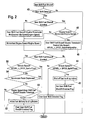
- Fig.2 shows a flow chart of a method for controlling an internal combustion engine using the method of detection of a gear shift of Fig.1. If a gear shift is detected (at 40) and the fuel shut off is not already enabled, the fuel is shut off to all the cylinders 42 if the vehicle speed is higher than the above described vehicle speed threshold value 44. It follows that the fuel shut off is now enabled.
- the engine speed is then monitored 46 in order to detect the moment when the engine speed starts to decrease. Once the engine speed decreases, a fuel shut off disable threshold is set as the desired idle speed plus a calibratable offset 48. Once the engine speed has decreased to a value below this fuel shut off disable threshold (50), the fuel shut off is disabled again and fuel is supplied to all cylinders 52.
- fuel shut off is also disabled if the accelerator is depressed 54 or if the vehicle speed decreases below the vehicle speed threshold value 56.
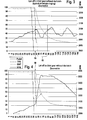
- Figures 3 and 4 illustrate the normal behavior of the engine speed in case of a transition from open to closed throttle (at 58) without declutch respectively followed by a declutch.
- the engine speed increases due to the large amount of air present in the manifold and the sudden decrease in the load on the engine.
- the resulting engine speed flare is represented in fig.4. If the let off is not followed by a declutch, the engine speed performs oscillations which dampen out with time. These oscillations are due to the drivetrain oscillations and accordingly the frequency and the amplitude of these oscillations are dependent on the gear. This case is illustrated in fig. 3.
- the drive train oscillations thus cause the engine speed to increase immediately after the transition from open to closed throttle. It follows that the monitoring of the engine speed immediately after the transition could lead to erroneous gear shift detection.
- the method according to the present invention proposes to preferably monitor the engine speed only during a gear dependent time window 60, which is defined so as to coincide temporally with the first valley of engine speed oscillations that would be caused by a let-off without a declutch (see fig. 3). If during this time window 60, the engine speed increases to a value above the gear dependent delta engine speed threshold value, one can without any doubt conclude to the occurrence of a declutch. Hence the fuel supply to the cylinders can be shut off and the speed flare shown in fig. 4 can be avoided.
Landscapes
- Engineering & Computer Science (AREA)
- General Engineering & Computer Science (AREA)
- Mechanical Engineering (AREA)
- Chemical & Material Sciences (AREA)
- Combustion & Propulsion (AREA)
- Physics & Mathematics (AREA)
- Fluid Mechanics (AREA)
- Electrical Control Of Air Or Fuel Supplied To Internal-Combustion Engine (AREA)
Applications Claiming Priority (2)
| Application Number | Priority Date | Filing Date | Title |
|---|---|---|---|
| LU90556 | 2000-03-24 | ||
| LU90556A LU90556B1 (en) | 2000-03-24 | 2000-03-24 | A method for detecting the occurrence of a declutch |
Publications (2)
| Publication Number | Publication Date |
|---|---|
| EP1136716A1 true EP1136716A1 (fr) | 2001-09-26 |
| EP1136716B1 EP1136716B1 (fr) | 2008-05-14 |
Family
ID=19731883
Family Applications (1)
| Application Number | Title | Priority Date | Filing Date |
|---|---|---|---|
| EP01106758A Expired - Lifetime EP1136716B1 (fr) | 2000-03-24 | 2001-03-17 | Procédé de reconnaissance d'un état de débrayage dans un embrayage |
Country Status (3)
| Country | Link |
|---|---|
| EP (1) | EP1136716B1 (fr) |
| DE (1) | DE60133963D1 (fr) |
| LU (1) | LU90556B1 (fr) |
Citations (8)
| Publication number | Priority date | Publication date | Assignee | Title |
|---|---|---|---|---|
| US4632231A (en) * | 1983-06-30 | 1986-12-30 | Isuzu Motors Limited | Method of controlling the starting of a vehicle having automatic clutch |
| DE3809118A1 (de) * | 1987-03-26 | 1988-10-13 | Zahnradfabrik Friedrichshafen | Einrichtung zur steuerung einer automatischen kraftfahrzeugkupplung |
| EP0390423A1 (fr) * | 1989-03-27 | 1990-10-03 | Diesel Kiki Co. Ltd. | Méthode pour commander un moteur à combustion interne pour véhicule avec système de transmission automatique |
| EP0423799A2 (fr) * | 1989-10-19 | 1991-04-24 | Toyota Jidosha Kabushiki Kaisha | Dispositif de commande d'une transmission semi-automatique de véhicule incluant des moyens pour empêcher un débrayage complet d'un embrayage automatique pour empêcher le moteur de passer en survitesse |
| FR2682649A1 (fr) * | 1991-10-19 | 1993-04-23 | Fichtel & Sachs Ag | Dispositif destine a detecter la position du debut de la transmission du couple de rotation d'un embrayage de vehicule automobile. |
| EP0627336A2 (fr) * | 1993-06-03 | 1994-12-07 | Aisin Aw Co., Ltd. | Système de commande à changement de vitesse pour une transmission automatique |
| EP0697302A2 (fr) * | 1994-08-19 | 1996-02-21 | Eaton Corporation | Logique retrogradée pour boîte de vitesses mécanisme semi-automatique avec activité manuelle d'embrayage |
| DE19538308A1 (de) * | 1994-10-27 | 1996-05-02 | Volkswagen Ag | Verfahren zur Steuerung der Drehzahl einer Brennkraftmaschine während eines Schaltvorganges eines Schaltgetriebes |
-
2000
- 2000-03-24 LU LU90556A patent/LU90556B1/en active
-
2001
- 2001-03-17 EP EP01106758A patent/EP1136716B1/fr not_active Expired - Lifetime
- 2001-03-17 DE DE60133963T patent/DE60133963D1/de not_active Expired - Lifetime
Patent Citations (8)
| Publication number | Priority date | Publication date | Assignee | Title |
|---|---|---|---|---|
| US4632231A (en) * | 1983-06-30 | 1986-12-30 | Isuzu Motors Limited | Method of controlling the starting of a vehicle having automatic clutch |
| DE3809118A1 (de) * | 1987-03-26 | 1988-10-13 | Zahnradfabrik Friedrichshafen | Einrichtung zur steuerung einer automatischen kraftfahrzeugkupplung |
| EP0390423A1 (fr) * | 1989-03-27 | 1990-10-03 | Diesel Kiki Co. Ltd. | Méthode pour commander un moteur à combustion interne pour véhicule avec système de transmission automatique |
| EP0423799A2 (fr) * | 1989-10-19 | 1991-04-24 | Toyota Jidosha Kabushiki Kaisha | Dispositif de commande d'une transmission semi-automatique de véhicule incluant des moyens pour empêcher un débrayage complet d'un embrayage automatique pour empêcher le moteur de passer en survitesse |
| FR2682649A1 (fr) * | 1991-10-19 | 1993-04-23 | Fichtel & Sachs Ag | Dispositif destine a detecter la position du debut de la transmission du couple de rotation d'un embrayage de vehicule automobile. |
| EP0627336A2 (fr) * | 1993-06-03 | 1994-12-07 | Aisin Aw Co., Ltd. | Système de commande à changement de vitesse pour une transmission automatique |
| EP0697302A2 (fr) * | 1994-08-19 | 1996-02-21 | Eaton Corporation | Logique retrogradée pour boîte de vitesses mécanisme semi-automatique avec activité manuelle d'embrayage |
| DE19538308A1 (de) * | 1994-10-27 | 1996-05-02 | Volkswagen Ag | Verfahren zur Steuerung der Drehzahl einer Brennkraftmaschine während eines Schaltvorganges eines Schaltgetriebes |
Also Published As
| Publication number | Publication date |
|---|---|
| EP1136716B1 (fr) | 2008-05-14 |
| LU90556B1 (en) | 2001-09-25 |
| DE60133963D1 (de) | 2008-06-26 |
Similar Documents
| Publication | Publication Date | Title |
|---|---|---|
| JP4670912B2 (ja) | 内燃機関制御装置 | |
| EP2031223B1 (fr) | Contrôleur pour moteur à combustion interne | |
| KR100292637B1 (ko) | 로크-업토크컨버터를갖는자동변속기에결합된내연기관을위한연료차단및연료공급회복제어시스템 | |
| US7285073B2 (en) | Engine fuel supply control device | |
| US7032571B2 (en) | Internal combustion engine controller | |
| US7881846B2 (en) | Driveline clunk detection and control | |
| US8108112B2 (en) | Engine control during coasting events | |
| CN102052174A (zh) | 发动机的控制装置 | |
| EP2071163A2 (fr) | Dispositif de commande pour moteur et méthode de commande d'un moteur à combustion interne | |
| JP2000073824A (ja) | 内燃機関に対する燃料供給量信号の形成のための電子式制御装置 | |
| US4788954A (en) | Method for controlling by-pass air flow on deceleration of internal combustion engine | |
| EP1136716A1 (fr) | Procédé de reconnaissance d'un état de débrayage dans un embrayage | |
| US7415342B2 (en) | Fuel delivery control system | |
| JP4075589B2 (ja) | エンジンの動力伝達部材の異常判定装置 | |
| US20030168045A1 (en) | Method for the damping of mechanical vibrations in the drive train of an internal combustion engine | |
| JP2001355495A (ja) | 車載内燃機関の燃料噴射制御装置 | |
| US6837826B2 (en) | Apparatus and a method for controlling an engine with an automatic transmission | |
| JP2000337495A (ja) | 自動変速機の制御装置 | |
| US11840229B1 (en) | Vehicle control apparatus | |
| JP3945612B2 (ja) | 自動変速機付きエンジンの制御装置 | |
| US4941556A (en) | Electronically-controlled fuel injection system for internal combustion engines | |
| JP3838855B2 (ja) | 内燃機関用制御装置 | |
| JPH0415538Y2 (fr) | ||
| JP2998370B2 (ja) | 内燃機関の燃料噴射量制御装置 | |
| JPH05180037A (ja) | 車両用内燃機関の制御装置 |
Legal Events
| Date | Code | Title | Description |
|---|---|---|---|
| PUAI | Public reference made under article 153(3) epc to a published international application that has entered the european phase |
Free format text: ORIGINAL CODE: 0009012 |
|
| AK | Designated contracting states |
Kind code of ref document: A1 Designated state(s): AT BE CH CY DE DK ES FI FR GB GR IE IT LI LU MC NL PT SE TR Kind code of ref document: A1 Designated state(s): DE FR IT |
|
| AX | Request for extension of the european patent |
Free format text: AL;LT;LV;MK;RO;SI |
|
| 17P | Request for examination filed |
Effective date: 20020202 |
|
| AKX | Designation fees paid |
Free format text: DE FR IT |
|
| 17Q | First examination report despatched |
Effective date: 20070727 |
|
| GRAP | Despatch of communication of intention to grant a patent |
Free format text: ORIGINAL CODE: EPIDOSNIGR1 |
|
| RIC1 | Information provided on ipc code assigned before grant |
Ipc: F16D 48/06 20060101AFI20071115BHEP Ipc: B60W 10/06 20060101ALN20071115BHEP Ipc: F02D 17/00 20060101ALI20071115BHEP Ipc: B60W 10/02 20060101ALN20071115BHEP |
|
| GRAS | Grant fee paid |
Free format text: ORIGINAL CODE: EPIDOSNIGR3 |
|
| GRAA | (expected) grant |
Free format text: ORIGINAL CODE: 0009210 |
|
| AK | Designated contracting states |
Kind code of ref document: B1 Designated state(s): DE FR IT |
|
| REF | Corresponds to: |
Ref document number: 60133963 Country of ref document: DE Date of ref document: 20080626 Kind code of ref document: P |
|
| PLBE | No opposition filed within time limit |
Free format text: ORIGINAL CODE: 0009261 |
|
| STAA | Information on the status of an ep patent application or granted ep patent |
Free format text: STATUS: NO OPPOSITION FILED WITHIN TIME LIMIT |
|
| 26N | No opposition filed |
Effective date: 20090217 |
|
| PGFP | Annual fee paid to national office [announced via postgrant information from national office to epo] |
Ref country code: FR Payment date: 20120319 Year of fee payment: 12 |
|
| PGFP | Annual fee paid to national office [announced via postgrant information from national office to epo] |
Ref country code: IT Payment date: 20120320 Year of fee payment: 12 |
|
| PGFP | Annual fee paid to national office [announced via postgrant information from national office to epo] |
Ref country code: DE Payment date: 20130327 Year of fee payment: 13 |
|
| REG | Reference to a national code |
Ref country code: FR Ref legal event code: ST Effective date: 20131129 |
|
| PG25 | Lapsed in a contracting state [announced via postgrant information from national office to epo] |
Ref country code: FR Free format text: LAPSE BECAUSE OF NON-PAYMENT OF DUE FEES Effective date: 20130402 |
|
| PG25 | Lapsed in a contracting state [announced via postgrant information from national office to epo] |
Ref country code: IT Free format text: LAPSE BECAUSE OF NON-PAYMENT OF DUE FEES Effective date: 20130317 |
|
| REG | Reference to a national code |
Ref country code: DE Ref legal event code: R119 Ref document number: 60133963 Country of ref document: DE |
|
| REG | Reference to a national code |
Ref country code: DE Ref legal event code: R119 Ref document number: 60133963 Country of ref document: DE Effective date: 20141001 |
|
| PG25 | Lapsed in a contracting state [announced via postgrant information from national office to epo] |
Ref country code: DE Free format text: LAPSE BECAUSE OF NON-PAYMENT OF DUE FEES Effective date: 20141001 |