EP1136742A1 - Raccord pour conduite de gaz - Google Patents
Raccord pour conduite de gaz Download PDFInfo
- Publication number
- EP1136742A1 EP1136742A1 EP01201058A EP01201058A EP1136742A1 EP 1136742 A1 EP1136742 A1 EP 1136742A1 EP 01201058 A EP01201058 A EP 01201058A EP 01201058 A EP01201058 A EP 01201058A EP 1136742 A1 EP1136742 A1 EP 1136742A1
- Authority
- EP
- European Patent Office
- Prior art keywords
- gas pipe
- pipe connection
- connection according
- male part
- coupling device
- Prior art date
- Legal status (The legal status is an assumption and is not a legal conclusion. Google has not performed a legal analysis and makes no representation as to the accuracy of the status listed.)
- Withdrawn
Links
- 230000008878 coupling Effects 0.000 claims abstract description 32
- 238000010168 coupling process Methods 0.000 claims abstract description 32
- 238000005859 coupling reaction Methods 0.000 claims abstract description 32
- 238000007789 sealing Methods 0.000 claims description 18
- 238000005192 partition Methods 0.000 claims description 6
- 230000004308 accommodation Effects 0.000 claims description 4
- 239000007789 gas Substances 0.000 description 15
- 238000003780 insertion Methods 0.000 description 4
- 230000037431 insertion Effects 0.000 description 4
- 230000000712 assembly Effects 0.000 description 3
- 238000000429 assembly Methods 0.000 description 3
- 229920002994 synthetic fiber Polymers 0.000 description 3
- 238000002485 combustion reaction Methods 0.000 description 2
- 239000000463 material Substances 0.000 description 2
- 239000004743 Polypropylene Substances 0.000 description 1
- 230000004075 alteration Effects 0.000 description 1
- 230000001174 ascending effect Effects 0.000 description 1
- 230000004323 axial length Effects 0.000 description 1
- 230000008602 contraction Effects 0.000 description 1
- 230000018109 developmental process Effects 0.000 description 1
- 238000001746 injection moulding Methods 0.000 description 1
- 238000000034 method Methods 0.000 description 1
- 229920000573 polyethylene Polymers 0.000 description 1
- 229920001155 polypropylene Polymers 0.000 description 1
- 238000004804 winding Methods 0.000 description 1
Images








Classifications
-
- F—MECHANICAL ENGINEERING; LIGHTING; HEATING; WEAPONS; BLASTING
- F16—ENGINEERING ELEMENTS AND UNITS; GENERAL MEASURES FOR PRODUCING AND MAINTAINING EFFECTIVE FUNCTIONING OF MACHINES OR INSTALLATIONS; THERMAL INSULATION IN GENERAL
- F16L—PIPES; JOINTS OR FITTINGS FOR PIPES; SUPPORTS FOR PIPES, CABLES OR PROTECTIVE TUBING; MEANS FOR THERMAL INSULATION IN GENERAL
- F16L37/00—Couplings of the quick-acting type
- F16L37/08—Couplings of the quick-acting type in which the connection between abutting or axially overlapping ends is maintained by locking members
- F16L37/084—Couplings of the quick-acting type in which the connection between abutting or axially overlapping ends is maintained by locking members combined with automatic locking
- F16L37/098—Couplings of the quick-acting type in which the connection between abutting or axially overlapping ends is maintained by locking members combined with automatic locking by means of flexible hooks
-
- F—MECHANICAL ENGINEERING; LIGHTING; HEATING; WEAPONS; BLASTING
- F16—ENGINEERING ELEMENTS AND UNITS; GENERAL MEASURES FOR PRODUCING AND MAINTAINING EFFECTIVE FUNCTIONING OF MACHINES OR INSTALLATIONS; THERMAL INSULATION IN GENERAL
- F16L—PIPES; JOINTS OR FITTINGS FOR PIPES; SUPPORTS FOR PIPES, CABLES OR PROTECTIVE TUBING; MEANS FOR THERMAL INSULATION IN GENERAL
- F16L37/00—Couplings of the quick-acting type
- F16L37/56—Couplings of the quick-acting type for double-walled or multi-channel pipes or pipe assemblies
- F16L37/565—Concentric pipes
-
- F—MECHANICAL ENGINEERING; LIGHTING; HEATING; WEAPONS; BLASTING
- F16—ENGINEERING ELEMENTS AND UNITS; GENERAL MEASURES FOR PRODUCING AND MAINTAINING EFFECTIVE FUNCTIONING OF MACHINES OR INSTALLATIONS; THERMAL INSULATION IN GENERAL
- F16L—PIPES; JOINTS OR FITTINGS FOR PIPES; SUPPORTS FOR PIPES, CABLES OR PROTECTIVE TUBING; MEANS FOR THERMAL INSULATION IN GENERAL
- F16L39/00—Joints or fittings for double-walled or multi-channel pipes or pipe assemblies
- F16L39/005—Joints or fittings for double-walled or multi-channel pipes or pipe assemblies for concentric pipes
-
- F—MECHANICAL ENGINEERING; LIGHTING; HEATING; WEAPONS; BLASTING
- F23—COMBUSTION APPARATUS; COMBUSTION PROCESSES
- F23J—REMOVAL OR TREATMENT OF COMBUSTION PRODUCTS OR COMBUSTION RESIDUES; FLUES
- F23J13/00—Fittings for chimneys or flues
- F23J13/04—Joints; Connections
-
- F—MECHANICAL ENGINEERING; LIGHTING; HEATING; WEAPONS; BLASTING
- F23—COMBUSTION APPARATUS; COMBUSTION PROCESSES
- F23J—REMOVAL OR TREATMENT OF COMBUSTION PRODUCTS OR COMBUSTION RESIDUES; FLUES
- F23J2211/00—Flue gas duct systems
- F23J2211/10—Balanced flues (combining air supply and flue gas exhaust)
- F23J2211/101—Balanced flues (combining air supply and flue gas exhaust) with coaxial duct arrangement
-
- F—MECHANICAL ENGINEERING; LIGHTING; HEATING; WEAPONS; BLASTING
- F23—COMBUSTION APPARATUS; COMBUSTION PROCESSES
- F23J—REMOVAL OR TREATMENT OF COMBUSTION PRODUCTS OR COMBUSTION RESIDUES; FLUES
- F23J2213/00—Chimneys or flues
- F23J2213/10—Linings
- F23J2213/101—Fastening means therefor
-
- F—MECHANICAL ENGINEERING; LIGHTING; HEATING; WEAPONS; BLASTING
- F23—COMBUSTION APPARATUS; COMBUSTION PROCESSES
- F23J—REMOVAL OR TREATMENT OF COMBUSTION PRODUCTS OR COMBUSTION RESIDUES; FLUES
- F23J2213/00—Chimneys or flues
- F23J2213/20—Joints; Connections
- F23J2213/202—Joints; Connections between duct or stack sections
Definitions
- the invention relates to a connection for two gas pipes aligned with each other, in particular gas pipes accommodated in a supply line for combustion air to an oil or gas fired boiler and/or in a discharge line for flue gasses of said boiler. Gas also includes air here.
- the invention provides a gas pipe connection of two gas pipes comprising a coupling device circumferentially extending at the outside for engaging the outer ends of both pipes, in which both pipe ends are provided with a hole or several holes arranged divided in circumferential direction and the coupling device is provided with protrusions that can be secured or snapped into said hole or said holes.
- the pipes to be connected to each other can each simply be connected to the coupling device. Additional tools are not necessary here.
- the connection is both shielded as to sight and leakage by the coupling device.
- the protrusions are formed as a unity with the coupling device.
- the coupling device is provided with a number of protrusions that are arranged regularly divided in circumferential direction, preferably for each pipe end, so that the load transfer can take place symmetrically.
- the coupling device comprises a female part and a male part, each being secured -preferably detachably- with snappable protrusions in respective pipe ends, in which the female part engages about the male part.
- the female part and the male part are secured on the outer surface and the inner surface, respectively, of the pipe ends. The mounting of the connection is further facilitated in this way. A further advantage of this is that the sealing can be realised on the interacting sealing surfaces of the female part and the male part.
- the female part and the male part are provided with circle-cylindrical circumferential surfaces for fitting engagement of the respective pipe ends.
- the female part and male part are provided with conical circumferential surfaces that sealingly abut each other.
- the conical circumferential surfaces moreover are a pilot aid when making the coupling.
- the conical circumferential surfaces are formed on circumferential ribs extending to the inside from the female part and to the outside from the male part, respectively, which preferably are situated between both end edges of both pipes.
- the circumferential ribs have axially oriented circumferential surfaces for abutment to the end edges of the pipes in question, for providing support to them and providing an axial stop for them.
- the female part engages over the protrusions of the male part, while fittingly engaging about the outer surface of the pipe that is connected to the male part.
- the female part can be provided here at its inside with accommodation spaces opening radially to the inside, into which the protrusions of the male part extend. Said protrusions of the male part then not only secure the male part to the pipe in question, but also to the female part.
- the accommodation spaces in circumferential direction are contiguous to a passage or exit for the protrusions, which passage/exit extends in circumferential direction and subsequently in axial direction facing away from the connection.
- the male part is tubular, as a result of which the resistance experienced by the gas flow at the location of the coupling device can remain minimal.
- the coupling device preferably has the shape of flat cylinder, which preferably has a slightly bent convex outer surface in the pipe axis, for facilitating its handling and embellishing the connection.
- the gas pipe connection according to the invention is suitable for a single line system, in which the supply and discharge lines are situated next to each other.
- the gas pipe connection according to the invention however can also be advantageously used in so-called concentric line systems.
- the coupling device is provided with radial partitions for keeping at least one of the inner pipes centred. In such concentric systems as well the connection of the -assembled- pipes will be simple as a result.
- the male part is provided with the partitions.
- the male part can be provided in a simple structural manner with means for retaining the inner pipe axially in a direction away from the connection.
- said inner pipe has an end that is shaped like a female part and accommodates the end of the other inner pipe. It is preferred here that the female part of said inner pipe near its end is provided with a ring chamber opening to the inside for accommodating a sealing ring, which chamber has a semicircular cross-section.
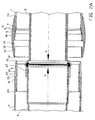
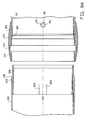
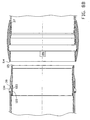
- FIG. 1A On the right hand side in figures 1A-1B, a cross-section of a concentric pair of pipes 1 and 3 is shown, and on the left hand side a concentric pair of pipes 2 and 4 to be coupled to it.
- the centre line of both pipe assemblies is shown by S-S. It is noted here that the cross-section in figure 1A and the cross-section in figure 1B have been made at cross-sectional surfaces that are at 90° with respect to each other.
- the outer pipes 1 and 2 are provided with-circle-cylindrical- outer surfaces 1a, 2a and inner surfaces 1b, 2b. Near their ends, as shown in figure 1B, in which figures 8A and 8B are also referred to, the pipes 1 and 2 are provided with holes 37 and 39, respectively. As a result of the presence of the inner pipes 3 and 4 in the figures 1-6 said holes cannot be seen in the views.
- the inner pipe 3 has an untreated end and the inner pipe 4 has an enlarged end section 31, having a circumferential semicircular ring chamber 32 opening to the inside, in which a semi-spherical, circumferential sealing ring 34 having a lip has been accommodated, in which the ring chamber 32 towards the end merges into a short, straight end section 33.
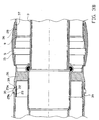
- the socket ring 5 is circumferential and has a smooth convex outer surface 12, which in axial direction merges into thin edges 13 and 14, respectively.
- the socket ring 5 is furthermore provided with a circle-cylindrical outer surface 18 and a circle-cylindrical inner surface 19, of which the diameter is at least almost similar to the-mutually equal- diameters of the surfaces 1b and 2b of the pipes 1 and 2.
- a shoulder-shaped ring 9 is present having a right-angled triangular cross-section and facing the inside and which has an axially facing circumferential stop surface 7 and a inclined turned circumferential sealing surface 10.
- a circumferential ring chamber 15 is provided, which at two diametrically opposite locations, as seen in the drawing to the left, merges into insertion or withdrawal channels 16, respectively, that are provided with an inclined wall 17.
- each protrusion 36 is provided with protrusions 36, that are each formed by a circular edge 28 surrounding a recess 38.
- the diameter of each protrusion 36 at least almost corresponds to the diameter of the aforementioned hole 37.
- a male part 6 of a coupling device is shown, which male part can cooperate with the aforementioned female part or socket ring 5.
- the male part 6 is substantially double-annular, having an outer ring 43 and an inner ring 27 situated at radial distance from it, which are connected to each other by means of radial partitions 26 that have a wing profile.
- the diameter of the inner ring 27 corresponds to the diameter of the widened pipe end 31, but is smaller than the one of the ring chamber 32 in order to retain it in axial direction to the left -as seen in the drawing-.
- the outer ring of the male part 6 is tapering.
- an also tapering end edge 24 is situated, its tip, however, being situated at the radial inner side of the ring, in order to thus form an inclined ascending or insertion surface for the male part 6 when inserting into the end of the pipe 2.
- the male part 6 is provided with a circumferential rib 29, having an inclined sealing surface 30 facing the right, as seen in the drawing, and at the other side an axially oriented circumferential end surface 8.
- the outer diameter of said rib corresponds to the one of the outer surface 2a of the pipe 2.
- the diameter of the outer surface 40 and 41 corresponds at least almost to the diameter of the inner surface 2b of the pipe 2.
- the male part 6 is provided with lips 22, that are bounded by the line-shaped breakthroughs 23 in the outer ring of the male part 6.
- the protrusions 35 are formed, comprising an annular raised edge 25a, b, surrounding a recess, in which the edge 25a has a straight portion 25b and a bevel 25a facing the right.
- the protrusion 35 can be snugly accommodated in the circular holes 39 in the pipe 2, in order to let the male part 6 form an as it were one manageable unit with the pipe 2, in which the male part 6 tightly abuts the edge 8.
- the inner surface 19 of the socket ring 5 then runs snugly fitting over the outer surface 2a of the pipe 2.
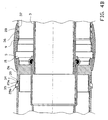
- the pointed end edge 14 then abuts the inclined portion 25a of the protrusion 35, which because of that and as a result of the lips 22 being springy, is urged down and radially to the inside.
- the socket ring 5 can then be slid further to the left, until the protrusion 35 ends up at the level of the annular chamber 15 and snaps into it.
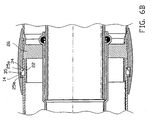
- the dimensions of the female part 5 and the male part 6 are such that at that moment also the inclined surfaces 10 and 30 abut each other tightly and sealingly.
- the annular channel that is limited radially to the outside by the pipes 1 and 2 and radially to the inside by the pipes 3 and 4 is then sealed at the location of the coupling by means of the contact between the outer surface 40 with the inner surface 1b, the outer surface 41 with the inner surface 2b, the contact of the end edges of the pipes 1 and 2 with the circumferential annular surface 7 and 8, the contact between the inclined surfaces 10 and 30, and the contact between the surfaces 18 and 19 of the socket ring 5 with the outer surfaces 1a and 2a.
- either the assembly of pipe 1 with socket ring 5 or the assembly of the pipe 2 with male part 6, can be rotated over 90° about either the inner pipe 3 or 4, so that the annular protrusions 35 arrive at the location of the insertion or withdrawal channels 16.
- An axial extracting force can then be exerted in order to let the protrusions move through the insertion/withdrawal channels 16, in which the lips 22 are then gradually urged radially to the inside, and via the situation shown in figure 5B, but in that case during the reversed process are then brought along the annular surface 19 beyond the end edge 14 of the socket ring 5, after which both pipe assemblies can simple be pulled from each other.
- connection according to the invention a minimal treatment of the usual pipes is necessary. Only a number of annular holes need to be made, such as holes 37 and 39. They can simply be made beforehand in the factory. The pipes 1 and 2 can then at any one of either ends be provided with part 5 or part 6.
- the provisions necessary for the coupling and sealing are arranged in the coupling device 5, 6 itself as much as possible.
- the parts 5, 6 have a short axial length and can easily be provided with the wanted shapes by means of injection moulding.
- the coupling thus obtained can, as to material, be independent from the material of the pipes.
- the socket ring may for instance be made of polyethene or polypropene and the male part of a heat resistant PBT.
- the socket ring can be given any wanted colour, and may be an embellishment of the pipes 1 and 2.
Landscapes
- Engineering & Computer Science (AREA)
- General Engineering & Computer Science (AREA)
- Mechanical Engineering (AREA)
- Quick-Acting Or Multi-Walled Pipe Joints (AREA)
Applications Claiming Priority (2)
| Application Number | Priority Date | Filing Date | Title |
|---|---|---|---|
| NL1014716A NL1014716C2 (nl) | 2000-03-22 | 2000-03-22 | Gaspijpverbinding. |
| NL1014716 | 2000-03-22 |
Publications (1)
| Publication Number | Publication Date |
|---|---|
| EP1136742A1 true EP1136742A1 (fr) | 2001-09-26 |
Family
ID=19771050
Family Applications (1)
| Application Number | Title | Priority Date | Filing Date |
|---|---|---|---|
| EP01201058A Withdrawn EP1136742A1 (fr) | 2000-03-22 | 2001-03-22 | Raccord pour conduite de gaz |
Country Status (2)
| Country | Link |
|---|---|
| EP (1) | EP1136742A1 (fr) |
| NL (1) | NL1014716C2 (fr) |
Cited By (2)
| Publication number | Priority date | Publication date | Assignee | Title |
|---|---|---|---|---|
| NL1022411C2 (nl) * | 2003-01-16 | 2004-07-19 | Cox Geelen Bv | Samenstel omvattende ten minste een binnenbuis en een zich evenwijdig om de binnenbuis heen uitstrekkende buitenbuis alsmede een koppelingselement. |
| DE102005048528B3 (de) * | 2005-10-07 | 2007-03-22 | Centrotherm Systemtechnik Gmbh | Einrichtung und Verfahren zum Herstellen einer Verbindung zwischen zwei Abschnitten eines Koaxialrohres |
Citations (4)
| Publication number | Priority date | Publication date | Assignee | Title |
|---|---|---|---|---|
| US2959196A (en) * | 1955-11-23 | 1960-11-08 | Dura Vent Corp | Multiple wall pipe |
| FR1424152A (fr) * | 1965-02-04 | 1966-01-07 | Accouplement tubulaire à joint hydraulique | |
| US4607665A (en) * | 1985-05-20 | 1986-08-26 | Marco Manufacturing, Inc. | Pipe spacer |
| US5176406A (en) * | 1990-12-20 | 1993-01-05 | Straghan Robert G | Coupling |
-
2000
- 2000-03-22 NL NL1014716A patent/NL1014716C2/nl not_active IP Right Cessation
-
2001
- 2001-03-22 EP EP01201058A patent/EP1136742A1/fr not_active Withdrawn
Patent Citations (4)
| Publication number | Priority date | Publication date | Assignee | Title |
|---|---|---|---|---|
| US2959196A (en) * | 1955-11-23 | 1960-11-08 | Dura Vent Corp | Multiple wall pipe |
| FR1424152A (fr) * | 1965-02-04 | 1966-01-07 | Accouplement tubulaire à joint hydraulique | |
| US4607665A (en) * | 1985-05-20 | 1986-08-26 | Marco Manufacturing, Inc. | Pipe spacer |
| US5176406A (en) * | 1990-12-20 | 1993-01-05 | Straghan Robert G | Coupling |
Cited By (2)
| Publication number | Priority date | Publication date | Assignee | Title |
|---|---|---|---|---|
| NL1022411C2 (nl) * | 2003-01-16 | 2004-07-19 | Cox Geelen Bv | Samenstel omvattende ten minste een binnenbuis en een zich evenwijdig om de binnenbuis heen uitstrekkende buitenbuis alsmede een koppelingselement. |
| DE102005048528B3 (de) * | 2005-10-07 | 2007-03-22 | Centrotherm Systemtechnik Gmbh | Einrichtung und Verfahren zum Herstellen einer Verbindung zwischen zwei Abschnitten eines Koaxialrohres |
Also Published As
| Publication number | Publication date |
|---|---|
| NL1014716C2 (nl) | 2001-09-25 |
Similar Documents
| Publication | Publication Date | Title |
|---|---|---|
| CN1327156C (zh) | 管接头 | |
| US6270125B1 (en) | Molded tubing assemblies | |
| EP1936253B1 (fr) | Raccord étanche de sections tubulaires en particulier pour l'évacuation de fumées ou de vapeurs | |
| CN1079146C (zh) | 互锁限动塑料管接合装置 | |
| US6439617B1 (en) | Coupler for a pipe or hose section | |
| EP1909016B1 (fr) | Raccord rapide de connecteur | |
| CN101896758B (zh) | 用于连接两个刚性物体的装置 | |
| US20150240980A1 (en) | Clam shell push-to-connect assembly | |
| US7971911B2 (en) | Plug part of a plug-type connection arrangement and plug-type connection arrangement | |
| JPH0323798B2 (fr) | ||
| EP3584489B1 (fr) | Agencement de couplage et connecteur pour un agencement de couplage | |
| US20100264652A1 (en) | Hose-line connector and line assembly | |
| EP0703397B1 (fr) | Raccord de fixation pour un tube annelé | |
| US4786089A (en) | Automatically locking tubing coupler | |
| EP1136742A1 (fr) | Raccord pour conduite de gaz | |
| CN100424398C (zh) | 具有角位锁定装置的插塞连接器 | |
| EP3441537A1 (fr) | Raccord de cuvette de toilettes amélioré | |
| KR20040045453A (ko) | 연결조립체 | |
| EP0083135B1 (fr) | Raccord pour tuyau ou tuyau de branchement | |
| EP1655528B1 (fr) | Élément de liaison entre la cuvette des toilettes et le tuyau de descente. | |
| EP1085246A2 (fr) | Systeme de raccord étanche pour tuyau ondulé avec puits | |
| WO2006112726A1 (fr) | Raccord pour tubes pour conduites d'ecoulement | |
| EP1245902A1 (fr) | Piece intermediaire pour tuyaux de dispositifs à gaz | |
| NL2032741B1 (en) | Roof terminal adapter | |
| IE48828B1 (en) | Pipe joints |
Legal Events
| Date | Code | Title | Description |
|---|---|---|---|
| PUAI | Public reference made under article 153(3) epc to a published international application that has entered the european phase |
Free format text: ORIGINAL CODE: 0009012 |
|
| AK | Designated contracting states |
Kind code of ref document: A1 Designated state(s): AT BE CH CY DE DK ES FI FR GB GR IE IT LI LU MC NL PT SE TR |
|
| AX | Request for extension of the european patent |
Free format text: AL;LT;LV;MK;RO;SI |
|
| AKX | Designation fees paid | ||
| REG | Reference to a national code |
Ref country code: DE Ref legal event code: 8566 |
|
| STAA | Information on the status of an ep patent application or granted ep patent |
Free format text: STATUS: THE APPLICATION IS DEEMED TO BE WITHDRAWN |
|
| 18D | Application deemed to be withdrawn |
Effective date: 20020327 |