EP1137524B1 - Production de mousses par nucleation induite par contraintes - Google Patents
Production de mousses par nucleation induite par contraintes Download PDFInfo
- Publication number
- EP1137524B1 EP1137524B1 EP99945797A EP99945797A EP1137524B1 EP 1137524 B1 EP1137524 B1 EP 1137524B1 EP 99945797 A EP99945797 A EP 99945797A EP 99945797 A EP99945797 A EP 99945797A EP 1137524 B1 EP1137524 B1 EP 1137524B1
- Authority
- EP
- European Patent Office
- Prior art keywords
- polymer
- blowing agent
- stress
- temperature
- foams
- Prior art date
- Legal status (The legal status is an assumption and is not a legal conclusion. Google has not performed a legal analysis and makes no representation as to the accuracy of the status listed.)
- Expired - Lifetime
Links
Images




Classifications
-
- C—CHEMISTRY; METALLURGY
- C08—ORGANIC MACROMOLECULAR COMPOUNDS; THEIR PREPARATION OR CHEMICAL WORKING-UP; COMPOSITIONS BASED THEREON
- C08J—WORKING-UP; GENERAL PROCESSES OF COMPOUNDING; AFTER-TREATMENT NOT COVERED BY SUBCLASSES C08B, C08C, C08F, C08G or C08H
- C08J9/00—Working-up of macromolecular substances to porous or cellular articles or materials; After-treatment thereof
- C08J9/04—Working-up of macromolecular substances to porous or cellular articles or materials; After-treatment thereof using blowing gases generated by a previously added blowing agent
- C08J9/12—Working-up of macromolecular substances to porous or cellular articles or materials; After-treatment thereof using blowing gases generated by a previously added blowing agent by a physical blowing agent
- C08J9/14—Working-up of macromolecular substances to porous or cellular articles or materials; After-treatment thereof using blowing gases generated by a previously added blowing agent by a physical blowing agent organic
-
- B—PERFORMING OPERATIONS; TRANSPORTING
- B29—WORKING OF PLASTICS; WORKING OF SUBSTANCES IN A PLASTIC STATE IN GENERAL
- B29C—SHAPING OR JOINING OF PLASTICS; SHAPING OF MATERIAL IN A PLASTIC STATE, NOT OTHERWISE PROVIDED FOR; AFTER-TREATMENT OF THE SHAPED PRODUCTS, e.g. REPAIRING
- B29C44/00—Shaping by internal pressure generated in the material, e.g. swelling or foaming ; Producing porous or cellular expanded plastics articles
- B29C44/02—Shaping by internal pressure generated in the material, e.g. swelling or foaming ; Producing porous or cellular expanded plastics articles for articles of definite length, i.e. discrete articles
- B29C44/04—Shaping by internal pressure generated in the material, e.g. swelling or foaming ; Producing porous or cellular expanded plastics articles for articles of definite length, i.e. discrete articles consisting of at least two parts of chemically or physically different materials, e.g. having different densities
-
- B—PERFORMING OPERATIONS; TRANSPORTING
- B29—WORKING OF PLASTICS; WORKING OF SUBSTANCES IN A PLASTIC STATE IN GENERAL
- B29C—SHAPING OR JOINING OF PLASTICS; SHAPING OF MATERIAL IN A PLASTIC STATE, NOT OTHERWISE PROVIDED FOR; AFTER-TREATMENT OF THE SHAPED PRODUCTS, e.g. REPAIRING
- B29C44/00—Shaping by internal pressure generated in the material, e.g. swelling or foaming ; Producing porous or cellular expanded plastics articles
- B29C44/34—Auxiliary operations
- B29C44/3442—Mixing, kneading or conveying the foamable material
- B29C44/3446—Feeding the blowing agent
- B29C44/3453—Feeding the blowing agent to solid plastic material
-
- B—PERFORMING OPERATIONS; TRANSPORTING
- B29—WORKING OF PLASTICS; WORKING OF SUBSTANCES IN A PLASTIC STATE IN GENERAL
- B29C—SHAPING OR JOINING OF PLASTICS; SHAPING OF MATERIAL IN A PLASTIC STATE, NOT OTHERWISE PROVIDED FOR; AFTER-TREATMENT OF THE SHAPED PRODUCTS, e.g. REPAIRING
- B29C44/00—Shaping by internal pressure generated in the material, e.g. swelling or foaming ; Producing porous or cellular expanded plastics articles
- B29C44/34—Auxiliary operations
- B29C44/3469—Cell or pore nucleation
- B29C44/3476—Cell or pore nucleation by, e.g. compression stress
-
- C—CHEMISTRY; METALLURGY
- C08—ORGANIC MACROMOLECULAR COMPOUNDS; THEIR PREPARATION OR CHEMICAL WORKING-UP; COMPOSITIONS BASED THEREON
- C08J—WORKING-UP; GENERAL PROCESSES OF COMPOUNDING; AFTER-TREATMENT NOT COVERED BY SUBCLASSES C08B, C08C, C08F, C08G or C08H
- C08J9/00—Working-up of macromolecular substances to porous or cellular articles or materials; After-treatment thereof
- C08J9/36—After-treatment
Definitions
- the invention disclosed provides a method for producing polymeric foams by stress nucleation, and for making new types of heterogeneous foams.
- Microcellular foams have been developed for materials saving and reportedly have attractive mechanical properties. Small cells in the materials, which are normally associated with high cell density, are responsible for such properties. Microcellular foams are stronger than conventional foams which have much bigger cells; thus, providing a potential for a variety of applications.
- Cell nucleation occurs when the gas saturated polymer is in the rubbery state, i.e. when the foaming temperature is higher than the glass transition temperature (T g ) of the polymer-gas system.
- T g glass transition temperature
- the pressure drop-induced nucleation is achieved by simply releasing the system's pressure while the polymer is in the rubbery state. See Goel and Beckman, 1 and Baldwin et al. 2
- the temperature increase-induced nucleation is achieved by heating the gas saturated polymer from its glassy state to a temperature where the system goes into the rubbery state or by heating the gas saturated polymer already in the rubbery state to a higher temperature. See U.S. Pat. No. 4,473,665 issued on September 25, 1984 to Martini-Vvedensky et al. and U.S. Pat. No.
- nucleating agents are usually added to the system to aid nucleation. This approach has proven very successful in producing conventional foams. In the production of microcellular foams, however, nucleating agents are seldom used because the required cell density is quite high and the contribution from nucleating agents to that end is insignificant. Nevertheless, a second phase polymeric material (U.S. Pat. No. 5,369,135 issued on November 29, 1994 to Campbell and Rasmussen) was found to provide nucleation sites to foam a polymer within a certain cell density range, although such a second polymer phase did not show any tendency to facilitate foaming at lower temperatures.
- the nucleation step is very important for achieving a desired cell density and cell size.
- nucleation occurs at quite high temperatures at which cell growth is fast and, thus, difficult to control.
- cell coalescence due to the uncontrolled cell growth can occur, resulting in poor quality foams. See Behravesh et al. 3
- Nucleating cells by applying stress is a new concept. It has been reported by Lee 4 , that application of stress enhances the effect of nucleating agents in the processing of conventional foams though the applied stress itself does not nucleate cells.
- the present invention provides a method to nucleate cells directly by the application of stress.
- a polymer saturated with blowing agent can be stressed e.g. by mechanical or hydrostatic pressure means, at a certain temperature to produce foam.
- the cell nucleation arises from the thermodynamic instability caused by the stress. Stress can be applied by various ways, of which compression is preferred and is easily achieved e.g. using a press or a rolling system.
- the compression mechanism can be adopted for both batch and continuous processes. Stress-induced nucleation has short induction time and develops almost instantly throughout the stressed material, giving foams with high cell density, small size cells, and the cellular characteristics can be easily controlled in a prescribed way.
- the method can be widely used for producing a variety of microcellular foams and can be extended to produce conventional foams.
- the polymer to be foamed can be in any desired geometrical shape e.g. a preformed sheet or formed into a sheet by conventional molding techniques.
- saturation time will depend upon the polymer-blowing agent combination used and the geometrical characteristics of the polymer. More specifically, there is a finite time, which is required for the polymer to become saturated with the blowing agent, which will vary depending upon the surface area to volume ratio of the polymer.
- a method for producing a closed cell polymer foam comprising
- stress nucleation can also be used for manufacturing speciality foams.
- One of its special applications is in producing anisotropic (i.e . heterogeneous) foams with potential applications as structural and/or functional materials.
- foams provide a good solution for materials saving while delivering the desired properties.
- a polymer containing dissolved blowing agent can be stressed in selected areas only to produce a heterogeneous material where the selected areas are foamed and the rest are not.
- a polymer can also be conditioned such that only the surface layer contains the blowing agent and the remainder of the material contains none or only an insignificant amount of the blowing agent.
- the thickness of the surface layer containing the blowing agent will depend on the conditioning parameters such as exposure time, temperature, and pressure of the blowing agent.
- the polymer surface can then be stressed to produce a heterogeneous foam where the interior of the polymer is not foamed and only the surface layer or a certain fraction of the surface layer is foamed.
- a polymer is conditioned with a blowing agent, usually a gas such as carbon dioxide, to achieve a desired solubility of the blowing agent in the polymer.
- a blowing agent usually a gas such as carbon dioxide
- the maximum desired solubility attainable is the saturation or equilibrium solubility.
- the minimum desired solubility depends upon the nature of the product being made.
- the equilibration can be conducted with polymer in the glassy ( i.e . solid) or the rubbery state. When in the glassy-state, for example, the polymer can be housed in a chamber and exposed to the blowing agent under certain pressure and temperature for a certain time period. The applied pressure, temperature, and the exposure time are selected according to the thermodynamic properties of the polymer-blowing agent system, in order to achieve a desired solubility of the blowing agent in the polymer.
- the polymer When in the rubbery state, the polymer can be mixed with the blowing agent e.g. in an extruder. In order to achieve the desired solubility, the pressure in the extruder should be kept at a rather high value.
- a cold die arrangement could be then applied to cool the polymer-blowing agent system down to a temperature such that foaming will not occur when the polymer exits the die.
- a cold die arrangement such as the one described in U.S. Pat. No. 4,761,256 issued on August 2, 1988 to Hardenbrook et al., can be used.
- An external stress is then applied to the polymer/blowing agent solution to nucleate cells and initiate cell growth.
- this step is conducted at a temperature from the temperature at which the polymer is conditioned with the blowing agent up to about the glass transition temperature (T g ) of the polymer-blowing agent system e.g. at room temperature, so that the cell growth can be easily controlled.
- T g glass transition temperature
- this step can be conducted at higher temperatures, up to about the T g of the neat polymer.
- the amount of stress applied depends on the thermodynamic properties of the polymer/blowing agent combination, the temperature, and the blowing agent content of the polymer.
- the optimum stress range for a certain polymer-blowing agent combination, temperature, and blowing agent content is in the range of 130 to 270 atm for PMMA containing 22.4 wt% CO 2 at room temperature.
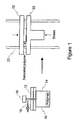
- Compressive stress can be applied by squeezing the sample in between the platens of a press or by a compressive rolling system, depending on whether the process is discontinuous or continuous.
- an apparatus used according to the invention includes an open topped pressure vessel 10, having a lid 12 and an internal chamber 14.
- the lid includes an inlet 16, connected to a supply of blowing agent.
- a pressure gauge 18 is connected to the inlet to measure the pressure in the chamber 14.
- a suitable continuous process could be an extrusion-based one with the cold-die arrangement as cited earlier or a semi-continuous one as disclosed in U.S. Pat. No. 5,684,055 issued on November 4, 1997 to Kumar and Schirmer.
- the polymer-blowing agent solution on exit from the extruder is cooled to a temperature at which foaming does not occur. It is then guided through a system of rollers for compression at a certain temperature.
- a spool of perforated-paper backed polymer sheet is saturated with a blowing agent and then the sheet from the spool is fed into hot water for foaming.
- the sheet from the blowing agent saturated spool is fed through a system of rollers which impart compressive stress to the polymer.
- Nucleation induced by stress can be completed within one second to a few seconds. After the nucleation, cells are allowed to grow for a short time before cooling rapidly to arrest the cell growth and, thus, lock-in the cell size.
- the polymer can be kept under the external stress which restricts cell growth to give foams with smaller cells and high cell density or the polymer can be freed of the stress to allow unconstrained foaming i.e. larger cell sizes and lower cell density.
- stress can also be applied to shape the polymer into a desired form. Such a shaping process can be achieved by controlling the residence time in the press, or by changing the roll number or rotation speed for the rolling system. Optimum residence time depends on the thermodynamic properties of the polymer-blowing agent system, solubility of the blowing agent in the polymer, and the stress applied.
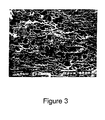
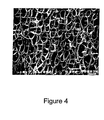
- a major advantage of such a technique is that stress-induced nucleation occurs very fast throughout the stressed material. As a result, foams with very high density and small cells can be produced as shown in figures 3 and 4. Secondly, the induction time for stress-induced nucleation is shorter than that for conventional pressure drop-induced or temperature increase-induced nucleation under the same conditions. Furthermore, stress nucleation can occur at a temperature at which nucleation by pressure drop or temperature increase methods is not possible. Consequently, foaming, nucleated by stress, can be carried out at quite low a temperature, such as room temperature, at which the polymer viscosity is quite high which makes it possible to control cell growth very easily.
- Stress nucleation can be used to produce custom designed anisotropic foams because stress can be applied on selected regions or areas of the polymer containing dissolved gas. Since stress nucleation has a shorter induction time and nucleation can be achieved at a lower temperature, a processing temperature can be selected so that only the stressed part will be foamed within a certain period of time while the unstressed parts remain unfoamed, or the stressed parts are foamed with high cell density and small cell size while the unstressed parts are foamed with lower cell density and larger cell size, depending on the selected temperature and the processing time scale.
- the anisotropic structure can be designed by simply designing the way in which stress is applied.
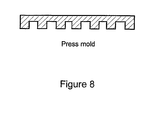
- the most convenient way is to compress the polymer system with a template, such as a press mold or a rolling system, which has a certain pattern e.g. as in figures 8, 10 and 11.
- a template such as a press mold or a rolling system
- the prescribed pattern is then transferred to the polymer-blowing agent system leading to foaming of the polymeric material to match the pattern.
- Anisotropic foams can be produced for structural applications.
- the present invention was used to produce rib foams, as shown in figure 9.
- Such materials will have advantage over the neat polymer along the rib direction when the ribs are dense enough.
- Anisotropic foams are known to be a practical solution to materials saving while maintaining the desired properties. This is demonstrated by naturally occurring foams such as various woods which are lightweight but have attractive load bearing properties.
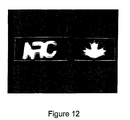
- Anisotropic foams can be produced for functional applications as well. For example, image foams (as shown in figure 12) can be used for decoration or other purposes.
- PMMA sheets, 2.72 mm thick, obtained from Canus Plastics were placed in a pressure vessel made up of stainless steel VCR fittings and exposed to CO 2 under 34 atm at -0.2°C for 24 hours.
- the solubility of CO 2 in the polymer was measured to be 22.4 wt%.
- the vessel was opened and the polymer sheets containing dissolved CO 2 taken out.
- a portion of the sheet was then compressed at various pressures from 20 atm to 350 atm in the press, as shown in Fig. 1 , at room temperature, although the actual temperature of the polymer was somewhere between the conditioning temperature of -0.2°C and room temperature.
- the applied stress was in the range 130 to 270 atm, nucleation, followed by foaming, occurred within one to a few seconds throughout the stressed portion while the unstressed portion remained unfoamed for 1.5 min.
- Figure 2 shows a typical photograph of the partially stressed PMMA after it was compressed at 220 atm for 30 seconds and then quenched in ice cold water.
- Figures 3 and 4 show a comparison of the SEM microphotographs of microcellular foams produced according to the invention by a stress of 220 atm in a press at 24°C for 30 seconds (figure 3) and by the conventional temperature increase-induced nucleation by transferring the gas-laden sample to a water bath kept at 24°C and letting it foam for 10 minutes (figure 4). The nucleation in the water bath was observed to occur more than one minute later than the stress-induced nucleation.
- the cell density and average cell size, respectively, are 1.5 ⁇ 10 11 cells/g and 2.9 ⁇ m for the stress-nucleated foams and 4.4 ⁇ 10 9 cells/g and 4.8 ⁇ m for the temperature increase-nucleated ones.
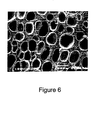
- PETG films 0.76 mm thick, were placed in the pressure vessel described in Example 1, and exposed to 58 atm CO 2 at 24°C for 24 hr. The solubility of CO 2 in PETG was measured to be 12 wt%. After the pressure was slowly released, the films were taken out of the pressure vessel and compressed in the press described in Example 1 at 24°C for 30 seconds within a pressure range of 220 to 320 atm and then quenched in ice cold water. Nucleation occurred instantly when the films were stressed. Nucleation arising from the conventional pressure drop method, also occurred for unstressed sheets but at a later time. A comparison of the results is shown in figures 5 and 6.
- Figure 5 shows a typical SEM microphotograph of stress-nucleated PETG foam
- figure 6 shows the conventional pressure drop-nucleated foam.
- the cell density and cell size, respectively, are 4.7 ⁇ 10 7 cells/g and 23.6 ⁇ m for the stress-nucleated foam, and 2.9 ⁇ 10 6 cells/g and 61.3 ⁇ m for the conventional pressure-drop one.
- Polycarbonate from GE was compression molded as 1.24 mm thick sheets, placed in the pressure vessel described in Example 1, and exposed to 58 atm CO 2 at 24°C for 48 hr. The solubility of CO 2 in polycarbonate was measured to be 6 wt%. After the pressure was slowly released, the sheets were taken out of the pressure vessel and some of the sheets were compressed in the press described in Example 1 at 24°C for 30 seconds under a pressure of 320 atm and then quenched in ice cold water. Nucleation occurred almost instantly when the sheets were stressed, while nothing happened to the unstressed sheets.
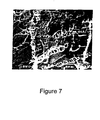
- Figure 7 shows the SEM microphotograph of stress-nucleated and foamed polycarbonate.
- PMMA sheets 2.72 mm thick, were exposed to CO 2 under the same conditions as in EXAMPLE 1.
- the saturated polymer was pressed at 24°C using a mold with a surface pattern as shown in figure 8, and figure 9 shows the resulting rib foam.
- PMMA sheets 1.22 mm thick, were exposed to CO 2 under the same conditions as in EXAMPLE 1 .
- the saturated polymer was pressed at 24°C with the molds having the surface patterns as shown in figure 11.
- Figure 12 shows the resulting image foams.
- PMMA sheets 1.22 mm thick, were exposed to CO 2 under the same conditions as in EXAMPLE 1 except that the exposure time was limited to 4 hours instead of 24 hours, to condition only the surface layer of the polymer. After depressurizing slowly, the polymer sheets containing dissolved blowing agent in the surface layers only were taken out of the pressure vessel and compressed at 220 atm for 30 seconds in the manner described in EXAMPLE 1 . This produced polymer sheets with foamed skin and unfoamed core.
- thermoplastic polymer any amorphous or semi-crystalline thermoplastic polymer can be used.
- examples include PMMA, PEMA, polystyrene, polyvinylchloride (PVC), polycarbonate, ABS copolymers, and polyethyleneterephthalate (PET).
- any inert compound which does not react with the polymer and which is reasonably soluble in the polymer such that it will induces nucleation in the polymer under the process conditions described above may be used e.g. Ar, N 2 , SF 6 , CO 2 , ethylene, and ethane.
- CO 2 is preferred, since it is non-toxic, non-flammable, environmentally acceptable, and inexpensive. It is also advantageous that CO 2 is relatively highly soluble in many thermoplastic polymers such as PMMA and PEMA.
Landscapes
- Chemical & Material Sciences (AREA)
- Engineering & Computer Science (AREA)
- Materials Engineering (AREA)
- Health & Medical Sciences (AREA)
- Chemical Kinetics & Catalysis (AREA)
- Medicinal Chemistry (AREA)
- Polymers & Plastics (AREA)
- Organic Chemistry (AREA)
- Manufacture Of Porous Articles, And Recovery And Treatment Of Waste Products (AREA)
Claims (17)
- Procédé pour produire une mousse polymère à alvéoles fermées comprenant(a) la sélection d'une combinaison adéquate d'un polymère et d'un d'agent d'expansion inerte, dans laquelle le polymère est dans un état solide ou liquide, et l'agent d'expansion est sous la forme d'un gaz ou d'un liquide volatil,(b) l'exposition du polymère à l'agent d'expansion dans l'état gazeux ou l'état liquide à une température de conditionnement, une pression et une durée d'exposition sélectionnées en fonction des propriétés thermodynamiques de la combinaison polymère/agent d'expansion afin de proposer une solution de polymère/d'agent d'expansion possédant une solubilité souhaitée allant jusqu'à un maximum de solubilité de saturation de l'agent d'expansion dans le polymère,(c) la dépressurisation lente de la solution de polymère/d'agent d'expansion à une pression ambiante afin d'éviter la formation de mousse prématurée,(d) l'application d'une contrainte de compression extérieure sur la solution de polymère/d'agent d'expansion à une température à laquelle le polymère est conditionné avec l'agent d'expansion jusqu'à la température de transformation environ du polymère pur, dans laquelle l'importance de la contrainte appliquée dépend des propriétés thermodynamiques de la combinaison polymère/agent d'expansion et de la quantité d'agent d'expansion dissoute dans le polymère, afin d'induire une nucléation et la formation de mousse, et(e) le refroidissement de la mousse par un refroidissement rapide à une température plus faible.
- Procédé selon la revendication 1, comprenant après l'étape (d), le maintien de la contrainte appliquée pendant une durée suffisante pour donner à la mousse une forme souhaitée.
- Procédé selon la revendication 1, dans lequel l'étape (d) comprend le contrôle de la taille des alvéoles en maintenant la contrainte afin de restreindre la taille des alvéoles, ou en éliminant la contrainte afin d'augmenter la taille des alvéoles et, est suivie par l'étape (e) de refroidissement lorsque la taille d'alvéole souhaitée est obtenue.
- Procédé selon la revendication 1, dans lequel l'agent d'expansion est sous la forme d'un gaz, et dans lequel l'étape (b) implique la pressurisation du gaz et l'exposition du polymère au gaz pressurisé.
- Procédé selon la revendication 1, dans lequel l'agent d'expansion est sous la forme d'un liquide volatil.
- Procédé selon la revendication 1, dans lequel des mousses micro-cellulaires avec une taille d'alvéole allant de 0,1 à 100 micromètres sont nécessaires, dans l'étape (d), la température va de la température à laquelle le polymère est conditionné avec l'agent d'expansion jusqu'à la température de transformation environ de la combinaison polymère/agent d'expansion.
- Procédé selon la revendication 1, dans lequel des mousses avec des alvéoles supérieures à 100 µm sont nécessaires, dans l'étape (d), la température va de la température de transformation de la combinaison polymère/agent d'expansion jusqu'à la température de transformation environ du polymère pur.
- Procédé selon la revendication 1, dans lequel le polymère est sélectionné à partir du groupe composé de polymères amorphes thermoplastiques et de polymères semi-cristallins thermoplastiques.
- Procédé selon la revendication 8, dans lequel l'agent d'expansion est sélectionné parmi le groupe composé du CO2, de l'éthylène, de l'éthane, du Ar, du N2 et du SF6.
- Procédé selon la revendication 9, dans lequel l'agent d'expansion est du CO2.
- Procédé selon la revendication 1, dans lequel à l'étape (b) la pression est de 22 à 58 atm, la température est de -0,2 à 24°C, et la durée d'exposition est de 24 à 48 heures, et dans lequel à l'étape (d) l'importance de la contrainte de compression est de 130 à 320 atm, la température est de l'ordre de 20 à 24°C et le temps de séjour est d'environ 30 secondes.
- Procédé selon la revendication 11, dans lequel le polymère est sélectionné à partir du groupe composé du polyméthacrylate de méthyle, du glycol de polyéthylène téréphtalate et du polycarbonate.
- Procédé selon la revendication 10, dans lequel le polymère est du polyméthacrylate de méthyle et dans lequel la solubilité du CO2 dans le polyméthacrylate de méthyle est d'environ 22,4 wt%.
- Procédé selon la revendication 10, dans lequel le polymère est du glycol de polyéthylène téréphtalate et dans lequel la solubilité du CO2 dans le glycol de polyéthylène téréphtalate est d'environ 12 wt%.
- Procédé selon la revendication 10, dans lequel le polymère est du polycarbonate et dans lequel la solubilité du CO2 dans le polycarbonate est d'environ 6 wt%.
- Procédé selon la revendication 1, dans lequel une mousse hétérogène possédant des portions modifiées sélectionnées est nécessaire, comprenant le conditionnement du polymère avec l'agent d'expansion comme à l'étape (b) et à l'étape (d) en appliquant la contrainte extérieure sur les portions sélectionnées, tout en sélectionnant la température et le temps de traitement.
- Procédé selon la revendication 1, dans lequel une mousse hétérogène possédant une surface modifiée sélectionnée est nécessaire, comprenant le conditionnement du polymère avec l'agent d'expansion comme à l'étape (b), dans laquelle la durée d'exposition est sélectionnée de telle sorte que seule la portion de surface sélectionnée dissolve l'agent d'expansion puis l'application d'une contrainte comme à l'étape (d).
Applications Claiming Priority (3)
| Application Number | Priority Date | Filing Date | Title |
|---|---|---|---|
| US09/161,448 US6080798A (en) | 1998-09-28 | 1998-09-28 | Manufacturing foams by stress-induced nucleation |
| US161448 | 1998-09-28 | ||
| PCT/CA1999/000883 WO2000018557A1 (fr) | 1998-09-28 | 1999-09-28 | Production de mousses par nucleation induite par contraintes |
Publications (2)
| Publication Number | Publication Date |
|---|---|
| EP1137524A1 EP1137524A1 (fr) | 2001-10-04 |
| EP1137524B1 true EP1137524B1 (fr) | 2003-05-07 |
Family
ID=22581210
Family Applications (1)
| Application Number | Title | Priority Date | Filing Date |
|---|---|---|---|
| EP99945797A Expired - Lifetime EP1137524B1 (fr) | 1998-09-28 | 1999-09-28 | Production de mousses par nucleation induite par contraintes |
Country Status (7)
| Country | Link |
|---|---|
| US (2) | US6080798A (fr) |
| EP (1) | EP1137524B1 (fr) |
| AT (1) | ATE239601T1 (fr) |
| AU (1) | AU5843999A (fr) |
| CA (1) | CA2343197A1 (fr) |
| DE (1) | DE69907728T2 (fr) |
| WO (1) | WO2000018557A1 (fr) |
Families Citing this family (29)
| Publication number | Priority date | Publication date | Assignee | Title |
|---|---|---|---|---|
| US7951449B2 (en) | 2002-06-27 | 2011-05-31 | Wenguang Ma | Polyester core materials and structural sandwich composites thereof |
| US9296126B2 (en) * | 2003-05-17 | 2016-03-29 | Microgreen Polymers, Inc. | Deep drawn microcellularly foamed polymeric containers made via solid-state gas impregnation thermoforming |
| US20050221075A1 (en) * | 2004-03-31 | 2005-10-06 | Travelute Frederick L Iii | Low density light weight filament and fiber |
| CA2562041A1 (fr) * | 2004-03-31 | 2005-10-20 | Wellman, Inc. | Filament et fibre poids leger faible densite |
| US8309619B2 (en) | 2004-09-03 | 2012-11-13 | Pactiv LLC | Reduced-VOC and non-VOC blowing agents for making expanded and extruded thermoplastic foams |
| US20060052466A1 (en) | 2004-09-03 | 2006-03-09 | Handa Yash P | Expanded and extruded thermoplastic foams made with methyl formate-based blowing agents |
| JP4999041B2 (ja) * | 2005-12-26 | 2012-08-15 | 古河電気工業株式会社 | ポリカーボネート発泡体 |
| US20070149640A1 (en) * | 2005-12-28 | 2007-06-28 | Sasa Andjelic | Bioabsorbable polymer compositions exhibiting enhanced crystallization and hydrolysis rates |
| US8236904B2 (en) | 2005-12-28 | 2012-08-07 | Ethicon, Inc. | Bioabsorbable polymer compositions exhibiting enhanced crystallization and hydrolysis rates |
| CA2634484A1 (fr) | 2006-02-22 | 2007-09-07 | Pactiv Corporation | Mousses de polyolefine expansee et extrudee fabriquees avec des agents d'expansion a base de formiate de methyle |
| US7977397B2 (en) * | 2006-12-14 | 2011-07-12 | Pactiv Corporation | Polymer blends of biodegradable or bio-based and synthetic polymers and foams thereof |
| JP2010513604A (ja) * | 2006-12-14 | 2010-04-30 | パクティヴ・コーポレーション | ギ酸メチル系発泡剤を用いて得られた、生分解性および低排出性の膨張および押出発泡体 |
| US7838108B2 (en) | 2007-01-17 | 2010-11-23 | Sabic Innovative Plastics Ip B.V. | Nano-cellular polymer foam and methods for making them |
| ATE536995T1 (de) * | 2007-01-17 | 2011-12-15 | Microgreen Polymers Inc | Mehrlagige, geschäumte polymergegenstände |
| WO2008112815A2 (fr) | 2007-03-12 | 2008-09-18 | University Of Washington | Procédés pour modifier la résistance aux chocs de matières thermoplastiques non cellulaires |
| US7842379B2 (en) | 2007-07-05 | 2010-11-30 | Sabic Innovative Plastics Ip B.V. | Polymeric foams with nanocellular morphology and methods for making them |
| US8908129B2 (en) | 2007-12-28 | 2014-12-09 | Sabic Global Technologies B.V. | Reflective polymeric article and manufacture |
| US8440732B2 (en) | 2008-03-25 | 2013-05-14 | Sabic Innovative Plastics Ip B.V. | Polymeric foams with nanocellular morphology and methods for making them |
| JP2010232895A (ja) * | 2009-03-26 | 2010-10-14 | Fuji Xerox Co Ltd | 通信制御装置及び情報処理装置 |
| US20150119482A1 (en) | 2012-04-09 | 2015-04-30 | University Of Washington Through Its Center For Commercialization | Method to enhance cell nucleation density in solid-state foams |
| CN103214777A (zh) * | 2013-04-26 | 2013-07-24 | 中塑联新材料科技湖北有限公司 | 有机玻璃密度调节剂 |
| US10597504B2 (en) * | 2014-06-12 | 2020-03-24 | Instituto De Capacitacion E Investigacion Del Plastico Y Del Caucho | Low temperature process for integrating a polymeric foam with a polymeric body |
| EP3706996A4 (fr) | 2017-10-12 | 2021-10-06 | Tredegar Surface Protection, LLC | Films destinés à être utilisés comme intercalaires entre des substrats |
| WO2022183144A1 (fr) | 2021-02-24 | 2022-09-01 | Nike Innovate C.V. | Articles expansés et leurs procédés de fabrication |
| EP4331825A3 (fr) | 2021-02-24 | 2024-04-10 | Nike Innovate C.V. | Articles en mousse et leurs procédés de fabrication |
| US12083717B2 (en) | 2021-02-24 | 2024-09-10 | Nike, Inc. | Foamed articles and methods of making the same |
| WO2023043480A1 (fr) | 2021-09-14 | 2023-03-23 | Nike Innovate C.V. | Articles expansés et leurs procédés de fabrication |
| EP4524185A3 (fr) | 2021-09-21 | 2025-05-21 | NIKE Innovate C.V. | Articles en mousse et leurs procédés de fabrication |
| EP4331826A3 (fr) * | 2021-11-12 | 2024-04-10 | Nike Innovate C.V. | Articles en mousse et leurs procédés de fabrication |
Family Cites Families (13)
| Publication number | Priority date | Publication date | Assignee | Title |
|---|---|---|---|---|
| US3072584A (en) * | 1959-12-21 | 1963-01-08 | Dow Chemical Co | Method of production of multi-celled extruded foamed polystyrene, polyethylene and polypropylene |
| US3249486A (en) * | 1962-06-29 | 1966-05-03 | Nat Gypsum Co | Method and apparatus for producing foamed synthetic resins |
| US3293108A (en) * | 1965-10-22 | 1966-12-20 | Congoleum Nairn Inc | Textured foam products |
| US3293094A (en) * | 1965-12-20 | 1966-12-20 | Congoleum Nairn Inc | Textured foam processes |
| US3663668A (en) * | 1968-02-28 | 1972-05-16 | Fmc Corp | Sonic nucleation in foam extrusion |
| JPS6056096B2 (ja) * | 1981-04-15 | 1985-12-09 | 旭ダウ株式会社 | スチレン系樹脂発泡体 |
| US4473665A (en) * | 1982-07-30 | 1984-09-25 | Massachusetts Institute Of Technology | Microcellular closed cell foams and their method of manufacture |
| US4668557A (en) * | 1986-07-18 | 1987-05-26 | The University Of Iowa Research Foundation | Polyhedron cell structure and method of making same |
| US5158986A (en) * | 1991-04-05 | 1992-10-27 | Massachusetts Institute Of Technology | Microcellular thermoplastic foamed with supercritical fluid |
| US5223545A (en) * | 1992-02-03 | 1993-06-29 | The Board Of Regents Of The University Of Washington | Polyethylene terephthalate foams with integral crystalline skins |
| US5369135A (en) * | 1992-05-13 | 1994-11-29 | Mobil Oil Corporation | Controlled microcellular foams of crystalline amorphous polymers |
| US5670102A (en) * | 1993-02-11 | 1997-09-23 | Minnesota Mining And Manufacturing Company | Method of making thermoplastic foamed articles using supercritical fluid |
| US6140379A (en) * | 1998-12-07 | 2000-10-31 | Armstrong World Industries, Inc. | Chemically embossed metallocene polyethylene foam |
-
1998
- 1998-09-28 US US09/161,448 patent/US6080798A/en not_active Expired - Fee Related
-
1999
- 1999-09-28 AU AU58439/99A patent/AU5843999A/en not_active Abandoned
- 1999-09-28 AT AT99945797T patent/ATE239601T1/de not_active IP Right Cessation
- 1999-09-28 EP EP99945797A patent/EP1137524B1/fr not_active Expired - Lifetime
- 1999-09-28 CA CA002343197A patent/CA2343197A1/fr not_active Abandoned
- 1999-09-28 DE DE69907728T patent/DE69907728T2/de not_active Expired - Fee Related
- 1999-09-28 WO PCT/CA1999/000883 patent/WO2000018557A1/fr not_active Ceased
- 1999-12-10 US US09/458,983 patent/US6391934B1/en not_active Expired - Fee Related
Also Published As
| Publication number | Publication date |
|---|---|
| AU5843999A (en) | 2000-04-17 |
| US6080798A (en) | 2000-06-27 |
| DE69907728D1 (de) | 2003-06-12 |
| EP1137524A1 (fr) | 2001-10-04 |
| CA2343197A1 (fr) | 2000-04-06 |
| DE69907728T2 (de) | 2004-02-19 |
| WO2000018557A1 (fr) | 2000-04-06 |
| ATE239601T1 (de) | 2003-05-15 |
| US6391934B1 (en) | 2002-05-21 |
Similar Documents
| Publication | Publication Date | Title |
|---|---|---|
| US6080798A (en) | Manufacturing foams by stress-induced nucleation | |
| US5997781A (en) | Injection-expansion molded, thermoplastic resin product and production process thereof | |
| US5334356A (en) | Supermicrocellular foamed materials | |
| EP0610953B1 (fr) | Articles thermoplastiques expansés et leur méthode de préparation | |
| Baldwin et al. | An extrusion system for the processing of microcellular polymer sheets: Shaping and cell growth control | |
| US5369135A (en) | Controlled microcellular foams of crystalline amorphous polymers | |
| US5684055A (en) | Semi-continuous production of solid state polymeric foams | |
| US5753717A (en) | Plastics foam and method of manufacturing same | |
| US5358675A (en) | Controlling heterogeneous nucleation and growth of foams | |
| US20150119482A1 (en) | Method to enhance cell nucleation density in solid-state foams | |
| CA2137273A1 (fr) | Production de panneaux de mousse a resistance elevee a la compression a partir de polystyrenes | |
| WO2000012596A1 (fr) | Fabrication de mousses polymeres ultramicrocellulaires a basse pression | |
| Huang et al. | Polycarbonate hollow fiber membranes by melt extrusion | |
| KR100250372B1 (ko) | 폐쇄된 셀을 가진 가변운 세포형 플라스틱 제품 제조방법 | |
| US6893587B2 (en) | Method of manufacturing a foam-molded product | |
| Handa et al. | A novel stress-induced nucleation and foaming process and its applications in making homogeneous foams, anisotropic foams, and multilayered foams | |
| CN115850790A (zh) | 一种带有皮层结构的发泡热塑性弹性体瑜伽垫及其制备方法 | |
| MX2023010846A (es) | Método para fabricar una espuma polimérica reciclable térmicamente de baja densidad. | |
| JP2001213991A (ja) | 発泡高分子材料の製造方法と発泡製品の製造方法 | |
| JP2001105447A (ja) | 発泡成形体の製造方法 | |
| JP2006069215A (ja) | 熱可塑性樹脂発泡射出成形体 | |
| JP3502678B2 (ja) | 発泡射出成形方法 | |
| JP3010315B2 (ja) | 予備発泡スチレン系樹脂粒子の製造方法 | |
| JPS59232831A (ja) | 熱可塑性樹脂発泡体の製造方法 | |
| JPH09277347A (ja) | 管状熱可塑性樹脂発泡体の製造方法及び押出金型 |
Legal Events
| Date | Code | Title | Description |
|---|---|---|---|
| PUAI | Public reference made under article 153(3) epc to a published international application that has entered the european phase |
Free format text: ORIGINAL CODE: 0009012 |
|
| 17P | Request for examination filed |
Effective date: 20010330 |
|
| AK | Designated contracting states |
Kind code of ref document: A1 Designated state(s): AT BE CH CY DE DK ES FI FR GB GR IE IT LI LU MC NL PT SE |
|
| GRAH | Despatch of communication of intention to grant a patent |
Free format text: ORIGINAL CODE: EPIDOS IGRA |
|
| GRAH | Despatch of communication of intention to grant a patent |
Free format text: ORIGINAL CODE: EPIDOS IGRA |
|
| GRAA | (expected) grant |
Free format text: ORIGINAL CODE: 0009210 |
|
| AK | Designated contracting states |
Designated state(s): AT BE CH CY DE DK ES FI FR GB GR IE IT LI LU MC NL PT SE |
|
| PG25 | Lapsed in a contracting state [announced via postgrant information from national office to epo] |
Ref country code: NL Free format text: LAPSE BECAUSE OF FAILURE TO SUBMIT A TRANSLATION OF THE DESCRIPTION OR TO PAY THE FEE WITHIN THE PRESCRIBED TIME-LIMIT Effective date: 20030507 Ref country code: IT Free format text: LAPSE BECAUSE OF FAILURE TO SUBMIT A TRANSLATION OF THE DESCRIPTION OR TO PAY THE FEE WITHIN THE PRE;WARNING: LAPSES OF ITALIAN PATENTS WITH EFFECTIVE DATE BEFORE 2007 MAY HAVE OCCURRED AT ANY TIME BEFORE 2007. THE CORRECT EFFECTIVE DATE MAY BE DIFFERENT FROM THE ONE RECORDED.SCRIBED TIME-LIMIT Effective date: 20030507 Ref country code: FI Free format text: LAPSE BECAUSE OF FAILURE TO SUBMIT A TRANSLATION OF THE DESCRIPTION OR TO PAY THE FEE WITHIN THE PRESCRIBED TIME-LIMIT Effective date: 20030507 |
|
| REG | Reference to a national code |
Ref country code: GB Ref legal event code: FG4D |
|
| REG | Reference to a national code |
Ref country code: CH Ref legal event code: EP |
|
| REG | Reference to a national code |
Ref country code: IE Ref legal event code: FG4D |
|
| REF | Corresponds to: |
Ref document number: 69907728 Country of ref document: DE Date of ref document: 20030612 Kind code of ref document: P |
|
| REG | Reference to a national code |
Ref country code: CH Ref legal event code: NV Representative=s name: HEPP, WENGER & RYFFEL AG |
|
| PG25 | Lapsed in a contracting state [announced via postgrant information from national office to epo] |
Ref country code: SE Free format text: LAPSE BECAUSE OF FAILURE TO SUBMIT A TRANSLATION OF THE DESCRIPTION OR TO PAY THE FEE WITHIN THE PRESCRIBED TIME-LIMIT Effective date: 20030807 Ref country code: PT Free format text: LAPSE BECAUSE OF FAILURE TO SUBMIT A TRANSLATION OF THE DESCRIPTION OR TO PAY THE FEE WITHIN THE PRESCRIBED TIME-LIMIT Effective date: 20030807 Ref country code: GR Free format text: LAPSE BECAUSE OF FAILURE TO SUBMIT A TRANSLATION OF THE DESCRIPTION OR TO PAY THE FEE WITHIN THE PRESCRIBED TIME-LIMIT Effective date: 20030807 Ref country code: DK Free format text: LAPSE BECAUSE OF FAILURE TO SUBMIT A TRANSLATION OF THE DESCRIPTION OR TO PAY THE FEE WITHIN THE PRESCRIBED TIME-LIMIT Effective date: 20030807 |
|
| PG25 | Lapsed in a contracting state [announced via postgrant information from national office to epo] |
Ref country code: ES Free format text: LAPSE BECAUSE OF FAILURE TO SUBMIT A TRANSLATION OF THE DESCRIPTION OR TO PAY THE FEE WITHIN THE PRESCRIBED TIME-LIMIT Effective date: 20030818 |
|
| PG25 | Lapsed in a contracting state [announced via postgrant information from national office to epo] |
Ref country code: LU Free format text: LAPSE BECAUSE OF NON-PAYMENT OF DUE FEES Effective date: 20030928 Ref country code: GB Free format text: LAPSE BECAUSE OF NON-PAYMENT OF DUE FEES Effective date: 20030928 Ref country code: CY Free format text: LAPSE BECAUSE OF FAILURE TO SUBMIT A TRANSLATION OF THE DESCRIPTION OR TO PAY THE FEE WITHIN THE PRESCRIBED TIME-LIMIT Effective date: 20030928 Ref country code: AT Free format text: LAPSE BECAUSE OF NON-PAYMENT OF DUE FEES Effective date: 20030928 |
|
| PG25 | Lapsed in a contracting state [announced via postgrant information from national office to epo] |
Ref country code: IE Free format text: LAPSE BECAUSE OF NON-PAYMENT OF DUE FEES Effective date: 20030929 |
|
| PG25 | Lapsed in a contracting state [announced via postgrant information from national office to epo] |
Ref country code: MC Free format text: LAPSE BECAUSE OF NON-PAYMENT OF DUE FEES Effective date: 20030930 Ref country code: LI Free format text: LAPSE BECAUSE OF NON-PAYMENT OF DUE FEES Effective date: 20030930 Ref country code: CH Free format text: LAPSE BECAUSE OF NON-PAYMENT OF DUE FEES Effective date: 20030930 Ref country code: BE Free format text: LAPSE BECAUSE OF NON-PAYMENT OF DUE FEES Effective date: 20030930 |
|
| NLV1 | Nl: lapsed or annulled due to failure to fulfill the requirements of art. 29p and 29m of the patents act | ||
| ET | Fr: translation filed | ||
| PLBE | No opposition filed within time limit |
Free format text: ORIGINAL CODE: 0009261 |
|
| STAA | Information on the status of an ep patent application or granted ep patent |
Free format text: STATUS: NO OPPOSITION FILED WITHIN TIME LIMIT |
|
| BERE | Be: lapsed |
Owner name: *NATIONAL RESEARCH COUNCIL OF CANADA Effective date: 20030930 |
|
| PG25 | Lapsed in a contracting state [announced via postgrant information from national office to epo] |
Ref country code: DE Free format text: LAPSE BECAUSE OF NON-PAYMENT OF DUE FEES Effective date: 20040401 |
|
| 26N | No opposition filed |
Effective date: 20040210 |
|
| REG | Reference to a national code |
Ref country code: CH Ref legal event code: PL |
|
| GBPC | Gb: european patent ceased through non-payment of renewal fee |
Effective date: 20030928 |
|
| REG | Reference to a national code |
Ref country code: IE Ref legal event code: MM4A |
|
| PG25 | Lapsed in a contracting state [announced via postgrant information from national office to epo] |
Ref country code: FR Free format text: LAPSE BECAUSE OF NON-PAYMENT OF DUE FEES Effective date: 20030930 |
|
| REG | Reference to a national code |
Ref country code: FR Ref legal event code: ST Effective date: 20111021 |