EP1138981A2 - Stufenlos verstellbares Getriebe - Google Patents
Stufenlos verstellbares Getriebe Download PDFInfo
- Publication number
- EP1138981A2 EP1138981A2 EP01108064A EP01108064A EP1138981A2 EP 1138981 A2 EP1138981 A2 EP 1138981A2 EP 01108064 A EP01108064 A EP 01108064A EP 01108064 A EP01108064 A EP 01108064A EP 1138981 A2 EP1138981 A2 EP 1138981A2
- Authority
- EP
- European Patent Office
- Prior art keywords
- clutch
- speed ratio
- continuously variable
- variable transmission
- port
- Prior art date
- Legal status (The legal status is an assumption and is not a legal conclusion. Google has not performed a legal analysis and makes no representation as to the accuracy of the status listed.)
- Withdrawn
Links
Images






Classifications
-
- F—MECHANICAL ENGINEERING; LIGHTING; HEATING; WEAPONS; BLASTING
- F16—ENGINEERING ELEMENTS AND UNITS; GENERAL MEASURES FOR PRODUCING AND MAINTAINING EFFECTIVE FUNCTIONING OF MACHINES OR INSTALLATIONS; THERMAL INSULATION IN GENERAL
- F16H—GEARING
- F16H37/00—Combinations of mechanical gearings, not provided for in groups F16H1/00 - F16H35/00
- F16H37/02—Combinations of mechanical gearings, not provided for in groups F16H1/00 - F16H35/00 comprising essentially only toothed or friction gearings
- F16H37/06—Combinations of mechanical gearings, not provided for in groups F16H1/00 - F16H35/00 comprising essentially only toothed or friction gearings with a plurality of driving or driven shafts; with arrangements for dividing torque between two or more intermediate shafts
- F16H37/08—Combinations of mechanical gearings, not provided for in groups F16H1/00 - F16H35/00 comprising essentially only toothed or friction gearings with a plurality of driving or driven shafts; with arrangements for dividing torque between two or more intermediate shafts with differential gearing
- F16H37/0833—Combinations of mechanical gearings, not provided for in groups F16H1/00 - F16H35/00 comprising essentially only toothed or friction gearings with a plurality of driving or driven shafts; with arrangements for dividing torque between two or more intermediate shafts with differential gearing with arrangements for dividing torque between two or more intermediate shafts, i.e. with two or more internal power paths
- F16H37/084—Combinations of mechanical gearings, not provided for in groups F16H1/00 - F16H35/00 comprising essentially only toothed or friction gearings with a plurality of driving or driven shafts; with arrangements for dividing torque between two or more intermediate shafts with differential gearing with arrangements for dividing torque between two or more intermediate shafts, i.e. with two or more internal power paths at least one power path being a continuously variable transmission, i.e. CVT
-
- F—MECHANICAL ENGINEERING; LIGHTING; HEATING; WEAPONS; BLASTING
- F16—ENGINEERING ELEMENTS AND UNITS; GENERAL MEASURES FOR PRODUCING AND MAINTAINING EFFECTIVE FUNCTIONING OF MACHINES OR INSTALLATIONS; THERMAL INSULATION IN GENERAL
- F16H—GEARING
- F16H37/00—Combinations of mechanical gearings, not provided for in groups F16H1/00 - F16H35/00
- F16H37/02—Combinations of mechanical gearings, not provided for in groups F16H1/00 - F16H35/00 comprising essentially only toothed or friction gearings
- F16H37/06—Combinations of mechanical gearings, not provided for in groups F16H1/00 - F16H35/00 comprising essentially only toothed or friction gearings with a plurality of driving or driven shafts; with arrangements for dividing torque between two or more intermediate shafts
- F16H37/08—Combinations of mechanical gearings, not provided for in groups F16H1/00 - F16H35/00 comprising essentially only toothed or friction gearings with a plurality of driving or driven shafts; with arrangements for dividing torque between two or more intermediate shafts with differential gearing
- F16H37/0833—Combinations of mechanical gearings, not provided for in groups F16H1/00 - F16H35/00 comprising essentially only toothed or friction gearings with a plurality of driving or driven shafts; with arrangements for dividing torque between two or more intermediate shafts with differential gearing with arrangements for dividing torque between two or more intermediate shafts, i.e. with two or more internal power paths
- F16H37/084—Combinations of mechanical gearings, not provided for in groups F16H1/00 - F16H35/00 comprising essentially only toothed or friction gearings with a plurality of driving or driven shafts; with arrangements for dividing torque between two or more intermediate shafts with differential gearing with arrangements for dividing torque between two or more intermediate shafts, i.e. with two or more internal power paths at least one power path being a continuously variable transmission, i.e. CVT
- F16H2037/088—Power-split transmissions with summing differentials, with the input of the CVT connected or connectable to the input shaft
-
- F—MECHANICAL ENGINEERING; LIGHTING; HEATING; WEAPONS; BLASTING
- F16—ENGINEERING ELEMENTS AND UNITS; GENERAL MEASURES FOR PRODUCING AND MAINTAINING EFFECTIVE FUNCTIONING OF MACHINES OR INSTALLATIONS; THERMAL INSULATION IN GENERAL
- F16H—GEARING
- F16H37/00—Combinations of mechanical gearings, not provided for in groups F16H1/00 - F16H35/00
- F16H37/02—Combinations of mechanical gearings, not provided for in groups F16H1/00 - F16H35/00 comprising essentially only toothed or friction gearings
- F16H37/06—Combinations of mechanical gearings, not provided for in groups F16H1/00 - F16H35/00 comprising essentially only toothed or friction gearings with a plurality of driving or driven shafts; with arrangements for dividing torque between two or more intermediate shafts
- F16H37/08—Combinations of mechanical gearings, not provided for in groups F16H1/00 - F16H35/00 comprising essentially only toothed or friction gearings with a plurality of driving or driven shafts; with arrangements for dividing torque between two or more intermediate shafts with differential gearing
- F16H37/0833—Combinations of mechanical gearings, not provided for in groups F16H1/00 - F16H35/00 comprising essentially only toothed or friction gearings with a plurality of driving or driven shafts; with arrangements for dividing torque between two or more intermediate shafts with differential gearing with arrangements for dividing torque between two or more intermediate shafts, i.e. with two or more internal power paths
- F16H37/084—Combinations of mechanical gearings, not provided for in groups F16H1/00 - F16H35/00 comprising essentially only toothed or friction gearings with a plurality of driving or driven shafts; with arrangements for dividing torque between two or more intermediate shafts with differential gearing with arrangements for dividing torque between two or more intermediate shafts, i.e. with two or more internal power paths at least one power path being a continuously variable transmission, i.e. CVT
- F16H37/086—CVT using two coaxial friction members cooperating with at least one intermediate friction member
-
- F—MECHANICAL ENGINEERING; LIGHTING; HEATING; WEAPONS; BLASTING
- F16—ENGINEERING ELEMENTS AND UNITS; GENERAL MEASURES FOR PRODUCING AND MAINTAINING EFFECTIVE FUNCTIONING OF MACHINES OR INSTALLATIONS; THERMAL INSULATION IN GENERAL
- F16H—GEARING
- F16H61/00—Control functions within control units of change-speed- or reversing-gearings for conveying rotary motion ; Control of exclusively fluid gearing, friction gearing, gearings with endless flexible members or other particular types of gearing
- F16H61/66—Control functions within control units of change-speed- or reversing-gearings for conveying rotary motion ; Control of exclusively fluid gearing, friction gearing, gearings with endless flexible members or other particular types of gearing specially adapted for continuously variable gearings
- F16H61/664—Friction gearings
- F16H61/6648—Friction gearings controlling of shifting being influenced by a signal derived from the engine and the main coupling
Definitions
- This invention relates to improvement of an infinite speed ratio continuously variable transmission used in vehicles, etc.
- IVT infinite speed ratio continuously variable transmission
- CVT continuously variable transmission
- IVT ratio ii unit input shaft rotation speed/unit output shaft rotation speed
- CVT ratio ic speed change control is performed according to the speed ratio of the CVT
- the change-over between the power recirculation mode and direct mode is performed at or in the vicinity of the rotation synchronous point RSP (Fig. 17) where the IVT ratio ii coincides in the power recirculation mode and direct mode, the change-over between the power recirculation mode clutch and direct mode clutch can be made while suppressing shock.
- the IVT ratio ii when the vehicle is traveling in the power recirculation mode, if the direct mode clutch is engaged due to a fault, the IVT ratio ii must take a value corresponding to the rotation synchronous point RSP, so the CVT ratio ic is forced to vary towards the rotation synchronous point RSP as shown by the dot-and-dash line of Fig. 17.
- this invention provides a toroidal continuously variable transmission comprising an infinite speed ratio continuously variable transmission, comprising a continuously variable transmission which can vary speed ratio continuously, a fixed speed ratio transmission, a unit input shaft which connects to input side of the continuously variable transmission and the fixed speed ratio transmission, a unit output shaft which connects to output side of the continuously variable transmission and the fixed speed ratio transmission via a planetary gear set, a first clutch device interposed between the fixed speed ratio transmission and the planetary gear set, which sets a power recirculation mode, a second clutch device interposed between the continuously variable transmission and the unit output shaft, which sets a direct mode, and a clutch control unit which controls the power recirculation mode and the direct mode by selectively engaging the clutches of the first and second clutch devices according to the running state, wherein at least one of the first clutch device and the second clutch device provides a one way clutch, a first clutch interposed in series to the one way clutch and a second clutch which is provided in parallel to the one way clutch , and the clutch control unit
- This invention further provides an infinite speed ratio continuously variable transmission, comprising a continuously variable transmission which can vary speed ratio continuously, a fixed speed ratio transmission, a unit input shaft which connects to input side of the continuously variable transmission and the fixed speed ratio transmission, a unit output shaft which connects to output side of the continuously variable transmission and the fixed speed ratio transmission via a planetary gear set, a first clutch device interposed between the fixed speed ratio transmission and the planetary gear set, which sets a power recirculation mode, a second clutch device interposed between the continuously variable transmission and the unit output shaft, which sets a direct mode, at least one of the first clutch device and the second clutch device can select a state from a engaging state which transmit torque in at least one direction, a engaging state which transmit torque in both direction, and a release state which does not transmit torque, and a clutch control unit which controls the power recirculation mode and the direct mode by selectively engaging the clutches of the first and second clutch devices according. to the running state, wherein the clutch control unit only permits engaging one of the first clutch device and the
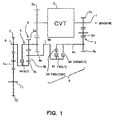
- Fig. 1 shows an example of an IVT using a half toroidal, double cavity type toroidal CVT 2.
- a unit input shaft 1 connected to an engine (not shown) is provided with a gear 3a of a fixed speed ratio transmission 3, and is connected with the input side of the toroidal CVT 2.
- An output gear 2a is provided on the output side of the CVT 2.
- a fixed speed ratio transmission output shaft 3c, carrier 50, CVT output shaft 4 and unit output shaft 6 are arranged sequentially and coaxially parallel to this unit input shaft 1.
- a gear 3b which meshes with the gear 3a of the unit input shaft 1 is disposed via a counter gear 3d at one end of the fixed speed ratio transmission output shaft 3c.
- the fixed speed change transmission 3 comprises the gear 3a, counter gear 3d and gear 3b.
- An overrun & reverse clutch (hereafter referred to as OVR&R/C, and as a second clutch in claims) 92 which can be selectively engaged with one end of the carrier 50 is interposed in the middle of the fixed speed ratio transmission output shaft 3c.
- a forward one-way clutch hereafter referred to as FWD/OWC, and as a one way clutch in claims
- FWD/C forward clutch
- FWD/C forward clutch
- the FWD/OWC 93 transmits torque from the fixed speed ratio transmission output shaft 3c to the carrier 50, and interrupts torque in the opposite direction (from the carrier 50 to the fixed speed ratio transmission output shaft 3c).
- this carrier 50 is connected with a pinion 5b of a planetary gear set 5 disposed in the middle of the CVT output shaft 4.
- a gear 4a which meshes with the output gear 2a of the CVT 2 is disposed at one end of the CVT output shaft 4, and a sun gear 5a of the planetary gear set 5 is formed in the middle of the CVT output shaft 4.
- this sun gear 5a meshes with the pinion 5b which can be selectively joined with the fixed speed ratio transmission output shaft 3c via the carrier 50, and this pinion 5b also meshes with a ring gear 5c joined to one end of the unit output shaft 6.
- a high clutch (hereafter referred to as H/C) 10 which engages in the direct mode is interposed between the other end of the CVT output shaft 4, and the middle of the unit output shaft 6.
- the unit output shaft 6, which is the output shaft of the IVT, transmits the torque to a drive shaft 11 via a counter gear 7a and final gear 12 from a transmission output gear 7 provided at the other end.
- FWD/C 91 the above-mentioned FWD/C 91, OVR&R/C 92 and FWD/OWC 93, constitute a three-way clutch unit 9 (first clutch device) which engages at least in the power recirculation mode.
- the CVT 2 comprises two sets of input disks 21 and output disks 22 forming a double cavity toroidal shape which respectively grips and presses power rollers 20, as shown in Fig. 2 in Fig. 3.
- the power roller 20 is supported by a trunnion 23 (power roller supporting member) whereof the lower end engages with an hydraulic cylinder 30, and which is free to displace in an axial direction and rotate around the axis, as shown in Fig. 3.
- the precess cam 135 comprises a cam groove (cam surface) 135A having a predetermined inclination in the circumferential direction as shown in Fig. 3, and one end of a feedback link 38 which is free to slide, slides in this cam groove 135A.
- the feedback link 38 is formed in, for example, an L-shape, and is supported free to pivot around a pivot shaft 39.
- One end of the link 38 slides in the cam groove or on the cam surface, while the other end engages with one end of a speed change link 37.
- the axial displacement and rotation amount of the trunnion 23, i.e., the gyration angle of the power roller 20, are thereby transmitted to one end of the speed change link 37.
- the speed change link 37 is joined to a spool 246S of the shift control valve 246 in its center as shown in Fig. 4.
- the other end of the speed change link 37 which is joined to the feedback link 38, is joined to a step motor 136 (actuator).
- the speed change link 37 causes the shift control valve 246 (speed change control valve) to displace in an axial direction due to the drive of the step motor 136, and causes the spool 246S of the shift control valve 246 to displace in an axial direction according to the rotation and axial displacement of the trunnion 23.
- the trunnion 23 is driven in an axial direction and gyrates the power roller 20 according to the drive position of the step motor 136.
- a predetermined speed ratio hereafter referred to as CVT ratio ic
- the overall speed ratio of the IVT IVT ratio ii (unit input shaft rotation speed Ni /unit output shaft rotation speed Nout ) is varied.
- the overall speed ratio is referred to as the IVT ratio ii, and the inverse of this IVT ratio ii is referred to as the IVT speed ratio e.
- a speed change control unit (clutch control unit) 80 essentially comprising a microcomputer, as shown in Fig. 5.
- the speed change control unit 80 processes these detected values as a running state, and selectively engages the FWD/C 91,H/C 10 and OVR&R/C 92 by driving a H/C solenoid 190, overrun clutch solenoid 211 and mode change-over solenoid 260 as actuators, as shown in Fig. 4, according to this running state. In this way, it changes over between a power recirculation mode and a direct mode, and drives the step motor 136 so that the unit speed ratio (IVT ratio) according to the running state is obtained.
- the running state can be selected according to the following table by selectively engaging the H/C 10 (second clutch device), FWD/C 91 and OVR&R/C 92.
- R REVERSE N or P D(FORWARD) and L(POWER) D and H(DIRECT) FWD/C X X O O OVR&R/C O X B X H/C X X X O
- R REVERSE N or P D(FORWARD) and L(POWER) D and H(DIRECT) FWD/C X X O O O OVR&R/C O X B X H/C X X X O
- the carrier 50 rotates idly according to the rotation of the sun gear 5a by disengaging the H/C 10, FWD/C 91 and OVR&R/C 92, so torque is not transmitted to the ring gear 5c.
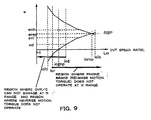
- the carrier 50 engages with the fixed speed ratio transmission output shaft 3c, the torque which was transmitted to the sun gear 5a from the CVT 2 is transmitted partially to each of the pinion 5b and ring gear 5c, and the transmission functions in the reverse direction of the power recirculation mode where the IVT speed ratio e is negative, as shown in Fig. 9 and Fig. 17.
- the OVR&R/C 92 is simultaneously engaged together with the one-way clutch 91, as shown by B in Table 1, and the torque on the engine braking side can be transmitted in addition to the torque on the drive side.
- the Ds range sports range
- M range manual mode
- L range low speed range
- the direct mode is obtained wherein the CVT output shaft 4 and unit output shaft 6 are joined, torque is transmitted to the unit output shaft 6 according to the CVT ratio ic of the CVT 2, and speed change control is performed in a region where the IVT speed ratio e is greater than a rotation synchronous point ersp , as shown in Fig. 9 and Fig. 17.
- the sun gear 5a of the planetary gear set 5 and the pinion 5b rotate, and the carrier 50 is also driven, but in Fig. 9, above the IVT speed ratio ersp corresponding to the rotation synchronous point RSP, the rotation speed of the carrier 50 is higher than the rotation speed of the fixed speed ratio transmission output shaft 3c, and as the power transmission path from the carrier 50 to the fixed speed ratio transmission output shaft 3 is interrupted by the FWD/OWC 93, the carrier 50 merely rotates together with the sun gear 5a and ring gear 5c.
- the change-over between the power recirculation mode and direct mode can be made rapidly and easily by controlling the engaging state of the H/C 10, and the change-over control of running mode can be largely simplified compared to the case where the running mode is changed over by selectively engaging both the FWD/C 91 and H/C 10.
- a differential pressure ⁇ P applied to a piston 31 of the hydraulic cylinder 30 is the transmission torque of the power roller 20, accordingly the transmitted torque can be controlled by adjusting oil pressures Plo, Phi of the oil chambers 30A, 30B of the hydraulic cylinder 30.
- the shift control valve 246 may be changed over according to the direction of torque transmission supported by the hydraulic cylinder 30.
- a line pressure PL is supplied to the oil chamber 30B, if the input disk 21 is rotating, a positive torque (taking the direction of the torque transmitted from the input disk 21 to the output disk 22 as positive, hereafter idem), can be controlled by adjusting the oil pressure Plo of the oil chamber 30A, as shown in Fig. 3.
- the torque transmitted varies according to the engaging mode of the power recirculation mode and the direct mode and the traveling direction of the vehicle.
- the direction of torque transmission passing through the CVT 2 is different when the vehicle is moving forward with the H/C 10 disengaged and only the FWD/C 91 engaged, and when the vehicle is reversing with only the OVR&R/C 92 engaged.
- the transmitted torque on the drive side can be controlled by controlling the negative torque passing through the CVT 2, i.e., the differential pressure ⁇ P between the line pressure PL supplied to the oil chamber 30A and oil pressure Phi supplied to the oil chamber 30B may be controlled as shown in Fig. 3 and Fig. 4.
- the positive torque passing through the CVT 2 may be controlled, so the OVR&R/C 92 is engaged in addition to the FWD/C 91, and a differential pressure ⁇ P between the line pressure PL supplied to the oil chamber 30B and oil pressure Plo supplied to the oil chamber 30A is controlled.
- the torque transmitted on the drive side can be controlled by controlling the positive torque passing through the CVT 2, and the differential pressure ⁇ P between the line pressure PL supplied to the oil chamber 30B and oil pressure Plo supplied to the oil chamber 30A may be controlled.
- the negative torque may be controlled, so the differential pressure ⁇ P between the line pressure PL supplied to the oil chamber 30A and the oil pressure Phi supplied to the oil chamber 30B is controlled as in the case when the vehicle is moving forward in the power recirculation mode.
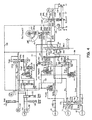
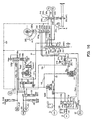
- a discharge port 110p of an oil pump 110 is led to a line pressure port 100p of a pressure regulator 100 via a line pressure circuit 101, and a signal pressure Psigpl from a line pressure solenoid 90 is connected to a port 100f of the pressure regulator valve 100.
- a spool 100a displaces so that the oil pressure from the discharge port 110p balances the force due to this signal pressure Psigpl and the pushing force of a spring 100b, and the line pressure PL of a line pressure circuit 101 connected to the line pressure port 100p is controlled to a predetermined value.
- the line pressure solenoid 90 is controlled by the speed change control unit 80, and the signal pressure is adjusted as an original pressure of a pilot pressure Pp from a pilot pressure circuit 102.
- a pilot valve 103 adjusts this pilot pressure Pp in direct proportion to the line pressure PL from the pressure regulator valve 100.
- An accumulator 120 is interposed between the line pressure solenoid 90 and port 100f.
- An intake port 110i of an oil pump 110 is connected to a pump intake oil passage 104.
- a second drain port 100d of the pressure regulator valve 100 which communicates with this pump intake oil passage 104, communicates with the line pressure port 100p, and increase of the line pressure PL is thereby suppressed.
- a relief valve 140 operates to decompress the line pressure circuit 101.
- a first drain port 100e is at a supply pressure of a cooler reducing valve 155, and the control pressure of the cooler reducing valve 155 is connected to a cooler port 291.
- the cooler reducing valve 155 prevents the cooler supply pressure from increasing beyond a fixed value, and protects the cooler pipe system. Further, if the cooler reducing valve 155 sticks, a cooler relief valve 150 which operates even more rapidly is controlled by the control pressure of the cooler reducing valve 155 to prevent abnormal rise of cooling system pressure.
- the control pressure of the cooler reducing valve 155 is connected to a lubrication port 292 via the cooler port 291 and an orifice, and is supplied to each part of the IVT to perform lubrication and cooling.
- a manual valve 230 which responds to a shift lever, not shown, a reverse torque shutoff valve 240 which responds to the gyration angle ⁇ of the trunnion 23, and the shift control valve 246 which responds to the step motor 136 and precess cam 135 via the speed change link 37, are connected to the line pressure circuit 101 whereof the pressure is adjusted by the pressure regulator valve 100,
- the step motor 136 drives the speed change link 37 so that the CVT ratio ic is on the small side (High side) when the step number is reduced, and drives the speed change link 37 so that the CVT ratio ic is on the large side (Low side) when the step number is increased.
- the relation between the rotation direction of the cam surface 135A of the precess cam 135 and the drive direction of the feedback link 38 is such that in Fig. 3, when the precess cam 135 rotates to the large side (Low side) of the CVT ratio ic , one end 38a of the feedback link 38 displaces downwards in the figure, and when the precess cam 135 rotates to the small side (High side) of the CVT ratio ic , the end 38a of the feedback link 38 displaces upwards in the figure so as to drive the speed change link 37 engaged with the other end.
- the shift control valve 246 comprises a supply port 246P which communicates with the line pressure circuit 101, a Low side port 246L which communicates with the oil chamber 30A of the hydraulic cylinder 30, and a High side port 246H which communicates with the oil chamber 30B of the hydraulic cylinder 30, and the line pressure PL is supplied to one of the Low side port 246L or High side port 246H according to the displacement of the spool 246S connected to the speed change link 37.
- the other port is connected to one of discharge ports 246C, 246D.
- the discharge port 246C which can communicate with the Low side port 246L, communicates with the pump intake passage 104 and a port 240f of the reverse torque shutoff valve 240.
- the port 246D which can communicate with the High side port 246H, is connected with a port 230d of the manual valve 230.
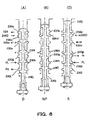
- a spool 230j of the manual valve 230 is driven by a cam, etc., not shown, which rotates according to a select lever, etc., shown in Fig. 6(D), and is set to one of three positions, i.e., the D range which is the forward range, R range which is the reverse range, or N or P range which are vehicle stop ranges, as shown in Fig. 6(A)-(C).
- the spool 230j when the D range is selected, the spool 230j is situated in the lowermost part of the figure as shown in Fig. 6(A), and when the R range is selected, the spool 230j is situated in the uppermost part of the figure as shown in Fig. 6(C).
- the spool 230j displaces to a position between the D range and N range, as shown in Fig. 6(B).
- the spool 230j displaces to the uppermost position of the figure shown in Fig. 4 and Fig. 6(A), a line pressure port 230h which communicates with the line pressure circuit 101 is connected with a D range pressure port 230i, and the line pressure PL is supplied to a D range pressure circuit 107 (first hydraulic supply device).
- the line pressure PL is supplied from the D range pressure circuit 107 to both a H/C control valve 180 (third hydraulic supply device) and the FWD/C 91. Further, the D range pressure circuit 107 supplies the line pressure PL to a port 240g of the reverse torque shutoff valve 240 which responds to the gyration angle ⁇ of the trunnion 23.
- the spool 240a of the reverse torque shutoff valve 240 displaces to the upper part of Fig. 4, this port 240g communicates with a port 240b, the line pressure PL from the D range pressure circuit 107 is supplied to an OVR&R/C control valve 201 (second hydraulic supply device) to permit engaging of the OVR&R/C 92, and the operation of the engine brake when the vehicle is moving forward in the D range is enabled.
- OVR&R/C control valve 201 second hydraulic supply device
- the R range pressure port 230g which communicates with an R range pressure circuit 108, is connected to a drain port 230f, and supply of oil pressure from the R range pressure circuit 108 to the OVR&R/C 92 connected to the R range pressure circuit 108 via a shuttle valve 271, is shut off.
- the manual valve 230 connects the port 230d communicating with the discharge side port 246D of the shift control valve 246 to the pump intake oil passage 104 via a port 230c.
- the spool 230j displaces to effectively the middle of a full stroke, the line pressure port 230h is sealed, the D range pressure port 230i is opened to the atmosphere to drain from the lower part of the figure, the R range pressure port 230g is connected to the drain port 230f, the D range pressure circuit 107 and R range pressure circuit 108 are both drained, and supply of the line pressure PL to the H/C control valve 180, OVR&R/C control 201 and FWD/C 91 is shut off. This disengages the FWD/C 91, H/C 10 and OVR&R/C 92, and torque transmission from the unit input shaft 1 to the unit output shaft 6 is interrupted.
- the spool 230j displaces to the upper part of the figure, the R range pressure port 230g is made to communicate with the line pressure port 230h, and the D range pressure port 230i is opened to the atmosphere to drain from the lower part of the figure.
- the line pressure PL is applied from the R range pressure port 230g to the R range pressure circuit 108, so the valve body of the shuttle valve 271 moves to the left in Fig. 4, and the OVR&R/C 92 is engaged.
- the oil pressure of the D range pressure circuit 107 is drained from the port 230i, so the FWD/C 91 is disengaged, the original pressures of a H/C control valve 180d and the OVR&R/C control valve 201 are both shut off, and the H/C 10 is disengaged.
- the port 230d which communicates with the discharge side port 246D of the shift control valve 246, communicates with the port 240e of the reverse torque shutoff valve 240 via the port 230e, and the oil chamber 30B of the hydraulic cylinder 30 then communicates with the port 240e of the reverse torque shutoff valve 240.
- a pilot pressure control circuit 102 of which the pressure is adjusted by a pilot valve 103 supplies the pilot pressure Pp to the H/C solenoid 190 which controls the H/C 10, the OVR&R/C solenoid 211 which controls the OVR&R/C 92, and the mode change-over solenoid 260 which controls the mode change-over valve 175 (engaging state control device).
- the H/C solenoid 190, OVR&R/C solenoid 211 and mode change-over solenoid 260 are duty-controlled by the speed change control unit 80, as shown in Fig. 4.
- a signal pressure PsolH/C adjusted by the H/C solenoid 190, is supplied to a port 180e of the H/C control valve 180.
- a signal pressure PsolOVR/C adjusted by the OVR&R/C solenoid 211 is supplied to a port 201e of the OVR&R/C control valve 201.
- the H/C control valve 180 drives the spool 180a according to the signal pressure PsolH/C supplied to the port 180e, decompresses a D range pressure Pd (the line pressure PL ) from the D range pressure circuit 107 supplied to the port 180g, and supplies this to the mode change-over valve 175 as a control pressure Phc from an output port 180c.
- the port 180d is connected to the pump intake pressure path 104.
- the signal pressure PsolH/C pushes the spool 180a against a spring 180b and the D range pressure Pd, and the signal pressure Phc increases as shown in Fig. 12 according to the increase of the signal pressure PsolH/C.
- the H/C control valve 180 makes the port 180c communicate with the port 180d, and releases the control pressure Phc.
- the OVR&R/C control valve 201 drives the spool 201a according to the signal pressure PSolOVR/C supplied to the port 201e, decompresses an R range pressure Pr (the line pressure PL) from the R range pressure circuit 108 supplied to the port 201g, and supplies this to the mode change-over valve 175 as a control pressure Povrc from an output port 201c.
- a port 201d is connected to the pump intake oil passage 104.
- the signal pressure PsolOVR/C pushes the spool 201a against a spring 201b and the R range pressure Pr, and the control pressure Povrc increases as shown in Fig. 12 according to the increase of the signal pressure PsolOVR/C.
- the OVR&R/C control valve 201 makes the output port 201c communicate with the port 201d by the pushing force of the spring 201b, and the control pressure Povrc is discharged to the pump intake oil passage 104.
- control pressure Phc and control pressure Povrc supplied from the H/C control valve 180 and OVR&R/C control valve 201 are supplied respectively to the OVR&R/C 92 and H/C 10 via the mode change-over valve 175 comprising a spool 175a which responds to a signal pressure PsolMC from the mode change-over solenoid 260.
- the output port 180c of the H/C control valve 180, and output port 201c of the OVR&R/C control valve 201, are respectively connected with ports 175d, 175h of the mode change-over valve 175.
- a port 175e of the mode change-over valve 175 communicates with the H/C 10, and a port 175g communicates with the OVR&R/C 92 via the shuttle valve 271.
- a port 175f formed between these ports 175e, 175g is drained, and one of the control pressures Phc supplied to the H/C 10 and the control pressure Povrc supplied to the OVR&R/C 92, is supplied according to the displacement of the spool 175a.
- an oil chamber 175c which receives the signal pressure PsolMC from the mode change-over solenoid 260, is formed at the end of the spool 175a of the mode change-over valve 175, and the signal pressure PsolMC pushes the spool 175a against a spring (or elastic member) 175b.
- the spool 175a When the signal pressure PsolMC is 0, as shown in Fig. 4, the spool 175a is pushed by the spring 175b displacing it to the upper part of the figure, the port 175d communicates with the port 175e and the signal pressure Phc is supplied to the H/C 10, while the ports 175g, 175f are made to communicate and the oil pressure supplied to the shuttle valve 271 is drained.
- a spool 240a of the reverse torque shutoff valve 240 comprises a pin 241 which engages with a cam groove 295a of a cam 295 connected to the trunnion 23, and displaces according to the gyration angle ⁇ of the power roller 20.
- the port 240e which communicates with the port 230e of the manual valve 230 is made to communicate with one of a pressure port 240d connected to the line pressure circuit 101, and the port 240f connected to the pump intake oil passage 104 and discharge port 246C of the shift control valve 246, while at the same time, the port 240b which communicates with the OVR&R/C control valve 201 is made to communicate with one of the port 240g connected to the D range pressure circuit 107, and a port 240c connected to the pump intake oil passage 104.
- a pin 241 which engages with the cam groove 295a is formed at one end of the spool 240a of the reverse torque shutoff valve 240.
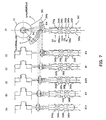
- the cam groove 295a formed in the cam 295 drives the spool 240a between the gyration angle ⁇ r set larger than a gyration angle ⁇ gnp corresponding to the geared neutral point GNP , and a gyration angle ⁇ d set smaller than the gyration angle ⁇ gnp , i.e., in a range extending from ⁇ d to ⁇ r including ⁇ gnp, and in a region less than the gyration angle ⁇ d or exceeding the gyration angle ⁇ r, the spool 240a is fixed, as shown in Fig. 7 to Fig. 9.
- the spool 240a driven by the cam groove 295a is situated effectively in the middle of a stroke, the port 240b communicates with the port 240c, and the port 201g of the OVR&R/C control valve 201 is connected with the pump intake oil passage 104, while at the same time, the line pressure port 240d communicates with the port 240e, and the line pressure PL is supplied to the port 230e of the manual valve 230.
- the cam groove 295a is formed so as to displace the spool 240a towards the upper part of the diagram at this time, and when the gyration angle varies towards a large CVT ratio ic from ⁇ gnp to ⁇ d , the spool 240a displaces to the position of Fig. 7(B).
- the port 240b which had communicated with the port 240c is sealed while the port 240e continues to communicate with the line pressure port 240d, and when the gyration angle becomes less than ⁇ d , the port 240b communicates with the port 240g, and the port 201g of the OVR&R/C control valve 201 connects with the D range pressure circuit 107.
- the spool 240a displaces further upwards, and is held in a position where the seal properties of the port 240b and port 240c are maintained, as shown in Fig. 7(A). Subsequently, it does not move upwards from the position in Fig. 7(A) even if the gyration angle varies to the minimum value ⁇ lo (CVT ratio is iclo ) used in the control, so increase in the total length of the reverse torque shutoff valve 240 is suppressed.
- the cam groove 295a is formed so as to displace the spool 240a towards the lower part of the figure at this time, and when the gyration angle varies towards a small CVT ratio ic from ⁇ gnp to ⁇ r, the spool 240a displaces to the position of Fig. 7(D).
- the port 240e In the position where the gyration angle is ⁇ r, the port 240e is shut off from the line pressure port 240d and sealed while the port 240b continues to communicate with the port 240c, and when the gyration angle exceeds ⁇ r, the port 240e communicates with the port 240f, and the port 230e of the manual valve 230 is connected to the pump intake oil passage 104.
- the spool 240a displaces further downwards, and is held in a position where the seal properties of the line pressure port 240d and port 240e are maintained, as shown in Fig. 7(E). Subsequently, it does not move downwards from the position in Fig. 7(E) even if the gyration angle varies to the maximum value ⁇ hi (CVT ratio is ichi ) used in the control, so increase in the total length of the reverse torque shutoff valve 240 is suppressed.
- the D range pressure (line pressure PL ) is further supplied from the manual valve 230 to the D range pressure circuit 107 and the FWD/C 91 is engaged, thus establishing the power recirculation mode.
- the step motor 136 is driven in the forward direction (large side of the CVT ratio ic ) as shown in Fig. 9 and Fig. 17 in order to obtain a predetermined creep torque.
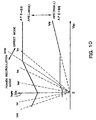
- the ordinary CVT ratio ic is controlled so that a predetermined input shaft rotation is achieved relative to the vehicle speed VSP, and the accelerator pedal depression amount APS and a target input shaft rotation speed according to the vehicle speed VSP are determined as shown by the speed change map in Fig. 10, for example.
- [target input shaft rotation speed Nin ]/[CVT output shaft rotation speed No ] shows a target CVT ratio ic
- the running mode is also determined based on a CVT ratio icrsp corresponding to the rotation synchronous point RSP, target CVT ratio and vehicle speed VSP.
- the change-over of running mode is shown for the case where it is performed at the CVT ratio icrsp corresponding to the rotation synchronous point RSP.
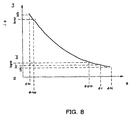
- the target gyration angle ⁇ is computed based on the map of Fig. 8 from the target CVT ratio ic , and the position of the step motor 136 is controlled relative to the target gyration angle.
- the OVR&R/C solenoid 211 is energized, the control pressure Povrc is generated, the mode change-over solenoid 260 is also energized to generate the signal pressure PsolMC which is supplied to the mode change-over valve 175, the spool 175a is pushed downwards in Fig. 4, and the signal pressure Povrc is supplied from the shuttle valve 271 from the port 175h via the port 175g to engage the OVR&R/C 92.
- the OVR&R/C 92 is disengaged to prevent torque on the engine brake side from being transmitted.
- the disengaging of the OVR&R/C 92 may also be performed by only interrupting energization of the mode change-over solenoid 260, and when the signal pressure PsolMC is 0, the spool 175a is pushed by the spring 175b to displace upwards in Fig. 4, the port 175g is made to communicate with the port 175f, and the oil pressure of the OVR&R/C 92 is drained.
- the determination of whether to disengage the OVR&R/C 92 may also be made at less than the predetermined vehicle speed, or when the IVT speed ratio e (or IVT ratio ii ) is a speed ratio corresponding to first gear of the planetary gear type automatic transmission, or has reached approximately the lowest speed ratio of the CVT equipped with torque converter.
- the OVR&R/C 92 by controlling the OVR&R/C 92, transmission of engine brake torque in the very low vehicle speed region is prevented, and excessive engine braking due for example to a fault of the speed change control unit 80 is suppressed.
- the port 201g which supplies the original pressure to the OVR&R/C control valve 201 is connected to the port 240b of the reverse torque shutoff valve 240, and the D range pressure Pd from the port 240g is selectively received according to the position of the spool 240a.
- the step motor 136 is driven to the High side of the CVT ratio ic relative to the geared neutral point GNP, the OVR&R/C solenoid 211 is energized above the gyration angle ⁇ d (below the CVT ratio icd ), the original pressure (D range pressure Pd) of the OVR&R/C 92 is shut off by the reverse torque shutoff valve 240 in response to the cam 295, and unintended speed change and engine braking due to the fault are prevented.
- the signal pressure PoslMC of the mode change-over solenoid 260 is generated, and the spool 175a of the mode change-over valve 175 is pushed downwards in Fig. 4, so the H/C 10 can be engaged, as described above. Therefore, simultaneous engaging of the OVR&R/C 92 and H/C 10 is prevented, and an unintended speed change towards the rotation synchronous point RSP is prevented.
- the mode change-over valve 175 interrupts energization of the mode change-over solenoid 260 when the OVR&R/C 92 is disengaged
- the spool 175a moves up as shown in Fig. 4, the OVR&R/C 92 is disengaged regardless of the control pressure Povrc , and the H/C 10 is engaged.
- the FWD/C 91 is always engaged when the D range (forward range) is selected, as shown also in the above Table 1, so the drive torque in the forward direction of the power recirculation mode continues to be transmitted by the FWD/C 91 even during a running mode change-over.
- the control pressure Phc from the H/C control valve 180 is gradually increased by gradually increasing the ON duty ratio which controls this solenoid 190, and when it has risen to the control pressure Phc required to engage the H/C 10, the mode changes over to the direct mode.
- the change-over between the power recirculation mode and direct mode can be performed rapidly and easily by controlling the engaging state of the H/C 10, and running mode change-over control can be largely simplified compared to the case where the running mode is changed over by alternately connecting the FWD/C 91 and H/C 10.
- all speed change regions which can be set by the CVT 2 can be used from the CVT ratio icrsp corresponding to the rotation synchronous point RSP to the highest CVT ratio ichi , as shown in Fig. 9.
- the OVR&R/C 92 may be engaged by controlling the OVR&R/C solenoid 211 as described above.
- the line pressure PL is supplied to the OVR&R/C 92 via the manual valve 230 and shuttle valve 271 so that it is constantly engaged.
- discharge port 246D on the Phi side of the shift control valve 246 is connected to the reverse torque shutoff valve 240 via the ports 230d, 230e of the manual valve 230, as shown in Fig. 6(C).
- the port 240e which communicates with the discharge port 246D of the shift control valve 246 is connected to the line pressure port 240d, as shown in Fig. 7(C), so the pressure supplied as the oil pressure Phi of the oil chamber 30B is the line pressure PL regardless of whether the reverse torque shutoff valve 240 is connected to the line pressure port 246P or the discharge port 246D.
- differential pressure control of the hydraulic cylinder 30 can be performed only in the range Phi ⁇ Plo.
- torque on the engine brake side (forward motion side) in the reverse range cannot be transmitted, excessive engine braking due for example to a fault of the speed change control unit 80 is prevented from occurring, and an unintended speed change in the vicinity of the geared neutral point GNP of the R range is prevented.
- the gyration angle ⁇ r which interrupts the engine brake torque is set between the geared neutral point GNP and the highest side of the CVT ratio ic, so at the gyration angle ⁇ r when the vehicle is traveling in the R range, i.e., in a region on the negative of the IVT speed ratio e in Fig. 9, the reverse torque shutoff valve 240 drains the discharge port 246D of the shift control valve 246 via the manual valve 230, port 240e and port 240f, as shown in Fig. 7(E), so engine brake torque is transmitted and drivability is maintained.
- the three-way clutch unit 9 which sets the power recirculation mode of the IVT comprises plural clutches, i.e., the FWD/C 91, OVR&R/C 92 and FWD/OWC 93
- the direct mode is set by the H/C 10
- the mode change-over valve 175 is provided which selectively supplies an oil pressure to the H/C 10 and OVR&R/C 92.
- the three-way clutch unit 9 comprises the FWD/OWC 93 which transmits torque in only one direction, in the forward range, if only the engaging state of the H/C 10 is controlled leaving the FWD/C 91 always engaged, the change-over between the power recirculation mode and direct mode can be accomplished quickly and easily, and running mode change-over control can be largely simplified in comparison to the case where the running mode change-over is performed by alternately connecting the FWD/C 91 and H/C 10.
- Fig. 13, Fig. 14 show a second embodiment wherein the reverse torque shutoff valve of the aforesaid first embodiment controls only engine braking in the reverse direction, and control of the OVR&R/C 92 is only electronic control by the OVR&R/C solenoid 211 where the original pressure of the OVR&R/C control valve 201 is the D range pressure Pd.
- the remaining features of the construction are identical to those of the aforesaid first embodiment.
- the D range pressure circuit 107 connected to the D range pressure port 230i of the manual valve 230 is connected to the port 180g of the H/C control valve 180, the port 201g of the OVR&R/C control valve 201 and the FWD/OWC 91, and when the D range, which is the forward range, is selected, the original control pressure Phc and control pressure Povrc are supplied, and the FWD/OWC 91 is engaged.
- a reverse torque shutoff valve 245 the ports 240g, 240b are eliminated from the reverse torque shutoff valve 240 shown in the aforesaid first embodiment, and the operating range of the spool 240a is modified.
- a spool 245a of the reverse torque shutoff valve 245 comprises a pin 241 which engages with a cam groove 295b of the cam 295 connected to the trunnion 23, and displaces according to the gyration angle ⁇ of the power roller 20.
- a port 245e communicating with the port 230e of the manual valve 230 is made to communicate with one of a line pressure port 245d connected to the line pressure circuit 101, and a port 245f connected to the pump intake oil passage 104 and discharge port 246C of the shift control valve 246, according to the displacement of the spool 245a.
- a pin 241 which engages with the cam groove 295b is formed at one end of the spool 245a of the reverse torque shutoff valve 245, as shown in Fig. 13 and Fig. 14.
- the cam groove 295a formed in the cam 295 drives the spool 245a between the gyration angle ⁇ r set larger than the gyration angle ⁇ gnp corresponding to the geared neutral point GNP and the gyration angle ⁇ gnp, and fixes the spool 245a in regions less than the gyration angle ⁇ gnp and beyond the gyration angle ⁇ r, as shown in Fig. 8 and Fig. 9.
- the spool 245a driven by the cam groove 295b is situated effectively in the middle of the stroke, and the port 245e which can communicate with the discharge port 246D of the shift control valve 246 via the manual valve 230, is sealed as shown in Fig. 14(B).
- the cam groove 295b is formed so that the spool 245a displaces towards the trunnion 23 in the figure at this time, and when the gyration angle varies beyond ⁇ r to ⁇ lo where the CVT ratio ic is large, the spool 245a displaces to the position of Fig. 14 (C).
- the port 245e communicates with the line pressure port 245d, and the line pressure PL can be supplied to the discharge port 246D of the shift control valve 246 via the manual valve 230.
- the cam groove 295b is formed so that the spool 245a displaces away from the trunnion 23 at this time, and when the gyration angle varies from ⁇ r to ⁇ hi where the CVT ratio ic is small, the spool 245a displaces to the position of Fig. 7(A).
- the port 245e communicates with the port 245f, and the port 230e of the manual valve 230 is connected to the pump intake oil passage 104,
- the port 230e communicates with the port 230d of the manual valve 230, and the discharge port 246D of the shift control valve 246 is connected to the port 245e of the reverse torque shutoff valve 245.
- the line pressure PL is supplied to the discharge port 246D, engine braking in the reverse range is prohibited, and unintended, excessive engine braking due for example to a fault of the speed change control unit 80 is definitively prevented from occurring.
- the discharge port 246D is connected to the pump intake oil passage 104, and the oil pressure Plo of the oil chamber 30B can be arbitrarily set between the line pressure PL and 0, so engine braking in the reverse range can be controlled.
- the OVR&R/C control valve 201 is supplied by the original pressure only in the D range, which is the forward range.
- the OVR&R/C 92 is engaged by the control pressure Povrc only when the signal pressure PsolMC of the mode change-over solenoid 260 and the signal pressure PsolOVR/C from the OVR&R/C solenoid 211 are generated, so engine braking on the forward motion side of the power recirculation mode can be controlled.
- the signal pressure PsolMC is 0, so the spool 175a of the mode change-over valve 175 displaces upwards as shown in Fig. 13, and the port 175g which can communicate with the OVR&R/C 92, communicates with the port 175f and is drained.
- the OVR&R/C 92 is not engaged even if a fault occurs in the OVR&R/C solenoid 211 or OVR&R/C control valve 201.
- Fig. 15 shows a third embodiment, wherein the H/C control valve 180 and H/C solenoid 190 of the aforesaid second embodiment are replaced by an accumulator 122 and orifice 123, and ON/OFF of the signal pressure PsolMC of the mode change-over valve 175 is modified in the direct mode and power recirculation mode.
- the remaining features of the construction are identical to those of the first embodiment.
- the FWD/C 91 is connected to the D range pressure circuit 107 via the accumulator 121, and the D range pressure circuit 107is connected to the port 201g of the OVR&R/C control valve 201 and the mode change-over valve 175d.
- the OVR&R/C control valve 201 is identical to that of the aforesaid first and second embodiments, but in a mode change-over valve 175', the relation between the signal pressure PsolMC and spool 175a is the reverse of that in the aforesaid first and second embodiments.
- the signal pressure PsolMC from the mode change-over solenoid 260 is supplied to the oil chamber 175c provided at one end of the spool 175a, and the spool 175a is pushed against the spring 175b.
- the D range pressure Pd is supplied to the accumulator 121 and FWD/C 91 so as to engage the FWD/C 91, and when engine braking is required, the OVR&R/C 92 is engaged by the control pressure Povrc supplied from the OVR&/C control valve 201 by generating the signal pressure PsolOVR/C from the OVR&R/C solenoid 211.
- the mode change-over valve 175' cannot supply the D range pressure Pd to the H/C 10, so on the forward motion side of the power recirculation mode, simultaneous engaging of the H/C 10 and OVR&R/C 92 is prevented, and an unintended speed change toward the rotation synchronous point RSP due to a fault is also prevented.
- the H/C 10 When there is a change-over from the power recirculation mode to the direct mode, the H/C 10 can be gradually engaged while the D range pressure Pd is built up in the accumulator 122, and the change-over of running mode can be performed smoothly without producing a change-over shock.
- the H/C solenoid 190 and H/C control valve 180 are rendered unnecessary while at the same time, an unintended change to the rotation synchronous point RSP due to a fault, etc., is prevented.
- This further simplifies the construction and control of the hydraulic circuit, reduces manufacturing costs, permits a smooth change-over of running mode and vehicle starting, and ensures good running performance.
- Fig. 16 shows a fourth embodiment wherein the reverse torque shutoff valve 245 of the third embodiment is replaced by the reverse torque shutoff valve 240 of the first embodiment, and the D range pressure circuit 107 and OVR&R/C control valve 201 are respectively connected to the reverse torque shutoff valve 240.
- the remaining features of the construction are identical to those of the third embodiment.
- the port 240g of the reverse torque shutoff valve 240 is also connected to the D range pressure circuit 107 which communicates with the D range pressure port 230i of the manual valve 230.
- the port 201g of the OVR&R/C control valve 201 is connected to the port 240b of the reverse torque shutoff valve 240, and the port 240b is selectively connected to the port 240g or the port 240c connected to the pump intake oil passage 104 according to the gyration angle ⁇ as in the case of the aforesaid first embodiment.
- the discharge port 246D of the shift control valve 246 is connected to the line pressure circuit 101 via the ports 230d, 230e of the manual valve 230 and the ports 240e, 240d of the reverse torque shutoff valve 240, hence, the oil pressure Phi of the oil chamber 30B is the line pressure PL, and engine braking (transmission of torque to forward side) is again restricted.
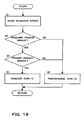
- Fig. 18 is a flowchart showing an example of the control of the OVR&R/C 92 shown from the first embodiment to the fourth embodiment, which is performed at a predetermined interval by the speed change control unit 80 shown in Fig. 5 of the first embodiment.
- a running state such as the CVT ratio ic (or gyration angle ⁇ , or IVT speed ratio e ) based on a selector position POS from the inhibitor switch 85, vehicle speed VSP from the vehicle speed sensor 83, unit input shaft rotation speed Ni from the unit input shaft rotation speed sensor 81 and rotation speed No from the CVT output shaft rotation speed sensor 82, is read.
- a step S2 it is determined whether or not, in the forward range, the detected selector position POS is set to the Ds range (sports range) or M range (manual mode) requiring engine braking, and if it is in the Ds range or M range, the routine proceeds to a step S3, otherwise the routine proceeds to a step S5 and the OVR&R/C 92 is disengaged.
- step S3 it is determined whether the CVT ratio iv or the gyration angle ⁇ is larger than the CVT ratio icd (Low side) or less than ⁇ d , or whether the IVT speed ratio e is greater than ed, and the vehicle is in a running range which permits engine braking in the forward range.
- the routine proceeds to a step S4 and the OVR&R/C 92 is engaged, while in a region where engine braking is prohibited (less than icd ), the routine proceeds to the step S5, and the OVR&R/C 92 is disengaged.
- a step S4 the mode change-over solenoid 260 and overrun clutch solenoid 211 are energized so that the control pressure Povrc is generated or can be generated, and oil pressure is supplied or can be supplied from the mode change-over valve 175 to the OVR&R/C 92 so as to engage the OVR&R/C 92.
- the control pressure Povrc when the reverse torque shutoff valve 240 operates in the forward range, the control pressure Povrc can be generated, and the control pressure Povrc can be supplied from the mode change-over valve 175 to the OVR&R/C 92.
- step S5 energization to the overrun clutch solenoid 211 and mode change-over solenoid 216 are interrupted, and the OVR&R/C 92 is connected to the drain and disengaged.
- a failsafe mechanism is provided in addition to mechanical control such as the reverse torque shutoff valve 240.
- the three-way clutch unit 9 was used as the clutch which sets the power recirculation mode, but this three-way clutch unit 9 may also be used to set the direct mode, the functions of the three-way clutch unit 9 may comprise at least torque transmission in only one direction, torque transmission in both directions and torque interruption, and the unit may additionally have other functions.
Landscapes
- Engineering & Computer Science (AREA)
- General Engineering & Computer Science (AREA)
- Mechanical Engineering (AREA)
- Control Of Transmission Device (AREA)
- Arrangement Of Transmissions (AREA)
- Transmissions By Endless Flexible Members (AREA)
- Transmission Devices (AREA)
Applications Claiming Priority (2)
| Application Number | Priority Date | Filing Date | Title |
|---|---|---|---|
| JP2000094795 | 2000-03-30 | ||
| JP2000094795A JP3458818B2 (ja) | 2000-03-30 | 2000-03-30 | 変速比無限大無段変速機の制御装置 |
Publications (2)
| Publication Number | Publication Date |
|---|---|
| EP1138981A2 true EP1138981A2 (de) | 2001-10-04 |
| EP1138981A3 EP1138981A3 (de) | 2003-01-29 |
Family
ID=18609784
Family Applications (1)
| Application Number | Title | Priority Date | Filing Date |
|---|---|---|---|
| EP01108064A Withdrawn EP1138981A3 (de) | 2000-03-30 | 2001-03-29 | Stufenlos verstellbares Getriebe |
Country Status (3)
| Country | Link |
|---|---|
| US (1) | US6659901B2 (de) |
| EP (1) | EP1138981A3 (de) |
| JP (1) | JP3458818B2 (de) |
Cited By (4)
| Publication number | Priority date | Publication date | Assignee | Title |
|---|---|---|---|---|
| DE10301736A1 (de) * | 2003-01-18 | 2004-08-05 | Audi Ag | Verfahren zum Steuern von Übersetzungsänderungen |
| WO2007003657A1 (en) * | 2005-07-05 | 2007-01-11 | Torotrak (Development) Limited | Ratio limiting arrangement |
| WO2008096175A2 (en) | 2007-02-09 | 2008-08-14 | Torotrak (Development) Limited | Cvt control system |
| CN102490599A (zh) * | 2011-12-26 | 2012-06-13 | 北京理工华创电动车技术有限公司 | 纯电动汽车用双动力耦合驱动系统 |
Families Citing this family (55)
| Publication number | Priority date | Publication date | Assignee | Title |
|---|---|---|---|---|
| JP3794295B2 (ja) * | 2001-07-25 | 2006-07-05 | 日産自動車株式会社 | トロイダル型無段変速機の変速制御装置 |
| EP1474623A2 (de) | 2002-02-07 | 2004-11-10 | LuK Lamellen und Kupplungsbau Beteiligungs KG | Verfahren zum regeln der bersetzung eines leistungsverzweig ten automatischen getriebes sowie leistungsverzweigtes automatisches getriebe |
| US7011600B2 (en) | 2003-02-28 | 2006-03-14 | Fallbrook Technologies Inc. | Continuously variable transmission |
| JP4529442B2 (ja) * | 2003-02-28 | 2010-08-25 | 日本精工株式会社 | トロイダル型無段変速機 |
| JP2005195106A (ja) * | 2004-01-08 | 2005-07-21 | Nsk Ltd | 無段変速装置 |
| US7048667B2 (en) * | 2004-02-09 | 2006-05-23 | Ford Global Technologies, Llc | Power split transaxle for producing stepless reverse, forward and geared neutral speed ratios |
| MX364884B (es) | 2004-10-05 | 2019-05-10 | Fallbrook Intellectual Property Company Llc Star | Transmisión continuamente variable. |
| NL1028800C2 (nl) * | 2004-10-20 | 2006-04-24 | Dti Group Bv | Aandrijving en transmissie-module met voor een voertuig aangepaste lay-out. |
| KR20130018976A (ko) | 2005-10-28 | 2013-02-25 | 폴브룩 테크놀로지즈 인크 | 전기 기계 동력 전달 방법 |
| US20070155567A1 (en) | 2005-11-22 | 2007-07-05 | Fallbrook Technologies Inc. | Continuously variable transmission |
| CN102226464B (zh) | 2005-12-09 | 2013-04-17 | 福博科技术公司 | 一种用于变速器的轴向力产生机构 |
| EP1811202A1 (de) | 2005-12-30 | 2007-07-25 | Fallbrook Technologies, Inc. | Stufenloses Getriebe |
| US7882762B2 (en) | 2006-01-30 | 2011-02-08 | Fallbrook Technologies Inc. | System for manipulating a continuously variable transmission |
| CN102269056B (zh) | 2006-06-26 | 2013-10-23 | 福博科技术公司 | 无级变速器 |
| EP2089642B1 (de) | 2006-11-08 | 2013-04-10 | Fallbrook Intellectual Property Company LLC | Klemmkraftgenerator |
| EP2125469A2 (de) | 2007-02-01 | 2009-12-02 | Fallbrook Technologies Inc. | System und verfahren zur getriebe- und/oder antriebsmotorsteuerung |
| CN101657653B (zh) | 2007-02-12 | 2014-07-16 | 福博科知识产权有限责任公司 | 一种传动装置 |
| WO2008101070A2 (en) | 2007-02-16 | 2008-08-21 | Fallbrook Technologies Inc. | Infinitely variable transmissions, continuously variable transmissions, methods, assemblies, subassemblies, and components therefor |
| EP2142826B1 (de) | 2007-04-24 | 2015-10-28 | Fallbrook Intellectual Property Company LLC | Elektrische zugvorrichtungen |
| US8641577B2 (en) | 2007-06-11 | 2014-02-04 | Fallbrook Intellectual Property Company Llc | Continuously variable transmission |
| KR20100046166A (ko) | 2007-07-05 | 2010-05-06 | 폴브룩 테크놀로지즈 인크 | 연속 가변 변속기 |
| CN103939602B (zh) | 2007-11-16 | 2016-12-07 | 福博科知识产权有限责任公司 | 用于变速传动装置的控制器 |
| EP2234869B1 (de) | 2007-12-21 | 2012-07-04 | Fallbrook Technologies Inc. | Automatikgetriebe und verfahren dafür |
| WO2009111328A1 (en) | 2008-02-29 | 2009-09-11 | Fallbrook Technologies Inc. | Continuously and/or infinitely variable transmissions and methods therefor |
| US8317651B2 (en) | 2008-05-07 | 2012-11-27 | Fallbrook Intellectual Property Company Llc | Assemblies and methods for clamping force generation |
| JP5457438B2 (ja) | 2008-06-06 | 2014-04-02 | フォールブルック インテレクチュアル プロパティー カンパニー エルエルシー | 無限可変変速機、及び無限可変変速機用の制御システム |
| CN107246463A (zh) | 2008-06-23 | 2017-10-13 | 福博科知识产权有限责任公司 | 无级变速器 |
| WO2010017242A1 (en) | 2008-08-05 | 2010-02-11 | Fallbrook Technologies Inc. | Methods for control of transmission and prime mover |
| US8469856B2 (en) | 2008-08-26 | 2013-06-25 | Fallbrook Intellectual Property Company Llc | Continuously variable transmission |
| GB2463911B (en) * | 2008-09-30 | 2012-06-06 | Jcb Transmissions | Vehicle transmission |
| US8167759B2 (en) | 2008-10-14 | 2012-05-01 | Fallbrook Technologies Inc. | Continuously variable transmission |
| WO2010119531A1 (ja) * | 2009-04-15 | 2010-10-21 | ヤマハ発動機株式会社 | 自動二輪車 |
| KR101718754B1 (ko) | 2009-04-16 | 2017-03-22 | 폴브룩 인텔렉츄얼 프로퍼티 컴퍼니 엘엘씨 | 무단 변속기를 위한 고정자 조립체 및 시프팅 장치 |
| IT1396101B1 (it) * | 2009-10-08 | 2012-11-16 | Nuova Maip Macchine Agric | Veicolo automobilistico con motore elettrico |
| JP5037589B2 (ja) * | 2009-11-16 | 2012-09-26 | 株式会社日本自動車部品総合研究所 | 車載動力伝達装置および車載動力伝達制御システム |
| US8512195B2 (en) | 2010-03-03 | 2013-08-20 | Fallbrook Intellectual Property Company Llc | Infinitely variable transmissions, continuously variable transmissions, methods, assemblies, subassemblies, and components therefor |
| EP2545298A4 (de) * | 2010-03-08 | 2013-10-09 | Transmission Cvt Corp Inc | Übertragungsanordnung mit einem leistungsmischmechanismus |
| CN102834651B (zh) * | 2010-05-12 | 2015-05-27 | 本田技研工业株式会社 | 自动变速器的液压控制装置 |
| US20110165986A1 (en) * | 2010-07-19 | 2011-07-07 | Ford Global Technologies, Llc | Transmission Producing Continuously Speed Ratios |
| US8574110B2 (en) * | 2010-08-02 | 2013-11-05 | Ford Global Technologies, Llc | Transmission producing stepless variable speed ratios |
| US8888643B2 (en) | 2010-11-10 | 2014-11-18 | Fallbrook Intellectual Property Company Llc | Continuously variable transmission |
| US8376889B2 (en) * | 2010-12-07 | 2013-02-19 | Ford Global Technologies, Llc | Transmission producing continuously variable speed ratios |
| WO2012138610A1 (en) | 2011-04-04 | 2012-10-11 | Fallbrook Intellectual Property Company Llc | Auxiliary power unit having a continuously variable transmission |
| JP6175450B2 (ja) | 2012-01-23 | 2017-08-02 | フォールブルック インテレクチュアル プロパティー カンパニー エルエルシー | 無限可変変速機、連続可変変速機、方法、組立体、部分組立体およびその構成要素 |
| US8862351B2 (en) * | 2012-05-31 | 2014-10-14 | Caterpillar Inc. | System and method for controlling shift hunting in variable transmissions |
| US9369077B1 (en) * | 2013-03-15 | 2016-06-14 | Daniel M. Gates | Differential speed control apparatus |
| CN109018173B (zh) | 2013-04-19 | 2021-05-28 | 福博科知识产权有限责任公司 | 无级变速器 |
| US9625019B2 (en) * | 2015-08-21 | 2017-04-18 | Ford Global Technologies, Llc | Infinitely variable transmission |
| US10047861B2 (en) | 2016-01-15 | 2018-08-14 | Fallbrook Intellectual Property Company Llc | Systems and methods for controlling rollback in continuously variable transmissions |
| JP6710551B2 (ja) * | 2016-03-15 | 2020-06-17 | 本田技研工業株式会社 | 自動変速機 |
| US10458526B2 (en) | 2016-03-18 | 2019-10-29 | Fallbrook Intellectual Property Company Llc | Continuously variable transmissions, systems and methods |
| US10023266B2 (en) | 2016-05-11 | 2018-07-17 | Fallbrook Intellectual Property Company Llc | Systems and methods for automatic configuration and automatic calibration of continuously variable transmissions and bicycles having continuously variable transmissions |
| JP7170389B2 (ja) * | 2017-11-28 | 2022-11-14 | 住友重機械工業株式会社 | ギヤモータ |
| US11215268B2 (en) | 2018-11-06 | 2022-01-04 | Fallbrook Intellectual Property Company Llc | Continuously variable transmissions, synchronous shifting, twin countershafts and methods for control of same |
| US11174922B2 (en) | 2019-02-26 | 2021-11-16 | Fallbrook Intellectual Property Company Llc | Reversible variable drives and systems and methods for control in forward and reverse directions |
Citations (2)
| Publication number | Priority date | Publication date | Assignee | Title |
|---|---|---|---|---|
| JPH10325459A (ja) | 1997-03-22 | 1998-12-08 | Mazda Motor Corp | トロイダル式無段変速機の制御装置 |
| JP2000094795A (ja) | 1998-09-17 | 2000-04-04 | Pfu Ltd | プリンタ装置の制御方法およびその記録媒体 |
Family Cites Families (17)
| Publication number | Priority date | Publication date | Assignee | Title |
|---|---|---|---|---|
| GB1078791A (en) | 1964-12-01 | 1967-08-09 | Nat Res Dev | Continuously variable ratio transmission system and control system therefor |
| GB2023753B (en) * | 1978-06-23 | 1982-12-22 | Brie Perry F G De | Control systems for steplessly-varibale ratio transmissions |
| US4402237A (en) * | 1981-06-29 | 1983-09-06 | General Motors Corporation | Variable ratio power transmission mechanisms |
| US4644820A (en) * | 1986-02-03 | 1987-02-24 | General Motors Corporation | Geared-neutral continuously variable transmission |
| US4864889A (en) * | 1986-05-06 | 1989-09-12 | Aisin-Warner Kabushiki Kaisha | Continuously variable transmission |
| US5238460A (en) * | 1991-02-28 | 1993-08-24 | Mazda Motor Corporation | Power transmission system for vehicle |
| JPH051756A (ja) * | 1991-03-29 | 1993-01-08 | Mazda Motor Corp | 無段変速機 |
| GB9217219D0 (en) * | 1992-08-13 | 1992-09-23 | Fellows Thomas G | Improvements in or relating to continuously-variableratio transmissions |
| JPH07139608A (ja) * | 1993-11-19 | 1995-05-30 | Nissan Motor Co Ltd | 無限減速比変速機の変速制御装置 |
| AU5124596A (en) * | 1995-03-24 | 1996-10-16 | Daewoo Motor Co., Ltd. | Infinitely variable speed transmission |
| US5803858A (en) * | 1997-05-23 | 1998-09-08 | General Motors Corporation | Powertrain transmission with torque converter planetary gearing and a continuously variable transmission unit |
| US6036616A (en) * | 1998-03-19 | 2000-03-14 | Ford Global Technologies, Inc. | All wheel drive continously variable transmission having dual mode operation |
| JP2000120822A (ja) * | 1998-10-21 | 2000-04-28 | Nsk Ltd | 無段変速装置 |
| JP4048625B2 (ja) * | 1998-12-15 | 2008-02-20 | 日産自動車株式会社 | 変速比無限大無段変速機の変速制御装置 |
| JP3508690B2 (ja) * | 1999-06-02 | 2004-03-22 | 日産自動車株式会社 | 変速比無限大無段変速機の制御装置 |
| JP3399441B2 (ja) * | 1999-06-28 | 2003-04-21 | 日産自動車株式会社 | 変速比無限大無段変速機の変速制御装置 |
| JP3508689B2 (ja) * | 1999-07-27 | 2004-03-22 | 日産自動車株式会社 | 変速比無限大無段変速機の制御装置 |
-
2000
- 2000-03-30 JP JP2000094795A patent/JP3458818B2/ja not_active Expired - Fee Related
-
2001
- 2001-03-29 EP EP01108064A patent/EP1138981A3/de not_active Withdrawn
- 2001-03-30 US US09/821,688 patent/US6659901B2/en not_active Expired - Fee Related
Patent Citations (2)
| Publication number | Priority date | Publication date | Assignee | Title |
|---|---|---|---|---|
| JPH10325459A (ja) | 1997-03-22 | 1998-12-08 | Mazda Motor Corp | トロイダル式無段変速機の制御装置 |
| JP2000094795A (ja) | 1998-09-17 | 2000-04-04 | Pfu Ltd | プリンタ装置の制御方法およびその記録媒体 |
Cited By (11)
| Publication number | Priority date | Publication date | Assignee | Title |
|---|---|---|---|---|
| DE10301736A1 (de) * | 2003-01-18 | 2004-08-05 | Audi Ag | Verfahren zum Steuern von Übersetzungsänderungen |
| WO2007003657A1 (en) * | 2005-07-05 | 2007-01-11 | Torotrak (Development) Limited | Ratio limiting arrangement |
| RU2391589C2 (ru) * | 2005-07-05 | 2010-06-10 | Торотрак (Дивелопмент) Лимитед | Устройство, ограничивающее передаточное число |
| US8388484B2 (en) | 2005-07-05 | 2013-03-05 | Torotrak (Development) Limited | Ratio limiting arrangement |
| KR101292647B1 (ko) * | 2005-07-05 | 2013-08-02 | 토로트랙 (디벨로프먼트) 리미티드 | 비율 제한 장치 |
| WO2008096175A2 (en) | 2007-02-09 | 2008-08-14 | Torotrak (Development) Limited | Cvt control system |
| WO2008096175A3 (en) * | 2007-02-09 | 2008-12-18 | Torotrak Dev Ltd | Cvt control system |
| RU2475669C2 (ru) * | 2007-02-09 | 2013-02-20 | Торотрак (Дивелопмент) Лимитед | Система управления бесступенчатой коробкой передач |
| KR101496125B1 (ko) * | 2007-02-09 | 2015-02-26 | 토로트랙 (디벨로프먼트) 리미티드 | Cvt 제어 시스템 |
| CN102490599A (zh) * | 2011-12-26 | 2012-06-13 | 北京理工华创电动车技术有限公司 | 纯电动汽车用双动力耦合驱动系统 |
| CN102490599B (zh) * | 2011-12-26 | 2014-12-03 | 北京理工华创电动车技术有限公司 | 纯电动汽车用双动力耦合驱动系统 |
Also Published As
| Publication number | Publication date |
|---|---|
| EP1138981A3 (de) | 2003-01-29 |
| JP3458818B2 (ja) | 2003-10-20 |
| US6659901B2 (en) | 2003-12-09 |
| US20010041640A1 (en) | 2001-11-15 |
| JP2001280477A (ja) | 2001-10-10 |
Similar Documents
| Publication | Publication Date | Title |
|---|---|---|
| EP1138981A2 (de) | Stufenlos verstellbares Getriebe | |
| EP0733830B1 (de) | Stufenloses Getriebe | |
| EP1271006B1 (de) | Steuerung für automatische Getriebe | |
| US6146308A (en) | Creep torque control of infinitely variable transmission | |
| EP0733829A2 (de) | Stufenloses Getriebe | |
| EP2221512A1 (de) | Hydraulische Steuervorrichtung eines Automatikgetriebes | |
| US20060111207A1 (en) | Hydraulic control system for vehicular power transmitting mechanism | |
| JP3508689B2 (ja) | 変速比無限大無段変速機の制御装置 | |
| JP3508690B2 (ja) | 変速比無限大無段変速機の制御装置 | |
| JP3726685B2 (ja) | クラッチ装置 | |
| US5207617A (en) | Hydraulic control apparatus for continuously variable power transmitting system including reversing gear device and auxiliary transmission | |
| EP0727598B1 (de) | Steuergerät für Getriebe | |
| KR20010019805A (ko) | 자동차용 무단 변속기의 유압 제어 시스템 | |
| JP2001271896A (ja) | ベルト式無段変速機 | |
| JPS61241562A (ja) | 車両用変速機の制御方法 | |
| JP3743158B2 (ja) | ハイブリッド駆動制御装置 | |
| JP2003014098A (ja) | 変速比無限大無段変速機の制御装置 | |
| JPS61105361A (ja) | 車両用無段変速装置 | |
| JP2001280476A (ja) | 変速比無限大無段変速機の制御装置 | |
| JP2737118B2 (ja) | 車両用変速装置の制御装置 | |
| JPH09166215A (ja) | 無段変速機 | |
| JP3475673B2 (ja) | 無段変速機 | |
| JPH08326860A (ja) | 無段変速機 | |
| JP2002168328A (ja) | 変速比無限大無段変速機の制御装置 | |
| JPH06174073A (ja) | 車両用ベルト式無段変速機の油圧制御装置 |
Legal Events
| Date | Code | Title | Description |
|---|---|---|---|
| PUAI | Public reference made under article 153(3) epc to a published international application that has entered the european phase |
Free format text: ORIGINAL CODE: 0009012 |
|
| 17P | Request for examination filed |
Effective date: 20010329 |
|
| AK | Designated contracting states |
Kind code of ref document: A2 Designated state(s): AT BE CH CY DE DK ES FI FR GB GR IE IT LI LU MC NL PT SE TR |
|
| AX | Request for extension of the european patent |
Free format text: AL;LT;LV;MK;RO;SI |
|
| PUAL | Search report despatched |
Free format text: ORIGINAL CODE: 0009013 |
|
| AK | Designated contracting states |
Designated state(s): AT BE CH CY DE DK ES FI FR GB GR IE IT LI LU MC NL PT SE TR |
|
| AX | Request for extension of the european patent |
Extension state: AL LT LV MK RO SI |
|
| 17Q | First examination report despatched |
Effective date: 20030410 |
|
| AKX | Designation fees paid |
Designated state(s): DE FR GB |
|
| STAA | Information on the status of an ep patent application or granted ep patent |
Free format text: STATUS: THE APPLICATION IS DEEMED TO BE WITHDRAWN |
|
| 18D | Application deemed to be withdrawn |
Effective date: 20031021 |