EP1139992B1 - Färbemittel mit in hohlräumen von käfigverbindungen (z.b. zeolithe) eingeschlossenen übergangsmetall-komplexen - Google Patents
Färbemittel mit in hohlräumen von käfigverbindungen (z.b. zeolithe) eingeschlossenen übergangsmetall-komplexen Download PDFInfo
- Publication number
- EP1139992B1 EP1139992B1 EP99967935A EP99967935A EP1139992B1 EP 1139992 B1 EP1139992 B1 EP 1139992B1 EP 99967935 A EP99967935 A EP 99967935A EP 99967935 A EP99967935 A EP 99967935A EP 1139992 B1 EP1139992 B1 EP 1139992B1
- Authority
- EP
- European Patent Office
- Prior art keywords
- composition
- und
- transition metal
- group
- bis
- Prior art date
- Legal status (The legal status is an assumption and is not a legal conclusion. Google has not performed a legal analysis and makes no representation as to the accuracy of the status listed.)
- Expired - Lifetime
Links
Classifications
-
- A—HUMAN NECESSITIES
- A61—MEDICAL OR VETERINARY SCIENCE; HYGIENE
- A61Q—SPECIFIC USE OF COSMETICS OR SIMILAR TOILETRY PREPARATIONS
- A61Q5/00—Preparations for care of the hair
- A61Q5/06—Preparations for styling the hair, e.g. by temporary shaping or colouring
- A61Q5/065—Preparations for temporary colouring the hair, e.g. direct dyes
-
- A—HUMAN NECESSITIES
- A61—MEDICAL OR VETERINARY SCIENCE; HYGIENE
- A61K—PREPARATIONS FOR MEDICAL, DENTAL OR TOILETRY PURPOSES
- A61K8/00—Cosmetics or similar toiletry preparations
- A61K8/18—Cosmetics or similar toiletry preparations characterised by the composition
- A61K8/19—Cosmetics or similar toiletry preparations characterised by the composition containing inorganic ingredients
-
- A—HUMAN NECESSITIES
- A61—MEDICAL OR VETERINARY SCIENCE; HYGIENE
- A61K—PREPARATIONS FOR MEDICAL, DENTAL OR TOILETRY PURPOSES
- A61K8/00—Cosmetics or similar toiletry preparations
- A61K8/18—Cosmetics or similar toiletry preparations characterised by the composition
- A61K8/30—Cosmetics or similar toiletry preparations characterised by the composition containing organic compounds
- A61K8/40—Cosmetics or similar toiletry preparations characterised by the composition containing organic compounds containing nitrogen
- A61K8/41—Amines
-
- A—HUMAN NECESSITIES
- A61—MEDICAL OR VETERINARY SCIENCE; HYGIENE
- A61K—PREPARATIONS FOR MEDICAL, DENTAL OR TOILETRY PURPOSES
- A61K8/00—Cosmetics or similar toiletry preparations
- A61K8/18—Cosmetics or similar toiletry preparations characterised by the composition
- A61K8/30—Cosmetics or similar toiletry preparations characterised by the composition containing organic compounds
- A61K8/49—Cosmetics or similar toiletry preparations characterised by the composition containing organic compounds containing heterocyclic compounds
- A61K8/4906—Cosmetics or similar toiletry preparations characterised by the composition containing organic compounds containing heterocyclic compounds with one nitrogen as the only hetero atom
- A61K8/4926—Cosmetics or similar toiletry preparations characterised by the composition containing organic compounds containing heterocyclic compounds with one nitrogen as the only hetero atom having six membered rings
-
- A—HUMAN NECESSITIES
- A61—MEDICAL OR VETERINARY SCIENCE; HYGIENE
- A61K—PREPARATIONS FOR MEDICAL, DENTAL OR TOILETRY PURPOSES
- A61K8/00—Cosmetics or similar toiletry preparations
- A61K8/18—Cosmetics or similar toiletry preparations characterised by the composition
- A61K8/30—Cosmetics or similar toiletry preparations characterised by the composition containing organic compounds
- A61K8/49—Cosmetics or similar toiletry preparations characterised by the composition containing organic compounds containing heterocyclic compounds
- A61K8/494—Cosmetics or similar toiletry preparations characterised by the composition containing organic compounds containing heterocyclic compounds with more than one nitrogen as the only hetero atom
-
- A—HUMAN NECESSITIES
- A61—MEDICAL OR VETERINARY SCIENCE; HYGIENE
- A61K—PREPARATIONS FOR MEDICAL, DENTAL OR TOILETRY PURPOSES
- A61K2800/00—Properties of cosmetic compositions or active ingredients thereof or formulation aids used therein and process related aspects
- A61K2800/40—Chemical, physico-chemical or functional or structural properties of particular ingredients
- A61K2800/56—Compounds, absorbed onto or entrapped into a solid carrier, e.g. encapsulated perfumes, inclusion compounds, sustained release forms
Definitions
- the present invention relates to colorants that are included in cage connections Contain transition metal complexes as oxidation catalysts and the use these agents for dyeing keratin fibers.
- keratin fibers e.g. Wool, furs and especially human hair
- keratin fibers e.g. Wool, furs and especially human hair
- direct dyes or Oxidation dyes by oxidative coupling of one or more Developer components with each other or with one or more coupler components arise for application.
- Direct dyes are applied under gentle conditions.
- their disadvantage lies in the fact that the dyeings often have insufficient fastness properties.
- oxidation dyes it is possible to achieve intensive dyeings with good fastness properties, but the development of the color usually takes place under the influence of H 2 O 2 or H 2 O 2 adducts, which can damage the fibers.
- Oxidation dyes with atmospheric oxygen as a very mild oxidizing agent have also been used already proposed; in general, however, the oxidations run with atmospheric oxygen not completely off. Especially in oxidation hair dyes, which are usually in one applied to creamy cosmetic carriers, the atmospheric oxygen encounters considerable Diffusion barriers. Furthermore, for example in EP-B1-0 548 620, suggested reducing the hydrogen peroxide content in the oxidation colorants to 1 Limit wt .-% and less, but the agent at the same time special for activation Add enzymes, peroxidases. However, all of these approaches have so far not had one decisive breakthrough in terms of a competitive market product.
- transition metal complexes in connection with an oxidative Hair coloring is known in principle. So in the European patent application EP-A2-507 448 suggested using a hair before the actual dyeing process Transition metal complex with the ligands 2,2'-dipyridyl or o-phenanthroline Treat to stabilize the hair against oxidative degradation of the cysteine. In the German patent DE-C1-195 34 214 has also been proposed To use transition metal complexes as oxidation catalysts in hair dyes as developer components derivatives of 4- (2,5-diaminophenoxymethyl) -1,3-dioxolane contain.
- a first subject of the invention is therefore agents for dyeing keratin fibers, in particular human hair, which contain at least one dye precursor as well 0.0001 to 1.0% by weight of one enclosed in cavities of cage connections Transition metal cations with at least two stable oxidation states, the one with at least a multidentate ligand.
- multidentate ligands are molecules which have two or more Have electron donor centers.
- transition metals are iron, cobalt, copper, manganese, molybdenum, ruthenium and / or vanadium; Complexes with iron and especially with copper or ruthenium as Transition metal has proven to be particularly suitable according to the invention.
- the selection of the suitable cage connection according to the size of the transition metal complex to be included is important that both the transition metal ion as well as the ligands necessary for complex formation in the cavity the cage connection can get through, but the complex forming no longer through the opening of the cavity is allowed to fit, so that a stable enclosure of the complex is guaranteed is.
- the sizes of the cavities of the various zeolites are known to the person skilled in the art known in principle.
- the zeolite Y preferred according to the invention has Y. Cavities with a diameter of approx.
- Stable inclusion should be understood to mean that under Conditions of use, that is in the hair treatment agent, not the Amounts of free complex influencing oxidation catalysis are detectable. Which within the cavities of cage connections forming and then enclosed Transition metal complexes are much more stable and therefore over a longer period of time effective as the same transition metal complexes that are on the surface of Backing materials have been applied, even if these backing materials are the same cage connections.
- Suitable ligands in the transition metal complexes which can be used according to the invention are customary substances of both inorganic and organic nature.
- the organic ligands in such complexes include, in addition to carboxylates, in particular compounds with primary, secondary and / or tertiary amine and / or alcohol functions, such as pyridine, pyridazine, pyrimidine, pyrazine, imidazole, pyrazole, triazole, 2,2'-bispyridylamine , Tris (2-pyridylmethyl) amine, 1,4,7-triazacyclononane, 1,4,7-trimethyl-1,4,7-triazacyclononane, 1,5,9-trimethyl-1,5,9-triazacyclododecane, (Bis - ((1-methylimidazol-2-yl) methyl)) - (2-pyridylmethyl) amine, N, N '- (bis (1-methylimidazol-2-
- the inorganic neutral ligands include, in particular, ammonia and water.
- the central atom is normally present with the coordination number 6, the presence of at least 1 ammonia ligand is preferred.
- a complex to be used according to the invention contains further, preferably anionic, and among these in particular mono- or bidentate ligands.
- these include in particular the halides such as fluoride, chloride, bromide and iodide, and the (NO 2 ) - group.
- a (NO 2 ) - group is understood to mean a nitro ligand which is bonded to the transition metal via the nitrogen atom, or a nitrito ligand which is bonded to the transition metal via an oxygen atom.
- the (NO 2 ) - group can also be chelated to form a transition metal or it can bridge two transition metal atoms asymmetrically or ⁇ 1 -O.
- the transition metal complexes to be used in the activator system according to the invention can also carry further ligands, generally of a simpler structure, in particular mono- or polyvalent anion ligands.
- nitrate, acetate, trifluoroacetate, formate, carbonate, citrate, perchlorate and complex anions such as hexafluorophosphate are suitable.
- the anion ligands are supposed to balance the charge between the transition metal central atom and the ligand system.
- the presence of oxo ligands, peroxo ligands and imino ligands is also possible.
- Such ligands in particular can also act as bridges, so that multinuclear complexes are formed.
- both metal atoms in the complex do not have to be the same.
- the use of dinuclear complexes in which the two transition metal central atoms have different oxidation numbers is also possible.
- anionic counterions are present, which the neutralize the cationic transition metal complex.
- anionic counterions include in particular nitrate, hydroxide, hexafluorophosphate, sulfate, chlorate, perchlorate, the halides such as chloride or the anions of carboxylic acids such as formate, acetate, Benzoate or citrate.
- Preferred according to the invention are ligands which have at least one nitrogen atom Have coordination office.
- the dye precursor be a developer type oxidation dye precursor. You can also have several Developers are used together in the agents according to the invention.
- Developer substances are usually aromatic or heterocyclic ring systems, by two reactive groups in ortho or para positions to each other, i.a. Hydroxy or amino groups are characterized.
- Such connections are for example primary aromatic amines with a further one in the para or ortho position free or substituted hydroxy or amino group, further Diaminopyridine derivatives, heterocyclic hydrazone derivatives or 4-aminopyrazolone derivatives.
- Preferred developer components according to the invention are p-phenylenediamine, p-toluenediamine, p-aminophenol, o-aminophenol, 1- (2'-hydroxyethyl) -2,5-diaminobenzene, N, N-bis (2-hydroxy-ethyl) -p-phenylenediamine, 2- (2,5-diaminophenoxy) ethanol, 1-phenyl-3-carboxyamido-4-aminopyrazolone-5, 4-amino-3-methylphenol, 2,4,5,6-tetraaminopyrimidine, 2-hydroxy-4,5,6-triaminopyrimidine, 4-hydroxy-2,5,6-triaminopyrimidine, 2,4-dihydroxy-5,6-diaminopyrimidine, 2-dimethylamino-4,5,6-triaminopyrimidine, 2-hydroxymethylamino-4-aminophenol, 4,4'-diaminodiphenylamine,
- Another preferred developer component is 4-amino-2 - ((diethylamino) methyl) phenol.
- developer components are p-phenylenediamine, p-toluenediamine, p-aminophenol, 1- (2'-hydroxyethyl) -2,5-diaminobenzene, 4-amino-3-methylphenol, 2-aminomethyl-4-aminophenol, 2,4,5,6-tetraammopyrimidine, 2-hydroxy-4,5,6-triaminopyrimidine and 4-hydroxy-2,5,6-triaminopyrimidine.
- Coupler substances are common aromatic or heterocyclic ring systems, the two reactive groups in the meta position exhibit.
- m-phenylenediamine derivatives, Naphthols, resorcinol and resorcinol derivatives, pyrazolones and m-aminophenol derivatives are used.
- Coupler components preferred according to the invention are 1-naphthol, pyrogallol, 1,5-, 2,7-and 1,7-dihydroxynaphthalene, o-aminophenol, 5-amino-2-methylphenol, m-aminophenol, Resorcinol, resorcinol monomethyl ether, m-phenylenediamine, 1-phenyl-3-methyl-pyrazolon-5, 2,4-dichloro-3-aminophenol, 1,3-bis (2,4-diaminophenoxy) propane, 4-chlororesorcinol, 2-chloro-6-methyl-3-aminophenol, 2-methylresorcinol, 5-methylresorcinol, 2,5-dimethylresorcinol, 2,6-dihydroxypyridine, 2,6-diaminopyridine, 2-amino-3-hydroxypyridine, 2,6-dihydroxy-3,4-diaminopyridine, 3-amino-2-methylamino-6-methoxypyr
- coupler components are 1-naphthol, 1,5-, 2,7- and 1,7-dihydroxynaphthalene, 5-amino-2-methylphenol, resorcinol, 3-aminophenol, 4-chlororesorcinol, 2-chloro-6-methyl-3-aminophenol, 2-methylresorcinol, 5-methylresorcinol, 2,5-dimethylresorcinol and 2,6-dihydroxy-3,4-diaminopyridine.
- the developer and coupler components are usually used in free form.
- substances with amino groups however, it may be preferred to use them in salt form, in particular in the form of the hydrochlorides and sulfates.
- the hair colorants according to the invention contain both the developer components and also the coupler components preferably in an amount of 0.005 to 20% by weight, preferably 0.1 to 5 wt .-%, based in each case on the entire oxidation coloring agent.
- Developer components and coupler components are usually roughly the same molar amounts used to each other. Even if the equimolar use is expedient has proven, is a certain excess of individual oxidation dye precursors not disadvantageous, so that developer components and Coupler components preferably in a molar ratio of 1: 0.5 to 1: 2 im Colorants can be included.
- the total amount of oxidation dye precursors is usually at most 20 wt .-%, based on the total agent.
- the dye precursor can be a derivative of the indoline of the formula (Ia) in which independently of one another R 1 represents hydrogen, a C 1 - to C 4 -alkyl group or a C 1 - to C 4 -hydroxy-alkyl group, R 2 represents hydrogen or a -COOH group, the -COOH group can also be present as a salt with a physiologically compatible cation, R 3 stands for hydrogen or a C 1 - to C 4 -alkyl group, R 4 stands for hydrogen, a hydroxyl group, an amino group, a C 1 - to C 4 -alkoxy group or one Group -OCO-R 6 , in which R 6 stands for a C 1 -C 4 -alkyl group, and R 5 stands for one of the groups mentioned under R 4 , or a physiologically tolerable salt of these compounds with an organic or inorganic acid, with the proviso that R 4 and R 5 are not
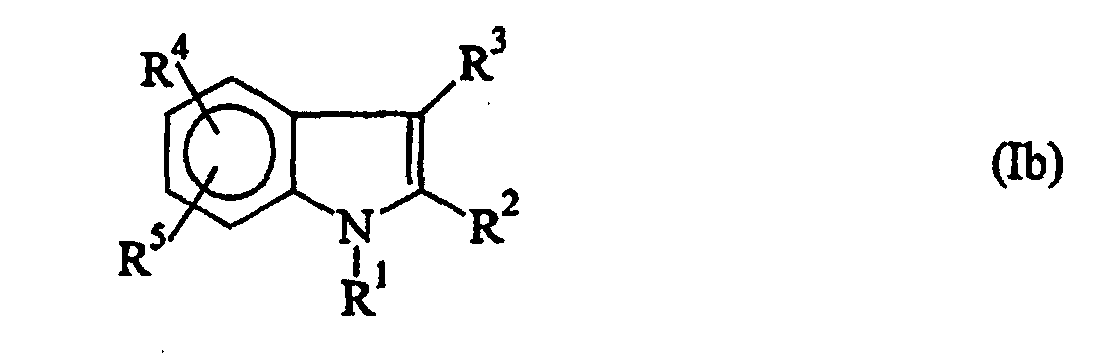
- the dye precursor can be a derivative of the indole of the formula (Ib) in which independently of one another R 1 represents hydrogen, a C 1 - to C 4 -alkyl group or a C 1 - to C 4 -hydroxy-alkyl group, R 2 represents hydrogen or a -COOH group, the -COOH group can also be present as a salt with a physiologically compatible cation, R 3 stands for hydrogen or a C 1 - to C 4 -alkyl group, R 4 stands for hydrogen, a hydroxyl group, an amino group, a C 1 - to C 4 -alkoxy group or one Group -OCO-R 6 , in which R 6 stands for a C 1 -C 4 -alkyl group, and R 5 stands for one of the groups mentioned under R 4 , or a physiologically tolerable salt of these compounds with an organic or inorganic acid, with the proviso that R 4 and R 5 are not simultaneously hydrogen
- Preferred substances of the formula (Ia) are 5,6-dihydroxyindoline, N-methyl-5,6-dihydroxyindoline, N-ethyl-5,6-dihydroxyindoline, N-propyl-5,6-dihydroxyindoline, N-butyl-5,6-dihydroxyindoline, 5,6-dihydroxyindoline-2-carboxylic acid, 6-hydroxyindoline, 6-aminoindoline and 4-aminoindoline.
- Preferred substances of the formula (Ib) are 5,6-dihydroxyindole, N-methyl-5,6-dihydroxyindole, N-ethyl-5,6-dihydroxyindole, N-propyl-5,6-dihydroxyindole, N-butyl-5,6-dihydroxyindole, 5,6-dihydroxyindole-2-carboxylic acid, 6-hydroxyindole, 6-aminoindole and 4-aminoindole.
- Indoline derivatives of the formulas (Ia) and (Ib) contain and are free from customary ones Oxidation dye precursors of the developer or coupler type.
- agents according to the invention in addition to the indole and / or indoline derivatives of the formulas (Ia) and (Ib) also conventional oxidation dye precursors from the developer or Coupler type included.
- the indole and / or the indoline derivatives of the formulas (Ia) and (Ib) in combination with one or more coupler components in Use hair dyes can be particularly preferred according to the invention.
- the indole and / or the indoline derivatives of the formulas (Ia) and (Ib) in combination with one or more coupler components in Use hair dyes An example at this point is expressly to the above referred coupler components.
- the indole and / or indoline derivatives Formula (la) and (Ib) in combination with at least one amino acid or one Use oligopeptide in hair dyes. It can continue according to the invention be preferred if the amino acid is an ⁇ -amino acid. Very particularly preferred ⁇ -amino acids are arginine, ornithine, lysine and histidine.
- the hair colorants according to the invention contain for further modification of the color nuances in addition to the dye precursors usual direct dyes.
- Direct dyes are usually nitrophenylenediamines, Nitroaminophenols, azo dyes, anthraquinones or indophenols.
- Preferred direct dyes are those under the international names or trade names HC Yellow 2, HC Yellow 4, HC Yellow 5, HC Yellow 6, Basic Yellow 57, Disperse Orange 3, HC Red 3, HC Red BN, Basic Red 76, HC Blue 2, HC Blue 12, Disperse Blue 3, Basic Blue 99, HC Violet 1, Disperse Violet 1, Disperse Violet 4, Disperse Black 9, Basic Brown 16 and Basic Brown 17 known compounds and 4-amino-2-nitrodiphenylamine-2'-carboxylic acid, 6-nitro-1,2,3,4-tetrahydroquinoxaline, hydroxyethyl-2-nitro-toluidine, Picramic acid, 2-amino-6-chloro-4-nitrophenol 4-ethylamino-3-nitrobenzoic acid and 2-chloro-6-ethylamino-1-hydroxy-4-nitrobenzene.
- the agents according to this embodiment contain the direct dyes preferably in an amount of 0.01 to 20 wt .-%, based on all of the colorant.
- preparations according to the invention can also occur in nature Dyes such as henna red, henna neutral, henna black, chamomile flower, Sandalwood, black tea, sapwood, sage, blue wood, madder root, catechu, sedre and contain alkanna root.
- Dyes such as henna red, henna neutral, henna black, chamomile flower, Sandalwood, black tea, sapwood, sage, blue wood, madder root, catechu, sedre and contain alkanna root.
- Colorings of a particular depth of color can be achieved if the agents next to the Dyes and / or dye precursors also an oil of Meadowfoam (INCI name: Meadowfoam Seed Oil) included.
- the dye precursors are in a suitable aqueous, alcoholic or aqueous-alcoholic carrier incorporated.
- a suitable aqueous, alcoholic or aqueous-alcoholic carrier incorporated.
- such carriers are e.g. Creams, emulsions, gels or even surfactant-containing foaming solutions, e.g. Shampoos, aerosols or other preparations, which are suitable for use on the hair.
- aqueous-alcoholic solutions are to be understood as meaning aqueous solutions containing 3 to 70% by weight of a C 1 -C 4 alcohol, in particular ethanol or isopropanol.
- the colorants of the invention can all known in such preparations Contain active ingredients, additives and auxiliary substances.
- the colorants contain at least one surfactant, in principle both anionic and zwitterionic, Ampholytic, nonionic and cationic surfactants are suitable.
- the surfactants from anionic, zwitterionic or select nonionic surfactants.
- Anionic surfactants can be very special be preferred.
- Zwitterionic surfactants are surface-active compounds that contain at least one quaternary ammonium group and at least one -COO (-) - or -SO 3 (-) group in the molecule.
- Particularly suitable zwitterionic surfactants are the so-called betaines such as the N-alkyl-N, N-dimethylammonium glycinate, for example the cocoalkyl-dimethylammonium glycinate, N-acyl-aminopropyl-N, N-dimethyl-ammonium glycinate, for example the cocoacylaminopropyl-dimethyl anionium glycinate, and 2-alkyl-3-carboxymethyl-3-hydroxyethyl-imidazolines each having 8 to 18 carbon atoms in the alkyl or acyl group, and also cocoacylaminoethyl-hydroxyethylcarboxymethylglycinate.
- a preferred zwitterionic surfactant is the
- Ampholytic surfactants are understood to mean those surface-active compounds which, in addition to a C 8 -C 18 -alkyl or -acyl group, contain at least one free amino group and at least one -COOH or -SO 3 H group in the molecule and are capable of forming internal salts are.
- ampholytic surfactants are N-alkylglycine, N-alkylpropionic acid, N-alkylaminobutyric acid, N-alkyliminodipropionic acid, N-hydroxyethyl-N-alkylamidopropylglycine, N-alkyltaurine, N-alkylsarcosine, 2-alkylaminopropionic acid and alkylaminoacetic acid each with about 8 to 18 C. Atoms in the alkyl group.
- Particularly preferred ampholytic surfactants are N-cocoalkylaminopropionate, cocoacylaminoethylaminopropionate and C12-18 acylsarcosine.
- Examples of the cationic which can be used in the hair treatment compositions according to the invention are especially quaternary ammonium compounds.
- are preferred Ammonium halides such as alkyltrimethylammonium chlorides, dialkyldi-methylammonium chlorides and trialkylmethylammonium chlorides, e.g. B. cetyltrimethyl-ammonium chloride, Stearyltrimethylammonium chloride, distearyldimethylammonium chloride, lauryldimethylammonium chloride, Lauryldiethylbenzylammonium chloride and tricetylmethylammonium chloride.
- Provide further cationic surfactants that can be used according to the invention the quaternized protein hydrolyzates.
- cationic silicone oils such as those in the Commercially available products Q2-7224 (manufacturer: Dow Corning; a stabilized Trimethylsilylamodimethicone), Dow Corning 929 emulsion (containing a hydroxylamino modified Silicone, also known as amodimethicone), SM-2059 (Manufacturer: General Electric), SLM-55067 (manufacturer: Wacker) and Abil®-Quat 3270 and 3272 (manufacturer: Th. Goldschmidt; diquaternary polydimethylsiloxanes, Quatemium-80).
- Alkylamidoamines especially fatty acid amidoamines such as that under the name Tego Amear®S 18 available stearylamidopropyldimethylamine, stand out in addition to a good one conditioning effect especially due to its good biodegradability.
- Quaternary ester compounds are also very readily biodegradable "Esterquats", such as the methylhydroxyalkyl dialkoyloxyalkylammonium methosulfates sold under the trademark Stepantex® as well as that under the Trademark of Dehyquart® products.
- quaternary sugar derivative that can be used as a cationic surfactant is provided represents the commercial product Glucquat®100, according to CTFA nomenclature a "Lauryl Methyl Gluceth-10 hydroxypropyl dimonium chloride ".
- the compounds with alkyl groups used as surfactants can in each case be act uniform substances. However, it is usually preferred in manufacturing these substances from natural vegetable or animal raw materials, so that one Mixtures of substances with different alkyl chain lengths depending on the respective raw material receives.
- the addition products of ethylene and / or propylene oxide Fatty alcohols or derivatives of these addition products can represent both products with a "normal” homolog distribution as well as those with a narrowed Homolog distribution can be used.
- "normal" homolog distribution thereby understood mixtures of homologues that are used in the implementation of fatty alcohol and alkylene oxide using alkali metals, alkali metal hydroxides or Alkali metal alcoholates obtained as catalysts.
- Narrowing homolog distributions will be on the other hand, if, for example, hydrotalcites, alkaline earth metal salts of Ether carboxylic acids, alkaline earth metal oxides, hydroxides or alcoholates as catalysts be used.
- the use of products with a narrow homolog distribution can be preferred.
- the surfactants in the invention Average usually in amounts of a total of 0.5 to 30 wt .-%, based on the total funds included.
- the hair treatment compositions according to the invention can preferably have one conditioning agent selected from the group consisting of cationic surfactants, cationic polymers, alkylamidoamines, paraffin oils, vegetable oils and synthetic Oils is formed.
- Cationic polymers of the first four groups are particularly preferred.
- Silicone oils in particular dialkyl and in particular, are also suitable as conditioning agents
- Alkylarylsiloxanes such as, for example, dimethylpolysiloxane and methylphenylpolysiloxane, and their alkoxylated and quaternized analogs.
- silicones examples include those of Dow Corning under the designations DC 190, DC 200, DC 344, DC 345 and DC 1401 distributed products as well as the commercial products Q2-7224 (manufacturer: Dow Corning; a stabilized trimethylsilylamodimethicone), Dow Corning® 929 emulsion (containing a hydroxyl-amino-modified silicone, also known as amodimethicone will), SM-2059 (manufacturer: General Electric), SLM-55067 (manufacturer: Wacker) and Abil®-Quat 3270 and 3272 (manufacturer: Th. Goldschmidt; diquaternmaschinee Polydimethylsiloxanes, Quaternium-80).
- Paraffin oils, synthetic, can also be used as conditioning agents prepared oligomeric alkenes and vegetable oils such as jojoba oil, sunflower oil, Orange oil, almond oil, wheat germ oil and peach seed oil.
- Suitable hair conditioning compounds are phospholipids, for example Soy lecithin, egg lecithin and cephaline.
- the colorants according to the invention preferably also contain a fatty substance.
- Preferred fatty substances are linear and branched, saturated and unsaturated fatty alcohols or natural fatty alcohol mixtures with 8 to 22 carbon atoms in the alkyl chain such as for example decanol, octanol, octenol, dodecenol, decenol, octadienol, dodecadienol, Decadienol, oleyl alcohol, eruca alcohol, ricinol alcohol, stearyl alcohol, isostearyl alcohol, Palmityl alcohol, lauryl alcohol, myristyl alcohol, arachidyl alcohol, caprylic alcohol, capric alcohol, Linoleyl alcohol, linolenyl alcohol and behenyl alcohol, and their Guerbet alcohols as well as fatty alcohol cuts by reducing naturally occurring triglycerides such as beef tallow, palm oil, peanut oil, turnip oil, cottonseed oil, soybean oil, sunflower oil and linseed oil or from their
- Monoesters of fatty acids with alcohols can also be used as fatty substances with 6 to 24 carbon atoms and triglycerides of natural origin.
- the oxidative development of the coloring can basically only with atmospheric oxygen respectively. However, it should not be ruled out that a chemical oxidizing agent is used, especially if, in addition to the coloring, a lightening effect on human hair is desired. Hydrogen peroxide in particular comes as the oxidizing agent or its adducts with urea, melamine or sodium borate in Question. It is also possible to carry out the oxidation with the aid of enzymes.
- the enzymes can be used to generate oxidizing per compounds be used, as well as to enhance the effect of a small amount of available Oxidant.
- An example of an enzymatic process is the procedure that Effect of small amounts (e.g. 1% and less, based on the total agent) Enhance hydrogen peroxide with peroxidases.
- the oxidation catalysts according to the invention can be used both in one joint preparation with the dye precursors as well as packaged separately his.
- Oxidation catalysts separately in a suitable solvent, for example in water, Ethanol or acetone, dissolved or suspended and immediately before dyeing of the hair mixed with the oxidizing agent preparation.
- This preparation will then mixed with a preparation containing the dye precursors.
- the resulting ready-to-use hair dye preparation should preferably have a pH in the Range from 6 to 10.
- a pH of 6.5 to 8 is particularly preferred
- Application temperatures can range between 15 and 40 ° C.
- the hair dye is rinsed off with the hair to be dyed. Washing with a shampoo is not necessary if one high tenside carrier, e.g. a coloring shampoo was used.
- the preparation with the dye precursors can be used especially for hair that is difficult to dye without prior mixing with the oxidation component on the Hair are applied. After an exposure time of 20 to 30 minutes then - optionally after an intermediate rinse - the oxidation component is applied. To a further exposure time of 10 to 20 minutes is then rinsed and, if desired shampooed.
- a second object of the present invention is the use of the above Means for coloring keratin fibers.
- zeolite Y 100 g of zeolite Y were stirred with approx. 1000 ml of a 1% by weight copper (II) chloride solution for 3 to 5 hours at room temperature.
- the zeolite was then filtered off and washed with water until free from chloride (detection with nitric acid AgNO 3 solution).
- the metal-doped zeolite was washed several times with a 5% by weight sodium chloride solution. The exchange is complete when no metal can be found in the filtrate.
- the zeolite was then washed again free of chloride, dried in a forced-air drying cabinet at 110 ° C. for 18 hours and finally calcined to constant weight at 250 ° C.
- the copper content of the metal-doped zeolite was determined using X-ray fluorescence analysis determined.
- the metal-doped zeolite was then added 1,8-diazablcyclo [5.4.0] undec-7-ene (1.5-5) (short: DBU) are added, so that a molar Cu: DBU ratio of 1: 2.5, and at 80 ° C for several hours in Water jet vacuum (80-100mbar) stirred on a Rotavapor. Then the Excess DBU washed out with water to the neutral point and the product 8 Dried for hours at 110 ° C in a forced air drying cabinet.
- a coloring cream of the following composition was produced (unless otherwise stated, all information is in g): Partial mixture A Hydrenol® D 8.50 Lorol® techn. 2.00 Eumulgin® B2 0.75 Texapon® NSO 20.00 Dehyton® K 12.50 water 30.00
- the dye precursors were in the 50 ° C hot water with the addition of Sodium sulfite, ammonium sulfate and ammonia dissolved.
- the dye precursor solution (partial mixture B) became an emulsion (partial mixture A) given, adjusted to the desired pH with an ammonia solution and with Make up water to 100 parts by weight. It was until the room temperature was reached further stirred.
- the application preparation was then applied to a strand of "Kerling Natur Experience “(1.5 g application preparation per g hair), given, leave there for 30 minutes and then rinsed with water.
Landscapes
- Life Sciences & Earth Sciences (AREA)
- Health & Medical Sciences (AREA)
- Animal Behavior & Ethology (AREA)
- General Health & Medical Sciences (AREA)
- Public Health (AREA)
- Veterinary Medicine (AREA)
- Birds (AREA)
- Epidemiology (AREA)
- Chemical & Material Sciences (AREA)
- Inorganic Chemistry (AREA)
- Cosmetics (AREA)
- Dental Preparations (AREA)
Description
- die Menge des Oxidationsmittels stark reduziert werden kann und/oder
- die Ausfärbung alleine mit Luftsauerstoff als Oxidationsmittel erfolgen kann oder
- die Ausfärbung im neutralen pH-Bereich erfolgen kann.
- 1,4,8,11-Tetraazacyclotetradecan
- 1,8-Diazabicyclo[5.4.0]undec-7-en (1,5-5)
- Ethylendiamin
- Nitrilotriessigsäure
- Tris(aminoethyl)amin
- Tris(aminomethyl)methan
- 1,3,5-Triaminocyclohexan sowie
- Pyridin-2,6-dicarbonsäure.
- 2,2':6',2"-Terpyridin
- 1,10-Phenanthrolin
- Tris(2-pyridylmethyl)amin
- Tris(2-pyridylethyl)amin sowie
- N-Carboxymethyl-N-(2-pyridylmethyl)glycin.

- lineare und verzweigte Fettsäuren mit 8 bis 22 C-Atomen (Seifen),
- Ethercarbonsäuren der Formel R-O-(CH2-CH2O)x-CH2-COOH, in der R eine lineare Alkylgruppe mit 10 bis 22 C-Atomen und x = 0 oder 1 bis 16 ist,
- Acylsarcoside mit 10 bis 18 C-Atomen in der Acylgruppe,
- Acyltauride mit 10 bis 18 C-Atomen in der Acylgruppe,
- Acylisethionate mit 10 bis 18 C-Atomen in der Acylgruppe,
- Sulfobemsteinsäuremono- und -dialkylester mit 8 bis 18 C-Atomen in der Alkylgruppe und Sulfobernsteinsäuremono-alkylpolyoxyethylester mit 8 bis 18 C-Atomen in der Alkylgruppe und 1 bis 6 Oxyethylgruppen,
- lineare Alkansulfonate mit 12 bis 18 C-Atomen,
- lineare Alpha-Olefinsulfonate mit 12 bis 18 C-Atomen,
- Alpha-Sulfofettsäuremethylester von Fettsäuren mit 12 bis 18 C-Atomen,
- Alkylsulfate und Alkylpolyglykolethersulfate der Formel R-O(-CH2-CH2O)x-SO3H, in der R eine bevorzugt lineare Alkylgruppe mit 10 bis 18 C-Atomen und x = 0 oder 1 bis 12 ist,
- Gemische oberflächenaktiver Hydroxysulfonate gemäß DE-A-37 25 030,
- sulfatierte Hydroxyalkyloplyethylen-und/oder Hydroxyalkylenpropylen glykolether gemäß DE-A-37 23 354,
- Sulfonate ungesättigter Fettsäuren mit 12 bis 24 C-Atomen und 1 bis 6 Doppelbindungen gemäß DE-A-39 26 344,
- Ester der Weinsäure und Zitronensäure mit Alkoholen, die Anlagerungs produkte von etwa 2-15 Molekülen Ethylenoxid und/oder Propylenoxid an Fettalkohole mit 8 bis 22 C-Atomen darstellen.
- Anlagerungsprodukte von 2 bis 30 Mol Ethylenoxid und/oder 0 bis 5 Mol Propylenoxid an lineare Fettalkohole mit 8 bis 22 C-Atomen, an Fettsäuren mit 12 bis 22 C-Atomen und an Alkylphenole mit 8 bis 15 C-Atomen in der Alkylgruppe,
- C12- bis C22-Fettsäuremono- und -diester von Anlagerungsprodukten von 1 bis 30 Mol Ethylenoxid an Glycerin,
- C8- bis C22-Alkylmono- und -oligoglycoside und deren ethoxylierte Analoga,
- Anlagerungsprodukte von 5 bis 60 Mol Ethylenoxid an Rizinusöl und gehärtetes Rizinusöl,
- Anlagerungsprodukte von Ethylenoxid an Sorbitanfettsäureester,
- Anlagerungsprodukte von Ethylenoxid an Fettsäurealkanolamide.
- quaternisierte Cellulose-Derivate, wie sie unter den Bezeichnungen Celquat® und Polymer JR® im Handel erhältlich sind. Die Verbindungen Celquat® H 100, Celquat® L 200 und Polymer JR®400 sind bevorzugte quaternierte Cellulose-Derivate.
- polymere Dimethyldiallylammoniumsalze und deren Copolymere mit Estern und Amiden von Acrylsäure und Methacrylsäure. Die unter den Bezeichnungen Merquat®100 (Poly(dimethyldiallylammoniumchlorid)) und Merquat®550 (Dimethyldiallylammoniumchlorid-Acrylamid-Copolymer) im Handel erhältlichen Produkte sind Beispiele für solche kationischen Polymere.
- Copolymere des Vinylpyrrolidons mit quaternierten Derivaten des Dialkylaminoacrylats- und -methacrylats, wie beispielsweise mit Diethylsulfat quaternierte Vinylpyrrolidon-Dimethylaminomethacrylat-Copolymere. Solche Verbindungen sind unter den Bezeichnungen Gafquat®734 und Gafquat®755 im Handel erhältlich.
- Vinylpyrrolidon-Methoimidazoliniumchlorid-Copolymere, wie sie unter der Bezeichnung Luviquat® angeboten werden.
- quaternierter Polyvinylalkohol
- Polyquaternium 2,
- Polyquaternium 17,
- Polyquaternium 18 und
- Polyquaternium 27 bekannten Polymeren mit quartären Stickstoffatomen in der Polymerhauptkette.
- nichtionische Polymere wie beispielsweise Vinylpyrrolidon/Vinylacrylat-Copolymere, Polyvinylpyrrolidon und Vinylpyrrolidon/Vinylacetat-Copolymere und Polysiloxane,
- zwitterionische und amphotere Polymere wie beispielsweise Acrylamidopropyl-trimethylammoniumchlorid/Acrylat-Copolymere und Octylacrylanud/Methyl-methacrylat/tert.Butylaminoethylmethacrylat/2-Hydroxypropylmethacrylat-Copolymere,
- anionische Polymere wie beispielsweise Polyacrylsäuren, vernetzte Polyacrylsäuren, Vinylacetat/Crotonsäure-Copolymere, Vinylpyrrolidon/Vinylacrylat-Copolymere, Vinylacetat/Butylmaleat/Isobornylacrylat-Copolymere, Methylvinylether/Maleinsäureanhydrid-Copolymere und Acrylsäure/Ethylacrylat/N-tert.-Butylacrylamid-Terpolymere,
- symmetrische und unsymmetrische, lineare und verzweigte Dialkylether mit insgesamt zwischen 12 bis 36 C-Atomen, insbesondere 12 bis 24 C-Atomen, beispielsweise Din-octylether, Di-n-decylether, Di-n-nonylether, Di-n-undecylether und Di-n-dodecylether, n-Hexyl-n-octylether, n-Octyl-n-decylether, n-Decyl-n-undecylether, n-Undecyl-n-dodecylether und n-Hexyl-n-undecylether sowie Di-tert-butylether, Di-iso-pentylether, Di-3-ethyldecylether, tert.-Butyl-n-octylether, iso-Pentyl-n-octylether und 2-Methyl-pentyl-n-octylether,
- Antischuppenwirkstoffe wie Piroctone Olamine, Zink Omadine und Climbazol,
- tierische und pflanzliche Proteinhydrolysate, insbesondere Elastin-, Kollagen-, Keratin-, Milcheiweiß-, Sojaprotein-, Mandelprotein- und Weizenproteinhydrolysate, sowie deren Fettsäurekondensationsprodukte und quaternierte Derivate,
- Vitamine und Vitaminvorstufen wie Panthenol, dessen Derivate und Biotin,
- Pflanzen- und Honigextrakte, wie insbesondere Extrakte aus Eichenrinden, Brennessel, Hamamelis, Hopfen, Kamille, Klettenwurzel, Schachtelhalm, Lindenblüten, Mandel, Aloe Vera, Kokosnuß, Mango, Aprikose, Limone, Weizen, Kiwi, Melone, Orange, Grapefruit, Salbei, Rosmarin, Birke, Wiesenschaumkraut, Quendel, Schafgarbe, Hauhechel, Meristem, Ginseng und Ingwerwurzel,
- Weitere Wirkstoffe wie Ceramide, Allantoin, Pyrrolidoncarbonsäuren, und Bisabolol,
- Lichtschutzmittel,
- Entschäumer wie Silikone,
- Verdickungsmittel wie Agar-Agar, Guar-Gum, Alginate, Xanthan-Gum, Gummi arabicum, Karaya-Gummi, Johannisbrotkernmehl, Leinsamengummen, Dextrane, Cellulose-Derivate, z. B. Methylcellulose, Hydroxyalkylcellulose und Carboxymethylcellulose, Stärke-Fraktionen und Derivate wie Amylose, Amylopektin und Dextrine, Tone wie z. B. Bentonit oder vollsynthetische Hydrokolloide wie z.B. Polyvinylalkohol,
- Strukturanten wie Glucose, Maleinsäure und Milchsäure,
- Parfümöle, Dimethylisosorbid und Cyclodextrine,
- Lösungsvermittler wie Ethanol, Isopropanol, Ethylenglykol, Propylenglykol, Glycerin und Diethylenglykol,
- Alkalisierungsmittel wie beispielsweise Ammoniak, Monoethanolamin, 2-Amino-2-methylpropanol und 2-Amino-2-methyl-propandiol-1,3
- weitere Substanzen zur Einstellung des pH-Wertes,
- Cholesterin,
- Quell- und Penetrationsstoffe wie Glycerin, Propylenglykolmonoethylether, Carbonate, Hydrogencarbonate, Guanidine, Harnstoffe sowie primäre, sekundäre und tertiäre Phosphate,
- Konsistenzgeber wie Zuckerester, Polyolester oder Polyolalkylether,
- Strukturanten wie Maleinsäure, Mono-, Di- und Oligosaccharide,
- Fette und Wachse, wie Walrat, Bienenwachs, Montanwachs und Paraffine,
- Fettsäurealkanolamide,
- Trübungsmittel wie Latex, Styrol/PVP- und Styrol/Acrylamid-Copolymere,
- Perlglanzmittel wie Ethylenglykolmono- und -distearat sowie PEG-3-distearat,
- Komplexbildner wie EDTA, NTA, β-Alanindiessigsäure und Phosphonsäuren,
- Reduktionsmittel wie z.B. Thioglykolsäure und deren Derivate, Thiomilchsäure, Cysteamin, Thioäpfelsäure und α-Mercaptoethansulfonsäure,
- Oxidationsmittel wie Wasserstoffperoxid, Kaliumbromat und Natriumbromat,
- Treibmittel wie Propan-Butan-Gemische, N2O, Dimethylether, CO2, N2 und Luft Bezüglich weiterer Bestandteile sowie Mengenbereiche für die einzelnen Inhaltsstoffe wird auf die dem Fachmann bekannten Handbücher, z.B. K. Schrader, Grundlagen und Rezepturen der Kosmetika, 2. Auflage, Hüthig Buch Verlag, Heidelberg, 1989, verwiesen.
- die üblicherweise nur unter alkalischen Bedingungen erhaltenen Färbeleistungen auch im neutralen pH-Bereich zu erzielen oder
- eine schonendere Färbebehandlung dadurch zu erzielen, daß im alkalischen Bereich die angestrebte Färbeleistung bereits ohne Oxidationsmittel beziehungsweise mit deutlich, d.h. bis zu 75 %, niedrigeren Konzentrationen erreicht wird.
- 4,14 Gew.-% Kohlenstoff(C)
- 1,03 Gew.-% Stickstoff (N)
- 1,10 Gew.-% Kupfer (Cu)
| Teilmischung A | |
| Hydrenol® D | 8,50 |
| Lorol® techn. | 2,00 |
| Eumulgin® B2 | 0,75 |
| Texapon® NSO | 20,00 |
| Dehyton® K | 12,50 |
| Wasser | 30,00 |
| Teilmischung B | |
| Natriumsulfit | 1,00 |
| Ammoniumsulfat | 1,00 |
| 5-Amino-2-methylphenol | 0,003mol |
| 4-Amino-2-aminomethylphenol-hydrochlorid | 0,003mol |
| Ammoniak (25%ige Lösung) | ad pH |
| Wasser | 10,00 |
| Metall | Konzentration | Ligand | H2O2-Konzentration | pH-Wert | Bewertung |
| Ruthenium | 200 ppm | DBU | 0,35 Gew.-% | 9,0 | Vollausfärbung |
| Ruthenium | 200 ppm | DBU | 1,5 Gew.-% | 7,0 | Vollausfärbung |
| Kupfer | 200 ppm | DBU | --- | 9,0 | Vollausfärbung |
| Kupfer | 200 ppm | DBU | 1,5 Gew.-% | 7,0 | Vollausfärbung |
| --- | --- | --- | 1,5 Gew.-% | 7,0 | Keine Färbung |
| --- | --- | --- | 1,5 Gew.-% | 9,0 | Vollausfärbung |
Claims (14)
- Mittel zum Färben keratinischer Fasern, insbesondere menschlicher Haare, enthaltend mindestens ein Farbstoffvorprodukt, dadurch gekennzeichnet, daß es 0,0001 bis 1,0 Gew.-% eines in Hohlräumen von Käfigverbindungen eingeschlossenen Übergangsmetallkations mit mindestens zwei stabilen Oxidationsstufen, das mit mindestens einem mehrzähnigen Liganden komplexiert ist, enthält.
- Mittel nach Anspruch 1, dadurch gekennzeichnet, daß das Übergangsmetallkation ausgewählt ist aus einer Gruppe gebildet von Eisen, Kobalt, Kupfer, Mangan, Molybdän, Ruthenium und Vanadium.
- Mittel nach Anspruch 2, dadurch gekennzeichnet, daß das Übergangsmetallkation Kupfer oder Ruthenium ist.
- Mittel nach einem der Ansprüche 1 bis 3, dadurch gekennzeichnet, daß die Käfigverbindungen, in welche die Übergangsmetallkationen eingeschlossen werden, aus den Zeolithen vom Typ A, K, L, P-L, O, T, X, Y und Ω sowie deren Mischungen ausgewählt werden.
- Mittel nach einem der Ansprüche 1 bis 4, dadurch gekennzeichnet, daß der Ligand mindestens ein Stickstoffatom als Koordinationsstelle aufweist.
- Mittel nach einem der Ansprüche 1 bis 5, dadurch gekennzeichnet, daß der Ligand ausgewählt ist aus einer Gruppe gebildet von1,4,8,11-Tetraazacyclotetradecan1,8-Diazabicyclo[5.4.0]undec-7-en (1,5-5)EthylendiaminNitrilotriessigsäureTris(aminoethyl)aminTris(aminomethyl)methan1,3,5-Triaminocyclohexan sowiePyridin-2,6-dicarbonsäure.
- Mittel nach einem der Ansprüche 1 bis 6, dadurch gekennzeichnet, daß der Ligand mindestens eine aromatische Koordinationsstelle aufweist.
- Mittel nach Anspruch 7, dadurch gekennzeichnet, daß der Ligand mit mindestens einer aromatischen Koordinationsstelle aus einer Gruppe stammt, die gebildet wird von2,2':6',2"-Terpyridin1,10-PhenanthrolinTris(2-pyridylmethyl)aminTris(2-pyridylethyl)amin sowieN-Carboxymethyl-N-(2-pyridylmethyl)glycin.
- Mittel nach einem der Ansprüche 1 bis 8, dadurch gekennzeichnet, daß es mindestens ein Farbstoffvorprodukt vom Typ der Entwickler enthält.
- Mittel nach einem der Ansprüche 1 bis 9, dadurch gekennzeichnet, es als Farbstoffvorprodukt mindestens eine Indol- und/oder Indolinderivat enthält.
- Mittel nach einem der Ansprüche 1 bis 10, dadurch gekennzeichnet, daß es mindestens eine Kupplerkomponente enthält.
- Mittel nach einem der Ansprüche 1 bis 11, dadurch gekennzeichnet, daß es einen pH-Wert von 6,5 bis 8 aufweist.
- Mittel nach einem der Ansprüche 1 bis 12, dadurch gekennzeichnet, daß es keine chemischen Oxidationsmittel enthält.
- Verwendung eines der Mittel der Ansprüche 1 bis 13 zum Färben keratinischer Fasern.
Applications Claiming Priority (3)
| Application Number | Priority Date | Filing Date | Title |
|---|---|---|---|
| DE19859681A DE19859681A1 (de) | 1998-12-23 | 1998-12-23 | Färbemittel mit Übergangsmetallen |
| DE19859681 | 1998-12-23 | ||
| PCT/EP1999/009903 WO2000038630A1 (de) | 1998-12-23 | 1999-12-14 | Färbemittel mit übergangsmetallen |
Publications (2)
| Publication Number | Publication Date |
|---|---|
| EP1139992A1 EP1139992A1 (de) | 2001-10-10 |
| EP1139992B1 true EP1139992B1 (de) | 2003-11-19 |
Family
ID=7892400
Family Applications (1)
| Application Number | Title | Priority Date | Filing Date |
|---|---|---|---|
| EP99967935A Expired - Lifetime EP1139992B1 (de) | 1998-12-23 | 1999-12-14 | Färbemittel mit in hohlräumen von käfigverbindungen (z.b. zeolithe) eingeschlossenen übergangsmetall-komplexen |
Country Status (8)
| Country | Link |
|---|---|
| US (1) | US6648925B1 (de) |
| EP (1) | EP1139992B1 (de) |
| JP (1) | JP2002533368A (de) |
| AT (1) | ATE254445T1 (de) |
| AU (1) | AU2431300A (de) |
| DE (2) | DE19859681A1 (de) |
| ES (1) | ES2212666T3 (de) |
| WO (1) | WO2000038630A1 (de) |
Families Citing this family (9)
| Publication number | Priority date | Publication date | Assignee | Title |
|---|---|---|---|---|
| DE10018160A1 (de) * | 2000-04-12 | 2001-10-18 | Henkel Kgaa | Färbemittel mit Rutheniumverbindungen |
| FR2814947B1 (fr) * | 2000-10-09 | 2003-01-31 | Oreal | Composition tinctoriale favorisant la pigmentation naturelle procede d'obtention et utilisation pour la coloration de la peau et/ou des fibres keratiniques |
| JP4312980B2 (ja) | 2001-12-26 | 2009-08-12 | 花王株式会社 | 染毛剤組成物 |
| EP1879548A2 (de) * | 2005-05-13 | 2008-01-23 | Ciba Specialty Chemicals Holding Inc. | Verfahren zur einfärbung metallkomplexhaltiger keratin-fasern |
| KR100633439B1 (ko) * | 2005-09-30 | 2006-10-16 | 주식회사 기린화장품 | 모발 염색제 조성물 |
| WO2007120971A2 (en) * | 2006-02-10 | 2007-10-25 | Elc Management Llc | Mineral ions in structured water |
| JP4992062B2 (ja) * | 2006-05-17 | 2012-08-08 | キム、スング−ホー | 骨伝導ヘッドセット |
| JP5339374B2 (ja) * | 2006-08-10 | 2013-11-13 | クーム インコーポレーテッド | 触媒空気酸化ヘアカラー |
| GB0911493D0 (en) * | 2009-07-02 | 2009-08-12 | Univ Leeds | Catalysed dye systems |
Family Cites Families (20)
| Publication number | Priority date | Publication date | Assignee | Title |
|---|---|---|---|---|
| GB1107463A (en) | 1964-08-05 | 1968-03-27 | Unilever Ltd | Keratinous materials |
| FR1439307A (fr) | 1965-04-23 | 1966-05-20 | Yamahatsu Sangyo Kaisha | Compositions tinctoriales pour cheveux |
| JPS6169718A (ja) | 1985-08-24 | 1986-04-10 | Hidetoshi Tsuchida | 染色剤組成物 |
| DE3642097A1 (de) | 1986-12-10 | 1988-06-16 | Henkel Kgaa | Oxidationshaarfaerbepulver |
| DE3723354A1 (de) | 1987-07-15 | 1989-01-26 | Henkel Kgaa | Sulfatierte hydroxy-mischether, verfahren zu ihrer herstellung und ihre verwendung |
| DE3725030A1 (de) | 1987-07-29 | 1989-02-09 | Henkel Kgaa | Oberflaechenaktive hydroxysulfonate |
| JPH01317443A (ja) | 1988-06-16 | 1989-12-22 | Nippon Zeon Co Ltd | 脱臭性組成物 |
| DE3926344A1 (de) | 1989-08-09 | 1991-02-28 | Henkel Kgaa | Verfahren zur herstellung von hellfarbigen oelsaeuresulfonaten |
| JPH0660090B2 (ja) | 1990-02-20 | 1994-08-10 | 株式会社ノエビア | 酸化染毛剤 |
| US5100436A (en) | 1991-03-07 | 1992-03-31 | Clairol Incorporated | Oxidative hair dyeing process with catalytic pretreatment |
| ATE121288T1 (de) | 1991-12-20 | 1995-05-15 | Goldwell Ag | Verfahren zum oxidativen färben von menschlichen haaren und mittel zur durchführung dieses verfahrens. |
| DE4234887A1 (de) | 1992-10-16 | 1994-04-21 | Wella Ag | Oxidationshaarfärbemittel mit einem Gehalt an 4,5-Diaminopyrazolderivaten sowie neue 4,5-Diaminopyrazolderivate und Verfahren zu ihrer Herstellung |
| US5368610A (en) | 1993-04-20 | 1994-11-29 | Clairol Incorporated | Use of metal salts and chelates together with chlorites as oxidants in hair coloring |
| JP3246217B2 (ja) | 1994-08-10 | 2002-01-15 | 株式会社富士通ゼネラル | ディスプレイパネルの中間調画像表示方法 |
| DE4438129A1 (de) * | 1994-10-27 | 1996-05-02 | Schwarzkopf Gmbh Hans | Neue substituierte 2,4-Diaminophenole, Verfahren zu ihrer Herstellung und Haarfärbemittel |
| FR2727314B1 (fr) | 1994-11-24 | 1997-01-03 | Oreal | Procede pour la deformation permanente des matieres keratiniques |
| FR2733749B1 (fr) | 1995-05-05 | 1997-06-13 | Oreal | Compositions pour la teinture des fibres keratiniques contenant des diamino pyrazoles, procede de teinture, nouveaux diamino pyrazoles et leur procede de preparation |
| DE19534214C1 (de) * | 1995-09-15 | 1996-10-17 | Schwarzkopf Gmbh Hans | Substituierte und unsubstituierte 4-(2,5-Diaminophenoxymethyl)-1,3-dioxolane, Verfahren zu ihrer Herstellung und Haarfärbemittel |
| DE19756455A1 (de) | 1997-12-18 | 1999-03-18 | Henkel Kgaa | Oxidationsfärbemittel und Verfahren |
| DE19757510A1 (de) | 1997-12-23 | 1999-06-24 | Henkel Kgaa | Verwendung von Übergangsmetallkomplexen und Färbemittel |
-
1998
- 1998-12-23 DE DE19859681A patent/DE19859681A1/de not_active Withdrawn
-
1999
- 1999-12-14 US US09/869,132 patent/US6648925B1/en not_active Expired - Fee Related
- 1999-12-14 JP JP2000590584A patent/JP2002533368A/ja active Pending
- 1999-12-14 AU AU24313/00A patent/AU2431300A/en not_active Abandoned
- 1999-12-14 EP EP99967935A patent/EP1139992B1/de not_active Expired - Lifetime
- 1999-12-14 AT AT99967935T patent/ATE254445T1/de not_active IP Right Cessation
- 1999-12-14 DE DE59907821T patent/DE59907821D1/de not_active Expired - Fee Related
- 1999-12-14 WO PCT/EP1999/009903 patent/WO2000038630A1/de not_active Ceased
- 1999-12-14 ES ES99967935T patent/ES2212666T3/es not_active Expired - Lifetime
Also Published As
| Publication number | Publication date |
|---|---|
| JP2002533368A (ja) | 2002-10-08 |
| AU2431300A (en) | 2000-07-31 |
| WO2000038630A1 (de) | 2000-07-06 |
| DE19859681A1 (de) | 2000-06-29 |
| DE59907821D1 (de) | 2003-12-24 |
| ES2212666T3 (es) | 2004-07-16 |
| US6648925B1 (en) | 2003-11-18 |
| ATE254445T1 (de) | 2003-12-15 |
| EP1139992A1 (de) | 2001-10-10 |
Similar Documents
| Publication | Publication Date | Title |
|---|---|---|
| EP1131042B1 (de) | Färbemittel mit übergangsmetallkomplexen | |
| EP1300136A2 (de) | Farbveränderndes Verfahren zur Haarbehandlung auf Basis von Dithionitsalzen | |
| EP1139992B1 (de) | Färbemittel mit in hohlräumen von käfigverbindungen (z.b. zeolithe) eingeschlossenen übergangsmetall-komplexen | |
| EP1041955B1 (de) | Verwendung von übergangsmetallkomplexen zum färben von keratinhaltigen fasern | |
| EP0832640B1 (de) | Oxidationsfärbemittel zum Färben von Keratinfasern | |
| DE19914926A1 (de) | Färbemittel mit konditionierenden Tensiden | |
| EP1139987B1 (de) | Färbemittel mit mangankationen | |
| EP1244419A2 (de) | Mittel zum färben von keratinhaltigen fasern | |
| EP1037592B1 (de) | Neue entwicklerkombinationen für oxidationsfärbemittel | |
| EP1200048A1 (de) | Neue entwickler-kuppler-kombinationen | |
| EP1272150B1 (de) | Färbemittel mit rutheniumverbindungen | |
| EP1414391B1 (de) | Mittel und VERFAHREN ZUR SCHONENDEN HAARFÄRBUNG unter Verwendung von 2-Chlor-4-aminophenol als Entwicklerkomponente | |
| EP0873987B1 (de) | Perfluoracylierte 3-Aminophenol-Derivate und deren Verwendung in Haarfärbemitteln | |
| EP1210060A2 (de) | Entwickler-kuppler-kombinationen | |
| DE19916032A1 (de) | Verfahren zum Färben keratinischer Fasern und Färbemittel | |
| DE10139561A1 (de) | Mittel zum Färben von keratinhaltigen Fasern | |
| EP0979064A1 (de) | Oxidationsfärbemittel | |
| DE19937311A1 (de) | Verfahren zur Färbung keratinischer Fasern | |
| DE19746249A1 (de) | Neue Aminophenol-Derivate und deren Verwendung | |
| EP1218344A2 (de) | Neue oxidationsfarbstoffvorprodukte | |
| DE19746250A1 (de) | Verwendung von substitutierten alpha-Naphtolen zum Färben von Keratinfasern | |
| DE19827366A1 (de) | Neue Kupplerkomponenten für Oxidationshaarfarben | |
| DE19951009A1 (de) | Mittel zum Färben von keratinhaltigen Fasern |
Legal Events
| Date | Code | Title | Description |
|---|---|---|---|
| PUAI | Public reference made under article 153(3) epc to a published international application that has entered the european phase |
Free format text: ORIGINAL CODE: 0009012 |
|
| 17P | Request for examination filed |
Effective date: 20010615 |
|
| AK | Designated contracting states |
Kind code of ref document: A1 Designated state(s): AT BE CH CY DE DK ES FI FR GB GR IE IT LI LU MC NL PT SE |
|
| GRAH | Despatch of communication of intention to grant a patent |
Free format text: ORIGINAL CODE: EPIDOS IGRA |
|
| GRAS | Grant fee paid |
Free format text: ORIGINAL CODE: EPIDOSNIGR3 |
|
| GRAA | (expected) grant |
Free format text: ORIGINAL CODE: 0009210 |
|
| AK | Designated contracting states |
Kind code of ref document: B1 Designated state(s): AT BE CH CY DE DK ES FI FR GB GR IE IT LI LU MC NL PT SE |
|
| PG25 | Lapsed in a contracting state [announced via postgrant information from national office to epo] |
Ref country code: IT Free format text: LAPSE BECAUSE OF FAILURE TO SUBMIT A TRANSLATION OF THE DESCRIPTION OR TO PAY THE FEE WITHIN THE PRESCRIBED TIME-LIMIT;WARNING: LAPSES OF ITALIAN PATENTS WITH EFFECTIVE DATE BEFORE 2007 MAY HAVE OCCURRED AT ANY TIME BEFORE 2007. THE CORRECT EFFECTIVE DATE MAY BE DIFFERENT FROM THE ONE RECORDED. Effective date: 20031119 Ref country code: IE Free format text: LAPSE BECAUSE OF FAILURE TO SUBMIT A TRANSLATION OF THE DESCRIPTION OR TO PAY THE FEE WITHIN THE PRESCRIBED TIME-LIMIT Effective date: 20031119 Ref country code: FI Free format text: LAPSE BECAUSE OF FAILURE TO SUBMIT A TRANSLATION OF THE DESCRIPTION OR TO PAY THE FEE WITHIN THE PRESCRIBED TIME-LIMIT Effective date: 20031119 |
|
| REG | Reference to a national code |
Ref country code: GB Ref legal event code: FG4D Free format text: NOT ENGLISH |
|
| REG | Reference to a national code |
Ref country code: CH Ref legal event code: EP |
|
| PGFP | Annual fee paid to national office [announced via postgrant information from national office to epo] |
Ref country code: SE Payment date: 20031204 Year of fee payment: 5 |
|
| PGFP | Annual fee paid to national office [announced via postgrant information from national office to epo] |
Ref country code: FI Payment date: 20031212 Year of fee payment: 5 |
|
| PG25 | Lapsed in a contracting state [announced via postgrant information from national office to epo] |
Ref country code: CY Free format text: LAPSE BECAUSE OF FAILURE TO SUBMIT A TRANSLATION OF THE DESCRIPTION OR TO PAY THE FEE WITHIN THE PRESCRIBED TIME-LIMIT Effective date: 20031214 |
|
| PGFP | Annual fee paid to national office [announced via postgrant information from national office to epo] |
Ref country code: LU Payment date: 20031216 Year of fee payment: 5 Ref country code: DK Payment date: 20031216 Year of fee payment: 5 |
|
| PGFP | Annual fee paid to national office [announced via postgrant information from national office to epo] |
Ref country code: IE Payment date: 20031218 Year of fee payment: 5 |
|
| PGFP | Annual fee paid to national office [announced via postgrant information from national office to epo] |
Ref country code: GR Payment date: 20031222 Year of fee payment: 5 |
|
| PGFP | Annual fee paid to national office [announced via postgrant information from national office to epo] |
Ref country code: CH Payment date: 20031223 Year of fee payment: 5 |
|
| REF | Corresponds to: |
Ref document number: 59907821 Country of ref document: DE Date of ref document: 20031224 Kind code of ref document: P |
|
| PGFP | Annual fee paid to national office [announced via postgrant information from national office to epo] |
Ref country code: MC Payment date: 20031229 Year of fee payment: 5 |
|
| REG | Reference to a national code |
Ref country code: IE Ref legal event code: FG4D Free format text: GERMAN |
|
| PG25 | Lapsed in a contracting state [announced via postgrant information from national office to epo] |
Ref country code: SE Free format text: LAPSE BECAUSE OF FAILURE TO SUBMIT A TRANSLATION OF THE DESCRIPTION OR TO PAY THE FEE WITHIN THE PRESCRIBED TIME-LIMIT Effective date: 20040219 Ref country code: GR Free format text: LAPSE BECAUSE OF FAILURE TO SUBMIT A TRANSLATION OF THE DESCRIPTION OR TO PAY THE FEE WITHIN THE PRESCRIBED TIME-LIMIT Effective date: 20040219 Ref country code: DK Free format text: LAPSE BECAUSE OF FAILURE TO SUBMIT A TRANSLATION OF THE DESCRIPTION OR TO PAY THE FEE WITHIN THE PRESCRIBED TIME-LIMIT Effective date: 20040219 |
|
| GBT | Gb: translation of ep patent filed (gb section 77(6)(a)/1977) |
Effective date: 20040223 |
|
| REG | Reference to a national code |
Ref country code: IE Ref legal event code: FD4D |
|
| REG | Reference to a national code |
Ref country code: ES Ref legal event code: FG2A Ref document number: 2212666 Country of ref document: ES Kind code of ref document: T3 |
|
| ET | Fr: translation filed | ||
| PLBE | No opposition filed within time limit |
Free format text: ORIGINAL CODE: 0009261 |
|
| STAA | Information on the status of an ep patent application or granted ep patent |
Free format text: STATUS: NO OPPOSITION FILED WITHIN TIME LIMIT |
|
| 26N | No opposition filed |
Effective date: 20040820 |
|
| PGFP | Annual fee paid to national office [announced via postgrant information from national office to epo] |
Ref country code: NL Payment date: 20041205 Year of fee payment: 6 |
|
| PGFP | Annual fee paid to national office [announced via postgrant information from national office to epo] |
Ref country code: AT Payment date: 20041213 Year of fee payment: 6 |
|
| PG25 | Lapsed in a contracting state [announced via postgrant information from national office to epo] |
Ref country code: LU Free format text: LAPSE BECAUSE OF NON-PAYMENT OF DUE FEES Effective date: 20041214 |
|
| PGFP | Annual fee paid to national office [announced via postgrant information from national office to epo] |
Ref country code: ES Payment date: 20041229 Year of fee payment: 6 |
|
| PG25 | Lapsed in a contracting state [announced via postgrant information from national office to epo] |
Ref country code: MC Free format text: LAPSE BECAUSE OF NON-PAYMENT OF DUE FEES Effective date: 20041231 Ref country code: LI Free format text: LAPSE BECAUSE OF NON-PAYMENT OF DUE FEES Effective date: 20041231 Ref country code: CH Free format text: LAPSE BECAUSE OF NON-PAYMENT OF DUE FEES Effective date: 20041231 |
|
| REG | Reference to a national code |
Ref country code: CH Ref legal event code: PL |
|
| PG25 | Lapsed in a contracting state [announced via postgrant information from national office to epo] |
Ref country code: AT Free format text: LAPSE BECAUSE OF NON-PAYMENT OF DUE FEES Effective date: 20051214 |
|
| PG25 | Lapsed in a contracting state [announced via postgrant information from national office to epo] |
Ref country code: ES Free format text: LAPSE BECAUSE OF NON-PAYMENT OF DUE FEES Effective date: 20051215 |
|
| PG25 | Lapsed in a contracting state [announced via postgrant information from national office to epo] |
Ref country code: NL Free format text: LAPSE BECAUSE OF NON-PAYMENT OF DUE FEES Effective date: 20060701 |
|
| NLV4 | Nl: lapsed or anulled due to non-payment of the annual fee |
Effective date: 20060701 |
|
| PGFP | Annual fee paid to national office [announced via postgrant information from national office to epo] |
Ref country code: DE Payment date: 20061207 Year of fee payment: 8 |
|
| PGFP | Annual fee paid to national office [announced via postgrant information from national office to epo] |
Ref country code: FR Payment date: 20061208 Year of fee payment: 8 |
|
| PGFP | Annual fee paid to national office [announced via postgrant information from national office to epo] |
Ref country code: GB Payment date: 20061213 Year of fee payment: 8 |
|
| REG | Reference to a national code |
Ref country code: ES Ref legal event code: FD2A Effective date: 20051215 |
|
| PG25 | Lapsed in a contracting state [announced via postgrant information from national office to epo] |
Ref country code: PT Free format text: LAPSE BECAUSE OF NON-PAYMENT OF DUE FEES Effective date: 20040419 |
|
| PGFP | Annual fee paid to national office [announced via postgrant information from national office to epo] |
Ref country code: BE Payment date: 20070921 Year of fee payment: 9 |
|
| GBPC | Gb: european patent ceased through non-payment of renewal fee |
Effective date: 20071214 |
|
| PG25 | Lapsed in a contracting state [announced via postgrant information from national office to epo] |
Ref country code: DE Free format text: LAPSE BECAUSE OF NON-PAYMENT OF DUE FEES Effective date: 20080701 |
|
| REG | Reference to a national code |
Ref country code: FR Ref legal event code: ST Effective date: 20081020 |
|
| PG25 | Lapsed in a contracting state [announced via postgrant information from national office to epo] |
Ref country code: GB Free format text: LAPSE BECAUSE OF NON-PAYMENT OF DUE FEES Effective date: 20071214 |
|
| PG25 | Lapsed in a contracting state [announced via postgrant information from national office to epo] |
Ref country code: FR Free format text: LAPSE BECAUSE OF NON-PAYMENT OF DUE FEES Effective date: 20071231 |
|
| BERE | Be: lapsed |
Owner name: *HENKEL K.G.A.A. Effective date: 20081231 |
|
| PG25 | Lapsed in a contracting state [announced via postgrant information from national office to epo] |
Ref country code: BE Free format text: LAPSE BECAUSE OF NON-PAYMENT OF DUE FEES Effective date: 20081231 |