EP1143603B1 - Dispositif à semiconducteur et dispositif de conversion de puissance électrique - Google Patents
Dispositif à semiconducteur et dispositif de conversion de puissance électrique Download PDFInfo
- Publication number
- EP1143603B1 EP1143603B1 EP00118264A EP00118264A EP1143603B1 EP 1143603 B1 EP1143603 B1 EP 1143603B1 EP 00118264 A EP00118264 A EP 00118264A EP 00118264 A EP00118264 A EP 00118264A EP 1143603 B1 EP1143603 B1 EP 1143603B1
- Authority
- EP
- European Patent Office
- Prior art keywords
- polarity
- direct current
- negative
- positive
- semiconductor device
- Prior art date
- Legal status (The legal status is an assumption and is not a legal conclusion. Google has not performed a legal analysis and makes no representation as to the accuracy of the status listed.)
- Expired - Lifetime
Links
Images



Classifications
-
- H—ELECTRICITY
- H02—GENERATION; CONVERSION OR DISTRIBUTION OF ELECTRIC POWER
- H02M—APPARATUS FOR CONVERSION BETWEEN AC AND AC, BETWEEN AC AND DC, OR BETWEEN DC AND DC, AND FOR USE WITH MAINS OR SIMILAR POWER SUPPLY SYSTEMS; CONVERSION OF DC OR AC INPUT POWER INTO SURGE OUTPUT POWER; CONTROL OR REGULATION THEREOF
- H02M7/00—Conversion of AC power input into DC power output; Conversion of DC power input into AC power output
- H02M7/003—Constructional details, e.g. physical layout, assembly, wiring or busbar connections
-
- H—ELECTRICITY
- H10—SEMICONDUCTOR DEVICES; ELECTRIC SOLID-STATE DEVICES NOT OTHERWISE PROVIDED FOR
- H10W—GENERIC PACKAGES, INTERCONNECTIONS, CONNECTORS OR OTHER CONSTRUCTIONAL DETAILS OF DEVICES COVERED BY CLASS H10
- H10W72/00—Interconnections or connectors in packages
- H10W72/50—Bond wires
- H10W72/541—Dispositions of bond wires
- H10W72/547—Dispositions of multiple bond wires
- H10W72/5475—Dispositions of multiple bond wires multiple bond wires connected to common bond pads at both ends of the wires
Definitions
- the present invention relates to a semiconductor device according to the preamble portion of patent claim 1.
- a semiconductor device is known from US 5,132,896 A1.
- the invention relates further to an electric power conversion device comprising such a semiconductor device.
- JP-A-7-311552 has disclosed an inner wiring structure of a semiconductor device
- JP-A-8-140363 has disclosed a wiring structure of connecting an electrolytic capacitor with the semiconductor device in an electric power conversion device.
- These technologies have disclosed the formation of a multilayer structure with an objective that, in the semiconductor device inner-wiring and the wiring of connecting the electrolytic capacitor with the semiconductor device in the electric power conversion device, the direction of an electric current flowing in a positive-polarity side wiring and that of an electric current flowing in a negative-polarity side wiring becomes opposite to each other.
- an object of the above-described formation is to decrease inductances that become the causes of an increase in the loss at the time of a switching and of an occurrence of a voltage exceeding an element withstand voltage.
- US 5,132,896 A1 discloses a semiconductor device, comprising at least two bridge-connected semiconductor switches, at least one output terminal, at least two direct current terminal pairs, a first conductor for connecting said output terminal with said semiconductor switches, at least two second conductors for connecting said direct current terminal pairs with said semiconductor switches, and a housing for including said semiconductor switches, wherein at least a portion of said second conductor is a part of a multilayer structure.
- EP 0 649 215 A 1 shows a semiconductor apparatus i.e. in Fig. 1 where the pairs of the positive-polarity terminal and the negative polarity terminal are provided at two opposing sides of a housing.
- JP-10 022451 A discloses (i.e. Fig. 9) a semiconductor device where one pair of a positive-polarity terminal and a negative-polarity terminal is provided. Further in Fig. 1 it is shown that the electrode terminals are disclosed at the center of the upper surface of the case.
- the above-described prior art reduces the inductances individually in the semiconductor device inner-wiring and the wiring of connecting the electrolytic capacitor with the semiconductor device in the electric power conversion device, the inductances becoming the causes of the increase in the loss at the time of the switching and of the occurrence of the voltage exceeding the element withstand voltage.
- no consideration has been given to the reduction of the inductances as a whole including inductances that occur in the wiring of connecting the electrolytic capacitor with the semiconductor device and a connection portion of a direct current terminal of the semiconductor device.
- FIGS. 1 to 9 the same reference numeral is assigned to the same configuration component or a configuration component having the same function. Also, in order to make the accompanying drawings easy to understand, a driving circuit for driving semiconductor switches is omitted.
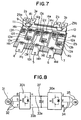
- FIG. 8 illustrates an example of the circuit configuration of the electric power conversion device.
- the reference numerals denote the following components, respectively: 30a, 30b semiconductor devices, 31 a 3-phase alternating current power supply, 32 input wires, 33a a main circuit wiring, 33b a main circuit wiring, 27 an electrolytic capacitor, 34 output wires, 35 an induction motor (which is also refereed to as a load).
- the semiconductor devices 30a, 30b include power semiconductor switch elements such as an IPM, a power MOSFET (Metal Oxide Semiconductor Field Effect Transistor) and an IGBT (Insulated Gate Bipolar Transistor).
- the semiconductor device 30b converts the 3-phase alternating current power supply 31 to direct currents, and accordingly it is possible to regard, as a direct current power supply, the semiconductor device 30b combined with the 3-phase alternating current power supply 31. Accordingly, when an input power supply is a direct current power supply such as a battery, it turns out that the electric power conversion device in FIG. 8 has an apparatus configuration where the semiconductor device 30b, the 3-phase alternating current power supply 31 and the input wires 32 are replaced by the direct current power supply. In the present embodiment, in some cases, the combination of the semiconductor device 30b, the 3-phase alternating current power supply 31 and the input wires 32 is also refereed to as a direct current power supply.
- the semiconductor device 30a inputs the direct voltage smoothed by the electrolytic capacitor 27, then outputting, to the output wires 34, a 3-phase alternating current with U, V, W phases and variable voltages and variable frequencies.
- the induction motor 35 is driven by the currents and the voltages supplied through the output wires 34.
- the electric power conversion device may further include components such as a circuit substrate, which becomes a control circuit for controlling switching operations of the semiconductor devices 30a, 30b, and a cooling fin and a cooling fan for cooling the semiconductor devices 30a, 30b.
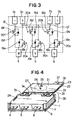
- FIG. 9 is a diagram for illustrating an example of the configuration of the semiconductor device 30a for inputting the direct currents so as to output the UVW 3-phase alternating current.
- the reference numerals denote the following components, respectively: 30a the semiconductor device, 18a, 18b, 18c, 18d, 18e, 18f semiconductor switches, 19a, 19b, 19c, 19d, 19e, 19f diodes, 20a, 20b, 20c, 20d, 20e, 20f semiconductor switch control terminals, 3 a positive-polarity terminal, 2 a negative-polarity terminal, 4 a W phase output terminal, 5 a V phase output terminal, 6 a U phase output terminal.
- Numerals 4, 5, 6 as a whole represents a 3-phase alternating output terminal as one set.
- the direct voltage is applied between the positive-polarity terminal 3 and negative-polarity terminal 2.
- the driving circuit for driving an ON/OFF signal of the respective semiconductor switches is omitted.
- the control signal from the driving circuit controls a switching of the respective semiconductor switches 18a, 18b, 18c, 18d, 18e, 18f through the semiconductor switch control terminals 20a, 20b, 20c, 20d, 20e, 20f.
- the power MOSFET or the IPM is employed as the respective semiconductor switches 18a, 18b, 18c, 18d, 18e, 18f.
- the power MOSFET since the power MOSFET includes a diode in its elemental structure, it is possible to configure the semiconductor switch 18a and the diode 19a on one chip. Consequently, when the power MOSFET is employed as each semiconductor switch, the diode need not be implemented as another configuration component.
- the semiconductor switch 18a and the semiconductor switch 18b, the semiconductor switch 18c and the semiconductor switch 18d, and the semiconductor switch 18e and the semiconductor switch 18f are bridge-connected to each other, respectively.
- the semiconductor device 30a applies a PWM (Pulse Width Modulation) control signal voltage to the semiconductor switch control terminals 20a, 20b, 20c, 20d, 20e, 20f so as to control a time of an ON (open) and that of an OFF (close) of the bridge-connected respective semiconductor switches 18a, 18b, 18c, 18d, 18e, 18f.
- PWM Pulse Width Modulation
- the above-described apparatus configuration for outputting the UVW 3-phase alternating current can also be implemented by using 3 semiconductor devices one of which includes the following components: The positive-polarity terminal 3, the negative-polarity terminal 2, the bridge-connected semiconductor switches 18a, 18b, and the output terminal 4.
- the present invention relates to a wiring structure of a portion that does not depend on the number of the semiconductor switches and the number of the bridge circuits. This condition makes it possible to apply the present invention to a semiconductor device that includes at least 2 of the bridge-connected controllable semiconductor switches, at least 1 of the output terminal and the positive-polarity and negative-polarity direct current terminals.
- the electric current value varies exceedingly.
- the electrical path is configured by the wiring that bridge-connects the semiconductor switch to be switched from the ON to the OFF, the main circuit wiring 33a, the main circuit wiring 33b, and the electrolytic capacitor 27.
- a voltage exceeding the direct voltage that is being applied to the electrolytic capacitor 27 is instantaneously applied to the semiconductor switch to be switched from the ON to the OFF.
- the amount of the above-described voltage (Hereinafter, this voltage is referred to as a jump-up voltage.) that exceeds the direct voltage is determined by the product of the following two values: A total inductance of an inductance of the above-described path and that of the electrolytic capacitor 27 and a time-differentiation value of the electric current value in the path. Accordingly, an increase in the above-described inductance results in an increase in the applied voltage to the semiconductor switch at the time of the switching. Moreover, when the applied voltage exceeds the element withstand voltage, there occurs the element breakdown.
- the switching loss of the semiconductor switch is also increased. This increase in the switching loss becomes one of the causes of a lifetime shortening of the semiconductor switch and of an increase in the cost for cooling.
- FIG. 1 is a schematic view of a semiconductor module for illustrating the location of the direct current terminals in the semiconductor device of the present invention.
- the reference numerals denote the following components, respectively: 1 a case, 2a, 2b the negative-polarity direct current terminals, 3a, 3b the positive-polarity direct current terminals, 4, 5, 6 the output terminals, 7 a metallic baseboard, 8 a screw hole, 24 a control assistance terminal, 30 the semiconductor device.
- a screw hole for installing wiring is provided in each of the terminals 2a, 2b, 3a, 3b. Also, a hole for installing wiring is provided in each of the output terminals 4, 5, 6.
- the screw hole 8 is used when a cooling fin and the metallic baseboard 7 are plane-fixed to each other.
- FIG. 1 illustrates a configuration where the positive-polarity direct current terminal 3a and the negative-polarity direct current terminal 2a form a pair and the positive-polarity direct current terminal 3b and the negative-polarity direct current terminal 2b form a pair in such a manner that the two pairs are provided side-by-side on one side of the rectangular parallelopiped case 1.
- a terminal combination like the above-described one of the terminal 3a and the terminal 2a is referred to as a positive-polarity negative-polarity direct current terminal pair.
- FIG. 4 illustrates an example where the electrolytic capacitor 27 is connected with the semiconductor device 30 in the electric power conversion device.
- the reference numerals denote the following components, respectively: 1 the case, 2a, 2b the negative-polarity direct current terminals, 3a, 3b the positive-polarity direct current terminals, 4, 5, 6 the output terminals, 7 the metallic baseboard, 8 the screw hole, 24 the control assistance terminal, 30 the semiconductor device, 21 a positive-polarity side conductive plate, 22 a negative-polarity side conductive plate, 23 an insulating seat, 25, 26 capacitor terminals, 27 the electrolytic capacitor, 36 a positive-polarity side terminal, 37 a negative-polarity side terminal.
- the positive-polarity side conductive plate 21 is plane-connected to the positive-polarity direct current terminals 3a, 3b by screws
- the negative-polarity side conductive plate 22 is plane-connected to the negative-polarity direct current terminals 2a, 2b by screws
- the electrolytic capacitor 27 is connected to the negative-polarity side conductive plate 22 and the positive-polarity side conductive plate 21 at the capacitor terminals 25, 26, respectively.
- the terminals 36, 37 are connected to a direct current power supply.
- the output terminals 4, 5, 6 are connected to the load.
- FIG. 2 is a perspective view for illustrating the wiring structure including the semiconductor switches and the bridge circuits within the semiconductor device in FIG. 1.
- the semiconductor device 30 in FIG. 1 is a semiconductor device where the 6 semiconductor switches are bridge-connected.
- the reference numerals denote the following components, respectively: 2a, 2b the negative-polarity direct current terminals, 3a, 3b the positive-polarity direct current terminals, 4, 5, 6 the output terminals, 9 a negative-polarity side plate-shaped conductor, 10 a positive-polarity side plate-shaped conductor, 11 an insulating seat, 12a, 12b, 12c, 12d, 12e, 12f substrates, 13a, 13b, 13c, 13d, 13e, 13f diodes/semiconductor switches, 14a, 14b, 14c, 14d, 14e, 14f, 14g, 14h, 14i, 14j, 14k, 141 wire wirings, 17 a metallic baseboard.
- the respective substrates 12a, 12b, 12c, 12d, 12e, 12f have a layer structure consisting of the conductor wiring and the insulating plate. This ensures the insulation between an electrical path on each substrate and the metallic baseboard 7.
- the respective wire wirings 14a, 14b, 14c, 14d, 14e, 14f, 14g, 14h, 14i, 14j, 14k, 141 are illustrated in such a manner that the number of the wire wiring is equal to 4.
- the number of the wire wiring differs depending on the specification of the semiconductor device and a diameter of the wire wiring, and thus the number is not limited to 4.
- the negative-polarity direct current terminals 2a, 2b is a portion of the negative-polarity side plate-shaped conductor 9
- the positive-polarity direct current terminals 3a, 3b is a portion of the positive-polarity side plate-shaped conductor 10.
- the negative-polarity side plate-shaped conductor 9 and the positive-polarity side plate-shaped conductor 10 form a multilayer structure in which the insulating seat 11 is sandwiched.
- the directions of the electric currents flowing therein are opposite to each other, and the distance between the conductors is in extreme proximity by the amount of a thickness of the insulating seat. On account of this, these wirings turn out to form a low inductance structure.
- the electrical path is the following path: Starting from the capacitor terminal 26, the electrical path passes through the positive-polarity direct current terminals 3a, 3b from the positive-polarity side conductive plate 21, and from the positive-polarity direct current terminals 3a, 3b, the electrical path passes through in the sequence of the positive-polarity side plate-shaped conductor 10, the wire wiring 14a, the substrate 12b, the diodes/semiconductor switch 13a, the wire wiring 14b, the substrate 12a, the diodes/semiconductor switch 13b, the wire wiring 14c and the negative-polarity side plate-shaped conductor 9, and from the negative-polarity side plate-shaped conductor 9, the electrical path passes through the negative-polarity direct current terminals 2a, 2b, and from the negative-polarity direct current terminals 2a, 2b, the electrical path passes through the negative-polarity side conductive plate 22, finally attaining to the capacitor terminal 25.
- the semiconductor device 30 and the electric power conversion device using it it is possible to parallelize the electrical path extending from the electrolytic capacitor 27 to the positive-polarity negative-polarity direct current terminal pairs 2a and 3a, 2b and 3b and the electrical path of the bridge wiring within the semiconductor device.
- the portion of the bridge wirings within the semiconductor device is made to form the multilayer structure and the positive-polarity negative-polarity direct current terminal pairs 2a and 3a, 2b and 3b are provided on the one side of the upper plane of the rectangular parallelopiped case 1, thereby enhancing the inductance-reducing effect based on the parallelizing of the electrical path.
- the portion 9' and 10' in FIG. 3 is made to exhibit the low inductance.
- it has been implemented to lessen a difference in the inductances that determines the magnitudes of the jump-up voltages in the 3 bridge circuits.
- This condition decreases a difference in the jump-up voltages in the 3 bridge circuits, thereby resulting in an effect of being also able to provide a semiconductor device with an excellent balance between the current and voltage outputs.
- the dimensions of the semiconductor device are set to be 120 mm longitudinal, 140mm transverse, and 30mm high.
- the electric power conversion device is assumed that uses the semiconductor switch with the element withstand voltage of 100V and a falling time of 300nsec under the conditions that the direct voltage is equal to 40V and a shielding electric current is equal to 250A.
- the inductance in the following electrical path is equal to about 35nH: Starting from the positive-polarity direct current terminal 3a, the electrical path passes through in the sequence of the positive-polarity side plate-shaped conductor 10, the wire wiring 14a, the substrate 12b, the diodes/semiconductor switch 13a, the wire wiring 14b, the substrate 12a, the diodes/semiconductor switch 13b, the wire wiring 14c and the negative-polarity side plate-shaped conductor 9, and from the negative-polarity side plate-shaped conductor 9, the electrical path passes through the negative-polarity direct current terminal 2a.
- the breakdown thereof is as follows: The inductance occurring in a non-multilayer structure of the positive-polarity direct current terminal 3a and the negative-polarity direct current terminal 2a is equal to about 15nH, the inductance occurring in the multilayered wirings 9, 10 is equal to about 5nH, and the inductance in an electrical path including the bonding wires 14, the substrates 12a, 12b and the semiconductor elements 13a, 13b is equal to about 15nH.
- the inductance in the following electrical path is equal to about 30nH: Starting from the positive-polarity direct current terminal 3b, the electrical path passes through in the sequence of the positive-polarity side plate-shaped conductor 10, the wire wiring 14a, the substrate 12b, the diodes/semiconductor switch 13a, the wire wiring 14b, the substrate 12a, the diodes/semiconductor switch 13b, the wire wiring 14c and the negative-polarity side plate-shaped conductor 9, and from the negative-polarity side plate-shaped conductor 9, the electrical path passes through the negative-polarity direct current terminal 2b.
- the wiring structure in the present invention a difference between the inductances in the above-described 2 paths is made small by multilayering the wirings 9, 10 that give rise to the difference.
- the above-described inductances are varied depending on the number of the bonding wires 14 and a rooftop height, they are presented as implementable numerical values.
- this semiconductor device 30 is connected with the electrolytic capacitor 27, using the positive-polarity side conductive plate 21 and the negative-polarity side conductive plate 22.
- the inner inductance value of the electrolytic capacitor 27 is assumed to be equal to 20nH.
- the inductance seen from the capacitor terminals at the time of short-circuiting the terminals 2a, 3a is equal to about 30nH.
- the breakdown thereof is as follows: The inductance resulting from the fact that the electric currents do not flow in the opposite directions in the capacitor terminals 25, 26 is equal to about 10nH, the inductance occurring in a portion in proximity to the direct terminals of semiconductor device 30 where the positive-polarity side conductive plate 21 and the negative-polarity side conductive plate 22 form a non-multilayer structure is equal to about 15nH, and the inductance occurring in the multilayer structure portion of the positive-polarity side conductive plate 21 and the negative-polarity side conductive plate 22 is equal to about 5nH.
- the inductance seen from the capacitor terminals 25, 26 at the time of short-circuiting the terminals 2b, 3b is similarly equal to about 30nH.
- the calculation result becomes equal to about 50nH on account of the effect of parallelizing the electrical path.
- the calculation result becomes equal to about 82V. This is a value having a sufficient degree of the design allowance with reference to the element withstand voltage.
- the calculation result becomes equal to about 75nH.
- the approximate calculation of the peak voltage applied to the semiconductor switch brings about a value of about 103V. Namely, the peak voltage exceeds the element withstand voltage. This situation means that, unless some other modification is performed, it is impossible to implement the semiconductor device and the electric power conversion device in the present specification.
- FIG. 5 is a schematic view for illustrating the electric power conversion device where the capacitors 28a, 28b are implemented in the positive-polarity negative-polarity direct current terminal pairs in the semiconductor device.
- the reference numerals denote the following components, respectively: 1 the case, 2a, 2b the negative-polarity direct current terminals, 3a, 3b the positive-polarity direct current terminals, 4, 5, 6 the output terminals, 7 the metallic baseboard, 8 the screw hole, 21 the positive-polarity side conductive plate, 22 the negative-polarity side conductive plate, 23 the insulating seat, 24 the control assistance terminal, 25, 26 the capacitor terminals, 27 the electrolytic capacitor, 28a, 28b the capacitors, 36 the positive-polarity side terminal, 37 the negative-polarity side terminal.
- the capacitors 28a, 28b charge/discharge only a high frequency electric current that flows at the time of the switching, and accordingly the capacitance thereof may be exceedingly smaller as compared with that of the electrolytic capacitor 27.
- a film capacitor the capacitance of which is in the range of about 1 ⁇ F to 10 ⁇ F and which has an excellent high frequency characteristic, i.e., has a small inductance. This condition makes the compact implementation possible.
- the electrical paths are the following 2 paths: One of the electrical paths, starting from the capacitor 28a, passes through in the sequence of the positive-polarity direct current terminal 3a, the positive-polarity side plate-shaped conductor 10, the wire wiring 14a, the substrate 12b, the diodes/semiconductor switch 13a, the wire wiring 14b, the substrate 12a, the diodes/semiconductor switch 13b, the wire wiring 14c and the negative-polarity side plate-shaped conductor 9, and from the negative-polarity side plate-shaped conductor 9, one of the electrical paths passes through the negative-polarity direct current terminal 2a, finally returning back to the capacitor 28a.
- the other electrical path starting from the capacitor 28b, passes through in the sequence of the positive-polarity direct current terminal 3b, the positive-polarity side plate-shaped conductor 10, the wire wiring 14a, the substrate 12b, the diodes/semiconductor switch 13a, the wire wiring 14b, the substrate 12a, the diodes/semiconductor switch 13b, the wire wiring 14c and the negative-polarity side plate-shaped conductor 9, and from the negative-polarity side plate-shaped conductor 9, the other electrical path passes through the negative-polarity direct current terminal 2b, finally returning back to the capacitor 28b.
- the portion extending from the wire wiring 14a to the wire wiring 14c is common to the above-described 2 paths.
- the structure in FIG. 5 includes none of the inductance occurring in the positive-polarity side conductive plate 21 and the negative-polarity side conductive plate 22, the inductances of the capacitors 28a, 28b are smaller as compared with the inner inductance of the electrolytic capacitor 27, and the 2 capacitors 28a, 28b are parallelized. These conditions allow a lower inductance to be implemented in comparison with the inductance in the structure in FIG. 4.
- the structure in FIG. 5 makes it possible to provide a semiconductor device that does not depend on the wiring structure of the positive-polarity side conductive plate 21, the negative-polarity side conductive plate 22, and the electrolytic capacitor 27.
- FIG. 6 illustrates an application example of a structure where the capacitors 28a, 28b are connected to the 2 positive-polarity negative-polarity direct current terminal pairs in FIG. 5.
- the reference numerals denote the following components, respectively: 1 the case, 2a, 2b the negative-polarity direct current terminals, 3a, 3b the positive-polarity direct current terminals, 4, 5, 6 the output terminals, 7 the metallic baseboard, 8 the screw hole, 21 the positive-polarity side conductive plate, 22 the negative-polarity side conductive plate, 23 the insulating seat, 24 the control assistance terminal, 25, 26 the capacitor terminals, 27 the electrolytic capacitor, 28a, 28b the capacitors, 36 the positive-polarity side terminal, 37 the negative-polarity side terminal.
- the structure in FIG. 6 is a structure where the positive-polarity side conductive plate 21 and the negative-polarity side conductive plate 22 are connected to only the positive-polarity direct current terminal 3a and the negative-polarity direct current terminal 2a, respectively.
- the structure in FIG. 6 makes it possible to implement a low inductance that is substantially equal to the low inductance implemented in the structure in FIG. 5.
- the semiconductor device 30 is of the structure that permits its flexible design that does not depend on the configurations of the positive-polarity side conductive plate 21 and the negative-polarity side conductive plate 22.
- the dimensions of the semiconductor device are set to be 120 mm longitudinal, 140mm transverse, and 30mm high.
- the electric power conversion device is assumed that uses the semiconductor switch with the element withstand voltage of 100V and the falling time of 300nsec under the conditions that the direct voltage is equal to 40V and the shielding electric current is equal to 400A.
- the inductance in the following electrical path is equal to about 35nH: Starting from the positive-polarity direct current terminal 3a, the electrical path passes through in the sequence of the positive-polarity side plate-shaped conductor 10, the wire wiring 14a, the substrate 12b, the diodes/semiconductor switch 13a, the wire wiring 14b, the substrate 12a, the diodes/semiconductor switch 13b, the wire wiring 14c and the negative-polarity side plate-shaped conductor 9, and from the negative-polarity side plate-shaped conductor 9, the electrical path passes through the negative-polarity direct current terminal 2a.
- the breakdown thereof is as follows: The inductance occurring in the non-multilayer structure of the positive-polarity direct current terminal 3a and the negative-polarity direct current terminal 2a is equal to about 15nH, the inductance occurring in the multilayered wirings 9, 10 is equal to about 5nH, and the inductance in the electrical path including the bonding wires 14, the substrates 12a, 12b and the semiconductor elements 13a, 13b is equal to about 15nH.
- the inductance in the following electrical path is equal to about 30nH: Starting from the positive-polarity direct current terminal 3b, the electrical path passes through in the sequence of the positive-polarity side plate-shaped conductor 10, the wire wiring 14a, the substrate 12b, the diodes/semiconductor switch 13a, the wire wiring 14b, the substrate 12a, the diodes/semiconductor switch 13b, the wire wiring 14c and the negative-polarity side plate-shaped conductor 9, and from the negative-polarity side plate-shaped conductor 9, the electrical path passes through the negative-polarity direct current terminal 2b.
- the electrical current paths that exert the outstanding influence on the jump-up voltage becomes only the electrical paths that extend from the capacitors 28a, 28b to the bridge wirings within the semiconductor device.
- the inductance of the capacitors 28a, 28b is assumed to be equal to 10nH.
- the inductance that exerts the outstanding influence on the jump-up voltage value becomes equal to about 25nH on account of the effect of parallelizing the electrical paths.
- the peak voltage applied to the semiconductor switch becomes equal to about 73V. This is a value having a sufficient degree of the design allowance with reference to the element withstand voltage.
- the inductance becomes equal to about 45nH.
- the peak voltage applied to the semiconductor switch becomes equal to about 100V. Namely, the peak voltage exhibits no allowance toward the element withstand voltage. This situation means that, unless some other modification is performed, it is impossible to implement the semiconductor device and the electric power conversion device in the present specification.
- the capacitance of the capacitors 28a, 28b required for the purpose of suppressing the jump-up voltage is in the range of about 5 ⁇ F to 10 ⁇ F.
- FIG. 7 illustrates a structure where, within the case 1, a capacitor 29a between the positive-polarity direct current terminal 3a and the negative-polarity direct current terminal 2a is connected to a capacitor 29b between the positive-polarity direct current terminal 3b and the negative-polarity direct current terminal 2b.
- the reference numerals denote the following components, respectively: 2a, 2b the negative-polarity direct current terminals, 3a, 3b the positive-polarity direct current terminals, 4, 5, 6 the output terminals, 9 the negative-polarity side plate-shaped conductor, 10 the positive-polarity side plate-shaped conductor, 11 the insulating seat, 12a, 12b, 12c, 12d, 12e, 12f the substrates, 13a, 13b, 13c, 13d, 13e, 13f the diodes/semiconductor switches, 14a, 14b, 14c, 14d, 14e, 14f, 14g, 14h, 14i, 14j, 14k, 141 the wire wirings, 7 the metallic baseboard, 29a, 29b the capacitors.
- the structure in FIG. 7 exhibits the same effect as that of the structures in FIGS. 5, 6.
- the schematic outside appearance as a semiconductor device becomes the same as that of the structure in FIG. 1.
- the structure in FIG. 7 has an advantage of being made compact. This advantage results from implementing the capacitors 29a, 29b within the case 1.
- the positive-polarity direct current terminals 3a, 3b and the negative-polarity direct current terminals 2a, 2b are provided on the one side of the upper plane of the case 1 in the sequence of 2a, 3a, 2b, 3b in the semiconductor device 30.
- the direct current terminals on the upper plane of the case 1 may also be located in the sequence of 2a, 3a, 3b, 2b, or in the sequence of 3a, 2a, 2b, 3b.
- FIGS. 1 to 7 the presentation has been given concerning the semiconductor device structure and the electric power conversion device that solve the problem of reducing the inductance with the use of the semiconductor device 30 where the 6 semiconductor switches are bridge-connected.
- the present embodiment relates to the structure of the positive-polarity direct current terminals, the negative-polarity direct current terminals, the negative-polarity side plate-shaped conductor 9, and the positive-polarity side plate-shaped conductor 10 in the semiconductor device.
- the effect of the present embodiment is applicable to the various types of structures of the diodes/semiconductor switches 13a, 13b, 13c, 13d, 13e, 13f, the wire wirings 14a, 14b, 14c, 14d, 14e, 14f, 14g, 14h, 14i, 14j, 14k, 141 that are directly connected to the diodes/semiconductor switches, and the substrates 12a, 12b, 12c, 12d, 12e, 12f.
- the effect of the present embodiment is applicable by, as is the case with the semiconductor device 30, multilayering at least a portion of the conductors that bridge-connect the semiconductor switches and providing the 2 or more positive-polarity negative-polarity direct current terminal pairs side-by-side on one side of an upper plane of the case. Consequently, the effect of the present embodiment is also applicable to a semiconductor device that includes at least 2 of the bridge-connected semiconductor switches.
- FIGS. 1 to 7 the presentation has been given employing, as the example, the semiconductor device 30 that has the 2 positive-polarity negative-polarity direct current terminal pairs.
- the inductance-reducing mechanism by the parallelizing of the positive-polarity negative-polarity direct current terminal pairs makes it possible to obtain the same effect even if 3 or more positive-polarity negative-polarity direct current terminal pairs described are parallelized on the one side of the upper plane of the case.
- the inductance-reducing mechanism by the parallelizing of the positive-polarity negative-polarity direct current terminal pairs makes it possible to obtain the same effect even in the following case:
- the 2 positive-polarity direct current terminals and the 1 negative-polarity direct current terminal or the 1 positive-polarity direct current terminal and the 2 negative-polarity direct current terminals are regarded as 1 pair of the positive-polarity negative-polarity direct current terminal pair, then being parallelized on the one side of the upper plane of the case.
- the semiconductor device having the above-described wiring and wiring structure or the semiconductor device where the capacitors are connected to the terminals of the semiconductor device, and the wiring structure of the electric power conversion device using these semiconductor devices exhibit effects of preventing the breakdown of the semiconductor elements caused by the fact that the voltage exceeding the withstand voltage of the semiconductor switch is applied at the time of the switching and of reducing the loss of the semiconductor elements at the time of the switching.
- the above-described effects allow greater electric current outputting semiconductor device and electric power conversion device to be provided by an inexpensive method of the modification of the wiring structure of the semiconductor device and the electric power conversion device.
- the structure of the semiconductor device and the electric power conversion device using it are disclosed, the structure making it possible to reduce the inductances that become the causes of the increase in the jump-up voltage at the time of the switching in the semiconductor device and of the element breakdown and the increase in the power loss that accompany the increase in the jump-up voltage.
Landscapes
- Engineering & Computer Science (AREA)
- Power Engineering (AREA)
- Inverter Devices (AREA)
- Power Conversion In General (AREA)
Claims (8)
- Dispositif à semi-conducteur (30) comprenant:- au moins deux commutateurs à semi-conducteur à montage en pont (18a, 18b),- au moins une borne de sortie (4, 5, 6),- au moins deux paires de bornes à courant continu respectivement constituées par une borne à courant continu à pôle positif et une borne à courant continu à pôle négatif (3a, 2a, 3b, 2b),- un premier conducteur destiné à raccorder ladite borne (4, 5, 6), au moins au nombre d'une, aux dits commutateurs à semi-conducteur à montage en pont, au moins au nombre de deux,- au moins un conducteur latéral en forme de lamelle à pôle négatif (9) et un conducteur latéral en forme de lamelle à pôle positif (10) destinés à raccorder lesdites paires de bornes à courant continu (3a, 2a et 3b, 2b), au moins au nombre de deux, aux dits commutateurs à semi-conducteur (18a, 18b), dans lequel au moins une portion dudit conducteur latéral en forme de lamelle à pôle négatif, au moins au nombre d'un (9) et dudit conducteur latéral en forme de lamelle à pôle positif, au moins au nombre d'un (10), faisant en l'occurrence partie d'une structure multicouche constituée en intercalant un isolant (11) entre ledit conducteur latéral en forme de lamelle à pôle négatif, au moins au nombre d'un (9) et ledit conducteur latéral en forme de lamelle à pôle positif, au moins au nombre d'un (10) et- un boîtier pour loger lesdits commutateurs à semi-conducteur à montage en pont, au moins au nombre de deux (18a, 18b),
caractérisé en ce que
ladite structure multicouche est disposée dans ledit boîtier et
lesdites bornes à courant continu à pôle positif et lesdites bornes à courant continu à pôle négatif (3a, 2a et 3b, 2b) sont toutes disposées selon un agencement en ligne droite unique au niveau du bord d'un plan dudit boîtier. - Dispositif à semi-conducteur (30) selon la revendication 1, dans lequel- lesdits commutateurs à semi-conducteur à montage en pont, au moins au nombre de deux, sont au nombre de six (18a, 18b, 18c, 18d, 18e, 18f)- ladite borne de sortie, au moins au nombre d'une, est au nombre de trois (4, 5, 6) et- ledit boîtier se compose d'une enceinte (1) et d'une plaque de montage métallique (7).
- Dispositif à semi-conducteur (30) comme revendiqué dans les revendications 1 ou 2, dans lequel au moins un des condensateurs (28a, 28b) est raccordé aux dites bornes à courant continu à pole positif et à pôle négatif (3a, 2a et 3b, 2b), respectivement.
- Dispositif à semi-conducteur (30) comme revendiqué dans l'une quelconque des revendications 1 à 3, dans lequel au moins des portions dudit conducteur latéral en forme de lamelle à pôle négatif, au moins au nombre d'une (9) et dudit conducteur latéral en forme de lamelle à pôle positif, au moins au nombre d'une (10), sont disposées sur ladite plaque de montage métallique (7), l'isolant (11) étant en l'occurrence intercalé entre elles.
- Dispositif de conversion de puissance électrique comprenant:- ledit dispositif à semi-conducteur (30) comme revendiqué dans l'une quelconque des revendications 1 à 4 et- un condensateur électrolytique (27) raccordé aux dites bornes à courant continu à pôle positif et à pôle négatif (3a, 3b, 2a, 2b) dudit dispositif à semi-conducteur (30).
- Dispositif de conversion de puissance électrique comme revendiqué dans la revendication 5, dans lequel- une borne (26) dudit condensateur électrolytique (27) est raccordée aux dites bornes à courant continu à pôle positif (3a, 3b) dudit dispositif à semi-conducteur (30) et une autre borne (25) dudit condensateur électrolytique (27) est raccordée aux dites bornes à courant continu à pôle négatif (2a, 2b) dudit dispositif à semi-conducteur (30),- ces connexions étant réalisées par des plaquettes conductrices côté pôle positif et côté pôle négatif (21, 22), constituées en structure multicouche par l'insertion d'un isolant (23) entre elles.
- Dispositif de conversion de puissance électrique comme revendiqué dans la revendication 6, dans lequel ladite première borne (26) dudit condensateur électrolytique (27) est raccordée à l'une desdites bornes à courant continu à pôle positif (3a, 3b) dudit dispositif à semi-conducteur (30) et ladite autre borne (25) dudit condensateur électrolytique (27) est raccordée à l'une desdites bornes à courant continu à pôle négatif (2a, 2b) dudit dispositif à semi-conducteur (30).
- Dispositif de conversion de puissance électrique comme revendiqué dans la revendication 7, dans lequel ledit dispositif à semi-conducteur (30) convertit un courant continu en un courant alternatif à tension réglable et à fréquence variable, ledit condensateur électrolytique (27) supprimant les fluctuations dudit courant continu.
Applications Claiming Priority (2)
| Application Number | Priority Date | Filing Date | Title |
|---|---|---|---|
| JP2000097816 | 2000-03-30 | ||
| JP2000097816A JP3633432B2 (ja) | 2000-03-30 | 2000-03-30 | 半導体装置及び電力変換装置 |
Publications (3)
| Publication Number | Publication Date |
|---|---|
| EP1143603A2 EP1143603A2 (fr) | 2001-10-10 |
| EP1143603A3 EP1143603A3 (fr) | 2002-10-16 |
| EP1143603B1 true EP1143603B1 (fr) | 2006-02-08 |
Family
ID=18612388
Family Applications (1)
| Application Number | Title | Priority Date | Filing Date |
|---|---|---|---|
| EP00118264A Expired - Lifetime EP1143603B1 (fr) | 2000-03-30 | 2000-09-04 | Dispositif à semiconducteur et dispositif de conversion de puissance électrique |
Country Status (4)
| Country | Link |
|---|---|
| US (1) | US6525950B1 (fr) |
| EP (1) | EP1143603B1 (fr) |
| JP (1) | JP3633432B2 (fr) |
| DE (1) | DE60025865T2 (fr) |
Families Citing this family (49)
| Publication number | Priority date | Publication date | Assignee | Title |
|---|---|---|---|---|
| JP3642012B2 (ja) | 2000-07-21 | 2005-04-27 | 株式会社日立製作所 | 半導体装置,電力変換装置及び自動車 |
| US6774465B2 (en) * | 2001-10-05 | 2004-08-10 | Fairchild Korea Semiconductor, Ltd. | Semiconductor power package module |
| JP4066644B2 (ja) * | 2001-11-26 | 2008-03-26 | 株式会社豊田自動織機 | 半導体装置、半導体装置の配線方法 |
| DE10237561C1 (de) * | 2002-08-16 | 2003-10-16 | Semikron Elektronik Gmbh | Induktivitätsarme Schaltungsanordnung bzw. Schaltungsaufbau für Leistungshalbleitermodule |
| WO2004105220A2 (fr) * | 2003-05-16 | 2004-12-02 | Ballard Power Systems Corporation | Systeme de module de puissance |
| JP2006187083A (ja) * | 2004-12-27 | 2006-07-13 | Daikin Ind Ltd | インバータ装置およびコンバータ用モジュールおよび空気調和機 |
| EP2306477B1 (fr) * | 2005-05-02 | 2013-07-03 | Epcos AG | Condensateur de puissance |
| EP2264726B1 (fr) * | 2005-05-02 | 2014-09-10 | Epcos Ag | Condensateur |
| CN101263547A (zh) * | 2005-06-24 | 2008-09-10 | 国际整流器公司 | 具有低电感的半导体半桥模块 |
| DE112007000366T5 (de) * | 2006-02-17 | 2009-01-02 | Kabushiki Kaisha Yaskawa Denki, Kitakyushu | Leistungsumwandlungsvorrichtung mit Sammelschiene |
| JP4564937B2 (ja) * | 2006-04-27 | 2010-10-20 | 日立オートモティブシステムズ株式会社 | 電気回路装置及び電気回路モジュール並びに電力変換装置 |
| JP4642804B2 (ja) * | 2007-04-27 | 2011-03-02 | カルソニックカンセイ株式会社 | Pwmモジュール |
| DE102007029657B4 (de) * | 2007-06-27 | 2017-10-19 | Fuji Electric Co., Ltd. | Wechselrichtermodul für Stromrichter |
| US8462529B2 (en) * | 2007-07-30 | 2013-06-11 | GM Global Technology Operations LLC | Power converter assembly with symmetrical layout of power modules |
| DE102008035234B4 (de) | 2007-07-30 | 2020-01-02 | GM Global Technology Operations LLC (n. d. Ges. d. Staates Delaware) | Verbessertes Leistungsmodullayout für Kraftfahrzeugleistungswandler und Kraftfahrzeugantriebssystem einen solchen umfassend |
| US20090284213A1 (en) * | 2008-05-15 | 2009-11-19 | Gm Global Technology Operations, Inc. | Power module layout for automotive power converters |
| ATE528856T1 (de) * | 2009-06-19 | 2011-10-15 | Vincotech Holdings S A R L | Leistungsmodul mit zusätzlichem transientem strompfad und leistungsmodulsystem |
| JP5177711B2 (ja) | 2010-05-21 | 2013-04-10 | 株式会社デンソー | 電動装置 |
| JP5067679B2 (ja) | 2010-05-21 | 2012-11-07 | 株式会社デンソー | 半導体モジュール、および、それを用いた駆動装置 |
| US9704831B2 (en) | 2010-05-21 | 2017-07-11 | Mitsubishi Electric Corporation | Power semiconductor module |
| JP5201171B2 (ja) | 2010-05-21 | 2013-06-05 | 株式会社デンソー | 半導体モジュール、および、それを用いた駆動装置 |
| JP5267959B2 (ja) | 2011-05-30 | 2013-08-21 | 株式会社デンソー | 半導体モジュール、及び、それを用いた駆動装置 |
| JP5370440B2 (ja) | 2011-08-31 | 2013-12-18 | 株式会社デンソー | 電子装置の製造方法 |
| US8405206B1 (en) * | 2011-09-30 | 2013-03-26 | Infineon Technologies Ag | Low-inductive semiconductor module |
| FR2985597B1 (fr) * | 2012-01-05 | 2014-10-24 | Valeo Equip Electr Moteur | Dispositif d'assemblage de capacites pour convertisseur electronique |
| JP2014107957A (ja) * | 2012-11-28 | 2014-06-09 | Hitachi Automotive Systems Ltd | インバータ装置およびモータ一体型インバータ装置 |
| JP6053642B2 (ja) * | 2013-08-23 | 2016-12-27 | 日立オートモティブシステムズ株式会社 | 電力変換装置 |
| JP6123722B2 (ja) * | 2014-03-26 | 2017-05-10 | 株式会社デンソー | 半導体装置 |
| JP5862702B2 (ja) | 2014-05-07 | 2016-02-16 | トヨタ自動車株式会社 | 三相インバータモジュール |
| JP6345583B2 (ja) * | 2014-12-03 | 2018-06-20 | ルネサスエレクトロニクス株式会社 | 半導体装置 |
| US9241428B1 (en) * | 2015-08-31 | 2016-01-19 | Faraday & Future Inc. | Inverter assembly |
| US10135355B2 (en) * | 2015-08-31 | 2018-11-20 | Faraday&Future Inc. | Inverter DC bus bar assembly |
| US11218080B2 (en) * | 2015-08-31 | 2022-01-04 | Faraday & Future Inc. | Inverter AC bus bar assembly |
| CN205160384U (zh) * | 2015-08-31 | 2016-04-13 | 法拉第未来公司 | 逆变器组件 |
| JP6665456B2 (ja) * | 2015-09-11 | 2020-03-13 | 富士電機株式会社 | パワー半導体装置 |
| WO2017136788A1 (fr) * | 2016-02-03 | 2017-08-10 | Faraday & Future Inc. | Ensemble onduleur |
| JP2017143679A (ja) * | 2016-02-12 | 2017-08-17 | 三菱電機株式会社 | パワーモジュール |
| DE102016206501A1 (de) * | 2016-04-18 | 2017-10-19 | Fraunhofer-Gesellschaft zur Förderung der angewandten Forschung e.V. | Leistungshalbleiterbauteil mit zwei lateralen Leistungshalbleiterbauelementen in Halbbrückenschaltung |
| JP6240262B2 (ja) * | 2016-06-15 | 2017-11-29 | 株式会社東芝 | 半導体装置 |
| US10749325B2 (en) * | 2016-11-18 | 2020-08-18 | Schaeffler Technologies AG & Co. KG | Busbar comprising a metal-sheet stack and method for producing a busbar |
| EP3613077B1 (fr) * | 2017-05-02 | 2020-10-07 | ABB Power Grids Switzerland AG | Module en demi-pont ayant un agencement coaxial des bornes dc |
| FR3068545B1 (fr) * | 2017-06-28 | 2019-07-19 | Valeo Equipements Electriques Moteur | Convertisseur de tension, systeme electrique, vehicule automobile et procede de fabrication associes |
| DE102017219674A1 (de) * | 2017-11-06 | 2019-05-09 | Audi Ag | Halbleiter-Leistungsmodul mit integriertem Kondensator |
| JP7034043B2 (ja) * | 2018-09-28 | 2022-03-11 | 京セラ株式会社 | パワーモジュール及びパワーモジュールを有する電気装置 |
| EP3909124A4 (fr) * | 2019-01-10 | 2022-10-26 | Wolfspeed, Inc. | Module multicouche haute puissance ayant une faible inductance et une commutation rapide pour mettre en parallèle des dispositifs de puissance |
| DE102019202728A1 (de) * | 2019-02-28 | 2020-09-03 | Robert Bosch Gmbh | Schaltungsanordnung zur Ansteuerung einer elektrischen Maschine |
| US20200328027A1 (en) * | 2019-04-12 | 2020-10-15 | Karma Automotive Llc | Integrated dc busbar and dc-link capacitor |
| TWI693682B (zh) * | 2019-08-28 | 2020-05-11 | 財團法人工業技術研究院 | 電子元件封裝結構 |
| JP7532945B2 (ja) * | 2020-06-25 | 2024-08-14 | 富士電機株式会社 | 半導体モジュール |
Family Cites Families (15)
| Publication number | Priority date | Publication date | Assignee | Title |
|---|---|---|---|---|
| US4907068A (en) | 1987-01-21 | 1990-03-06 | Siemens Aktiengesellschaft | Semiconductor arrangement having at least one semiconductor body |
| DE3721266A1 (de) | 1987-06-27 | 1989-01-12 | Schloemann Siemag Ag | Verstellbare stranggiesskokille zur erzeugung von vorprofilen fuer die traegerwalzung |
| GB2242580B (en) | 1990-03-30 | 1994-06-15 | Mitsubishi Electric Corp | Inverter unit with improved bus-plate configuration |
| US5172310A (en) * | 1991-07-10 | 1992-12-15 | U.S. Windpower, Inc. | Low impedance bus for power electronics |
| JP2910330B2 (ja) * | 1991-07-11 | 1999-06-23 | 富士電機株式会社 | 半導体装置 |
| JP2725952B2 (ja) * | 1992-06-30 | 1998-03-11 | 三菱電機株式会社 | 半導体パワーモジュール |
| JP2979923B2 (ja) | 1993-10-13 | 1999-11-22 | 富士電機株式会社 | 半導体装置 |
| JP2809095B2 (ja) * | 1994-03-04 | 1998-10-08 | 株式会社デンソー | インバータ装置 |
| JPH07311552A (ja) | 1994-05-17 | 1995-11-28 | Kyoto Jushi Kk | 看 板 |
| JPH08140363A (ja) | 1994-11-04 | 1996-05-31 | Fuji Electric Co Ltd | 電力変換装置 |
| US5748456A (en) * | 1995-11-24 | 1998-05-05 | Asea Brown Boveri Ag | Power semiconductor module system |
| JPH1022451A (ja) * | 1996-07-01 | 1998-01-23 | Mitsubishi Electric Corp | 半導体装置 |
| JP3550970B2 (ja) * | 1997-09-19 | 2004-08-04 | 株式会社日立製作所 | 電力変換装置並びに多層積層導体と電気部品接続体 |
| JP3424532B2 (ja) * | 1997-11-25 | 2003-07-07 | 株式会社日立製作所 | 電力変換装置 |
| US6024060A (en) * | 1998-06-05 | 2000-02-15 | Buehrle, Ii; Harry W. | Internal combustion engine valve operating mechanism |
-
2000
- 2000-03-30 JP JP2000097816A patent/JP3633432B2/ja not_active Expired - Fee Related
- 2000-09-01 US US09/653,164 patent/US6525950B1/en not_active Expired - Fee Related
- 2000-09-04 DE DE60025865T patent/DE60025865T2/de not_active Expired - Lifetime
- 2000-09-04 EP EP00118264A patent/EP1143603B1/fr not_active Expired - Lifetime
Non-Patent Citations (1)
| Title |
|---|
| KOLAR J.W. ET AL: "Status of the Techniques of Three-Phase Rectifier Systems with Low Effects on the Mains", 21ST INTELEC, 6 June 1999 (1999-06-06) - 9 June 1999 (1999-06-09), COPENHAGEN, DENMARK * |
Also Published As
| Publication number | Publication date |
|---|---|
| EP1143603A3 (fr) | 2002-10-16 |
| EP1143603A2 (fr) | 2001-10-10 |
| DE60025865D1 (de) | 2006-04-20 |
| JP2001286158A (ja) | 2001-10-12 |
| JP3633432B2 (ja) | 2005-03-30 |
| DE60025865T2 (de) | 2006-11-02 |
| US6525950B1 (en) | 2003-02-25 |
Similar Documents
| Publication | Publication Date | Title |
|---|---|---|
| EP1143603B1 (fr) | Dispositif à semiconducteur et dispositif de conversion de puissance électrique | |
| US10903736B2 (en) | Power converter | |
| EP1376696B1 (fr) | Dispositif a semi-conducteur | |
| US9899283B2 (en) | Power module with low stray inductance | |
| JP3642012B2 (ja) | 半導体装置,電力変換装置及び自動車 | |
| EP1160866B1 (fr) | Dispositif semi-conducteur avec structure d'interconnexion | |
| EP2568787B1 (fr) | Dispositif semi-conducteur et dispositif de conversion de puissance l'utilisant | |
| US8045352B2 (en) | Power converter | |
| US11239766B2 (en) | Flying capacitor circuit, circuit module and power conversion apparatus | |
| JP2003009546A (ja) | 電力変換装置及びそれを備えた移動体 | |
| US10270366B2 (en) | Device and method for generating a negative voltage for a high side switch in an inverter | |
| JP2005176555A (ja) | 電力変換装置 | |
| US6266258B1 (en) | Power substrate element topology | |
| JP3675403B2 (ja) | 半導体素子およびその使用方法 | |
| EP0527033B1 (fr) | Module semi-conducteur | |
| US20060209494A1 (en) | Electronic assembly for switching electric power | |
| JP7840793B2 (ja) | 電力変換装置 | |
| CN112968622A (zh) | 智能功率模块及采用其的智能功率模块结构 | |
| JP2022062669A (ja) | 中間回路コンデンサにより電動車駆動を作動させるパワーモジュール | |
| JP2001128467A (ja) | 電力変換装置 | |
| WO2021192218A1 (fr) | Module de puissance à semi-conducteur et convertisseur de puissance | |
| JP3660480B2 (ja) | 電力変換装置の配線構造 |
Legal Events
| Date | Code | Title | Description |
|---|---|---|---|
| PUAI | Public reference made under article 153(3) epc to a published international application that has entered the european phase |
Free format text: ORIGINAL CODE: 0009012 |
|
| AK | Designated contracting states |
Kind code of ref document: A2 Designated state(s): AT BE CH CY DE DK ES FI FR GB GR IE IT LI LU MC NL PT SE |
|
| AX | Request for extension of the european patent |
Free format text: AL;LT;LV;MK;RO;SI |
|
| PUAL | Search report despatched |
Free format text: ORIGINAL CODE: 0009013 |
|
| AK | Designated contracting states |
Kind code of ref document: A3 Designated state(s): AT BE CH CY DE DK ES FI FR GB GR IE IT LI LU MC NL PT SE |
|
| AX | Request for extension of the european patent |
Free format text: AL;LT;LV;MK;RO;SI |
|
| 17P | Request for examination filed |
Effective date: 20030213 |
|
| AKX | Designation fees paid |
Designated state(s): DE FR GB |
|
| 17Q | First examination report despatched |
Effective date: 20040127 |
|
| GRAP | Despatch of communication of intention to grant a patent |
Free format text: ORIGINAL CODE: EPIDOSNIGR1 |
|
| GRAS | Grant fee paid |
Free format text: ORIGINAL CODE: EPIDOSNIGR3 |
|
| GRAA | (expected) grant |
Free format text: ORIGINAL CODE: 0009210 |
|
| RIN1 | Information on inventor provided before grant (corrected) |
Inventor name: SHIRAKAWA, SHINJI, C/O HITACHI, LTD. INTELLECTUAL Inventor name: MASHINO, KEIICHI, C/O HITACHI, LTD. INTELLECTUAL Inventor name: MISHIMA, AKIRA, C/O HITACHI, LTD. INTELLECTUAL PRO Inventor name: INNAMI, TOSHIYUKI, C/O HITACHI, LTD.INTELLECTUAL Inventor name: FUKUMOTO, HIDESHI, C/O HITACHI, LTD. INTELLECTUAL |
|
| RAP1 | Party data changed (applicant data changed or rights of an application transferred) |
Owner name: HITACHI, LTD. |
|
| AK | Designated contracting states |
Kind code of ref document: B1 Designated state(s): DE FR GB |
|
| REG | Reference to a national code |
Ref country code: GB Ref legal event code: FG4D |
|
| REF | Corresponds to: |
Ref document number: 60025865 Country of ref document: DE Date of ref document: 20060420 Kind code of ref document: P |
|
| ET | Fr: translation filed | ||
| PLBE | No opposition filed within time limit |
Free format text: ORIGINAL CODE: 0009261 |
|
| STAA | Information on the status of an ep patent application or granted ep patent |
Free format text: STATUS: NO OPPOSITION FILED WITHIN TIME LIMIT |
|
| 26N | No opposition filed |
Effective date: 20061109 |
|
| PGFP | Annual fee paid to national office [announced via postgrant information from national office to epo] |
Ref country code: FR Payment date: 20080814 Year of fee payment: 9 |
|
| PGFP | Annual fee paid to national office [announced via postgrant information from national office to epo] |
Ref country code: GB Payment date: 20080820 Year of fee payment: 9 |
|
| PGFP | Annual fee paid to national office [announced via postgrant information from national office to epo] |
Ref country code: DE Payment date: 20090824 Year of fee payment: 10 |
|
| GBPC | Gb: european patent ceased through non-payment of renewal fee |
Effective date: 20090904 |
|
| REG | Reference to a national code |
Ref country code: FR Ref legal event code: ST Effective date: 20100531 |
|
| PG25 | Lapsed in a contracting state [announced via postgrant information from national office to epo] |
Ref country code: FR Free format text: LAPSE BECAUSE OF NON-PAYMENT OF DUE FEES Effective date: 20090930 |
|
| PG25 | Lapsed in a contracting state [announced via postgrant information from national office to epo] |
Ref country code: GB Free format text: LAPSE BECAUSE OF NON-PAYMENT OF DUE FEES Effective date: 20090904 |
|
| REG | Reference to a national code |
Ref country code: DE Ref legal event code: R119 Ref document number: 60025865 Country of ref document: DE Effective date: 20110401 |
|
| PG25 | Lapsed in a contracting state [announced via postgrant information from national office to epo] |
Ref country code: DE Free format text: LAPSE BECAUSE OF NON-PAYMENT OF DUE FEES Effective date: 20110401 |