EP1149552A1 - Absorbierendes Papierprodukt wie Servietten oder Taschentücher, Verfahren zur Herstellung und Vorrichtungen zur Durchführung dieser Verfahren - Google Patents
Absorbierendes Papierprodukt wie Servietten oder Taschentücher, Verfahren zur Herstellung und Vorrichtungen zur Durchführung dieser Verfahren Download PDFInfo
- Publication number
- EP1149552A1 EP1149552A1 EP00401192A EP00401192A EP1149552A1 EP 1149552 A1 EP1149552 A1 EP 1149552A1 EP 00401192 A EP00401192 A EP 00401192A EP 00401192 A EP00401192 A EP 00401192A EP 1149552 A1 EP1149552 A1 EP 1149552A1
- Authority
- EP
- European Patent Office
- Prior art keywords
- engraved
- cylinder
- zone
- format
- patterns
- Prior art date
- Legal status (The legal status is an assumption and is not a legal conclusion. Google has not performed a legal analysis and makes no representation as to the accuracy of the status listed.)
- Withdrawn
Links
Images




Classifications
-
- B—PERFORMING OPERATIONS; TRANSPORTING
- B31—MAKING ARTICLES OF PAPER, CARDBOARD OR MATERIAL WORKED IN A MANNER ANALOGOUS TO PAPER; WORKING PAPER, CARDBOARD OR MATERIAL WORKED IN A MANNER ANALOGOUS TO PAPER
- B31F—MECHANICAL WORKING OR DEFORMATION OF PAPER, CARDBOARD OR MATERIAL WORKED IN A MANNER ANALOGOUS TO PAPER
- B31F1/00—Mechanical deformation without removing material, e.g. in combination with laminating
- B31F1/07—Embossing, i.e. producing impressions formed by locally deep-drawing, e.g. using rolls provided with complementary profiles
-
- A—HUMAN NECESSITIES
- A41—WEARING APPAREL
- A41B—SHIRTS; UNDERWEAR; BABY LINEN; HANDKERCHIEFS
- A41B15/00—Handkerchiefs
-
- A—HUMAN NECESSITIES
- A47—FURNITURE; DOMESTIC ARTICLES OR APPLIANCES; COFFEE MILLS; SPICE MILLS; SUCTION CLEANERS IN GENERAL
- A47K—SANITARY EQUIPMENT; ACCESSORIES THEREFOR, e.g. TOILET ACCESSORIES
- A47K10/00—Body-drying implements; Toilet paper; Holders therefor
- A47K10/16—Paper towels; Toilet paper; Holders therefor
-
- B—PERFORMING OPERATIONS; TRANSPORTING
- B31—MAKING ARTICLES OF PAPER, CARDBOARD OR MATERIAL WORKED IN A MANNER ANALOGOUS TO PAPER; WORKING PAPER, CARDBOARD OR MATERIAL WORKED IN A MANNER ANALOGOUS TO PAPER
- B31D—MAKING ARTICLES OF PAPER, CARDBOARD OR MATERIAL WORKED IN A MANNER ANALOGOUS TO PAPER, NOT PROVIDED FOR IN SUBCLASSES B31B OR B31C
- B31D1/00—Multiple-step processes for making flat articles ; Making flat articles
- B31D1/04—Multiple-step processes for making flat articles ; Making flat articles the articles being napkins, handkerchiefs, towels, doilies, or the like
-
- B—PERFORMING OPERATIONS; TRANSPORTING
- B31—MAKING ARTICLES OF PAPER, CARDBOARD OR MATERIAL WORKED IN A MANNER ANALOGOUS TO PAPER; WORKING PAPER, CARDBOARD OR MATERIAL WORKED IN A MANNER ANALOGOUS TO PAPER
- B31D—MAKING ARTICLES OF PAPER, CARDBOARD OR MATERIAL WORKED IN A MANNER ANALOGOUS TO PAPER, NOT PROVIDED FOR IN SUBCLASSES B31B OR B31C
- B31D3/00—Making articles of cellular structure, e.g. insulating board
- B31D3/002—Methods for making cellular structures; Cellular structures
-
- B—PERFORMING OPERATIONS; TRANSPORTING
- B32—LAYERED PRODUCTS
- B32B—LAYERED PRODUCTS, i.e. PRODUCTS BUILT-UP OF STRATA OF FLAT OR NON-FLAT, e.g. CELLULAR OR HONEYCOMB, FORM
- B32B1/00—Layered products having a non-planar shape
-
- B—PERFORMING OPERATIONS; TRANSPORTING
- B32—LAYERED PRODUCTS
- B32B—LAYERED PRODUCTS, i.e. PRODUCTS BUILT-UP OF STRATA OF FLAT OR NON-FLAT, e.g. CELLULAR OR HONEYCOMB, FORM
- B32B29/00—Layered products comprising a layer of paper or cardboard
- B32B29/002—Layered products comprising a layer of paper or cardboard as the main or only constituent of a layer, which is next to another layer of the same or of a different material
- B32B29/005—Layered products comprising a layer of paper or cardboard as the main or only constituent of a layer, which is next to another layer of the same or of a different material next to another layer of paper or cardboard layer
-
- B—PERFORMING OPERATIONS; TRANSPORTING
- B32—LAYERED PRODUCTS
- B32B—LAYERED PRODUCTS, i.e. PRODUCTS BUILT-UP OF STRATA OF FLAT OR NON-FLAT, e.g. CELLULAR OR HONEYCOMB, FORM
- B32B29/00—Layered products comprising a layer of paper or cardboard
- B32B29/08—Corrugated paper or cardboard
-
- B—PERFORMING OPERATIONS; TRANSPORTING
- B32—LAYERED PRODUCTS
- B32B—LAYERED PRODUCTS, i.e. PRODUCTS BUILT-UP OF STRATA OF FLAT OR NON-FLAT, e.g. CELLULAR OR HONEYCOMB, FORM
- B32B3/00—Layered products comprising a layer with external or internal discontinuities or unevennesses, or a layer of non-planar shape; Layered products comprising a layer having particular features of form
- B32B3/02—Layered products comprising a layer with external or internal discontinuities or unevennesses, or a layer of non-planar shape; Layered products comprising a layer having particular features of form characterised by features of form at particular places, e.g. in edge regions
-
- B—PERFORMING OPERATIONS; TRANSPORTING
- B32—LAYERED PRODUCTS
- B32B—LAYERED PRODUCTS, i.e. PRODUCTS BUILT-UP OF STRATA OF FLAT OR NON-FLAT, e.g. CELLULAR OR HONEYCOMB, FORM
- B32B3/00—Layered products comprising a layer with external or internal discontinuities or unevennesses, or a layer of non-planar shape; Layered products comprising a layer having particular features of form
- B32B3/26—Layered products comprising a layer with external or internal discontinuities or unevennesses, or a layer of non-planar shape; Layered products comprising a layer having particular features of form characterised by a particular shape of the outline of the cross-section of a continuous layer; characterised by a layer with cavities or internal voids ; characterised by an apertured layer
- B32B3/28—Layered products comprising a layer with external or internal discontinuities or unevennesses, or a layer of non-planar shape; Layered products comprising a layer having particular features of form characterised by a particular shape of the outline of the cross-section of a continuous layer; characterised by a layer with cavities or internal voids ; characterised by an apertured layer characterised by a layer comprising a deformed thin sheet, i.e. the layer having its entire thickness deformed out of the plane, e.g. corrugated, crumpled
-
- D—TEXTILES; PAPER
- D21—PAPER-MAKING; PRODUCTION OF CELLULOSE
- D21H—PULP COMPOSITIONS; PREPARATION THEREOF NOT COVERED BY SUBCLASSES D21C OR D21D; IMPREGNATING OR COATING OF PAPER; TREATMENT OF FINISHED PAPER NOT COVERED BY CLASS B31 OR SUBCLASS D21G; PAPER NOT OTHERWISE PROVIDED FOR
- D21H27/00—Special paper not otherwise provided for, e.g. made by multi-step processes
- D21H27/30—Multi-ply
- D21H27/40—Multi-ply at least one of the sheets being non-planar, e.g. crêped
-
- B—PERFORMING OPERATIONS; TRANSPORTING
- B31—MAKING ARTICLES OF PAPER, CARDBOARD OR MATERIAL WORKED IN A MANNER ANALOGOUS TO PAPER; WORKING PAPER, CARDBOARD OR MATERIAL WORKED IN A MANNER ANALOGOUS TO PAPER
- B31F—MECHANICAL WORKING OR DEFORMATION OF PAPER, CARDBOARD OR MATERIAL WORKED IN A MANNER ANALOGOUS TO PAPER
- B31F2201/00—Mechanical deformation of paper or cardboard without removing material
- B31F2201/07—Embossing
- B31F2201/0707—Embossing by tools working continuously
- B31F2201/0715—The tools being rollers
- B31F2201/0723—Characteristics of the rollers
- B31F2201/0733—Pattern
-
- B—PERFORMING OPERATIONS; TRANSPORTING
- B31—MAKING ARTICLES OF PAPER, CARDBOARD OR MATERIAL WORKED IN A MANNER ANALOGOUS TO PAPER; WORKING PAPER, CARDBOARD OR MATERIAL WORKED IN A MANNER ANALOGOUS TO PAPER
- B31F—MECHANICAL WORKING OR DEFORMATION OF PAPER, CARDBOARD OR MATERIAL WORKED IN A MANNER ANALOGOUS TO PAPER
- B31F2201/00—Mechanical deformation of paper or cardboard without removing material
- B31F2201/07—Embossing
- B31F2201/0707—Embossing by tools working continuously
- B31F2201/0715—The tools being rollers
- B31F2201/0723—Characteristics of the rollers
- B31F2201/0738—Cross sectional profile of the embossments
-
- B—PERFORMING OPERATIONS; TRANSPORTING
- B31—MAKING ARTICLES OF PAPER, CARDBOARD OR MATERIAL WORKED IN A MANNER ANALOGOUS TO PAPER; WORKING PAPER, CARDBOARD OR MATERIAL WORKED IN A MANNER ANALOGOUS TO PAPER
- B31F—MECHANICAL WORKING OR DEFORMATION OF PAPER, CARDBOARD OR MATERIAL WORKED IN A MANNER ANALOGOUS TO PAPER
- B31F2201/00—Mechanical deformation of paper or cardboard without removing material
- B31F2201/07—Embossing
- B31F2201/0758—Characteristics of the embossed product
- B31F2201/0761—Multi-layered
- B31F2201/0764—Multi-layered the layers being nested
-
- B—PERFORMING OPERATIONS; TRANSPORTING
- B31—MAKING ARTICLES OF PAPER, CARDBOARD OR MATERIAL WORKED IN A MANNER ANALOGOUS TO PAPER; WORKING PAPER, CARDBOARD OR MATERIAL WORKED IN A MANNER ANALOGOUS TO PAPER
- B31F—MECHANICAL WORKING OR DEFORMATION OF PAPER, CARDBOARD OR MATERIAL WORKED IN A MANNER ANALOGOUS TO PAPER
- B31F2201/00—Mechanical deformation of paper or cardboard without removing material
- B31F2201/07—Embossing
- B31F2201/0758—Characteristics of the embossed product
- B31F2201/0761—Multi-layered
- B31F2201/0766—Multi-layered the layers being superposed tip to tip
-
- B—PERFORMING OPERATIONS; TRANSPORTING
- B32—LAYERED PRODUCTS
- B32B—LAYERED PRODUCTS, i.e. PRODUCTS BUILT-UP OF STRATA OF FLAT OR NON-FLAT, e.g. CELLULAR OR HONEYCOMB, FORM
- B32B2250/00—Layers arrangement
- B32B2250/02—2 layers
-
- B—PERFORMING OPERATIONS; TRANSPORTING
- B32—LAYERED PRODUCTS
- B32B—LAYERED PRODUCTS, i.e. PRODUCTS BUILT-UP OF STRATA OF FLAT OR NON-FLAT, e.g. CELLULAR OR HONEYCOMB, FORM
- B32B2250/00—Layers arrangement
- B32B2250/26—All layers being made of paper or paperboard
-
- B—PERFORMING OPERATIONS; TRANSPORTING
- B32—LAYERED PRODUCTS
- B32B—LAYERED PRODUCTS, i.e. PRODUCTS BUILT-UP OF STRATA OF FLAT OR NON-FLAT, e.g. CELLULAR OR HONEYCOMB, FORM
- B32B2307/00—Properties of the layers or laminate
- B32B2307/70—Other properties
- B32B2307/726—Permeability to liquids, absorption
-
- B—PERFORMING OPERATIONS; TRANSPORTING
- B32—LAYERED PRODUCTS
- B32B—LAYERED PRODUCTS, i.e. PRODUCTS BUILT-UP OF STRATA OF FLAT OR NON-FLAT, e.g. CELLULAR OR HONEYCOMB, FORM
- B32B2555/00—Personal care
- B32B2555/02—Diapers or napkins
-
- Y—GENERAL TAGGING OF NEW TECHNOLOGICAL DEVELOPMENTS; GENERAL TAGGING OF CROSS-SECTIONAL TECHNOLOGIES SPANNING OVER SEVERAL SECTIONS OF THE IPC; TECHNICAL SUBJECTS COVERED BY FORMER USPC CROSS-REFERENCE ART COLLECTIONS [XRACs] AND DIGESTS
- Y10—TECHNICAL SUBJECTS COVERED BY FORMER USPC
- Y10T—TECHNICAL SUBJECTS COVERED BY FORMER US CLASSIFICATION
- Y10T428/00—Stock material or miscellaneous articles
- Y10T428/24—Structurally defined web or sheet [e.g., overall dimension, etc.]
- Y10T428/24355—Continuous and nonuniform or irregular surface on layer or component [e.g., roofing, etc.]
- Y10T428/24446—Wrinkled, creased, crinkled or creped
- Y10T428/24455—Paper
-
- Y—GENERAL TAGGING OF NEW TECHNOLOGICAL DEVELOPMENTS; GENERAL TAGGING OF CROSS-SECTIONAL TECHNOLOGIES SPANNING OVER SEVERAL SECTIONS OF THE IPC; TECHNICAL SUBJECTS COVERED BY FORMER USPC CROSS-REFERENCE ART COLLECTIONS [XRACs] AND DIGESTS
- Y10—TECHNICAL SUBJECTS COVERED BY FORMER USPC
- Y10T—TECHNICAL SUBJECTS COVERED BY FORMER US CLASSIFICATION
- Y10T428/00—Stock material or miscellaneous articles
- Y10T428/24—Structurally defined web or sheet [e.g., overall dimension, etc.]
- Y10T428/24355—Continuous and nonuniform or irregular surface on layer or component [e.g., roofing, etc.]
- Y10T428/24446—Wrinkled, creased, crinkled or creped
- Y10T428/24455—Paper
- Y10T428/24463—Plural paper components
-
- Y—GENERAL TAGGING OF NEW TECHNOLOGICAL DEVELOPMENTS; GENERAL TAGGING OF CROSS-SECTIONAL TECHNOLOGIES SPANNING OVER SEVERAL SECTIONS OF THE IPC; TECHNICAL SUBJECTS COVERED BY FORMER USPC CROSS-REFERENCE ART COLLECTIONS [XRACs] AND DIGESTS
- Y10—TECHNICAL SUBJECTS COVERED BY FORMER USPC
- Y10T—TECHNICAL SUBJECTS COVERED BY FORMER US CLASSIFICATION
- Y10T428/00—Stock material or miscellaneous articles
- Y10T428/24—Structurally defined web or sheet [e.g., overall dimension, etc.]
- Y10T428/24479—Structurally defined web or sheet [e.g., overall dimension, etc.] including variation in thickness
-
- Y—GENERAL TAGGING OF NEW TECHNOLOGICAL DEVELOPMENTS; GENERAL TAGGING OF CROSS-SECTIONAL TECHNOLOGIES SPANNING OVER SEVERAL SECTIONS OF THE IPC; TECHNICAL SUBJECTS COVERED BY FORMER USPC CROSS-REFERENCE ART COLLECTIONS [XRACs] AND DIGESTS
- Y10—TECHNICAL SUBJECTS COVERED BY FORMER USPC
- Y10T—TECHNICAL SUBJECTS COVERED BY FORMER US CLASSIFICATION
- Y10T428/00—Stock material or miscellaneous articles
- Y10T428/24—Structurally defined web or sheet [e.g., overall dimension, etc.]
- Y10T428/24479—Structurally defined web or sheet [e.g., overall dimension, etc.] including variation in thickness
- Y10T428/24488—Differential nonuniformity at margin
-
- Y—GENERAL TAGGING OF NEW TECHNOLOGICAL DEVELOPMENTS; GENERAL TAGGING OF CROSS-SECTIONAL TECHNOLOGIES SPANNING OVER SEVERAL SECTIONS OF THE IPC; TECHNICAL SUBJECTS COVERED BY FORMER USPC CROSS-REFERENCE ART COLLECTIONS [XRACs] AND DIGESTS
- Y10—TECHNICAL SUBJECTS COVERED BY FORMER USPC
- Y10T—TECHNICAL SUBJECTS COVERED BY FORMER US CLASSIFICATION
- Y10T428/00—Stock material or miscellaneous articles
- Y10T428/24—Structurally defined web or sheet [e.g., overall dimension, etc.]
- Y10T428/24479—Structurally defined web or sheet [e.g., overall dimension, etc.] including variation in thickness
- Y10T428/24562—Interlaminar spaces
-
- Y—GENERAL TAGGING OF NEW TECHNOLOGICAL DEVELOPMENTS; GENERAL TAGGING OF CROSS-SECTIONAL TECHNOLOGIES SPANNING OVER SEVERAL SECTIONS OF THE IPC; TECHNICAL SUBJECTS COVERED BY FORMER USPC CROSS-REFERENCE ART COLLECTIONS [XRACs] AND DIGESTS
- Y10—TECHNICAL SUBJECTS COVERED BY FORMER USPC
- Y10T—TECHNICAL SUBJECTS COVERED BY FORMER US CLASSIFICATION
- Y10T428/00—Stock material or miscellaneous articles
- Y10T428/24—Structurally defined web or sheet [e.g., overall dimension, etc.]
- Y10T428/24479—Structurally defined web or sheet [e.g., overall dimension, etc.] including variation in thickness
- Y10T428/24612—Composite web or sheet
-
- Y—GENERAL TAGGING OF NEW TECHNOLOGICAL DEVELOPMENTS; GENERAL TAGGING OF CROSS-SECTIONAL TECHNOLOGIES SPANNING OVER SEVERAL SECTIONS OF THE IPC; TECHNICAL SUBJECTS COVERED BY FORMER USPC CROSS-REFERENCE ART COLLECTIONS [XRACs] AND DIGESTS
- Y10—TECHNICAL SUBJECTS COVERED BY FORMER USPC
- Y10T—TECHNICAL SUBJECTS COVERED BY FORMER US CLASSIFICATION
- Y10T428/00—Stock material or miscellaneous articles
- Y10T428/24—Structurally defined web or sheet [e.g., overall dimension, etc.]
- Y10T428/24628—Nonplanar uniform thickness material
-
- Y—GENERAL TAGGING OF NEW TECHNOLOGICAL DEVELOPMENTS; GENERAL TAGGING OF CROSS-SECTIONAL TECHNOLOGIES SPANNING OVER SEVERAL SECTIONS OF THE IPC; TECHNICAL SUBJECTS COVERED BY FORMER USPC CROSS-REFERENCE ART COLLECTIONS [XRACs] AND DIGESTS
- Y10—TECHNICAL SUBJECTS COVERED BY FORMER USPC
- Y10T—TECHNICAL SUBJECTS COVERED BY FORMER US CLASSIFICATION
- Y10T428/00—Stock material or miscellaneous articles
- Y10T428/24—Structurally defined web or sheet [e.g., overall dimension, etc.]
- Y10T428/24628—Nonplanar uniform thickness material
- Y10T428/24661—Forming, or cooperating to form cells
Definitions
- the invention relates to a paper towel product for sanitary use and domesticated. It relates more particularly to products cut or precut in formats such as tissues, disposable paper napkins, or similar products. These products include at least two folds or sheets of cellulose wadding, superimposed and combined by any known means.
- Marking consists of compressing certain parts of a fold or sheet consisting of several plies of cellulose wadding, forming compacted areas and by significantly reducing the thickness of the fold or sheet in these areas without form corresponding relief on the opposite face. When multiple folds are marked together, in particular two folds, the latter are associated and linked.
- the marked product includes compressed areas of reduced thickness forming marking patterns on the product.
- embossing consists in creating on a ply of cellulose wadding or several plies superimposed, reliefs on a first face with corresponding depressions on the opposite side of the folds, increasing the thickness of the overlapped fold (s).
- the reliefs and depressions thus obtained form embossing patterns on the surface of the paper products. This technique can also provide a association of folds.
- One of the marking methods consists in passing two plies of cotton wool cellulose between an engraved steel cylinder and a smooth steel counter-cylinder, the engraved cylinder with raised areas, most often in the form of pins on a part of its surface corresponding to the edges of the towel. Pressure exerted by the cylinders is sufficient to bind the folds.
- the cut product obtained has on one of its faces, borders with compressed parts or surfaces compacted in which the thickness is significantly reduced. There is no corresponding relief on the other side of the product. These products are distinguished by a absence of additional thickness. They have a flat central area, with no allowance in the center. They do not have bulking and do not have a "hand", properties however sought after for products intended for wiping the skin.
- This process requires very high precision and a high level of control.
- the products obtained have the same drawbacks as those described for the conventional marking process described above, namely that they are flat in the central area.
- European patent application A-0 674 990 describes napkins in paper that are embossed.
- the embossing allows to create on a part of the surface of each of the folds forming the product, relief patterns with depressions on the opposite side of the folds. Therefore, the product which is embossed, increases in thickness.
- the towels once folded in four present a certain asymmetry.
- the packages When stacked and wrapped, the packages have tendency to warp.
- the towels have an unpleasant touch in the border areas due to the asymmetrical embossing relief.
- the third possibility is a compromise between the other two, with a selective distribution of the embossing points in the central part of the napkin.
- the invention aims to overcome all of the drawbacks mentioned previously, by providing a paper towel product cut or precut in format, comprising at least two well associated folds, this product being flexible, with bulk and a good hand in its central area, while remaining pleasant to the touch. Indeed, we seek to obtain products with a higher large perceived thickness compared to most conventional products relatively dishes in their central area. This perceived thickness may in particular result from the difference in thickness between the edges or peripheral area of the towel and the central area.
- the invention also aims to provide simple methods of manufacture of the product according to the invention making it possible to combine different natures and types of patterns.
- Another object of the invention is to provide devices allowing the implementation work of these processes.
- Marking consists in compressing certain parts of a fold or several folds of cellulose wadding, forming compacted areas and reducing significantly the thickness of the fold or folds in these areas without forming any relief corresponding on the opposite side. When several folds are marked together, in particular two folds, these are associated and linked in the compacted areas or marked, which is the case in the present invention.
- the marked product includes compressed areas of reduced thickness forming marking patterns on the product.
- the invention encompasses several methods of labeling and excludes labeling associated with a collage.
- the most common border marking process is to mark and link at least two folds by passing the two folds between a cylinder engraved in material hard of the steel type whose etching patterns consist of pins and a counter-cylinder smooth, also of hard material, of the steel type and applying a sufficient pressure.
- Another method is to mark a watermark pattern on a product.
- absorbent paper deforming the product under stress by at least one pass between a hard, non-deformable engraved cylinder whose etching patterns are of the type linear and a receiving cylinder with a hardness of at least 40 Shore D.
- the product thus marked has the particularity of having smooth marked surfaces, shiny and translucent forming watermarks, the unmarked surfaces being mates. This product and this process are described in more detail in the application. WO-A-97/20107.
- embossing consists in creating on a ply of cellulose wadding or several plies superimposed, reliefs on a first face with corresponding depressions on the opposite side of the folds, increasing the thickness of the overlapped fold (s).
- the reliefs and depressions thus obtained form embossing patterns on the surface of the paper products.
- the invention excludes however, with respect to embossing multiple plies, embossing combined with a collage.
- One of the embossing methods consists in passing one or more folds between a cylinder engraved in hard material comprising male engraving patterns and a counterpart engraved in hard material including female engraving patterns correspondents.
- Another method is to pass one or more folds between a cylinder of hard material, for example steel, engraved, having male engraving patterns and a counter-cylinder made of deformable material such as paper or rubber.
- the counter-cylinder deforms by matching the male engraving patterns of the engraved cylinder. The result obtained is close to that obtained by the first method described above.
- the parts in relief of the embossing patterns of a fold can be positioned opposite the parts embossed embossing patterns of another fold; this position is qualified as tip-tip. They can also be offset from the raised parts of the patterns.
- embossing of the other fold we then speak of a "nested" position: a hollow part of a embossing pattern of a fold placed in an embossed part of the pattern embossing of the other fold.
- the embossing process used consists in passing one or more several folds between an embossing cylinder or cylinder engraved in hard material, of the type steel, including engraving patterns and a counter cylinder or receiving cylinder smooth, in deformable material such as rubber.
- each of the folds is embossed separately and then the two embossed folds are superimposed.
- the two folds can also be embossed together and can be combined partially by embossing.
- the marking folds can be made on two superimposed folds, one of which is already embossed and has embossing patterns.
- the marking reasons are in this case partly or completely identical to the embossing patterns.
- the subject of the invention is a product made of absorbent paper such as a towel or a handkerchief comprising at least two folds of superimposed cellulose wadding and associated, cut or precut to the desired format and linked together along at least minus part of a peripheral area.
- the folds are linked along said part by marking patterns without gluing and at least one fold comprises embossing patterns in the central area.
- the two folds include identical or different embossing patterns in the central area.
- At least one of the folds comprises only marking patterns.
- At least one of the folds includes patterns of marking in part or completely identical to the embossing patterns.
- the marking patterns in the peripheral zone form watermarks.
- the central area of a fold includes a decoration formed by the combination of embossed parts and non-embossed parts embossed.
- the method comprises between step a1) and step b), an additional step a2) consisting of embossing the second fold between the second cylinder of hard material, engraved at least in one area corresponding to the central area of the format, and a second counter-cylinder.
- the invention also relates to devices for the implementation of methods according to the invention.
- the product according to the invention is a paper towel product, more precisely in cellulose wadding. It is cut in format, for example square or rectangular.
- This product is a tissue or paper napkin or any product similar.
- the product which is described below and illustrated by FIGS. 1 to 5B, comprises two folds cellulose wadding.
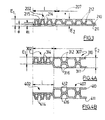
- FIG. 1 schematically represents, seen from above, a cut product 1: a napkin or handkerchief, here square. It includes an area peripheral 2 forming a strip of a determined width l, along the edges 3, 4, 5 and 6 of the product 1, and a central zone 7 surrounded by the peripheral zone 2.
- the two folds are linked along this peripheral zone 2 of width l by marking patterns without collage.
- the pattern marking can consist of simple or complex shapes. He can understand small disc-shaped, diamond-shaped or other surfaces, produced by marking of the classic type. It can also consist of a set of lines, lines, curves forming a design and defining a decorative pattern when using the technique of marking forming a watermark as described in application WO 97/20107.
- FIG. 1 illustrates a preferred embodiment of the product comprising a embossing pattern distributed over the entire surface of this central area in the form of small areas represented here by dots.
- the central area also includes non-embossed portions 8 which themselves form decorations and creating softer areas in contact with the skin, for products intended for wiping the skin as a towel or handkerchief.
- the embossing patterns in the central area form a decoration and alternate with non-embossed areas.
- the non-embossed areas are distributed in the central area of the square format so as to be symmetrical by and other medians of the format. As a result, the products when folded in four has a certain symmetry.
- the folds are mechanically linked in 1a peripheral zone and include a central zone, providing bulking and hand to the product.
- the different embodiments of the product are illustrated by the Figures 2A, 2B, 3, 4A to 4G, 5A and 5B representing cross sections.
- the peripheral zone 2 of width l includes marking patterns 9. At the level of these marking patterns, the thickness of the product is reduced. The first fold is pressed towards the inside of the product. The fibers of the first fold 10 have been overwritten and to a lesser extent those of the second fold 11, thereby ensuring the connection of the two folds.
- the first fold 10 is embossed according to embossing patterns 12 thereby increasing the total thickness of the produced in this area.
- the narrower parts 13 of the reliefs of the motifs of embossing are oriented towards the inside of the folds in order to limit the loss of softness in these embossed areas.
- Figure 2B is a variant of the product shown in Figure 2A in which the marking patterns 109 of the peripheral zone 102 appear on the level of the second fold 111 which is pressed towards the inside of the product.
- the first fold 110 is also slightly depressed. It is the first fold 110 which includes the embossing patterns 112 in the central area 107.
- the product in the peripheral zone 202 of width l comprises patterns 214 which are both embossing patterns and marking patterns.
- the overall thickness E 1 of the product is greater in the peripheral zone compared to the thickness e 1 of the two folds simply superimposed without embossing or marking.
- the fold 210 is pressed towards the inside of the product, the thickness of the product e in this hollow part which corresponds to the connection of the two folds ensured by the marking, is reduced relative to at the thickness e 1 of the two folds simply superimposed without embossing or marking.
- the marking patterns are completely identical to the embossing patterns.
- the marking patterns can also be only partially identical to the embossing patterns.
- the peripheral zone may include additional patterns which will be embossing patterns alone.
- the central area 207 remains unchanged and only includes embossing patterns 212.
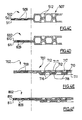
- FIG. 4A illustrates another embodiment of the product according to the invention.
- the peripheral zone includes marking and embossing patterns 314 similar to FIG. 3. But in the central zone, the two folds each include embossing patterns.
- the fold 310 comprises embossing patterns 312 and the fold 311 comprises embossing patterns 316.
- the embossing patterns 312 and 316 are identical for the two folds.
- the recessed portions of the embossing patterns of one ply being in the point-to-tip position with the recessed portions of the patterns of the other ply.
- the two folds in the central area are perfectly symmetrical on the cross section of the product.
- the overall thickness E 2 of the product in the central zone is greater here than the thickness E 1 of the product in the peripheral zone. In the case of FIG. 3, E 2 is substantially equal to E 1 .
- the embossing patterns 412 and 416 of each of the folds 410 and 411 are identical to those 312 and 316 of the product shown in FIG. 4A.
- the embossing patterns of the central zone can also be different between the two folds which will no longer be symmetrical in cross section.
- FIGS. 4C and 4D differ from the products represented in FIGS. 4A and 4B by their peripheral zone 502 and 602 which do not understands that a marking pattern 509 and 609, printed respectively mainly on the first fold 510, secondarily on the second fold 511 and mainly on the second fold 611 and secondarily on the first fold 610.
- the two folds are also symmetrical in the central sectional area transverse.
- the two folds can still be asymmetrical in cross section in the central area.
- the hollow parts of the embossing patterns 712 of the fold 710 can be position or nest in the raised parts of the 716 embossing patterns of the other fold 711, we then speak of "nested" position.
- the two folds may not be in contact over the entire deformed surface of the folds, as shown in FIG. 4E: the part 717 of fold 710 does not come into contact from part 718 of fold 711.
- Figure 4F illustrates a variant in which the second fold 811 is first pressed in at the level of the 809 marking patterns for the peripheral area 802.
- FIG. 4G illustrates a product according to the invention comprising three folds: two outer pleats 850 and 851 embossed and a central pleat 852 unembossed.
- the two folds 850 and 851 include embossing patterns 862 in tip-tip position.
- the three folds 850, 851 and 852 include marking patterns 879.
- FIG. 5A illustrates a product in which the peripheral zone 902 includes marking patterns such as those described for the product shown in the Figure 2A.
- the two folds 910 and 911 in the central area include 919 embossing patterns and are associated by these embossing patterns.
- the fold 910 in the peripheral zone, includes the patterns of marking 909.
- the products described above may include in their central area not only embossing patterns but also marking patterns forming a watermark, which constitute other decorations.
- the method according to the invention has the advantage of providing a product in format comprising a combination of marking patterns and embossing patterns, the area peripheral comprising at least marking patterns and the central zone, at less embossing patterns.
- This product has at least two folds, the patterns of marking and embossing being located on the same fold or on different folds.
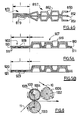
- FIG. 6 A first simple embodiment of the method according to the invention is illustrated by figure 6.
- the method consists of a first step, to emboss a first ply 10 of cellulose wadding between a first cylinder engraved in hard material 1001 and a first counter-cylinder 1002 here in deformable material, for example rubber so as to emboss the central zone products according to the invention at the first fold.
- a second step a second ply of cellulose wadding 11 is superimposed on the first embossed ply 10 and the two folds are marked together so as to be linked, between the first cylinder engraved in hard material 1001 and a second cylinder made of smooth hard material 1003 (i.e. a cylinder whose surface is not engraved).
- the first cylinder 1001 is engraved, among others, on surfaces corresponding to the peripheral zones 2 of the products in formats according to the invention.
- the two folds 10 and 11 in the peripheral zone of the formats, undergo a pressure necessary for the connection. This pressure is exerted by the system formed by the first engraved cylinder 1001 and the second smooth cylinder in hard material 1003. This principle is found in all the methods of the invention described below.
- the two folds at the end of this marking step are linked at least in peripheral zone 2.
- the products are then cut into formats.
- the product produced by this process is illustrated in Figure 2A.
- the device allowing the implementation of the above process is illustrated by the set of three cylinders shown in Figure 6.
- the first engraved cylinder 1001 is made of steel and has engraved areas 1004 on the surface corresponding to the embossing patterns 12 of the central zone 7 of the products in format. It also includes between the etched areas 1004, etched areas 1005 corresponding to the patterns of marking 9 of the peripheral zone 2 of the products in format.
- the counter-cylinder or receiving cylinder 1002 of the first engraved cylinder 1001 is made of deformable material, for example rubber, and includes zones hollowed out 1006 positioned opposite the engraved areas 1005 of the first engraved cylinder 1001 corresponding to the marking patterns 9 in the peripheral zone 2 products in formats.
- the second cylinder made of hard material 1003 is made of steel or other non-deformable material.
- the first cylinder engraved in hard material 1001 has two engraving levels: a first level for engraved areas 1004 corresponding to the embossing patterns 12 of the central zone 7 of the products in format and a second level for the engraved areas 1005 corresponding to the patterns of marking 9 of the peripheral zone 2 of the products in format.
- the first counter-cylinder 1002 made of deformable material, for example rubber, includes recessed areas 1006 into which the engraved areas are inserted marking 1005 of the first engraved cylinder 1001 when the two cylinders are applied one against the other during the embossing step. Note that these areas engraved 1005 are not applied directly against the recessed areas 1006.
- Figure 6C illustrates the heights of the engraved areas of the first cylinders engraved and second cylinder in smooth hard material and / or engraved devices according to the invention.
- Zone G corresponds to the surface of the cylinders intended for the embossing of the central zone of products in format and zone M corresponds to the surface of cylinders intended for marking the peripheral zone of products in format.
- the engraved areas of the cylinders have prominent or raised portions.
- the etching height, for example h 1 of a raised part is defined by the distance between the surface S of this raised part and the central axis of the cylinder in a direction perpendicular to the aforementioned surface.
- h 1 is the engraving height of the engraved area of the first engraved cylinder corresponding to the embossing patterns of the central area of the products in format.
- h 2 is the engraving height of the engraved area of the first engraved cylinder corresponding to the marking patterns of the peripheral area.
- h 3 is the engraving height of the unengraved or engraved area of the second hard or engraved cylinder corresponding to the central area of the product in format.
- And h 4 is the etching height of the unetched or etched area of the second cylinder corresponding to the peripheral area.
- FIG. 6D illustrates the heights of the different engraved zones 1004 and 1005 of the first engraved cylinder 1001 applied against the second cylinder of hard material 1003 of the device shown in FIG. 6.
- the raised parts of the engraving have a height h 1 .
- the raised parts of the engraving have a height h 2 .
- h 2 is strictly greater than h 1 .
- the heights h 3 and h 4 are equal.
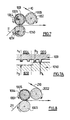
- FIG. 7 A variant of the device represented in FIG. 6 is illustrated by FIG. 7.
- the product obtained is illustrated in FIG. 2A.
- FIG. 7A illustrates the respective heights of the raised parts of the first engraved cylinder applied against the second hard cylinder of the device shown in figure 7.
- the first engraved cylinder 1001 comprises in its engraved zones 1004 raised parts having a height h 1 and in its engraved zones 1005, raised parts having a height h 2 .
- h 2 is greater than or equal to h 1 .
- the second steel cylinder 1050 comprises recessed zones 1051 thus creating a smooth hollow part having a height h 3 , and a smooth part having a height h 4 in the zone of the cylinder 1050 coming to be positioned opposite the raised parts of the engraved area 1005 of the first engraved cylinder 1001 corresponding to the marking patterns 9 of the peripheral area 2 of the products in format.
- the sum of the heights h 2 and h 4 is strictly greater than the sum of the heights h 1 and h 3 .
- the method consists in embossing the first ply of cotton wool of cellulose 210 between the first cylinder engraved in hard material 1001 and the first counter-cylinder of deformable material 2002.
- This first fold 210 is embossed in the central area 207 of the product in format and also in the peripheral area 202 of the product in format.
- the second fold 211 is then attached to the first embossed fold 210 and the two folds are marked between the first cylinder engraved in hard material 1001 and the second smooth cylinder made of hard material 1003.
- the two folds are marked according to all or part of the embossing pattern of the first fold in the peripheral area of the product in format.
- FIG 3. A product produced by this process is illustrated in Figure 3. Indeed, one can see that in the peripheral zone 202 of the product in format, the patterns 214 are at the both embossing patterns and marking patterns.
- the second hard cylinder 1003 here is perfectly smooth as well as the 2002 counter-cylinder made of deformable material.
- FIG. 6D illustrates the heights h 1 and h 2 of the raised portions respectively of the engraved zones 1004 and 1005 of the first engraved cylinder 1001 applied against the second smooth hard cylinder 1003.
- the device shown in Figure 9 is a variant of that shown in figure 8. It is distinguished by the second hard cylinder 4001, made of steel which includes hollowed out areas 4006 which are positioned opposite the engraved areas 3004 of the first engraved cylinder 3001, corresponding to the central zone 207 of the products in format.
- FIG. 9A represents the configuration of the first engraved cylinder 3001 and second hard cylinder 4001 applied one against the other during the step of marking in partial transverse section along line IX-IX of FIG. 9.
- h ' 2 is less than or equal to h' 1
- h ' 3 is strictly less than h' 4
- the sum of the heights h ' 2 and h' 4 is strictly greater than the sum of the heights h ' 1 and h' 3 .
- the second hard cylinder 5001 can be engraved in the corresponding zones 5002 to the marking patterns 109 of the peripheral zone 102 of the products in format.
- the 5050 cylinder includes smooth recessed areas 5055 positioned opposite engraved areas 5002 of the second hard cylinder engraved 5001.
- the cylinder 5001, between the engraved zones 5002, comprises hollowed out zones 5056.
- FIG. 10A shows the height of the raised parts of the zones: h “ 1 for the engraved zone 5057 and h" 2 for the plane zone 5055 of the first engraved cylinder 5050, h “ 3 for the plane and smooth zone 5056 and h” 4 for the engraved area 5002 of the second hard cylinder engraved 5001.
- h " 2 is strictly less than h" 1 and h " 3 strictly less than h” 4 .
- the sum of the heights h “ 2 and h” 4 is strictly greater than the sum of the heights h " 1 and h” 3 .
- the first engraved cylinder 5050 will have the function of embossing and participate in the marking in conjunction with the second hard engraved cylinder 5002 which will have the only function is to mark.
- FIG. 2B The resulting product is illustrated in Figure 2B.
- the peripheral zone 102 of the product in format it is the second fold 111 which is pressed by the cylinder 5001 and to a lesser extent the first superimposed fold 110.
- FIG. 11 Another embodiment of the method according to the invention is illustrated by the figure 11.
- This process consists of embossing the first ply of cellulose wadding 310 between the first cylinder engraved in 1001 steel and the smooth 2002 counter-cylinder in material deformable, at least in a central zone 307 of the products in format, emboss the second fold 311 between the second cylinder engraved in hard material 6000 and a second counter-cylinder of deformable material 7000, at least in the central zone 307 of the products in format, then superimpose the two folds separately embossed and mark them between the first engraved cylinder 1001 and the second hard cylinder 6000, and finally cut out products in formats.
- the first engraved cylinder 1001 is similar to the cylinder shown in the figure 6A comprising two engraving levels.
- a first level of engraving corresponds to the engraved area 1004 for the embossing patterns 312 of the central area 307 of the products in format.
- the second level of engraving corresponds to the engraved area 1005 intended for marking patterns 314 which, here, are also embossing patterns of the peripheral area of products in format.
- the second engraved cylinder 6000 includes engraved zones 6001 for the embossing of the patterns of the central area 307 of the second fold 311 and of the flat areas not engraved 6002 corresponding to the peripheral zone 302 of the products in format.
- zones 1004 and 6001 of cylinders 1001 and 6000 can be identical or different. Cylinders 1001 and 6000 must be synchronized from so that we can superimpose the two embossed folds in the "tip-tip" position or offset of the "nested" type.
- FIG. 4A A product obtained by a tip-tip process is illustrated in Figure 4A.
- the product is produced by engraved cylinders or embossers in tip-tip position.
- FIGS. 11A to 11D show different possibilities for distributing the engraving heights on the two engraved cylinders of the device according to FIG. 11.
- the first engraved cylinder 1001 comprises engraved zones 1004, the raised parts of which have a height h 1 corresponding to the embossing patterns 312 of the central zone 307 of the products in format for the first fold, and engraved zones 1005, the raised parts of which have a height h 2 corresponding to the embossing and marking patterns 314 of the peripheral zone 302 of the products in formats.
- the second engraved cylinder 6000 comprises engraved zones 6001, the raised parts of which have a height h 3 corresponding to the embossing patterns 316 of the central zone 307 of the products in format for the second fold 311 and non-engraved zones 6002, smooth, having a height h 4 and corresponding to the peripheral zone 302 of the products in format.
- the sum of the heights h2 and h4 is strictly greater than the sum of the heights h 1 and h 3 .
- h 4 when h 2 is equal to h 1 , h 4 is strictly greater than h 3 and when h 2 is strictly greater than h 1 , h 4 is greater than or equal to h 3 .
- h 4 when h 2 is equal to h 1 , h 4 is strictly greater than h 3 and when h 2 is strictly less than h 1 , h 4 is greater than or equal to h 3 .
- h 4 when h 2 is equal to h 1 , h 4 is strictly less than h 3 and when h 2 is strictly greater than h 1 , h 4 is less than or equal to h 3 .
- FIG. 11D illustrates the "nested" position for the association of the two embossed folds by means of the engraved cylinders 1001 and 6000.
- h 2 is less than or equal to h 1 and h 4 is less than or equal to h 3 .
- the sum of the heights h 2 and h 4 is strictly greater than h 1 and strictly greater than h 3 .
- the first fold 510 is embossed between the first cylinder engraved in hard material 1001 and the first counter-cylinder 1002 in material deformable in the central area of format products.
- the second fold 511 is also embossed between the second cylinder engraved in hard material 6000 and the second counter-cylinder 7000 of deformable material in the central area of the products in format.
- the two folds 510 and 511 are then superimposed and marked between the first cylinder engraved 1001 and the second cylinder engraved 6000 in the area peripheral 502 products in format. Finally, the products are cut into formats.
- the first engraved cylinder of the device shown in Figure 12 includes engraved areas 1004 corresponding to the embossing patterns 512 of the central area 507 products in formats and engraved areas 1005 corresponding to the patterns of marking 509 of the peripheral zone 502 of the products in formats.
- the counter-cylinder 1002 made of deformable material includes recessed areas 1006 positioned at the level of the engraved areas 1005 of the first cylinder engraved 1001 corresponding to the marking patterns 509 of the peripheral zone 502 products in format, when the two cylinders are applied against each other.
- the first fold 510 is not embossed in the peripheral zone 502.
- the second engraved cylinder 6000 includes engraved zones 6001 corresponding to the embossing patterns 512 of the central zone 507 of the products in format and unetched areas 6002 corresponding to the peripheral area 502 of the products in format. These smooth non-etched areas 6002 are positioned opposite engraved areas 1005 of the first engraved cylinder 1001, which are intended for marking of the peripheral zone 502 of the products in formats.
- the second counter-cylinder 7000 made of deformable material also includes recessed areas 7006 which are positioned at the level of the smooth areas not engraved 6002 of the second cylinder engraved 6000 when the two cylinders are applied one against the other so that the second fold is not embossed either in the area peripheral 502 products in formats.
- the engraved cylinder 1001 may be of the type shown in FIG. 6A, and includes two levels of engraving.
- the counter cylinders 1002 and 7000 are of the type of that shown in FIG. 6B on which zones of deformable material 1006 or 7006 have been hollowed out.
- FIGS. 11A to 11D show the distributions between the different heights h 1 , h 2 , h 3 and h 4 of the parts in relief of the engraved areas.
- FIG. 13 is a variant in which a third smooth or embossed fold 852 is introduced in the marking step between the two embossed folds 850 and 851.
- the third fold 852 could also be introduced at the marking stage of the processes illustrated in Figures 11 and 12.
- Another subject of the invention is to carry out simultaneously the embossing and marking stages.
- this method consists in simultaneously embossing the first and second folds 910 and 911 between the first engraved cylinder 1001 and a counter-cylinder At least 8000 in a central 907 area of the format, mark simultaneously with the embossing step the first and second folds 910 and 911 between the first cylinder engraved 1001 and the second counter-cylinder 8000 comprising smooth hard surfaces 8002 in zones corresponding to the 909 marking patterns in the zone peripheral 902 and deformable zones 8003 corresponding to the engraved zones of embossing 1004.
- the first and second folds 910 and 911 are superimposed and pass between a cylinder engraved in hard material of steel 1001 comprising engraved areas 1004 corresponding to the embossing patterns 919 of the central zone 907 for products in formats and an 8000 counter-cylinder comprising non-etched surface areas 8003 of deformable material such as rubber, positioned opposite the engraved areas 1004 of the first engraved cylinder 1001 when the two cylinders 1001 and 8000 are applied against each other for the setting of the process.
- the two folds 910 and 911 are thus embossed together and associated in the central zone 907 products in formats.
- smooth non-etched surface areas 8003 can be replaced by engraved areas of hard material.
- the engraved cylinder 1001 includes engraved areas 1005 corresponding to the marking patterns 909 of the area device 902 format products.
- the 8000 cylinder has hard zones smooth not engraved 8006.
- the cylinder 1001 can be engraved on two levels like the engraved cylinder shown in Figure 6A.
- the counter-cylinder 8000 shown in FIG. 14A is made of steel or any similar hard material. It includes hollowed out or hollow areas that have been filled with 8003 inserts of deformable material such as rubber, ensuring thus the smooth deformable counterpart for the embossing step.
- the remaining surfaces 8006 of the counter-cylinder 8000 are hard and smooth and participate in tagging.
- the counter-cylinder 9000 which includes engraved areas 9005 corresponding to the marking patterns 929 of the peripheral area of products in format.
- the engraved cylinder 6000 includes him non-etched hard zones 6002 positioned opposite the etched zones 9005 of cylinder 9000 when the two cylinders are applied against each other for the implementation of the process.
- the cylinder 9000 also includes inserts 9006 made of material deformable ensuring the smooth counterpart for the embossing step.
- all of the engraved steel cylinders described above for the devices according to the invention can be made of other materials having similar hardnesses and similar properties.
- the counter cylinders made of any deformable material have resilience characteristics desired.
- cylinders made of hard material, engraved or smooth may include treads located at the ends of the cylinders, which allow limit the shocks linked to variations in the surfaces of the patterns.
Landscapes
- Engineering & Computer Science (AREA)
- Mechanical Engineering (AREA)
- Health & Medical Sciences (AREA)
- Public Health (AREA)
- Textile Engineering (AREA)
- Machines For Manufacturing Corrugated Board In Mechanical Paper-Making Processes (AREA)
Priority Applications (5)
| Application Number | Priority Date | Filing Date | Title |
|---|---|---|---|
| EP00401192A EP1149552A1 (de) | 2000-04-28 | 2000-04-28 | Absorbierendes Papierprodukt wie Servietten oder Taschentücher, Verfahren zur Herstellung und Vorrichtungen zur Durchführung dieser Verfahren |
| CA002344279A CA2344279C (fr) | 2000-04-28 | 2001-04-18 | Produit en papier absorbant tel que serviette ou mouchoir, procedes pour fabriquer un tel produit et dispositifs pour la mise en oeuvre de tels procedes |
| US09/839,407 US7026037B2 (en) | 2000-04-28 | 2001-04-23 | Absorbent paper product such as napkin or handkerchief, methods for manufacturing such a product, and apparatus implementing such methods |
| US11/128,386 US7670669B2 (en) | 2000-04-28 | 2005-05-13 | Absorbent paper product such as napkin or handkerchief, methods for manufacturing such a product, and apparatus implementing such methods |
| US11/237,829 US7513974B2 (en) | 2000-04-28 | 2005-09-29 | Absorbent paper product such as napkin or handkerchief, methods for manufacturing such a product, and apparatus implementing such methods |
Applications Claiming Priority (1)
| Application Number | Priority Date | Filing Date | Title |
|---|---|---|---|
| EP00401192A EP1149552A1 (de) | 2000-04-28 | 2000-04-28 | Absorbierendes Papierprodukt wie Servietten oder Taschentücher, Verfahren zur Herstellung und Vorrichtungen zur Durchführung dieser Verfahren |
Publications (1)
| Publication Number | Publication Date |
|---|---|
| EP1149552A1 true EP1149552A1 (de) | 2001-10-31 |
Family
ID=8173663
Family Applications (1)
| Application Number | Title | Priority Date | Filing Date |
|---|---|---|---|
| EP00401192A Withdrawn EP1149552A1 (de) | 2000-04-28 | 2000-04-28 | Absorbierendes Papierprodukt wie Servietten oder Taschentücher, Verfahren zur Herstellung und Vorrichtungen zur Durchführung dieser Verfahren |
Country Status (3)
| Country | Link |
|---|---|
| US (3) | US7026037B2 (de) |
| EP (1) | EP1149552A1 (de) |
| CA (1) | CA2344279C (de) |
Cited By (7)
| Publication number | Priority date | Publication date | Assignee | Title |
|---|---|---|---|---|
| WO2003057989A1 (en) * | 2001-12-31 | 2003-07-17 | Kimberly-Clark Worldwide, Inc. | Multiple ply paper wiping product having a soft side and a textured side |
| FR2895934A1 (fr) * | 2006-01-12 | 2007-07-13 | Georgia Pacific France Soc En | Feuille hybride de papier absorbant, rouleau de papier realiser a partir de cette feuille |
| US7497923B2 (en) | 2000-11-14 | 2009-03-03 | Kimberly-Clark Worldwide, Inc. | Enhanced multi-ply tissue products |
| WO2009060353A1 (en) * | 2007-11-05 | 2009-05-14 | The Procter & Gamble Company | Textured multi-ply sanitary paper product having optimized emboss patterns |
| EP1319748B2 (de) † | 2001-12-12 | 2010-12-01 | Georgia-Pacific France | Mehrlagige Bahn eines saugfähigen Papiers |
| EP2228212A3 (de) * | 2009-03-13 | 2012-11-21 | Chan Li Machinery Co., Ltd. | Vervielfältigung von dünnen Einzelblättern mit Druckverbindungsstruktur |
| EP3151709B1 (de) * | 2014-06-05 | 2024-10-09 | Kimberly-Clark Worldwide, Inc. | Verfahren zum prägen von tissuelagen |
Families Citing this family (22)
| Publication number | Priority date | Publication date | Assignee | Title |
|---|---|---|---|---|
| EP1149552A1 (de) * | 2000-04-28 | 2001-10-31 | Georgia-Pacific France | Absorbierendes Papierprodukt wie Servietten oder Taschentücher, Verfahren zur Herstellung und Vorrichtungen zur Durchführung dieser Verfahren |
| US7799169B2 (en) | 2004-09-01 | 2010-09-21 | Georgia-Pacific Consumer Products Lp | Multi-ply paper product with moisture strike through resistance and method of making the same |
| US8034215B2 (en) * | 2004-11-29 | 2011-10-11 | The Procter & Gamble Company | Patterned fibrous structures |
| ITFI20050033A1 (it) * | 2005-03-01 | 2006-09-02 | Perini Fabio Spa | Rullo goffratore, dispositivo goffratore comprendente detto rullo ed articolo di materiale cartaceo realizzato con detto dispositivo goffratore |
| RU2407841C2 (ru) * | 2006-03-17 | 2010-12-27 | Ска Хайджин Продактс Аб | Ламинированное бумажное изделие и бумажное полотно |
| EP1845193A1 (de) | 2006-04-14 | 2007-10-17 | Georgia-Pacific France | Mehrlagiger saugfähiger Papierbogen, Rolle und Verfahren zu seiner Herstellung |
| FR2914221B1 (fr) * | 2007-03-28 | 2009-10-02 | Georgia Pacific France Soc Par | Feuille absorbante a motif de gaufrage unique |
| FR2914170B1 (fr) * | 2007-03-28 | 2012-08-31 | Georgia Pacific France | Rouleau de produit cellulosique fibreux |
| FR2914838B1 (fr) * | 2007-04-13 | 2009-06-05 | Georgia Pacific France Soc En | Rouleau de feuilles de produit absorbant de type papier toilette |
| FR2928383B1 (fr) | 2008-03-06 | 2010-12-31 | Georgia Pacific France | Feuille gaufree comportant un pli en materiau hydrosoluble et procede de realisation d'une telle feuille. |
| DE102008041951A1 (de) * | 2008-09-10 | 2010-03-11 | Voith Patent Gmbh | Verfahren zur Vorhersage der Oberflächentopographie von Tissuepapier |
| US20100213699A1 (en) * | 2009-02-23 | 2010-08-26 | Maureen Tremper | Thematic paper napkin set |
| US8167490B2 (en) | 2009-04-22 | 2012-05-01 | Reynolds Consumer Products Inc. | Multilayer stretchy drawstring |
| US8282775B2 (en) | 2009-05-19 | 2012-10-09 | The Procter & Gamble Company | Web substrate having optimized emboss area |
| IT1398500B1 (it) * | 2010-03-03 | 2013-03-01 | Delicarta Spa | Fazzoletto in materiale cellulosico plurivelo |
| US8586167B2 (en) | 2011-08-22 | 2013-11-19 | Bellemarque, Llc | Tri-fold napkin |
| US8974887B2 (en) | 2012-07-26 | 2015-03-10 | Bellemarque, Llc | Low-fold napkin |
| US20150352803A1 (en) * | 2014-06-05 | 2015-12-10 | Kimberly-Clark Worldwide, Inc. | Embossed multi-ply tissue product |
| MX2020003492A (es) * | 2017-10-31 | 2020-07-22 | Kimberly Clark Co | Pila absorbente de laminas que tienen una union comprimida. |
| RU186121U1 (ru) * | 2018-02-19 | 2019-01-09 | Кирилл Владимирович Бунчук | Сервировочная салфетка с тиснением и удерживающим бортом |
| MX2022015935A (es) | 2020-07-03 | 2023-01-24 | Essity Hygiene & Health Ab | Rollos sin nucleo de un producto de papel tisu y metodos de fabricacion de rollos sin nucleo. |
| JP7668372B2 (ja) * | 2021-05-07 | 2025-04-24 | フォー ポーズ プロダクツ,リミテッド | 上昇式ペット排泄物収集トレーニングパッド |
Citations (11)
| Publication number | Priority date | Publication date | Assignee | Title |
|---|---|---|---|---|
| GB363699A (en) * | 1930-01-28 | 1931-12-23 | Cellulose Products Inc | Improvements in or relating to paper handkerchiefs, towels, table napkins or like articles and methods of making the same |
| FR2075452A5 (de) * | 1970-01-12 | 1971-10-08 | Int Paper Canada | |
| EP0265298A1 (de) * | 1986-10-02 | 1988-04-27 | Kaysersberg Sa | Absorbierendes, mehrschichtiges Blatt und Verfahren zur Herstellung eines solchen Blattes |
| EP0436170A2 (de) * | 1989-12-22 | 1991-07-10 | PWA Hygienepapiere GmbH | Verfahren und Anlage zur Herstellung eines geprägten Haushalts- oder Hygienepapiers |
| WO1992014605A1 (fr) * | 1991-02-20 | 1992-09-03 | Kaysersberg | Feuilles de papier multicouches presentant des marquages, procede et dispositif pour leur elaboration |
| WO1993011929A1 (fr) * | 1991-12-09 | 1993-06-24 | Kaysersberg | Procede de fabrication de feuilles gaufrees stratifiees, machine pour sa mise en ×uvre |
| EP0674990A2 (de) * | 1993-12-22 | 1995-10-04 | James River Corporation Of Virginia | Geprägte verwertbare konzeption für mehrschichtige servietten |
| WO1995027429A1 (en) * | 1994-04-12 | 1995-10-19 | The Procter & Gamble Company | A cellulose cloth for hygiene |
| WO1997020107A1 (en) * | 1995-11-30 | 1997-06-05 | Fort James France | Absorbent paper sheet marked with pattern simulating watermark, method and device for the marking thereof |
| DE19654249A1 (de) * | 1996-12-23 | 1998-06-25 | Sca Hygiene Paper Gmbh | Überwiegend aus Zellstoff bestehendes Produkt für den Hygienebereich |
| FR2777919A1 (fr) * | 1998-04-24 | 1999-10-29 | Fort James France | Feuille de papier absorbant gaufre |
Family Cites Families (10)
| Publication number | Priority date | Publication date | Assignee | Title |
|---|---|---|---|---|
| US1771983A (en) * | 1930-01-28 | 1930-07-29 | Cellulose Products Inc | Paper article and process of producing the same |
| US1774497A (en) * | 1930-06-27 | 1930-08-26 | Cellulose Products Inc | Paper article and process of manufacture |
| US2020668A (en) * | 1935-03-22 | 1935-11-12 | Wandel Kurt | Tissue handkerchief and method |
| GB1435703A (en) * | 1972-09-09 | 1976-05-12 | Kroyer St Annes Ltd Karl | Multi-ply paper and paperboard |
| US4307141A (en) * | 1978-10-10 | 1981-12-22 | American Can Company | Multi-ply fibrous sheet structure |
| US4320162A (en) * | 1980-05-15 | 1982-03-16 | American Can Company | Multi-ply fibrous sheet structure and its manufacture |
| US5543202A (en) * | 1994-03-14 | 1996-08-06 | Kimberly-Clark Corporation | Process for producing a crimp-bonded fibrous cellulosic laminate |
| US5736224A (en) * | 1996-06-17 | 1998-04-07 | Georgia-Pacific Corporation | Napkin |
| US6214146B1 (en) * | 1997-04-17 | 2001-04-10 | Kimberly-Clark Worldwide, Inc. | Creped wiping product containing binder fibers |
| EP1149552A1 (de) * | 2000-04-28 | 2001-10-31 | Georgia-Pacific France | Absorbierendes Papierprodukt wie Servietten oder Taschentücher, Verfahren zur Herstellung und Vorrichtungen zur Durchführung dieser Verfahren |
-
2000
- 2000-04-28 EP EP00401192A patent/EP1149552A1/de not_active Withdrawn
-
2001
- 2001-04-18 CA CA002344279A patent/CA2344279C/fr not_active Expired - Fee Related
- 2001-04-23 US US09/839,407 patent/US7026037B2/en not_active Expired - Fee Related
-
2005
- 2005-05-13 US US11/128,386 patent/US7670669B2/en not_active Expired - Fee Related
- 2005-09-29 US US11/237,829 patent/US7513974B2/en not_active Expired - Fee Related
Patent Citations (11)
| Publication number | Priority date | Publication date | Assignee | Title |
|---|---|---|---|---|
| GB363699A (en) * | 1930-01-28 | 1931-12-23 | Cellulose Products Inc | Improvements in or relating to paper handkerchiefs, towels, table napkins or like articles and methods of making the same |
| FR2075452A5 (de) * | 1970-01-12 | 1971-10-08 | Int Paper Canada | |
| EP0265298A1 (de) * | 1986-10-02 | 1988-04-27 | Kaysersberg Sa | Absorbierendes, mehrschichtiges Blatt und Verfahren zur Herstellung eines solchen Blattes |
| EP0436170A2 (de) * | 1989-12-22 | 1991-07-10 | PWA Hygienepapiere GmbH | Verfahren und Anlage zur Herstellung eines geprägten Haushalts- oder Hygienepapiers |
| WO1992014605A1 (fr) * | 1991-02-20 | 1992-09-03 | Kaysersberg | Feuilles de papier multicouches presentant des marquages, procede et dispositif pour leur elaboration |
| WO1993011929A1 (fr) * | 1991-12-09 | 1993-06-24 | Kaysersberg | Procede de fabrication de feuilles gaufrees stratifiees, machine pour sa mise en ×uvre |
| EP0674990A2 (de) * | 1993-12-22 | 1995-10-04 | James River Corporation Of Virginia | Geprägte verwertbare konzeption für mehrschichtige servietten |
| WO1995027429A1 (en) * | 1994-04-12 | 1995-10-19 | The Procter & Gamble Company | A cellulose cloth for hygiene |
| WO1997020107A1 (en) * | 1995-11-30 | 1997-06-05 | Fort James France | Absorbent paper sheet marked with pattern simulating watermark, method and device for the marking thereof |
| DE19654249A1 (de) * | 1996-12-23 | 1998-06-25 | Sca Hygiene Paper Gmbh | Überwiegend aus Zellstoff bestehendes Produkt für den Hygienebereich |
| FR2777919A1 (fr) * | 1998-04-24 | 1999-10-29 | Fort James France | Feuille de papier absorbant gaufre |
Cited By (11)
| Publication number | Priority date | Publication date | Assignee | Title |
|---|---|---|---|---|
| US7497923B2 (en) | 2000-11-14 | 2009-03-03 | Kimberly-Clark Worldwide, Inc. | Enhanced multi-ply tissue products |
| US7699959B2 (en) | 2000-11-14 | 2010-04-20 | Kimberly-Clark Worldwide, Inc. | Enhanced multi-ply tissue products |
| US7862686B2 (en) | 2000-11-14 | 2011-01-04 | Kimberly-Clark Worldwide, Inc. | Enhanced multi-ply tissue products |
| EP1319748B2 (de) † | 2001-12-12 | 2010-12-01 | Georgia-Pacific France | Mehrlagige Bahn eines saugfähigen Papiers |
| WO2003057989A1 (en) * | 2001-12-31 | 2003-07-17 | Kimberly-Clark Worldwide, Inc. | Multiple ply paper wiping product having a soft side and a textured side |
| US6649025B2 (en) | 2001-12-31 | 2003-11-18 | Kimberly-Clark Worldwide, Inc. | Multiple ply paper wiping product having a soft side and a textured side |
| FR2895934A1 (fr) * | 2006-01-12 | 2007-07-13 | Georgia Pacific France Soc En | Feuille hybride de papier absorbant, rouleau de papier realiser a partir de cette feuille |
| WO2007080322A3 (fr) * | 2006-01-12 | 2007-09-07 | Georgia Pacific France | Feuille hybride de papier absorbant, rouleau de papier realise a partir de cette feuille |
| WO2009060353A1 (en) * | 2007-11-05 | 2009-05-14 | The Procter & Gamble Company | Textured multi-ply sanitary paper product having optimized emboss patterns |
| EP2228212A3 (de) * | 2009-03-13 | 2012-11-21 | Chan Li Machinery Co., Ltd. | Vervielfältigung von dünnen Einzelblättern mit Druckverbindungsstruktur |
| EP3151709B1 (de) * | 2014-06-05 | 2024-10-09 | Kimberly-Clark Worldwide, Inc. | Verfahren zum prägen von tissuelagen |
Also Published As
| Publication number | Publication date |
|---|---|
| US7513974B2 (en) | 2009-04-07 |
| US20020060000A1 (en) | 2002-05-23 |
| US20060062972A1 (en) | 2006-03-23 |
| US7670669B2 (en) | 2010-03-02 |
| US7026037B2 (en) | 2006-04-11 |
| CA2344279A1 (fr) | 2001-10-28 |
| CA2344279C (fr) | 2010-01-05 |
| US20050244615A1 (en) | 2005-11-03 |
Similar Documents
| Publication | Publication Date | Title |
|---|---|---|
| CA2344279C (fr) | Produit en papier absorbant tel que serviette ou mouchoir, procedes pour fabriquer un tel produit et dispositifs pour la mise en oeuvre de tels procedes | |
| CA2458952C (fr) | Produit en papier absorbant presentant un gaufrage ameliore | |
| EP0765215B1 (de) | Mehrschichtfolie aus absorbierendem papier und verfahren zu deren herstellung | |
| EP0679122B1 (de) | Verfahren zur herstellung einer prägefolie aus einer oder mehreren schichten | |
| EP1101866B2 (de) | Gekrepptes, geprägtes saugfähiges Seidenpapier, Prägewalze und Verfahren zum Prägen | |
| EP0797705B1 (de) | Absorbierendes papier mit geprägten motiven | |
| CA2201633C (fr) | Feuille multicouche absorbante et son procede de fabrication | |
| EP1047546B1 (de) | Geprägte absorbierende papierbahn, herstellungsverfahren und vorrichtung zu dessen herstellung | |
| EP0876537B1 (de) | Mehrschichtige bahn mit kombinierter prägung | |
| EP1670991B1 (de) | Blatt aus saugfähigem papier mit verbessertem relief | |
| EP0564319B1 (de) | Neue geprägte mehrlagige Papiere, Vorrichtung und Verfahren zu ihrer Herstellung | |
| EP0572503B1 (de) | Verfahren zum prägen und kaschieren von papier, sowie erhaltenes produkt | |
| EP1081284B1 (de) | Saugfähiges, mindestens dreilagiges Papierprodukt und Verfahren zu seiner Herstellung | |
| EP1159487B1 (de) | Zwei- oder dreilagiges saugfähiges papierprodukt | |
| CA2379081C (fr) | Produit en papier absorbant a structure dissymetrique | |
| FR2684599A1 (fr) | Feuille complexe de papier absorbant. | |
| CA2406577C (fr) | Feuille de papier absorbant crepee et gaufree, cylindre de gaufrage d'une telle feuille et procede de gaufrage | |
| CA2202166C (fr) | Papier absorbant gaufre a motifs combines |
Legal Events
| Date | Code | Title | Description |
|---|---|---|---|
| PUAI | Public reference made under article 153(3) epc to a published international application that has entered the european phase |
Free format text: ORIGINAL CODE: 0009012 |
|
| AK | Designated contracting states |
Kind code of ref document: A1 Designated state(s): AT BE CH CY DE DK ES FI FR GB GR IE IT LI LU MC NL PT SE |
|
| AX | Request for extension of the european patent |
Free format text: AL;LT;LV;MK;RO;SI |
|
| 17P | Request for examination filed |
Effective date: 20020502 |
|
| AKX | Designation fees paid |
Free format text: AT BE CH CY DE DK ES FI FR GB GR IE IT LI LU MC NL PT SE |
|
| 17Q | First examination report despatched |
Effective date: 20030915 |
|
| STAA | Information on the status of an ep patent application or granted ep patent |
Free format text: STATUS: THE APPLICATION IS DEEMED TO BE WITHDRAWN |
|
| 18D | Application deemed to be withdrawn |
Effective date: 20040127 |