EP1154852B1 - Stabilisation d'une alumine de transition - Google Patents
Stabilisation d'une alumine de transition Download PDFInfo
- Publication number
- EP1154852B1 EP1154852B1 EP00903882A EP00903882A EP1154852B1 EP 1154852 B1 EP1154852 B1 EP 1154852B1 EP 00903882 A EP00903882 A EP 00903882A EP 00903882 A EP00903882 A EP 00903882A EP 1154852 B1 EP1154852 B1 EP 1154852B1
- Authority
- EP
- European Patent Office
- Prior art keywords
- barium
- alumina
- boehmite
- mixture
- temperature
- Prior art date
- Legal status (The legal status is an assumption and is not a legal conclusion. Google has not performed a legal analysis and makes no representation as to the accuracy of the status listed.)
- Expired - Lifetime
Links
Images






Classifications
-
- B—PERFORMING OPERATIONS; TRANSPORTING
- B01—PHYSICAL OR CHEMICAL PROCESSES OR APPARATUS IN GENERAL
- B01J—CHEMICAL OR PHYSICAL PROCESSES, e.g. CATALYSIS OR COLLOID CHEMISTRY; THEIR RELEVANT APPARATUS
- B01J23/00—Catalysts comprising metals or metal oxides or hydroxides, not provided for in group B01J21/00
- B01J23/02—Catalysts comprising metals or metal oxides or hydroxides, not provided for in group B01J21/00 of the alkali- or alkaline earth metals or beryllium
-
- B—PERFORMING OPERATIONS; TRANSPORTING
- B01—PHYSICAL OR CHEMICAL PROCESSES OR APPARATUS IN GENERAL
- B01J—CHEMICAL OR PHYSICAL PROCESSES, e.g. CATALYSIS OR COLLOID CHEMISTRY; THEIR RELEVANT APPARATUS
- B01J23/00—Catalysts comprising metals or metal oxides or hydroxides, not provided for in group B01J21/00
- B01J23/38—Catalysts comprising metals or metal oxides or hydroxides, not provided for in group B01J21/00 of noble metals
- B01J23/54—Catalysts comprising metals or metal oxides or hydroxides, not provided for in group B01J21/00 of noble metals combined with metals, oxides or hydroxides provided for in groups B01J23/02 - B01J23/36
- B01J23/56—Platinum group metals
- B01J23/58—Platinum group metals with alkali- or alkaline earth metals
-
- B—PERFORMING OPERATIONS; TRANSPORTING
- B01—PHYSICAL OR CHEMICAL PROCESSES OR APPARATUS IN GENERAL
- B01J—CHEMICAL OR PHYSICAL PROCESSES, e.g. CATALYSIS OR COLLOID CHEMISTRY; THEIR RELEVANT APPARATUS
- B01J37/00—Processes, in general, for preparing catalysts; Processes, in general, for activation of catalysts
- B01J37/02—Impregnation, coating or precipitation
- B01J37/03—Precipitation; Co-precipitation
- B01J37/036—Precipitation; Co-precipitation to form a gel or a cogel
-
- B—PERFORMING OPERATIONS; TRANSPORTING
- B01—PHYSICAL OR CHEMICAL PROCESSES OR APPARATUS IN GENERAL
- B01J—CHEMICAL OR PHYSICAL PROCESSES, e.g. CATALYSIS OR COLLOID CHEMISTRY; THEIR RELEVANT APPARATUS
- B01J21/00—Catalysts comprising the elements, oxides, or hydroxides of magnesium, boron, aluminium, carbon, silicon, titanium, zirconium, or hafnium
- B01J21/02—Boron or aluminium; Oxides or hydroxides thereof
- B01J21/04—Alumina
-
- B—PERFORMING OPERATIONS; TRANSPORTING
- B01—PHYSICAL OR CHEMICAL PROCESSES OR APPARATUS IN GENERAL
- B01J—CHEMICAL OR PHYSICAL PROCESSES, e.g. CATALYSIS OR COLLOID CHEMISTRY; THEIR RELEVANT APPARATUS
- B01J37/00—Processes, in general, for preparing catalysts; Processes, in general, for activation of catalysts
- B01J37/02—Impregnation, coating or precipitation
- B01J37/0215—Coating
Definitions
- the present invention relates to the general field of catalysts, such as automobile exhaust catalysts, and, in particular, to a stabilized transition alumina catalyst support material.
- new catalysts are needed for temperatures above 1000°C, not only for the removal of pollutants, for example to clean up automobile exhausts, but also for catalytic combustion, for example in heaters, boilers, and gas turbines.
- catalytic combustion of fuels offers the advantages of a more uniform combustion temperature and a more complete combustion of the fuel. The result is a higher thermal efficiency, together with less nitrogen oxide formation through the prevention of localised high temperature areas.
- Automobile exhaust catalysts are used to reduce automobile exhaust emissions by converting CO, unburned hydrocarbons and NO x in the exhaust gas to an environmentally less harmful mixture comprising CO 2 , H 2 O and N 2 .
- the catalysts typically comprise a metal or ceramic monolithic carrier, such as Cordierite (2MgO.2Al 2 O 3 .5SiO 2 ), coated with a high surface area catalyst support material.
- Catalytically active noble metal particles such as, for example, Pt, Pd and/or Rh, and other additives, are dispersed on and within the support material.
- the catalytically active particles need to be held in the exhaust gas stream on a support material which has a high specific surface area to maximize their exposure to the gas stream and thereby maximize the catalytic efficiency.
- Gamma-alumina and the closely related transition aluminas theta and delta are commonly used as support materials because of their high specific surface areas.
- gamma-alumina is unusual among ceramic materials in that it has a very high specific surface area, for example exceeding 100 m 2 /g, compared with the more typical values of from about 1 to 5 m 2 /g for other ceramic materials.
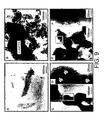
- gamma and the other transition aluminas are metastable phases, which are subject to thermal degradation and undergo a phase transition at temperatures exceeding about 1000°C to the thermodynamically more stable alpha-alumina (see Figures 1 and 9B) with the corollary of a significant reduction in the specific surface area; typically from about 100 m 2 /g to about 1 to 2 m 2 /g. This results in a corresponding reduction in catalytic activity.
- the transformation sequence for boehmite is gamma ⁇ delta ⁇ theta ⁇ alpha.
- Gamma, delta and theta alumina all have a cubic oxygen sub-lattice and the only difference between them is in the progressive increase in ordering of aluminium atoms on the cation deficient aluminium sub-lattice.
- alpha-alumina has a hexagonal oxygen sub-lattice and its formation involves a total restructuring of the lattice.
- Transition alumina is a kinetic effect which accelerates rapidly with increasing temperature. Whereas at 600°C it is too slow to be significant within the lifetime of a catalytic converter, at 1100°C it may be complete within 1 hour. Catalytic converters are operated at the upper limit of their stability and catalyst support materials with improved resistance to thermal degradation would allow higher operating temperatures and a longer service life.
- Automotive exhaust gases from petrol engines may contain up to 3% CO and 100 ppm unburned hydrocarbons which react exothermically in the catalytic converter with NO x to yield an environmentally less harmful mixture of gases, namely CO 2 , H 2 O and N 2 .
- Peak operation temperatures of from about 700°C to about 800°C are frequently achieved.
- the current trend to reduce CO 2 emissions has resulted in increased use of diesel engines with lower fuel consumption and hence lower CO 2 emissions.
- diesel engines operate at higher exhaust temperatures; approximately 800°C is normal with peak temperatures of up to about 1300°C.
- US-4,624,940 relates to a catalyst for the oxidation of carbon monoxide and unburned hydrocarbons in an exhaust stream.
- the catalyst comprises support particles of stabilized gamma-alumina having palladium dispersed thereon and can remain effective after exposure to temperatures greater than 1000°C.
- the gamma-alumina is stabilized by either (i) incorporation of a combination of lanthana and baria into the alumina particles, or (ii) impregnation of the alumina particles with an aqueous dispersion of a high molecular weight polyorganosiloxane followed by heating to a temperature which is effective to decompose the polyorganosiloxane.
- the additives are introduced by soaking an alumina powder or a solid alumina precursor in a solution containing the additive followed by drying and calcining at a temperature sufficient to effect stabilization.
- An alternative but less widely used method of introducing additives is by a coprecipitation process as described in US-4,056,489. In this manner an intimate admixture of alumina and the stabilizing additives is formed, which is then calcined.
- US 5,212,130 gives a general teaching to produce a high surface area washcoat for use as a support for catalysts.
- the waistcoats are made essentially of of AO-Al 2 O 3 , wherein A is Ba and/or Sr.
- the high surface is achieved by a method which involves forming the AO-Al 2 O 3 by contacting element A in the ionic form with an aluminium oxide yielding species followed by firing to result in the A (Ba or Sr) being homogenously distributed through the Al 2 O 3 .
- the present inventors have now devised a process whereby transition alumina can be further stabilized against thermal degradation to alpha-alumina. This results in a catalyst which is effective at higher operating temperatures and for longer times compared with the prior art catalysts.
- the present invention provides a process for the production of a precursor material for use in the preparation of a stabilized alumina catalyst support material, which process comprises the steps of:
- Boehmite is a mineral form of aluminium monohydroxide (AlO.OH).
- the additive is preferably a barium containing compound.
- the layer formed on the particles of boehmite preferably comprises barium carbonate.
- An important advantage of the process according to the present invention is that the particles of boehmite can be substantially coated completely with the said layer.
- the mixture in step (a) is preferably a substantially homogenous mixture.
- the substantially homogenous mixture may be formed by any process which results in an intimate admixture.
- a particularly preferred process for forming the substantially homogenous mixture is by homogeneous precipitation, ideally homogeneous precipitation of water-soluble aluminium and barium containing compounds, for example salts thereof.
- Suitable aluminum compounds include aluminium nitrate, aluminium sulphate and/or aluminium chloride, preferably aluminium chloride hexahydrate (AlCl 3 ⁇ 6H 2 O).
- Suitable barium compounds include barium nitrate, barium sulphate and/or barium chloride, preferably barium chloride dihydrate (BaCl 2 ⁇ 2H 2 O).
- Precipitation from aqueous solution is widely used for producing ceramic oxide powders. Precipitation occurs by adding a precipitating ligand (anion) to a solution containing cations of the appropriate metal. If the precipitating ligand is added directly by simply pouring one solution into another then there is little control of the chemistry during precipitation because of the large and inhomogeneous gradients in solution concentration. Better control of chemical and morphological characteristics can be achieved if the precipitating ligands are generated "in situ", simultaneously and uniformly throughout the solution. This is know as a "homogeneous" precipitation process.
- a precipitating ligand anion
- the mixture in step (a) is formed by homogeneous precipitation in which a base is generated within a metal salt solution through thermal decomposition of a suitable water-soluble reagent.
- suitable water-soluble reagents include any compound that decomposes on heating in aqueous solution to release NH 3 groups, thereby forming ammonium hydroxide which increases the pH of the solution. Examples include urea and amines, such as hexamethylene tetramine.
- Suitable compounds of aluminium include aluminium nitrate, aluminium sulphate and/or aluminium chloride, preferably aluminium chloride hexahydrate (AlCl 3 ⁇ 6H 2 O).
- Suitable compounds of barium include barium nitrate, barium sulphate and/or barium chloride, preferably barium chloride dihydrate (BaCl 2 ⁇ 2H 2 O).
- a small amount of a dispersant for example polyvinylpyrrolidone, may also be added to the metal salt solution. The dispersant improves the uniformity of the precipitation product by reducing the tendency of the precipitate particles to stick together. Additionally, diffusion of ionic species through an adsorbed dispersant layer may be the rate limiting step to further particle growth.
- the mixture comprising aluminium and barium containing compounds will generally be in the form of a gel when produced by the homogeneous precipitation process described above, although the mixture can take other forms including, for example, hydroxides, molecular and ionic complex species or compounds.
- the gel is a three-dimensional network of colloidal particles of mainly amorphous aluminium hydroxide containing a large amount of water (for example approximately 170 g of wet gel yields approximately 7 g of dried powder) and in which the barium additive is trapped.
- the consistency of the gel is generally between that of a thick paste and a jelly, and it easily breaks up when stirred in an excess of water and slowly settles to the bottom again.
- the mixture comprising aluminum and barium containing compounds may also be formed by adding a water-soluble barium compound, for example barium nitrate, barium sulphate and/or barium chloride, to a slurry of, for example, boehmite in water.
- a water-soluble barium compound for example barium nitrate, barium sulphate and/or barium chloride
- an organic acid such as a carboxylic acid is added to the mixture.
- a preferred carboxylic acid is oxalic acid.
- a solution comprising barium nitrate and oxalic acid is added to the slurry of boehmite in water and the mixture is then heated under conditions to produce particles of boehmite at least partially coated with a layer comprising barium and/or a barium compound.
- the heating in step (b) is preferably achieved by a hydrothermal treatment, which is typically carried out on an aqueous solution of the mixture of aluminium and barium containing compounds in a pressure vessel, such as an autoclave, at a temperature above the normal boiling point and under applied or autogenous pressure to substantially prevent boiling.
- the hydrothermal treatment will generally be performed at a temperature typically in the range of from 90 to 300°C, more typically from 100 to 220°C. It will be appreciated that the pressure required to substantially prevent boiling will depend on the applied temperature.
- the hydrothermal treatment is performed at a pressure in the range of from 1 to 150 bar, more typically from 5 to 50 bar, still more typically from 10 to 40 bar.
- the hydrothermal treatment is typically carried out for a time in the range of from 30 minutes to 25 hours, more typically from 1 to 10 hours.
- the heating in step (b) may also be achieved by heating at a temperature in the range of from ambient temperature to boiling temperature. This may readily be achieved by a reflux operation, which may be carried out, for example, at atmospheric pressure and a temperature in the range of from 80 to 120°C, preferably approximately 100°C.
- the process of forming coated boehmite particles from a solution comprising aluminium and barium containing compounds can be seen to involve sequential precipitation: first, the formation of an aluminium hydroxide gel; second the precipitation of barium and/or a barium compound (probably as a carbonate) within the gel at a higher pH to give a uniform mixture; third crystallization of boehmite particles; and fourth precipitation or re-precipitation of barium and/or a barium compound (probably as a carbonate) on the surface of the boehmite particles.
- the product of the process according to the first aspect of the present invention may subsequently be dried and then calcined. Drying and calcination will generally be carried out in air or other oxidizing atmosphere.
- the present invention provides a process for the preparation of a stabilized alumina catalyst support material, which process comprises the steps of:
- heating is typically carried out at a temperature in the range of from 500 to 1000°C.
- the process may also include an additional step of further heating whereby at least some of the gamma-alumina transforms to theta and/or delta-alumina.
- the further heating is typically carried out at a temperature in the range of from 1000 to 1400°C. Heating will generally be carried out in air or other oxidizing atmosphere.
- the precursor material comprising particles of boehmite may be unsupported or may be provided in the form of a washcoat on a catalyst carrier substrate, such as a ceramic honeycomb.
- the gamma-alumina particles produced according to the second aspect of the present invention may be provided in the form of a dry powder which can be redispersed in an appropriate liquid, such as water, to form a slurry or washcoat.
- the precursor material may be produced according to a process as herein described with reference to the first aspect of the invention.
- the present invention provides a process for the preparation of a catalyst, such as an automotive catalytic converter, which process comprises the steps of dispersing a precursor mixture comprising particles of boehmite at least partially coated with a layer comprising barium and/or a compound of barium on a metal or ceramic monolithic substrate, followed by heating the precursor mixture to a temperature at which at least some of the boehmite transforms to gamma-alumina.
- heating is typically carried out at a temperature in the range of from 500 to 1000°C.
- the process may also include an additional step of further heating whereby at least some of the gamma-alumina transforms to delta and/or theta-alumina.
- the further heating is typically carried out at a temperature in the range of from 1000 to 1400°C. Again, heating will generally be carried out in air or other oxidizing atmosphere.
- the mixture can be dispersed on to metal or ceramic monolithic substrate in a conventional manner, for example by dipping the substrate one or more times into an aqueous slurry (washcoat) of the coated boehmite powder, followed by drying.
- aqueous slurry washcoat
- the particles of gamma-alumina, theta, delta-alumina and/or boehmite will typically be at least partially coated with a layer comprising barium and/or a compound of barium.
- the layer will typically comprise one or more of barium carbonate, barium oxide and/or barium aluminate depending on the heat-treatment.
- the layer will generally comprise barium oxide as the major constituent, whilst for theta and delta-alumina particles, the layer will generally comprise one or more barium aluminates as the major constituent(s).
- the present invention provides a process for the preparation of a catalyst, such as an automotive catalytic converter, which process comprises the step of dispersing a stabilized alumina catalyst support material as herein described on a metal or ceramic monolithic substrate.
- the stabilized alumina catalyst support material may be dispersed on to the metal or ceramic monolithic substrate in a conventional manner, for example by dipping the substrate one or more times into an aqueous slurry (washcoat) of stabilized alumina powder, followed by drying.
- the present invention provides a precursor material for use in the preparation of catalyst support material, which precursor material comprises particles of boehmite and/or transition alumina at least partially coated with a layer comprising barium and/or a compound of barium.
- Each particle of boehmite and/or transition alumina preferably has a substantially uniform surface layer comprising barium and/or a compound of barium.
- the layer will typically comprise one or more of barium carbonate, barium oxide and/or barium aluminate depending on the heat-treatment used to process the particles.
- the layer will generally comprise barium carbonate as the major constituent; for gamma-alumina particles, the layer will generally comprise barium oxide as the major constituent; and for theta and delta-alumina particles, the layer will generally comprise one or more barium aluminates as the major constituent(s).
- the size of the particles may range from 10 nm to 5 ⁇ m, but the particles typically have an average particle size in the range of from 100 to 500 nm.
- the particles take the form of thin prismatic crystals with an average length to width ratio typically of about 3:1.
- the average length to thickness ratio is typically in the range of from 10:1 to 20:1.
- the crystal sizes are for the longest dimension.
- the surface layer comprising barium and/or a compound of barium will typically be up to 5 nm in thickness, more typically up to 3 nm in thickness.
- the precursor material may provided in the form of an aqueous slurry, a non-aqueous slurry or a powder.
- the present invention provides a stabilized alumina catalyst support material which comprises gamma, theta and/or delta-alumina, and which withstands substantial degradation to alpha-alumina after exposure to a temperature of approximately 1400°C for 1 hour when heated in, for example, air or other oxidizing atmosphere.
- the stabilized alumina catalyst support material preferably has a specific surface area of at least 20 m 2 /g, more preferably at least 25 m 2 /g, still more preferably at least 31 m 2 /g, after exposure to a temperature of 1400°C for 1 hour.
- the specific surface area is measured using the standard BET method.
- the present invention provides a catalyst, such as an automotive catalytic converter, which comprises a metal or ceramic monolithic substrate having dispersed thereon a stabilized alumina catalyst support material as herein described.
- one or more catalytically active noble metal particles for example Pt, Pd and/or Rh, optionally together with other additives, will typically be dispersed on the support material.
- the catalyst may be a 3-way automotive catalytic converter.
- the monolithic substrate can be formed from any of the conventional ceramic materials in the art including, for example, one or more of cordierite, cordierite-alpha alumina, silicon nitride, silicon carbide, mullite, zirconia-mullite, spodumene, alumina-silica-magnesia and/or zirconium silicate.
- suitable metal substrates include austenitic stainless steel and high aluminium ferritic stainless steel.
- the stabilized alumina according to the present invention may be used in conjunction with other components conventionally used in the field of catalysis, such as, for example: catalytic promoters, including Ni, Co, Mn, Cr 2 O 3 , TiO 2 , ZrO 2 and/or CeO 2 ; washcoat stabilization oxides, including cordierite, mullite and/or magnesium aluminium titanate; additional stabilization additives, including Zr, Ce, La, Ca, Cu, Th and/or Si.
- catalytic promoters including Ni, Co, Mn, Cr 2 O 3 , TiO 2 , ZrO 2 and/or CeO 2
- washcoat stabilization oxides including cordierite, mullite and/or magnesium aluminium titanate
- additional stabilization additives including Zr, Ce, La, Ca, Cu, Th and/or Si.
- the present inventors have investigated a number of ways of introducing barium additives to gamma-alumina and have found that they all yield similar results to those already known except for two methods which yielded a product with a markedly superior resistance to thermal degradation.
- the process according to the present invention relies on a hydrothermal or refluxing treatment of a substantially homogeneous mixture of aluminium and barium containing compounds.
- Boehmite (AlO.OH) is an aluminium monohydroxide which is a gamma-alumina precursor. On heating to about 500°C, boehmite transforms to gamma-alumina without a substantial change in external crystal shape, but with the development of internal porosity, which is thought to be responsible for the unusually high specific surface area of gamma-alumina.
- the barium As a substantially uniform surface coating, the effectiveness of the barium as a stabilizer for gamma-alumina is maximized and that the hydrothermal or refluxing method is therefore markedly superior to other methods such as calcining that yield a more or less homogeneous mixture of phases.
- the hydrothermally treated material transforms to gamma-alumina at temperatures up to about 1000°C (see Figure 3) and transition alumina (theta and delta phases) at temperatures up to about 1400°C for about 1 hour (see Figure 4).
- Barium aluminates are believed to be effective in preventing the nucleation of alpha-alumina if a sufficient quantity is present on the surface of gamma-alumina particles to fill surface defects which otherwise act as nucleation sites for the phase transformation to alpha-alumina.
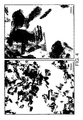
- barium aluminate (BaAl 13.2 O 20.8 ) was visible as nano-sized particles predominantly inside much larger alpha-alumina crystals in transmission electron micrographs and was particularly well-developed after about 1 hour at approximately 1400°C (see Figures 9C and 9D), whereas in hydrothermally-treated alumina such particles were absent after treatment at 1400°C, except when heated in argon instead of air, in which case nano-sized particles of barium aluminate (BaAl 12 O 19 ) were visible, predominantly on the surface of the alpha-alumina crystals (see Figure 2).
- barium aluminate was present as a thin surface layer in the hydrothermally treated material even after 1 hour at 1400°C in air, but not in a similar starting material treated by oven-drying or microwave-drying because those materials transformed or partly transformed to alpha-alumina after 1 hour at 1200°C, a temperature similar to that reported by other authors.
- An important step therefore seems to be the formation of a generally uniform surface layer of barium and/or a barium compound on the boehmite crystals during the hydrothermal or refluxing treatment.
- the length of hydrothermal treatment is important in determining the specific surface area of the product after the subsequent high temperature treatment.
- a material that was previously given a 4 hour hydrothermal treatment at approximately 210°C resulted in theta-alumina with a specific surface area of 6 m 2 /g.
- a material that was previously given a 22 hour hydrothermal treatment at 210°C resulted in theta-alumina with a more useful specific surface area of 31 m 2 /g.
- Such a material would retain sufficient surface area to remain effective as a catalyst support material.
- Figures 5A and 5B shows that there is remarkably little change in general appearance of the hydrothermally treated material before (5A) and after (5B) heating for 1 hour at 1400°C which demonstrates the effectiveness of this material in resisting thermal degradation.
- Aluminium chloride hexahydrate AlCl 3 ⁇ 6H 2 O
- barium chloride dihydrate BaCl 2 ⁇ 2H 2 O
- urea CON 2 H 4
- PVP polyvinylpyrrolidone
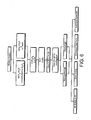
- Alumina and alumina doped with approximately 10 mol% baria were synthesised by homogeneous precipitation from a metal salt solution induced by the thermal decomposition of urea as shown in the flow chart in Figure 6.
- the urea decomposed to produce a controlled and uniform increase in pH until precipitation occurred.
- Very fine sol particles sedimented from the solution after standing for several hours at room temperature.
- the reaction product was centrifuged to separate the characteristically voluminous and transparent gel. The gel was washed twice with double its own volume of distilled water to remove most of the anion and organic impurities. About 1200 ml of the transparent gel was produced from 5 1 of solution in a typical experiment.
- the alumina and alumina-baria gels were treated in a variety of different ways: air-dried at room temperature; oven-dried at a temperature in the range of from 90 to 100°C; dried in a microwave oven; and hydrothermally treated in an autoclave.
- the air-dried gel was prepared by leaving the gel in a glass beaker at room temperature until a solid formed which was then crushed in an agate mortar to produce a fine powder.
- the oven-dried gel was prepared by heating the gel in air in an oven at about 90 to 100°C for approximately 24 hours; the solid was then crushed as above to produce a fine powder.
- the microwave-dried samples of gel were prepared in a standard domestic microwave oven at a power setting of 500 W using cycles of 5 min power on and from 2 to 3 min power off, because of extensive foaming of the gel due to the release of gaseous products.
- the dried solid was crushed as above and later calcined at different temperatures.
- the hydrothermal treatment was conducted on 150 ml samples of centrifuged gel in 230 ml Teflon-lined pressure-tight steel containers. A heating rate of about 0.5°C/min to a temperature of 210 ⁇ 5°C was used. The hold time at the temperature was about 4 hours.
- the resulting brownish liquor with a pH in the range of from 8 to 8.5 was decanted and the crystallised product was dried at a temperature from 90 to 100°C.
- the crystalline product was calcined in either air or argon.
- the size of the colloidal particles in the alumina and alumina-baria gels was measured by Small Angle X-ray Scattering (SAXS); evaluation of the results of this technique was based on the assumption that the gel was a fractal system (see J. Teixeira, J . Appl. Cryst. 21 (1988) 781).
- the phase composition of the samples was determined by XRD, either in-situ during calcination (Siemens D5000), or conventionally before and after calcination at various temperatures (Philips PW173).
- the important characteristic of the homogeneous precipitation process was that it yielded a product substantially uniform both in chemical composition and particle size.
- the decomposition of urea on heating the solution released ammonium ions into solution in a very uniform manner resulting in a gradual and uniform increase in pH.
- These uniform conditions ensured that the alumina-baria composite gel which precipitated from the dissolved chloride salts was substantially chemically homogeneous on a colloidal scale.
- the precipitation kinetics were easily controlled through the heating rate and the ageing temperature.
- the flow chart in Figure 6 summarises the steps and conditions of the synthesis.
- the size of the sol particles in the gel samples was calculated from SAXS measurements as shown in Table 1.
- the alumina and alumina-baria precursor gels both consisted of particles of about 4 nm diameter and the fractal dimension indicates that both gels were in a similar state of aggregation.
- Table 1 Properties of alumina and alumina-baria precursor gel measured by SAXS Alumina Alumina-baria Fractal dimension 2.2 2.4 Particle diameter (nm) 3.7 4.1
- phase evolution during calcination was studied by X-ray diffraction "in-situ" and conventionally, i.e. on specimens measured at room temperature after calcination.
- the main results for the conventional measurements are summarised in Table 2 with phases listed in order of abundance.
- the phases in alumina-baria samples were compared with those in pure alumina samples to obtain information on the effects of each of the gel treatment techniques.
- Table 2 Phase composition of alumina-baria samples before and after calcination of dehydrated gel.
- the alumina-baria gel dried at room temperature appeared to be amorphous from the XRD spectra.
- the only indication of the presence of a crystalline phase was a small amount of retained urea.
- the XRD spectrum for the oven-dried sample (100°C) also indicated predominantly amorphous material and the presence of very poorly crystallized bayerite Al(OH) 3 , besides traces of crystalline urea. There was no indication of the presence of any crystalline barium containing phase.
- transition aluminas that formed were ⁇ -Al 2 O 3 and ⁇ -Al 2 O 3 instead of just ⁇ -Al 2 O 3 as in the pure alumina sample.
- the transformation from ⁇ -Al 2 O 3 to ⁇ -Al 2 O 3 began at about 1050-1100°C. After calcination at 1000°C for 1 hour traces of the BaAl 9.2 O 14.8 ( ⁇ II ) phase were present. After calcination for 1 hour at 1200°C or 1400°C, BaAl 13.2 O 20.8 ( ⁇ I ) was present instead of ⁇ II . Calcination in argon or argon and air for 1 hour at 1400°C gave the same result.
- the DTA/TG curves in Figure 7 for the hydrothermally treated baria-doped samples show well-defined exothermic peaks corresponding to the decomposition of boehmite by dehydroxylation.
- a displacement of the dehydroxylation peaks to higher temperatures with increased heating rate indicates the slow kinetics of dehydration.
- the theoretical weight loss for the dehydroxylation of boehmite is 15%.
- Ba doped boehmite a weight loss of less than 15% was expected whatever barium compound was present, for example carbonate or hydroxide, due to the high atomic weight of barium compared with aluminium.
- Ba phases such as BaCO 3 or Ba(OH) 2 ⁇ xH 2 O which have a number of well-defined peaks by which they could easily be identified if present.
- the phases present in order of abundance in the specimen autoclaved for 4h were: ⁇ -Al 2 O 3 , ⁇ -Al 2 O 3 , BaAl 2 O 4 and ⁇ II .
- the specimen autoclaved for 22 hours differed in that ⁇ -Al 2 O 3 was absent.
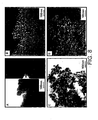
- the oven-dried material consisted of densely agglomerated fine crystals, Figures 8A and 8B, which were identified by electron diffraction as bayerite.
- the microwaved material was much less tightly agglomerated as shown in Figure 9A and consisted of boehmite crystallites of about 5 nm as seen by HRTEM (not shown here) which approximately correspond to the size of the colloidal particles in the gel.
- the hydrothermally treated sample consisted of plate-like boehmite crystals about 250 x 100 x 10 nm as shown in Figure 10A. There was no evidence of a separate Ba containing phase in any of the uncalcined samples.
- TEM micrographs of oven-dried material calcined for 1 hour at 1000°C indicated the presence of a ⁇ -Al 2 O 3 matrix and finely distributed BaO (small dark particles) (see Figures 8C and 8D).
- the crystallite size of the ⁇ -Al 2 O 3 and barium containing phase was about the same after calcination as that of bayerite before calcination (see Figures 8B and 8D).
- the autoclaved material consisted of ⁇ -Al 2 O 3 which retained the shape of the boehmite crystals (pseudomorphs) as shown in Figure 10B.
- the pseudomorphs were porous and the pore facets can be seen in Figure 10C.
- the microwaved material After calcination at 1400°C for 1 hour in air or argon, the microwaved material consisted of BaAl 13.2 O 20.8 ( ⁇ 1 ) particles of from 10 to 15 nm diameter and much larger ⁇ -Al 2 O 3 crystals as shown in Figures 9C to 9F.
- the ⁇ 1 particles were predominantly within the ⁇ -Al 2 O 3 crystals after calcination in air, but were distributed both within and on the surface of the ⁇ -Al 2 O 3 crystals after calcination in argon.
- the autoclave treated material calcined at 1400°C in air, consisted mainly of finely twinned ⁇ -Al 2 O 3 with twin planes spaced about 5 nm apart as shown in Figures 11 A-D.
- the boehmite pseudomorph crystal shape was still retained although the internal porosity was much less than at 1000°C, and was more spherical in shape.
- the ⁇ -Al 2 O 3 twin planes were parallel to the long axis of the pseudomorphs, i.e. the boehmite ⁇ 001> direction. There was no evidence of sintering between the crystals and their size was similar to that at 1200°C. Small amounts ⁇ -Al 2 O 3 were observed.
- the present invention provides a process whereby transition alumina can be further stabilized against thermal degradation to alpha-alumina. This results in a catalyst which is effective at higher operating temperatures and for longer times compared with the prior art catalysts.
- An additional advantage of the present invention is that it is very effective at forming thin (approximately 1 to 5 ⁇ m) washcoats of gamma-alumina on cordierite or other ceramic substrates. This is important because the use in the future of ceramic honeycomb substrates with a very high channel density will require the use of thinner washcoats.
- the process according to the present invention can produce thinner films where (coated) boehmite is used in the slurry, rather than gamma-alumina.
Landscapes
- Chemical & Material Sciences (AREA)
- Engineering & Computer Science (AREA)
- Materials Engineering (AREA)
- Organic Chemistry (AREA)
- Chemical Kinetics & Catalysis (AREA)
- Dispersion Chemistry (AREA)
- Catalysts (AREA)
- Compositions Of Oxide Ceramics (AREA)
- Investigating Or Analyzing Materials By The Use Of Fluid Adsorption Or Reactions (AREA)
- Organic Insulating Materials (AREA)
- Compounds Of Alkaline-Earth Elements, Aluminum Or Rare-Earth Metals (AREA)
- Transition And Organic Metals Composition Catalysts For Addition Polymerization (AREA)
Claims (25)
- Procédé pour la production d'une matière précurseur à utiliser dans la préparation d'une matière de support de catalyseur d'alumine stabilisée, ledit procédé comprenant les étapes de :(a) procurer un mélange essentiellement homogène comprenant des composés contenant de l'aluminium et du baryum, ledit mélange se présentant sous la forme d'un précipité essentiellement homogène ; et(b) chauffer le mélange dans des conditions qui permettent de former des particules de boehmite enduites au moins en partie d'une couche comprenant un composé de baryum.
- Procédé selon la revendication 1, dans lequel la couche formée sur les particules de boehmite comprend du carbonate de baryum.
- Procédé selon la revendication 1 ou 2, dans lequel le composé contenant de l'aluminium comprend du chlorure d'aluminium, du nitrate d'aluminium, du sulfate d'aluminium, de l'alumine et/ou de la boehmite.
- Procédé selon l'une quelconque des revendications précédentes, dans lequel le composé contenant du baryum comprend du chlorure de baryum, du sulfate de baryum et/ou du nitrate de baryum.
- Procédé selon l'une quelconque des revendications précédentes, dans lequel le précipité essentiellement homogène est formé via un procédé impliquant la précipitation homogène de composés contenant de l'aluminium et du baryum à partir d'une solution salée.
- Procédé selon la revendication 5, dans lequel la précipitation homogène implique la génération d'une base au sein de la solution salée par décomposition thermique d'un réactif soluble dans l'eau.
- Procédé selon la revendication 6, dans lequel le réactif soluble dans l'eau comprend de l'urée et/ou de l'hexaméthylènetétramine.
- Procédé selon l'une quelconque des revendications 5 à 7, dans lequel la solution salée englobe en outre un agent dispersant tel que la polyvinylpyrrolidone.
- Procédé selon l'une quelconque des revendications 1 à 3, dans lequel le mélange à l'étape (a) est formé par addition d'une solution comprenant de l'acide oxalique et un composé de baryum soluble dans l'eau, de préférence du nitrate de baryum, à une suspension aqueuse comprenant de la boehmite.
- Procédé selon l'une quelconque des revendications précédentes, dans lequel le chauffage du mélange à l'étape (b) est mis en oeuvre via un procédé hydrothermique.
- Procédé selon la revendication 10, dans lequel le traitement hydrothermique est mis en oeuvre à une température dans la plage de 90 à 300 °C, de manière plus préférée de 100 à 220 °C.
- Procédé selon la revendication 10 ou 11, dans lequel le traitement hydrothermique est mis en oeuvre sous une pression dans la plage de 1 à 150 bars, de préférence de 5 à 50 bars.
- Procédé selon l'une quelconque des revendications 10 à 12, dans lequel le traitement hydrothermique est mis en oeuvre pendant un laps de temps dans la plage de 30 minutes à 25 heures, de préférence de 1 à 10 heures.
- Procédé selon l'une quelconque des revendications 1 à 9, dans lequel le mélange à l'étape (b) est chauffé à une température dans la plage allant de la température ambiante à la température d'ébullition, de préférence via un procédé de chauffage à reflux.
- Procédé pour la préparation d'une matière de support de catalyseur d'alumine stabilisée, ledit procédé comprenant les étapes de :(i) procurer une matière précurseur comprenant des particules de boehmite enduites au moins en partie d'une couche comprenant un composé de baryum, la matière précurseur étant obtenue conformément à un procédé selon l'une quelconque des revendications 1 à 14 ; et(ii) chauffer les particules de boehmite enduites à une température à laquelle au moins une certaine quantité de la boehmite se transforme en alumine gamma.
- Procédé selon la revendication 15, comprenant l'étape de chauffer supplémentairement, si bien qu'au moins une certaine quantité de l'alumine gamma se transforme en alumine thêta et/ou delta.
- Procédé pour la préparation d'un pot catalytique pour automobile, ledit procédé comprenant les étapes de :(i) procurer une matière précurseur comprenant des particules de boehmite enduites au moins en partie d'une couche comprenant un composé de baryum, la matière précurseur étant obtenue conformément à un procédé selon l'une quelconque des revendications 1 à 14 ;(ii) disperser un mélange comprenant ladite matière précurseur sur un substrat monolithique métallique ou céramique ; et(iii) chauffer ledit mélange comprenant ladite matière précurseur à une température à laquelle au moins une certaine quantité de la boehmite se transforme en alumine gamma.
- Procédé selon la revendication 17, comprenant l'étape de chauffer supplémentairement, si bien qu'au moins une certaine quantité de l'alumine gamma se transforme en alumine thêta et/ou delta.
- Procédé selon la revendication 15 ou 17, dans lequel le chauffage est mis en oeuvre à une température dans la plage de 500 à 1000 °C.
- Procédé selon la revendication 16 ou 18, dans lequel le chauffage supplémentaire est mis en oeuvre à une température dans la plage de 1000 à 1400 °C.
- Matière précurseur à utiliser dans la préparation d'une matière de support de catalyseur, ladite matière précurseur étant obtenue via un procédé comprenant les étapes de :(a) procurer un mélange essentiellement homogène comprenant des composés contenant de l'aluminium et du baryum, ledit mélange se présentant sous la forme d'un précipité essentiellement homogène ; et(b) chauffer le mélange dans des conditions qui permettent de former des particules de boehmite et/ou d'alumine de transition enduites au moins en partie d'une couche comprenant du carbonate de baryum, de l'oxyde de baryum et/ou de l'aluminate de baryum.
- Matière précurseur selon la revendication 21, procurée sous la forme d'une suspension ou d'un washcoat.
- Matière de support de catalyseur d'alumine stabilisée, d'un type capable de résister à une dégradation substantielle en alumine alpha après exposition à une température d'approximativement 1400 °C pendant 1 heure, que l'on obtient via un procédé comprenant les étapes de :(a) procurer un mélange essentiellement homogène comprenant des composés contenant de l'aluminium et du baryum, ledit mélange se présentant sous la forme d'un précipité essentiellement homogène ; et(b) chauffer le mélange dans des conditions qui permettent de former des particules de boehmite enduites au moins en partie d'une couche comprenant un composé de baryum,ladite matière comprenant des particules d'alumine gamma, thêta et/ou delta enduites, de manière essentiellement complète, d'une couche comprenant du carbonate de baryum, de l'oxyde de baryum et/ou de l'aluminate de baryum.
- Matière de support ou porteuse de catalyseur d'alumine stabilisée selon la revendication 23, possédant une aire de surface spécifique d'au moins 20 m2/g après exposition à une température de 1400 °C pendant 1 heure.
- Matière de support ou porteuse de catalyseur d'alumine stabilisée selon la revendication 23 ou 24, possédant une aire de surface spécifique d'au moins 31 m2/g après exposition à une température de 1400 °C pendant 1 heure
Applications Claiming Priority (3)
| Application Number | Priority Date | Filing Date | Title |
|---|---|---|---|
| GBGB9904269.9A GB9904269D0 (en) | 1999-02-24 | 1999-02-24 | Stabilization of transition alumina |
| GB9904269 | 1999-02-24 | ||
| PCT/GB2000/000571 WO2000050168A1 (fr) | 1999-02-24 | 2000-02-17 | Stabilisation d'une alumine de transition |
Publications (2)
| Publication Number | Publication Date |
|---|---|
| EP1154852A1 EP1154852A1 (fr) | 2001-11-21 |
| EP1154852B1 true EP1154852B1 (fr) | 2007-01-03 |
Family
ID=10848432
Family Applications (1)
| Application Number | Title | Priority Date | Filing Date |
|---|---|---|---|
| EP00903882A Expired - Lifetime EP1154852B1 (fr) | 1999-02-24 | 2000-02-17 | Stabilisation d'une alumine de transition |
Country Status (8)
| Country | Link |
|---|---|
| EP (1) | EP1154852B1 (fr) |
| JP (1) | JP2002537111A (fr) |
| AT (1) | ATE350155T1 (fr) |
| CA (1) | CA2360447A1 (fr) |
| DE (1) | DE60032742T2 (fr) |
| GB (1) | GB9904269D0 (fr) |
| NO (1) | NO20014057L (fr) |
| WO (1) | WO2000050168A1 (fr) |
Families Citing this family (17)
| Publication number | Priority date | Publication date | Assignee | Title |
|---|---|---|---|---|
| US7622095B2 (en) | 2004-08-12 | 2009-11-24 | Ford Global Technologies, Llc | Catalyst composition for use in a lean NOx trap and method of using |
| US7811961B2 (en) | 2004-08-12 | 2010-10-12 | Ford Global Technologies, Llc | Methods and formulations for enhancing NH3 adsorption capacity of selective catalytic reduction catalysts |
| US7749474B2 (en) | 2004-08-12 | 2010-07-06 | Ford Global Technologies, Llc | Catalyst composition for use in a lean NOx trap and method of using |
| US7137249B2 (en) | 2004-08-12 | 2006-11-21 | Ford Global Technologies, Llc | Thermally stable lean nox trap |
| RU2471010C2 (ru) | 2007-05-21 | 2012-12-27 | Орбит Элюминэ Инк. | Способ извлечения алюминия и железа из глиноземистых руд |
| JP5316482B2 (ja) * | 2008-03-13 | 2013-10-16 | 株式会社デンソー | アルミナ粒子の製造方法 |
| US20120165185A1 (en) * | 2010-12-27 | 2012-06-28 | Basf Corporation | Thermally Stable Catalyst Carrier Comprising Barium Sulfate |
| JP2014508863A (ja) | 2011-03-18 | 2014-04-10 | オーバイト アルミナ インコーポレイテッド | アルミニウム含有材料から希土類元素を回収する方法 |
| JP5894262B2 (ja) | 2011-05-04 | 2016-03-23 | オーバイト アルミナ インコーポレイテッドOrbite Aluminae Inc. | 種々の鉱石から希土類元素を回収する方法 |
| US9150428B2 (en) | 2011-06-03 | 2015-10-06 | Orbite Aluminae Inc. | Methods for separating iron ions from aluminum ions |
| AU2012308068B2 (en) | 2011-09-16 | 2015-02-05 | Aem Technologies Inc. | Processes for preparing alumina and various other products |
| WO2013104059A1 (fr) | 2012-01-10 | 2013-07-18 | Orbite Aluminae Inc. | Procédés de traitement de boue rouge |
| CA2862307C (fr) | 2012-03-29 | 2015-12-01 | Orbite Aluminae Inc. | Procedes de traitement de cendres volantes |
| WO2014008586A1 (fr) | 2012-07-12 | 2014-01-16 | Orbite Aluminae Inc. | Procédés pour la préparation d'oxyde de titane et de divers autres produits |
| BR112015006536A2 (pt) | 2012-09-26 | 2017-08-08 | Orbite Aluminae Inc | processos para preparar alumina e cloreto de magnésio por lixiviação com hcl de vários materiais. |
| US9534274B2 (en) | 2012-11-14 | 2017-01-03 | Orbite Technologies Inc. | Methods for purifying aluminium ions |
| CN110129791B (zh) * | 2019-06-10 | 2021-05-25 | 辽宁工程技术大学 | 一种耐铝液腐蚀的钢表面复合膜的制备方法 |
Family Cites Families (3)
| Publication number | Priority date | Publication date | Assignee | Title |
|---|---|---|---|---|
| JP2744275B2 (ja) * | 1989-02-16 | 1998-04-28 | マツダ株式会社 | 排気ガス浄化用触媒の製造方法 |
| US5116800A (en) * | 1990-12-11 | 1992-05-26 | Allied-Signal Inc. | High durability and exhuast catalyst with low hydrogen sulfide emissions |
| US5212130A (en) * | 1992-03-09 | 1993-05-18 | Corning Incorporated | High surface area washcoated substrate and method for producing same |
-
1999
- 1999-02-24 GB GBGB9904269.9A patent/GB9904269D0/en not_active Ceased
-
2000
- 2000-02-17 JP JP2000600773A patent/JP2002537111A/ja not_active Withdrawn
- 2000-02-17 CA CA002360447A patent/CA2360447A1/fr not_active Abandoned
- 2000-02-17 EP EP00903882A patent/EP1154852B1/fr not_active Expired - Lifetime
- 2000-02-17 DE DE60032742T patent/DE60032742T2/de not_active Expired - Lifetime
- 2000-02-17 WO PCT/GB2000/000571 patent/WO2000050168A1/fr not_active Ceased
- 2000-02-17 AT AT00903882T patent/ATE350155T1/de not_active IP Right Cessation
-
2001
- 2001-08-21 NO NO20014057A patent/NO20014057L/no not_active Application Discontinuation
Also Published As
| Publication number | Publication date |
|---|---|
| EP1154852A1 (fr) | 2001-11-21 |
| NO20014057L (no) | 2001-10-22 |
| GB9904269D0 (en) | 1999-04-21 |
| WO2000050168A1 (fr) | 2000-08-31 |
| JP2002537111A (ja) | 2002-11-05 |
| DE60032742T2 (de) | 2007-11-08 |
| CA2360447A1 (fr) | 2000-08-31 |
| ATE350155T1 (de) | 2007-01-15 |
| NO20014057D0 (no) | 2001-08-21 |
| DE60032742D1 (de) | 2007-02-15 |
Similar Documents
| Publication | Publication Date | Title |
|---|---|---|
| EP1154852B1 (fr) | Stabilisation d'une alumine de transition | |
| RU2509725C2 (ru) | Композиция на основе оксида церия и оксида циркония с особой пористостью, способ получения и применение в катализе | |
| RU2606505C2 (ru) | Пористый неорганический композитный оксид | |
| KR101286799B1 (ko) | 알루미나 또는 옥시수산화 알루미늄 기재 상에 란탄 페로브스카이트를 포함하는 조성물, 제조 방법 및 촉매에서의 용도 | |
| KR101130908B1 (ko) | 지지체 상의 나노미터크기 산화세륨으로 제조된, 높은 환원능을 갖는 조성물, 제조 방법, 및 촉매로서의 용도 | |
| KR0180919B1 (ko) | 촉매용 알루미나-기재의 조성물 및 이의 제조방법, 촉매 및 이의 제조방법 | |
| JP2008526661A (ja) | 熱的に安定なドープされたもしくはドープされない多孔質酸化アルミニウム及びceo2−zro2及びal2o3含有ナノ複合酸化物 | |
| KR20130000419A (ko) | 지르코늄, 세륨 및 1종 이상의 다른 희토류의 산화물을 함유하며 특정 다공도를 갖는 조성물, 그의 제조 방법 및 촉매작용에서의 그의 용도 | |
| CN105873663B (zh) | 无机氧化物材料 | |
| WO2018098064A1 (fr) | Catalyseur pour reformage à la vapeur à haute température | |
| JP3265534B2 (ja) | 排ガス浄化用触媒 | |
| KR20130084305A (ko) | 특정 공극률을 가지며 지르코늄 산화물, 및 세륨 이외의 1종 이상 희토류의 산화물을 기재로 한 조성물, 상기 조성물의 제조 방법 및 촉매 작용에서의 그 용도 | |
| EP2119671A1 (fr) | Préparation d'hexaaluminate | |
| US5280002A (en) | Thermally stable ceric oxide-based compositions and process for their preparation | |
| RU2699652C2 (ru) | ИМЕЮЩИЙ ПОКРЫТИЕ КОМПОЗИЦИОННЫЙ МАТЕРИАЛ, СОДЕРЖАЩИЙ Al2O3-CeO2/ZrO2, И СПОСОБ ЕГО ПОЛУЧЕНИЯ | |
| CN107511179A (zh) | 具有储氧能力(osc)的掺杂催化剂载体材料及其制造方法 | |
| JP4972868B2 (ja) | 表面修飾されたセリア・ジルコニア系水和酸化物、その酸化物及びそれらの製造方法並びに用途 | |
| Djuričić et al. | Preparation and properties of alumina-baria nano-composites | |
| US20080242536A1 (en) | Metal Oxide with High Thermal Stability and Preparing Method Thereof | |
| US20050239645A1 (en) | Thermally stabile materials having high specific surfaces | |
| JP2006256911A (ja) | セリア・ジルコニア系酸化物の製造方法 | |
| JP2005170775A (ja) | 酸化物粉末及びその製造方法並びに排気ガス浄化用触媒 | |
| EP0808800A2 (fr) | Oxydes binaires de praséodyme et de zirconium pour catalyseur et revêtement | |
| WO2007029957A1 (fr) | Procede de preparation d'oxyde de metal contenant des metaux precieux | |
| US20250041833A1 (en) | Aluminium and Zirconium-Based Mixed Oxide |
Legal Events
| Date | Code | Title | Description |
|---|---|---|---|
| PUAI | Public reference made under article 153(3) epc to a published international application that has entered the european phase |
Free format text: ORIGINAL CODE: 0009012 |
|
| AK | Designated contracting states |
Kind code of ref document: A1 Designated state(s): AT BE CH CY DE DK ES FI FR GB GR IE IT LI LU MC NL PT SE |
|
| 17P | Request for examination filed |
Effective date: 20010924 |
|
| 17Q | First examination report despatched |
Effective date: 20011228 |
|
| RAP1 | Party data changed (applicant data changed or rights of an application transferred) |
Owner name: EUROPEAN COMMUNITY |
|
| RIN1 | Information on inventor provided before grant (corrected) |
Inventor name: MAGNE, JEAN-FRANEOIS Inventor name: PICKERING, STEPHEN Inventor name: DJURICIC, BORO |
|
| GRAP | Despatch of communication of intention to grant a patent |
Free format text: ORIGINAL CODE: EPIDOSNIGR1 |
|
| GRAS | Grant fee paid |
Free format text: ORIGINAL CODE: EPIDOSNIGR3 |
|
| GRAA | (expected) grant |
Free format text: ORIGINAL CODE: 0009210 |
|
| AK | Designated contracting states |
Kind code of ref document: B1 Designated state(s): AT BE CH CY DE DK ES FI FR GB GR IE IT LI LU MC NL PT SE |
|
| PG25 | Lapsed in a contracting state [announced via postgrant information from national office to epo] |
Ref country code: CH Free format text: LAPSE BECAUSE OF FAILURE TO SUBMIT A TRANSLATION OF THE DESCRIPTION OR TO PAY THE FEE WITHIN THE PRESCRIBED TIME-LIMIT Effective date: 20070103 Ref country code: FI Free format text: LAPSE BECAUSE OF FAILURE TO SUBMIT A TRANSLATION OF THE DESCRIPTION OR TO PAY THE FEE WITHIN THE PRESCRIBED TIME-LIMIT Effective date: 20070103 Ref country code: NL Free format text: LAPSE BECAUSE OF FAILURE TO SUBMIT A TRANSLATION OF THE DESCRIPTION OR TO PAY THE FEE WITHIN THE PRESCRIBED TIME-LIMIT Effective date: 20070103 Ref country code: DK Free format text: LAPSE BECAUSE OF FAILURE TO SUBMIT A TRANSLATION OF THE DESCRIPTION OR TO PAY THE FEE WITHIN THE PRESCRIBED TIME-LIMIT Effective date: 20070103 Ref country code: LI Free format text: LAPSE BECAUSE OF FAILURE TO SUBMIT A TRANSLATION OF THE DESCRIPTION OR TO PAY THE FEE WITHIN THE PRESCRIBED TIME-LIMIT Effective date: 20070103 |
|
| REG | Reference to a national code |
Ref country code: GB Ref legal event code: FG4D |
|
| REF | Corresponds to: |
Ref document number: 60032742 Country of ref document: DE Date of ref document: 20070215 Kind code of ref document: P |
|
| REG | Reference to a national code |
Ref country code: IE Ref legal event code: FG4D |
|
| PG25 | Lapsed in a contracting state [announced via postgrant information from national office to epo] |
Ref country code: MC Free format text: LAPSE BECAUSE OF NON-PAYMENT OF DUE FEES Effective date: 20070228 |
|
| PG25 | Lapsed in a contracting state [announced via postgrant information from national office to epo] |
Ref country code: SE Free format text: LAPSE BECAUSE OF FAILURE TO SUBMIT A TRANSLATION OF THE DESCRIPTION OR TO PAY THE FEE WITHIN THE PRESCRIBED TIME-LIMIT Effective date: 20070403 |
|
| PG25 | Lapsed in a contracting state [announced via postgrant information from national office to epo] |
Ref country code: ES Free format text: LAPSE BECAUSE OF FAILURE TO SUBMIT A TRANSLATION OF THE DESCRIPTION OR TO PAY THE FEE WITHIN THE PRESCRIBED TIME-LIMIT Effective date: 20070414 |
|
| PG25 | Lapsed in a contracting state [announced via postgrant information from national office to epo] |
Ref country code: PT Free format text: LAPSE BECAUSE OF FAILURE TO SUBMIT A TRANSLATION OF THE DESCRIPTION OR TO PAY THE FEE WITHIN THE PRESCRIBED TIME-LIMIT Effective date: 20070604 |
|
| ET | Fr: translation filed | ||
| NLV1 | Nl: lapsed or annulled due to failure to fulfill the requirements of art. 29p and 29m of the patents act | ||
| REG | Reference to a national code |
Ref country code: CH Ref legal event code: PL |
|
| PLBE | No opposition filed within time limit |
Free format text: ORIGINAL CODE: 0009261 |
|
| STAA | Information on the status of an ep patent application or granted ep patent |
Free format text: STATUS: NO OPPOSITION FILED WITHIN TIME LIMIT |
|
| 26N | No opposition filed |
Effective date: 20071005 |
|
| PG25 | Lapsed in a contracting state [announced via postgrant information from national office to epo] |
Ref country code: IT Free format text: LAPSE BECAUSE OF FAILURE TO SUBMIT A TRANSLATION OF THE DESCRIPTION OR TO PAY THE FEE WITHIN THE PRESCRIBED TIME-LIMIT Effective date: 20070103 Ref country code: GR Free format text: LAPSE BECAUSE OF FAILURE TO SUBMIT A TRANSLATION OF THE DESCRIPTION OR TO PAY THE FEE WITHIN THE PRESCRIBED TIME-LIMIT Effective date: 20070404 |
|
| PG25 | Lapsed in a contracting state [announced via postgrant information from national office to epo] |
Ref country code: CY Free format text: LAPSE BECAUSE OF FAILURE TO SUBMIT A TRANSLATION OF THE DESCRIPTION OR TO PAY THE FEE WITHIN THE PRESCRIBED TIME-LIMIT Effective date: 20070103 |
|
| PG25 | Lapsed in a contracting state [announced via postgrant information from national office to epo] |
Ref country code: LU Free format text: LAPSE BECAUSE OF NON-PAYMENT OF DUE FEES Effective date: 20070217 |
|
| PGFP | Annual fee paid to national office [announced via postgrant information from national office to epo] |
Ref country code: IE Payment date: 20100125 Year of fee payment: 11 |
|
| PGFP | Annual fee paid to national office [announced via postgrant information from national office to epo] |
Ref country code: FR Payment date: 20100324 Year of fee payment: 11 |
|
| PGFP | Annual fee paid to national office [announced via postgrant information from national office to epo] |
Ref country code: GB Payment date: 20100128 Year of fee payment: 11 Ref country code: BE Payment date: 20100129 Year of fee payment: 11 Ref country code: AT Payment date: 20100122 Year of fee payment: 11 Ref country code: DE Payment date: 20100202 Year of fee payment: 11 |
|
| REG | Reference to a national code |
Ref country code: FR Ref legal event code: CD |
|
| REG | Reference to a national code |
Ref country code: DE Ref legal event code: R081 Ref document number: 60032742 Country of ref document: DE Owner name: EUROPEAN UNION, BE Free format text: FORMER OWNER: EUROPEAN COMMUNITY, BRUESSEL/ BRUXELLES, BE Effective date: 20110208 |
|
| BERE | Be: lapsed |
Owner name: EUROPEAN UNION Effective date: 20110228 |
|
| GBPC | Gb: european patent ceased through non-payment of renewal fee |
Effective date: 20110217 |
|
| REG | Reference to a national code |
Ref country code: FR Ref legal event code: ST Effective date: 20111102 |
|
| REG | Reference to a national code |
Ref country code: IE Ref legal event code: MM4A |
|
| PG25 | Lapsed in a contracting state [announced via postgrant information from national office to epo] |
Ref country code: AT Free format text: LAPSE BECAUSE OF NON-PAYMENT OF DUE FEES Effective date: 20110217 Ref country code: BE Free format text: LAPSE BECAUSE OF NON-PAYMENT OF DUE FEES Effective date: 20110228 |
|
| REG | Reference to a national code |
Ref country code: DE Ref legal event code: R119 Ref document number: 60032742 Country of ref document: DE Effective date: 20110901 |
|
| PG25 | Lapsed in a contracting state [announced via postgrant information from national office to epo] |
Ref country code: IE Free format text: LAPSE BECAUSE OF NON-PAYMENT OF DUE FEES Effective date: 20110217 Ref country code: FR Free format text: LAPSE BECAUSE OF NON-PAYMENT OF DUE FEES Effective date: 20110228 |
|
| PG25 | Lapsed in a contracting state [announced via postgrant information from national office to epo] |
Ref country code: GB Free format text: LAPSE BECAUSE OF NON-PAYMENT OF DUE FEES Effective date: 20110217 |
|
| PG25 | Lapsed in a contracting state [announced via postgrant information from national office to epo] |
Ref country code: DE Free format text: LAPSE BECAUSE OF NON-PAYMENT OF DUE FEES Effective date: 20110901 |