EP1156597A1 - Terminal mobile dans un système AMRC avec transmission en diversité - Google Patents
Terminal mobile dans un système AMRC avec transmission en diversité Download PDFInfo
- Publication number
- EP1156597A1 EP1156597A1 EP20010111121 EP01111121A EP1156597A1 EP 1156597 A1 EP1156597 A1 EP 1156597A1 EP 20010111121 EP20010111121 EP 20010111121 EP 01111121 A EP01111121 A EP 01111121A EP 1156597 A1 EP1156597 A1 EP 1156597A1
- Authority
- EP
- European Patent Office
- Prior art keywords
- base station
- downward
- unit
- link
- mobile terminal
- Prior art date
- Legal status (The legal status is an assumption and is not a legal conclusion. Google has not performed a legal analysis and makes no representation as to the accuracy of the status listed.)
- Withdrawn
Links
- 230000005540 biological transmission Effects 0.000 claims abstract description 73
- 238000005562 fading Methods 0.000 description 3
- 238000005259 measurement Methods 0.000 description 3
- 238000004891 communication Methods 0.000 description 2
- 230000003247 decreasing effect Effects 0.000 description 2
- 238000010586 diagram Methods 0.000 description 2
- 238000000034 method Methods 0.000 description 2
- 238000010295 mobile communication Methods 0.000 description 2
- 238000012544 monitoring process Methods 0.000 description 2
- 238000001228 spectrum Methods 0.000 description 2
- 238000013213 extrapolation Methods 0.000 description 1
Images




Classifications
-
- H—ELECTRICITY
- H04—ELECTRIC COMMUNICATION TECHNIQUE
- H04B—TRANSMISSION
- H04B7/00—Radio transmission systems, i.e. using radiation field
- H04B7/02—Diversity systems; Multi-antenna system, i.e. transmission or reception using multiple antennas
- H04B7/04—Diversity systems; Multi-antenna system, i.e. transmission or reception using multiple antennas using two or more spaced independent antennas
- H04B7/06—Diversity systems; Multi-antenna system, i.e. transmission or reception using multiple antennas using two or more spaced independent antennas at the transmitting station
- H04B7/0602—Diversity systems; Multi-antenna system, i.e. transmission or reception using multiple antennas using two or more spaced independent antennas at the transmitting station using antenna switching
- H04B7/0608—Antenna selection according to transmission parameters
- H04B7/061—Antenna selection according to transmission parameters using feedback from receiving side
Definitions
- the present invention relates to mobile terminals such as digital land mobile radiotelephones and pocket telephones, and particularly to mobile terminals for code division multiple access (CDMA) or CDMA frequency division duplex (CDMA/FDD).
- CDMA code division multiple access
- CDMA/FDD CDMA frequency division duplex
- the diversity is used for overcoming the fading or a fluctuation of a level of received electromagnetic wave due to interference by the waves which propagate through various routes.
- the strongest component is selected among the components received by a plurality of antennas, or several components are selectively combined.
- electromagnetic waves are transmitted by a plurality of antennas of which directivities are different from each other.
- the transmission diversity is executed by selecting an antenna by which the mobile station received the strongest wave and by transmitting by using the selected antenna.
- the transmission diversity in the TDD can not be employed for the frequency division duplex (FDD), because the frequency for an upward link is different from that for a downward link in FDD, and therefore the upward fading is different from the downward fading.
- FDD frequency division duplex
- the closed loop control is required for controlling a level and phase of the wave transmitted by a base station, on the basis of a control command from mobile stations.
- information symbols or pseudo noise codes are different antenna by antenna.
- 0.625 ms time slot is used in the closed loop control, thereby the mobile terminal's measuring propagation states from each antenna of the base station, and thereby the base station's determining an antenna for transmission, or transmission ratio and phases for each antenna.
- antenna 1 may be selected on the basis of a command from a mobile terminal.
- Antenna 2 may be selected, when the mobile station prefers antenna 2.
- the base station changes the antenna after the slot next to the slot which instructs the antenna selection.
- the ratio of transmission levels and phases of the transmission waves are also changed by the control command from the mobile station.
- control command controls the base station precisely.
- the transmission diversity as disclosed in JP 8-195703 A (1996) employs a plurality of orthogonal codes such as WALSH function in order to communicate with all the mobile stations.
- the mobile stations despread the signals from the base station, and select one of them or combine two or more of them.
- the transmission power can be reduced due to the transmission diversity.
- a sub-frame consisting of a plurality of slots is used for CDMA/TDD-TDMA, in order to maintain controllability of transmission power and transmission diversity.
- the mobile terminal is provided with a signal interference ratio (SIR) measurement unit for monitoring a notification channel in the downward channel
- the base station is provided with a transmission power control unit for controlling the upward transmission power on the basis of the measurement result by an SIR measurement unit.
- SIR signal interference ratio
- an asymmetric communication by CDMA/TDD is executed by using one slot for the upward and three slots for the downward. In this case, all the sub-frames consisting of four slots allocated for all the users are transmitted by TDMA.
- the base station may possibly confuse the control command from the mobile terminal, when the upward link is not in a good condition.
- the base station may execute a transmission by using antenna 2, in spite of the command from the mobile terminal which orders the base station to use antenna 1. In this case, communication qualities may become worse.
- the mobile terminal may not recognize correctly the transmission channel, even when the base station works according to the control command. For example, the mobile station may recognize that the base station executes a transmission by antenna 2, in spite of the fact that the base station is using antenna 1. As a result, the mobile terminal can not demodulate the signal from the base station, because information symbol or pseudo random code differs antenna by antenna.
- An object of the present invention is to control the transmission diversity by monitoring the upward and downward link.
- the mobile terminal of the present invention transmits a control command for controlling a base station with transmission diversity by using two or more antennas, thereby enjoying a good downward link.
- the mobile terminal of the present invention includes:
- the mobile terminal of the present invention receives signals from the base station which receives the control command from the mobile terminal and executes on the basis of the control command the transmission diversity by using two or more antennas, thereby enjoying a good downward link.
- the mobile terminal of the present invention includes:
- the downward link estimation unit in the mobile terminal of the present invention estimates the downward link on the basis of a signal level, or SIR of the received signal.
- the upward link estimation unit in the mobile terminal of the present invention estimates the upward link on the basis of a transmission power control command from the base station.
- the base station estimation unit in the mobile terminal of the present invention on the basis of the estimated downward link, when the downward link is in a good condition and the upward link is in a bad condition. On the contrary, the base station estimation unit estimates that the base station executes a transmission in accordance with the control command from mobile terminal, when the downward link is in a bad condition and the upward link is in a good condition.
- the transmission state of the base station can be grasped correctly, even when the upward link and/or downward link is in a bad condition. Therefore, the mobile terminal receives good quality signals and enjoys a merit of the transmission diversity.
- Figure 1 is a block diagram of a CDMA mobile communication system including the mobile terminal of the present invention.
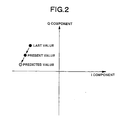
- Figure 2 is an illustration for explaining an estimation method executed by the channel estimation unit in the mobile terminal on the present invention.
- Figure 3 is a timing chart of downward link and upward link.
- Figure 4 is a flow chart for estimating the upward link.
- Figure 5 is a flow chart for estimating the downward link.
- Figure 6 is a flow chart for estimating a transmission state of the base station.
- Figure 1 is a block diagram of a mobile communication system which comprises base station 100 and mobile station 200 of the present invention.
- Base station as shown in Figure 1 comprises transmission unit (Tx) 6 for modulating information signal inputted from input terminal 5 into CDMA signal, transmission antenna 7 for transmitting the output from Tx 6, reception antenna 1 for receiving signals from a plurality of mobile terminals, reception unit (Rx) 2 for outputting through a radio frequency amplifier, band pass filter and intermediate frequency amplifier, information data received by antenna 1.
- Rx 2 also generates a reception control command on the basis of a signal interference ratio (SIR) and outputs the reception control command to transmission control unit 4.
- SIR signal interference ratio
- Mobile terminal 200 comprises reception antenna 8, reception unit (Rx) 9 for converting the radio frequency signal into a base band signal, upward link estimation unit 17 for estimating the upward channel on the basis of reception level, SIR, or S/N received by Rx 9, downward link estimation unit 18 for estimating the downward channel on the basis of reception level, SIR, or S/N received by Rx 9, base station estimation unit 19 for estimating the transmission state of the base station on the basis of the outputs from upward link estimation unit 17 and downward estimation unit 18, demodulator 20 for demodulating the base band signal on the basis of the output from base station estimation unit 19.
- a bit error rate of the output from demodulator 20 may also be used for generating a control command, although demodulator 20 is not connected with control command generating unit 12, in Figure 1.
- Mobile terminal 200 further comprises channel estimation unit 10 for estimating an optimum transmission channel on the basis of reception level, SIR or S/N received by Rx 9, channel prediction unit 11 for predicting an optimum channel for the next slot on the basis of the output from channel estimation unit, control command generation unit 12 for generating commands for controlling base station 100 on the basis of the output from channel prediction unit 11, mixer unit 14 for mixing the control command from control command generation unit 12 and transmission information data from output terminal 13, transmission unit (Tx) 15 for modulating the output from mixer unit 14 into CDMA signal, and transmission antenna 16 for transmitting the CDMA signal from Tx 15.
- channel estimation unit 10 for estimating an optimum transmission channel on the basis of reception level, SIR or S/N received by Rx 9
- channel prediction unit 11 for predicting an optimum channel for the next slot on the basis of the output from channel estimation unit
- control command generation unit 12 for generating commands for controlling base station 100 on the basis of the output from channel prediction unit 11
- mixer unit 14 for mixing the control command from control command generation unit 12 and transmission information data from output terminal 13
- base station 100 uses two transmission antenna, and transmission symbol sequence in the control channel for the first transmission antenna is " 0011", while the symbol sequence for the second antenna is "0101".
- the control channel signal on downward link from Rx 9 is averaged over a prescribed period such as one slot period (0.625ms) by channel estimation unit 10.
- Channel prediction unit 11 predicts the downward channel from the first and second antennas on the basis of the estimation value obtained by channel estimation unit 10.
- Channel prediction unit 11 may predict the channel value by an extrapolation by using the present slot and the last slot.
- Channel value may be expressed by a coordinate (I,Q), where I is an In-phase component and Q is a Quadrature-phase component, as shown in Figure 2.
- Two or more slots may be employed for the prediction.
- control command generation unit 12 generates a control command for base station 100.
- the control command may designate an antenna which is in a better condition.
- control command may instruct the best phase difference between the transmission antennas among every possible phase differences, so as to maximize the combined level.
- control command generated by control command generation unit 12 is supplied together with the information data from output terminal 13 to Tx 15 through mixer unit 14.
- Tx 15 transmits through antenna 16 a spread spectrum signal of the output from mixer 14.
- Base station 100 receives through antenna 1 the spread spectrum signal on the upward link, and despreads it, thereby outputting the information data to output terminal 3 and outputting the control command to transmission control unit 4.
- Transmission control unit 4 instructs transmission levels and phases for the transmission antennas on the basis of the control command which is periodically supplied by mobile terminal 200.
- Transmission unit 6 transmission information data on the data channel the conditions instructed by transmission control unit 4.
- Rx 9 in mobile terminal 200 receives through reception antenna 8 the signal on the data channel.
- the received signal is fed into upward link estimation unit 17 and downward link estimation unit 18.
- Upward link estimation unit 17 reads out a power control command from base station 100.
- the power control command is such that the transmission power from mobile terminal 200 be decreased, when the upward link observed by base station 100 is in a good condition.
- the power control command is such that the transmission power from mobile terminal 200 be increased, when the upward link observed by base station 100 is in a bad condition. Therefore, 2 bit command may be used for decreasing, increasing or maintaining the transmission power from mobile terminal 200. Three bit command may well be used for the power control.
- the power control command instructing a decrease in the transmission power from mobile terminal is sent repeatedly from base station, when the upward link is in a very good condition, while the power control command instructing an increase in the transmission power is sent repeatedly from base station 100, when the upward link is in a very bad condition.
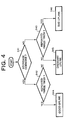
- Figure 4 is an exemplary flow chart for estimating the upward link.
- the control bit instructs an increase or decrease in transmission power. If the command bit instructs a decrease in the transmission power, then, it is determined whether the decrease command is received repeatedly more than three times at S42. If the decrease command is received repeatedly more than three times, then, the upward link is estimated to be in a good condition at S44. On the other hand, if it is determined at S42 that the decrease command is not received repeatedly more than three times, the upward link is estimated to be in an ordinary condition. If the command bit instructs an increase in the transmission power at S41, then, it is determined whether the increase command is received repeatedly more than three times at S43.
- the upward link is estimated to be in a bad condition at S46.
- the upward link is estimated to be in an ordinary condition.
- the upward link may be represented by 7 level by using three bits command. Further, the upward link is estimated by an average of the levels.
- Downward link estimation unit 18 estimates the downward link on the basis of reception level, or SIR on data channel or control channel on the downward link.
- Figure 5 is an exemplary flow chart for estimating the downward link, by using two threshold A and B ( >A).
- S51 SIR is measured in a data channel. If SIR is greater than or equal to threshold B, then the downward link is estimated in a good condition at S52. If SIR is smaller than threshold A, then the downward link is estimated in a bad condition at S54. If SIR is greater than or equal to threshold A and smaller than threshold B, then the downward link is estimated in an ordinary condition at S53.
- three or more thresholds may be employed for the downward link estimation.
- Base station estimation unit 19 estimates the transmission state of base station 100 on the basis of the estimated upward link and estimated downward link. Concretely, The state of base station 100 is estimated on the basis of the estimated downward link, when the downward link is in a good condition and the upward link is in a bad condition. On the contrary, mobile terminal expects that base station 100 executes a transmission in accordance with the control command from mobile terminal 200, when the downward link is in a bad condition and the upward link is in a good condition.
- Figure 6 is an exemplary flow chart for estimating the state of base station 100.
- S61 it is determined whether the downward link is in a good condition or in an ordinary condition. If the downward link is in a good condition or in an ordinary condition, then, mobile terminal expects at S63 that base station 100 is using an antenna from which the greater reception level is obtained by mobile terminal. If the downward link is in a bad condition, it is determined at S62 whether the upward link is in a good condition or in an ordinary condition. If the upward link is in a good condition or in an ordinary condition, then, mobile terminal expects at S64 that base station 100 is executing a transmission in accordance with the control command on the upward link. If both the downward link and upward link are in bad conditions, then, mobile terminal expects at S63 that base station 100 is using an antenna from which the greater reception level is obtained by mobile terminal.
- the above-explained estimation method can be applied not only antenna switching diversity, but also transmission power ratio control or phase difference control for the transmission antennas.
- demodulation unit 20 demodulates the received signal on the basis of the transmission state outputted from base station estimation unit 19.
- mobile terminal estimates transmission channels by using the control channel and data channel from the antenna which is expected to be used by base station 100, and demodulates the data channel from the antenna which is used by base station 100.
Landscapes
- Engineering & Computer Science (AREA)
- Computer Networks & Wireless Communication (AREA)
- Signal Processing (AREA)
- Mobile Radio Communication Systems (AREA)
- Radio Transmission System (AREA)
Applications Claiming Priority (2)
| Application Number | Priority Date | Filing Date | Title |
|---|---|---|---|
| JP2000146751A JP3478242B2 (ja) | 2000-05-18 | 2000-05-18 | Cdma移動通信システムの移動機 |
| JP2000146751 | 2000-05-18 |
Publications (1)
| Publication Number | Publication Date |
|---|---|
| EP1156597A1 true EP1156597A1 (fr) | 2001-11-21 |
Family
ID=18653047
Family Applications (1)
| Application Number | Title | Priority Date | Filing Date |
|---|---|---|---|
| EP20010111121 Withdrawn EP1156597A1 (fr) | 2000-05-18 | 2001-05-08 | Terminal mobile dans un système AMRC avec transmission en diversité |
Country Status (3)
| Country | Link |
|---|---|
| US (1) | US6792279B2 (fr) |
| EP (1) | EP1156597A1 (fr) |
| JP (1) | JP3478242B2 (fr) |
Cited By (2)
| Publication number | Priority date | Publication date | Assignee | Title |
|---|---|---|---|---|
| EP1410528B1 (fr) * | 2001-07-19 | 2006-04-19 | Intel Corporation | Prevision de canal dans un systeme de diversite d'emission en boucle fermee |
| EP1681784A3 (fr) * | 2005-01-13 | 2009-04-22 | NTT DoCoMo INC. | Dispositif de station mobile et procédé de contrôle pour le dispositif de station mobile |
Families Citing this family (7)
| Publication number | Priority date | Publication date | Assignee | Title |
|---|---|---|---|---|
| JP2002271266A (ja) * | 2001-03-09 | 2002-09-20 | Nec Corp | Cdma基地局および送信ダイバーシチ制御方法 |
| FI20040269A0 (fi) * | 2004-02-20 | 2004-02-20 | Nokia Corp | Tiedonsiirtomenetelmä ja -järjestelmä, tukiasema ja lähetin-vastaanotin |
| US7660598B2 (en) * | 2004-12-21 | 2010-02-09 | Qualcomm, Incorporated | Transmit power reduction for a wireless device with multiple transmit signal paths |
| KR100786125B1 (ko) * | 2006-08-30 | 2007-12-18 | 삼성전자주식회사 | 릴레이 방식의 통신 시스템에서 서비스 경로 선택 방법 및장치 |
| US7756099B2 (en) * | 2007-07-13 | 2010-07-13 | Mitsubishi Electric Research Laboratories, Inc. | Method and system for selecting antennas adaptively in OFDMA networks |
| JP5320829B2 (ja) * | 2008-06-09 | 2013-10-23 | 富士通株式会社 | 制御チャネル送信方法、及び無線通信装置 |
| US9002283B2 (en) | 2011-08-01 | 2015-04-07 | Apple Inc. | Antenna switching system with adaptive switching criteria |
Citations (2)
| Publication number | Priority date | Publication date | Assignee | Title |
|---|---|---|---|---|
| WO1999026423A2 (fr) * | 1997-11-13 | 1999-05-27 | Industrial Research Limited | Prediction de signaux dans des communications mobiles et systemes utilisant ces predictions pour la reception et le decodage de signaux |
| DE19824152A1 (de) * | 1998-05-29 | 1999-12-16 | Siemens Ag | Verfahren und Funkstation zur Signalübertragung in einem Funk-Kommunikationssystem |
Family Cites Families (11)
| Publication number | Priority date | Publication date | Assignee | Title |
|---|---|---|---|---|
| JPH06152494A (ja) | 1992-11-02 | 1994-05-31 | Nippon Telegr & Teleph Corp <Ntt> | 送信電力制御方式 |
| JPH07226709A (ja) | 1994-02-14 | 1995-08-22 | Matsushita Electric Ind Co Ltd | 無線通信システム |
| JPH08195703A (ja) | 1995-01-17 | 1996-07-30 | Toshiba Corp | 無線通信装置 |
| JPH10336144A (ja) | 1997-05-29 | 1998-12-18 | Matsushita Electric Ind Co Ltd | 符号分割多元接続移動体通信装置 |
| JPH11112419A (ja) | 1997-10-08 | 1999-04-23 | Oki Electric Ind Co Ltd | 送信電力制御方法 |
| US6377812B1 (en) * | 1997-11-20 | 2002-04-23 | University Of Maryland | Combined power control and space-time diversity in mobile cellular communications |
| JPH11275035A (ja) | 1998-01-26 | 1999-10-08 | Matsushita Electric Ind Co Ltd | 移動局通信装置、基地局通信装置及び無線通信システム |
| JP3897457B2 (ja) | 1998-07-01 | 2007-03-22 | キヤノン株式会社 | 立体画像撮影用光学系およびそれに用いるズームレンズ |
| US6295289B1 (en) * | 1998-11-30 | 2001-09-25 | Nokia Mobile Phones, Ltd. | Power control in a transmitter |
| US6600772B1 (en) * | 2000-03-21 | 2003-07-29 | Interdigital Communications Corporation | Combined closed loop/open loop power control in a time division duplex communication system |
| JP2002271266A (ja) * | 2001-03-09 | 2002-09-20 | Nec Corp | Cdma基地局および送信ダイバーシチ制御方法 |
-
2000
- 2000-05-18 JP JP2000146751A patent/JP3478242B2/ja not_active Expired - Fee Related
-
2001
- 2001-05-01 US US09/845,161 patent/US6792279B2/en not_active Expired - Fee Related
- 2001-05-08 EP EP20010111121 patent/EP1156597A1/fr not_active Withdrawn
Patent Citations (2)
| Publication number | Priority date | Publication date | Assignee | Title |
|---|---|---|---|---|
| WO1999026423A2 (fr) * | 1997-11-13 | 1999-05-27 | Industrial Research Limited | Prediction de signaux dans des communications mobiles et systemes utilisant ces predictions pour la reception et le decodage de signaux |
| DE19824152A1 (de) * | 1998-05-29 | 1999-12-16 | Siemens Ag | Verfahren und Funkstation zur Signalübertragung in einem Funk-Kommunikationssystem |
Non-Patent Citations (1)
| Title |
|---|
| JALLOUL L M A ET AL: "PERFORMANCE ANALYSIS OF CDMA TRANSMIT DIVERSITY METHODS", VTC 1999-FALL. IEEE VTS 50TH. VEHICULAR TECHNOLOGY CONFERENCE. GATEWAY TO THE 21ST. CENTURY COMMUNICATIONS VILLAGE. AMSTERDAM, SEPT. 19 - 22, 1999, IEEE VEHICULAR TECHNOLGY CONFERENCE, NEW YORK, NY: IEEE, US, vol. 3 CONF. 50, September 1999 (1999-09-01), pages 1326 - 1330, XP002929408, ISBN: 0-7803-5436-2 * |
Cited By (4)
| Publication number | Priority date | Publication date | Assignee | Title |
|---|---|---|---|---|
| EP1410528B1 (fr) * | 2001-07-19 | 2006-04-19 | Intel Corporation | Prevision de canal dans un systeme de diversite d'emission en boucle fermee |
| US7174178B2 (en) | 2001-07-19 | 2007-02-06 | Intel Corporation | Deriving a more accurate estimate from prediction data in closed loop transmit diversity modes |
| EP1681784A3 (fr) * | 2005-01-13 | 2009-04-22 | NTT DoCoMo INC. | Dispositif de station mobile et procédé de contrôle pour le dispositif de station mobile |
| US8005440B2 (en) | 2005-01-13 | 2011-08-23 | Ntt Docomo, Inc. | Mobile station apparatus and control method for the mobile station apparatus |
Also Published As
| Publication number | Publication date |
|---|---|
| JP3478242B2 (ja) | 2003-12-15 |
| US6792279B2 (en) | 2004-09-14 |
| JP2001326591A (ja) | 2001-11-22 |
| US20010046873A1 (en) | 2001-11-29 |
Similar Documents
| Publication | Publication Date | Title |
|---|---|---|
| KR100909973B1 (ko) | 무선 통신 시스템 | |
| EP1220470B1 (fr) | Procédé de commande de la puissance de transmission, procédé de rèception, systèmes de communications mobiles et station mobile | |
| US7421039B2 (en) | Method and system employing antenna arrays | |
| EP1265449B1 (fr) | Ordonnancement et sélection du schema de modulation et de codage dans un système CDMA | |
| KR101188396B1 (ko) | 무선 통신 시스템에서 수행성능을 향상시키는 방법들 및장치 | |
| US7995536B2 (en) | Multi-input multi-output (MIMO) for wireless transmitting and receiving stations | |
| KR100978841B1 (ko) | 레이크 수신기가 구비된 광대역 코드분할 다중 접속네트워크에서 간섭 억제를 통해 폐루프 송신 다이버시티모드 성능을 개선한 방법 및 장치 | |
| US7907973B2 (en) | Communication system for controlling directivity based on signal quality | |
| KR100431387B1 (ko) | 이동국 장치 및 송신 전력 제어 방법 | |
| US20020131381A1 (en) | Apparatus and method for controlling transmit antenna array for physical downlink shared channel in a mobile communication system | |
| JPH07283779A (ja) | 移動体通信装置 | |
| EP1906552A2 (fr) | Gain de diversité spatio-temporel | |
| CA2400990C (fr) | Dispositif de station de base sans fil et procede de communication sans fil | |
| US7519028B2 (en) | Channel structure, method forming the same, radio base station, mobile station in mobile communication system | |
| US7020445B1 (en) | Wireless base station system, and wireless transmission method | |
| KR19980086626A (ko) | 코드 분할 다중 접속 통신 장치 및 방법 | |
| EP1753152A1 (fr) | Systeme de connexion/deconnexion de vérification d'antennes travaillant en diversité de transmission en boucle fermée mode 1 | |
| US9277507B2 (en) | Radio communication system, method of operating a communication system, and a mobile station | |
| JP2001268637A (ja) | 移動機及び基地局並びにそれ等を用いた移動通信システム | |
| US7142888B2 (en) | Radio communication method, base station and mobile station | |
| US20040023627A1 (en) | Interference power measurement apparatus, transmission power control apparatus, and method | |
| JP2000151488A (ja) | 無線通信装置及び無線通信方法 | |
| US6792279B2 (en) | Mobile terminal for transmission diversity CDMA communication system | |
| KR20010112321A (ko) | 무선 기지국 장치, 통신 단말 장치 및 무선 통신 방법 | |
| JP2001057528A (ja) | Sttd及びssdtを用いるセル選択 |
Legal Events
| Date | Code | Title | Description |
|---|---|---|---|
| PUAI | Public reference made under article 153(3) epc to a published international application that has entered the european phase |
Free format text: ORIGINAL CODE: 0009012 |
|
| 17P | Request for examination filed |
Effective date: 20010912 |
|
| AK | Designated contracting states |
Kind code of ref document: A1 Designated state(s): AT BE CH CY DE DK ES FI FR GB GR IE IT LI LU MC NL PT SE TR Kind code of ref document: A1 Designated state(s): DE FR GB IT |
|
| AX | Request for extension of the european patent |
Free format text: AL;LT;LV;MK;RO;SI |
|
| AKX | Designation fees paid |
Free format text: DE FR GB IT |
|
| 17Q | First examination report despatched |
Effective date: 20070117 |
|
| STAA | Information on the status of an ep patent application or granted ep patent |
Free format text: STATUS: THE APPLICATION IS DEEMED TO BE WITHDRAWN |
|
| 18D | Application deemed to be withdrawn |
Effective date: 20101201 |