EP1157247B1 - Regler und verfahren zur regelung der temperatur in einem kühlschrank - Google Patents
Regler und verfahren zur regelung der temperatur in einem kühlschrank Download PDFInfo
- Publication number
- EP1157247B1 EP1157247B1 EP00909214A EP00909214A EP1157247B1 EP 1157247 B1 EP1157247 B1 EP 1157247B1 EP 00909214 A EP00909214 A EP 00909214A EP 00909214 A EP00909214 A EP 00909214A EP 1157247 B1 EP1157247 B1 EP 1157247B1
- Authority
- EP
- European Patent Office
- Prior art keywords
- temperature
- compressor
- evaporator
- food compartment
- rate
- Prior art date
- Legal status (The legal status is an assumption and is not a legal conclusion. Google has not performed a legal analysis and makes no representation as to the accuracy of the status listed.)
- Expired - Lifetime
Links
- 238000000034 method Methods 0.000 title claims description 6
- 239000006185 dispersion Substances 0.000 claims abstract description 55
- 235000013305 food Nutrition 0.000 claims abstract description 49
- 238000005057 refrigeration Methods 0.000 claims description 4
- 239000012809 cooling fluid Substances 0.000 claims description 3
- 238000011156 evaluation Methods 0.000 description 11
- 230000001419 dependent effect Effects 0.000 description 3
- 238000009413 insulation Methods 0.000 description 3
- 230000001360 synchronised effect Effects 0.000 description 2
- 125000004122 cyclic group Chemical group 0.000 description 1
- 230000007423 decrease Effects 0.000 description 1
- 230000000694 effects Effects 0.000 description 1
- 235000013611 frozen food Nutrition 0.000 description 1
- 230000035945 sensitivity Effects 0.000 description 1
- 230000006641 stabilisation Effects 0.000 description 1
- 238000011105 stabilization Methods 0.000 description 1
Images


Classifications
-
- F—MECHANICAL ENGINEERING; LIGHTING; HEATING; WEAPONS; BLASTING
- F25—REFRIGERATION OR COOLING; COMBINED HEATING AND REFRIGERATION SYSTEMS; HEAT PUMP SYSTEMS; MANUFACTURE OR STORAGE OF ICE; LIQUEFACTION SOLIDIFICATION OF GASES
- F25D—REFRIGERATORS; COLD ROOMS; ICE-BOXES; COOLING OR FREEZING APPARATUS NOT OTHERWISE PROVIDED FOR
- F25D29/00—Arrangement or mounting of control or safety devices
-
- G—PHYSICS
- G05—CONTROLLING; REGULATING
- G05D—SYSTEMS FOR CONTROLLING OR REGULATING NON-ELECTRIC VARIABLES
- G05D23/00—Control of temperature
- G05D23/19—Control of temperature characterised by the use of electric means
- G05D23/1902—Control of temperature characterised by the use of electric means characterised by the use of a variable reference value
-
- G—PHYSICS
- G05—CONTROLLING; REGULATING
- G05D—SYSTEMS FOR CONTROLLING OR REGULATING NON-ELECTRIC VARIABLES
- G05D23/00—Control of temperature
- G05D23/19—Control of temperature characterised by the use of electric means
- G05D23/1906—Control of temperature characterised by the use of electric means using an analogue comparing device
- G05D23/1909—Control of temperature characterised by the use of electric means using an analogue comparing device whose output amplitude can only take two discrete values
-
- F—MECHANICAL ENGINEERING; LIGHTING; HEATING; WEAPONS; BLASTING
- F25—REFRIGERATION OR COOLING; COMBINED HEATING AND REFRIGERATION SYSTEMS; HEAT PUMP SYSTEMS; MANUFACTURE OR STORAGE OF ICE; LIQUEFACTION SOLIDIFICATION OF GASES
- F25B—REFRIGERATION MACHINES, PLANTS OR SYSTEMS; COMBINED HEATING AND REFRIGERATION SYSTEMS; HEAT PUMP SYSTEMS
- F25B2500/00—Problems to be solved
- F25B2500/19—Calculation of parameters
-
- F—MECHANICAL ENGINEERING; LIGHTING; HEATING; WEAPONS; BLASTING
- F25—REFRIGERATION OR COOLING; COMBINED HEATING AND REFRIGERATION SYSTEMS; HEAT PUMP SYSTEMS; MANUFACTURE OR STORAGE OF ICE; LIQUEFACTION SOLIDIFICATION OF GASES
- F25B—REFRIGERATION MACHINES, PLANTS OR SYSTEMS; COMBINED HEATING AND REFRIGERATION SYSTEMS; HEAT PUMP SYSTEMS
- F25B2500/00—Problems to be solved
- F25B2500/29—High ambient temperatures
-
- F—MECHANICAL ENGINEERING; LIGHTING; HEATING; WEAPONS; BLASTING
- F25—REFRIGERATION OR COOLING; COMBINED HEATING AND REFRIGERATION SYSTEMS; HEAT PUMP SYSTEMS; MANUFACTURE OR STORAGE OF ICE; LIQUEFACTION SOLIDIFICATION OF GASES
- F25B—REFRIGERATION MACHINES, PLANTS OR SYSTEMS; COMBINED HEATING AND REFRIGERATION SYSTEMS; HEAT PUMP SYSTEMS
- F25B2500/00—Problems to be solved
- F25B2500/31—Low ambient temperatures
-
- F—MECHANICAL ENGINEERING; LIGHTING; HEATING; WEAPONS; BLASTING
- F25—REFRIGERATION OR COOLING; COMBINED HEATING AND REFRIGERATION SYSTEMS; HEAT PUMP SYSTEMS; MANUFACTURE OR STORAGE OF ICE; LIQUEFACTION SOLIDIFICATION OF GASES
- F25B—REFRIGERATION MACHINES, PLANTS OR SYSTEMS; COMBINED HEATING AND REFRIGERATION SYSTEMS; HEAT PUMP SYSTEMS
- F25B2600/00—Control issues
- F25B2600/02—Compressor control
- F25B2600/025—Compressor control by controlling speed
- F25B2600/0251—Compressor control by controlling speed with on-off operation
-
- F—MECHANICAL ENGINEERING; LIGHTING; HEATING; WEAPONS; BLASTING
- F25—REFRIGERATION OR COOLING; COMBINED HEATING AND REFRIGERATION SYSTEMS; HEAT PUMP SYSTEMS; MANUFACTURE OR STORAGE OF ICE; LIQUEFACTION SOLIDIFICATION OF GASES
- F25D—REFRIGERATORS; COLD ROOMS; ICE-BOXES; COOLING OR FREEZING APPARATUS NOT OTHERWISE PROVIDED FOR
- F25D2700/00—Means for sensing or measuring; Sensors therefor
- F25D2700/02—Sensors detecting door opening
-
- F—MECHANICAL ENGINEERING; LIGHTING; HEATING; WEAPONS; BLASTING
- F25—REFRIGERATION OR COOLING; COMBINED HEATING AND REFRIGERATION SYSTEMS; HEAT PUMP SYSTEMS; MANUFACTURE OR STORAGE OF ICE; LIQUEFACTION SOLIDIFICATION OF GASES
- F25D—REFRIGERATORS; COLD ROOMS; ICE-BOXES; COOLING OR FREEZING APPARATUS NOT OTHERWISE PROVIDED FOR
- F25D2700/00—Means for sensing or measuring; Sensors therefor
- F25D2700/10—Sensors measuring the temperature of the evaporator
Definitions
- the present invention relates to a controller and a method for controlling the temperature in a food compartment of a refrigerator, according to the preamble of claims 1 and 8, respectively.
- a controller and a method of this kind are known from EP 0 686 818.
- a controller for controlling the temperature in a compartment of a refrigerator which addresses the well-known problem that in conventional refrigerator appliances the air temperature within the food compartment shows a strong dependency on the ambient temperature of the refrigerator appliance.
- Reason for this phenomenon is, that the actual air temperature resulting from the two point control of the evaporator temperature in the food compartment does not only depend on evaporator temperature thresholds T on and T off between which the evaporator temperature changes periodically, but furthermore depends on the running time t on of the compressor and the pause time t off of the compressor.
- the running time t on of the compressor will be larger than for low ambient temperatures.
- the pause time t off will be higher for low ambient temperatures than for high ambient temperatures. Consequently, for high ambient temperatures the air temperature inside the food compartment tends to be lower than if the ambient temperature is low.
- EP 0 686 818 suggests to measure a rate of rise in evaporator temperature when the compressor is switched off. This rate of rise in evaporator temperature is dependent on the dispersion through the appliance insulation. The dispersion in turn depends on the temperature difference between the air temperature inside the food compartment and the ambient temperature of the refrigerator. In EP 0 686 818 the rate of rise in evaporator temperature when the compressor is switched off, is taken to adjust the lower temperature threshold T off in order to compensate the influence of the ambient temperature on the air temperature in the food compartment.
- the rate of rise in evaporator temperature is, however, not only dependent on the temperature dispersion through the appliance insulation. This rate of rise of evaporator temperature can be influenced by other factors, particularly the amount of food stored in the food compartment. If the food compartment is fully loaded, the rate of rise in evaporator temperature will be lower than when the food compartment is empty, given the same thermal dispersion, that is, given the same temperature difference between the air in the food compartment and the ambient temperature. For this reason the known solution of compensating the influence of different ambient temperatures is not always accurate.
- the ambient temperature is estimated on the basis of a ratio of the rate of rise of evaporator temperature when the compressor is off to the rate of fall of evaporator temperature when the compressor is on.
- the present invention is based on the recognition that factors like food load influence the rate of rise of evaporator temperature when the compressor is off in the same way as they influence the rate of fall of evaporator temperature when the compressor is on. Accordingly, an entity which reflects the ratio of the rate of rise of evaporator temperature when the compressor is off to the rate of fall of evaporator temperature when the compressor is on, can be taken as a basis for estimating the thermal dispersion of the food compartment with a reduced influence of factors like the food load.
- the thermal dispersion ratio of the rate of rise of evaporator temperature when the compressor is off to rate of fall of evaporator temperature when the compressor is on can be evaluated in a number of different ways. These rates of rise and fall can be measured either over a constant time period or over a constant temperature change. If these rates of rise and fall are measured over a constant time period, the beginning of the time interval used for measuring a temperature change can be synchronized with that time instant when the compressor is switched off, to measure the rate of rise of evaporator temperature when the compressor is off, and can be synchronized with that time instant when the compressor is switched on, to measure the rate of fall of evaporator temperature when the compressor is on.
- a low temperature threshold also called cut-out temperature
- a high temperature threshold also called cut-in temperature
- the temperature change for measuring the rate of rise of evaporator temperature is the same as the temperature change for measuring the rate of fall of evaporator temperature
- said ratio of the rate of rise of evaporator temperature when the compressor is off to the rate of fall of evaporator temperature when the compressor is on can be evaluated from a ratio t on /t off of the compressor on-time period t on to the compressor off-time period t off .
- This evaluation of the thermal dispension ratio is to a large extent independent from factors such as food load. It provides an indication of the thermal dispersion of the food compartment which in turn indicates the ambient temperature of the refrigerator.
- the thermal dispersion ratio is preferably calculated by the refrigerator control on a continuous basis. That is, preferably each time the compressor changes its operating state from off to on or from on to off, the rate of change of evaporator temperature is evaluated such that each time the operating state of the compressor has changed, an updated thermal dispersion ratio can be evaluated.
- the low temperature threshold and/or the high temperature threshold are adjusted in accordance with the evaluation of the thermal dispersion ratio such that the influence of the ambient temperature on the actual average air temperature within the food compartment can be compensated.
- This compensation can be achieved by means of only adjusting the low temperature threshold based on the thermal dispersion ratio, or by means of only adjusting the high temperature threshold based on the thermal dispersion ratio, or by means of adjusting both the low temperature threshold and the high temperature threshold on the basis of the thermal dispersion ratio.
- the thermal dispersion ratio can be disturbed by factors such as frequent or long refrigerator door openings or the introduction of extremely warm or cold goods. If it is desired to also reduce the influence of these factors, it is advantageous to look for a stabilization of the thermal dispersion ratio before an adjustment of said at least one of the high and low temperature thresholds is made. Whether or not the thermal dispersion ratio has stabilized, can for instance be judged from a number of consecutive evaluations of this ratio and analyzing whether this predetermined number of consecutive evaluations differ from each other by less than a predetermined amount. If a predetermined number of consecutive evaluations of the thermal dispersion ratio does not differ by more than this predetermined amount, said adjustment of thresholds based on the thermal dispersion ratio is enabled, otherwise disabled.
- a controller implementing this method is advantageous in that it does not require an additional sensor for sensing the door position and needs no more than an input from the existing evaporator temperature sensor and an input from a user adjustable temperature dial for setting a target value of the air temperature within the food compartment.
- the controller includes a lookup table which contains various thermal dispersion ratios and associated cut-in temperatures and cut-out temperatures for the compressor which have been chosen empirically during development testing of the refrigerator appliance, to suit the particular ambient conditions detected. It is convenient if these ambient temperatures are organized into temperature bands internationally recognized for refrigeration appliances.
- a controller according to the present invention is preferably implemented using an appropriately programmed micro-controller.
- Fig. 1 is a time chart with three curves A, B and C. All three curves use the same time axis t. Curve A shows the behaviour of the air temperature within a food compartment of a refrigerator over time. Curve B shows the behaviour of the temperature of the evaporator in the food compartment over time. Finally, curve C shows the operating states ON and OFF of the compressor in association with the temperature curves A and B.
- the temperature difference T on - T off between the high temperature threshold and the low temperature threshold can be substantial, e.g. about 20°C, the resulting cyclic change of the air temperature in the food compartment is much lower, as indicated in curve A of Fig. 1.
- the average air temperature depends on the high temperature threshold T on and on the low temperature threshold T off and furthermore on the duration of each of the operating states of the compressor in each cycle.
- the present invention is based on the recognition that when the ambient temperature increases, the rate of fall of evaporator temperature when the compressor is on, decreases due to the thermal dispersion of the refrigerator insulation and other reasons. Moreover, the rate of rise of evaporator temperature when the compressor is off, will increase with an increase in the ambient temperature.
- an increased food load in the compartment will not only slow down the rate of fall of evaporator temperature when the compressor is on but also the rate of rise of evaporator temperature when the compressor is off. Accordingly, a ratio of the rate of rise of evaporator temperature when the compressor is off to the rate of fall of evaporator temperature when the compressor is on, will be a sensitive indication of ambient temperature and will at the same time be insensitive against food load variations.
- Fig. 1 indicates one possibility how this thermal dispersion ratio can be evaluated.
- a temperature difference ⁇ T off is measured over a predetermined time interval ⁇ t which begins whenever the compressor changes its operating state from on to off.
- the ratio ⁇ T off / ⁇ t is an evaluation of the rate of rise of evaporator temperature when the compressor is off.
- a temperature difference ⁇ T on is measured over a predetermined time interval ⁇ t which can be of the same length as that used for measuring ⁇ T off , the interval ⁇ t for measuring ⁇ T on beginning when the compressor changes its operating state from off to on.
- the ratio ⁇ T on / ⁇ t is an evaluation of the rate of fall of evaporator temperature when the compressor is off. The ratio of this rate of rise to this rate of fall represents the thermal dispersion ratio indicating the ambient temperature with low sensitivity towards food load variations.
- the time interval ⁇ t can be kept constant when measuring the change of temperature ⁇ T off and ⁇ T on , or the change of temperature is kept constant and the time interval ⁇ t is measured.
- Fig. 2 shows a first embodiment of a controller according to the present invention.
- reference numeral 1 denotes the controller which can be implemented by means of software in a microcontroller.
- Reference numeral 7 denotes a temperature sensor, for instance a temperature dependent resistor. This temperature sensor is mounted in thermal contact with the evaporator in the food compartment and provides a temperature input to the controller 1.
- Reference numeral 8 denotes a temperature setting means which is user-adjustable, for presetting a target temperature inside the food compartment. The user-adjustable temperature setting means 8 can be a potentiometer which provides a target temperature input to controller 1.
- Reference numeral 5 denotes a power supply for the controller 1.
- Reference numeral 6 represents the compressor which is switched on and off by the controller 1.
- Reference numeral 4 denotes a comparator with hysteresis which compares the temperature sensed by the temperature sensor 7 with a high temperature threshold T on and with a low temperature threshold T off . As depicted in Fig. 7, the comparator 4 switches on the compressor as soon as the detected evaporator temperature has exceeded T on , and switches off the compressor as soon as the detected evaporator temperature falls below T off .
- Reference numeral 2 denotes a section for evaluating a thermal dispersion ratio based on a ratio of said rate of fall of evaporator temperature when said compressor is off to a rate of rise of temperature when said compressor is on.
- section 2 receives the detected evaporator temperature and the operating state of the compressor 6 as inputs. For each of the operating states ON and OFF of the compressor, section 2 evaluates a rate of fall of evaporator temperature and a rate of rise of evaporator temperature, respectively, and evaluates a ratio of these rates each time the compressor 6 has changed its operating state.
- This section comprises a database which contains high temperature threshold values and low temperature threshold values for a variety of different values of the thermal dispersion ratio provided by section 2, and for a variety of different target temperature values set by a user.
- section 3 furthermore contains memory locations for storing a predetermined number of most recent thermal dispersion ratios. Each time when section 2 outputs a new thermal dispersion ratio, the oldest of the stored previous thermal dispersion ratios is discarded and replaced by the newest. Section 3 furthermore contains means for judging whether the stored thermal dispersion ratios differ from each other by more than a predetermined amount. If this is the case, section 3 detects an unstable condition, e.g. resulting from frequent or long door openings or the introduction of extremely warm or cold goods. As long as the unstable condition prevails, section 3 will not update the high temperature threshold T on and the low temperature threshold Toff output to comparator 4.
- an unstable condition e.g. resulting from frequent or long door openings or the introduction of extremely warm or cold goods. As long as the unstable condition prevails, section 3 will not update the high temperature threshold T on and the low temperature threshold Toff output to comparator 4.
- section 3 detects a stable condition. As long as the stable condition prevails, section 3 takes the most recent thermal dispersion ratio provided by section 2, furthermore takes the user-adjusted target temperature provided by setting means 8, reads from its database a low temperature threshold T off and a high temperature threshold T on and outputs these thresholds to comparator 4.
- the database of section 3 can be a table filled with threshold values which have been chosen empirically during development testing under different ambient temperature conditions.
- section 3 provides both the low temperature threshold and the high temperature threshold to comparator 4 depending on the set target temperature and the evaluated thermal dispersion ratio, the same effect of compensating the influence of ambient temperature variations on the average air temperature in the food compartment can be obtained if only one of these temperature thresholds, preferably the low temperature threshold, is adjusted by section 3 while the other temperature threshold is kept fixed.
- Fig. 3 shows a second embodiment of the present invention. This embodiment differs from the embodiment of Fig. 2 in section 2 for evaluating a thermal dispersion ratio. All other elements of Fig. 3 are not different from the corresponding elements of Fig. 2, such that their description need not be repeated.
- the section 2 for evaluating a thermal dispersion ratio based on a ratio of said rate of fall of evaporator temperature when said compressor is off to a rate of rise of temperature when said compressor is on is constituted to measure the on time t on of the compressor and the off time t off of the compressor.
- section 2 receives information on the current operating status of the compressor 6 from comparator 4. Each time the compressor 6 has changed its operating state, section 2 calculates a ratio t on /t off for evaluating the thermal dispersion ratio of the refrigerator, and outputs this ratio to section 3.
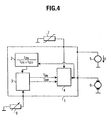
- Fig. 4 shows a third embodiment of a controller according to the present invention. This embodiment differs from the embodiment of Fig. 3 only in section 2. All remaining elements are not different from the corresponding elements in Figs. 2 and 3 such that their description need not be repeated.
- section 2 evaluates a thermal dispersion ratio of the refrigerator based on the duty cycle of the compressor 6. To this end, section 2 receives an indication on the current operating state of compressor 6 from comparator 4. Section 2 measures the on time period t on of the compressor and the off time period t off of the compressor. Each time the operating state of the compressor has changed, section 2 calculates a new duty cycle from the most recently completed on period and the most recently completed off period of the compressor. The duty cycles calculated by section 2 are input into section 3 as an evaluation of the thermal dispersion ratio of the refrigerator.
- a controller according to the present invention is suitable for controlling the temperature in the freshfood compartment, also called fridge compartment of a refrigerator. It is similarly suitable for controlling the temperature in a freezer compartment for storing frozen food, of a refrigerator.
- a controller is particularly suitable for controlling the temperature in a refrigerator combining a freezer compartment and a fridge compartment. If such a refrigerator has a high compressor and a single refrigeration circuit with a series connection of the evaporator in the fridge compartment and the evaporator in the freezer compartment, and a temperature sensor only on the evaporator of the fridge compartment, the controller is able to maintain the temperature in the freezer compartment essentially stable in different ambient temperature conditions.
- freezer compartment refers to compartments having at least a one star rating.
- a controller according to the present invention can compensate the influence of ambient temperatures on the temperature inside the food compartment of a refrigerator essentially independently from the food load and does not require a separate ambient temperature sensor.
Landscapes
- Engineering & Computer Science (AREA)
- Physics & Mathematics (AREA)
- General Physics & Mathematics (AREA)
- Automation & Control Theory (AREA)
- Chemical & Material Sciences (AREA)
- Combustion & Propulsion (AREA)
- Mechanical Engineering (AREA)
- Thermal Sciences (AREA)
- General Engineering & Computer Science (AREA)
- Devices That Are Associated With Refrigeration Equipment (AREA)
Claims (8)
- Steuerung zum Steuern der Temperatur in einem Nahrungsmittelfach einer Kühlvorrichtung mit einem Verdampfer, der in dem Nahrungsmittelfach angeordnet ist, und einem Kompressor (6) zum Zirkulieren von Kühlungsfluid durch den Verdampfer, wobei die Steuerung (1) folgendes aufweist:dadurch gekennzeichnet, dasseine Einrichtung (8) zum Empfangen eines Solltemperaturwerts von einer Solltemperatur-Einstelleinrichtung für das Nahrungsmittelfach;eine Einrichtung (7) zum Empfangen eines tatsächlichen Temperaturwerts des Verdampfers in einem Kühlfach der Kühlvorrichtung;eine Einrichtung (4) zum Einschalten des Kompressors (6), wenn die tatsächliche Temperatur eine hohe Temperaturschwelle (Ton) übersteigt, und zum Ausschalten des Kompressors (6), wenn die tatsächliche Temperatur unter eine niedrige Temperaturschwelle (Toff) abfällt, wobei wenigstens eine der Temperaturschwellen in Abhängigkeit von der Solltemperatur des Nahrungsmittelfachs bestimmt wird;eine Einrichtung (3) zum Kompensieren einer Abhängigkeit einer Durchschnittstemperatur im Nahrungsmittelfach von einer Umgebungstemperatur der Kühlvorrichtung durch Einstellen der niedrigen Temperaturschwelle (Toff) und/oder der hohen Temperaturschwelle (Ton), wobei die Kompensationseinrichtung (3) geeignet ist, eine Anstiegsrate einer Verdampfertemperatur zu messen, wenn der Kompressor im Aus-Zustand ist;die Kompensationseinrichtung (3) dazu geeignet ist, ein thermisches Dispersionsverhältnis basierend auf einem Verhältnis der Anstiegsrate einer Verdampfertemperatur, wenn der Kompressor (6) im Aus-Zustand ist, zu einer Abfallrate einer Temperatur, wenn der Kompressor (6) im Ein-Zustand ist, zu bewerten und die niedrige Temperaturschwelle (Toff) und/oder die hohe Temperaturschwelle. (Ton) gemäß dem thermischen Dispersionsverhältnis einzustellen.
- Steuerung nach Anspruch 1,
dadurch gekennzeichnet, dassdie Kompensationseinrichtung (3) dazu geeignet ist, die Abfallrate und/oder die Anstiegsrate einer Verdampfertemperatur durch Messen einer Änderung einer Verdampfertemperatur über eine spezifizierte Zeitperiode (Δt) oder durch Messen einer Zeitperiode, während welcher sich die Verdampfertemperatur um einen spezifizierten Betrag (ΔT) ändert, zu bestimmen. - Steuerung nach Anspruch 1,
dadurch gekennzeichnet, dassdie Kompensationseinrichtung (3) dazu geeignet ist, eine Periode (ton), wenn der Kompressor (6) im Ein-Zustand ist, und eine Periode (toff), wenn der Kompressor im Aus-Zustand ist, zu messen und das thermische Dispersionsverhältnis aus einem Verhältnis (ton/toff) der EIN-Zeitperiode zu der AUS-Zeitperiode zu erhalten. - Steuerung nach Anspruch 1,
dadurch gekennzeichnet, dassdie Kompensationseinrichtung (3) dazu geeignet ist, eine Periode (ton), wenn der Kompressor (6) im Ein-Zustand ist, und eine Periode (toff), wenn der Kompressor (6) im Aus-Zustand ist, zu messen und das thermische Dispersionsverhältnis aus einem Verhältnis der AUS-Zeitperiode (toff) zu einer Summe (ton + toff) der EIN-Zeitperiode und der AUS-Zeitperiode zu erhalten. - Steuerung nach einem der vorangehenden Ansprüche, gekennzeichnet durcheine Nachschautabelleneinrichtung (3) zum Speichern von Werten für die niedrige Temperaturschwelle und/oder von Werten für die hohe Temperaturschwelle in Zusammenhang mit verschiedenen Werten des thermischen Dispersionsverhältnisses und mit Solltemperaturwerten des Nahrungsmittelfachs;wobei die Kompensationseinrichtung (3) dazu geeignet ist, die niedrige Temperaturschwelle und/oder die hohe Temperaturschwelle aus einer Stelle in der Nachschautabelle zu lesen, die durch das bewertete thermische Dispersionsverhältnis und die Solltemperatur des Nahrungsmittelfachs angezeigt wird.
- Steuerung nach einem der vorangehenden Ansprüche,
dadurch gekennzeichnet, dassdie Kompensationseinrichtung (3) dazu geeignet ist, eine vorbestimmte Anzahl von aufeinander folgend bewerteten thermischen Dispersionsverhältnissen zu speichern; undeine Einstellung der niedrigen Temperaturschwelle (toff) und/oder der hohen Temperaturschwelle (ton) zu verhindern, wenn sich die vorbestimmte Zahl von thermischen Dispersionsverhältnissen von einander um mehr als eine vorbestimmte Varianzschwelle unterscheidet. - Steuerung nach einem der vorangehenden Ansprüche,
dadurch gekennzeichnet, dasswenigstens die Kompensationseinrichtung (3) in einer Mikrosteuerung implementiert ist. - Verfahren zum Steuern der Temperatur in einem Nahrungsmittelfach einer Kühlvorrichtung mit einem Verdampfer, der im Nahrungsmittelfach angeordnet ist, und einem Kompressor (6) zum Zirkulieren eines Kühlfluids durch den Verdampfer, welches Verfahren die folgenden Schritte aufweist:gekennzeichnet durchEmpfangen eines Solltemperaturwerts für das Nahrungsmittelfach;Empfangen eines aktuellen Temperaturwerts des Verdampfers im Nahrungsmittelfach der Kühlvorrichtung;Einschalten des Kompressors (6), wenn die aktuelle Temperatur eine hohe Temperaturschwelle (Ton) übersteigt, und Ausschalten des Kompressors (6), wenn die aktuelle Temperatur unter eine niedrige Temperaturschwelle (Toff) abfällt; wobei wenigstens eine der Temperaturschwellen in Abhängigkeit von der Solltemperatur des Nahrungsmittelfachs bestimmt wird;Messen einer Anstiegsrate einer Verdampfertemperatur, wenn der Kompressor (6) im Aus-Zustand ist, und Kompensieren einer Abhängigkeit des Durchschnittswerts im Nahrungsmittelfach von einer Umgebungstemperatur durch Einstellen der niedrigen Temperaturschwelle und/oder der hohen Temperaturschwelle;Bewerten eines thermischen Dispersionsverhältnisses basierend auf einem Verhältnis der Anstiegsrate einer Verdampfertemperatur, wenn der Kompressor (6) im Aus-Zustand ist, zu einer Abfallrate einer Temperatur, wenn der Kompressor (6) im Ein-Zustand ist, und Einstellen der niedrigen Temperaturschwelle (Toff) und/oder der hohen Temperaturschwelle (Ton) gemäß dem thermischen Dispersionsverhältnis.
Priority Applications (1)
| Application Number | Priority Date | Filing Date | Title |
|---|---|---|---|
| EP00909214A EP1157247B1 (de) | 1999-02-19 | 2000-02-18 | Regler und verfahren zur regelung der temperatur in einem kühlschrank |
Applications Claiming Priority (4)
| Application Number | Priority Date | Filing Date | Title |
|---|---|---|---|
| EP19990102743 EP1030147B1 (de) | 1999-02-19 | 1999-02-19 | Regler und Verfahren zur Regelung der Temperatur in einem Kühlschrank |
| EP99102743 | 1999-02-19 | ||
| EP00909214A EP1157247B1 (de) | 1999-02-19 | 2000-02-18 | Regler und verfahren zur regelung der temperatur in einem kühlschrank |
| PCT/EP2000/001363 WO2000049354A1 (en) | 1999-02-19 | 2000-02-18 | Controller and method for controlling the temperature in a refrigerator |
Publications (2)
| Publication Number | Publication Date |
|---|---|
| EP1157247A1 EP1157247A1 (de) | 2001-11-28 |
| EP1157247B1 true EP1157247B1 (de) | 2004-04-07 |
Family
ID=8237553
Family Applications (2)
| Application Number | Title | Priority Date | Filing Date |
|---|---|---|---|
| EP19990102743 Expired - Lifetime EP1030147B1 (de) | 1999-02-19 | 1999-02-19 | Regler und Verfahren zur Regelung der Temperatur in einem Kühlschrank |
| EP00909214A Expired - Lifetime EP1157247B1 (de) | 1999-02-19 | 2000-02-18 | Regler und verfahren zur regelung der temperatur in einem kühlschrank |
Family Applications Before (1)
| Application Number | Title | Priority Date | Filing Date |
|---|---|---|---|
| EP19990102743 Expired - Lifetime EP1030147B1 (de) | 1999-02-19 | 1999-02-19 | Regler und Verfahren zur Regelung der Temperatur in einem Kühlschrank |
Country Status (6)
| Country | Link |
|---|---|
| EP (2) | EP1030147B1 (de) |
| AU (1) | AU3157200A (de) |
| DE (2) | DE69916231D1 (de) |
| DK (1) | DK1157247T3 (de) |
| ES (1) | ES2219316T3 (de) |
| WO (1) | WO2000049354A1 (de) |
Families Citing this family (13)
| Publication number | Priority date | Publication date | Assignee | Title |
|---|---|---|---|---|
| IT1301875B1 (it) * | 1998-07-29 | 2000-07-07 | Whirlpool Co | Controllo autoadattivo per la regolazione di frigoriferi e congelatori |
| EP1524484A1 (de) * | 2003-10-16 | 2005-04-20 | Whirlpool Corporation | Kühlschrank |
| ITVA20030039A1 (it) * | 2003-10-21 | 2005-04-22 | Whirlpool Co | Congelatore orizzontale. |
| BRPI0402012A (pt) * | 2004-05-04 | 2005-12-20 | Multibras Eletrodomesticos Sa | Sistema de controle de temperatura em um aparelho de refrigeração |
| BRPI0500666A (pt) * | 2005-02-21 | 2006-10-17 | Multibras Eletrodomesticos Sa | sistema compensador de carga térmica em um aparelho de refrigeração |
| JP4954484B2 (ja) * | 2005-03-08 | 2012-06-13 | ホシザキ電機株式会社 | 冷却貯蔵庫 |
| US7607312B2 (en) * | 2005-05-27 | 2009-10-27 | Maytag Corporation | Insulated ice compartment for bottom mount refrigerator with temperature control system |
| DE202005012456U1 (de) | 2005-07-08 | 2006-11-16 | Liebherr-Hausgeräte Ochsenhausen GmbH | Kühl- und/oder Gefriergerät |
| JP5097361B2 (ja) | 2006-05-15 | 2012-12-12 | ホシザキ電機株式会社 | 冷却貯蔵庫及びその運転方法 |
| PL2449323T3 (pl) * | 2009-06-30 | 2013-08-30 | Arcelik As | Lodówka działająca niezależnie od temperatury otoczenia |
| CN114608258A (zh) * | 2022-03-11 | 2022-06-10 | 长虹美菱股份有限公司 | 一种基于电子膨胀阀的冰箱制冷系统化霜控制方法 |
| US20240068700A1 (en) * | 2022-08-25 | 2024-02-29 | Johnson Controls Tyco IP Holdings LLP | Multi-circuit hvac systems and methods |
| CN116294271A (zh) * | 2023-02-28 | 2023-06-23 | 浙江中广电器集团股份有限公司 | 关于热泵定频喷焓压缩机低温启动排气温度过高的处理方法 |
Family Cites Families (8)
| Publication number | Priority date | Publication date | Assignee | Title |
|---|---|---|---|---|
| US4410132A (en) * | 1980-11-14 | 1983-10-18 | Levine Michael R | Thermostat with dead zone seeking servo action |
| ATE40227T1 (de) * | 1982-07-21 | 1989-02-15 | Rene Rossier | Verfahren zur steuerung der energie-zu- resp.abf¨hrung. |
| US5115968A (en) * | 1990-10-02 | 1992-05-26 | Honeywell Inc. | Method and apparatus for controlling a heating/cooling system based on a temperature error |
| GB2254452B (en) * | 1991-04-04 | 1994-11-02 | Total Temperature Control Limi | Control of refrigerators and freezers |
| JPH0682141A (ja) * | 1992-09-02 | 1994-03-22 | Matsushita Refrig Co Ltd | 冷凍冷蔵庫の制御装置 |
| KR0129507B1 (ko) * | 1993-08-09 | 1998-04-08 | 김광호 | 냉장고의 댐퍼제어방법 |
| IT1266851B1 (it) * | 1994-06-08 | 1997-01-21 | Merloni Elettrodomestici Spa | Metodo per il controllo di un apparato frigorifero, ed apparato implementante tale metodo. |
| US5524444A (en) * | 1994-12-16 | 1996-06-11 | Robertshaw Controls Company | Temperature control of an appliance using ambient air temperature determination |
-
1999
- 1999-02-19 DE DE69916231T patent/DE69916231D1/de not_active Expired - Lifetime
- 1999-02-19 EP EP19990102743 patent/EP1030147B1/de not_active Expired - Lifetime
-
2000
- 2000-02-18 DK DK00909214T patent/DK1157247T3/da active
- 2000-02-18 ES ES00909214T patent/ES2219316T3/es not_active Expired - Lifetime
- 2000-02-18 AU AU31572/00A patent/AU3157200A/en not_active Abandoned
- 2000-02-18 DE DE60009676T patent/DE60009676T2/de not_active Expired - Fee Related
- 2000-02-18 WO PCT/EP2000/001363 patent/WO2000049354A1/en not_active Ceased
- 2000-02-18 EP EP00909214A patent/EP1157247B1/de not_active Expired - Lifetime
Also Published As
| Publication number | Publication date |
|---|---|
| DK1157247T3 (da) | 2004-08-02 |
| ES2219316T3 (es) | 2004-12-01 |
| DE60009676T2 (de) | 2005-04-14 |
| AU3157200A (en) | 2000-09-04 |
| WO2000049354A1 (en) | 2000-08-24 |
| EP1157247A1 (de) | 2001-11-28 |
| EP1030147B1 (de) | 2004-04-07 |
| DE69916231D1 (de) | 2004-05-13 |
| DE60009676D1 (de) | 2004-05-13 |
| EP1030147A1 (de) | 2000-08-23 |
Similar Documents
| Publication | Publication Date | Title |
|---|---|---|
| EP1030147B1 (de) | Regler und Verfahren zur Regelung der Temperatur in einem Kühlschrank | |
| CA2365747C (en) | Deterministic refrigerator defrost method and apparatus | |
| US5515692A (en) | Power consumption determining device and method | |
| CA1242778A (en) | Apparatus and method for controlling a refrigerator in low ambient temperature conditions | |
| CA1114038A (en) | Refrigeration apparatus demand defrost control system and method | |
| US7055338B2 (en) | Refrigerator | |
| AU2005212639B2 (en) | A refrigerator and a method for controlling variable cooling capacity thereof | |
| EP1423649B1 (de) | Kühlungsregelsystem für ein zu kühlendes lokal, steuerverfahren eines kühlungssystem, und kühler | |
| JPS6125075B2 (de) | ||
| EP0803689B1 (de) | Temperaturregelung eines Gerätes mit Bestimmung der Umgebungstemperatur | |
| KR20170094551A (ko) | 냉장고 및 그 제어 방법 | |
| CN112393508B (zh) | 结霜时间的计算方法、制冷设备 | |
| US20050120727A1 (en) | Freezer with defrosting indicator | |
| EP1225406B1 (de) | Verfahren und Gerät zur Abtauregelung | |
| EP0803690B1 (de) | Abtausteuerung für ein Kühlsystem, wobei die Bestimmung der Umgebungstemperatur verwendet wird | |
| CN1471622B (zh) | 具有自动除霜功能的制冷装置 | |
| EP0644386B1 (de) | Verfahren zur dynamischen Kontrolle der Eisbildung an einem Kühlschrankverdampfer und Kühlschrank in dem das Verfahren angewandt ist | |
| EP1180652B1 (de) | Steuervorrichtung und Verfahren zum Steuern des Abtauvorgangs in einem Kühlschrank | |
| US5156011A (en) | Load operation control method of refrigerator | |
| EP1030137B1 (de) | Steuervorrichtung und Verfahren zum Steuern des Abtauvorganges in einem Kühlschrank | |
| EP0388726A2 (de) | Kühlgerät mit nur einer thermostatischen Temperaturregelvorrichtung | |
| KR100596499B1 (ko) | 외기온도 고려 히터 동작 방법 | |
| KR100279075B1 (ko) | 김치저장고의고내온도감지장치 | |
| WO2006086866A1 (en) | Thermal load compensating system for a refrigeration appliance | |
| KR100577417B1 (ko) | 냉장고 및 제어방법 |
Legal Events
| Date | Code | Title | Description |
|---|---|---|---|
| PUAI | Public reference made under article 153(3) epc to a published international application that has entered the european phase |
Free format text: ORIGINAL CODE: 0009012 |
|
| 17P | Request for examination filed |
Effective date: 20010919 |
|
| AK | Designated contracting states |
Kind code of ref document: A1 Designated state(s): AT BE CH CY DE DK ES FI FR GB GR IE IT LI LU MC NL PT SE |
|
| AX | Request for extension of the european patent |
Free format text: AL;LT;LV;MK;RO;SI |
|
| GRAH | Despatch of communication of intention to grant a patent |
Free format text: ORIGINAL CODE: EPIDOS IGRA |
|
| GRAS | Grant fee paid |
Free format text: ORIGINAL CODE: EPIDOSNIGR3 |
|
| GRAA | (expected) grant |
Free format text: ORIGINAL CODE: 0009210 |
|
| AK | Designated contracting states |
Kind code of ref document: B1 Designated state(s): DE DK ES IT |
|
| REF | Corresponds to: |
Ref document number: 60009676 Country of ref document: DE Date of ref document: 20040513 Kind code of ref document: P |
|
| REG | Reference to a national code |
Ref country code: IE Ref legal event code: FG4D |
|
| REG | Reference to a national code |
Ref country code: DK Ref legal event code: T3 |
|
| LTIE | Lt: invalidation of european patent or patent extension |
Effective date: 20040407 |
|
| REG | Reference to a national code |
Ref country code: ES Ref legal event code: FG2A Ref document number: 2219316 Country of ref document: ES Kind code of ref document: T3 |
|
| PLBE | No opposition filed within time limit |
Free format text: ORIGINAL CODE: 0009261 |
|
| STAA | Information on the status of an ep patent application or granted ep patent |
Free format text: STATUS: NO OPPOSITION FILED WITHIN TIME LIMIT |
|
| 26N | No opposition filed |
Effective date: 20050110 |
|
| PGFP | Annual fee paid to national office [announced via postgrant information from national office to epo] |
Ref country code: ES Payment date: 20090218 Year of fee payment: 10 Ref country code: DK Payment date: 20090108 Year of fee payment: 10 |
|
| PGFP | Annual fee paid to national office [announced via postgrant information from national office to epo] |
Ref country code: DE Payment date: 20090227 Year of fee payment: 10 |
|
| PGFP | Annual fee paid to national office [announced via postgrant information from national office to epo] |
Ref country code: IT Payment date: 20090214 Year of fee payment: 10 |
|
| REG | Reference to a national code |
Ref country code: DK Ref legal event code: EBP |
|
| PG25 | Lapsed in a contracting state [announced via postgrant information from national office to epo] |
Ref country code: DK Free format text: LAPSE BECAUSE OF NON-PAYMENT OF DUE FEES Effective date: 20100228 |
|
| PG25 | Lapsed in a contracting state [announced via postgrant information from national office to epo] |
Ref country code: DE Free format text: LAPSE BECAUSE OF NON-PAYMENT OF DUE FEES Effective date: 20100901 |
|
| REG | Reference to a national code |
Ref country code: ES Ref legal event code: FD2A Effective date: 20110328 |
|
| PG25 | Lapsed in a contracting state [announced via postgrant information from national office to epo] |
Ref country code: IT Free format text: LAPSE BECAUSE OF NON-PAYMENT OF DUE FEES Effective date: 20100218 |
|
| PG25 | Lapsed in a contracting state [announced via postgrant information from national office to epo] |
Ref country code: ES Free format text: LAPSE BECAUSE OF NON-PAYMENT OF DUE FEES Effective date: 20110315 |
|
| PG25 | Lapsed in a contracting state [announced via postgrant information from national office to epo] |
Ref country code: ES Free format text: LAPSE BECAUSE OF NON-PAYMENT OF DUE FEES Effective date: 20100219 |