EP1159999A1 - Procédé et dispositif de récupération de l'azote pendant la production de polyéthylène - Google Patents
Procédé et dispositif de récupération de l'azote pendant la production de polyéthylène Download PDFInfo
- Publication number
- EP1159999A1 EP1159999A1 EP00810678A EP00810678A EP1159999A1 EP 1159999 A1 EP1159999 A1 EP 1159999A1 EP 00810678 A EP00810678 A EP 00810678A EP 00810678 A EP00810678 A EP 00810678A EP 1159999 A1 EP1159999 A1 EP 1159999A1
- Authority
- EP
- European Patent Office
- Prior art keywords
- nitrogen
- ethylene
- polyethylene
- membrane
- vacuum pump
- Prior art date
- Legal status (The legal status is an assumption and is not a legal conclusion. Google has not performed a legal analysis and makes no representation as to the accuracy of the status listed.)
- Withdrawn
Links
- IJGRMHOSHXDMSA-UHFFFAOYSA-N Atomic nitrogen Chemical compound N#N IJGRMHOSHXDMSA-UHFFFAOYSA-N 0.000 title claims abstract description 132
- 229910052757 nitrogen Inorganic materials 0.000 title claims abstract description 66
- 238000004519 manufacturing process Methods 0.000 title claims abstract description 18
- 238000000034 method Methods 0.000 title claims description 19
- VGGSQFUCUMXWEO-UHFFFAOYSA-N Ethene Chemical compound C=C VGGSQFUCUMXWEO-UHFFFAOYSA-N 0.000 claims abstract description 44
- 239000005977 Ethylene Substances 0.000 claims abstract description 37
- -1 polyethylene Polymers 0.000 claims abstract description 36
- 229920000573 polyethylene Polymers 0.000 claims abstract description 35
- 239000004698 Polyethylene Substances 0.000 claims abstract description 33
- 239000012528 membrane Substances 0.000 claims abstract description 32
- 239000000203 mixture Substances 0.000 claims abstract description 13
- 238000011084 recovery Methods 0.000 claims abstract description 12
- 239000007789 gas Substances 0.000 claims abstract description 10
- OKTJSMMVPCPJKN-UHFFFAOYSA-N Carbon Chemical compound [C] OKTJSMMVPCPJKN-UHFFFAOYSA-N 0.000 claims abstract description 8
- 238000001914 filtration Methods 0.000 claims abstract description 3
- 239000007788 liquid Substances 0.000 claims description 27
- 210000004379 membrane Anatomy 0.000 description 16
- 239000012530 fluid Substances 0.000 description 14
- XLYOFNOQVPJJNP-UHFFFAOYSA-N water Substances O XLYOFNOQVPJJNP-UHFFFAOYSA-N 0.000 description 11
- 229930195733 hydrocarbon Natural products 0.000 description 10
- 150000002430 hydrocarbons Chemical class 0.000 description 9
- VLKZOEOYAKHREP-UHFFFAOYSA-N n-Hexane Chemical compound CCCCCC VLKZOEOYAKHREP-UHFFFAOYSA-N 0.000 description 7
- 239000003054 catalyst Substances 0.000 description 3
- 230000006835 compression Effects 0.000 description 3
- 238000007906 compression Methods 0.000 description 3
- 239000000428 dust Substances 0.000 description 3
- 230000000711 cancerogenic effect Effects 0.000 description 2
- 231100000357 carcinogen Toxicity 0.000 description 2
- 239000003183 carcinogenic agent Substances 0.000 description 2
- 239000002131 composite material Substances 0.000 description 2
- 238000001816 cooling Methods 0.000 description 2
- 230000035699 permeability Effects 0.000 description 2
- 238000006116 polymerization reaction Methods 0.000 description 2
- 239000004215 Carbon black (E152) Substances 0.000 description 1
- VZRYGYNKSRKYLD-UHFFFAOYSA-N [N].C=C Chemical compound [N].C=C VZRYGYNKSRKYLD-UHFFFAOYSA-N 0.000 description 1
- 230000015572 biosynthetic process Effects 0.000 description 1
- 238000004140 cleaning Methods 0.000 description 1
- 238000005056 compaction Methods 0.000 description 1
- 239000004020 conductor Substances 0.000 description 1
- 239000000470 constituent Substances 0.000 description 1
- 238000009795 derivation Methods 0.000 description 1
- 238000005265 energy consumption Methods 0.000 description 1
- 230000007613 environmental effect Effects 0.000 description 1
- 230000000379 polymerizing effect Effects 0.000 description 1
- 239000000047 product Substances 0.000 description 1
- 230000000717 retained effect Effects 0.000 description 1
- 239000012465 retentate Substances 0.000 description 1
- 239000007787 solid Substances 0.000 description 1
- 239000010409 thin film Substances 0.000 description 1
Images
Classifications
-
- B—PERFORMING OPERATIONS; TRANSPORTING
- B01—PHYSICAL OR CHEMICAL PROCESSES OR APPARATUS IN GENERAL
- B01D—SEPARATION
- B01D53/00—Separation of gases or vapours; Recovering vapours of volatile solvents from gases; Chemical or biological purification of waste gases, e.g. engine exhaust gases, smoke, fumes, flue gases, aerosols
- B01D53/22—Separation of gases or vapours; Recovering vapours of volatile solvents from gases; Chemical or biological purification of waste gases, e.g. engine exhaust gases, smoke, fumes, flue gases, aerosols by diffusion
- B01D53/229—Integrated processes (Diffusion and at least one other process, e.g. adsorption, absorption)
-
- B—PERFORMING OPERATIONS; TRANSPORTING
- B01—PHYSICAL OR CHEMICAL PROCESSES OR APPARATUS IN GENERAL
- B01D—SEPARATION
- B01D19/00—Degasification of liquids
- B01D19/0005—Degasification of liquids with one or more auxiliary substances
- B01D19/001—Degasification of liquids with one or more auxiliary substances by bubbling steam through the liquid
- B01D19/0015—Degasification of liquids with one or more auxiliary substances by bubbling steam through the liquid in contact columns containing plates, grids or other filling elements
Definitions
- the invention relates to a process for the recovery of nitrogen in the Production of polyethylene according to the preamble of claim 1. Die The invention further relates to a device for recovering nitrogen in the production of polyethylene according to the preamble of claim 7.
- Polyethylene is made by polymerizing ethylene. After this Manufacture of polyethylene requires a cleaning process be subjected.
- Raw polyethylene contains a significant amount of unreacted hydrocarbons. Before the raw polyethylene extrudes , the unreacted hydrocarbons must be removed. These hydrocarbons are placed in a stripping column Subtracted using nitrogen. Usually the withdrawn hydrocarbons together with the nitrogen over a Flare released to the environment.
- the object of the present invention is an economically more advantageous one Method or a corresponding device for generating Propose polyethylene.
- the recovered nitrogen is returned to the stripping column.
- the process according to the invention thus has the advantage that the nitrogen (N 2 ) can be recycled, as a result of which the production of polyethylene is less expensive.
- the recovered Ethylene back to the reactor in which the polymerization takes place fed.
- the method according to the invention thus has the advantage that ethlen is recyclable.
- the method and the device according to the invention thus have the Advantage that the ethylene and / or nitrogen with such a high Purity levels can be obtained that reuse the Nitrogen as a stripping medium in the stripping column and a Reuse of ethylene as a starting product in the reactor is possible.
- the separated ethylene together with the Nitrogen, and optionally with further hydrocarbons, Polyethylene dust and catalyst components, as a fluid or gas mixture deducted, then compressed by the compressor, and then one Membrane supplied.
- A is preferably used for compaction Liquid ring compressor used, which preferably with water is operated, and which the fluid to a pressure of, for example, 10th compressed to 15 bar.
- Such a liquid ring compressor compresses the gas mixture almost isothermally, which has the advantage that the temperature of the gas mixture does not increase due to the compression becomes.
- a liquid ring compressor also has the advantage that both solid parts like polyethylene dust and liquid parts like the cathalyser, which is carried away from the stripping column, with the water system of the liquid ring compressor can.
- the liquid ring compressor is thus washed promoted fluid, in particular the fluid contained Polyethylene dust is washed out, remains in the water, and can be deducted in a decanter, for example.
- On Liquid ring compressor also has the advantage that the Parts of the catalyst are washed out by the water.
- hexane is often used as a catalyst, a carcinogen. This hexane can thus be the stripping column at least partially withdrawn.
- the compressed ethylene-hydrocarbon gas-nitrogen mixture which is saturates with water vapor in the liquid ring compressor, one becomes organophilic membrane surface supplied, which the ethylene and the Permits hydrocarbons to pass through, while water vapor and Nitrogen is retained as a retentate.
- Embodiment is the nitrogen along with the water vapor Stripping column fed again.
- the stripping process takes place with the Nitrogen / water vapor mixture, the recycled Nitrogen / water vapor mixture after the membrane preferably through An activated carbon filter is passed to the rest of the carcinogen Reduce Hexans to an acceptable concentration. So that's an advantage the fact that the general nitrogen consumption to a minimum is reduced.
- the relatively high pressure caused by the compressor for example 10 to 15 bar has the advantage that the one arranged below Membrane can have a small area, and that the membrane has higher permeability, so that the membrane device is relatively small can be designed.
- the high pressure occurs on Liquid ring compressor no polymerization due to the compression in the essentially isothermal. That in the device according to the invention conveyed fluid does not have to be heated up or cooled down, so that the fluid delivered is neither particularly high nor high have a particularly low temperature. In particular, none occurs Liquefaction of components of the fluid. That aspect is of particular importance for the life of the membrane, since the Membrane itself is temperature sensitive.
- Another advantage of The inventive device is the fact that due to the in Plant prevailing, relatively high pressure, the plant is very small and can be compactly designed and dimensioned.
- the vacuum pump system and the compressor preferably comprise one Liquid ring compressor, such as this in the publication EP 0 967 393 A2.
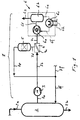
- Fig. 1 shows a first device for the recovery of nitrogen.
- the ethylene becomes raw polyethylene polymerized.
- a stripping column 2 follows the reactor arranged, which via the feed line 2 a fluid conducting with the reactor connected is. Inside the stripping column 2 is the raw polyethylene cleaned with a method known per se, by the raw Polyethylene using unreacted nitrogen Hydrocarbons are removed. The polyethylene cleaned in this way becomes fed to further processing via the derivation 2b.
- the stripping column 2 is connected to a nitrogen recovery device 1 in a fluid-conducting manner.
- a membrane device 4 with membrane 4a is connected to the stripping column 2 in a fluid-conducting manner via a feed line 7b, an oil-free compressor 3 and a feed line 7a.
- the compressor 3 is designed, for example, as a labyrinth piston compressor.
- a filter 5 is arranged downstream of the membrane device 4 via a connecting line 7d, the filter 5 being fluidly connected to the stripping column 2 via the connecting lines 7e, 7f.
- the membrane device 4 is also connected to a vacuum pump system 6 via the connecting line 7c.
- the vacuum pump system 6 comprises a liquid ring pump 6a, which, forming a liquid circuit, is connected in a fluid-conducting manner via the connecting lines 6d, 6e, 6f to a separator 6b, also referred to as a gas-liquid separator, and a cooler 6c to the cooling conductor 6h.
- the liquid ring pump 6a is arranged such that it generates a vacuum with respect to the membrane device 4.
- water is particularly suitable for use in the liquid circuit.
- the liquid and gaseous constituents are separated in the separator 6b, the gaseous components being discharged via the discharge line 6g, for example to a flare. In the illustrated embodiment, between 700 and 1500 kg of nitrogen (N 2 ) per hour are converted in stripping column 2.
- the gas mixture comprising ethylene and nitrogen is extracted using the Compressor 3 withdrawn from the stripping column 2 and the Membrane device 4 supplied.
- the membrane 4a has the property that it is much more permeable to hydrocarbons than to nitrogen.
- the Hydrocarbons, especially ethylene is produced through the Aspirated connecting line 7c, while the one depleted of ethylene Nitrogen in the filter 5 is filtered with activated carbon, and then cleaned the Stripping column 2 is fed.
- the nitrogen purified in this way can for example, have a purity of 99.5%.
- the membrane 4a can consist of a multi-layer composite, for example English also referred to as "multilayer composite membrane".
- a Such thin film membrane has, for example, a 10 to 100 times higher Permeability to hydrocarbons compared to nitrogen.
- That of the membrane device 4 with the help of the liquid ring pump 6a withdrawn ethylene is separated from the liquid in the separator 6b and the lead 6g fed.
- the ethylene withdrawn in this way can be burned be used, or a subsequent processing.
- the Withdrawn ethylene can also be used to manufacture polyethylene can be used by the polyethylene for example the reactor is fed.
- Additional nitrogen can be supplied via the connecting line 7f to compensate for the loss that occurs in the recovery process compensate.
- the nitrogen recovery device enables To produce polyethylene inexpensively.
- the loss of ethylene will reduced.
- the environmental impact and energy consumption Production of ethylene reduced.
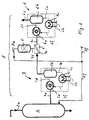
- the compressor 3 shown in FIG. 2 is designed as a liquid ring compressor system 3, with a liquid ring compressor 3a, a separator 3b and a cooler 3c, the three latter components being connected via connecting lines 3d, 3e, 3f , and with the formation of a circuit, fluid are connected conductively.
- the cooler 3c is also connected to a cooling line 3h.
- water is preferably used as the conveying liquid.
- the exemplary embodiment shown in FIG. 2 has the advantage that the fluid drawn off from the stripping column 2 via the connecting line 7a is compressed isothermally or almost isothermally. In addition, the withdrawn fluid is washed in the liquid ring compressor 3a.
Landscapes
- Chemical & Material Sciences (AREA)
- Chemical Kinetics & Catalysis (AREA)
- Engineering & Computer Science (AREA)
- Analytical Chemistry (AREA)
- General Chemical & Material Sciences (AREA)
- Oil, Petroleum & Natural Gas (AREA)
- Organic Low-Molecular-Weight Compounds And Preparation Thereof (AREA)
Priority Applications (1)
| Application Number | Priority Date | Filing Date | Title |
|---|---|---|---|
| EP00810678A EP1159999A1 (fr) | 2000-05-31 | 2000-07-28 | Procédé et dispositif de récupération de l'azote pendant la production de polyéthylène |
Applications Claiming Priority (3)
| Application Number | Priority Date | Filing Date | Title |
|---|---|---|---|
| EP00810483 | 2000-05-31 | ||
| EP00810483 | 2000-05-31 | ||
| EP00810678A EP1159999A1 (fr) | 2000-05-31 | 2000-07-28 | Procédé et dispositif de récupération de l'azote pendant la production de polyéthylène |
Publications (1)
| Publication Number | Publication Date |
|---|---|
| EP1159999A1 true EP1159999A1 (fr) | 2001-12-05 |
Family
ID=26073906
Family Applications (1)
| Application Number | Title | Priority Date | Filing Date |
|---|---|---|---|
| EP00810678A Withdrawn EP1159999A1 (fr) | 2000-05-31 | 2000-07-28 | Procédé et dispositif de récupération de l'azote pendant la production de polyéthylène |
Country Status (1)
| Country | Link |
|---|---|
| EP (1) | EP1159999A1 (fr) |
Cited By (3)
| Publication number | Priority date | Publication date | Assignee | Title |
|---|---|---|---|---|
| EP2197562A4 (fr) * | 2007-08-30 | 2010-12-15 | Environmental Prot Agency | Séparation de liquides par un procédé à la vapeur à l'aide de membranes |
| CN107513005A (zh) * | 2017-09-27 | 2017-12-26 | 中科瑞奥能源科技股份有限公司 | 从聚乙烯工程尾气中回收乙烯、异丁烷和氮气的工艺与系统 |
| CN112265970A (zh) * | 2020-10-22 | 2021-01-26 | 吉林工程技术师范学院 | 一种聚乙烯尾气完全回收再利用装置 |
Citations (4)
| Publication number | Priority date | Publication date | Assignee | Title |
|---|---|---|---|---|
| US4501885A (en) * | 1981-10-14 | 1985-02-26 | Phillips Petroleum Company | Diluent and inert gas recovery from a polymerization process |
| US5127926A (en) * | 1991-05-06 | 1992-07-07 | Membrane Technology & Research, Inc. | Membrane process for treating pump exhausts |
| EP0585161A1 (fr) * | 1992-08-26 | 1994-03-02 | L'air Liquide, Societe Anonyme Pour L'etude Et L'exploitation Des Procedes Georges Claude | Générateur à membrane à response rapide utilisant l'accumulation de chaleur |
| US5769927A (en) * | 1997-01-24 | 1998-06-23 | Membrane Technology And Research, Inc. | Monomer recovery process |
-
2000
- 2000-07-28 EP EP00810678A patent/EP1159999A1/fr not_active Withdrawn
Patent Citations (4)
| Publication number | Priority date | Publication date | Assignee | Title |
|---|---|---|---|---|
| US4501885A (en) * | 1981-10-14 | 1985-02-26 | Phillips Petroleum Company | Diluent and inert gas recovery from a polymerization process |
| US5127926A (en) * | 1991-05-06 | 1992-07-07 | Membrane Technology & Research, Inc. | Membrane process for treating pump exhausts |
| EP0585161A1 (fr) * | 1992-08-26 | 1994-03-02 | L'air Liquide, Societe Anonyme Pour L'etude Et L'exploitation Des Procedes Georges Claude | Générateur à membrane à response rapide utilisant l'accumulation de chaleur |
| US5769927A (en) * | 1997-01-24 | 1998-06-23 | Membrane Technology And Research, Inc. | Monomer recovery process |
Cited By (4)
| Publication number | Priority date | Publication date | Assignee | Title |
|---|---|---|---|---|
| EP2197562A4 (fr) * | 2007-08-30 | 2010-12-15 | Environmental Prot Agency | Séparation de liquides par un procédé à la vapeur à l'aide de membranes |
| CN107513005A (zh) * | 2017-09-27 | 2017-12-26 | 中科瑞奥能源科技股份有限公司 | 从聚乙烯工程尾气中回收乙烯、异丁烷和氮气的工艺与系统 |
| CN107513005B (zh) * | 2017-09-27 | 2022-11-15 | 中科瑞奥能源科技股份有限公司 | 从聚乙烯工程尾气中回收乙烯、异丁烷和氮气的工艺与系统 |
| CN112265970A (zh) * | 2020-10-22 | 2021-01-26 | 吉林工程技术师范学院 | 一种聚乙烯尾气完全回收再利用装置 |
Similar Documents
| Publication | Publication Date | Title |
|---|---|---|
| DE60112813T2 (de) | Verfahren zur behandlung einer verbrauchten glycolaufschlämmung | |
| DE69926526T2 (de) | Wiedergewinnung von c02 und h2 aus psa-abgasen in einer h2-produktionsanlage | |
| DE60009920T2 (de) | Verfahren zur entfernung von verunreinigungen aus einem gas unter verwendung von polyethylenglykohlen | |
| DE60033881T2 (de) | Verfahren zum Behandeln eines Abfallöls | |
| EP0144956B1 (fr) | Procédé et dispositif pour régénérer un solvant | |
| WO2017020919A1 (fr) | Procédé pour obtenir une fraction de produit riche en hélium | |
| DE2441304C3 (de) | Verfahren und Vorrichtung zur Senkung des Gehaltes an gasförmigen Monomeren in Polyvinylchlorid-Wasser-Dispersionen | |
| GB2092170A (en) | Process for the purification of crude glyceride oil compossitions | |
| DE2818127C2 (de) | Verfahren und Vorrichtung zur Ultrafiltration von Flüssigkeitsgemischen | |
| DE2713359A1 (de) | Verfahren zur fraktionierung von crackgasen mit hilfe der kaeltetechnik | |
| WO2019141508A1 (fr) | Procédé et installation pour l'obtention d'hélium pur | |
| EP1159999A1 (fr) | Procédé et dispositif de récupération de l'azote pendant la production de polyéthylène | |
| EP0230543B1 (fr) | Procédé de revalorisation d'huile usée | |
| DE102009034949A1 (de) | Verfahren zur Aufbereitung einer Suspension | |
| DD249639A5 (de) | Reinigung von oelen, die suspendierte feststoffe enthalten | |
| DE60320477T2 (de) | Verfahren zur Erniedrigung oder Entfernung von NH3/HF Nebenprodukten bei der Hestellung von Stickstofftriflourid | |
| EP1160000A1 (fr) | Procédé et dispositif de récupération d'azote et/ou de propylène pendant la production de polypropylène | |
| DE3237930C1 (de) | Reinigung von wasserstoff-freien,fluorierten Schmiermitteln | |
| DE2521507A1 (de) | Verfahren zum behandeln von beim konzentrieren einer waessrigen harnstoffloesung gebildetem wasserdampf | |
| EP1160001A1 (fr) | Procédé et dispositif pour comprimer un fluide contenant de l'éthylène et de l'azote | |
| EP0095850A1 (fr) | Procédé de purification de compositions d'huiles glycéridiques brutes | |
| DE602005004939T2 (de) | Epoxidierung von propylen, bei der eine membran zur abtrennung des phospin- und/oder phosphinoxidpromotors vom produkt verwendet wird | |
| DE2618244C2 (de) | Verfahren zur Gewinnung von nicht umgesetzten Monomeren aus Polymeren des Vinylchlorids | |
| EP1847587B1 (fr) | Procédé de traitement d'huiles usées pour obtenir des huiles de base à haut indice de viscosité | |
| EP3362489A1 (fr) | Procédé d'élimination de monomères et/ou d'oligomères dans une pièce obtenue par polymérisation |
Legal Events
| Date | Code | Title | Description |
|---|---|---|---|
| PUAI | Public reference made under article 153(3) epc to a published international application that has entered the european phase |
Free format text: ORIGINAL CODE: 0009012 |
|
| AK | Designated contracting states |
Kind code of ref document: A1 Designated state(s): AT BE CH CY DE DK ES FI FR GB GR IE IT LI LU MC NL PT SE |
|
| AX | Request for extension of the european patent |
Free format text: AL;LT;LV;MK;RO;SI |
|
| AKX | Designation fees paid | ||
| REG | Reference to a national code |
Ref country code: DE Ref legal event code: 8566 |
|
| STAA | Information on the status of an ep patent application or granted ep patent |
Free format text: STATUS: THE APPLICATION IS DEEMED TO BE WITHDRAWN |
|
| 18D | Application deemed to be withdrawn |
Effective date: 20020606 |